Bit Shift Operators:
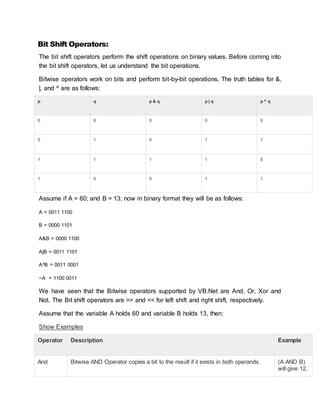
The bit shift operators perform the shift operations on binary values. Before coming into
the bit shift operators, let us understand the bit operations.
Bitwise operators work on bits and perform bit-by-bit operations. The truth tables for &,
|, and ^ are as follows:
p q p & q p | q p ^ q
0 0 0 0 0
0 1 0 1 1
1 1 1 1 0
1 0 0 1 1
Assume if A = 60; and B = 13; now in binary format they will be as follows:
A = 0011 1100
B = 0000 1101
A&B = 0000 1100
A|B = 0011 1101
A^B = 0011 0001
~A = 1100 0011
We have seen that the Bitwise operators supported by VB.Net are And, Or, Xor and
Not. The Bit shift operators are >> and << for left shift and right shift, respectively.
Assume that the variable A holds 60 and variable B holds 13, then:
Show Examples
Operator Description Example
And Bitwise AND Operator copies a bit to the result if it exists in both operands. (A AND B)
will give 12,
which is
0000 1100
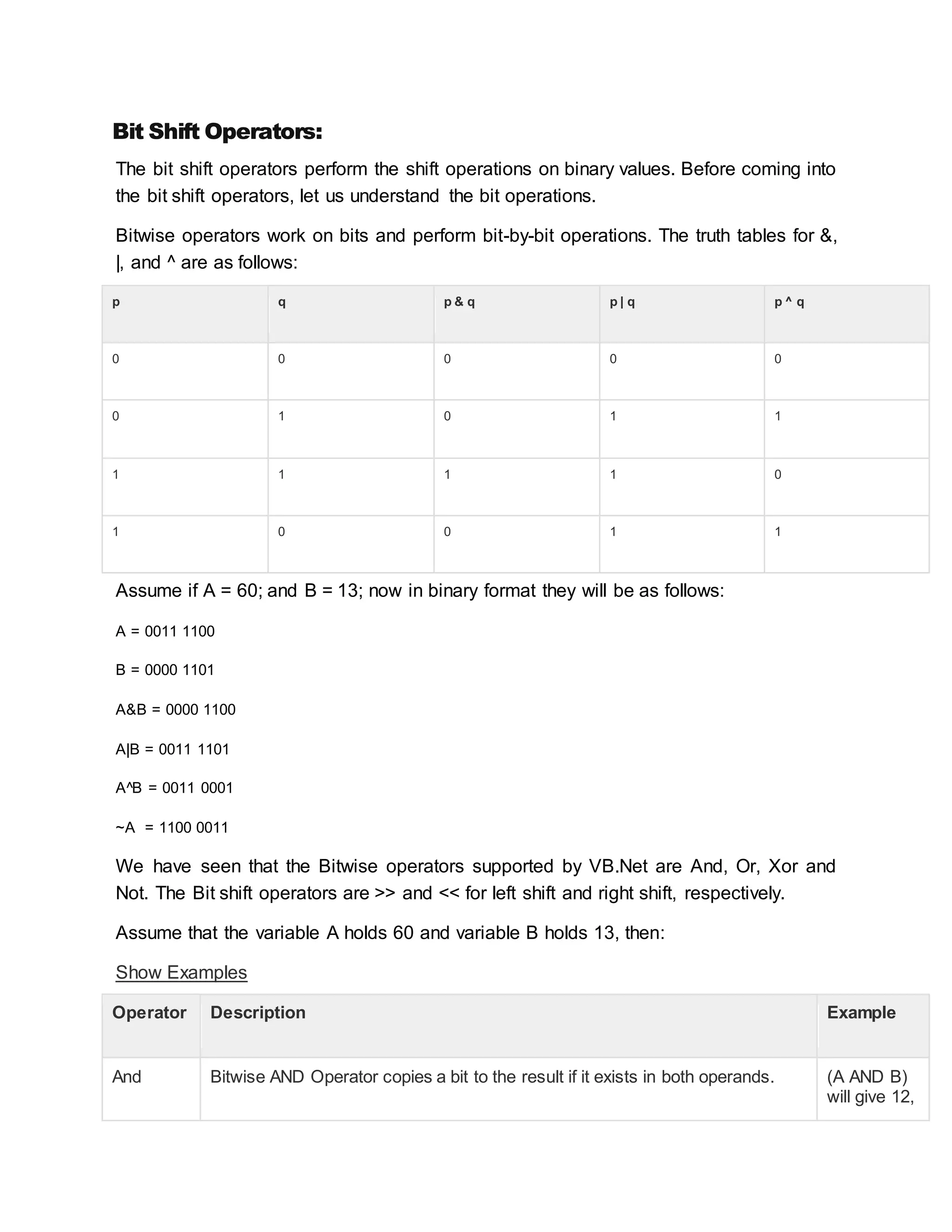
Or Binary OR Operator copies a bit if it exists in either operand. (A Or B) will
give 61,
which is
0011 1101
Xor Binary XOR Operator copies the bit if it is set in one operand but not both. (A Xor B)
will give 49,
which is
0011 0001
Not Binary Ones Complement Operator is unary and has the effect of 'flipping' bits. (Not A ) will
give -61,
which is
1100 0011
in 2's
complement
form due to
a signed
binary
number.
<< Binary Left Shift Operator. The left operands value is moved left by the number
of bits specified by the right operand.
A << 2 will
give 240,
which is
1111 0000
>> Binary Right Shift Operator. The left operands value is moved right by the
number of bits specified by the right operand.
A >> 2 will
give 15,
which is
0000 1111
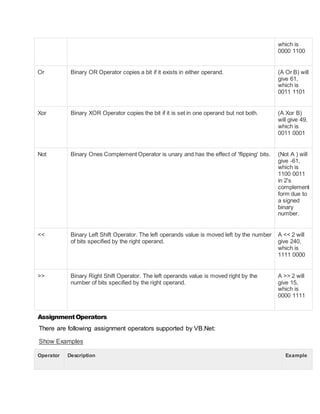
AssignmentOperators
There are following assignment operators supported by VB.Net:
Show Examples
Operator Description Example
= Simple assignment operator, Assigns values from right side operands to left side operand C = A + B
will assign
value of A
+ B into C
+= Add AND assignment operator, It adds right operand to the left operand and assigns the
result to left operand
C += A is
equivalent
to C = C +
A
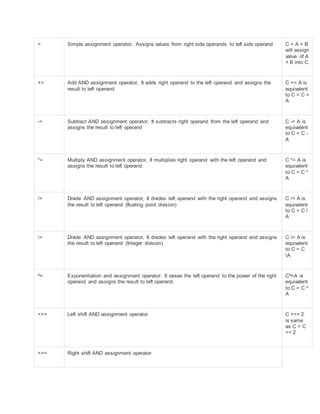
-= Subtract AND assignment operator, It subtracts right operand from the left operand and
assigns the result to left operand
C -= A is
equivalent
to C = C -
A
*= Multiply AND assignment operator, It multiplies right operand with the left operand and
assigns the result to left operand
C *= A is
equivalent
to C = C *
A
/= Divide AND assignment operator, It divides left operand with the right operand and assigns
the result to left operand (floating point division)
C /= A is
equivalent
to C = C /
A
= Divide AND assignment operator, It divides left operand with the right operand and assigns
the result to left operand (Integer division)
C = A is
equivalent
to C = C
A
^= Exponentiation and assignment operator. It raises the left operand to the power of the right
operand and assigns the result to left operand.
C^=A is
equivalent
to C = C ^
A
<<= Left shift AND assignment operator C <<= 2
is same
as C = C
<< 2
>>= Right shift AND assignment operator
MiscellaneousOperators:
There are few other important operators supported by VB.Net.
Show Examples
Operator Description Example
AddressOf Returns the address of a procedure.
AddHandler Button1.Click,
AddressOf Button1_Click
Await It is applied to an operand in an asynchronous method or
lambda expression to suspend execution of the method
until the awaited task completes.
Dim result As res
= Await
AsyncMethodThatReturnsResult()
Await AsyncMethod()
GetType It returns a Type object for the specified type. The Type
object provides information about the type such as its
properties, methods, and events.
MsgBox(GetType(Integer).ToString())
Function
Expression
It declares the parameters and code that define a function
lambda expression.
Dim add5 = Function(num As
Integer) num + 5
'prints 10
Console.WriteLine(add5(5))
If It uses short-circuit evaluation to conditionally return one of
two values. The If operator can be called with three
arguments or with two arguments.
Dim num = 5
Console.WriteLine(If(num >= 0,
"Positive", "Negative"))

Bit shift operators

  • 1.
    Bit Shift Operators: Thebit shift operators perform the shift operations on binary values. Before coming into the bit shift operators, let us understand the bit operations. Bitwise operators work on bits and perform bit-by-bit operations. The truth tables for &, |, and ^ are as follows: p q p & q p | q p ^ q 0 0 0 0 0 0 1 0 1 1 1 1 1 1 0 1 0 0 1 1 Assume if A = 60; and B = 13; now in binary format they will be as follows: A = 0011 1100 B = 0000 1101 A&B = 0000 1100 A|B = 0011 1101 A^B = 0011 0001 ~A = 1100 0011 We have seen that the Bitwise operators supported by VB.Net are And, Or, Xor and Not. The Bit shift operators are >> and << for left shift and right shift, respectively. Assume that the variable A holds 60 and variable B holds 13, then: Show Examples Operator Description Example And Bitwise AND Operator copies a bit to the result if it exists in both operands. (A AND B) will give 12,
  • 2.
    which is 0000 1100 OrBinary OR Operator copies a bit if it exists in either operand. (A Or B) will give 61, which is 0011 1101 Xor Binary XOR Operator copies the bit if it is set in one operand but not both. (A Xor B) will give 49, which is 0011 0001 Not Binary Ones Complement Operator is unary and has the effect of 'flipping' bits. (Not A ) will give -61, which is 1100 0011 in 2's complement form due to a signed binary number. << Binary Left Shift Operator. The left operands value is moved left by the number of bits specified by the right operand. A << 2 will give 240, which is 1111 0000 >> Binary Right Shift Operator. The left operands value is moved right by the number of bits specified by the right operand. A >> 2 will give 15, which is 0000 1111 AssignmentOperators There are following assignment operators supported by VB.Net: Show Examples Operator Description Example
  • 3.
    = Simple assignmentoperator, Assigns values from right side operands to left side operand C = A + B will assign value of A + B into C += Add AND assignment operator, It adds right operand to the left operand and assigns the result to left operand C += A is equivalent to C = C + A -= Subtract AND assignment operator, It subtracts right operand from the left operand and assigns the result to left operand C -= A is equivalent to C = C - A *= Multiply AND assignment operator, It multiplies right operand with the left operand and assigns the result to left operand C *= A is equivalent to C = C * A /= Divide AND assignment operator, It divides left operand with the right operand and assigns the result to left operand (floating point division) C /= A is equivalent to C = C / A = Divide AND assignment operator, It divides left operand with the right operand and assigns the result to left operand (Integer division) C = A is equivalent to C = C A ^= Exponentiation and assignment operator. It raises the left operand to the power of the right operand and assigns the result to left operand. C^=A is equivalent to C = C ^ A <<= Left shift AND assignment operator C <<= 2 is same as C = C << 2 >>= Right shift AND assignment operator
  • 4.
    MiscellaneousOperators: There are fewother important operators supported by VB.Net. Show Examples Operator Description Example AddressOf Returns the address of a procedure. AddHandler Button1.Click, AddressOf Button1_Click Await It is applied to an operand in an asynchronous method or lambda expression to suspend execution of the method until the awaited task completes. Dim result As res = Await AsyncMethodThatReturnsResult() Await AsyncMethod() GetType It returns a Type object for the specified type. The Type object provides information about the type such as its properties, methods, and events. MsgBox(GetType(Integer).ToString()) Function Expression It declares the parameters and code that define a function lambda expression. Dim add5 = Function(num As Integer) num + 5 'prints 10 Console.WriteLine(add5(5)) If It uses short-circuit evaluation to conditionally return one of two values. The If operator can be called with three arguments or with two arguments. Dim num = 5 Console.WriteLine(If(num >= 0, "Positive", "Negative"))