
Slides by Jonathan Eisen for BIS2C at UC Davis Spring 2016
Lecture 32:
Deuterosomes II:
Chordates
BIS 002C
Biodiversity & the Tree of Life
Spring 2016
Prof. Jonathan Eisen
2
Slides by Jonathan Eisen for BIS2C at UC Davis Spring 2016
Where we are going and where we have been…
3
•Previous lecture:
•31: Deuterosomes I: Echinoderms &
Hemichordates
•Current Lecture:
•32: Deuterosomes II: Chordates
•Next Lecture:
•33: Deuterosomes III: Chordates II
Slides by Jonathan Eisen for BIS2C at UC Davis Spring 2016
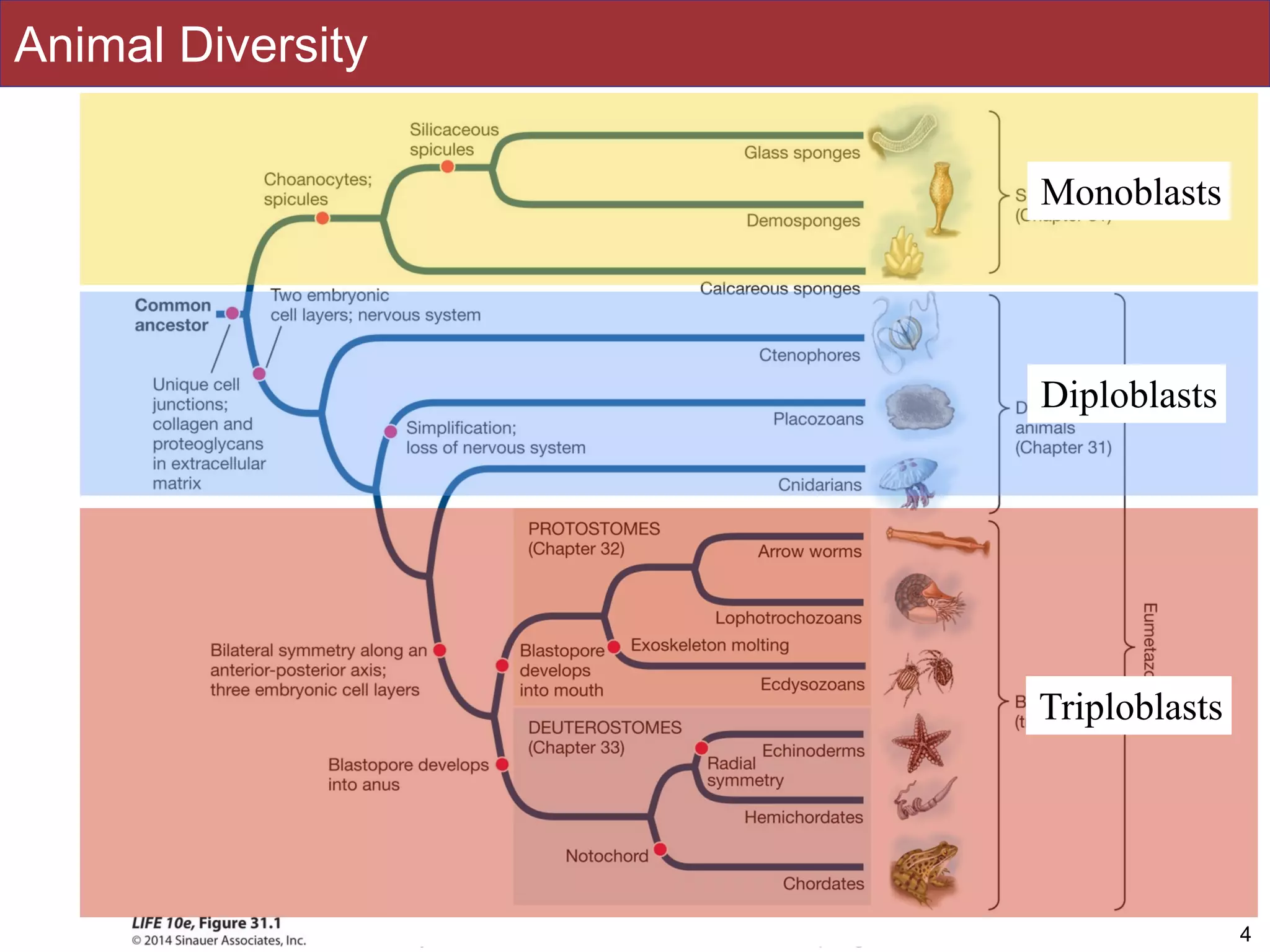
Animal Diversity
4
Diploblasts
Triploblasts
Monoblasts
Slides by Jonathan Eisen for BIS2C at UC Davis Spring 2016
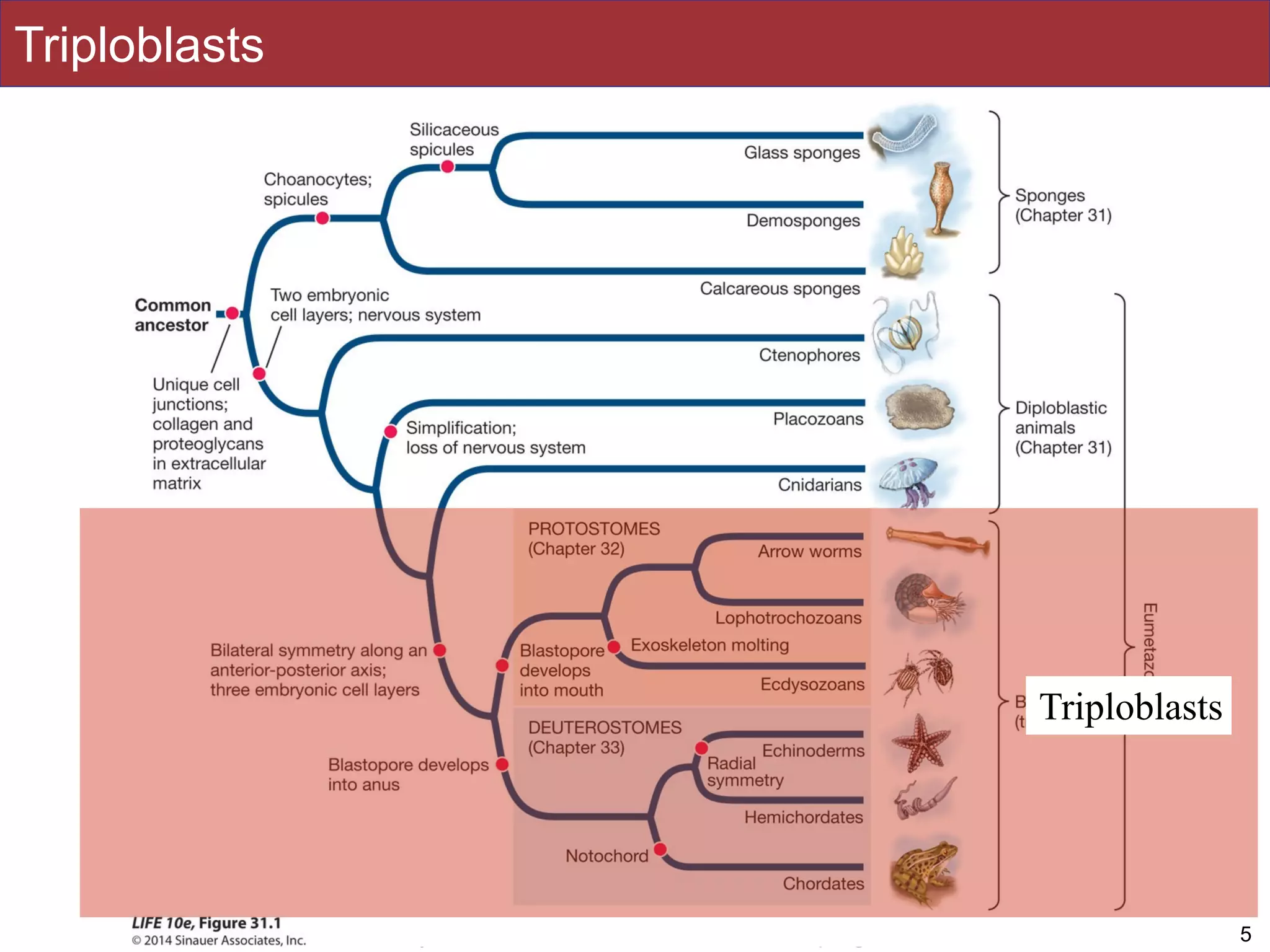
Triploblasts
5
Triploblasts
Slides by Jonathan Eisen for BIS2C at UC Davis Spring 2016
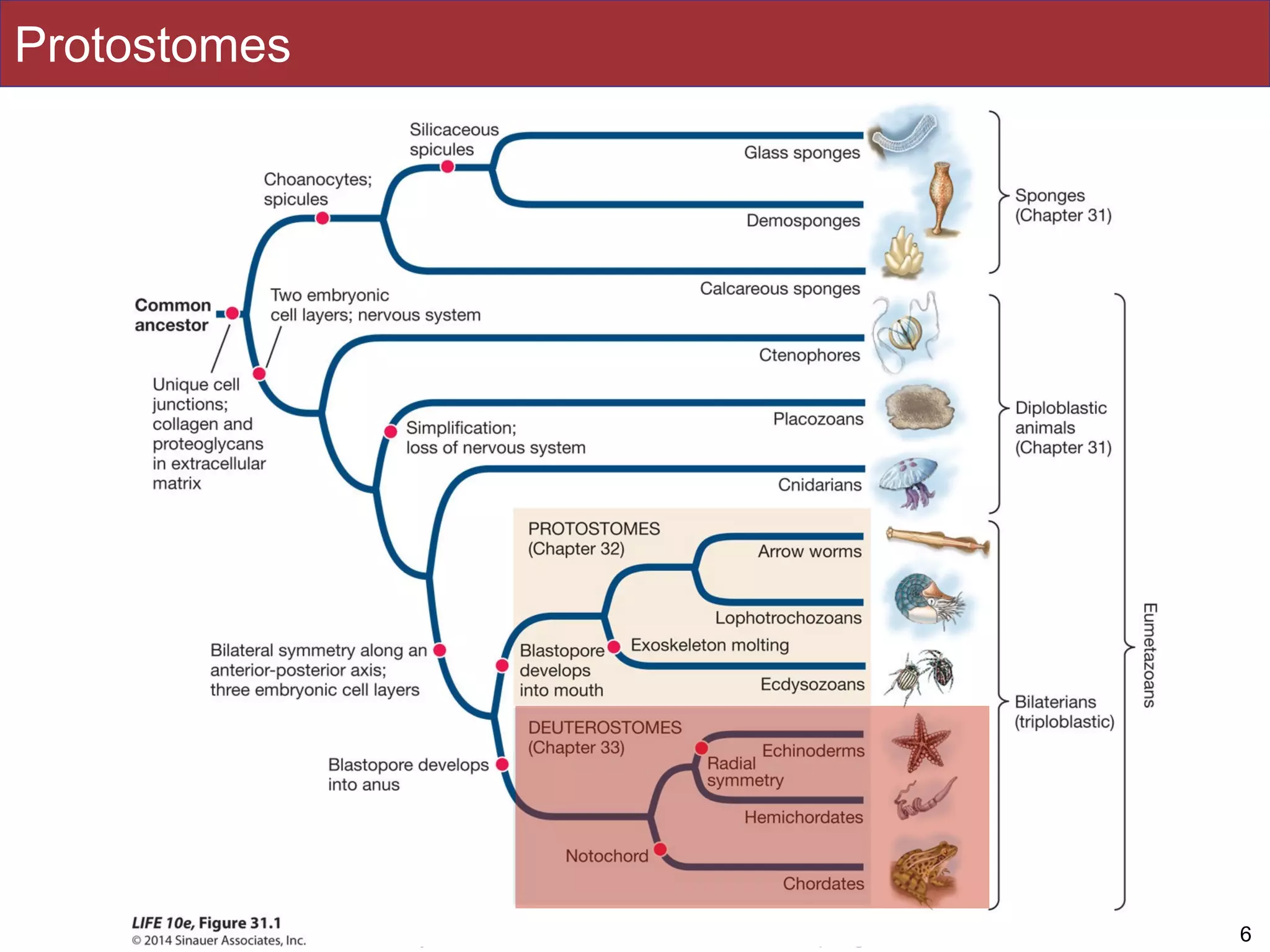
Protostomes
6
Slides by Jonathan Eisen for BIS2C at UC Davis Spring 2016
Clicker
What evidence is consistent with
echinoderms being deuterostomes?
A. Molecular phylogenetics
B. Blastopore developing into anus
C. Presence of bilateral symmetry
D. All of A-C
E. None of A-C
7
Slides by Jonathan Eisen for BIS2C at UC Davis Spring 2016
Clicker
What evidence is consistent with
echinoderms being deuterostomes?
A. Molecular phylogenetics
B. Blastopore developing into anus
C. Presence of bilateral symmetry
D. All of A-C
E. None of A-C
8
Slides by Jonathan Eisen for BIS2C at UC Davis Spring 2016
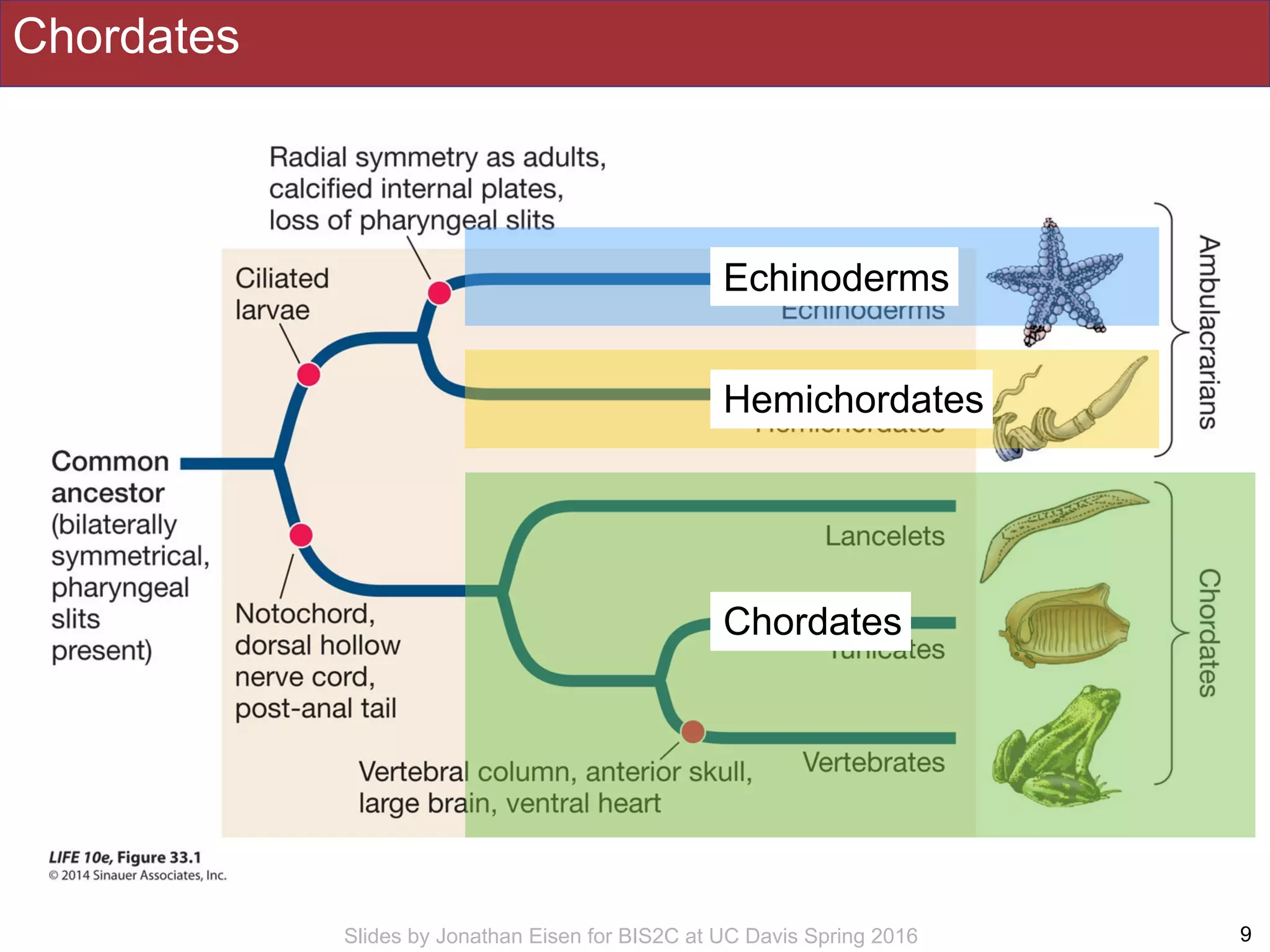
Chordates
9
Echinoderms
Hemichordates
Chordates
Slides by Jonathan Eisen for BIS2C at UC Davis Spring 2016
Chordates
10
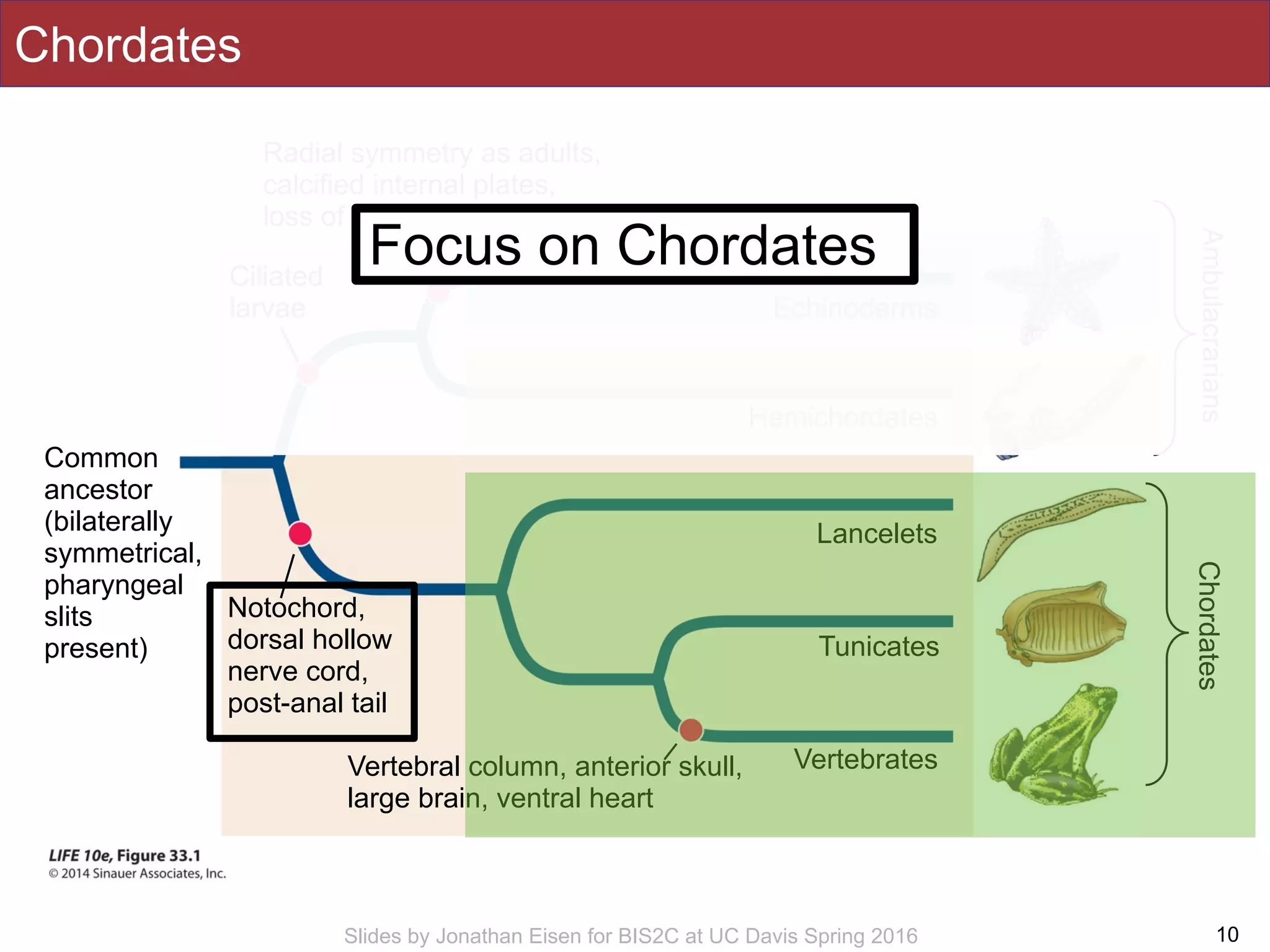
Chordates
Common
ancestor
(bilaterally
symmetrical,
pharyngeal
slits
present)
Echinoderms
Hemichordates
Lancelets
Tunicates
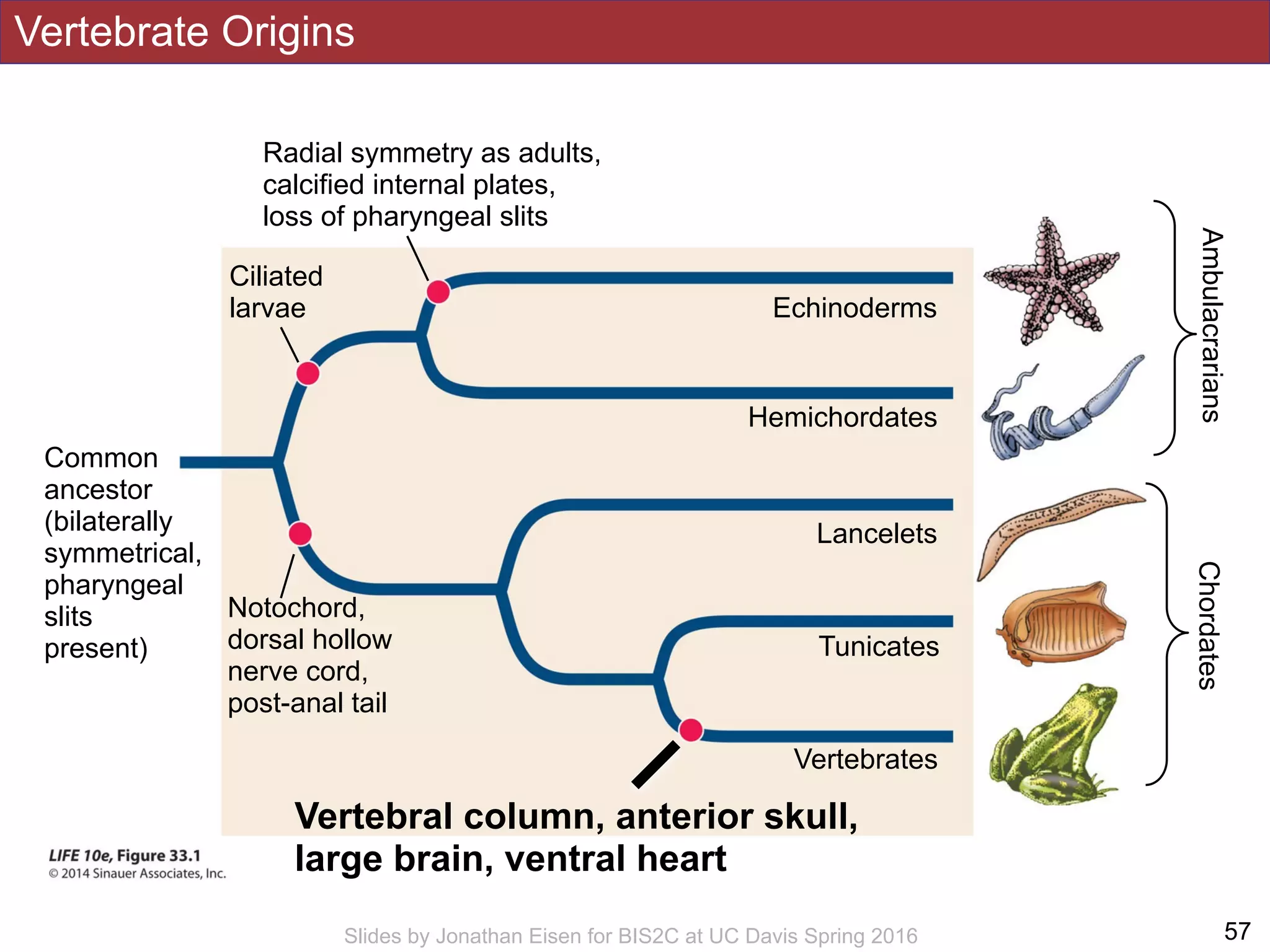
VertebratesVertebral column, anterior skull,
large brain, ventral heart
Notochord,
dorsal hollow
nerve cord,
post-anal tail
Radial symmetry as adults,
calcified internal plates,
loss of pharyngeal slits
Ciliated
larvae
Ambulacrarians
Focus on Chordates
Slides by Jonathan Eisen for BIS2C at UC Davis Spring 2016
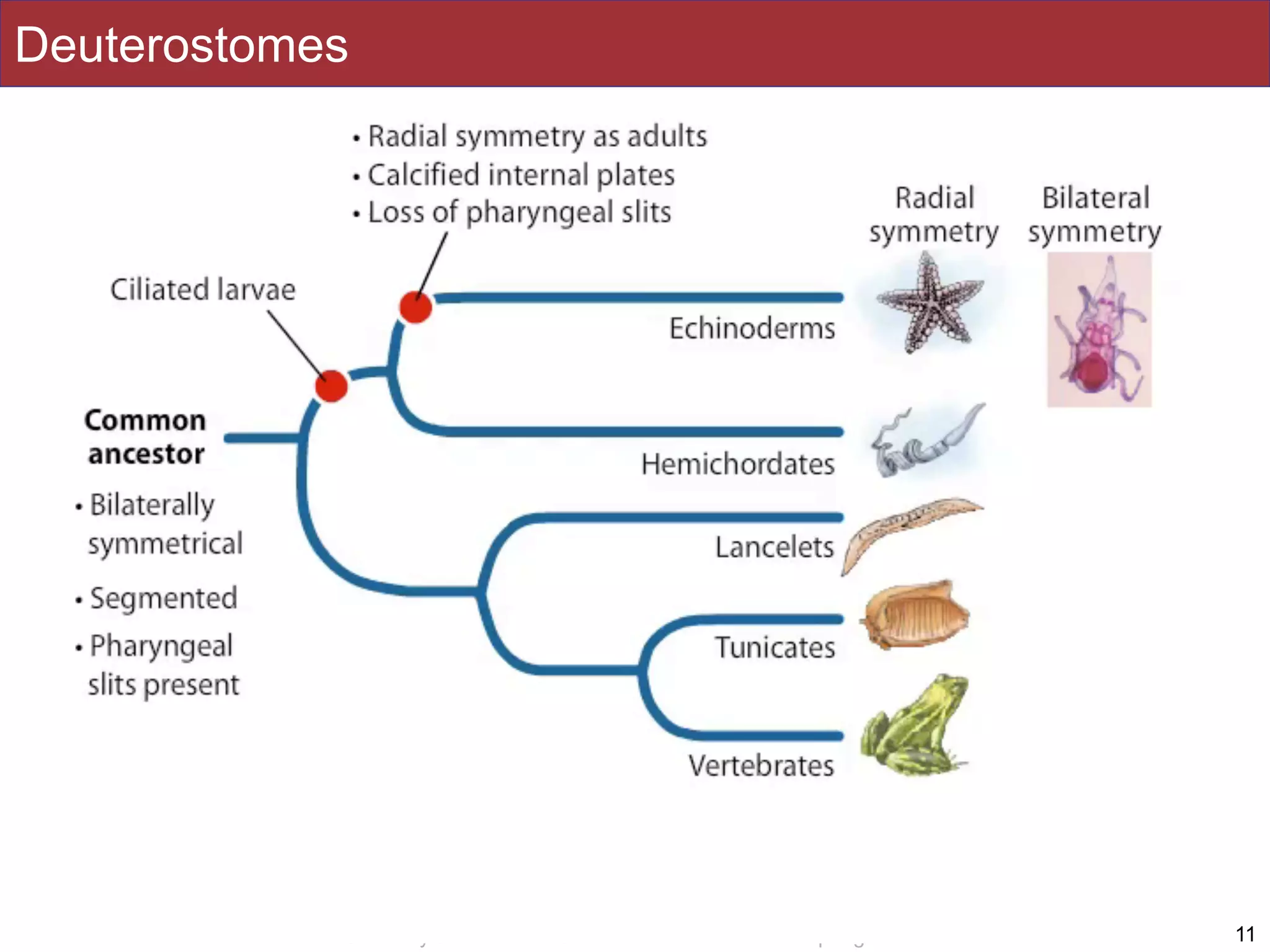
Deuterostomes
11
Slides by Jonathan Eisen for BIS2C at UC Davis Spring 2016
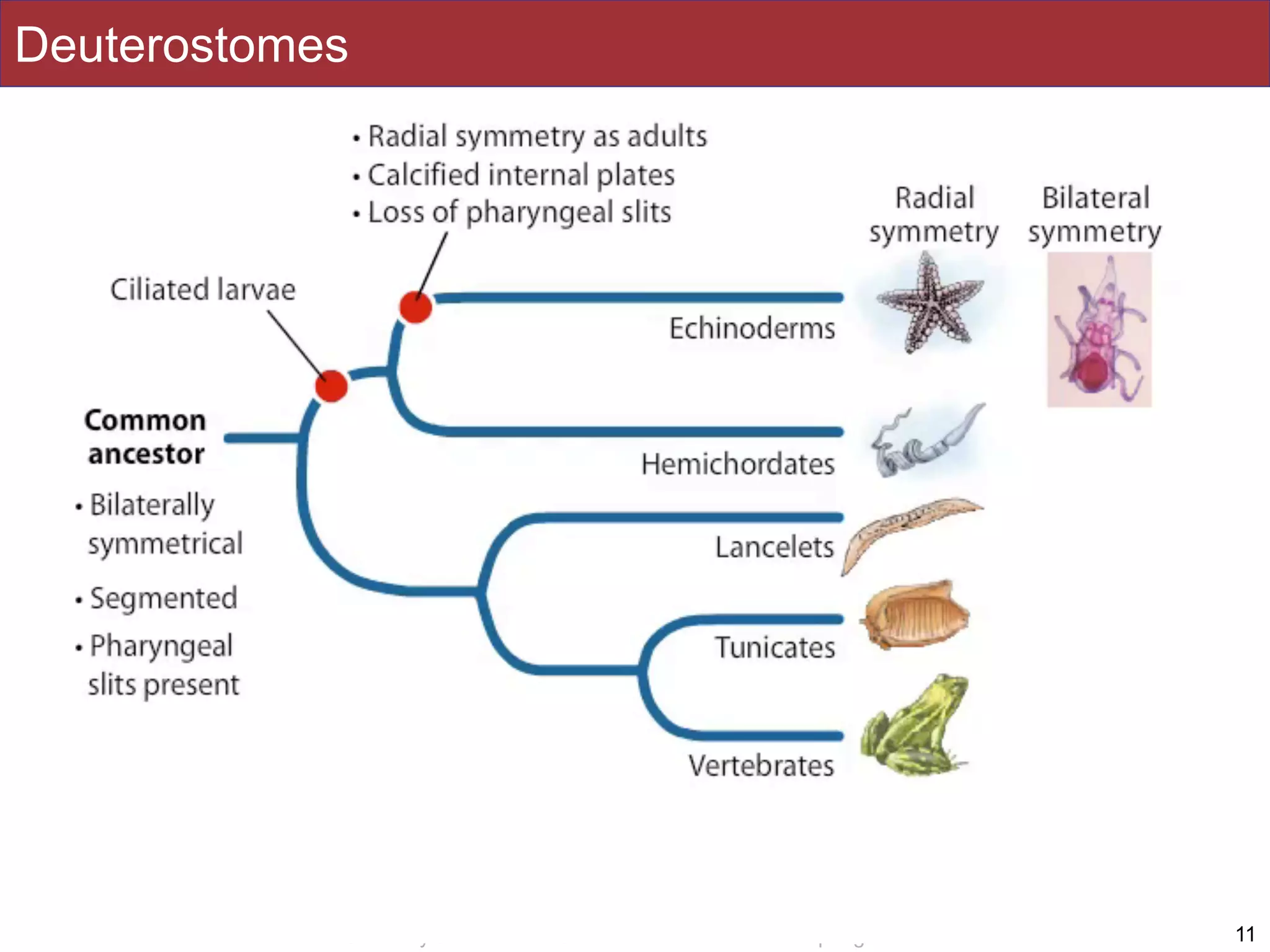
Deuterostomes
11
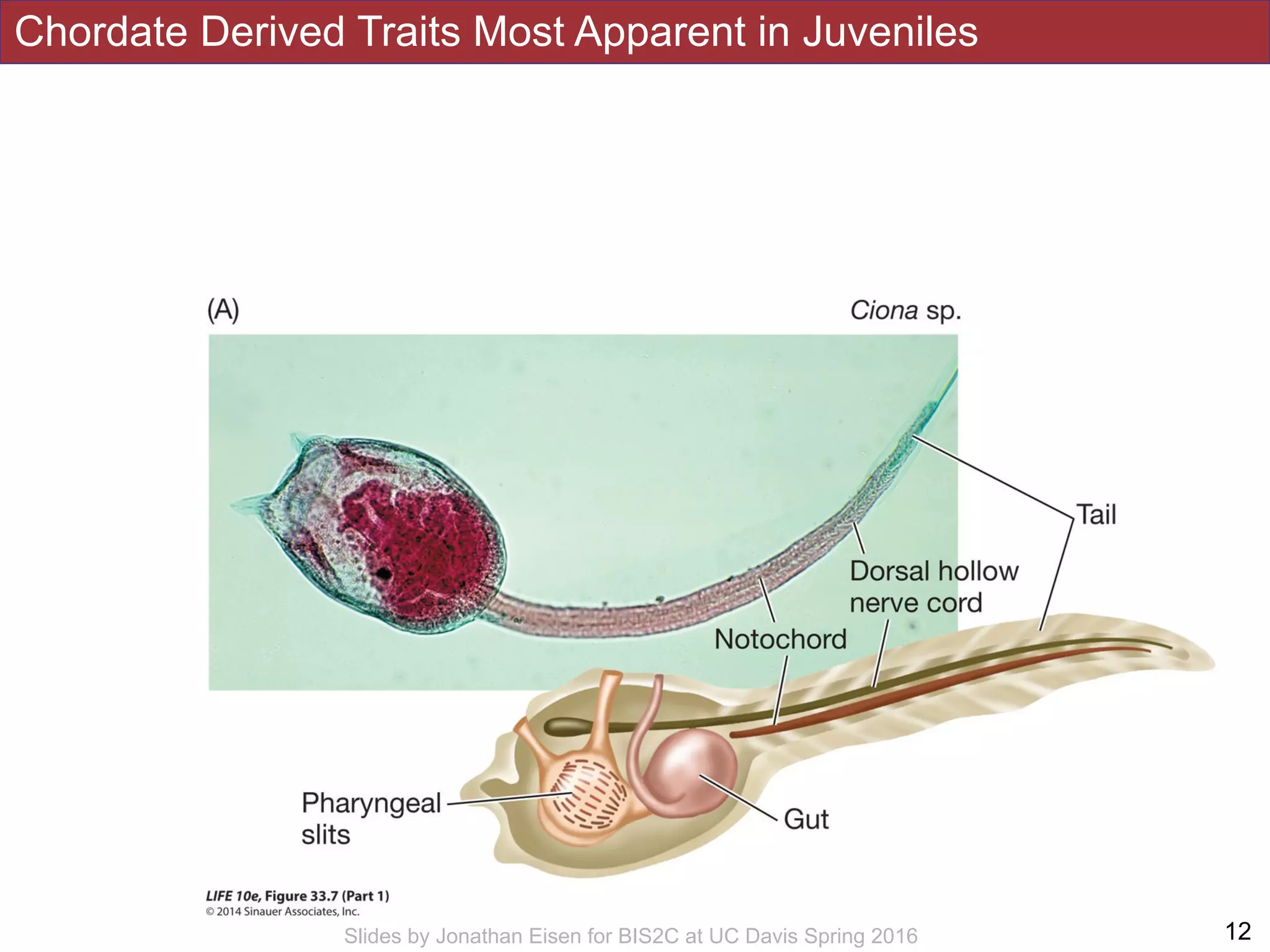
Chordate Derived Traits Most Apparent in Juveniles
!12Slides by Jonathan Eisen for BIS2C at UC Davis Spring 2016
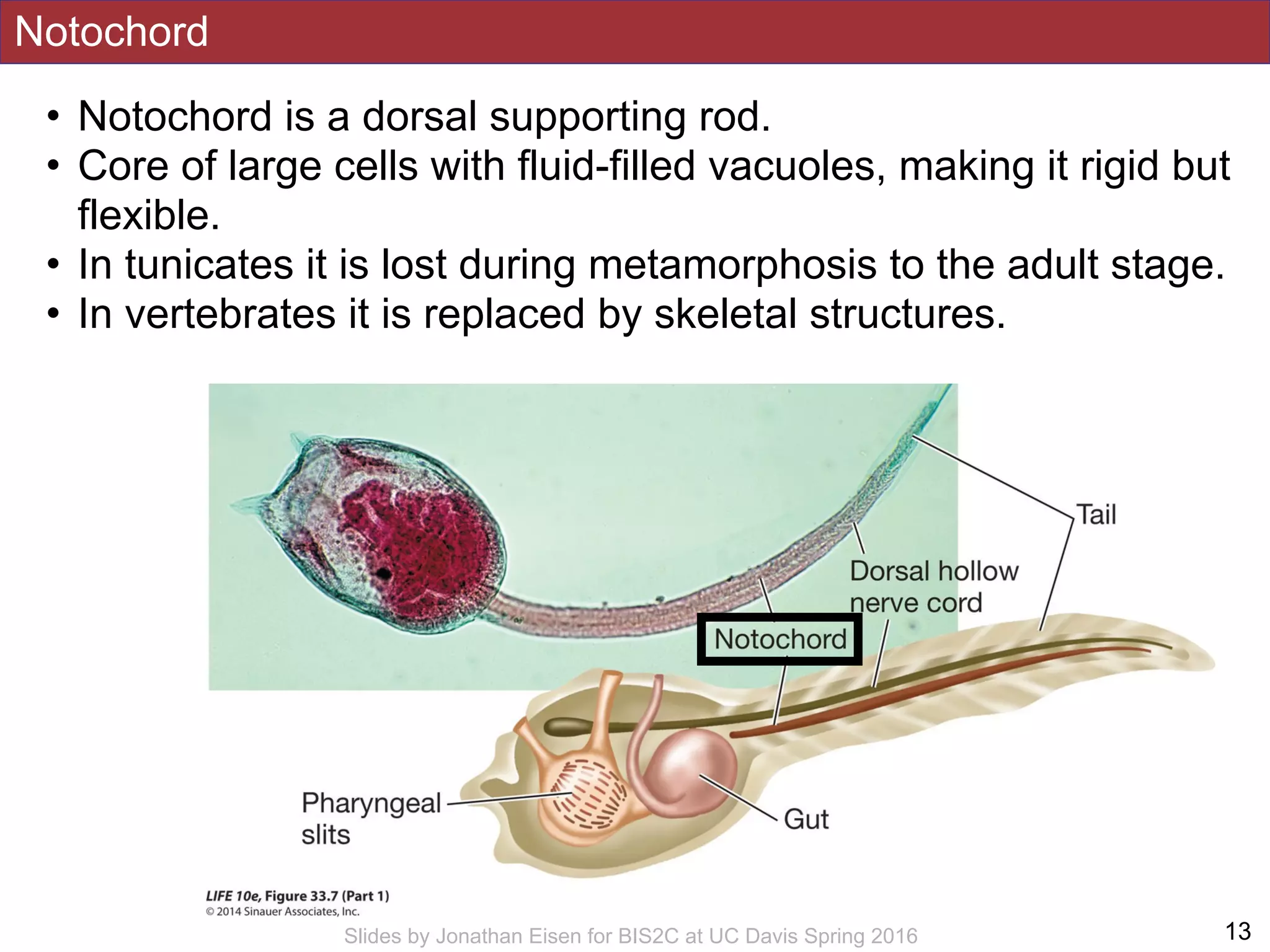
Notochord
!13Slides by Jonathan Eisen for BIS2C at UC Davis Spring 2016
• Notochord is a dorsal supporting rod.
• Core of large cells with fluid-filled vacuoles, making it rigid but
flexible.
• In tunicates it is lost during metamorphosis to the adult stage.
• In vertebrates it is replaced by skeletal structures.
Dorsal hollow nerve cord
!14Slides by Jonathan Eisen for BIS2C at UC Davis Spring 2016
• Formed by an embryonic folding of the ectoderm
• Develops to form the central nervous system in vertebrates
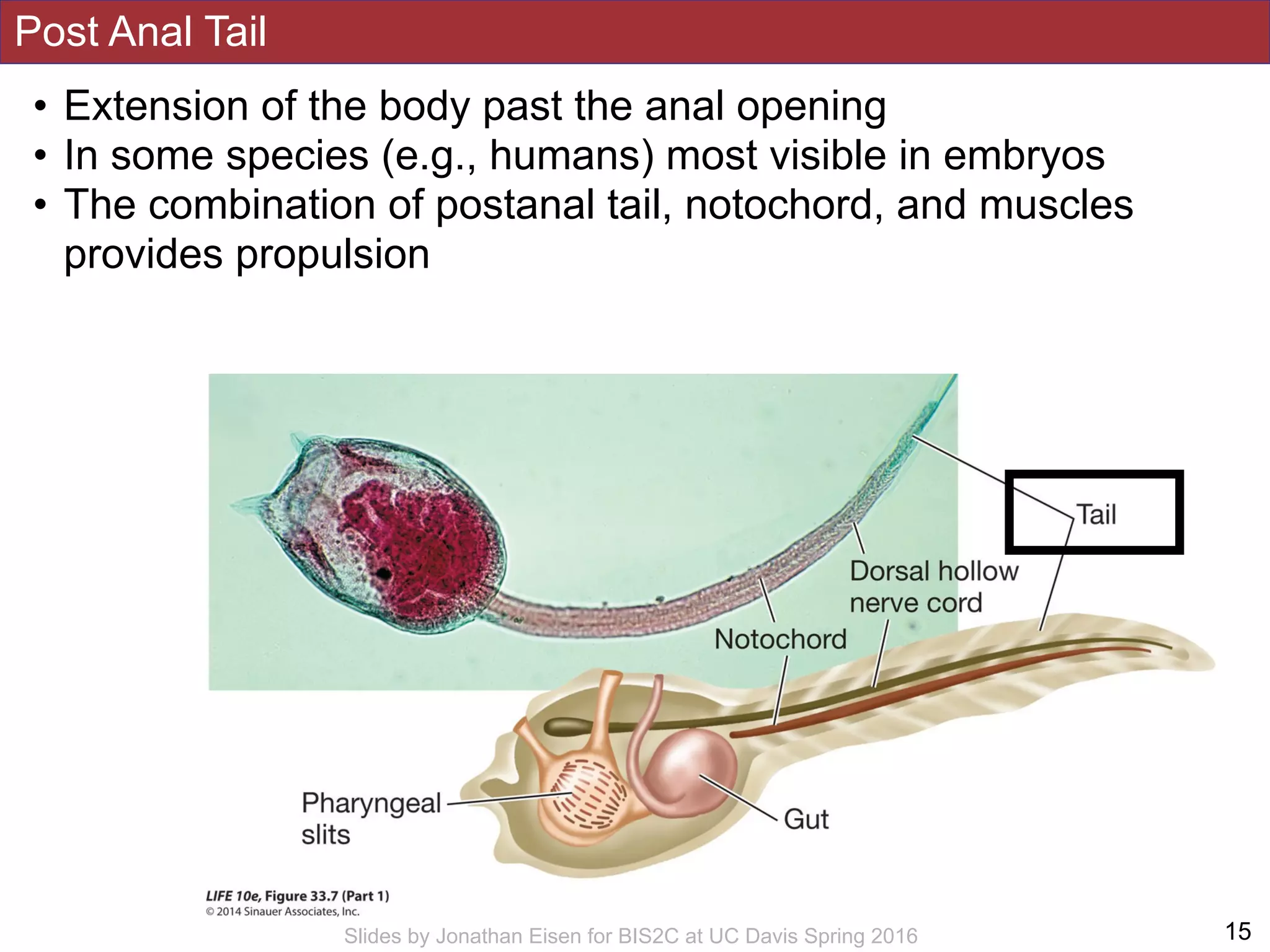
Post Anal Tail
!15Slides by Jonathan Eisen for BIS2C at UC Davis Spring 2016
• Extension of the body past the anal opening
• In some species (e.g., humans) most visible in embryos
• The combination of postanal tail, notochord, and muscles
provides propulsion
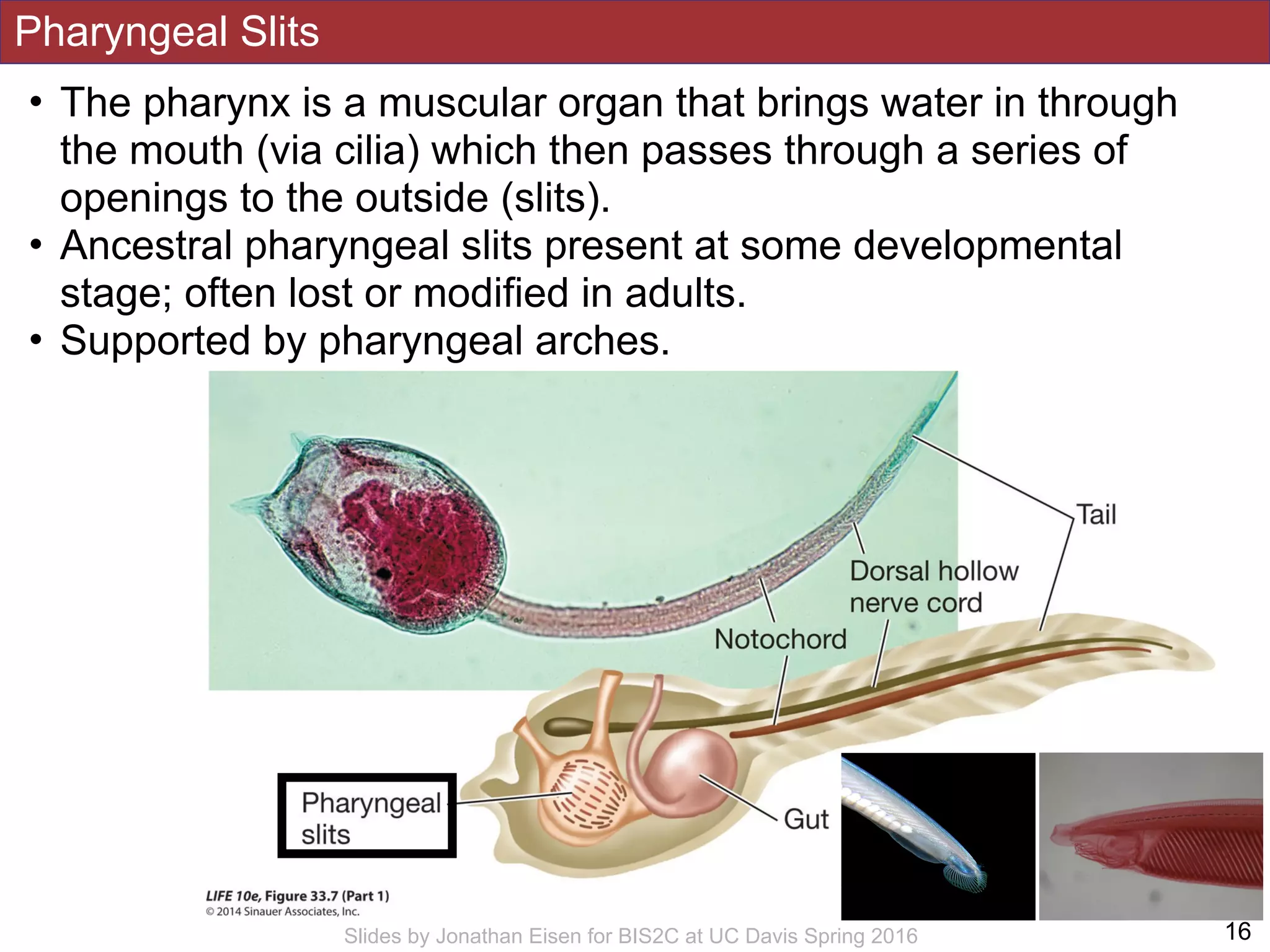
Pharyngeal Slits
!16Slides by Jonathan Eisen for BIS2C at UC Davis Spring 2016
• The pharynx is a muscular organ that brings water in through
the mouth (via cilia) which then passes through a series of
openings to the outside (slits).
• Ancestral pharyngeal slits present at some developmental
stage; often lost or modified in adults.
• Supported by pharyngeal arches.
Slides by Jonathan Eisen for BIS2C at UC Davis Spring 2016
Clicker
17
Why are pharyngeal slits NOT considered a
synapomorphy (shared derived trait) of chordates?
A. They occur in other deuterostomes
B. They are lost in some chordates
C. They are modified into gills in vertebrates
D. They only occur in the embryo of some chordates
Slides by Jonathan Eisen for BIS2C at UC Davis Spring 2016
Clicker
18
Why are pharyngeal slits NOT considered a
synapomorphy (shared derived trait) of chordates?
A. They occur in other deuterostomes
B. They are lost in some chordates
C. They are modified into gills in vertebrates
D. They only occur in the embryo of some chordates
Figure 33.1 Phylogeny of the Deuterostomes
!19Slides by Jonathan Eisen for BIS2C at UC Davis Spring 2016
Slides by Jonathan Eisen for BIS2C at UC Davis Spring 2016
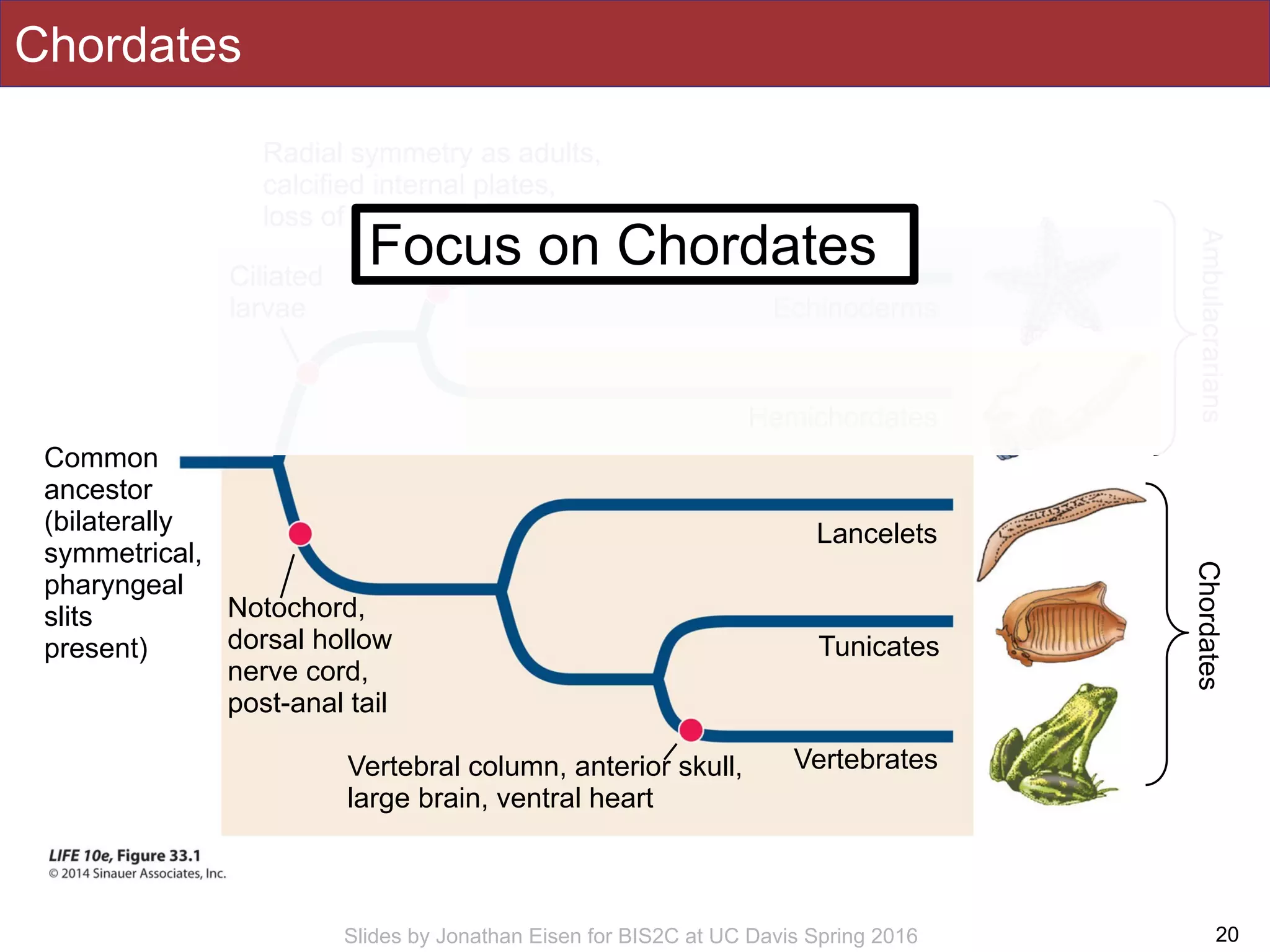
Chordates
20
Chordates
Common
ancestor
(bilaterally
symmetrical,
pharyngeal
slits
present)
Echinoderms
Hemichordates
Lancelets
Tunicates
VertebratesVertebral column, anterior skull,
large brain, ventral heart
Notochord,
dorsal hollow
nerve cord,
post-anal tail
Radial symmetry as adults,
calcified internal plates,
loss of pharyngeal slits
Ciliated
larvae
Ambulacrarians
Focus on Chordates
Slides by Jonathan Eisen for BIS2C at UC Davis Spring 2016
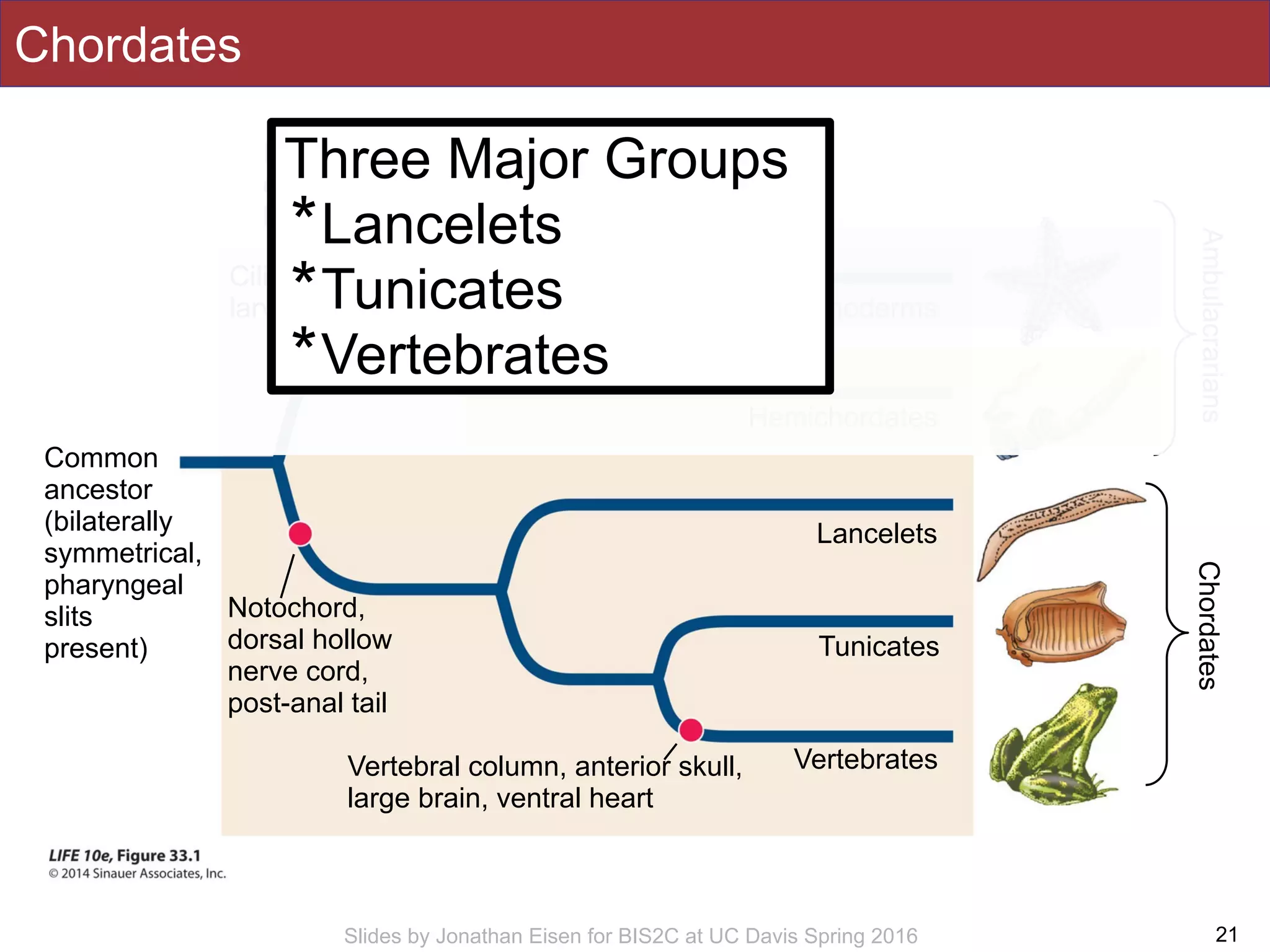
Chordates
21
Chordates
Common
ancestor
(bilaterally
symmetrical,
pharyngeal
slits
present)
Echinoderms
Hemichordates
Lancelets
Tunicates
VertebratesVertebral column, anterior skull,
large brain, ventral heart
Notochord,
dorsal hollow
nerve cord,
post-anal tail
Radial symmetry as adults,
calcified internal plates,
loss of pharyngeal slits
Ciliated
larvae
Ambulacrarians
Three Major Groups
*Lancelets
*Tunicates
*Vertebrates
Slides by Jonathan Eisen for BIS2C at UC Davis Spring 2016
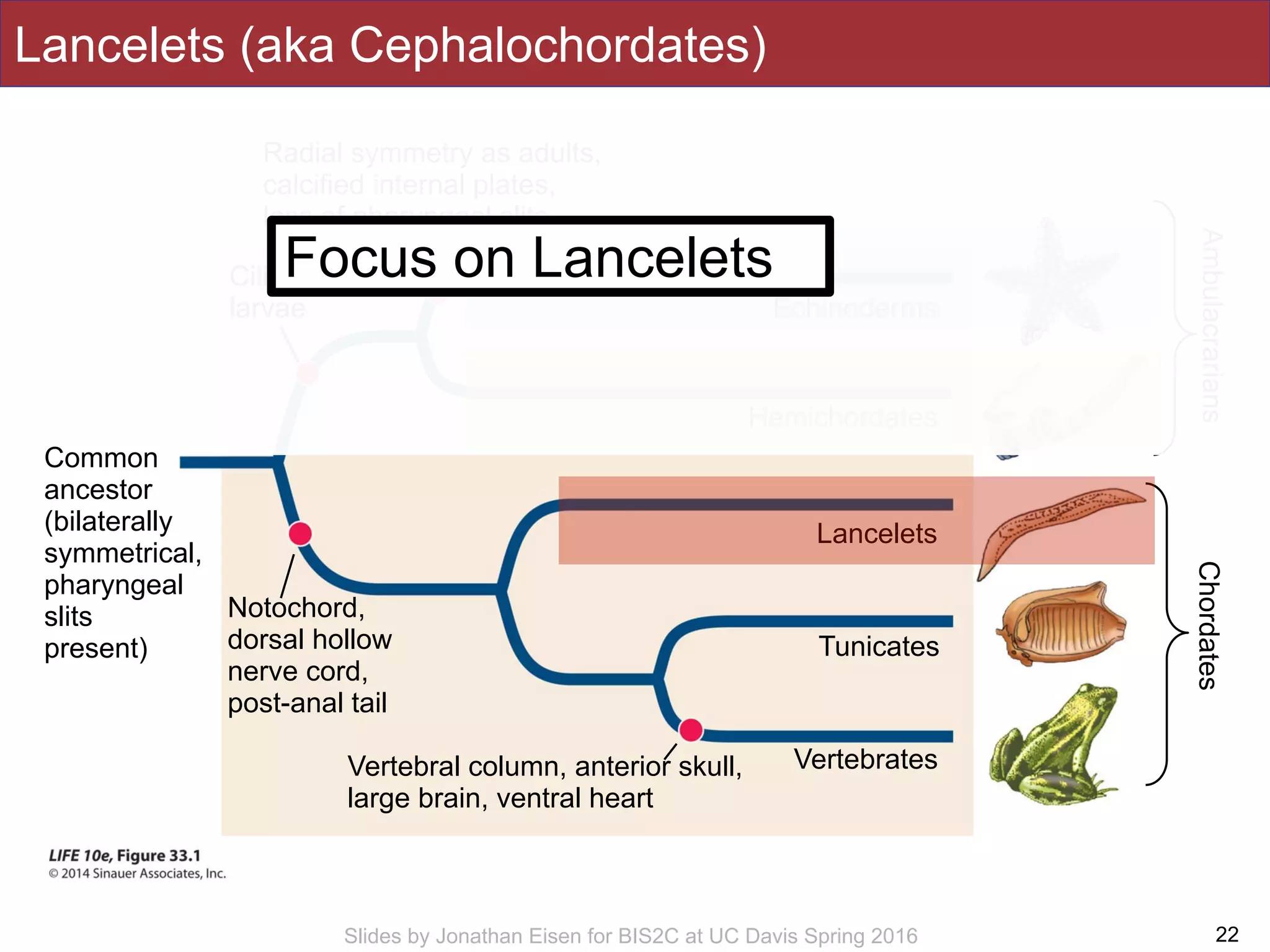
Lancelets (aka Cephalochordates)
22
Chordates
Common
ancestor
(bilaterally
symmetrical,
pharyngeal
slits
present)
Echinoderms
Hemichordates
Lancelets
Tunicates
VertebratesVertebral column, anterior skull,
large brain, ventral heart
Notochord,
dorsal hollow
nerve cord,
post-anal tail
Radial symmetry as adults,
calcified internal plates,
loss of pharyngeal slits
Ciliated
larvae
Ambulacrarians
Focus on Lancelets
Slides by Jonathan Eisen for BIS2C at UC Davis Spring 2016
Lancelet development
23
Slides by Jonathan Eisen for BIS2C at UC Davis Spring 2016 24
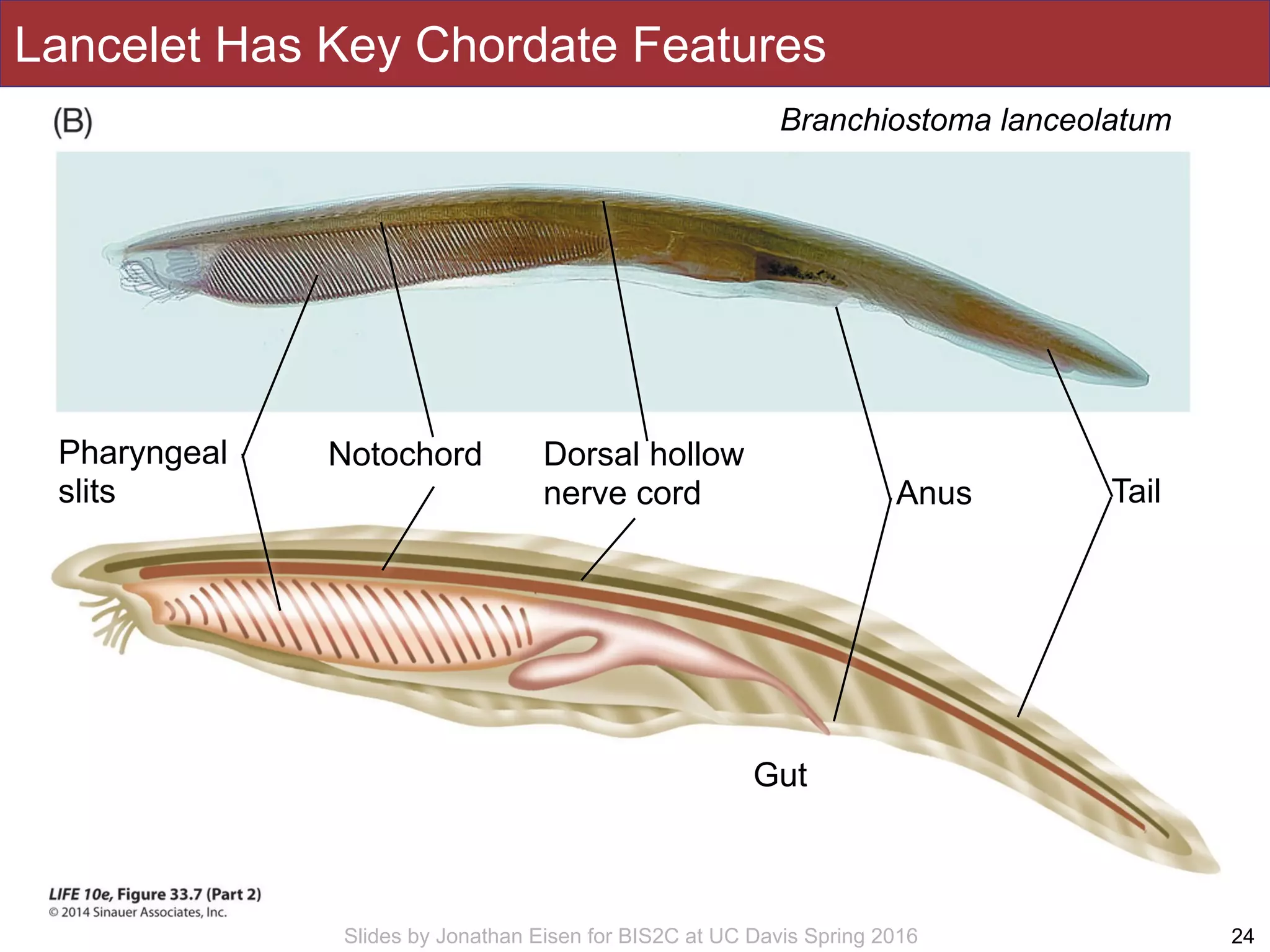
Branchiostoma lanceolatum
Gut
TailAnus
Dorsal hollow
nerve cord
NotochordPharyngeal
slits
Lancelet Has Key Chordate Features
Slides by Jonathan Eisen for BIS2C at UC Davis Spring 2016 25
Branchiostoma lanceolatum
TailAnus
Dorsal hollow
nerve cord
NotochordPharyngeal
slits
Lancelet Features
• Lancelets (aka amphioxus) are very small, less than 5 cm.
• Notochord is retained throughout life.
• Burrow in sand with head protruding; also swim.
• Pharynx is enlarged to form a pharyngeal basket for
filtering prey from the water.
• Fertilization takes place in the water.
• Segmented body muscles
Slides by Jonathan Eisen for BIS2C at UC Davis Spring 2016
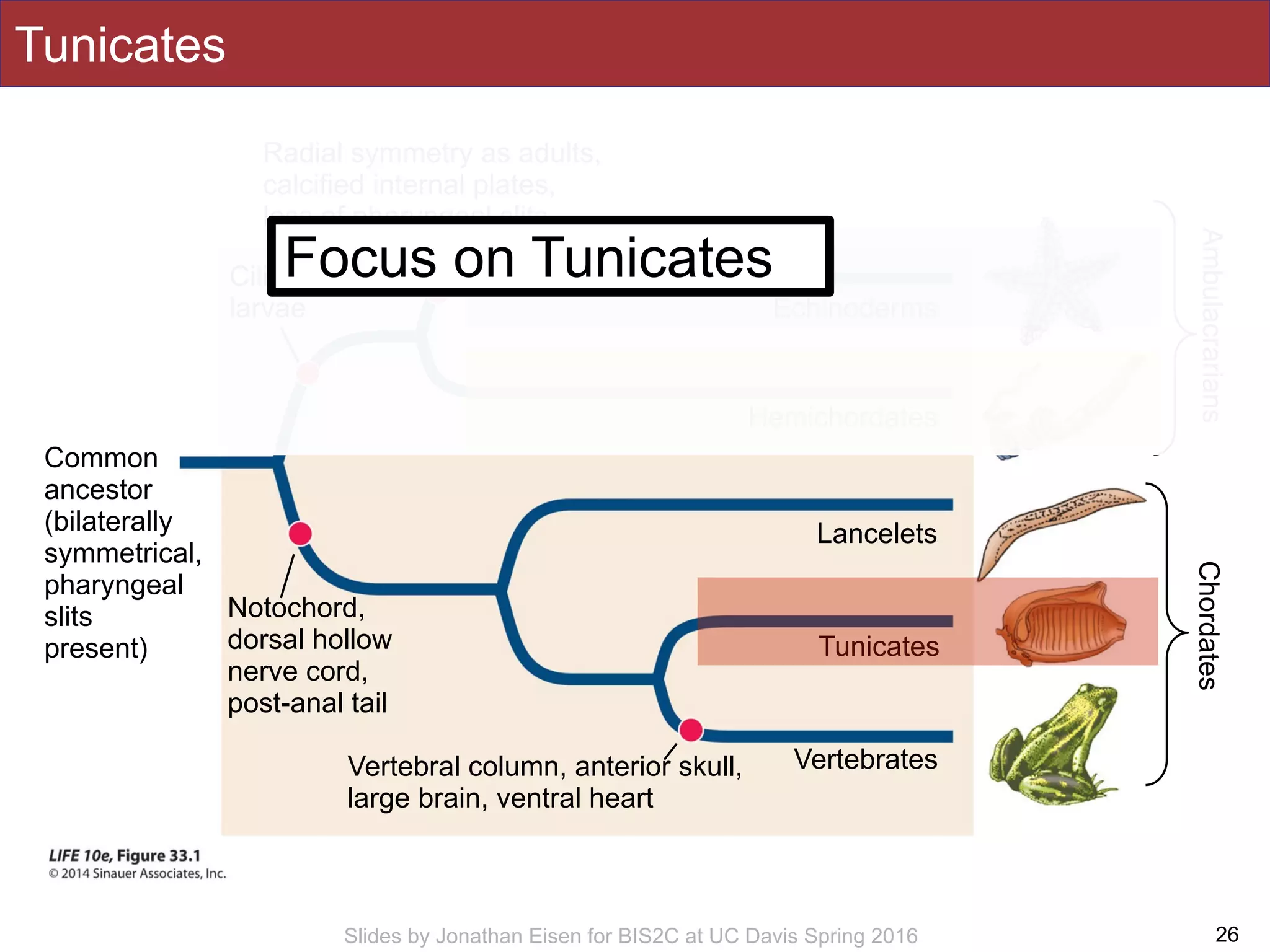
Tunicates
26
Chordates
Common
ancestor
(bilaterally
symmetrical,
pharyngeal
slits
present)
Echinoderms
Hemichordates
Lancelets
Tunicates
VertebratesVertebral column, anterior skull,
large brain, ventral heart
Notochord,
dorsal hollow
nerve cord,
post-anal tail
Radial symmetry as adults,
calcified internal plates,
loss of pharyngeal slits
Ciliated
larvae
Ambulacrarians
Focus on Tunicates
Slides by Jonathan Eisen for BIS2C at UC Davis Spring 2016
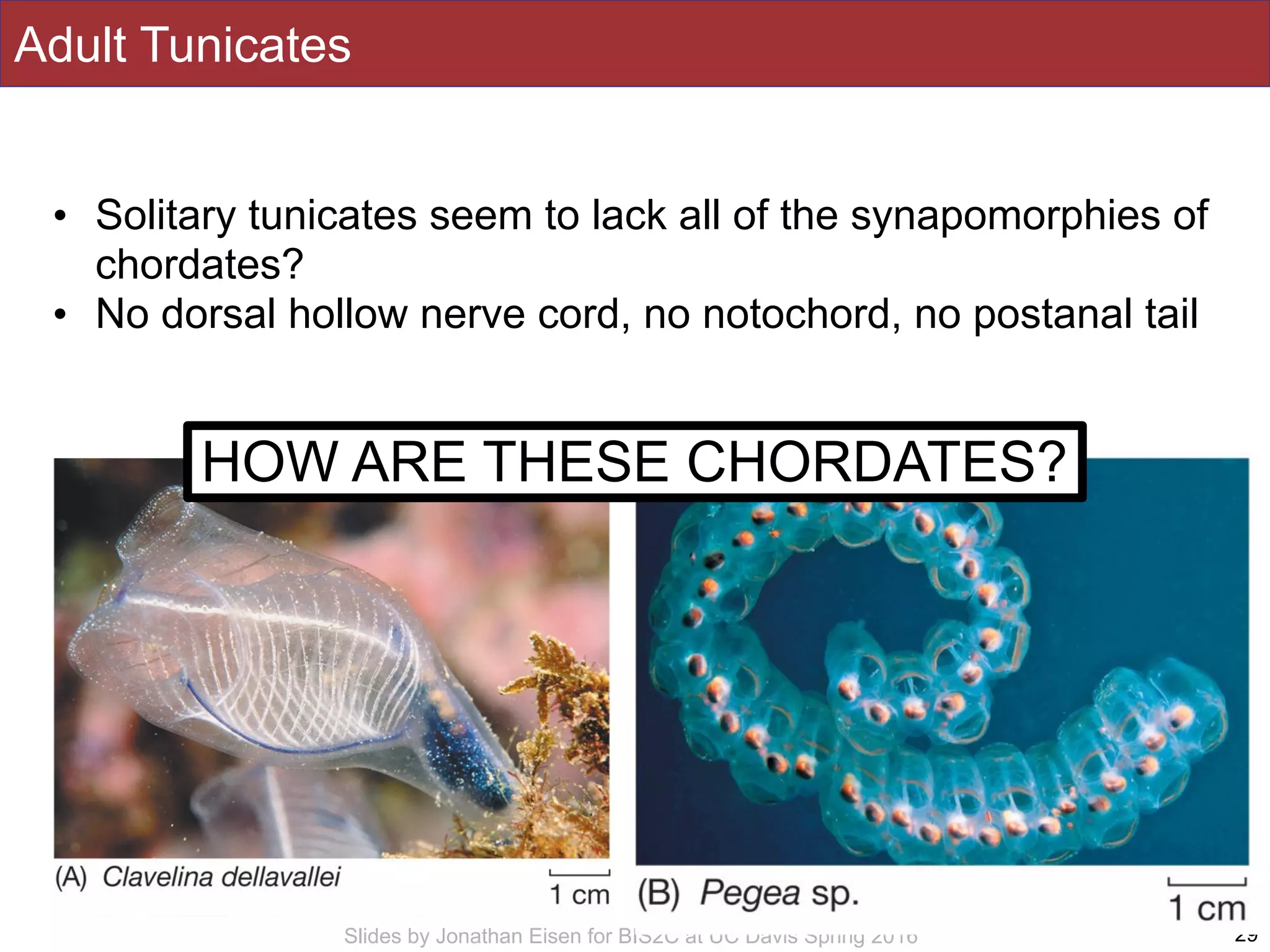
Adult Tunicates
27
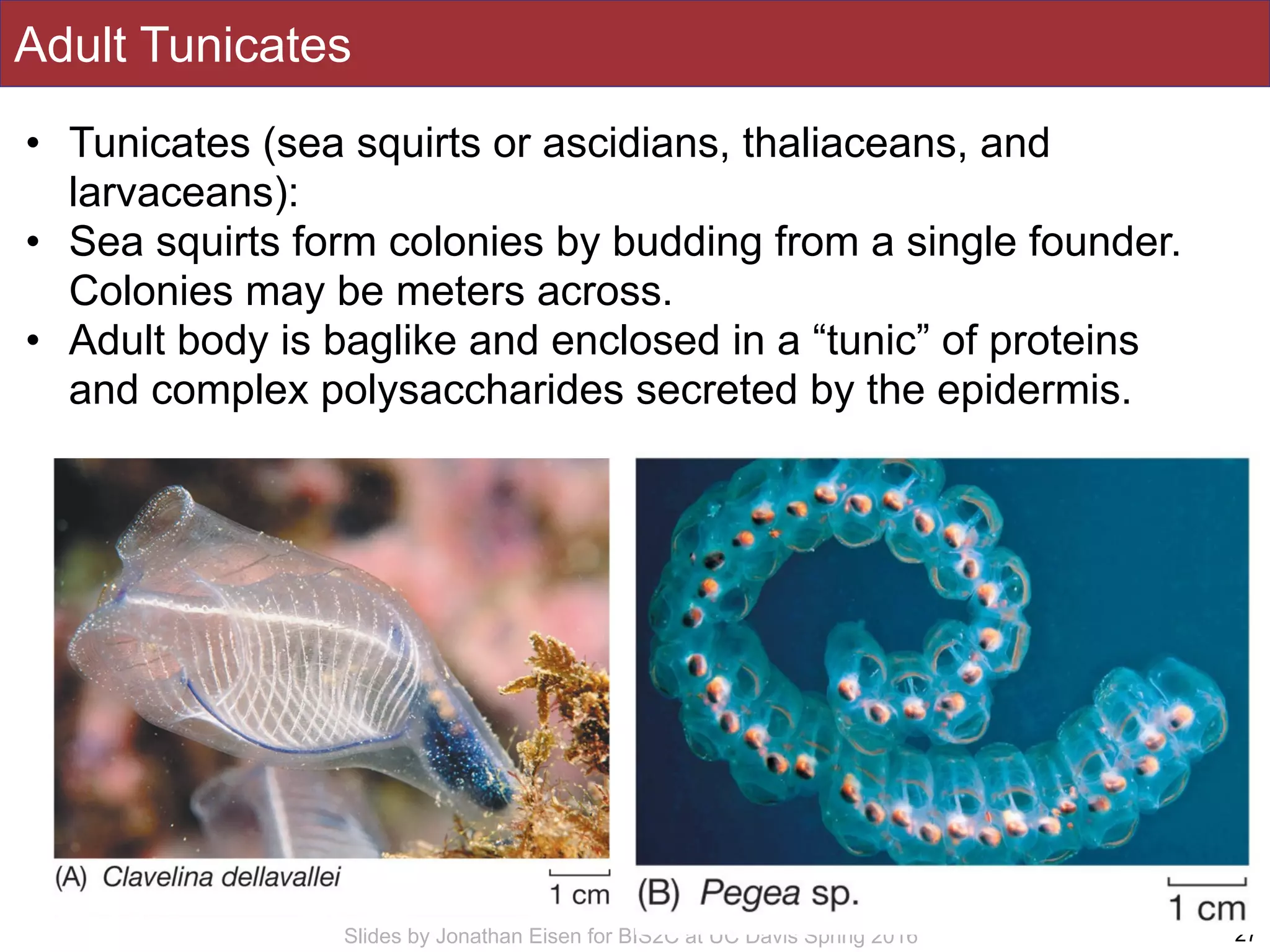
• Tunicates (sea squirts or ascidians, thaliaceans, and
larvaceans):
• Sea squirts form colonies by budding from a single founder.
Colonies may be meters across.
• Adult body is baglike and enclosed in a “tunic” of proteins
and complex polysaccharides secreted by the epidermis.
Slides by Jonathan Eisen for BIS2C at UC Davis Spring 2016
Adult Tunicates
28
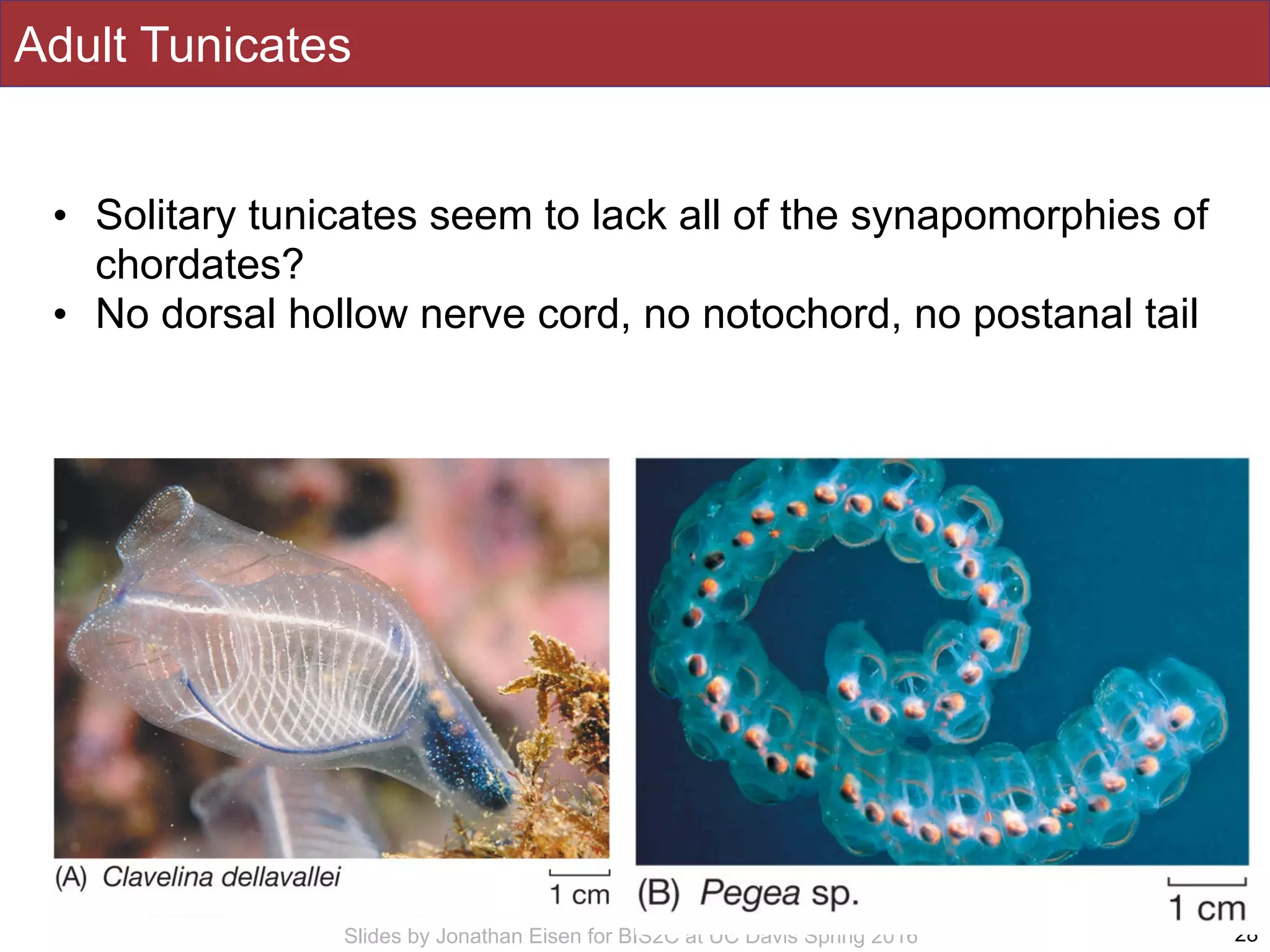
• Solitary tunicates seem to lack all of the synapomorphies of
chordates?
• No dorsal hollow nerve cord, no notochord, no postanal tail
Slides by Jonathan Eisen for BIS2C at UC Davis Spring 2016
Adult Tunicates
29
• Solitary tunicates seem to lack all of the synapomorphies of
chordates?
• No dorsal hollow nerve cord, no notochord, no postanal tail
HOW ARE THESE CHORDATES?
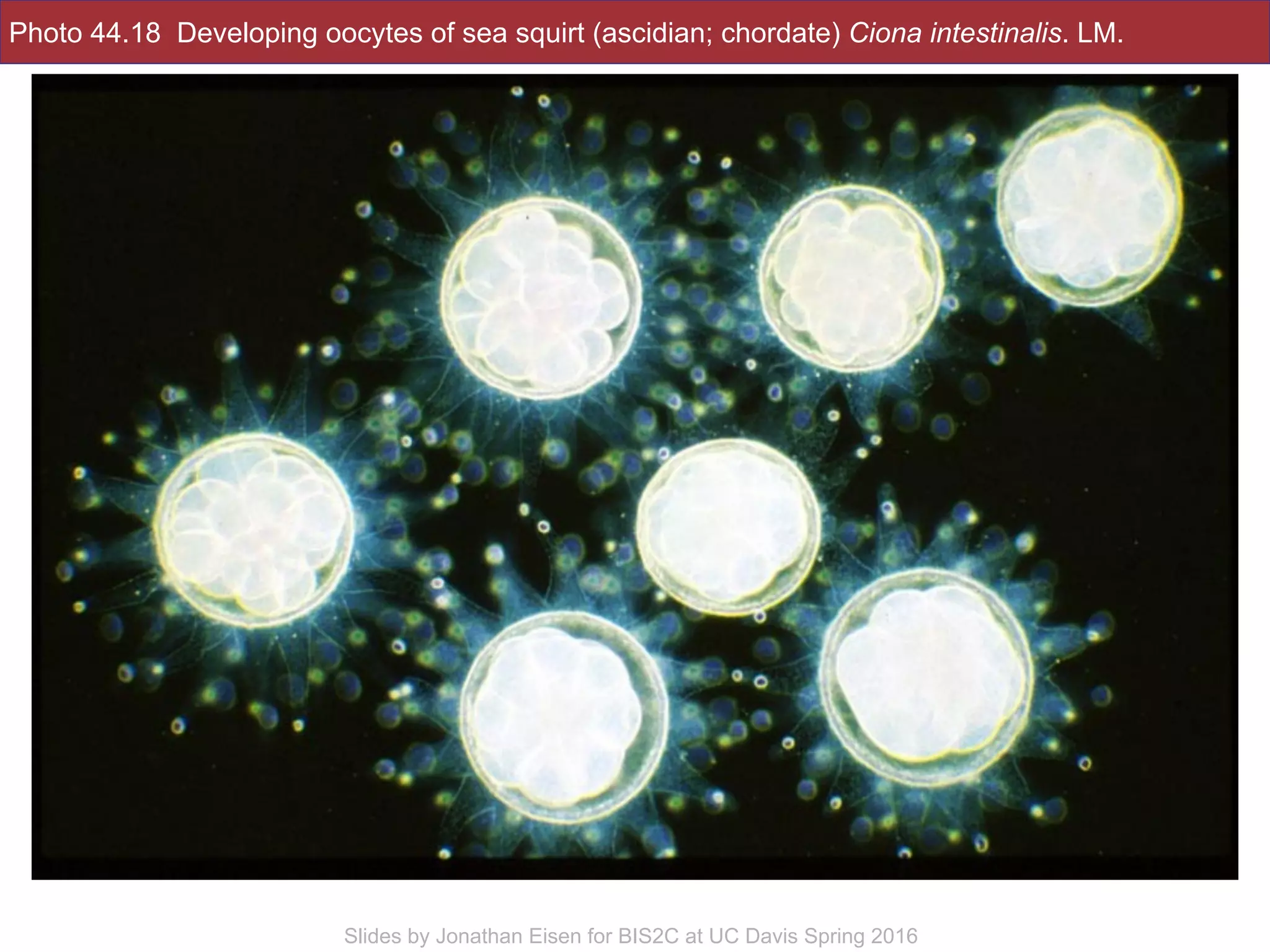
Photo 44.18 Developing oocytes of sea squirt (ascidian; chordate) Ciona intestinalis. LM.
!30Slides by Jonathan Eisen for BIS2C at UC Davis Spring 2016
Photo 44.19 Sea squirt (primitive chordate, C. intestinalis): free-swimming larva.
!31Slides by Jonathan Eisen for BIS2C at UC Davis Spring 2016
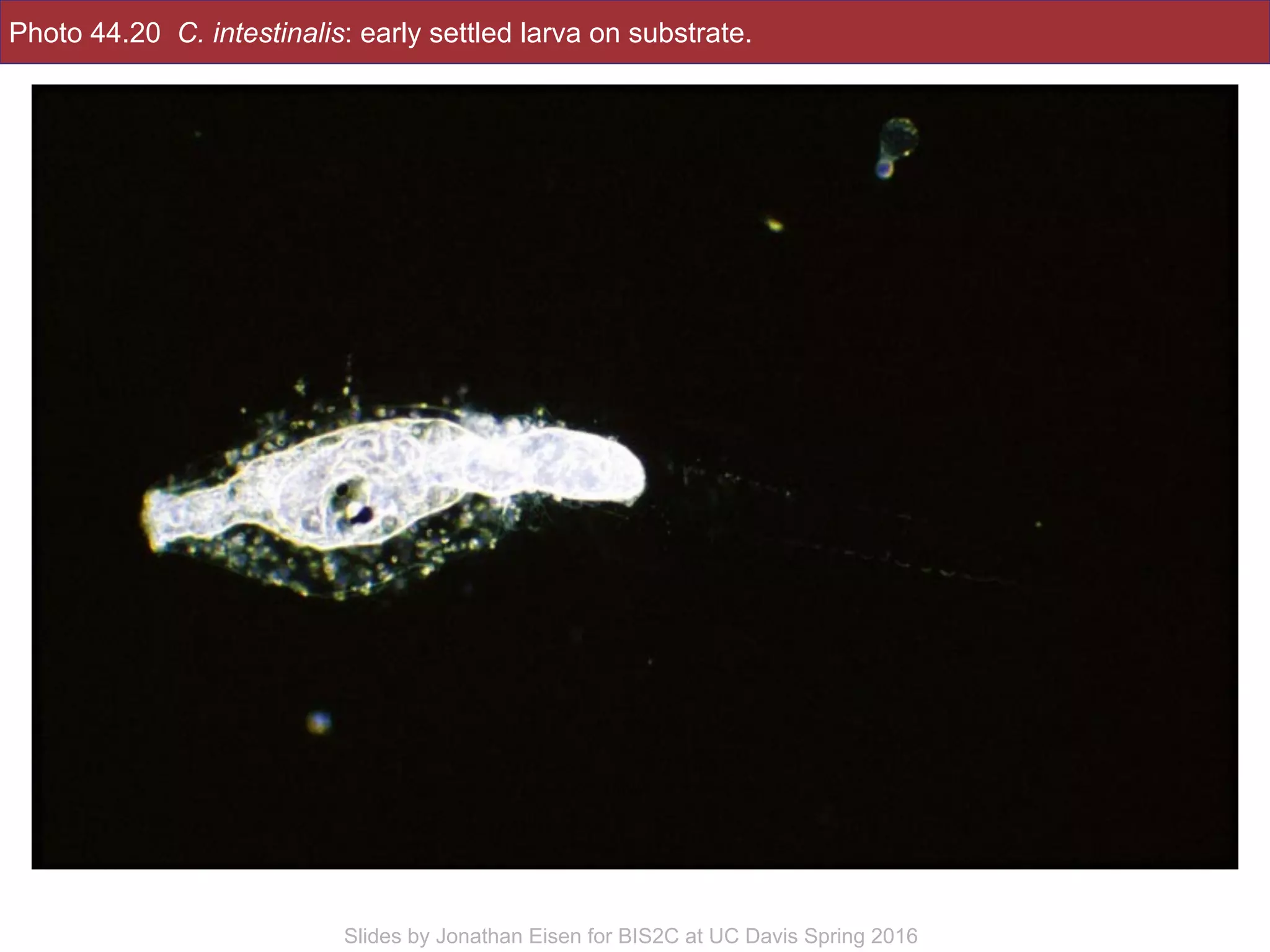
Photo 44.20 C. intestinalis: early settled larva on substrate.
!32Slides by Jonathan Eisen for BIS2C at UC Davis Spring 2016
Photo 44.21 C. intestinalis: further metamorphosis of early settled larva.
!33Slides by Jonathan Eisen for BIS2C at UC Davis Spring 2016
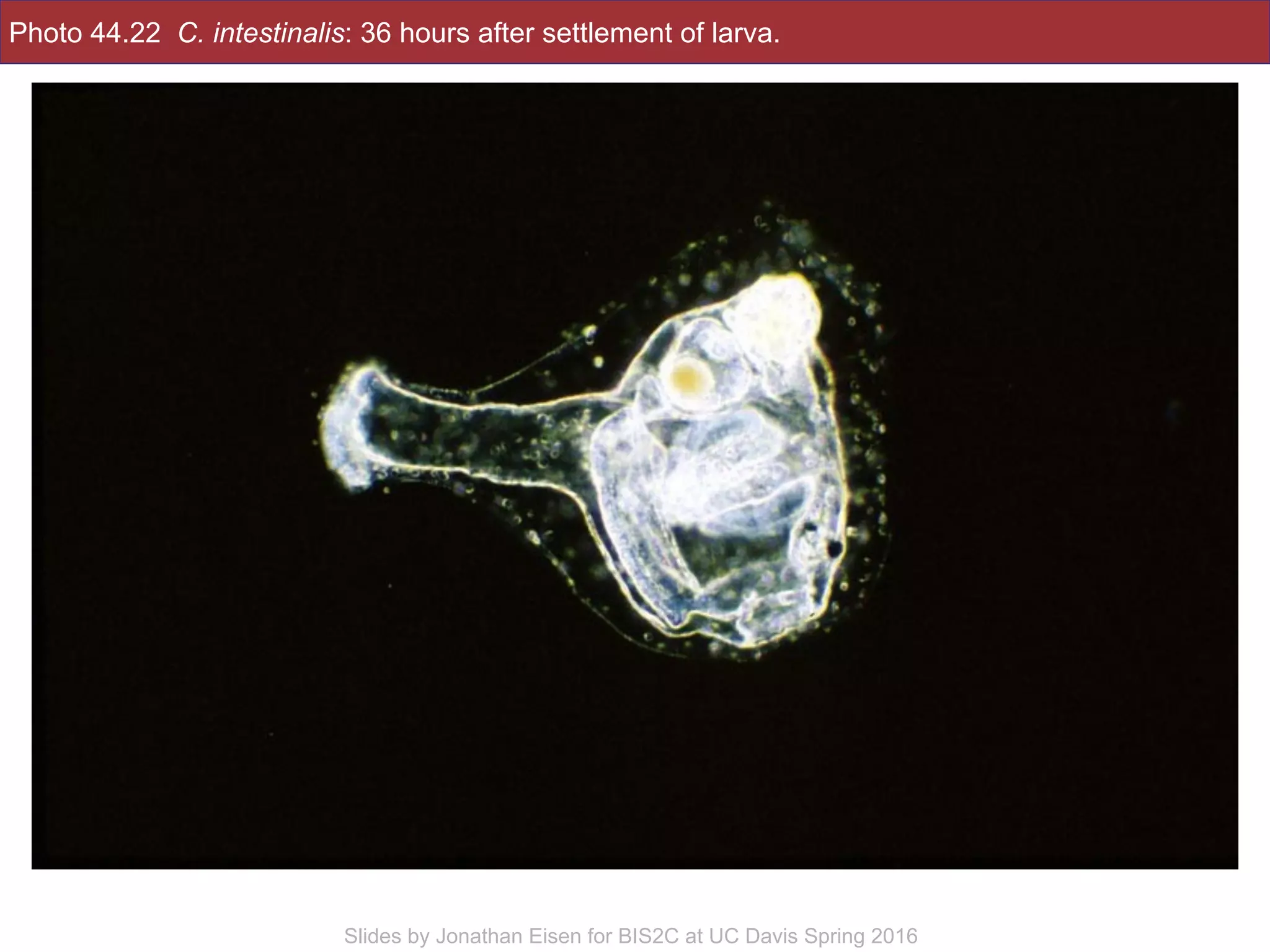
Photo 44.22 C. intestinalis: 36 hours after settlement of larva.
!34Slides by Jonathan Eisen for BIS2C at UC Davis Spring 2016
Photo 44.23 C. intestinalis: 4 days after settlement of larva. Features of adult can be seen.
!35Slides by Jonathan Eisen for BIS2C at UC Davis Spring 2016
Photo 44.24 C. intestinalis: 7 days after settlement of larva
!36Slides by Jonathan Eisen for BIS2C at UC Davis Spring 2016
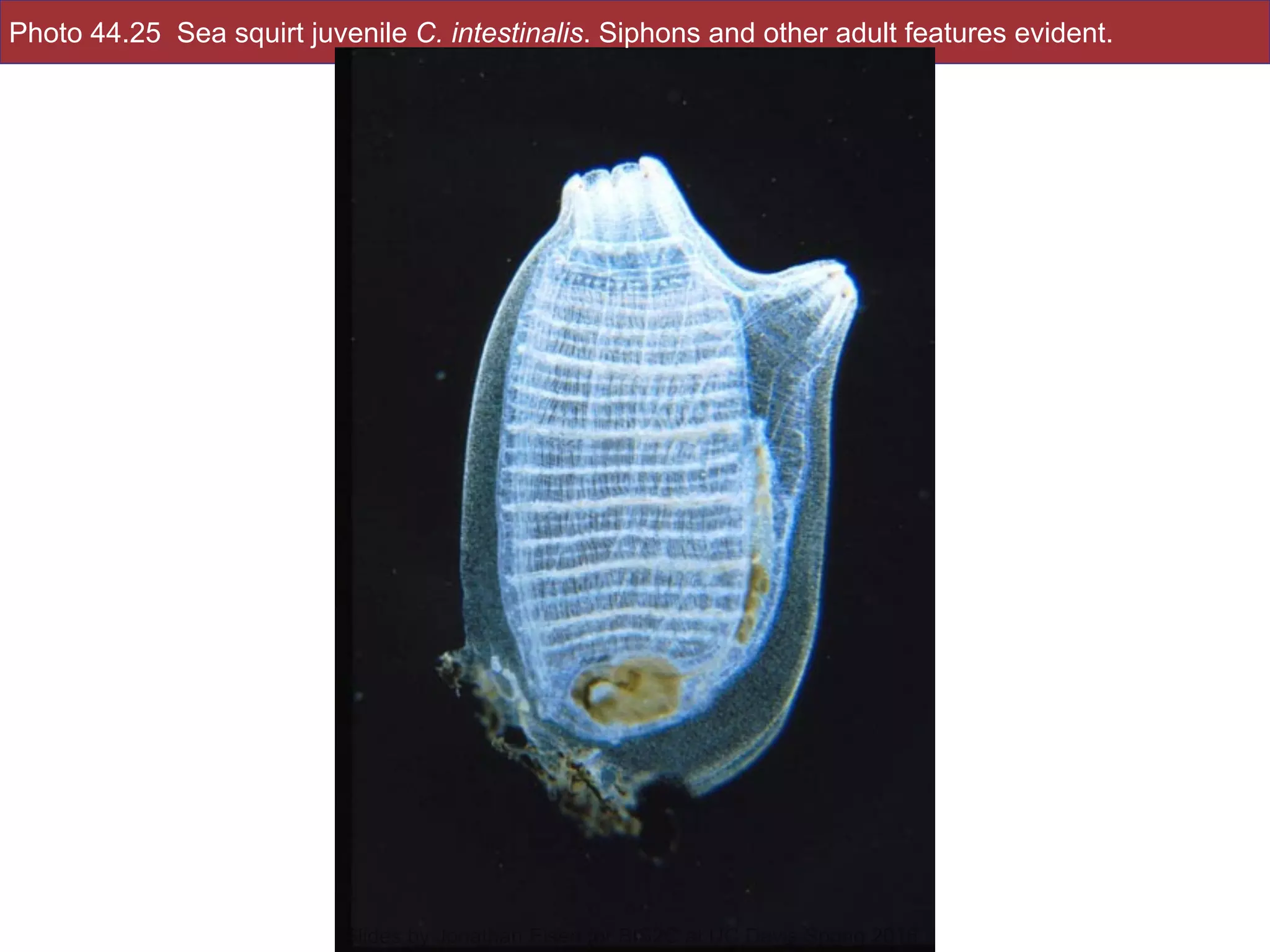
Photo 44.25 Sea squirt juvenile C. intestinalis. Siphons and other adult features evident.
!37Slides by Jonathan Eisen for BIS2C at UC Davis Spring 2016
Slides by Jonathan Eisen for BIS2C at UC Davis Spring 2016
Juvenile Tunicates
38
Ascidian tunicate larva
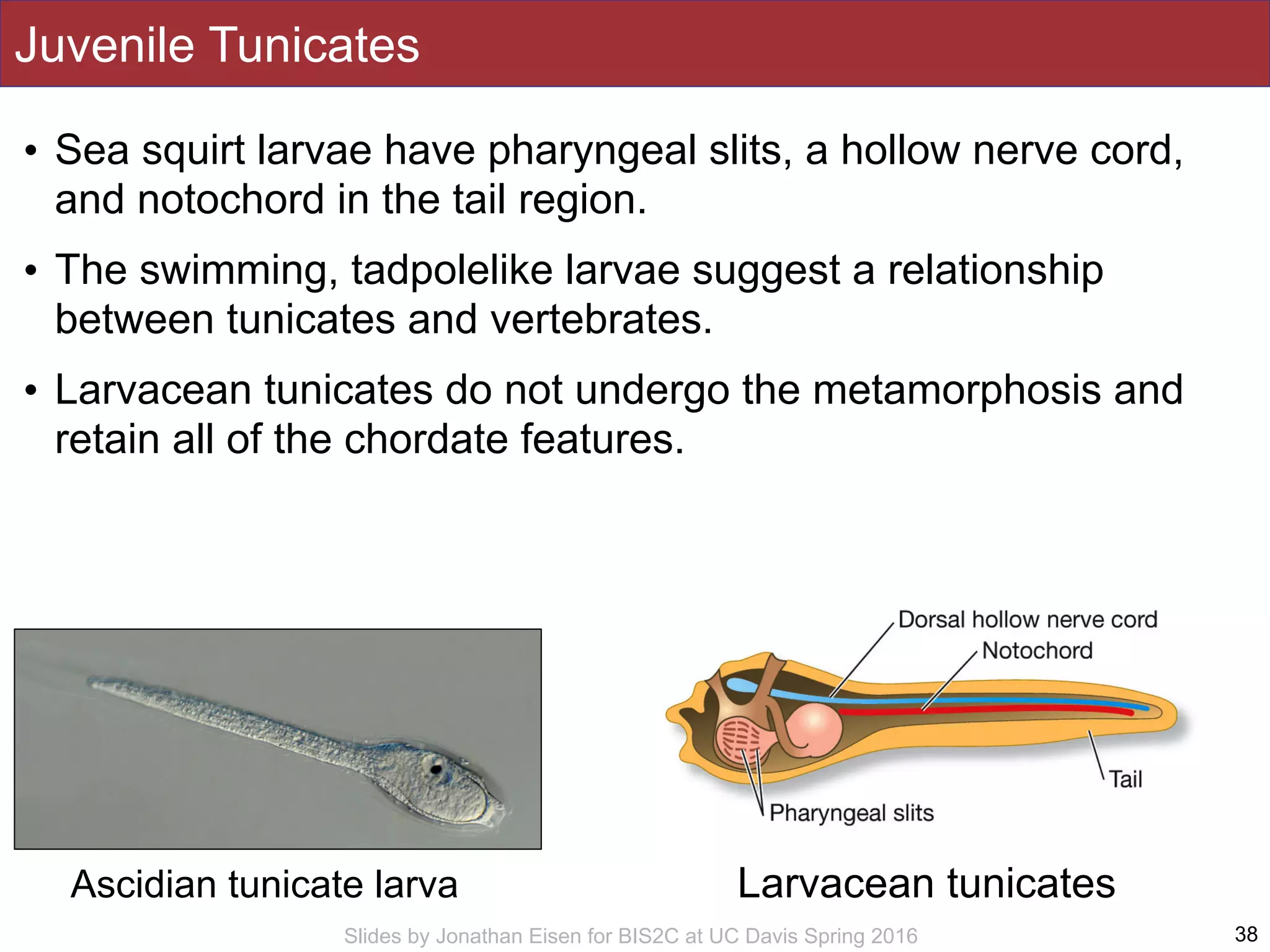
• Sea squirt larvae have pharyngeal slits, a hollow nerve cord,
and notochord in the tail region.
• The swimming, tadpolelike larvae suggest a relationship
between tunicates and vertebrates.
• Larvacean tunicates do not undergo the metamorphosis and
retain all of the chordate features.
Larvacean tunicates
• Where have we seen big differences between larval
forms and adult forms?
!39Slides by Jonathan Eisen for BIS2C at UC Davis Spring 2016
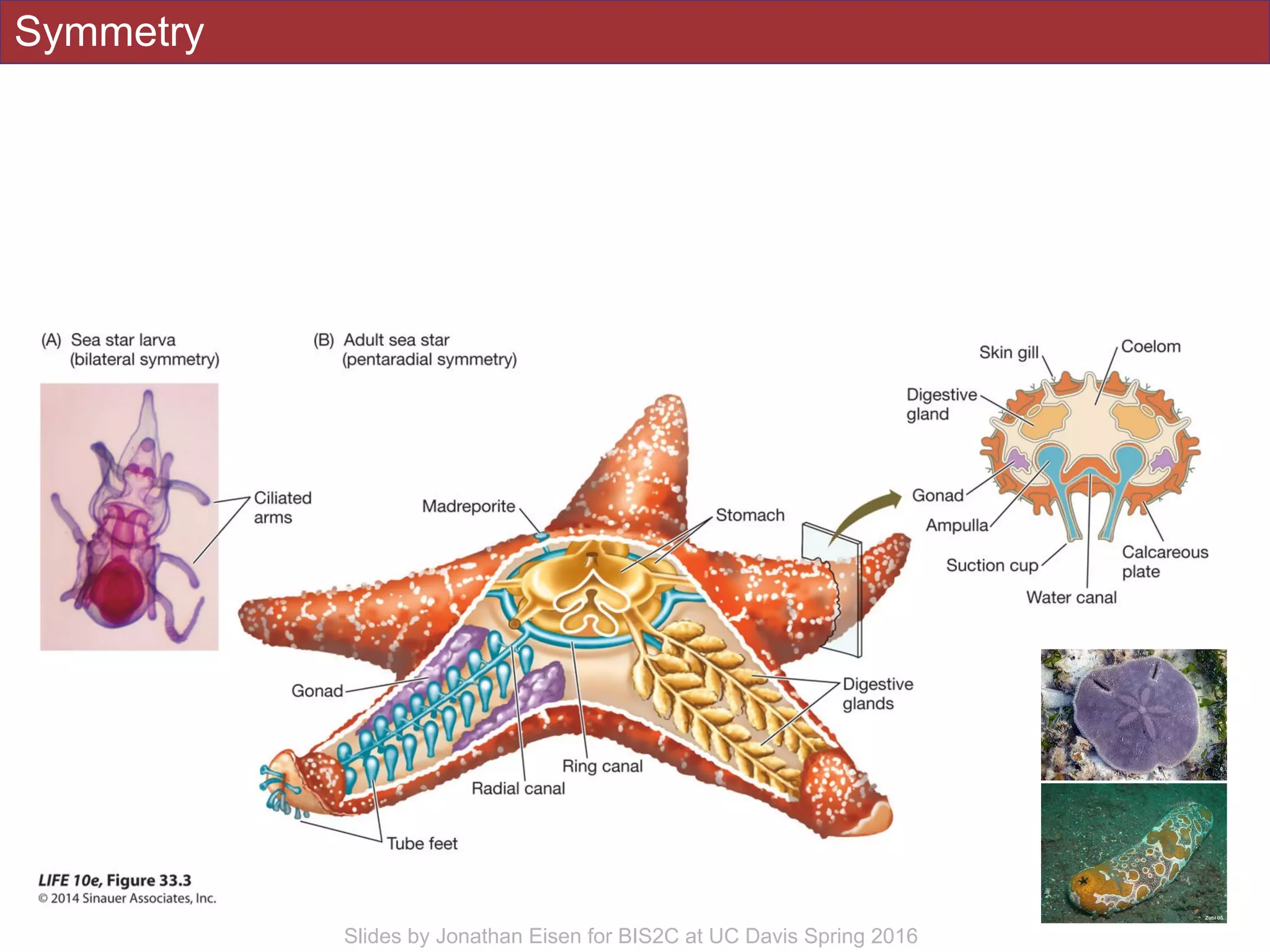
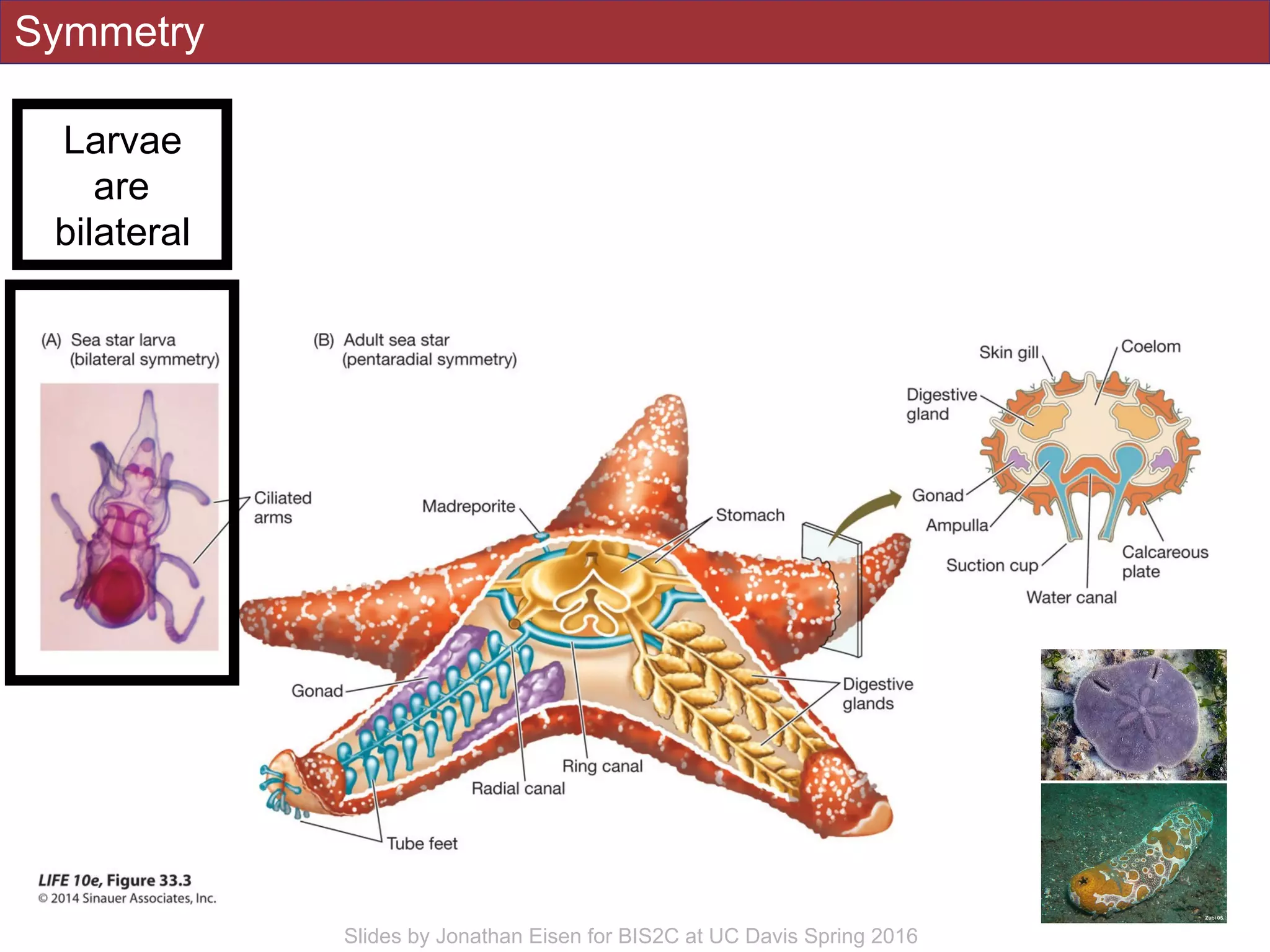
Symmetry
Slides by Jonathan Eisen for BIS2C at UC Davis Spring 2016
Symmetry
Slides by Jonathan Eisen for BIS2C at UC Davis Spring 2016
Larvae
are
bilateral
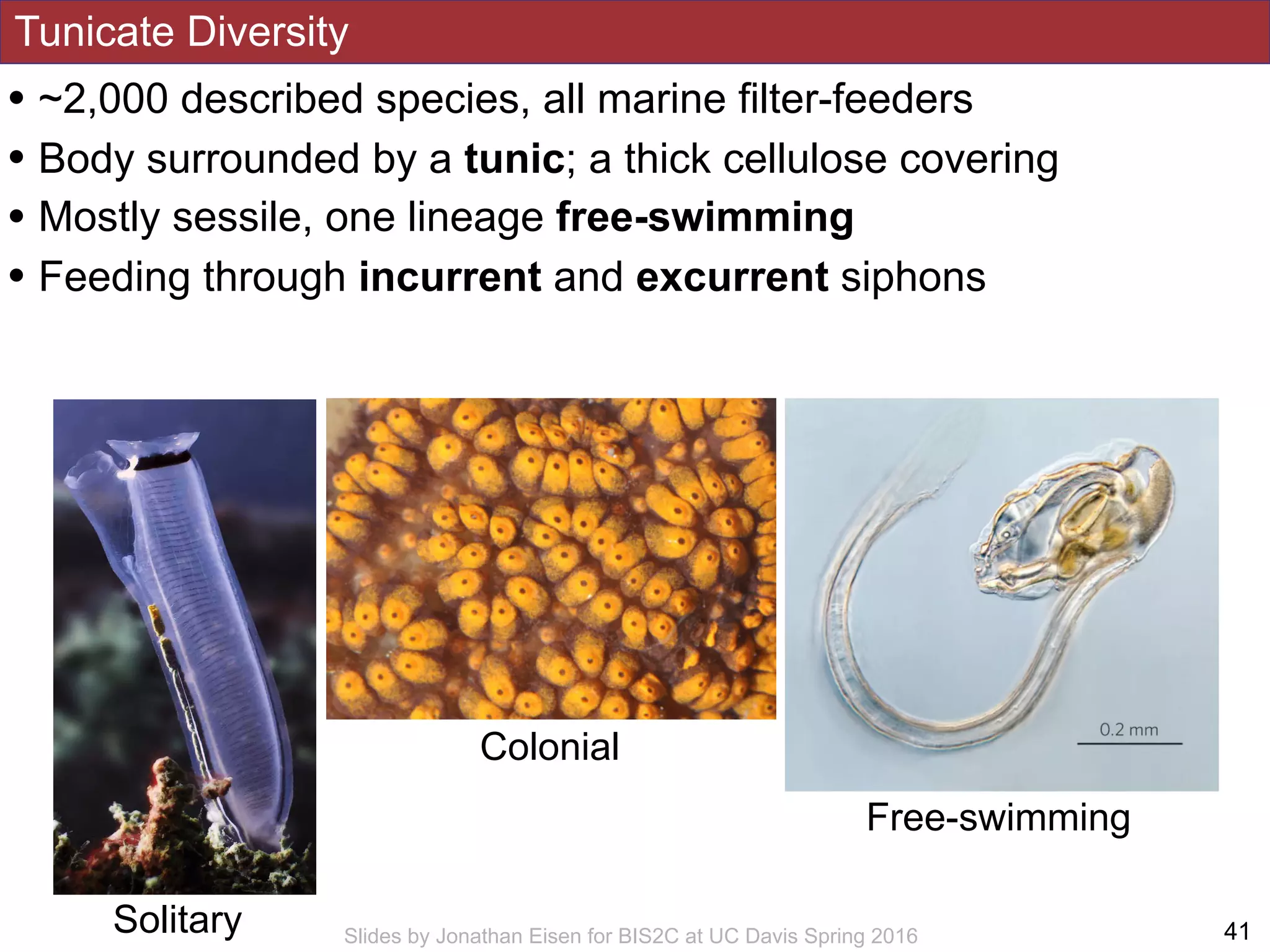
Tunicate Diversity
!41Slides by Jonathan Eisen for BIS2C at UC Davis Spring 2016
• ~2,000 described species, all marine filter-feeders
• Body surrounded by a tunic; a thick cellulose covering
• Mostly sessile, one lineage free-swimming
• Feeding through incurrent and excurrent siphons
Solitary
Colonial
Free-swimming
!42Slides by Jonathan Eisen for BIS2C at UC Davis Spring 2016
Slides by Jonathan Eisen for BIS2C at UC Davis Spring 2016
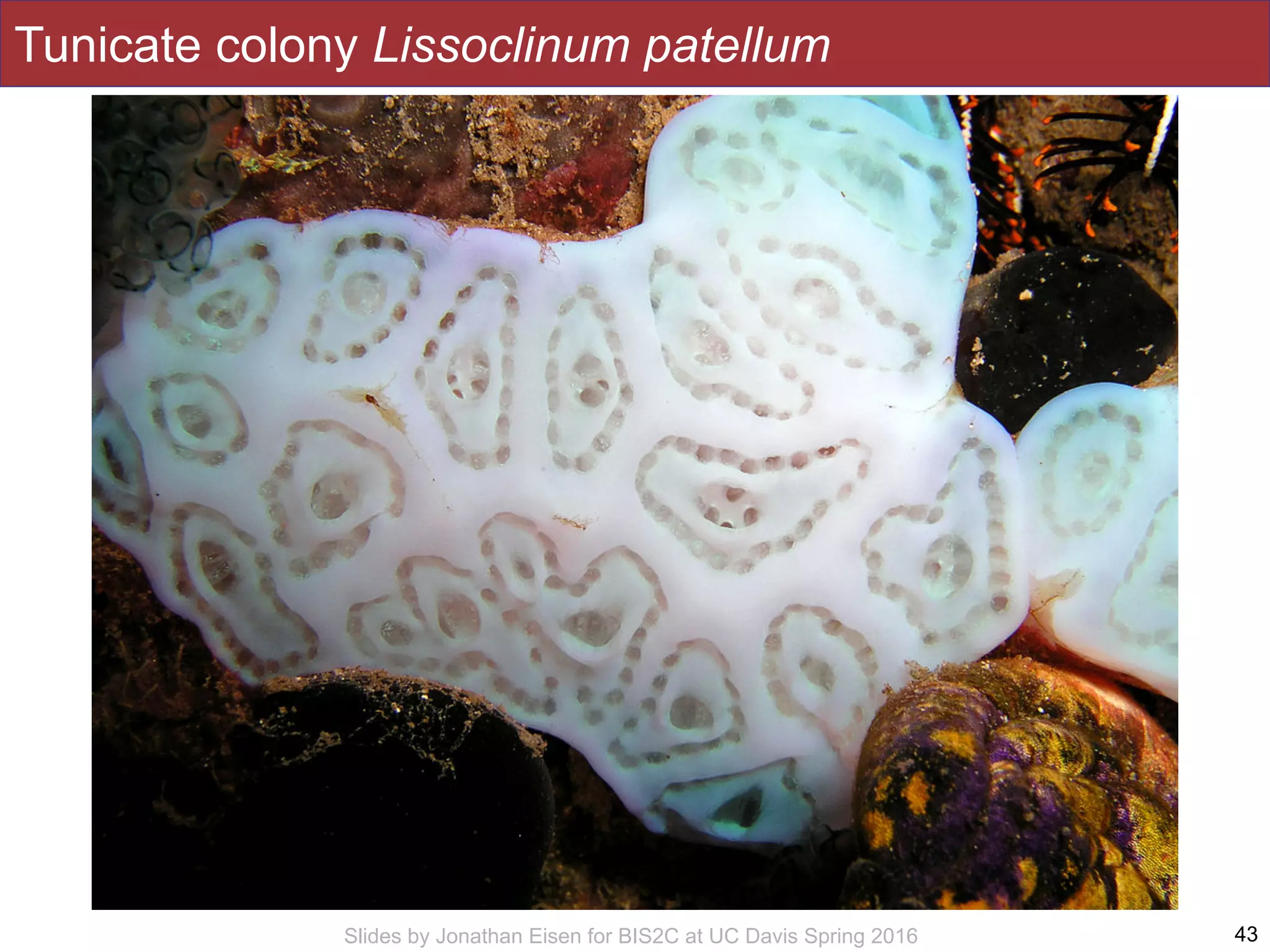
Tunicate colony Lissoclinum patellum
43
Slides by Jonathan Eisen for BIS2C at UC Davis Spring 2016
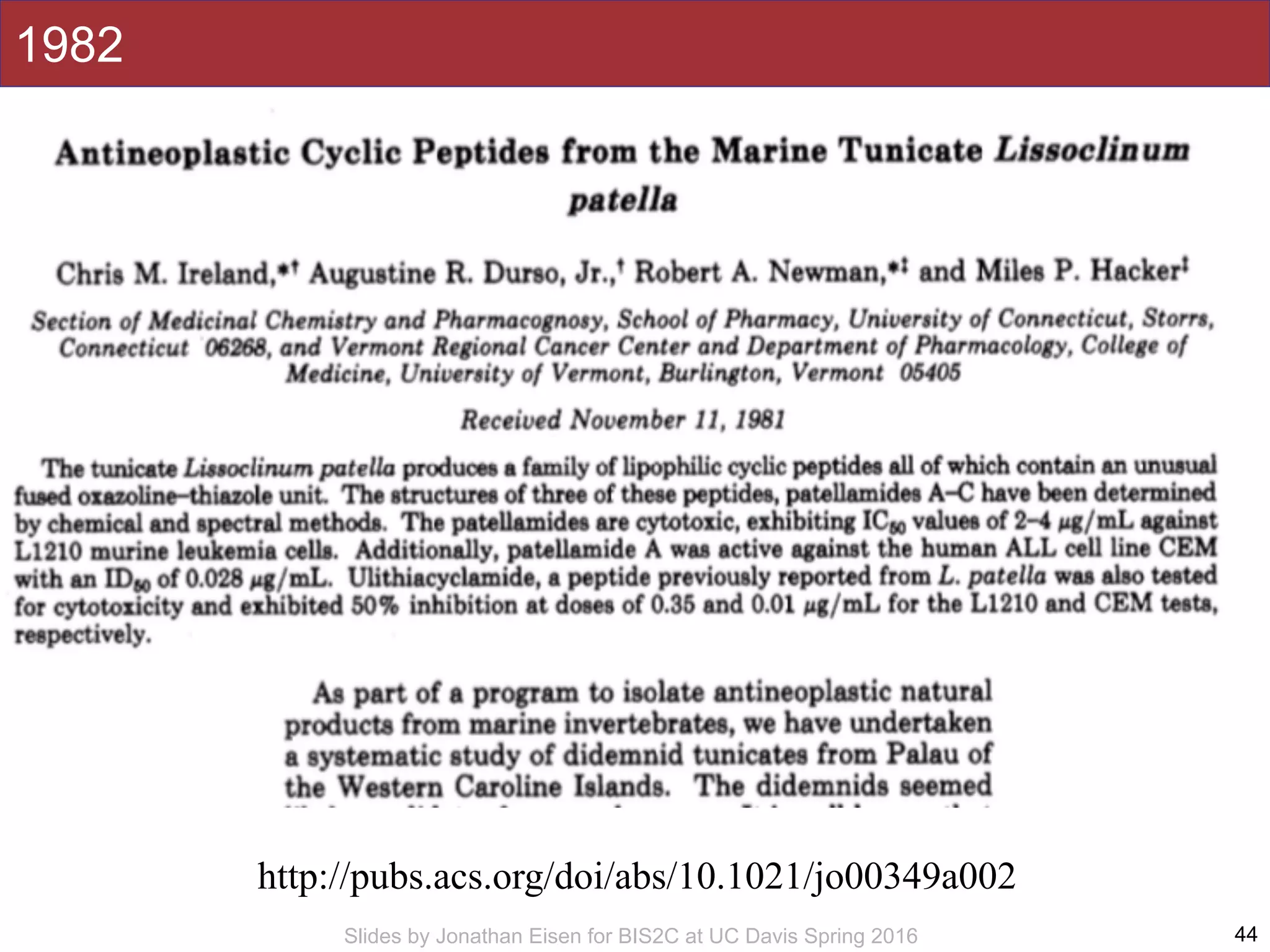
1982
44
http://pubs.acs.org/doi/abs/10.1021/jo00349a002
Slides by Jonathan Eisen for BIS2C at UC Davis Spring 2016 45
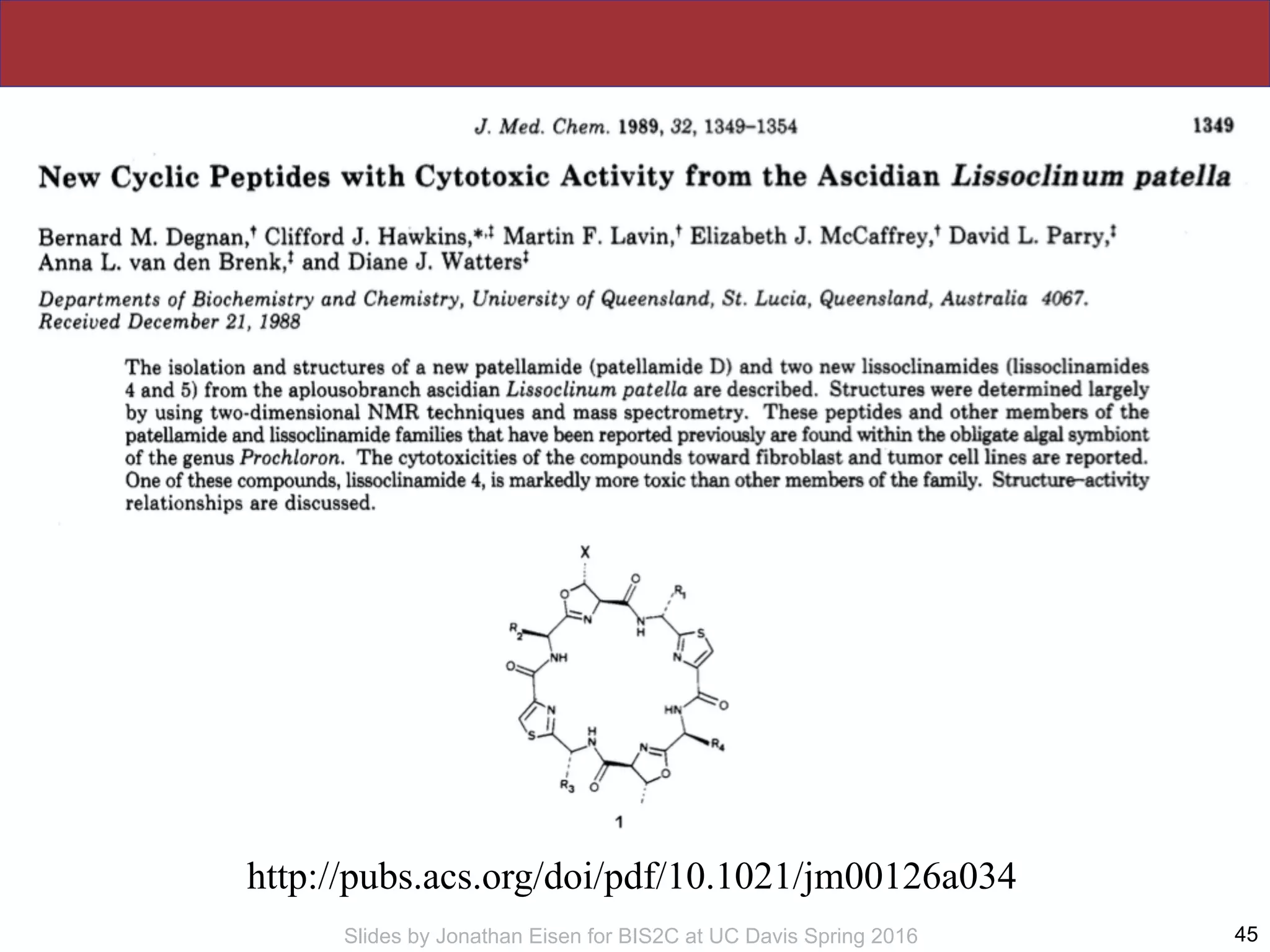
http://pubs.acs.org/doi/pdf/10.1021/jm00126a034
Slides by Jonathan Eisen for BIS2C at UC Davis Spring 2016
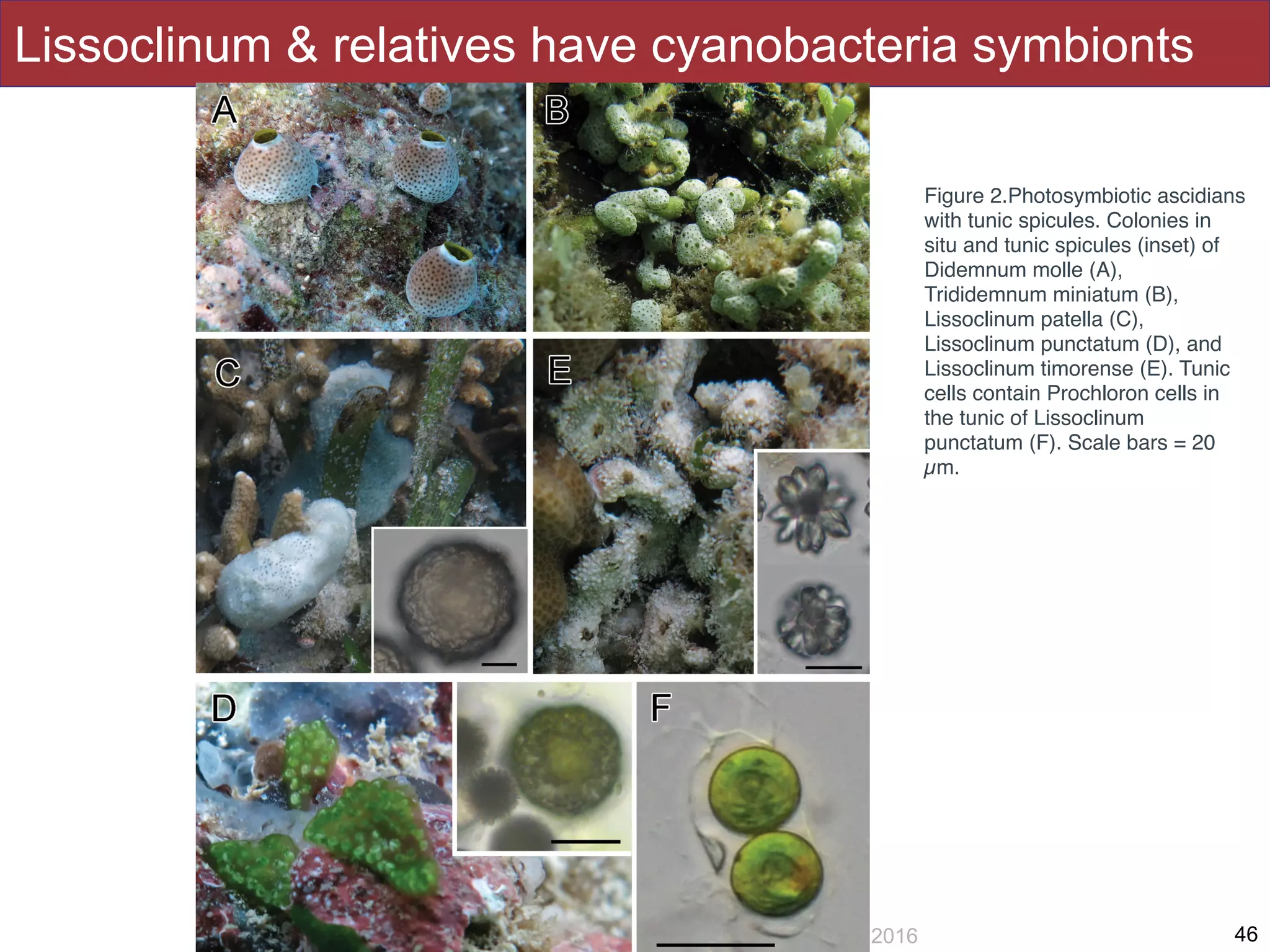
Lissoclinum & relatives have cyanobacteria symbionts
46
Figure 2.Photosymbiotic ascidians
with tunic spicules. Colonies in
situ and tunic spicules (inset) of
Didemnum molle (A),
Trididemnum miniatum (B),
Lissoclinum patella (C),
Lissoclinum punctatum (D), and
Lissoclinum timorense (E). Tunic
cells contain Prochloron cells in
the tunic of Lissoclinum
punctatum (F). Scale bars = 20
µm. 
Slides by Jonathan Eisen for BIS2C at UC Davis Spring 2016
Lesson …
• If you find a novel biochemical activity in
some animal …
• Most likely it is NOT actually from the
animal
48
Slides by Jonathan Eisen for BIS2C at UC Davis Spring 2016
Clicker
What groups of animals have we seen to
have autotrophic mutualistic symbionts?
A. Annelids
B. Cnidarians
C. Protostomes
D. Chordates
E. All of the above
49
Slides by Jonathan Eisen for BIS2C at UC Davis Spring 2016
Clicker
What groups of animals have we seen to
have autotrophic mutualistic symbionts?
A. Annelids
B. Cnidarians
C. Protostomes
D. Chordates
E. All of the above
50
Slides by Jonathan Eisen for BIS2C at UC Davis Spring 2016
Clicker
What groups of animals have we seen to
have autotrophic mutualistic symbionts?
A. Annelids (Tubeworms)
B. Cnidarians (Coral)
C. Protostomes (Tubeworms)
D. Chordates (Tunicates)
E. All of the above
51
Filled with Bacteria
52Slides by Jonathan Eisen for BIS2C at UC Davis Spring 2016
Basic Tubeworm Anatomy
Dr. Colleen Cavanaugh used microscopy
techniques in 1981 and discovered billions
of bacterial cells packed inside the
tubeworm’s trophosome.
1011 bacteria per gram of trophosome!!
Plume
Trophosome
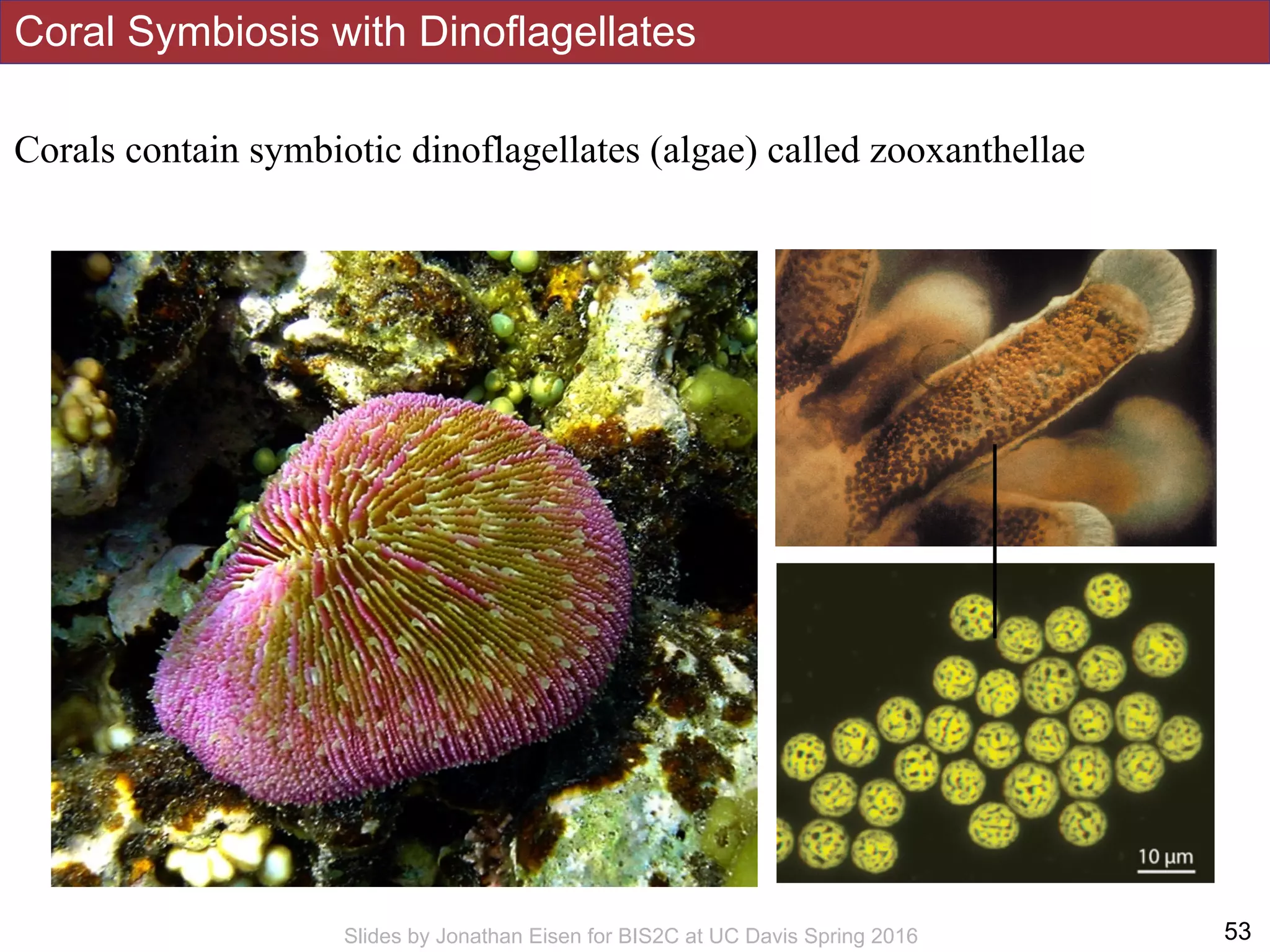
Coral Symbiosis with Dinoflagellates
!53Slides by Jonathan Eisen for BIS2C at UC Davis Spring 2016
Corals contain symbiotic dinoflagellates (algae) called zooxanthellae
Slides by Jonathan Eisen for BIS2C at UC Davis Spring 2016
Other Examples?
54
Slides by Jonathan Eisen for BIS2C at UC Davis Spring 2016
Other Types of Mutualisms in Animals?
55
Slides by Jonathan Eisen for BIS2C at UC Davis Spring 2016
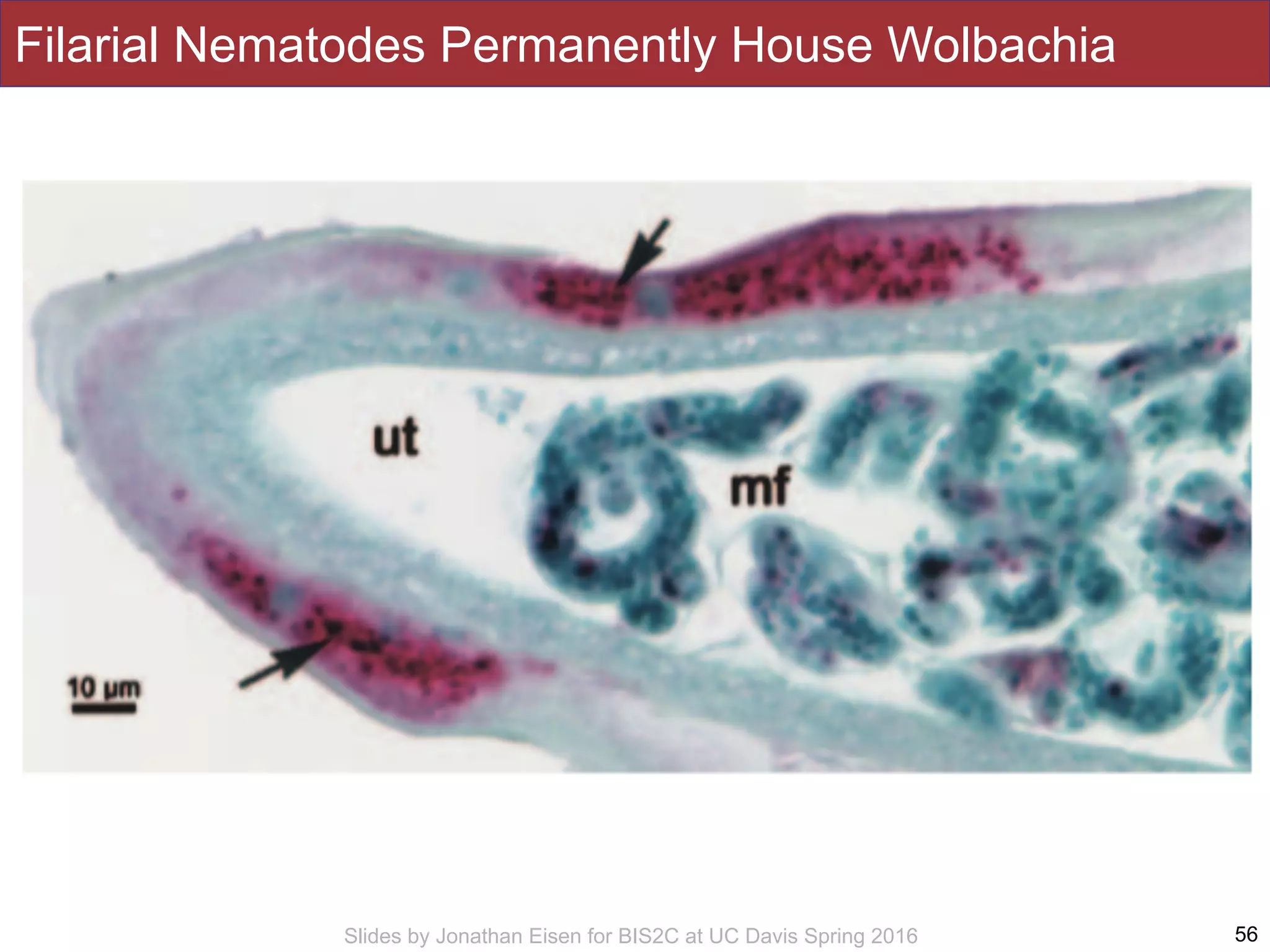
Filarial Nematodes Permanently House Wolbachia
56
Vertebrate Origins
!57Slides by Jonathan Eisen for BIS2C at UC Davis Spring 2016
Ciliated
larvae
AmbulacrariansChordates
Common
ancestor
(bilaterally
symmetrical,
pharyngeal
slits
present)
Echinoderms
Hemichordates
Lancelets
Tunicates
Vertebrates
Radial symmetry as adults,
calcified internal plates,
loss of pharyngeal slits
Vertebral column, anterior skull,
large brain, ventral heart
Notochord,
dorsal hollow
nerve cord,
post-anal tail
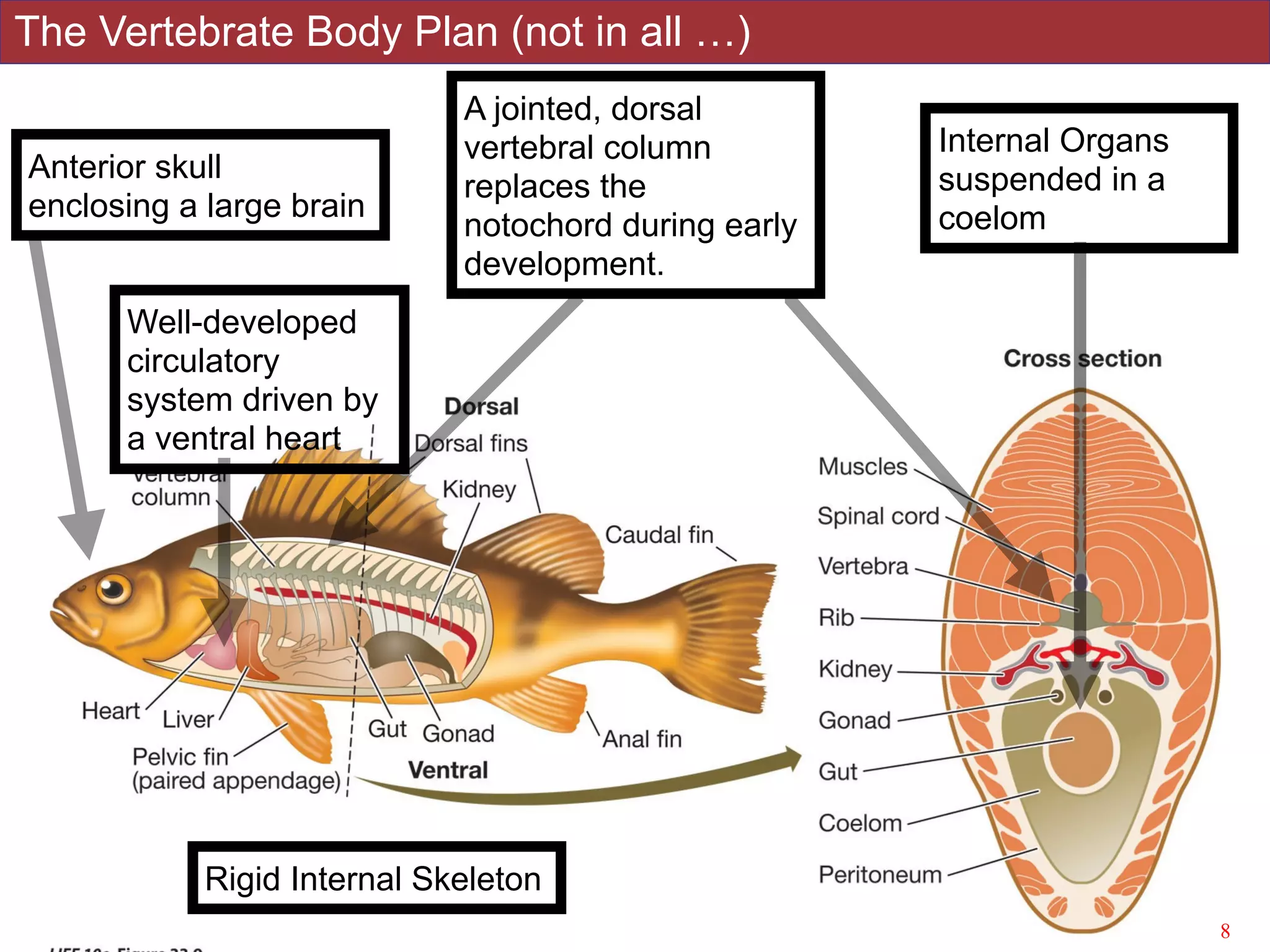
The Vertebrate Body Plan (not in all …)
!58Slides by Jonathan Eisen for BIS2C at UC Davis Spring 2016
Anterior skull
enclosing a large brain
A jointed, dorsal
vertebral column
replaces the
notochord during early
development.
Internal Organs
suspended in a
coelom
Well-developed
circulatory
system driven by
a ventral heart
Rigid Internal Skeleton
Slides by Jonathan Eisen for BIS2C at UC Davis Spring 2016
Vertebrate Evolution
• The structural features can support large,
active animals.
• Internal skeleton supports an extensive
muscular system that gets oxygen from the
circulatory system and is controlled by the
nervous system.
• These features allowed vertebrates to
diversify widely.
59
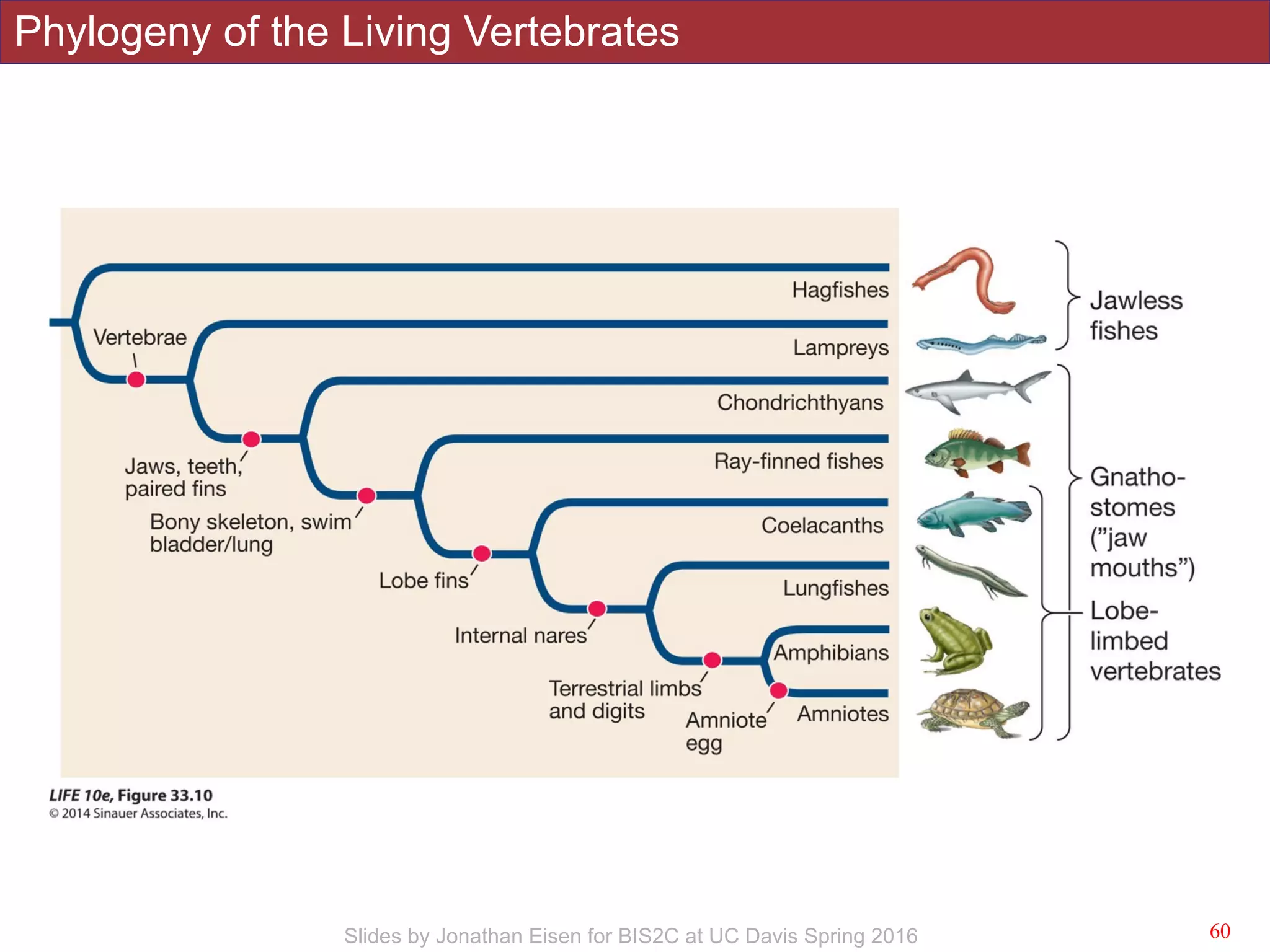
Phylogeny of the Living Vertebrates
!60Slides by Jonathan Eisen for BIS2C at UC Davis Spring 2016
Slides by Jonathan Eisen for BIS2C at UC Davis Spring 2016
Vertebrates and Land
• All other deuterostomes are marine.
• Vertebrates probably evolved in the oceans
or estuarine environments during the
Cambrian period.
• They have radiated into marine, freshwater,
terrestrial, and aerial environments.
61
Slides by Jonathan Eisen for BIS2C at UC Davis Spring 2016
Jawless Fishes (hagfish and lampreys)
62
Slides by Jonathan Eisen for BIS2C at UC Davis Spring 2016
Sister group for all other vertebrates
63
Hagfish
Slides by Jonathan Eisen for BIS2C at UC Davis Spring 2016
• Weak circulatory system w/ 3 small hearts, a partial cranium,
no stomach, no jaws
• NO BONE (skeleton is cartilage); no vertebrae.
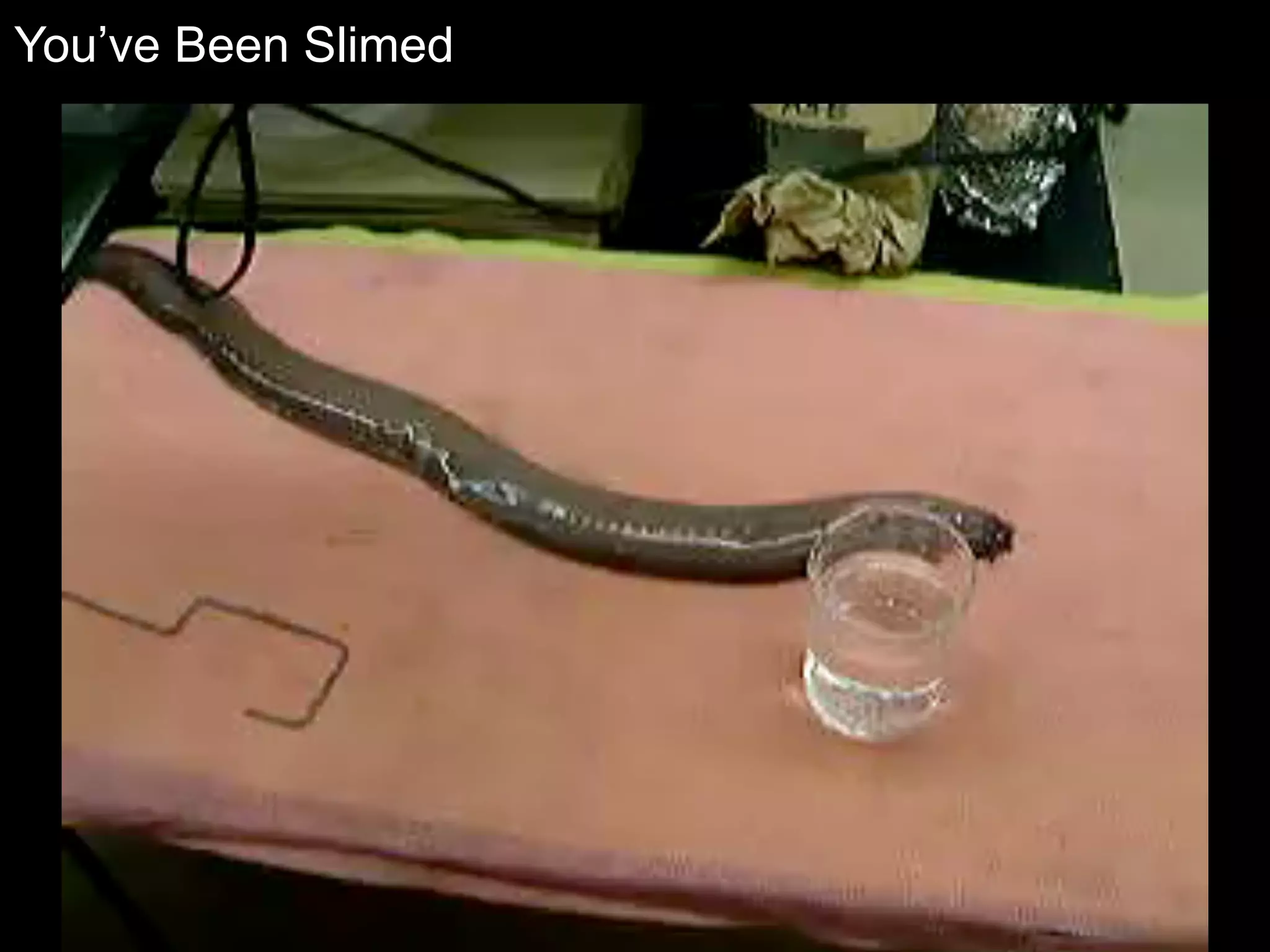
• Blind and produce large amounts of slime as a defense
• They have a specialized structure to capture prey and tear
up dead organisms.
• Development is direct; adults can change sex from year to
year.
64
Hagfish not quite full vertebrates
Photo 33.18 Pacific hagfish (Eptatretus stouti).
Slides by Jonathan Eisen for BIS2C at UC Davis Spring 2016
• https://youtu.be/bqk0mnMgwUQ
66
You’ve Been Slimed
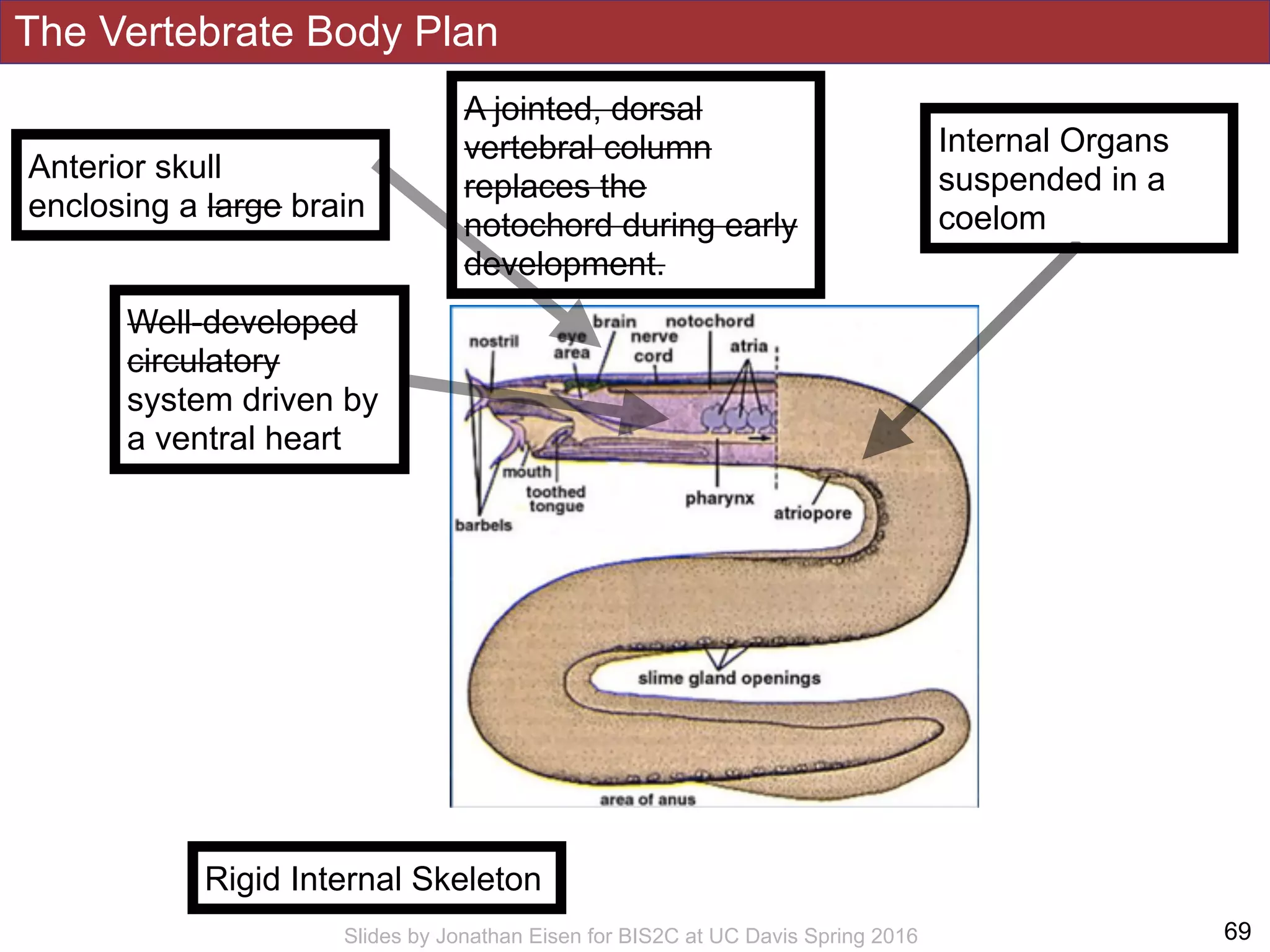
!69Slides by Jonathan Eisen for BIS2C at UC Davis Spring 2016
Anterior skull
enclosing a large brain
A jointed, dorsal
vertebral column
replaces the
notochord during early
development.
Internal Organs
suspended in a
coelom
Rigid Internal Skeleton
Well-developed
circulatory
system driven by
a ventral heart
The Vertebrate Body Plan
Slides by Jonathan Eisen for BIS2C at UC Davis Spring 2016 70
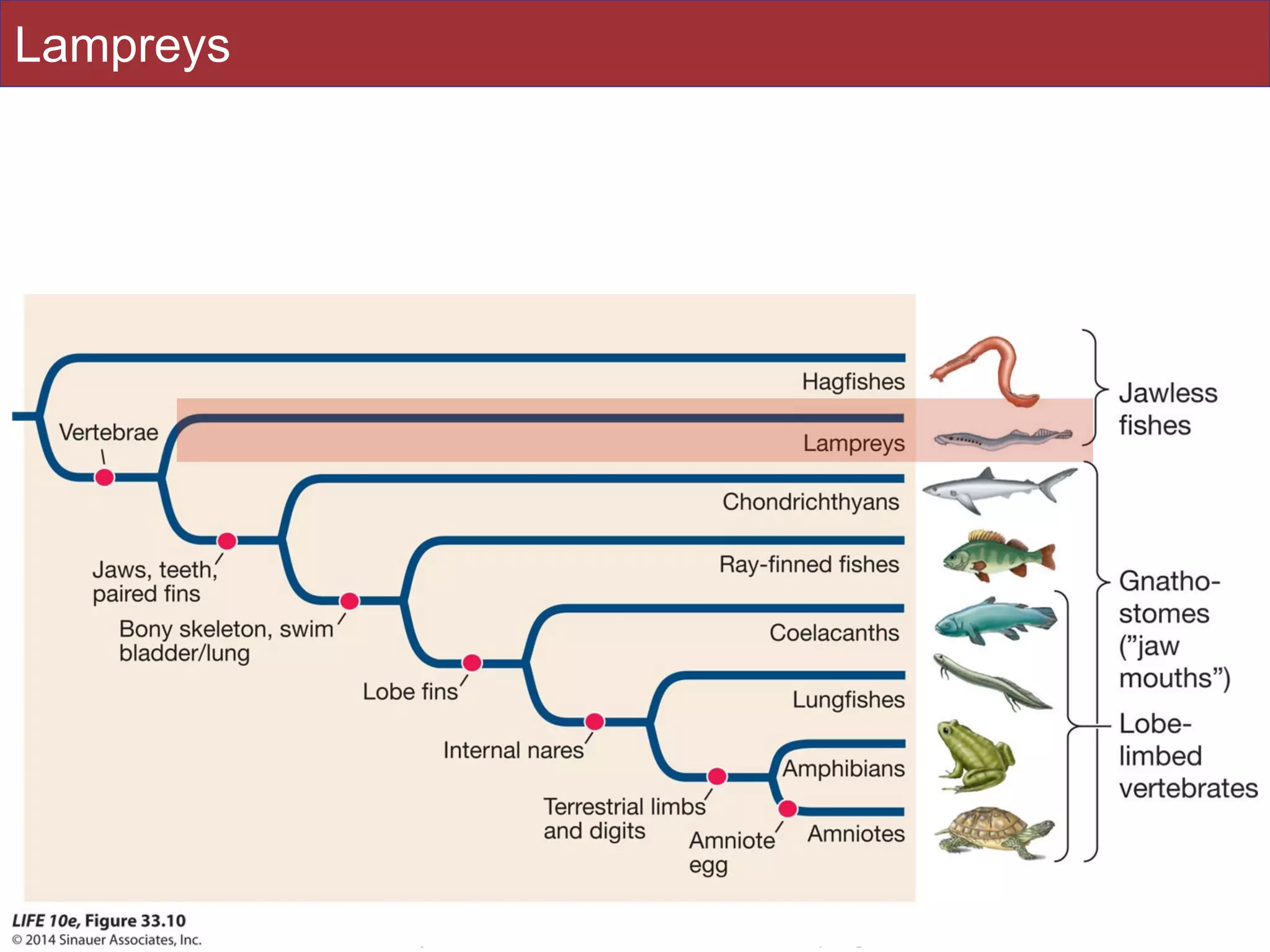
Lampreys
Slides by Jonathan Eisen for BIS2C at UC Davis Spring 2016
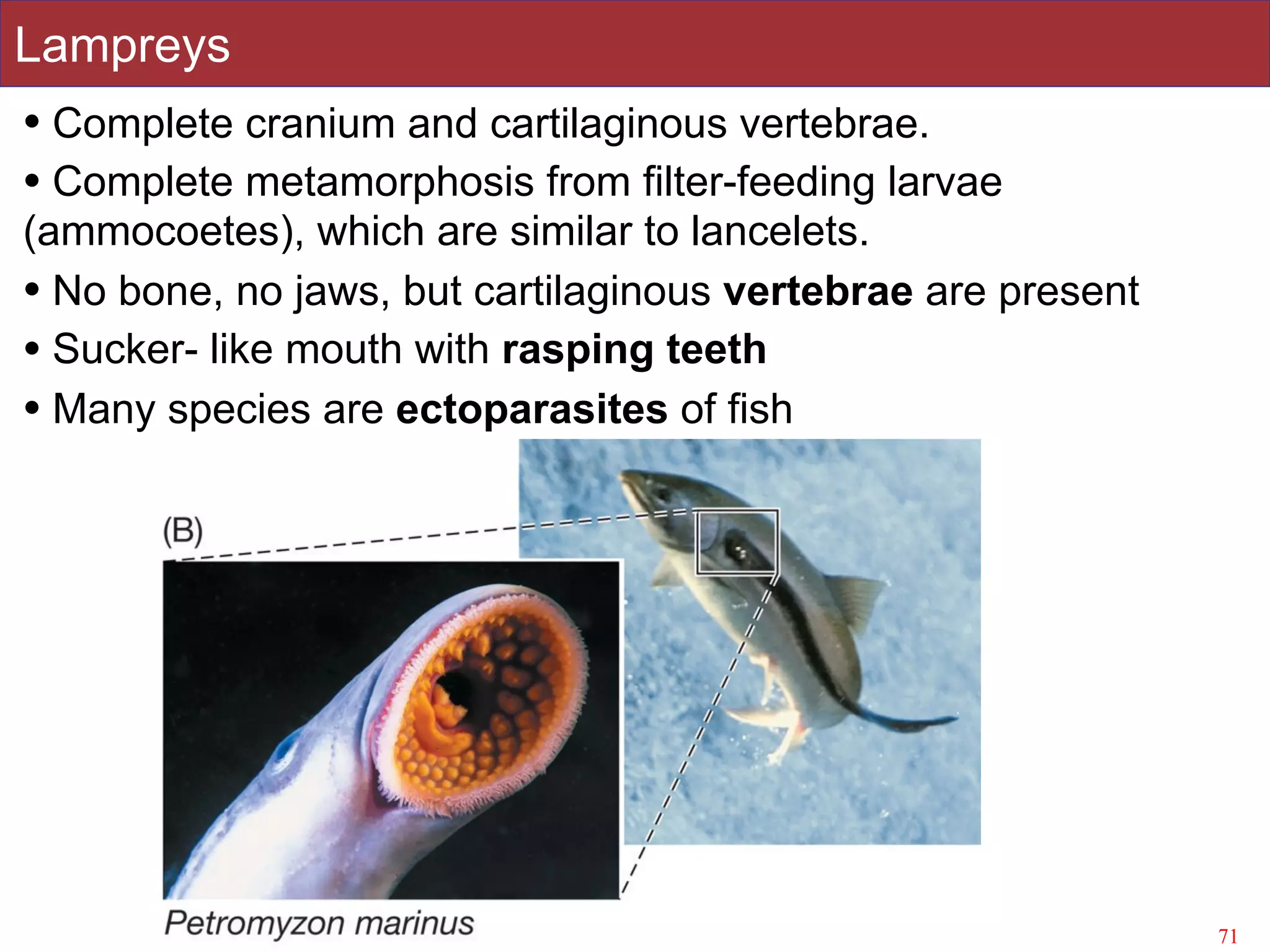
Lampreys
71
• Complete cranium and cartilaginous vertebrae.
• Complete metamorphosis from filter-feeding larvae
(ammocoetes), which are similar to lancelets.
• No bone, no jaws, but cartilaginous vertebrae are present
• Sucker- like mouth with rasping teeth
• Many species are ectoparasites of fish
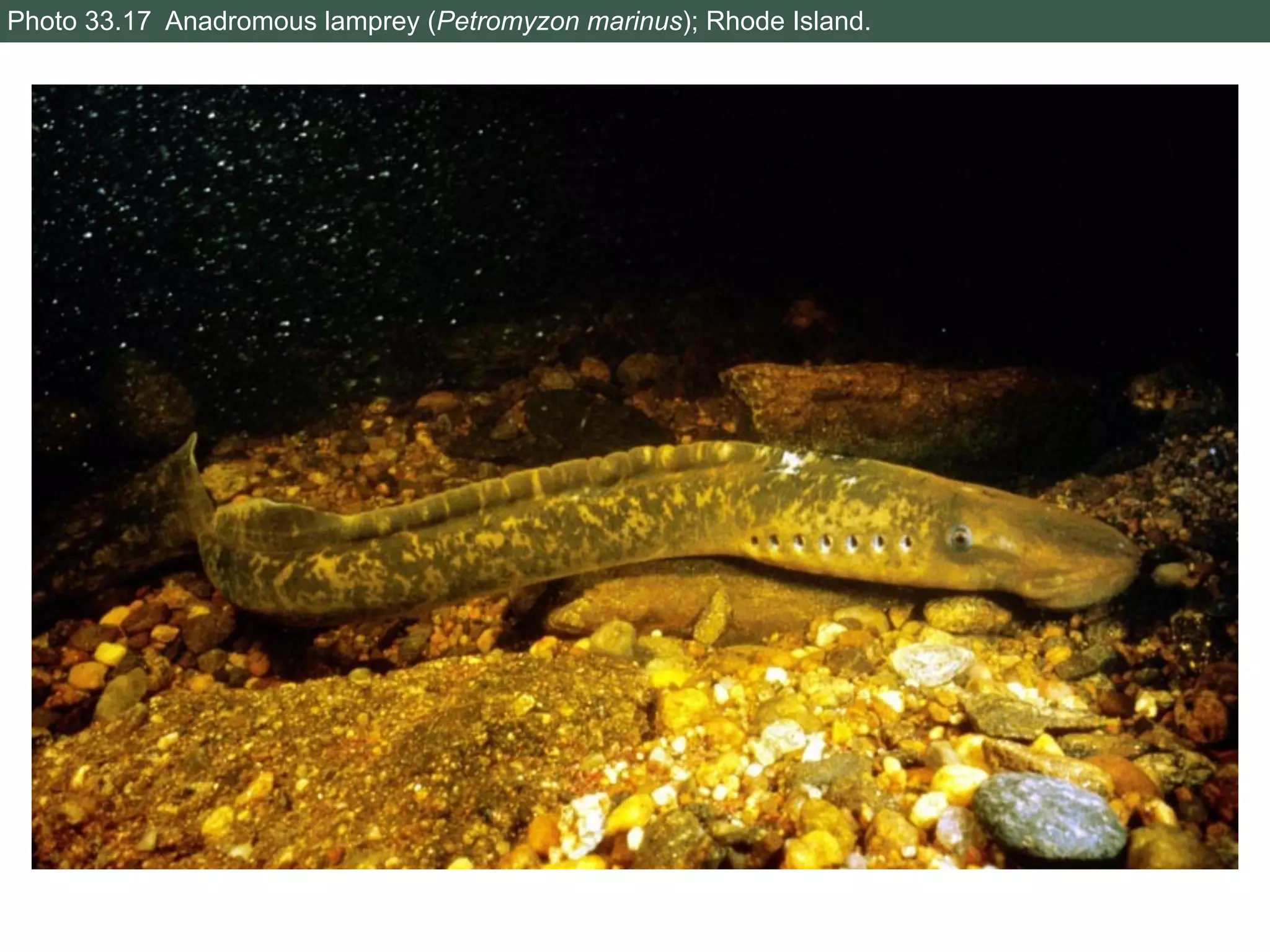
Photo 33.17 Anadromous lamprey (Petromyzon marinus); Rhode Island.
Slides by Jonathan Eisen for BIS2C at UC Davis Spring 2016 73

BIS2C: Lecture 32 - Deuterosomes II: Chordates

  • 1.
    Slides by JonathanEisen for BIS2C at UC Davis Spring 2016 Lecture 32: Deuterosomes II: Chordates BIS 002C Biodiversity & the Tree of Life Spring 2016 Prof. Jonathan Eisen 2
  • 2.
    Slides by JonathanEisen for BIS2C at UC Davis Spring 2016 Where we are going and where we have been… 3 •Previous lecture: •31: Deuterosomes I: Echinoderms & Hemichordates •Current Lecture: •32: Deuterosomes II: Chordates •Next Lecture: •33: Deuterosomes III: Chordates II
  • 3.
    Slides by JonathanEisen for BIS2C at UC Davis Spring 2016 Animal Diversity 4 Diploblasts Triploblasts Monoblasts
  • 4.
    Slides by JonathanEisen for BIS2C at UC Davis Spring 2016 Triploblasts 5 Triploblasts
  • 5.
    Slides by JonathanEisen for BIS2C at UC Davis Spring 2016 Protostomes 6
  • 6.
    Slides by JonathanEisen for BIS2C at UC Davis Spring 2016 Clicker What evidence is consistent with echinoderms being deuterostomes? A. Molecular phylogenetics B. Blastopore developing into anus C. Presence of bilateral symmetry D. All of A-C E. None of A-C 7
  • 7.
    Slides by JonathanEisen for BIS2C at UC Davis Spring 2016 Clicker What evidence is consistent with echinoderms being deuterostomes? A. Molecular phylogenetics B. Blastopore developing into anus C. Presence of bilateral symmetry D. All of A-C E. None of A-C 8
  • 8.
    Slides by JonathanEisen for BIS2C at UC Davis Spring 2016 Chordates 9 Echinoderms Hemichordates Chordates
  • 9.
    Slides by JonathanEisen for BIS2C at UC Davis Spring 2016 Chordates 10 Chordates Common ancestor (bilaterally symmetrical, pharyngeal slits present) Echinoderms Hemichordates Lancelets Tunicates VertebratesVertebral column, anterior skull, large brain, ventral heart Notochord, dorsal hollow nerve cord, post-anal tail Radial symmetry as adults, calcified internal plates, loss of pharyngeal slits Ciliated larvae Ambulacrarians Focus on Chordates
  • 10.
    Slides by JonathanEisen for BIS2C at UC Davis Spring 2016 Deuterostomes 11
  • 11.
    Slides by JonathanEisen for BIS2C at UC Davis Spring 2016 Deuterostomes 11
  • 12.
    Chordate Derived TraitsMost Apparent in Juveniles !12Slides by Jonathan Eisen for BIS2C at UC Davis Spring 2016
  • 13.
    Notochord !13Slides by JonathanEisen for BIS2C at UC Davis Spring 2016 • Notochord is a dorsal supporting rod. • Core of large cells with fluid-filled vacuoles, making it rigid but flexible. • In tunicates it is lost during metamorphosis to the adult stage. • In vertebrates it is replaced by skeletal structures.
  • 14.
    Dorsal hollow nervecord !14Slides by Jonathan Eisen for BIS2C at UC Davis Spring 2016 • Formed by an embryonic folding of the ectoderm • Develops to form the central nervous system in vertebrates
  • 15.
    Post Anal Tail !15Slidesby Jonathan Eisen for BIS2C at UC Davis Spring 2016 • Extension of the body past the anal opening • In some species (e.g., humans) most visible in embryos • The combination of postanal tail, notochord, and muscles provides propulsion
  • 16.
    Pharyngeal Slits !16Slides byJonathan Eisen for BIS2C at UC Davis Spring 2016 • The pharynx is a muscular organ that brings water in through the mouth (via cilia) which then passes through a series of openings to the outside (slits). • Ancestral pharyngeal slits present at some developmental stage; often lost or modified in adults. • Supported by pharyngeal arches.
  • 17.
    Slides by JonathanEisen for BIS2C at UC Davis Spring 2016 Clicker 17 Why are pharyngeal slits NOT considered a synapomorphy (shared derived trait) of chordates? A. They occur in other deuterostomes B. They are lost in some chordates C. They are modified into gills in vertebrates D. They only occur in the embryo of some chordates
  • 18.
    Slides by JonathanEisen for BIS2C at UC Davis Spring 2016 Clicker 18 Why are pharyngeal slits NOT considered a synapomorphy (shared derived trait) of chordates? A. They occur in other deuterostomes B. They are lost in some chordates C. They are modified into gills in vertebrates D. They only occur in the embryo of some chordates
  • 19.
    Figure 33.1 Phylogenyof the Deuterostomes !19Slides by Jonathan Eisen for BIS2C at UC Davis Spring 2016
  • 20.
    Slides by JonathanEisen for BIS2C at UC Davis Spring 2016 Chordates 20 Chordates Common ancestor (bilaterally symmetrical, pharyngeal slits present) Echinoderms Hemichordates Lancelets Tunicates VertebratesVertebral column, anterior skull, large brain, ventral heart Notochord, dorsal hollow nerve cord, post-anal tail Radial symmetry as adults, calcified internal plates, loss of pharyngeal slits Ciliated larvae Ambulacrarians Focus on Chordates
  • 21.
    Slides by JonathanEisen for BIS2C at UC Davis Spring 2016 Chordates 21 Chordates Common ancestor (bilaterally symmetrical, pharyngeal slits present) Echinoderms Hemichordates Lancelets Tunicates VertebratesVertebral column, anterior skull, large brain, ventral heart Notochord, dorsal hollow nerve cord, post-anal tail Radial symmetry as adults, calcified internal plates, loss of pharyngeal slits Ciliated larvae Ambulacrarians Three Major Groups *Lancelets *Tunicates *Vertebrates
  • 22.
    Slides by JonathanEisen for BIS2C at UC Davis Spring 2016 Lancelets (aka Cephalochordates) 22 Chordates Common ancestor (bilaterally symmetrical, pharyngeal slits present) Echinoderms Hemichordates Lancelets Tunicates VertebratesVertebral column, anterior skull, large brain, ventral heart Notochord, dorsal hollow nerve cord, post-anal tail Radial symmetry as adults, calcified internal plates, loss of pharyngeal slits Ciliated larvae Ambulacrarians Focus on Lancelets
  • 23.
    Slides by JonathanEisen for BIS2C at UC Davis Spring 2016 Lancelet development 23
  • 24.
    Slides by JonathanEisen for BIS2C at UC Davis Spring 2016 24 Branchiostoma lanceolatum Gut TailAnus Dorsal hollow nerve cord NotochordPharyngeal slits Lancelet Has Key Chordate Features
  • 25.
    Slides by JonathanEisen for BIS2C at UC Davis Spring 2016 25 Branchiostoma lanceolatum TailAnus Dorsal hollow nerve cord NotochordPharyngeal slits Lancelet Features • Lancelets (aka amphioxus) are very small, less than 5 cm. • Notochord is retained throughout life. • Burrow in sand with head protruding; also swim. • Pharynx is enlarged to form a pharyngeal basket for filtering prey from the water. • Fertilization takes place in the water. • Segmented body muscles
  • 26.
    Slides by JonathanEisen for BIS2C at UC Davis Spring 2016 Tunicates 26 Chordates Common ancestor (bilaterally symmetrical, pharyngeal slits present) Echinoderms Hemichordates Lancelets Tunicates VertebratesVertebral column, anterior skull, large brain, ventral heart Notochord, dorsal hollow nerve cord, post-anal tail Radial symmetry as adults, calcified internal plates, loss of pharyngeal slits Ciliated larvae Ambulacrarians Focus on Tunicates
  • 27.
    Slides by JonathanEisen for BIS2C at UC Davis Spring 2016 Adult Tunicates 27 • Tunicates (sea squirts or ascidians, thaliaceans, and larvaceans): • Sea squirts form colonies by budding from a single founder. Colonies may be meters across. • Adult body is baglike and enclosed in a “tunic” of proteins and complex polysaccharides secreted by the epidermis.
  • 28.
    Slides by JonathanEisen for BIS2C at UC Davis Spring 2016 Adult Tunicates 28 • Solitary tunicates seem to lack all of the synapomorphies of chordates? • No dorsal hollow nerve cord, no notochord, no postanal tail
  • 29.
    Slides by JonathanEisen for BIS2C at UC Davis Spring 2016 Adult Tunicates 29 • Solitary tunicates seem to lack all of the synapomorphies of chordates? • No dorsal hollow nerve cord, no notochord, no postanal tail HOW ARE THESE CHORDATES?
  • 30.
    Photo 44.18 Developingoocytes of sea squirt (ascidian; chordate) Ciona intestinalis. LM. !30Slides by Jonathan Eisen for BIS2C at UC Davis Spring 2016
  • 31.
    Photo 44.19 Seasquirt (primitive chordate, C. intestinalis): free-swimming larva. !31Slides by Jonathan Eisen for BIS2C at UC Davis Spring 2016
  • 32.
    Photo 44.20 C.intestinalis: early settled larva on substrate. !32Slides by Jonathan Eisen for BIS2C at UC Davis Spring 2016
  • 33.
    Photo 44.21 C.intestinalis: further metamorphosis of early settled larva. !33Slides by Jonathan Eisen for BIS2C at UC Davis Spring 2016
  • 34.
    Photo 44.22 C.intestinalis: 36 hours after settlement of larva. !34Slides by Jonathan Eisen for BIS2C at UC Davis Spring 2016
  • 35.
    Photo 44.23 C.intestinalis: 4 days after settlement of larva. Features of adult can be seen. !35Slides by Jonathan Eisen for BIS2C at UC Davis Spring 2016
  • 36.
    Photo 44.24 C.intestinalis: 7 days after settlement of larva !36Slides by Jonathan Eisen for BIS2C at UC Davis Spring 2016
  • 37.
    Photo 44.25 Seasquirt juvenile C. intestinalis. Siphons and other adult features evident. !37Slides by Jonathan Eisen for BIS2C at UC Davis Spring 2016
  • 38.
    Slides by JonathanEisen for BIS2C at UC Davis Spring 2016 Juvenile Tunicates 38 Ascidian tunicate larva • Sea squirt larvae have pharyngeal slits, a hollow nerve cord, and notochord in the tail region. • The swimming, tadpolelike larvae suggest a relationship between tunicates and vertebrates. • Larvacean tunicates do not undergo the metamorphosis and retain all of the chordate features. Larvacean tunicates
  • 39.
    • Where havewe seen big differences between larval forms and adult forms? !39Slides by Jonathan Eisen for BIS2C at UC Davis Spring 2016
  • 40.
    Symmetry Slides by JonathanEisen for BIS2C at UC Davis Spring 2016
  • 41.
    Symmetry Slides by JonathanEisen for BIS2C at UC Davis Spring 2016 Larvae are bilateral
  • 42.
    Tunicate Diversity !41Slides byJonathan Eisen for BIS2C at UC Davis Spring 2016 • ~2,000 described species, all marine filter-feeders • Body surrounded by a tunic; a thick cellulose covering • Mostly sessile, one lineage free-swimming • Feeding through incurrent and excurrent siphons Solitary Colonial Free-swimming
  • 43.
    !42Slides by JonathanEisen for BIS2C at UC Davis Spring 2016
  • 44.
    Slides by JonathanEisen for BIS2C at UC Davis Spring 2016 Tunicate colony Lissoclinum patellum 43
  • 45.
    Slides by JonathanEisen for BIS2C at UC Davis Spring 2016 1982 44 http://pubs.acs.org/doi/abs/10.1021/jo00349a002
  • 46.
    Slides by JonathanEisen for BIS2C at UC Davis Spring 2016 45 http://pubs.acs.org/doi/pdf/10.1021/jm00126a034
  • 47.
    Slides by JonathanEisen for BIS2C at UC Davis Spring 2016 Lissoclinum & relatives have cyanobacteria symbionts 46 Figure 2.Photosymbiotic ascidians with tunic spicules. Colonies in situ and tunic spicules (inset) of Didemnum molle (A), Trididemnum miniatum (B), Lissoclinum patella (C), Lissoclinum punctatum (D), and Lissoclinum timorense (E). Tunic cells contain Prochloron cells in the tunic of Lissoclinum punctatum (F). Scale bars = 20 µm. 
  • 48.
    Slides by JonathanEisen for BIS2C at UC Davis Spring 2016 Lesson … • If you find a novel biochemical activity in some animal … • Most likely it is NOT actually from the animal 48
  • 49.
    Slides by JonathanEisen for BIS2C at UC Davis Spring 2016 Clicker What groups of animals have we seen to have autotrophic mutualistic symbionts? A. Annelids B. Cnidarians C. Protostomes D. Chordates E. All of the above 49
  • 50.
    Slides by JonathanEisen for BIS2C at UC Davis Spring 2016 Clicker What groups of animals have we seen to have autotrophic mutualistic symbionts? A. Annelids B. Cnidarians C. Protostomes D. Chordates E. All of the above 50
  • 51.
    Slides by JonathanEisen for BIS2C at UC Davis Spring 2016 Clicker What groups of animals have we seen to have autotrophic mutualistic symbionts? A. Annelids (Tubeworms) B. Cnidarians (Coral) C. Protostomes (Tubeworms) D. Chordates (Tunicates) E. All of the above 51
  • 52.
    Filled with Bacteria 52Slidesby Jonathan Eisen for BIS2C at UC Davis Spring 2016 Basic Tubeworm Anatomy Dr. Colleen Cavanaugh used microscopy techniques in 1981 and discovered billions of bacterial cells packed inside the tubeworm’s trophosome. 1011 bacteria per gram of trophosome!! Plume Trophosome
  • 53.
    Coral Symbiosis withDinoflagellates !53Slides by Jonathan Eisen for BIS2C at UC Davis Spring 2016 Corals contain symbiotic dinoflagellates (algae) called zooxanthellae
  • 54.
    Slides by JonathanEisen for BIS2C at UC Davis Spring 2016 Other Examples? 54
  • 55.
    Slides by JonathanEisen for BIS2C at UC Davis Spring 2016 Other Types of Mutualisms in Animals? 55
  • 56.
    Slides by JonathanEisen for BIS2C at UC Davis Spring 2016 Filarial Nematodes Permanently House Wolbachia 56
  • 57.
    Vertebrate Origins !57Slides byJonathan Eisen for BIS2C at UC Davis Spring 2016 Ciliated larvae AmbulacrariansChordates Common ancestor (bilaterally symmetrical, pharyngeal slits present) Echinoderms Hemichordates Lancelets Tunicates Vertebrates Radial symmetry as adults, calcified internal plates, loss of pharyngeal slits Vertebral column, anterior skull, large brain, ventral heart Notochord, dorsal hollow nerve cord, post-anal tail
  • 58.
    The Vertebrate BodyPlan (not in all …) !58Slides by Jonathan Eisen for BIS2C at UC Davis Spring 2016 Anterior skull enclosing a large brain A jointed, dorsal vertebral column replaces the notochord during early development. Internal Organs suspended in a coelom Well-developed circulatory system driven by a ventral heart Rigid Internal Skeleton
  • 59.
    Slides by JonathanEisen for BIS2C at UC Davis Spring 2016 Vertebrate Evolution • The structural features can support large, active animals. • Internal skeleton supports an extensive muscular system that gets oxygen from the circulatory system and is controlled by the nervous system. • These features allowed vertebrates to diversify widely. 59
  • 60.
    Phylogeny of theLiving Vertebrates !60Slides by Jonathan Eisen for BIS2C at UC Davis Spring 2016
  • 61.
    Slides by JonathanEisen for BIS2C at UC Davis Spring 2016 Vertebrates and Land • All other deuterostomes are marine. • Vertebrates probably evolved in the oceans or estuarine environments during the Cambrian period. • They have radiated into marine, freshwater, terrestrial, and aerial environments. 61
  • 62.
    Slides by JonathanEisen for BIS2C at UC Davis Spring 2016 Jawless Fishes (hagfish and lampreys) 62
  • 63.
    Slides by JonathanEisen for BIS2C at UC Davis Spring 2016 Sister group for all other vertebrates 63 Hagfish
  • 64.
    Slides by JonathanEisen for BIS2C at UC Davis Spring 2016 • Weak circulatory system w/ 3 small hearts, a partial cranium, no stomach, no jaws • NO BONE (skeleton is cartilage); no vertebrae. • Blind and produce large amounts of slime as a defense • They have a specialized structure to capture prey and tear up dead organisms. • Development is direct; adults can change sex from year to year. 64 Hagfish not quite full vertebrates
  • 65.
    Photo 33.18 Pacifichagfish (Eptatretus stouti).
  • 66.
    Slides by JonathanEisen for BIS2C at UC Davis Spring 2016 • https://youtu.be/bqk0mnMgwUQ 66
  • 67.
  • 68.
    !69Slides by JonathanEisen for BIS2C at UC Davis Spring 2016 Anterior skull enclosing a large brain A jointed, dorsal vertebral column replaces the notochord during early development. Internal Organs suspended in a coelom Rigid Internal Skeleton Well-developed circulatory system driven by a ventral heart The Vertebrate Body Plan
  • 69.
    Slides by JonathanEisen for BIS2C at UC Davis Spring 2016 70 Lampreys
  • 70.
    Slides by JonathanEisen for BIS2C at UC Davis Spring 2016 Lampreys 71 • Complete cranium and cartilaginous vertebrae. • Complete metamorphosis from filter-feeding larvae (ammocoetes), which are similar to lancelets. • No bone, no jaws, but cartilaginous vertebrae are present • Sucker- like mouth with rasping teeth • Many species are ectoparasites of fish
  • 71.
    Photo 33.17 Anadromouslamprey (Petromyzon marinus); Rhode Island.
  • 72.
    Slides by JonathanEisen for BIS2C at UC Davis Spring 2016 73