Slides by Jonathan Eisen for BIS2C at UC Davis Spring 2016
Lecture 24:
Introduction to Opisthokonts
BIS 002C
Biodiversity & the Tree of Life
Spring 2016
Prof. Jonathan Eisen
1
Slides by Jonathan Eisen for BIS2C at UC Davis Spring 2016
Where we are going and where we have been…
2
•Previous lecture:
•23: Botanical Conservatory
•Current Lecture:
•24: Intro to Opisthokonts
•Next Lecture:
•25: Sponges
Slides by Jonathan Eisen for BIS2C at UC Davis Spring 2016
Key Topics
• Opisthokonts - major groups
• Shared traits of opisthokonts
• Derived traits of major opisthokont groups
• Evolution of multicellularity
• Choanoflagellates and their relevance to
animals
3
Slides by Jonathan Eisen for BIS2C at UC Davis Spring 2016 44
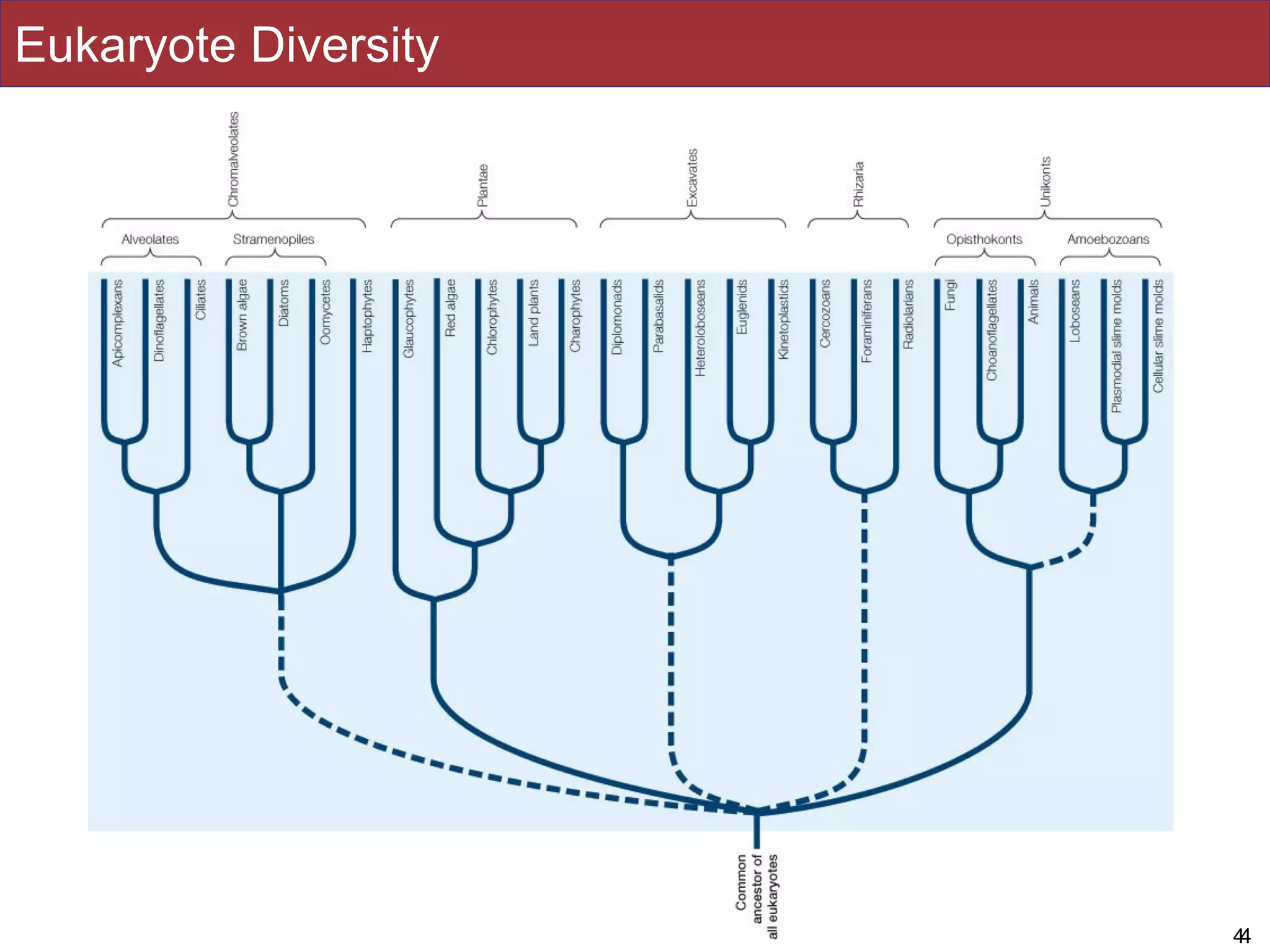
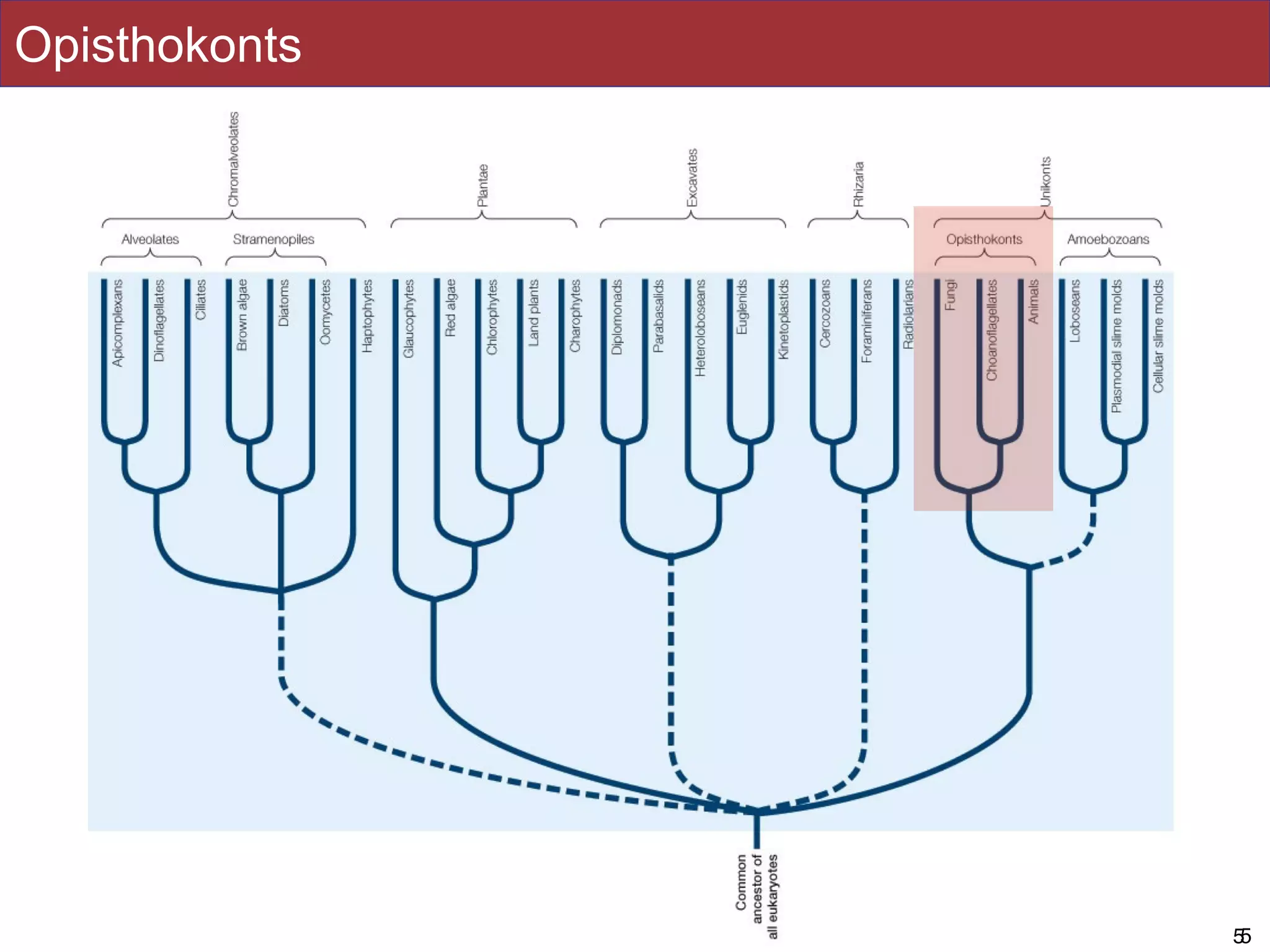
Eukaryote Diversity
Slides by Jonathan Eisen for BIS2C at UC Davis Spring 2016 55
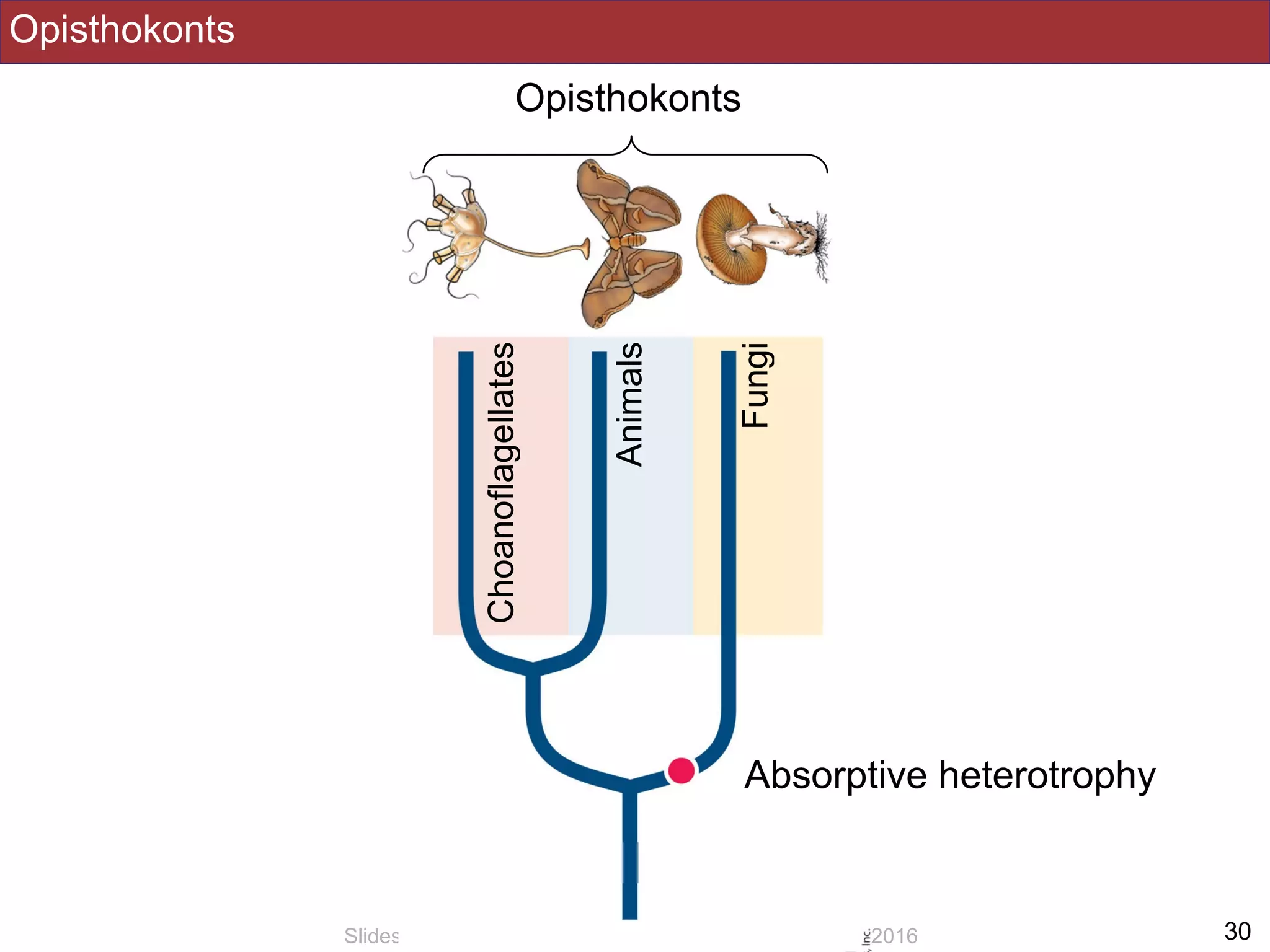
Opisthokonts
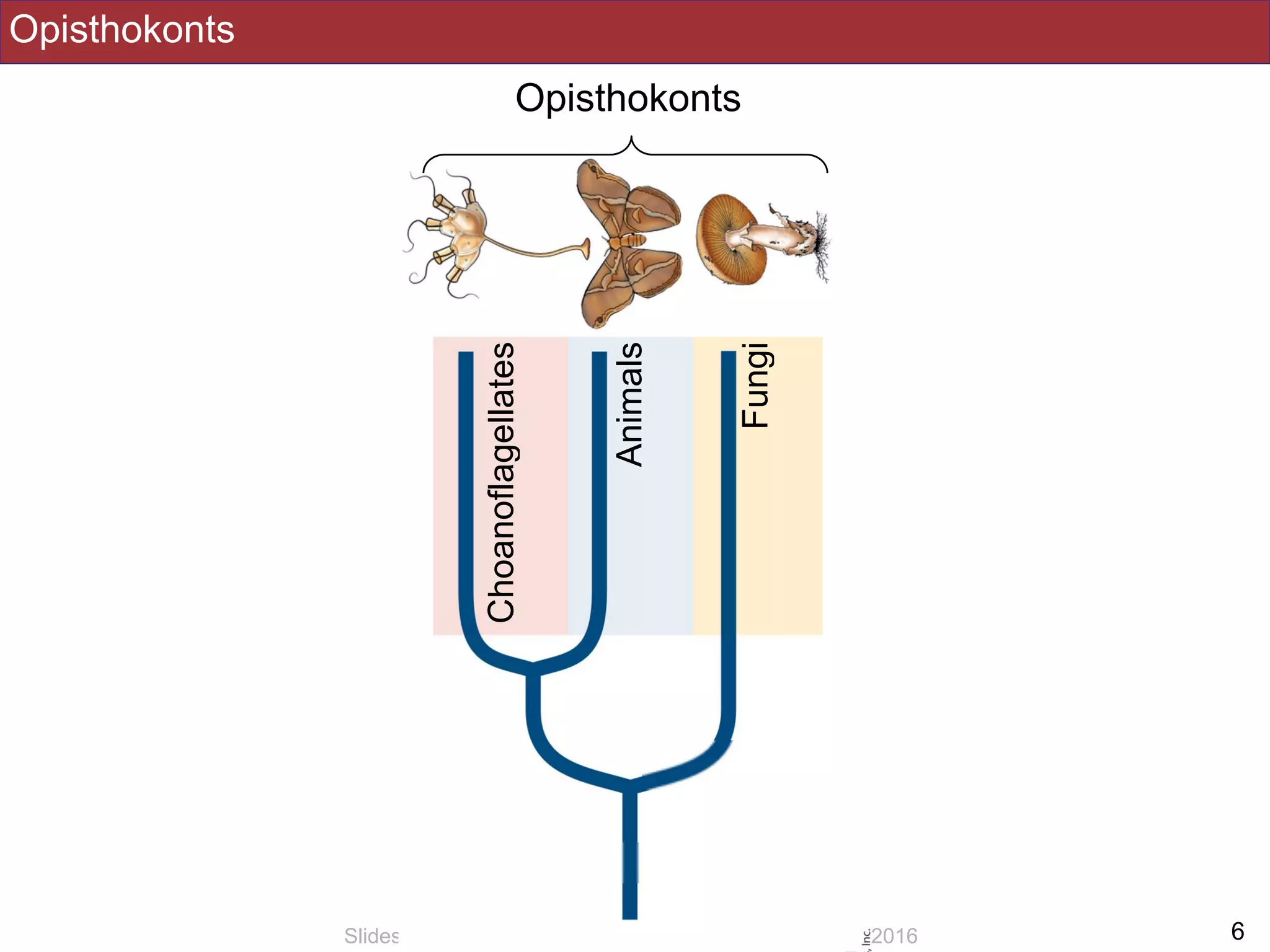
Opisthokonts
!6Slides by Jonathan Eisen for BIS2C at UC Davis Spring 2016
Opisthokonts
Fungi
Animals
Choanoflagellates
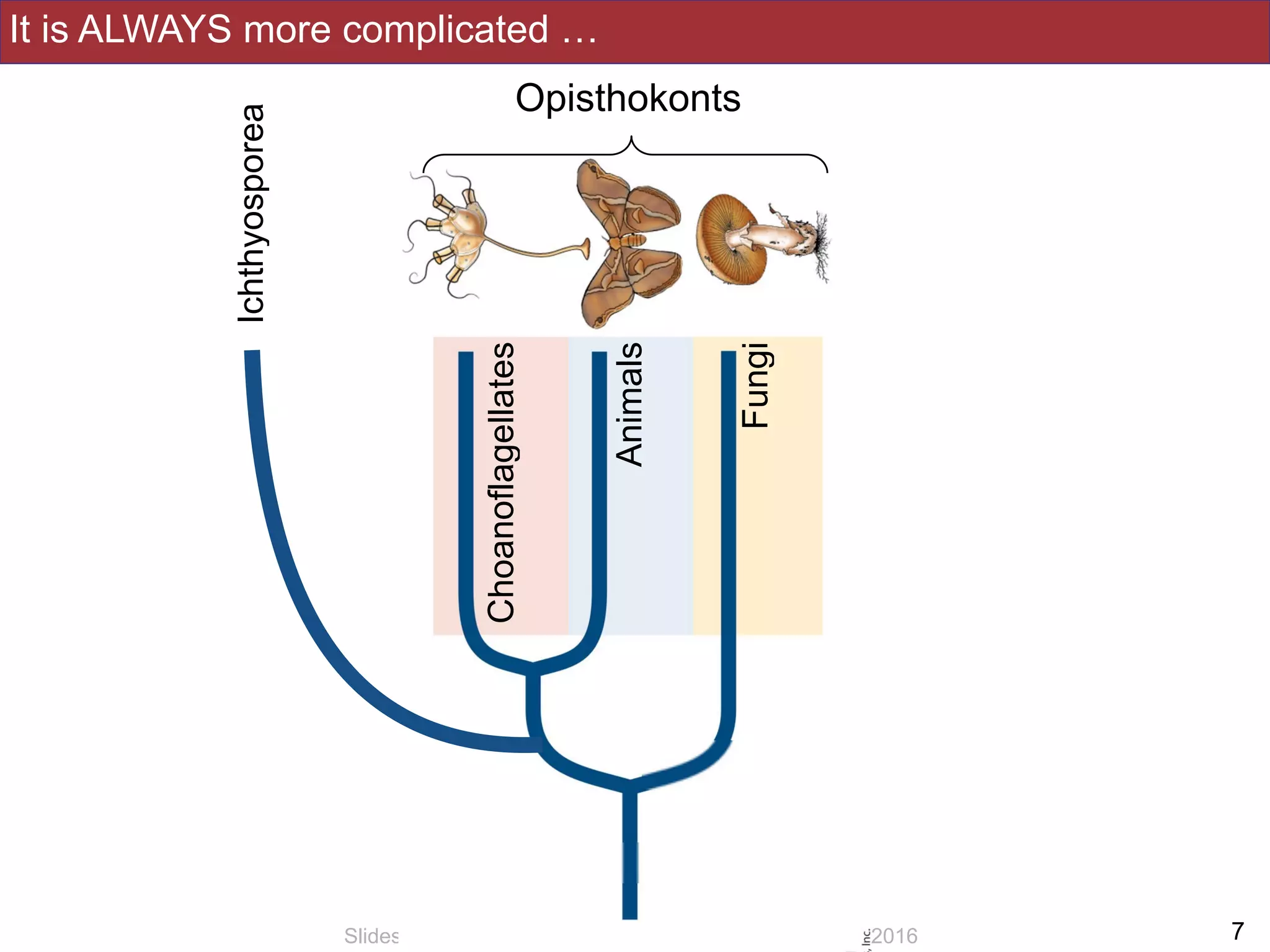
It is ALWAYS more complicated …
!7Slides by Jonathan Eisen for BIS2C at UC Davis Spring 2016
Opisthokonts
Fungi
Animals
Choanoflagellates
Ichthyosporea
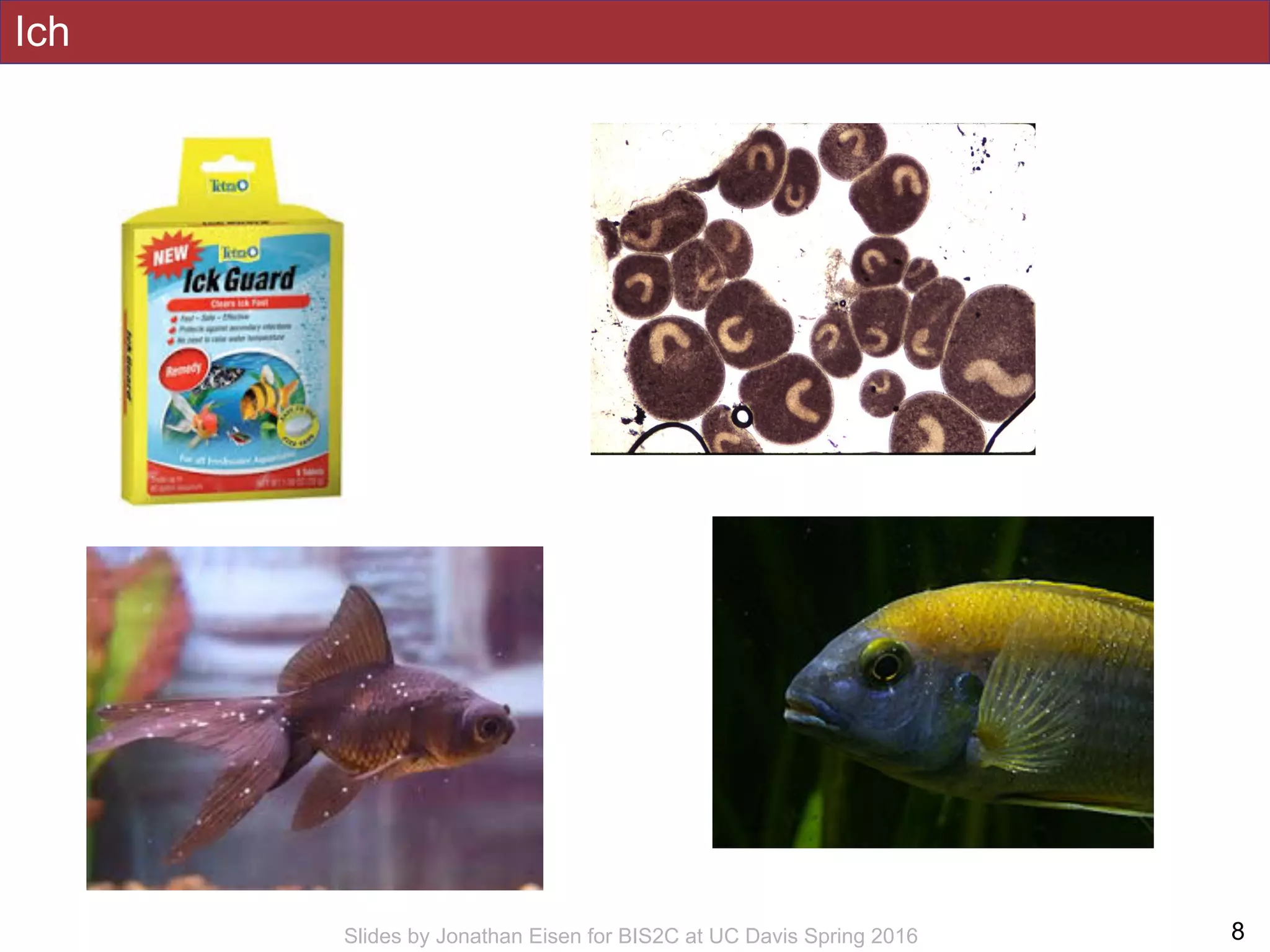
Ich
!8Slides by Jonathan Eisen for BIS2C at UC Davis Spring 2016
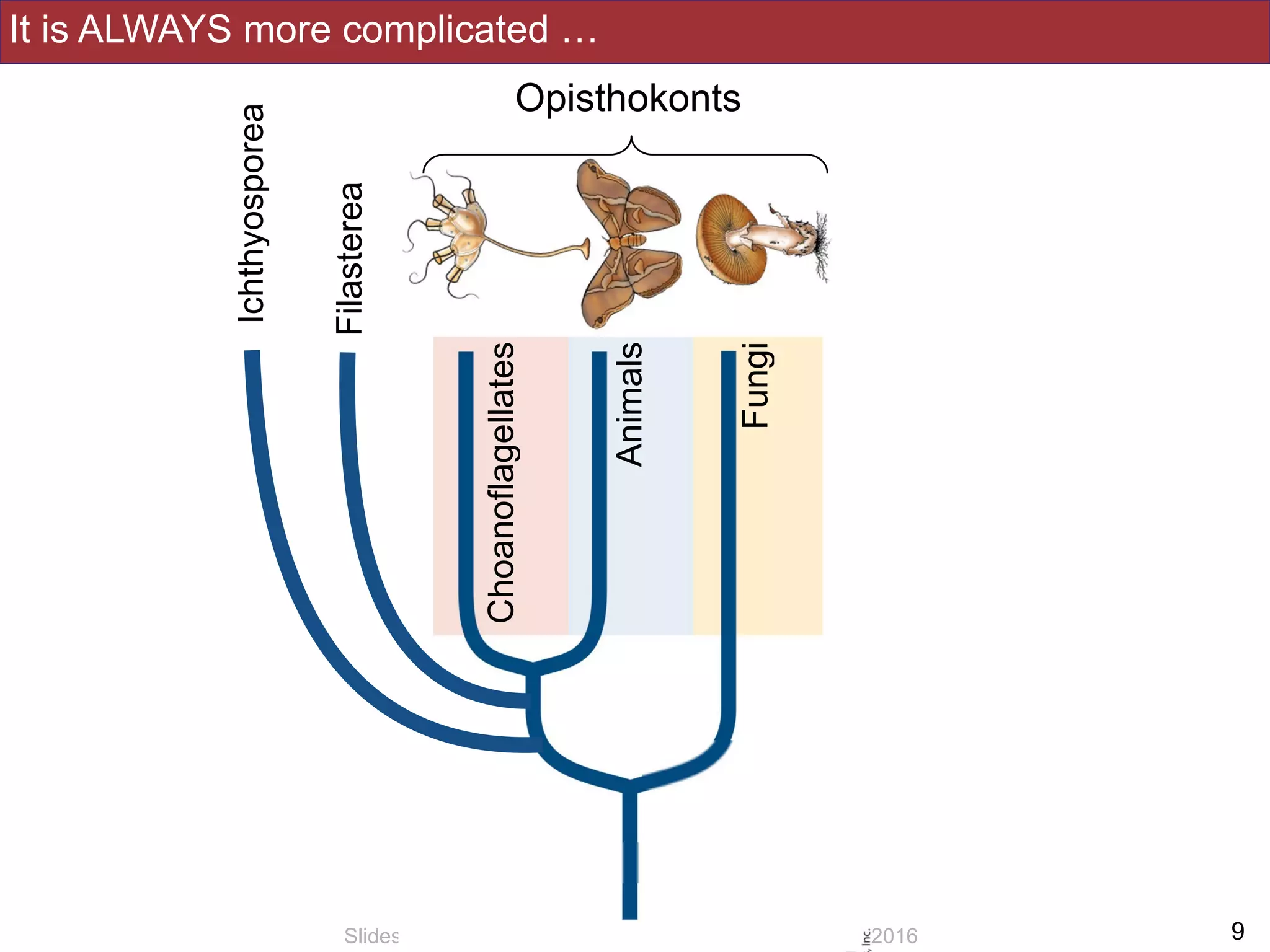
It is ALWAYS more complicated …
!9Slides by Jonathan Eisen for BIS2C at UC Davis Spring 2016
Opisthokonts
Fungi
Animals
Choanoflagellates
Filasterea
Ichthyosporea
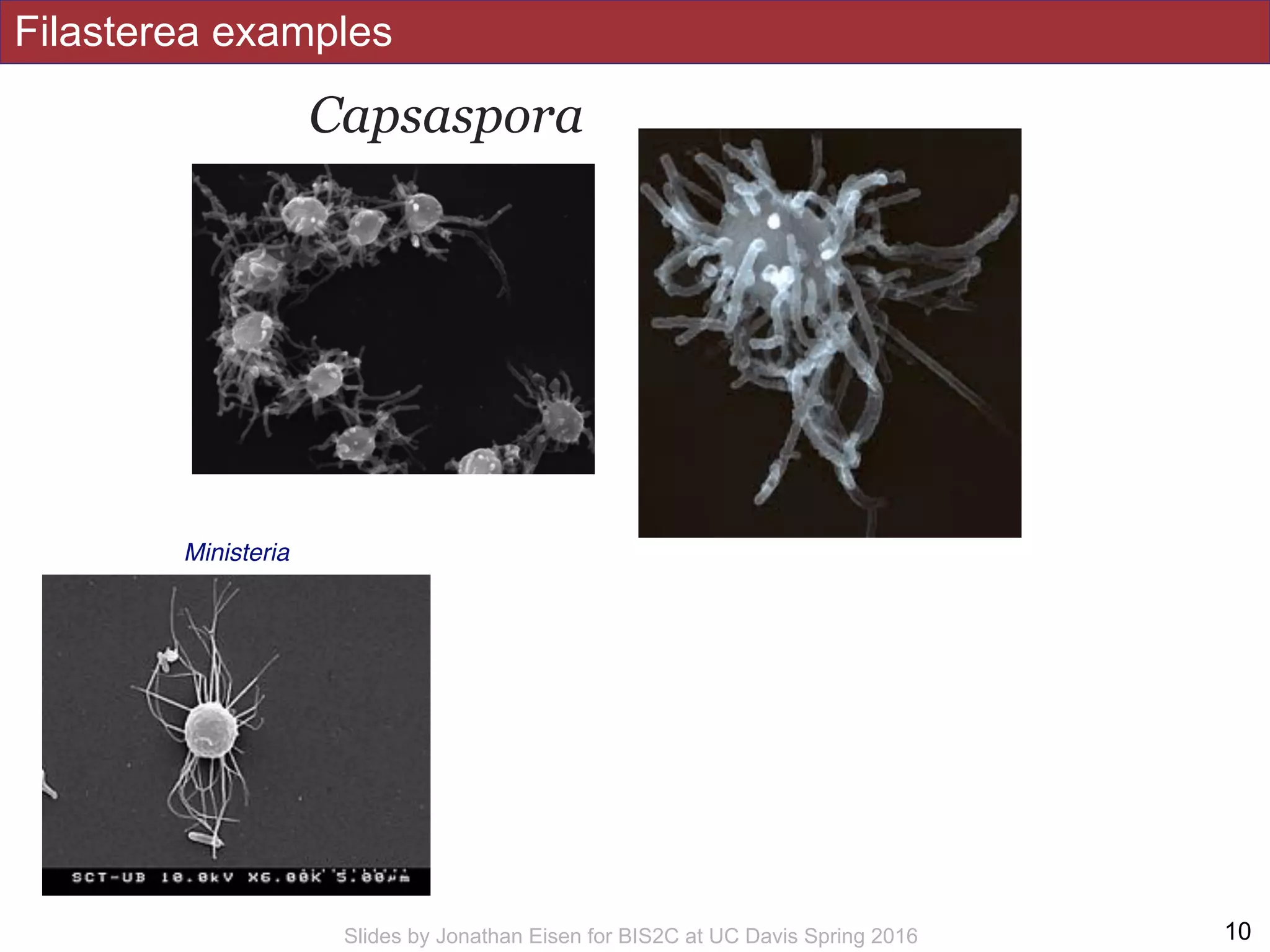
Filasterea examples
!10Slides by Jonathan Eisen for BIS2C at UC Davis Spring 2016
Ministeria
Capsaspora
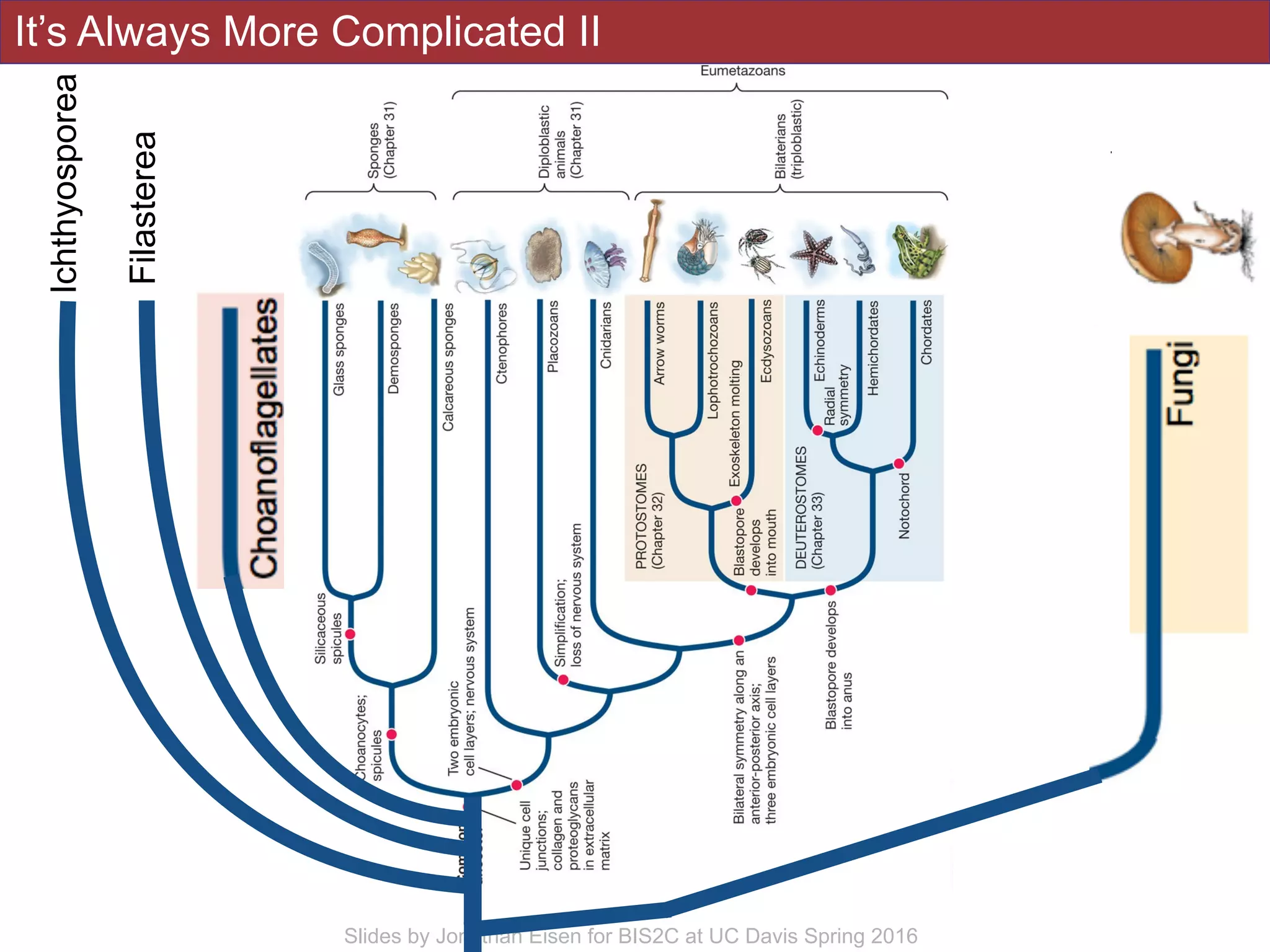
It’s Always More Complicated II
!11Slides by Jonathan Eisen for BIS2C at UC Davis Spring 2016
Filasterea
Ichthyosporea
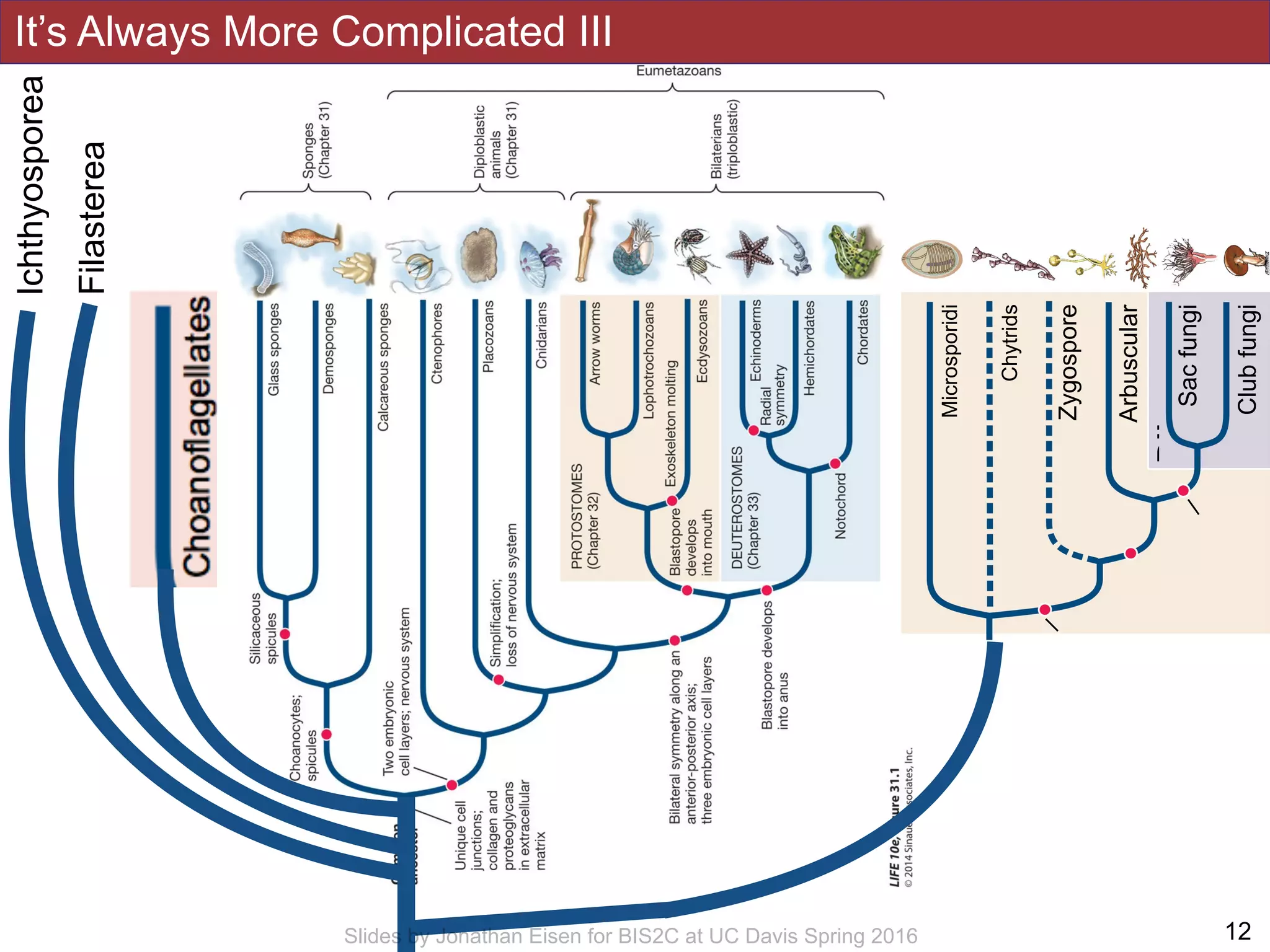
!12
Filasterea
Ichthyosporea
Microsporidi
Chytrids
Zygospore
Arbuscular
Sacfungi
Clubfungi
Dik
It’s Always More Complicated III
Slides by Jonathan Eisen for BIS2C at UC Davis Spring 2016
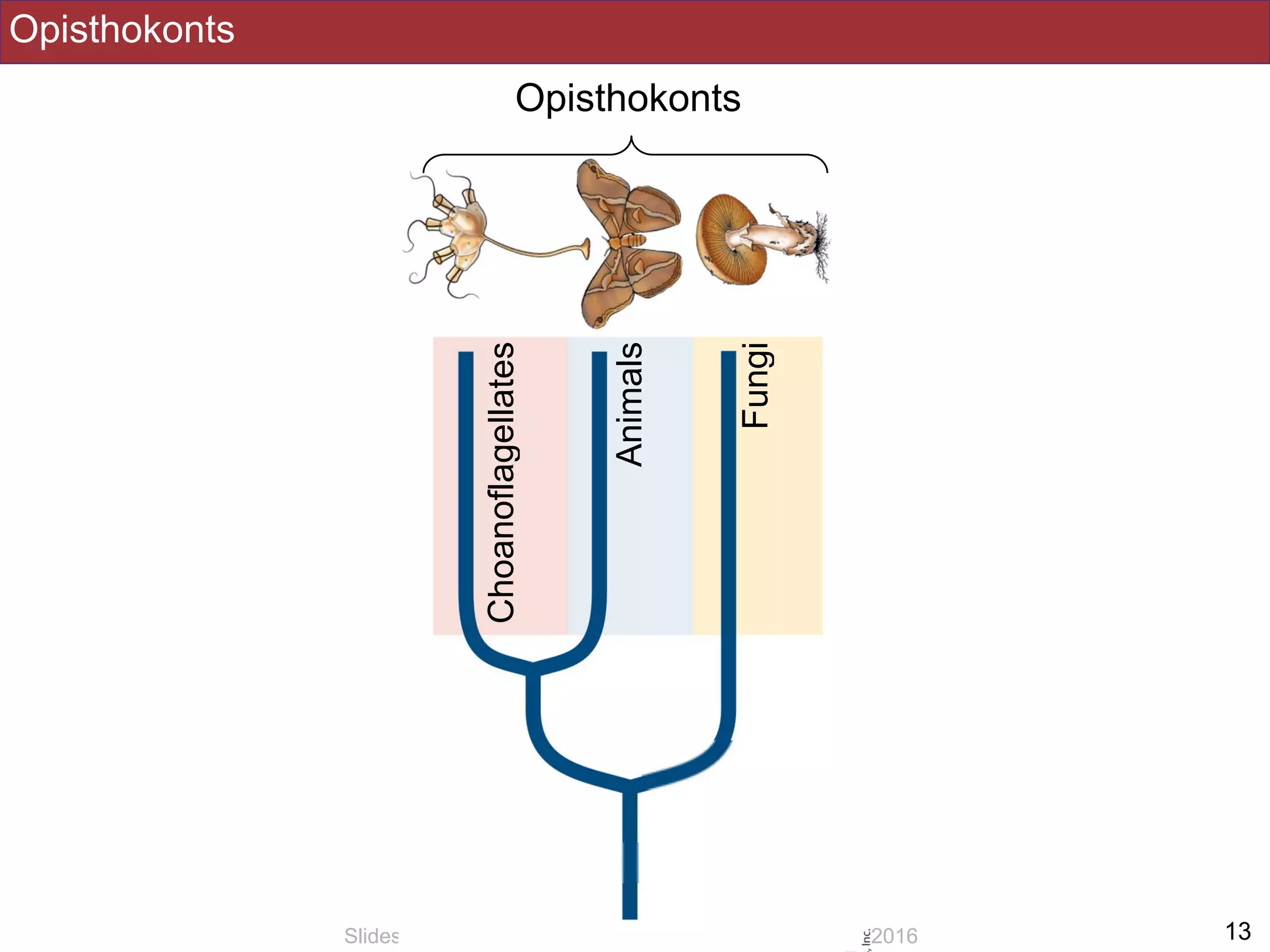
Opisthokonts
!13Slides by Jonathan Eisen for BIS2C at UC Davis Spring 2016
Opisthokonts
Fungi
Animals
Choanoflagellates
Opisthokonts
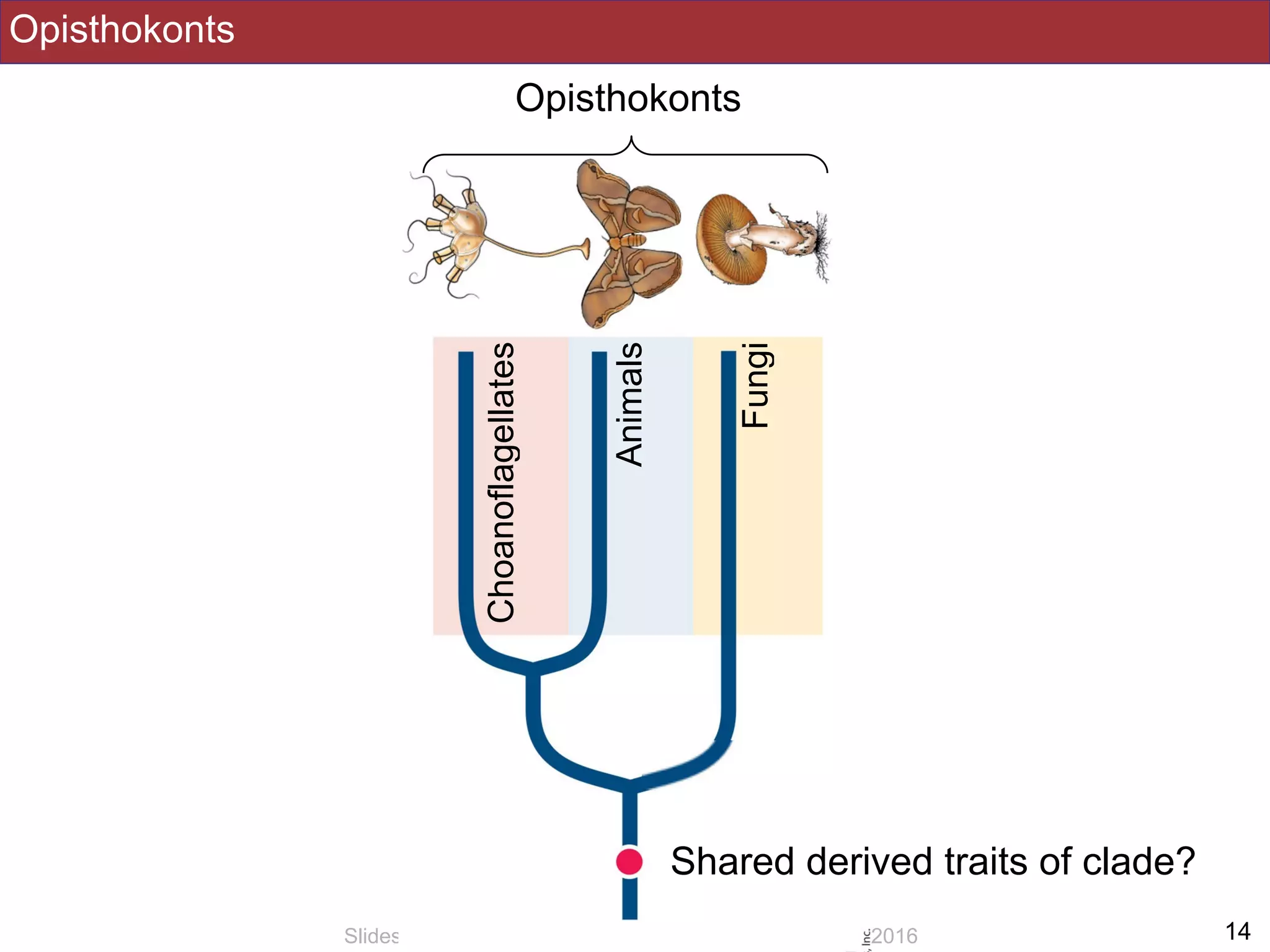
!14Slides by Jonathan Eisen for BIS2C at UC Davis Spring 2016
Opisthokonts
Fungi
Animals
Choanoflagellates
Shared derived traits of clade?
Opisthokonts
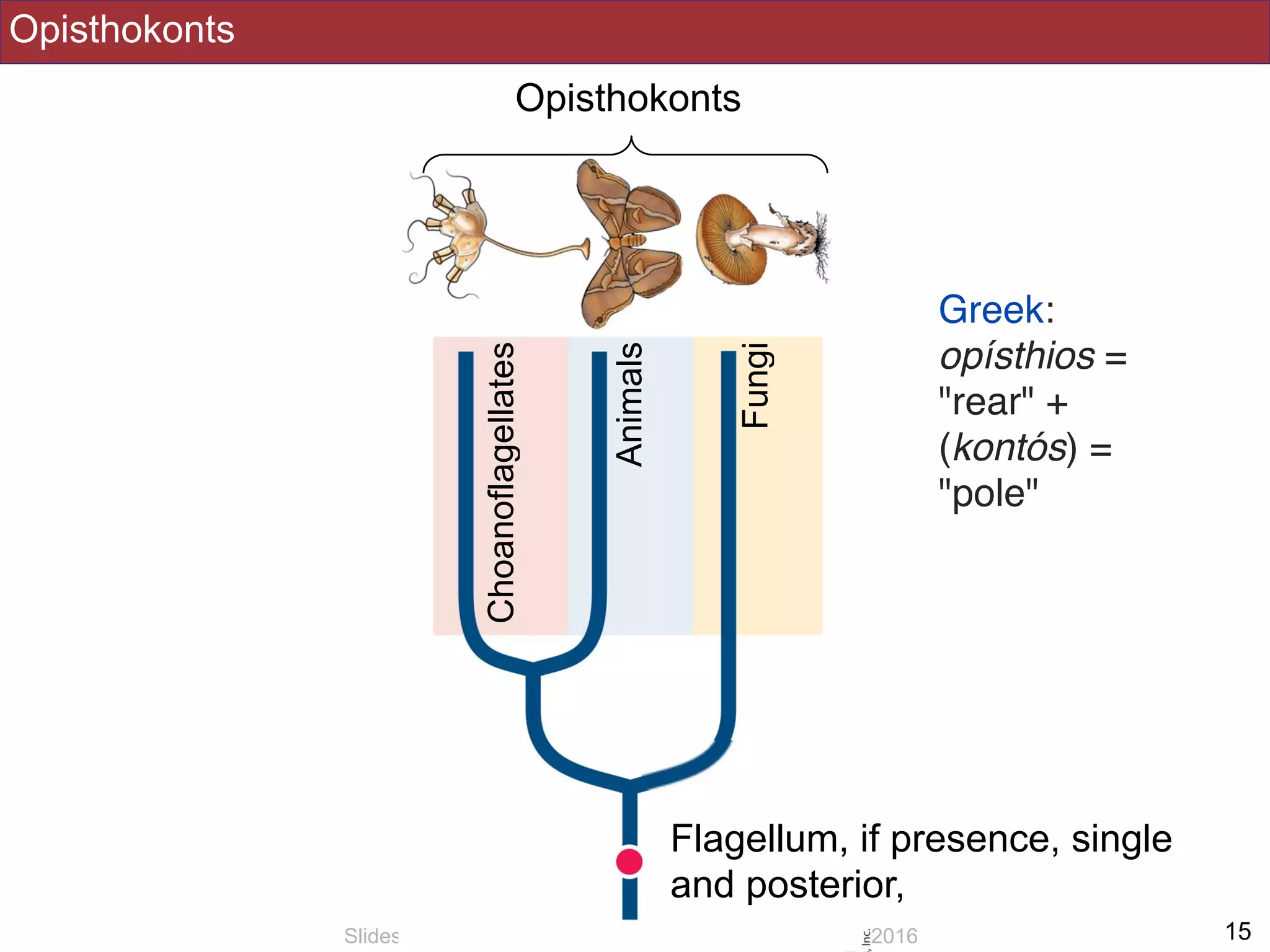
!15Slides by Jonathan Eisen for BIS2C at UC Davis Spring 2016
Opisthokonts
Fungi
Animals
Choanoflagellates
Flagellum, if presence, single
and posterior,
Greek:
opísthios =
"rear" +
(kontós) =
"pole"
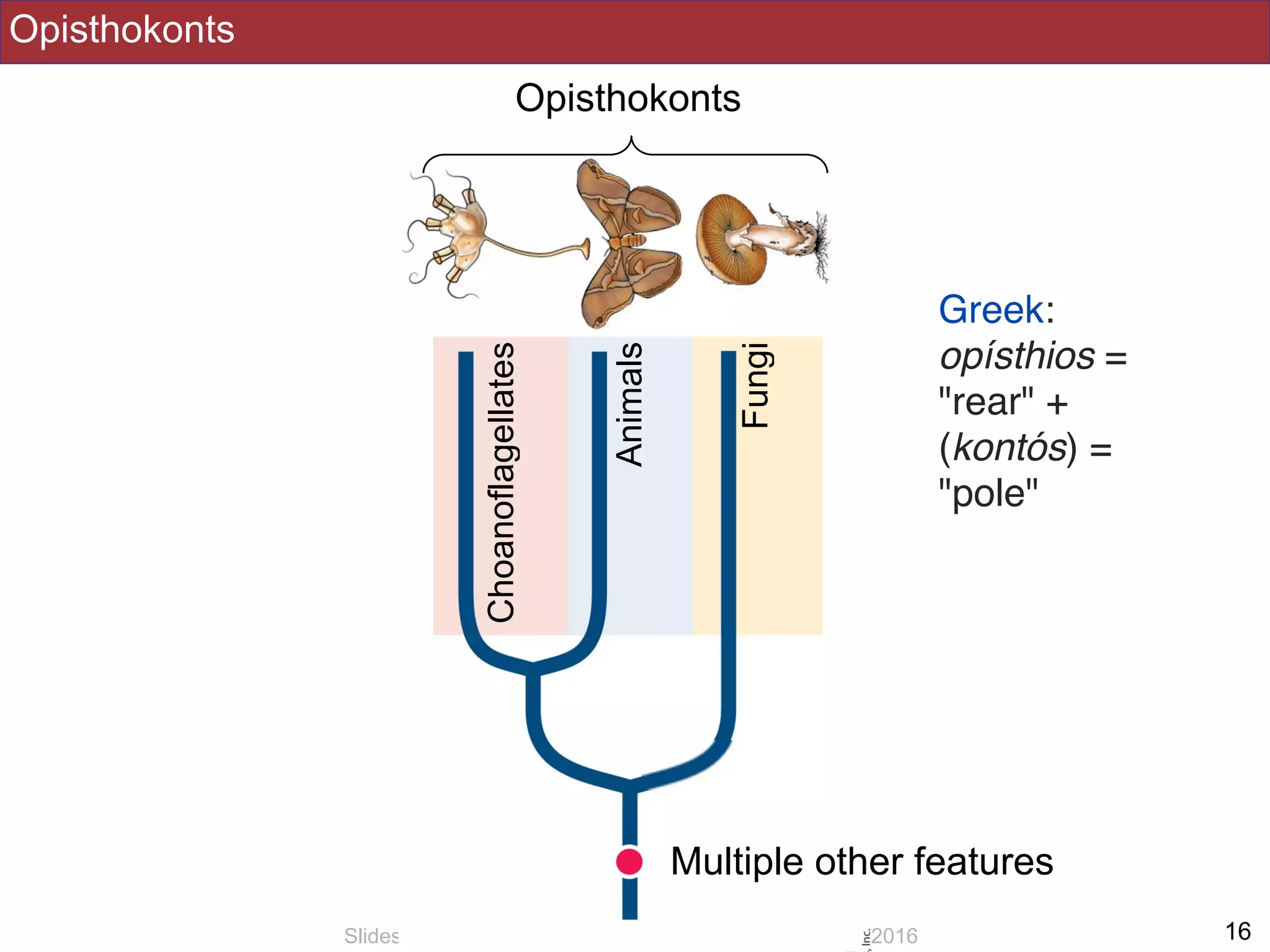
Opisthokonts
!16Slides by Jonathan Eisen for BIS2C at UC Davis Spring 2016
Opisthokonts
Fungi
Animals
Choanoflagellates
Multiple other features
Greek:
opísthios =
"rear" +
(kontós) =
"pole"
Opisthokonts
!17Slides by Jonathan Eisen for BIS2C at UC Davis Spring 2016
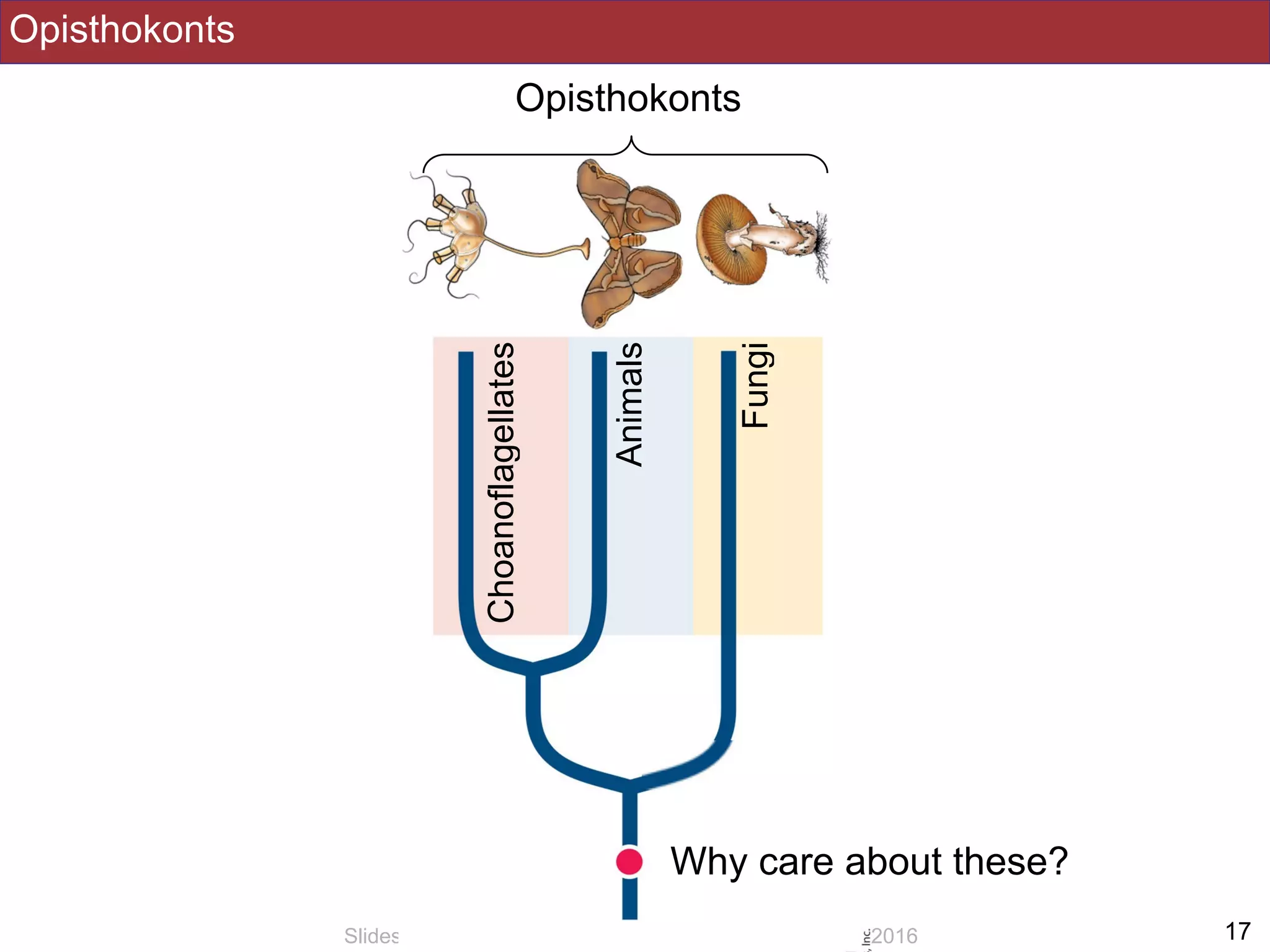
Opisthokonts
Fungi
Animals
Choanoflagellates
Why care about these?
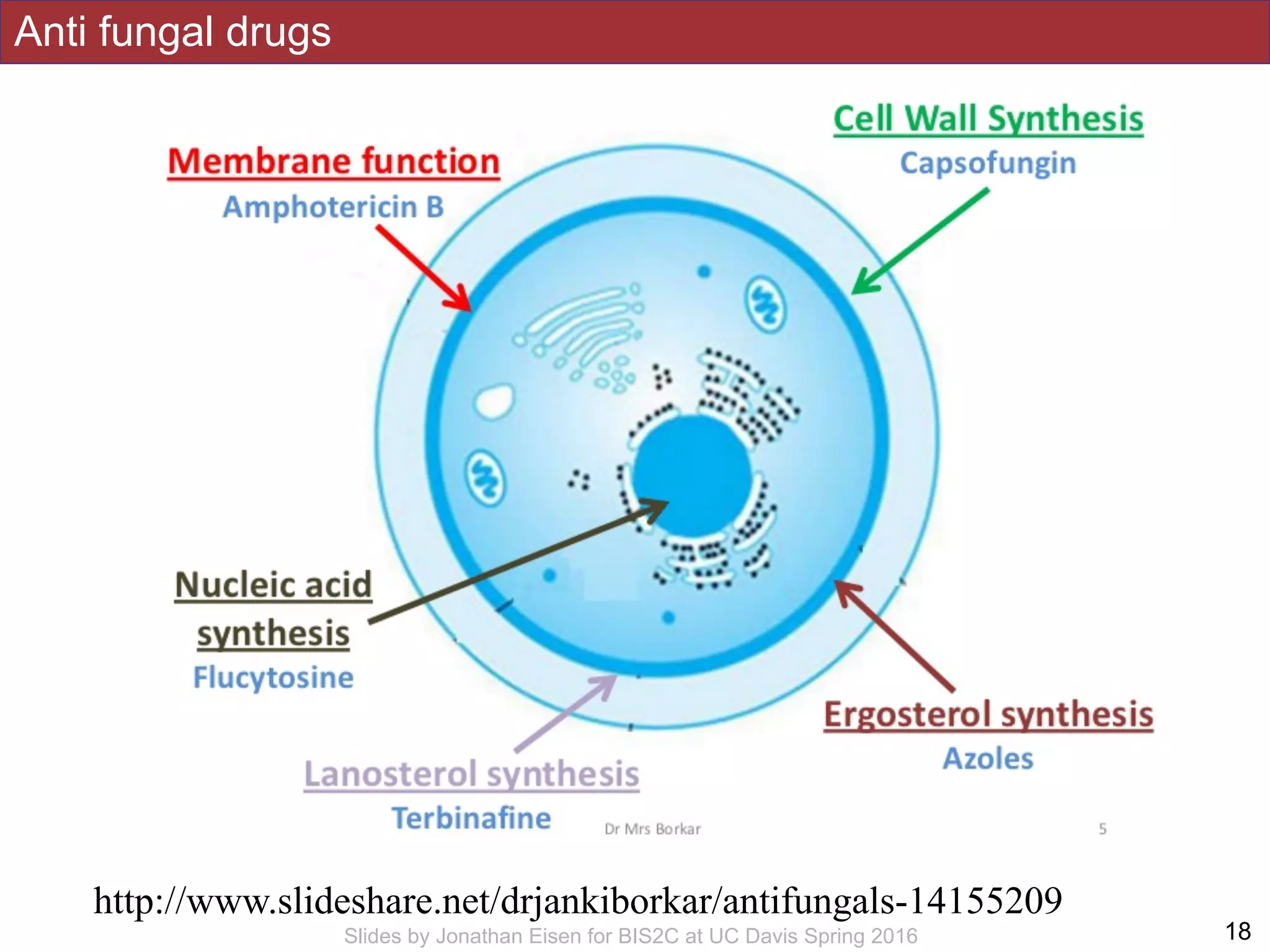
Anti fungal drugs
!18Slides by Jonathan Eisen for BIS2C at UC Davis Spring 2016
http://www.slideshare.net/drjankiborkar/antifungals-14155209
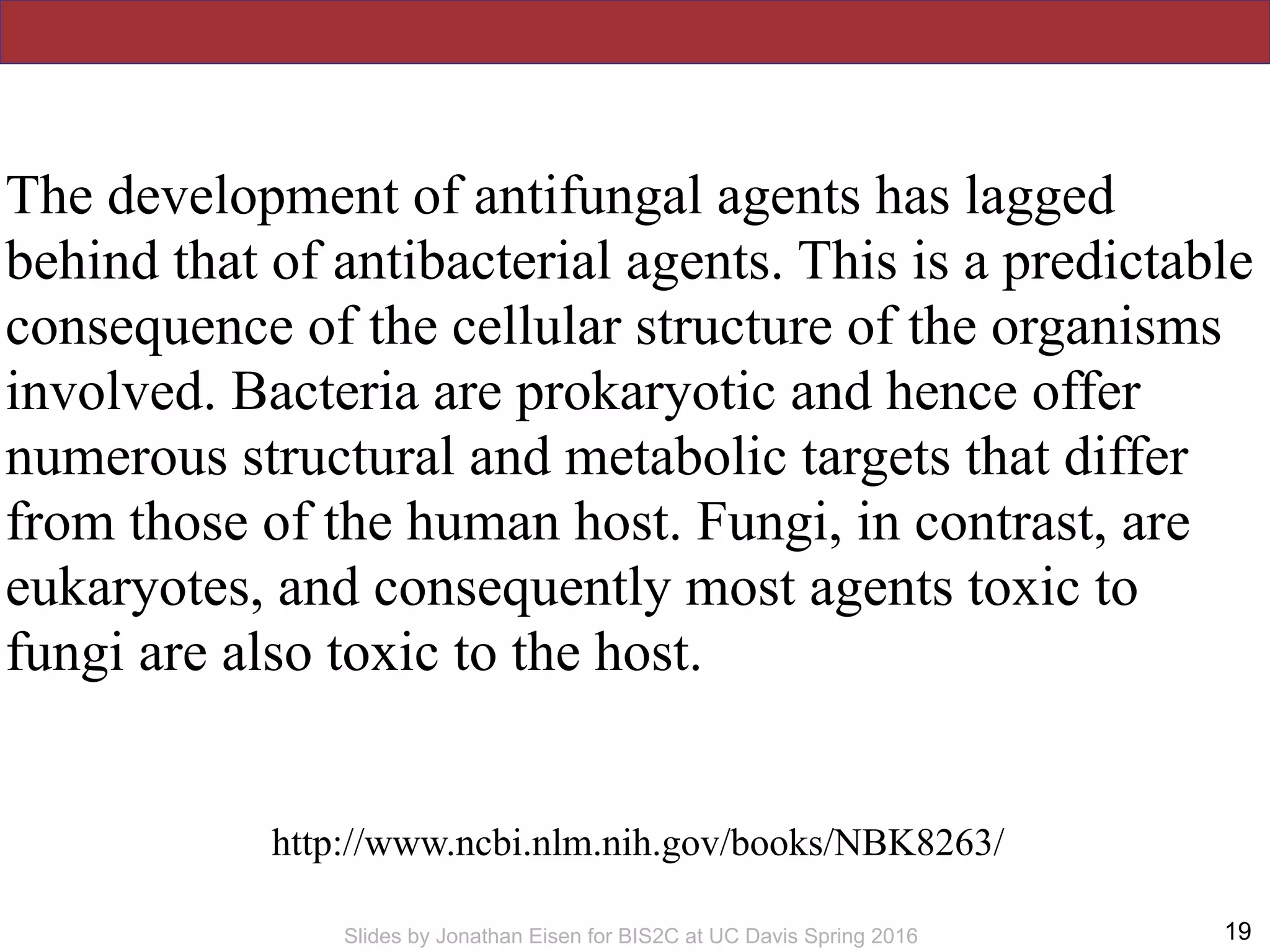
!19Slides by Jonathan Eisen for BIS2C at UC Davis Spring 2016
The development of antifungal agents has lagged
behind that of antibacterial agents. This is a predictable
consequence of the cellular structure of the organisms
involved. Bacteria are prokaryotic and hence offer
numerous structural and metabolic targets that differ
from those of the human host. Fungi, in contrast, are
eukaryotes, and consequently most agents toxic to
fungi are also toxic to the host.
http://www.ncbi.nlm.nih.gov/books/NBK8263/
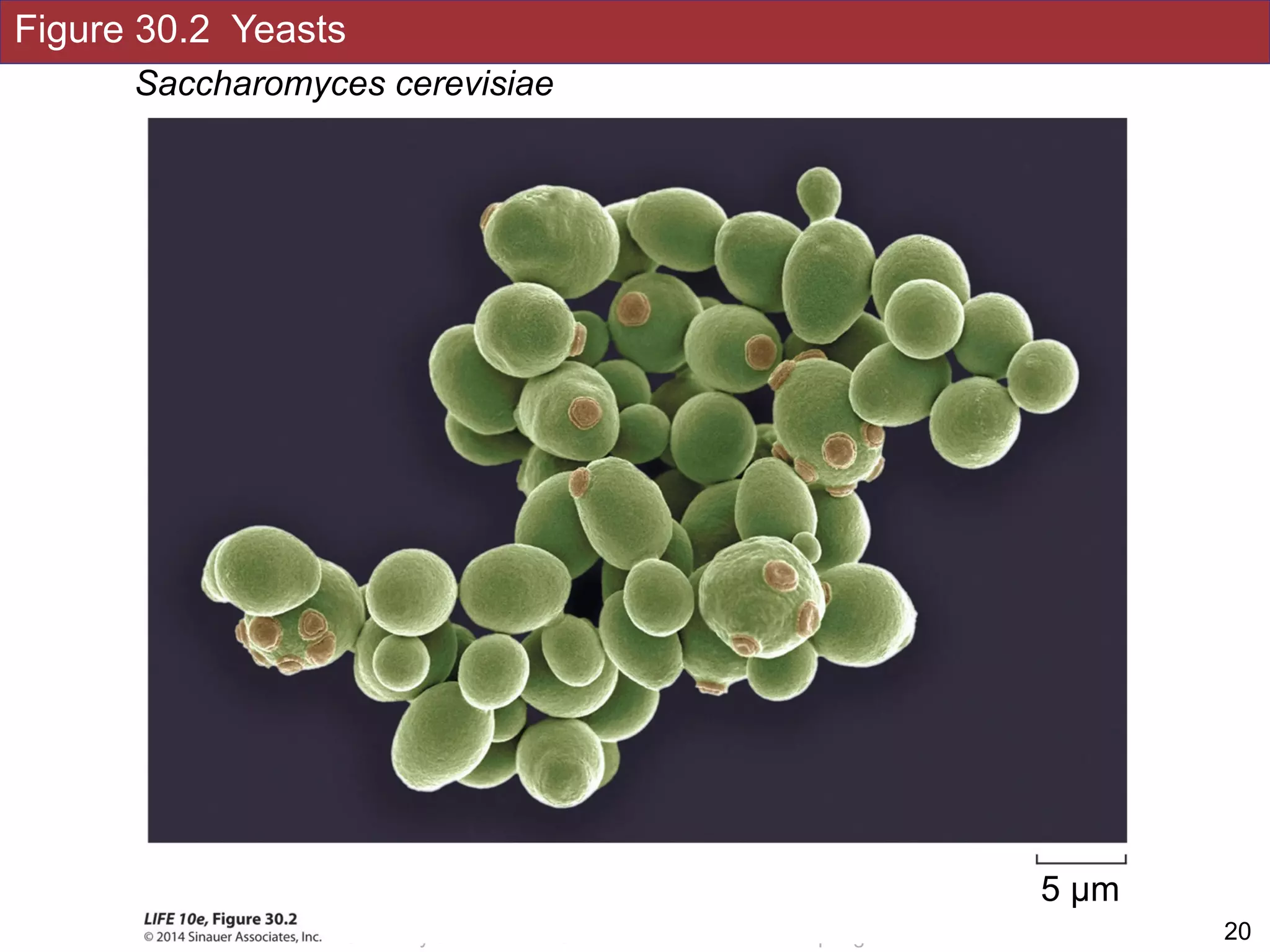
Figure 30.2 Yeasts
!20Slides by Jonathan Eisen for BIS2C at UC Davis Spring 2016
Saccharomyces cerevisiae
5 µm
Slides by Jonathan Eisen for BIS2C at UC Davis Spring 2016
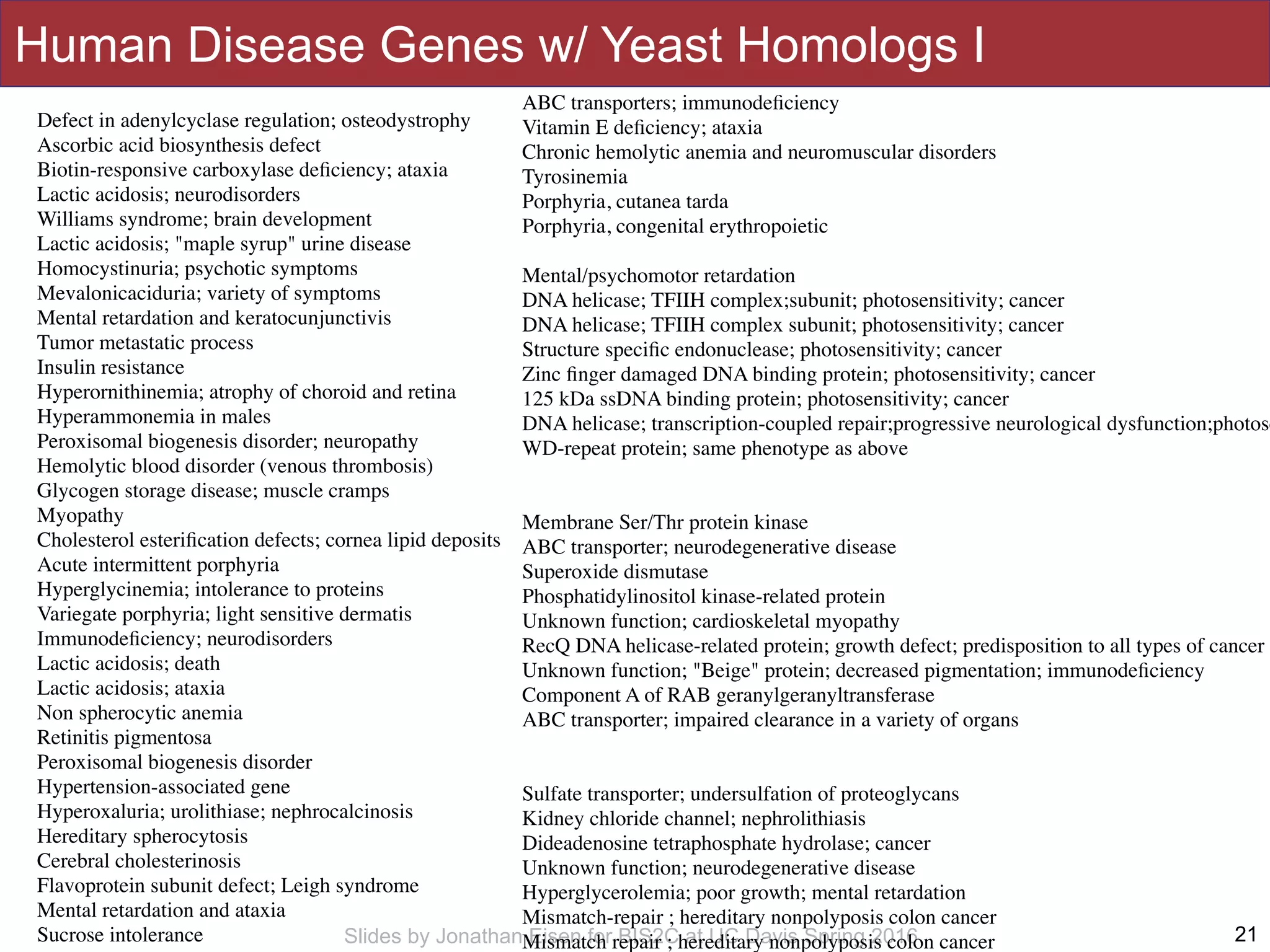
Human Disease Genes w/ Yeast Homologs I
21
Defect in adenylcyclase regulation; osteodystrophy
Ascorbic acid biosynthesis defect
Biotin-responsive carboxylase deficiency; ataxia
Lactic acidosis; neurodisorders
Williams syndrome; brain development
Lactic acidosis; "maple syrup" urine disease
Homocystinuria; psychotic symptoms
Mevalonicaciduria; variety of symptoms
Mental retardation and keratocunjunctivis
Tumor metastatic process
Insulin resistance
Hyperornithinemia; atrophy of choroid and retina
Hyperammonemia in males
Peroxisomal biogenesis disorder; neuropathy
Hemolytic blood disorder (venous thrombosis)
Glycogen storage disease; muscle cramps
Myopathy
Cholesterol esterification defects; cornea lipid deposits
Acute intermittent porphyria
Hyperglycinemia; intolerance to proteins
Variegate porphyria; light sensitive dermatis
Immunodeficiency; neurodisorders
Lactic acidosis; death
Lactic acidosis; ataxia
Non spherocytic anemia
Retinitis pigmentosa
Peroxisomal biogenesis disorder
Hypertension-associated gene
Hyperoxaluria; urolithiase; nephrocalcinosis
Hereditary spherocytosis
Cerebral cholesterinosis
Flavoprotein subunit defect; Leigh syndrome
Mental retardation and ataxia
Sucrose intolerance
ABC transporters; immunodeficiency
Vitamin E deficiency; ataxia
Chronic hemolytic anemia and neuromuscular disorders
Tyrosinemia
Porphyria, cutanea tarda
Porphyria, congenital erythropoietic
Mental/psychomotor retardation
DNA helicase; TFIIH complex;subunit; photosensitivity; cancer
DNA helicase; TFIIH complex subunit; photosensitivity; cancer
Structure specific endonuclease; photosensitivity; cancer
Zinc finger damaged DNA binding protein; photosensitivity; cancer
125 kDa ssDNA binding protein; photosensitivity; cancer
DNA helicase; transcription-coupled repair;progressive neurological dysfunction;photose
WD-repeat protein; same phenotype as above
Membrane Ser/Thr protein kinase
ABC transporter; neurodegenerative disease
Superoxide dismutase
Phosphatidylinositol kinase-related protein
Unknown function; cardioskeletal myopathy
RecQ DNA helicase-related protein; growth defect; predisposition to all types of cancer
Unknown function; "Beige" protein; decreased pigmentation; immunodeficiency
Component A of RAB geranylgeranyltransferase
ABC transporter; impaired clearance in a variety of organs
Sulfate transporter; undersulfation of proteoglycans
Kidney chloride channel; nephrolithiasis
Dideadenosine tetraphosphate hydrolase; cancer
Unknown function; neurodegenerative disease
Hyperglycerolemia; poor growth; mental retardation
Mismatch-repair ; hereditary nonpolyposis colon cancer
Mismatch repair ; hereditary nonpolyposis colon cancer
Slides by Jonathan Eisen for BIS2C at UC Davis Spring 2016 22
Subunit of platelet-activating factor
acetylhydrolase
Inositol polyphosphate 5 phosphatase-related
protein; cataracts and glaucoma
Copper-transporting ATPase; neurodegenerative
disease and death
Calcium channel; familial hemiplegic migraine
and episodic ataxia
Acetyltransferase; erythrophagocytosis
Related to transmembrane receptors with a
cytoplasmic tyrosine kinase domain
Ser/thr protein kinase; neurodegenerative disease
Probable tyrosine phosphatase; muscle specific
disease
Homologue of Drosophila patched; nevoid basal
cell carcinoma syndrome
GTPase-activating protein
Fatal neurovisceral disorder
Defect in development of multiple organ systems
RCC1-related protein; progressive retinal
degeneration
Muscle chloride channel; myotonic disorders
DNA helicase Q-related protein; premature aging
and strong predisposition to cancer
Zinc finger protein; nephroblastoma
Copper transporting ATPase; toxic accumulation
of copper in liver and brain
Effector for CDC42H GTPase; immunodeficiency
Metabolic acidosis
Hemolytic blood disorder (venous thrombosis)
Urolithiasis
Immunodeficiency
Peroxisomal biogenesis disorder; neuropathy
Hemolytic anemia
Hypermethioninemia; mental and motor retardation
Purine nucleotide biosynthesis defect; autism features
Delayed oxidation of acetaldehyde; acute alcohol intoxication
Hepatic porphyria
Spherocytic anemia
Neonatal infantile chronic hyperammonemia
Argininemia; severe psychomotor retardation
Hypokalaemic alkalosis with hypercalciura
Hyperammonemia
Galactosialidosis
Lipid metabolism defect; cardiomyopathy
Acatalasia
Coproporphyria; psychiatric symptoms
Homocystinuria
Lactic acidosis; "maple syrup" urine disease
Protoporphyria, erythropoietic
Fumaric aciduria; encephalopathy
Hemolytic anemia
Glycogen storage disease; familial cirrhosis
Glycogen storage disease; hepatomegaly
Lysosomal storage disease; cardiomyopathy; skeletal muscular hypotonia
Hyperglycemia; diabetes
Glutathionuria
Hemolytic anemia
Non ketotic hyperglycinemia; lethargy; severe mental retardation
Glycogen storage disease; skeletal muscle weakness
Human Disease Genes w/ Yeast Homologs II
Slides by Jonathan Eisen for BIS2C at UC Davis Spring 2016 23
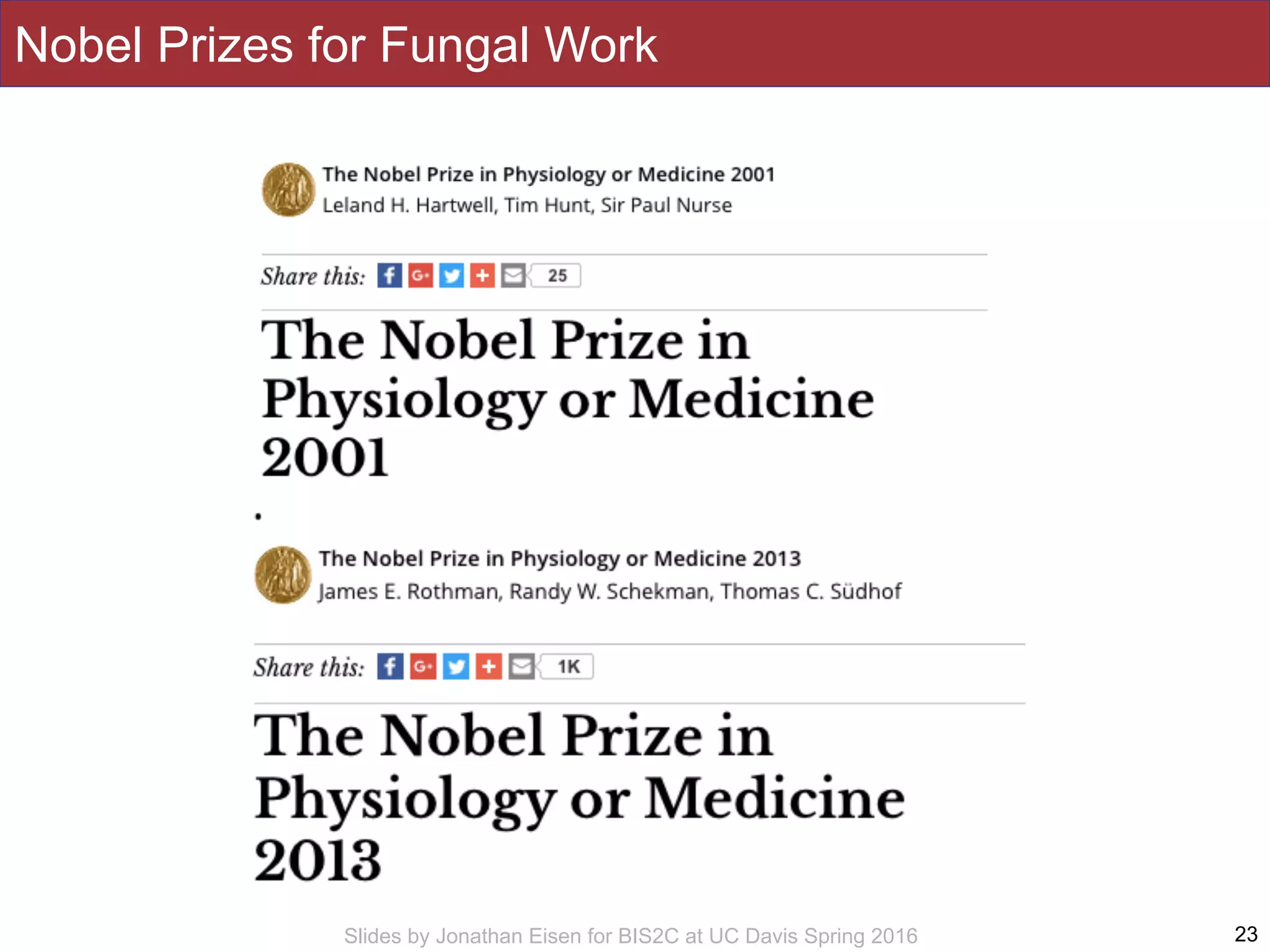
Nobel Prizes for Fungal Work
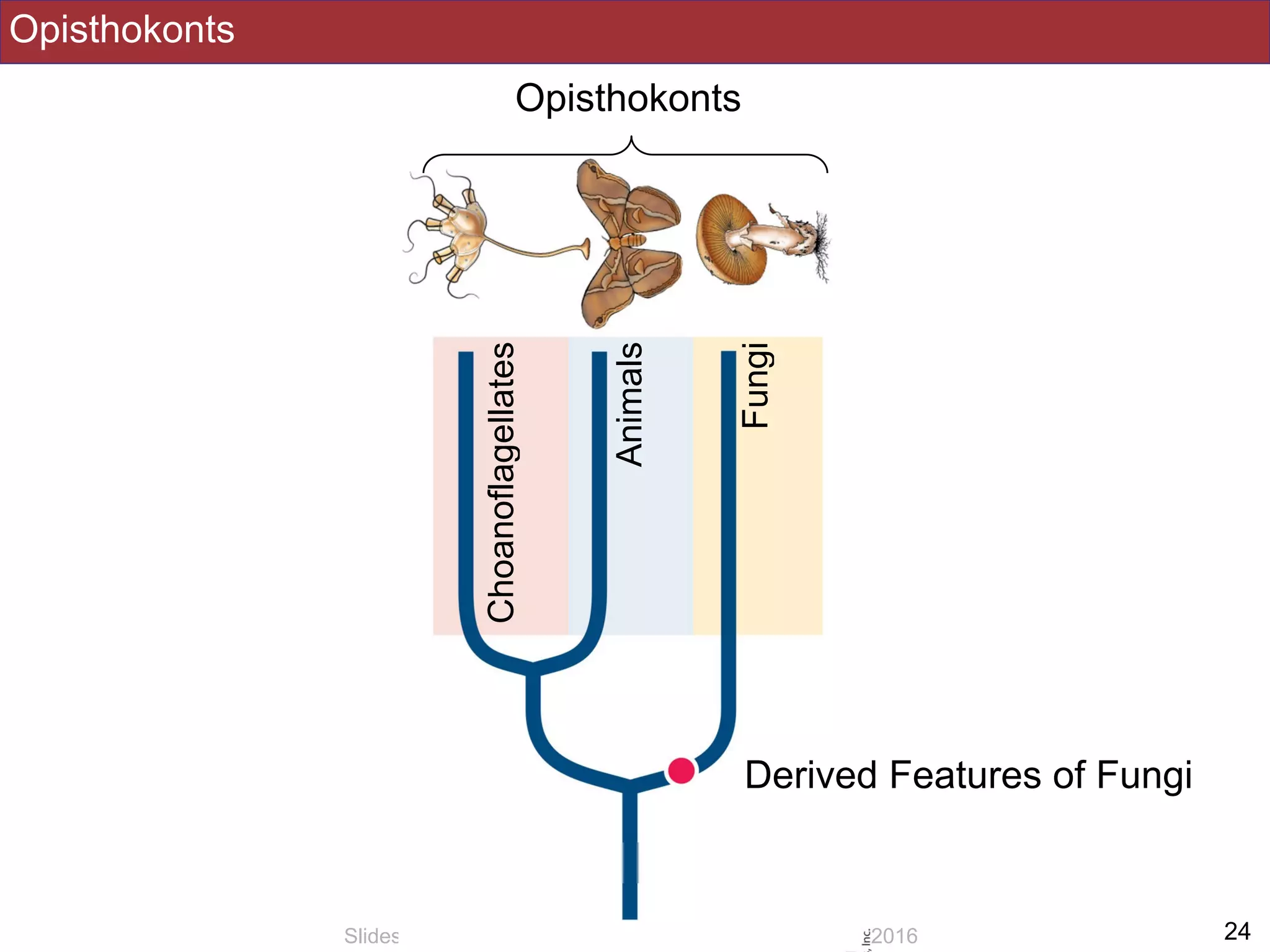
Opisthokonts
!24Slides by Jonathan Eisen for BIS2C at UC Davis Spring 2016
Opisthokonts
Fungi
Animals
Choanoflagellates
Derived Features of Fungi
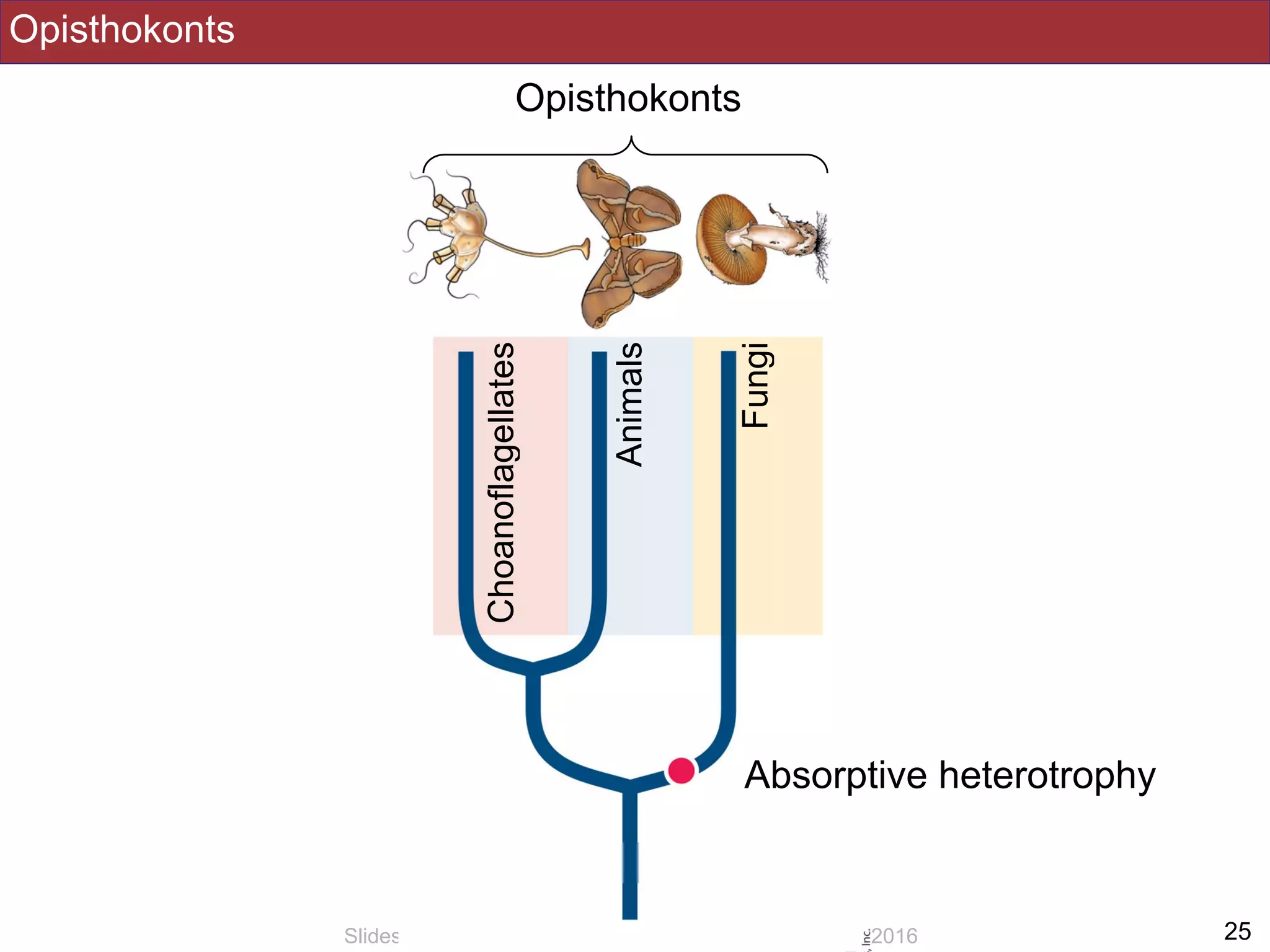
Opisthokonts
!25Slides by Jonathan Eisen for BIS2C at UC Davis Spring 2016
Opisthokonts
Fungi
Animals
Choanoflagellates
Absorptive heterotrophy
Clicker
!26Slides by Jonathan Eisen for BIS2C at UC Davis Spring 2016
Clicker
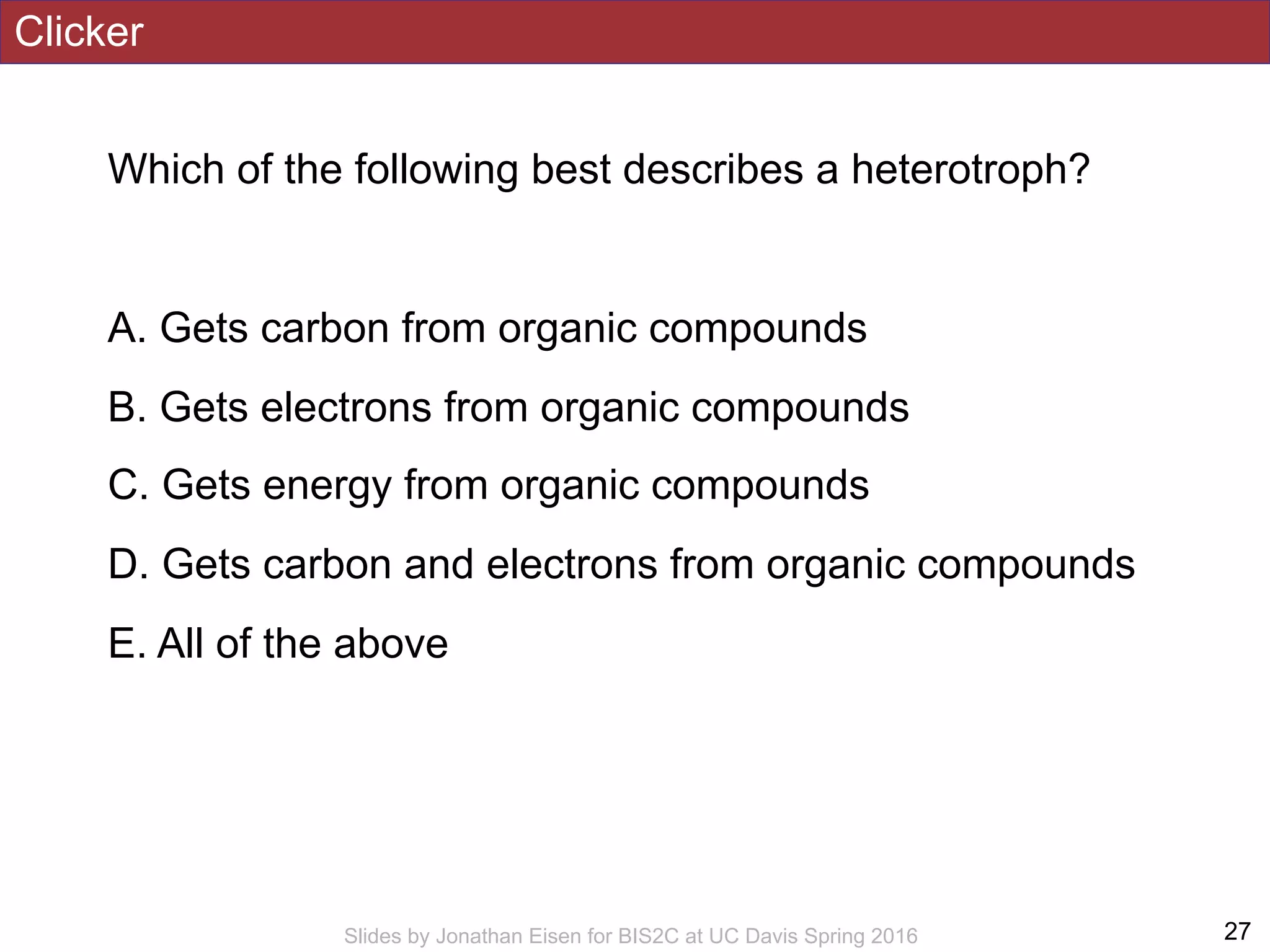
Which of the following best describes a heterotroph?
A. Gets carbon from organic compounds
B. Gets electrons from organic compounds
C. Gets energy from organic compounds
D. Gets carbon and electrons from organic compounds
E. All of the above
!27Slides by Jonathan Eisen for BIS2C at UC Davis Spring 2016
Clicker
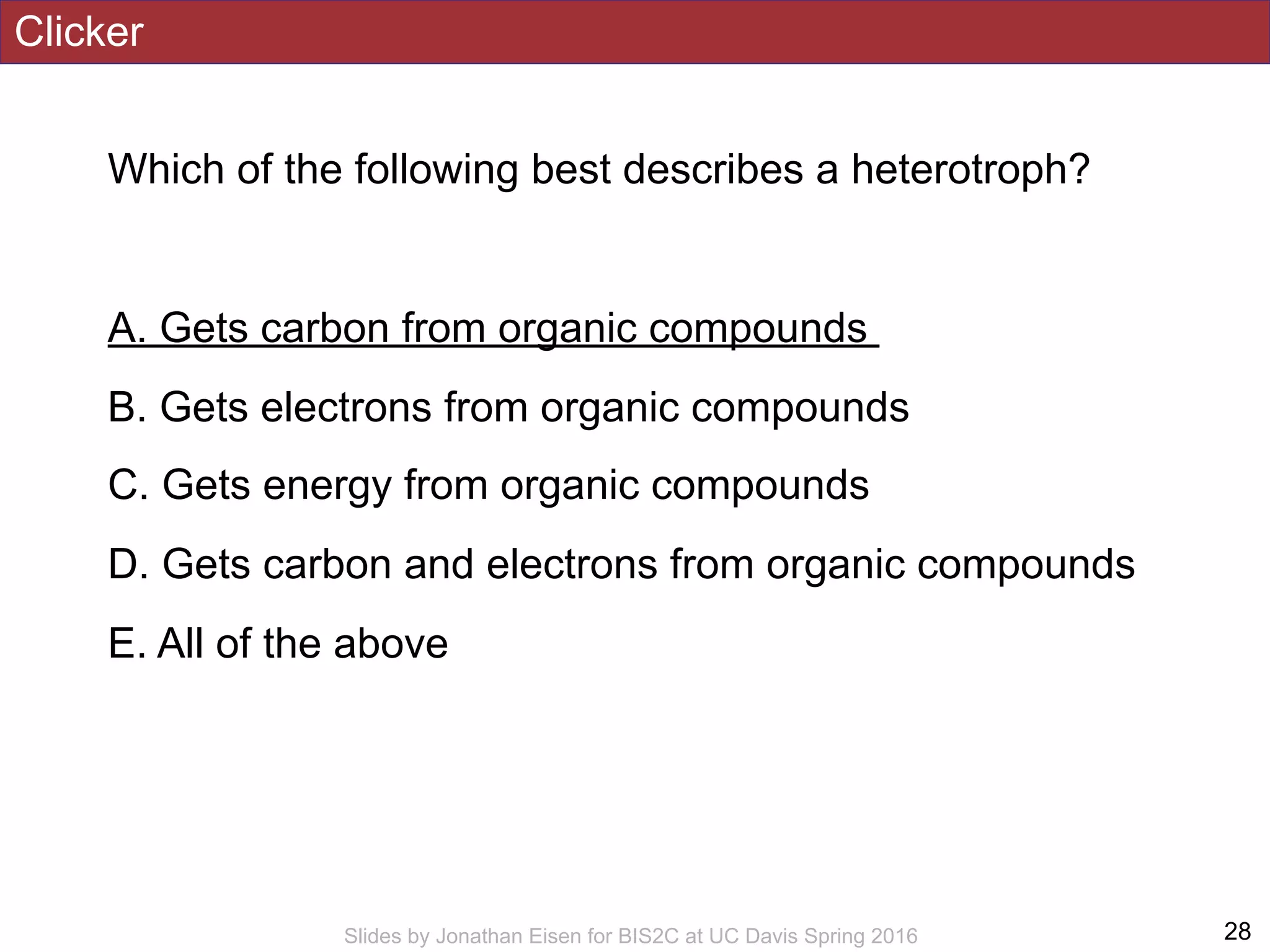
Which of the following best describes a heterotroph?
A. Gets carbon from organic compounds
B. Gets electrons from organic compounds
C. Gets energy from organic compounds
D. Gets carbon and electrons from organic compounds
E. All of the above
!28Slides by Jonathan Eisen for BIS2C at UC Davis Spring 2016
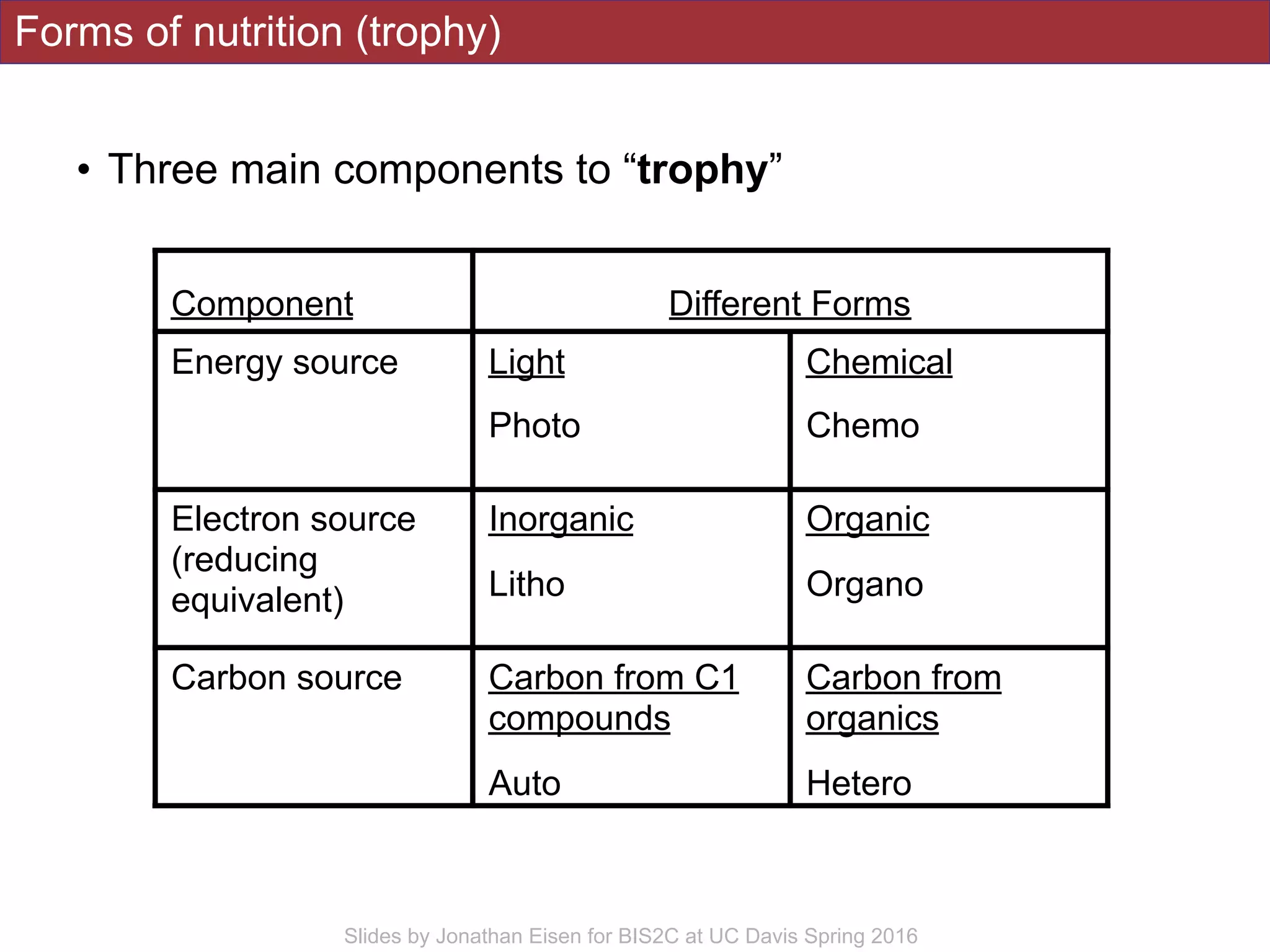
Component Different Forms
Energy source Light
Photo
Chemical
Chemo
Electron source
(reducing
equivalent)
Inorganic
Litho
Organic
Organo
Carbon source Carbon from C1
compounds
Auto
Carbon from
organics
Hetero
Forms of nutrition (trophy)
• Three main components to “trophy”
Slides by Jonathan Eisen for BIS2C at UC Davis Spring 2016
Opisthokonts
!30Slides by Jonathan Eisen for BIS2C at UC Davis Spring 2016
Opisthokonts
Fungi
Animals
Choanoflagellates
Absorptive heterotrophy
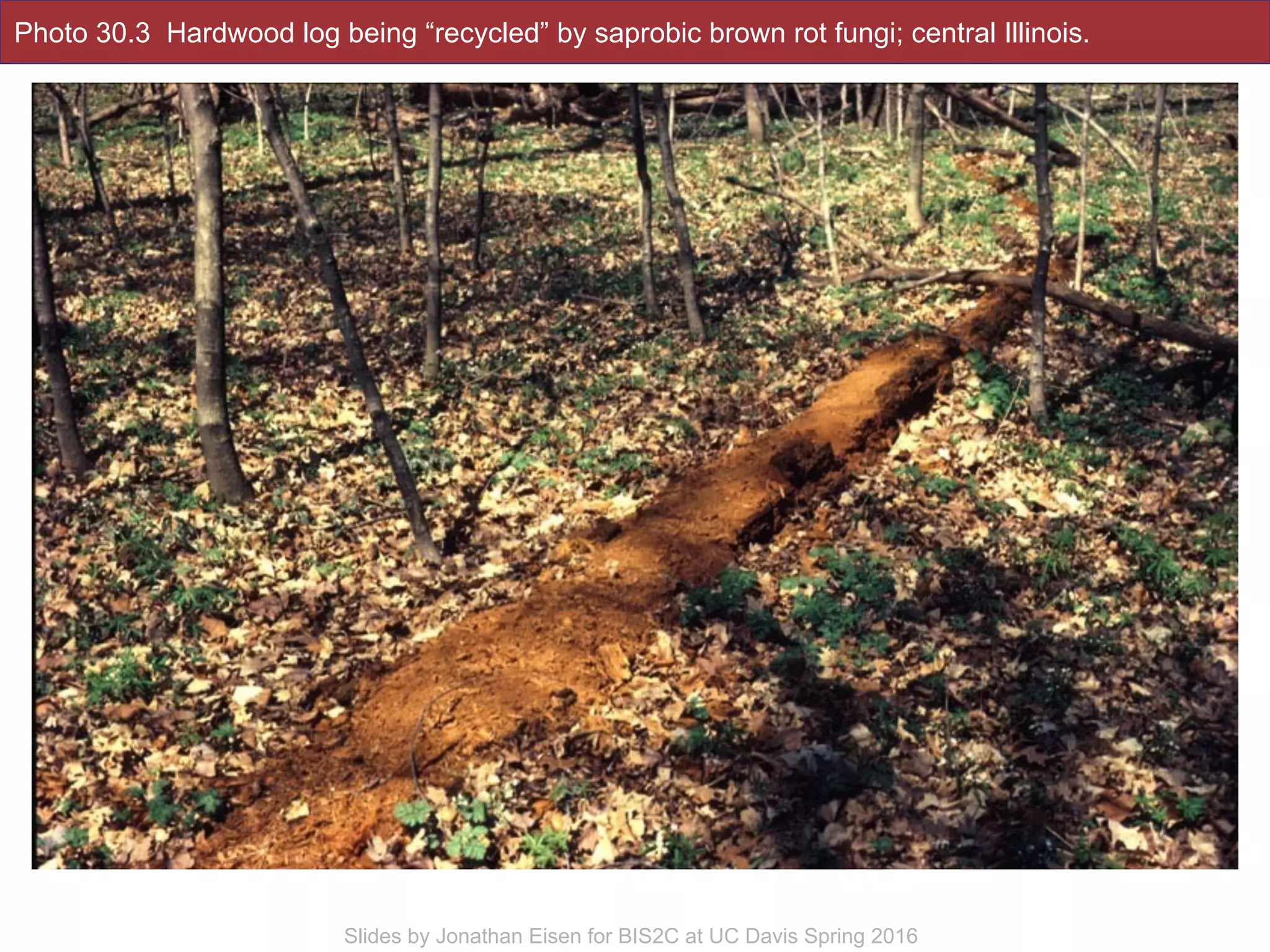
Photo 30.3 Hardwood log being “recycled” by saprobic brown rot fungi; central Illinois.
!31Slides by Jonathan Eisen for BIS2C at UC Davis Spring 2016
Opisthokonts
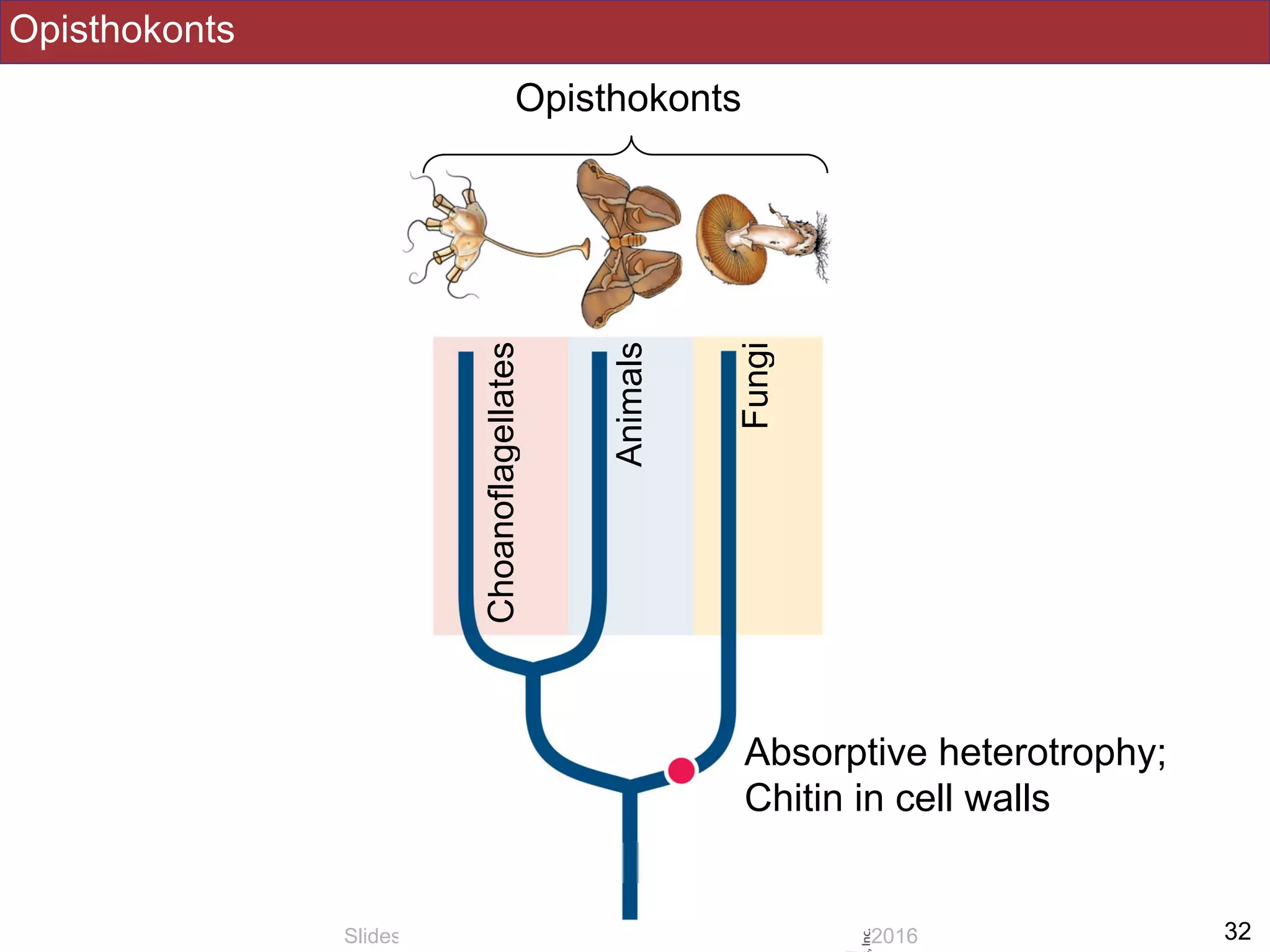
!32Slides by Jonathan Eisen for BIS2C at UC Davis Spring 2016
Opisthokonts
Fungi
Animals
Choanoflagellates
Absorptive heterotrophy;
Chitin in cell walls
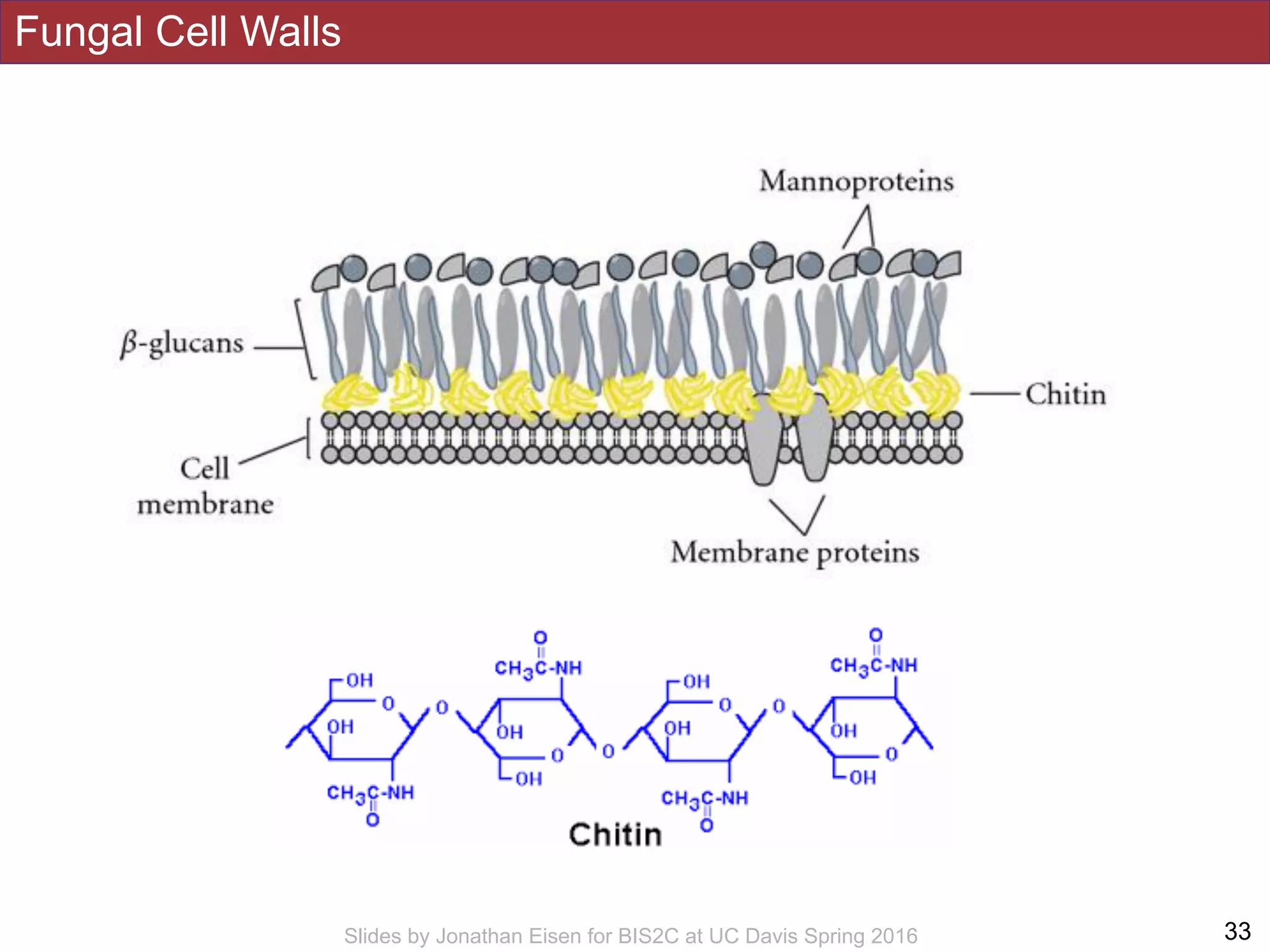
Fungal Cell Walls
!33Slides by Jonathan Eisen for BIS2C at UC Davis Spring 2016
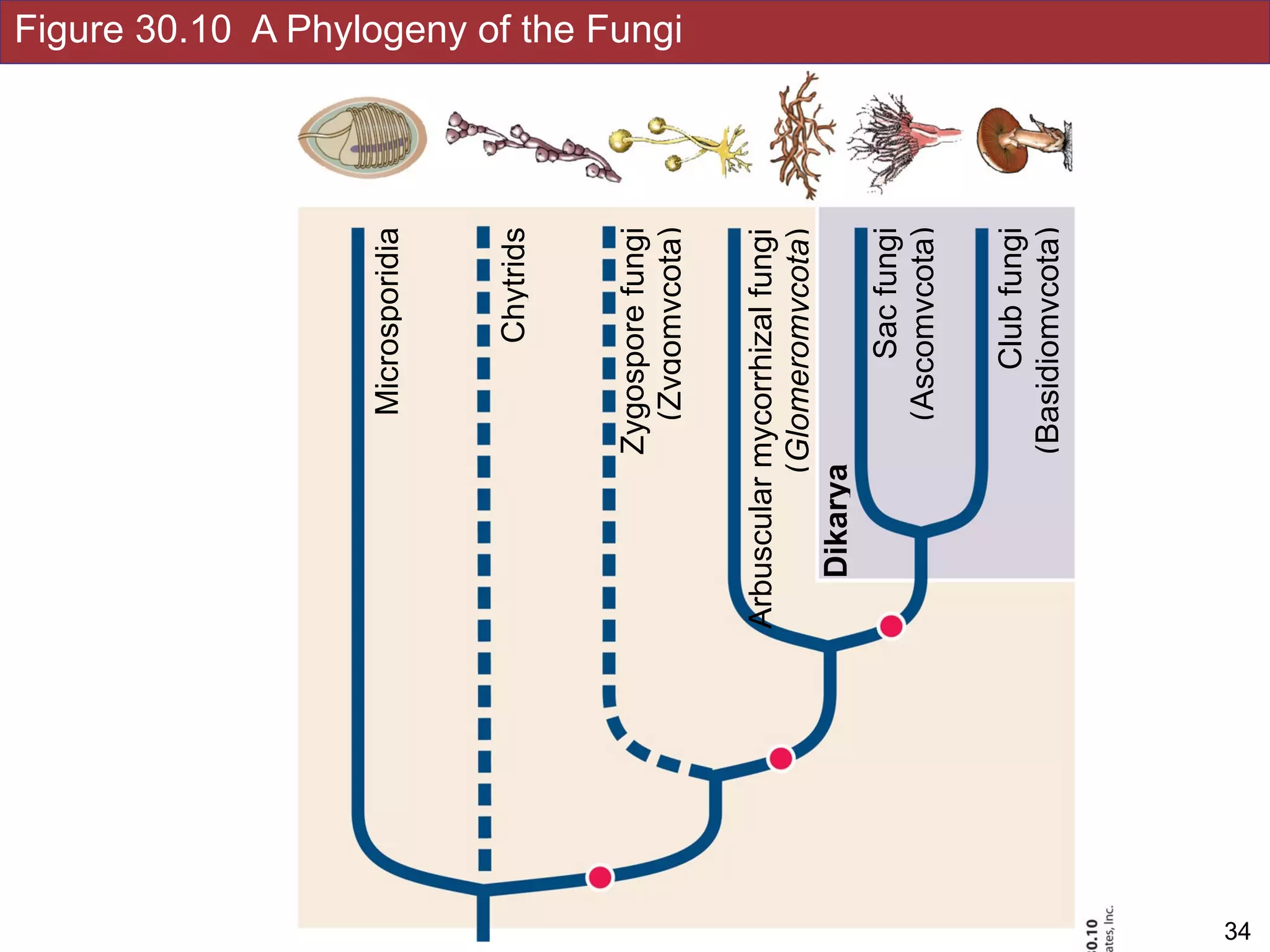
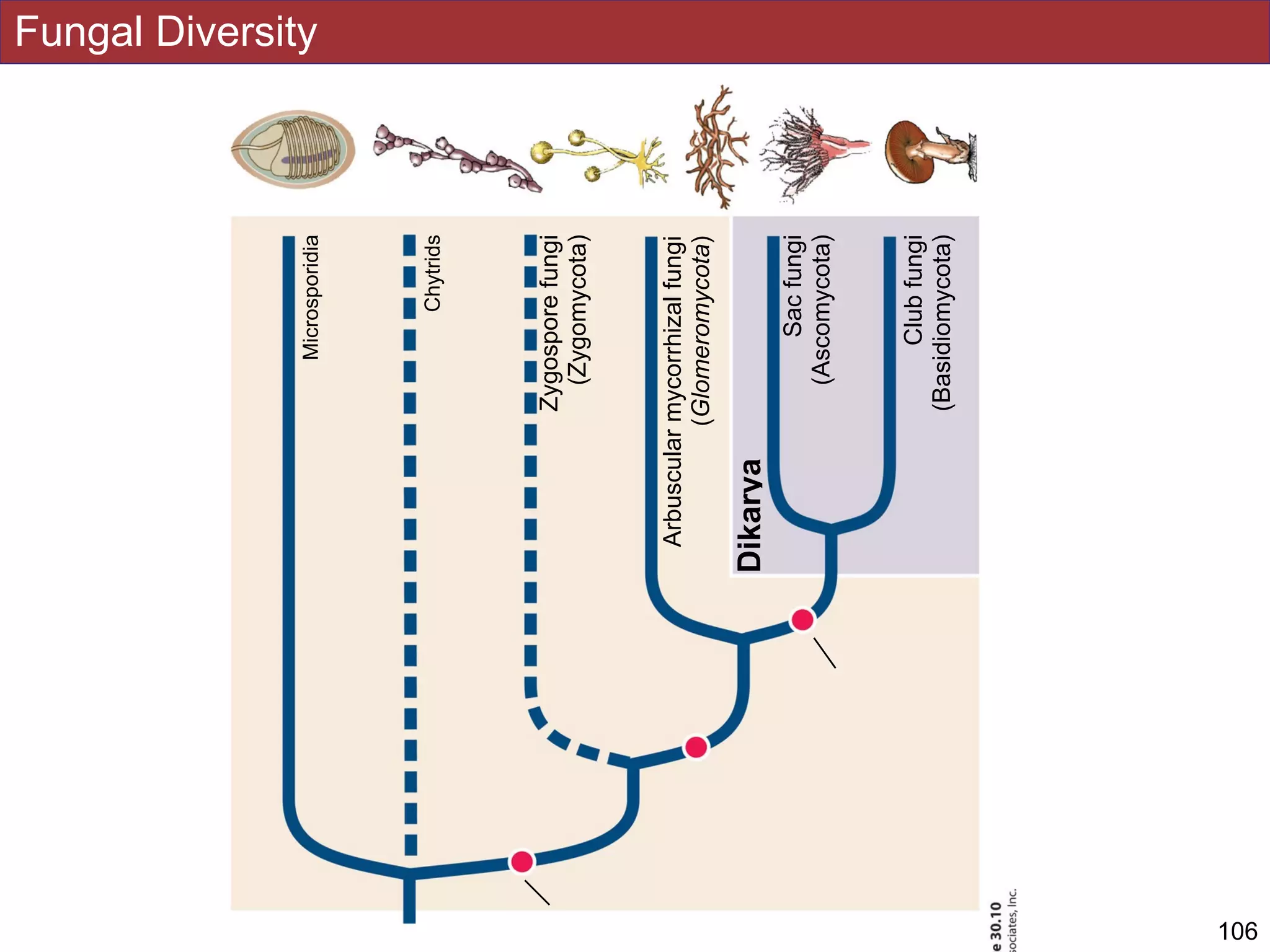
Figure 30.10 A Phylogeny of the Fungi
!34Slides by Jonathan Eisen for BIS2C at UC Davis Spring 2016
Microsporidia
Chytrids
Zygosporefungi
(Zygomycota)
Arbuscularmycorrhizalfungi
(Glomeromycota)
Sacfungi
(Ascomycota)
Clubfungi
(Basidiomycota)
Dikarya
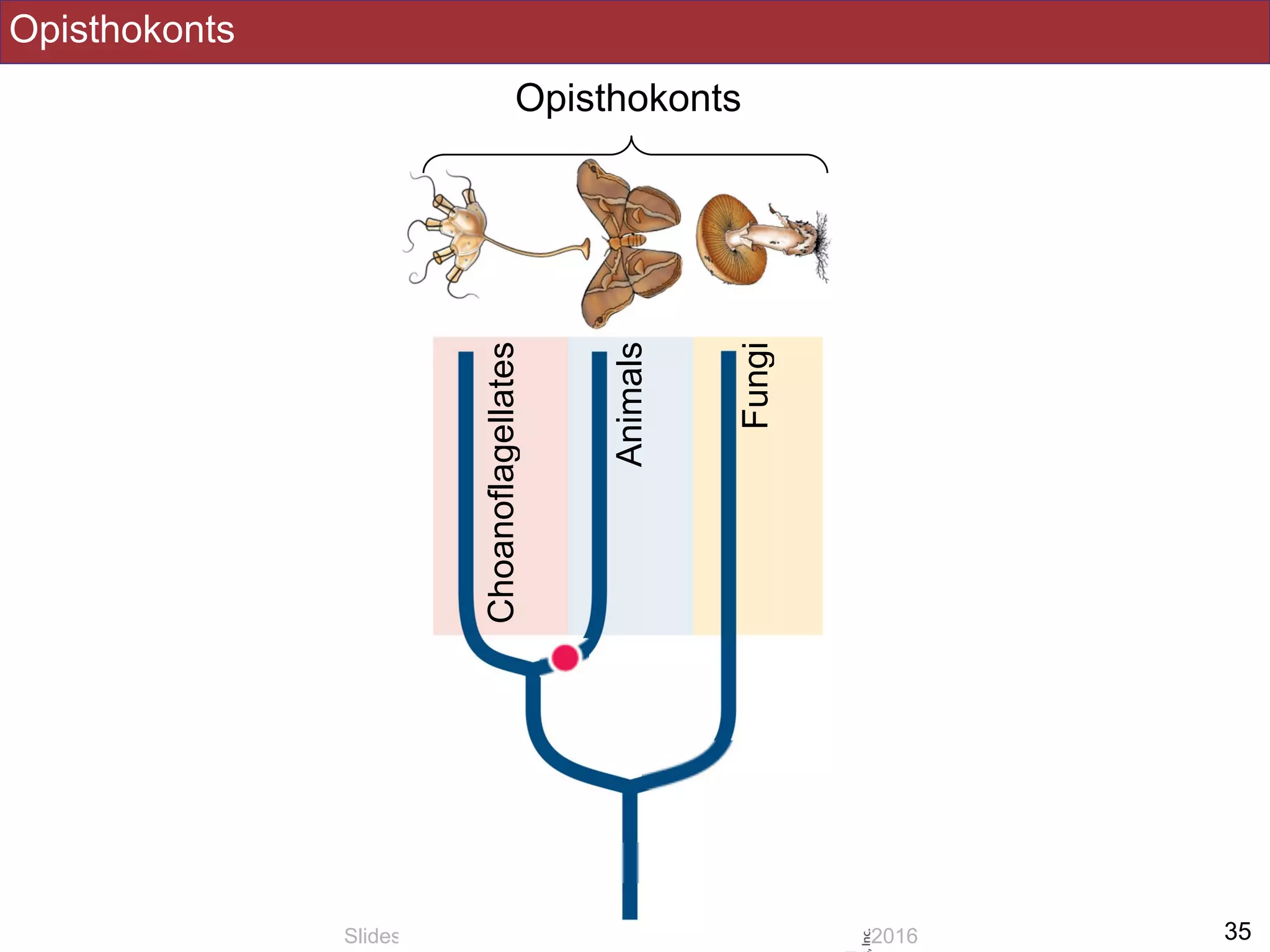
Opisthokonts
!35Slides by Jonathan Eisen for BIS2C at UC Davis Spring 2016
Opisthokonts
Fungi
Animals
Choanoflagellates
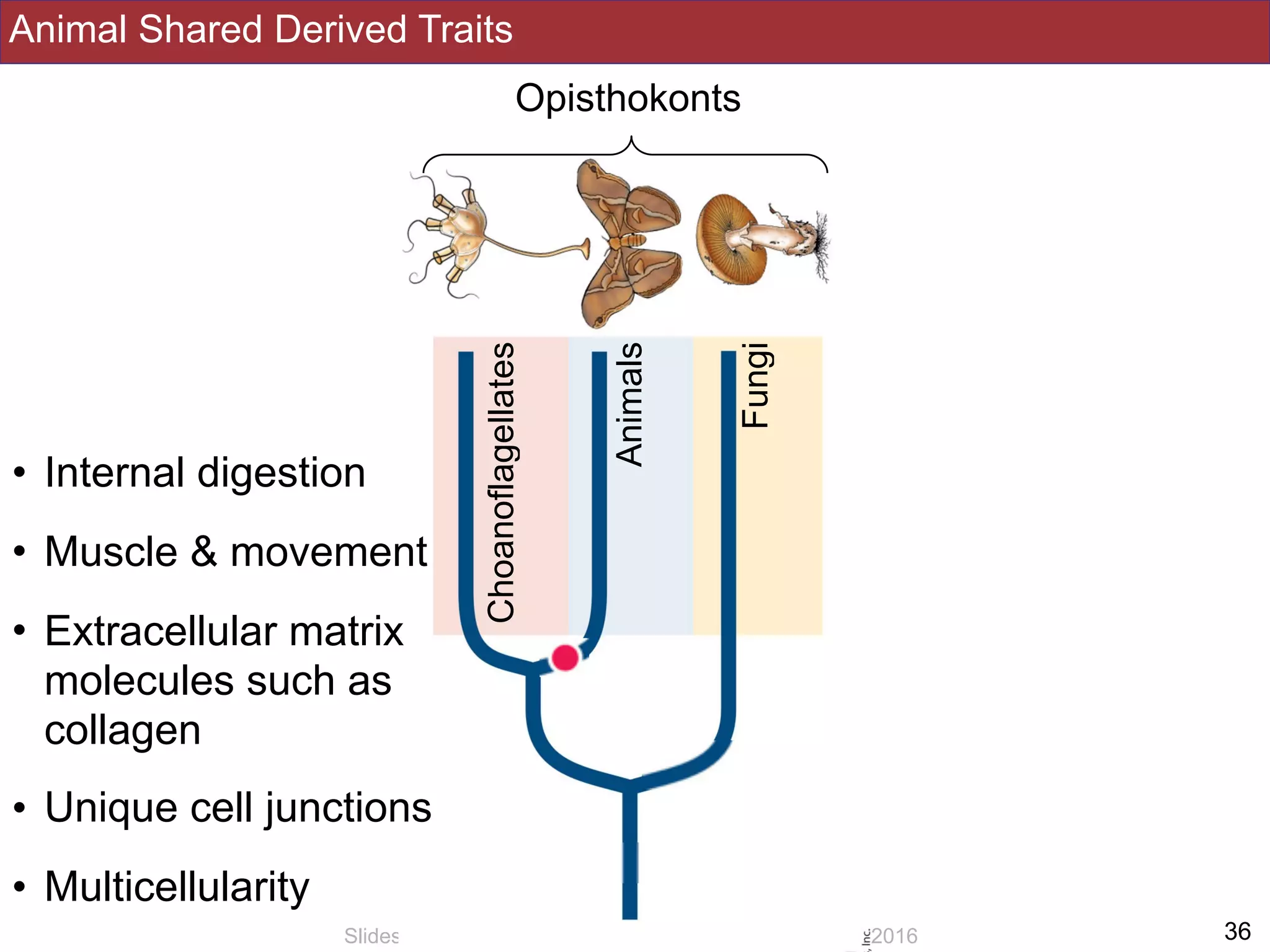
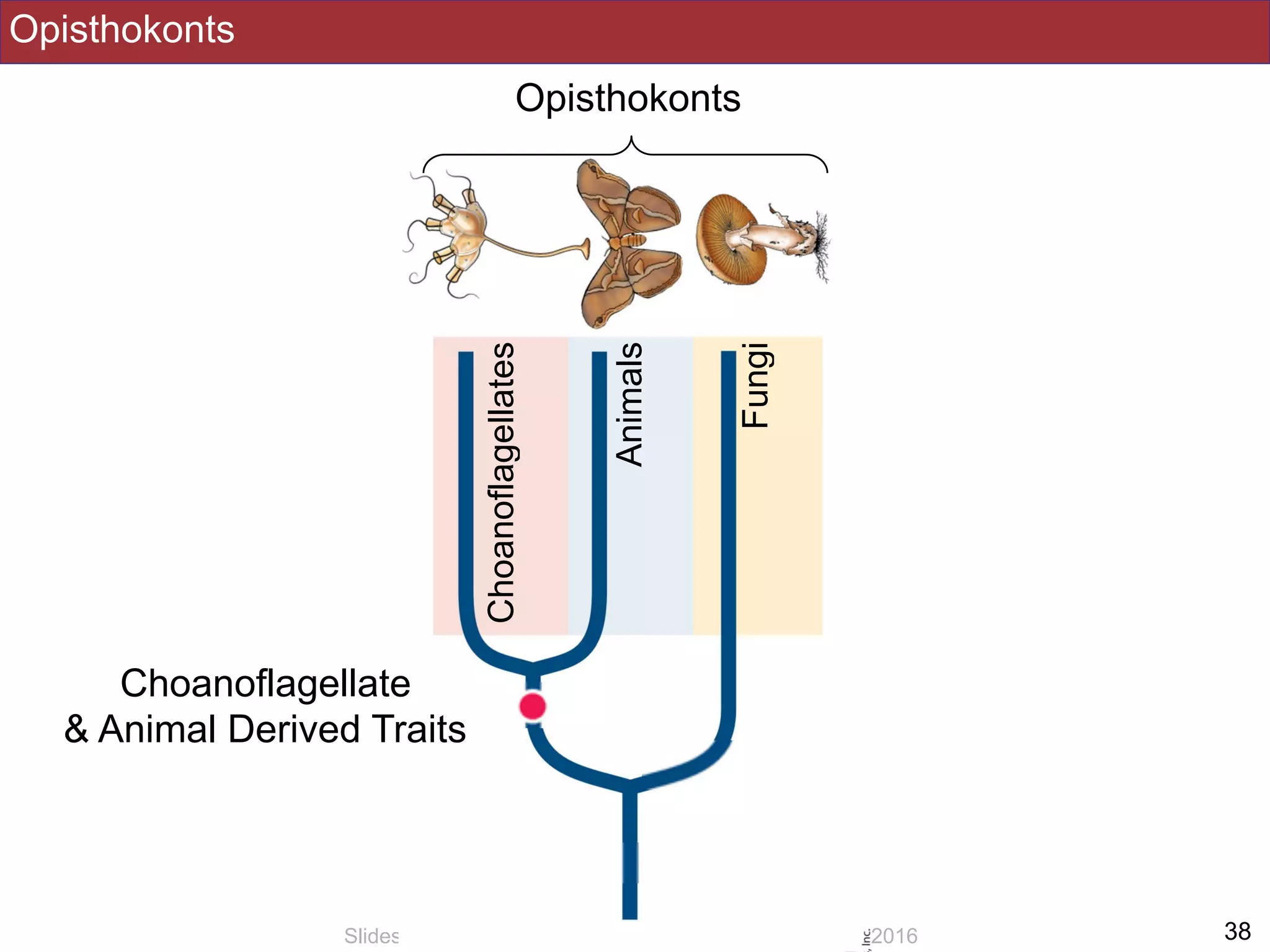
Animal Shared Derived Traits
!36Slides by Jonathan Eisen for BIS2C at UC Davis Spring 2016
Opisthokonts
Fungi
Animals
Choanoflagellates
• Internal digestion
• Muscle & movement
• Extracellular matrix
molecules such as
collagen
• Unique cell junctions
• Multicellularity
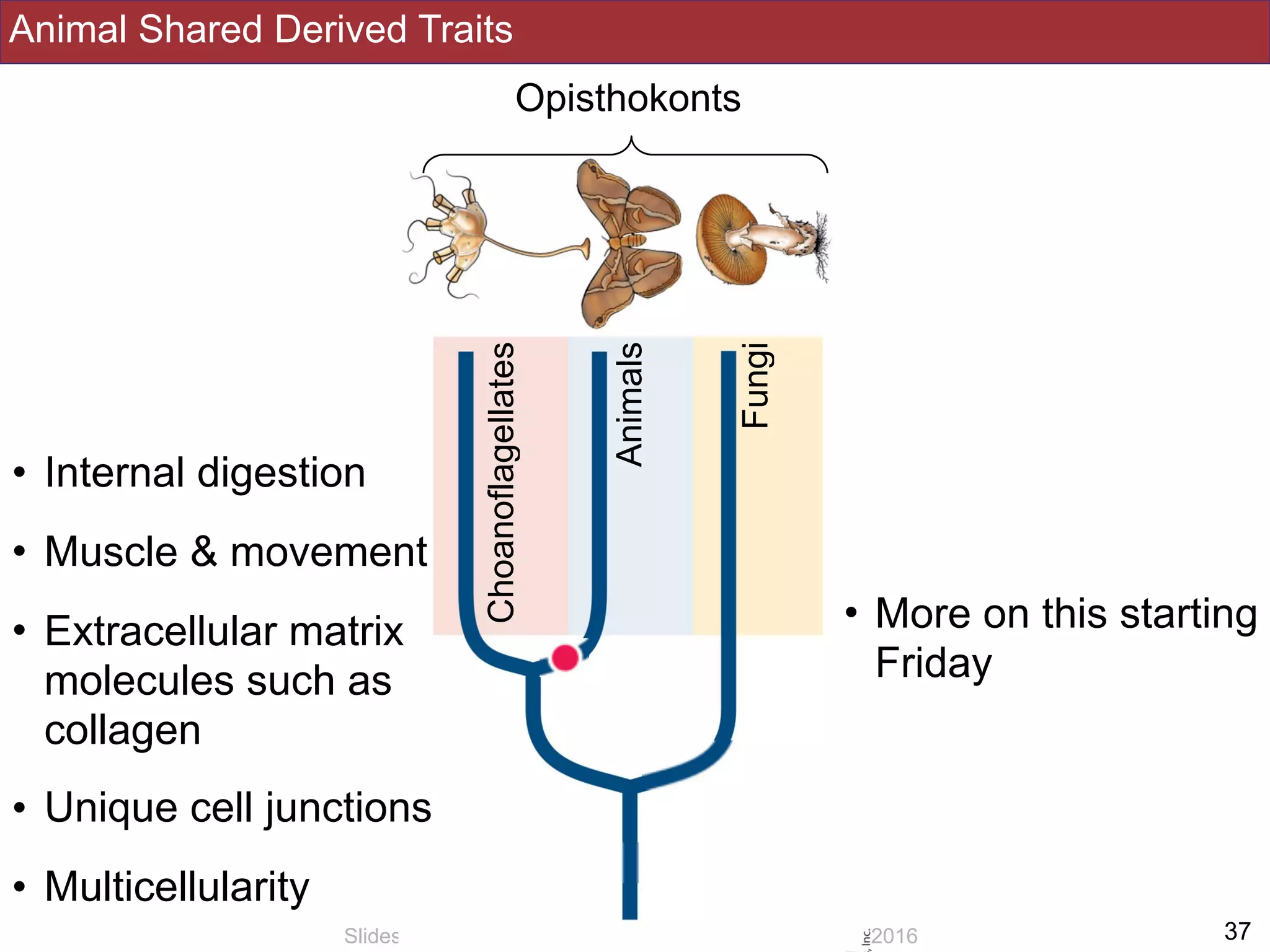
Animal Shared Derived Traits
!37Slides by Jonathan Eisen for BIS2C at UC Davis Spring 2016
Opisthokonts
Fungi
Animals
Choanoflagellates
• Internal digestion
• Muscle & movement
• Extracellular matrix
molecules such as
collagen
• Unique cell junctions
• Multicellularity
• More on this starting
Friday
Opisthokonts
!38Slides by Jonathan Eisen for BIS2C at UC Davis Spring 2016
Opisthokonts
Fungi
Animals
Choanoflagellates
Choanoflagellate
& Animal Derived Traits
Opisthokonts
!39Slides by Jonathan Eisen for BIS2C at UC Davis Spring 2016
Opisthokonts
Fungi
Animals
Choanoflagellates
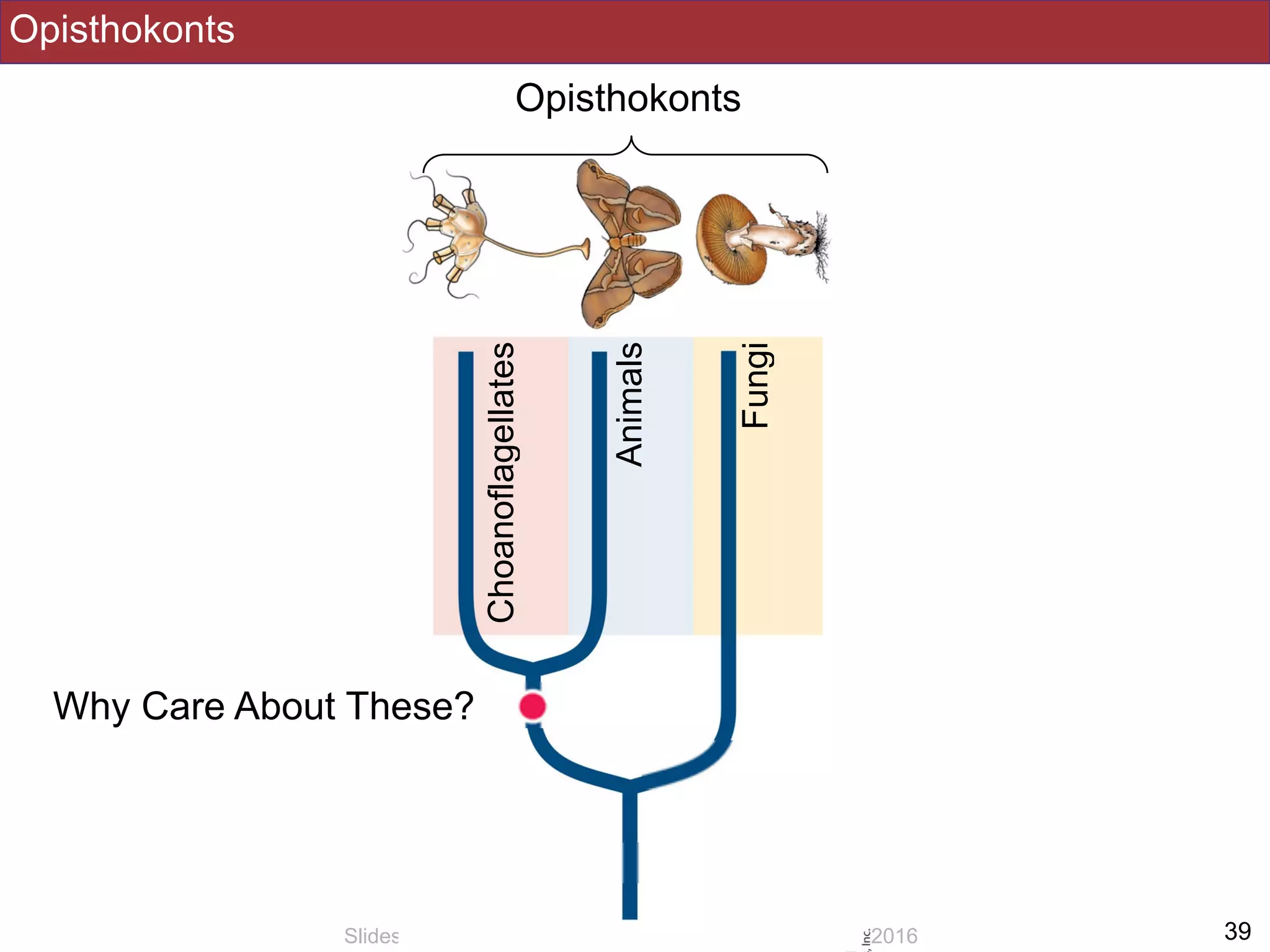
Why Care About These?
Opisthokonts
!40Slides by Jonathan Eisen for BIS2C at UC Davis Spring 2016
Opisthokonts
Fungi
Animals
Choanoflagellates
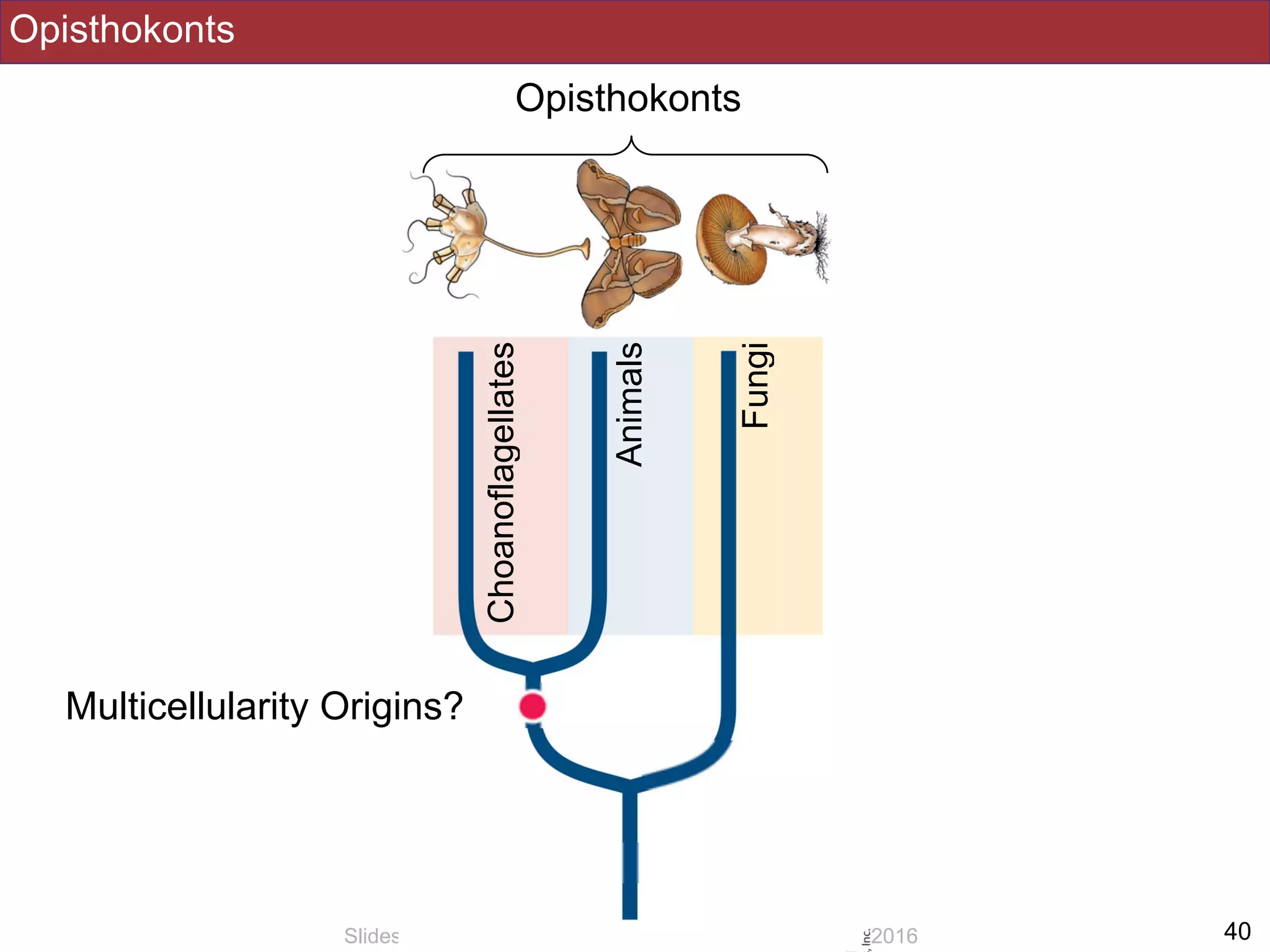
Multicellularity Origins?
Slides by Jonathan Eisen for BIS2C at UC Davis Spring 2016
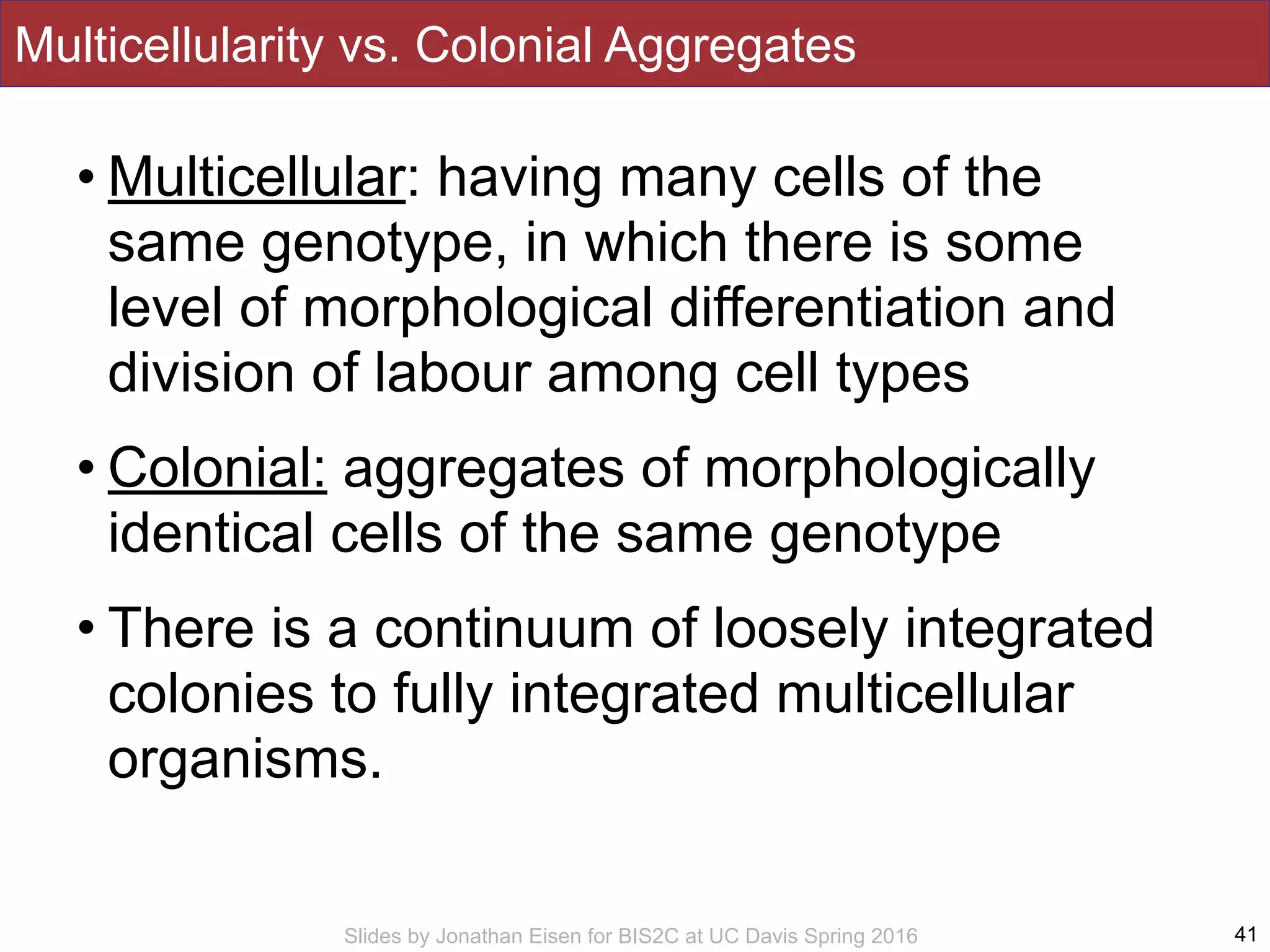
Multicellularity vs. Colonial Aggregates
• Multicellular: having many cells of the
same genotype, in which there is some
level of morphological differentiation and
division of labour among cell types
• Colonial: aggregates of morphologically
identical cells of the same genotype
• There is a continuum of loosely integrated
colonies to fully integrated multicellular
organisms.
41
Opisthokonts
!42Slides by Jonathan Eisen for BIS2C at UC Davis Spring 2016
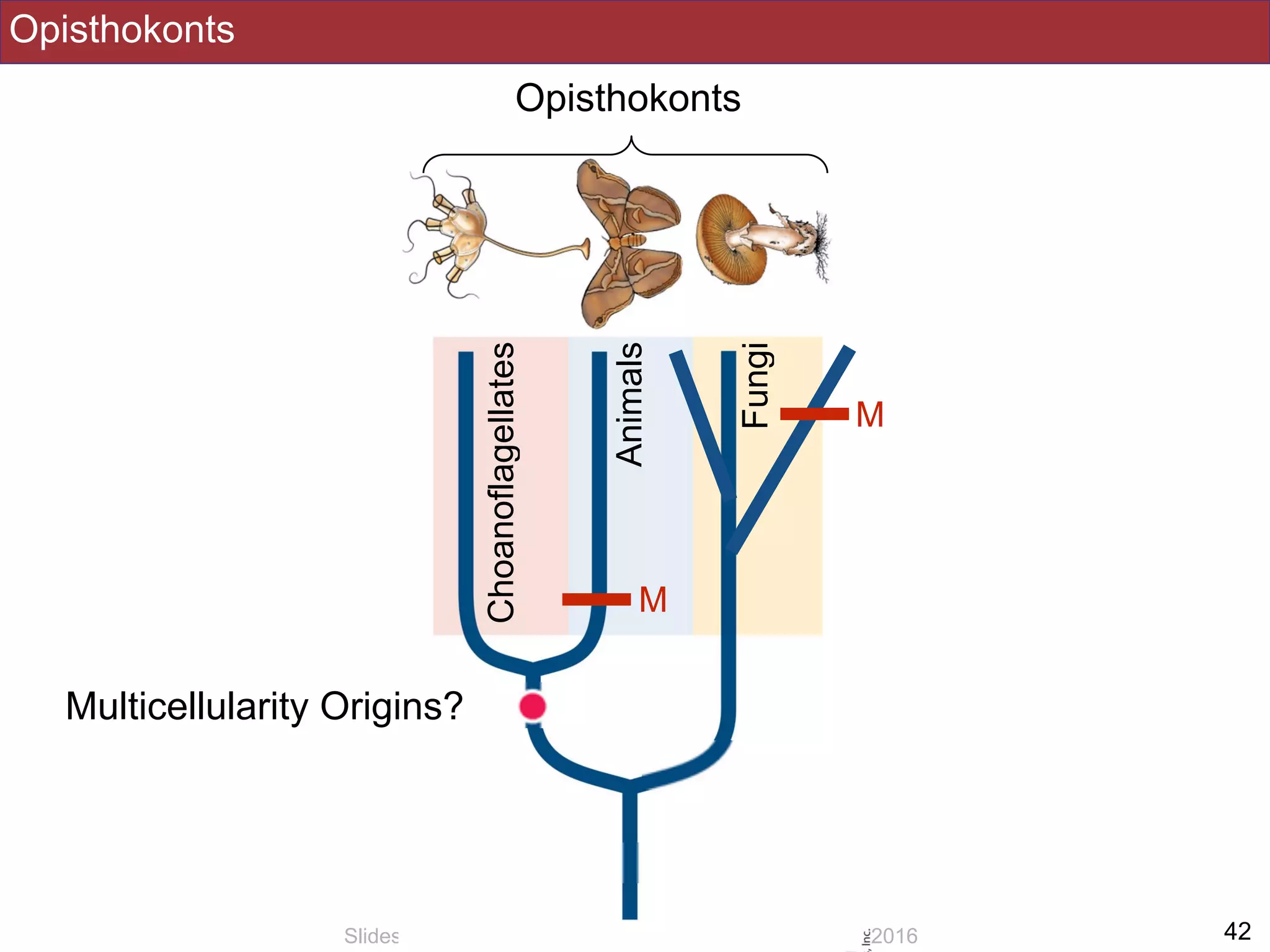
Opisthokonts
Fungi
Animals
Choanoflagellates
Multicellularity Origins?
M
M
Slides by Jonathan Eisen for BIS2C at UC Davis Spring 2016 4343
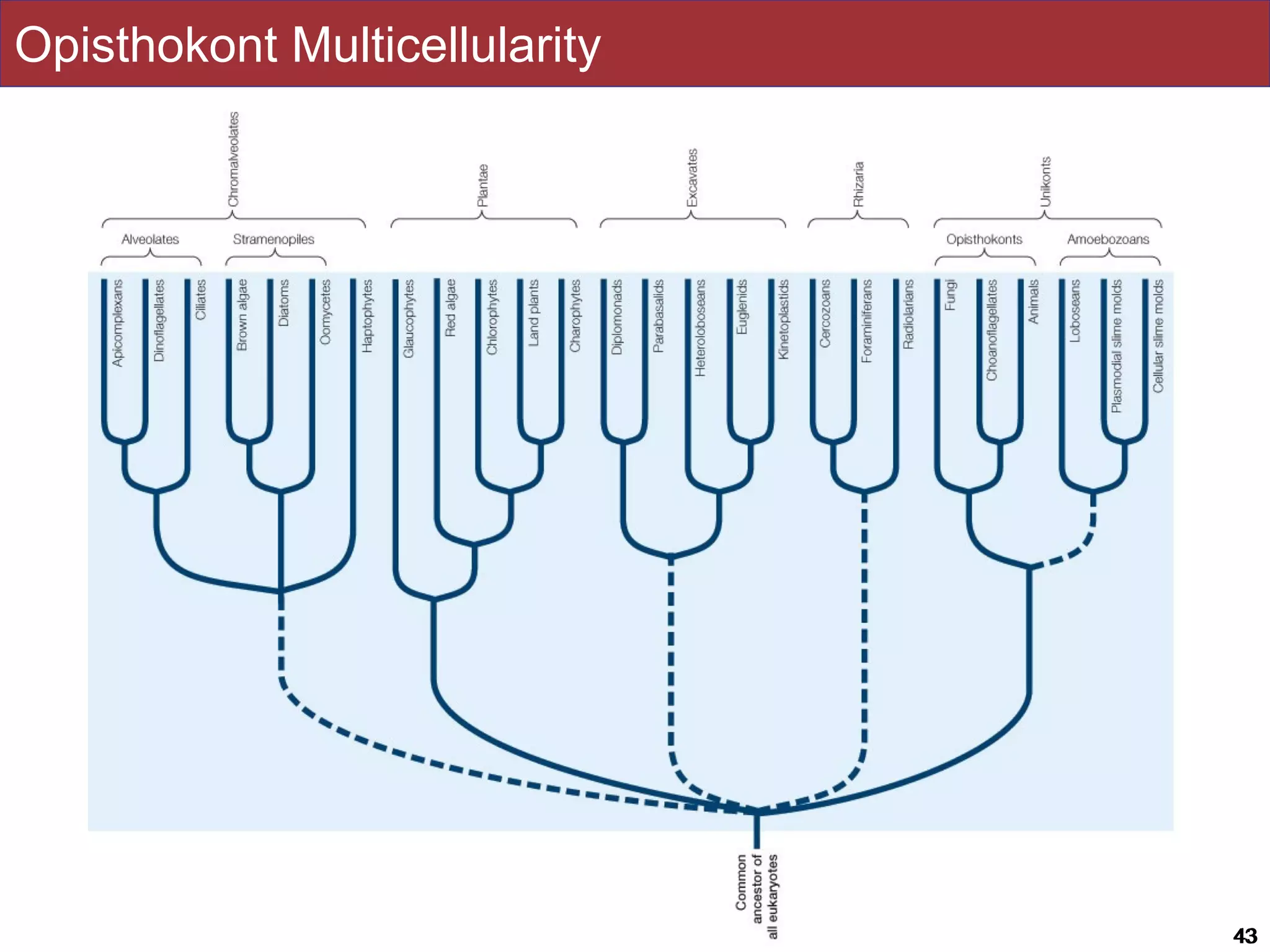
Opisthokont Multicellularity
Slides by Jonathan Eisen for BIS2C at UC Davis Spring 2016 4444
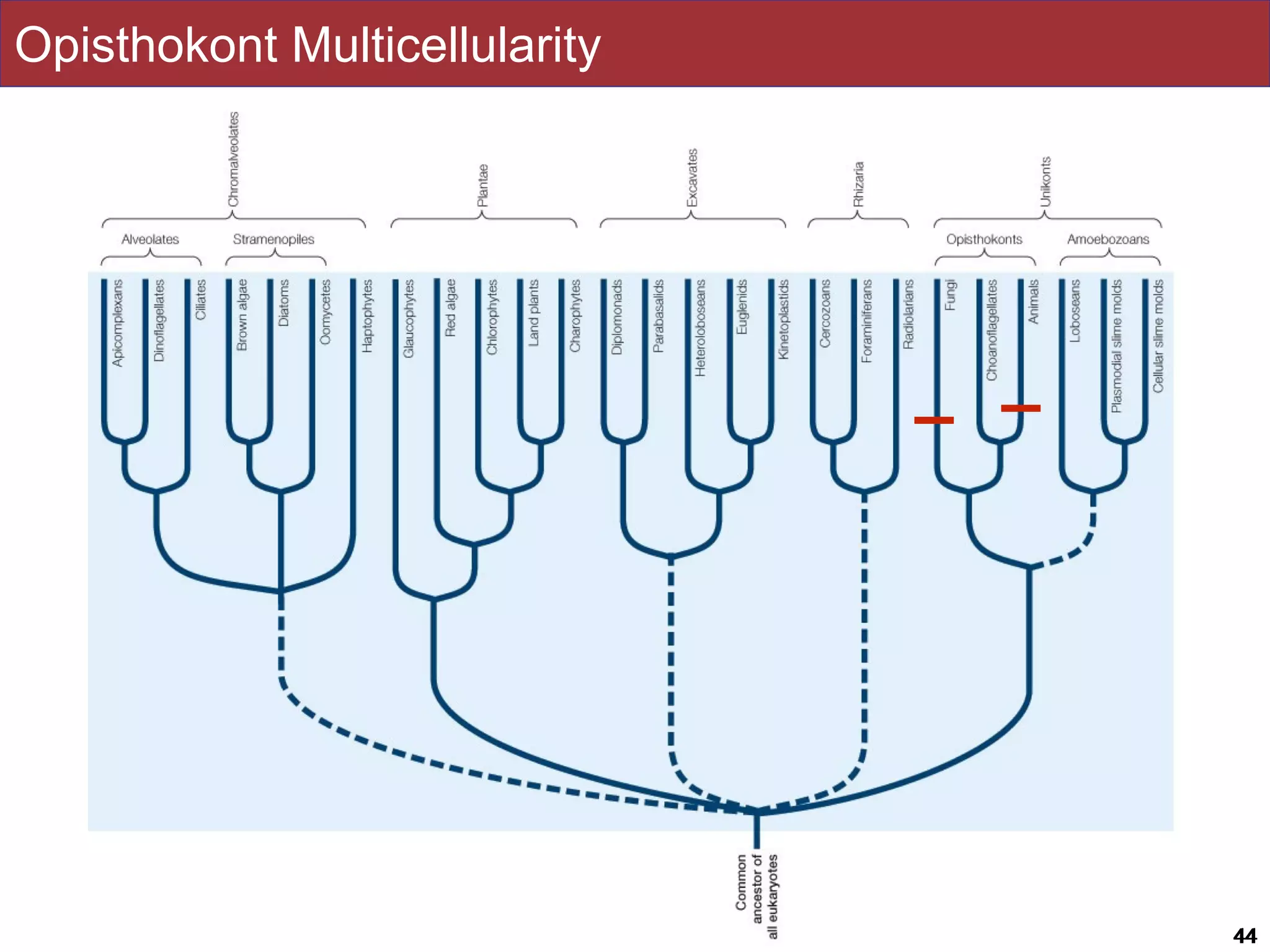
Opisthokont Multicellularity
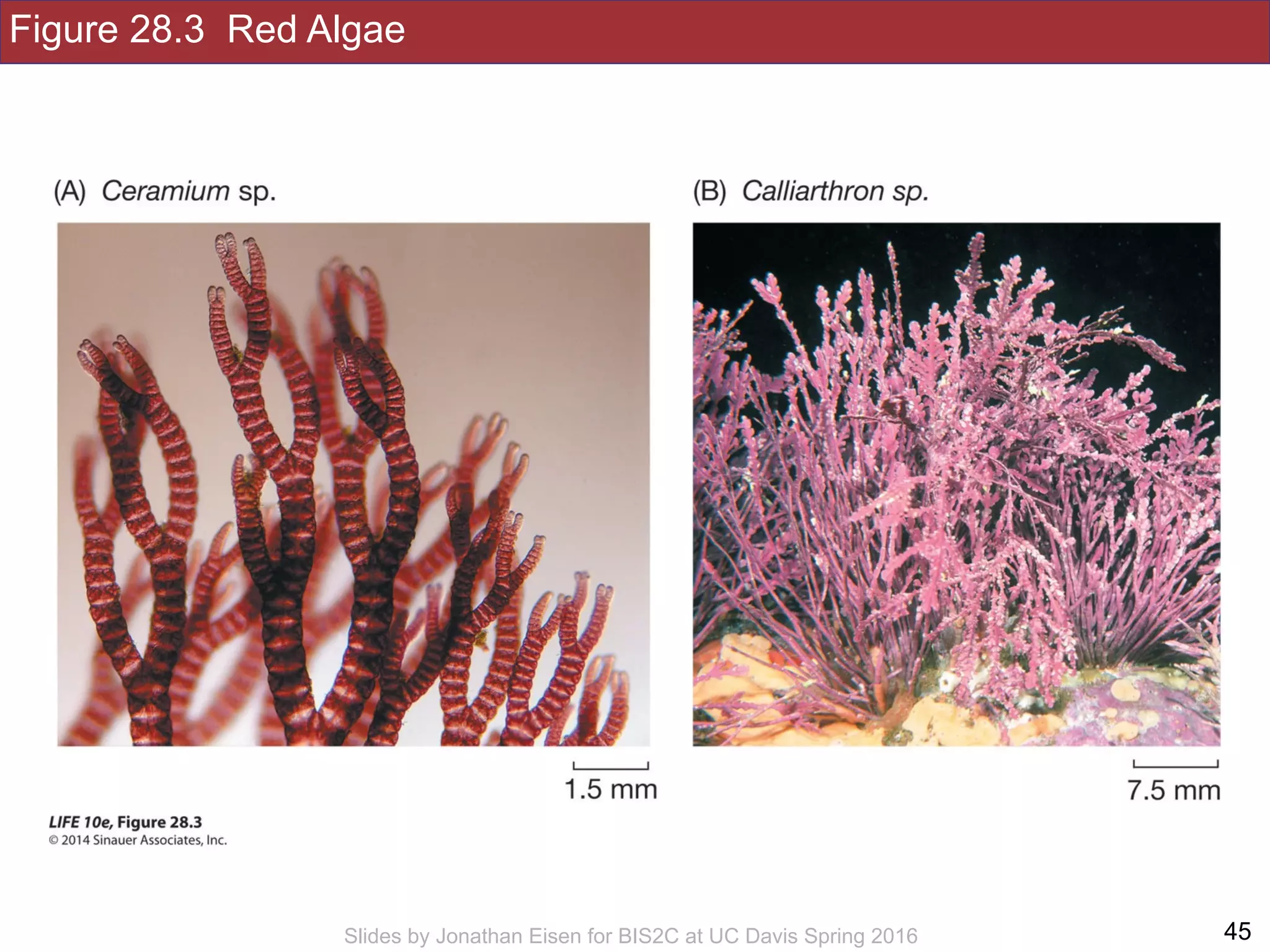
Figure 28.3 Red Algae
!45Slides by Jonathan Eisen for BIS2C at UC Davis Spring 2016
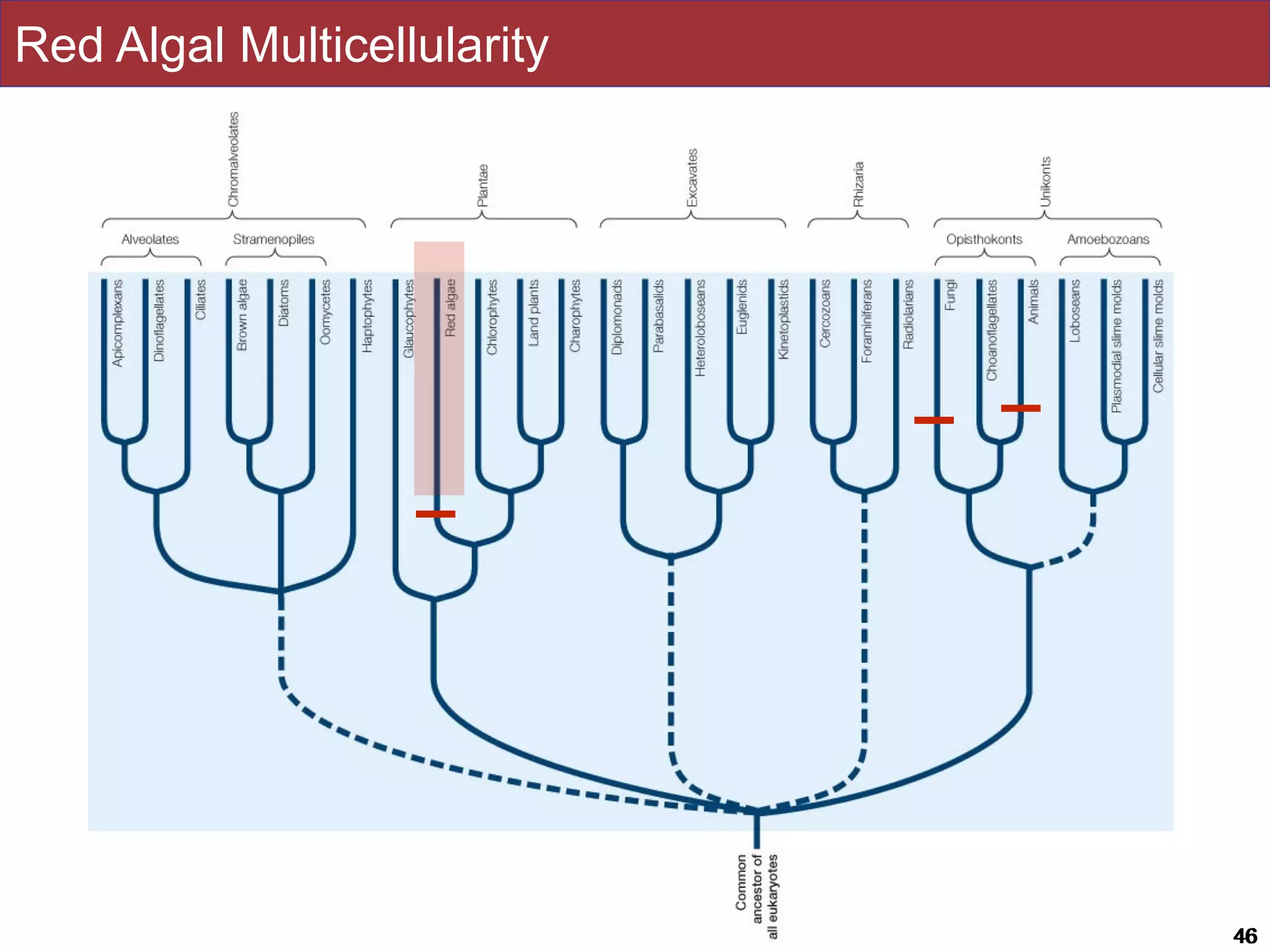
Slides by Jonathan Eisen for BIS2C at UC Davis Spring 2016 4646
Red Algal Multicellularity
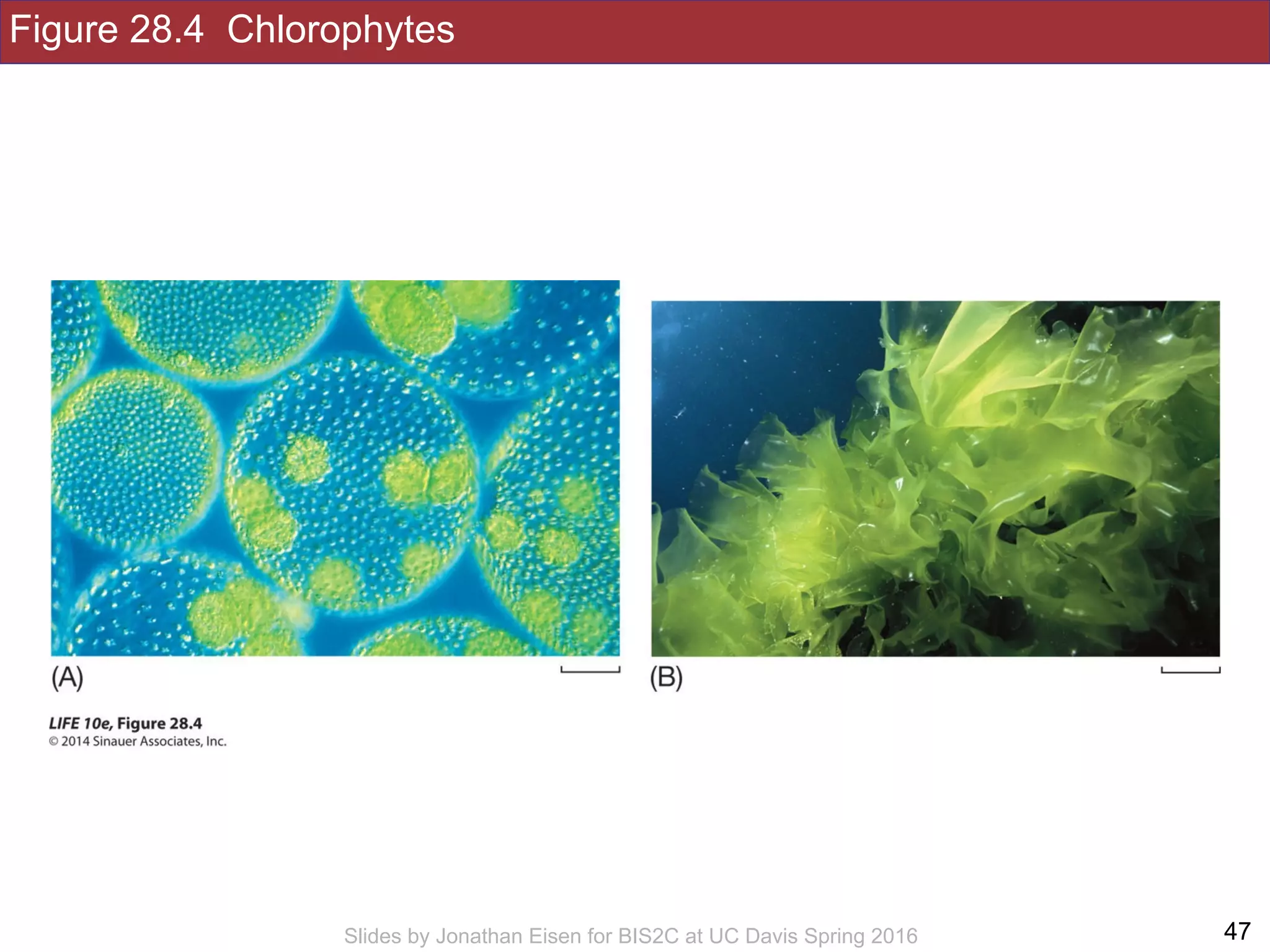
Figure 28.4 Chlorophytes
!47Slides by Jonathan Eisen for BIS2C at UC Davis Spring 2016
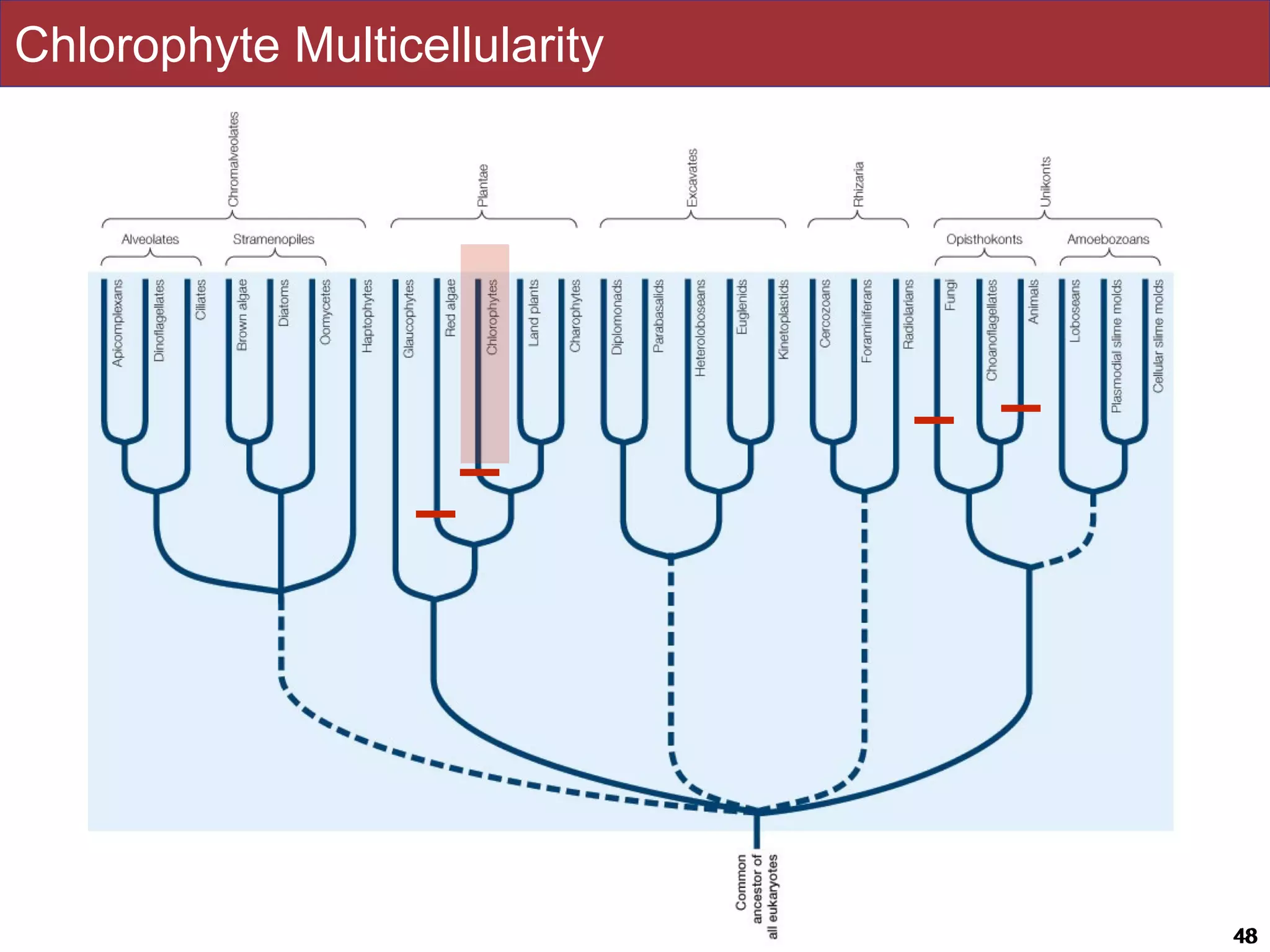
Slides by Jonathan Eisen for BIS2C at UC Davis Spring 2016 4848
Chlorophyte Multicellularity
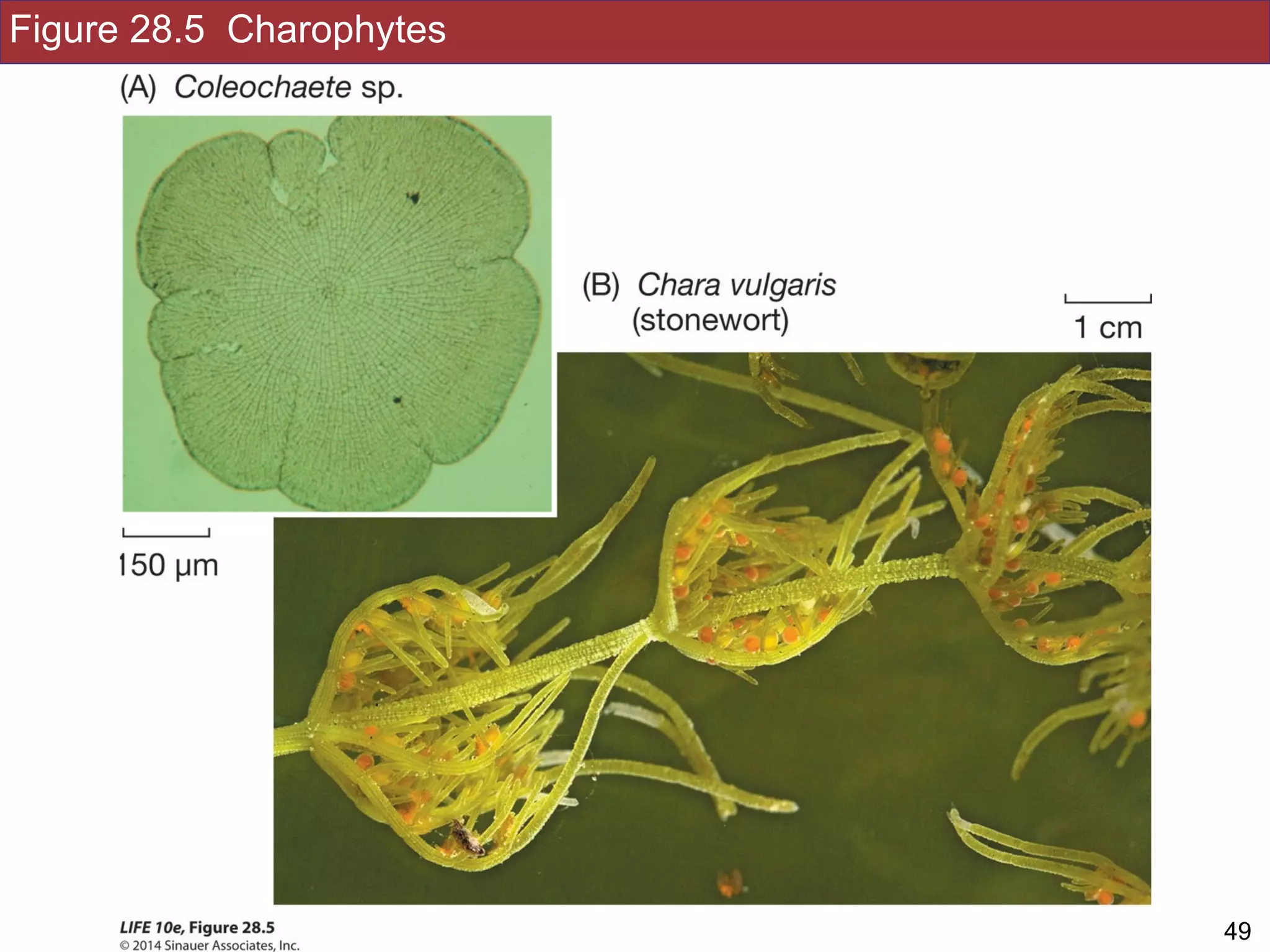
Figure 28.5 Charophytes
!49Slides by Jonathan Eisen for BIS2C at UC Davis Spring 2016
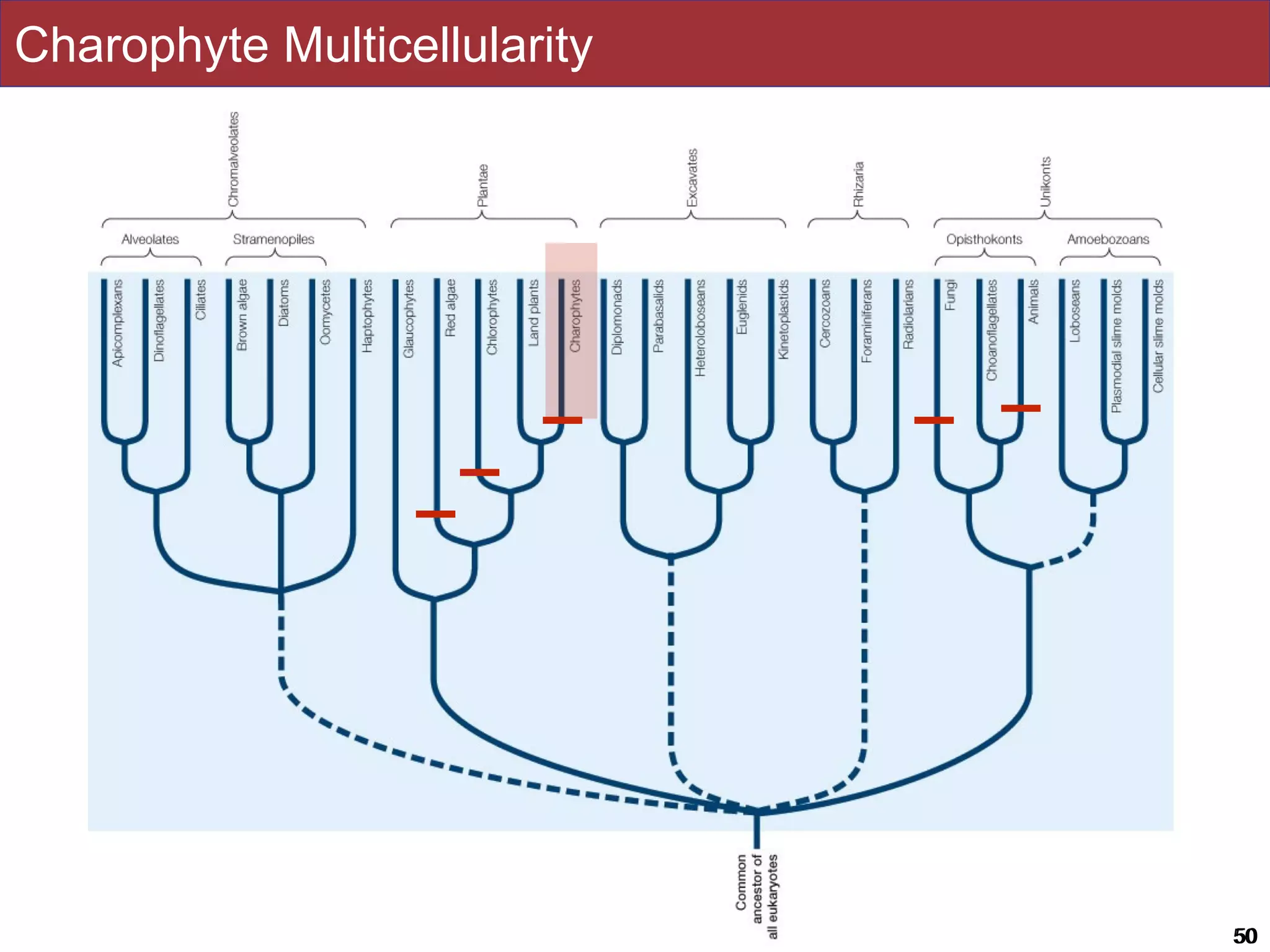
Slides by Jonathan Eisen for BIS2C at UC Davis Spring 2016 5050
Charophyte Multicellularity
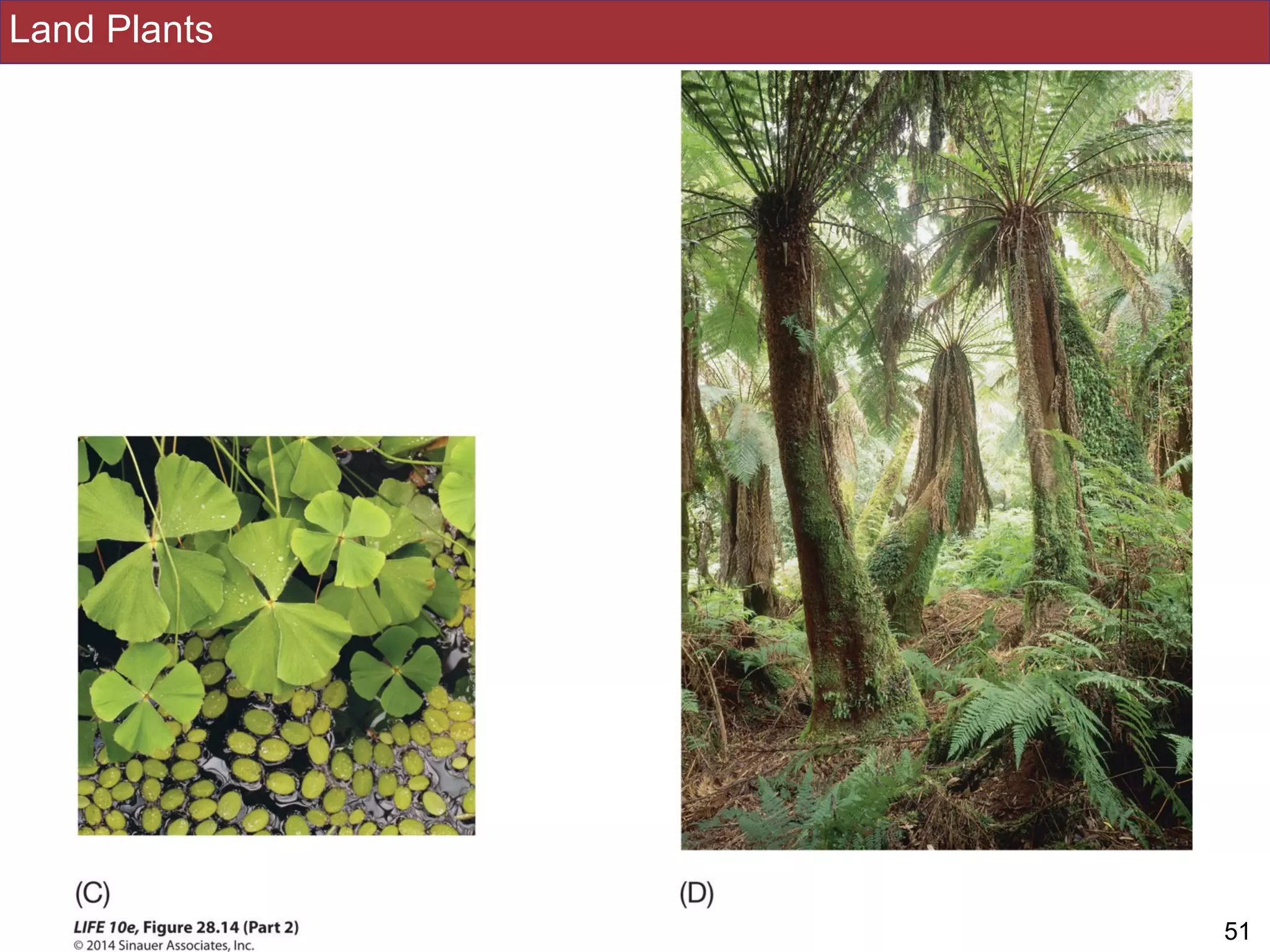
Land Plants
!51Slides by Jonathan Eisen for BIS2C at UC Davis Spring 2016
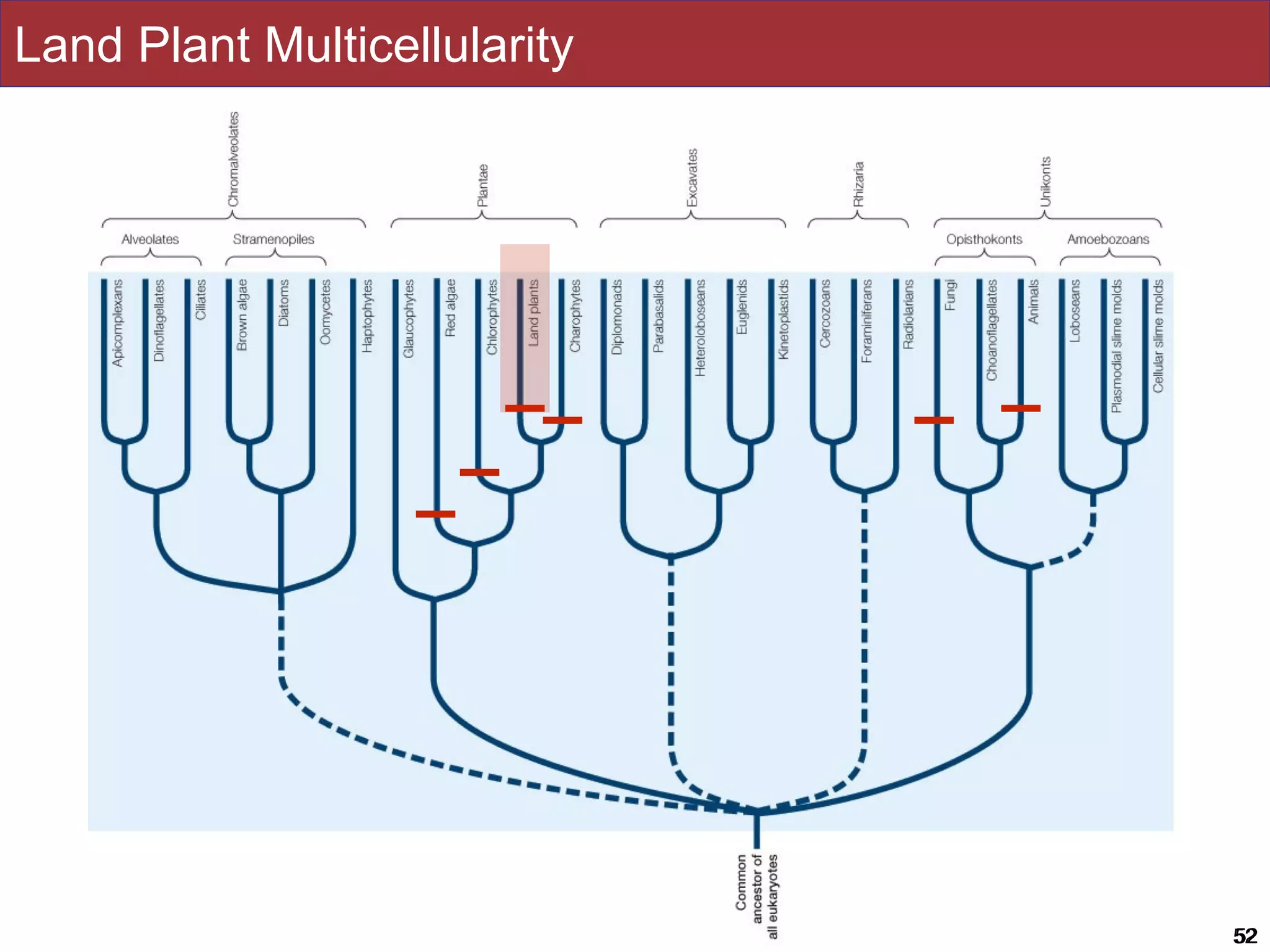
Slides by Jonathan Eisen for BIS2C at UC Davis Spring 2016 5252
Land Plant Multicellularity
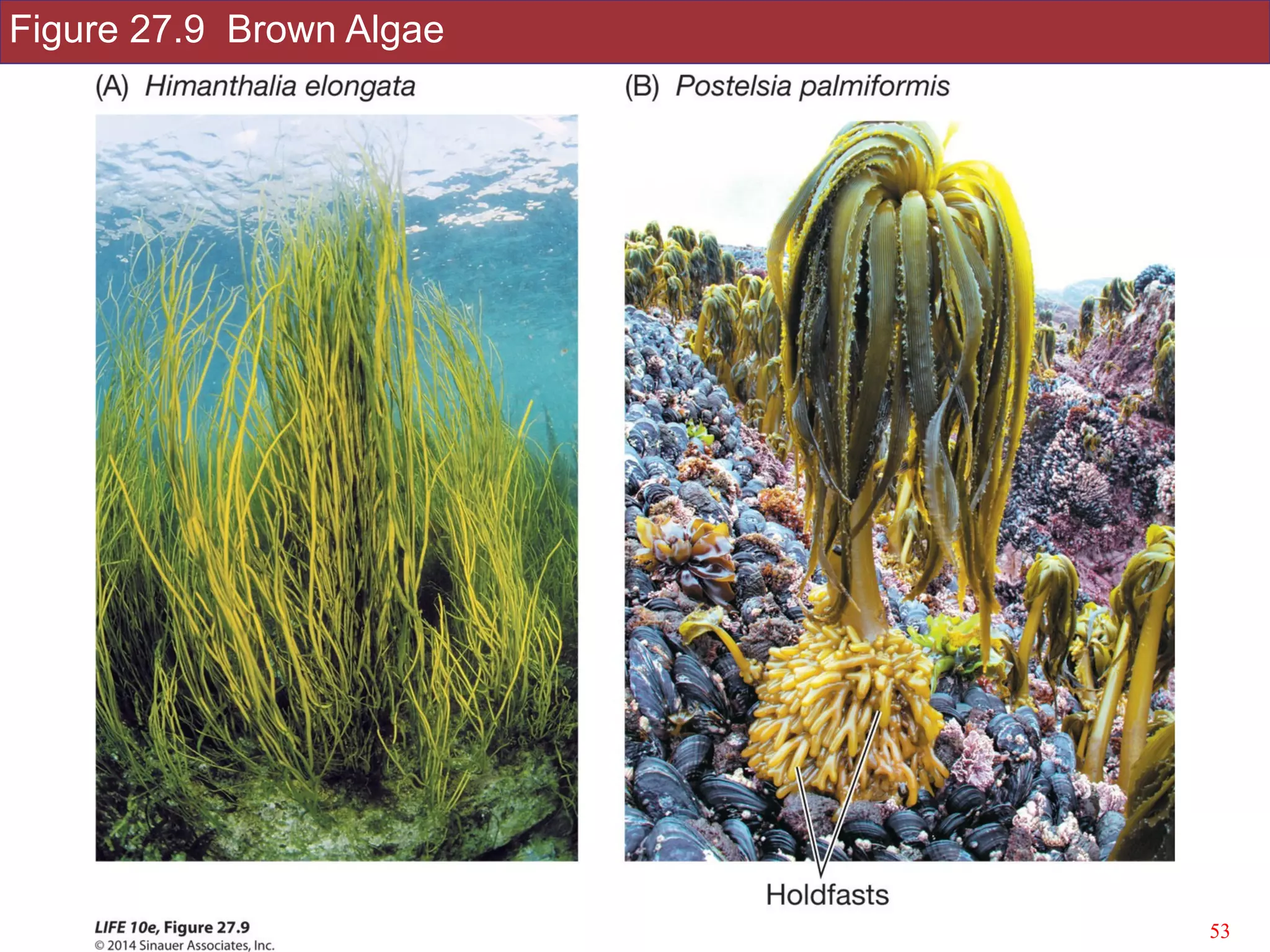
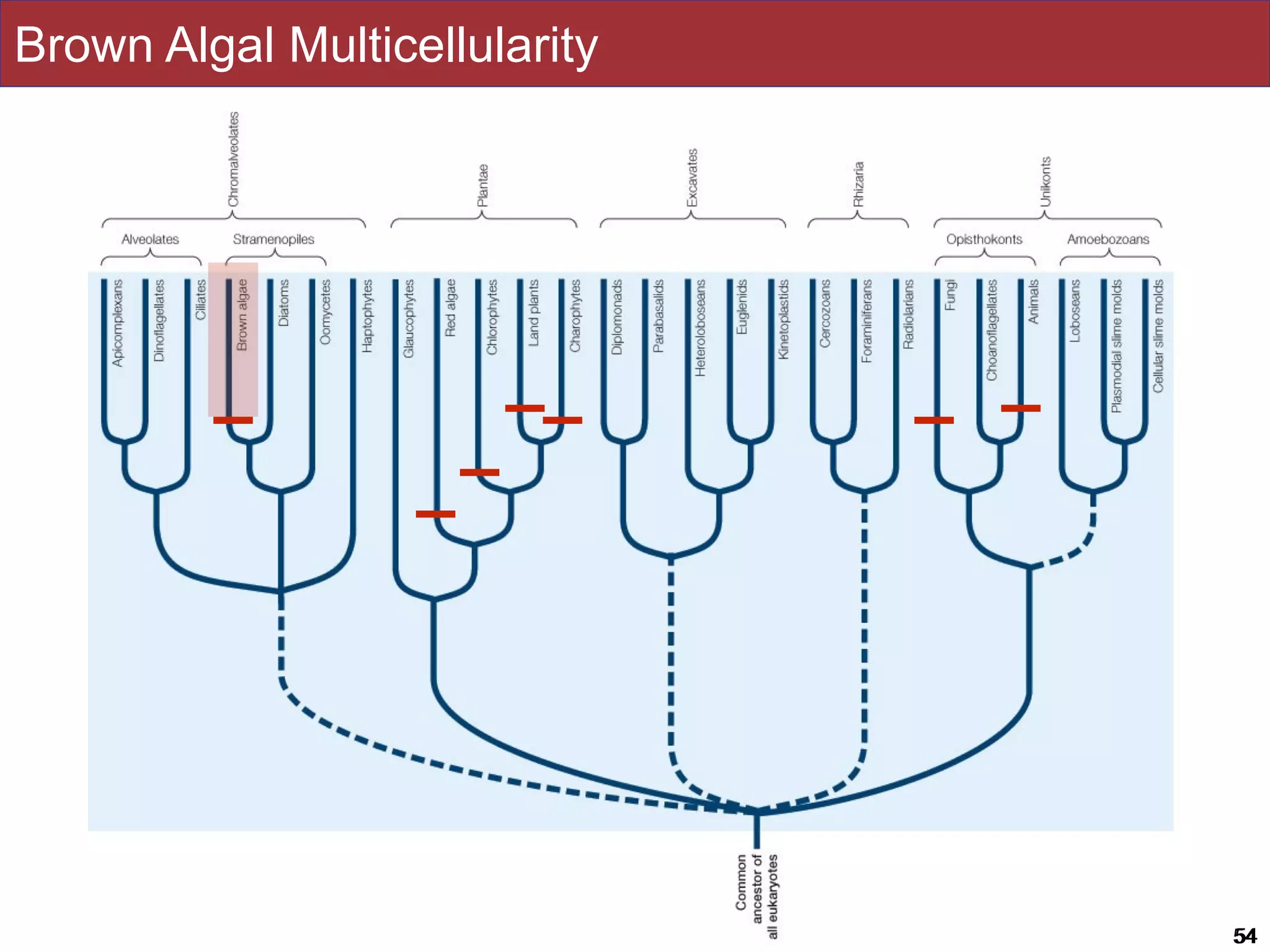
Figure 27.9 Brown Algae
!53Slides by Jonathan Eisen for BIS2C at UC Davis Spring 2016
Slides by Jonathan Eisen for BIS2C at UC Davis Spring 2016 5454
Brown Algal Multicellularity
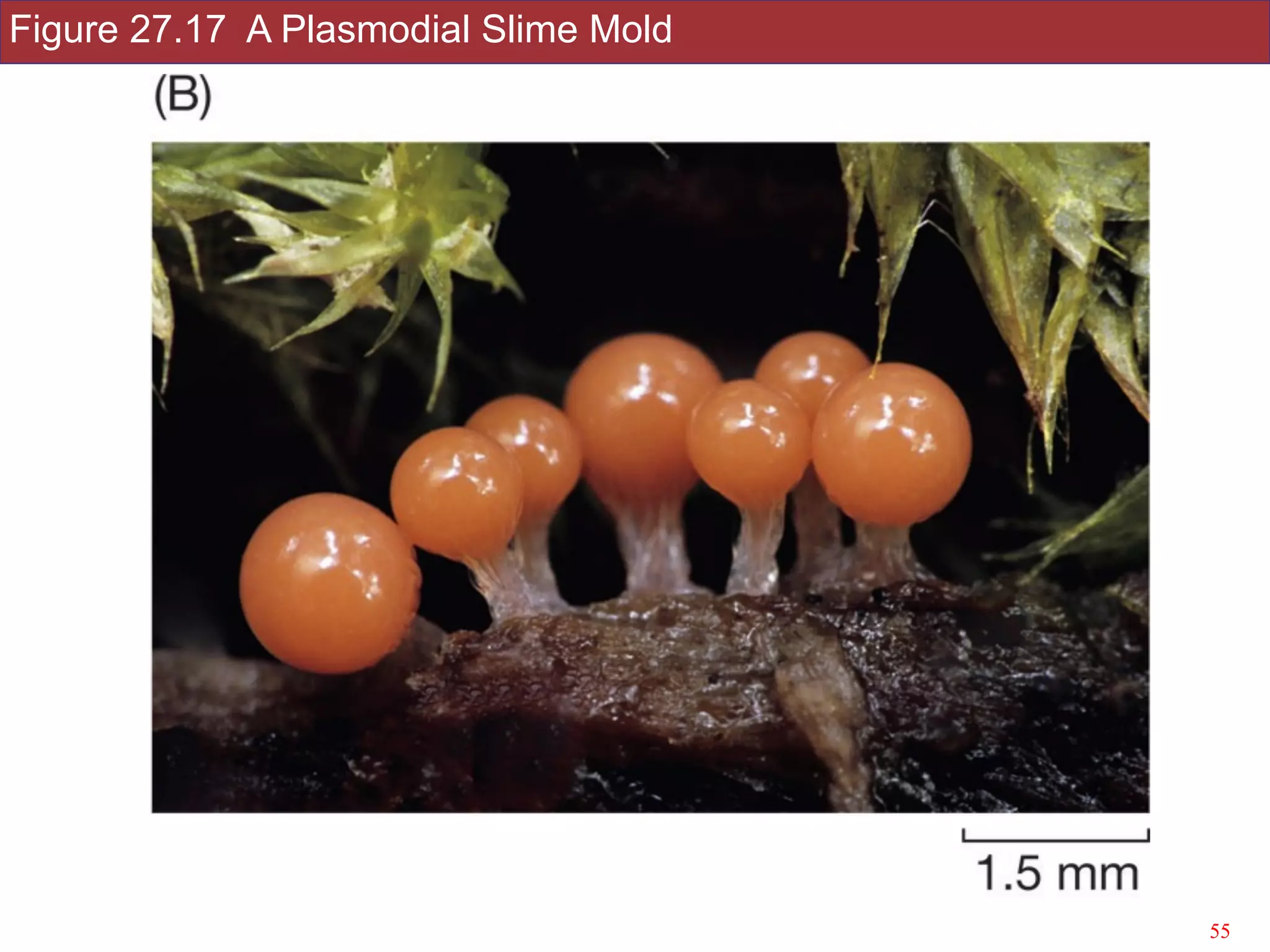
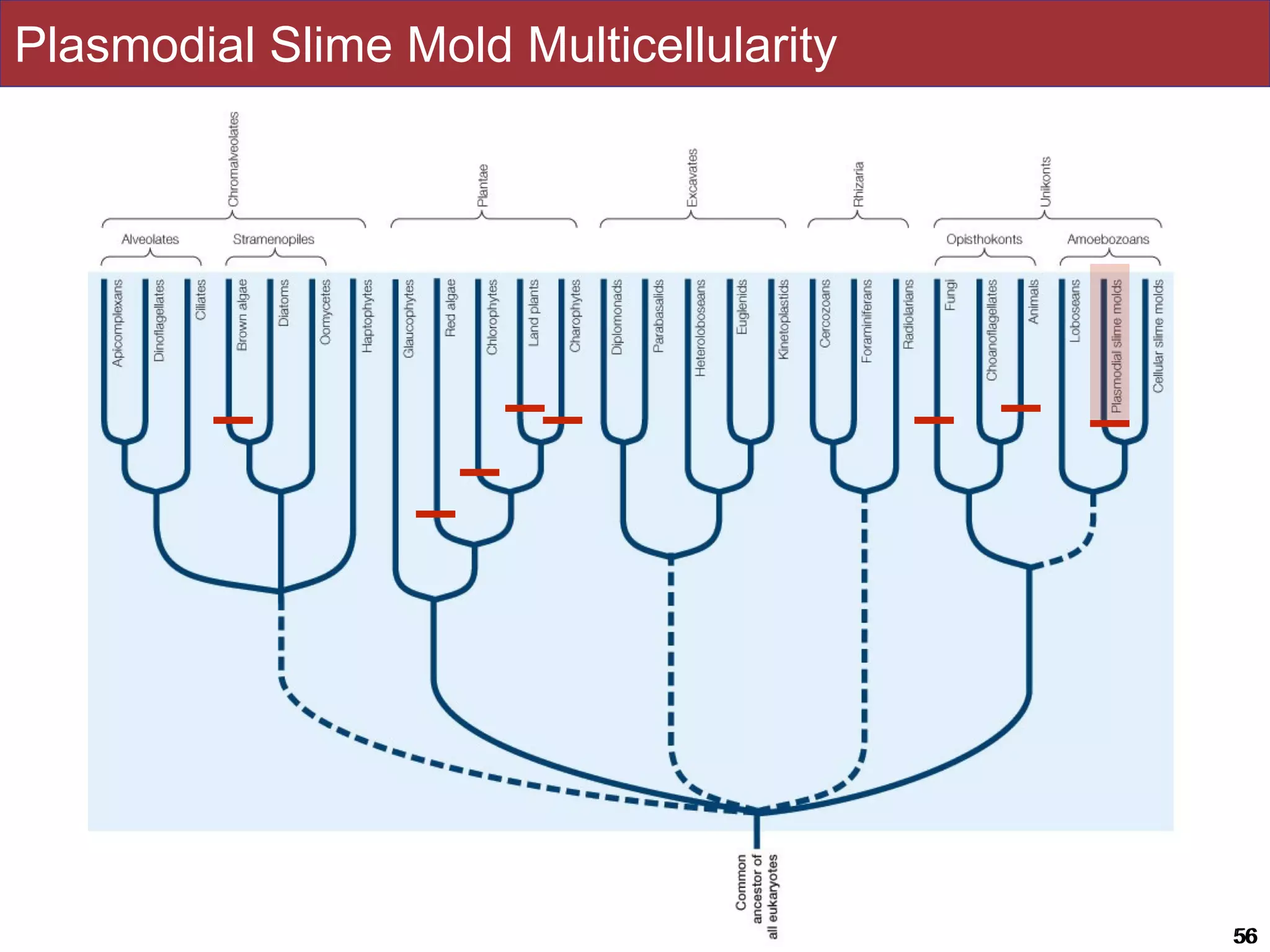
Figure 27.17 A Plasmodial Slime Mold
!55Slides by Jonathan Eisen for BIS2C at UC Davis Spring 2016
Slides by Jonathan Eisen for BIS2C at UC Davis Spring 2016 5656
Plasmodial Slime Mold Multicellularity
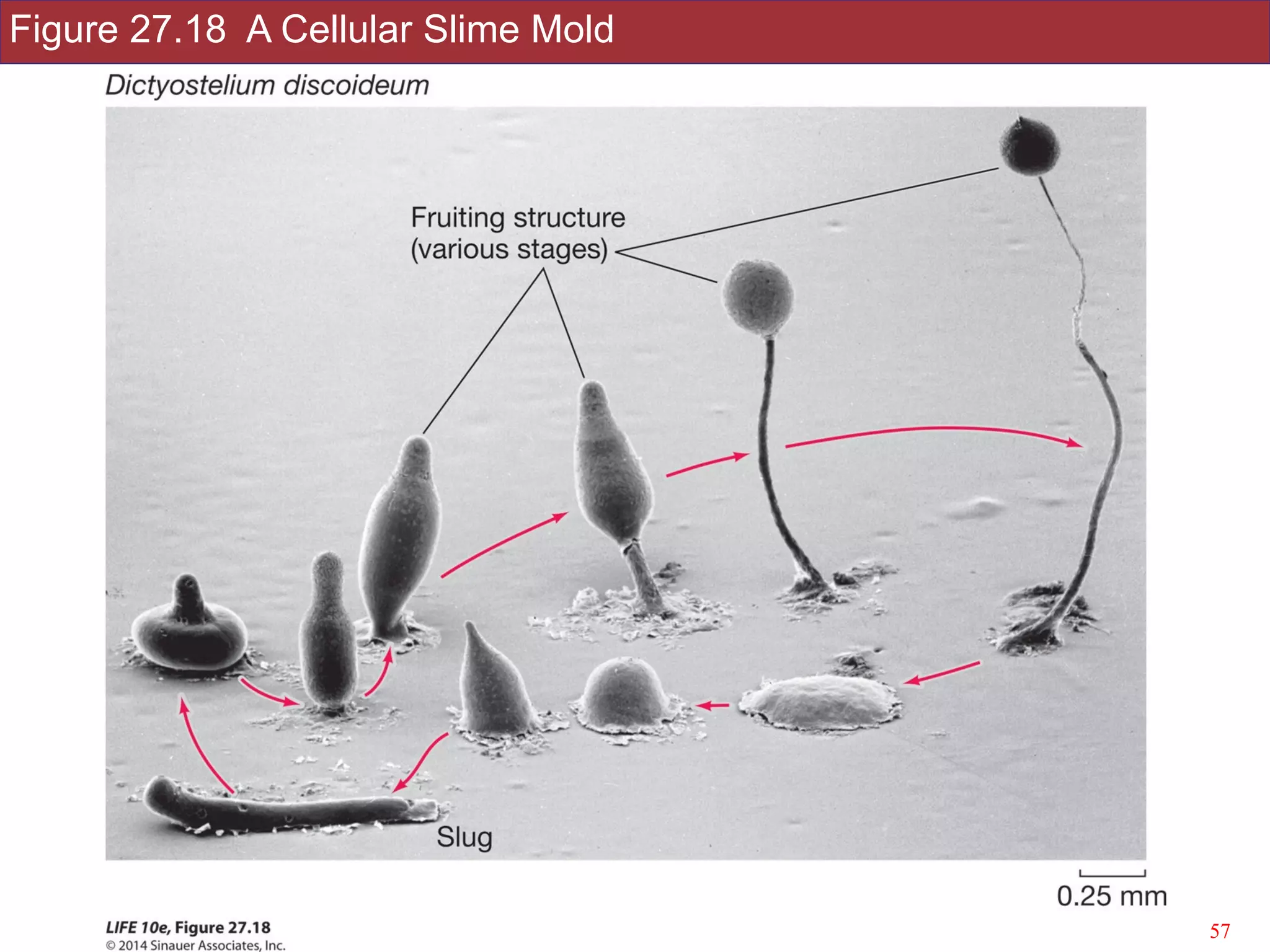
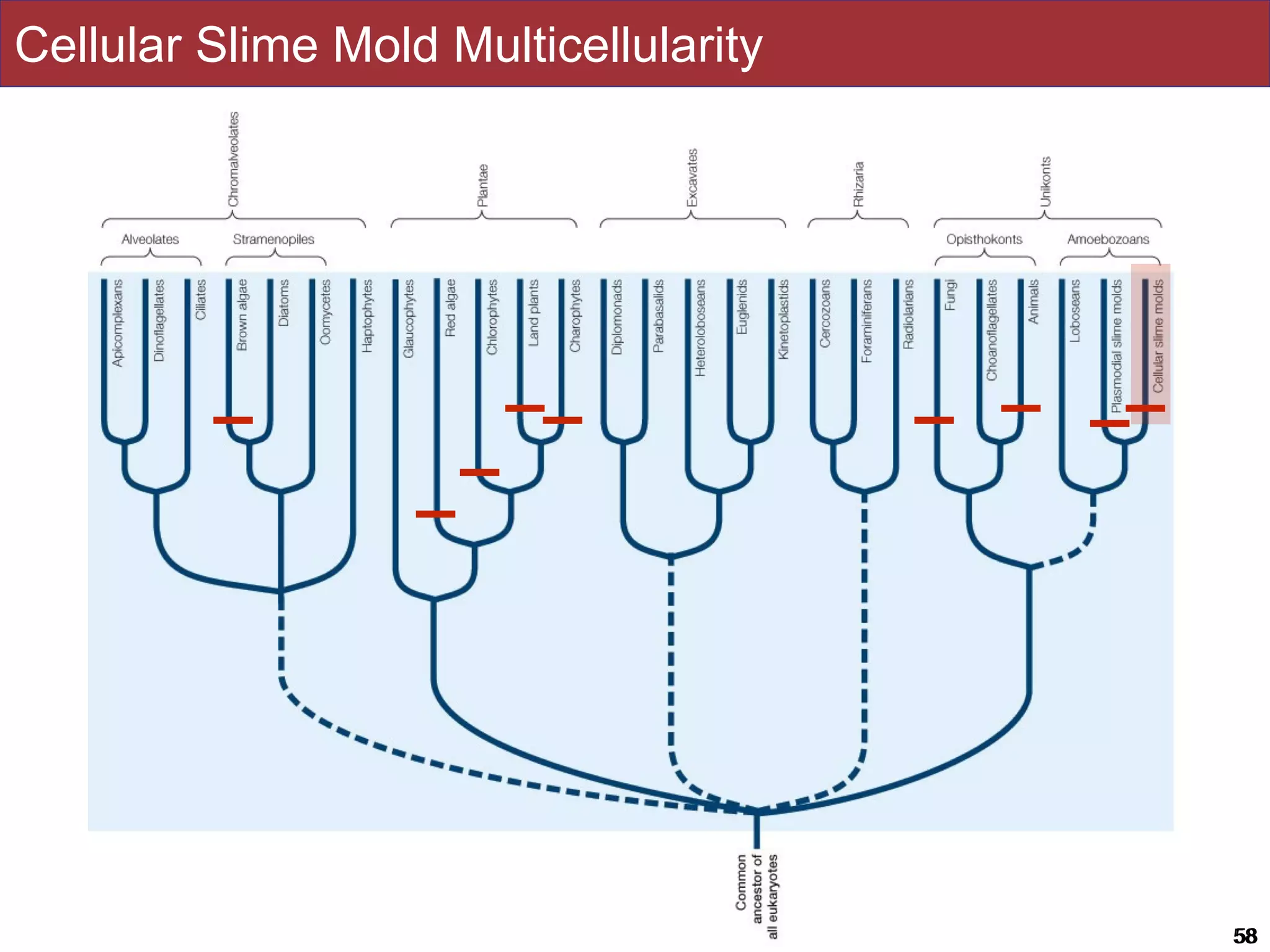
Figure 27.18 A Cellular Slime Mold
!57Slides by Jonathan Eisen for BIS2C at UC Davis Spring 2016
Slides by Jonathan Eisen for BIS2C at UC Davis Spring 2016 5858
Cellular Slime Mold Multicellularity
Slides by Jonathan Eisen for BIS2C at UC Davis Spring 2016 5959
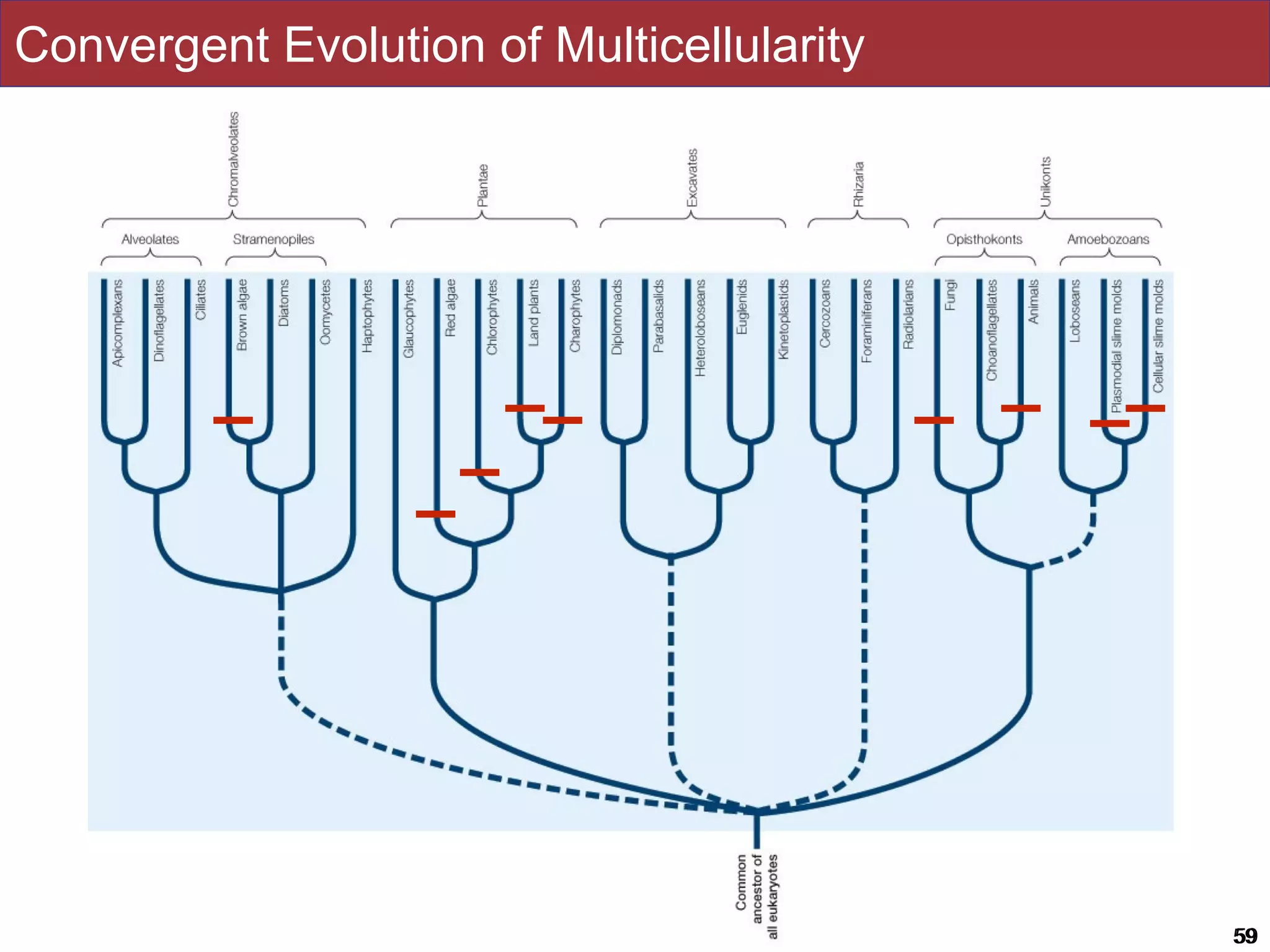
Convergent Evolution of Multicellularity
Slides by Jonathan Eisen for BIS2C at UC Davis Spring 2016
Clicker
60
Slides by Jonathan Eisen for BIS2C at UC Davis Spring 2016
Clicker
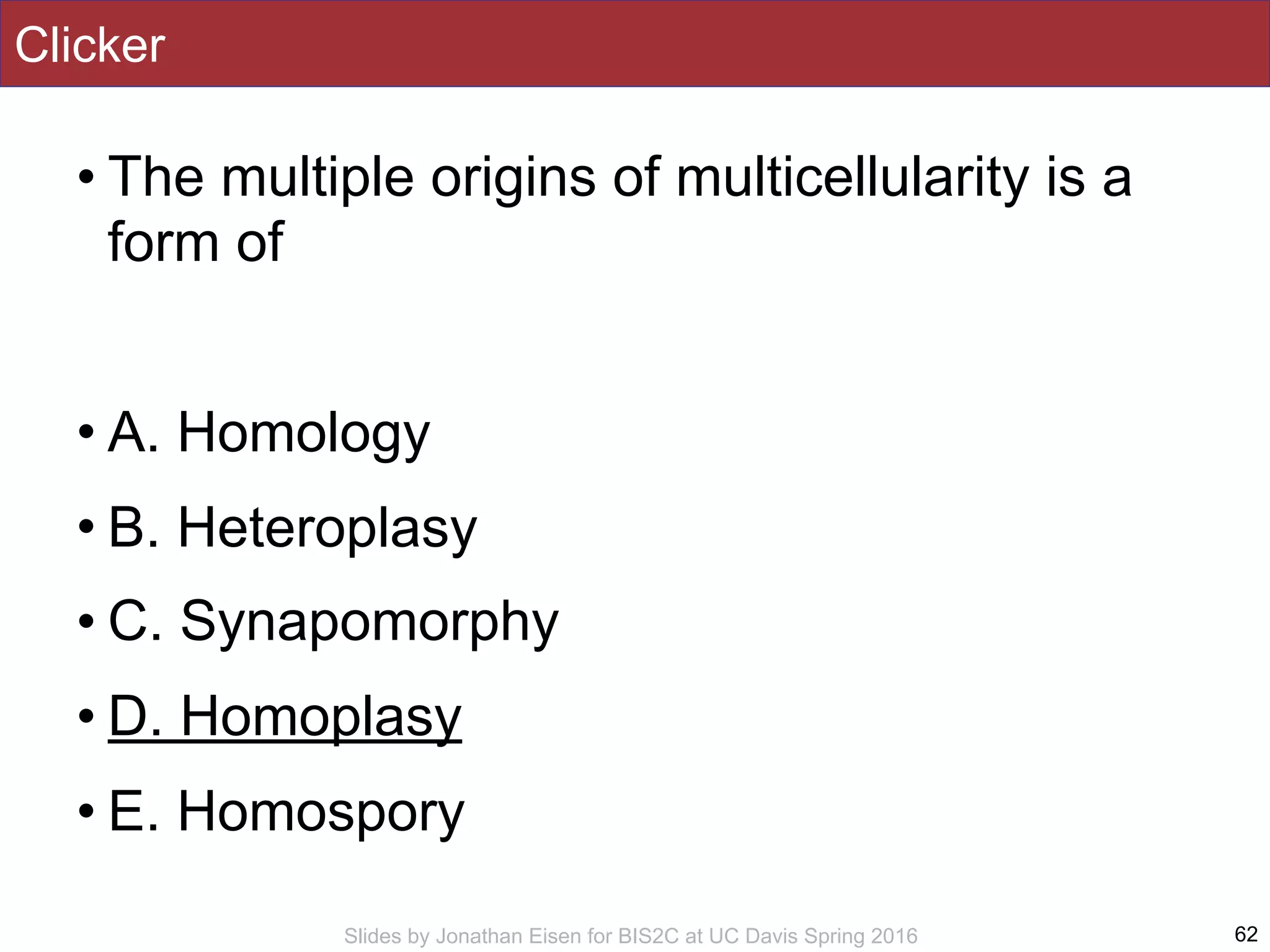
• The multiple origins of multicellularity is a
form of
• A. Homology
• B. Heteroplasy
• C. Synapomorphy
• D. Homoplasy
• E. Homospory
61
Slides by Jonathan Eisen for BIS2C at UC Davis Spring 2016
Clicker
• The multiple origins of multicellularity is a
form of
• A. Homology
• B. Heteroplasy
• C. Synapomorphy
• D. Homoplasy
• E. Homospory
62
Slides by Jonathan Eisen for BIS2C at UC Davis Spring 2016
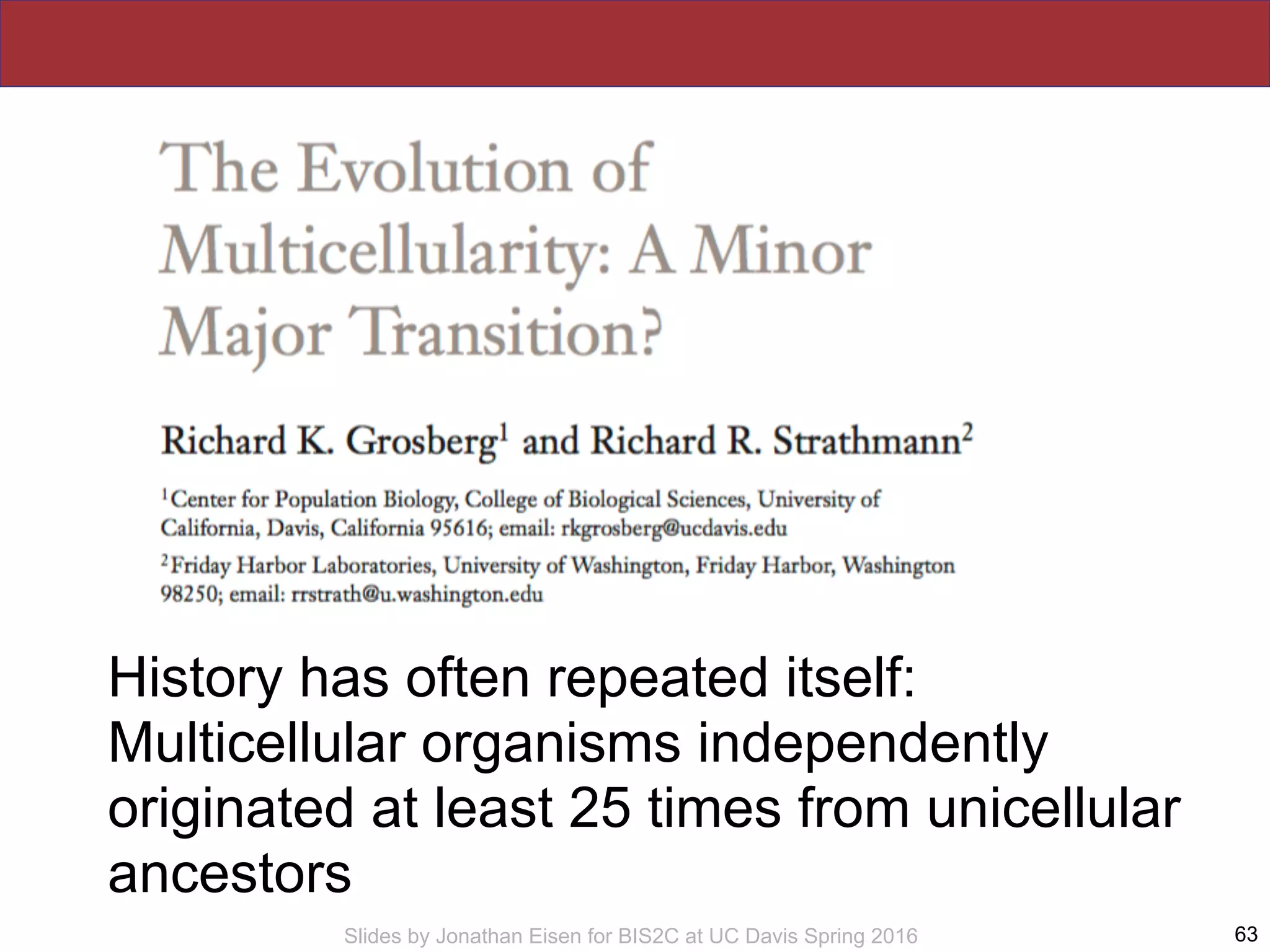
History has often repeated itself:
Multicellular organisms independently
originated at least 25 times from unicellular
ancestors
63
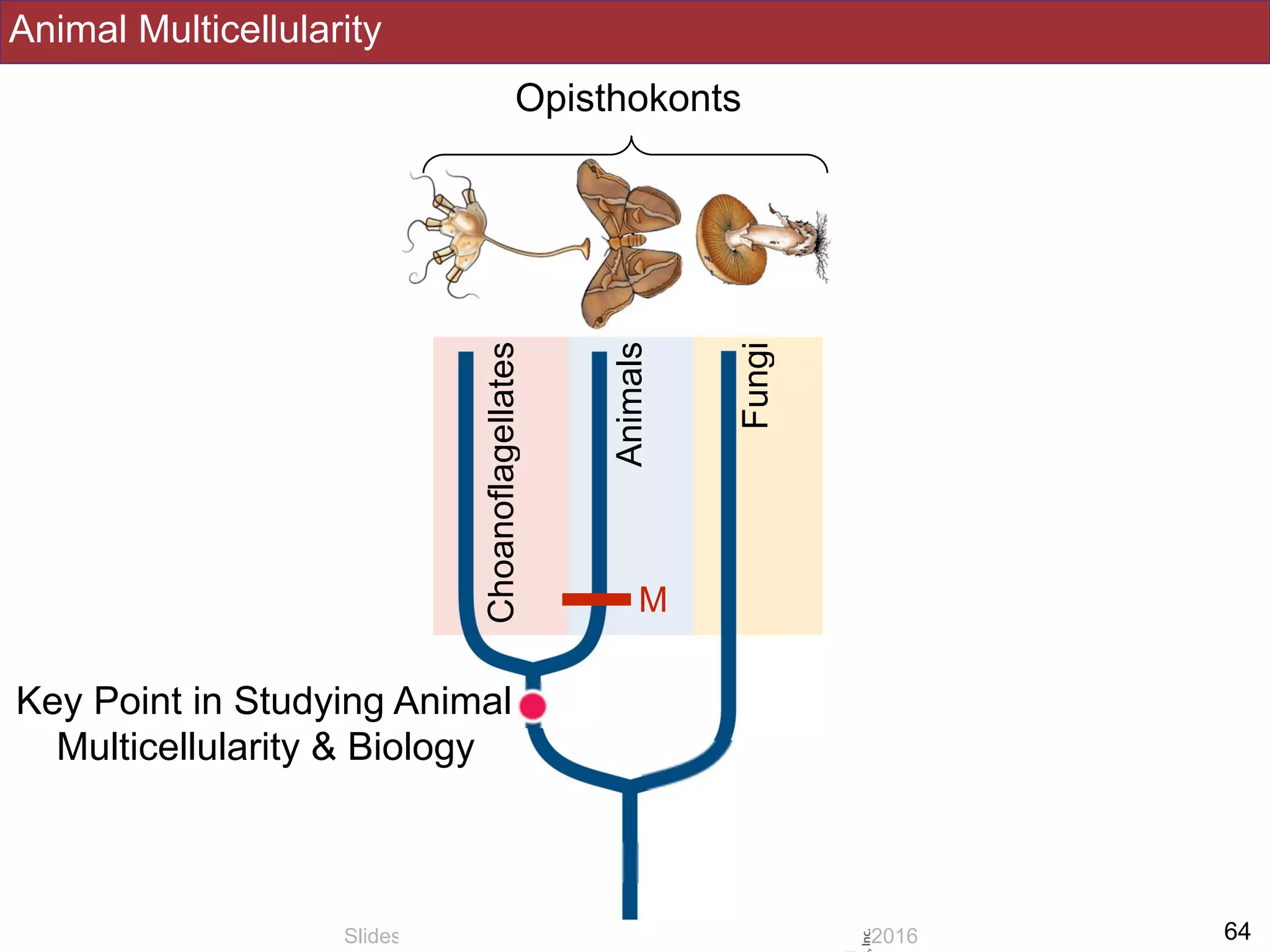
Animal Multicellularity
!64Slides by Jonathan Eisen for BIS2C at UC Davis Spring 2016
Opisthokonts
Fungi
Animals
Choanoflagellates
Key Point in Studying Animal
Multicellularity & Biology
M
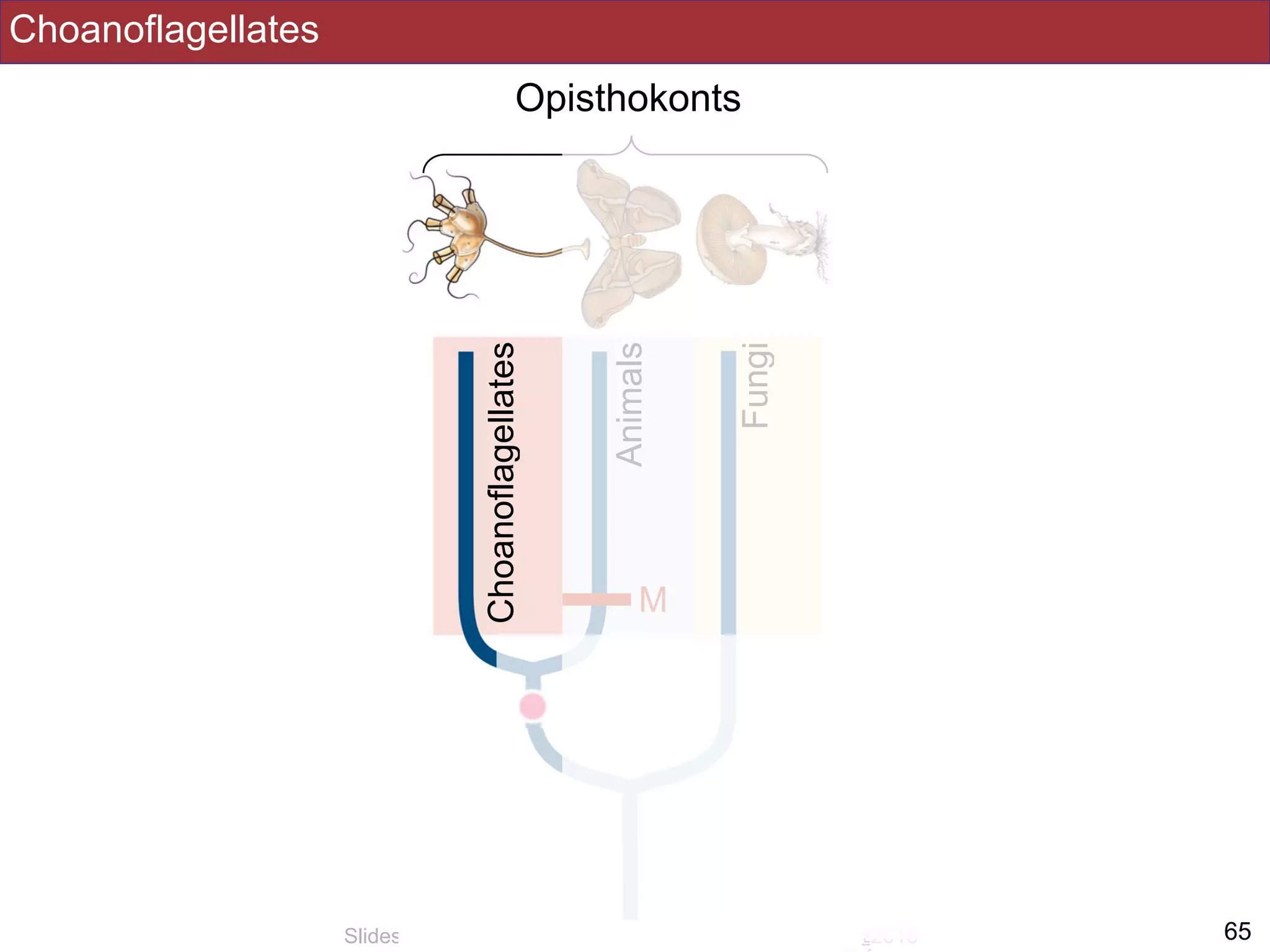
Choanoflagellates
!65Slides by Jonathan Eisen for BIS2C at UC Davis Spring 2016
Opisthokonts
Fungi
Animals
Choanoflagellates
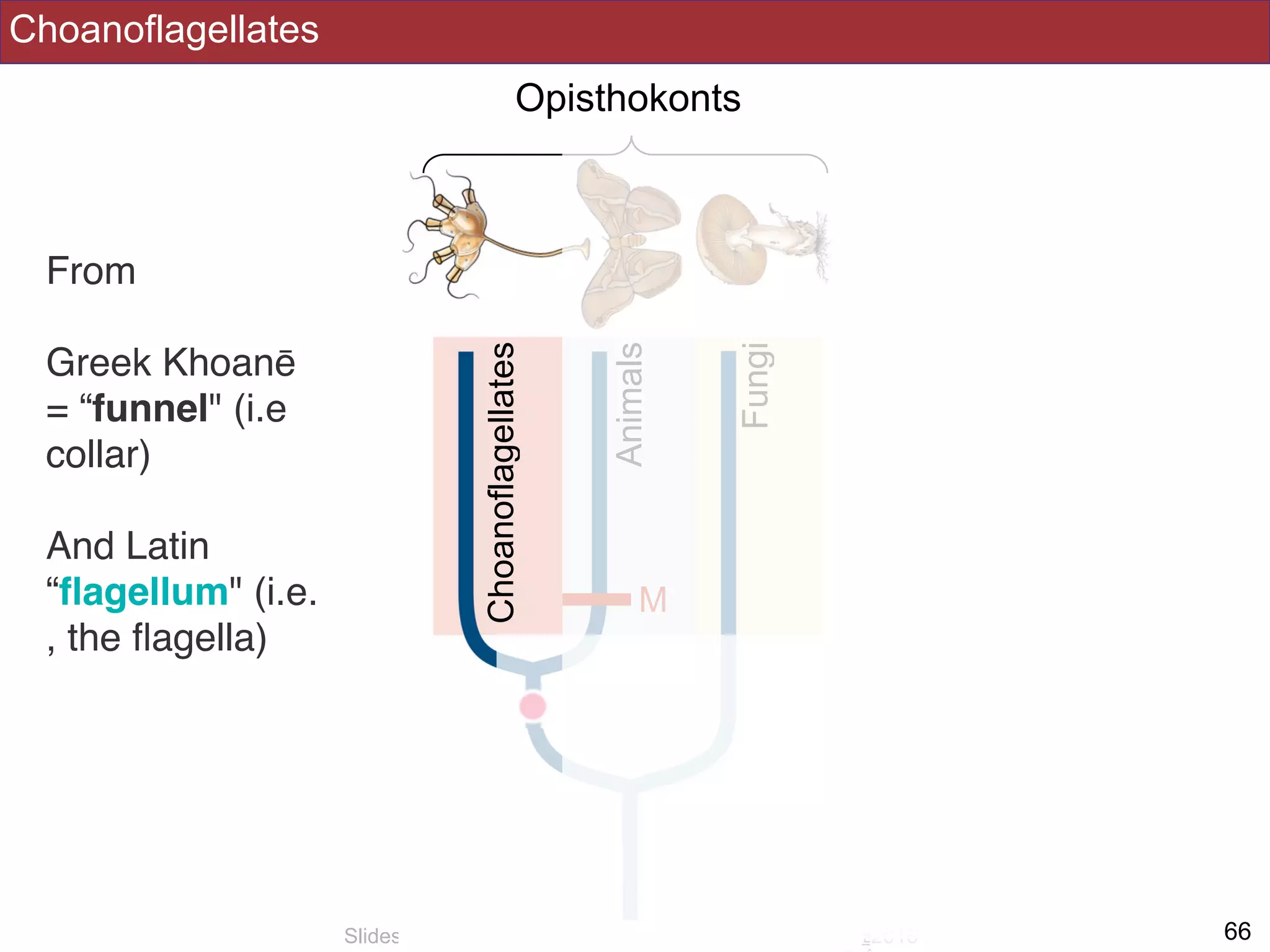
M
Choanoflagellates
!66Slides by Jonathan Eisen for BIS2C at UC Davis Spring 2016
Opisthokonts
Fungi
Animals
Choanoflagellates
M
From
Greek Khoanē
= “funnel" (i.e
collar)
And Latin
“flagellum" (i.e.
, the flagella)
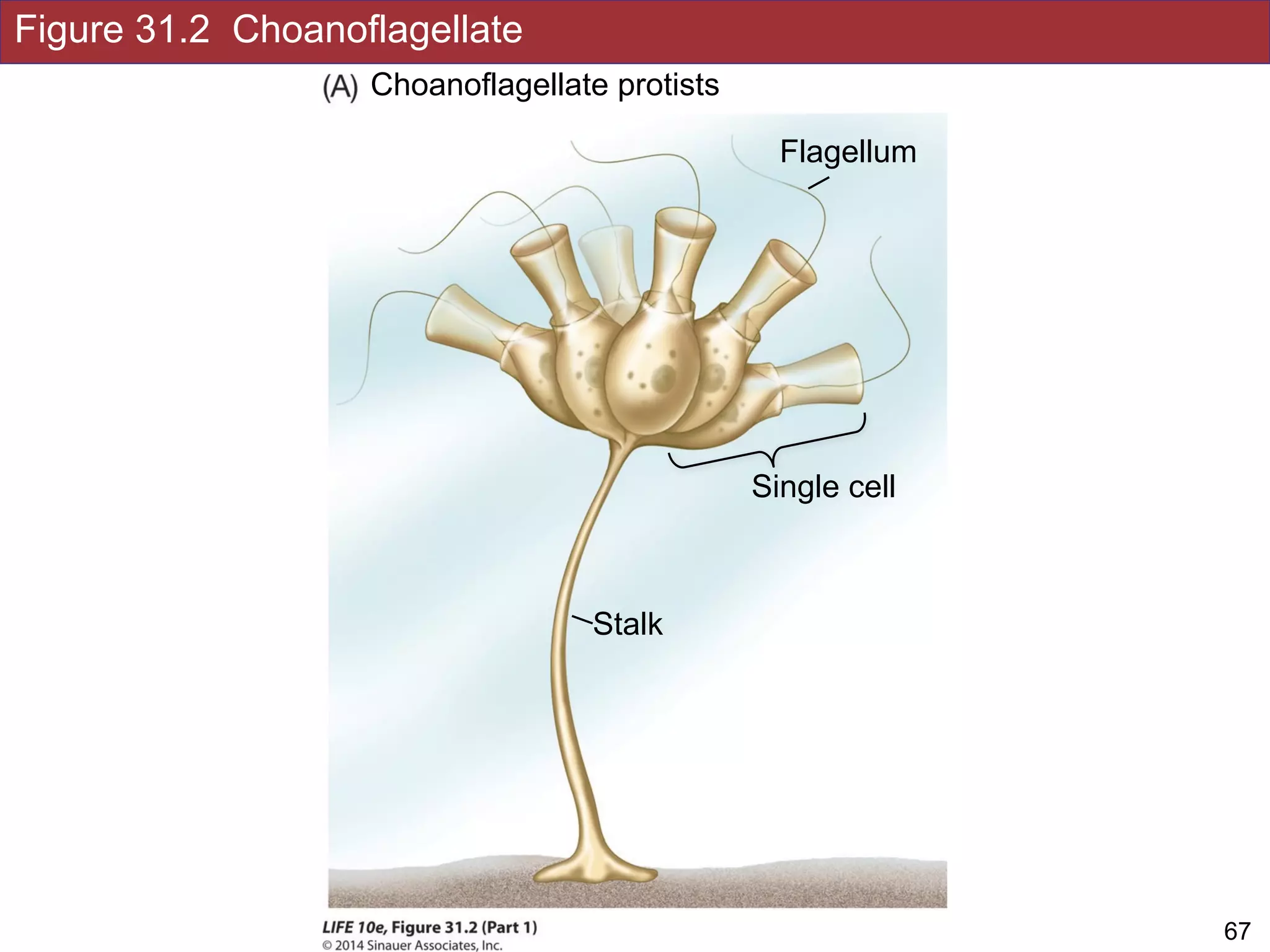
Figure 31.2 Choanoflagellate
!67Slides by Jonathan Eisen for BIS2C at UC Davis Spring 2016
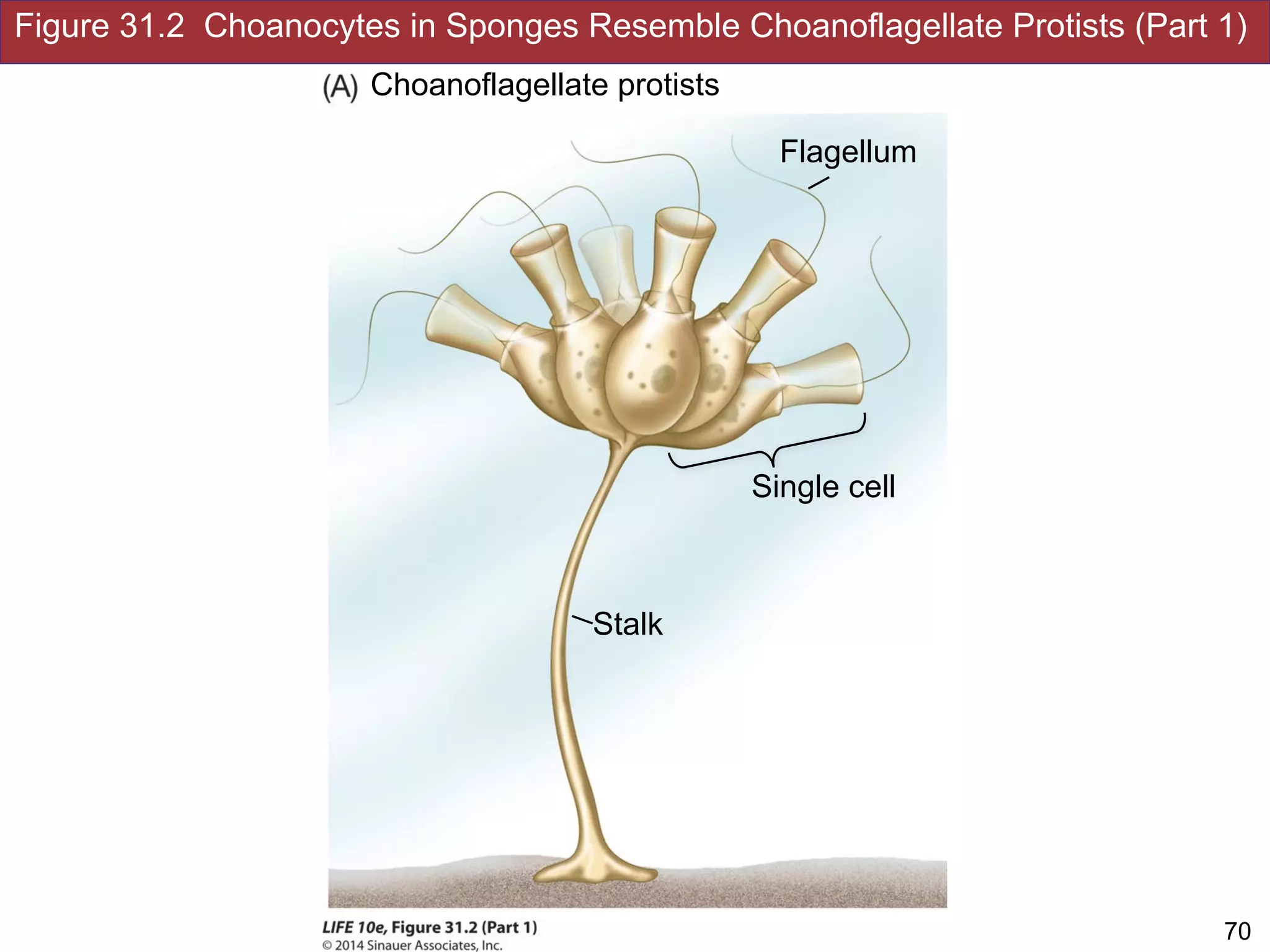
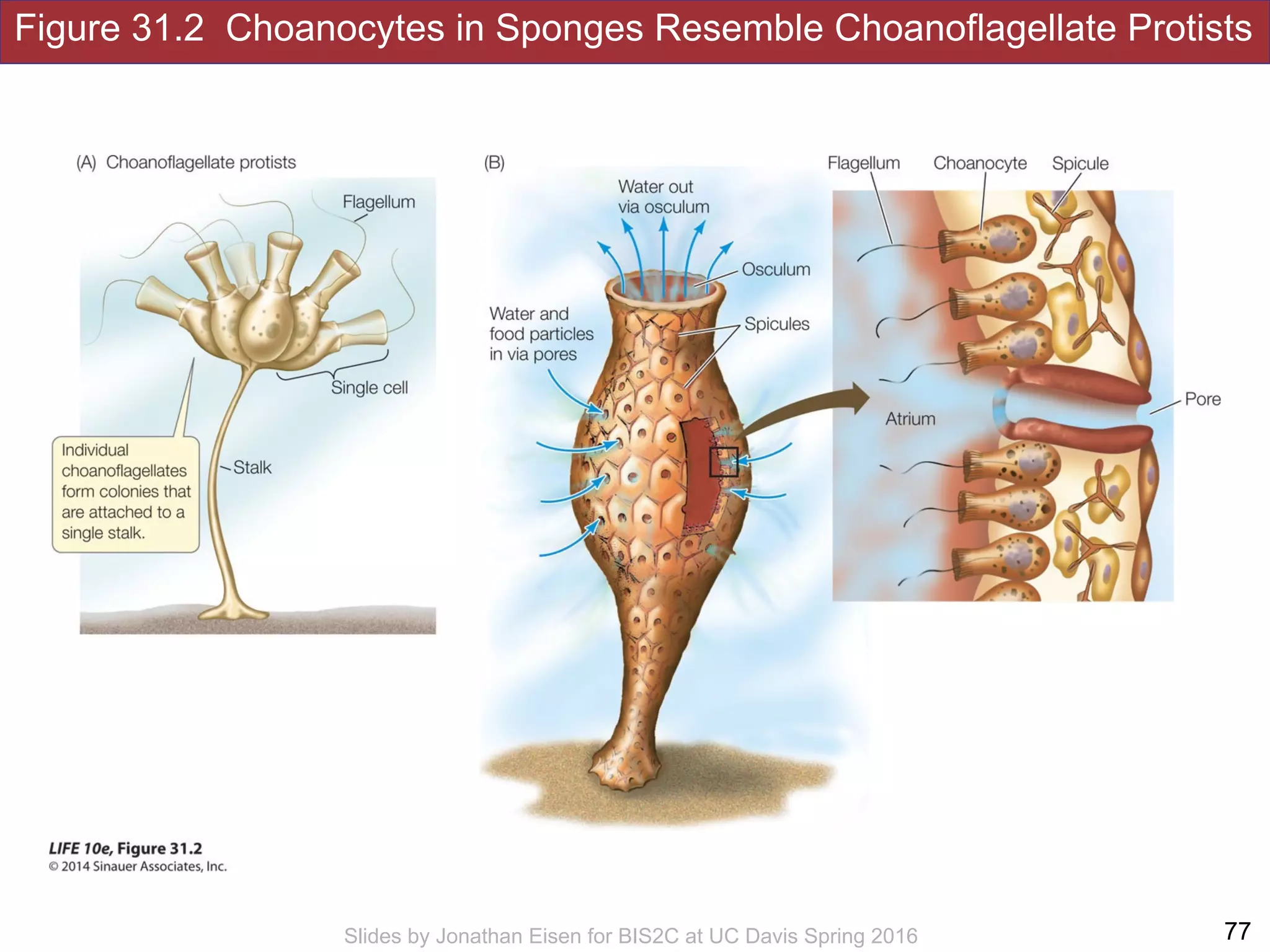
Choanoflagellate protists
Stalk
Flagellum
Single cell
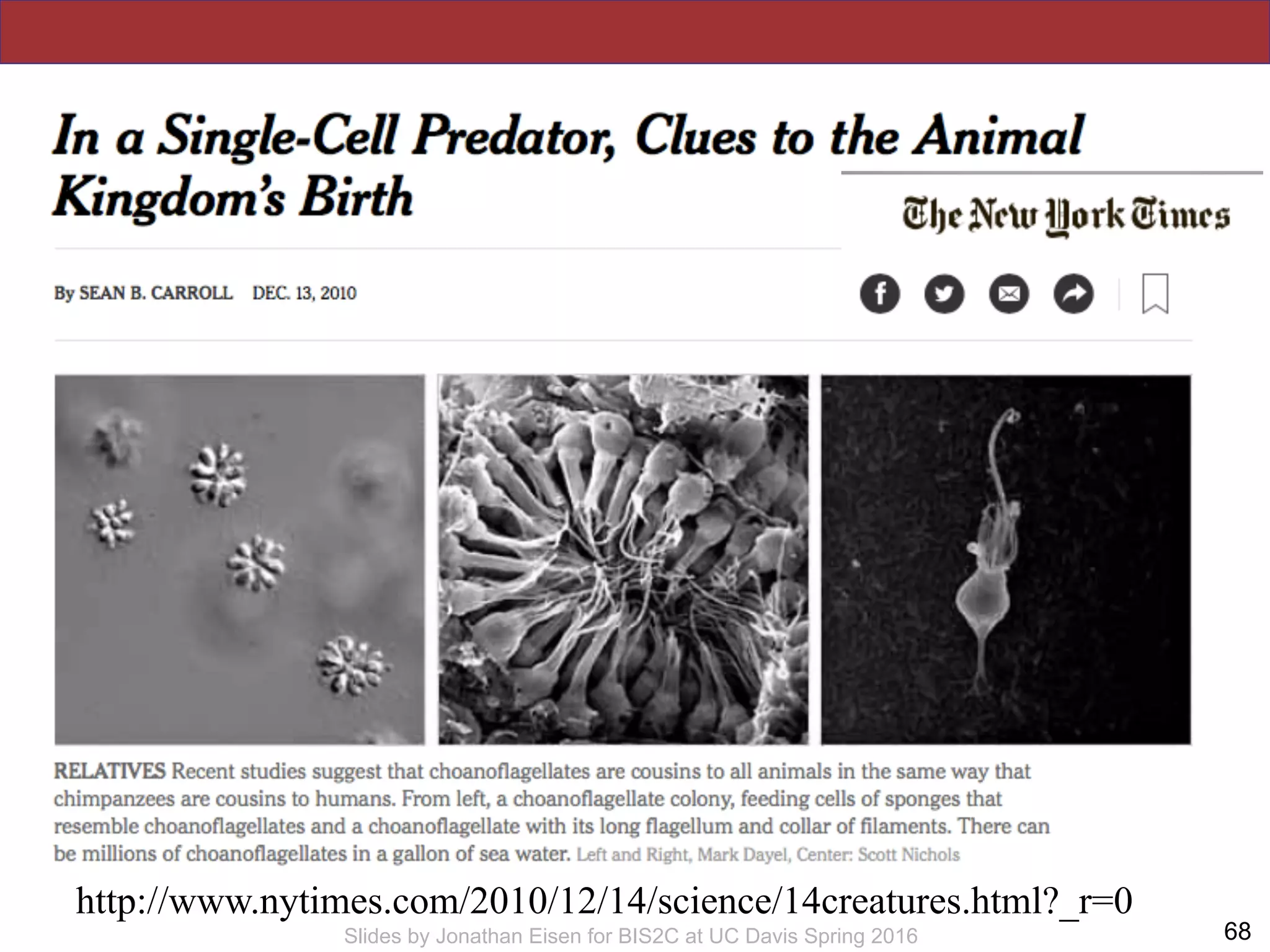
!68Slides by Jonathan Eisen for BIS2C at UC Davis Spring 2016
http://www.nytimes.com/2010/12/14/science/14creatures.html?_r=0
!69Slides by Jonathan Eisen for BIS2C at UC Davis Spring 2016
Figure 31.2 Choanocytes in Sponges Resemble Choanoflagellate Protists (Part 1)
!70Slides by Jonathan Eisen for BIS2C at UC Davis Spring 2016
Choanoflagellate protists
Stalk
Flagellum
Single cell
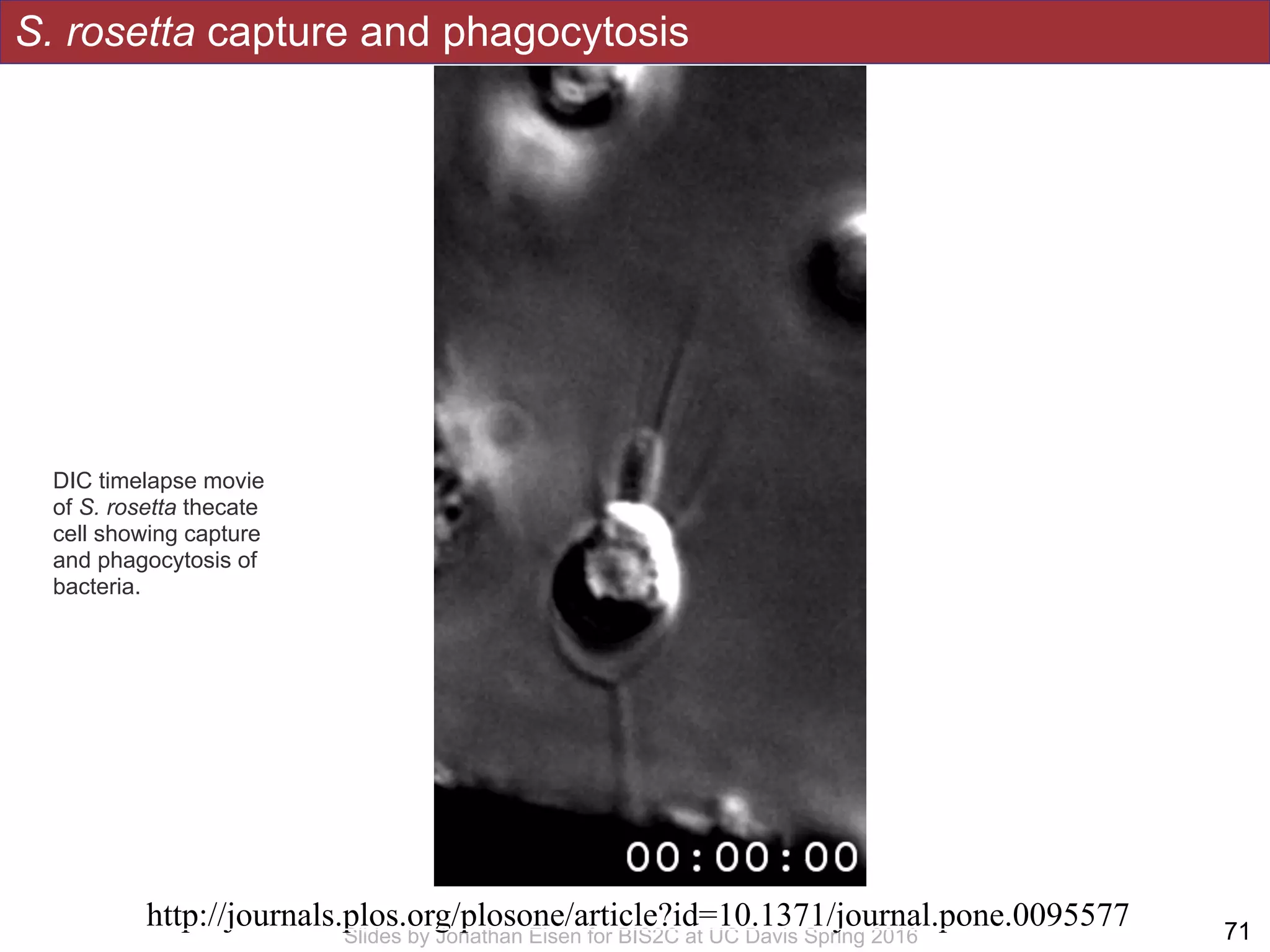
S. rosetta capture and phagocytosis
!71Slides by Jonathan Eisen for BIS2C at UC Davis Spring 2016
DIC timelapse movie
of S. rosetta thecate
cell showing capture
and phagocytosis of
bacteria.
http://journals.plos.org/plosone/article?id=10.1371/journal.pone.0095577
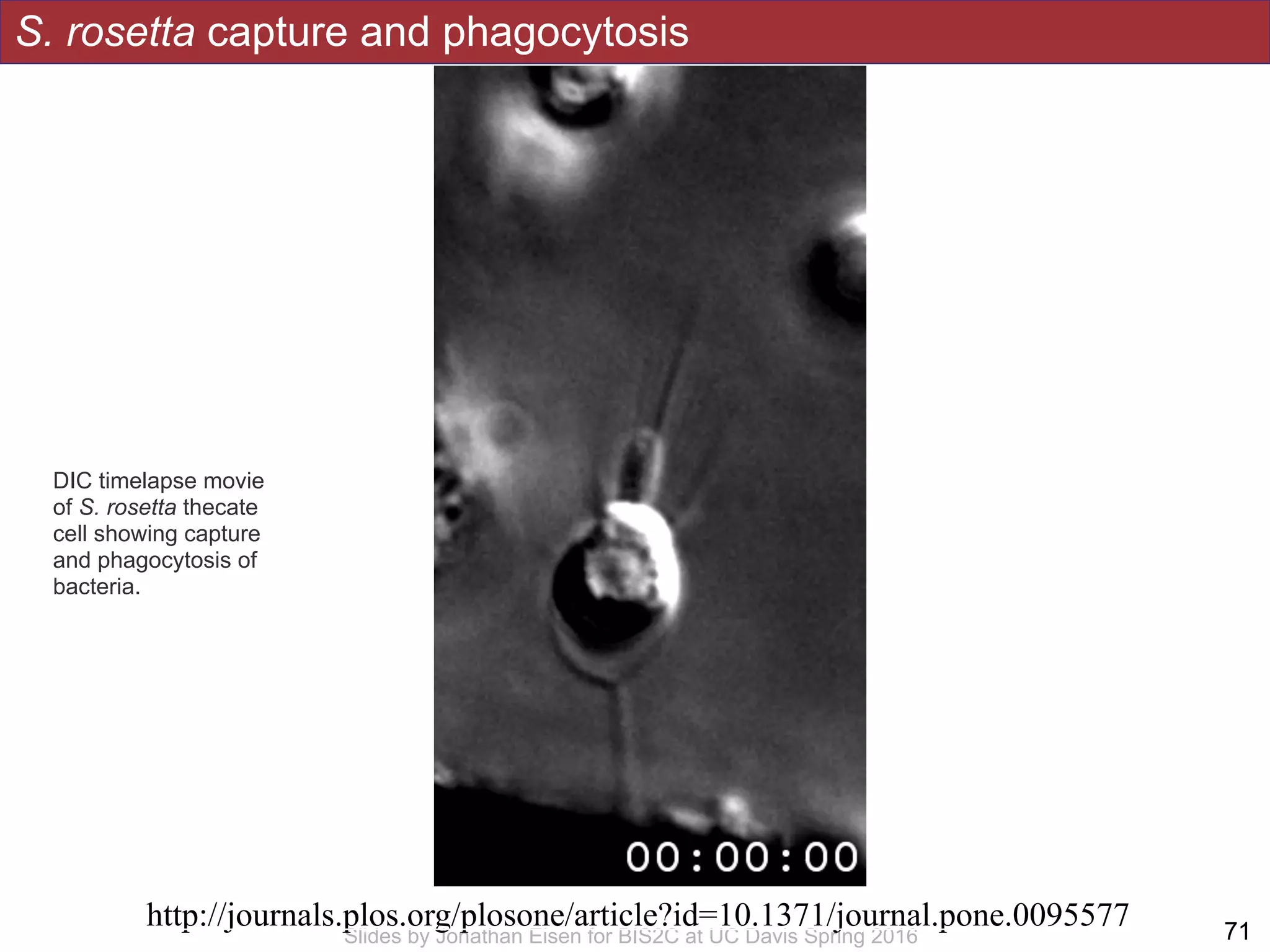
S. rosetta capture and phagocytosis
!71Slides by Jonathan Eisen for BIS2C at UC Davis Spring 2016
DIC timelapse movie
of S. rosetta thecate
cell showing capture
and phagocytosis of
bacteria.
http://journals.plos.org/plosone/article?id=10.1371/journal.pone.0095577
!72Slides by Jonathan Eisen for BIS2C at UC Davis Spring 2016
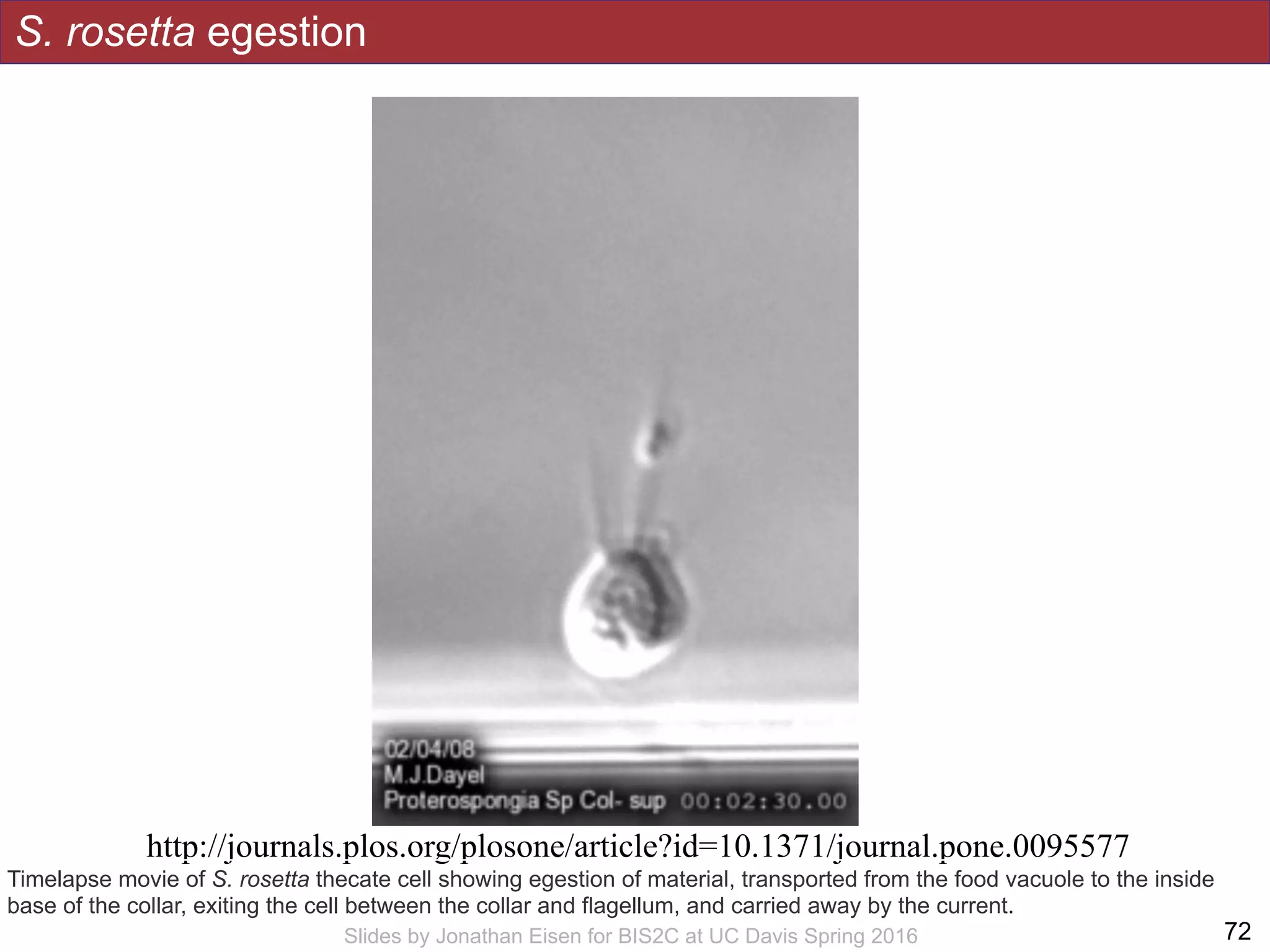
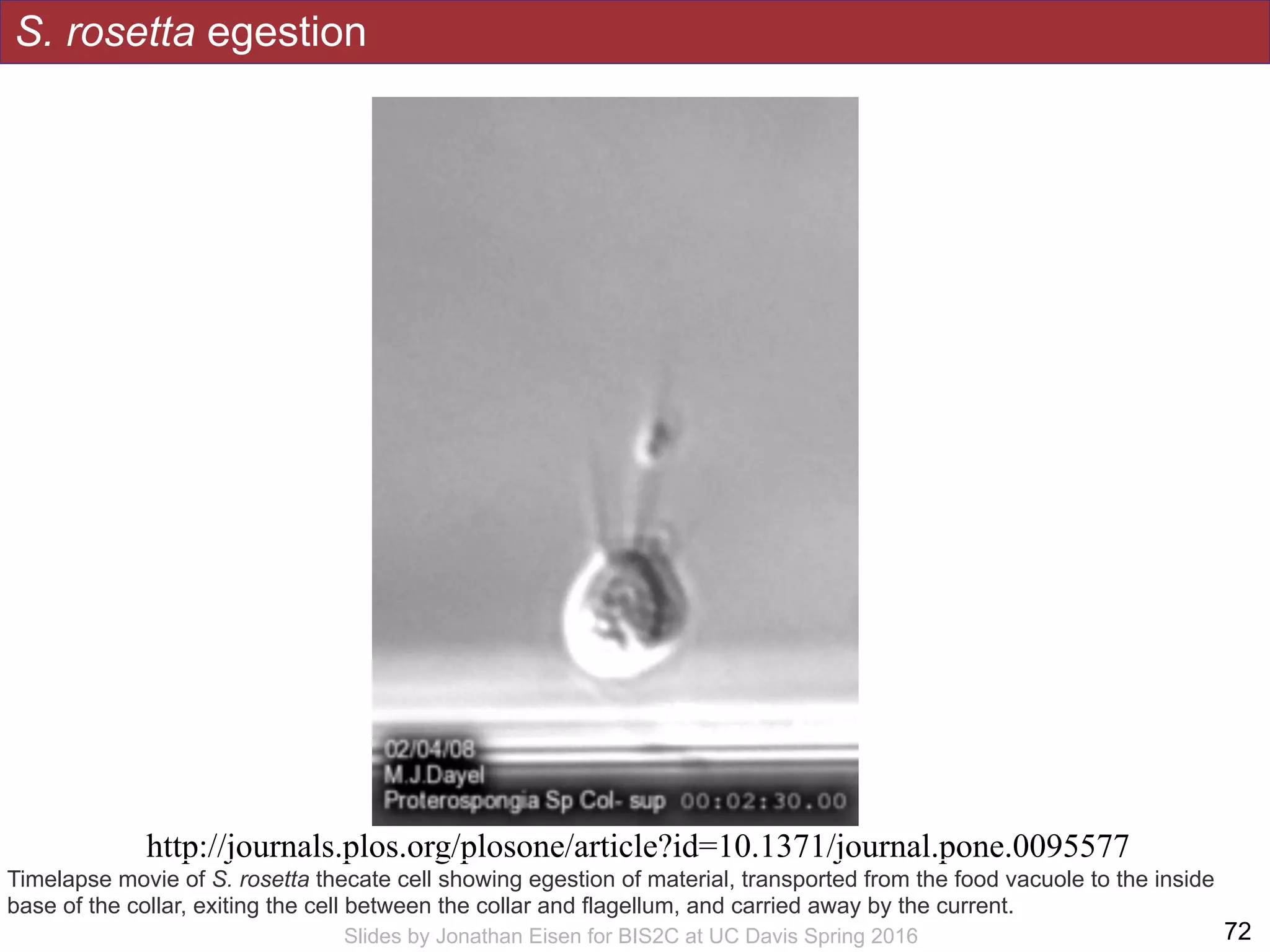
Timelapse movie of S. rosetta thecate cell showing egestion of material, transported from the food vacuole to the inside
base of the collar, exiting the cell between the collar and flagellum, and carried away by the current.
http://journals.plos.org/plosone/article?id=10.1371/journal.pone.0095577
S. rosetta egestion
!72Slides by Jonathan Eisen for BIS2C at UC Davis Spring 2016
Timelapse movie of S. rosetta thecate cell showing egestion of material, transported from the food vacuole to the inside
base of the collar, exiting the cell between the collar and flagellum, and carried away by the current.
http://journals.plos.org/plosone/article?id=10.1371/journal.pone.0095577
S. rosetta egestion
!73Slides by Jonathan Eisen for BIS2C at UC Davis Spring 2016
http://journals.plos.org/plosone/article?id=10.1371/journal.pone.0095577
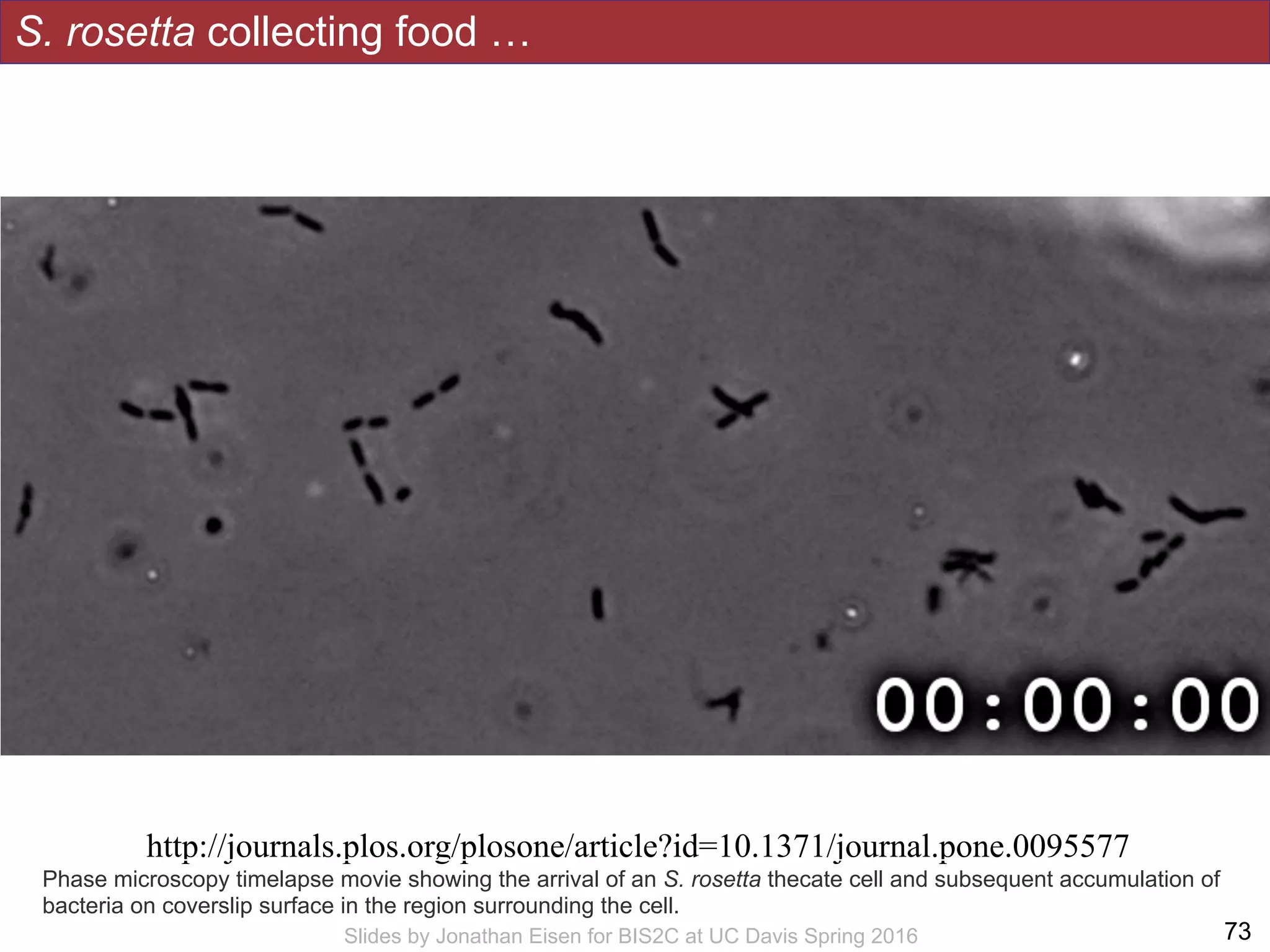
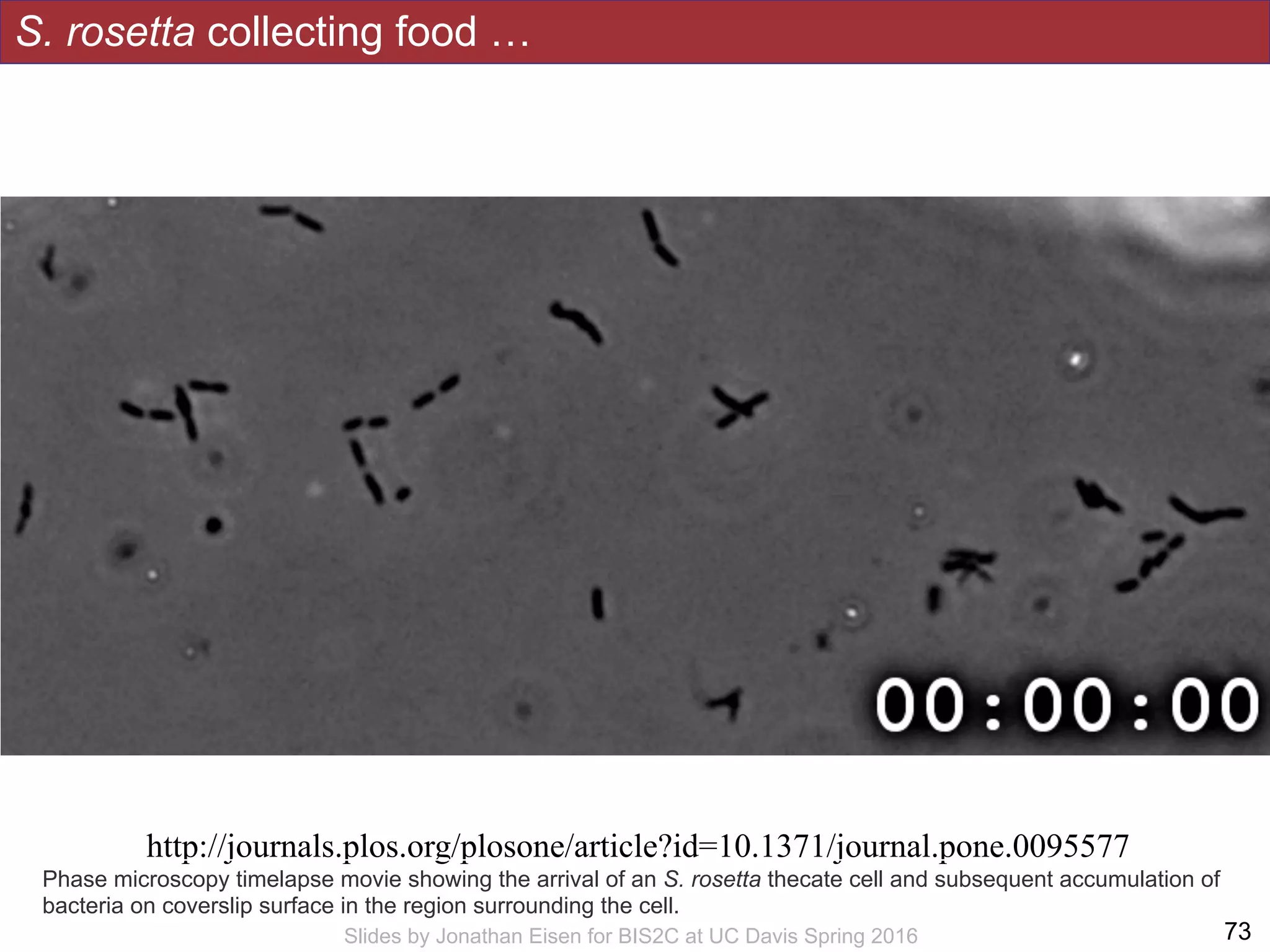
Phase microscopy timelapse movie showing the arrival of an S. rosetta thecate cell and subsequent accumulation of
bacteria on coverslip surface in the region surrounding the cell.
S. rosetta collecting food …
!73Slides by Jonathan Eisen for BIS2C at UC Davis Spring 2016
http://journals.plos.org/plosone/article?id=10.1371/journal.pone.0095577
Phase microscopy timelapse movie showing the arrival of an S. rosetta thecate cell and subsequent accumulation of
bacteria on coverslip surface in the region surrounding the cell.
S. rosetta collecting food …
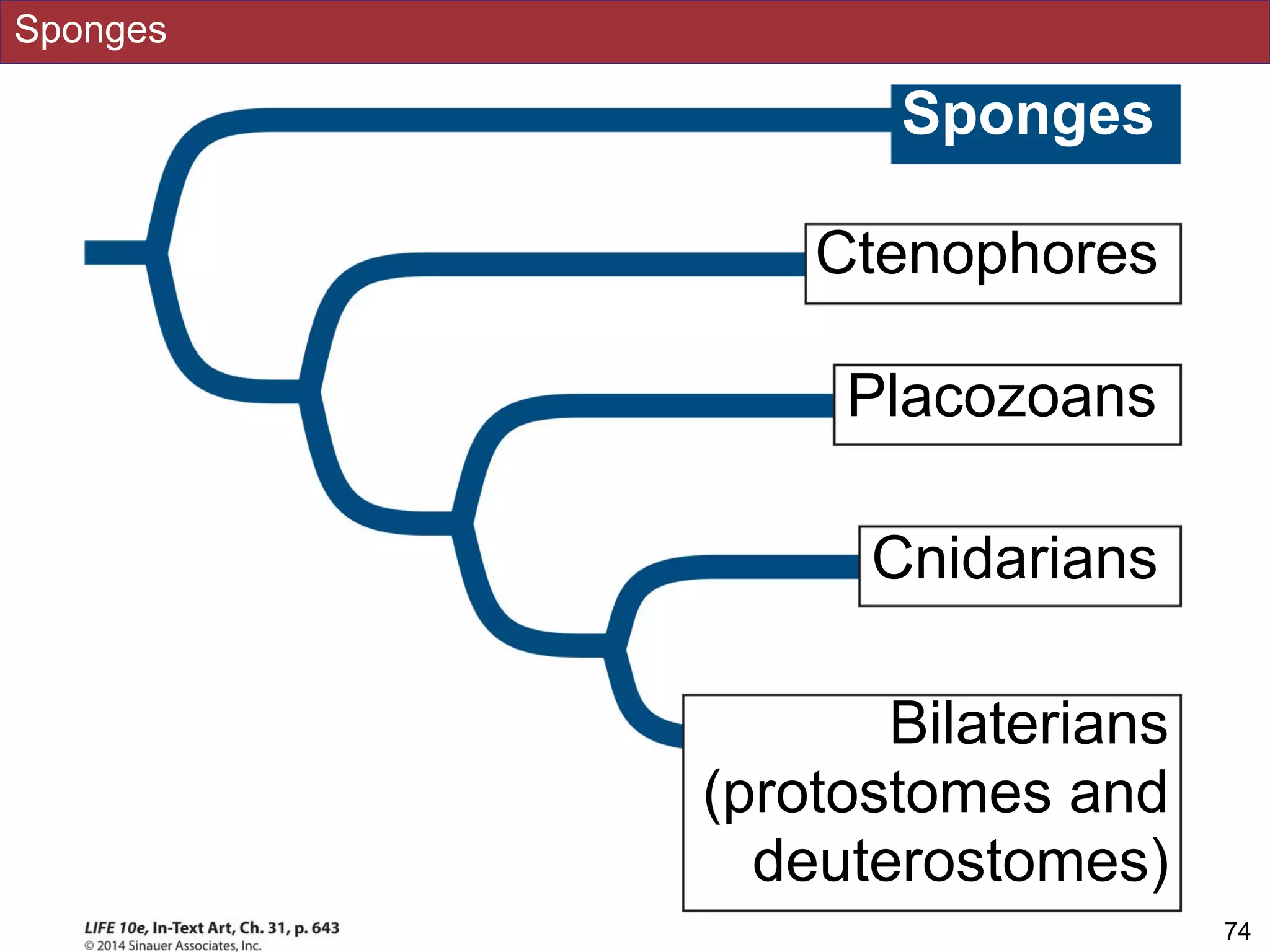
Sponges
!74Slides by Jonathan Eisen for BIS2C at UC Davis Spring 2016
Sponges
Bilaterians
(protostomes and
deuterostomes)
Ctenophores
Cnidarians
Placozoans
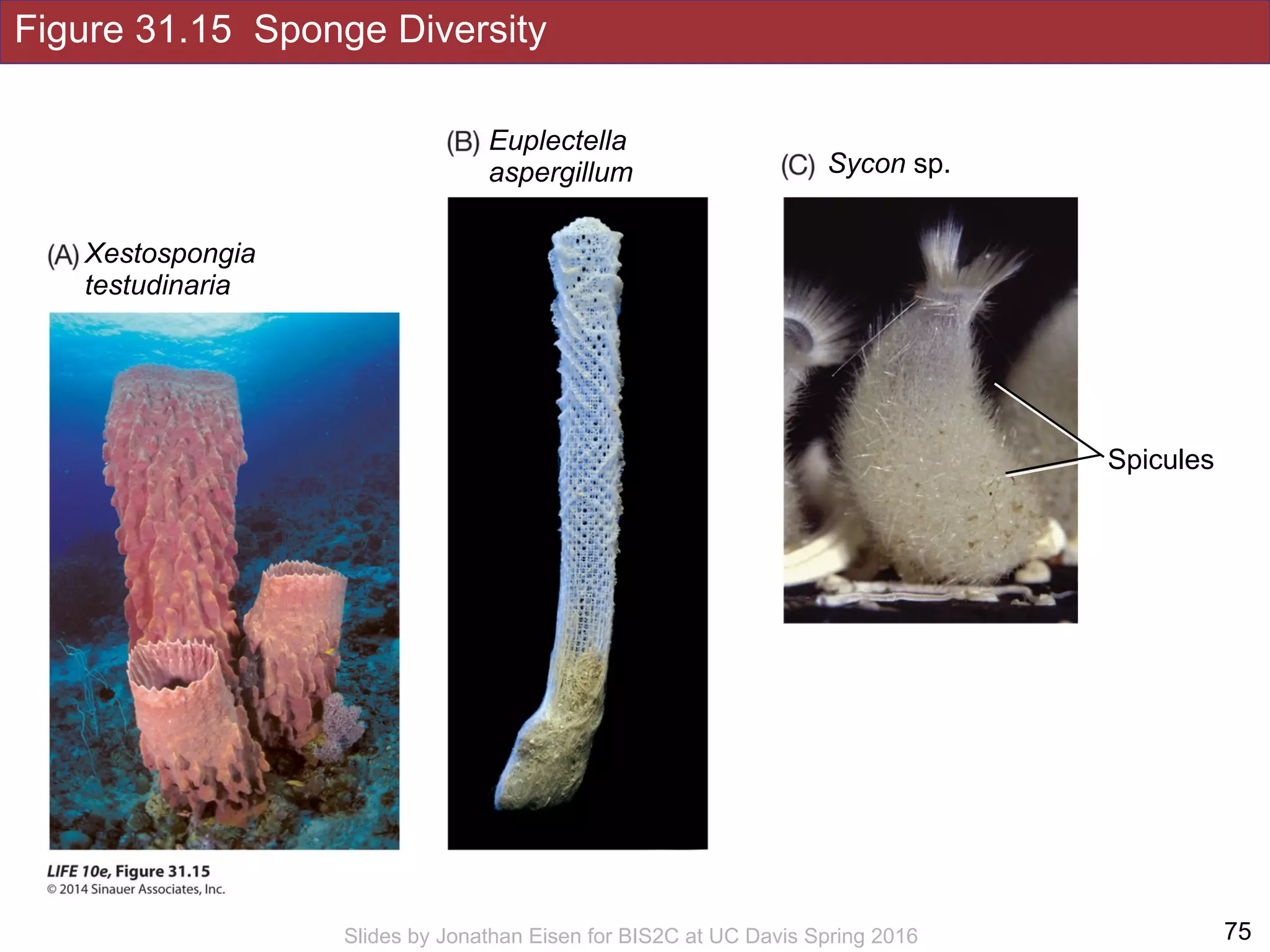
Figure 31.15 Sponge Diversity
!75Slides by Jonathan Eisen for BIS2C at UC Davis Spring 2016
Euplectella
aspergillum
Xestospongia
testudinaria
Spicules
Sycon sp.
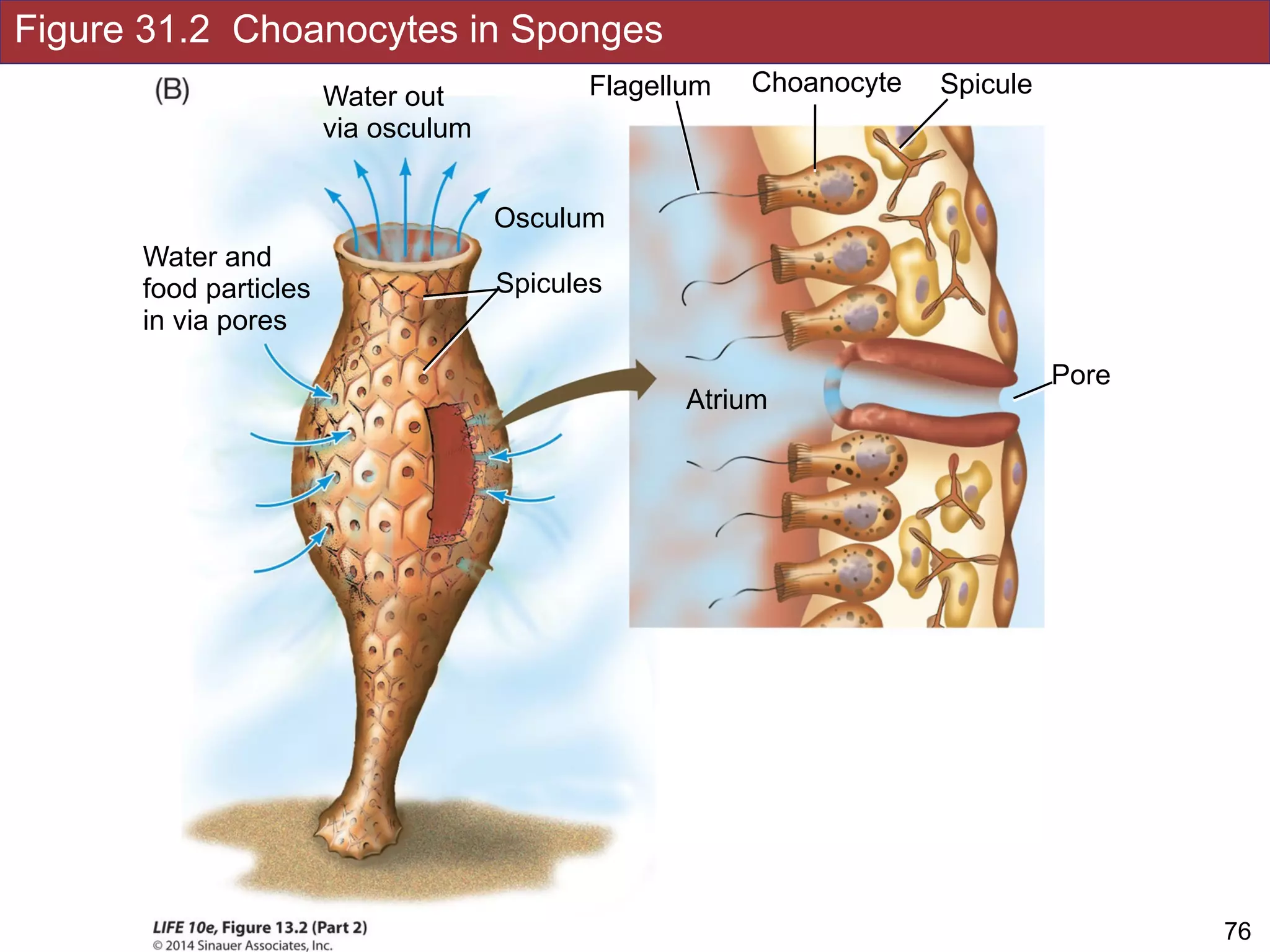
Figure 31.2 Choanocytes in Sponges
!76Slides by Jonathan Eisen for BIS2C at UC Davis Spring 2016
Choanocyte
Pore
Osculum
Water out
via osculum
Atrium
Spicule
Water and
food particles
in via pores
Spicules
Flagellum
!77
Figure 31.2 Choanocytes in Sponges Resemble Choanoflagellate Protists
Slides by Jonathan Eisen for BIS2C at UC Davis Spring 2016
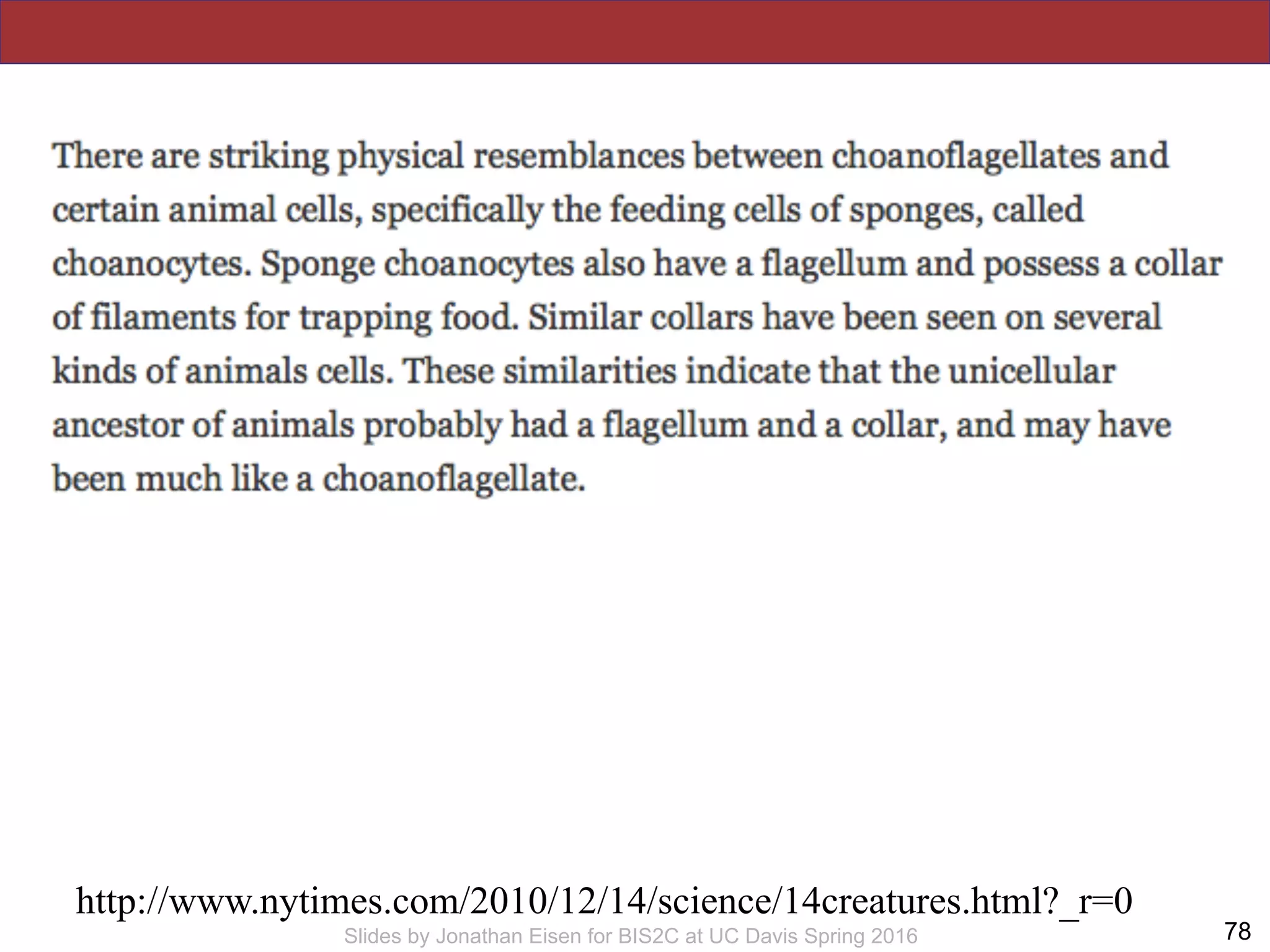
!78Slides by Jonathan Eisen for BIS2C at UC Davis Spring 2016
http://www.nytimes.com/2010/12/14/science/14creatures.html?_r=0
Animal Multicellularity
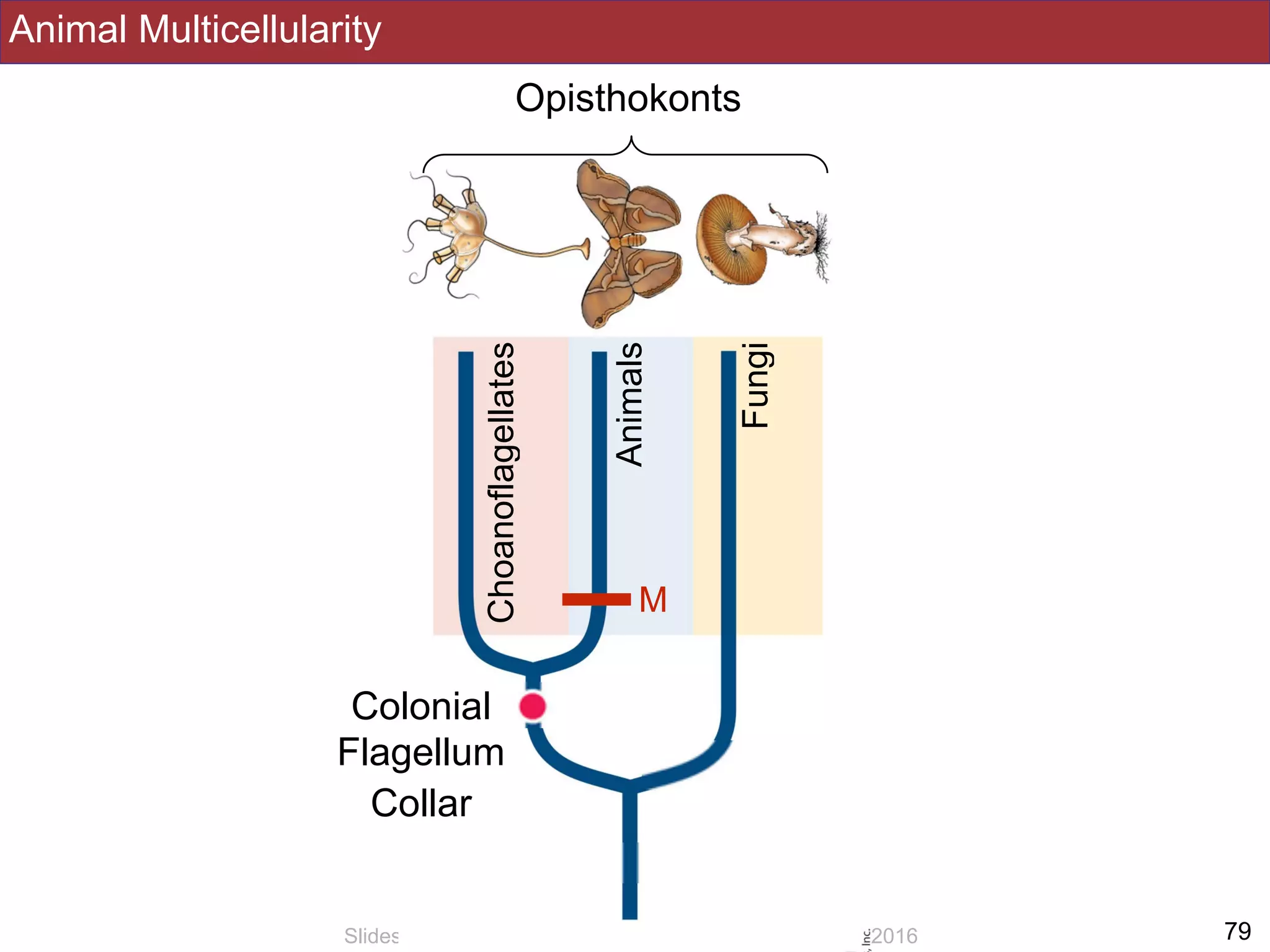
!79Slides by Jonathan Eisen for BIS2C at UC Davis Spring 2016
Opisthokonts
Fungi
Animals
Choanoflagellates
Colonial
M
Flagellum
Collar
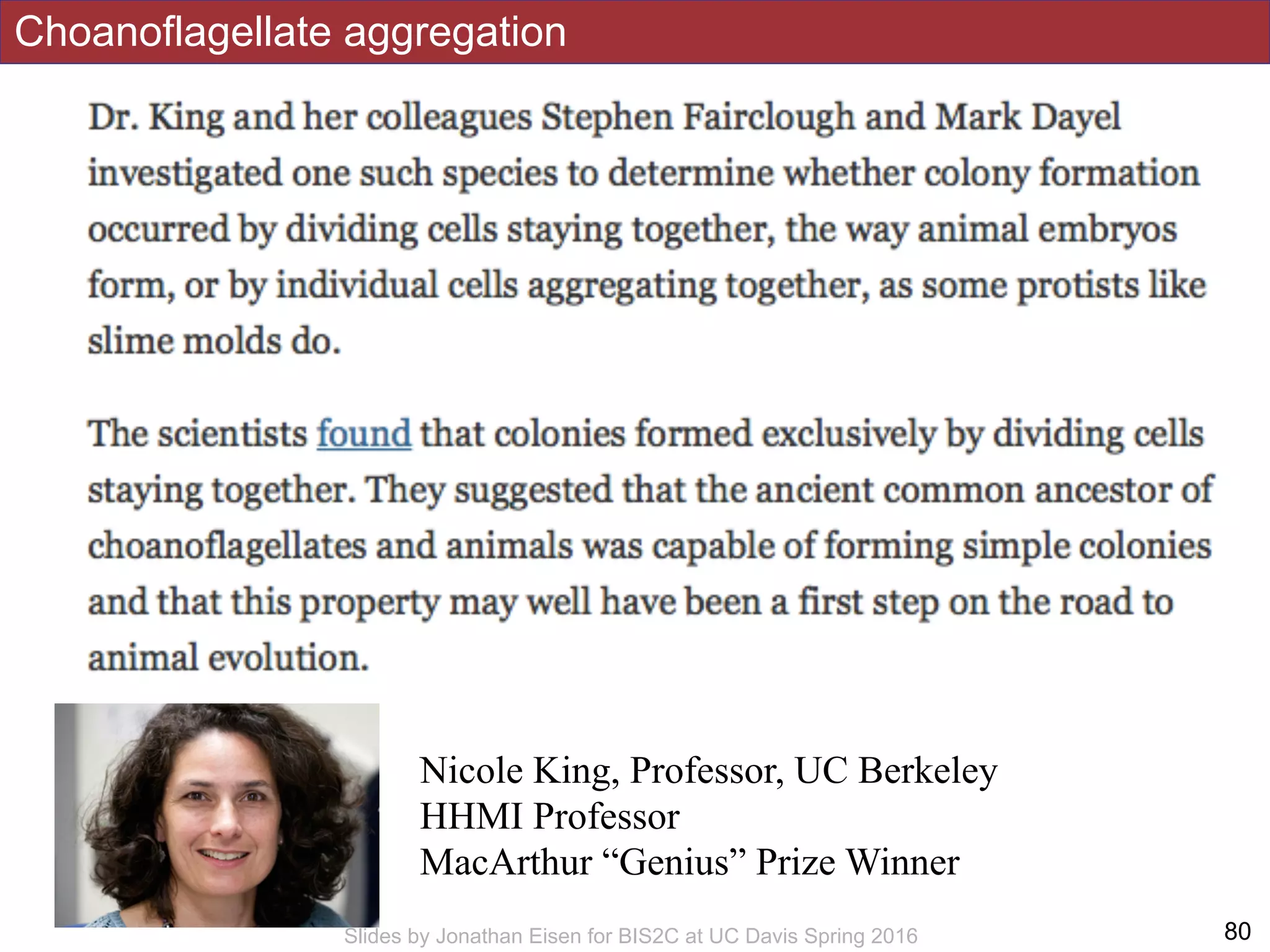
Choanoflagellate aggregation
!80Slides by Jonathan Eisen for BIS2C at UC Davis Spring 2016
Nicole King, Professor, UC Berkeley
HHMI Professor
MacArthur “Genius” Prize Winner
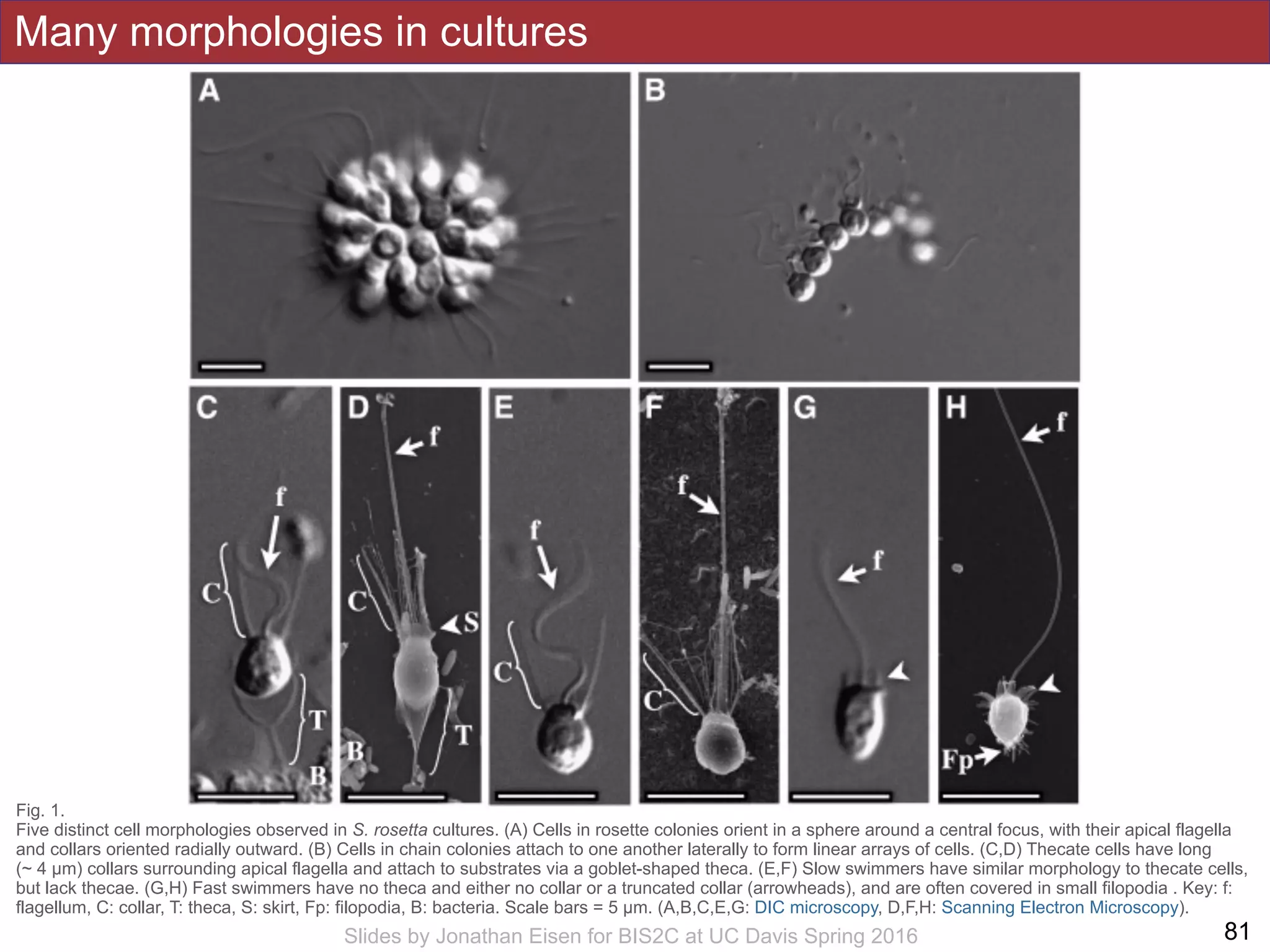
Many morphologies in cultures
!81Slides by Jonathan Eisen for BIS2C at UC Davis Spring 2016
Fig. 1.
Five distinct cell morphologies observed in S. rosetta cultures. (A) Cells in rosette colonies orient in a sphere around a central focus, with their apical flagella
and collars oriented radially outward. (B) Cells in chain colonies attach to one another laterally to form linear arrays of cells. (C,D) Thecate cells have long
(~ 4 µm) collars surrounding apical flagella and attach to substrates via a goblet-shaped theca. (E,F) Slow swimmers have similar morphology to thecate cells,
but lack thecae. (G,H) Fast swimmers have no theca and either no collar or a truncated collar (arrowheads), and are often covered in small filopodia . Key: f:
flagellum, C: collar, T: theca, S: skirt, Fp: filopodia, B: bacteria. Scale bars = 5 µm. (A,B,C,E,G: DIC microscopy, D,F,H: Scanning Electron Microscopy).
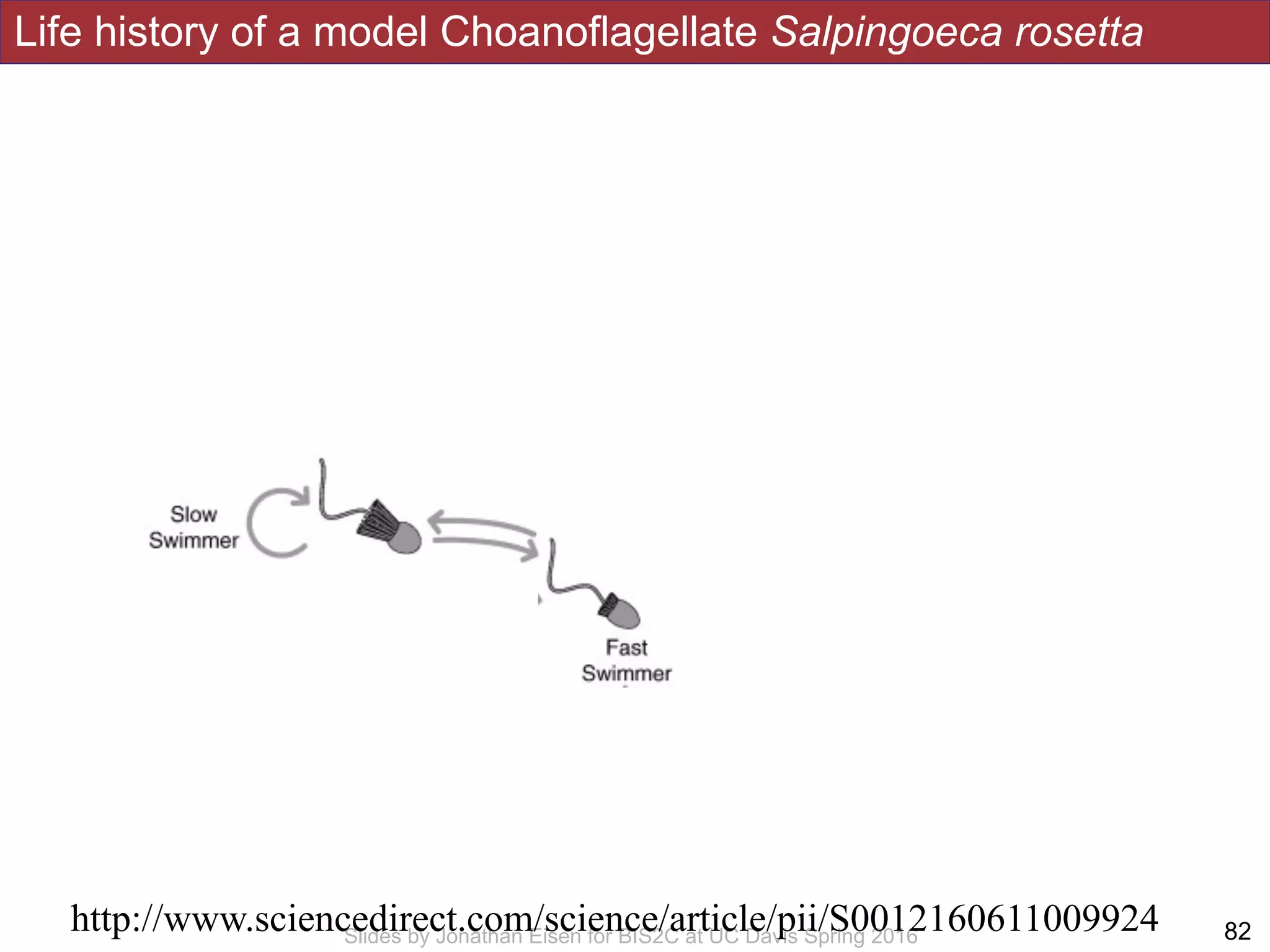
Life history of a model Choanoflagellate Salpingoeca rosetta
!82Slides by Jonathan Eisen for BIS2C at UC Davis Spring 2016
http://www.sciencedirect.com/science/article/pii/S0012160611009924
Life history of a model Choanoflagellate Salpingoeca rosetta
!83Slides by Jonathan Eisen for BIS2C at UC Davis Spring 2016
http://www.sciencedirect.com/science/article/pii/S0012160611009924
!84Slides by Jonathan Eisen for BIS2C at UC Davis Spring 2016
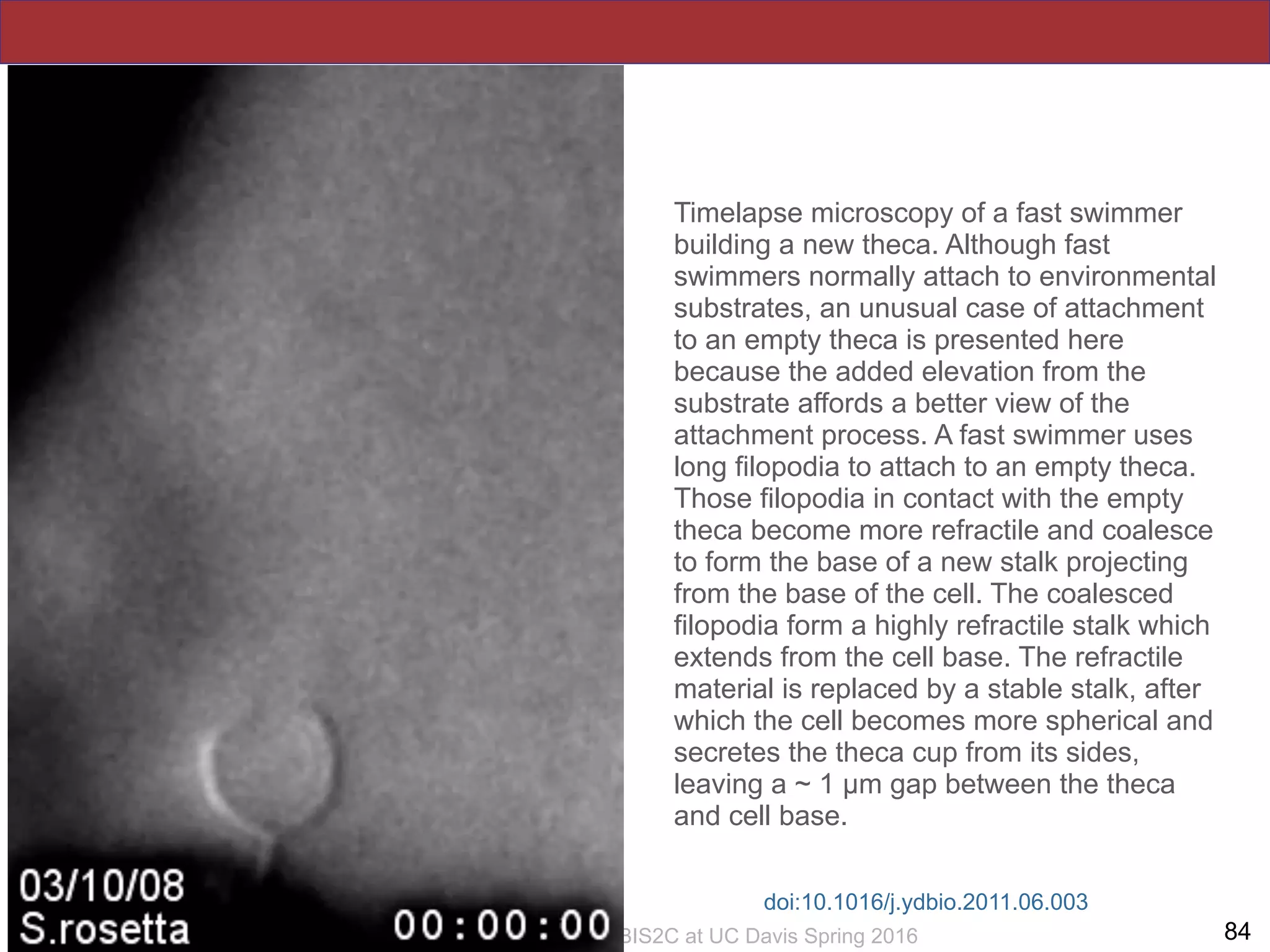
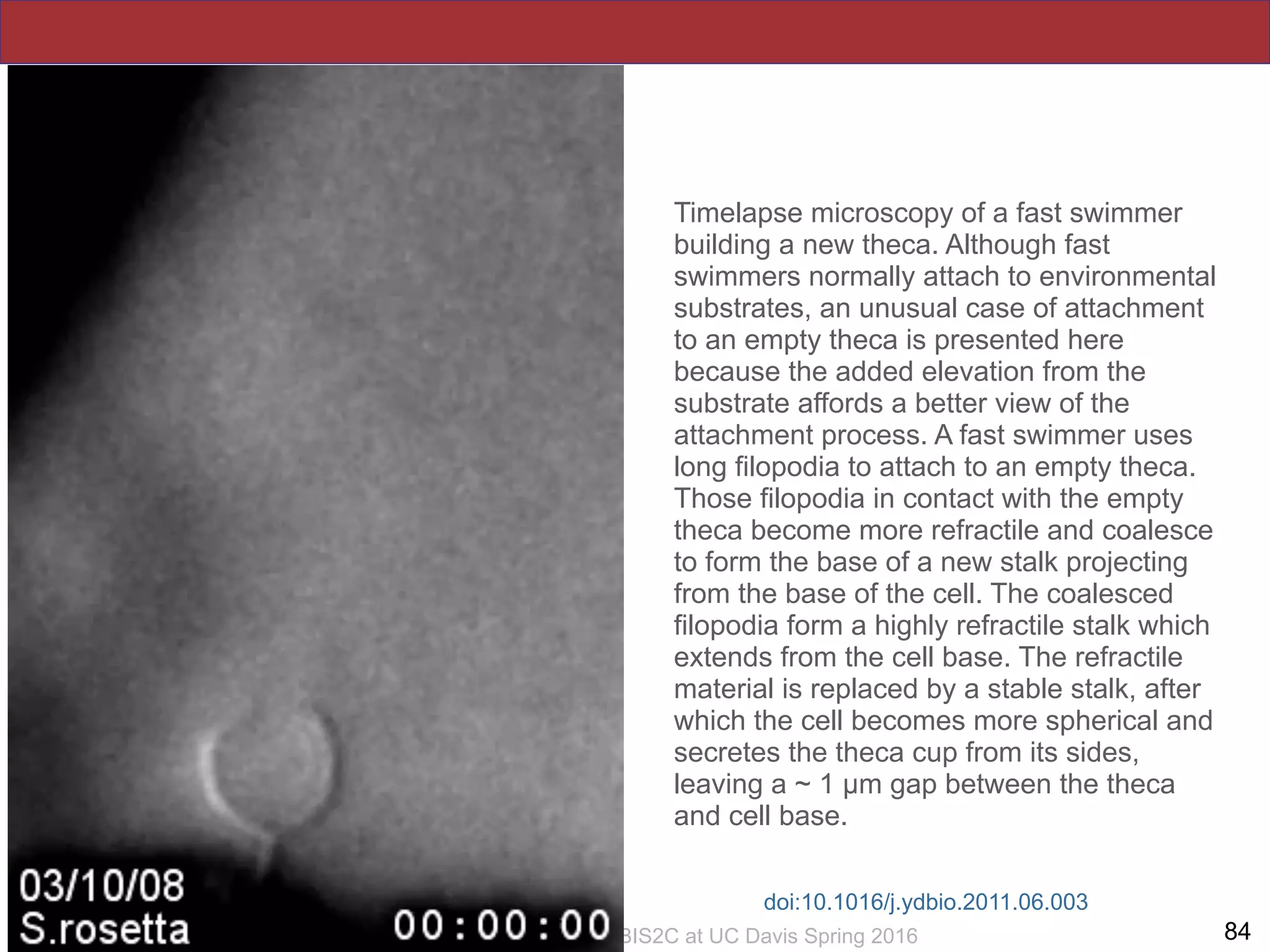
Timelapse microscopy of a fast swimmer
building a new theca. Although fast
swimmers normally attach to environmental
substrates, an unusual case of attachment
to an empty theca is presented here
because the added elevation from the
substrate affords a better view of the
attachment process. A fast swimmer uses
long filopodia to attach to an empty theca.
Those filopodia in contact with the empty
theca become more refractile and coalesce
to form the base of a new stalk projecting
from the base of the cell. The coalesced
filopodia form a highly refractile stalk which
extends from the cell base. The refractile
material is replaced by a stable stalk, after
which the cell becomes more spherical and
secretes the theca cup from its sides,
leaving a ~ 1 µm gap between the theca
and cell base.
doi:10.1016/j.ydbio.2011.06.003
!84Slides by Jonathan Eisen for BIS2C at UC Davis Spring 2016
Timelapse microscopy of a fast swimmer
building a new theca. Although fast
swimmers normally attach to environmental
substrates, an unusual case of attachment
to an empty theca is presented here
because the added elevation from the
substrate affords a better view of the
attachment process. A fast swimmer uses
long filopodia to attach to an empty theca.
Those filopodia in contact with the empty
theca become more refractile and coalesce
to form the base of a new stalk projecting
from the base of the cell. The coalesced
filopodia form a highly refractile stalk which
extends from the cell base. The refractile
material is replaced by a stable stalk, after
which the cell becomes more spherical and
secretes the theca cup from its sides,
leaving a ~ 1 µm gap between the theca
and cell base.
doi:10.1016/j.ydbio.2011.06.003
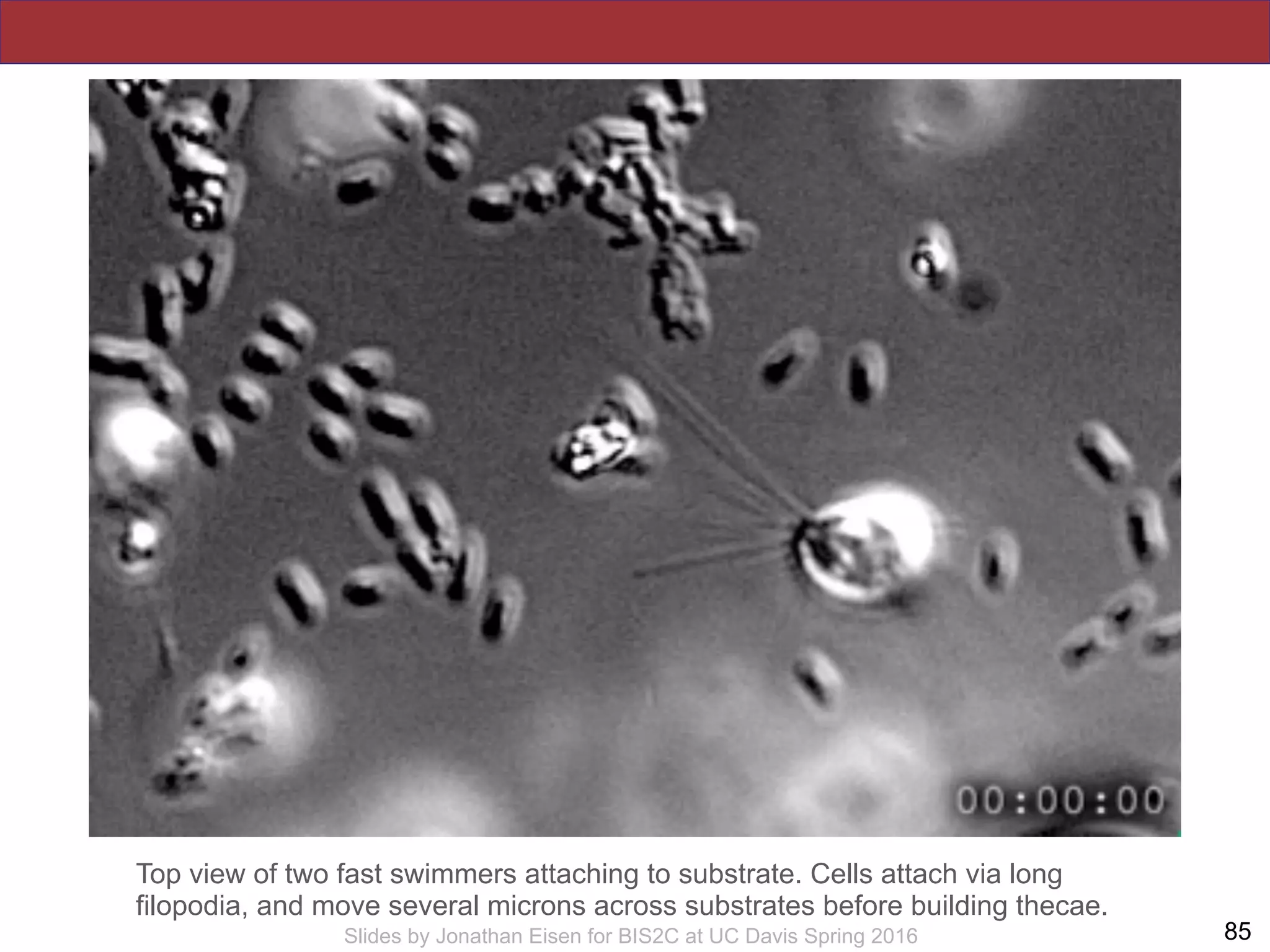
!85Slides by Jonathan Eisen for BIS2C at UC Davis Spring 2016
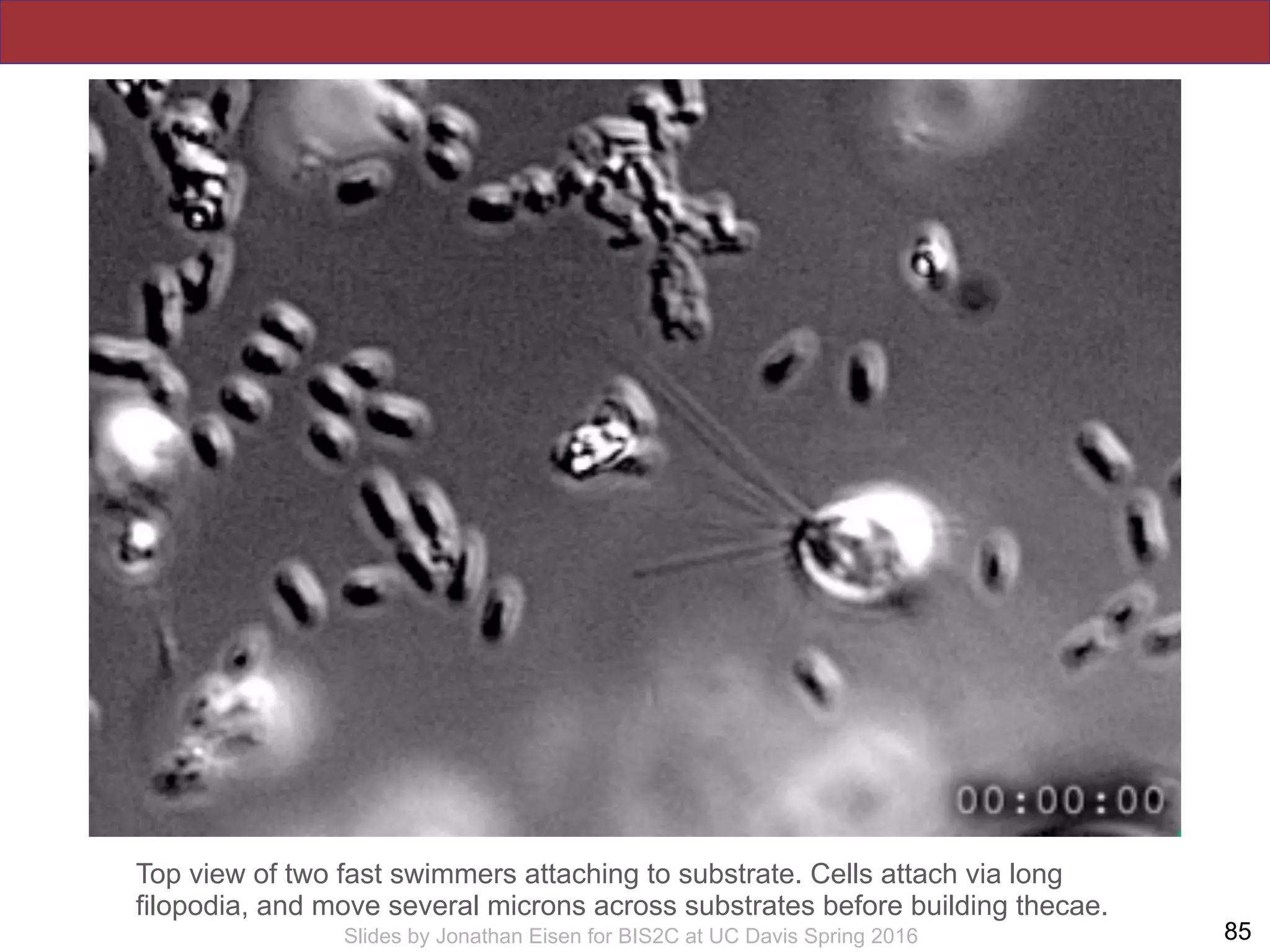
Top view of two fast swimmers attaching to substrate. Cells attach via long
filopodia, and move several microns across substrates before building thecae.
!85Slides by Jonathan Eisen for BIS2C at UC Davis Spring 2016
Top view of two fast swimmers attaching to substrate. Cells attach via long
filopodia, and move several microns across substrates before building thecae.
Life history of a model Choanoflagellate Salpingoeca rosetta
!86Slides by Jonathan Eisen for BIS2C at UC Davis Spring 2016
http://www.sciencedirect.com/science/article/pii/S0012160611009924
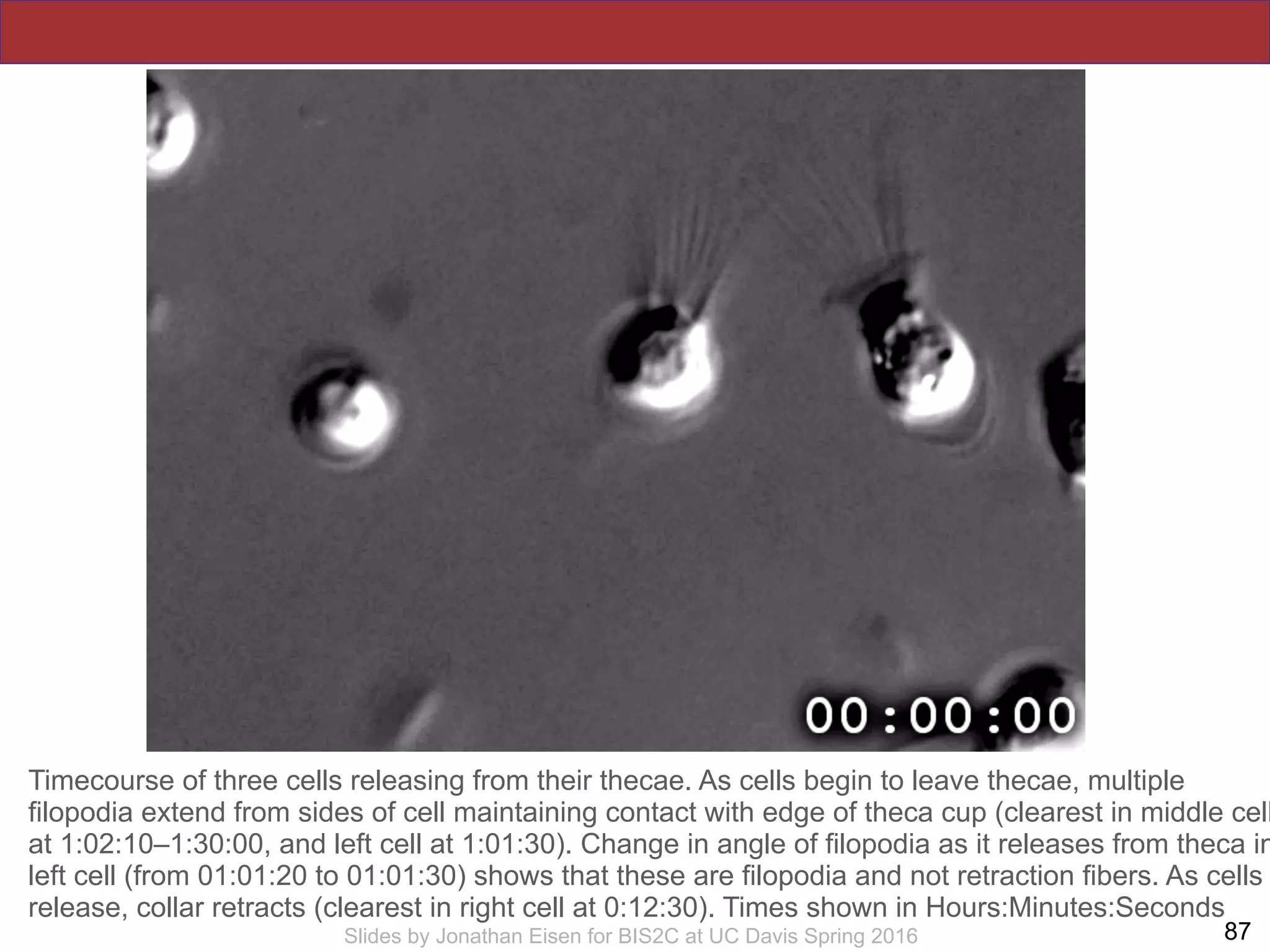
!87Slides by Jonathan Eisen for BIS2C at UC Davis Spring 2016
Timecourse of three cells releasing from their thecae. As cells begin to leave thecae, multiple
filopodia extend from sides of cell maintaining contact with edge of theca cup (clearest in middle cell
at 1:02:10–1:30:00, and left cell at 1:01:30). Change in angle of filopodia as it releases from theca in
left cell (from 01:01:20 to 01:01:30) shows that these are filopodia and not retraction fibers. As cells
release, collar retracts (clearest in right cell at 0:12:30). Times shown in Hours:Minutes:Seconds
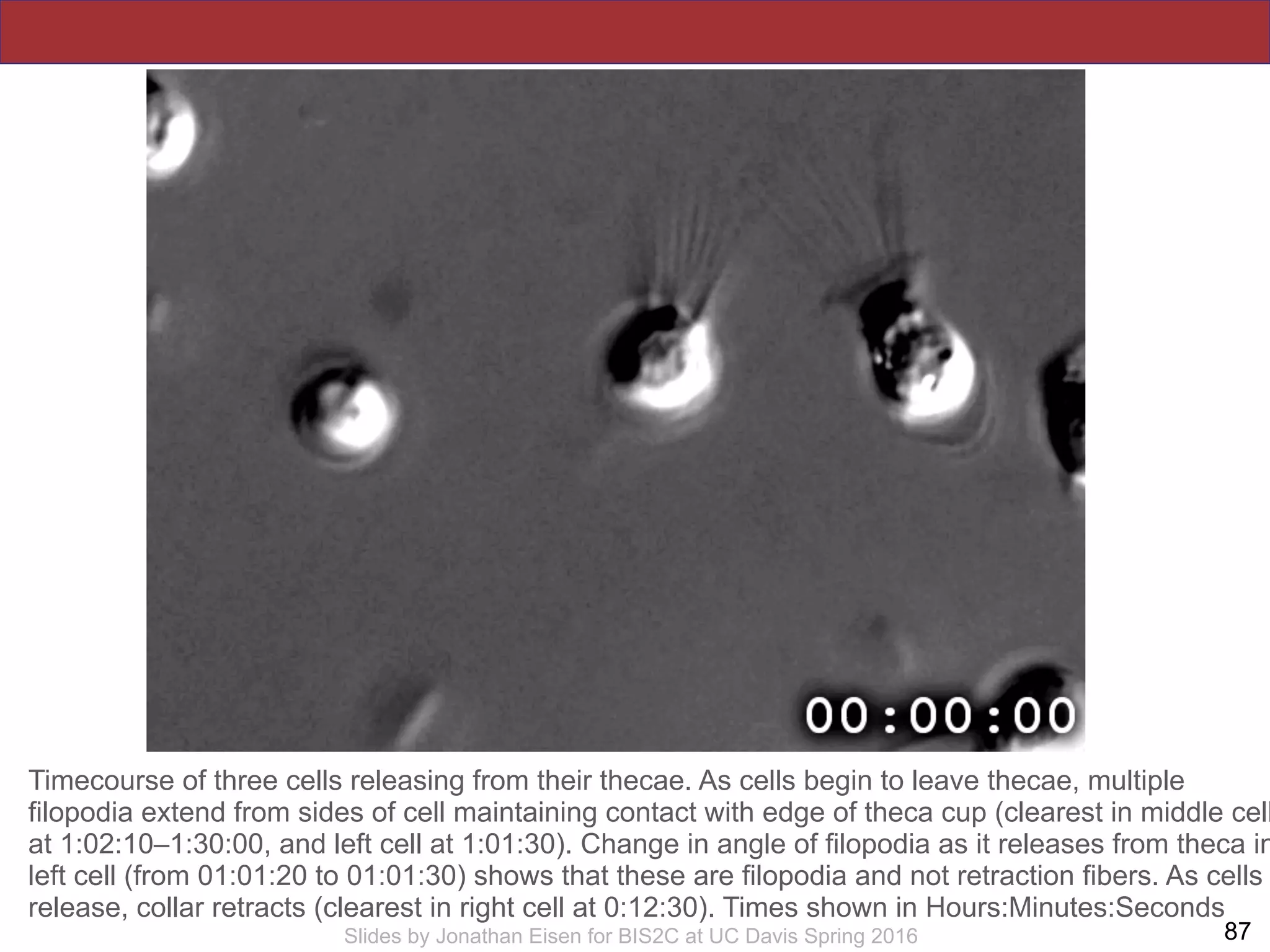
!87Slides by Jonathan Eisen for BIS2C at UC Davis Spring 2016
Timecourse of three cells releasing from their thecae. As cells begin to leave thecae, multiple
filopodia extend from sides of cell maintaining contact with edge of theca cup (clearest in middle cell
at 1:02:10–1:30:00, and left cell at 1:01:30). Change in angle of filopodia as it releases from theca in
left cell (from 01:01:20 to 01:01:30) shows that these are filopodia and not retraction fibers. As cells
release, collar retracts (clearest in right cell at 0:12:30). Times shown in Hours:Minutes:Seconds
!88Slides by Jonathan Eisen for BIS2C at UC Davis Spring 2016
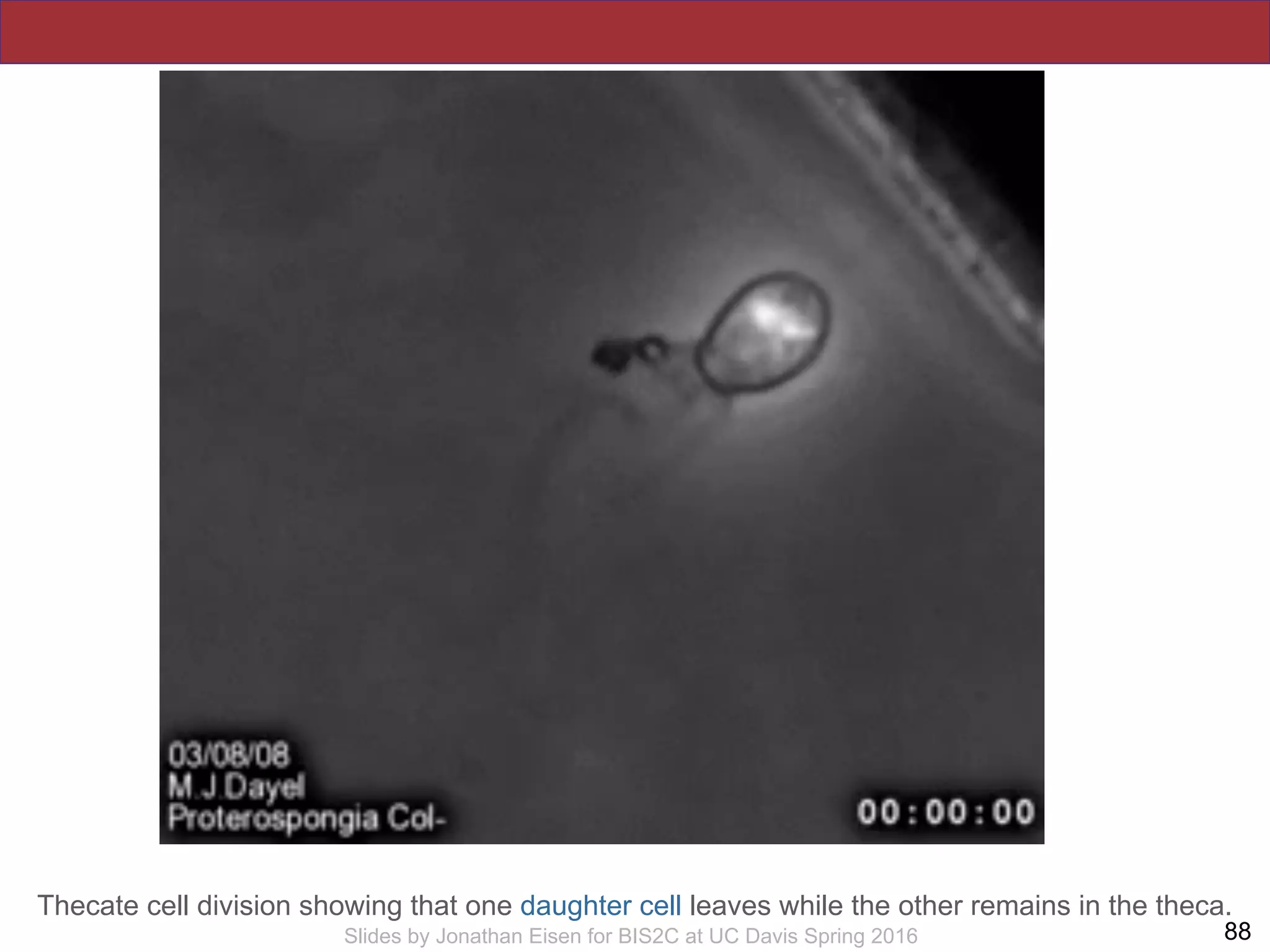
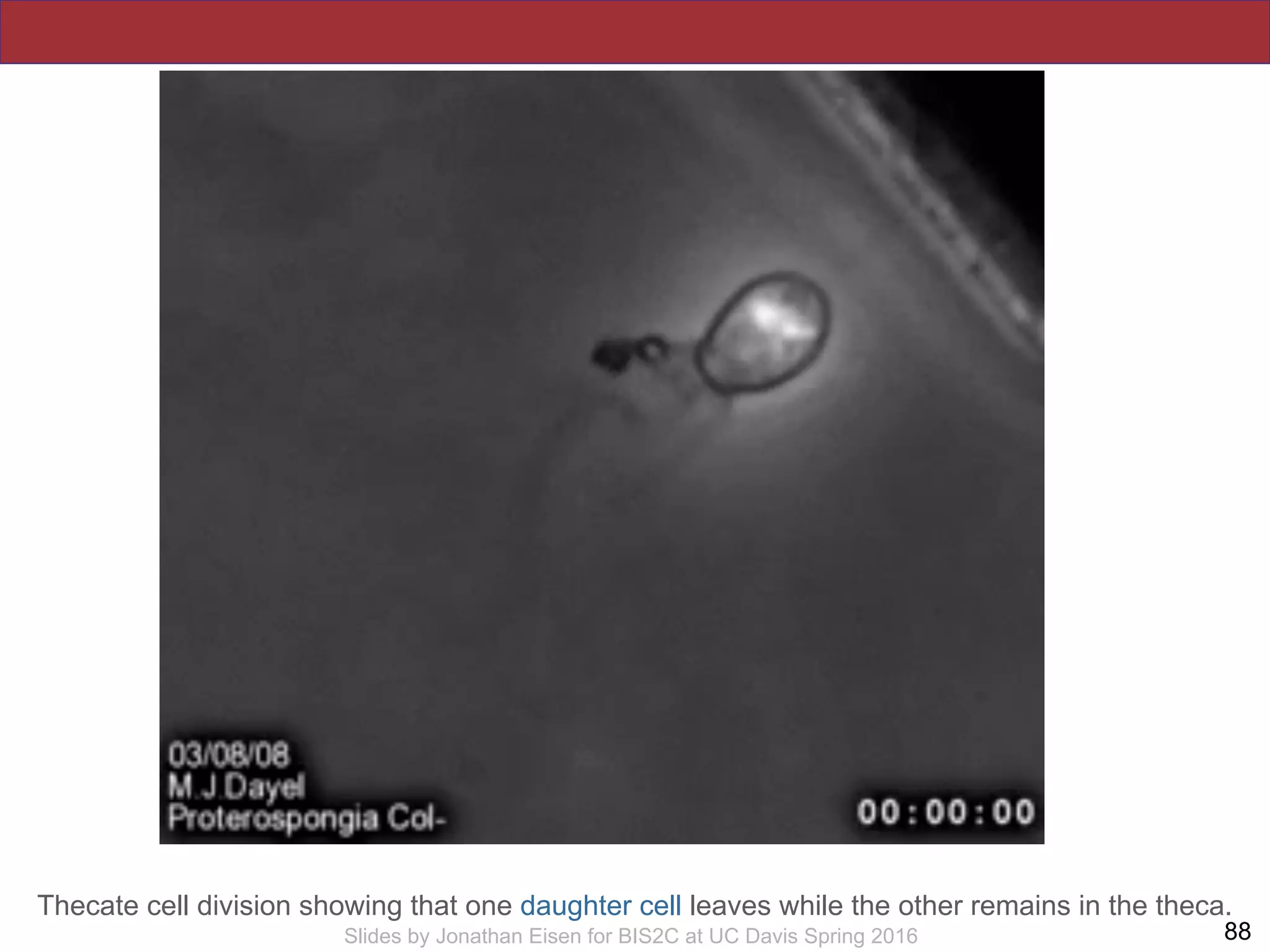
Thecate cell division showing that one daughter cell leaves while the other remains in the theca.
!88Slides by Jonathan Eisen for BIS2C at UC Davis Spring 2016
Thecate cell division showing that one daughter cell leaves while the other remains in the theca.
Life history of a model Choanoflagellate Salpingoeca rosetta
!89Slides by Jonathan Eisen for BIS2C at UC Davis Spring 2016
http://www.sciencedirect.com/science/article/pii/S0012160611009924
!90Slides by Jonathan Eisen for BIS2C at UC Davis Spring 2016
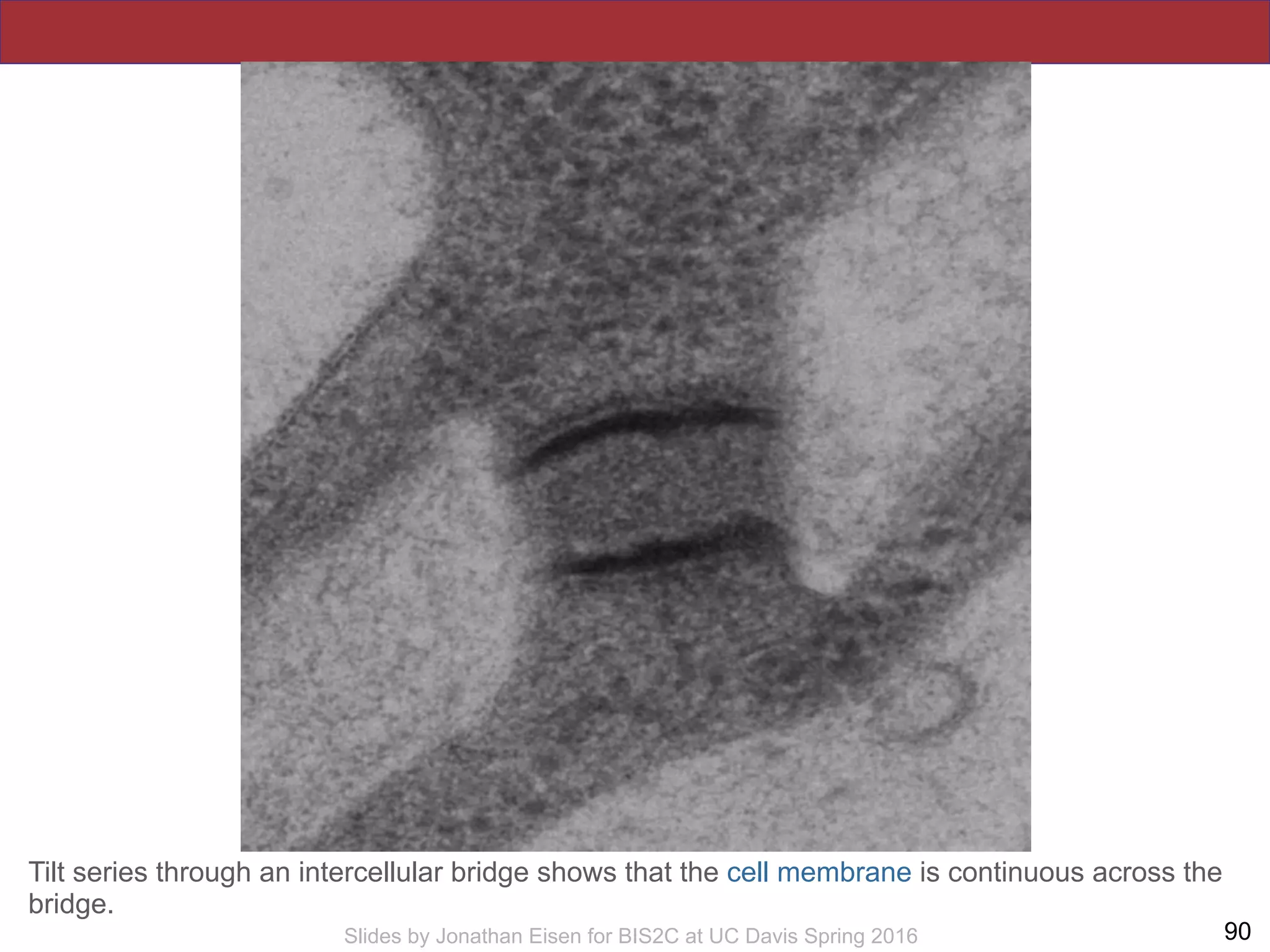
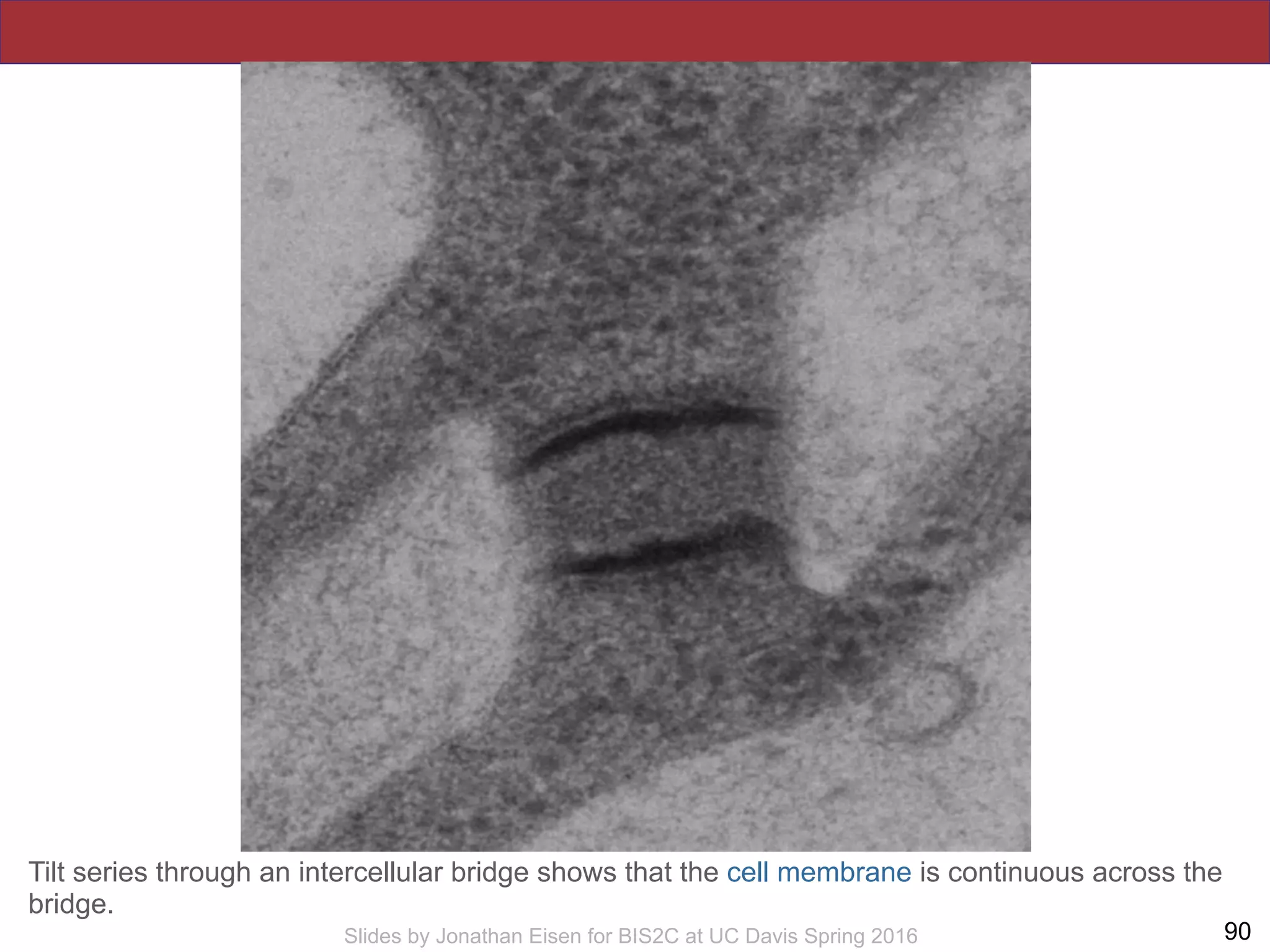
Tilt series through an intercellular bridge shows that the cell membrane is continuous across the
bridge.
!90Slides by Jonathan Eisen for BIS2C at UC Davis Spring 2016
Tilt series through an intercellular bridge shows that the cell membrane is continuous across the
bridge.
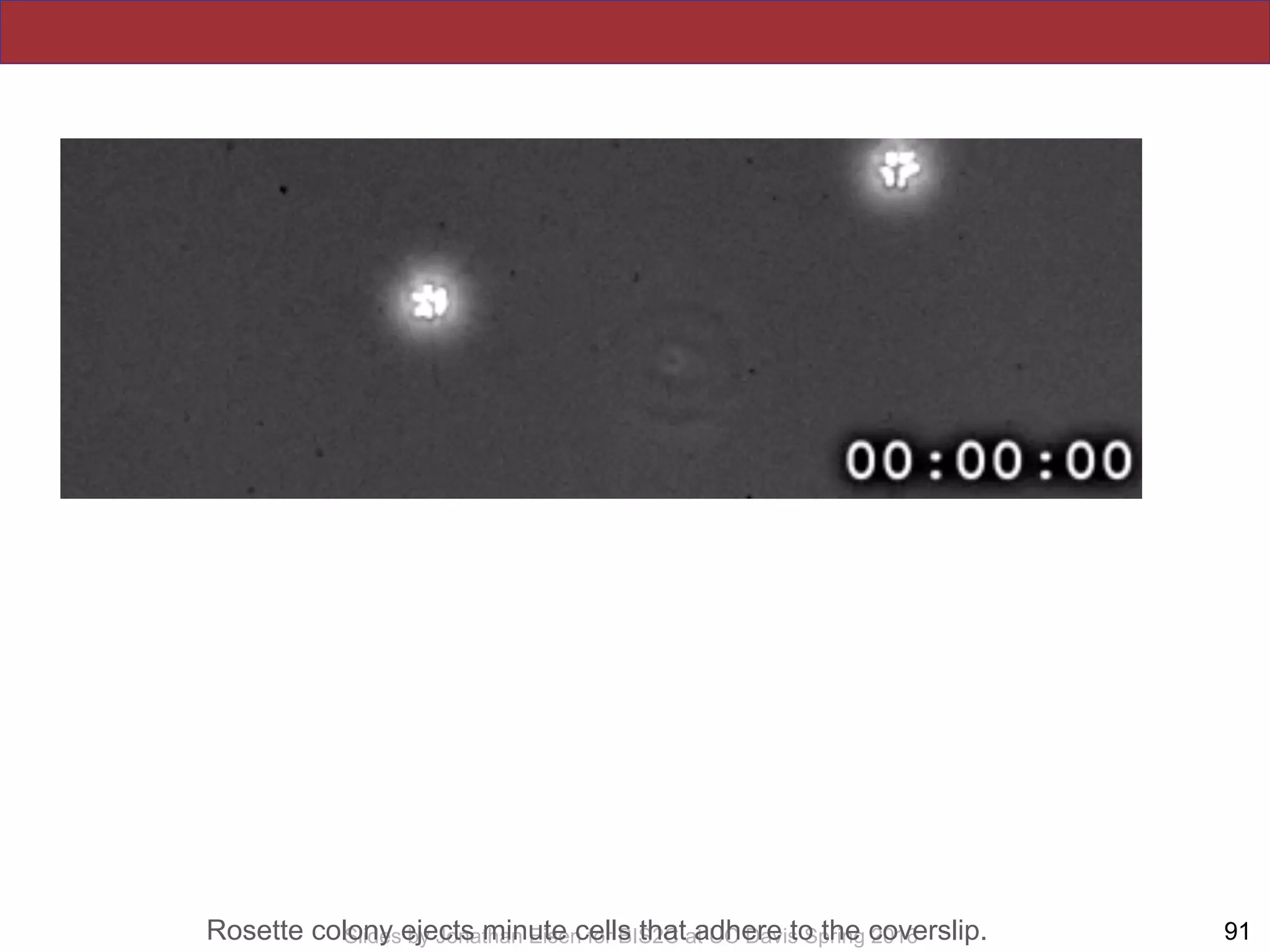
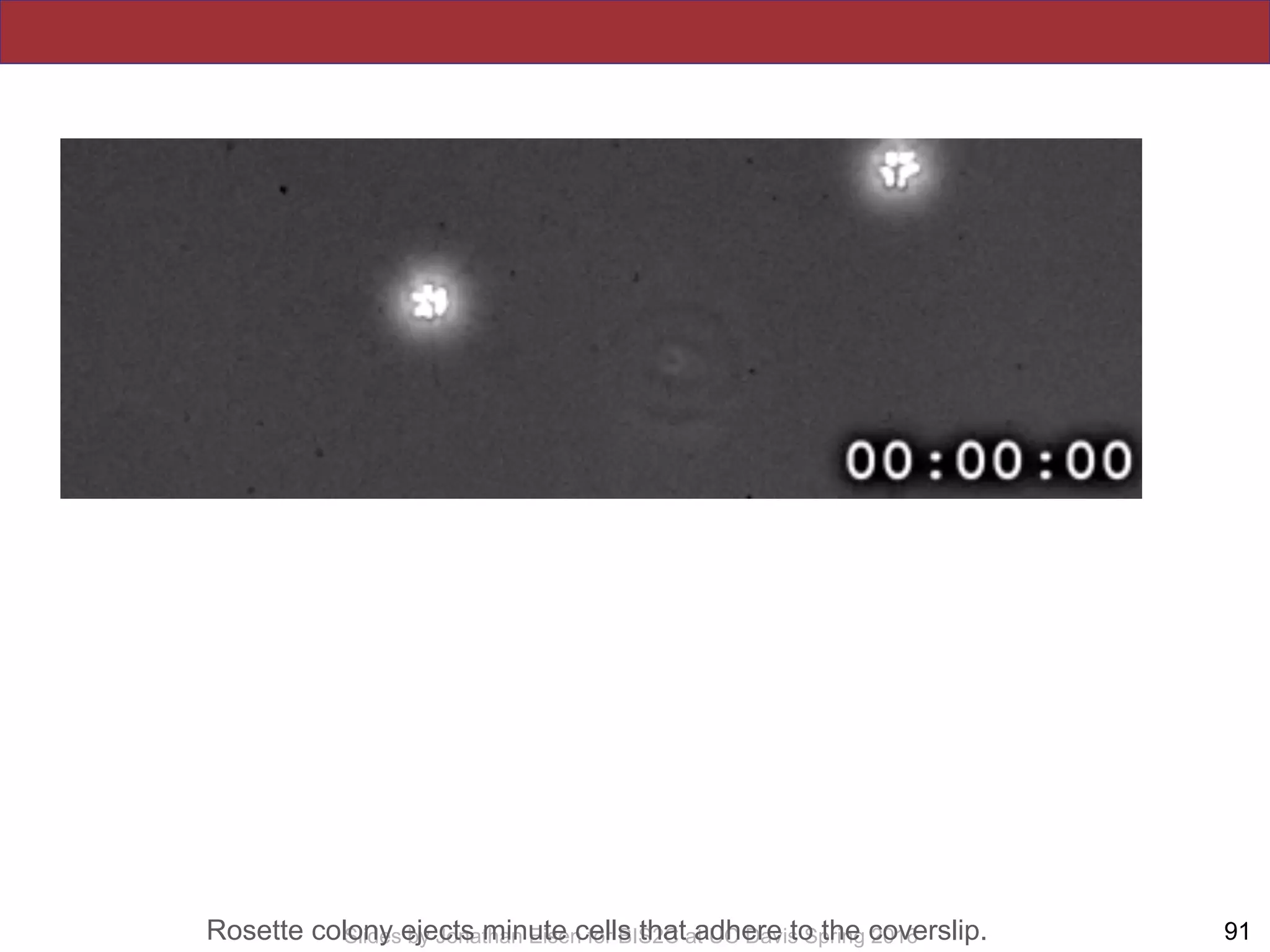
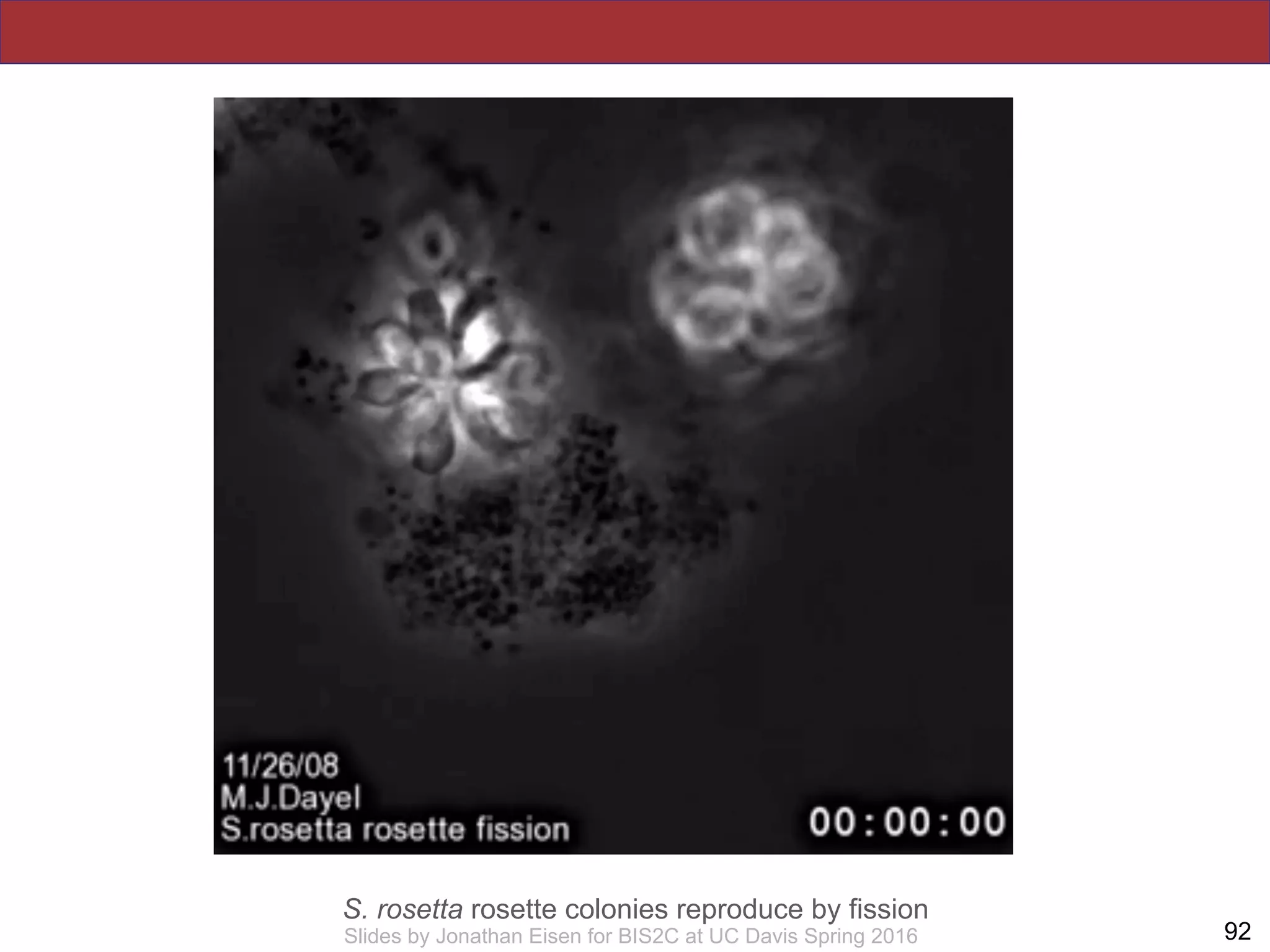
!91Slides by Jonathan Eisen for BIS2C at UC Davis Spring 2016Rosette colony ejects minute cells that adhere to the coverslip.
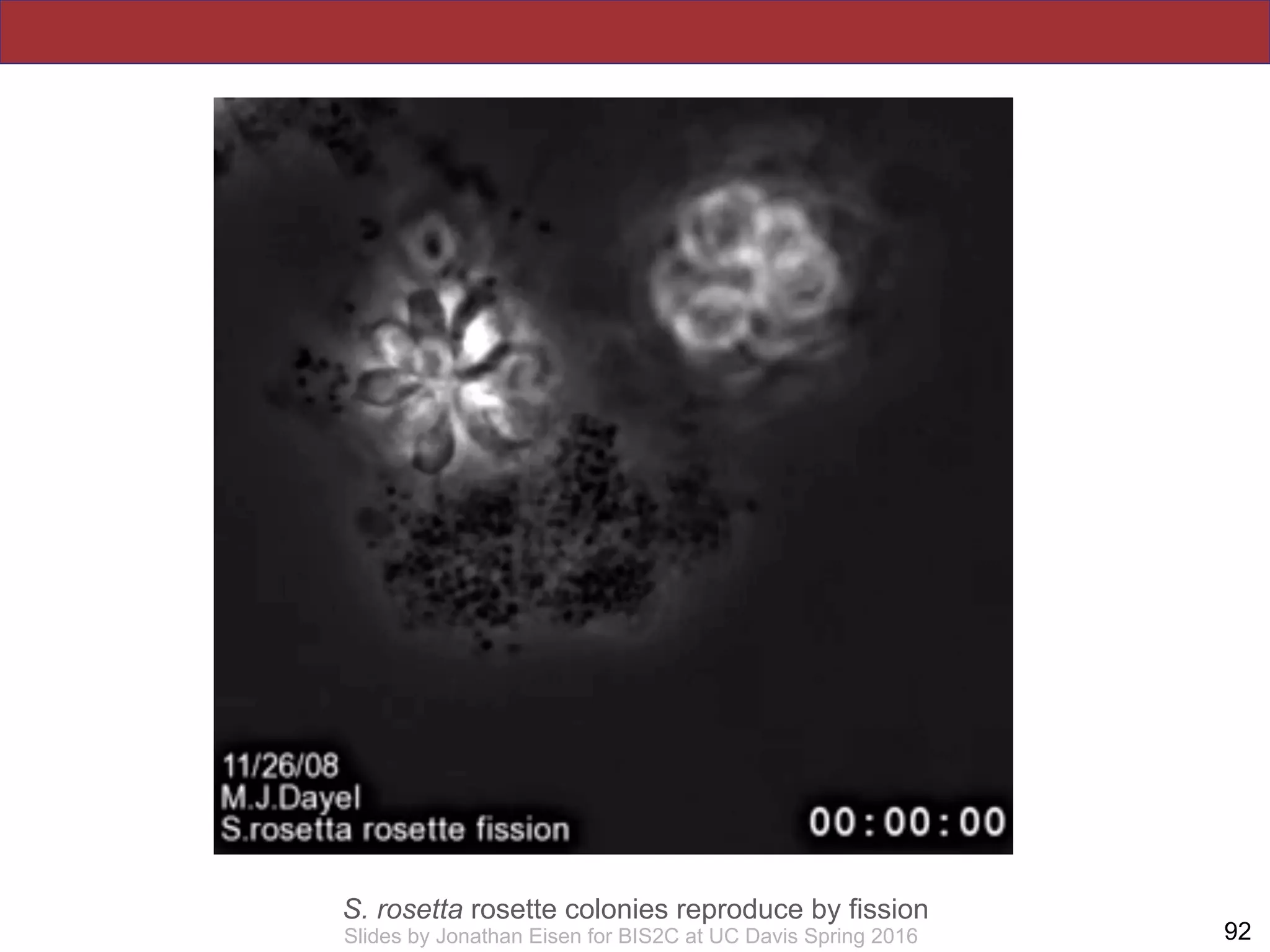
!92Slides by Jonathan Eisen for BIS2C at UC Davis Spring 2016
S. rosetta rosette colonies reproduce by fission
!92Slides by Jonathan Eisen for BIS2C at UC Davis Spring 2016
S. rosetta rosette colonies reproduce by fission
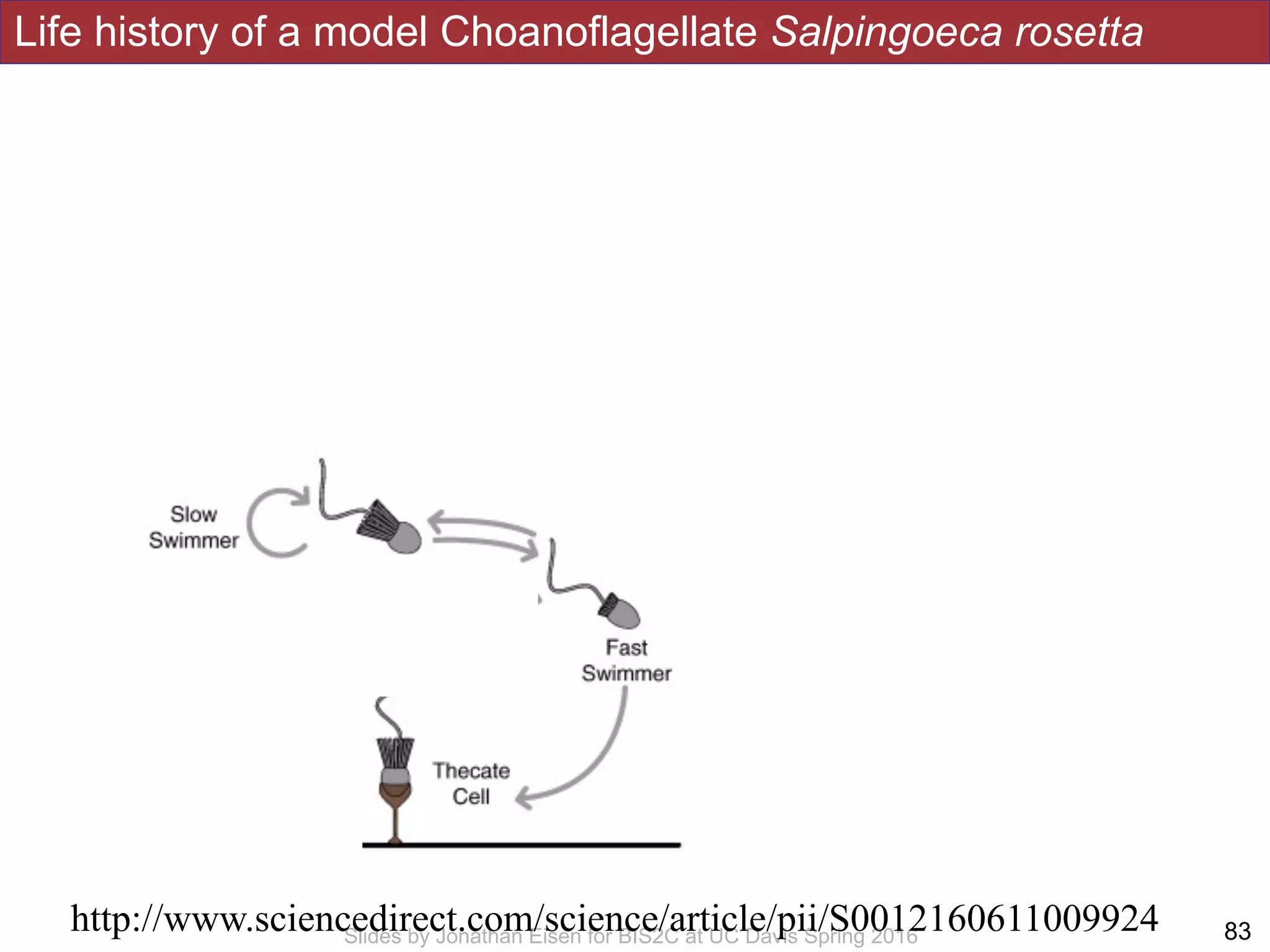
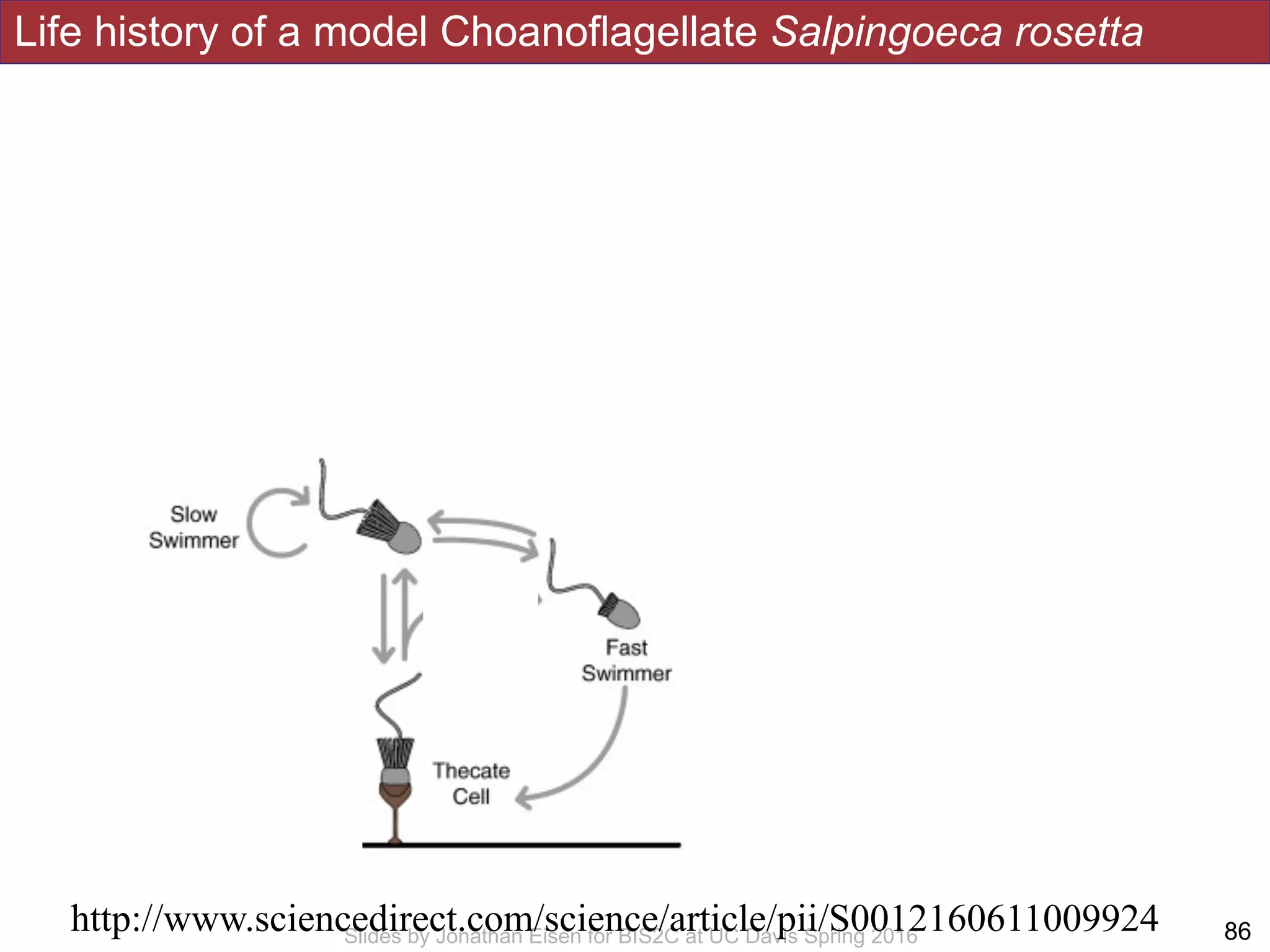
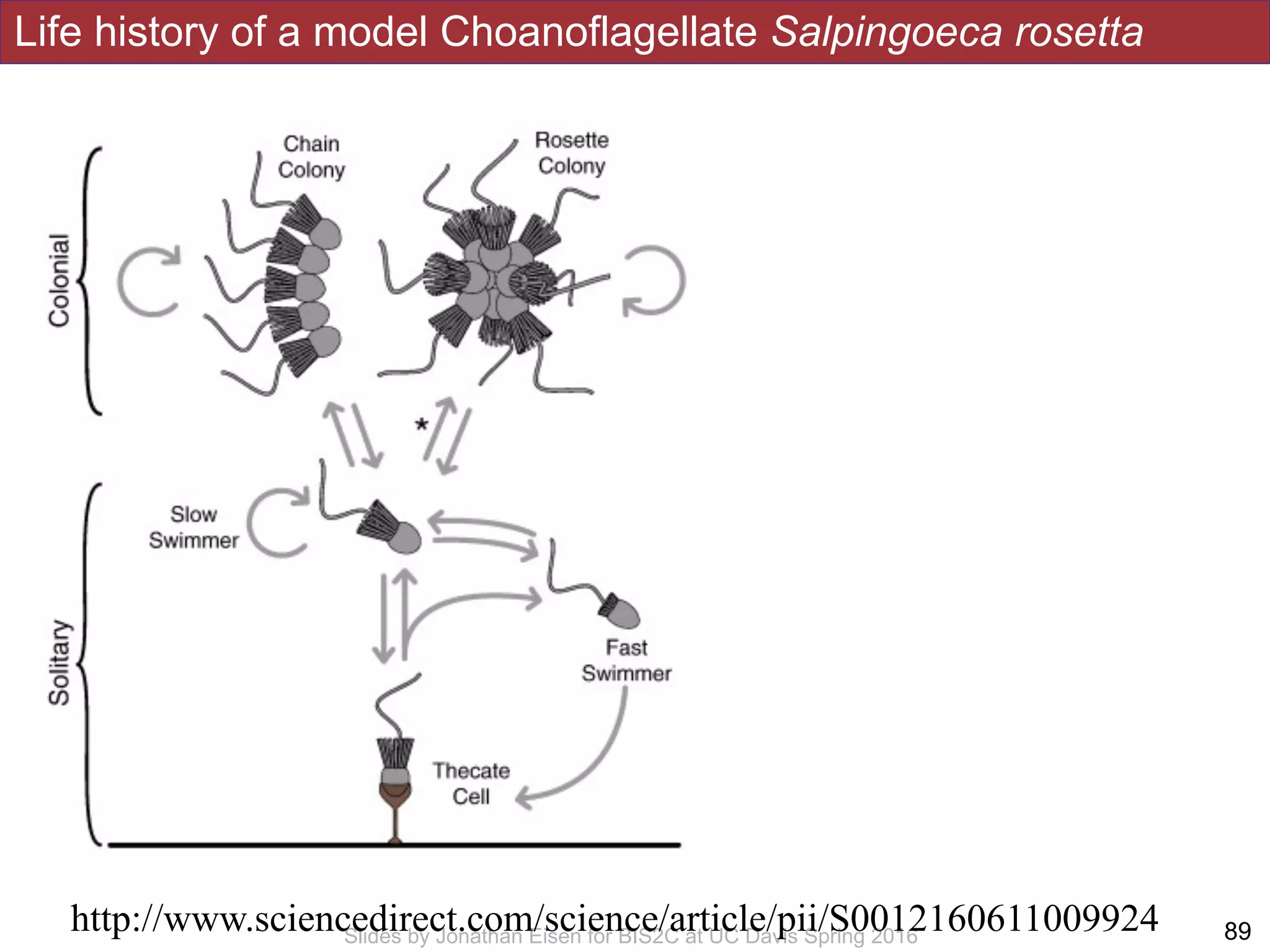
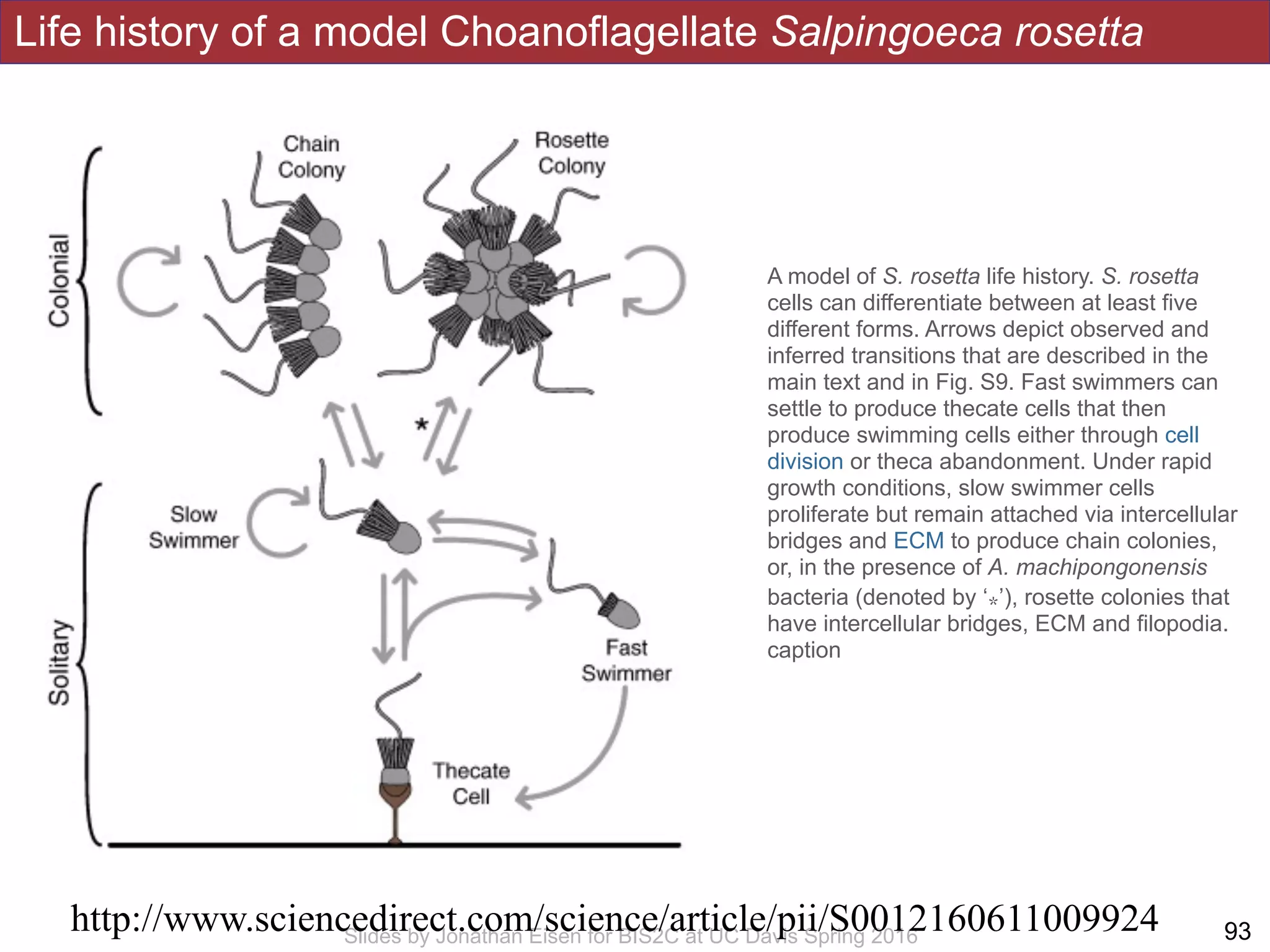
Life history of a model Choanoflagellate Salpingoeca rosetta
!93Slides by Jonathan Eisen for BIS2C at UC Davis Spring 2016
A model of S. rosetta life history. S. rosetta
cells can differentiate between at least five
different forms. Arrows depict observed and
inferred transitions that are described in the
main text and in Fig. S9. Fast swimmers can
settle to produce thecate cells that then
produce swimming cells either through cell
division or theca abandonment. Under rapid
growth conditions, slow swimmer cells
proliferate but remain attached via intercellular
bridges and ECM to produce chain colonies,
or, in the presence of A. machipongonensis
bacteria (denoted by ‘⁎’), rosette colonies that
have intercellular bridges, ECM and filopodia.
caption
http://www.sciencedirect.com/science/article/pii/S0012160611009924
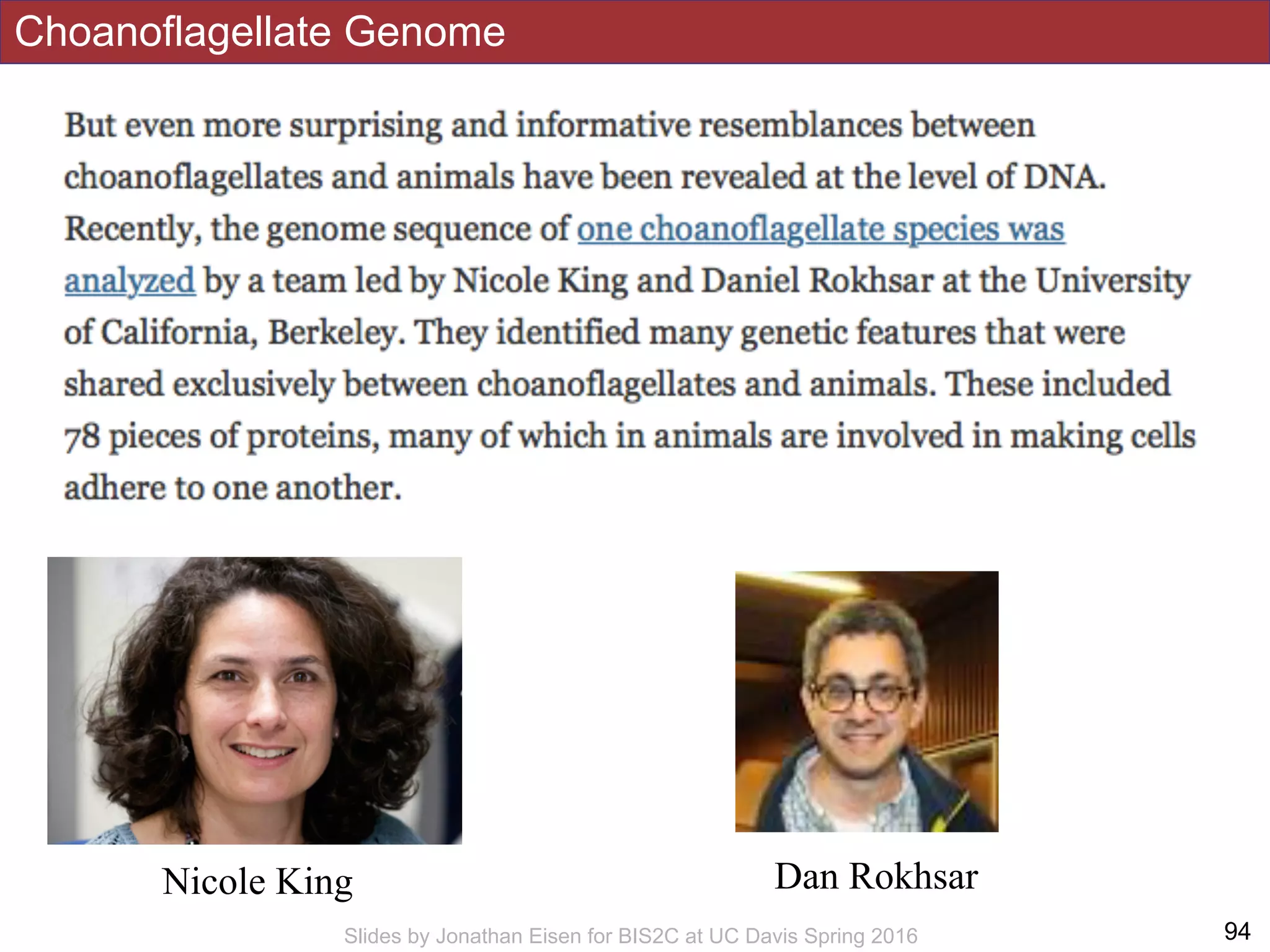
Choanoflagellate Genome
!94Slides by Jonathan Eisen for BIS2C at UC Davis Spring 2016
Nicole King Dan Rokhsar
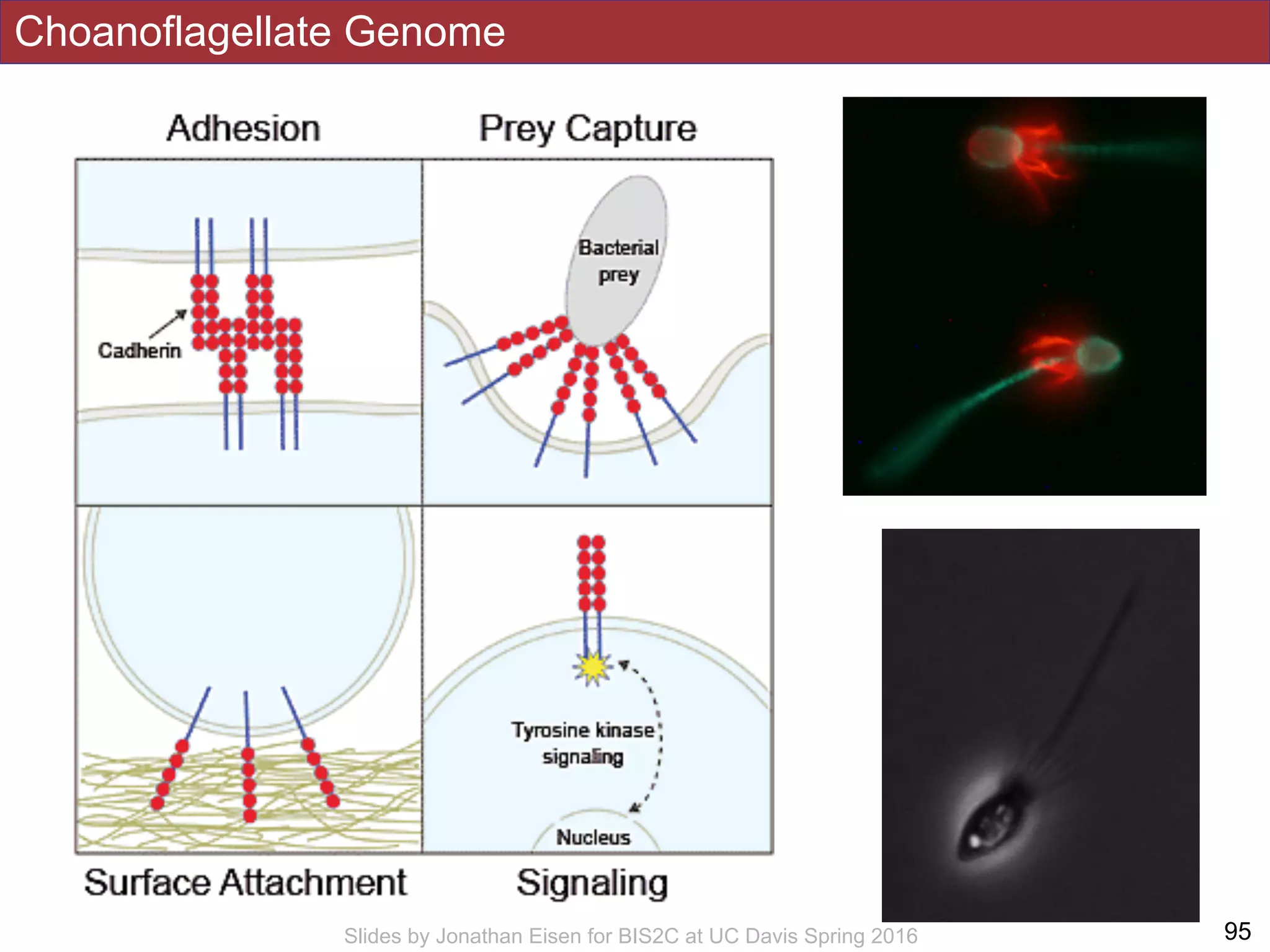
Choanoflagellate Genome
!95Slides by Jonathan Eisen for BIS2C at UC Davis Spring 2016
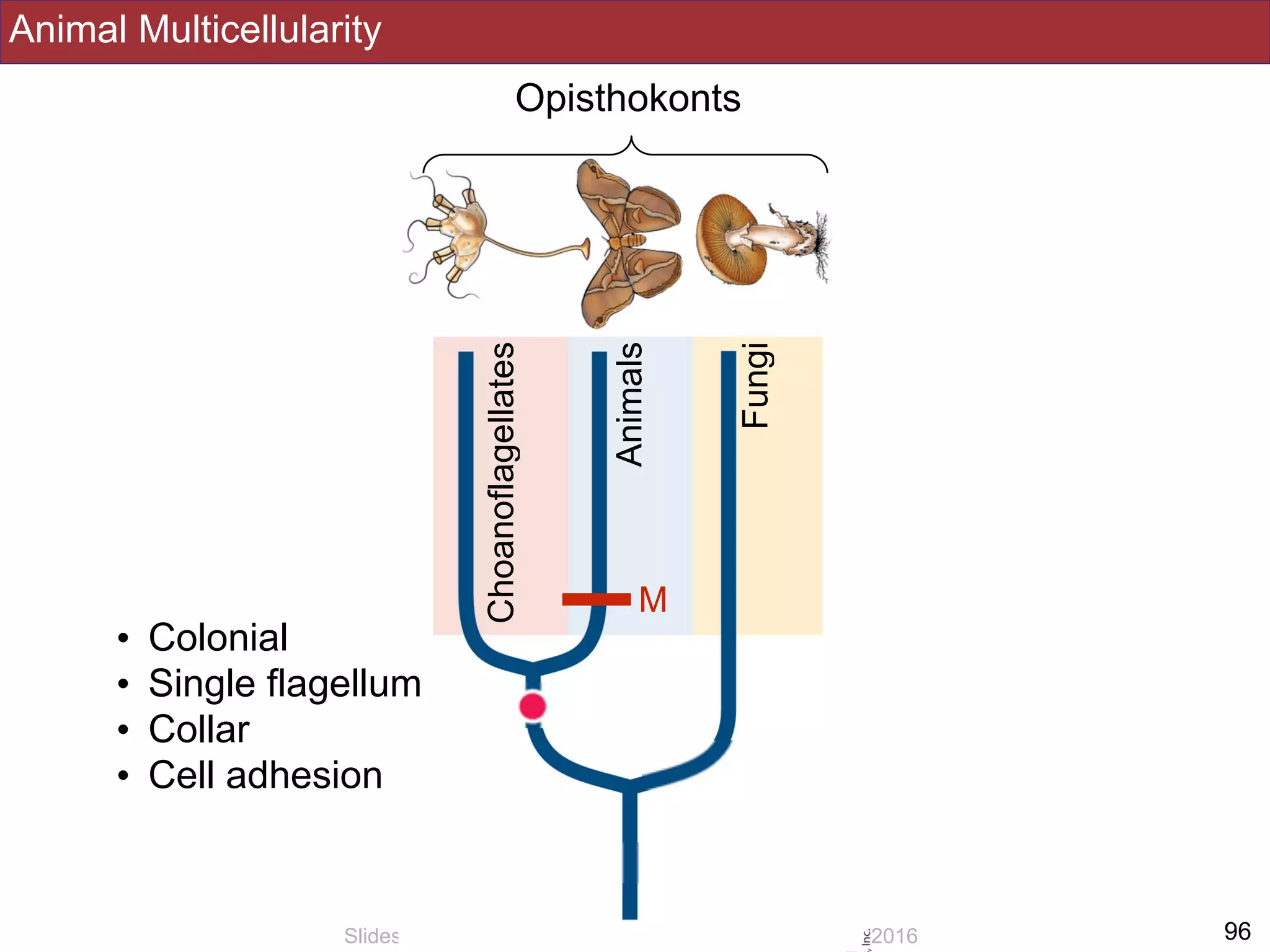
Animal Multicellularity
!96Slides by Jonathan Eisen for BIS2C at UC Davis Spring 2016
Opisthokonts
Fungi
Animals
Choanoflagellates
• Colonial
• Single flagellum
• Collar
• Cell adhesion
M
!97Slides by Jonathan Eisen for BIS2C at UC Davis Spring 2016
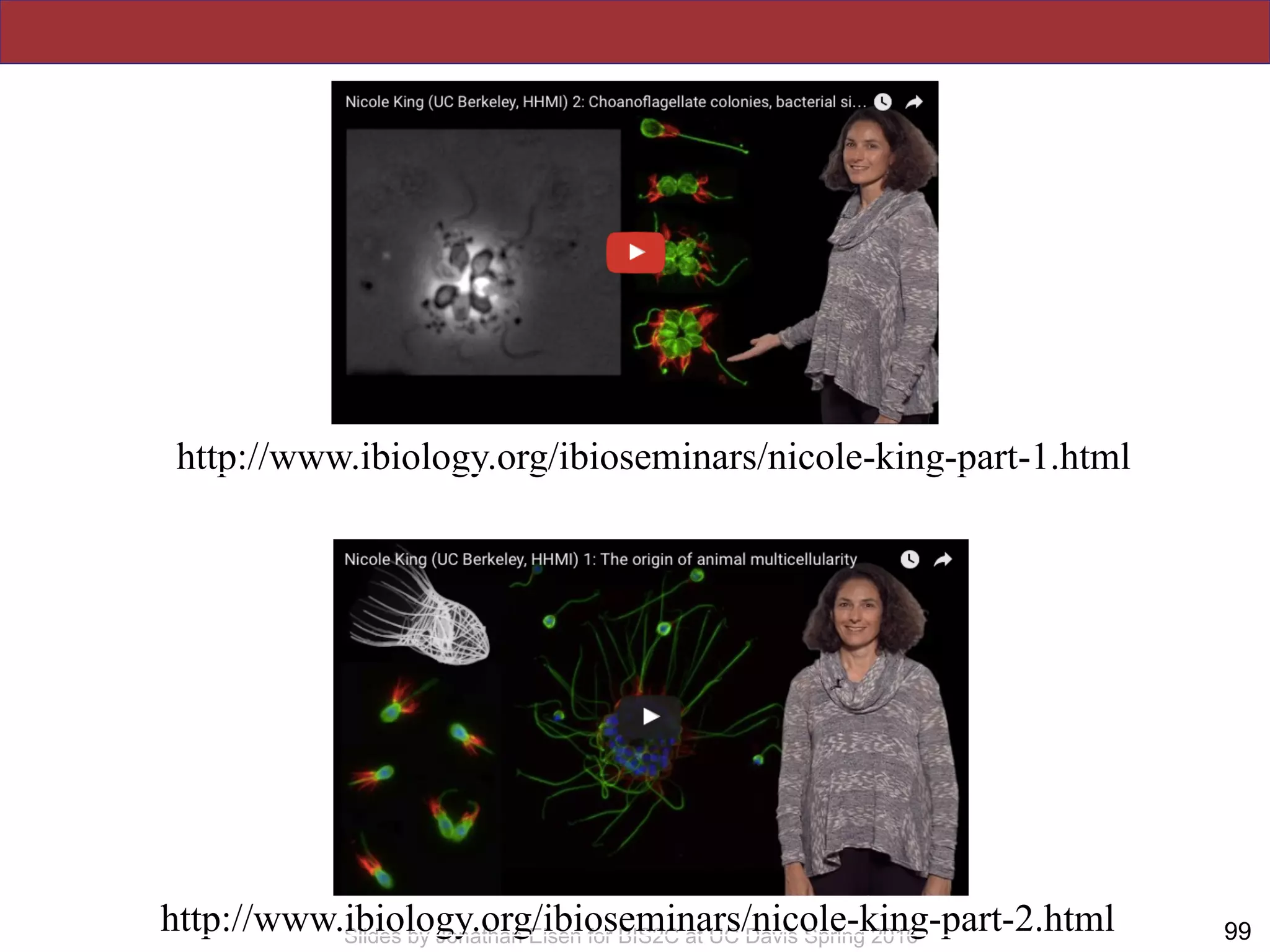
Nicole King
!98Slides by Jonathan Eisen for BIS2C at UC Davis Spring 2016
!99Slides by Jonathan Eisen for BIS2C at UC Davis Spring 2016
http://www.ibiology.org/ibioseminars/nicole-king-part-1.html
http://www.ibiology.org/ibioseminars/nicole-king-part-2.html
Slides by Jonathan Eisen for BIS2C at UC Davis Spring 2016
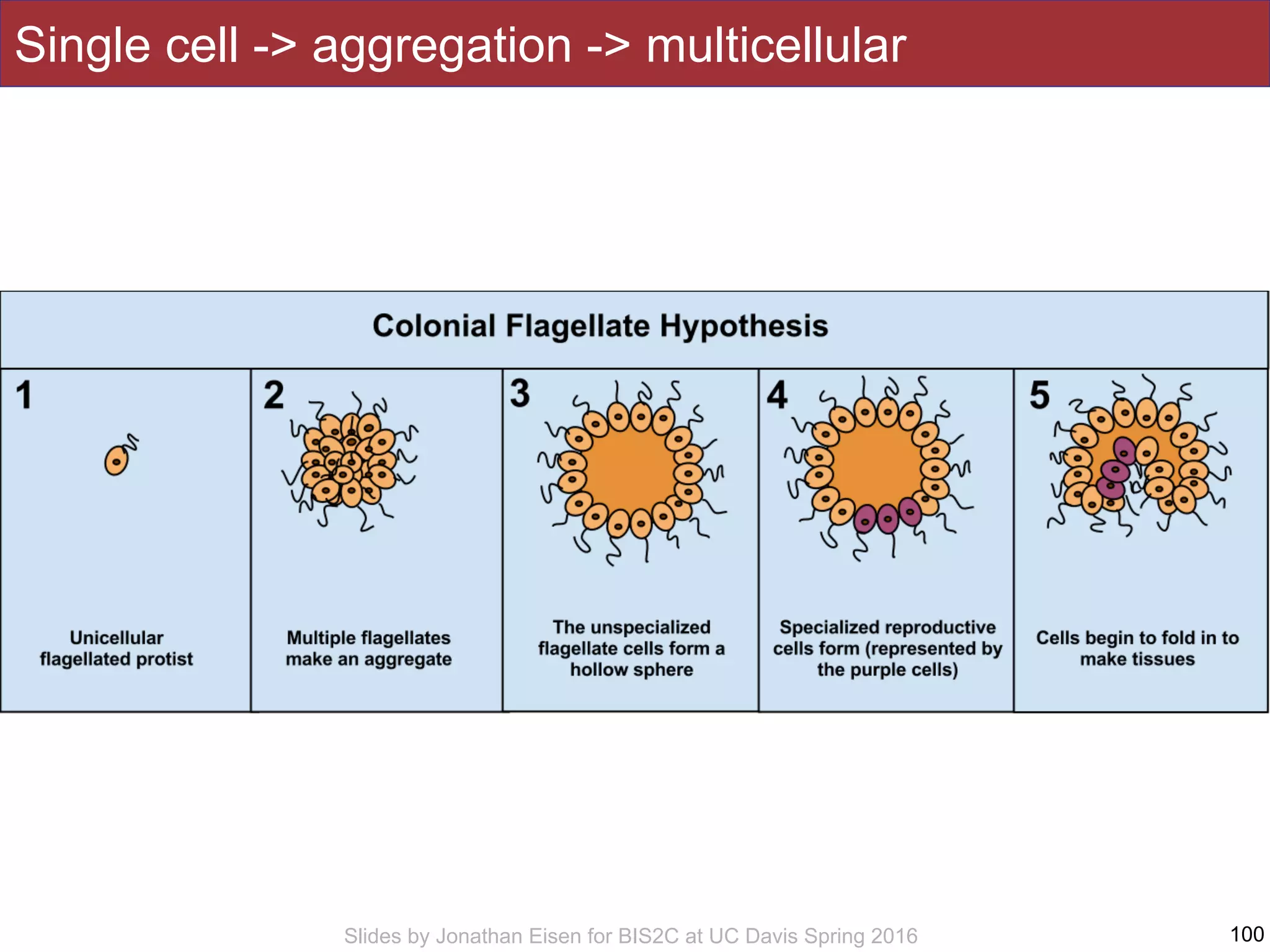
Single cell -> aggregation -> multicellular
100
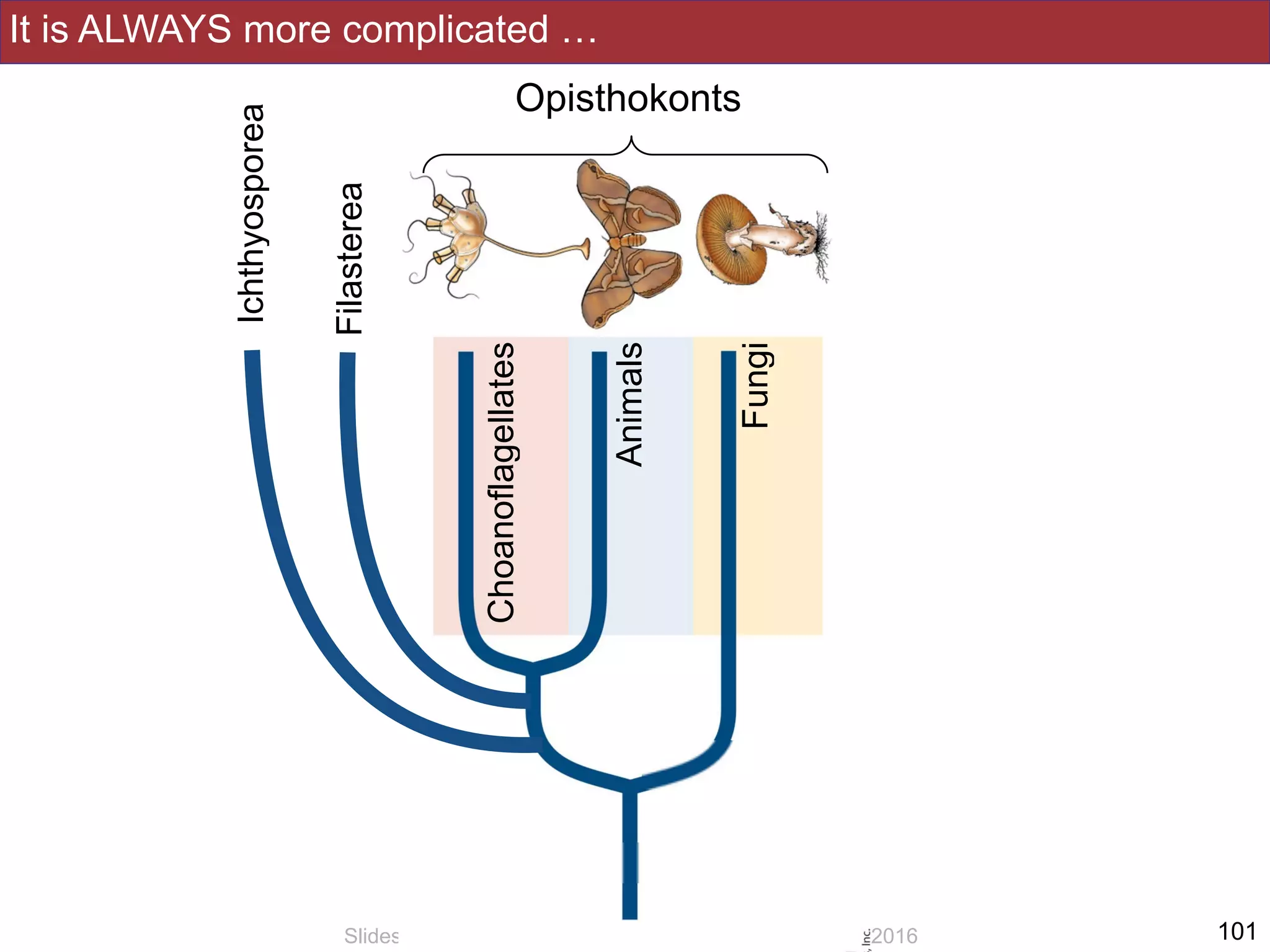
It is ALWAYS more complicated …
!101Slides by Jonathan Eisen for BIS2C at UC Davis Spring 2016
Opisthokonts
Fungi
Animals
Choanoflagellates
Filasterea
Ichthyosporea
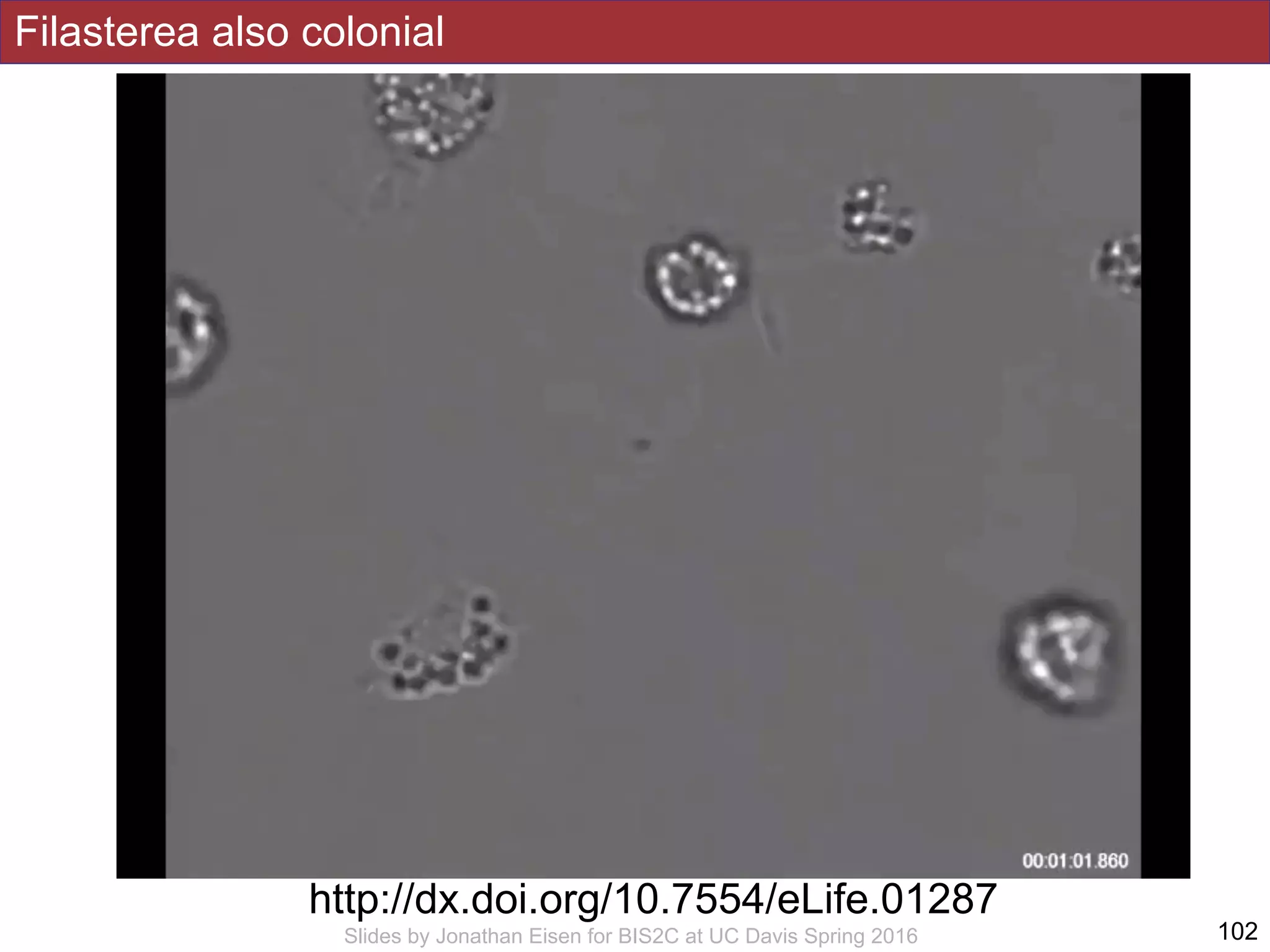
Filasterea also colonial
!102Slides by Jonathan Eisen for BIS2C at UC Davis Spring 2016
http://dx.doi.org/10.7554/eLife.01287
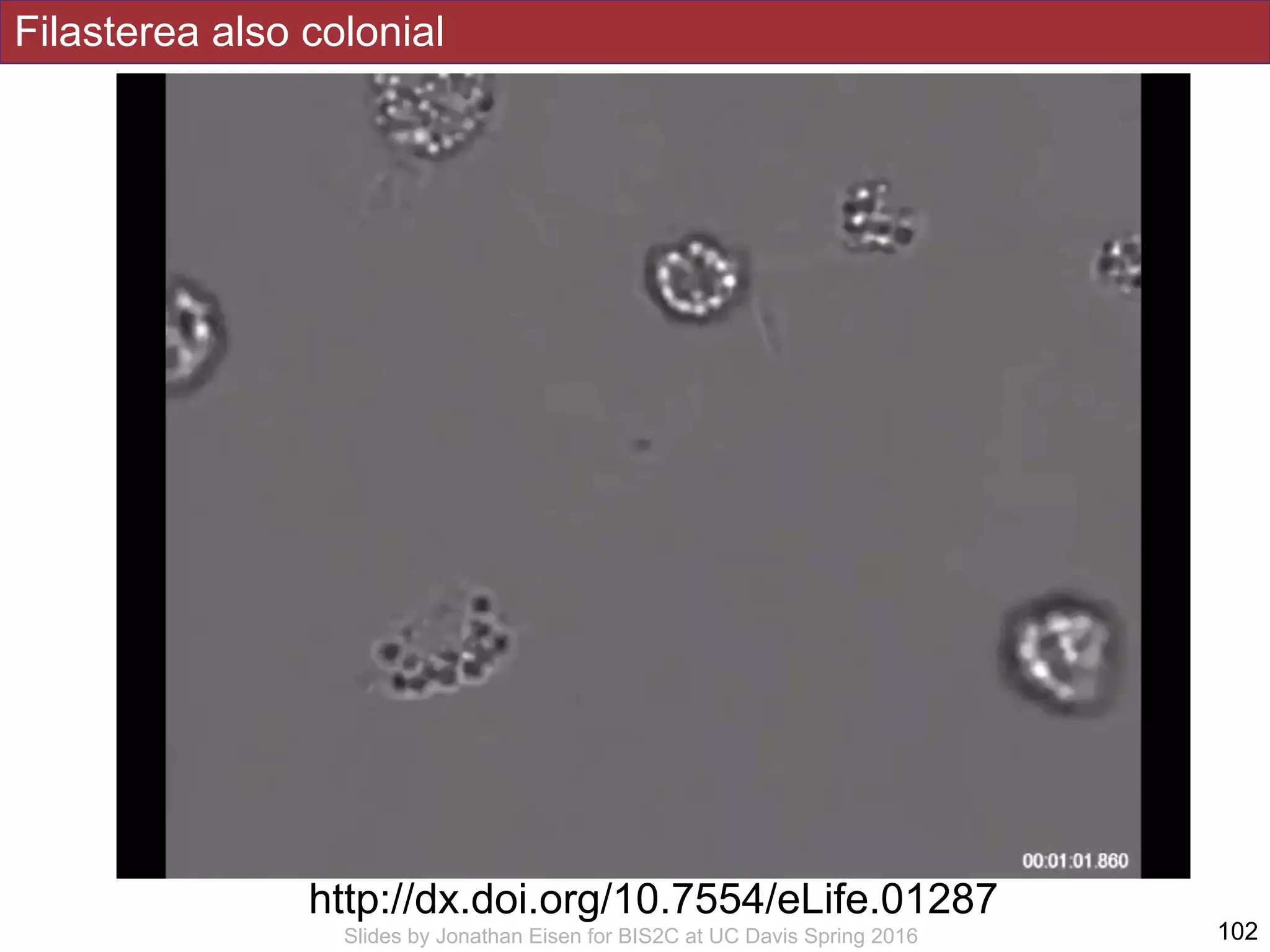
Filasterea also colonial
!102Slides by Jonathan Eisen for BIS2C at UC Davis Spring 2016
http://dx.doi.org/10.7554/eLife.01287
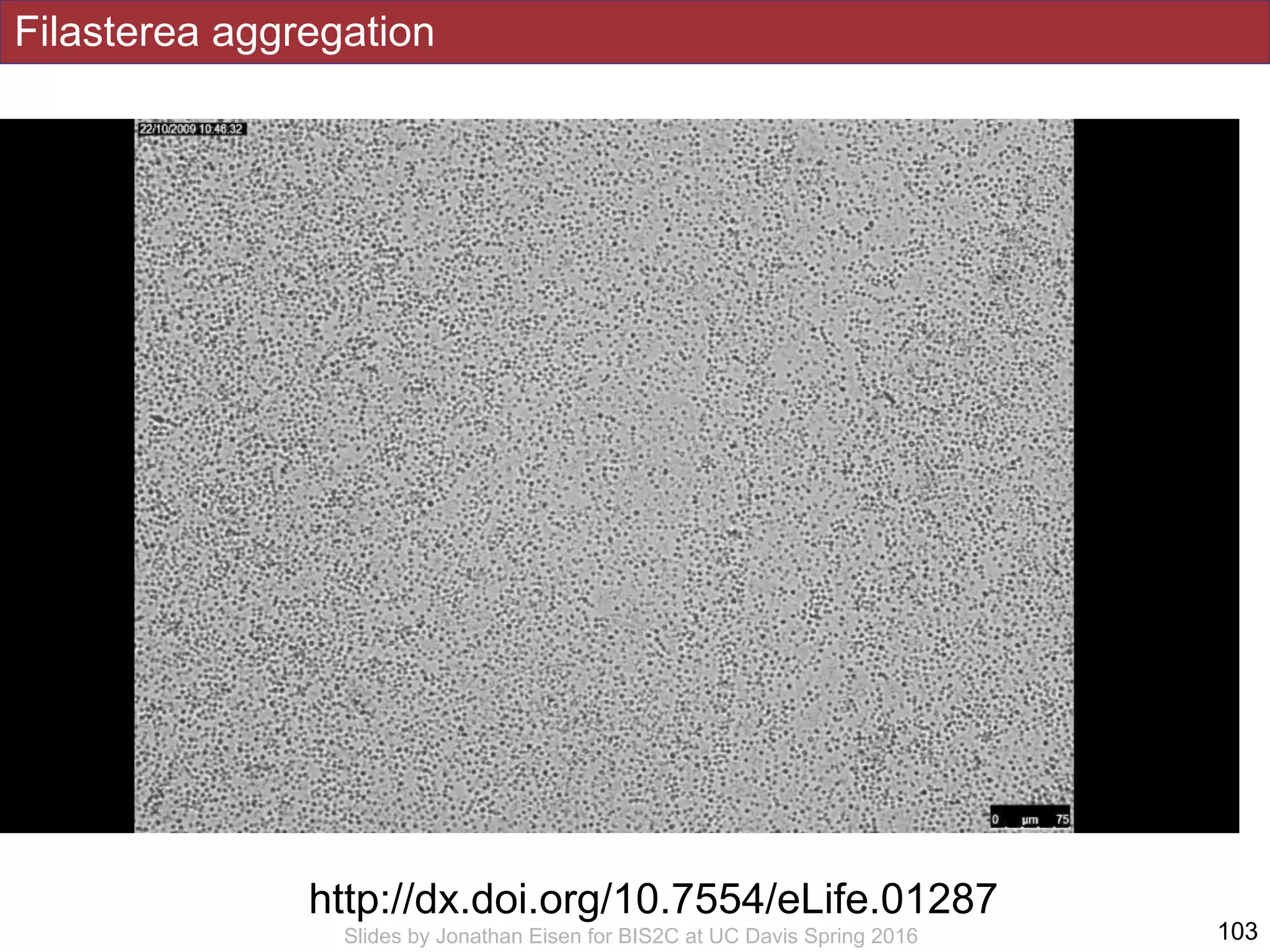
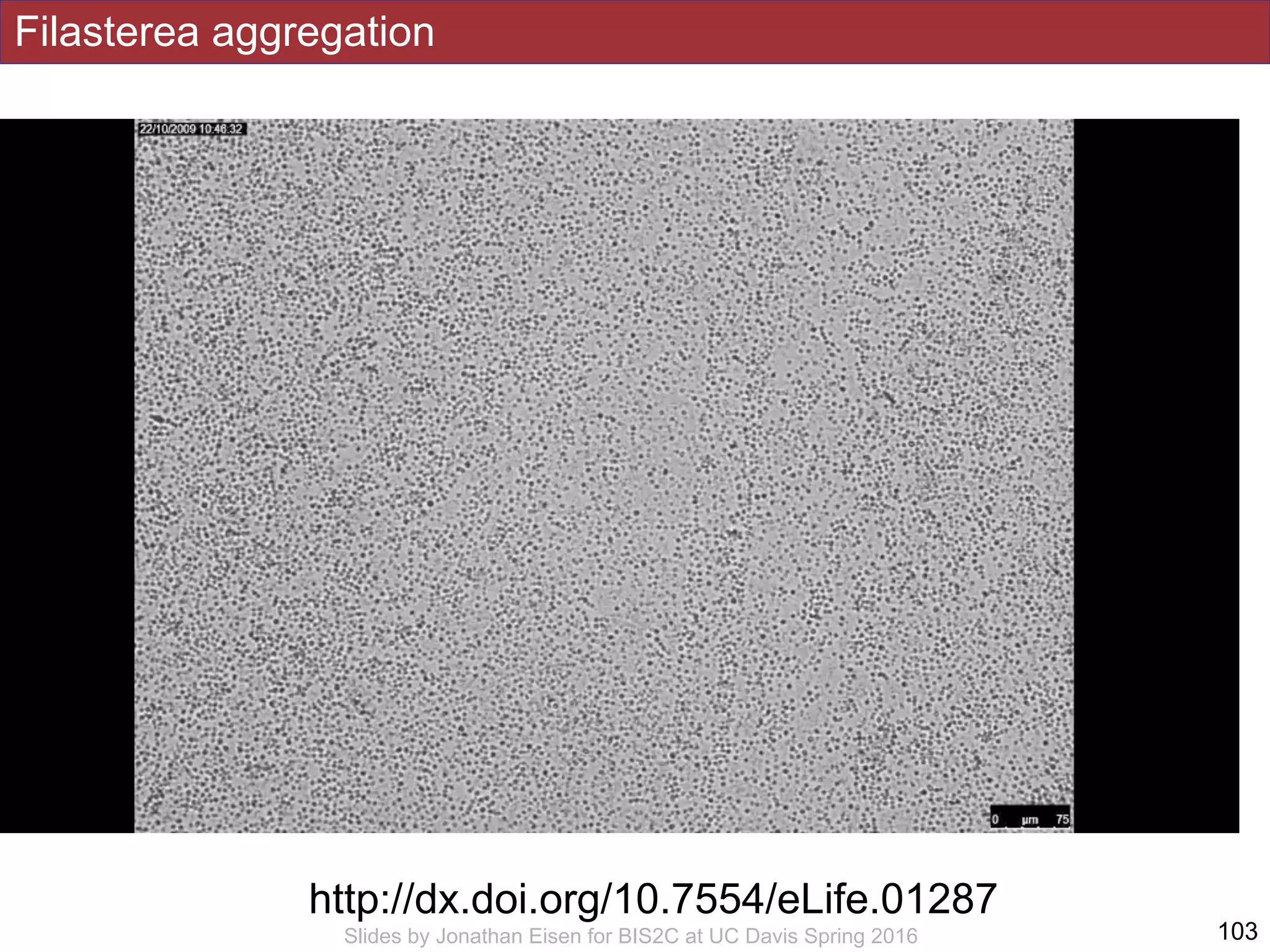
Filasterea aggregation
!103Slides by Jonathan Eisen for BIS2C at UC Davis Spring 2016
http://dx.doi.org/10.7554/eLife.01287
Filasterea aggregation
!103Slides by Jonathan Eisen for BIS2C at UC Davis Spring 2016
http://dx.doi.org/10.7554/eLife.01287
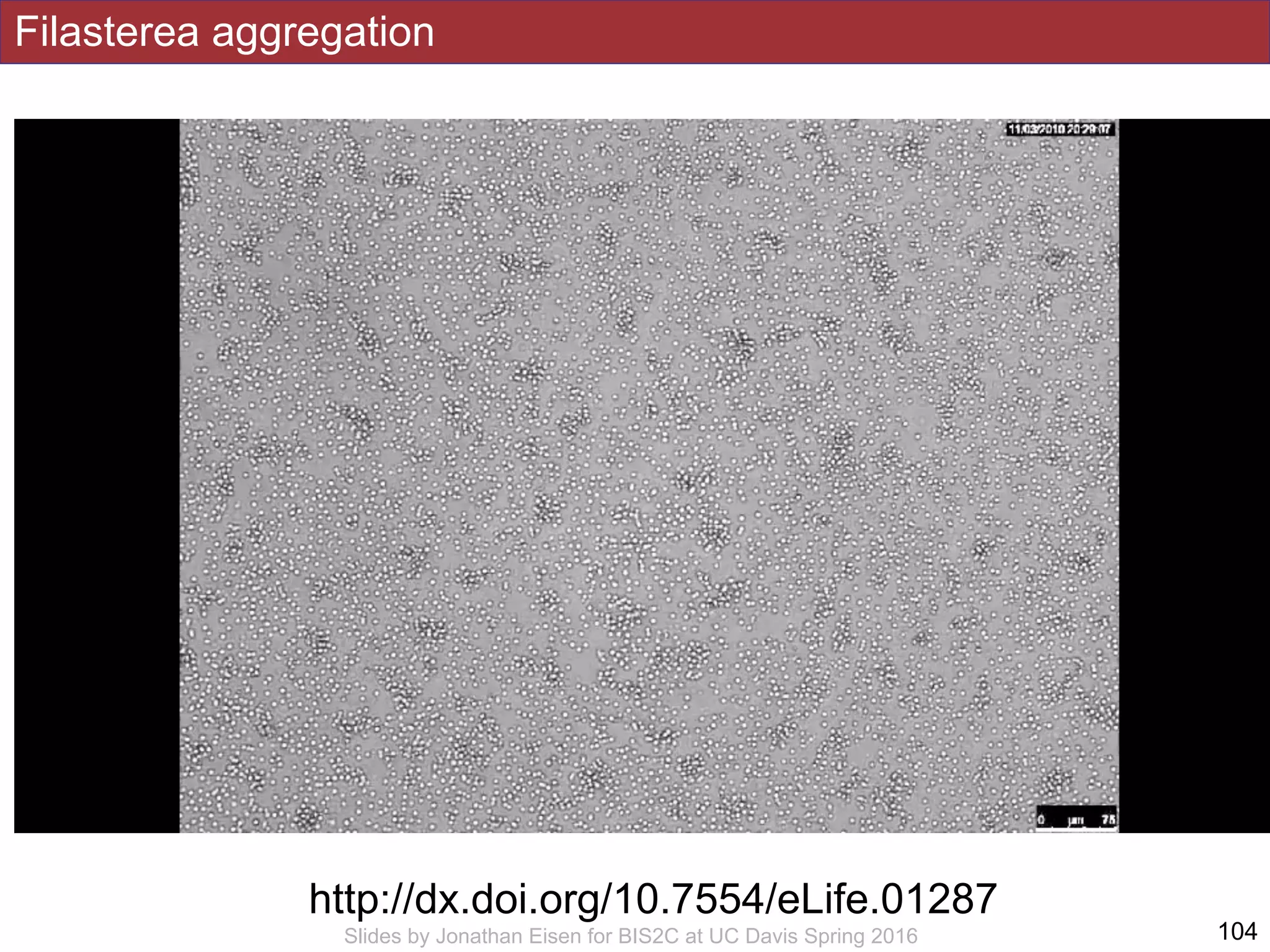
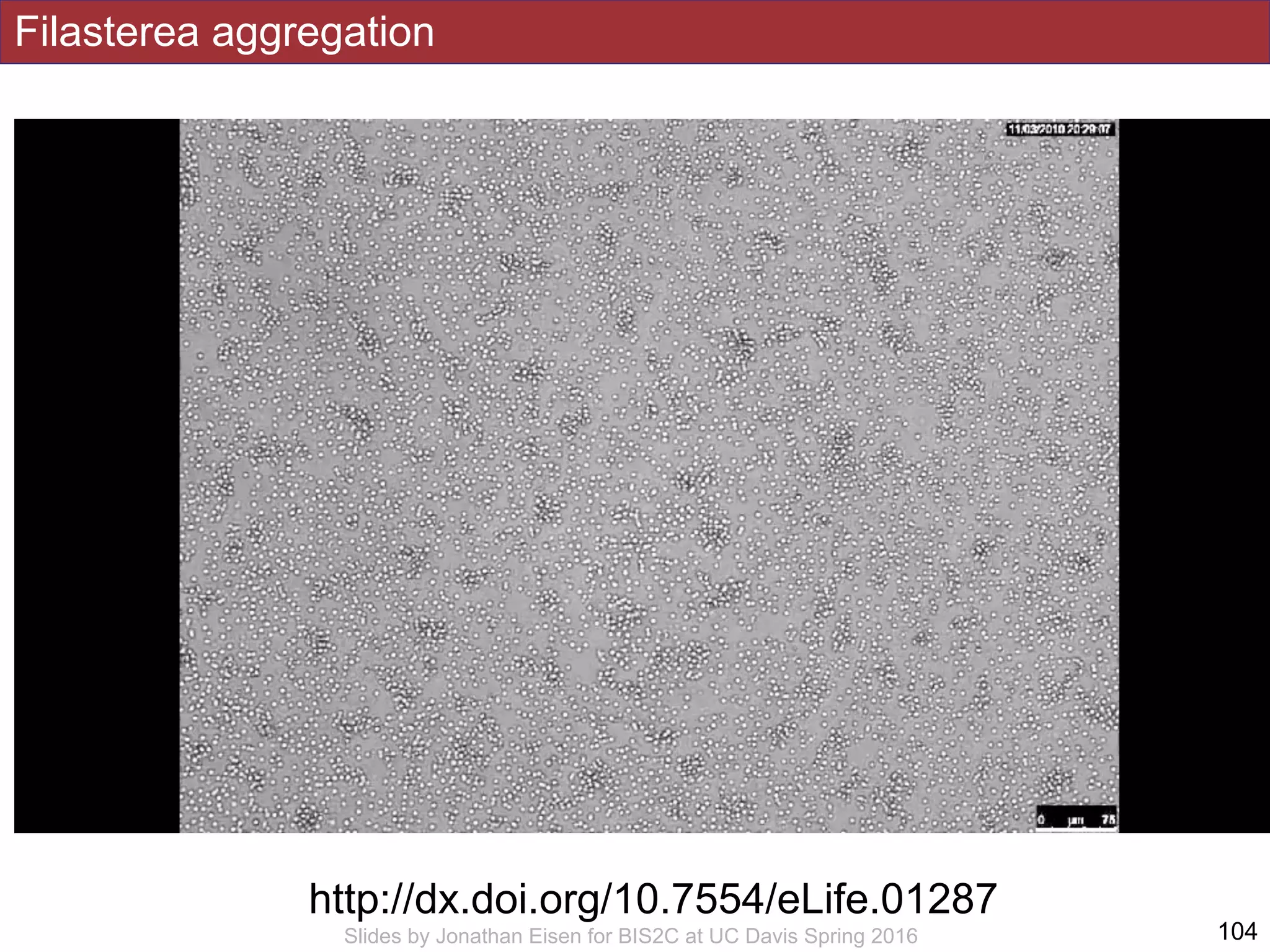
!104Slides by Jonathan Eisen for BIS2C at UC Davis Spring 2016
Filasterea aggregation
http://dx.doi.org/10.7554/eLife.01287
!104Slides by Jonathan Eisen for BIS2C at UC Davis Spring 2016
Filasterea aggregation
http://dx.doi.org/10.7554/eLife.01287
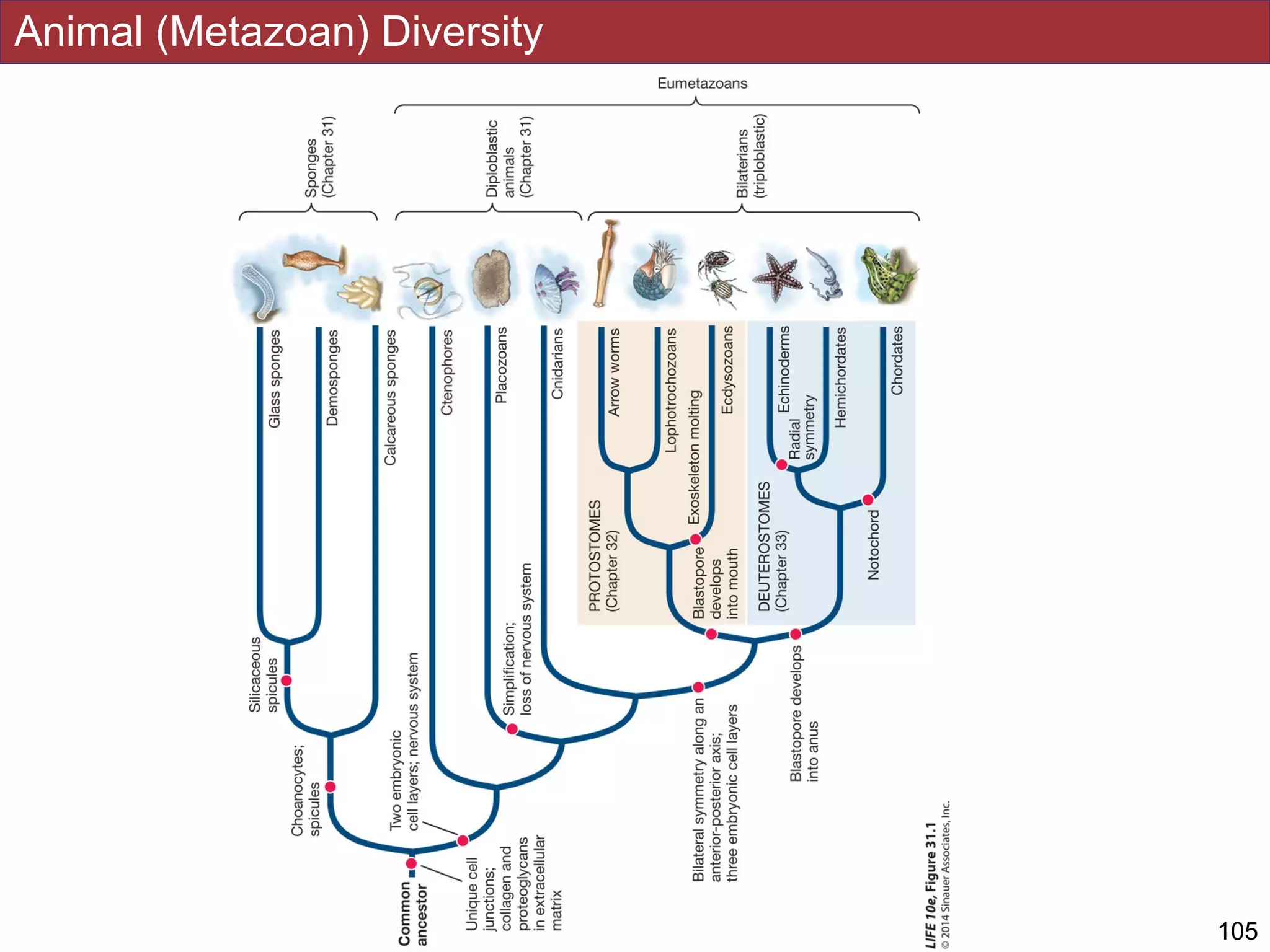
Animal (Metazoan) Diversity
!105Slides by Jonathan Eisen for BIS2C at UC Davis Spring 2016
Fungal Diversity
!106Slides by Jonathan Eisen for BIS2C at UC Davis Spring 2016
Microsporidia
Chytrids
Zygosporefungi
(Zygomycota)
Arbuscularmycorrhizalfungi
(Glomeromycota)
Sacfungi
(Ascomycota)
Clubfungi
(Basidiomycota)
Dikarya

BIS2C: Lecture 24: Opisthokonts

  • 1.
    Slides by JonathanEisen for BIS2C at UC Davis Spring 2016 Lecture 24: Introduction to Opisthokonts BIS 002C Biodiversity & the Tree of Life Spring 2016 Prof. Jonathan Eisen 1
  • 2.
    Slides by JonathanEisen for BIS2C at UC Davis Spring 2016 Where we are going and where we have been… 2 •Previous lecture: •23: Botanical Conservatory •Current Lecture: •24: Intro to Opisthokonts •Next Lecture: •25: Sponges
  • 3.
    Slides by JonathanEisen for BIS2C at UC Davis Spring 2016 Key Topics • Opisthokonts - major groups • Shared traits of opisthokonts • Derived traits of major opisthokont groups • Evolution of multicellularity • Choanoflagellates and their relevance to animals 3
  • 4.
    Slides by JonathanEisen for BIS2C at UC Davis Spring 2016 44 Eukaryote Diversity
  • 5.
    Slides by JonathanEisen for BIS2C at UC Davis Spring 2016 55 Opisthokonts
  • 6.
    Opisthokonts !6Slides by JonathanEisen for BIS2C at UC Davis Spring 2016 Opisthokonts Fungi Animals Choanoflagellates
  • 7.
    It is ALWAYSmore complicated … !7Slides by Jonathan Eisen for BIS2C at UC Davis Spring 2016 Opisthokonts Fungi Animals Choanoflagellates Ichthyosporea
  • 8.
    Ich !8Slides by JonathanEisen for BIS2C at UC Davis Spring 2016
  • 9.
    It is ALWAYSmore complicated … !9Slides by Jonathan Eisen for BIS2C at UC Davis Spring 2016 Opisthokonts Fungi Animals Choanoflagellates Filasterea Ichthyosporea
  • 10.
    Filasterea examples !10Slides byJonathan Eisen for BIS2C at UC Davis Spring 2016 Ministeria Capsaspora
  • 11.
    It’s Always MoreComplicated II !11Slides by Jonathan Eisen for BIS2C at UC Davis Spring 2016 Filasterea Ichthyosporea
  • 12.
  • 13.
    Opisthokonts !13Slides by JonathanEisen for BIS2C at UC Davis Spring 2016 Opisthokonts Fungi Animals Choanoflagellates
  • 14.
    Opisthokonts !14Slides by JonathanEisen for BIS2C at UC Davis Spring 2016 Opisthokonts Fungi Animals Choanoflagellates Shared derived traits of clade?
  • 15.
    Opisthokonts !15Slides by JonathanEisen for BIS2C at UC Davis Spring 2016 Opisthokonts Fungi Animals Choanoflagellates Flagellum, if presence, single and posterior, Greek: opísthios = "rear" + (kontós) = "pole"
  • 16.
    Opisthokonts !16Slides by JonathanEisen for BIS2C at UC Davis Spring 2016 Opisthokonts Fungi Animals Choanoflagellates Multiple other features Greek: opísthios = "rear" + (kontós) = "pole"
  • 17.
    Opisthokonts !17Slides by JonathanEisen for BIS2C at UC Davis Spring 2016 Opisthokonts Fungi Animals Choanoflagellates Why care about these?
  • 18.
    Anti fungal drugs !18Slidesby Jonathan Eisen for BIS2C at UC Davis Spring 2016 http://www.slideshare.net/drjankiborkar/antifungals-14155209
  • 19.
    !19Slides by JonathanEisen for BIS2C at UC Davis Spring 2016 The development of antifungal agents has lagged behind that of antibacterial agents. This is a predictable consequence of the cellular structure of the organisms involved. Bacteria are prokaryotic and hence offer numerous structural and metabolic targets that differ from those of the human host. Fungi, in contrast, are eukaryotes, and consequently most agents toxic to fungi are also toxic to the host. http://www.ncbi.nlm.nih.gov/books/NBK8263/
  • 20.
    Figure 30.2 Yeasts !20Slidesby Jonathan Eisen for BIS2C at UC Davis Spring 2016 Saccharomyces cerevisiae 5 µm
  • 21.
    Slides by JonathanEisen for BIS2C at UC Davis Spring 2016 Human Disease Genes w/ Yeast Homologs I 21 Defect in adenylcyclase regulation; osteodystrophy Ascorbic acid biosynthesis defect Biotin-responsive carboxylase deficiency; ataxia Lactic acidosis; neurodisorders Williams syndrome; brain development Lactic acidosis; "maple syrup" urine disease Homocystinuria; psychotic symptoms Mevalonicaciduria; variety of symptoms Mental retardation and keratocunjunctivis Tumor metastatic process Insulin resistance Hyperornithinemia; atrophy of choroid and retina Hyperammonemia in males Peroxisomal biogenesis disorder; neuropathy Hemolytic blood disorder (venous thrombosis) Glycogen storage disease; muscle cramps Myopathy Cholesterol esterification defects; cornea lipid deposits Acute intermittent porphyria Hyperglycinemia; intolerance to proteins Variegate porphyria; light sensitive dermatis Immunodeficiency; neurodisorders Lactic acidosis; death Lactic acidosis; ataxia Non spherocytic anemia Retinitis pigmentosa Peroxisomal biogenesis disorder Hypertension-associated gene Hyperoxaluria; urolithiase; nephrocalcinosis Hereditary spherocytosis Cerebral cholesterinosis Flavoprotein subunit defect; Leigh syndrome Mental retardation and ataxia Sucrose intolerance ABC transporters; immunodeficiency Vitamin E deficiency; ataxia Chronic hemolytic anemia and neuromuscular disorders Tyrosinemia Porphyria, cutanea tarda Porphyria, congenital erythropoietic Mental/psychomotor retardation DNA helicase; TFIIH complex;subunit; photosensitivity; cancer DNA helicase; TFIIH complex subunit; photosensitivity; cancer Structure specific endonuclease; photosensitivity; cancer Zinc finger damaged DNA binding protein; photosensitivity; cancer 125 kDa ssDNA binding protein; photosensitivity; cancer DNA helicase; transcription-coupled repair;progressive neurological dysfunction;photose WD-repeat protein; same phenotype as above Membrane Ser/Thr protein kinase ABC transporter; neurodegenerative disease Superoxide dismutase Phosphatidylinositol kinase-related protein Unknown function; cardioskeletal myopathy RecQ DNA helicase-related protein; growth defect; predisposition to all types of cancer Unknown function; "Beige" protein; decreased pigmentation; immunodeficiency Component A of RAB geranylgeranyltransferase ABC transporter; impaired clearance in a variety of organs Sulfate transporter; undersulfation of proteoglycans Kidney chloride channel; nephrolithiasis Dideadenosine tetraphosphate hydrolase; cancer Unknown function; neurodegenerative disease Hyperglycerolemia; poor growth; mental retardation Mismatch-repair ; hereditary nonpolyposis colon cancer Mismatch repair ; hereditary nonpolyposis colon cancer
  • 22.
    Slides by JonathanEisen for BIS2C at UC Davis Spring 2016 22 Subunit of platelet-activating factor acetylhydrolase Inositol polyphosphate 5 phosphatase-related protein; cataracts and glaucoma Copper-transporting ATPase; neurodegenerative disease and death Calcium channel; familial hemiplegic migraine and episodic ataxia Acetyltransferase; erythrophagocytosis Related to transmembrane receptors with a cytoplasmic tyrosine kinase domain Ser/thr protein kinase; neurodegenerative disease Probable tyrosine phosphatase; muscle specific disease Homologue of Drosophila patched; nevoid basal cell carcinoma syndrome GTPase-activating protein Fatal neurovisceral disorder Defect in development of multiple organ systems RCC1-related protein; progressive retinal degeneration Muscle chloride channel; myotonic disorders DNA helicase Q-related protein; premature aging and strong predisposition to cancer Zinc finger protein; nephroblastoma Copper transporting ATPase; toxic accumulation of copper in liver and brain Effector for CDC42H GTPase; immunodeficiency Metabolic acidosis Hemolytic blood disorder (venous thrombosis) Urolithiasis Immunodeficiency Peroxisomal biogenesis disorder; neuropathy Hemolytic anemia Hypermethioninemia; mental and motor retardation Purine nucleotide biosynthesis defect; autism features Delayed oxidation of acetaldehyde; acute alcohol intoxication Hepatic porphyria Spherocytic anemia Neonatal infantile chronic hyperammonemia Argininemia; severe psychomotor retardation Hypokalaemic alkalosis with hypercalciura Hyperammonemia Galactosialidosis Lipid metabolism defect; cardiomyopathy Acatalasia Coproporphyria; psychiatric symptoms Homocystinuria Lactic acidosis; "maple syrup" urine disease Protoporphyria, erythropoietic Fumaric aciduria; encephalopathy Hemolytic anemia Glycogen storage disease; familial cirrhosis Glycogen storage disease; hepatomegaly Lysosomal storage disease; cardiomyopathy; skeletal muscular hypotonia Hyperglycemia; diabetes Glutathionuria Hemolytic anemia Non ketotic hyperglycinemia; lethargy; severe mental retardation Glycogen storage disease; skeletal muscle weakness Human Disease Genes w/ Yeast Homologs II
  • 23.
    Slides by JonathanEisen for BIS2C at UC Davis Spring 2016 23 Nobel Prizes for Fungal Work
  • 24.
    Opisthokonts !24Slides by JonathanEisen for BIS2C at UC Davis Spring 2016 Opisthokonts Fungi Animals Choanoflagellates Derived Features of Fungi
  • 25.
    Opisthokonts !25Slides by JonathanEisen for BIS2C at UC Davis Spring 2016 Opisthokonts Fungi Animals Choanoflagellates Absorptive heterotrophy
  • 26.
    Clicker !26Slides by JonathanEisen for BIS2C at UC Davis Spring 2016
  • 27.
    Clicker Which of thefollowing best describes a heterotroph? A. Gets carbon from organic compounds B. Gets electrons from organic compounds C. Gets energy from organic compounds D. Gets carbon and electrons from organic compounds E. All of the above !27Slides by Jonathan Eisen for BIS2C at UC Davis Spring 2016
  • 28.
    Clicker Which of thefollowing best describes a heterotroph? A. Gets carbon from organic compounds B. Gets electrons from organic compounds C. Gets energy from organic compounds D. Gets carbon and electrons from organic compounds E. All of the above !28Slides by Jonathan Eisen for BIS2C at UC Davis Spring 2016
  • 29.
    Component Different Forms Energysource Light Photo Chemical Chemo Electron source (reducing equivalent) Inorganic Litho Organic Organo Carbon source Carbon from C1 compounds Auto Carbon from organics Hetero Forms of nutrition (trophy) • Three main components to “trophy” Slides by Jonathan Eisen for BIS2C at UC Davis Spring 2016
  • 30.
    Opisthokonts !30Slides by JonathanEisen for BIS2C at UC Davis Spring 2016 Opisthokonts Fungi Animals Choanoflagellates Absorptive heterotrophy
  • 31.
    Photo 30.3 Hardwoodlog being “recycled” by saprobic brown rot fungi; central Illinois. !31Slides by Jonathan Eisen for BIS2C at UC Davis Spring 2016
  • 32.
    Opisthokonts !32Slides by JonathanEisen for BIS2C at UC Davis Spring 2016 Opisthokonts Fungi Animals Choanoflagellates Absorptive heterotrophy; Chitin in cell walls
  • 33.
    Fungal Cell Walls !33Slidesby Jonathan Eisen for BIS2C at UC Davis Spring 2016
  • 34.
    Figure 30.10 APhylogeny of the Fungi !34Slides by Jonathan Eisen for BIS2C at UC Davis Spring 2016 Microsporidia Chytrids Zygosporefungi (Zygomycota) Arbuscularmycorrhizalfungi (Glomeromycota) Sacfungi (Ascomycota) Clubfungi (Basidiomycota) Dikarya
  • 35.
    Opisthokonts !35Slides by JonathanEisen for BIS2C at UC Davis Spring 2016 Opisthokonts Fungi Animals Choanoflagellates
  • 36.
    Animal Shared DerivedTraits !36Slides by Jonathan Eisen for BIS2C at UC Davis Spring 2016 Opisthokonts Fungi Animals Choanoflagellates • Internal digestion • Muscle & movement • Extracellular matrix molecules such as collagen • Unique cell junctions • Multicellularity
  • 37.
    Animal Shared DerivedTraits !37Slides by Jonathan Eisen for BIS2C at UC Davis Spring 2016 Opisthokonts Fungi Animals Choanoflagellates • Internal digestion • Muscle & movement • Extracellular matrix molecules such as collagen • Unique cell junctions • Multicellularity • More on this starting Friday
  • 38.
    Opisthokonts !38Slides by JonathanEisen for BIS2C at UC Davis Spring 2016 Opisthokonts Fungi Animals Choanoflagellates Choanoflagellate & Animal Derived Traits
  • 39.
    Opisthokonts !39Slides by JonathanEisen for BIS2C at UC Davis Spring 2016 Opisthokonts Fungi Animals Choanoflagellates Why Care About These?
  • 40.
    Opisthokonts !40Slides by JonathanEisen for BIS2C at UC Davis Spring 2016 Opisthokonts Fungi Animals Choanoflagellates Multicellularity Origins?
  • 41.
    Slides by JonathanEisen for BIS2C at UC Davis Spring 2016 Multicellularity vs. Colonial Aggregates • Multicellular: having many cells of the same genotype, in which there is some level of morphological differentiation and division of labour among cell types • Colonial: aggregates of morphologically identical cells of the same genotype • There is a continuum of loosely integrated colonies to fully integrated multicellular organisms. 41
  • 42.
    Opisthokonts !42Slides by JonathanEisen for BIS2C at UC Davis Spring 2016 Opisthokonts Fungi Animals Choanoflagellates Multicellularity Origins? M M
  • 43.
    Slides by JonathanEisen for BIS2C at UC Davis Spring 2016 4343 Opisthokont Multicellularity
  • 44.
    Slides by JonathanEisen for BIS2C at UC Davis Spring 2016 4444 Opisthokont Multicellularity
  • 45.
    Figure 28.3 RedAlgae !45Slides by Jonathan Eisen for BIS2C at UC Davis Spring 2016
  • 46.
    Slides by JonathanEisen for BIS2C at UC Davis Spring 2016 4646 Red Algal Multicellularity
  • 47.
    Figure 28.4 Chlorophytes !47Slidesby Jonathan Eisen for BIS2C at UC Davis Spring 2016
  • 48.
    Slides by JonathanEisen for BIS2C at UC Davis Spring 2016 4848 Chlorophyte Multicellularity
  • 49.
    Figure 28.5 Charophytes !49Slidesby Jonathan Eisen for BIS2C at UC Davis Spring 2016
  • 50.
    Slides by JonathanEisen for BIS2C at UC Davis Spring 2016 5050 Charophyte Multicellularity
  • 51.
    Land Plants !51Slides byJonathan Eisen for BIS2C at UC Davis Spring 2016
  • 52.
    Slides by JonathanEisen for BIS2C at UC Davis Spring 2016 5252 Land Plant Multicellularity
  • 53.
    Figure 27.9 BrownAlgae !53Slides by Jonathan Eisen for BIS2C at UC Davis Spring 2016
  • 54.
    Slides by JonathanEisen for BIS2C at UC Davis Spring 2016 5454 Brown Algal Multicellularity
  • 55.
    Figure 27.17 APlasmodial Slime Mold !55Slides by Jonathan Eisen for BIS2C at UC Davis Spring 2016
  • 56.
    Slides by JonathanEisen for BIS2C at UC Davis Spring 2016 5656 Plasmodial Slime Mold Multicellularity
  • 57.
    Figure 27.18 ACellular Slime Mold !57Slides by Jonathan Eisen for BIS2C at UC Davis Spring 2016
  • 58.
    Slides by JonathanEisen for BIS2C at UC Davis Spring 2016 5858 Cellular Slime Mold Multicellularity
  • 59.
    Slides by JonathanEisen for BIS2C at UC Davis Spring 2016 5959 Convergent Evolution of Multicellularity
  • 60.
    Slides by JonathanEisen for BIS2C at UC Davis Spring 2016 Clicker 60
  • 61.
    Slides by JonathanEisen for BIS2C at UC Davis Spring 2016 Clicker • The multiple origins of multicellularity is a form of • A. Homology • B. Heteroplasy • C. Synapomorphy • D. Homoplasy • E. Homospory 61
  • 62.
    Slides by JonathanEisen for BIS2C at UC Davis Spring 2016 Clicker • The multiple origins of multicellularity is a form of • A. Homology • B. Heteroplasy • C. Synapomorphy • D. Homoplasy • E. Homospory 62
  • 63.
    Slides by JonathanEisen for BIS2C at UC Davis Spring 2016 History has often repeated itself: Multicellular organisms independently originated at least 25 times from unicellular ancestors 63
  • 64.
    Animal Multicellularity !64Slides byJonathan Eisen for BIS2C at UC Davis Spring 2016 Opisthokonts Fungi Animals Choanoflagellates Key Point in Studying Animal Multicellularity & Biology M
  • 65.
    Choanoflagellates !65Slides by JonathanEisen for BIS2C at UC Davis Spring 2016 Opisthokonts Fungi Animals Choanoflagellates M
  • 66.
    Choanoflagellates !66Slides by JonathanEisen for BIS2C at UC Davis Spring 2016 Opisthokonts Fungi Animals Choanoflagellates M From Greek Khoanē = “funnel" (i.e collar) And Latin “flagellum" (i.e. , the flagella)
  • 67.
    Figure 31.2 Choanoflagellate !67Slidesby Jonathan Eisen for BIS2C at UC Davis Spring 2016 Choanoflagellate protists Stalk Flagellum Single cell
  • 68.
    !68Slides by JonathanEisen for BIS2C at UC Davis Spring 2016 http://www.nytimes.com/2010/12/14/science/14creatures.html?_r=0
  • 69.
    !69Slides by JonathanEisen for BIS2C at UC Davis Spring 2016
  • 70.
    Figure 31.2 Choanocytesin Sponges Resemble Choanoflagellate Protists (Part 1) !70Slides by Jonathan Eisen for BIS2C at UC Davis Spring 2016 Choanoflagellate protists Stalk Flagellum Single cell
  • 71.
    S. rosetta captureand phagocytosis !71Slides by Jonathan Eisen for BIS2C at UC Davis Spring 2016 DIC timelapse movie of S. rosetta thecate cell showing capture and phagocytosis of bacteria. http://journals.plos.org/plosone/article?id=10.1371/journal.pone.0095577
  • 72.
    S. rosetta captureand phagocytosis !71Slides by Jonathan Eisen for BIS2C at UC Davis Spring 2016 DIC timelapse movie of S. rosetta thecate cell showing capture and phagocytosis of bacteria. http://journals.plos.org/plosone/article?id=10.1371/journal.pone.0095577
  • 73.
    !72Slides by JonathanEisen for BIS2C at UC Davis Spring 2016 Timelapse movie of S. rosetta thecate cell showing egestion of material, transported from the food vacuole to the inside base of the collar, exiting the cell between the collar and flagellum, and carried away by the current. http://journals.plos.org/plosone/article?id=10.1371/journal.pone.0095577 S. rosetta egestion
  • 74.
    !72Slides by JonathanEisen for BIS2C at UC Davis Spring 2016 Timelapse movie of S. rosetta thecate cell showing egestion of material, transported from the food vacuole to the inside base of the collar, exiting the cell between the collar and flagellum, and carried away by the current. http://journals.plos.org/plosone/article?id=10.1371/journal.pone.0095577 S. rosetta egestion
  • 75.
    !73Slides by JonathanEisen for BIS2C at UC Davis Spring 2016 http://journals.plos.org/plosone/article?id=10.1371/journal.pone.0095577 Phase microscopy timelapse movie showing the arrival of an S. rosetta thecate cell and subsequent accumulation of bacteria on coverslip surface in the region surrounding the cell. S. rosetta collecting food …
  • 76.
    !73Slides by JonathanEisen for BIS2C at UC Davis Spring 2016 http://journals.plos.org/plosone/article?id=10.1371/journal.pone.0095577 Phase microscopy timelapse movie showing the arrival of an S. rosetta thecate cell and subsequent accumulation of bacteria on coverslip surface in the region surrounding the cell. S. rosetta collecting food …
  • 77.
    Sponges !74Slides by JonathanEisen for BIS2C at UC Davis Spring 2016 Sponges Bilaterians (protostomes and deuterostomes) Ctenophores Cnidarians Placozoans
  • 78.
    Figure 31.15 SpongeDiversity !75Slides by Jonathan Eisen for BIS2C at UC Davis Spring 2016 Euplectella aspergillum Xestospongia testudinaria Spicules Sycon sp.
  • 79.
    Figure 31.2 Choanocytesin Sponges !76Slides by Jonathan Eisen for BIS2C at UC Davis Spring 2016 Choanocyte Pore Osculum Water out via osculum Atrium Spicule Water and food particles in via pores Spicules Flagellum
  • 80.
    !77 Figure 31.2 Choanocytesin Sponges Resemble Choanoflagellate Protists Slides by Jonathan Eisen for BIS2C at UC Davis Spring 2016
  • 81.
    !78Slides by JonathanEisen for BIS2C at UC Davis Spring 2016 http://www.nytimes.com/2010/12/14/science/14creatures.html?_r=0
  • 82.
    Animal Multicellularity !79Slides byJonathan Eisen for BIS2C at UC Davis Spring 2016 Opisthokonts Fungi Animals Choanoflagellates Colonial M Flagellum Collar
  • 83.
    Choanoflagellate aggregation !80Slides byJonathan Eisen for BIS2C at UC Davis Spring 2016 Nicole King, Professor, UC Berkeley HHMI Professor MacArthur “Genius” Prize Winner
  • 84.
    Many morphologies incultures !81Slides by Jonathan Eisen for BIS2C at UC Davis Spring 2016 Fig. 1. Five distinct cell morphologies observed in S. rosetta cultures. (A) Cells in rosette colonies orient in a sphere around a central focus, with their apical flagella and collars oriented radially outward. (B) Cells in chain colonies attach to one another laterally to form linear arrays of cells. (C,D) Thecate cells have long (~ 4 µm) collars surrounding apical flagella and attach to substrates via a goblet-shaped theca. (E,F) Slow swimmers have similar morphology to thecate cells, but lack thecae. (G,H) Fast swimmers have no theca and either no collar or a truncated collar (arrowheads), and are often covered in small filopodia . Key: f: flagellum, C: collar, T: theca, S: skirt, Fp: filopodia, B: bacteria. Scale bars = 5 µm. (A,B,C,E,G: DIC microscopy, D,F,H: Scanning Electron Microscopy).
  • 85.
    Life history ofa model Choanoflagellate Salpingoeca rosetta !82Slides by Jonathan Eisen for BIS2C at UC Davis Spring 2016 http://www.sciencedirect.com/science/article/pii/S0012160611009924
  • 86.
    Life history ofa model Choanoflagellate Salpingoeca rosetta !83Slides by Jonathan Eisen for BIS2C at UC Davis Spring 2016 http://www.sciencedirect.com/science/article/pii/S0012160611009924
  • 87.
    !84Slides by JonathanEisen for BIS2C at UC Davis Spring 2016 Timelapse microscopy of a fast swimmer building a new theca. Although fast swimmers normally attach to environmental substrates, an unusual case of attachment to an empty theca is presented here because the added elevation from the substrate affords a better view of the attachment process. A fast swimmer uses long filopodia to attach to an empty theca. Those filopodia in contact with the empty theca become more refractile and coalesce to form the base of a new stalk projecting from the base of the cell. The coalesced filopodia form a highly refractile stalk which extends from the cell base. The refractile material is replaced by a stable stalk, after which the cell becomes more spherical and secretes the theca cup from its sides, leaving a ~ 1 µm gap between the theca and cell base. doi:10.1016/j.ydbio.2011.06.003
  • 88.
    !84Slides by JonathanEisen for BIS2C at UC Davis Spring 2016 Timelapse microscopy of a fast swimmer building a new theca. Although fast swimmers normally attach to environmental substrates, an unusual case of attachment to an empty theca is presented here because the added elevation from the substrate affords a better view of the attachment process. A fast swimmer uses long filopodia to attach to an empty theca. Those filopodia in contact with the empty theca become more refractile and coalesce to form the base of a new stalk projecting from the base of the cell. The coalesced filopodia form a highly refractile stalk which extends from the cell base. The refractile material is replaced by a stable stalk, after which the cell becomes more spherical and secretes the theca cup from its sides, leaving a ~ 1 µm gap between the theca and cell base. doi:10.1016/j.ydbio.2011.06.003
  • 89.
    !85Slides by JonathanEisen for BIS2C at UC Davis Spring 2016 Top view of two fast swimmers attaching to substrate. Cells attach via long filopodia, and move several microns across substrates before building thecae.
  • 90.
    !85Slides by JonathanEisen for BIS2C at UC Davis Spring 2016 Top view of two fast swimmers attaching to substrate. Cells attach via long filopodia, and move several microns across substrates before building thecae.
  • 91.
    Life history ofa model Choanoflagellate Salpingoeca rosetta !86Slides by Jonathan Eisen for BIS2C at UC Davis Spring 2016 http://www.sciencedirect.com/science/article/pii/S0012160611009924
  • 92.
    !87Slides by JonathanEisen for BIS2C at UC Davis Spring 2016 Timecourse of three cells releasing from their thecae. As cells begin to leave thecae, multiple filopodia extend from sides of cell maintaining contact with edge of theca cup (clearest in middle cell at 1:02:10–1:30:00, and left cell at 1:01:30). Change in angle of filopodia as it releases from theca in left cell (from 01:01:20 to 01:01:30) shows that these are filopodia and not retraction fibers. As cells release, collar retracts (clearest in right cell at 0:12:30). Times shown in Hours:Minutes:Seconds
  • 93.
    !87Slides by JonathanEisen for BIS2C at UC Davis Spring 2016 Timecourse of three cells releasing from their thecae. As cells begin to leave thecae, multiple filopodia extend from sides of cell maintaining contact with edge of theca cup (clearest in middle cell at 1:02:10–1:30:00, and left cell at 1:01:30). Change in angle of filopodia as it releases from theca in left cell (from 01:01:20 to 01:01:30) shows that these are filopodia and not retraction fibers. As cells release, collar retracts (clearest in right cell at 0:12:30). Times shown in Hours:Minutes:Seconds
  • 94.
    !88Slides by JonathanEisen for BIS2C at UC Davis Spring 2016 Thecate cell division showing that one daughter cell leaves while the other remains in the theca.
  • 95.
    !88Slides by JonathanEisen for BIS2C at UC Davis Spring 2016 Thecate cell division showing that one daughter cell leaves while the other remains in the theca.
  • 96.
    Life history ofa model Choanoflagellate Salpingoeca rosetta !89Slides by Jonathan Eisen for BIS2C at UC Davis Spring 2016 http://www.sciencedirect.com/science/article/pii/S0012160611009924
  • 97.
    !90Slides by JonathanEisen for BIS2C at UC Davis Spring 2016 Tilt series through an intercellular bridge shows that the cell membrane is continuous across the bridge.
  • 98.
    !90Slides by JonathanEisen for BIS2C at UC Davis Spring 2016 Tilt series through an intercellular bridge shows that the cell membrane is continuous across the bridge.
  • 99.
    !91Slides by JonathanEisen for BIS2C at UC Davis Spring 2016Rosette colony ejects minute cells that adhere to the coverslip.
  • 100.
    !91Slides by JonathanEisen for BIS2C at UC Davis Spring 2016Rosette colony ejects minute cells that adhere to the coverslip.
  • 101.
    !92Slides by JonathanEisen for BIS2C at UC Davis Spring 2016 S. rosetta rosette colonies reproduce by fission
  • 102.
    !92Slides by JonathanEisen for BIS2C at UC Davis Spring 2016 S. rosetta rosette colonies reproduce by fission
  • 103.
    Life history ofa model Choanoflagellate Salpingoeca rosetta !93Slides by Jonathan Eisen for BIS2C at UC Davis Spring 2016 A model of S. rosetta life history. S. rosetta cells can differentiate between at least five different forms. Arrows depict observed and inferred transitions that are described in the main text and in Fig. S9. Fast swimmers can settle to produce thecate cells that then produce swimming cells either through cell division or theca abandonment. Under rapid growth conditions, slow swimmer cells proliferate but remain attached via intercellular bridges and ECM to produce chain colonies, or, in the presence of A. machipongonensis bacteria (denoted by ‘⁎’), rosette colonies that have intercellular bridges, ECM and filopodia. caption http://www.sciencedirect.com/science/article/pii/S0012160611009924
  • 104.
    Choanoflagellate Genome !94Slides byJonathan Eisen for BIS2C at UC Davis Spring 2016 Nicole King Dan Rokhsar
  • 105.
    Choanoflagellate Genome !95Slides byJonathan Eisen for BIS2C at UC Davis Spring 2016
  • 106.
    Animal Multicellularity !96Slides byJonathan Eisen for BIS2C at UC Davis Spring 2016 Opisthokonts Fungi Animals Choanoflagellates • Colonial • Single flagellum • Collar • Cell adhesion M
  • 107.
    !97Slides by JonathanEisen for BIS2C at UC Davis Spring 2016
  • 108.
    Nicole King !98Slides byJonathan Eisen for BIS2C at UC Davis Spring 2016
  • 109.
    !99Slides by JonathanEisen for BIS2C at UC Davis Spring 2016 http://www.ibiology.org/ibioseminars/nicole-king-part-1.html http://www.ibiology.org/ibioseminars/nicole-king-part-2.html
  • 110.
    Slides by JonathanEisen for BIS2C at UC Davis Spring 2016 Single cell -> aggregation -> multicellular 100
  • 111.
    It is ALWAYSmore complicated … !101Slides by Jonathan Eisen for BIS2C at UC Davis Spring 2016 Opisthokonts Fungi Animals Choanoflagellates Filasterea Ichthyosporea
  • 112.
    Filasterea also colonial !102Slidesby Jonathan Eisen for BIS2C at UC Davis Spring 2016 http://dx.doi.org/10.7554/eLife.01287
  • 113.
    Filasterea also colonial !102Slidesby Jonathan Eisen for BIS2C at UC Davis Spring 2016 http://dx.doi.org/10.7554/eLife.01287
  • 114.
    Filasterea aggregation !103Slides byJonathan Eisen for BIS2C at UC Davis Spring 2016 http://dx.doi.org/10.7554/eLife.01287
  • 115.
    Filasterea aggregation !103Slides byJonathan Eisen for BIS2C at UC Davis Spring 2016 http://dx.doi.org/10.7554/eLife.01287
  • 116.
    !104Slides by JonathanEisen for BIS2C at UC Davis Spring 2016 Filasterea aggregation http://dx.doi.org/10.7554/eLife.01287
  • 117.
    !104Slides by JonathanEisen for BIS2C at UC Davis Spring 2016 Filasterea aggregation http://dx.doi.org/10.7554/eLife.01287
  • 118.
    Animal (Metazoan) Diversity !105Slidesby Jonathan Eisen for BIS2C at UC Davis Spring 2016
  • 119.
    Fungal Diversity !106Slides byJonathan Eisen for BIS2C at UC Davis Spring 2016 Microsporidia Chytrids Zygosporefungi (Zygomycota) Arbuscularmycorrhizalfungi (Glomeromycota) Sacfungi (Ascomycota) Clubfungi (Basidiomycota) Dikarya