FIRE RESISTANT DESIGN
AND CONSTRUCTION
DIRECTORATE OF MAHARASHTRA FIRE SERVICE
Sustainable Development
¨ All buildings shall be planned,
designed, constructed and maintained
to ensure fire & life safety of the
occupants and this shall be achieved
by implementing provisions mentioned
in Part 4 i.e. Fire & Life Safety of
National Building Code India, amended
from time to time.
Safe Built Environment
Built around the philosophy of creating and
maintaining Safe Built Environment for
People and Property by ensuring:
§ Structural Safety
§ Health Safety
§ Fire Safety
§ Construction Safety
§ Electric Safety
§ Environment Safety
§ Life Safety
§ Public Safety
Revision of NBC, Part 4
¨ Part 4 of the National Building Code
deals with safety from fire and
explosion. It specifies classification of
buildings and the necessary
requirements to minimize danger to
life from fire, smoke and fumes or
panic before the building or area is
evacuated.
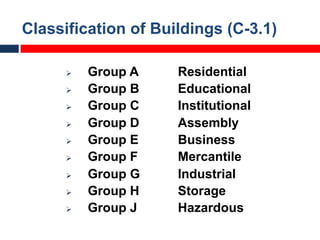
Classification of Buildings (C-3.1)
Ø Group A Residential
Ø Group B Educational
Ø Group C Institutional
Ø Group D Assembly
Ø Group E Business
Ø Group F Mercantile
Ø Group G Industrial
Ø Group H Storage
Ø Group J Hazardous
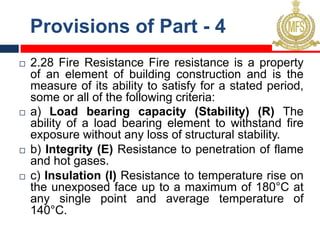
Provisions of Part - 4
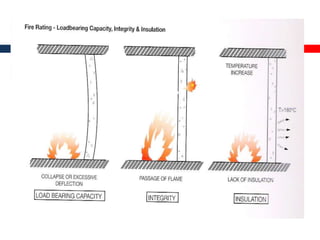
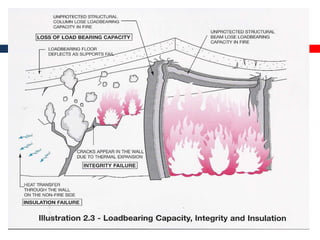
¨ 2.28 Fire Resistance Fire resistance is a property
of an element of building construction and is the
measure of its ability to satisfy for a stated period,
some or all of the following criteria:
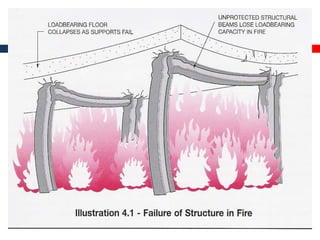
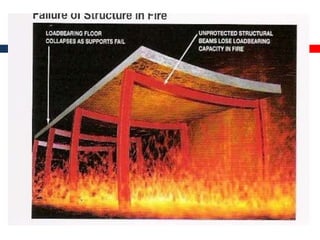
¨ a) Load bearing capacity (Stability) (R) The
ability of a load bearing element to withstand fire
exposure without any loss of structural stability.
¨ b) Integrity (E) Resistance to penetration of flame
and hot gases.
¨ c) Insulation (I) Resistance to temperature rise on
the unexposed face up to a maximum of 180°C at
any single point and average temperature of
140°C.
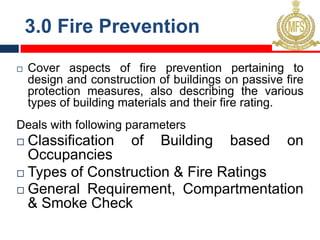
3.0 Fire Prevention
¨ Cover aspects of fire prevention pertaining to
design and construction of buildings on passive fire
protection measures, also describing the various
types of building materials and their fire rating.
Deals with following parameters
¨ Classification of Building based on
Occupancies
¨ Types of Construction & Fire Ratings
¨ General Requirement, Compartmentation
& Smoke Check
3.3. Types of Construction
¨ The major factors that one needs to keep in
mind is the material used for construction are:
¨ Fire resistant?
¨ Prevent spread of fire or smoke or fumes?
¨ Fire Load ?
¨ Structural Stability? And on basis of that types
of construction (especially with fire resistance)
is classified into Four categories.
3.3.1. Type of Construction
¨ Type 1
¨ Type 2
¨ Type 3
¨ Type 4 and all these talks about the fire will be
resistant for how much hour
¨ 4 hrs, 3 hrs, 2 hrs 1 hrs………..
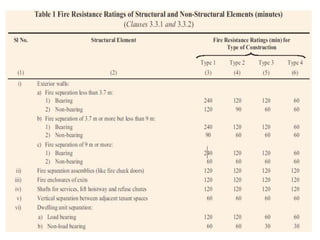
¨ Construction of Type 3 & 4 is not permitted for
Industrial, Storage and Hazard Occupancy.
¨ Ref: Table 1 and Annex C (Table 10 to 26)
Fire Resistance Materials
¨ The design of any building and the type of
materials used in its construction are important
factors in making the building resistant to a
complete burn-out and in preventing the rapid
spread of fire, smoke or fumes.
¨ The fire resistance of a building or its structural
and non-structural elements is expressed in
hours against a specified fire load which is
expressed in kcal/m2, and against a certain
intensity of fire.
Other Parameters
¨ Include:
¨ Openings in Separating Walls and Floors –
Horizontal / Vertical
¨ Electrical Installations
¨ Air-conditioning and Ventilation
¨ Smoke Venting
¨ Heating
¨ Surface Interior Finishes
¨ Glazing
¨ Glass Facade
Glass façade & Glazing
¨ The glazing shall be in accordance with Part 6 -
Structural Design, Section 8 Glass and Glazing of
the Code. The entire glazing assembly shall be rated
to that type of construction as given in Table 1
¨ Glass facade shall be in accordance with the following:
¨ a) For fully sprinklered buildings having fire separation of 9 m
or more, tempered glass in a non-combustible assembly, with
ability to hold the glass in place, shall be provided. It shall be
ensured that sprinklers are located within 600 mm of the
glass facade providing full coverage to the glass
¨ (in details ref Clause 3.4.10 of Part 4)
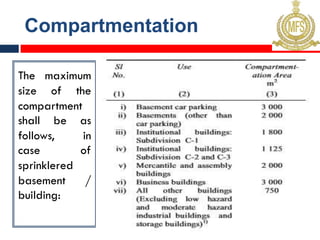
Compartmentation
The maximum
size of the
compartment
shall be as
follows, in
case of
sprinklered
basement /
building:
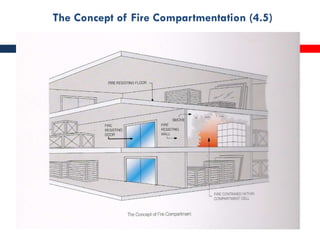
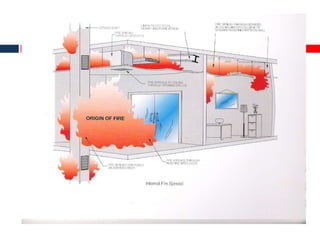
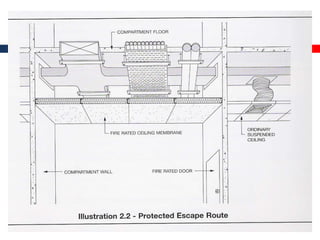
The Concept of Fire Compartmentation (4.5)
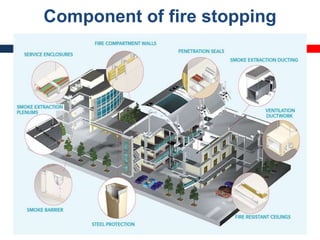
Component of fire stopping
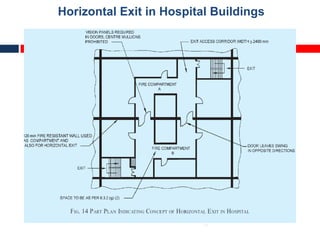
Horizontal Exit in Hospital Buildings
19
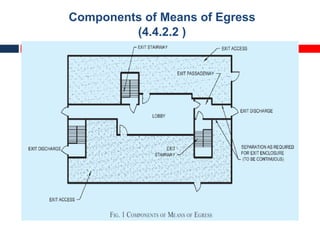
Components of Means of Egress
(4.4.2.2 )
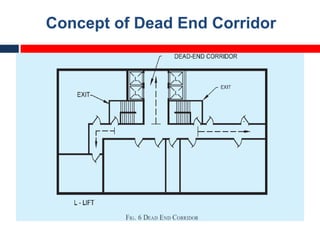
Concept of Dead End Corridor
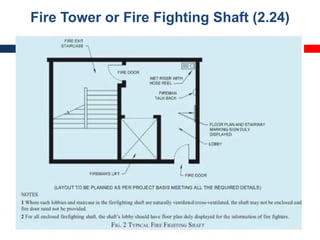
Fire Tower or Fire Fighting Shaft (2.24)
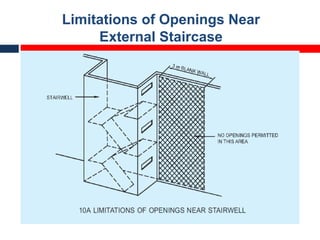
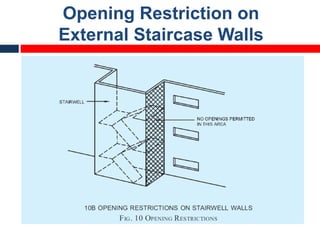
Limitations of Openings Near
External Staircase
Opening Restriction on
External Staircase Walls
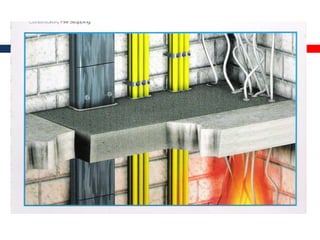
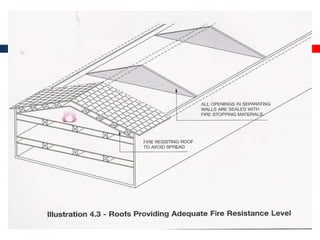
FIRE STOPPING
¨ Openings in walls or floors which are provided
for the passage of all building services like
cables, electrical wiring and telephone cables
etc., shall be protected by enclosures in the form
of ducts/shafts with a fire resistance of not less
than 2 hours.
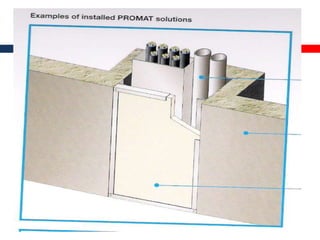
¨ Fire rated barriers/fire stopping systems will
provide the required solution. The system
installed shall be such that the normal
functioning of the services penetrating the
compartment shall not be affected.
FIRE STOPPING
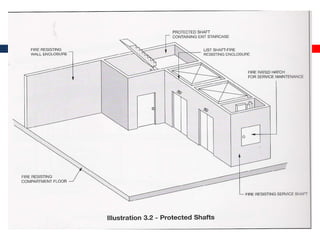
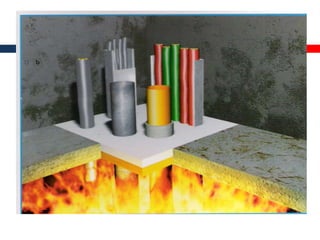
¨ The shafts across the floors to carry services
through floor levels can result in fire and smoke
spread to other floors. The shafts shall be
protected at every floor and wall penetration with
fire tested fire stopping systems.
Any opening with in the shaft wall or floors
through which pass electrical conduits should
also be sealed to have a fire resistance of not
less than 1 hour.
¨ b
Refuge Area (E-4)
For buildings more than 24 m in height, refuge area of
15 m2 or an area equivalent to 0.3 m2 per person to
accommodate the occupants of two consecutive floors,
whichever is higher, shall be provided as under:
The refuge area shall be provided on the periphery of
the floor or preferably on a cantilever projection and
open to air at least on one side protected with suitable
railings.
For Floors Above 24 m and Up to 39 m – One refuge
area on the floor immediately above 24 m.
For Floors Above 39 m – One refuge area on the floor
immediately above 39 m and so on after every 15 m.
Refuge area provided in excess of the requirements
shall be counted towards FAR.
32
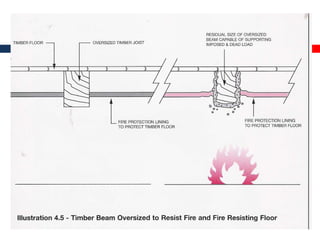
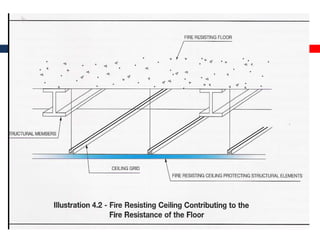
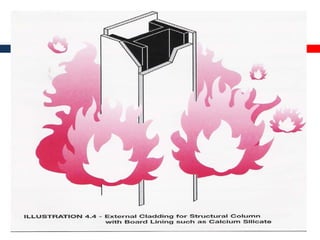
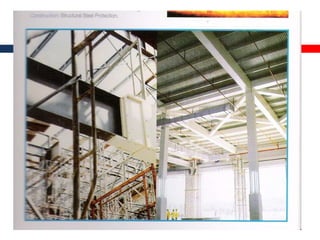
Steel Protection
by
application of fire resistant
cladding
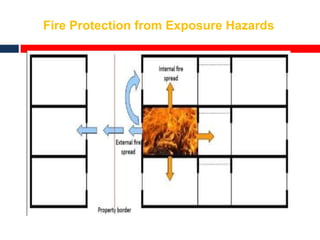
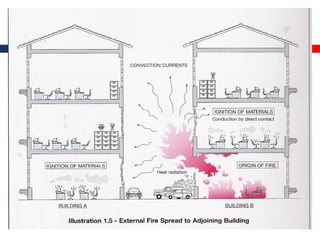
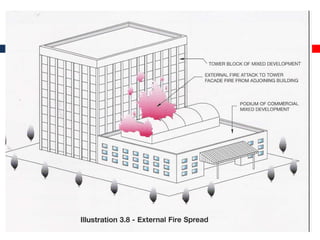
Fire Protection from Exposure Hazards
Conclusion
¨ The Fire Prevention & Protection focus is
shifting from Active to Passive Fire Protection.
¨ The emphasis is to minimized the possibility of
outbreak of fire and to limit the spread of fire
and the products of combustion.
¨ The implementation will cause some initial
investment for the owners but in long term this
will be very useful tool for fire protection which
will help to save precious lives and to
safeguard national property.
¨ Fire Prevention is Better Then Cure
Thank you
Please visit
www.mahafireservice.gov.in
WE SERVE TO SAVE

BIS Fire Resistant Design 27.06.2022_compressed.pdf

  • 1.
    FIRE RESISTANT DESIGN ANDCONSTRUCTION DIRECTORATE OF MAHARASHTRA FIRE SERVICE
  • 2.
    Sustainable Development ¨ Allbuildings shall be planned, designed, constructed and maintained to ensure fire & life safety of the occupants and this shall be achieved by implementing provisions mentioned in Part 4 i.e. Fire & Life Safety of National Building Code India, amended from time to time.
  • 3.
    Safe Built Environment Builtaround the philosophy of creating and maintaining Safe Built Environment for People and Property by ensuring: § Structural Safety § Health Safety § Fire Safety § Construction Safety § Electric Safety § Environment Safety § Life Safety § Public Safety
  • 4.
    Revision of NBC,Part 4 ¨ Part 4 of the National Building Code deals with safety from fire and explosion. It specifies classification of buildings and the necessary requirements to minimize danger to life from fire, smoke and fumes or panic before the building or area is evacuated.
  • 5.
    Classification of Buildings(C-3.1) Ø Group A Residential Ø Group B Educational Ø Group C Institutional Ø Group D Assembly Ø Group E Business Ø Group F Mercantile Ø Group G Industrial Ø Group H Storage Ø Group J Hazardous
  • 6.
    Provisions of Part- 4 ¨ 2.28 Fire Resistance Fire resistance is a property of an element of building construction and is the measure of its ability to satisfy for a stated period, some or all of the following criteria: ¨ a) Load bearing capacity (Stability) (R) The ability of a load bearing element to withstand fire exposure without any loss of structural stability. ¨ b) Integrity (E) Resistance to penetration of flame and hot gases. ¨ c) Insulation (I) Resistance to temperature rise on the unexposed face up to a maximum of 180°C at any single point and average temperature of 140°C.
  • 8.
    3.0 Fire Prevention ¨Cover aspects of fire prevention pertaining to design and construction of buildings on passive fire protection measures, also describing the various types of building materials and their fire rating. Deals with following parameters ¨ Classification of Building based on Occupancies ¨ Types of Construction & Fire Ratings ¨ General Requirement, Compartmentation & Smoke Check
  • 9.
    3.3. Types ofConstruction ¨ The major factors that one needs to keep in mind is the material used for construction are: ¨ Fire resistant? ¨ Prevent spread of fire or smoke or fumes? ¨ Fire Load ? ¨ Structural Stability? And on basis of that types of construction (especially with fire resistance) is classified into Four categories.
  • 10.
    3.3.1. Type ofConstruction ¨ Type 1 ¨ Type 2 ¨ Type 3 ¨ Type 4 and all these talks about the fire will be resistant for how much hour ¨ 4 hrs, 3 hrs, 2 hrs 1 hrs……….. ¨ Construction of Type 3 & 4 is not permitted for Industrial, Storage and Hazard Occupancy. ¨ Ref: Table 1 and Annex C (Table 10 to 26)
  • 12.
    Fire Resistance Materials ¨The design of any building and the type of materials used in its construction are important factors in making the building resistant to a complete burn-out and in preventing the rapid spread of fire, smoke or fumes. ¨ The fire resistance of a building or its structural and non-structural elements is expressed in hours against a specified fire load which is expressed in kcal/m2, and against a certain intensity of fire.
  • 13.
    Other Parameters ¨ Include: ¨Openings in Separating Walls and Floors – Horizontal / Vertical ¨ Electrical Installations ¨ Air-conditioning and Ventilation ¨ Smoke Venting ¨ Heating ¨ Surface Interior Finishes ¨ Glazing ¨ Glass Facade
  • 14.
    Glass façade &Glazing ¨ The glazing shall be in accordance with Part 6 - Structural Design, Section 8 Glass and Glazing of the Code. The entire glazing assembly shall be rated to that type of construction as given in Table 1 ¨ Glass facade shall be in accordance with the following: ¨ a) For fully sprinklered buildings having fire separation of 9 m or more, tempered glass in a non-combustible assembly, with ability to hold the glass in place, shall be provided. It shall be ensured that sprinklers are located within 600 mm of the glass facade providing full coverage to the glass ¨ (in details ref Clause 3.4.10 of Part 4)
  • 15.
    Compartmentation The maximum size ofthe compartment shall be as follows, in case of sprinklered basement / building:
  • 16.
    The Concept ofFire Compartmentation (4.5)
  • 18.
  • 19.
    Horizontal Exit inHospital Buildings 19
  • 20.
    Components of Meansof Egress (4.4.2.2 )
  • 21.
    Concept of DeadEnd Corridor
  • 22.
    Fire Tower orFire Fighting Shaft (2.24)
  • 24.
    Limitations of OpeningsNear External Staircase
  • 25.
  • 26.
    FIRE STOPPING ¨ Openingsin walls or floors which are provided for the passage of all building services like cables, electrical wiring and telephone cables etc., shall be protected by enclosures in the form of ducts/shafts with a fire resistance of not less than 2 hours. ¨ Fire rated barriers/fire stopping systems will provide the required solution. The system installed shall be such that the normal functioning of the services penetrating the compartment shall not be affected.
  • 27.
    FIRE STOPPING ¨ Theshafts across the floors to carry services through floor levels can result in fire and smoke spread to other floors. The shafts shall be protected at every floor and wall penetration with fire tested fire stopping systems. Any opening with in the shaft wall or floors through which pass electrical conduits should also be sealed to have a fire resistance of not less than 1 hour.
  • 30.
  • 32.
    Refuge Area (E-4) Forbuildings more than 24 m in height, refuge area of 15 m2 or an area equivalent to 0.3 m2 per person to accommodate the occupants of two consecutive floors, whichever is higher, shall be provided as under: The refuge area shall be provided on the periphery of the floor or preferably on a cantilever projection and open to air at least on one side protected with suitable railings. For Floors Above 24 m and Up to 39 m – One refuge area on the floor immediately above 24 m. For Floors Above 39 m – One refuge area on the floor immediately above 39 m and so on after every 15 m. Refuge area provided in excess of the requirements shall be counted towards FAR. 32
  • 33.
    Steel Protection by application offire resistant cladding
  • 42.
    Fire Protection fromExposure Hazards
  • 46.
    Conclusion ¨ The FirePrevention & Protection focus is shifting from Active to Passive Fire Protection. ¨ The emphasis is to minimized the possibility of outbreak of fire and to limit the spread of fire and the products of combustion. ¨ The implementation will cause some initial investment for the owners but in long term this will be very useful tool for fire protection which will help to save precious lives and to safeguard national property. ¨ Fire Prevention is Better Then Cure
  • 47.