PRESENTATION ON
BIOTERRORISM
BY:--
BIJAY KUMAR MAHATO
BPH 2ND SEMESTER
PADMASHREE SCHOOL OF PUBLIC HEALTH
LEARNING OBJECTIVES
INTRODUCTION
BIOTERRORISM AGENTS
HISTORY
IMPACT ON HUMAN
WHY GERMS ARE USED
PUBLIC HEALTH ROLE AND RESPONSE
MEDICAL RESPONSE
TESTING IN PUBLIC HEALTH LABORATORY
PREVENTION
REFERENCE
INTRODUCTION
BIOTERRORISM
A biological attack, or bioterrorism, is the intentional release of
viruses, bacteria, or other germs that can sicken or kill people,
livestock, or crops.
• known as "germ warfare," biological weapons involve the use of
toxins or infectious agents that are biological in origin. This can
include bacteria, viruses, or fungi.
• These agents are used to incapacitate or kill humans, animals, or
plants as part of a war effort.
WHAT DO WE NEED TO KNOW?
• Understand the risk of bioterrorism
• Recognize a potential bioterrorist event
• Meet immediate care needs of patients
• Notify appropriate authorities
• Participate in coordinated emergency response
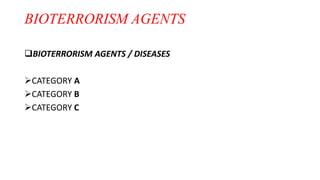
BIOTERRORISM AGENTS
BIOTERRORISM AGENTS / DISEASES
CATEGORY A
CATEGORY B
CATEGORY C
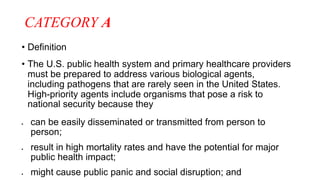
CATEGORY A
• Definition
• The U.S. public health system and primary healthcare providers
must be prepared to address various biological agents,
including pathogens that are rarely seen in the United States.
High-priority agents include organisms that pose a risk to
national security because they
 can be easily disseminated or transmitted from person to
person;
 result in high mortality rates and have the potential for major
public health impact;
 might cause public panic and social disruption; and
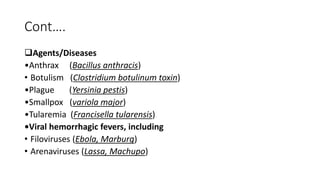
Cont….
Agents/Diseases
•Anthrax (Bacillus anthracis)
• Botulism (Clostridium botulinum toxin)
•Plague (Yersinia pestis)
•Smallpox (variola major)
•Tularemia (Francisella tularensis)
•Viral hemorrhagic fevers, including
• Filoviruses (Ebola, Marburg)
• Arenaviruses (Lassa, Machupo)
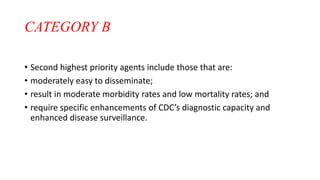
CATEGORY B
• Second highest priority agents include those that are:
• moderately easy to disseminate;
• result in moderate morbidity rates and low mortality rates; and
• require specific enhancements of CDC’s diagnostic capacity and
enhanced disease surveillance.
CONT…..
Agents/Diseases
•Brucellosis (Brucella species)
•Epsilon toxin of Clostridium perfringens
•Food safety threats (Salmonella species, Escherichia coli , Shigella)
•Psittacosis (Chlamydia psittaci)
•Q fever (Coxiella burnetii)
•Ricin toxin from Ricinus communis
•Staphylococcal enterotoxin B
•Typhus fever (Rickettsia prowazekii)
•Viral encephalitis (alphaviruses, such as eastern equine encephalitis, Venezuelan
encephalitis)
•Water safety threats (Vibrio cholerae, Cryptosporidium parvum)
CATEGORY C
• Third highest priority agents include emerging pathogens that
could be engineered for mass dissemination in the future
because of
 availability;
 ease of production and dissemination; and
 potential for high morbidity and mortality rates and major health
impact.
•Agents
 Emerging infectious diseases such as nipah virus and
hantavirus.
HISTORY OF BIOTERRORISM
• 1763-------French and Indian war, small pox
• WW 1st ----German program ; anthrax, glanders
• 1925--------Geneva protocol bans biological weapon
• WW 2nd ------Japanese program; anthrax, plegue, shigella
• 1979--------accidental release of B. anthracis spores at weapon
research centre swerdlovsk, USSR
• 1984 ------- Rajneesh cult member contaminate salad bar with salmonella
typhimurium in Oregon
• 2001 --------anthrax releases in FL, DC, NY, NJ
IMPACT ON HUMAN HEALTH
 High fever
 Headache
 emotional disturbances such as:
• Emotional numbness
• Horror and disgust at unfamiliar forms of injury
• Anger at authorities for failing to protect them
• Paranoia and xenophobia;
• Loss of trust and increased feelings of vulnerability
• Hopelessness and helplessness
• Survivor guilt
Cont…
• Many infectious diseases
Bacterial diseases
 eg. Anthrax, plague, botulism, typhoid, Q-fever, brucellosis and many
more….
 viral diseases
 eg. small pox , viral encephalitis and many more…
EPIDEMIOLOGICAL CLUES
• Unusual disease / symptoms (exotic disease)
• Epidemic numbers with similar syndromes
• Tight geographic cluster
• Unusual timing for endemic disease
• Rapidly increasing disease incidence in a healthy
population
• Multiple diseases in one patient
• Dead animals (especially multiple species)
• History of visible cloud
• Claims by aggressors
• Fulminant disease presentations
WHY GERMS ARE USED?
 Agents easy to manufacture
 Possible to attack covertly
 Psychological impact
 Potential economic impact
• Mainly inhaled - may be ingested or absorbed
• Particles may remain suspended for hours
• May be released silently with no immediate effect
• Person-to-person spread happens for some agents
• Long incubation periods mean "first responders
may be primary health care providers
• Agents may be lethal or incapacitating
• Vaccines antitoxins exist for some agents
•
CONT….
• Undetectable by our 5 senses
• Relatively inexpensive lt600X less Chem,lt800X
Nuc
• Relatively low-tech to make deliver
• Small amounts hard to trace Undetectable by our 5 senses
• Relatively inexpensive lt600X less Chem,lt800X
Nuc
• Relatively low-tech to make deliver
• Small amounts hard to trace
• Delay in symptoms anonymity
• Chance of mass casualties
PUBLIC HEALTH ROLE AND RESPONSE
Public Health Role
• Early Detection
• Mass Patient Care
• Mass Immunization/Prophylaxis
• Epidemiologic investigation
• Communication
• Command and Control
• Mass Fatality Management
• Evacuations/sheltering (humans and animals)
• Environmental Surety
•
MEDICAL RESPONSE
• active and passive immunization
• Prophylaxis.
• identification of threat/use.
• Incubation period.
• Diagnosis.
• antimicrobial or supportive therapy.
• Overt disease.
• Diagnosis.
• Treatment.
• direct patient care will predominate.
PUBLIC HEALTH ACTION
 Promptly investigate original case
 Confirm laboratory results
 Identify interview case contacts as needed
 Initiate active surveillance for additional cases
 Take immediate public health prevention action as
needed
 Alert local medical community/public
 Determine need for Rx of contacts/health
professionals
 Mobilize needed assets at local, provincial,
federal level
 Maintain contact with case family reporting MD
STRATEGIES
• Strategies
• Plans should be implemented for educating and reminding health-
care providers about how to recognize unusual illnesses that might
indicate intentional release of a biologic agent. Strategies for
responding to potential bioterrorism could include [7]
1. Providing information to health-care providers and clinical
laboratories about how to report events through the appropriate
fastest channel.
2. Reporting immediately to higher HQ if the results of an
investigation suggest release of a biologic agent. Implementing a
sustained capacity to receive and act on any positive report of
events that suggest intentional release of a biologic agent.
Cont…
3. Investigating immediately any report of a cluster of illnesses or other
event that suggests an intentional release of a biologic agent and
requesting assistance of a Preventive Medicine specialist when
necessary.
4. Implementing a plan, to collect and transport specimens and to
store them appropriately before analysis at designated laboratories.
5. Reporting immediately to higher HQ if the results of an investigation
suggest release of a biologic agent.
DIAGNOSIS IN PUBLIC HEALTH
LABORATORY
• Open and examine package in a negative pressure
containment lab using level 3 protection.
• Gram stain, /- spore stains for bacteria on any
material (powder, etc.) present.
• Cultures, motility, biochemicals as required.
• Testing performed while maintaining chain of
custody procedures and evidence documentation.
• preserve DNA, fingerprints, handwriting
PREVENTION
• EDUCATION
• Awareness
• Development of Contingency Plans
• Focus on Class A Agents
• Avoidance of High Risk Areas
• Use of mass inoculations
• Rapid delivery of pharmaceuticals
How can you protect yourself from
bioterrorism?
• Depending on the situation, wear a face mask to reduce
inhaling or spreading germs. If you have been exposed to a
biological agent, remove and bag your clothes and personal
items. Follow official instructions for disposal of contaminated
items. Wash yourself with soap and water and put on clean
clothes.
•
REFRENCE
www.cdc.gov.in
www.medicine.in
THANKS
FOR YOUR ATTENTION

Presentation on bioterrorism

  • 1.
    PRESENTATION ON BIOTERRORISM BY:-- BIJAY KUMARMAHATO BPH 2ND SEMESTER PADMASHREE SCHOOL OF PUBLIC HEALTH
  • 2.
    LEARNING OBJECTIVES INTRODUCTION BIOTERRORISM AGENTS HISTORY IMPACTON HUMAN WHY GERMS ARE USED PUBLIC HEALTH ROLE AND RESPONSE MEDICAL RESPONSE TESTING IN PUBLIC HEALTH LABORATORY PREVENTION REFERENCE
  • 3.
    INTRODUCTION BIOTERRORISM A biological attack,or bioterrorism, is the intentional release of viruses, bacteria, or other germs that can sicken or kill people, livestock, or crops. • known as "germ warfare," biological weapons involve the use of toxins or infectious agents that are biological in origin. This can include bacteria, viruses, or fungi. • These agents are used to incapacitate or kill humans, animals, or plants as part of a war effort.
  • 4.
    WHAT DO WENEED TO KNOW? • Understand the risk of bioterrorism • Recognize a potential bioterrorist event • Meet immediate care needs of patients • Notify appropriate authorities • Participate in coordinated emergency response
  • 5.
    BIOTERRORISM AGENTS BIOTERRORISM AGENTS/ DISEASES CATEGORY A CATEGORY B CATEGORY C
  • 6.
    CATEGORY A • Definition •The U.S. public health system and primary healthcare providers must be prepared to address various biological agents, including pathogens that are rarely seen in the United States. High-priority agents include organisms that pose a risk to national security because they  can be easily disseminated or transmitted from person to person;  result in high mortality rates and have the potential for major public health impact;  might cause public panic and social disruption; and
  • 7.
    Cont…. Agents/Diseases •Anthrax (Bacillus anthracis) •Botulism (Clostridium botulinum toxin) •Plague (Yersinia pestis) •Smallpox (variola major) •Tularemia (Francisella tularensis) •Viral hemorrhagic fevers, including • Filoviruses (Ebola, Marburg) • Arenaviruses (Lassa, Machupo)
  • 8.
    CATEGORY B • Secondhighest priority agents include those that are: • moderately easy to disseminate; • result in moderate morbidity rates and low mortality rates; and • require specific enhancements of CDC’s diagnostic capacity and enhanced disease surveillance.
  • 9.
    CONT….. Agents/Diseases •Brucellosis (Brucella species) •Epsilontoxin of Clostridium perfringens •Food safety threats (Salmonella species, Escherichia coli , Shigella) •Psittacosis (Chlamydia psittaci) •Q fever (Coxiella burnetii) •Ricin toxin from Ricinus communis •Staphylococcal enterotoxin B •Typhus fever (Rickettsia prowazekii) •Viral encephalitis (alphaviruses, such as eastern equine encephalitis, Venezuelan encephalitis) •Water safety threats (Vibrio cholerae, Cryptosporidium parvum)
  • 10.
    CATEGORY C • Thirdhighest priority agents include emerging pathogens that could be engineered for mass dissemination in the future because of  availability;  ease of production and dissemination; and  potential for high morbidity and mortality rates and major health impact. •Agents  Emerging infectious diseases such as nipah virus and hantavirus.
  • 11.
    HISTORY OF BIOTERRORISM •1763-------French and Indian war, small pox • WW 1st ----German program ; anthrax, glanders • 1925--------Geneva protocol bans biological weapon • WW 2nd ------Japanese program; anthrax, plegue, shigella • 1979--------accidental release of B. anthracis spores at weapon research centre swerdlovsk, USSR • 1984 ------- Rajneesh cult member contaminate salad bar with salmonella typhimurium in Oregon • 2001 --------anthrax releases in FL, DC, NY, NJ
  • 12.
    IMPACT ON HUMANHEALTH  High fever  Headache  emotional disturbances such as: • Emotional numbness • Horror and disgust at unfamiliar forms of injury • Anger at authorities for failing to protect them • Paranoia and xenophobia; • Loss of trust and increased feelings of vulnerability • Hopelessness and helplessness • Survivor guilt
  • 13.
    Cont… • Many infectiousdiseases Bacterial diseases  eg. Anthrax, plague, botulism, typhoid, Q-fever, brucellosis and many more….  viral diseases  eg. small pox , viral encephalitis and many more…
  • 14.
    EPIDEMIOLOGICAL CLUES • Unusualdisease / symptoms (exotic disease) • Epidemic numbers with similar syndromes • Tight geographic cluster • Unusual timing for endemic disease • Rapidly increasing disease incidence in a healthy population • Multiple diseases in one patient • Dead animals (especially multiple species) • History of visible cloud • Claims by aggressors • Fulminant disease presentations
  • 15.
    WHY GERMS AREUSED?  Agents easy to manufacture  Possible to attack covertly  Psychological impact  Potential economic impact • Mainly inhaled - may be ingested or absorbed • Particles may remain suspended for hours • May be released silently with no immediate effect • Person-to-person spread happens for some agents • Long incubation periods mean "first responders may be primary health care providers • Agents may be lethal or incapacitating • Vaccines antitoxins exist for some agents •
  • 16.
    CONT…. • Undetectable byour 5 senses • Relatively inexpensive lt600X less Chem,lt800X Nuc • Relatively low-tech to make deliver • Small amounts hard to trace Undetectable by our 5 senses • Relatively inexpensive lt600X less Chem,lt800X Nuc • Relatively low-tech to make deliver • Small amounts hard to trace • Delay in symptoms anonymity • Chance of mass casualties
  • 17.
    PUBLIC HEALTH ROLEAND RESPONSE Public Health Role • Early Detection • Mass Patient Care • Mass Immunization/Prophylaxis • Epidemiologic investigation • Communication • Command and Control • Mass Fatality Management • Evacuations/sheltering (humans and animals) • Environmental Surety •
  • 18.
    MEDICAL RESPONSE • activeand passive immunization • Prophylaxis. • identification of threat/use. • Incubation period. • Diagnosis. • antimicrobial or supportive therapy. • Overt disease. • Diagnosis. • Treatment. • direct patient care will predominate.
  • 19.
    PUBLIC HEALTH ACTION Promptly investigate original case  Confirm laboratory results  Identify interview case contacts as needed  Initiate active surveillance for additional cases  Take immediate public health prevention action as needed  Alert local medical community/public  Determine need for Rx of contacts/health professionals  Mobilize needed assets at local, provincial, federal level  Maintain contact with case family reporting MD
  • 20.
    STRATEGIES • Strategies • Plansshould be implemented for educating and reminding health- care providers about how to recognize unusual illnesses that might indicate intentional release of a biologic agent. Strategies for responding to potential bioterrorism could include [7] 1. Providing information to health-care providers and clinical laboratories about how to report events through the appropriate fastest channel. 2. Reporting immediately to higher HQ if the results of an investigation suggest release of a biologic agent. Implementing a sustained capacity to receive and act on any positive report of events that suggest intentional release of a biologic agent.
  • 21.
    Cont… 3. Investigating immediatelyany report of a cluster of illnesses or other event that suggests an intentional release of a biologic agent and requesting assistance of a Preventive Medicine specialist when necessary. 4. Implementing a plan, to collect and transport specimens and to store them appropriately before analysis at designated laboratories. 5. Reporting immediately to higher HQ if the results of an investigation suggest release of a biologic agent.
  • 22.
    DIAGNOSIS IN PUBLICHEALTH LABORATORY • Open and examine package in a negative pressure containment lab using level 3 protection. • Gram stain, /- spore stains for bacteria on any material (powder, etc.) present. • Cultures, motility, biochemicals as required. • Testing performed while maintaining chain of custody procedures and evidence documentation. • preserve DNA, fingerprints, handwriting
  • 23.
    PREVENTION • EDUCATION • Awareness •Development of Contingency Plans • Focus on Class A Agents • Avoidance of High Risk Areas • Use of mass inoculations • Rapid delivery of pharmaceuticals
  • 24.
    How can youprotect yourself from bioterrorism? • Depending on the situation, wear a face mask to reduce inhaling or spreading germs. If you have been exposed to a biological agent, remove and bag your clothes and personal items. Follow official instructions for disposal of contaminated items. Wash yourself with soap and water and put on clean clothes. •
  • 25.
  • 26.