BIOTERRORISM
SEMINAR PRESENTATION BY
JOHN IWUCHUKWU ONWORDI MED1706267 SN:94
DEPARTMENT OF PUBLIC HEALTH AND COMMUNITY MEDICINE
UNIVERSITY OF BENIN
23RD
MAY, 2024
2
OUTLINE
• Introduction
• Historical Context
• Categories of Bioterrorism Agents
• Public health Implications of bioterrorism
• Response strategies to bioterrorism
• The Nigerian Situation
• Role of the Health Care Worker
• Challenges
• Conclusion
• Recommendations
3
LIST OF ABBREVIATIONS
• APIC: Association for Professionals in Infection Control and
Epidemiology
• BWC: Biological Weapons Convention
• CDC:Centre for Disease Control and Prevention
• EPROG: Emergency Preparedness and Response Operational Guideline
• EPRS: National Emergency Preparedness and Response
• GIDEON: Global Infectious Diseases and Epidemiology Online Network
• MDR-TB: Multidrug-resistant Tuberculosis
• SOP: Standard Operational Procedure
4
DEFINITION OF TERMS
• Biosurveillance: the active, real-time gathering and analysis of data
related to disease activity and health threats, in order to achieve early
warning, early detection, and situational awareness. It involves
monitoring human, animal, food, water, agriculture, and
environmental data for potential biological threats, whether natural or
intentional in origin
5
DEFINITION OF TERMS
• Bioterrorism: the intentional release or threat of release of biological
agents, such as viruses, bacteria, or toxins, with the goal of causing
harm to humans, animals, or plants. It is a form of terrorism that uses
biological agents as weapons
• Biowarfare: also known as germ warfare, involves the use of
biological toxins or infectious agents like bacteria, viruses, insects,
and fungi to kill, harm, or incapacitate humans, animals, or plants as
an act of war
6
DEFINITION OF TERMS
• Bioweapon: often termed "bio-weapons" or "biological threat agents,"
are living organisms or replicating entities that can be used for
offensive purposes in warfare
• Terrorism: the unlawful use of violence or threats to intimidate or
coerce a civilian population or government, with the goal of furthering
political, social, or ideological objectives
7
INTRODUCTION
• Bioterrorism is carried out by terrorists to create outbreaks of
infectious diseases which will cause widespread casualties, terror,
societal upheaval, or significant negative impact to a nation’s economy
• Such outbreaks of infectious diseases pose a major threat to global
health
• Bioterrorism and its potential for mass destruction have been subjects
of increasing international concern
(Adekunte et al., 2023)
8
INTRODUCTION…
• These weapons are subject to strict international prohibitions, with
offensive biological warfare considered a war crime under various
international treaties
• Thus, it is important to recognize early signs of bioterrorism attack,
conduct epidemiologic investigations, and developing response
strategies
(Schneider, 2024)
9
HISTORY
• Bioterrorism has a long and disturbing history, with recorded instances
dating back to the 14th century BC when the Hittites sent infected
rams to their enemies
• In the 14th century, Mongol forces catapulted plague-infested bodies
over the walls of the Black Sea port of Caffa, possibly starting the
Black Death pandemic that swept through Europe
• Also in the 14th century, cadavers were used as biological agents in
wars, dropped into enemy wells to poison the drinking water
(Pal et al., 2017)
10
HISTORY…
• Similarly, bioterrorism occurred during the French and Indian wars,
when native Americans were given smallpox laden blankets. This
action is believed to have initiated smallpox in this previously
unexposed population and resulted in a 40% mortality rate
• During World War I, Germany initiated a clandestine program to infect
horses and cattle owned by Allied armies
(Schneider, 2020)
11
HISTORY…
• In World War II, Japan conducted extensive biological weapons
research from 1932 until the end of the war, with the center of their
program known as "Unit 731" located in Manchuria
• The main function of Unit 731 was microbiological research for
developing biological weapons
• Over 10,000 prisoners died as a result of experimental infection with
agents like anthrax, plague, and cholera
(James et al., 2022)
12
HISTORY…
• The knowledge of the unit's activity comes mainly from the testimony
of survivors
• Healthy individuals were inoculated with germs causing anthrax,
yellow fever, typhoid and paratyphoid fevers, typhus, chicken pox,
cholera, dysentery, scarlet fever, encephalitis, hemorrhagic fever,
whooping cough, diphtheria, pneumonia, meningitis, tuberculosis,
salmonella, gonorrhea, and syphilis
(Cuerda-Galindo et al., 2014)
13
HISTORY…
• The program experimented on thousands of humans - Chinese,
Mongols, and Koreans accused of spying or working for the
resistance, along with prisoners of war from Western countries and the
physically or mentally disabled
• The program is estimated to have killed over 10 000 human beings
between 1937 and 1945
(Cuerda-Galindo et al., 2014)
14
HISTORY…
• After WWII, both the Soviet Union and the United States embarked on
large-scale biological warfare programs, which were required by law
to be halted upon signing the Biological Weapons Convention in 1972
• However, the Soviets conducted a clandestine program in violation of
the treaty
(James et al., 2022)
15
HISTORY…
• In the 1990s, the religious group “Aum Shinrikyo” attempted several
unsuccessful biological attacks in Japan using anthrax and botulinum
toxin
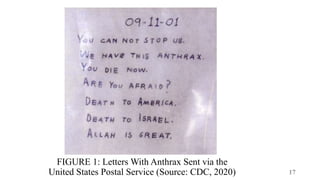
• In 2001, letters laced with anthrax were sent to news media offices and
the U.S. Congress in the United States, killing five people
(Jansen et al., 2014)
16
HISTORY…
• Bioterrorism remains an ongoing threat today
• Biological agents are attractive to terrorists because they are difficult
to detect, can be easily disseminated, and can cause widespread fear
and panic
• Preparedness and export controls on biological agents are crucial to
prevent future attacks
(Green et al., 2019)
17
FIGURE 1: Letters With Anthrax Sent via the
United States Postal Service (Source: CDC, 2020)
18
CATEGORIES OF BIOTERRORISM
AGENTS
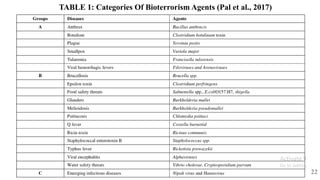
• Bioterrorism agents are categorized into three groups based on their
potential to cause harm, ease of dissemination, and the severity of
illness or death they can cause
• These categories are designated as A, B, and C, with Category A being
the highest priority and Category C being the lowest
• These categorizations are important for public health preparedness and
response to bioterrorism threats
[Centre for Disease Control and Prevention (CDC), 2018]
19
CATEGORIES OF BIOTERRORISM
AGENTS…
Category A Agents
• These agents are considered the highest risk and pose a significant
threat to national security
• They are highly contagious, have a short incubation period, and can
cause severe illness or death
• Examples of Category A agents include anthrax (Bacillus anthracis),
botulism (Clostridium botulinum toxin), plague (Yersinia pestis) etc.
(CDC, 2018)
20
CATEGORIES OF BIOTERRORISM
AGENTS…
Category B Agents
• These agents are the second highest priority and include naturally
occurring infectious diseases
• They are moderately easy to disseminate and can cause moderate
morbidity rates and low mortality rates
• Examples of Category B agents include brucellosis (Brucella species),
epsilon toxin of Clostridium perfringens and food safety threats
(Salmonella species, Escherichia coli O157:H7, Shigella)
(CDC, 2018)
21
CATEGORIES OF BIOTERRORISM
AGENTS…
Category C Agents
• These agents are the third highest priority and include emerging
pathogens that could be engineered for mass dissemination in the
future.
• They are considered emerging threats for disease and have the
potential for high morbidity and mortality rates
• Examples of Category C agents include Nipah virus, Tick-borne
hemorrhagic fever viruses, Yellow fever, (MDR-TB)
(CDC, 2018)
22
TABLE 1: Categories Of Bioterrorism Agents (Pal et al., 2017)
23
CATEGORIES OF BIOTERRORISM
AGENTS…
Anthrax
• A zoonotic disease caused by the gram-positive, non-motile bacterium
Bacillus anthracis
• It has historically affected cattle and other herbivores
• Recognized as an occupational disease during the Industrial
Revolution, particularly in wool industry workers
(Pal et al., 2017)
24
CATEGORIES OF BIOTERRORISM
AGENTS…
Anthrax…
• The inhalation form is highly lethal and suitable for biological warfare
due to ease of production and dissemination
• Bacillus anthracis is easy to cultivate, and spore production is readily
induced. Anthrax spores are resistant to sunlight, heat, and
disinfectants
(Pal et al., 2017)
25
CATEGORIES OF BIOTERRORISM
AGENTS…
Anthrax…
• Inhalation anthrax is commonly used in bioterrorism, requiring
aerosolization
• Spores can be dispersed over large areas via missiles, bombs, or
aircraft
• They maintain virulence for decades and can be milled to an optimal
size for respiratory tract infection
(Pal et al., 2017)
26
CATEGORIES OF BIOTERRORISM
AGENTS…
Anthrax…
Clinical Features: Symptoms begin within 1 to 60 days of exposure
• Cutaneous; Pruritic macule or papule, ulceration, and eschar; edema;
lymphangitis and lymphadenopathy
• Gastrointestinal; abdominal pain, nausea and vomiting, hematemesis,
and bowel perforation
• Inhalational; Cough, chest pain, dyspnea, fever, sepsis, hemorrhagic
mediastinitis, ending in hemodynamic and respiratory failure.
(Williams et al., 2023)
27
PUBLIC HEALTH IMPLICATIONS OF
BIOTERRORISM
Potential consequences of a bioterrorism event can be wide-ranging and
severe, including:
• Mass casualties
• Spread of infectious diseases
• Strain on healthcare systems
• Public panic and psychological impact
• Economic disruption
• Public health infrastructure stress
(Pal et al., 2017)
28
BIOTERRORISM RESPONSE
STRATEGIES
This involves 5 phases:
• Preparedness Phase: The preparedness phase involves developing
plans, protocols, and procedures for responding to a bioterrorism
attack. This includes stockpiling vaccines and medications, training
healthcare workers, and conducting drills and exercises.
• Early Warning Phase: The early warning phase involves detecting
the first cases of a bioterrorism attack and quickly alerting public
health officials
[Global Infectious Diseases and Epidemiology Online Network
(GIDEON), 2022]
29
BIOTERRORISM RESPONSE
STRATEGIES…
• Notification Phase: The notification phase involves alerting
healthcare workers, emergency responders, and the public about the
attack and providing guidance on response and treatment
• Response Phase: The response phase involves implementing response
plans, including distributing vaccines and medications, setting up
emergency treatment centers, and conducting contact tracing
(GIDEON, 2022)
30
BIOTERRORISM RESPONSE
STRATEGIES…
• Recovery Phase: The recovery phase involves restoring public health
infrastructure, providing mental health services to affected individuals,
and conducting an after-action review to identify areas for
improvement
(GIDEON, 2022)
31
BIOTERRORISM RESPONSE
STRATEGIES…
• An association of professionals in CDC and APIC prepared a
Bioterrorism Readiness Plan as a guiding framework for healthcare
facilities
• Below are some key subsections covered:
Detection of outbreaks caused by bioterrorism agents: via syndrome-
based criteria and epidemiological features
(CDC, 2018)
32
BIOTERRORISM RESPONSE
STRATEGIES…
 Infection control practices for patient management: includes
precautions on isolation, use of PPEs, patient location and transport,
cleaning and disinfection amongst others
 Post exposure management: covering decontamination of patient
environment, prophylaxis and post-exposure immunization, triage to
manage large scale exposures and so on
 Laboratory support and confirmation
(CDC, 2018)
33
ROLE OF HEALTHCARE WORKERS
• Public health professionals, including clinicians, pathologists,
microbiologists, and epidemiologists, collaborate to recognize and
respond to bioterrorism incidents.
• Public health professionals play critical roles in recognizing the early
signs of a bioterrorism attack, conducting epidemiologic
investigations, and developing response strategies
(Kosal, 2014)
34
ROLE OF HEALTHCARE WORKERS…
• They help enhance biosurveillance, lab cooperation, and research and
development of diagnostics and countermeasures
• Help promote regular vaccinations, educate the public, foster calm in
times of threats and ensure access to timely medical care, all geared
towards mitigating bioterrorism impacts
(Kosal, 2014)
35
THE NIGERIAN SITUATION
• Nigeria faces a real threat of bioterrorism, with terrorist groups
potentially having the capability and intention to use biological agents
to cause harm
• The country has had its share of biosecurity incidents due to
transboundary and migratory activities
• Nigeria seems to be unprepared for most emergency situations and
may not cope well in the face of a biological attack
(The Federal Republic of Nigeria, 2022)
36
THE NIGERIAN SITUATION…
• Nevertheless, Nigeria has developed a National Biosecurity Policy and
Action Plan to coordinate activities across government to protect
against bio-threats, whether naturally occurring, accidental, or
deliberate attacks
• There is, however, increasing need for effective implementation of
aforesaid plan, good political will and more scientists to acquire
pathogenic microorganisms for research
(The Federal Republic of Nigeria, 2022)
37
CHALLENGES
• Biological agents are naturally occurring, lower in production cost,
and diverse in potential use, complicating monitoring and control
• Difficulty in early detection of biological agents further complicated
by limited availability of rapid and accurate diagnostic tools
• Inadequate global biosurveillance systems, limited international
cooperation and information sharing and difficulty in tracking the
spread of infectious agents
38
CHALLENGES…
• Delay in response times due to lack of preparedness.
• Ineffective communication and coordination among agencies
• Lack of comprehensive international laws and regulations or
challenges in their enforcement
39
CHALLENGES…
• Difficulty in ensuring the safety and security of biotechnological
research as scientific research can be misused
• Misinformation of the public and lack of awareness about biological
threats, both causing fear and panic
• Lack of political will and fear of misuse of technology
40
CONCLUSION
• Although biological attacks are infrequent, they are regarded as high-
risk events because they can reverse decades of progress in disease
prevention, control, and eradication
• Thus healthcare professionals need to equip themselves with the
knowledge and training required to counter bioterrorism
• Countries worldwide must collaborate to ensure global safety from
bioterrorism attacks
41
RECOMMENDATIONS
To the Federal Government
• Reinforce multisectoral collaborations between ministries of defense,
health, food and agriculture and information to tackle bioterrorism
• Provide funding and resources to upgrade public health preparedness
and response capabilities and ensure funds are properly appropriated
• Formulate and practice SOP/drills at all levels of healthcare
42
RECOMMENDATIONS…
To the Federal Government…
• National Orientation Agency should oversee the education of the
public on potential bioterrorism threats and how to prepare emergency
supplies based on healthcare guidelines
• Enhance the use of digital facilities and networks for collecting and
disseminating critical health data
43
RECOMMENDATIONS…
To the State Government…
• Ensure adequate stockpiles of antibiotics, antidotes, vaccines, and
other medical supplies for rapid distribution in the event of an attack
• Maintain emergency response plans and coordinate with federal, state,
and local agencies including law enforcement, emergency department,
and public health agencies
44
RECOMMENDATIONS…
To the Community…
• Community members are encouraged to be alert for suspicious
packages or activities and report them to authorities
• Support public health agency efforts by following official guidelines
and recommendations in the event of an attack or threat
45
RECOMMENDATIONS…
Public Health Departments
• Enhance disease surveillance systems to rapidly detect unusual
clusters of illness that could indicate a bioterrorism event
• Ensure public health personnel are trained to recognize syndromes
caused by potential bioterrorism agents
• Establish protocols for coordinating with law enforcement, emergency
management, and healthcare providers during a response
46
REFERENCES
• Adekunte P, Musa S and Sadiku M. (2020). Bioterrorism: an
introduction. International Journal of Trend in Scientific Research and
Development (IJTSRD). Available at: http://
www.ijtsrd.com/papers/ijtsrd31660.pdf (Accessed 17th May, 2024)
• Barras V and Greub G. (2014). History of biological warfare and
bioterrorism. Clinical Microbiology and Infection [online] 20(6),
pp.497–502. doi:10.1111/1469-0691.12706 (Accessed 19th May,
2024)
47
REFERENCES…
• Centers for Disease Control and Prevention (CDC).
(2018). Bioterrorism agents/diseases (by category) | emergency
preparedness & response. [online] . Available at:
https://emergency.cdc.gov/agent/agentlist-category.asp (Accessed 17th
May, 2024)
• CDC. (2020). History | federal select agent program. [online].
Available at: https://www.selectagents.gov/overview/history.htm
(Accessed 17th May, 2024)
48
REFERENCES…
• Cuerda-Galindo E, González-López E, López-Muñoz F and Sierra-
Valentí X. (2014). Syphilis and human experimentation from the first
appearance of the disease to world war ii: a historical perspective and
reflections on ethics. Actas Dermo-Sifiliográficas (English Edition)
105(8), 762–767. doi:https://doi.org/10.1016/j.adengl.2013.09.009
(Accessed 19th May, 2024)
49
REFERENCES…
• Federal Republic Of Nigeria National Biosecurity Policy And Action
Plan. (2022). Available at:
https://faolex.fao.org/docs/pdf/nig214336.pdf (Accessed 19th May,
2024)
• Global Infectious Diseases and Epidemiology Online Network
(GIDEON). (2022). Bioterrorism and bioterrorism agents.
https://tools.ovid.com/gideon/lessonplans/Ovid_Lesson_Plan-Bioterro
rism.pdf
(Accessed 19th May, 2024)
50
REFERENCES…
• Cohen D, Franz DR, Green MS and LeDuc J. (2019). Confronting the
threat of bioterrorism: realities, challenges, and defensive
strategies. The Lancet Infectious Diseases, 19(1),e2–e13.
doi:10.1016/S1473-3099(18)30298-6 (Accessed 19th May, 2024)
51
REFERENCES…
• Jansen HJ, Breeveld FJ, Stijnis, C. and Grobusch, M.P. (2014).
Biological warfare, bioterrorism, and biocrime. Clinical Microbiology
and Infection, 20(6),488–496. doi:10.1111/1469-0691.12699
(Accessed 19th May, 2024)
• Kosal ME. (2014). A new role for public health in bioterrorism
deterrence. Frontiers in Public Health, 2, p.98589. https://
www.frontiersin.org/journals/public-health/articles/10.3389/fpubh.201
4.00278
(Accessed 19th May, 2024)
52
REFERENCES…
• Newman, T. (2018). Biological weapons and bioterrorism: Past,
present, and future. [online] www.medicalnewstoday.com. Available
at: https://www.medicalnewstoday.com/articles/321030 (Accessed
17th May, 2024)
• Pal, M., Tsegaye, M., Girzaw, F., Bedada, H., Godishala, V. and Kandi,
V. (2017). An overview on biological weapons and
bioterrorism. American Journal of Biomedical Research, 5(2), pp.24-
34. doi:10.12691/ajbr-5-2-2 (Accessed 17th May, 2024)
53
REFERENCES…
• Schneider B. (2020). Biological weapon - biological weapons in
history . Encyclopædia Britannica. [online] Available at: https://
www.britannica.com/technology/biological-weapon/Biological-weapo
ns-in-history
(Accessed 16th May, 2024)
• Adekunte PA Musa SM and Sadiku MNO. (2020). Bioterrorism: An
Introduction. International Journal of Trend in Scientific Research and
Development, [online] 4(5). Available at: https://
doi.org/10.3389/fpubh.2014.00278 (Accessed 19th May, 2024)
54
REFERENCES…
• Armstrong L, Williams M and Sizemore D. (2023). Biologic,
Chemical, and Radiation Terrorism Review. PubMed. Available at:
https://www.ncbi.nlm.nih.gov/books/NBK493217/#article-40691.s3
(Accessed 19th May, 2024)
55
THANK YOU
FOR LISTENING

CATEGORIES OF BIOTERRORISM AGENTS....pptx

  • 1.
    BIOTERRORISM SEMINAR PRESENTATION BY JOHNIWUCHUKWU ONWORDI MED1706267 SN:94 DEPARTMENT OF PUBLIC HEALTH AND COMMUNITY MEDICINE UNIVERSITY OF BENIN 23RD MAY, 2024
  • 2.
    2 OUTLINE • Introduction • HistoricalContext • Categories of Bioterrorism Agents • Public health Implications of bioterrorism • Response strategies to bioterrorism • The Nigerian Situation • Role of the Health Care Worker • Challenges • Conclusion • Recommendations
  • 3.
    3 LIST OF ABBREVIATIONS •APIC: Association for Professionals in Infection Control and Epidemiology • BWC: Biological Weapons Convention • CDC:Centre for Disease Control and Prevention • EPROG: Emergency Preparedness and Response Operational Guideline • EPRS: National Emergency Preparedness and Response • GIDEON: Global Infectious Diseases and Epidemiology Online Network • MDR-TB: Multidrug-resistant Tuberculosis • SOP: Standard Operational Procedure
  • 4.
    4 DEFINITION OF TERMS •Biosurveillance: the active, real-time gathering and analysis of data related to disease activity and health threats, in order to achieve early warning, early detection, and situational awareness. It involves monitoring human, animal, food, water, agriculture, and environmental data for potential biological threats, whether natural or intentional in origin
  • 5.
    5 DEFINITION OF TERMS •Bioterrorism: the intentional release or threat of release of biological agents, such as viruses, bacteria, or toxins, with the goal of causing harm to humans, animals, or plants. It is a form of terrorism that uses biological agents as weapons • Biowarfare: also known as germ warfare, involves the use of biological toxins or infectious agents like bacteria, viruses, insects, and fungi to kill, harm, or incapacitate humans, animals, or plants as an act of war
  • 6.
    6 DEFINITION OF TERMS •Bioweapon: often termed "bio-weapons" or "biological threat agents," are living organisms or replicating entities that can be used for offensive purposes in warfare • Terrorism: the unlawful use of violence or threats to intimidate or coerce a civilian population or government, with the goal of furthering political, social, or ideological objectives
  • 7.
    7 INTRODUCTION • Bioterrorism iscarried out by terrorists to create outbreaks of infectious diseases which will cause widespread casualties, terror, societal upheaval, or significant negative impact to a nation’s economy • Such outbreaks of infectious diseases pose a major threat to global health • Bioterrorism and its potential for mass destruction have been subjects of increasing international concern (Adekunte et al., 2023)
  • 8.
    8 INTRODUCTION… • These weaponsare subject to strict international prohibitions, with offensive biological warfare considered a war crime under various international treaties • Thus, it is important to recognize early signs of bioterrorism attack, conduct epidemiologic investigations, and developing response strategies (Schneider, 2024)
  • 9.
    9 HISTORY • Bioterrorism hasa long and disturbing history, with recorded instances dating back to the 14th century BC when the Hittites sent infected rams to their enemies • In the 14th century, Mongol forces catapulted plague-infested bodies over the walls of the Black Sea port of Caffa, possibly starting the Black Death pandemic that swept through Europe • Also in the 14th century, cadavers were used as biological agents in wars, dropped into enemy wells to poison the drinking water (Pal et al., 2017)
  • 10.
    10 HISTORY… • Similarly, bioterrorismoccurred during the French and Indian wars, when native Americans were given smallpox laden blankets. This action is believed to have initiated smallpox in this previously unexposed population and resulted in a 40% mortality rate • During World War I, Germany initiated a clandestine program to infect horses and cattle owned by Allied armies (Schneider, 2020)
  • 11.
    11 HISTORY… • In WorldWar II, Japan conducted extensive biological weapons research from 1932 until the end of the war, with the center of their program known as "Unit 731" located in Manchuria • The main function of Unit 731 was microbiological research for developing biological weapons • Over 10,000 prisoners died as a result of experimental infection with agents like anthrax, plague, and cholera (James et al., 2022)
  • 12.
    12 HISTORY… • The knowledgeof the unit's activity comes mainly from the testimony of survivors • Healthy individuals were inoculated with germs causing anthrax, yellow fever, typhoid and paratyphoid fevers, typhus, chicken pox, cholera, dysentery, scarlet fever, encephalitis, hemorrhagic fever, whooping cough, diphtheria, pneumonia, meningitis, tuberculosis, salmonella, gonorrhea, and syphilis (Cuerda-Galindo et al., 2014)
  • 13.
    13 HISTORY… • The programexperimented on thousands of humans - Chinese, Mongols, and Koreans accused of spying or working for the resistance, along with prisoners of war from Western countries and the physically or mentally disabled • The program is estimated to have killed over 10 000 human beings between 1937 and 1945 (Cuerda-Galindo et al., 2014)
  • 14.
    14 HISTORY… • After WWII,both the Soviet Union and the United States embarked on large-scale biological warfare programs, which were required by law to be halted upon signing the Biological Weapons Convention in 1972 • However, the Soviets conducted a clandestine program in violation of the treaty (James et al., 2022)
  • 15.
    15 HISTORY… • In the1990s, the religious group “Aum Shinrikyo” attempted several unsuccessful biological attacks in Japan using anthrax and botulinum toxin • In 2001, letters laced with anthrax were sent to news media offices and the U.S. Congress in the United States, killing five people (Jansen et al., 2014)
  • 16.
    16 HISTORY… • Bioterrorism remainsan ongoing threat today • Biological agents are attractive to terrorists because they are difficult to detect, can be easily disseminated, and can cause widespread fear and panic • Preparedness and export controls on biological agents are crucial to prevent future attacks (Green et al., 2019)
  • 17.
    17 FIGURE 1: LettersWith Anthrax Sent via the United States Postal Service (Source: CDC, 2020)
  • 18.
    18 CATEGORIES OF BIOTERRORISM AGENTS •Bioterrorism agents are categorized into three groups based on their potential to cause harm, ease of dissemination, and the severity of illness or death they can cause • These categories are designated as A, B, and C, with Category A being the highest priority and Category C being the lowest • These categorizations are important for public health preparedness and response to bioterrorism threats [Centre for Disease Control and Prevention (CDC), 2018]
  • 19.
    19 CATEGORIES OF BIOTERRORISM AGENTS… CategoryA Agents • These agents are considered the highest risk and pose a significant threat to national security • They are highly contagious, have a short incubation period, and can cause severe illness or death • Examples of Category A agents include anthrax (Bacillus anthracis), botulism (Clostridium botulinum toxin), plague (Yersinia pestis) etc. (CDC, 2018)
  • 20.
    20 CATEGORIES OF BIOTERRORISM AGENTS… CategoryB Agents • These agents are the second highest priority and include naturally occurring infectious diseases • They are moderately easy to disseminate and can cause moderate morbidity rates and low mortality rates • Examples of Category B agents include brucellosis (Brucella species), epsilon toxin of Clostridium perfringens and food safety threats (Salmonella species, Escherichia coli O157:H7, Shigella) (CDC, 2018)
  • 21.
    21 CATEGORIES OF BIOTERRORISM AGENTS… CategoryC Agents • These agents are the third highest priority and include emerging pathogens that could be engineered for mass dissemination in the future. • They are considered emerging threats for disease and have the potential for high morbidity and mortality rates • Examples of Category C agents include Nipah virus, Tick-borne hemorrhagic fever viruses, Yellow fever, (MDR-TB) (CDC, 2018)
  • 22.
    22 TABLE 1: CategoriesOf Bioterrorism Agents (Pal et al., 2017)
  • 23.
    23 CATEGORIES OF BIOTERRORISM AGENTS… Anthrax •A zoonotic disease caused by the gram-positive, non-motile bacterium Bacillus anthracis • It has historically affected cattle and other herbivores • Recognized as an occupational disease during the Industrial Revolution, particularly in wool industry workers (Pal et al., 2017)
  • 24.
    24 CATEGORIES OF BIOTERRORISM AGENTS… Anthrax… •The inhalation form is highly lethal and suitable for biological warfare due to ease of production and dissemination • Bacillus anthracis is easy to cultivate, and spore production is readily induced. Anthrax spores are resistant to sunlight, heat, and disinfectants (Pal et al., 2017)
  • 25.
    25 CATEGORIES OF BIOTERRORISM AGENTS… Anthrax… •Inhalation anthrax is commonly used in bioterrorism, requiring aerosolization • Spores can be dispersed over large areas via missiles, bombs, or aircraft • They maintain virulence for decades and can be milled to an optimal size for respiratory tract infection (Pal et al., 2017)
  • 26.
    26 CATEGORIES OF BIOTERRORISM AGENTS… Anthrax… ClinicalFeatures: Symptoms begin within 1 to 60 days of exposure • Cutaneous; Pruritic macule or papule, ulceration, and eschar; edema; lymphangitis and lymphadenopathy • Gastrointestinal; abdominal pain, nausea and vomiting, hematemesis, and bowel perforation • Inhalational; Cough, chest pain, dyspnea, fever, sepsis, hemorrhagic mediastinitis, ending in hemodynamic and respiratory failure. (Williams et al., 2023)
  • 27.
    27 PUBLIC HEALTH IMPLICATIONSOF BIOTERRORISM Potential consequences of a bioterrorism event can be wide-ranging and severe, including: • Mass casualties • Spread of infectious diseases • Strain on healthcare systems • Public panic and psychological impact • Economic disruption • Public health infrastructure stress (Pal et al., 2017)
  • 28.
    28 BIOTERRORISM RESPONSE STRATEGIES This involves5 phases: • Preparedness Phase: The preparedness phase involves developing plans, protocols, and procedures for responding to a bioterrorism attack. This includes stockpiling vaccines and medications, training healthcare workers, and conducting drills and exercises. • Early Warning Phase: The early warning phase involves detecting the first cases of a bioterrorism attack and quickly alerting public health officials [Global Infectious Diseases and Epidemiology Online Network (GIDEON), 2022]
  • 29.
    29 BIOTERRORISM RESPONSE STRATEGIES… • NotificationPhase: The notification phase involves alerting healthcare workers, emergency responders, and the public about the attack and providing guidance on response and treatment • Response Phase: The response phase involves implementing response plans, including distributing vaccines and medications, setting up emergency treatment centers, and conducting contact tracing (GIDEON, 2022)
  • 30.
    30 BIOTERRORISM RESPONSE STRATEGIES… • RecoveryPhase: The recovery phase involves restoring public health infrastructure, providing mental health services to affected individuals, and conducting an after-action review to identify areas for improvement (GIDEON, 2022)
  • 31.
    31 BIOTERRORISM RESPONSE STRATEGIES… • Anassociation of professionals in CDC and APIC prepared a Bioterrorism Readiness Plan as a guiding framework for healthcare facilities • Below are some key subsections covered: Detection of outbreaks caused by bioterrorism agents: via syndrome- based criteria and epidemiological features (CDC, 2018)
  • 32.
    32 BIOTERRORISM RESPONSE STRATEGIES…  Infectioncontrol practices for patient management: includes precautions on isolation, use of PPEs, patient location and transport, cleaning and disinfection amongst others  Post exposure management: covering decontamination of patient environment, prophylaxis and post-exposure immunization, triage to manage large scale exposures and so on  Laboratory support and confirmation (CDC, 2018)
  • 33.
    33 ROLE OF HEALTHCAREWORKERS • Public health professionals, including clinicians, pathologists, microbiologists, and epidemiologists, collaborate to recognize and respond to bioterrorism incidents. • Public health professionals play critical roles in recognizing the early signs of a bioterrorism attack, conducting epidemiologic investigations, and developing response strategies (Kosal, 2014)
  • 34.
    34 ROLE OF HEALTHCAREWORKERS… • They help enhance biosurveillance, lab cooperation, and research and development of diagnostics and countermeasures • Help promote regular vaccinations, educate the public, foster calm in times of threats and ensure access to timely medical care, all geared towards mitigating bioterrorism impacts (Kosal, 2014)
  • 35.
    35 THE NIGERIAN SITUATION •Nigeria faces a real threat of bioterrorism, with terrorist groups potentially having the capability and intention to use biological agents to cause harm • The country has had its share of biosecurity incidents due to transboundary and migratory activities • Nigeria seems to be unprepared for most emergency situations and may not cope well in the face of a biological attack (The Federal Republic of Nigeria, 2022)
  • 36.
    36 THE NIGERIAN SITUATION… •Nevertheless, Nigeria has developed a National Biosecurity Policy and Action Plan to coordinate activities across government to protect against bio-threats, whether naturally occurring, accidental, or deliberate attacks • There is, however, increasing need for effective implementation of aforesaid plan, good political will and more scientists to acquire pathogenic microorganisms for research (The Federal Republic of Nigeria, 2022)
  • 37.
    37 CHALLENGES • Biological agentsare naturally occurring, lower in production cost, and diverse in potential use, complicating monitoring and control • Difficulty in early detection of biological agents further complicated by limited availability of rapid and accurate diagnostic tools • Inadequate global biosurveillance systems, limited international cooperation and information sharing and difficulty in tracking the spread of infectious agents
  • 38.
    38 CHALLENGES… • Delay inresponse times due to lack of preparedness. • Ineffective communication and coordination among agencies • Lack of comprehensive international laws and regulations or challenges in their enforcement
  • 39.
    39 CHALLENGES… • Difficulty inensuring the safety and security of biotechnological research as scientific research can be misused • Misinformation of the public and lack of awareness about biological threats, both causing fear and panic • Lack of political will and fear of misuse of technology
  • 40.
    40 CONCLUSION • Although biologicalattacks are infrequent, they are regarded as high- risk events because they can reverse decades of progress in disease prevention, control, and eradication • Thus healthcare professionals need to equip themselves with the knowledge and training required to counter bioterrorism • Countries worldwide must collaborate to ensure global safety from bioterrorism attacks
  • 41.
    41 RECOMMENDATIONS To the FederalGovernment • Reinforce multisectoral collaborations between ministries of defense, health, food and agriculture and information to tackle bioterrorism • Provide funding and resources to upgrade public health preparedness and response capabilities and ensure funds are properly appropriated • Formulate and practice SOP/drills at all levels of healthcare
  • 42.
    42 RECOMMENDATIONS… To the FederalGovernment… • National Orientation Agency should oversee the education of the public on potential bioterrorism threats and how to prepare emergency supplies based on healthcare guidelines • Enhance the use of digital facilities and networks for collecting and disseminating critical health data
  • 43.
    43 RECOMMENDATIONS… To the StateGovernment… • Ensure adequate stockpiles of antibiotics, antidotes, vaccines, and other medical supplies for rapid distribution in the event of an attack • Maintain emergency response plans and coordinate with federal, state, and local agencies including law enforcement, emergency department, and public health agencies
  • 44.
    44 RECOMMENDATIONS… To the Community… •Community members are encouraged to be alert for suspicious packages or activities and report them to authorities • Support public health agency efforts by following official guidelines and recommendations in the event of an attack or threat
  • 45.
    45 RECOMMENDATIONS… Public Health Departments •Enhance disease surveillance systems to rapidly detect unusual clusters of illness that could indicate a bioterrorism event • Ensure public health personnel are trained to recognize syndromes caused by potential bioterrorism agents • Establish protocols for coordinating with law enforcement, emergency management, and healthcare providers during a response
  • 46.
    46 REFERENCES • Adekunte P,Musa S and Sadiku M. (2020). Bioterrorism: an introduction. International Journal of Trend in Scientific Research and Development (IJTSRD). Available at: http:// www.ijtsrd.com/papers/ijtsrd31660.pdf (Accessed 17th May, 2024) • Barras V and Greub G. (2014). History of biological warfare and bioterrorism. Clinical Microbiology and Infection [online] 20(6), pp.497–502. doi:10.1111/1469-0691.12706 (Accessed 19th May, 2024)
  • 47.
    47 REFERENCES… • Centers forDisease Control and Prevention (CDC). (2018). Bioterrorism agents/diseases (by category) | emergency preparedness & response. [online] . Available at: https://emergency.cdc.gov/agent/agentlist-category.asp (Accessed 17th May, 2024) • CDC. (2020). History | federal select agent program. [online]. Available at: https://www.selectagents.gov/overview/history.htm (Accessed 17th May, 2024)
  • 48.
    48 REFERENCES… • Cuerda-Galindo E,González-López E, López-Muñoz F and Sierra- Valentí X. (2014). Syphilis and human experimentation from the first appearance of the disease to world war ii: a historical perspective and reflections on ethics. Actas Dermo-Sifiliográficas (English Edition) 105(8), 762–767. doi:https://doi.org/10.1016/j.adengl.2013.09.009 (Accessed 19th May, 2024)
  • 49.
    49 REFERENCES… • Federal RepublicOf Nigeria National Biosecurity Policy And Action Plan. (2022). Available at: https://faolex.fao.org/docs/pdf/nig214336.pdf (Accessed 19th May, 2024) • Global Infectious Diseases and Epidemiology Online Network (GIDEON). (2022). Bioterrorism and bioterrorism agents. https://tools.ovid.com/gideon/lessonplans/Ovid_Lesson_Plan-Bioterro rism.pdf (Accessed 19th May, 2024)
  • 50.
    50 REFERENCES… • Cohen D,Franz DR, Green MS and LeDuc J. (2019). Confronting the threat of bioterrorism: realities, challenges, and defensive strategies. The Lancet Infectious Diseases, 19(1),e2–e13. doi:10.1016/S1473-3099(18)30298-6 (Accessed 19th May, 2024)
  • 51.
    51 REFERENCES… • Jansen HJ,Breeveld FJ, Stijnis, C. and Grobusch, M.P. (2014). Biological warfare, bioterrorism, and biocrime. Clinical Microbiology and Infection, 20(6),488–496. doi:10.1111/1469-0691.12699 (Accessed 19th May, 2024) • Kosal ME. (2014). A new role for public health in bioterrorism deterrence. Frontiers in Public Health, 2, p.98589. https:// www.frontiersin.org/journals/public-health/articles/10.3389/fpubh.201 4.00278 (Accessed 19th May, 2024)
  • 52.
    52 REFERENCES… • Newman, T.(2018). Biological weapons and bioterrorism: Past, present, and future. [online] www.medicalnewstoday.com. Available at: https://www.medicalnewstoday.com/articles/321030 (Accessed 17th May, 2024) • Pal, M., Tsegaye, M., Girzaw, F., Bedada, H., Godishala, V. and Kandi, V. (2017). An overview on biological weapons and bioterrorism. American Journal of Biomedical Research, 5(2), pp.24- 34. doi:10.12691/ajbr-5-2-2 (Accessed 17th May, 2024)
  • 53.
    53 REFERENCES… • Schneider B.(2020). Biological weapon - biological weapons in history . Encyclopædia Britannica. [online] Available at: https:// www.britannica.com/technology/biological-weapon/Biological-weapo ns-in-history (Accessed 16th May, 2024) • Adekunte PA Musa SM and Sadiku MNO. (2020). Bioterrorism: An Introduction. International Journal of Trend in Scientific Research and Development, [online] 4(5). Available at: https:// doi.org/10.3389/fpubh.2014.00278 (Accessed 19th May, 2024)
  • 54.
    54 REFERENCES… • Armstrong L,Williams M and Sizemore D. (2023). Biologic, Chemical, and Radiation Terrorism Review. PubMed. Available at: https://www.ncbi.nlm.nih.gov/books/NBK493217/#article-40691.s3 (Accessed 19th May, 2024)
  • 55.

Editor's Notes

  • #18 These categorizations are important for public health preparedness and response to bioterrorism threats, as they help prioritize efforts to prevent and respond to potential attacks