BIOPHARMACEUTICS
ABSORPTION
PREPARED BY: AMRUTHA MOHANDAS
ASST.PROFESSOR
SMT.S.M SHAH PHARMACY COLLEGE
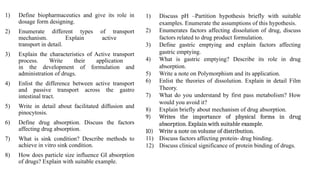
1) Define biopharmaceutics and give its role in
dosage form designing.
2) Enumerate different types of transport
mechanism. Explain active
transport in detail.
3) Explain the characteristics of Active transport
process. Write their application
in the development of formulation and
administration of drugs.
4) Enlist the difference between active transport
and passive transport across the gastro
intestinal tract.
5) Write in detail about facilitated diffusion and
pinocytosis.
6) Define drug absorption. Discuss the factors
affecting drug absorption.
7) What is sink condition? Describe methods to
achieve in vitro sink condition.
8) How does particle size influence GI absorption
of drugs? Explain with suitable example.
1) Discuss pH –Partition hypothesis briefly with suitable
examples. Enumerate the assumptions of this hypothesis.
2) Enumerates factors affecting dissolution of drug, discuss
factors related to drug product formulation.
3) Define gastric emptying and explain factors affecting
gastric emptying.
4) What is gastric emptying? Describe its role in drug
absorption.
5) Write a note on Polymorphism and its application.
6) Enlist the theories of dissolution. Explain in detail Film
Theory.
7) What do you understand by first pass metabolism? How
would you avoid it?
8) Explain briefly about mechanism of drug absorption.
9) Writes the importance of physical forms in drug
absorption. Explain with suitable example.
10) Write a note on volume of distribution.
11) Discuss factors affecting protein- drug binding.
12) Discuss clinical significance of protein binding of drugs.
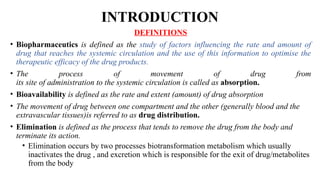
INTRODUCTION
DEFINITIONS
• Biopharmaceutics is defined as the study of factors influencing the rate and amount of
drug that reaches the systemic circulation and the use of this information to optimise the
therapeutic efficacy of the drug products.
• The process of movement of drug from
its site of administration to the systemic circulation is called as absorption.
• Bioavailability is defined as the rate and extent (amount) of drug absorption
• The movement of drug between one compartment and the other (generally blood and the
extravascular tissues)is referred to as drug distribution.
• Elimination is defined as the process that tends to remove the drug from the body and
terminate its action.
• Elimination occurs by two processes biotransformation metabolism which usually
inactivates the drug , and excretion which is responsible for the exit of drug/metabolites
from the body
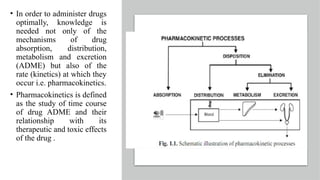
• In order to administer drugs
optimally, knowledge is
needed not only of the
mechanisms of drug
absorption, distribution,
metabolism and excretion
(ADME) but also of the
rate (kinetics) at which they
occur i.e. pharmacokinetics.
• Pharmacokinetics is defined
as the study of time course
of drug ADME and their
relationship with its
therapeutic and toxic effects
of the drug .
Role Of Biopharmaceutics in Dosage Form Designing
• To achieve optimal therapy with a drug, the drug product must be designed
to deliver the active principle at an optimal rate and amount, depending upon
the patient’s needs.
• Knowledge of the factors affecting the bioavailability of drug helps in
designing such an optimum formulation and saves many drugs that may be
discarded as useless.
• On the other hand, rational use of the drug or the therapeutic objective can
only be achieved through a better understanding of pharmacokinetics (in
addition to pharmacodynamics of the drug), which helps in designing a proper
dosage regimen (the manner in which the drug should be taken).
• This removes the need of the use of the empirical approach where a
considerable experimentation is needed to arrive at the
balance between the desired therapeutic and the undesired toxic effects
in order to define an appropriate dosage regimen
• The knowledge and concepts of biopharmaceutics and pharmacokinetics
thus have an integral role in the design and development of new
drugs and their dosage forms and improvement of therapeutic
efficacy of existing drugs.
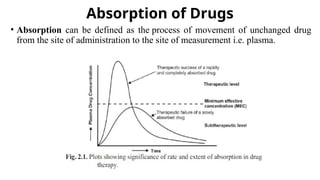
Absorption of Drugs
• Absorption can be defined as the process of movement of unchanged drug
from the site of administration to the site of measurement i.e. plasma.
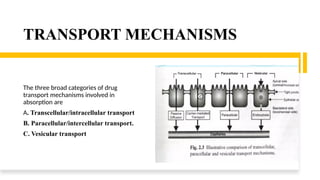
TRANSPORT MECHANISMS
The three broad categories of drug
transport mechanisms involved in
absorption are
A. Transcellular/intracellular transport
B. Paracellular/intercellular transport.
C. Vesicular transport
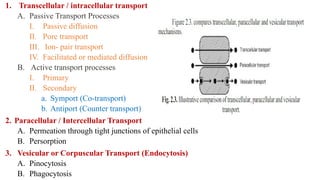
1. Transcellular / intracellular transport
A. Passive Transport Processes
I. Passive diffusion
II. Pore transport
III. Ion- pair transport
IV. Facilitated or mediated diffusion
B. Active transport processes
I. Primary
II. Secondary
a. Symport (Co-transport)
b. Antiport (Counter transport)
2. Paracellular / Intercellular Transport
A. Permeation through tight junctions of epithelial cells
B. Persorption
3. Vesicular or Corpuscular Transport (Endocytosis)
A. Pinocytosis
B. Phagocytosis
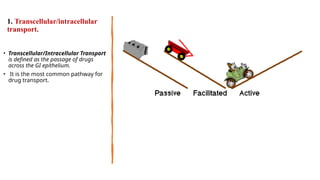
1. Transcellular/intracellular
transport.
• Transcellular/Intracellular Transport
is defined as the passage of drugs
across the GI epithelium.
• It is the most common pathway for
drug transport.
Passive
Diffusion
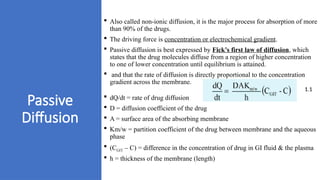
 Also called non-ionic diffusion, it is the major process for absorption of more
than 90% of the drugs.
 The driving force is concentration or electrochemical gradient.
 Passive diffusion is best expressed by Fick’s first law of diffusion, which
states that the drug molecules diffuse from a region of higher concentration
to one of lower concentration until equilibrium is attained.
 and that the rate of diffusion is directly proportional to the concentration
gradient across the membrane.
 dQ/dt = rate of drug diffusion
 D = diffusion coefficient of the drug
 A = surface area of the absorbing membrane
 Km/w = partition coefficient of the drug between membrane and the aqueous
phase
 (CGIT – C) = difference in the concentration of drug in GI fluid & the plasma
 h = thickness of the membrane (length)
1.1
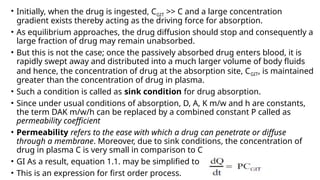
• Initially, when the drug is ingested, CGIT >> C and a large concentration
gradient exists thereby acting as the driving force for absorption.
• As equilibrium approaches, the drug diffusion should stop and consequently a
large fraction of drug may remain unabsorbed.
• But this is not the case; once the passively absorbed drug enters blood, it is
rapidly swept away and distributed into a much larger volume of body fluids
and hence, the concentration of drug at the absorption site, CGIT, is maintained
greater than the concentration of drug in plasma.
• Such a condition is called as sink condition for drug absorption.
• Since under usual conditions of absorption, D, A, K m/w and h are constants,
the term DAK m/w/h can be replaced by a combined constant P called as
permeability coefficient
• Permeability refers to the ease with which a drug can penetrate or diffuse
through a membrane. Moreover, due to sink conditions, the concentration of
drug in plasma C is very small in comparison to C
• GI As a result, equation 1.1. may be simplified to
• This is an expression for first order process.
Certain characteristics of passive diffusion can be generalized as follows:
1. The drug moves down the concentration gradient indicating downhill
transport.
2.The process is energy-independent and non-saturable.
3.The rate of drug transfer is directly proportional to the concentration
gradient between GI fluids and the blood compartment.
4.Greater the area and lesser the thickness of the membrane, faster the
diffusion; thus, more rapid is the rate of drug absorption from the intestine
than from the stomach.
5.The process is rapid over short distances and slower over long distances.
6.Equilibrium is attained when the concentration on either side of the
membrane becomes equal.
7. Greater the membrane/water partition coefficient of drug, faster
the absorption; since the membrane is lipoidal in nature, a lipophilic drug
diffuses at a faster rate by solubilising in the lipid layer of the membrane.
8. The drug diffuses rapidly when the volume of GI fluid is low;
conversely, dilution of GI fluids decreases the drug concentration in these
fluids (CGIT) and lower the concentration gradient (CGIT – C).This
phenomenon is, however, made use of in treating cases of oral overdose or
poisoning.
Pore Transport
• It is also called as convective transport bulk flow or
filtration.
• This mechanism is responsible for transport of molecules
into the cell through the protein channels present in the cell
membrane.
•Following are the characteristics of pore transport
• The driving force is constituted by the hydrostatic
pressure or the osmotic differences across the
membrane due to which bulk flow of water along with
small solid molecules occurs through such aqueous
channels. Water flux that promotes such a transport is
called as solvent drag
• The process is important in the absorption of low
molecular weight (less than 100), low molecular size
(smaller than the diameter of the pore) and generally
water-soluble drugs through narrow, aqueous-filled
channels or pores in the membrane structure. for
example, urea, water and sugars.
• Chain-like or linear compounds of molecular weight up
to 400 daltons can be absorbed by filtration.
Ion-Pair
Transport
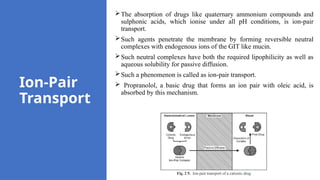
The absorption of drugs like quaternary ammonium compounds and
sulphonic acids, which ionise under all pH conditions, is ion-pair
transport.
Such agents penetrate the membrane by forming reversible neutral
complexes with endogenous ions of the GIT like mucin.
Such neutral complexes have both the required lipophilicity as well as
aqueous solubility for passive diffusion.
Such a phenomenon is called as ion-pair transport.
 Propranolol, a basic drug that forms an ion pair with oleic acid, is
absorbed by this mechanism.
Facilitate
d
Diffusion
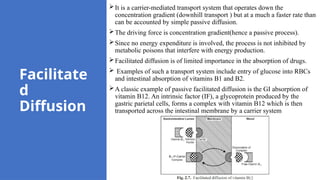
It is a carrier-mediated transport system that operates down the
concentration gradient (downhill transport ) but at a much a faster rate than
can be accounted by simple passive diffusion.
The driving force is concentration gradient(hence a passive process).
Since no energy expenditure is involved, the process is not inhibited by
metabolic poisons that interfere with energy production.
Facilitated diffusion is of limited importance in the absorption of drugs.
 Examples of such a transport system include entry of glucose into RBCs
and intestinal absorption of vitamins B1 and B2.
A classic example of passive facilitated diffusion is the GI absorption of
vitamin B12. An intrinsic factor (IF), a glycoprotein produced by the
gastric parietal cells, forms a complex with vitamin B12 which is then
transported across the intestinal membrane by a carrier system
ACTIVE
TRANSPORT
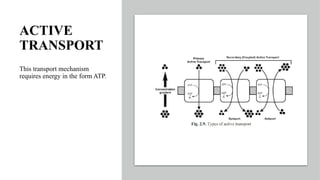
This transport mechanism
requires energy in the form ATP.
a. Primary active transport : In this process, there is direct ATP
requirement.
Moreover, the process transfers only one ion or molecule and in only one
direction, and hence called as uniporter
e.g. absorption of glucose.
Carrier proteins involved in primary active transport are of two types
i. Ion transporters are responsible for transporting ions in or out of
cells. A classic example of ATP-driven ion pump is proton pump.
a)Organic anion transporter which aids absorption of drugs such
as pravastatin and atorvastatin
b)Organic cation transporter which aids absorption of drugs
such as diphenhydramine.
ii) ABC (ATP-binding cassette) transporters are responsible for
transporting small foreign molecules (like drugs and toxins)especially out of
cells (and thus called as efflux pumps) which make them clinically
important. A classic example of ABC transporter is P-glycoprotein (P-gp).
 Itisresponsiblefor pumping hydrophobic drugs especially anticancer drugs
out of cells.
 Presence of large quantity of this protein thus makes the cells resistant to a
variety of drugs used in cancer chemotherapy , a phenomenon called as
multi-drug resistance.
 It is for this reason that P-gp is called as multi-drug resistance
(MDR) protein
b. Secondary active transport : In these processes, there is no direct
requirement of ATP i.e. it takes advantage of previously existing concentration
gradient.
 The energy required in transporting an ion aids transport of another ion or
molecule (co-transport or coupled transport)either in the same direction or in
the opposite direction.
 Accordingly this process is further subdivided into:
i. Symport (co-transport): involves movement of both molecules in the
same direction e.g. Na+
glucose symporter uses the potential energy of
the Na +
concentration gradient to move glucose against its concentration
gradient.
ii. Antiport (counter-transport) :involves movement of molecules in the
opposite direction e.g. expulsion of H ions using the Na +
gradient in the
kidneys.
2. Paracellular / Intercellular Transport
Paracellular/Intercellular Transport is defined as the transport of drugs through
the junctions between the GI epithelial cells
• This pathway is of minor importance in drug absorption.
• The two paracellular transport mechanisms involved in drug absorption are
i. Permeation through tight junctions of epithelial cells
this process basically occurs through openings which are little bigger than the
aqueous pores. Compounds such as insulin and cardiac glycosides are taken up
this mechanism.
ii. Persorption is permeation of drug through temporary openings formed by
shedding of two neighbouring epithelial cells into the lumen.
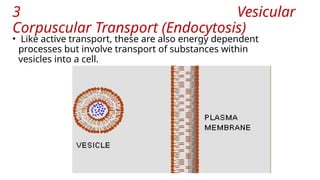
3 Vesicular
Corpuscular Transport (Endocytosis)
• Like active transport, these are also energy dependent
processes but involve transport of substances within
vesicles into a cell.
Endocytic uptake of macromolecules.
 This phenomenon is responsible for the cellular uptake of macromolecular
nutrients like fats and starch, oil soluble vitamins like A, D, E and K, water
soluble vitamin like B and drugs such as insulin.
 Another significance of such a process is that the drug is absorbed into the
lymphatic circulation thereby bypassing first-pass hepatic metabolism.
 Endocytosis includes two types of processes:
1.Phagocytosis (cell eating )adsorptive uptake of solid particulates,
2.Pinocytosis cell drinking uptake of fluid solute. Orally administered
Sabin polio vaccine, large protein molecules and
the botulism toxin (that causes food poisoning) are thought to be absorbed b
y pinocytosis.
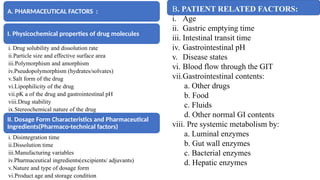
A. PHARMACEUTICAL FACTORS :
I. Physicochemical properties of drug molecules
i. Drug solubility and dissolution rate
ii.Particle size and effective surface area
iii.Polymorphism and amorphism
iv.Pseudopolymorphism (hydrates/solvates)
v.Salt form of the drug
vi.Lipophilicity of the drug
vii.pK a of the drug and gastrointestinal pH
viii.Drug stability
ix.Stereochemical nature of the drug
II. Dosage Form Characteristics and Pharmaceutical
Ingredients(Pharmaco-technical factors)
i. Disintegration time
ii.Dissolution time
iii.Manufacturing variables
iv.Pharmaceutical ingredients(excipients/ adjuvants)
v.Nature and type of dosage form
vi.Product age and storage condition
B. PATIENT RELATED FACTORS:
i. Age
ii. Gastric emptying time
iii. Intestinal transit time
iv. Gastrointestinal pH
v. Disease states
vi. Blood flow through the GIT
vii.Gastrointestinal contents:
a. Other drugs
b. Food
c. Fluids
d. Other normal GI contents
viii. Pre systemic metabolism by:
a. Luminal enzymes
b. Gut wall enzymes
c. Bacterial enzymes
d. Hepatic enzymes
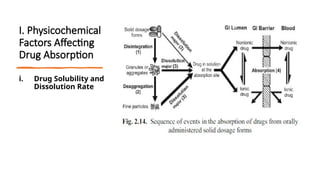
I. Physicochemical
Factors Affecting
Drug Absorption
i. Drug Solubility and
Dissolution Rate
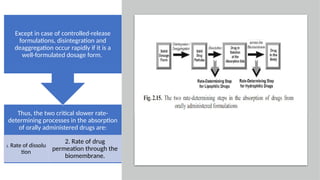
Thus, the two critical slower rate-
determining processes in the absorption
of orally administered drugs are:
1. Rate of dissolu
tion
2. Rate of drug
permeation through the
biomembrane.
Except in case of controlled-release
formulations, disintegration and
deaggregation occur rapidly if it is a
well-formulated dosage form.
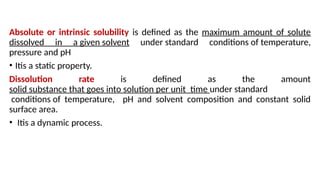
Absolute or intrinsic solubility is defined as the maximum amount of solute
dissolved in a given solvent under standard conditions of temperature,
pressure and pH
• Itis a static property.
Dissolution rate is defined as the amount
solid substance that goes into solution per unit time under standard
conditions of temperature, pH and solvent composition and constant solid
surface area.
• Itis a dynamic process.
Theories of Drug Dissolution
• Dissolution is a process in which a solid substance solubilises in a
given solvent i.e. mass transfer from the solid surface to the liquid phase
Theories:
1.Diffusion layer model/Film theory
2. Danckwert’s model/Penetration or Surface renewal theory, and
3. Interfacial barrier model/Double-barrier or Limited solvation theory
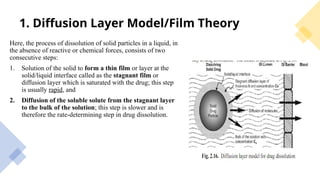
1. Diffusion Layer Model/Film Theory
Here, the process of dissolution of solid particles in a liquid, in
the absence of reactive or chemical forces, consists of two
consecutive steps:
1. Solution of the solid to form a thin film or layer at the
solid/liquid interface called as the stagnant film or
diffusion layer which is saturated with the drug; this step
is usually rapid, and
2. Diffusion of the soluble solute from the stagnant layer
to the bulk of the solution; this step is slower and is
therefore the rate-determining step in drug dissolution.
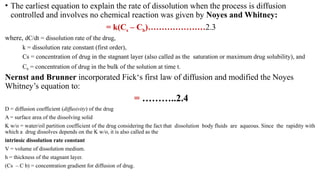
• The earliest equation to explain the rate of dissolution when the process is diffusion
controlled and involves no chemical reaction was given by Noyes and Whitney:
= k(Cs – Cb)…………………2.3
where, dC/dt = dissolution rate of the drug,
k = dissolution rate constant (first order),
Cs = concentration of drug in the stagnant layer (also called as the saturation or maximum drug solubility), and
Cb = concentration of drug in the bulk of the solution at time t.
Nernst and Brunner incorporated Fick‘s first law of diffusion and modified the Noyes
Whitney’s equation to:
= ………..2.4
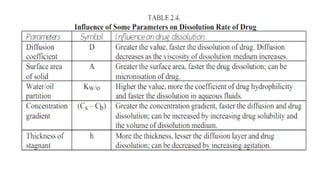
D = diffusion coefficient (diffusivity) of the drug
A = surface area of the dissolving solid
K w/o = water/oil partition coefficient of the drug considering the fact that dissolution body fluids are aqueous. Since the rapidity with
which a drug dissolves depends on the K w/o, it is also called as the
intrinsic dissolution rate constant
V = volume of dissolution medium.
h = thickness of the stagnant layer.
(Cs – C b) = concentration gradient for diffusion of drug.
The driving force for diffusion is the concentration gradient (Cs- C b).
Under such a situation, dissolution is said to be under non-sink
conditions.
This is true in case of in vitro dissolution in a limited dissolution
medium. Dissolution in such a situation slows down after sometime due
to build-up in the concentration of drug in the bulk of the solution.
The in vivo dissolution is always rapid than in vitro dissolution because
the moment the drug dissolves ;it is absorbed into the systemic
circulation.
As a result, C b = 0, and dissolution is at its maximum.
Thus, under in vivo conditions, there is no concentration build-up in the
bulk of the solution and hence no retarding effect on the dissolution rate
of the drug i.e. Cs >> C b and sink conditions are maintained.
• Under sink conditions, if
the volume and surface
area of solid arekept
constant, then equation 2.4
reduces to:
• K = dt/dC……………..2.5
where K incorporates all the
constants in equation 2.4.
• Equation 2.5 represents that
the dissolution rate is
constant under sink
conditions and follows
zero-order kinetics
• To obtain good in vitro-in vivo dissolution rate correlation, the in vitro
dissolution must always be carried under sink conditions.
• This can beachieved in one or more of the following ways:
1.Bathing the dissolving solid in fresh solvent from time to time.
2.Increasing the volume of dissolution fluid.
3.Removing the dissolved drug by partitioning it from the aqueous phase of the
dissolution fluid into an organic phase placed either above or below the
dissolution fluid for example, hexane or chloroform.
4. Adding a water miscible solvent such as alcohol to the dissolution fluid,
5.By adding selected adsorbents to remove the dissolved drug.
The in vitro sink conditions are so maintained that C b is always less than10% of
Cs.
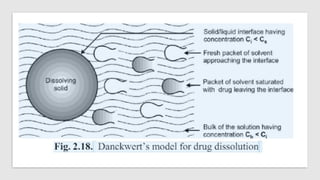
2. Danckwert’s Model (Penetration or Surface Renewal Theory)
• Danckwert did not approve of the existence of a stagnant layer and suggested
that turbulence in the dissolution medium exists at the solid/liquid interface.
• As a result, the agitated fluid consisting of macroscopic mass of eddies or
packets reach the solid/liquid interface in a random fashion due to eddy
currents, absorb the solute by diffusion and carry it to the bulk of the solution.
• Such solute containing packets are continuously replaced with new packets of
fresh solvent due to which the drug concentration at the solid/liquid interface
never reaches Cs and has a lower limiting value of Ci.
• Since the solvent packets are exposed to new solid surface each time, the
theory is called as surface renewal theory
• The Danckwert’s model is expressed by equation:
Where , m = mass of solid dissolved, and= rate of surface renewal (or the
ɣ=interfacial tension
3. Interfacial Barrier Model (Double Barrier or Limited
Solvation Theory)
According to the interfacial barrier model, an intermediate concentration
can exist at the interface as a result of solvation mechanism and is a
function of solubility rather than diffusion.
When considering the dissolution of a crystal, each face of the crystal will
have a different interfacial barrier. Such a concept is given by the following
equation:
G = Ki(Cs-Cb)………….(2.8)
where, G = dissolution rate per unit area, and
K i = effective interfacial transport constant.
Factors Affecting Drug Dissolution and Dissolution Rate
Factors that can affect dissolution and hence absorption can be categorized into 2 classes:
1. Physicochemical properties of the drug, and
2. Dosage form factors
Physicochemical properties of drug that affect drug dissolution and its rate are
i. Solubility
ii. particle size
iii. Polymorphism
iv. salt form
v. Pseudo polymorphism
vi. Complexation
vii. Wettability etc.
Dosage form factors include :
viii. formulation factors and
ix. excipients incorporated in the dosage form.
1. Particle Size and Effective Surface Area of the Drug
Particle size and surface area of a solid drug are inversely related to each
other.
Smaller the drug particle, greater the surface area.
Two types of surface area of interest can be defined:
1.Absolute surface area: which is the total area of solid surface of any
particle
2.Effective surface area :which is the area of solid surface exposed to the
dissolution medium
• From the modified Noyes-Whitney equation 2.4, it is clear that larger the
surface area, higher the dissolution rate.
• Since the surface area increases with decreasing particle size, a decrease in
particle size, which can be accomplished by micronisation, will result in higher
dissolution rates.
• However, it is important to note that it is not the absolute surface area but the
effective surface area that is proportional to the dissolution rate.
• Greater the effective surface area, more intimate the contact between the solid
surface and the aqueous solvent and faster the dissolution.
• But it is only when micronisation reduces the size of particles below 0.1 microns
that there is an increase in the intrinsic solubility and dissolution rate of the
drug.
• The surface of such small particles has energy higher than the bulk of the solid
resulting in an increased interaction with the solvent.
• Micronisation has in fact enabled the formulator to decrease the dose of
certain drugs because of increased absorption efficiency
• for example, the griseofulvin dose was reduced to half and that of
spironolactone was decreased 20 times following micronisation.
• However, in case of hydrophobic drugs like aspirin, phenacetin and
phenobarbital, micronisation actually results in a decrease in the effective
surface area of such powders and thus, a fall in the dissolution rate.
Three reasons have been suggested for such an outcome
1. The hydrophobic surface of the drug adsorbs air onto their surface which
inhibit their wettability.
2. The particles re-aggregate to form larger particles due to their high surface
free energy, which either float on the surface or settle at the bottom of the
dissolution medium.
3.Electrically induced agglomeration owing to surface charges prevents
intimate contact of the drug with the dissolution medium.
• The absolute surface area of hydrophobic drugs can be converted to
their effective surface area by:
1. Use of surfactant as a wetting agent that -
Decreases the interfacial tension, and
Displaces the adsorbed air with the solvent
For example, polysorbate 80 increases the bioavailability of phenacetin by
promoting its wettability.
2. Adding hydrophilic diluents such as PEG, PVP, dextrose, etc. which coat
the surface of hydrophobic drug particles and render them hydrophilic.
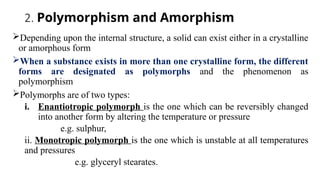
2. Polymorphism and Amorphism
Depending upon the internal structure, a solid can exist either in a crystalline
or amorphous form
When a substance exists in more than one crystalline form, the different
forms are designated as polymorphs and the phenomenon as
polymorphism
Polymorphs are of two types:
i. Enantiotropic polymorph is the one which can be reversibly changed
into another form by altering the temperature or pressure
e.g. sulphur,
ii. Monotropic polymorph is the one which is unstable at all temperatures
and pressures
e.g. glyceryl stearates.
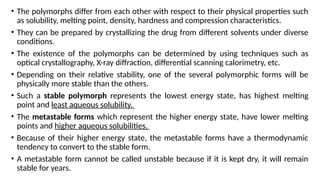
• The polymorphs differ from each other with respect to their physical properties such
as solubility, melting point, density, hardness and compression characteristics.
• They can be prepared by crystallizing the drug from different solvents under diverse
conditions.
• The existence of the polymorphs can be determined by using techniques such as
optical crystallography, X-ray diffraction, differential scanning calorimetry, etc.
• Depending on their relative stability, one of the several polymorphic forms will be
physically more stable than the others.
• Such a stable polymorph represents the lowest energy state, has highest melting
point and least aqueous solubility.
• The metastable forms which represent the higher energy state, have lower melting
points and higher aqueous solubilities.
• Because of their higher energy state, the metastable forms have a thermodynamic
tendency to convert to the stable form.
• A metastable form cannot be called unstable because if it is kept dry, it will remain
stable for years.
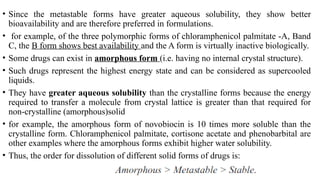
• Since the metastable forms have greater aqueous solubility, they show better
bioavailability and are therefore preferred in formulations.
• for example, of the three polymorphic forms of chloramphenicol palmitate -A, Band
C, the B form shows best availability and the A form is virtually inactive biologically.
• Some drugs can exist in amorphous form (i.e. having no internal crystal structure).
• Such drugs represent the highest energy state and can be considered as supercooled
liquids.
• They have greater aqueous solubility than the crystalline forms because the energy
required to transfer a molecule from crystal lattice is greater than that required for
non-crystalline (amorphous)solid
• for example, the amorphous form of novobiocin is 10 times more soluble than the
crystalline form. Chloramphenicol palmitate, cortisone acetate and phenobarbital are
other examples where the amorphous forms exhibit higher water solubility.
• Thus, the order for dissolution of different solid forms of drugs is:
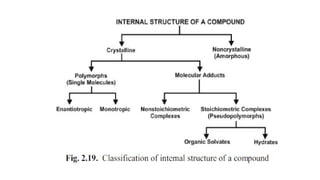
3. Hydrates/Solvates (Pseudopolymorphism)
The crystalline form of a drug can either be a polymorph or a molecular
adduct or both.
The stoichiometric type of adducts where the solvent molecules are
incorporated in the crystal lattice of the solid are called as the solvates
and the trapped solvent as solvent of crystallization
The solvates can exist in different crystalline forms called as pseudo
polymorphs.This phenomenon is called as pseudopolymorphism
When the solvent in association with the drug is water, the solvate is
known as a hydrate
Hydrates are most common solvate forms of drugs.
Generally, the anhydrous form of a drug has greater aqueous solubility
than the hydrates.
This is because the hydrates are already in interaction with water and
therefore have less energy for crystal break-up in comparison to the
anhydrates for further interaction with water.
The anhydrous form of theophylline and ampicillin have higher aqueous
solubilities, dissolve at a faster rate and show better bioavailability in
comparison to their monohydrate and trihydrate forms respectively.
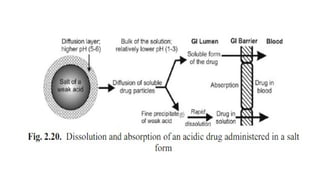
4. Salt Form of the Drug
• Most drugs are either weak acids or weak bases.
• One of the easiest approaches to enhance the solubility and dissolution rate
of such drugs is to convert them into their salt forms.
• Generally, with weakly acidic drugs, a strong base salt is prepared such as
the sodium and potassium salts of barbiturates and sulphonamides.
• In case of weakly basic drugs, a strong acid salt is prepared like the
hydrochloride or sulphate salts of several alkaloidal drugs.
• The influence of salt formation on the drug solubility, rate of dissolution
and absorption can be explained by considering the pH of the diffusion
layer and not the pH of the bulk of the solution.
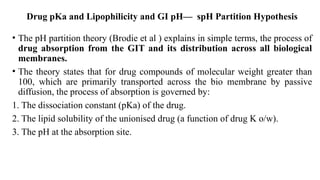
Drug pKa and Lipophilicity and GI pH— spH Partition Hypothesis
• The pH partition theory (Brodie et al ) explains in simple terms, the process of
drug absorption from the GIT and its distribution across all biological
membranes.
• The theory states that for drug compounds of molecular weight greater than
100, which are primarily transported across the bio membrane by passive
diffusion, the process of absorption is governed by:
1. The dissociation constant (pKa) of the drug.
2. The lipid solubility of the unionised drug (a function of drug K o/w).
3. The pH at the absorption site.
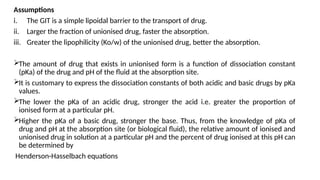
Assumptions
i. The GIT is a simple lipoidal barrier to the transport of drug.
ii. Larger the fraction of unionised drug, faster the absorption.
iii. Greater the lipophilicity (Ko/w) of the unionised drug, better the absorption.
The amount of drug that exists in unionised form is a function of dissociation constant
(pKa) of the drug and pH of the fluid at the absorption site.
It is customary to express the dissociation constants of both acidic and basic drugs by pKa
values.
The lower the pKa of an acidic drug, stronger the acid i.e. greater the proportion of
ionised form at a particular pH.
Higher the pKa of a basic drug, stronger the base. Thus, from the knowledge of pKa of
drug and pH at the absorption site (or biological fluid), the relative amount of ionised and
unionised drug in solution at a particular pH and the percent of drug ionised at this pH can
be determined by
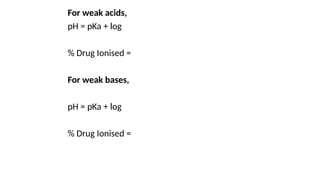
Henderson-Hasselbach equations
For weak acids,
pH = pKa + log
% Drug Ionised =
For weak bases,
pH = pKa + log
% Drug Ionised =
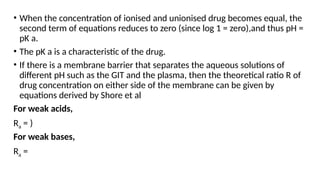
• When the concentration of ionised and unionised drug becomes equal, the
second term of equations reduces to zero (since log 1 = zero),and thus pH =
pK a.
• The pK a is a characteristic of the drug.
• If there is a membrane barrier that separates the aqueous solutions of
different pH such as the GIT and the plasma, then the theoretical ratio R of
drug concentration on either side of the membrane can be given by
equations derived by Shore et al
For weak acids,
Ra = )
For weak bases,
Ra =
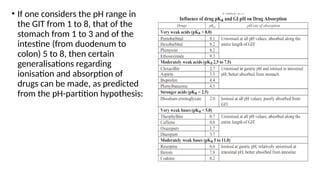
• If one considers the pH range in
the GIT from 1 to 8, that of the
stomach from 1 to 3 and of the
intestine (from duodenum to
colon) 5 to 8, then certain
generalisations regarding
ionisation and absorption of
drugs can be made, as predicted
from the pH-partition hypothesis:
DOSAGE FORM FACTORS
1. Disintegration Time
If a solid dosage form does not conform to the DT, it portends bioavailability
problems because the subsequent process of dissolution will be much slower
and absorption may be insufficient.
Coated tablets, especially sugar coated ones have long DT.
Rapid disintegration is thus important in the therapeutic success of a solid
dosage form.
DT of a tablet is directly related to the amount of binder presentand the
compression force (hardness) of a tablet.
A harder tablet with large amount of binder has a long DT.
Disintegration can be aided by incorporating disintegrants in suitable amounts
during formulation.
2. Manufacturing/Processing Variables
The dosage form related factors that influence dissolution and hence absorption of a drug from such
formulations are:
1. Excipients (formulation ingredients apart from the active principles),
2. Manufacturing processes.
a. Method of granulation, and
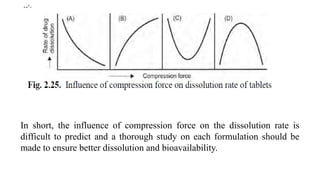
b. Compression force- The compression force employed in tabletting process influence
density, porosity, hardness, disintegration time and dissolution of tablets.
On the one hand, higher compression force increases the density and hardness of tablet,
decreases porosity and hence penetrability of the solvent into the tablet, retards wettability by
forming a firmer and more effective sealing layer by the lubricant, and in many cases,
promotes tighter bonding between the particles, all of which result in slowing of the
dissolution rate of tablets.[curve A]
On the other hand, higher compression forces cause deformation, crushing or fracture of drug
particles into smaller ones or convert a spherical granule into a disc shaped particle with a
large increase in the effective surface area. This results in an increase in the dissolution rate of
the tablet.[curve B]
A combination of both the curves A and B is also possible as shown in curves C and D.
In short, the influence of compression force on the dissolution rate is
difficult to predict and a thorough study on each formulation should be
made to ensure better dissolution and bioavailability.
Excipients(Formulation Factors)
A drug is rarely administered in its original form.
Excipients are added to ensure acceptability, physicochemical stability during the
shelf-life, uniformity of composition and dosage, and optimum bioavailability and
functionality of the drug product.
Despite their inertness and utility in the dosage form, excipients can influence
absorption of drugs.
The more the number of excipients in a dosage form, the more complex it is and
greater the potential for absorption and bioavailability problems.
Commonly used excipients in various dosage forms are vehicles, diluents (fillers),
binders and granulating agents, disintegrants, lubricants, coatings, suspending agents,
emulsifiers, surfactants, buffers, complexing agents, colorants, sweeteners, crystal
growth inhibitors, etc.
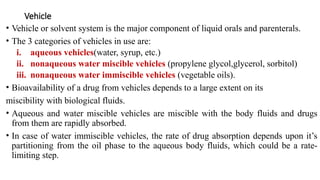
Vehicle
• Vehicle or solvent system is the major component of liquid orals and parenterals.
• The 3 categories of vehicles in use are:
i. aqueous vehicles(water, syrup, etc.)
ii. nonaqueous water miscible vehicles (propylene glycol,glycerol, sorbitol)
iii. nonaqueous water immiscible vehicles (vegetable oils).
• Bioavailability of a drug from vehicles depends to a large extent on its
miscibility with biological fluids.
• Aqueous and water miscible vehicles are miscible with the body fluids and drugs
from them are rapidly absorbed.
• In case of water immiscible vehicles, the rate of drug absorption depends upon it’s
partitioning from the oil phase to the aqueous body fluids, which could be a rate-
limiting step.
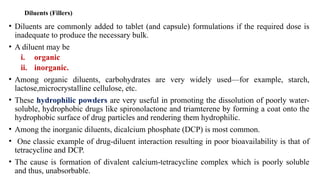
Diluents (Fillers)
• Diluents are commonly added to tablet (and capsule) formulations if the required dose is
inadequate to produce the necessary bulk.
• A diluent may be
i. organic
ii. inorganic.
• Among organic diluents, carbohydrates are very widely used—for example, starch,
lactose,microcrystalline cellulose, etc.
• These hydrophilic powders are very useful in promoting the dissolution of poorly water-
soluble, hydrophobic drugs like spironolactone and triamterene by forming a coat onto the
hydrophobic surface of drug particles and rendering them hydrophilic.
• Among the inorganic diluents, dicalcium phosphate (DCP) is most common.
• One classic example of drug-diluent interaction resulting in poor bioavailability is that of
tetracycline and DCP.
• The cause is formation of divalent calcium-tetracycline complex which is poorly soluble
and thus, unabsorbable.
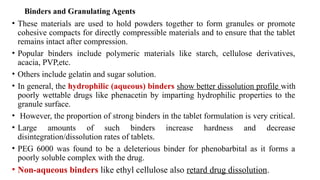
Binders and Granulating Agents
• These materials are used to hold powders together to form granules or promote
cohesive compacts for directly compressible materials and to ensure that the tablet
remains intact after compression.
• Popular binders include polymeric materials like starch, cellulose derivatives,
acacia, PVP,etc.
• Others include gelatin and sugar solution.
• In general, the hydrophilic (aqueous) binders show better dissolution profile with
poorly wettable drugs like phenacetin by imparting hydrophilic properties to the
granule surface.
• However, the proportion of strong binders in the tablet formulation is very critical.
• Large amounts of such binders increase hardness and decrease
disintegration/dissolution rates of tablets.
• PEG 6000 was found to be a deleterious binder for phenobarbital as it forms a
poorly soluble complex with the drug.
• Non-aqueous binders like ethyl cellulose also retard drug dissolution.
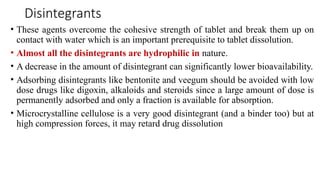
Disintegrants
• These agents overcome the cohesive strength of tablet and break them up on
contact with water which is an important prerequisite to tablet dissolution.
• Almost all the disintegrants are hydrophilic in nature.
• A decrease in the amount of disintegrant can significantly lower bioavailability.
• Adsorbing disintegrants like bentonite and veegum should be avoided with low
dose drugs like digoxin, alkaloids and steroids since a large amount of dose is
permanently adsorbed and only a fraction is available for absorption.
• Microcrystalline cellulose is a very good disintegrant (and a binder too) but at
high compression forces, it may retard drug dissolution
Lubricants/Antifrictional Agents:
• These agents are added to tablet formulations to aid flow of granules, to
reduce interparticle friction and sticking or adhesion of particles to dies and
punches.
• The commonly used lubricants are hydrophobic in nature (several metallic
stearates and waxes)and known to inhibit wettability, penetration of water
into tablet and their disintegration and dissolution.
• This is because the disintegrant gets coated with the lubricant if blended
simultaneously which however can be prevented by adding the lubricant in
the final stage.
• The best alternative is use of soluble lubricants like SLS and carbowaxes
which promote drug dissolution.
Coatings:
• In general, the deleterious effect of various coatings on drug
dissolution from a tablet dosage form is in the following order:
Enteric coat > Sugar coat > Non-enteric film coat.
Suspending Agents/Viscosity Imparters:
• Popular suspending agents are hydrophilic polymers like
i. Natural gums (acacia, tragacanth, etc.),
ii. semisynthetic gums (CMC, MC)
iii. synthetic gums
• which primarily stabilize the solid drug particles by reducing their rate of settling through an
increase in the viscosity of the medium.
• These agents and some sugars are also used as viscosity imparters to affect palatability and
pourability of solution dosage forms.
• Such agents can influence drug absorption in several ways.
• The macromolecular gums often form unabsorbable complexes with drugs—for example,
sodium CMC forms a poorly soluble complex with amphetamine.
• An increase in viscosity by these agents acts as a mechanical barrier to the diffusion of drug
from the dosage form into the bulk of GI fluids and from GI fluids to the mucosal lining by
forming a viscid layer on the GI mucosa.
• They also retard the GI transit of drugs.
Surfactants
• Surfactants are widely used in formulations as wetting agents, solubilisers, emulsifiers, etc.
• Their influence on drug absorption is very complex.
• They may enhance or retard drug absorption either by interacting with the drug or the
membrane or both.
• Mechanisms involved in the increased absorption of drug by use of surfactants include:
i. Promotion of wetting
ii. Better membrane contact of the drug for absorption.
iii. Enhanced membrane permeability of the drug.
• Decreased absorption of drug in the presence of surfactants has been suggested to be due
to:
i. Formation of unabsorbable drug-micelle complex at surfactant concentrations above
critical micelle concentration
ii. Laxative action induced by a large surfactant concentration
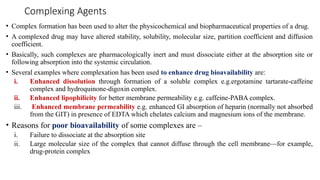
Complexing Agents
• Complex formation has been used to alter the physicochemical and biopharmaceutical properties of a drug.
• A complexed drug may have altered stability, solubility, molecular size, partition coefficient and diffusion
coefficient.
• Basically, such complexes are pharmacologically inert and must dissociate either at the absorption site or
following absorption into the systemic circulation.
• Several examples where complexation has been used to enhance drug bioavailability are:
i. Enhanced dissolution through formation of a soluble complex e.g.ergotamine tartarate-caffeine
complex and hydroquinone-digoxin complex.
ii. Enhanced lipophilicity for better membrane permeability e.g. caffeine-PABA complex.
iii. Enhanced membrane permeability e.g. enhanced GI absorption of heparin (normally not absorbed
from the GIT) in presence of EDTA which chelates calcium and magnesium ions of the membrane.
• Reasons for poor bioavailability of some complexes are –
i. Failure to dissociate at the absorption site
ii. Large molecular size of the complex that cannot diffuse through the cell membrane—for example,
drug-protein complex
3. Nature and Type of Dosage Form
• Apart from the proper selection of drug, clinical success often depends
to a great extent on the proper selection of dosage form of that drug.
For a given drug, a 2 to 5 fold or perhaps more difference could be
observed in the oral bioavailability of a drug depending upon the nature
and type of dosage form.
• Such a difference is due to the relative rate at which a particular dosage
form releases the drug to the biological fluids and the membrane.
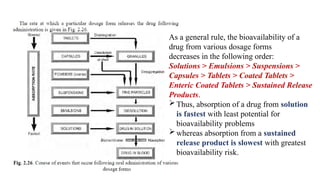
As a general rule, the bioavailability of a
drug from various dosage forms
decreases in the following order:
Solutions > Emulsions > Suspensions >
Capsules > Tablets > Coated Tablets >
Enteric Coated Tablets > Sustained Release
Products.
Thus, absorption of a drug from solution
is fastest with least potential for
bioavailability problems
whereas absorption from a sustained
release product is slowest with greatest
bioavailability risk.
i. Solutions: A drug in a solution (syrups, elixirs, etc.) is most rapidly
absorbed since the major rate-limiting step, drug dissolution, is absent.
ii. Emulsions: Emulsion dosage forms have been found to be superior to
suspensions in administering poorly aqueous soluble lipophilic drugs.
Emulsion dosage form presents a large surface area of oil to the GIT for
absorption of a drug.
Scientists have claimed that a drug administered in oily vehicle can direct
the distribution of drug directly into the lymphatic system thereby
avoiding the hepatic portal vein and first-pass metabolism.
iii. Suspensions: The major rate-limiting step in the absorption of a drug
from suspension dosage form is drug dissolution which is generally rapid
due to the large surface area of the particles.
iv. Powders: Though powders are superior to tablets and capsules, they are
not in use nowadays due to handling and palatability problems.
Major factors to be considered in the absorption of a drug from powders
are particle size, polymorphism, wettability, etc.
v. Capsules: Powders and granules are popularly administered in hard
gelatin capsules whereas viscous fluids and oils in soft elastic shells.
Soft elastic capsules as such dissolve faster than hard gelatin capsules and
tablets and show better drug availability from oily solutions, emulsions or
suspensions of medicaments.
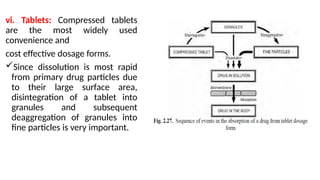
vi. Tablets: Compressed tablets
are the most widely used
convenience and
cost effective dosage forms.
Since dissolution is most rapid
from primary drug particles due
to their large surface area,
disintegration of a tablet into
granules and subsequent
deaggregation of granules into
fine particles is very important.
vii. Coated Tablets: In addition to factors that influence drug release from
compressed tablets, the coating acts as yet another barrier which must first
dissolve or disrupt to give way to disintegration and dissolution of tablet.
Of the two types of coatings,
i. Film coat, which is thin, dissolves rapidly and does not significantly affect drug
absorption.
ii. The sugar coat which though soluble, is generally tough and takes longer to
dissolve.
The sealing coat which is generally of shellac, is most deleterious.
Press coated tablets may be superior to sugar coated tablets in such cases.
viii. Enteric-Coated Tablets: Enteric coated tablets have great potential in
creating bioavailability problems because the coat dissolves only in the
alkaline pH of the intestine and it may take as long as 2 to 4 hours for such
a tablet to empty from the stomach into the intestine depending upon the
meals and the GI motility.
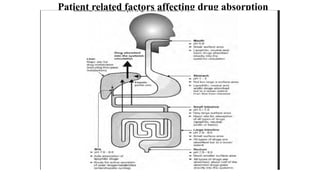
Patient related factors affecting drug absorption
1. Age
In infants, the gastric pH is high and intestinal surface and blood flow to
the GIT is low resulting in altered absorption pattern in comparison to
adults.
In elderly persons, causes of impaired drug absorption include altered
gastric emptying, decreased intestinal surface area and GI blood flow,
higher incidents of achlorhydria and bacterial overgrowth in small
intestine.
2. Gastric Emptying
The passage from stomach to the small intestine, called as gastric emptying.
It can also be a rate-limiting step in drug absorption because the major site of drug
absorption is intestine.
Thus, generally speaking, rapid gastric emptying increases bioavailability of a
drug.
Rapid gastric emptying is advisable where:
1. A rapid onset of action is desired e.g. sedatives.
2. Dissolution of drug occurs in the intestine e.g. enteric-coated dosage forms.
3. The drugs are not stable in the gastric fluids e.g. penicillin G and erythromycin.
4. The drug is best absorbed from the distal part of the small intestine e.g. vitamin B12.
For better dissolution and absorption, the gastric emptying can be promoted by taking the drug on
empty stomach.
Delay in gastric emptying is recommended in particular where:
1. The food promotes drug dissolution and absorption e.g. griseofulvin.
2. Disintegration and dissolution of dosage form is promoted by gastric fluids.
3. The drugs dissolve slowly e.g. griseofulvin.
Factors influencing gastric emptying:
i. Volume of meal: Larger the bulk of the meals, longer the gastric
emptying time.
ii. Composition of meal: Predictably, the rate of gastric emptying for
various food materials is in the following order:
carbohydrates >proteins > fats.
 Fats promote secretion of bile which too has an inhibitory effect on
gastric emptying.
Delayed gastric emptying as observed with fatty meals, is beneficial for
the absorption of poorly soluble drugs like griseofulvin.
iii. Physical state and viscosity of meal:
Liquid meals take less than an hour to empty whereas a solid meal may take as long as 6 to 7 hours.
Viscous materials empty at a slow rate in comparison to less viscous materials.
iv. Temperature of the meal: High or low temperature of the ingested fluid (in comparison to body
temperature) reduce the gastric emptying rate.
v. Gastrointestinal pH: Gastric emptying is retarded at low stomach pH and promoted at higher or
alkaline pH. Chemicals that affect gastrointestinal pH also alter gastric emptying.
The inhibitory effect of various acids on gastric emptying decreases with increase in molecular weight
and is in the following order -
HCl > acetic > lactic > tartaric > citric
With alkaline solutions, a low base concentration (1% NaHCO3) increases the gastric emptying rate more
than the one of higher concentration (5%).
vi. Electrolytes and osmotic pressure: Water, isotonic solutions, and solutions of low
salt concentration empty the stomach rapidly whereas a higher electrolyte concentration
decreases gastric emptying rate.
vii. Body posture: Gastric emptying is favoured while standing and by lying on the
right side since the normal curvature of the stomach provides a downhill path
whereas lying on the left side or in supine position retards it.
viii. Emotional state: Stress and anxiety promote gastric motility whereas depression
retards it.
ix. Exercise: Vigorous physical training retards gastric emptying.
x. Disease states: Diseases like gastroenteritis, gastric ulcer, pyloric stenosis, diabetes
and hypothyroidism retard gastric emptying. Partial or total gastrectomy, duodenal
ulcer and hyperthyroidism promote gastric emptying rate.
xi. Drugs: Drugs that retard gastric emptying include poorly soluble antacids
(aluminium hydroxide), anticholinergics (atropine,propantheline), narcotic analgesics
(morphine) and tricyclic antidepressants (imipramine, amitriptyline). Metoclopramide,
domperidone and cisapride (prokinetic agents) stimulate gastric emptying.
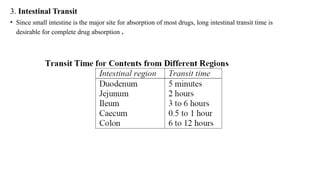
3. Intestinal Transit
• Since small intestine is the major site for absorption of most drugs, long intestinal transit time is
desirable for complete drug absorption .
Delayed intestinal transit is desirable for:
1. Drugs that dissolve or release slowly from their dosage form (sustained-
release products) or when the ratio of dose to solubility is high e.g.
chlorothiazide.
2. Drugs that dissolve only in the intestine (enteric-coated formulations).
3. Drugs which are absorbed from specific sites in the intestine (several B
vitamins, lithium carbonate, etc.).
4. When the drug penetrates the intestinal mucosa very slowly e.g. acyclovir.
5. When absorption of drug from the colon is minimal.
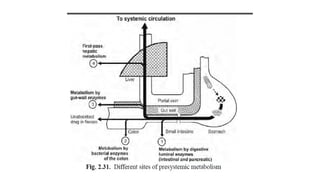
4. Presystemic Metabolism/First-Pass Effects
For a drug administered orally, the 3 main reasons for its decreased
bioavailability are:
1. Decreased absorption (owing to adsorption, precipitation,complexation
and poor solubility).
2. Destabilisation or destruction of drug.
3. First-pass/presystemic metabolism
• Before a drug reaches blood circulation, it has to pass for the first time through
organs of elimination namely the GIT and the liver.
• The loss of drug through biotransformation by such eliminating organs during its
passage to systemic circulation is called as first-pass or presystemic metabolism.
• The diminished drug concentration or rarely, complete absence of the drug in
plasma after oral administration is indicative of first-pass effects.
• The 3 primary systems which affect presystemic metabolism of a drug are :
1. Luminal enzymes – the metabolism by these enzymes are further categorised
into two –
(a) Digestive enzymes, and
(b) Bacterial enzymes.
2. Gut wall enzymes/mucosal enzymes.
3. Hepatic enzymes.
1. Digestive enzymes: These are the enzymes present in the gut fluids and
include enzymes from intestinal and pancreatic secretions.
The pancreatic secretions contains hydrolases which hydrolyse ester drugs like
chloramphenicol palmitate into active chloramphenicol,
and peptidases which split amide linkages and inactivate protein/polypeptide
drugs.
Thus, one of the approaches to effect oral absorption of peptides is to deliver
them to colon which lack peptidases.
2. Bacterial enzymes: The GI microflora is present in small amount in stomach
and small intestine and is rich in colon.
Hence, most orally administered drugs remain unaffected by them.
The colonic microbes generally render a drug more active or toxic on
biotransformation—for example sulphasalazine, a drug used in ulcerative
colitis, is hydrolysed to sulphapyridine and 5-amino salicylic acid by the
microbial enzymes of the colon.
An important role of intestinal microflora is that in enterohepatic cycling.
Their enzymes hydrolyse the conjugates of drugs actively secreted via bile
such as glucuronides of digoxin and oral contraceptives.
The free drugs are reabsorbed into the systemic circulation.
3. Gut wall enzymes: Also called as mucosal enzymes, they are present
in stomach, intestine and colon.
Alcohol dehydrogenase (ADH) is an enzyme of stomach mucosa that
inactivates ethanol. Intestinal mucosa contains both phase I and phase II
(predominant) enzymes, e.g. sulphation of ethinyl oestradiol and
isoprenaline.
The colonic mucosa also contain both phase I and phase II enzymes.
However, it is only the enzymes of the proximal small intestine that are
most active.
4. Hepatic enzymes: Several drugs undergo first-pass hepatic metabolism,
the highly extracted ones being isoprenaline, propranolol, alprenolol,
pentoxifylline, nitroglycerine, diltiazem, nifedipine, lidocaine, morphine,
etc.
5. Disease States
Several disease states can influence the rate and extent of drug absorption.
The 3 major classes of disease states that can influence the bioavailability
of a drug are:
1. Gastrointestinal diseases,
2. Cardiovascular diseases, and
3. Hepatic diseases
Gastrointestinal diseases
(a) Altered GI motility: (discussed earlier)
(b) Gastrointestinal diseases and infections:
The influence of achlorhydria(decreased gastric acid secretion and increased stomach pH) on
gastric emptying and drug absorption, especially that of acidic drugs (decreased absorption, e.g.
aspirin) has been studied.
Two of the intestinal disorders that influence drug availability are
i. celiac disease (characterized by destruction of villi and microvilli) : Abnormalities
associated with celiac disease include
• increased gastric emptying rate and GI permeability,
• altered intestinal drug metabolism,
• steatorrhea (impaired secretion of bile thus affecting absorption of lipophilic drugs and
vitamins) and
• reduced enterohepatic cycling of bile salts,
all of which can significantly impair drug absorption.
ii. Crohn’s disease. Conditions associated with Crohn’s disease that can alter absorption
pattern are altered gut wall microbial flora, decreased gut surface area and intestinal
transit rate.
(c) Gastrointestinal surgery: Gastrectomy can result in drug dumping in
the intestine, osmotic diarrhoea and reduced intestinal transit time.
Intestinal surgery also influences drug absorption for predictable
reasons.
2. Cardiovascular diseases: Several changes associated with congestive
cardiac failure influence bioavailability of a drug viz. oedema of the
intestine, decreased blood flow to the GIT and gastric emptying rate and
altered GI pH,secretions and microbial flora.
3. Hepatic diseases: Disorders such as hepatic cirrhosis influence
bioavailability mainly of drugs that undergo considerable first-pass hepatic
metabolism e.g. propranolol; enhanced bioavailability is observed in such
cases.
ABSORPTION OF DRUGS FROM NON-PER OS EXTRAVASCULAR ROUTES
Drug absorption from all non-oral extravascular sites is governed by the same
factors that influence absorption from GIT like
 the physicochemical properties of drug
 formulation factors
 anatomic, physiologic and pathologic characteristics of the patient.
This is so because the barrier to transport of drugs into the systemic
circulation from all such sites is a lipoidal membrane similar to the GI barrier
and the major mechanism in the absorption is passive diffusion.
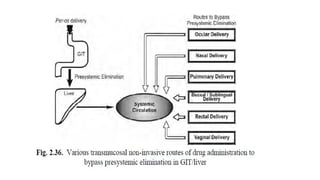
One of the major advantages of administering drugs by non-invasive
transmucosal routes such as nasal, buccal, rectal, etc. is that greater systemic
availability is attainable for drugs normally subjected to metabolism
Moreover, peptide and protein drugs can also be delivered by such routes.
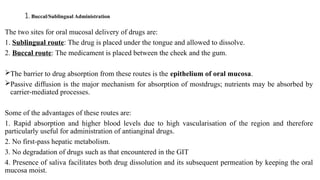
1. Buccal/Sublingual Administration
The two sites for oral mucosal delivery of drugs are:
1. Sublingual route: The drug is placed under the tongue and allowed to dissolve.
2. Buccal route: The medicament is placed between the cheek and the gum.
The barrier to drug absorption from these routes is the epithelium of oral mucosa.
Passive diffusion is the major mechanism for absorption of mostdrugs; nutrients may be absorbed by
carrier-mediated processes.
Some of the advantages of these routes are:
1. Rapid absorption and higher blood levels due to high vascularisation of the region and therefore
particularly useful for administration of antianginal drugs.
2. No first-pass hepatic metabolism.
3. No degradation of drugs such as that encountered in the GIT
4. Presence of saliva facilitates both drug dissolution and its subsequent permeation by keeping the oral
mucosa moist.
2. Rectal Administration
Despite its diminished popularity, the rectal route of drug administration is
still an important route for children and old patients.
The drugs may be administered as solutions (microenemas) or suppositories.
 Absorption is more rapid from solutions than from suppositories but is more
variable in comparison to oral route.
Absorption of drugs from the lower half of rectum bypasses presystemic
hepatic metabolism.
Drugs administered by this route include aspirin, paracetamol, theophylline,
few barbiturates, etc.
3. Topical Administration
Skin is the largest organ of the body weighing approximately 2 Kg and 2
m2
in area and receives about 1/3rd of total blood circulating through the
body.
Majority of drugs applied topically are meant to exert their effect locally.
When topically applied drugs are meant to exert their effects
systemically, the mode of administration is called as percutaneous or
transdermal delivery.
Percutaneous absorption occurs only if the topically applied drug
permeates the dermal capillaries and enters the blood stream.
Drugs that are administered percutaneously include nitro-glycerine, lidocaine,
betamethasone, oestradiol, testosterone, etc.
The route is particularly useful for drugs with low oral availability and short duration
of action; the effect of the latter category of drugs is prolonged because percutaneous
absorption is a slow process.
Certain ionic drugs are not absorbed transdermally despite the use of
chemical penetration enhancers in the topical formulations.
Percutaneous absorption of such drugs can be affected by novel techniques such as –
i. Iontophoresis: implies delivery of ionic drugs into the body by means of an electric
current.
ii. Phonophoresis: movement of drug molecules through the skin under the influence
of ultrasound.
4. Intramuscular Administration
Absorption of drugs from i.m. sites is relatively rapid but much slower in comparison to i.v.
injections.
Factors that determine rate of drug absorptionfrom i.m. sites are:
1. Vascularity of the injection site:the decreasing order of blood flow rate to muscular tissues
in which drugs are usually injected is:
Arm (deltoid) > Thigh (vastus lateralis) > Buttocks (gluteus maximus).
Since blood flow rate is often the rate-limiting step in absorption of drugs from i.m. sites, most
rapid absorption is from deltoid muscles and slowest from gluteal region.
2. Lipid solubility and ionisation of drug
3. Molecular size of the drug
4. Volume of injection and drug concentration
5. pH, composition and viscosity of injection vehicle
5. Sub cutaneous absorption
All factors that influence i.m. drug absorption are also applicable to absorption from
subcutaneous site.
Generally, absorption of drugs from a s.c site is slower than that from i.m. sites due
to poor perfusion,
But it is of particular importance for the administration of drugs for which a rapid
response is not desired and for drugs that degrade when taken orally
e.g.insulin and sodium heparin.
The rate of absorption of a drug from subcutaneous site can be increased in 2 ways:
1. Enhancing blood flow to the injection site
2. Increasing the drug-tissue contact area
6. Pulmonary Administration
All drugs intended for systemic effects can be administered by inhalation since
the large surface area of the alveoli, high permeability of the alveolar
epithelium and rich perfusion permit extremely rapid absorption just like
exchange of gases between the blood and the inspired air.
However, the route has been limited for administering drugs that affect
pulmonary system such as
 bronchodilators (salbutamol),
 anti-inflammatory steroids(beclomethasone) and
 antiallergics (cromolyn).
 Sometimes, the patients’ inability to inhale a sufficient amount of drug limits
drug delivery to lungs.
7. Intranasal Administration
The nasal route is becoming increasingly popular for systemic delivery
especially of some peptide and protein drugs.
Drug absorption from nasal mucosa is as rapid as observed after parenteral
administration because of its rich vasculature and high permeability.
The route is otherwise used for drugs to treat local symptoms like nasal
congestion, rhinitis, etc.

Absorption : Biopharmaceutics and Pharmacokinetics

  • 1.
    BIOPHARMACEUTICS ABSORPTION PREPARED BY: AMRUTHAMOHANDAS ASST.PROFESSOR SMT.S.M SHAH PHARMACY COLLEGE
  • 3.
    1) Define biopharmaceuticsand give its role in dosage form designing. 2) Enumerate different types of transport mechanism. Explain active transport in detail. 3) Explain the characteristics of Active transport process. Write their application in the development of formulation and administration of drugs. 4) Enlist the difference between active transport and passive transport across the gastro intestinal tract. 5) Write in detail about facilitated diffusion and pinocytosis. 6) Define drug absorption. Discuss the factors affecting drug absorption. 7) What is sink condition? Describe methods to achieve in vitro sink condition. 8) How does particle size influence GI absorption of drugs? Explain with suitable example. 1) Discuss pH –Partition hypothesis briefly with suitable examples. Enumerate the assumptions of this hypothesis. 2) Enumerates factors affecting dissolution of drug, discuss factors related to drug product formulation. 3) Define gastric emptying and explain factors affecting gastric emptying. 4) What is gastric emptying? Describe its role in drug absorption. 5) Write a note on Polymorphism and its application. 6) Enlist the theories of dissolution. Explain in detail Film Theory. 7) What do you understand by first pass metabolism? How would you avoid it? 8) Explain briefly about mechanism of drug absorption. 9) Writes the importance of physical forms in drug absorption. Explain with suitable example. 10) Write a note on volume of distribution. 11) Discuss factors affecting protein- drug binding. 12) Discuss clinical significance of protein binding of drugs.
  • 4.
    INTRODUCTION DEFINITIONS • Biopharmaceutics isdefined as the study of factors influencing the rate and amount of drug that reaches the systemic circulation and the use of this information to optimise the therapeutic efficacy of the drug products. • The process of movement of drug from its site of administration to the systemic circulation is called as absorption. • Bioavailability is defined as the rate and extent (amount) of drug absorption • The movement of drug between one compartment and the other (generally blood and the extravascular tissues)is referred to as drug distribution. • Elimination is defined as the process that tends to remove the drug from the body and terminate its action. • Elimination occurs by two processes biotransformation metabolism which usually inactivates the drug , and excretion which is responsible for the exit of drug/metabolites from the body
  • 5.
    • In orderto administer drugs optimally, knowledge is needed not only of the mechanisms of drug absorption, distribution, metabolism and excretion (ADME) but also of the rate (kinetics) at which they occur i.e. pharmacokinetics. • Pharmacokinetics is defined as the study of time course of drug ADME and their relationship with its therapeutic and toxic effects of the drug .
  • 6.
    Role Of Biopharmaceuticsin Dosage Form Designing • To achieve optimal therapy with a drug, the drug product must be designed to deliver the active principle at an optimal rate and amount, depending upon the patient’s needs. • Knowledge of the factors affecting the bioavailability of drug helps in designing such an optimum formulation and saves many drugs that may be discarded as useless. • On the other hand, rational use of the drug or the therapeutic objective can only be achieved through a better understanding of pharmacokinetics (in addition to pharmacodynamics of the drug), which helps in designing a proper dosage regimen (the manner in which the drug should be taken).
  • 7.
    • This removesthe need of the use of the empirical approach where a considerable experimentation is needed to arrive at the balance between the desired therapeutic and the undesired toxic effects in order to define an appropriate dosage regimen • The knowledge and concepts of biopharmaceutics and pharmacokinetics thus have an integral role in the design and development of new drugs and their dosage forms and improvement of therapeutic efficacy of existing drugs.
  • 8.
    Absorption of Drugs •Absorption can be defined as the process of movement of unchanged drug from the site of administration to the site of measurement i.e. plasma.
  • 9.
    TRANSPORT MECHANISMS The threebroad categories of drug transport mechanisms involved in absorption are A. Transcellular/intracellular transport B. Paracellular/intercellular transport. C. Vesicular transport
  • 10.
    1. Transcellular /intracellular transport A. Passive Transport Processes I. Passive diffusion II. Pore transport III. Ion- pair transport IV. Facilitated or mediated diffusion B. Active transport processes I. Primary II. Secondary a. Symport (Co-transport) b. Antiport (Counter transport) 2. Paracellular / Intercellular Transport A. Permeation through tight junctions of epithelial cells B. Persorption 3. Vesicular or Corpuscular Transport (Endocytosis) A. Pinocytosis B. Phagocytosis
  • 11.
    1. Transcellular/intracellular transport. • Transcellular/IntracellularTransport is defined as the passage of drugs across the GI epithelium. • It is the most common pathway for drug transport.
  • 12.
    Passive Diffusion  Also callednon-ionic diffusion, it is the major process for absorption of more than 90% of the drugs.  The driving force is concentration or electrochemical gradient.  Passive diffusion is best expressed by Fick’s first law of diffusion, which states that the drug molecules diffuse from a region of higher concentration to one of lower concentration until equilibrium is attained.  and that the rate of diffusion is directly proportional to the concentration gradient across the membrane.  dQ/dt = rate of drug diffusion  D = diffusion coefficient of the drug  A = surface area of the absorbing membrane  Km/w = partition coefficient of the drug between membrane and the aqueous phase  (CGIT – C) = difference in the concentration of drug in GI fluid & the plasma  h = thickness of the membrane (length) 1.1
  • 13.
    • Initially, whenthe drug is ingested, CGIT >> C and a large concentration gradient exists thereby acting as the driving force for absorption. • As equilibrium approaches, the drug diffusion should stop and consequently a large fraction of drug may remain unabsorbed. • But this is not the case; once the passively absorbed drug enters blood, it is rapidly swept away and distributed into a much larger volume of body fluids and hence, the concentration of drug at the absorption site, CGIT, is maintained greater than the concentration of drug in plasma. • Such a condition is called as sink condition for drug absorption. • Since under usual conditions of absorption, D, A, K m/w and h are constants, the term DAK m/w/h can be replaced by a combined constant P called as permeability coefficient • Permeability refers to the ease with which a drug can penetrate or diffuse through a membrane. Moreover, due to sink conditions, the concentration of drug in plasma C is very small in comparison to C • GI As a result, equation 1.1. may be simplified to • This is an expression for first order process.
  • 14.
    Certain characteristics ofpassive diffusion can be generalized as follows: 1. The drug moves down the concentration gradient indicating downhill transport. 2.The process is energy-independent and non-saturable. 3.The rate of drug transfer is directly proportional to the concentration gradient between GI fluids and the blood compartment. 4.Greater the area and lesser the thickness of the membrane, faster the diffusion; thus, more rapid is the rate of drug absorption from the intestine than from the stomach. 5.The process is rapid over short distances and slower over long distances. 6.Equilibrium is attained when the concentration on either side of the membrane becomes equal.
  • 15.
    7. Greater themembrane/water partition coefficient of drug, faster the absorption; since the membrane is lipoidal in nature, a lipophilic drug diffuses at a faster rate by solubilising in the lipid layer of the membrane. 8. The drug diffuses rapidly when the volume of GI fluid is low; conversely, dilution of GI fluids decreases the drug concentration in these fluids (CGIT) and lower the concentration gradient (CGIT – C).This phenomenon is, however, made use of in treating cases of oral overdose or poisoning.
  • 16.
    Pore Transport • Itis also called as convective transport bulk flow or filtration. • This mechanism is responsible for transport of molecules into the cell through the protein channels present in the cell membrane. •Following are the characteristics of pore transport • The driving force is constituted by the hydrostatic pressure or the osmotic differences across the membrane due to which bulk flow of water along with small solid molecules occurs through such aqueous channels. Water flux that promotes such a transport is called as solvent drag • The process is important in the absorption of low molecular weight (less than 100), low molecular size (smaller than the diameter of the pore) and generally water-soluble drugs through narrow, aqueous-filled channels or pores in the membrane structure. for example, urea, water and sugars. • Chain-like or linear compounds of molecular weight up to 400 daltons can be absorbed by filtration.
  • 17.
    Ion-Pair Transport The absorption ofdrugs like quaternary ammonium compounds and sulphonic acids, which ionise under all pH conditions, is ion-pair transport. Such agents penetrate the membrane by forming reversible neutral complexes with endogenous ions of the GIT like mucin. Such neutral complexes have both the required lipophilicity as well as aqueous solubility for passive diffusion. Such a phenomenon is called as ion-pair transport.  Propranolol, a basic drug that forms an ion pair with oleic acid, is absorbed by this mechanism.
  • 18.
    Facilitate d Diffusion It is acarrier-mediated transport system that operates down the concentration gradient (downhill transport ) but at a much a faster rate than can be accounted by simple passive diffusion. The driving force is concentration gradient(hence a passive process). Since no energy expenditure is involved, the process is not inhibited by metabolic poisons that interfere with energy production. Facilitated diffusion is of limited importance in the absorption of drugs.  Examples of such a transport system include entry of glucose into RBCs and intestinal absorption of vitamins B1 and B2. A classic example of passive facilitated diffusion is the GI absorption of vitamin B12. An intrinsic factor (IF), a glycoprotein produced by the gastric parietal cells, forms a complex with vitamin B12 which is then transported across the intestinal membrane by a carrier system
  • 19.
  • 20.
    a. Primary activetransport : In this process, there is direct ATP requirement. Moreover, the process transfers only one ion or molecule and in only one direction, and hence called as uniporter e.g. absorption of glucose. Carrier proteins involved in primary active transport are of two types i. Ion transporters are responsible for transporting ions in or out of cells. A classic example of ATP-driven ion pump is proton pump. a)Organic anion transporter which aids absorption of drugs such as pravastatin and atorvastatin b)Organic cation transporter which aids absorption of drugs such as diphenhydramine.
  • 21.
    ii) ABC (ATP-bindingcassette) transporters are responsible for transporting small foreign molecules (like drugs and toxins)especially out of cells (and thus called as efflux pumps) which make them clinically important. A classic example of ABC transporter is P-glycoprotein (P-gp).  Itisresponsiblefor pumping hydrophobic drugs especially anticancer drugs out of cells.  Presence of large quantity of this protein thus makes the cells resistant to a variety of drugs used in cancer chemotherapy , a phenomenon called as multi-drug resistance.  It is for this reason that P-gp is called as multi-drug resistance (MDR) protein
  • 22.
    b. Secondary activetransport : In these processes, there is no direct requirement of ATP i.e. it takes advantage of previously existing concentration gradient.  The energy required in transporting an ion aids transport of another ion or molecule (co-transport or coupled transport)either in the same direction or in the opposite direction.  Accordingly this process is further subdivided into: i. Symport (co-transport): involves movement of both molecules in the same direction e.g. Na+ glucose symporter uses the potential energy of the Na + concentration gradient to move glucose against its concentration gradient. ii. Antiport (counter-transport) :involves movement of molecules in the opposite direction e.g. expulsion of H ions using the Na + gradient in the kidneys.
  • 23.
    2. Paracellular /Intercellular Transport Paracellular/Intercellular Transport is defined as the transport of drugs through the junctions between the GI epithelial cells • This pathway is of minor importance in drug absorption. • The two paracellular transport mechanisms involved in drug absorption are i. Permeation through tight junctions of epithelial cells this process basically occurs through openings which are little bigger than the aqueous pores. Compounds such as insulin and cardiac glycosides are taken up this mechanism. ii. Persorption is permeation of drug through temporary openings formed by shedding of two neighbouring epithelial cells into the lumen.
  • 24.
    3 Vesicular Corpuscular Transport(Endocytosis) • Like active transport, these are also energy dependent processes but involve transport of substances within vesicles into a cell.
  • 25.
    Endocytic uptake ofmacromolecules.  This phenomenon is responsible for the cellular uptake of macromolecular nutrients like fats and starch, oil soluble vitamins like A, D, E and K, water soluble vitamin like B and drugs such as insulin.  Another significance of such a process is that the drug is absorbed into the lymphatic circulation thereby bypassing first-pass hepatic metabolism.  Endocytosis includes two types of processes: 1.Phagocytosis (cell eating )adsorptive uptake of solid particulates, 2.Pinocytosis cell drinking uptake of fluid solute. Orally administered Sabin polio vaccine, large protein molecules and the botulism toxin (that causes food poisoning) are thought to be absorbed b y pinocytosis.
  • 27.
    A. PHARMACEUTICAL FACTORS: I. Physicochemical properties of drug molecules i. Drug solubility and dissolution rate ii.Particle size and effective surface area iii.Polymorphism and amorphism iv.Pseudopolymorphism (hydrates/solvates) v.Salt form of the drug vi.Lipophilicity of the drug vii.pK a of the drug and gastrointestinal pH viii.Drug stability ix.Stereochemical nature of the drug II. Dosage Form Characteristics and Pharmaceutical Ingredients(Pharmaco-technical factors) i. Disintegration time ii.Dissolution time iii.Manufacturing variables iv.Pharmaceutical ingredients(excipients/ adjuvants) v.Nature and type of dosage form vi.Product age and storage condition B. PATIENT RELATED FACTORS: i. Age ii. Gastric emptying time iii. Intestinal transit time iv. Gastrointestinal pH v. Disease states vi. Blood flow through the GIT vii.Gastrointestinal contents: a. Other drugs b. Food c. Fluids d. Other normal GI contents viii. Pre systemic metabolism by: a. Luminal enzymes b. Gut wall enzymes c. Bacterial enzymes d. Hepatic enzymes
  • 28.
    I. Physicochemical Factors Affecting DrugAbsorption i. Drug Solubility and Dissolution Rate
  • 29.
    Thus, the twocritical slower rate- determining processes in the absorption of orally administered drugs are: 1. Rate of dissolu tion 2. Rate of drug permeation through the biomembrane. Except in case of controlled-release formulations, disintegration and deaggregation occur rapidly if it is a well-formulated dosage form.
  • 30.
    Absolute or intrinsicsolubility is defined as the maximum amount of solute dissolved in a given solvent under standard conditions of temperature, pressure and pH • Itis a static property. Dissolution rate is defined as the amount solid substance that goes into solution per unit time under standard conditions of temperature, pH and solvent composition and constant solid surface area. • Itis a dynamic process.
  • 31.
    Theories of DrugDissolution • Dissolution is a process in which a solid substance solubilises in a given solvent i.e. mass transfer from the solid surface to the liquid phase Theories: 1.Diffusion layer model/Film theory 2. Danckwert’s model/Penetration or Surface renewal theory, and 3. Interfacial barrier model/Double-barrier or Limited solvation theory
  • 32.
    1. Diffusion LayerModel/Film Theory Here, the process of dissolution of solid particles in a liquid, in the absence of reactive or chemical forces, consists of two consecutive steps: 1. Solution of the solid to form a thin film or layer at the solid/liquid interface called as the stagnant film or diffusion layer which is saturated with the drug; this step is usually rapid, and 2. Diffusion of the soluble solute from the stagnant layer to the bulk of the solution; this step is slower and is therefore the rate-determining step in drug dissolution.
  • 33.
    • The earliestequation to explain the rate of dissolution when the process is diffusion controlled and involves no chemical reaction was given by Noyes and Whitney: = k(Cs – Cb)…………………2.3 where, dC/dt = dissolution rate of the drug, k = dissolution rate constant (first order), Cs = concentration of drug in the stagnant layer (also called as the saturation or maximum drug solubility), and Cb = concentration of drug in the bulk of the solution at time t. Nernst and Brunner incorporated Fick‘s first law of diffusion and modified the Noyes Whitney’s equation to: = ………..2.4 D = diffusion coefficient (diffusivity) of the drug A = surface area of the dissolving solid K w/o = water/oil partition coefficient of the drug considering the fact that dissolution body fluids are aqueous. Since the rapidity with which a drug dissolves depends on the K w/o, it is also called as the intrinsic dissolution rate constant V = volume of dissolution medium. h = thickness of the stagnant layer. (Cs – C b) = concentration gradient for diffusion of drug.
  • 35.
    The driving forcefor diffusion is the concentration gradient (Cs- C b). Under such a situation, dissolution is said to be under non-sink conditions. This is true in case of in vitro dissolution in a limited dissolution medium. Dissolution in such a situation slows down after sometime due to build-up in the concentration of drug in the bulk of the solution. The in vivo dissolution is always rapid than in vitro dissolution because the moment the drug dissolves ;it is absorbed into the systemic circulation. As a result, C b = 0, and dissolution is at its maximum. Thus, under in vivo conditions, there is no concentration build-up in the bulk of the solution and hence no retarding effect on the dissolution rate of the drug i.e. Cs >> C b and sink conditions are maintained.
  • 36.
    • Under sinkconditions, if the volume and surface area of solid arekept constant, then equation 2.4 reduces to: • K = dt/dC……………..2.5 where K incorporates all the constants in equation 2.4. • Equation 2.5 represents that the dissolution rate is constant under sink conditions and follows zero-order kinetics
  • 37.
    • To obtaingood in vitro-in vivo dissolution rate correlation, the in vitro dissolution must always be carried under sink conditions. • This can beachieved in one or more of the following ways: 1.Bathing the dissolving solid in fresh solvent from time to time. 2.Increasing the volume of dissolution fluid. 3.Removing the dissolved drug by partitioning it from the aqueous phase of the dissolution fluid into an organic phase placed either above or below the dissolution fluid for example, hexane or chloroform. 4. Adding a water miscible solvent such as alcohol to the dissolution fluid, 5.By adding selected adsorbents to remove the dissolved drug. The in vitro sink conditions are so maintained that C b is always less than10% of Cs.
  • 38.
    2. Danckwert’s Model(Penetration or Surface Renewal Theory) • Danckwert did not approve of the existence of a stagnant layer and suggested that turbulence in the dissolution medium exists at the solid/liquid interface. • As a result, the agitated fluid consisting of macroscopic mass of eddies or packets reach the solid/liquid interface in a random fashion due to eddy currents, absorb the solute by diffusion and carry it to the bulk of the solution. • Such solute containing packets are continuously replaced with new packets of fresh solvent due to which the drug concentration at the solid/liquid interface never reaches Cs and has a lower limiting value of Ci. • Since the solvent packets are exposed to new solid surface each time, the theory is called as surface renewal theory • The Danckwert’s model is expressed by equation: Where , m = mass of solid dissolved, and= rate of surface renewal (or the ɣ=interfacial tension
  • 40.
    3. Interfacial BarrierModel (Double Barrier or Limited Solvation Theory) According to the interfacial barrier model, an intermediate concentration can exist at the interface as a result of solvation mechanism and is a function of solubility rather than diffusion. When considering the dissolution of a crystal, each face of the crystal will have a different interfacial barrier. Such a concept is given by the following equation: G = Ki(Cs-Cb)………….(2.8) where, G = dissolution rate per unit area, and K i = effective interfacial transport constant.
  • 41.
    Factors Affecting DrugDissolution and Dissolution Rate Factors that can affect dissolution and hence absorption can be categorized into 2 classes: 1. Physicochemical properties of the drug, and 2. Dosage form factors Physicochemical properties of drug that affect drug dissolution and its rate are i. Solubility ii. particle size iii. Polymorphism iv. salt form v. Pseudo polymorphism vi. Complexation vii. Wettability etc. Dosage form factors include : viii. formulation factors and ix. excipients incorporated in the dosage form.
  • 42.
    1. Particle Sizeand Effective Surface Area of the Drug Particle size and surface area of a solid drug are inversely related to each other. Smaller the drug particle, greater the surface area. Two types of surface area of interest can be defined: 1.Absolute surface area: which is the total area of solid surface of any particle 2.Effective surface area :which is the area of solid surface exposed to the dissolution medium
  • 43.
    • From themodified Noyes-Whitney equation 2.4, it is clear that larger the surface area, higher the dissolution rate. • Since the surface area increases with decreasing particle size, a decrease in particle size, which can be accomplished by micronisation, will result in higher dissolution rates. • However, it is important to note that it is not the absolute surface area but the effective surface area that is proportional to the dissolution rate. • Greater the effective surface area, more intimate the contact between the solid surface and the aqueous solvent and faster the dissolution. • But it is only when micronisation reduces the size of particles below 0.1 microns that there is an increase in the intrinsic solubility and dissolution rate of the drug. • The surface of such small particles has energy higher than the bulk of the solid resulting in an increased interaction with the solvent.
  • 44.
    • Micronisation hasin fact enabled the formulator to decrease the dose of certain drugs because of increased absorption efficiency • for example, the griseofulvin dose was reduced to half and that of spironolactone was decreased 20 times following micronisation. • However, in case of hydrophobic drugs like aspirin, phenacetin and phenobarbital, micronisation actually results in a decrease in the effective surface area of such powders and thus, a fall in the dissolution rate. Three reasons have been suggested for such an outcome 1. The hydrophobic surface of the drug adsorbs air onto their surface which inhibit their wettability. 2. The particles re-aggregate to form larger particles due to their high surface free energy, which either float on the surface or settle at the bottom of the dissolution medium. 3.Electrically induced agglomeration owing to surface charges prevents intimate contact of the drug with the dissolution medium.
  • 45.
    • The absolutesurface area of hydrophobic drugs can be converted to their effective surface area by: 1. Use of surfactant as a wetting agent that - Decreases the interfacial tension, and Displaces the adsorbed air with the solvent For example, polysorbate 80 increases the bioavailability of phenacetin by promoting its wettability. 2. Adding hydrophilic diluents such as PEG, PVP, dextrose, etc. which coat the surface of hydrophobic drug particles and render them hydrophilic.
  • 46.
    2. Polymorphism andAmorphism Depending upon the internal structure, a solid can exist either in a crystalline or amorphous form When a substance exists in more than one crystalline form, the different forms are designated as polymorphs and the phenomenon as polymorphism Polymorphs are of two types: i. Enantiotropic polymorph is the one which can be reversibly changed into another form by altering the temperature or pressure e.g. sulphur, ii. Monotropic polymorph is the one which is unstable at all temperatures and pressures e.g. glyceryl stearates.
  • 48.
    • The polymorphsdiffer from each other with respect to their physical properties such as solubility, melting point, density, hardness and compression characteristics. • They can be prepared by crystallizing the drug from different solvents under diverse conditions. • The existence of the polymorphs can be determined by using techniques such as optical crystallography, X-ray diffraction, differential scanning calorimetry, etc. • Depending on their relative stability, one of the several polymorphic forms will be physically more stable than the others. • Such a stable polymorph represents the lowest energy state, has highest melting point and least aqueous solubility. • The metastable forms which represent the higher energy state, have lower melting points and higher aqueous solubilities. • Because of their higher energy state, the metastable forms have a thermodynamic tendency to convert to the stable form. • A metastable form cannot be called unstable because if it is kept dry, it will remain stable for years.
  • 49.
    • Since themetastable forms have greater aqueous solubility, they show better bioavailability and are therefore preferred in formulations. • for example, of the three polymorphic forms of chloramphenicol palmitate -A, Band C, the B form shows best availability and the A form is virtually inactive biologically. • Some drugs can exist in amorphous form (i.e. having no internal crystal structure). • Such drugs represent the highest energy state and can be considered as supercooled liquids. • They have greater aqueous solubility than the crystalline forms because the energy required to transfer a molecule from crystal lattice is greater than that required for non-crystalline (amorphous)solid • for example, the amorphous form of novobiocin is 10 times more soluble than the crystalline form. Chloramphenicol palmitate, cortisone acetate and phenobarbital are other examples where the amorphous forms exhibit higher water solubility. • Thus, the order for dissolution of different solid forms of drugs is:
  • 50.
    3. Hydrates/Solvates (Pseudopolymorphism) Thecrystalline form of a drug can either be a polymorph or a molecular adduct or both. The stoichiometric type of adducts where the solvent molecules are incorporated in the crystal lattice of the solid are called as the solvates and the trapped solvent as solvent of crystallization The solvates can exist in different crystalline forms called as pseudo polymorphs.This phenomenon is called as pseudopolymorphism When the solvent in association with the drug is water, the solvate is known as a hydrate Hydrates are most common solvate forms of drugs.
  • 51.
    Generally, the anhydrousform of a drug has greater aqueous solubility than the hydrates. This is because the hydrates are already in interaction with water and therefore have less energy for crystal break-up in comparison to the anhydrates for further interaction with water. The anhydrous form of theophylline and ampicillin have higher aqueous solubilities, dissolve at a faster rate and show better bioavailability in comparison to their monohydrate and trihydrate forms respectively.
  • 52.
    4. Salt Formof the Drug • Most drugs are either weak acids or weak bases. • One of the easiest approaches to enhance the solubility and dissolution rate of such drugs is to convert them into their salt forms. • Generally, with weakly acidic drugs, a strong base salt is prepared such as the sodium and potassium salts of barbiturates and sulphonamides. • In case of weakly basic drugs, a strong acid salt is prepared like the hydrochloride or sulphate salts of several alkaloidal drugs. • The influence of salt formation on the drug solubility, rate of dissolution and absorption can be explained by considering the pH of the diffusion layer and not the pH of the bulk of the solution.
  • 54.
    Drug pKa andLipophilicity and GI pH— spH Partition Hypothesis • The pH partition theory (Brodie et al ) explains in simple terms, the process of drug absorption from the GIT and its distribution across all biological membranes. • The theory states that for drug compounds of molecular weight greater than 100, which are primarily transported across the bio membrane by passive diffusion, the process of absorption is governed by: 1. The dissociation constant (pKa) of the drug. 2. The lipid solubility of the unionised drug (a function of drug K o/w). 3. The pH at the absorption site.
  • 55.
    Assumptions i. The GITis a simple lipoidal barrier to the transport of drug. ii. Larger the fraction of unionised drug, faster the absorption. iii. Greater the lipophilicity (Ko/w) of the unionised drug, better the absorption. The amount of drug that exists in unionised form is a function of dissociation constant (pKa) of the drug and pH of the fluid at the absorption site. It is customary to express the dissociation constants of both acidic and basic drugs by pKa values. The lower the pKa of an acidic drug, stronger the acid i.e. greater the proportion of ionised form at a particular pH. Higher the pKa of a basic drug, stronger the base. Thus, from the knowledge of pKa of drug and pH at the absorption site (or biological fluid), the relative amount of ionised and unionised drug in solution at a particular pH and the percent of drug ionised at this pH can be determined by Henderson-Hasselbach equations
  • 56.
    For weak acids, pH= pKa + log % Drug Ionised = For weak bases, pH = pKa + log % Drug Ionised =
  • 57.
    • When theconcentration of ionised and unionised drug becomes equal, the second term of equations reduces to zero (since log 1 = zero),and thus pH = pK a. • The pK a is a characteristic of the drug. • If there is a membrane barrier that separates the aqueous solutions of different pH such as the GIT and the plasma, then the theoretical ratio R of drug concentration on either side of the membrane can be given by equations derived by Shore et al For weak acids, Ra = ) For weak bases, Ra =
  • 58.
    • If oneconsiders the pH range in the GIT from 1 to 8, that of the stomach from 1 to 3 and of the intestine (from duodenum to colon) 5 to 8, then certain generalisations regarding ionisation and absorption of drugs can be made, as predicted from the pH-partition hypothesis:
  • 59.
    DOSAGE FORM FACTORS 1.Disintegration Time If a solid dosage form does not conform to the DT, it portends bioavailability problems because the subsequent process of dissolution will be much slower and absorption may be insufficient. Coated tablets, especially sugar coated ones have long DT. Rapid disintegration is thus important in the therapeutic success of a solid dosage form. DT of a tablet is directly related to the amount of binder presentand the compression force (hardness) of a tablet. A harder tablet with large amount of binder has a long DT. Disintegration can be aided by incorporating disintegrants in suitable amounts during formulation.
  • 60.
    2. Manufacturing/Processing Variables Thedosage form related factors that influence dissolution and hence absorption of a drug from such formulations are: 1. Excipients (formulation ingredients apart from the active principles), 2. Manufacturing processes. a. Method of granulation, and b. Compression force- The compression force employed in tabletting process influence density, porosity, hardness, disintegration time and dissolution of tablets. On the one hand, higher compression force increases the density and hardness of tablet, decreases porosity and hence penetrability of the solvent into the tablet, retards wettability by forming a firmer and more effective sealing layer by the lubricant, and in many cases, promotes tighter bonding between the particles, all of which result in slowing of the dissolution rate of tablets.[curve A] On the other hand, higher compression forces cause deformation, crushing or fracture of drug particles into smaller ones or convert a spherical granule into a disc shaped particle with a large increase in the effective surface area. This results in an increase in the dissolution rate of the tablet.[curve B] A combination of both the curves A and B is also possible as shown in curves C and D.
  • 61.
    In short, theinfluence of compression force on the dissolution rate is difficult to predict and a thorough study on each formulation should be made to ensure better dissolution and bioavailability.
  • 62.
    Excipients(Formulation Factors) A drugis rarely administered in its original form. Excipients are added to ensure acceptability, physicochemical stability during the shelf-life, uniformity of composition and dosage, and optimum bioavailability and functionality of the drug product. Despite their inertness and utility in the dosage form, excipients can influence absorption of drugs. The more the number of excipients in a dosage form, the more complex it is and greater the potential for absorption and bioavailability problems. Commonly used excipients in various dosage forms are vehicles, diluents (fillers), binders and granulating agents, disintegrants, lubricants, coatings, suspending agents, emulsifiers, surfactants, buffers, complexing agents, colorants, sweeteners, crystal growth inhibitors, etc.
  • 63.
    Vehicle • Vehicle orsolvent system is the major component of liquid orals and parenterals. • The 3 categories of vehicles in use are: i. aqueous vehicles(water, syrup, etc.) ii. nonaqueous water miscible vehicles (propylene glycol,glycerol, sorbitol) iii. nonaqueous water immiscible vehicles (vegetable oils). • Bioavailability of a drug from vehicles depends to a large extent on its miscibility with biological fluids. • Aqueous and water miscible vehicles are miscible with the body fluids and drugs from them are rapidly absorbed. • In case of water immiscible vehicles, the rate of drug absorption depends upon it’s partitioning from the oil phase to the aqueous body fluids, which could be a rate- limiting step.
  • 64.
    Diluents (Fillers) • Diluentsare commonly added to tablet (and capsule) formulations if the required dose is inadequate to produce the necessary bulk. • A diluent may be i. organic ii. inorganic. • Among organic diluents, carbohydrates are very widely used—for example, starch, lactose,microcrystalline cellulose, etc. • These hydrophilic powders are very useful in promoting the dissolution of poorly water- soluble, hydrophobic drugs like spironolactone and triamterene by forming a coat onto the hydrophobic surface of drug particles and rendering them hydrophilic. • Among the inorganic diluents, dicalcium phosphate (DCP) is most common. • One classic example of drug-diluent interaction resulting in poor bioavailability is that of tetracycline and DCP. • The cause is formation of divalent calcium-tetracycline complex which is poorly soluble and thus, unabsorbable.
  • 65.
    Binders and GranulatingAgents • These materials are used to hold powders together to form granules or promote cohesive compacts for directly compressible materials and to ensure that the tablet remains intact after compression. • Popular binders include polymeric materials like starch, cellulose derivatives, acacia, PVP,etc. • Others include gelatin and sugar solution. • In general, the hydrophilic (aqueous) binders show better dissolution profile with poorly wettable drugs like phenacetin by imparting hydrophilic properties to the granule surface. • However, the proportion of strong binders in the tablet formulation is very critical. • Large amounts of such binders increase hardness and decrease disintegration/dissolution rates of tablets. • PEG 6000 was found to be a deleterious binder for phenobarbital as it forms a poorly soluble complex with the drug. • Non-aqueous binders like ethyl cellulose also retard drug dissolution.
  • 66.
    Disintegrants • These agentsovercome the cohesive strength of tablet and break them up on contact with water which is an important prerequisite to tablet dissolution. • Almost all the disintegrants are hydrophilic in nature. • A decrease in the amount of disintegrant can significantly lower bioavailability. • Adsorbing disintegrants like bentonite and veegum should be avoided with low dose drugs like digoxin, alkaloids and steroids since a large amount of dose is permanently adsorbed and only a fraction is available for absorption. • Microcrystalline cellulose is a very good disintegrant (and a binder too) but at high compression forces, it may retard drug dissolution
  • 67.
    Lubricants/Antifrictional Agents: • Theseagents are added to tablet formulations to aid flow of granules, to reduce interparticle friction and sticking or adhesion of particles to dies and punches. • The commonly used lubricants are hydrophobic in nature (several metallic stearates and waxes)and known to inhibit wettability, penetration of water into tablet and their disintegration and dissolution. • This is because the disintegrant gets coated with the lubricant if blended simultaneously which however can be prevented by adding the lubricant in the final stage. • The best alternative is use of soluble lubricants like SLS and carbowaxes which promote drug dissolution.
  • 68.
    Coatings: • In general,the deleterious effect of various coatings on drug dissolution from a tablet dosage form is in the following order: Enteric coat > Sugar coat > Non-enteric film coat.
  • 69.
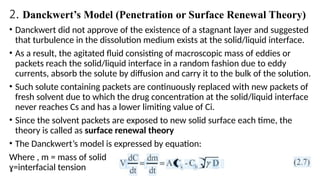
    Suspending Agents/Viscosity Imparters: •Popular suspending agents are hydrophilic polymers like i. Natural gums (acacia, tragacanth, etc.), ii. semisynthetic gums (CMC, MC) iii. synthetic gums • which primarily stabilize the solid drug particles by reducing their rate of settling through an increase in the viscosity of the medium. • These agents and some sugars are also used as viscosity imparters to affect palatability and pourability of solution dosage forms. • Such agents can influence drug absorption in several ways. • The macromolecular gums often form unabsorbable complexes with drugs—for example, sodium CMC forms a poorly soluble complex with amphetamine. • An increase in viscosity by these agents acts as a mechanical barrier to the diffusion of drug from the dosage form into the bulk of GI fluids and from GI fluids to the mucosal lining by forming a viscid layer on the GI mucosa. • They also retard the GI transit of drugs.
  • 70.
    Surfactants • Surfactants arewidely used in formulations as wetting agents, solubilisers, emulsifiers, etc. • Their influence on drug absorption is very complex. • They may enhance or retard drug absorption either by interacting with the drug or the membrane or both. • Mechanisms involved in the increased absorption of drug by use of surfactants include: i. Promotion of wetting ii. Better membrane contact of the drug for absorption. iii. Enhanced membrane permeability of the drug. • Decreased absorption of drug in the presence of surfactants has been suggested to be due to: i. Formation of unabsorbable drug-micelle complex at surfactant concentrations above critical micelle concentration ii. Laxative action induced by a large surfactant concentration
  • 71.
    Complexing Agents • Complexformation has been used to alter the physicochemical and biopharmaceutical properties of a drug. • A complexed drug may have altered stability, solubility, molecular size, partition coefficient and diffusion coefficient. • Basically, such complexes are pharmacologically inert and must dissociate either at the absorption site or following absorption into the systemic circulation. • Several examples where complexation has been used to enhance drug bioavailability are: i. Enhanced dissolution through formation of a soluble complex e.g.ergotamine tartarate-caffeine complex and hydroquinone-digoxin complex. ii. Enhanced lipophilicity for better membrane permeability e.g. caffeine-PABA complex. iii. Enhanced membrane permeability e.g. enhanced GI absorption of heparin (normally not absorbed from the GIT) in presence of EDTA which chelates calcium and magnesium ions of the membrane. • Reasons for poor bioavailability of some complexes are – i. Failure to dissociate at the absorption site ii. Large molecular size of the complex that cannot diffuse through the cell membrane—for example, drug-protein complex
  • 72.
    3. Nature andType of Dosage Form • Apart from the proper selection of drug, clinical success often depends to a great extent on the proper selection of dosage form of that drug. For a given drug, a 2 to 5 fold or perhaps more difference could be observed in the oral bioavailability of a drug depending upon the nature and type of dosage form. • Such a difference is due to the relative rate at which a particular dosage form releases the drug to the biological fluids and the membrane.
  • 73.
    As a generalrule, the bioavailability of a drug from various dosage forms decreases in the following order: Solutions > Emulsions > Suspensions > Capsules > Tablets > Coated Tablets > Enteric Coated Tablets > Sustained Release Products. Thus, absorption of a drug from solution is fastest with least potential for bioavailability problems whereas absorption from a sustained release product is slowest with greatest bioavailability risk.
  • 74.
    i. Solutions: Adrug in a solution (syrups, elixirs, etc.) is most rapidly absorbed since the major rate-limiting step, drug dissolution, is absent. ii. Emulsions: Emulsion dosage forms have been found to be superior to suspensions in administering poorly aqueous soluble lipophilic drugs. Emulsion dosage form presents a large surface area of oil to the GIT for absorption of a drug. Scientists have claimed that a drug administered in oily vehicle can direct the distribution of drug directly into the lymphatic system thereby avoiding the hepatic portal vein and first-pass metabolism. iii. Suspensions: The major rate-limiting step in the absorption of a drug from suspension dosage form is drug dissolution which is generally rapid due to the large surface area of the particles.
  • 75.
    iv. Powders: Thoughpowders are superior to tablets and capsules, they are not in use nowadays due to handling and palatability problems. Major factors to be considered in the absorption of a drug from powders are particle size, polymorphism, wettability, etc. v. Capsules: Powders and granules are popularly administered in hard gelatin capsules whereas viscous fluids and oils in soft elastic shells. Soft elastic capsules as such dissolve faster than hard gelatin capsules and tablets and show better drug availability from oily solutions, emulsions or suspensions of medicaments.
  • 76.
    vi. Tablets: Compressedtablets are the most widely used convenience and cost effective dosage forms. Since dissolution is most rapid from primary drug particles due to their large surface area, disintegration of a tablet into granules and subsequent deaggregation of granules into fine particles is very important.
  • 77.
    vii. Coated Tablets:In addition to factors that influence drug release from compressed tablets, the coating acts as yet another barrier which must first dissolve or disrupt to give way to disintegration and dissolution of tablet. Of the two types of coatings, i. Film coat, which is thin, dissolves rapidly and does not significantly affect drug absorption. ii. The sugar coat which though soluble, is generally tough and takes longer to dissolve. The sealing coat which is generally of shellac, is most deleterious. Press coated tablets may be superior to sugar coated tablets in such cases.
  • 78.
    viii. Enteric-Coated Tablets:Enteric coated tablets have great potential in creating bioavailability problems because the coat dissolves only in the alkaline pH of the intestine and it may take as long as 2 to 4 hours for such a tablet to empty from the stomach into the intestine depending upon the meals and the GI motility.
  • 79.
    Patient related factorsaffecting drug absorption
  • 81.
    1. Age In infants,the gastric pH is high and intestinal surface and blood flow to the GIT is low resulting in altered absorption pattern in comparison to adults. In elderly persons, causes of impaired drug absorption include altered gastric emptying, decreased intestinal surface area and GI blood flow, higher incidents of achlorhydria and bacterial overgrowth in small intestine.
  • 82.
    2. Gastric Emptying Thepassage from stomach to the small intestine, called as gastric emptying. It can also be a rate-limiting step in drug absorption because the major site of drug absorption is intestine. Thus, generally speaking, rapid gastric emptying increases bioavailability of a drug. Rapid gastric emptying is advisable where: 1. A rapid onset of action is desired e.g. sedatives. 2. Dissolution of drug occurs in the intestine e.g. enteric-coated dosage forms. 3. The drugs are not stable in the gastric fluids e.g. penicillin G and erythromycin. 4. The drug is best absorbed from the distal part of the small intestine e.g. vitamin B12. For better dissolution and absorption, the gastric emptying can be promoted by taking the drug on empty stomach.
  • 83.
    Delay in gastricemptying is recommended in particular where: 1. The food promotes drug dissolution and absorption e.g. griseofulvin. 2. Disintegration and dissolution of dosage form is promoted by gastric fluids. 3. The drugs dissolve slowly e.g. griseofulvin.
  • 84.
    Factors influencing gastricemptying: i. Volume of meal: Larger the bulk of the meals, longer the gastric emptying time. ii. Composition of meal: Predictably, the rate of gastric emptying for various food materials is in the following order: carbohydrates >proteins > fats.  Fats promote secretion of bile which too has an inhibitory effect on gastric emptying. Delayed gastric emptying as observed with fatty meals, is beneficial for the absorption of poorly soluble drugs like griseofulvin.
  • 85.
    iii. Physical stateand viscosity of meal: Liquid meals take less than an hour to empty whereas a solid meal may take as long as 6 to 7 hours. Viscous materials empty at a slow rate in comparison to less viscous materials. iv. Temperature of the meal: High or low temperature of the ingested fluid (in comparison to body temperature) reduce the gastric emptying rate. v. Gastrointestinal pH: Gastric emptying is retarded at low stomach pH and promoted at higher or alkaline pH. Chemicals that affect gastrointestinal pH also alter gastric emptying. The inhibitory effect of various acids on gastric emptying decreases with increase in molecular weight and is in the following order - HCl > acetic > lactic > tartaric > citric With alkaline solutions, a low base concentration (1% NaHCO3) increases the gastric emptying rate more than the one of higher concentration (5%).
  • 86.
    vi. Electrolytes andosmotic pressure: Water, isotonic solutions, and solutions of low salt concentration empty the stomach rapidly whereas a higher electrolyte concentration decreases gastric emptying rate. vii. Body posture: Gastric emptying is favoured while standing and by lying on the right side since the normal curvature of the stomach provides a downhill path whereas lying on the left side or in supine position retards it. viii. Emotional state: Stress and anxiety promote gastric motility whereas depression retards it. ix. Exercise: Vigorous physical training retards gastric emptying. x. Disease states: Diseases like gastroenteritis, gastric ulcer, pyloric stenosis, diabetes and hypothyroidism retard gastric emptying. Partial or total gastrectomy, duodenal ulcer and hyperthyroidism promote gastric emptying rate. xi. Drugs: Drugs that retard gastric emptying include poorly soluble antacids (aluminium hydroxide), anticholinergics (atropine,propantheline), narcotic analgesics (morphine) and tricyclic antidepressants (imipramine, amitriptyline). Metoclopramide, domperidone and cisapride (prokinetic agents) stimulate gastric emptying.
  • 87.
    3. Intestinal Transit •Since small intestine is the major site for absorption of most drugs, long intestinal transit time is desirable for complete drug absorption .
  • 88.
    Delayed intestinal transitis desirable for: 1. Drugs that dissolve or release slowly from their dosage form (sustained- release products) or when the ratio of dose to solubility is high e.g. chlorothiazide. 2. Drugs that dissolve only in the intestine (enteric-coated formulations). 3. Drugs which are absorbed from specific sites in the intestine (several B vitamins, lithium carbonate, etc.). 4. When the drug penetrates the intestinal mucosa very slowly e.g. acyclovir. 5. When absorption of drug from the colon is minimal.
  • 89.
    4. Presystemic Metabolism/First-PassEffects For a drug administered orally, the 3 main reasons for its decreased bioavailability are: 1. Decreased absorption (owing to adsorption, precipitation,complexation and poor solubility). 2. Destabilisation or destruction of drug. 3. First-pass/presystemic metabolism
  • 90.
    • Before adrug reaches blood circulation, it has to pass for the first time through organs of elimination namely the GIT and the liver. • The loss of drug through biotransformation by such eliminating organs during its passage to systemic circulation is called as first-pass or presystemic metabolism. • The diminished drug concentration or rarely, complete absence of the drug in plasma after oral administration is indicative of first-pass effects. • The 3 primary systems which affect presystemic metabolism of a drug are : 1. Luminal enzymes – the metabolism by these enzymes are further categorised into two – (a) Digestive enzymes, and (b) Bacterial enzymes. 2. Gut wall enzymes/mucosal enzymes. 3. Hepatic enzymes.
  • 92.
    1. Digestive enzymes:These are the enzymes present in the gut fluids and include enzymes from intestinal and pancreatic secretions. The pancreatic secretions contains hydrolases which hydrolyse ester drugs like chloramphenicol palmitate into active chloramphenicol, and peptidases which split amide linkages and inactivate protein/polypeptide drugs. Thus, one of the approaches to effect oral absorption of peptides is to deliver them to colon which lack peptidases.
  • 93.
    2. Bacterial enzymes:The GI microflora is present in small amount in stomach and small intestine and is rich in colon. Hence, most orally administered drugs remain unaffected by them. The colonic microbes generally render a drug more active or toxic on biotransformation—for example sulphasalazine, a drug used in ulcerative colitis, is hydrolysed to sulphapyridine and 5-amino salicylic acid by the microbial enzymes of the colon. An important role of intestinal microflora is that in enterohepatic cycling. Their enzymes hydrolyse the conjugates of drugs actively secreted via bile such as glucuronides of digoxin and oral contraceptives. The free drugs are reabsorbed into the systemic circulation.
  • 94.
    3. Gut wallenzymes: Also called as mucosal enzymes, they are present in stomach, intestine and colon. Alcohol dehydrogenase (ADH) is an enzyme of stomach mucosa that inactivates ethanol. Intestinal mucosa contains both phase I and phase II (predominant) enzymes, e.g. sulphation of ethinyl oestradiol and isoprenaline. The colonic mucosa also contain both phase I and phase II enzymes. However, it is only the enzymes of the proximal small intestine that are most active. 4. Hepatic enzymes: Several drugs undergo first-pass hepatic metabolism, the highly extracted ones being isoprenaline, propranolol, alprenolol, pentoxifylline, nitroglycerine, diltiazem, nifedipine, lidocaine, morphine, etc.
  • 95.
    5. Disease States Severaldisease states can influence the rate and extent of drug absorption. The 3 major classes of disease states that can influence the bioavailability of a drug are: 1. Gastrointestinal diseases, 2. Cardiovascular diseases, and 3. Hepatic diseases
  • 96.
    Gastrointestinal diseases (a) AlteredGI motility: (discussed earlier) (b) Gastrointestinal diseases and infections: The influence of achlorhydria(decreased gastric acid secretion and increased stomach pH) on gastric emptying and drug absorption, especially that of acidic drugs (decreased absorption, e.g. aspirin) has been studied. Two of the intestinal disorders that influence drug availability are i. celiac disease (characterized by destruction of villi and microvilli) : Abnormalities associated with celiac disease include • increased gastric emptying rate and GI permeability, • altered intestinal drug metabolism, • steatorrhea (impaired secretion of bile thus affecting absorption of lipophilic drugs and vitamins) and • reduced enterohepatic cycling of bile salts, all of which can significantly impair drug absorption. ii. Crohn’s disease. Conditions associated with Crohn’s disease that can alter absorption pattern are altered gut wall microbial flora, decreased gut surface area and intestinal transit rate.
  • 97.
    (c) Gastrointestinal surgery:Gastrectomy can result in drug dumping in the intestine, osmotic diarrhoea and reduced intestinal transit time. Intestinal surgery also influences drug absorption for predictable reasons.
  • 98.
    2. Cardiovascular diseases:Several changes associated with congestive cardiac failure influence bioavailability of a drug viz. oedema of the intestine, decreased blood flow to the GIT and gastric emptying rate and altered GI pH,secretions and microbial flora. 3. Hepatic diseases: Disorders such as hepatic cirrhosis influence bioavailability mainly of drugs that undergo considerable first-pass hepatic metabolism e.g. propranolol; enhanced bioavailability is observed in such cases.
  • 99.
    ABSORPTION OF DRUGSFROM NON-PER OS EXTRAVASCULAR ROUTES Drug absorption from all non-oral extravascular sites is governed by the same factors that influence absorption from GIT like  the physicochemical properties of drug  formulation factors  anatomic, physiologic and pathologic characteristics of the patient. This is so because the barrier to transport of drugs into the systemic circulation from all such sites is a lipoidal membrane similar to the GI barrier and the major mechanism in the absorption is passive diffusion. One of the major advantages of administering drugs by non-invasive transmucosal routes such as nasal, buccal, rectal, etc. is that greater systemic availability is attainable for drugs normally subjected to metabolism Moreover, peptide and protein drugs can also be delivered by such routes.
  • 101.
    1. Buccal/Sublingual Administration Thetwo sites for oral mucosal delivery of drugs are: 1. Sublingual route: The drug is placed under the tongue and allowed to dissolve. 2. Buccal route: The medicament is placed between the cheek and the gum. The barrier to drug absorption from these routes is the epithelium of oral mucosa. Passive diffusion is the major mechanism for absorption of mostdrugs; nutrients may be absorbed by carrier-mediated processes. Some of the advantages of these routes are: 1. Rapid absorption and higher blood levels due to high vascularisation of the region and therefore particularly useful for administration of antianginal drugs. 2. No first-pass hepatic metabolism. 3. No degradation of drugs such as that encountered in the GIT 4. Presence of saliva facilitates both drug dissolution and its subsequent permeation by keeping the oral mucosa moist.
  • 102.
    2. Rectal Administration Despiteits diminished popularity, the rectal route of drug administration is still an important route for children and old patients. The drugs may be administered as solutions (microenemas) or suppositories.  Absorption is more rapid from solutions than from suppositories but is more variable in comparison to oral route. Absorption of drugs from the lower half of rectum bypasses presystemic hepatic metabolism. Drugs administered by this route include aspirin, paracetamol, theophylline, few barbiturates, etc.
  • 103.
    3. Topical Administration Skinis the largest organ of the body weighing approximately 2 Kg and 2 m2 in area and receives about 1/3rd of total blood circulating through the body. Majority of drugs applied topically are meant to exert their effect locally. When topically applied drugs are meant to exert their effects systemically, the mode of administration is called as percutaneous or transdermal delivery. Percutaneous absorption occurs only if the topically applied drug permeates the dermal capillaries and enters the blood stream.
  • 104.
    Drugs that areadministered percutaneously include nitro-glycerine, lidocaine, betamethasone, oestradiol, testosterone, etc. The route is particularly useful for drugs with low oral availability and short duration of action; the effect of the latter category of drugs is prolonged because percutaneous absorption is a slow process. Certain ionic drugs are not absorbed transdermally despite the use of chemical penetration enhancers in the topical formulations. Percutaneous absorption of such drugs can be affected by novel techniques such as – i. Iontophoresis: implies delivery of ionic drugs into the body by means of an electric current. ii. Phonophoresis: movement of drug molecules through the skin under the influence of ultrasound.
  • 105.
    4. Intramuscular Administration Absorptionof drugs from i.m. sites is relatively rapid but much slower in comparison to i.v. injections. Factors that determine rate of drug absorptionfrom i.m. sites are: 1. Vascularity of the injection site:the decreasing order of blood flow rate to muscular tissues in which drugs are usually injected is: Arm (deltoid) > Thigh (vastus lateralis) > Buttocks (gluteus maximus). Since blood flow rate is often the rate-limiting step in absorption of drugs from i.m. sites, most rapid absorption is from deltoid muscles and slowest from gluteal region. 2. Lipid solubility and ionisation of drug 3. Molecular size of the drug 4. Volume of injection and drug concentration 5. pH, composition and viscosity of injection vehicle
  • 106.
    5. Sub cutaneousabsorption All factors that influence i.m. drug absorption are also applicable to absorption from subcutaneous site. Generally, absorption of drugs from a s.c site is slower than that from i.m. sites due to poor perfusion, But it is of particular importance for the administration of drugs for which a rapid response is not desired and for drugs that degrade when taken orally e.g.insulin and sodium heparin. The rate of absorption of a drug from subcutaneous site can be increased in 2 ways: 1. Enhancing blood flow to the injection site 2. Increasing the drug-tissue contact area
  • 107.
    6. Pulmonary Administration Alldrugs intended for systemic effects can be administered by inhalation since the large surface area of the alveoli, high permeability of the alveolar epithelium and rich perfusion permit extremely rapid absorption just like exchange of gases between the blood and the inspired air. However, the route has been limited for administering drugs that affect pulmonary system such as  bronchodilators (salbutamol),  anti-inflammatory steroids(beclomethasone) and  antiallergics (cromolyn).  Sometimes, the patients’ inability to inhale a sufficient amount of drug limits drug delivery to lungs.
  • 108.
    7. Intranasal Administration Thenasal route is becoming increasingly popular for systemic delivery especially of some peptide and protein drugs. Drug absorption from nasal mucosa is as rapid as observed after parenteral administration because of its rich vasculature and high permeability. The route is otherwise used for drugs to treat local symptoms like nasal congestion, rhinitis, etc.