
BIOMIMICRY & 3D
PRINTING
Workshop Instructor: Nettrice R. Gaskins, Ph.D.
STEAM Lab Director
Boston Arts Academy
WHAT IS BIOMIMICRY?
The design and production of materials, structures, and
systems that are modeled on biological entities and
processes.
Nature & Natural Processes
Dragonfly
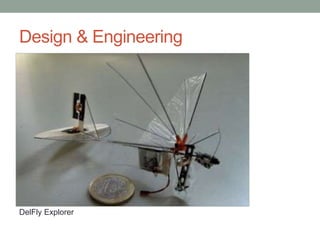
Design & Engineering
DelFly Explorer
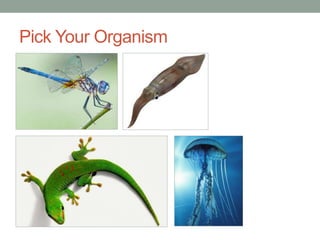
Pick Your Organism
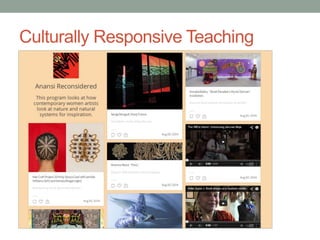
Culturally Responsive Teaching
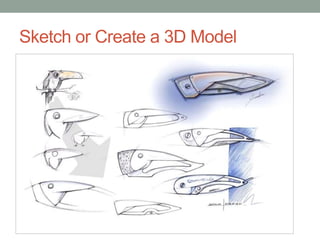
Sketch or Create a 3D Model
WHAT ARE THE STEPS TO
3D PRINT?
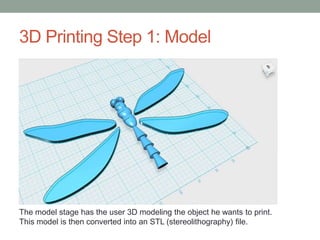
3D Printing Step 1: Model
The model stage has the user 3D modeling the object he wants to print.
This model is then converted into an STL (stereolithography) file.
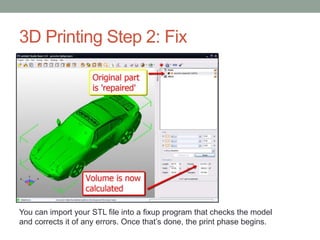
3D Printing Step 2: Fix
You can import your STL file into a fixup program that checks the model
and corrects it of any errors. Once that’s done, the print phase begins.
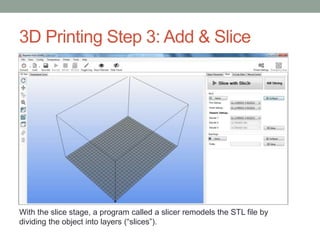
3D Printing Step 3: Add & Slice
With the slice stage, a program called a slicer remodels the STL file by
dividing the object into layers (“slices”).
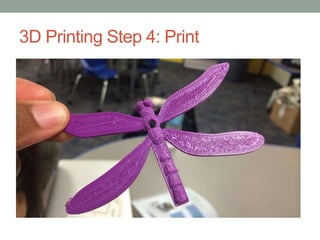
3D Printing Step 4: Print
WHAT IS A 3D PRINTER?
Invented in the mid-1980s, it is a printer that uses
plastic, wax, resin, paper, gold, titanium—a whole host
of materials—instead of ink to create a solid, three-
dimensional object.
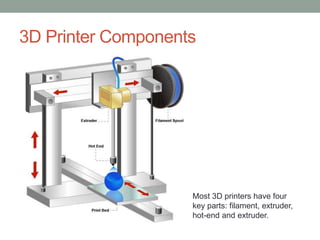
3D Printer Components
Most 3D printers have four
key parts: filament, extruder,
hot-end and extruder.
LIVE DEMO
URLs
Biomimicry 3.8: http://biomimicry.net
Biomimicry Projects: http://www.greenbiz.com/blog/2014/01/08/best-2013-
biomimicry-robots
Anansi Reconsidered: Creative, Critical, and Connected Making in
Interdisciplinary Education: http://museum.spelman.edu/events/anansi-
reconsidered-creative-critical-connected-making-interdisciplinary-education
Anansi Reconsidered (Tumblr page): http://anansireconsidered.tumblr.com
3D Printing Basics: http://www.supermediastore.com/blog/article/nitty-gritty-
3d-printing

Biomimicry & 3D Printing

  • 1.
    BIOMIMICRY & 3D PRINTING WorkshopInstructor: Nettrice R. Gaskins, Ph.D. STEAM Lab Director Boston Arts Academy
  • 2.
    WHAT IS BIOMIMICRY? Thedesign and production of materials, structures, and systems that are modeled on biological entities and processes.
  • 3.
    Nature & NaturalProcesses Dragonfly
  • 4.
  • 5.
  • 6.
  • 7.
    Sketch or Createa 3D Model
  • 8.
    WHAT ARE THESTEPS TO 3D PRINT?
  • 9.
    3D Printing Step1: Model The model stage has the user 3D modeling the object he wants to print. This model is then converted into an STL (stereolithography) file.
  • 10.
    3D Printing Step2: Fix You can import your STL file into a fixup program that checks the model and corrects it of any errors. Once that’s done, the print phase begins.
  • 11.
    3D Printing Step3: Add & Slice With the slice stage, a program called a slicer remodels the STL file by dividing the object into layers (“slices”).
  • 12.
  • 13.
    WHAT IS A3D PRINTER? Invented in the mid-1980s, it is a printer that uses plastic, wax, resin, paper, gold, titanium—a whole host of materials—instead of ink to create a solid, three- dimensional object.
  • 14.
    3D Printer Components Most3D printers have four key parts: filament, extruder, hot-end and extruder.
  • 16.
  • 17.
    URLs Biomimicry 3.8: http://biomimicry.net BiomimicryProjects: http://www.greenbiz.com/blog/2014/01/08/best-2013- biomimicry-robots Anansi Reconsidered: Creative, Critical, and Connected Making in Interdisciplinary Education: http://museum.spelman.edu/events/anansi- reconsidered-creative-critical-connected-making-interdisciplinary-education Anansi Reconsidered (Tumblr page): http://anansireconsidered.tumblr.com 3D Printing Basics: http://www.supermediastore.com/blog/article/nitty-gritty- 3d-printing

Editor's Notes

  • #4 Researchers at TU Delft University have designed a prototype ultralight flying robot called the DelFly Explorer. This micro air vehicle (MAV) is the first of its kind to move by flapping wings. It weighs 20 grams and performs takeoff and obstacle avoidance autonomously. It is equipped with two camera eyes that provide binocular vision for judging distances, and can flap its double wings for about nine minutes on a tiny battery.
  • #5 Researchers at TU Delft University have designed a prototype ultralight flying robot called the DelFly Explorer. This micro air vehicle (MAV) is the first of its kind to move by flapping wings. It weighs 20 grams and performs takeoff and obstacle avoidance autonomously. It is equipped with two camera eyes that provide binocular vision for judging distances, and can flap its double wings for about nine minutes on a tiny battery.
  • #7 Anansi is a Ghanaian folk hero and spider-man who is the central character in countless West African and Caribbean fables. He proves an influential muse for the eight Black women artists who comprise the Spelman College Museum of Fine Art exhibition Brides of Anansi: Fiber and Contemporary Art. In November, I will join artists Saya Woolfalk and Xenobia Bailey in conversation to look at how contemporary women artists look at STEAM and biomimicry.
  • #10 The user can develop the model by scratch or by downloading a pre-developed blueprint from a website, such as Thingiverse.
  • #11 Your 3D model should be “water tight.” "Watertight" is a term used to describe a 3D mesh suitable for 3D printing. This is how you can make sure there are no holes, cracks or missing features specified in a file which would render it unsuitable for printing.
  • #12 A printer works by producing layer upon layer until those layers become a complete object.
  • #13 3D printers measure resolution by tenths to hundredths of a millimeter (mm). The more minute the resolution, the longer the printing process. A small object may take 10-12 minutes, while larger object may take 1-2 hours to print. The more precise the print the more expensive the printer. This printer is only able to print 1 mm at a time.
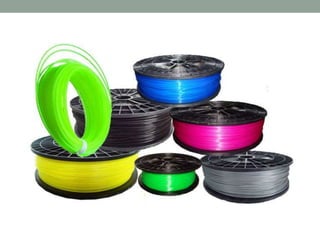
  • #15 The filament is to a 3D printer what ink and toner are to 2D printers. Filament is commonly made of a plastic thread wrapped around a spool, but it can also be made up of other materials. The extruder is the component that delivers (“extrudes”) the filament to the hot-end, the nozzle section. (The extruder and hot-end are often combined.) The filament is then produced in layers on the print bed.
  • #16 PLA or Poly-lactic acid is the type of filament we use, that is both biodegradable and available in soft or hard form.