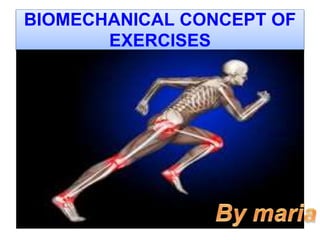
BIOMECHANICAL CONCEPT OF
EXERCISES
What is Biomechanics?
Biomechanics: The study of movement.
Knowledge of joints, muscle structure, and their
possible actions lead to a better understanding
of what occurs during the execution of strength
and other exercises.

Biomechanics: The science concerned with the
internal and external forces acting on the human
body and the effects produced by these forces.
Stability is the act
of maintaining
your body to
ensure safety and
effectiveness
when using free
weights

Stability

Maintaining a
stable (balanced)
body is necessary
to ensure safety
during exercise
execution.
Stability also helps
produce the
desired results
when using free
weights

when doing an
overhead press the
muscles of the legs
and trunk must
contract to hold you
in place

increasing stability is
to bend your knees in
order to lower your
center of gravity
(where your weight is
concentrated)

Foot placement
also plays an
important role
Components of Force
1. The magnitude or how much force is applied
to the dumbbells, barbells, or machine
handles
2. The force must have direction: The way in
which the force is applied.
3. The point of application of the force: Where
the force is applied on the body or
implement being used. It plays a role in many
exercises from the overhead press to the
squat
4. The line of action or line of force
Angle of Muscle Pull
Inertia
Inertia is based on Newton’s first law of motio
1. Resting inertia means that when an object is
at rest it tends to stay at rest unless acted
upon by some outside force.
2. Moving inertia means that when an object is
in motion it will remain in motion unless
acted upon by some outside force
The Relationship between Force,
Mass and Acceleration
• Newton’s Second Law of Motion deals with
force and its relationship to mass and
acceleration. In essence, in order to create a
force you must place a mass into motion with
acceleration and a change in velocity.
Work
• The actual amount of work that you do is
measured by the formula W = F x D, where W=
work, F= force, and D= distance or
displacement of the object being move.
Power
• power is defined as the work done in a unit of
time. To calculate it, you must first consider
the time involved in executing the movement
powerlifting, more precise Mastery over the Weight is
required. Lets look at things that may disqualify you:
1.Raising your butt 2.Uneven lockout 3.Dipping of the
bar 4.Heaving of the bar 5.Moving your feet 6.Beating
the Press Command 7.Beating the Rack
Command 8.Pronounced uneven extension during the
Lift 9.Rules about head movement 10.Placement of the
bar on your chest
• Example: the squat and the deadlift, the bench press
POWER LIFTING
Weightlifting is the more commonly known
sport of these two strength sport giants
• the clean
• jerk and the snatch
Weightlifting requires an extreme amount of
speed and flexibility along with strength.
WEIGHT LIFTING
Equal and Opposite Reactions
• Newton’s third law of motion, known as the
equal and opposite reaction principle, applies
to weightlifting and bodybuilding exercises
Levers
1. First-Class Levers
The first-class lever is similar to
the seesaw, in that it has its
fulcrum between the force
and the resistance
Levers

First-Class Levers
The first-class lever
is similar to the
seesaw, in that it
has its fulcrum
between the force
and the resistance
Second-Class Lever In
the second-class
lever, the weight
(resistance) is
distributed between
the axis of rotation
(fulcrum) and the
application of force.
Third-Class Lever
In the third-class
lever the force is
applied between the
fulcrum and the
resistance.
Biomechanical concept of exercise

Biomechanical concept of exercise

  • 1.
  • 2.
    What is Biomechanics? Biomechanics:The study of movement. Knowledge of joints, muscle structure, and their possible actions lead to a better understanding of what occurs during the execution of strength and other exercises. Biomechanics: The science concerned with the internal and external forces acting on the human body and the effects produced by these forces.
  • 3.
    Stability is theact of maintaining your body to ensure safety and effectiveness when using free weights Stability Maintaining a stable (balanced) body is necessary to ensure safety during exercise execution. Stability also helps produce the desired results when using free weights when doing an overhead press the muscles of the legs and trunk must contract to hold you in place increasing stability is to bend your knees in order to lower your center of gravity (where your weight is concentrated) Foot placement also plays an important role
  • 4.
    Components of Force 1.The magnitude or how much force is applied to the dumbbells, barbells, or machine handles 2. The force must have direction: The way in which the force is applied. 3. The point of application of the force: Where the force is applied on the body or implement being used. It plays a role in many exercises from the overhead press to the squat 4. The line of action or line of force
  • 5.
  • 7.
    Inertia Inertia is basedon Newton’s first law of motio 1. Resting inertia means that when an object is at rest it tends to stay at rest unless acted upon by some outside force. 2. Moving inertia means that when an object is in motion it will remain in motion unless acted upon by some outside force
  • 9.
    The Relationship betweenForce, Mass and Acceleration • Newton’s Second Law of Motion deals with force and its relationship to mass and acceleration. In essence, in order to create a force you must place a mass into motion with acceleration and a change in velocity.
  • 13.
    Work • The actualamount of work that you do is measured by the formula W = F x D, where W= work, F= force, and D= distance or displacement of the object being move.
  • 15.
    Power • power isdefined as the work done in a unit of time. To calculate it, you must first consider the time involved in executing the movement
  • 16.
    powerlifting, more preciseMastery over the Weight is required. Lets look at things that may disqualify you: 1.Raising your butt 2.Uneven lockout 3.Dipping of the bar 4.Heaving of the bar 5.Moving your feet 6.Beating the Press Command 7.Beating the Rack Command 8.Pronounced uneven extension during the Lift 9.Rules about head movement 10.Placement of the bar on your chest • Example: the squat and the deadlift, the bench press
  • 17.
  • 18.
    Weightlifting is themore commonly known sport of these two strength sport giants • the clean • jerk and the snatch Weightlifting requires an extreme amount of speed and flexibility along with strength.
  • 19.
  • 20.
    Equal and OppositeReactions • Newton’s third law of motion, known as the equal and opposite reaction principle, applies to weightlifting and bodybuilding exercises
  • 21.
    Levers 1. First-Class Levers Thefirst-class lever is similar to the seesaw, in that it has its fulcrum between the force and the resistance
  • 22.
    Levers First-Class Levers The first-classlever is similar to the seesaw, in that it has its fulcrum between the force and the resistance
  • 23.
    Second-Class Lever In thesecond-class lever, the weight (resistance) is distributed between the axis of rotation (fulcrum) and the application of force.
  • 24.
    Third-Class Lever In thethird-class lever the force is applied between the fulcrum and the resistance.