D 
BA 
D 
D 
1C 
2B 
3D 
4D 
5C 
6B 
Answers 
Objective Questions 
7 
8 
9 
10 
ll 
Structured Question 
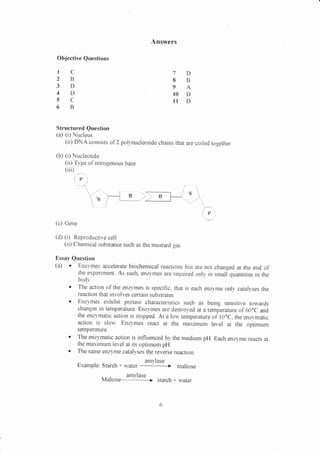
(a) (i) Nucleus 
(ir) DNA consists of 2 polynucleotide chains that 
(b) (i) Nucleotide 
(ii) Tvpe of nitrogenous base 
(iii) 
are coiled together 
,F 
(c) Gene 
(d) (i) Reproductive cell 
(ii) Chemical substance such as the mustard gas 
Essay Question (a) o Enz--vmes accelerate biochemical reactions but are not 
the experiment. As such, enzymes are required only in 
changed at the end of 
small quantities in the 
body. o The action of the enzymes is specific. that 
reaction that involves certain substrates. 
ts each enz_yme onlS'catalyses the 
c Enzymes exhibit protein characteristics such as being sensitive towards 
changes in temperature. Enzymes are destroyed at a temperature of 60"c and 
the enzymatic action is stopped. At a low temperature of 10.c, the enzymatic 
action is slorv. Enry-mes react at the rnaximum level at the opiirrlo-temperature. 
o The erzymatic action is influenced by the medium pH. Each enzvme reacts at 
the maximum level at its optimum pH. r The same enzyme catalyses the reverse reaction. 
Exampie: Starch + water amylase t maitose 
amr-lase Maltose ' > starch*water
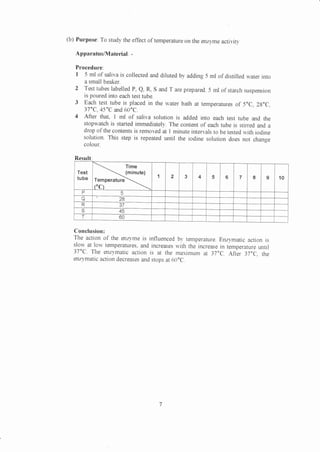
(b) Purpose: To siudy the effect of temperature on the enz),rne activity 
Apparatus/Material: - 
Procedure. 
I 5 rnl of saliva is collected and diluted by adding 5 ml of distilled water into 
a small beaLer. 2 Test tubes labelled P, Q, R, S and T are prepared. 
is poured into each test tube. 
5 nrl ofstalch suspension 
3 Each test tube is placed in the water bath at temperatures of 5oc, 2g"c, 
37'C,45oC and 60"C. 4 After that. I ml of saliva solution is added into each test tube and the 
stopwatch is started immediately. The content of each tube is stirred and a 
drop of the contents is removed at I minute interr,'als to be tested with iodine 
solution. This step is repeated until the iodine solution does not change 
colour. 
Result: 
Test 
tube 
---- --- Time 
{minute) 
Temperature---r.- 
(oC) 
1 2 3 4 5 6 7 8 o 10 
P t 
o 28 
R 37 
e 45 
T 60 
Conclusion: 
The action of the enzyme is influenced bv temperature. Enzymatic action is 
llo-tl ut low temperatures, and increases u'ith the increase in temperature until 37"c. The enzymatic action is at ihe maximum at 37"c. Aft-er 37.c. the 
enzyrnatic action decreases and stops at 60"C.
Objective Questions 1D 
2B 
3C 
4B 
5A 
6B 
7C 
8B 
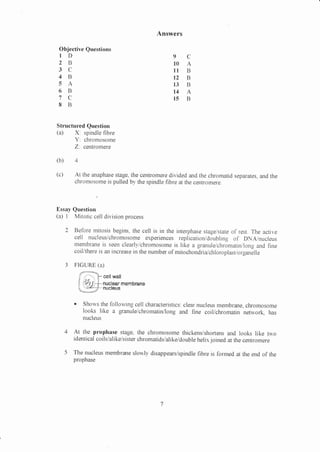
Structured Question (a) X: spindle fibre 
Y: chromosome 
Z: centromere 
Answers 
9 
tn tl, 
11 
12 
13 
t4 
15 
C 
A 
B 
B 
B 
A 
B 
(b) 
(c) 
4 
At the anaphase stage. the centromere divided and the chromatid separates, and the 
chromosome is pulled by the spindle fibre at the centromere. 
Essay Question 
(a) 1 Mitotic cell division process 
2 Before mitosis begins, the cell is in the interphase stage/state of rest. The acii1.e cell nucleus/chromosome experiences replication/doubling of DNA/nucleus 
membrane is seen clearl,v/chromosome is like a granule/chromatin/long and fine 
coil/there is an increase rn ihe number of mitochondriaichloroplast/organille 
3 FIGURE (a) 
AFcellwall 
ltlt =t'4-% lllf nuctear membrane nucleus 
Shows the following cell characteristics: clear nucleus membrane, chromosome 
looks like a granule/chromatir,.,tong and fine coil/chiomatin netrvork. has 
nucleus 
At the prophase siage, the chromosorne thickens/shortens anrl looks like two 
identical coils/alike/sister chromatids/alike/double helix joined at the centromere 
The nucieus membrane slowly disappears/spindie fibre is formed al the end of the 
prophase
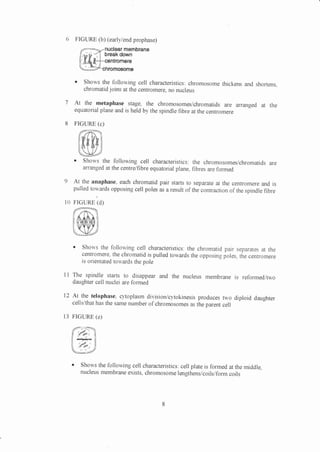
6 FIGURE (b) (early/end prophase) 
l0 
nuclear membrane 
break down 
centromeie 
chromosome 
r Shows the following cell characteristics: chromosome thickens and shortens-chromatid 
ioins at the centromere, no nucleus 
At the metaphase stage, the chromosomes/chromatids are arranged at the 
equatorial plane and is held by the spindle fibre at the centromere 
FIGURE (c) 
r Shows the follou'ing cell characteristics: the chromosomes/chromatids are 
arranged at the centre/fibre equatorial plane, fibres are formed 
At the anaphase, each chromatid pair starts to separate at the centromere and is 
pulled tou'ards opposing cell poles as a result of the contraction of the spindle fibre 
FIGURE (d) 
o Shows the following cell characteristics: the chromatid pair separates at the 
centromere, the chromatid is pulled towards the opposing poles, the centromere 
is orientated towards the pole 
The spindle starts to disappear and the nucleus membrane is reformed/trvo 
daughter cell nuclei are formed 
At the telophase, c1'toplasm division/cl.tokinesis produces two diploid daughter 
cells/that has the same number of chromosomes as the parent cell 
FIGURE (e) 
I Shows the following cell characteristics: cell plate is formed at the middle, 
nucleus membrane exists, chromosome lengthens/coils/form coils 
ll 
I2 
13
(b) (i) The process of producing a new individual from a parent without involving 
fertilisation between gametes. 
(iD . Cell division through mitosis on the multi-cell organism can increase the 
number of cell for grou,ttr, and to replace damaged or dead cells. o unicellular organisms (Amoeba sp. and pqramecium sp.), reproduces by 
splitting into two through mitosis. e Division through mitosis maintains the number of diploid chromosomes in the 
daughter cell, and as such, the new organism that is formed will have the same 
characteristics as the parent. . Mitosis is used in agriculture to produce flowering plants arrd fruit plants in a 
larger quantity and at a higher qualiqv.

Biology form 4 chapter 4 5

  • 1.
    D BA D D 1C 2B 3D 4D 5C 6B Answers Objective Questions 7 8 9 10 ll Structured Question (a) (i) Nucleus (ir) DNA consists of 2 polynucleotide chains that (b) (i) Nucleotide (ii) Tvpe of nitrogenous base (iii) are coiled together ,F (c) Gene (d) (i) Reproductive cell (ii) Chemical substance such as the mustard gas Essay Question (a) o Enz--vmes accelerate biochemical reactions but are not the experiment. As such, enzymes are required only in changed at the end of small quantities in the body. o The action of the enzymes is specific. that reaction that involves certain substrates. ts each enz_yme onlS'catalyses the c Enzymes exhibit protein characteristics such as being sensitive towards changes in temperature. Enzymes are destroyed at a temperature of 60"c and the enzymatic action is stopped. At a low temperature of 10.c, the enzymatic action is slorv. Enry-mes react at the rnaximum level at the opiirrlo-temperature. o The erzymatic action is influenced by the medium pH. Each enzvme reacts at the maximum level at its optimum pH. r The same enzyme catalyses the reverse reaction. Exampie: Starch + water amylase t maitose amr-lase Maltose ' > starch*water
  • 2.
    (b) Purpose: Tosiudy the effect of temperature on the enz),rne activity Apparatus/Material: - Procedure. I 5 rnl of saliva is collected and diluted by adding 5 ml of distilled water into a small beaLer. 2 Test tubes labelled P, Q, R, S and T are prepared. is poured into each test tube. 5 nrl ofstalch suspension 3 Each test tube is placed in the water bath at temperatures of 5oc, 2g"c, 37'C,45oC and 60"C. 4 After that. I ml of saliva solution is added into each test tube and the stopwatch is started immediately. The content of each tube is stirred and a drop of the contents is removed at I minute interr,'als to be tested with iodine solution. This step is repeated until the iodine solution does not change colour. Result: Test tube ---- --- Time {minute) Temperature---r.- (oC) 1 2 3 4 5 6 7 8 o 10 P t o 28 R 37 e 45 T 60 Conclusion: The action of the enzyme is influenced bv temperature. Enzymatic action is llo-tl ut low temperatures, and increases u'ith the increase in temperature until 37"c. The enzymatic action is at ihe maximum at 37"c. Aft-er 37.c. the enzyrnatic action decreases and stops at 60"C.
  • 3.
    Objective Questions 1D 2B 3C 4B 5A 6B 7C 8B Structured Question (a) X: spindle fibre Y: chromosome Z: centromere Answers 9 tn tl, 11 12 13 t4 15 C A B B B A B (b) (c) 4 At the anaphase stage. the centromere divided and the chromatid separates, and the chromosome is pulled by the spindle fibre at the centromere. Essay Question (a) 1 Mitotic cell division process 2 Before mitosis begins, the cell is in the interphase stage/state of rest. The acii1.e cell nucleus/chromosome experiences replication/doubling of DNA/nucleus membrane is seen clearl,v/chromosome is like a granule/chromatin/long and fine coil/there is an increase rn ihe number of mitochondriaichloroplast/organille 3 FIGURE (a) AFcellwall ltlt =t'4-% lllf nuctear membrane nucleus Shows the following cell characteristics: clear nucleus membrane, chromosome looks like a granule/chromatir,.,tong and fine coil/chiomatin netrvork. has nucleus At the prophase siage, the chromosorne thickens/shortens anrl looks like two identical coils/alike/sister chromatids/alike/double helix joined at the centromere The nucieus membrane slowly disappears/spindie fibre is formed al the end of the prophase
  • 4.
    6 FIGURE (b)(early/end prophase) l0 nuclear membrane break down centromeie chromosome r Shows the following cell characteristics: chromosome thickens and shortens-chromatid ioins at the centromere, no nucleus At the metaphase stage, the chromosomes/chromatids are arranged at the equatorial plane and is held by the spindle fibre at the centromere FIGURE (c) r Shows the follou'ing cell characteristics: the chromosomes/chromatids are arranged at the centre/fibre equatorial plane, fibres are formed At the anaphase, each chromatid pair starts to separate at the centromere and is pulled tou'ards opposing cell poles as a result of the contraction of the spindle fibre FIGURE (d) o Shows the following cell characteristics: the chromatid pair separates at the centromere, the chromatid is pulled towards the opposing poles, the centromere is orientated towards the pole The spindle starts to disappear and the nucleus membrane is reformed/trvo daughter cell nuclei are formed At the telophase, c1'toplasm division/cl.tokinesis produces two diploid daughter cells/that has the same number of chromosomes as the parent cell FIGURE (e) I Shows the following cell characteristics: cell plate is formed at the middle, nucleus membrane exists, chromosome lengthens/coils/form coils ll I2 13
  • 5.
    (b) (i) Theprocess of producing a new individual from a parent without involving fertilisation between gametes. (iD . Cell division through mitosis on the multi-cell organism can increase the number of cell for grou,ttr, and to replace damaged or dead cells. o unicellular organisms (Amoeba sp. and pqramecium sp.), reproduces by splitting into two through mitosis. e Division through mitosis maintains the number of diploid chromosomes in the daughter cell, and as such, the new organism that is formed will have the same characteristics as the parent. . Mitosis is used in agriculture to produce flowering plants arrd fruit plants in a larger quantity and at a higher qualiqv.