04/25/16
Biology 2Biology 2
AQA Additional ScienceAQA Additional Science
04/25/16
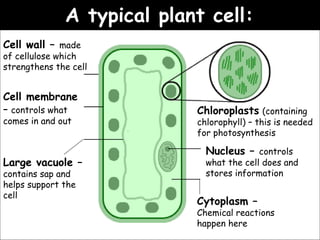
A typical plant cell:A typical plant cell:
Cell wall – made
of cellulose which
strengthens the cell
Cell membrane
– controls what
comes in and out
Nucleus – controls
what the cell does and
stores information
Large vacuole –
contains sap and
helps support the
cell
Cytoplasm –
Chemical reactions
happen here
Chloroplasts (containing
chlorophyll) – this is needed
for photosynthesis
04/25/16
4)
1)
5)
3)
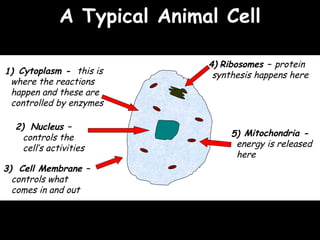
A Typical Animal CellA Typical Animal Cell
Ribosomes – protein
synthesis happens here
Mitochondria -
energy is released
here
Cell Membrane –
controls what
comes in and out
Cytoplasm - this is
where the reactions
happen and these are
controlled by enzymes
2) Nucleus –
controls the
cell’s activities
04/25/16
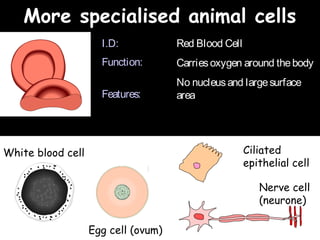
More specialised animal cellsMore specialised animal cells
Red Blood Cell
Carriesoxygen around thebody
No nucleusand largesurface
area
I.D:
Function:
Features:
White blood cell
Egg cell (ovum)
Ciliated
epithelial cell
Nerve cell
(neurone)
04/25/16
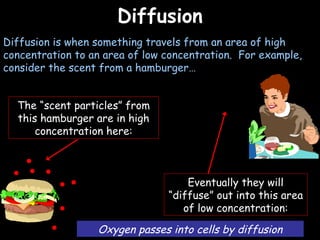
DiffusionDiffusion
Diffusion is when something travels from an area of high
concentration to an area of low concentration. For example,
consider the scent from a hamburger…
The “scent particles” from
this hamburger are in high
concentration here:
Eventually they will
“diffuse” out into this area
of low concentration:
Oxygen passes into cells by diffusion
04/25/16
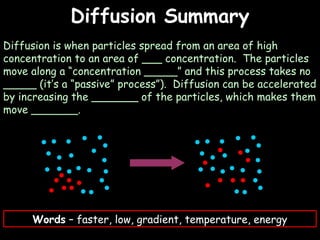
Diffusion SummaryDiffusion Summary
Diffusion is when particles spread from an area of high
concentration to an area of ___ concentration. The particles
move along a “concentration _____” and this process takes no
_____ (it’s a “passive” process”). Diffusion can be accelerated
by increasing the _______ of the particles, which makes them
move _______.
Words – faster, low, gradient, temperature, energy
04/25/16
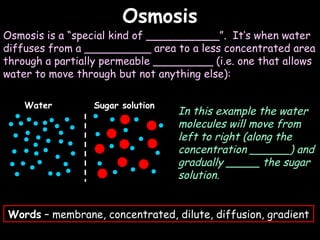
OsmosisOsmosis
Osmosis is a “special kind of ___________”. It’s when water
diffuses from a __________ area to a less concentrated area
through a partially permeable _________ (i.e. one that allows
water to move through but not anything else):
Water Sugar solution
In this example the water
molecules will move from
left to right (along the
concentration ______) and
gradually _____ the sugar
solution.
Words – membrane, concentrated, dilute, diffusion, gradient
04/25/16
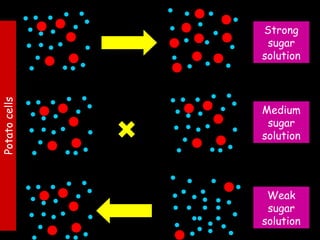
Strong
sugar
solution
Medium
sugar
solution
Weak
sugar
solution
Potatocells
04/25/16
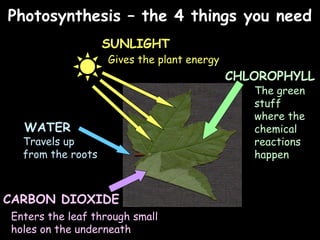
Travels up
from the roots
WATER
CARBON DIOXIDE
Enters the leaf through small
holes on the underneath
SUNLIGHT
Gives the plant energy
CHLOROPHYLL
The green
stuff
where the
chemical
reactions
happen
Photosynthesis – the 4 things you needPhotosynthesis – the 4 things you need
04/25/16
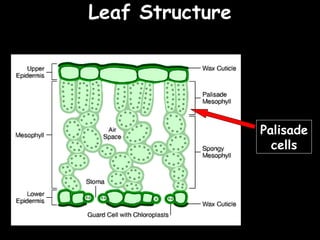
Leaf StructureLeaf Structure
Palisade
cells
04/25/16
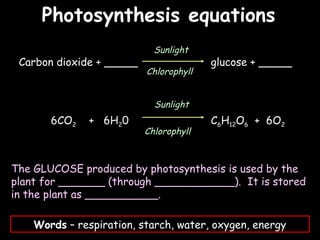
Carbon dioxide + _____ glucose + _____
6CO2 + 6H20 C6H12O6 + 6O2
Sunlight
Chlorophyll
Sunlight
Chlorophyll
The GLUCOSE produced by photosynthesis is used by the
plant for _______ (through ____________). It is stored
in the plant as ___________.
Words – respiration, starch, water, oxygen, energy
Photosynthesis equationsPhotosynthesis equations
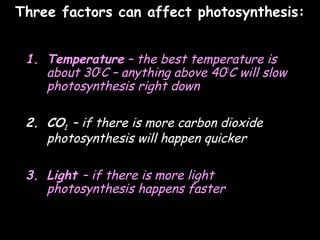
04/25/16Three factors can affect photosynthesis:Three factors can affect photosynthesis:
1. Temperature – the best temperature is
about 300
C – anything above 400
C will slow
photosynthesis right down
2. CO2 – if there is more carbon dioxide
photosynthesis will happen quicker
3. Light – if there is more light
photosynthesis happens faster
04/25/16
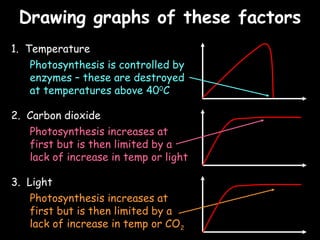
Drawing graphs of these factorsDrawing graphs of these factors
1. Temperature
Photosynthesis is controlled by
enzymes – these are destroyed
at temperatures above 400
C
2. Carbon dioxide
3. Light
Photosynthesis increases at
first but is then limited by a
lack of increase in temp or CO2
Photosynthesis increases at
first but is then limited by a
lack of increase in temp or light
04/25/16
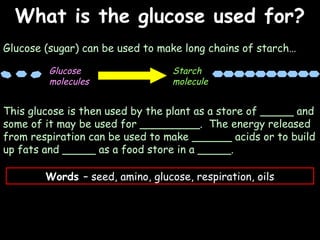
What is the glucose used for?What is the glucose used for?
Glucose (sugar) can be used to make long chains of starch…
Glucose
molecules
Starch
molecule
This glucose is then used by the plant as a store of _____ and
some of it may be used for _________. The energy released
from respiration can be used to make ______ acids or to build
up fats and _____ as a food store in a _____.
Words – seed, amino, glucose, respiration, oils
04/25/16
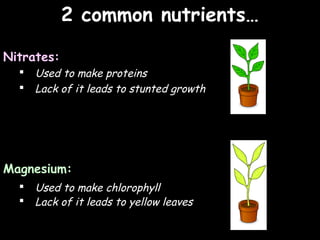
2 common nutrients…2 common nutrients…
Nitrates:
 Used to make proteins
 Lack of it leads to stunted growth
Magnesium:
 Used to make chlorophyll
 Lack of it leads to yellow leaves
04/25/16
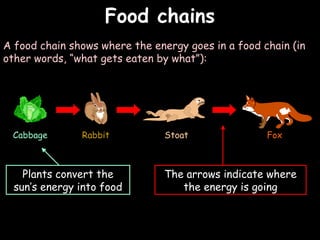
Food chainsFood chains
A food chain shows where the energy goes in a food chain (in
other words, “what gets eaten by what”):
Cabbage Rabbit Stoat Fox
The arrows indicate where
the energy is going
Plants convert the
sun’s energy into food
04/25/16
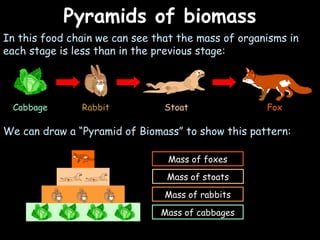
Pyramids of biomassPyramids of biomass
In this food chain we can see that the mass of organisms in
each stage is less than in the previous stage:
Cabbage Rabbit Stoat Fox
We can draw a “Pyramid of Biomass” to show this pattern:
Mass of cabbages
Mass of rabbits
Mass of stoats
Mass of foxes
04/25/16
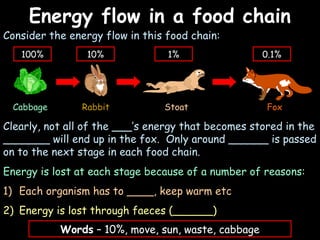
Energy flow in a food chainEnergy flow in a food chain
Consider the energy flow in this food chain:
Cabbage Rabbit Stoat Fox
100% 10% 1% 0.1%
Clearly, not all of the ___’s energy that becomes stored in the
_______ will end up in the fox. Only around ______ is passed
on to the next stage in each food chain.
Energy is lost at each stage because of a number of reasons:
1) Each organism has to ____, keep warm etc
2) Energy is lost through faeces (______)
Words – 10%, move, sun, waste, cabbage
04/25/16
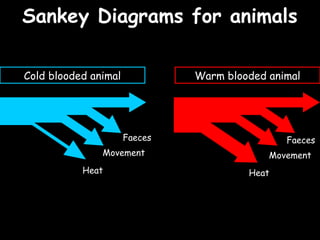
Sankey Diagrams for animalsSankey Diagrams for animals
Cold blooded animal Warm blooded animal
Faeces
Movement
Heat
Faeces
Movement
Heat
04/25/16
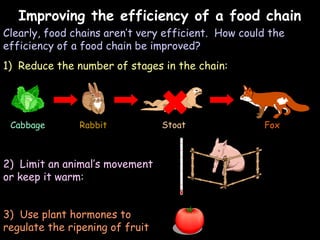
Improving the efficiency of a food chainImproving the efficiency of a food chain
Clearly, food chains aren’t very efficient. How could the
efficiency of a food chain be improved?
1) Reduce the number of stages in the chain:
Cabbage Rabbit Stoat
2) Limit an animal’s movement
or keep it warm:
Fox
3) Use plant hormones to
regulate the ripening of fruit
04/25/16
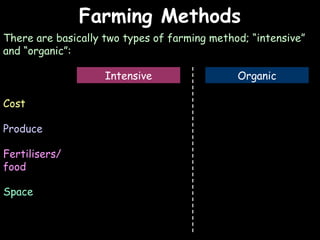
Farming MethodsFarming Methods
There are basically two types of farming method; “intensive”
and “organic”:
Intensive Organic
Cost
Produce
Fertilisers/
food
Space
04/25/16
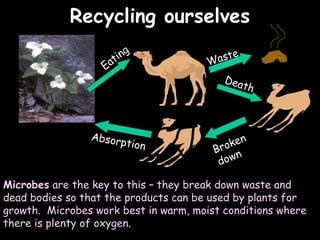
Recycling ourselvesRecycling ourselves
Microbes are the key to this – they break down waste and
dead bodies so that the products can be used by plants for
growth. Microbes work best in warm, moist conditions where
there is plenty of oxygen.
Eating
Waste
Death
Broken
down
Absorption
04/25/16
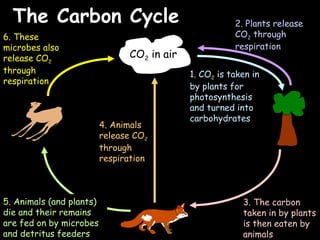
The Carbon CycleThe Carbon Cycle
CO2 in air
1. CO2 is taken in
by plants for
photosynthesis
and turned into
carbohydrates
2. Plants release
CO2 through
respiration
3. The carbon
taken in by plants
is then eaten by
animals
5. Animals (and plants)
die and their remains
are fed on by microbes
and detritus feeders
6. These
microbes also
release CO2
through
respiration
4. Animals
release CO2
through
respiration
04/25/16
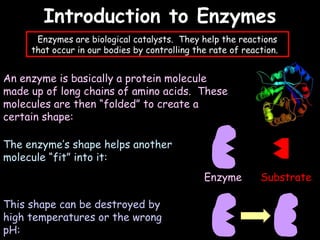
Introduction to EnzymesIntroduction to Enzymes
Enzymes are biological catalysts. They help the reactions
that occur in our bodies by controlling the rate of reaction.
An enzyme is basically a protein molecule
made up of long chains of amino acids. These
molecules are then “folded” to create a
certain shape:
The enzyme’s shape helps another
molecule “fit” into it:
This shape can be destroyed by
high temperatures or the wrong
pH:
Enzyme Substrate
04/25/16
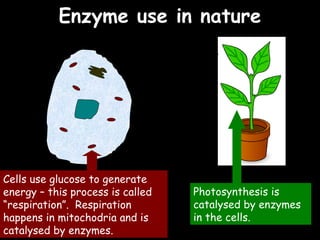
Enzyme use in natureEnzyme use in nature
Cells use glucose to generate
energy – this process is called
“respiration”. Respiration
happens in mitochodria and is
catalysed by enzymes.
Photosynthesis is
catalysed by enzymes
in the cells.
04/25/16
(Aerobic) Respiration(Aerobic) Respiration
Words – breathing, energy, grow, respiration, food
All living organisms have to move, _____, reproduce etc. Each
of these life processes needs ENERGY. ___________ is the
process our bodies use to produce this energy:
Glucose + oxygen water + carbon dioxide + ENERGY
The glucose we need comes from ______ and the oxygen from
_________. Water and carbon dioxide are breathed out.
The MAIN product of this equation is _________.
04/25/16
Uses for this energyUses for this energy
Animals and plants have many uses for the energy they
generate from respiration:
1) To perform the life processes, such as moving, _____ etc
2) To build up body _______
3) To maintain a constant body ___________ (warm-blooded
mammals only)
4) To build up sugars, ________ and other nutrients in plants
5) To build up amino acids and ________
Words – nitrates, tissue, proteins, respiration, growing
04/25/16
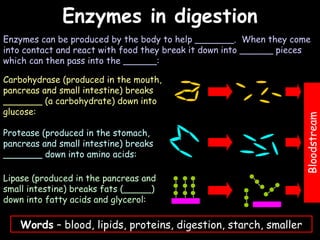
Enzymes in digestionEnzymes in digestion
Enzymes can be produced by the body to help _______. When they come
into contact and react with food they break it down into ______ pieces
which can then pass into the ______:
Carbohydrase (produced in the mouth,
pancreas and small intestine) breaks
_______ (a carbohydrate) down into
glucose:
Protease (produced in the stomach,
pancreas and small intestine) breaks
_______ down into amino acids:
Lipase (produced in the pancreas and
small intestine) breaks fats (_____)
down into fatty acids and glycerol:
Words – blood, lipids, proteins, digestion, starch, smaller
Bloodstream
04/25/16
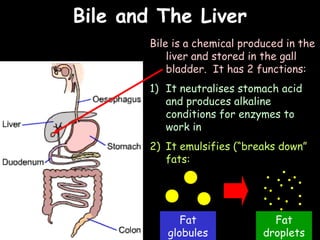
Bile and The LiverBile and The Liver
Bile is a chemical produced in the
liver and stored in the gall
bladder. It has 2 functions:
1) It neutralises stomach acid
and produces alkaline
conditions for enzymes to
work in
2) It emulsifies (“breaks down”
fats:
Fat
globules
Fat
droplets
04/25/16
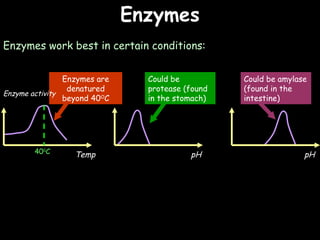
Enzymes are
denatured
beyond 40O
C
EnzymesEnzymes
Enzymes work best in certain conditions:
Enzyme activity
Temp pH pH400
C
Could be
protease (found
in the stomach)
Could be amylase
(found in the
intestine)
04/25/16
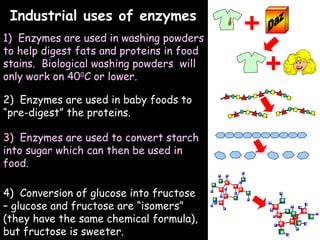
Industrial uses of enzymesIndustrial uses of enzymes
1) Enzymes are used in washing powders
to help digest fats and proteins in food
stains. Biological washing powders will
only work on 400
C or lower.
2) Enzymes are used in baby foods to
“pre-digest” the proteins.
3) Enzymes are used to convert starch
into sugar which can then be used in
food.
4) Conversion of glucose into fructose
– glucose and fructose are “isomers”
(they have the same chemical formula),
but fructose is sweeter.
04/25/16
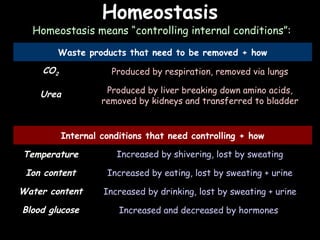
HomeostasisHomeostasis
Homeostasis means “controlling internal conditions”:
Waste products that need to be removed + how
CO2
Urea
Internal conditions that need controlling + how
Temperature
Ion content
Water content
Blood glucose
Produced by respiration, removed via lungs
Produced by liver breaking down amino acids,
removed by kidneys and transferred to bladder
Increased by shivering, lost by sweating
Increased by eating, lost by sweating + urine
Increased by drinking, lost by sweating + urine
Increased and decreased by hormones
04/25/16
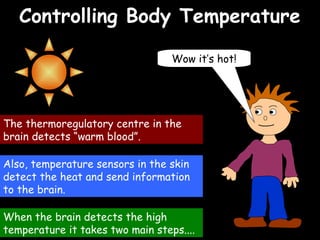
Controlling Body TemperatureControlling Body Temperature
Wow it’s hot!
Also, temperature sensors in the skin
detect the heat and send information
to the brain.
The thermoregulatory centre in the
brain detects “warm blood”.
When the brain detects the high
temperature it takes two main steps....
04/25/16
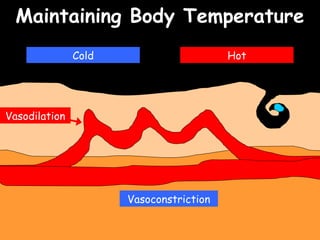
Maintaining Body TemperatureMaintaining Body Temperature
Cold Hot
Vasodilation
Vasoconstriction
04/25/16
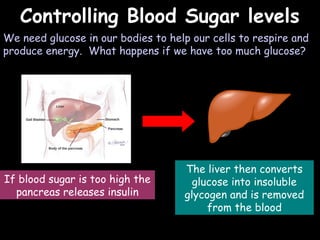
Controlling Blood Sugar levelsControlling Blood Sugar levels
We need glucose in our bodies to help our cells to respire and
produce energy. What happens if we have too much glucose?
If blood sugar is too high the
pancreas releases insulin
The liver then converts
glucose into insoluble
glycogen and is removed
from the blood
04/25/16
DiabetesDiabetes
Diabetes is a ________ in which a person’s blood sugar
(i.e. glucose) level may rise to a _______ level. This is
because the ______ doesn’t produce enough _________.
Diabetes can be treated by __________ carefully or by
injecting extra insulin when needed. Diabetics have to
test their blood sugar level before they decide how much
insulin to _______ themselves with.
Words – insulin, disease, inject,
dangerous, eating, pancreas
04/25/16
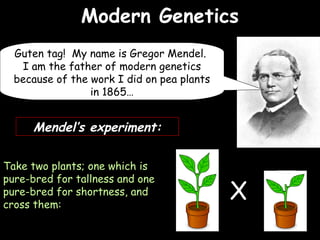
Modern GeneticsModern Genetics
Guten tag! My name is Gregor Mendel.
I am the father of modern genetics
because of the work I did on pea plants
in 1865…
Take two plants; one which is
pure-bred for tallness and one
pure-bred for shortness, and
cross them:
X
Mendel’s experiment:
04/25/16
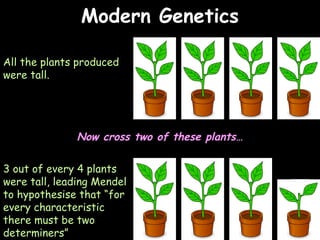
Modern GeneticsModern Genetics
All the plants produced
were tall.
Now cross two of these plants…
3 out of every 4 plants
were tall, leading Mendel
to hypothesise that “for
every characteristic
there must be two
determiners”
04/25/16
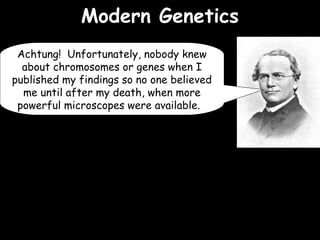
Modern GeneticsModern Genetics
Achtung! Unfortunately, nobody knew
about chromosomes or genes when I
published my findings so no one believed
me until after my death, when more
powerful microscopes were available.
04/25/16
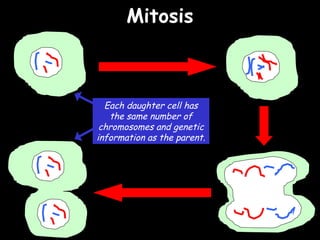
MitosisMitosis
Each daughter cell has
the same number of
chromosomes and genetic
information as the parent.
04/25/16
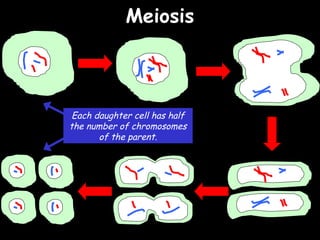
MeiosisMeiosis
Each daughter cell has half
the number of chromosomes
of the parent.
04/25/16
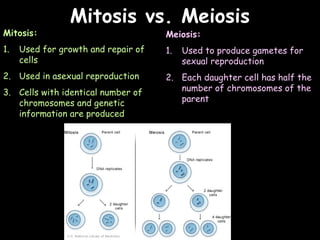
Mitosis vs. MeiosisMitosis vs. Meiosis
Mitosis:
1. Used for growth and repair of
cells
2. Used in asexual reproduction
3. Cells with identical number of
chromosomes and genetic
information are produced
Meiosis:
1. Used to produce gametes for
sexual reproduction
2. Each daughter cell has half the
number of chromosomes of the
parent
04/25/16
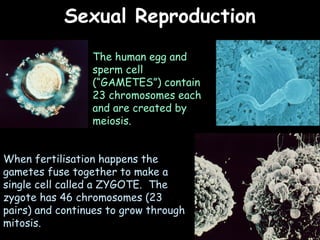
Sexual ReproductionSexual Reproduction
The human egg and
sperm cell
(“GAMETES”) contain
23 chromosomes each
and are created by
meiosis.
When fertilisation happens the
gametes fuse together to make a
single cell called a ZYGOTE. The
zygote has 46 chromosomes (23
pairs) and continues to grow through
mitosis.
04/25/16
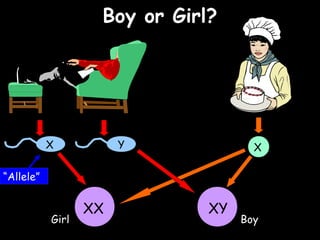
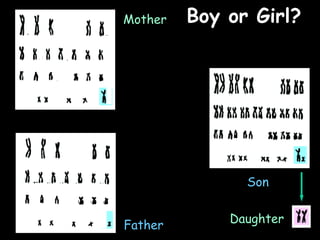
Boy or Girl?Boy or Girl?
X Y X
XX XY
Girl Boy
“Allele”
04/25/16
Father
Mother
Son
Daughter
Boy or Girl?Boy or Girl?
04/25/16
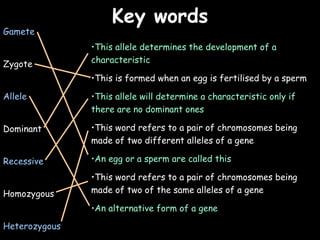
Key wordsKey words
Gamete
Zygote
Allele
Dominant
Recessive
Homozygous
Heterozygous
•This allele determines the development of a
characteristic
•This is formed when an egg is fertilised by a sperm
•This allele will determine a characteristic only if
there are no dominant ones
•This word refers to a pair of chromosomes being
made of two different alleles of a gene
•An egg or a sperm are called this
•This word refers to a pair of chromosomes being
made of two of the same alleles of a gene
•An alternative form of a gene
04/25/16
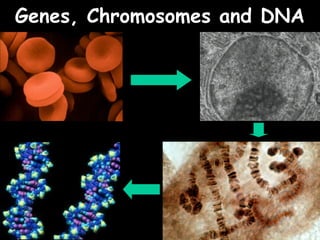
Genes, Chromosomes and DNAGenes, Chromosomes and DNA
04/25/16
Some facts:
- Made up of paired bases
- Contain instructions on what a cell does, how the organism
should work etc
- The instructions are in the form of a code
- The code is made up from the four bases that hold the
strands together
- The bases represent the order in which amino acids are
assembled to make proteins
- Everyone (apart from identical twins) has different DNA
and people can be identified by “DNA finger printing”
How genes workHow genes work
04/25/16
Eye colourEye colour
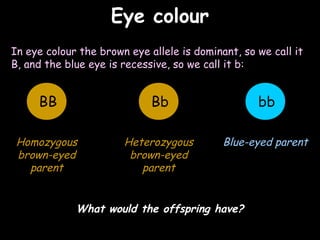
In eye colour the brown eye allele is dominant, so we call it
B, and the blue eye is recessive, so we call it b:
bbBB Bb
Homozygous
brown-eyed
parent
Heterozygous
brown-eyed
parent
Blue-eyed parent
What would the offspring have?
04/25/16
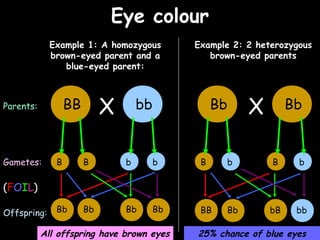
Eye colourEye colour
Example 1: A homozygous
brown-eyed parent and a
blue-eyed parent:
Example 2: 2 heterozygous
brown-eyed parents
BB bbX Bb BbXParents:
Gametes:
Offspring: Bb Bb BbBb BB Bb bbbB
B B bb B bB b
(FOIL)
All offspring have brown eyes 25% chance of blue eyes
04/25/16
Eye colourEye colour
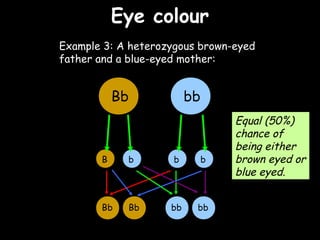
Example 3: A heterozygous brown-eyed
father and a blue-eyed mother:
Bb
Bb Bb bbbb
bb
b bB b
Equal (50%)
chance of
being either
brown eyed or
blue eyed.
04/25/16
B b
b
b
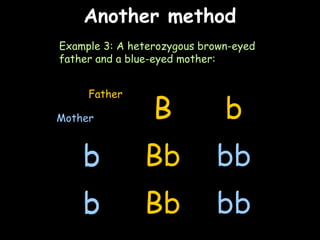
Another methodAnother method
Example 3: A heterozygous brown-eyed
father and a blue-eyed mother:
B b
b Bb bb
b Bb bb
Father
Mother
04/25/16
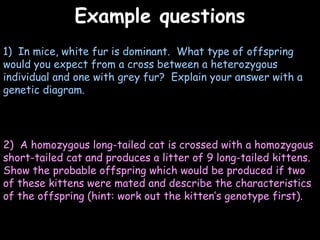
Example questionsExample questions
1) In mice, white fur is dominant. What type of offspring
would you expect from a cross between a heterozygous
individual and one with grey fur? Explain your answer with a
genetic diagram.
2) A homozygous long-tailed cat is crossed with a homozygous
short-tailed cat and produces a litter of 9 long-tailed kittens.
Show the probable offspring which would be produced if two
of these kittens were mated and describe the characteristics
of the offspring (hint: work out the kitten’s genotype first).
04/25/16
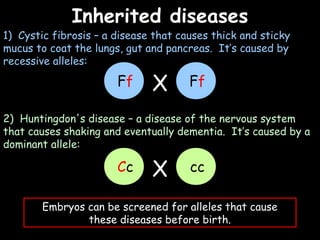
Inherited diseasesInherited diseases
1) Cystic fibrosis – a disease that causes thick and sticky
mucus to coat the lungs, gut and pancreas. It’s caused by
recessive alleles:
2) Huntingdon's disease – a disease of the nervous system
that causes shaking and eventually dementia. It’s caused by a
dominant allele:
Embryos can be screened for alleles that cause
these diseases before birth.
Ff FfX
Cc ccX
04/25/16
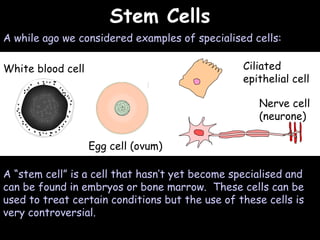
Stem CellsStem Cells
A while ago we considered examples of specialised cells:
White blood cell
Egg cell (ovum)
Ciliated
epithelial cell
Nerve cell
(neurone)
A “stem cell” is a cell that hasn’t yet become specialised and
can be found in embryos or bone marrow. These cells can be
used to treat certain conditions but the use of these cells is
very controversial.
04/25/16
Research tasksResearch tasks
Task
Present an argument concerning one of these two topics:
1) Use of stem cells from embryos in medical research
2) The use of embryo screening to identify deformities

Biology 2

  • 1.
    04/25/16 Biology 2Biology 2 AQAAdditional ScienceAQA Additional Science
  • 2.
    04/25/16 A typical plantcell:A typical plant cell: Cell wall – made of cellulose which strengthens the cell Cell membrane – controls what comes in and out Nucleus – controls what the cell does and stores information Large vacuole – contains sap and helps support the cell Cytoplasm – Chemical reactions happen here Chloroplasts (containing chlorophyll) – this is needed for photosynthesis
  • 3.
    04/25/16 4) 1) 5) 3) A Typical AnimalCellA Typical Animal Cell Ribosomes – protein synthesis happens here Mitochondria - energy is released here Cell Membrane – controls what comes in and out Cytoplasm - this is where the reactions happen and these are controlled by enzymes 2) Nucleus – controls the cell’s activities
  • 4.
    04/25/16 More specialised animalcellsMore specialised animal cells Red Blood Cell Carriesoxygen around thebody No nucleusand largesurface area I.D: Function: Features: White blood cell Egg cell (ovum) Ciliated epithelial cell Nerve cell (neurone)
  • 5.
    04/25/16 DiffusionDiffusion Diffusion is whensomething travels from an area of high concentration to an area of low concentration. For example, consider the scent from a hamburger… The “scent particles” from this hamburger are in high concentration here: Eventually they will “diffuse” out into this area of low concentration: Oxygen passes into cells by diffusion
  • 6.
    04/25/16 Diffusion SummaryDiffusion Summary Diffusionis when particles spread from an area of high concentration to an area of ___ concentration. The particles move along a “concentration _____” and this process takes no _____ (it’s a “passive” process”). Diffusion can be accelerated by increasing the _______ of the particles, which makes them move _______. Words – faster, low, gradient, temperature, energy
  • 7.
    04/25/16 OsmosisOsmosis Osmosis is a“special kind of ___________”. It’s when water diffuses from a __________ area to a less concentrated area through a partially permeable _________ (i.e. one that allows water to move through but not anything else): Water Sugar solution In this example the water molecules will move from left to right (along the concentration ______) and gradually _____ the sugar solution. Words – membrane, concentrated, dilute, diffusion, gradient
  • 8.
  • 9.
    04/25/16 Travels up from theroots WATER CARBON DIOXIDE Enters the leaf through small holes on the underneath SUNLIGHT Gives the plant energy CHLOROPHYLL The green stuff where the chemical reactions happen Photosynthesis – the 4 things you needPhotosynthesis – the 4 things you need
  • 10.
  • 11.
    04/25/16 Carbon dioxide +_____ glucose + _____ 6CO2 + 6H20 C6H12O6 + 6O2 Sunlight Chlorophyll Sunlight Chlorophyll The GLUCOSE produced by photosynthesis is used by the plant for _______ (through ____________). It is stored in the plant as ___________. Words – respiration, starch, water, oxygen, energy Photosynthesis equationsPhotosynthesis equations
  • 12.
    04/25/16Three factors canaffect photosynthesis:Three factors can affect photosynthesis: 1. Temperature – the best temperature is about 300 C – anything above 400 C will slow photosynthesis right down 2. CO2 – if there is more carbon dioxide photosynthesis will happen quicker 3. Light – if there is more light photosynthesis happens faster
  • 13.
    04/25/16 Drawing graphs ofthese factorsDrawing graphs of these factors 1. Temperature Photosynthesis is controlled by enzymes – these are destroyed at temperatures above 400 C 2. Carbon dioxide 3. Light Photosynthesis increases at first but is then limited by a lack of increase in temp or CO2 Photosynthesis increases at first but is then limited by a lack of increase in temp or light
  • 14.
    04/25/16 What is theglucose used for?What is the glucose used for? Glucose (sugar) can be used to make long chains of starch… Glucose molecules Starch molecule This glucose is then used by the plant as a store of _____ and some of it may be used for _________. The energy released from respiration can be used to make ______ acids or to build up fats and _____ as a food store in a _____. Words – seed, amino, glucose, respiration, oils
  • 15.
    04/25/16 2 common nutrients…2common nutrients… Nitrates:  Used to make proteins  Lack of it leads to stunted growth Magnesium:  Used to make chlorophyll  Lack of it leads to yellow leaves
  • 16.
    04/25/16 Food chainsFood chains Afood chain shows where the energy goes in a food chain (in other words, “what gets eaten by what”): Cabbage Rabbit Stoat Fox The arrows indicate where the energy is going Plants convert the sun’s energy into food
  • 17.
    04/25/16 Pyramids of biomassPyramidsof biomass In this food chain we can see that the mass of organisms in each stage is less than in the previous stage: Cabbage Rabbit Stoat Fox We can draw a “Pyramid of Biomass” to show this pattern: Mass of cabbages Mass of rabbits Mass of stoats Mass of foxes
  • 18.
    04/25/16 Energy flow ina food chainEnergy flow in a food chain Consider the energy flow in this food chain: Cabbage Rabbit Stoat Fox 100% 10% 1% 0.1% Clearly, not all of the ___’s energy that becomes stored in the _______ will end up in the fox. Only around ______ is passed on to the next stage in each food chain. Energy is lost at each stage because of a number of reasons: 1) Each organism has to ____, keep warm etc 2) Energy is lost through faeces (______) Words – 10%, move, sun, waste, cabbage
  • 19.
    04/25/16 Sankey Diagrams foranimalsSankey Diagrams for animals Cold blooded animal Warm blooded animal Faeces Movement Heat Faeces Movement Heat
  • 20.
    04/25/16 Improving the efficiencyof a food chainImproving the efficiency of a food chain Clearly, food chains aren’t very efficient. How could the efficiency of a food chain be improved? 1) Reduce the number of stages in the chain: Cabbage Rabbit Stoat 2) Limit an animal’s movement or keep it warm: Fox 3) Use plant hormones to regulate the ripening of fruit
  • 21.
    04/25/16 Farming MethodsFarming Methods Thereare basically two types of farming method; “intensive” and “organic”: Intensive Organic Cost Produce Fertilisers/ food Space
  • 22.
    04/25/16 Recycling ourselvesRecycling ourselves Microbesare the key to this – they break down waste and dead bodies so that the products can be used by plants for growth. Microbes work best in warm, moist conditions where there is plenty of oxygen. Eating Waste Death Broken down Absorption
  • 23.
    04/25/16 The Carbon CycleTheCarbon Cycle CO2 in air 1. CO2 is taken in by plants for photosynthesis and turned into carbohydrates 2. Plants release CO2 through respiration 3. The carbon taken in by plants is then eaten by animals 5. Animals (and plants) die and their remains are fed on by microbes and detritus feeders 6. These microbes also release CO2 through respiration 4. Animals release CO2 through respiration
  • 24.
    04/25/16 Introduction to EnzymesIntroductionto Enzymes Enzymes are biological catalysts. They help the reactions that occur in our bodies by controlling the rate of reaction. An enzyme is basically a protein molecule made up of long chains of amino acids. These molecules are then “folded” to create a certain shape: The enzyme’s shape helps another molecule “fit” into it: This shape can be destroyed by high temperatures or the wrong pH: Enzyme Substrate
  • 25.
    04/25/16 Enzyme use innatureEnzyme use in nature Cells use glucose to generate energy – this process is called “respiration”. Respiration happens in mitochodria and is catalysed by enzymes. Photosynthesis is catalysed by enzymes in the cells.
  • 26.
    04/25/16 (Aerobic) Respiration(Aerobic) Respiration Words– breathing, energy, grow, respiration, food All living organisms have to move, _____, reproduce etc. Each of these life processes needs ENERGY. ___________ is the process our bodies use to produce this energy: Glucose + oxygen water + carbon dioxide + ENERGY The glucose we need comes from ______ and the oxygen from _________. Water and carbon dioxide are breathed out. The MAIN product of this equation is _________.
  • 27.
    04/25/16 Uses for thisenergyUses for this energy Animals and plants have many uses for the energy they generate from respiration: 1) To perform the life processes, such as moving, _____ etc 2) To build up body _______ 3) To maintain a constant body ___________ (warm-blooded mammals only) 4) To build up sugars, ________ and other nutrients in plants 5) To build up amino acids and ________ Words – nitrates, tissue, proteins, respiration, growing
  • 28.
    04/25/16 Enzymes in digestionEnzymesin digestion Enzymes can be produced by the body to help _______. When they come into contact and react with food they break it down into ______ pieces which can then pass into the ______: Carbohydrase (produced in the mouth, pancreas and small intestine) breaks _______ (a carbohydrate) down into glucose: Protease (produced in the stomach, pancreas and small intestine) breaks _______ down into amino acids: Lipase (produced in the pancreas and small intestine) breaks fats (_____) down into fatty acids and glycerol: Words – blood, lipids, proteins, digestion, starch, smaller Bloodstream
  • 29.
    04/25/16 Bile and TheLiverBile and The Liver Bile is a chemical produced in the liver and stored in the gall bladder. It has 2 functions: 1) It neutralises stomach acid and produces alkaline conditions for enzymes to work in 2) It emulsifies (“breaks down” fats: Fat globules Fat droplets
  • 30.
    04/25/16 Enzymes are denatured beyond 40O C EnzymesEnzymes Enzymeswork best in certain conditions: Enzyme activity Temp pH pH400 C Could be protease (found in the stomach) Could be amylase (found in the intestine)
  • 31.
    04/25/16 Industrial uses ofenzymesIndustrial uses of enzymes 1) Enzymes are used in washing powders to help digest fats and proteins in food stains. Biological washing powders will only work on 400 C or lower. 2) Enzymes are used in baby foods to “pre-digest” the proteins. 3) Enzymes are used to convert starch into sugar which can then be used in food. 4) Conversion of glucose into fructose – glucose and fructose are “isomers” (they have the same chemical formula), but fructose is sweeter.
  • 32.
    04/25/16 HomeostasisHomeostasis Homeostasis means “controllinginternal conditions”: Waste products that need to be removed + how CO2 Urea Internal conditions that need controlling + how Temperature Ion content Water content Blood glucose Produced by respiration, removed via lungs Produced by liver breaking down amino acids, removed by kidneys and transferred to bladder Increased by shivering, lost by sweating Increased by eating, lost by sweating + urine Increased by drinking, lost by sweating + urine Increased and decreased by hormones
  • 33.
    04/25/16 Controlling Body TemperatureControllingBody Temperature Wow it’s hot! Also, temperature sensors in the skin detect the heat and send information to the brain. The thermoregulatory centre in the brain detects “warm blood”. When the brain detects the high temperature it takes two main steps....
  • 34.
    04/25/16 Maintaining Body TemperatureMaintainingBody Temperature Cold Hot Vasodilation Vasoconstriction
  • 35.
    04/25/16 Controlling Blood SugarlevelsControlling Blood Sugar levels We need glucose in our bodies to help our cells to respire and produce energy. What happens if we have too much glucose? If blood sugar is too high the pancreas releases insulin The liver then converts glucose into insoluble glycogen and is removed from the blood
  • 36.
    04/25/16 DiabetesDiabetes Diabetes is a________ in which a person’s blood sugar (i.e. glucose) level may rise to a _______ level. This is because the ______ doesn’t produce enough _________. Diabetes can be treated by __________ carefully or by injecting extra insulin when needed. Diabetics have to test their blood sugar level before they decide how much insulin to _______ themselves with. Words – insulin, disease, inject, dangerous, eating, pancreas
  • 37.
    04/25/16 Modern GeneticsModern Genetics Gutentag! My name is Gregor Mendel. I am the father of modern genetics because of the work I did on pea plants in 1865… Take two plants; one which is pure-bred for tallness and one pure-bred for shortness, and cross them: X Mendel’s experiment:
  • 38.
    04/25/16 Modern GeneticsModern Genetics Allthe plants produced were tall. Now cross two of these plants… 3 out of every 4 plants were tall, leading Mendel to hypothesise that “for every characteristic there must be two determiners”
  • 39.
    04/25/16 Modern GeneticsModern Genetics Achtung!Unfortunately, nobody knew about chromosomes or genes when I published my findings so no one believed me until after my death, when more powerful microscopes were available.
  • 40.
    04/25/16 MitosisMitosis Each daughter cellhas the same number of chromosomes and genetic information as the parent.
  • 41.
    04/25/16 MeiosisMeiosis Each daughter cellhas half the number of chromosomes of the parent.
  • 42.
    04/25/16 Mitosis vs. MeiosisMitosisvs. Meiosis Mitosis: 1. Used for growth and repair of cells 2. Used in asexual reproduction 3. Cells with identical number of chromosomes and genetic information are produced Meiosis: 1. Used to produce gametes for sexual reproduction 2. Each daughter cell has half the number of chromosomes of the parent
  • 43.
    04/25/16 Sexual ReproductionSexual Reproduction Thehuman egg and sperm cell (“GAMETES”) contain 23 chromosomes each and are created by meiosis. When fertilisation happens the gametes fuse together to make a single cell called a ZYGOTE. The zygote has 46 chromosomes (23 pairs) and continues to grow through mitosis.
  • 44.
    04/25/16 Boy or Girl?Boyor Girl? X Y X XX XY Girl Boy “Allele”
  • 45.
  • 46.
    04/25/16 Key wordsKey words Gamete Zygote Allele Dominant Recessive Homozygous Heterozygous •Thisallele determines the development of a characteristic •This is formed when an egg is fertilised by a sperm •This allele will determine a characteristic only if there are no dominant ones •This word refers to a pair of chromosomes being made of two different alleles of a gene •An egg or a sperm are called this •This word refers to a pair of chromosomes being made of two of the same alleles of a gene •An alternative form of a gene
  • 47.
    04/25/16 Genes, Chromosomes andDNAGenes, Chromosomes and DNA
  • 48.
    04/25/16 Some facts: - Madeup of paired bases - Contain instructions on what a cell does, how the organism should work etc - The instructions are in the form of a code - The code is made up from the four bases that hold the strands together - The bases represent the order in which amino acids are assembled to make proteins - Everyone (apart from identical twins) has different DNA and people can be identified by “DNA finger printing” How genes workHow genes work
  • 49.
    04/25/16 Eye colourEye colour Ineye colour the brown eye allele is dominant, so we call it B, and the blue eye is recessive, so we call it b: bbBB Bb Homozygous brown-eyed parent Heterozygous brown-eyed parent Blue-eyed parent What would the offspring have?
  • 50.
    04/25/16 Eye colourEye colour Example1: A homozygous brown-eyed parent and a blue-eyed parent: Example 2: 2 heterozygous brown-eyed parents BB bbX Bb BbXParents: Gametes: Offspring: Bb Bb BbBb BB Bb bbbB B B bb B bB b (FOIL) All offspring have brown eyes 25% chance of blue eyes
  • 51.
    04/25/16 Eye colourEye colour Example3: A heterozygous brown-eyed father and a blue-eyed mother: Bb Bb Bb bbbb bb b bB b Equal (50%) chance of being either brown eyed or blue eyed.
  • 52.
    04/25/16 B b b b Another methodAnothermethod Example 3: A heterozygous brown-eyed father and a blue-eyed mother: B b b Bb bb b Bb bb Father Mother
  • 53.
    04/25/16 Example questionsExample questions 1)In mice, white fur is dominant. What type of offspring would you expect from a cross between a heterozygous individual and one with grey fur? Explain your answer with a genetic diagram. 2) A homozygous long-tailed cat is crossed with a homozygous short-tailed cat and produces a litter of 9 long-tailed kittens. Show the probable offspring which would be produced if two of these kittens were mated and describe the characteristics of the offspring (hint: work out the kitten’s genotype first).
  • 54.
    04/25/16 Inherited diseasesInherited diseases 1)Cystic fibrosis – a disease that causes thick and sticky mucus to coat the lungs, gut and pancreas. It’s caused by recessive alleles: 2) Huntingdon's disease – a disease of the nervous system that causes shaking and eventually dementia. It’s caused by a dominant allele: Embryos can be screened for alleles that cause these diseases before birth. Ff FfX Cc ccX
  • 55.
    04/25/16 Stem CellsStem Cells Awhile ago we considered examples of specialised cells: White blood cell Egg cell (ovum) Ciliated epithelial cell Nerve cell (neurone) A “stem cell” is a cell that hasn’t yet become specialised and can be found in embryos or bone marrow. These cells can be used to treat certain conditions but the use of these cells is very controversial.
  • 56.
    04/25/16 Research tasksResearch tasks Task Presentan argument concerning one of these two topics: 1) Use of stem cells from embryos in medical research 2) The use of embryo screening to identify deformities