BIOLOGICAL EVOLUTION
By: Maricel B. Sinamban
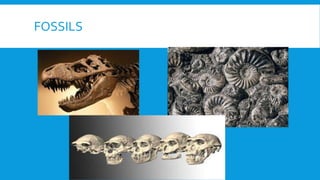
FOSSILS
RELATIVE DATING
 Using relative dating the fossil is compared
to something for which the age is already
known
Stratigraphy- science that examines the way
by which each sediments are laid down in
successive layers or strata.
- Most commonly used dating technique.
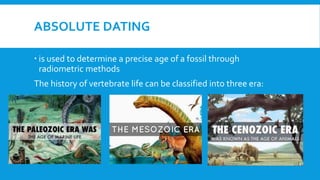
ABSOLUTE DATING
 is used to determine a precise age of a fossil through
radiometric methods
The history of vertebrate life can be classified into three era:
MIOCENE EPOCH
Fossils of apelike humans were
discovered by
paleoanthropologist, Louis and
Mary Leakey in Africa.
HOMINIDSTO AUSTROLOPITHECINES
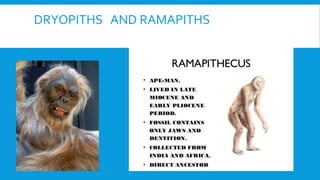
DRYOPITHS AND RAMAPITHS
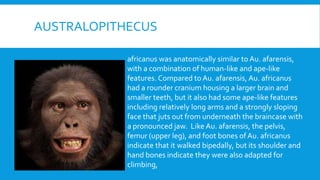
AUSTRALOPITHECUS
africanus was anatomically similar to Au. afarensis,
with a combination of human-like and ape-like
features. Compared to Au. afarensis, Au. africanus
had a rounder cranium housing a larger brain and
smaller teeth, but it also had some ape-like features
including relatively long arms and a strongly sloping
face that juts out from underneath the braincase with
a pronounced jaw. Like Au. afarensis, the pelvis,
femur (upper leg), and foot bones of Au. africanus
indicate that it walked bipedally, but its shoulder and
hand bones indicate they were also adapted for
climbing,
AUSTRALOPITHECINE SPECIES
CONT..
 Australopithecus africanus – “Taung Child”
CONT..
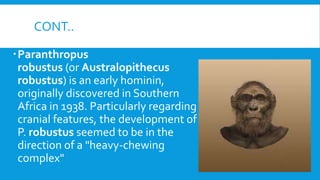
Paranthropus
robustus (or Australopithecus
robustus) is an early hominin,
originally discovered in Southern
Africa in 1938. Particularly regarding
cranial features, the development of
P. robustus seemed to be in the
direction of a "heavy-chewing
complex"
CONT..
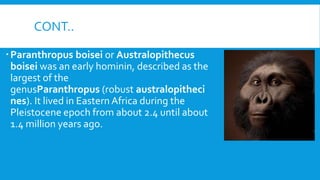
Paranthropus boisei or Australopithecus
boisei was an early hominin, described as the
largest of the
genusParanthropus (robust australopitheci
nes). It lived in Eastern Africa during the
Pleistocene epoch from about 2.4 until about
1.4 million years ago.
SPECIES OF HOMO
HOMO HABILIS:THE HANDY MAN
HOMO ERECTUS: UPRIGHT MAN
HOMO FLORESIENSIS:THE HOBBIT
NEANDERTHALS, DENISOVIANS,
CRO-MAGNON: ARCHAIC HUMAN
NEANDERTHALS, DENISOVIANS, CRO-
MAGNON
NEANDERTHALS
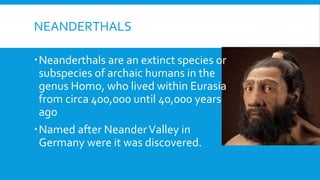
Neanderthals are an extinct species or
subspecies of archaic humans in the
genus Homo, who lived within Eurasia
from circa 400,000 until 40,000 years
ago
Named after NeanderValley in
Germany were it was discovered.
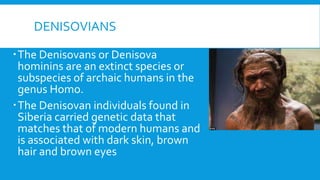
DENISOVIANS
The Denisovans or Denisova
hominins are an extinct species or
subspecies of archaic humans in the
genus Homo.
The Denisovan individuals found in
Siberia carried genetic data that
matches that of modern humans and
is associated with dark skin, brown
hair and brown eyes
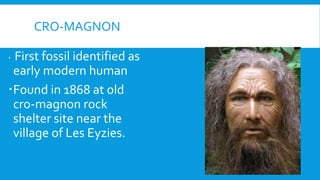
CRO-MAGNON
 First fossil identified as
early modern human
Found in 1868 at old
cro-magnon rock
shelter site near the
village of Les Eyzies.
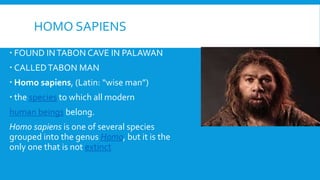
HOMO SAPIENS
 FOUND INTABON CAVE IN PALAWAN
 CALLEDTABON MAN
 Homo sapiens, (Latin: “wise man”)
 the species to which all modern
human beings belong.
Homo sapiens is one of several species
grouped into the genus Homo, but it is the
only one that is not extinct

Biological evolution

  • 1.
  • 2.
  • 3.
    RELATIVE DATING  Usingrelative dating the fossil is compared to something for which the age is already known Stratigraphy- science that examines the way by which each sediments are laid down in successive layers or strata. - Most commonly used dating technique.
  • 4.
    ABSOLUTE DATING  isused to determine a precise age of a fossil through radiometric methods The history of vertebrate life can be classified into three era:
  • 5.
    MIOCENE EPOCH Fossils ofapelike humans were discovered by paleoanthropologist, Louis and Mary Leakey in Africa.
  • 6.
  • 7.
  • 8.
    AUSTRALOPITHECUS africanus was anatomicallysimilar to Au. afarensis, with a combination of human-like and ape-like features. Compared to Au. afarensis, Au. africanus had a rounder cranium housing a larger brain and smaller teeth, but it also had some ape-like features including relatively long arms and a strongly sloping face that juts out from underneath the braincase with a pronounced jaw. Like Au. afarensis, the pelvis, femur (upper leg), and foot bones of Au. africanus indicate that it walked bipedally, but its shoulder and hand bones indicate they were also adapted for climbing,
  • 9.
  • 10.
  • 11.
    CONT.. Paranthropus robustus (or Australopithecus robustus)is an early hominin, originally discovered in Southern Africa in 1938. Particularly regarding cranial features, the development of P. robustus seemed to be in the direction of a "heavy-chewing complex"
  • 12.
    CONT.. Paranthropus boisei orAustralopithecus boisei was an early hominin, described as the largest of the genusParanthropus (robust australopitheci nes). It lived in Eastern Africa during the Pleistocene epoch from about 2.4 until about 1.4 million years ago.
  • 13.
    SPECIES OF HOMO HOMOHABILIS:THE HANDY MAN HOMO ERECTUS: UPRIGHT MAN HOMO FLORESIENSIS:THE HOBBIT NEANDERTHALS, DENISOVIANS, CRO-MAGNON: ARCHAIC HUMAN
  • 14.
  • 15.
    NEANDERTHALS Neanderthals are anextinct species or subspecies of archaic humans in the genus Homo, who lived within Eurasia from circa 400,000 until 40,000 years ago Named after NeanderValley in Germany were it was discovered.
  • 16.
    DENISOVIANS The Denisovans orDenisova hominins are an extinct species or subspecies of archaic humans in the genus Homo. The Denisovan individuals found in Siberia carried genetic data that matches that of modern humans and is associated with dark skin, brown hair and brown eyes
  • 17.
    CRO-MAGNON  First fossilidentified as early modern human Found in 1868 at old cro-magnon rock shelter site near the village of Les Eyzies.
  • 18.
    HOMO SAPIENS  FOUNDINTABON CAVE IN PALAWAN  CALLEDTABON MAN  Homo sapiens, (Latin: “wise man”)  the species to which all modern human beings belong. Homo sapiens is one of several species grouped into the genus Homo, but it is the only one that is not extinct