

1
BIOENERGETICSBIOENERGETICS
Copyright Cmassengale
2
What is Bioenergetics?
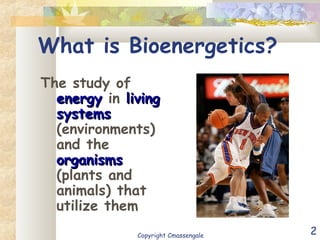
The study of
energyenergy in livingliving
systemssystems
(environments)
and the
organismsorganisms
(plants and
animals) that
utilize them
Copyright Cmassengale
3
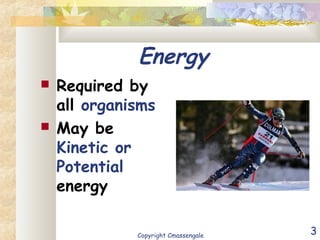
Energy
 Required by
all organisms
 May be
Kinetic or
Potential
energy
Copyright Cmassengale
4
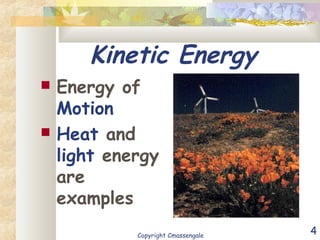
Kinetic Energy
 Energy of
Motion
 Heat and
light energy
are
examples
Copyright Cmassengale
5
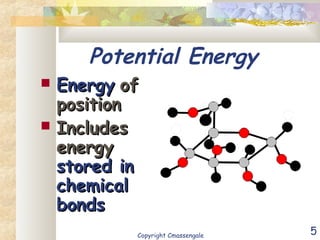
Potential Energy
 EnergyEnergy ofof
positionposition
 IncludesIncludes
energyenergy
stored instored in
chemicalchemical
bondsbonds
Copyright Cmassengale
6
Two Types of
Energy Reactions
Copyright Cmassengale
7
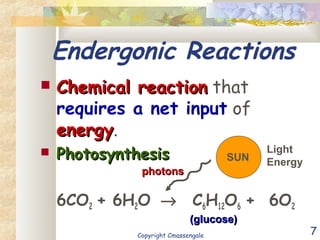
Endergonic Reactions
 Chemical reactionChemical reaction that
requires a net input of
energyenergy.
 PhotosynthesisPhotosynthesis
6CO2 + 6H2O → C6H12O6 + 6O2
SUN
photonsphotons
Light
Energy
(glucose)(glucose)
Copyright Cmassengale
8
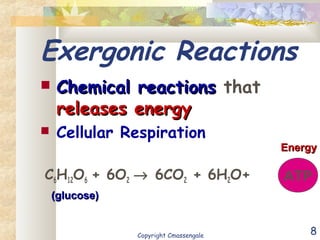
Exergonic Reactions
 Chemical reactionsChemical reactions that
releases energyreleases energy
 Cellular Respiration
C6H12O6 + 6O2 → 6CO2 + 6H2O+ ATP
(glucose)(glucose)
EnergyEnergy
Copyright Cmassengale
9
Metabolic Reactions
of Cells
Copyright Cmassengale
10
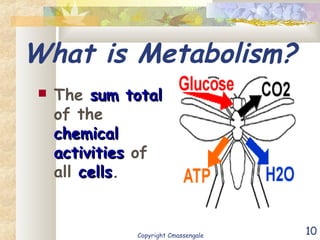
What is Metabolism?
 The sum totalsum total
of the
chemicalchemical
activitiesactivities of
all cellscells.
Copyright Cmassengale
11
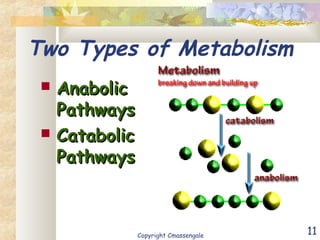
Two Types of Metabolism
 AnabolicAnabolic
PathwaysPathways
 CatabolicCatabolic
PathwaysPathways
Copyright Cmassengale
12
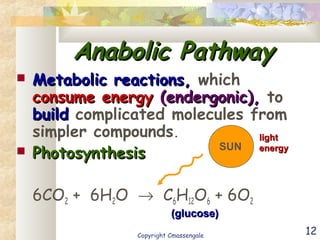
Anabolic PathwayAnabolic Pathway
 Metabolic reactions,Metabolic reactions, which
consume energyconsume energy (endergonic),(endergonic), to
buildbuild complicated molecules from
simpler compounds.
 PhotosynthesisPhotosynthesis
6CO2 + 6H2O → C6H12O6 + 6O2
SUN
lightlight
energyenergy
(glucose)(glucose)
Copyright Cmassengale
13
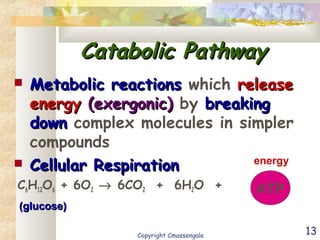
Catabolic PathwayCatabolic Pathway
 Metabolic reactionsMetabolic reactions which releaserelease
energyenergy (exergonic)(exergonic) by breakingbreaking
downdown complex molecules in simpler
compounds
 Cellular RespirationCellular Respiration
C6H12O6 + 6O2 → 6CO2 + 6H2O + ATP
(glucose)(glucose)
energy
Copyright Cmassengale
14
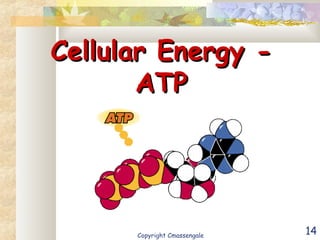
Cellular Energy -Cellular Energy -
ATPATP
Copyright Cmassengale
15
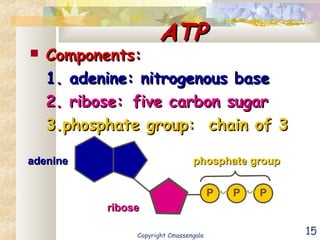
ATPATP
 Components:Components:
1. adenine: nitrogenous base1. adenine: nitrogenous base
2. ribose:2. ribose: five carbon sugarfive carbon sugar
3.phosphate group: chain of 33.phosphate group: chain of 3
riboseribose
adenineadenine
P P P
phosphate groupphosphate group
Copyright Cmassengale
16
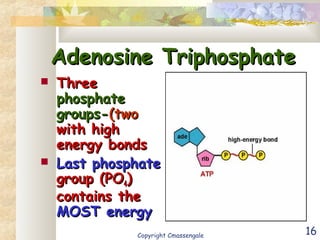
Adenosine TriphosphateAdenosine Triphosphate
 ThreeThree
phosphatephosphate
groups-groups-(two(two
with highwith high
energy bondsenergy bonds
 Last phosphateLast phosphate
group (POgroup (PO44))
contains thecontains the
MOST energyMOST energy
Copyright Cmassengale
17
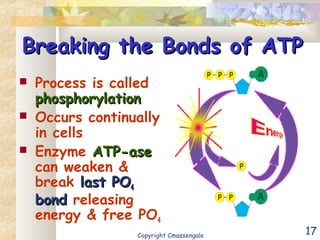
Breaking the Bonds of ATPBreaking the Bonds of ATP
 Process is called
phosphorylationphosphorylation
 Occurs continually
in cells
 Enzyme ATP-aseATP-ase
can weaken &
break last POlast PO44
bondbond releasing
energy & free PO4
Copyright Cmassengale
18
How does ATP work ?How does ATP work ?
 Organisms use enzymesenzymes to
break down energy-richenergy-rich
glucoseglucose to release its
potential energy
 This energy is trapped and
stored in the form of
adenosine triphosphate(ATP)adenosine triphosphate(ATP)
Copyright Cmassengale
19
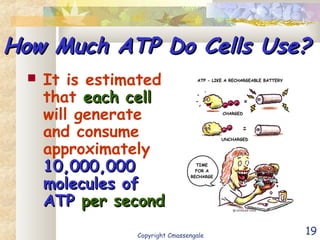
How Much ATP Do Cells Use?How Much ATP Do Cells Use?
 It is estimated
that each celleach cell
will generate
and consume
approximately
10,000,00010,000,000
molecules ofmolecules of
ATPATP per secondper second
Copyright Cmassengale
20
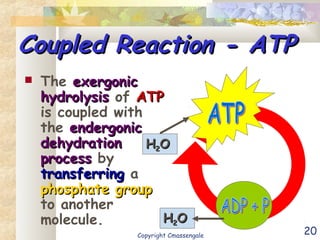
Coupled Reaction - ATPCoupled Reaction - ATP
 The exergonicexergonic
hydrolysishydrolysis of ATPATP
is coupled with
the endergonicendergonic
dehydrationdehydration
processprocess by
transferringtransferring a
phosphate groupphosphate group
to another
molecule.
HH22OO
HH22OO
Copyright Cmassengale
21
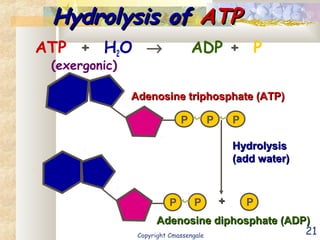
Hydrolysis ofHydrolysis of ATPATP
ATP + H2O → ADP + P
(exergonic)
HydrolysisHydrolysis
(add water)(add water)
P P P
Adenosine triphosphate (ATP)Adenosine triphosphate (ATP)
P P P++
Adenosine diphosphate (ADP)Adenosine diphosphate (ADP)
Copyright Cmassengale
22
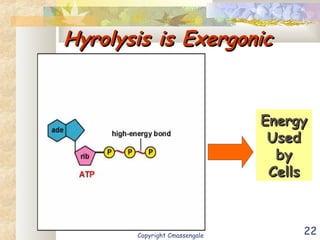
Hyrolysis is ExergonicHyrolysis is Exergonic
EnergyEnergy
UsedUsed
byby
CellsCells
Copyright Cmassengale
23
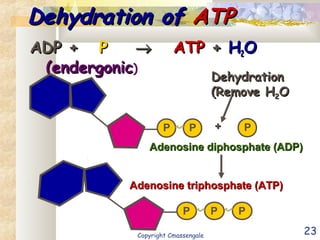
Dehydration ofDehydration of ATPATP
ADP +ADP + PP →→ ATPATP ++ HH22OO
(endergonic(endergonic)
P P P
Adenosine triphosphate (ATP)Adenosine triphosphate (ATP)
P P P++
Adenosine diphosphate (ADP)Adenosine diphosphate (ADP)
DehydrationDehydration
(Remove H(Remove H22OO
Copyright Cmassengale
24
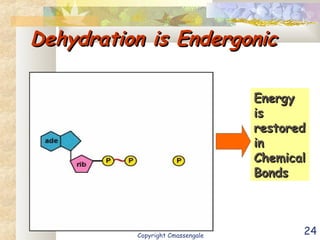
Dehydration is EndergonicDehydration is Endergonic
EnergyEnergy
isis
restoredrestored
inin
ChemicalChemical
BondsBonds
Copyright Cmassengale
25
ReviewReview
Copyright Cmassengale
26
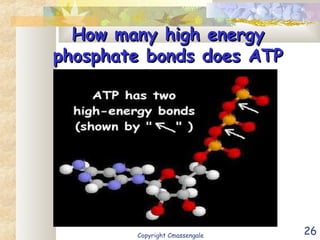
How many high energyHow many high energy
phosphate bonds does ATPphosphate bonds does ATP
have?have?
Copyright Cmassengale
27
Which is true of photosyntheis?Which is true of photosyntheis?
AnabolicAnabolic oror CatabolicCatabolic
ExergonicExergonic OrOr EndergonicEndergonic
Copyright Cmassengale
28
The breakdown of ATP isThe breakdown of ATP is
due to:due to:
DehydrationDehydration oror HydrolysisHydrolysis
HH22O addedO added oror HH22O removedO removed
Copyright Cmassengale
29
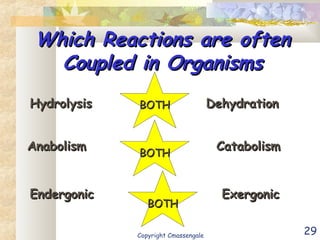
Which Reactions are oftenWhich Reactions are often
Coupled in OrganismsCoupled in Organisms
HydrolysisHydrolysis oror DehydrationDehydration
AnabolismAnabolism or Catabolismor Catabolism
EndergonicEndergonic oror ExergonicExergonic
BOTHBOTH
BOTHBOTH
BOTHBOTH
Copyright Cmassengale
30
Ready for the test?Ready for the test?
If not, review andIf not, review and
try again!!!try again!!!
Copyright Cmassengale

Bioenergetics1

  • 1.
  • 2.
    2 What is Bioenergetics? Thestudy of energyenergy in livingliving systemssystems (environments) and the organismsorganisms (plants and animals) that utilize them Copyright Cmassengale
  • 3.
    3 Energy  Required by allorganisms  May be Kinetic or Potential energy Copyright Cmassengale
  • 4.
    4 Kinetic Energy  Energyof Motion  Heat and light energy are examples Copyright Cmassengale
  • 5.
    5 Potential Energy  EnergyEnergyofof positionposition  IncludesIncludes energyenergy stored instored in chemicalchemical bondsbonds Copyright Cmassengale
  • 6.
    6 Two Types of EnergyReactions Copyright Cmassengale
  • 7.
    7 Endergonic Reactions  ChemicalreactionChemical reaction that requires a net input of energyenergy.  PhotosynthesisPhotosynthesis 6CO2 + 6H2O → C6H12O6 + 6O2 SUN photonsphotons Light Energy (glucose)(glucose) Copyright Cmassengale
  • 8.
    8 Exergonic Reactions  ChemicalreactionsChemical reactions that releases energyreleases energy  Cellular Respiration C6H12O6 + 6O2 → 6CO2 + 6H2O+ ATP (glucose)(glucose) EnergyEnergy Copyright Cmassengale
  • 9.
  • 10.
    10 What is Metabolism? The sum totalsum total of the chemicalchemical activitiesactivities of all cellscells. Copyright Cmassengale
  • 11.
    11 Two Types ofMetabolism  AnabolicAnabolic PathwaysPathways  CatabolicCatabolic PathwaysPathways Copyright Cmassengale
  • 12.
    12 Anabolic PathwayAnabolic Pathway Metabolic reactions,Metabolic reactions, which consume energyconsume energy (endergonic),(endergonic), to buildbuild complicated molecules from simpler compounds.  PhotosynthesisPhotosynthesis 6CO2 + 6H2O → C6H12O6 + 6O2 SUN lightlight energyenergy (glucose)(glucose) Copyright Cmassengale
  • 13.
    13 Catabolic PathwayCatabolic Pathway Metabolic reactionsMetabolic reactions which releaserelease energyenergy (exergonic)(exergonic) by breakingbreaking downdown complex molecules in simpler compounds  Cellular RespirationCellular Respiration C6H12O6 + 6O2 → 6CO2 + 6H2O + ATP (glucose)(glucose) energy Copyright Cmassengale
  • 14.
    14 Cellular Energy -CellularEnergy - ATPATP Copyright Cmassengale
  • 15.
    15 ATPATP  Components:Components: 1. adenine:nitrogenous base1. adenine: nitrogenous base 2. ribose:2. ribose: five carbon sugarfive carbon sugar 3.phosphate group: chain of 33.phosphate group: chain of 3 riboseribose adenineadenine P P P phosphate groupphosphate group Copyright Cmassengale
  • 16.
    16 Adenosine TriphosphateAdenosine Triphosphate ThreeThree phosphatephosphate groups-groups-(two(two with highwith high energy bondsenergy bonds  Last phosphateLast phosphate group (POgroup (PO44)) contains thecontains the MOST energyMOST energy Copyright Cmassengale
  • 17.
    17 Breaking the Bondsof ATPBreaking the Bonds of ATP  Process is called phosphorylationphosphorylation  Occurs continually in cells  Enzyme ATP-aseATP-ase can weaken & break last POlast PO44 bondbond releasing energy & free PO4 Copyright Cmassengale
  • 18.
    18 How does ATPwork ?How does ATP work ?  Organisms use enzymesenzymes to break down energy-richenergy-rich glucoseglucose to release its potential energy  This energy is trapped and stored in the form of adenosine triphosphate(ATP)adenosine triphosphate(ATP) Copyright Cmassengale
  • 19.
    19 How Much ATPDo Cells Use?How Much ATP Do Cells Use?  It is estimated that each celleach cell will generate and consume approximately 10,000,00010,000,000 molecules ofmolecules of ATPATP per secondper second Copyright Cmassengale
  • 20.
    20 Coupled Reaction -ATPCoupled Reaction - ATP  The exergonicexergonic hydrolysishydrolysis of ATPATP is coupled with the endergonicendergonic dehydrationdehydration processprocess by transferringtransferring a phosphate groupphosphate group to another molecule. HH22OO HH22OO Copyright Cmassengale
  • 21.
    21 Hydrolysis ofHydrolysis ofATPATP ATP + H2O → ADP + P (exergonic) HydrolysisHydrolysis (add water)(add water) P P P Adenosine triphosphate (ATP)Adenosine triphosphate (ATP) P P P++ Adenosine diphosphate (ADP)Adenosine diphosphate (ADP) Copyright Cmassengale
  • 22.
    22 Hyrolysis is ExergonicHyrolysisis Exergonic EnergyEnergy UsedUsed byby CellsCells Copyright Cmassengale
  • 23.
    23 Dehydration ofDehydration ofATPATP ADP +ADP + PP →→ ATPATP ++ HH22OO (endergonic(endergonic) P P P Adenosine triphosphate (ATP)Adenosine triphosphate (ATP) P P P++ Adenosine diphosphate (ADP)Adenosine diphosphate (ADP) DehydrationDehydration (Remove H(Remove H22OO Copyright Cmassengale
  • 24.
    24 Dehydration is EndergonicDehydrationis Endergonic EnergyEnergy isis restoredrestored inin ChemicalChemical BondsBonds Copyright Cmassengale
  • 25.
  • 26.
    26 How many highenergyHow many high energy phosphate bonds does ATPphosphate bonds does ATP have?have? Copyright Cmassengale
  • 27.
    27 Which is trueof photosyntheis?Which is true of photosyntheis? AnabolicAnabolic oror CatabolicCatabolic ExergonicExergonic OrOr EndergonicEndergonic Copyright Cmassengale
  • 28.
    28 The breakdown ofATP isThe breakdown of ATP is due to:due to: DehydrationDehydration oror HydrolysisHydrolysis HH22O addedO added oror HH22O removedO removed Copyright Cmassengale
  • 29.
    29 Which Reactions areoftenWhich Reactions are often Coupled in OrganismsCoupled in Organisms HydrolysisHydrolysis oror DehydrationDehydration AnabolismAnabolism or Catabolismor Catabolism EndergonicEndergonic oror ExergonicExergonic BOTHBOTH BOTHBOTH BOTHBOTH Copyright Cmassengale
  • 30.
    30 Ready for thetest?Ready for the test? If not, review andIf not, review and try again!!!try again!!! Copyright Cmassengale