G A L A X Y
H A M A D S A A D A L B A D R
K H A L E D I B R A H I M A L B A D R
J A S S I M S A A D A L B A D R
AL-BAIRAQ
I AM DISCOVERING MATERIALS
BIODEGRADABLE MATERIALS
OUTLINE
• Introduction
• Activity 1: Comparing packing materials (part A&B)
• Activity 2: Hunting for biodegradable objects
• Activity 3: Processing biodegradable materials and
comparing their mechanical properties
– Part A: Processing gelatin into a gel and films
– Part B: Testing mechanical properties
• Activity 4: Measuring the degradation rates of
biodegradable materials
• Design Project: Designing a medicine release capsule
• Product Idea: Biodegradable Air Packaging
INTRODUCTION
• What is biodegradation
• Biodegradation is the disintegration of materials by
bacteria, fungi, or other biological means. The term is
often used in relation to: biomedicine, waste
management, ecology, and the bioremediation of the
natural environment.
ACTIVITY 1: COMPARING PACKING
MATERIALS (PART A)
• White peanut degrade faster in water because it’s
biodegradable
ACTIVITY 1: COMPARING PACKING
MATERIALS (PART B)
• White peanut and green peanut both protect the egg, but
the white biodegradable peanut is better for the
environment
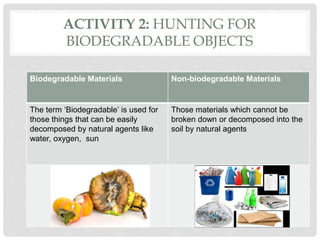
ACTIVITY 2: HUNTING FOR
BIODEGRADABLE OBJECTS
Biodegradable Materials Non-biodegradable Materials
The term ‘Biodegradable’ is used for
those things that can be easily
decomposed by natural agents like
water, oxygen, sun
Those materials which cannot be
broken down or decomposed into the
soil by natural agents
ACTIVITY 3: PROCESSING BIODEGRADABLE
MATERIALS AND COMPARING THEIR MECHANICAL
PROPERTIES
PART A: PROCESSING GELATIN INTO A GEL AND FILMS
• 1 capsule is 0.1 g
• Prepare 5% w/v film :
5 capsules + 10 ml HCl
• Prepare 10% w/v film :
10 capsules + 10 ml HCl
• Prepare 20% w/v film :
20 capsules + 10 ml HCl
• Procedure:
• Dissolve the capsules in the HCL on
60 Celsius degree
• Let dry for 2 days
ACTIVITY 4: MEASURING THE
DEGRADATION RATES OF
BIODEGRADABLE MATERIALS
• Test the effect of pH, temperature and
concentration on the degradation rates of the
gel, films, packing material (starch), and gelatin
capsule.
DESIGN PROJECT: DESIGNING A
MEDICINE RELEASE CAPSULES
• Objective: Simulation of drug release and capsule degradation inside the
human body
• Procedure:
• Drop Sodium alginate into Calcium Chloride and wait for 10 minutes and then filter
the beads (capsules are ready)
• Soak the beads into colors (as medicine) and wait for 30 minutes and then filter
the beads again
• Now the medicine capsules are ready
• Drop the capsules inside Sodium citrate (human body) and notice what happens
DESIGN PROJECT: DESIGNING A
MEDICINE RELEASE CAPSULES
• Observations:
• We notices medicine release in the solution
• After a while, the capsules start to degrade
• Conclusion:
• Biodegradable materials are used heavily in medical and
industrial applications
FINAL PROJECT:
BIODEGRADABLE AIR PACKAGING
• Introduction and Rationale:
• Biodegradable air packaging is the next
generation of sustainable packaging for smart
looking to address the environmental concerns.
From manufacturing to disposal, Biodegradable
air packages are made to provide superior void
fill product protection while being
environmentally friendly packaging.
• Biodegradable air packaging is made from
100% recyclable material. Means that it will
decompose completely within 9 to 60 months in
the presence of microorganisms, whether they
are sent to a landfill or end up as litter in the
soil. It provides an eco friendly packaging
alternative to other protective packaging
materials.
BIODEGRADABLE AIR PACKAGING
AIM OF THE WORK (OBJECTIVES)
Design a cost effective, durable
Packaging that provides protection
while providing an environmentally
responsible product that is
lightweight, recyclable, reusable and
biodegradable.
BIODEGRADABLE AIR PACKAGING
BENEFITS OVER COMMERCIAL PLASTIC
PACKAGING
• Made from 100% recyclable material that is biodegradable
• Biodegrades in 9-60 months in the presence of microorganisms
• Will degrade in landfills, whereas plastic packaging will not degrade
in landfills
• Superior performing air fill
• Cost less than plastic packaging
BIODEGRADABLE AIR PACKAGING
MATERIALS AND METHODS
• Cellophane
• Cellophane is a thin, transparent sheet made of
regenerated cellulose. Its low permeability to air, oils,
greases, bacteria, and water makes it useful for edible
and non-edible products packaging.
BIODEGRADABLE AIR PACKAGING
RESULTS:
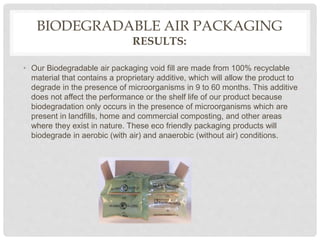
• Our Biodegradable air packaging void fill are made from 100% recyclable
material that contains a proprietary additive, which will allow the product to
degrade in the presence of microorganisms in 9 to 60 months. This additive
does not affect the performance or the shelf life of our product because
biodegradation only occurs in the presence of microorganisms which are
present in landfills, home and commercial composting, and other areas
where they exist in nature. These eco friendly packaging products will
biodegrade in aerobic (with air) and anaerobic (without air) conditions.
BIODEGRADABLE AIR PACKAGING
RECOMMENDATIONS:
• We recommend to replace the traditional old packaging
with our invented biodegradable air packaging product.
CONCLUSIONS
(OVERALL OF THE WHOLE MODULE)
Biodegradable materials are capable of being broken
down (decomposed) rapidly by the action of
microorganisms. Biodegradable substances include food
scraps, cotton, wool, wood, human and animal waste,
manufactured products based on natural materials (such
as paper, and vegetable-oil based soaps)
ACKNOWLEDGMENT
Many thanks to AL-Bairaq team from Center for Advanced
Materials (CAM), Qatar University for supporting us during
our journey with a AL-Bairaq.
Also, I would like to thank the sponsors UNESCO, Qatar
National Commission, and Shell.

Biodegradable, Biodegradable Air Packaging

  • 1.
    G A LA X Y H A M A D S A A D A L B A D R K H A L E D I B R A H I M A L B A D R J A S S I M S A A D A L B A D R AL-BAIRAQ I AM DISCOVERING MATERIALS BIODEGRADABLE MATERIALS
  • 2.
    OUTLINE • Introduction • Activity1: Comparing packing materials (part A&B) • Activity 2: Hunting for biodegradable objects • Activity 3: Processing biodegradable materials and comparing their mechanical properties – Part A: Processing gelatin into a gel and films – Part B: Testing mechanical properties • Activity 4: Measuring the degradation rates of biodegradable materials • Design Project: Designing a medicine release capsule • Product Idea: Biodegradable Air Packaging
  • 3.
    INTRODUCTION • What isbiodegradation • Biodegradation is the disintegration of materials by bacteria, fungi, or other biological means. The term is often used in relation to: biomedicine, waste management, ecology, and the bioremediation of the natural environment.
  • 4.
    ACTIVITY 1: COMPARINGPACKING MATERIALS (PART A) • White peanut degrade faster in water because it’s biodegradable
  • 5.
    ACTIVITY 1: COMPARINGPACKING MATERIALS (PART B) • White peanut and green peanut both protect the egg, but the white biodegradable peanut is better for the environment
  • 6.
    ACTIVITY 2: HUNTINGFOR BIODEGRADABLE OBJECTS Biodegradable Materials Non-biodegradable Materials The term ‘Biodegradable’ is used for those things that can be easily decomposed by natural agents like water, oxygen, sun Those materials which cannot be broken down or decomposed into the soil by natural agents
  • 7.
    ACTIVITY 3: PROCESSINGBIODEGRADABLE MATERIALS AND COMPARING THEIR MECHANICAL PROPERTIES PART A: PROCESSING GELATIN INTO A GEL AND FILMS • 1 capsule is 0.1 g • Prepare 5% w/v film : 5 capsules + 10 ml HCl • Prepare 10% w/v film : 10 capsules + 10 ml HCl • Prepare 20% w/v film : 20 capsules + 10 ml HCl • Procedure: • Dissolve the capsules in the HCL on 60 Celsius degree • Let dry for 2 days
  • 8.
    ACTIVITY 4: MEASURINGTHE DEGRADATION RATES OF BIODEGRADABLE MATERIALS • Test the effect of pH, temperature and concentration on the degradation rates of the gel, films, packing material (starch), and gelatin capsule.
  • 9.
    DESIGN PROJECT: DESIGNINGA MEDICINE RELEASE CAPSULES • Objective: Simulation of drug release and capsule degradation inside the human body • Procedure: • Drop Sodium alginate into Calcium Chloride and wait for 10 minutes and then filter the beads (capsules are ready) • Soak the beads into colors (as medicine) and wait for 30 minutes and then filter the beads again • Now the medicine capsules are ready • Drop the capsules inside Sodium citrate (human body) and notice what happens
  • 10.
    DESIGN PROJECT: DESIGNINGA MEDICINE RELEASE CAPSULES • Observations: • We notices medicine release in the solution • After a while, the capsules start to degrade • Conclusion: • Biodegradable materials are used heavily in medical and industrial applications
  • 11.
    FINAL PROJECT: BIODEGRADABLE AIRPACKAGING • Introduction and Rationale: • Biodegradable air packaging is the next generation of sustainable packaging for smart looking to address the environmental concerns. From manufacturing to disposal, Biodegradable air packages are made to provide superior void fill product protection while being environmentally friendly packaging. • Biodegradable air packaging is made from 100% recyclable material. Means that it will decompose completely within 9 to 60 months in the presence of microorganisms, whether they are sent to a landfill or end up as litter in the soil. It provides an eco friendly packaging alternative to other protective packaging materials.
  • 12.
    BIODEGRADABLE AIR PACKAGING AIMOF THE WORK (OBJECTIVES) Design a cost effective, durable Packaging that provides protection while providing an environmentally responsible product that is lightweight, recyclable, reusable and biodegradable.
  • 13.
    BIODEGRADABLE AIR PACKAGING BENEFITSOVER COMMERCIAL PLASTIC PACKAGING • Made from 100% recyclable material that is biodegradable • Biodegrades in 9-60 months in the presence of microorganisms • Will degrade in landfills, whereas plastic packaging will not degrade in landfills • Superior performing air fill • Cost less than plastic packaging
  • 14.
    BIODEGRADABLE AIR PACKAGING MATERIALSAND METHODS • Cellophane • Cellophane is a thin, transparent sheet made of regenerated cellulose. Its low permeability to air, oils, greases, bacteria, and water makes it useful for edible and non-edible products packaging.
  • 15.
    BIODEGRADABLE AIR PACKAGING RESULTS: •Our Biodegradable air packaging void fill are made from 100% recyclable material that contains a proprietary additive, which will allow the product to degrade in the presence of microorganisms in 9 to 60 months. This additive does not affect the performance or the shelf life of our product because biodegradation only occurs in the presence of microorganisms which are present in landfills, home and commercial composting, and other areas where they exist in nature. These eco friendly packaging products will biodegrade in aerobic (with air) and anaerobic (without air) conditions.
  • 16.
    BIODEGRADABLE AIR PACKAGING RECOMMENDATIONS: •We recommend to replace the traditional old packaging with our invented biodegradable air packaging product.
  • 17.
    CONCLUSIONS (OVERALL OF THEWHOLE MODULE) Biodegradable materials are capable of being broken down (decomposed) rapidly by the action of microorganisms. Biodegradable substances include food scraps, cotton, wool, wood, human and animal waste, manufactured products based on natural materials (such as paper, and vegetable-oil based soaps)
  • 18.
    ACKNOWLEDGMENT Many thanks toAL-Bairaq team from Center for Advanced Materials (CAM), Qatar University for supporting us during our journey with a AL-Bairaq. Also, I would like to thank the sponsors UNESCO, Qatar National Commission, and Shell.