BIOMATERIALS
Presenter: Lalisa M. (MD, OSR)
Moderator: Dr. Solomon (Consultant Orthopaedic Surgeon)
PRESENTATION OUTLINE
 Objective
 Introduction
 Properties of biomaterials
 Commonly used biomaterials in orthopaedics
Metallic alloys
Polymers
Ceramics
 Conclusions
 References
2
OBJECTIVE
 To see overview materials properties commonly
used in orthopaedic practice.
 To give overview on the basic science of
biomaterials that are commonly used in orthopaedic
practice.
 Discuss different biomaterials used in orthopaedics
briefly.
3
INTRODUCTION TO BIOMATERIALS
 Definitions:
 Biomaterials are synthetic or treated natural materials
that are used to replace or augment tissue and organ
function.
 Orthopaedic Biomaterials encompasses all materials
used during orthopaedic procedures (frequently man-
made materials).
 Any material that performs, aids, or replaces a natural
function.
4
Introduction…
Replace or augment tissue and organ function
5
INTRODUCTION…
 Aztecs are known to have used gold and silver.
 In 16th century in Mexico Aztec physicians used wooden sticks
.
 In mid 1800’s Ivory pegs were inserted into the medullary canal
for non-union.
 In 1917’s Hoglund of USA reported the use of autogenous bone
as an intramedullary implant.
 Structural augmentation of bone using metals begun in
nineteenth century (silver wires, iron nails, and galvanized steel
plates ).
6
7
INTRODUCTION…
 Qualities of a material to be used as biomaterials:
1) Biocompatible
2) Resistant to corrosion and degradation
3) Reproducible fabrication to the highest standards
of quality control
4) Reasonable cost
5) Possess adequate mechanical and wear
properties.
8
INTRODUCTION…
 Biocompatibility -State of mutual coexistance between a
biomaterial and the physiological environment such as
neither has an undesirable effect on the other.
A. Inert
B. Interactive
C. Viable
D. Replant
E. Not biocompatible
9
INTRODUCTION…
 Biomaterials that meet these criteria have been
used successfully to develop devices for:
Internal fixation of fractures, osteotomies and
arthrodeses,
Wound closure,
Soft tissue reconstruction,
Total joint arthroplasty, and
Prosthetics (metals and polymers) e.t.c
10
INTRODUCTION…
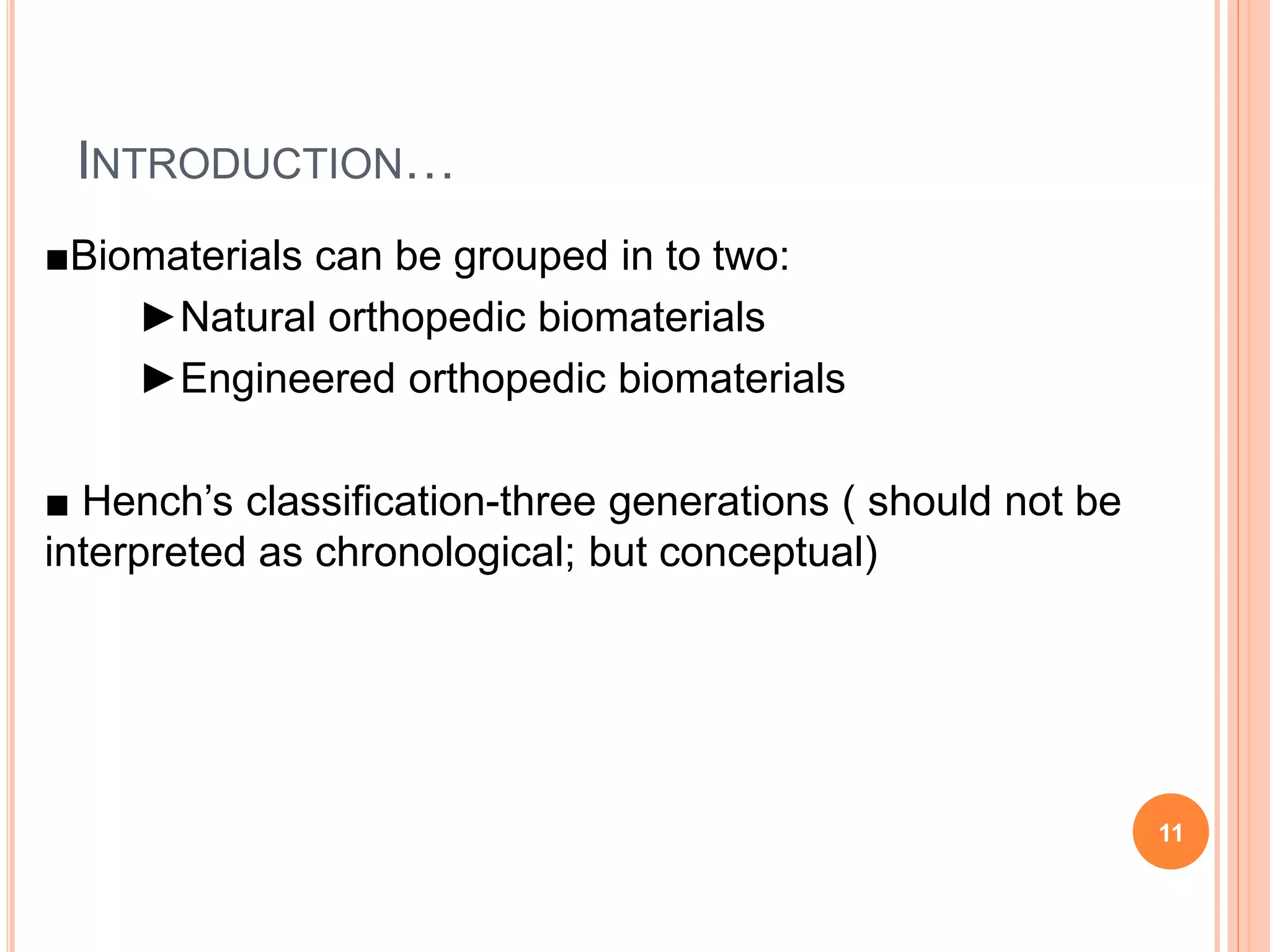
■Biomaterials can be grouped in to two:
►Natural orthopedic biomaterials
►Engineered orthopedic biomaterials
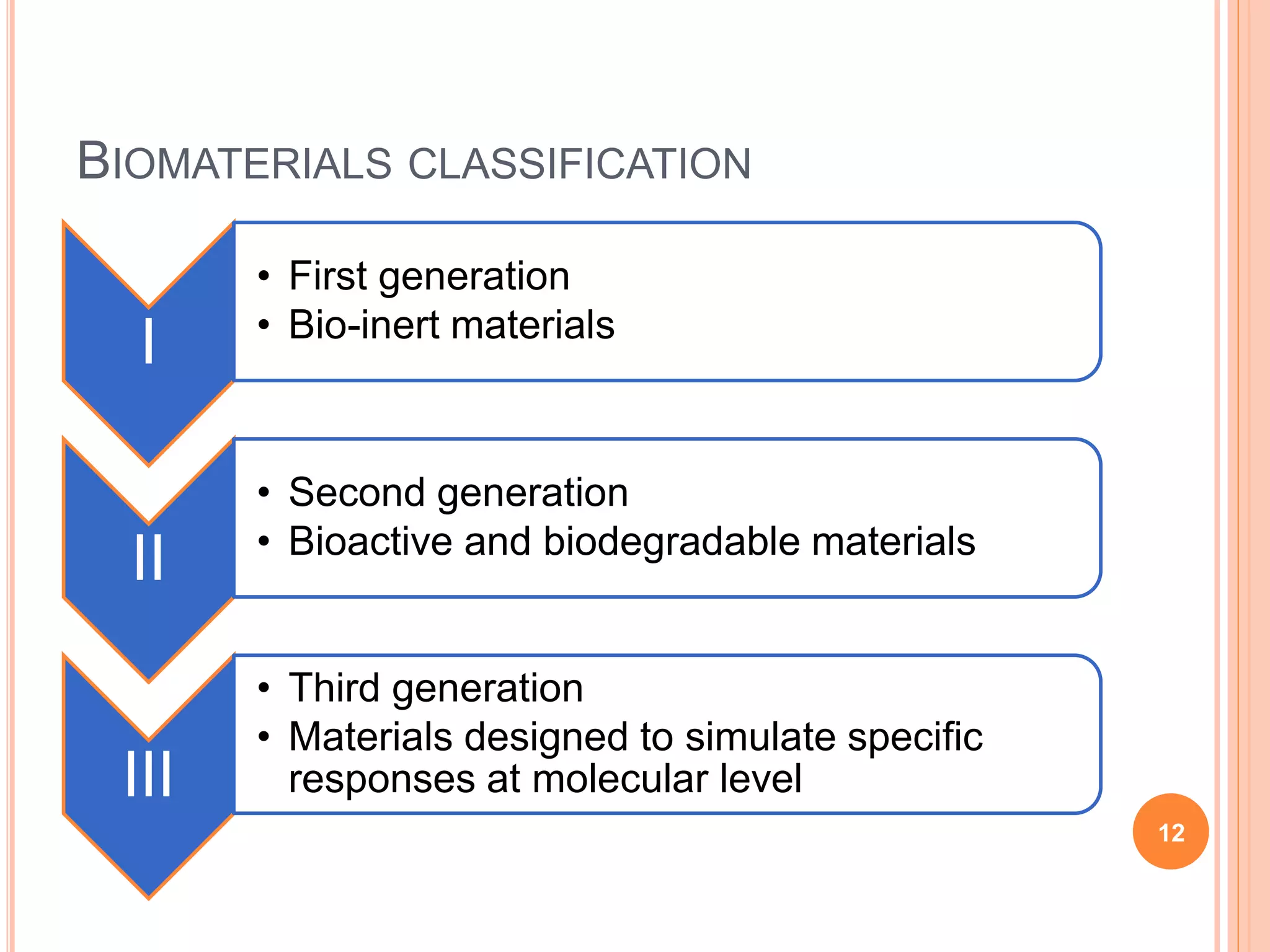
■ Hench’s classification-three generations ( should not be
interpreted as chronological; but conceptual)
11
BIOMATERIALS CLASSIFICATION
I
• First generation
• Bio-inert materials
II
• Second generation
• Bioactive and biodegradable materials
III
• Third generation
• Materials designed to simulate specific
responses at molecular level
12
FUNDAMENTALS OF MECHANICAL BEHAVIOR
 LOAD
 A force that acts on a body
a. Compression/tension—Forces perpendicular to the
surface of application.
b. Shear—Forces parallel to the surface of application.
c. Torsion—Force that causes rotation.
 Stress-Intensity of an internal force
-Force /Area
-Units - Pascal's (Pa) or N/m2
 Strain- Relative measure of the deformation of an
object
 - Change in length / original length
 - Units—none
►Strain rate = strain / time
13
BASIC DEFINITIONS…
14
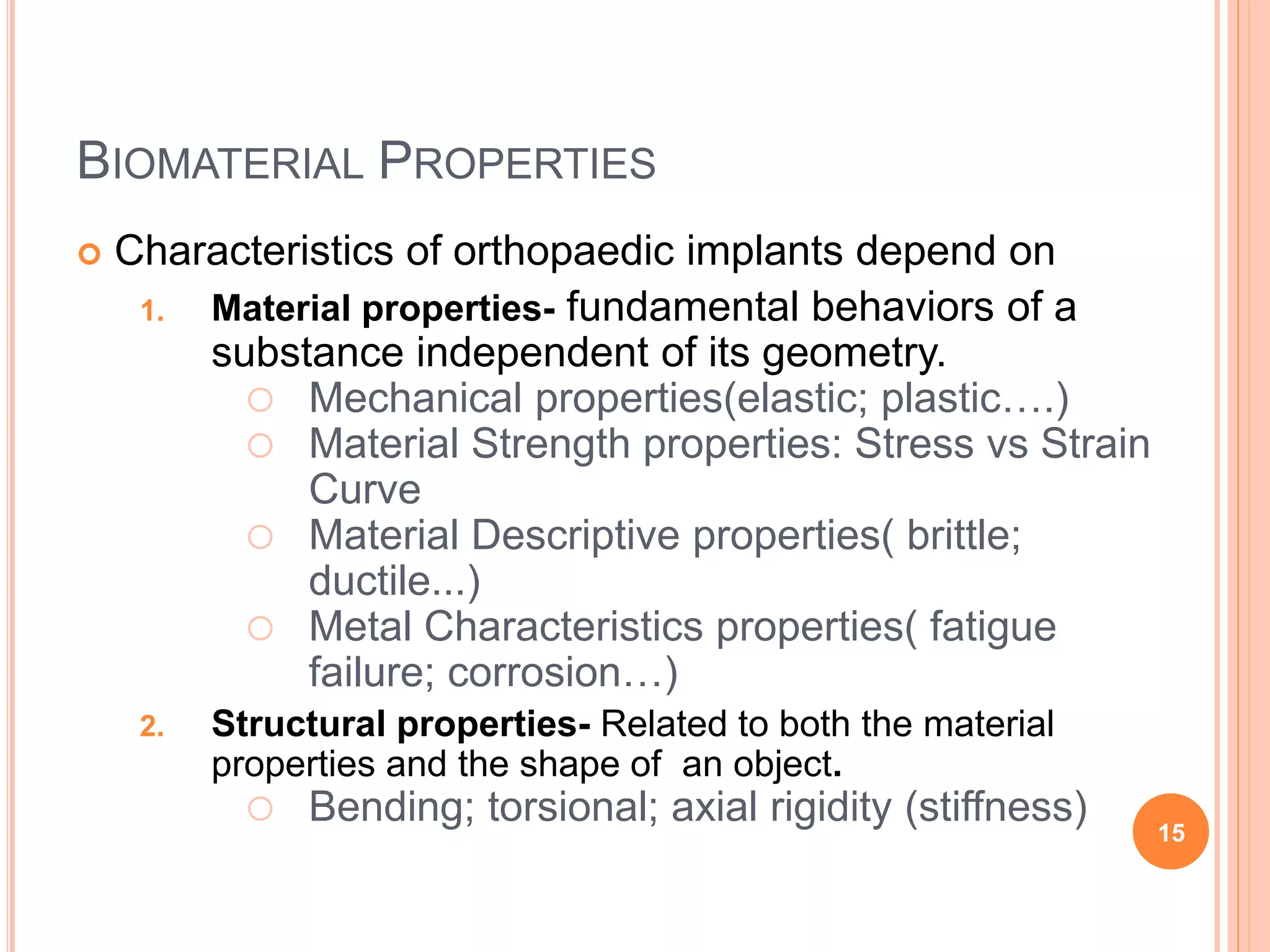
BIOMATERIAL PROPERTIES
 Characteristics of orthopaedic implants depend on
1. Material properties- fundamental behaviors of a
substance independent of its geometry.
 Mechanical properties(elastic; plastic….)
 Material Strength properties: Stress vs Strain
Curve
 Material Descriptive properties( brittle;
ductile...)
 Metal Characteristics properties( fatigue
failure; corrosion…)
2. Structural properties- Related to both the material
properties and the shape of an object.
 Bending; torsional; axial rigidity (stiffness) 15
BIOMATERIAL PROPERTIES…
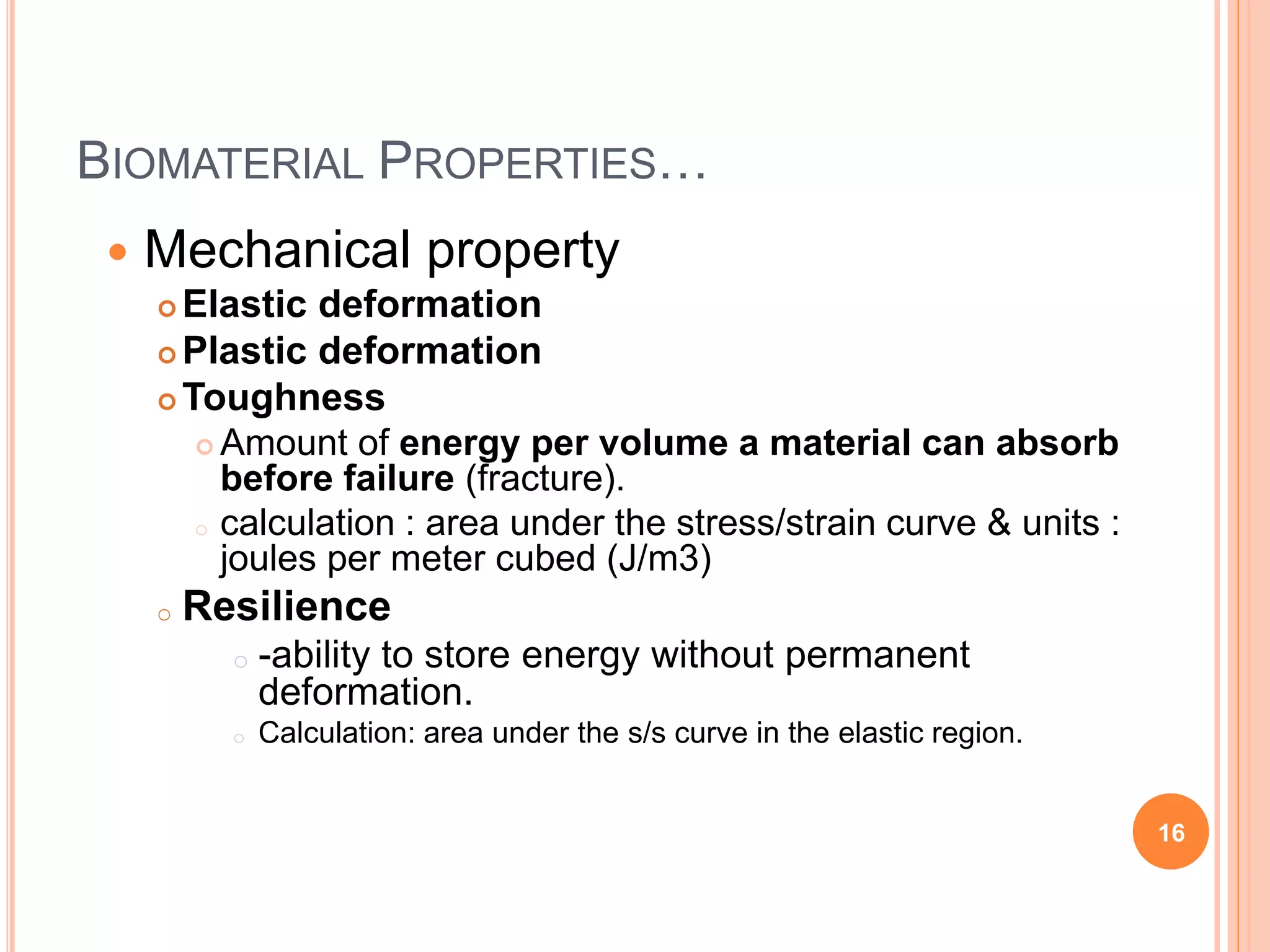
 Mechanical property
 Elastic deformation
 Plastic deformation
 Toughness
 Amount of energy per volume a material can absorb
before failure (fracture).
o calculation : area under the stress/strain curve & units :
joules per meter cubed (J/m3)
o Resilience
o -ability to store energy without permanent
deformation.
o Calculation: area under the s/s curve in the elastic region.
16
TOUGHNESS
17
TOUGHNESS …
.
18
stiff and brittle
flexible and ductile
MECHANICAL PROPERTY…
 Creep- Progressive deformation of materials in response
to a constant force applied over an extended period of
time. If sudden stress followed by constant loading causes
material to continue to deform over time, it demonstrates a
creep.
>Creep - Increase in strain over time in response to constant tensile stress
> Stress relaxation - Decrease in stress over time in response to a change of
and then maintenance of constant strain.
19
MECHANICAL PROPERTY…
20
BIOMATERIAL PROPERTIES…
 Material Strength:
 Elastic zone
 Yield point
 Yield strength
 Plastic zone
 Breaking point /failure point
21
STRESS- STRAIN CURVE
-Derived from axially loading an object and plotting the stress
verses strain curve
22
MATERIAL STRENGTH…
 Ultimate (Tensile) strength
o The load that will cause material failure.
 Hooke's law
o When a material is loaded in the elastic zone, the stress is
proportional to the strain
 Young's modulus of elasticity
o Measure of the stiffness (ability to resist deformation) in the
elastic zone
. The slope= stress/strain in the elastic zone 23
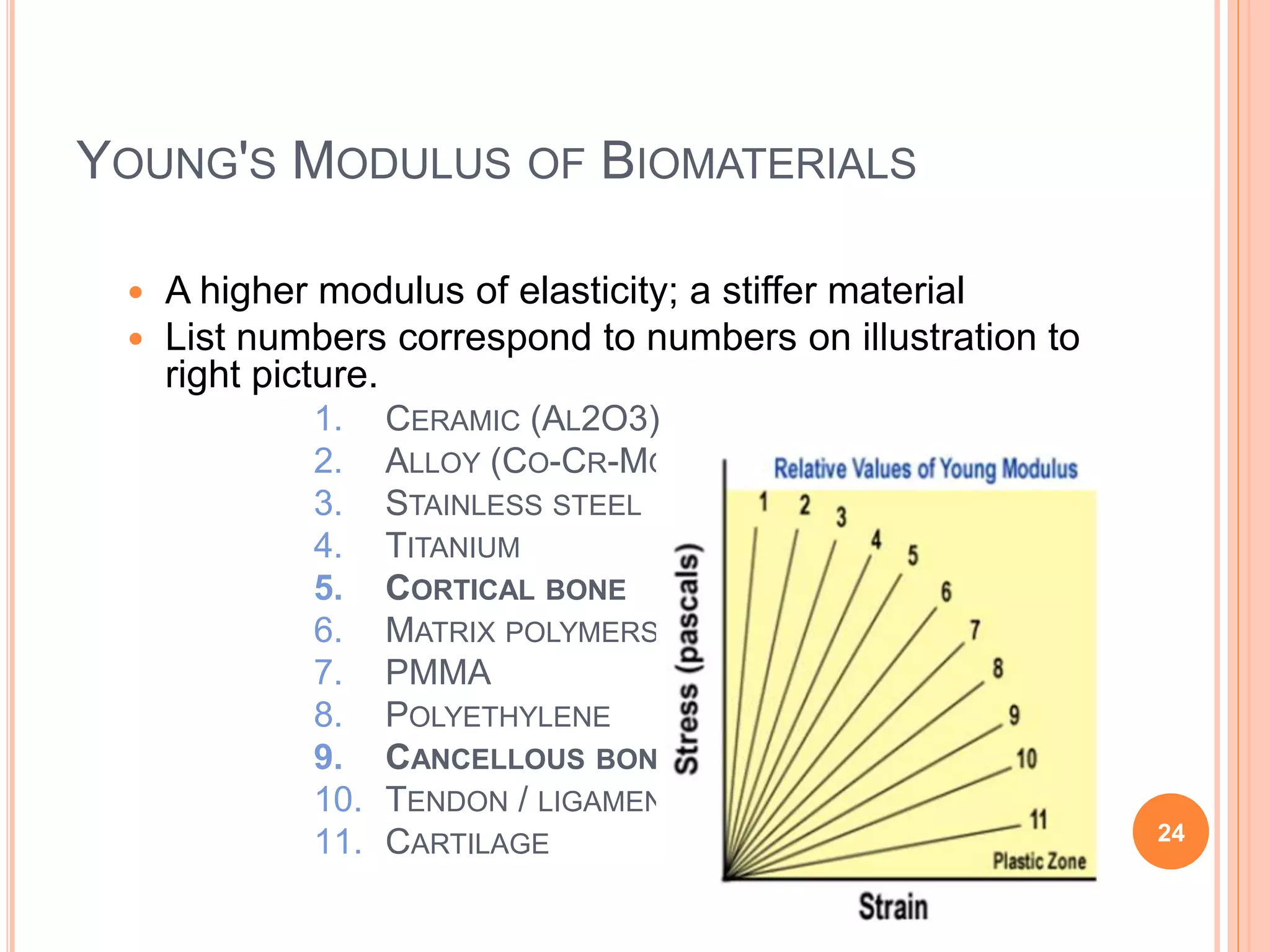
YOUNG'S MODULUS OF BIOMATERIALS
 A higher modulus of elasticity; a stiffer material
 List numbers correspond to numbers on illustration to
right picture.
1. CERAMIC (AL2O3)
2. ALLOY (CO-CR-MO)
3. STAINLESS STEEL
4. TITANIUM
5. CORTICAL BONE
6. MATRIX POLYMERS
7. PMMA
8. POLYETHYLENE
9. CANCELLOUS BONE
10. TENDON / LIGAMENT
11. CARTILAGE 24
25
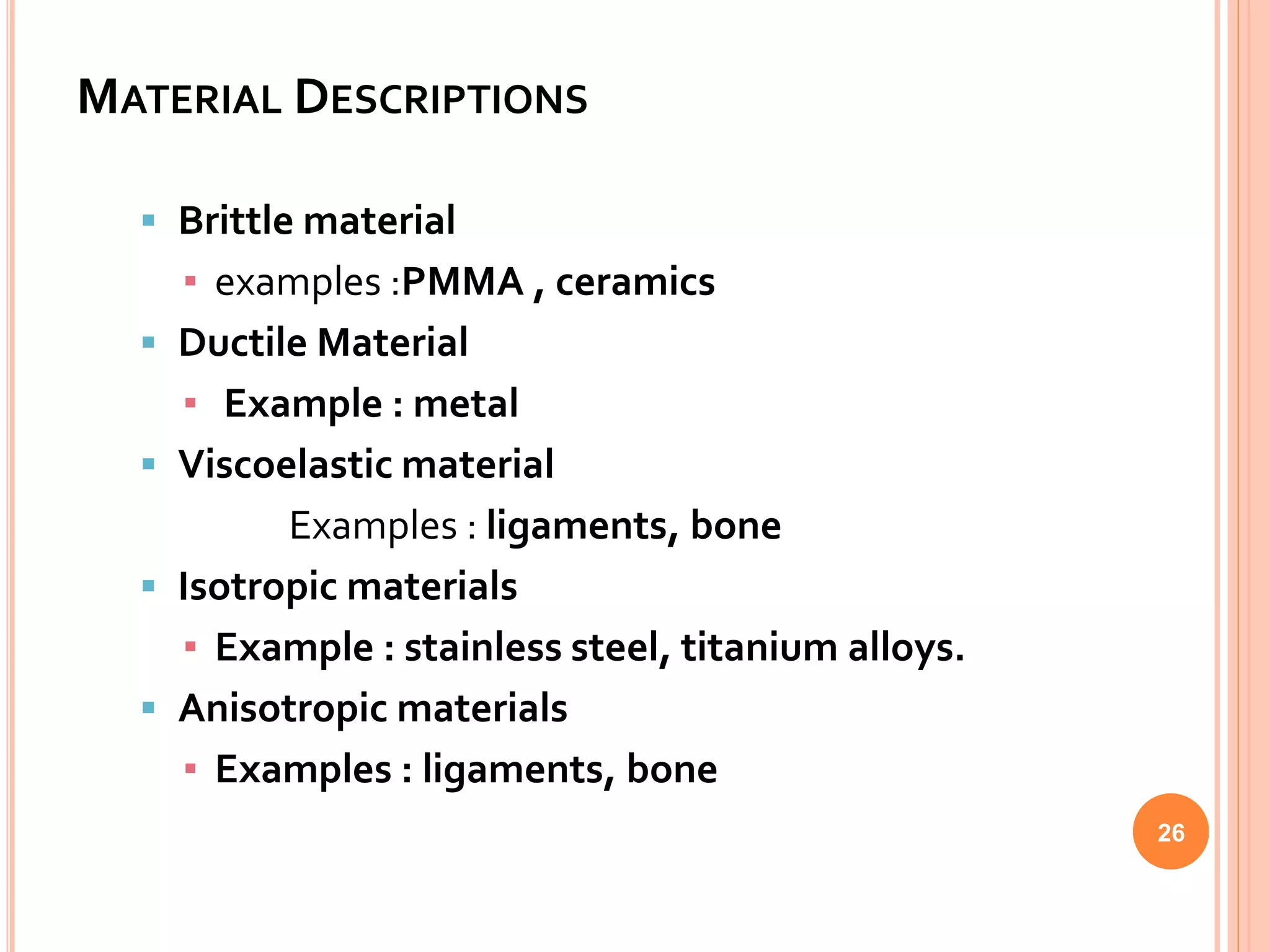
MATERIAL DESCRIPTIONS
 Brittle material
▪ examples :PMMA , ceramics
 Ductile Material
▪ Example : metal
 Viscoelastic material
Examples : ligaments, bone
 Isotropic materials
▪ Example : stainless steel, titanium alloys.
 Anisotropic materials
▪ Examples : ligaments, bone
26
MATERIAL DESCRIPTIONS…
27
METAL CHARACTERISTICS
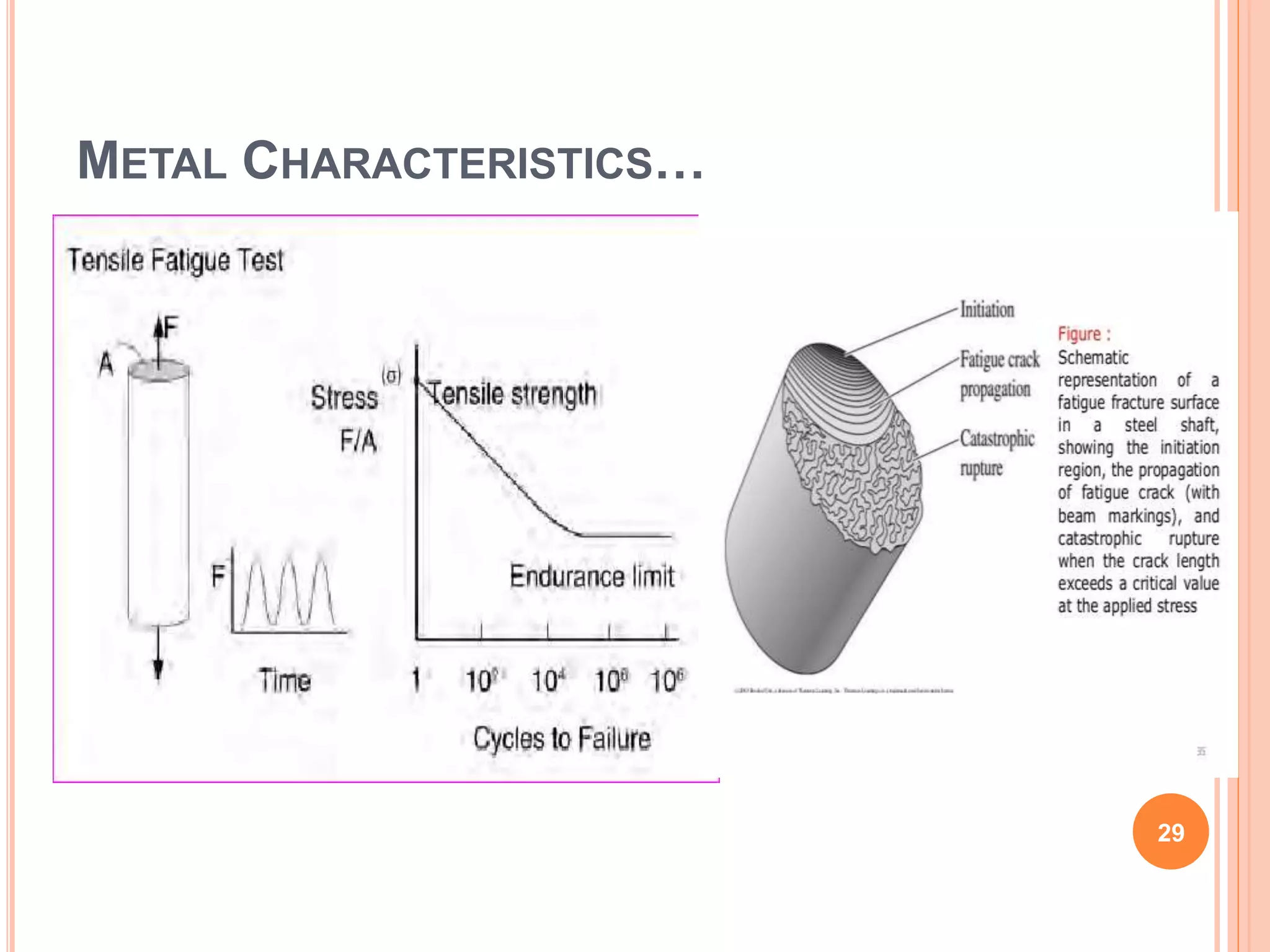
 Fatigue failure
 Failure at a point below the ultimate tensile strength
secondary to repetitive/cyclic loading.
 Depends on magnitude of stress and number of cycles.
 Most common mode of failure in orthopaedic
applications.
 When a material is subjected to a dynamic load with a
large number of loading cycles, failure will occur at a lower
stress than the ultimate stress of static loading.
 The stress at failure decreases as the number of cycles
increases.
28
METAL CHARACTERISTICS…
29
METAL CHARACTERISTICS…
 Endurance limit
 Defined as the maximal stress under which an object is
immune to fatigue failure regardless of the number of
cycles.
 Creep
 Phenomenon of progressive deformation of metal in
response to a constant force over an extended period of
time.
30
METAL CHARACTERISTICS…
 Wear
 Erosion of one material in contact with another
material under repeated loading
 Not limited character to metals
 Can occur between articulating surfaces
metal-on metal, ceramic-on-metal, and metal-on-
polyethylene bearing surfaces
 Debris generated by the wear process elicits a
cascade of biologic responses at the cellular and
tissue levels
31
METAL CHARACTERISTICS…
 Corrosion
o Refers to the chemical dissolving of metal.
 The in vivo environment of the human body can be highly
corrosive.
 Corrosion can weaken implants and release products that can
adversely affect biocompatibility and cause pain, swelling,
and destruction of nearby tissue.
 Orthopaedic devices can be susceptible to several modes of
corrosion
32
CORROSION
►Types include:
 Galvanic corrosion
 Dissimilar metals leads to electrochemical destruction.
 Crevice corrosion
 Occurs in fatigue cracks due to differences in oxygen
tension.
 Fretting corrosion
 occurs at contact sites between two materials that are in
contact & have micromotion.
 Pitting corrosion is a form of localized, symmetric corrosion
in which pits form on the metal surface.
33
Crevice corrosion
34
Fretting corrosion
35
STRUCTURAL PROPERTIES
 Structural characteristic:
 Is a result of both the type of biomaterial the implant
is made from (Strength characteristic ) and structural
configuration (design or shape) of the implant ( e.g
cylinder, rectangle).
 Structural properties can also be demonstrated in a
stress vs. strain curve. E.g. Bending rigidity
(stiffness)
36
STRUCTURAL PROPERTIES…
 Bending Rigidity (stiffness)
 Definition
 the slope of the curve in the elastic range on a structure
stress-strain curve.
 Solid Cylinder
 proportional to the radius to 4th power for a solid cylinder.
 cylinder A has great rigidity than cyliner B on illustration above
(and thus has greater radius)
 Hollow Cylinder
 proportional to the radius to the 3rd power for a hollow
cylinder.
 Rectangular Object
 proportional to the (base x height) to the 3rd power. 37
TYPES OF BIOMATERIALS
 Biomaterials used for implants in orthopaedic
include:
Metallic alloys
Polymers
Ceramics
Bone
Ligaments and tendons.
38
METALLIC ALLOYS
♦Metals are crystalline arrays in which the atoms are
regularly spaced and packed in specific configurations,
allowing for the sharing of outer electrons.
- Metals are commonly used for orthopedic implants.
- They are strong, ductile and stiff.
♦Alloys are metals composed of mixtures of metallic and
non-metallic elements.
 Goals of alloying:
 To improve the high strength, ductility, elastic modulus, the
corrosion resistance, and the biocompatibility.
39
METALLIC ALLOYS…
 Metals are typically fabricated by casting, forging, or
extrusion.
40
METALLIC ALLOYS…
 Metallic bond
 Crystalline arrays in which the nuclei of the atoms are
closely packed in an orderly array that repeats in a 3-
dimensional pattern
 These specific configurations allow for the sharing of
outer electrons
 Excellent heat and electrical conductivity
 Very strong> high strength and melting point
41
METALLIC ALLOYS…
 Metallic Microstructures
 Grain size
 Molten liquid solidifies: polycrystalline array of individual
crystals of atoms
 Grain boundaries: boundaries between crystals of atoms
 The finer the gain size the more homogeneous, and
stronger the material will be
42
METALLIC ALLOYS…
 Three common alloys used in orthopaedics
 Stainless steel
 Cobalt chromium alloy
 Titanium alloy
 Aerospace, marine & chemical industries
43
1. STAINLESS STEEL
 An alloy of iron and carbon.
 The form commonly used is 316L ( 3% molybdenum;
16% nickel & L= low carbon)
 Other major alloying element include chromium
 With minor amounts of
 manganese, phosphorous, sulfur, and silicon.
 ☻Carbon provides strength and chromium provides
the stainless quality to the stainless steel.
 Nickle stabilizes the face-centered cubic austenitic
phase
 Chromium, Molybdenum, silicon - stabilizes the
ferritic, body-centered cubic phase (weaker) 44
316L
45
STAINLESS STEEL…
 Chromium also forms strongly adherent passive oxide film (Cr2O3
- corrosion resistance)
 Nitric acid bath
 Standardized method to enhance the passive oxide layer
 limits the rate of electrochemical corrosion by about a
thousand to a million times.
 Carbon
 Must be kept at low
 If high > carbides > chromium is used up > prone to corrosion
related fractures
 Grain size
 100 microns
 Controlled by- Solidification process 46
STAINLESS STEEL…
 Advantages
 Very strong; biocompatible and reasonable corrosion resistance
 Fracture resistant; relatively cheap and ductile
 Disadvantages
 Susceptible to corrosion( the most susceptible material to both
crevice and galvanic corrosion)
 Poor wear resistance
 Stress shielding of bone due to superior stiffness ( High Young’s
modulus- 200 G Pascals = 10x that of bone )
 Used in plates; screws; IMN; external fixators
47
STAINLESS STEEL…
48
2. COBALT-CHROMIUM ALLOYS
 Primarily alloy of cobalt with chromium.
 The chromium forms a strongly adherent oxide film
that provides a passive layer shielding the bulk
material from the environment for corrosion
resistance.
 Chromium added for corrosion resistance. (as with
stainless steel)
49
COBALT-CHROMIUM ALLOYS…
50
COBALT-CHROMIUM ALLOYS…
 Advantages
very strong
Ease of fabrication
better resistance to corrosion than stainless steel
 excellent long term biocompatibility
Disadvantages
- risk of stress sheilding ( very high Young’s modulus)
- expensive
Uses:- usually for bearing surfaces; metal on metal devices
eg. THR
51
3. TITANIUM ALLOYS
 Primary alloying elements are aluminum and
vanadium.
 Adherent passive layer of titanium oxide (TiO2)
significantly exceeds the other alloys (stainless steel
and the cobalt alloys) in corrosion resistance.
 Excellent pitting; intergranular and crevice corrosion
resistance
 Uses: fracture plates ( esp. compression plates ),
screws, intramedullary nails, some femoral stems.
52
TITANIUM ALLOYS…
The most common titanium alloy used in orthopedic surgery is T64 (Ti-6A1-4V).
☼Osseointegration
Titanium has been shown
to promote good bone
apposition to its surface
when it is implanted, and
porous surfaces have
proven to be receptive to
bone ingrowth.
89%
53
54
TITANIUM ALLOYS…
 Advantages
 very biocompatable
 forms adherent oxide coating
through self passivation
(exceptional corrosion
resistant)- form its passivation
layer in air before
implantation
 Ductile and fatigue resistant
 low modulus of elasticity
makes it more similar to
biologic materials as cortical
bone.
 MR scan compatability
55
Disadvantages
-poor resistance to
wear (notch sensitivity)
(not used as a femoral
head prosthesis)
-generates more metal
debris than cobalt
chromium (Vanadium is
cytotoxic).
-relatively expensive
56
57
4. TANTALUM
 The latest metal to hit the orthopedic market is tantalum.
 The benefit of tantalum is the ability to form it into porous
foams with a structure on the order of trabecular bone,
providing a scaffold that is optimum for bone ingrowth.
 The mechanical properties of this novel metal depend on its
porosity and structure but are sufficient to provide mechanical
support during the period of bony integration
 Tantalum has been shown to be virtually inert, provoking a
minimal tissue response.
 This combination of properties has lead to the development of
tantalum structures for the backing of acetabular cups and
spinal fusion cages.
 It shows great promise for future!
58
TANTALUM…
59
Left- porous tantalum micro-stracture
Right -Top row: monoblock acetabulum and acetabular augment
- Middle row: tibia; TKA augment; salvage patella button
- Bottom row: osteonecrosis and spine arthrodesis implants
TANTALUM…
60
5. POLYMERS
 Polymers are large molecules made from
combinations of smaller molecules (consists of many
repeating units of monomers).
 Copolymers are polymers that contain > 1 type of
monomer.
 Example: Bone cement
61
POLYMERS …
 Its properties are dictated by
 Its chemical structure (the monomer)
 The molecular weight (the number of monomers)
 The physical structure (the way monomers are attached
to each other)
 Linear, branched, cross linked
 Isomerism (the different orientation of atoms in some
polymers)
 Crystallinity (the packing of polymer chains into ordered
atomic arrays)
62
POLYMERS …
 Virtually all polymers are semicrystalline in that only
some areas of the structure are ordered.
 The degree of crystallinity can greatly influence
the properties of the polymer.
The 3 specific families of polymers used extensively
in orthopaedic applications are:
 PMMA (Polymethylmethacrylate) (bone cement )
 UHMWPE
Resorbable polymers
Others: Composites, Hydrogels
63
A. POLYMETHYLMETHACRYLATE (PMMA)
 Bone cement; most commonly used polymer in orthopaedics
 2 component material
 powder (in a bag)
 PMMA alone or with copolymer of polystyrene or methacrylic acid
(Polymer)
 Dibenzoyl peroxide (initiator/catalyst)
 BaSO4 or ZrO2 (radio-opacifier)
 liquid (in a sealed glass ampoule)
 Methylmethacrylate (monomer)
 DMPT (N, N, -dimethyl-p-toluidine) (accelerator- accelerate
polymerization once it starts)
 Hydroquinone (stabilizer) (inhibitor-polymerization inhibitor)
64
PMMA…
65
BONE CEMENT CONT`D…
 Clinically relevant stages of cement reactions:
- Dough time…….. 2 to 3 mins
- Working time…... 5 to 8 mins
- Setting time…….. 8 to 10 mins
■ The performance of cement has been enhanced by
improved protocols in cement handling, bone preparation, and
cement delivery
66
BONE CEMENT CONT`D…
 Mixing of the two components results in an
exothermic reaction
 130 calories/g of methylmethacrylate monomer
 Amount of cement, heat transfer to surrounding
areas, and the thickness of the cement
3 mm thick cement around femoral stem – 600c
6 mm thick section – 1000c
 Actual in vitro temperature 400c
67
BONE CEMENT CONT`D…
 Centrifugation or vacuum during mixing
 Reduce the porosity by greater than 50% over that of hand
mixing
 44% (mean) increase in ultimate tensile strength relative to
hand-mixed
 Antibiotics can be added to PMMA bone cement
 Provide prophylaxis or aid in the treatment of infection
 Can negatively affect the properties of PMMA bone cement
(few reports)
 interfering with the crystallinity of the polymer
 Therapeutic levels of antibiotics can be added to the cement
without any measurable reduction of properties (Generally) 68
BONE CEMENT CONT`D…
69
BONE CEMENT CONT`D…
 Advantages
 reaches ultimate strength at 24 hours
 strongest in compression
 Young's modulus between cortical and cancellous bone
 Disadvantages
 poor tensile and shear strength (weaker than bone in
tension)
 polymerizes in vivo through an exothermic reaction that
elevates the temperature of the surrounding tissues.
 production of wear debris and debris-related bone loss
 insertion can lead to dangerous drop in blood pressure
 failure often caused by microfracture and fragmentation
70
BONE CEMENT CONT`D…
 Uses
 Secure arthroplasty components to bone by interlocking with
bone; does not act as an adhesive but rather a space filler
 Stabilize osteoporotic fractures of the spine
 Fill tumor defects and minimize local recurrence
71
72
B. UHMWPE
 A polymer with much higher molecular weight (
polymer of ethylene with MW of 2 – 6 million.)
 Higher impact strength, toughness, and better
abrasive wear.
 Most common method of sterilization – radiation
 Results in the formation of free radicals
73
UHMWPE…
 Orthopaedic use: to make joint replacement components -
acetabular cups in THR and tibial components in TKR .
 Advantages
 tough
 ductile
 resilient
 resistant to wear
 Disadvantages
 susceptible to abrasion
 Polyethylene wear derbis > osteolysis > aseptic loosening
 thermoplastic (may be altered
by extreme temperatures)
 weaker than bone in tension.
74
C. BIODEGRADABLE/ BIORESORBABLE
 Are polymers synthesized so that they will degrade
chemically and physically overtime. No need for
remove of the device.
 As stiffness of the polymer decrease; stiffness of
callus increases.
 Strong enough at implantation; appropriate rate of
degradation; biocompatible degradation products
 Their properties are not easily provided; can span an
enormously large range (eg, modulus values from .1–
30 MPa and strength values from 3 to 290 MPa).
75
BIODEGRADABLE/ BIORESORBABLE …
 Have several uses. e.g.
 primary fixation or support as a suture, screw, anchor, or
pin &
 as the support matrix for drug delivery. e.g. Antibiotic
beads.
 Mainly used in orthopaedics today include:
 polylactic acid (PLA),
 polyglycolic acid (PGA),
 polydioxanone (PDS), and
 polycaprolactone (PCL).
 PLA has long been considered a desirable choice as
the basis for a bioresorbable polymer because the
degradation product is lactic acid, a “natural” Krebs
cycle constituent that is already present.
76
Biodegradable/ Bioresorbable …
77
BIODEGRADABLE/ BIORESORBABLE …
 Advantage
 Alleviate the need for a second surgical procedure to remove the
device
 Support matrix for drug delivery
 Disadvantage
 High concentration of lactic acid released to the surrounding region of
the device may nonetheless present biocompatibility problems.
 Mechanical properties often decrease faster than mass loss
rate; virtually no strength left in these materials in just a 2- to 3-
week period.
 Heat during manufacturing- difficulties during any fabrication
process – degradation of material (change in final property)
78
D. SILICONES
 Polymers that are often used for replacement in non-weight
bearing joints
 Disadvantages
 Poor strength and wear capability responsible for frequent
synovitis.
79
SILICONES…
80
E. CARBON FIBERS
 Composite with many ranges of orthopaedic applications.
 Applications:
- Total hip replacements
- Plates
- Nails
- Washers
- External fixator
81
CARBON FIBERS….
82
CARBON FIBERS…
◊ Advantages:
-Radiolucency on x-ray
- Extremely light weight; but stronger than steel (so far
apparently none have broken)
- Bio-inert material; lower tissue reaction
- Carbon fiber plates less rigid; allow micro-movement
 Disadvantages:
- Release of carbon debris into surrounding medium.
- Its main limitation is cost ( now decreasing)
83
6. CERAMICS
 Ceramic materials are solid, inorganic compounds
consisting of metallic and nonmetallic elements held
together by ionic or covalent bonding.
 Ceramics include compounds such as
Silica i.e Silicon oxide (SiO2),
Zirconia i.e Zirconium oxide (ZrO2)
Alumina i.e Aluminum oxide (Al2O3)
Calcium phosphate(HA), and
Bioglass (SiO2-Na2O-CaO-P2O5),
84
85
86
CERAMICS…
 Examples:
 Inert
Silica (SiO2), Alumina (Al2O3), Zirconia (ZrO2)
 Bioactive
Hydroxyapatite [Ca10(PO4)6(OH)2]
Tricalcium phosphate [Ca3(PO4)2]
87
CERAMICS CONT`D…
 Applications in orthopaedics:
 Total joint replacement components (alumina and
zirconia).
 Bone graft substitutes and as coatings for metallic
implants (calcium phosphate and bioglass).
 Advantages
 Best biocompatability and wear characteristics
 Osteoconductive
 Excellent wettability (hydrophylic)
 High compressive strength
 Highly inert and insoluble
 Good electric and thermal insulators
 Good aesthetic appearance 88
CERAMICS CONT`D…
 Disadvantages
 Typically brittle, low fracture toughness
 Very difficult to process ( high melting point)
 High Young's modulus
 Low tensile strength
 Poor crack resistance
 Very expensive
 Very stiff and brittle
89
CERAMICS CONT`D…
 Alumina
 Strength (580MPa), EM (380)
► Uses:
 Femoral head, bone screws and plates
 Porous coatings for femoral stems
 Porous spacers (specifically in revision surgery)
 Knee prosthesis
90
CERAMICS CONT`D..ALUMINA -INERT CERAMICS…
91
CERAMICS CONT`D…
 Zirconia
 Strength (900MPa), EM (210)
 Obtained from the mineral zircon(Zr)
► Uses:
 Femoral head, artificial knee; bone screws and plates
 Favored over UHMWPE due to superior wear
resistance
-One fifth the wear of alumina ceramic on
polyethylene
92
CERAMICS CONT`D… ZIRCONIA…
93
CERAMICS CONT`D…
 Alternative Bearing Surfaces for Total Joint
Arthroplasty
 Metal-on-polyethylene
 Standards for comparison
 Wear: 75 to 250 µm/yr; periprosthetic osteolysis
 Ceramic-on-Polyethylene
 Most common alternative bearing
 Wear: 0 to 150 µm/yr
 New-Generation Ceramic-on- Ceramic
 Wear: 0.5 to 2.5 µm/component/yr
 New-Generation Metal-on-Metal
 Wear: 4.0 to 5.9 µm/component/yr
94
CERAMICS CONT`D…
95
BIOACTIVE CERAMICS
 Bone graft substitutes & coating in metallic implants
 Hydroxyapatite - hydrated calcium phosphate; similar
in crystalline structure to the mineral of bone; very slow
to resorb. See HA coated screws
96
BIOACTIVE CERAMICS- HA COATED
97
.
BIOACTIVE CERAMICS…
 Calcium phosphates
▪ Is bioactive/degradable ceramics
▪ Not used in high load bearing devices due to low tensile
strength and toughness
Uses:
- repair material for bone; trauma or disease
- void filling after resection of bone tumours
- repair and fusion of vertebrae; repair of herniated disk
- drug-delivery
98
BIOACTIVE CERAMICS…
99
7. TISSUE ADHESIVES
 Commonly used tissue adhesives are:
- Fibrin gel
- Albumin
- Cyanoacrylates
- Mucopolysaccharides
 Properties of tissue adhesives
- Moderately viscous ( spreads easily)
- Ability to degrade at appropriate rate
- Biocompatability
100
GENERAL TISSUE-IMPLANT RESPONSES
 All implant materials elicit some response from the
host
 The response occurs at tissue-implant interface
 Response depend on many factors:
- Type of tissue/organ
- Mechanical load
- Amount of motion
- Composition of the implant
- Age of the patient
101
TISSUE IMPLANT RESPONSES
.
Biomaterial
Toxic
Death of
surrounding
tissues
Non-toxic
Bio-
degradable
Bio-active Bio-inert
Dissolution
of material
Interfacial
bond
formation
Fibrous
encapsulation 102
IMPLANT ASSOCIATED COMPLICATIONS
 Aseptic loosening: caused by osteolysis from
body’s reaction to wear debris
 Stress shielding: implant prevents bone from being
properly loaded
 Corrosion: reaction of the implant with its
environment resulting in its degradation to
oxides/hydroxides
 Infection
 Metal hypersensitivity
 Manufacturing errors
103
RECENT ADVANCES
 The aim is to use material that match mechanical
property of bone.
 Modifications to currently available materials to
minimize harmful effects.
Ex. Nickel free metal alloys
 The possibility of the use of anti-cytokines in
prevention of osteolysis around implants.
 Antibacterial implants
 Porous tantalum is also being used clinically in
several orthopaedic applications eg. TJA.
104
CONCLUSION
 Adequate knowledge of implant materials is an essential
platform to make best choice for the patient.
 Promising and satisfying results from the use of existing
implants
 Advances in medical engineering will go a long way in
helping orthopaedic surgeons
 From their first passive role, in which replacement by
substitution was the target, today at all levels (industrial,
academic and clinical) the present pro-active biomaterials
are typically required for assisting healthy cells to
regenerate the diseased tissue and organs. So, the trend
today is from a passive towards a more active role for
biomaterials.
105
CONCLUSION…
 As a materials scientist or a clinician, one should
disregard any notion that modern technology has
the ability to replace any part of a living organism
with an artificial organ which will be superior to the
original structure.
 The search is on …
106
107
REFERENCES
1. Orthopaedic Basic Science, 2 edition.
2. AAOS comprehensive orthopaedic review, Vol 1, 2oo9.
3. Biomechanics and Biomaterials in Orthopedics, 2004.
5. Biomaterials in Orthopedics; 2004
6. Black J (ed): Orthopaedic Biomaterials in Research and Practice. New York, NY,
Churchill Livingstone, 1988.
7. Burstein AH, Wright TM (eds): Fundamentals of Orthopaedic Biomechanics.
Baltimore, MD, Williams & Wilkins, 1994.
8. Frymoyer JW (ed): Orthopaedic Knowledge Update 4: Home Study Syllabus.
Rosemont, IL, American Academy of Orthopaedic Surgeons, 1993.
9. Ratner BD, Hoffman AS, Schoen FJ, Lemons JE (eds): Biomaterials Science: An
Introduction to Materials in Medicine. San Diego, CA, Academic Press, 1996.
10. Von Recum A, Jacobi JE (eds): Handbook of Biomaterials Evaluation: Scientific,
Technical and Clinical Testing of Implant Materials, ed 2. Philadelphia, PA, Taylor &
Francis, 1999.
11. American Society for Testing and Materials: 1998 ASTM Book of Standards,
Volume 13.01 Medical Devices and Services.West Conshohocken, PA, American
Society for Testing and Materials, 1998.
12. Li P: Bioactive ceramics: State of the art and future trends. Semin Arthroplasty
1998;9:165–175.
13. Willmann G: Ceramics for total hip replacement: What a surgeon should know.
Orthopedics 1998;21:173–177.
14. Heros RJ, Willmann G: Ceramics in total hip arthroplasty. Semin Arthroplasty
1998;9:114–122.
108
109

Biomaterials in Orthopaedics

  • 1.
    BIOMATERIALS Presenter: Lalisa M.(MD, OSR) Moderator: Dr. Solomon (Consultant Orthopaedic Surgeon)
  • 2.
    PRESENTATION OUTLINE  Objective Introduction  Properties of biomaterials  Commonly used biomaterials in orthopaedics Metallic alloys Polymers Ceramics  Conclusions  References 2
  • 3.
    OBJECTIVE  To seeoverview materials properties commonly used in orthopaedic practice.  To give overview on the basic science of biomaterials that are commonly used in orthopaedic practice.  Discuss different biomaterials used in orthopaedics briefly. 3
  • 4.
    INTRODUCTION TO BIOMATERIALS Definitions:  Biomaterials are synthetic or treated natural materials that are used to replace or augment tissue and organ function.  Orthopaedic Biomaterials encompasses all materials used during orthopaedic procedures (frequently man- made materials).  Any material that performs, aids, or replaces a natural function. 4
  • 5.
    Introduction… Replace or augmenttissue and organ function 5
  • 6.
    INTRODUCTION…  Aztecs areknown to have used gold and silver.  In 16th century in Mexico Aztec physicians used wooden sticks .  In mid 1800’s Ivory pegs were inserted into the medullary canal for non-union.  In 1917’s Hoglund of USA reported the use of autogenous bone as an intramedullary implant.  Structural augmentation of bone using metals begun in nineteenth century (silver wires, iron nails, and galvanized steel plates ). 6
  • 7.
  • 8.
    INTRODUCTION…  Qualities ofa material to be used as biomaterials: 1) Biocompatible 2) Resistant to corrosion and degradation 3) Reproducible fabrication to the highest standards of quality control 4) Reasonable cost 5) Possess adequate mechanical and wear properties. 8
  • 9.
    INTRODUCTION…  Biocompatibility -Stateof mutual coexistance between a biomaterial and the physiological environment such as neither has an undesirable effect on the other. A. Inert B. Interactive C. Viable D. Replant E. Not biocompatible 9
  • 10.
    INTRODUCTION…  Biomaterials thatmeet these criteria have been used successfully to develop devices for: Internal fixation of fractures, osteotomies and arthrodeses, Wound closure, Soft tissue reconstruction, Total joint arthroplasty, and Prosthetics (metals and polymers) e.t.c 10
  • 11.
    INTRODUCTION… ■Biomaterials can begrouped in to two: ►Natural orthopedic biomaterials ►Engineered orthopedic biomaterials ■ Hench’s classification-three generations ( should not be interpreted as chronological; but conceptual) 11
  • 12.
    BIOMATERIALS CLASSIFICATION I • Firstgeneration • Bio-inert materials II • Second generation • Bioactive and biodegradable materials III • Third generation • Materials designed to simulate specific responses at molecular level 12
  • 13.
    FUNDAMENTALS OF MECHANICALBEHAVIOR  LOAD  A force that acts on a body a. Compression/tension—Forces perpendicular to the surface of application. b. Shear—Forces parallel to the surface of application. c. Torsion—Force that causes rotation.  Stress-Intensity of an internal force -Force /Area -Units - Pascal's (Pa) or N/m2  Strain- Relative measure of the deformation of an object  - Change in length / original length  - Units—none ►Strain rate = strain / time 13
  • 14.
  • 15.
    BIOMATERIAL PROPERTIES  Characteristicsof orthopaedic implants depend on 1. Material properties- fundamental behaviors of a substance independent of its geometry.  Mechanical properties(elastic; plastic….)  Material Strength properties: Stress vs Strain Curve  Material Descriptive properties( brittle; ductile...)  Metal Characteristics properties( fatigue failure; corrosion…) 2. Structural properties- Related to both the material properties and the shape of an object.  Bending; torsional; axial rigidity (stiffness) 15
  • 16.
    BIOMATERIAL PROPERTIES…  Mechanicalproperty  Elastic deformation  Plastic deformation  Toughness  Amount of energy per volume a material can absorb before failure (fracture). o calculation : area under the stress/strain curve & units : joules per meter cubed (J/m3) o Resilience o -ability to store energy without permanent deformation. o Calculation: area under the s/s curve in the elastic region. 16
  • 17.
  • 18.
    TOUGHNESS … . 18 stiff andbrittle flexible and ductile
  • 19.
    MECHANICAL PROPERTY…  Creep-Progressive deformation of materials in response to a constant force applied over an extended period of time. If sudden stress followed by constant loading causes material to continue to deform over time, it demonstrates a creep. >Creep - Increase in strain over time in response to constant tensile stress > Stress relaxation - Decrease in stress over time in response to a change of and then maintenance of constant strain. 19
  • 20.
  • 21.
    BIOMATERIAL PROPERTIES…  MaterialStrength:  Elastic zone  Yield point  Yield strength  Plastic zone  Breaking point /failure point 21
  • 22.
    STRESS- STRAIN CURVE -Derivedfrom axially loading an object and plotting the stress verses strain curve 22
  • 23.
    MATERIAL STRENGTH…  Ultimate(Tensile) strength o The load that will cause material failure.  Hooke's law o When a material is loaded in the elastic zone, the stress is proportional to the strain  Young's modulus of elasticity o Measure of the stiffness (ability to resist deformation) in the elastic zone . The slope= stress/strain in the elastic zone 23
  • 24.
    YOUNG'S MODULUS OFBIOMATERIALS  A higher modulus of elasticity; a stiffer material  List numbers correspond to numbers on illustration to right picture. 1. CERAMIC (AL2O3) 2. ALLOY (CO-CR-MO) 3. STAINLESS STEEL 4. TITANIUM 5. CORTICAL BONE 6. MATRIX POLYMERS 7. PMMA 8. POLYETHYLENE 9. CANCELLOUS BONE 10. TENDON / LIGAMENT 11. CARTILAGE 24
  • 25.
  • 26.
    MATERIAL DESCRIPTIONS  Brittlematerial ▪ examples :PMMA , ceramics  Ductile Material ▪ Example : metal  Viscoelastic material Examples : ligaments, bone  Isotropic materials ▪ Example : stainless steel, titanium alloys.  Anisotropic materials ▪ Examples : ligaments, bone 26
  • 27.
  • 28.
    METAL CHARACTERISTICS  Fatiguefailure  Failure at a point below the ultimate tensile strength secondary to repetitive/cyclic loading.  Depends on magnitude of stress and number of cycles.  Most common mode of failure in orthopaedic applications.  When a material is subjected to a dynamic load with a large number of loading cycles, failure will occur at a lower stress than the ultimate stress of static loading.  The stress at failure decreases as the number of cycles increases. 28
  • 29.
  • 30.
    METAL CHARACTERISTICS…  Endurancelimit  Defined as the maximal stress under which an object is immune to fatigue failure regardless of the number of cycles.  Creep  Phenomenon of progressive deformation of metal in response to a constant force over an extended period of time. 30
  • 31.
    METAL CHARACTERISTICS…  Wear Erosion of one material in contact with another material under repeated loading  Not limited character to metals  Can occur between articulating surfaces metal-on metal, ceramic-on-metal, and metal-on- polyethylene bearing surfaces  Debris generated by the wear process elicits a cascade of biologic responses at the cellular and tissue levels 31
  • 32.
    METAL CHARACTERISTICS…  Corrosion oRefers to the chemical dissolving of metal.  The in vivo environment of the human body can be highly corrosive.  Corrosion can weaken implants and release products that can adversely affect biocompatibility and cause pain, swelling, and destruction of nearby tissue.  Orthopaedic devices can be susceptible to several modes of corrosion 32
  • 33.
    CORROSION ►Types include:  Galvaniccorrosion  Dissimilar metals leads to electrochemical destruction.  Crevice corrosion  Occurs in fatigue cracks due to differences in oxygen tension.  Fretting corrosion  occurs at contact sites between two materials that are in contact & have micromotion.  Pitting corrosion is a form of localized, symmetric corrosion in which pits form on the metal surface. 33
  • 34.
  • 35.
  • 36.
    STRUCTURAL PROPERTIES  Structuralcharacteristic:  Is a result of both the type of biomaterial the implant is made from (Strength characteristic ) and structural configuration (design or shape) of the implant ( e.g cylinder, rectangle).  Structural properties can also be demonstrated in a stress vs. strain curve. E.g. Bending rigidity (stiffness) 36
  • 37.
    STRUCTURAL PROPERTIES…  BendingRigidity (stiffness)  Definition  the slope of the curve in the elastic range on a structure stress-strain curve.  Solid Cylinder  proportional to the radius to 4th power for a solid cylinder.  cylinder A has great rigidity than cyliner B on illustration above (and thus has greater radius)  Hollow Cylinder  proportional to the radius to the 3rd power for a hollow cylinder.  Rectangular Object  proportional to the (base x height) to the 3rd power. 37
  • 38.
    TYPES OF BIOMATERIALS Biomaterials used for implants in orthopaedic include: Metallic alloys Polymers Ceramics Bone Ligaments and tendons. 38
  • 39.
    METALLIC ALLOYS ♦Metals arecrystalline arrays in which the atoms are regularly spaced and packed in specific configurations, allowing for the sharing of outer electrons. - Metals are commonly used for orthopedic implants. - They are strong, ductile and stiff. ♦Alloys are metals composed of mixtures of metallic and non-metallic elements.  Goals of alloying:  To improve the high strength, ductility, elastic modulus, the corrosion resistance, and the biocompatibility. 39
  • 40.
    METALLIC ALLOYS…  Metalsare typically fabricated by casting, forging, or extrusion. 40
  • 41.
    METALLIC ALLOYS…  Metallicbond  Crystalline arrays in which the nuclei of the atoms are closely packed in an orderly array that repeats in a 3- dimensional pattern  These specific configurations allow for the sharing of outer electrons  Excellent heat and electrical conductivity  Very strong> high strength and melting point 41
  • 42.
    METALLIC ALLOYS…  MetallicMicrostructures  Grain size  Molten liquid solidifies: polycrystalline array of individual crystals of atoms  Grain boundaries: boundaries between crystals of atoms  The finer the gain size the more homogeneous, and stronger the material will be 42
  • 43.
    METALLIC ALLOYS…  Threecommon alloys used in orthopaedics  Stainless steel  Cobalt chromium alloy  Titanium alloy  Aerospace, marine & chemical industries 43
  • 44.
    1. STAINLESS STEEL An alloy of iron and carbon.  The form commonly used is 316L ( 3% molybdenum; 16% nickel & L= low carbon)  Other major alloying element include chromium  With minor amounts of  manganese, phosphorous, sulfur, and silicon.  ☻Carbon provides strength and chromium provides the stainless quality to the stainless steel.  Nickle stabilizes the face-centered cubic austenitic phase  Chromium, Molybdenum, silicon - stabilizes the ferritic, body-centered cubic phase (weaker) 44
  • 45.
  • 46.
    STAINLESS STEEL…  Chromiumalso forms strongly adherent passive oxide film (Cr2O3 - corrosion resistance)  Nitric acid bath  Standardized method to enhance the passive oxide layer  limits the rate of electrochemical corrosion by about a thousand to a million times.  Carbon  Must be kept at low  If high > carbides > chromium is used up > prone to corrosion related fractures  Grain size  100 microns  Controlled by- Solidification process 46
  • 47.
    STAINLESS STEEL…  Advantages Very strong; biocompatible and reasonable corrosion resistance  Fracture resistant; relatively cheap and ductile  Disadvantages  Susceptible to corrosion( the most susceptible material to both crevice and galvanic corrosion)  Poor wear resistance  Stress shielding of bone due to superior stiffness ( High Young’s modulus- 200 G Pascals = 10x that of bone )  Used in plates; screws; IMN; external fixators 47
  • 48.
  • 49.
    2. COBALT-CHROMIUM ALLOYS Primarily alloy of cobalt with chromium.  The chromium forms a strongly adherent oxide film that provides a passive layer shielding the bulk material from the environment for corrosion resistance.  Chromium added for corrosion resistance. (as with stainless steel) 49
  • 50.
  • 51.
    COBALT-CHROMIUM ALLOYS…  Advantages verystrong Ease of fabrication better resistance to corrosion than stainless steel  excellent long term biocompatibility Disadvantages - risk of stress sheilding ( very high Young’s modulus) - expensive Uses:- usually for bearing surfaces; metal on metal devices eg. THR 51
  • 52.
    3. TITANIUM ALLOYS Primary alloying elements are aluminum and vanadium.  Adherent passive layer of titanium oxide (TiO2) significantly exceeds the other alloys (stainless steel and the cobalt alloys) in corrosion resistance.  Excellent pitting; intergranular and crevice corrosion resistance  Uses: fracture plates ( esp. compression plates ), screws, intramedullary nails, some femoral stems. 52
  • 53.
    TITANIUM ALLOYS… The mostcommon titanium alloy used in orthopedic surgery is T64 (Ti-6A1-4V). ☼Osseointegration Titanium has been shown to promote good bone apposition to its surface when it is implanted, and porous surfaces have proven to be receptive to bone ingrowth. 89% 53
  • 54.
  • 55.
    TITANIUM ALLOYS…  Advantages very biocompatable  forms adherent oxide coating through self passivation (exceptional corrosion resistant)- form its passivation layer in air before implantation  Ductile and fatigue resistant  low modulus of elasticity makes it more similar to biologic materials as cortical bone.  MR scan compatability 55 Disadvantages -poor resistance to wear (notch sensitivity) (not used as a femoral head prosthesis) -generates more metal debris than cobalt chromium (Vanadium is cytotoxic). -relatively expensive
  • 56.
  • 57.
  • 58.
    4. TANTALUM  Thelatest metal to hit the orthopedic market is tantalum.  The benefit of tantalum is the ability to form it into porous foams with a structure on the order of trabecular bone, providing a scaffold that is optimum for bone ingrowth.  The mechanical properties of this novel metal depend on its porosity and structure but are sufficient to provide mechanical support during the period of bony integration  Tantalum has been shown to be virtually inert, provoking a minimal tissue response.  This combination of properties has lead to the development of tantalum structures for the backing of acetabular cups and spinal fusion cages.  It shows great promise for future! 58
  • 59.
    TANTALUM… 59 Left- porous tantalummicro-stracture Right -Top row: monoblock acetabulum and acetabular augment - Middle row: tibia; TKA augment; salvage patella button - Bottom row: osteonecrosis and spine arthrodesis implants
  • 60.
  • 61.
    5. POLYMERS  Polymersare large molecules made from combinations of smaller molecules (consists of many repeating units of monomers).  Copolymers are polymers that contain > 1 type of monomer.  Example: Bone cement 61
  • 62.
    POLYMERS …  Itsproperties are dictated by  Its chemical structure (the monomer)  The molecular weight (the number of monomers)  The physical structure (the way monomers are attached to each other)  Linear, branched, cross linked  Isomerism (the different orientation of atoms in some polymers)  Crystallinity (the packing of polymer chains into ordered atomic arrays) 62
  • 63.
    POLYMERS …  Virtuallyall polymers are semicrystalline in that only some areas of the structure are ordered.  The degree of crystallinity can greatly influence the properties of the polymer. The 3 specific families of polymers used extensively in orthopaedic applications are:  PMMA (Polymethylmethacrylate) (bone cement )  UHMWPE Resorbable polymers Others: Composites, Hydrogels 63
  • 64.
    A. POLYMETHYLMETHACRYLATE (PMMA) Bone cement; most commonly used polymer in orthopaedics  2 component material  powder (in a bag)  PMMA alone or with copolymer of polystyrene or methacrylic acid (Polymer)  Dibenzoyl peroxide (initiator/catalyst)  BaSO4 or ZrO2 (radio-opacifier)  liquid (in a sealed glass ampoule)  Methylmethacrylate (monomer)  DMPT (N, N, -dimethyl-p-toluidine) (accelerator- accelerate polymerization once it starts)  Hydroquinone (stabilizer) (inhibitor-polymerization inhibitor) 64
  • 65.
  • 66.
    BONE CEMENT CONT`D… Clinically relevant stages of cement reactions: - Dough time…….. 2 to 3 mins - Working time…... 5 to 8 mins - Setting time…….. 8 to 10 mins ■ The performance of cement has been enhanced by improved protocols in cement handling, bone preparation, and cement delivery 66
  • 67.
    BONE CEMENT CONT`D… Mixing of the two components results in an exothermic reaction  130 calories/g of methylmethacrylate monomer  Amount of cement, heat transfer to surrounding areas, and the thickness of the cement 3 mm thick cement around femoral stem – 600c 6 mm thick section – 1000c  Actual in vitro temperature 400c 67
  • 68.
    BONE CEMENT CONT`D… Centrifugation or vacuum during mixing  Reduce the porosity by greater than 50% over that of hand mixing  44% (mean) increase in ultimate tensile strength relative to hand-mixed  Antibiotics can be added to PMMA bone cement  Provide prophylaxis or aid in the treatment of infection  Can negatively affect the properties of PMMA bone cement (few reports)  interfering with the crystallinity of the polymer  Therapeutic levels of antibiotics can be added to the cement without any measurable reduction of properties (Generally) 68
  • 69.
  • 70.
    BONE CEMENT CONT`D… Advantages  reaches ultimate strength at 24 hours  strongest in compression  Young's modulus between cortical and cancellous bone  Disadvantages  poor tensile and shear strength (weaker than bone in tension)  polymerizes in vivo through an exothermic reaction that elevates the temperature of the surrounding tissues.  production of wear debris and debris-related bone loss  insertion can lead to dangerous drop in blood pressure  failure often caused by microfracture and fragmentation 70
  • 71.
    BONE CEMENT CONT`D… Uses  Secure arthroplasty components to bone by interlocking with bone; does not act as an adhesive but rather a space filler  Stabilize osteoporotic fractures of the spine  Fill tumor defects and minimize local recurrence 71
  • 72.
  • 73.
    B. UHMWPE  Apolymer with much higher molecular weight ( polymer of ethylene with MW of 2 – 6 million.)  Higher impact strength, toughness, and better abrasive wear.  Most common method of sterilization – radiation  Results in the formation of free radicals 73
  • 74.
    UHMWPE…  Orthopaedic use:to make joint replacement components - acetabular cups in THR and tibial components in TKR .  Advantages  tough  ductile  resilient  resistant to wear  Disadvantages  susceptible to abrasion  Polyethylene wear derbis > osteolysis > aseptic loosening  thermoplastic (may be altered by extreme temperatures)  weaker than bone in tension. 74
  • 75.
    C. BIODEGRADABLE/ BIORESORBABLE Are polymers synthesized so that they will degrade chemically and physically overtime. No need for remove of the device.  As stiffness of the polymer decrease; stiffness of callus increases.  Strong enough at implantation; appropriate rate of degradation; biocompatible degradation products  Their properties are not easily provided; can span an enormously large range (eg, modulus values from .1– 30 MPa and strength values from 3 to 290 MPa). 75
  • 76.
    BIODEGRADABLE/ BIORESORBABLE … Have several uses. e.g.  primary fixation or support as a suture, screw, anchor, or pin &  as the support matrix for drug delivery. e.g. Antibiotic beads.  Mainly used in orthopaedics today include:  polylactic acid (PLA),  polyglycolic acid (PGA),  polydioxanone (PDS), and  polycaprolactone (PCL).  PLA has long been considered a desirable choice as the basis for a bioresorbable polymer because the degradation product is lactic acid, a “natural” Krebs cycle constituent that is already present. 76
  • 77.
  • 78.
    BIODEGRADABLE/ BIORESORBABLE … Advantage  Alleviate the need for a second surgical procedure to remove the device  Support matrix for drug delivery  Disadvantage  High concentration of lactic acid released to the surrounding region of the device may nonetheless present biocompatibility problems.  Mechanical properties often decrease faster than mass loss rate; virtually no strength left in these materials in just a 2- to 3- week period.  Heat during manufacturing- difficulties during any fabrication process – degradation of material (change in final property) 78
  • 79.
    D. SILICONES  Polymersthat are often used for replacement in non-weight bearing joints  Disadvantages  Poor strength and wear capability responsible for frequent synovitis. 79
  • 80.
  • 81.
    E. CARBON FIBERS Composite with many ranges of orthopaedic applications.  Applications: - Total hip replacements - Plates - Nails - Washers - External fixator 81
  • 82.
  • 83.
    CARBON FIBERS… ◊ Advantages: -Radiolucencyon x-ray - Extremely light weight; but stronger than steel (so far apparently none have broken) - Bio-inert material; lower tissue reaction - Carbon fiber plates less rigid; allow micro-movement  Disadvantages: - Release of carbon debris into surrounding medium. - Its main limitation is cost ( now decreasing) 83
  • 84.
    6. CERAMICS  Ceramicmaterials are solid, inorganic compounds consisting of metallic and nonmetallic elements held together by ionic or covalent bonding.  Ceramics include compounds such as Silica i.e Silicon oxide (SiO2), Zirconia i.e Zirconium oxide (ZrO2) Alumina i.e Aluminum oxide (Al2O3) Calcium phosphate(HA), and Bioglass (SiO2-Na2O-CaO-P2O5), 84
  • 85.
  • 86.
  • 87.
    CERAMICS…  Examples:  Inert Silica(SiO2), Alumina (Al2O3), Zirconia (ZrO2)  Bioactive Hydroxyapatite [Ca10(PO4)6(OH)2] Tricalcium phosphate [Ca3(PO4)2] 87
  • 88.
    CERAMICS CONT`D…  Applicationsin orthopaedics:  Total joint replacement components (alumina and zirconia).  Bone graft substitutes and as coatings for metallic implants (calcium phosphate and bioglass).  Advantages  Best biocompatability and wear characteristics  Osteoconductive  Excellent wettability (hydrophylic)  High compressive strength  Highly inert and insoluble  Good electric and thermal insulators  Good aesthetic appearance 88
  • 89.
    CERAMICS CONT`D…  Disadvantages Typically brittle, low fracture toughness  Very difficult to process ( high melting point)  High Young's modulus  Low tensile strength  Poor crack resistance  Very expensive  Very stiff and brittle 89
  • 90.
    CERAMICS CONT`D…  Alumina Strength (580MPa), EM (380) ► Uses:  Femoral head, bone screws and plates  Porous coatings for femoral stems  Porous spacers (specifically in revision surgery)  Knee prosthesis 90
  • 91.
  • 92.
    CERAMICS CONT`D…  Zirconia Strength (900MPa), EM (210)  Obtained from the mineral zircon(Zr) ► Uses:  Femoral head, artificial knee; bone screws and plates  Favored over UHMWPE due to superior wear resistance -One fifth the wear of alumina ceramic on polyethylene 92
  • 93.
  • 94.
    CERAMICS CONT`D…  AlternativeBearing Surfaces for Total Joint Arthroplasty  Metal-on-polyethylene  Standards for comparison  Wear: 75 to 250 µm/yr; periprosthetic osteolysis  Ceramic-on-Polyethylene  Most common alternative bearing  Wear: 0 to 150 µm/yr  New-Generation Ceramic-on- Ceramic  Wear: 0.5 to 2.5 µm/component/yr  New-Generation Metal-on-Metal  Wear: 4.0 to 5.9 µm/component/yr 94
  • 95.
  • 96.
    BIOACTIVE CERAMICS  Bonegraft substitutes & coating in metallic implants  Hydroxyapatite - hydrated calcium phosphate; similar in crystalline structure to the mineral of bone; very slow to resorb. See HA coated screws 96
  • 97.
  • 98.
    BIOACTIVE CERAMICS…  Calciumphosphates ▪ Is bioactive/degradable ceramics ▪ Not used in high load bearing devices due to low tensile strength and toughness Uses: - repair material for bone; trauma or disease - void filling after resection of bone tumours - repair and fusion of vertebrae; repair of herniated disk - drug-delivery 98
  • 99.
  • 100.
    7. TISSUE ADHESIVES Commonly used tissue adhesives are: - Fibrin gel - Albumin - Cyanoacrylates - Mucopolysaccharides  Properties of tissue adhesives - Moderately viscous ( spreads easily) - Ability to degrade at appropriate rate - Biocompatability 100
  • 101.
    GENERAL TISSUE-IMPLANT RESPONSES All implant materials elicit some response from the host  The response occurs at tissue-implant interface  Response depend on many factors: - Type of tissue/organ - Mechanical load - Amount of motion - Composition of the implant - Age of the patient 101
  • 102.
    TISSUE IMPLANT RESPONSES . Biomaterial Toxic Deathof surrounding tissues Non-toxic Bio- degradable Bio-active Bio-inert Dissolution of material Interfacial bond formation Fibrous encapsulation 102
  • 103.
    IMPLANT ASSOCIATED COMPLICATIONS Aseptic loosening: caused by osteolysis from body’s reaction to wear debris  Stress shielding: implant prevents bone from being properly loaded  Corrosion: reaction of the implant with its environment resulting in its degradation to oxides/hydroxides  Infection  Metal hypersensitivity  Manufacturing errors 103
  • 104.
    RECENT ADVANCES  Theaim is to use material that match mechanical property of bone.  Modifications to currently available materials to minimize harmful effects. Ex. Nickel free metal alloys  The possibility of the use of anti-cytokines in prevention of osteolysis around implants.  Antibacterial implants  Porous tantalum is also being used clinically in several orthopaedic applications eg. TJA. 104
  • 105.
    CONCLUSION  Adequate knowledgeof implant materials is an essential platform to make best choice for the patient.  Promising and satisfying results from the use of existing implants  Advances in medical engineering will go a long way in helping orthopaedic surgeons  From their first passive role, in which replacement by substitution was the target, today at all levels (industrial, academic and clinical) the present pro-active biomaterials are typically required for assisting healthy cells to regenerate the diseased tissue and organs. So, the trend today is from a passive towards a more active role for biomaterials. 105
  • 106.
    CONCLUSION…  As amaterials scientist or a clinician, one should disregard any notion that modern technology has the ability to replace any part of a living organism with an artificial organ which will be superior to the original structure.  The search is on … 106
  • 107.
  • 108.
    REFERENCES 1. Orthopaedic BasicScience, 2 edition. 2. AAOS comprehensive orthopaedic review, Vol 1, 2oo9. 3. Biomechanics and Biomaterials in Orthopedics, 2004. 5. Biomaterials in Orthopedics; 2004 6. Black J (ed): Orthopaedic Biomaterials in Research and Practice. New York, NY, Churchill Livingstone, 1988. 7. Burstein AH, Wright TM (eds): Fundamentals of Orthopaedic Biomechanics. Baltimore, MD, Williams & Wilkins, 1994. 8. Frymoyer JW (ed): Orthopaedic Knowledge Update 4: Home Study Syllabus. Rosemont, IL, American Academy of Orthopaedic Surgeons, 1993. 9. Ratner BD, Hoffman AS, Schoen FJ, Lemons JE (eds): Biomaterials Science: An Introduction to Materials in Medicine. San Diego, CA, Academic Press, 1996. 10. Von Recum A, Jacobi JE (eds): Handbook of Biomaterials Evaluation: Scientific, Technical and Clinical Testing of Implant Materials, ed 2. Philadelphia, PA, Taylor & Francis, 1999. 11. American Society for Testing and Materials: 1998 ASTM Book of Standards, Volume 13.01 Medical Devices and Services.West Conshohocken, PA, American Society for Testing and Materials, 1998. 12. Li P: Bioactive ceramics: State of the art and future trends. Semin Arthroplasty 1998;9:165–175. 13. Willmann G: Ceramics for total hip replacement: What a surgeon should know. Orthopedics 1998;21:173–177. 14. Heros RJ, Willmann G: Ceramics in total hip arthroplasty. Semin Arthroplasty 1998;9:114–122. 108
  • 109.

Editor's Notes

  • #7 Aztecs are known to have used gold and silver to replace pieces of the skull following craniotomies (the first metals implanted into the body in prehistoric times ) In 16th century in Mexico Aztec physicians have placed wooden sticks into the medullary canals of patients with long bone non-union. In mid 1800’s Ivory pegs were inserted into the medullary canal for non-union. In 1917’s Hoglund of USA reported the use of autogenous bone as an intramedullary implant. Structural augmentation of bone using metals to assist fracture healing began in the nineteenth century, when common materials such as silver wires, iron nails, and galvanized steel plates were used to hold fragments of bone together .
  • #9 No matter what the source, biomaterials must meet several criteria to perform successfully in orthopaedic applications. Biocompatible Resistant to corrosion and degradation Reproducible fabrication to the highest standards of quality control Reasonable cost Possess adequate mechanical and wear properties.
  • #10 Biocompatibility -State of mutual coexistance between a biomaterial and the physiological environment such as neither has an undesirable effect on the Other. Inert—Little or no host response. Interactive—Designed to elicit specific beneficial responses such as tissue ingrowth (porous tantalum). Viable—Incorporates and attracts cells that are then resorbed and remodeled (biodegradable polymeric scaffolds for functional tissue engineering). Replant—Native tissue that has been cultured in vitro from cells obtained from a specific patient (chondroplasty). Not biocompatible—Elicits unacceptable biologic reactions.
  • #16 Material Properties Elastic-Plastic Yield point Brittle-Ductile Toughness Independent of Shape! Structural Properties Bending Stiffness Torsional Stiffness Axial Stiffness Depends on Shape of Material!
  • #17 Mechanical property Elastic deformation reversible changes in shape to a material due to a load & material returns to original shape when load is removed. Plastic deformation irreversible changes in shape to a material due to a load & material DOES NOT return to original shape when load is removed. Toughness Amount of energy per volume a material can absorb before failure (fracture). calculation : area under the stress/strain curve & units : joules per meter cubed (J/m3) Resilience -ability to store energy without permanent deformation. Calculation: area under the s/s curve in the elastic region.
  • #19 >Toughness Amount of energy (per unit volume) absorbed/withstood prior to failure J/m3 Indicated by area under stress Vs strain curve >A brittle material can be tough, even though it cannot plastically deform, because it has a high modulus and high strength. A ductile material can absorb large amounts of energy even if it is not very strong, provided it can undergo large amounts of plastic deformation before failing > These 2 materials are equally tough (the areas under the curve are the same), even though one is stiff and brittle, and the other is flexible and ductile
  • #21 Hysteresis (energy dissipation) loading and unloading curves do not overlap, forming a closed loop; area b/n them is hysteresis. characteristic of viseoelastic materials-loading curve doesn’t follow unloading curve loading curve - strain energy stored in the material during loading exceeds the area under the unloading curve Unloading curve - release of strain energy during unloading Difference between the two curves is the energy that is dissipated Finite element analysis  Breaking up a complex shape into triangular or quadrilateral forms and balancing the forces& moments of each form to match it c its neighbor
  • #22 Material Strength: Elastic zone the zone where a material will return to its original shape for a given amount of stress. Yield point the transition point between elastic and plastic deformation  Yield strength the amount of stress necessary to produce a specific amount of permanent deformation. Plastic zone the zone where a material will not return to its orginal shape for a given amount of stress Breaking point /failure point The point where the object fails/breaks.
  • #26 Review the elastic modulus of common materials encountered in orthopaedic surgery relative to each other. Stainless Steel 200 Titanium 100 Cortical Bone 7-21 Bone Cement 2.5-3.5 Cancellous Bone 0.7-4.9
  • #27 Brittle material  a material that exhibits linear stress strain relationship up until the point of failure a material that undergoes only elastic deformation, and little to no plastic deformation up until the point of failure. examples :PMMA , ceramics Ductile Material  undergoes large amount of plastic deformation before failure. Example : metal Viscoelastic material a material that exhibits a stress-strain relationship that is dependent on the amount of the load and the rate by which the load is applied. Examples : ligaments, bone Isotropic materials possess the same mechanical properties in all directions . Example : stainless steel, titanium alloys. Anisotropic materials possess different mechanical properties depending on the direction of the applied load. Examples : ligaments, bone Isotropic Same mechanical properties in all directions Defining their properties in 1 direction is sufficient to define their properties in all directions Most common orthopaedic materials Anisotropic Different mechanical properties with different directions of loading Result of specifically oriented constituent parts Biological tissues, composites Most common orthopaedic materials are isotropic Stainless steel, cobalt chromium alloys, PMMA, UHMWPE, alumina and zirconia biologic tissues (bone, cartilage, muscle, ligament, and tendon) and composites (plaster cast, fiberglass and carbon fiberreinforced resins) >Pic>Cortical bone tissue is anisotropic. Specimens taken in different orientations within the cortex of a long bone and loaded in tension will exhibit very different stress-strain behavior. In general, the longitudinal direction exhibits a higher elastic modulus and greater strength, while the transverse direction exhibits the lowest elastic modulus and strength. Bone tissue at an ultrastructural scale has both collagen fibrils and mineral crystals both aligned in a generally longitudinal direction in the cortices of the long bones of the skeleton. At a microstructural scale, the osteons are also generally aligned longitudinally, as are the cement lines between osteons. Given such an organization of the material’s components, it is easy to understand why the tissue has its greatest strength in the longitudinal direction. The properties can be altered by mechanical and thermal treatments EG: Stainless steel > cold work Cold working - Increases the yield stress and decreases the ductility - Heat treating – after heating the steel to the austenite phase and then quenching it in water When a material’s properties are time-dependent Eg: Cortical bone, ligaments, polymers Ligament tissue exhibits less viscoelastic behavior than bone tissue? Low loading rate: bone tissue < ligament tissue High loading rate: bone tissue > ligament tissue Specimens of cortical bone loaded at 3 different rates will exhibit 3 different stress-strain curves, with with elastic modulus, yield stress, and ultimate stress increasing, and strain rate and ductility decreasing as the rate increases. This transition in strength can be used to explain the transition from bone avulsion to midsubstance ligament tears in ACL injuries as loading rate increases.
  • #34 Types include: Galvanic corrosion dissimilar metals leads to electrochemical destruction (mixing stainless steel and cobalt chromium has highest risk ). seen in fracture fixation plates at the interface between the plate and the screws or constructs when different metals are used. can be reduced by using similar metal. Crevice corrosion occurs in fatigue cracks due to differences in oxygen tension (stainless steel most prone to crevice corrosion). The area between the screw heads and countersunk holes in stainless steel plates is the common site for crevice corrosion. It is best avoided by minimizing surface defects that might be created during manufacturing and intraoperative handling. Fretting corrosion occurs at contact sites between two materials that are in contact & have micromotion(common at the head-neck junction in hip arthroplasty). It is best prevented by avoiding implant junctions and/or micromotion. Pitting corrosion is a form of localized, symmetric corrosion in which pits form on the metal surface.
  • #42 >The elements in a metallic alloy are held together by metallic bonds >Metallic bonds are nondirectional in that atoms are free to associate in any direction with neighboring atoms. The nondirectional nature of the bond allows for plastic deformation, as defects in the crystalline packing flow through the structure >A) body-centered cubic; B) face-centered cubic; C)Hexagonal arrays- atoms packed together touching 8 or 12 neighboring atoms Shifting from one phase to anther….explain
  • #43 >Grain size is one of the most important microstructural features of metals and metallic alloys. >the resulting solid is > FIG. Microstructure of the American Society for Testing and Materials F75 cobalt alloy showing the polycrystalline nature and the intergranular matrix carbides.
  • #44 None of these alloys were developed specifically for orthopaedic or biomedical applications. Instead, their proven strength and corrosion resistance in the aerospace, marine, and chemical industries have led them to be adopted for implant use.
  • #50 American Society for Testing and Materials (ASTM). ASTM International is an international standards organization responsible for standardization of materials in industrial use; classify cobalt-chromium alloys as follows: >All of these alloys are primarily cobalt with significant amounts of chromium added for corrosion resistance. (As with stainless steel) ASTM F75 (casting) Co-Cr-Mo ASTM F90 - cw Co-Cr-W-Ni The tungeston- improves machinability and fabrication via cold-working. ASTM F799 (forging) Co-Cr-Mo Superior to F75 ASTM F562 - cw Co-Cr-Ni-Mo Cold working - face-centered cubic phase into a hexagonal phase
  • #74 Most common method of sterilization – radiation Results in the formation of free radicals Recombination: no net change in chemistry Chain scission: lower molecular weight, higher density Cross-linking: harder and more abrasion resistant (decreased wear rate).