Bioavailability, Half-life,
Loading & Maintenance Dose
Dr. AWAIS IRSHAD
Lecture Objectives
After completion of lecture, students will be able to:
• Describe bioavailability, bioequivalence, Half-life, Loading & Maintenance
Dose
• Explain why certain drugs have low bioavailability.
• Explain factors affecting bioavailability.
• Describe clinical importance of bioavailability, bioequivalence, Half-life,
Loading & Maintenance Dose
Bioavailability
The rate and extent to which the active ingredient
or active moiety is absorbed from a drug product
and becomes available at the site of action
Bioequivalence
Absence of a significant difference in the rate and extent
to which the active ingredient or active moiety becomes
available at the site of drug action when administered at
the same molar dose under similar conditions in an
appropriately designed study.
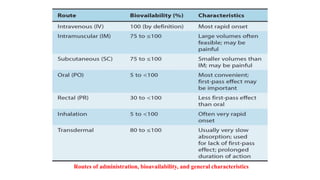
Routes of administration, bioavailability, and general characteristics
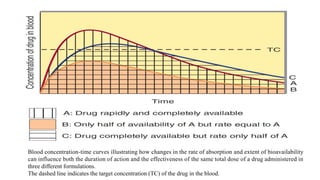
Blood concentration-time curves illustrating how changes in the rate of absorption and extent of bioavailability
can influence both the duration of action and the effectiveness of the same total dose of a drug administered in
three different formulations.
The dashed line indicates the target concentration (TC) of the drug in the blood.
Plasma drug concentration–time curve after oral drug administration
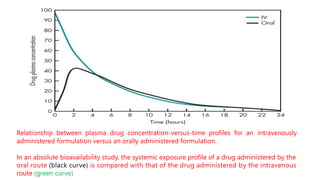
Relationship between plasma drug concentration-versus-time profiles for an intravenously
administered formulation versus an orally administered formulation.
In an absolute bioavailability study, the systemic exposure profile of a drug administered by the
oral route (black curve) is compared with that of the drug administered by the intravenous
route (green curve)
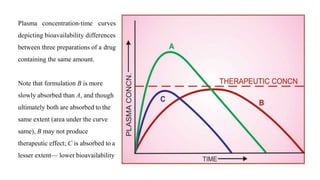
Plasma concentration-time curves
depicting bioavailability differences
between three preparations of a drug
containing the same amount.
Note that formulation B is more
slowly absorbed than A, and though
ultimately both are absorbed to the
same extent (area under the curve
same), B may not produce
therapeutic effect; C is absorbed to a
lesser extent— lower bioavailability
A. Extent of Absorption
Bioavailability variation assumes practical significance for drugs with low
safety margin (digoxin) or where dosage needs precise control (oral
hypoglycemics, oral anticoagulants).
B. First-Pass Elimination
Before a drug enters the systemic circulation, it can be metabolized in the gut
wall or in the liver. Any reduction in bioavailability can be caused by any of these
sites, the overall process is known as ‘first-pass elimination’.
Dissolution rate is governed by the inherent solubility,
particle size, crystal form and other physical properties of
the drug.
Differences in bioavailability may arise due to variations in
disintegration and dissolution rates.
Particle size reduction increases the rate of absorption of
aspirin (microfine tablets).
The amount of griseofulvin and spironolactone in the tablet
can be reduced to half if the drug particle is microfine.
There is no need to reduce the particle size of freely water
soluble drugs, e.g. paracetamol.
Factors Affecting Bioavailability
• Physicochemical properties of the drug
• Route of drug administration
• Ionization
• Food
• Presence of other drugs
• Area of absorbing surface
• Diseases
• First-pass metabolism (Enterohepatic Cycling)
Plasma Half-Life
• It is the time required for the plasma concentration of a drug to decrease by 50% of
its original value.
• A drug is almost completely eliminated in four to five half-lives after single
administration.
Clinical Importance of Plasma Half-Life:
• Determine the duration of drug action
• Determine the frequency of drug administration
• Estimate the time required to reach the steady state
Clearance
• That volume of plasma from which the drug is removed in unit time
• Clearance = Rate of elimination / Plasma concentration of the drug
• First - Order Kinetics: A constant fraction of the drug in the body is
eliminated per unit time.
• Zero-order kinetics: A constant amount of a drug in the body is
eliminated per unit time.
• The rate of elimination is independent of plasma drug concentration,
Steady State Concentration
• The amount of drug eliminated will equal the amount
of drug administered in the dosing interval.
• The drug is said to have reached steady state or
plateau level.
• It is attained after approximately 4-5 half-lives.
Loading Dose
• The loading dose or initial bolus dose of a drug, is used to obtain desired
concentrations as rapidly as possible.
• Loading dose is given to saturate the tissue stores so it is mainly dependent
on ‘volume of distribution’.
• e.g. the half-life of lignocaine is more than 1 hour, so it takes more than
4-6 hours to reach the target concentration at steady state.
Maintenance Dose:
A drug dose that is repeated at regular intervals
or given as a continuous infusion to maintain a
target level in plasma or steady state
concentration.
The dose administered is equal to dose eliminated in
a dosing interval.
References:
• Katzung BG, Masters SB and Trevor AJ eds, 2018. Basic & clinical
pharmacology.
• Rosenbaum SE ed, 2016. Basic pharmacokinetics and pharmacodynamics: An
integrated textbook and computer simulations. John Wiley & Sons.
• Tripathi KD, 2013. Essentials of medical pharmacology. JP Medical Ltd.
• Rang And Dale’s Pharmacology (© 2020, Elsevier) James M. Ritter, Rod
Flower, Graeme Henderson, Et Al,

Bioavailability.pptx

  • 1.
    Bioavailability, Half-life, Loading &Maintenance Dose Dr. AWAIS IRSHAD
  • 2.
    Lecture Objectives After completionof lecture, students will be able to: • Describe bioavailability, bioequivalence, Half-life, Loading & Maintenance Dose • Explain why certain drugs have low bioavailability. • Explain factors affecting bioavailability. • Describe clinical importance of bioavailability, bioequivalence, Half-life, Loading & Maintenance Dose
  • 3.
    Bioavailability The rate andextent to which the active ingredient or active moiety is absorbed from a drug product and becomes available at the site of action
  • 4.
    Bioequivalence Absence of asignificant difference in the rate and extent to which the active ingredient or active moiety becomes available at the site of drug action when administered at the same molar dose under similar conditions in an appropriately designed study.
  • 5.
    Routes of administration,bioavailability, and general characteristics
  • 6.
    Blood concentration-time curvesillustrating how changes in the rate of absorption and extent of bioavailability can influence both the duration of action and the effectiveness of the same total dose of a drug administered in three different formulations. The dashed line indicates the target concentration (TC) of the drug in the blood.
  • 7.
    Plasma drug concentration–timecurve after oral drug administration
  • 8.
    Relationship between plasmadrug concentration-versus-time profiles for an intravenously administered formulation versus an orally administered formulation. In an absolute bioavailability study, the systemic exposure profile of a drug administered by the oral route (black curve) is compared with that of the drug administered by the intravenous route (green curve)
  • 9.
    Plasma concentration-time curves depictingbioavailability differences between three preparations of a drug containing the same amount. Note that formulation B is more slowly absorbed than A, and though ultimately both are absorbed to the same extent (area under the curve same), B may not produce therapeutic effect; C is absorbed to a lesser extent— lower bioavailability
  • 10.
    A. Extent ofAbsorption Bioavailability variation assumes practical significance for drugs with low safety margin (digoxin) or where dosage needs precise control (oral hypoglycemics, oral anticoagulants). B. First-Pass Elimination Before a drug enters the systemic circulation, it can be metabolized in the gut wall or in the liver. Any reduction in bioavailability can be caused by any of these sites, the overall process is known as ‘first-pass elimination’.
  • 11.
    Dissolution rate isgoverned by the inherent solubility, particle size, crystal form and other physical properties of the drug. Differences in bioavailability may arise due to variations in disintegration and dissolution rates.
  • 12.
    Particle size reductionincreases the rate of absorption of aspirin (microfine tablets). The amount of griseofulvin and spironolactone in the tablet can be reduced to half if the drug particle is microfine. There is no need to reduce the particle size of freely water soluble drugs, e.g. paracetamol.
  • 13.
    Factors Affecting Bioavailability •Physicochemical properties of the drug • Route of drug administration • Ionization • Food • Presence of other drugs • Area of absorbing surface • Diseases • First-pass metabolism (Enterohepatic Cycling)
  • 14.
    Plasma Half-Life • Itis the time required for the plasma concentration of a drug to decrease by 50% of its original value. • A drug is almost completely eliminated in four to five half-lives after single administration. Clinical Importance of Plasma Half-Life: • Determine the duration of drug action • Determine the frequency of drug administration • Estimate the time required to reach the steady state
  • 15.
    Clearance • That volumeof plasma from which the drug is removed in unit time • Clearance = Rate of elimination / Plasma concentration of the drug • First - Order Kinetics: A constant fraction of the drug in the body is eliminated per unit time. • Zero-order kinetics: A constant amount of a drug in the body is eliminated per unit time. • The rate of elimination is independent of plasma drug concentration,
  • 16.
    Steady State Concentration •The amount of drug eliminated will equal the amount of drug administered in the dosing interval. • The drug is said to have reached steady state or plateau level. • It is attained after approximately 4-5 half-lives.
  • 17.
    Loading Dose • Theloading dose or initial bolus dose of a drug, is used to obtain desired concentrations as rapidly as possible. • Loading dose is given to saturate the tissue stores so it is mainly dependent on ‘volume of distribution’. • e.g. the half-life of lignocaine is more than 1 hour, so it takes more than 4-6 hours to reach the target concentration at steady state.
  • 18.
    Maintenance Dose: A drugdose that is repeated at regular intervals or given as a continuous infusion to maintain a target level in plasma or steady state concentration. The dose administered is equal to dose eliminated in a dosing interval.
  • 19.
    References: • Katzung BG,Masters SB and Trevor AJ eds, 2018. Basic & clinical pharmacology. • Rosenbaum SE ed, 2016. Basic pharmacokinetics and pharmacodynamics: An integrated textbook and computer simulations. John Wiley & Sons. • Tripathi KD, 2013. Essentials of medical pharmacology. JP Medical Ltd. • Rang And Dale’s Pharmacology (© 2020, Elsevier) James M. Ritter, Rod Flower, Graeme Henderson, Et Al,