University of central Punjab 
Tel #+923314947934
OBJECTIVE.. 
As a result of completing this module you should be 
able to understand the: 
The concept of : 
 Electrical Safety Analyzers 
 Performance Analyzers 
 Simulators & Controllers
The Reality of Life…
"... hearts & brains too good to die." 
Peter Safar, MD
Despite advances in medical science 
Sudden Death continues to increase 
Advances in modern medical science (including 
Emergency Medical Services) have helped to prolong 
life and reduce the number of deaths from many “killer” 
health problems. But the problem of sudden cardiac 
death has continued to go virtually unchecked.
BUT THANX TO BIOMEDICAL 
ENGINEERING AND ADVANCE 
TECHNOLOGY
BIOMEDICAL ENGINEERS 
Who we are ? 
What we do?
WHO WE ARE? 
 Biomedical engineering is a team of 
engineering professionals working in a 
clinical environment to resolve technology 
issues related to patient care 
What we do? 
 Biomedical engineers provide their services 
by reducing the risks, improve patient 
outcome and enhance patient care in a cost 
effective manner
FOR THE HEALTH INDUSTRY , 
BE IT HOSPITALS OR 
MANUFACTURES OF 
MEDICAL EQUIPMENT-NOTHING 
COUNTS MORE 
THAN THE SAFETY OF 
PATIENT.
Hence proper Testing , Repairing , and 
Calibrations of medical Equipment's is 
necessary
Why testing and calibration is 
necessary?
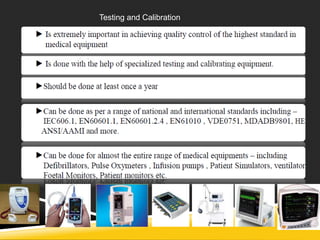
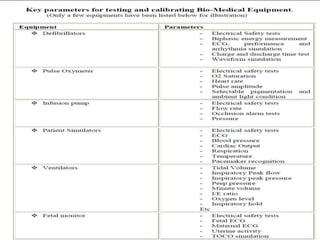
Testing and Calibration
CLASSIFICATION OF LAB DEVICES
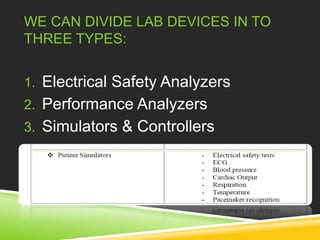
WE CAN DIVIDE LAB DEVICES IN TO 
THREE TYPES: 
1. Electrical Safety Analyzers 
2. Performance Analyzers 
3. Simulators & Controllers
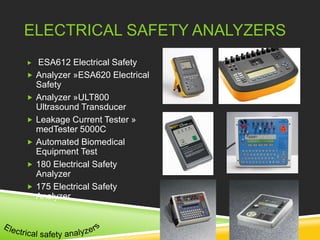
ELECTRICAL SAFETY ANALYZERS 
 ESA612 Electrical Safety 
Analyzer »ESA620 Electrical Safety 
Analyzer »ULT800 Ultrasound Transducer 
 Leakage Current Tester » medTester 5000C 
Automated Biomedical Equipment Test 
 System 
 180 Electrical Safety Analyzer 
 175 Electrical Safety Analyzer
PERFORMANCE ANALYZERS 
 Defibrillator analyzer 
 Electrosurgery 
 Infusion Device 
 Incubator 
 Pressure Meters 
 Gas-Flow 
 Oxygen Analyzers 
 Medical Scopemeters
SIMULATORS & CONTROLLERS 
 Multipara meter Patient Simulators 
Non-Invasive Blood Pressure Simulators 
Sp02 Simulators 
 Fetal Simulators 
Controllers
1: ELECTRICAL SAFETY 
TESTING 
AND ANALYZERS
WHY CALIBRATION AND ELECTRICAL 
SAFETY OF MEDICAL EQUIPMENT 
Why Test & Calibration 
What you cannot measure you cannot control
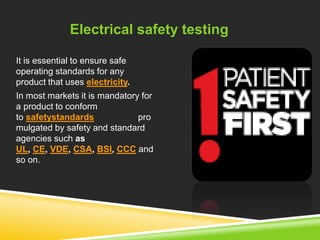
Electrical safety testing 
It is essential to ensure safe 
operating standards for any 
product that uses electricity. 
In most markets it is mandatory for 
a product to conform 
to safetystandards pro 
mulgated by safety and standard 
agencies such as 
UL, CE, VDE, CSA, BSI, CCC and 
so on.
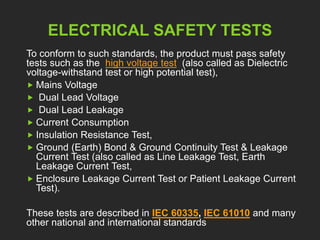
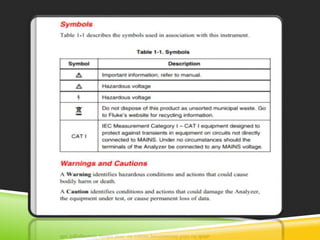
ELECTRICAL SAFETY TESTS 
To conform to such standards, the product must pass safety 
tests such as the high voltage test (also called as Dielectric 
voltage-withstand test or high potential test), 
 Mains Voltage 
 Dual Lead Voltage 
 Dual Lead Leakage 
 Current Consumption 
 Insulation Resistance Test, 
 Ground (Earth) Bond & Ground Continuity Test & Leakage 
Current Test (also called as Line Leakage Test, Earth 
Leakage Current Test, 
 Enclosure Leakage Current Test or Patient Leakage Current 
Test). 
These tests are described in IEC 60335, IEC 61010 and many 
other national and international standards
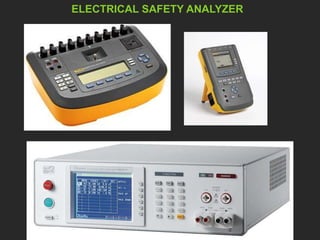
ELECTRICAL SAFETY ANALYZER
ELECTRICAL SAFETY ANALYZERS 
 ESA612 Electrical Safety 
 Analyzer »ESA620 Electrical 
Safety 
 Analyzer »ULT800 
Ultrasound Transducer 
 Leakage Current Tester » 
medTester 5000C 
 Automated Biomedical 
Equipment Test 
 180 Electrical Safety 
Analyzer 
 175 Electrical Safety 
Analyzer
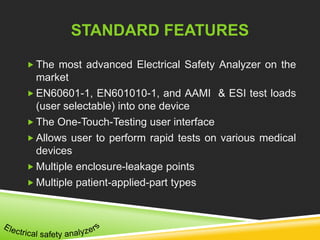
STANDARD FEATURES 
 The most advanced Electrical Safety Analyzer on the 
market 
EN60601-1, EN601010-1, and AAMI & ESI test loads 
(user selectable) into one device 
The One-Touch-Testing user interface 
 Allows user to perform rapid tests on various medical 
devices 
 Multiple enclosure-leakage points 
 Multiple patient-applied-part types
STANDARD FEATURES 
• Power ON/OFF delay 
• DC only for patient- and auxiliary-leakage tests 
• User-programmable test sequences 
• Offers manual, auto, step, and computer-control mode 
operations 
• ASCII data transfer 
• Memory for up to 1000 device-information records 
• Conducts electrical safety testing in accordance with 
IEC 601-1, VDE 751, VDE 701, HEI 95, IEC 1010, 
AAMI, and AS/NZS 3551 requirements
STANDARD FEATURES 
• Flags failures, and simulates 
performance, ECG, and 
arrhythmia, waveforms. 
• Results automatically analyzed 
and saved in non-volatile 
memory 
• Accepts device information that 
is input using an 
– External keyboard, 
– Integrated keypad, 
– Barcode keyboard wedge 
Optional Feature 
• Onboard thermal printing
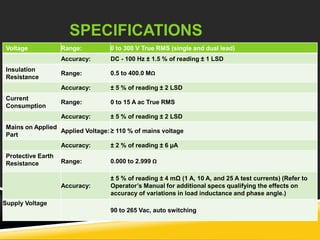
SPECIFICATIONS 
Voltage Range: 0 to 300 V True RMS (single and dual lead) 
Accuracy: DC - 100 Hz ± 1.5 % of reading ± 1 LSD 
Insulation 
Resistance 
Range: 0.5 to 400.0 MΩ 
Accuracy: ± 5 % of reading ± 2 LSD 
Current 
Consumption 
Range: 0 to 15 A ac True RMS 
Accuracy: ± 5 % of reading ± 2 LSD 
Mains on Applied 
Part 
Applied Voltage: ≥ 110 % of mains voltage 
Accuracy: ± 2 % of reading ± 6 μA 
Protective Earth 
Resistance Range: 0.000 to 2.999 Ω 
Accuracy: 
± 5 % of reading ± 4 mΩ (1 A, 10 A, and 25 A test currents) (Refer to 
Operator’s Manual for additional specs qualifying the effects on 
accuracy of variations in load inductance and phase angle.) 
Supply Voltage 
90 to 265 Vac, auto switching
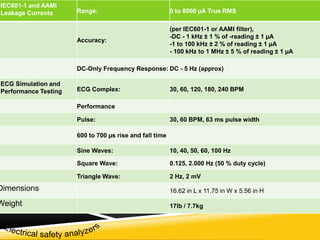
IEC601-1 and AAMI 
Leakage Currents Range: 0 to 8000 μA True RMS 
Accuracy: 
(per IEC601-1 or AAMI filter), 
-DC - 1 kHz ± 1 % of -reading ± 1 μA 
-1 to 100 kHz ± 2 % of reading ± 1 μA 
- 100 kHz to 1 MHz ± 5 % of reading ± 1 μA 
DC-Only Frequency Response: DC - 5 Hz (approx) 
ECG Simulation and 
Performance Testing ECG Complex: 30, 60, 120, 180, 240 BPM 
Performance 
Pulse: 30, 60 BPM, 63 ms pulse width 
600 to 700 μs rise and fall time 
Sine Waves: 10, 40, 50, 60, 100 Hz 
Square Wave: 0.125, 2.000 Hz (50 % duty cycle) 
Triangle Wave: 2 Hz, 2 mV 
Dimensions 16.62 in L x 11.75 in W x 5.56 in H 
Weight 17lb / 7.7kg
Effects of Electric 
Current on Human 
Body
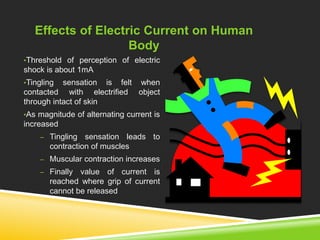
Effects of Electric Current on Human 
Body 
•Threshold of perception of electric 
shock is about 1mA 
•Tingling sensation is felt when 
contacted with electrified object 
through intact of skin 
•As magnitude of alternating current is 
increased 
– Tingling sensation leads to 
contraction of muscles 
– Muscular contraction increases 
– Finally value of current is 
reached where grip of current 
cannot be released
 Let -go- current: the max. current at which the subject 
is still capable of releasing a conductor by using 
muscles 
 Here individual can withstand with no serious effects 
 Average let go current for males- 16mA, females-10.5mA, 
approx. 9-6 mA for both. 
Hold-on-type: A current level higher than let go 
current, the subject looses ability to control his own 
muscle action and unable to release grip on the 
conductor 
 Such currents are very painful and hard to bear 
 Physical injury is caused b currents in range of 20-100mA 
A very high currents (6 amperes and above) lead to 
 Temporary respiratory paralysis 
 Serious burns
Recommendations of IEC 
International Electrotechnical 
Commission (IEC) said: 
 Continuous medical equipment current 
should not exceed 100 uA 
 Should be with in a frequency range of 0 
to 1kHz 
 In abnormal situations recommended 
max. current is 500 uA 
 Should be in a frequency upto 1 kHz 
 Above 1 kHz max increases is 
proportionally with frequency
PERFORMANCE ANALYZERS 
 Defibrillator analyzer 
 Electrosurgery 
 Infusion Device 
 Incubator 
 Pressure Meters 
 Gas-Flow 
 Oxygen Analyzers 
 Medical Scopemeters
DEFIBRILLATOR ANALYZER
To understand the cocept of defibrillator analyzer first we 
must know : 
What is defibrillation? 
What is defibrillator?
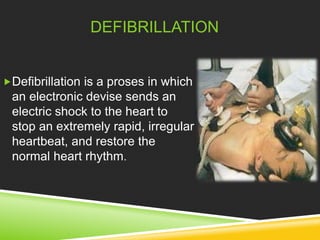
DEFIBRILLATION 
Defibrillation is a proses in which 
an electronic devise sends an 
electric shock to the heart to 
stop an extremely rapid, irregular 
heartbeat, and restore the 
normal heart rhythm.
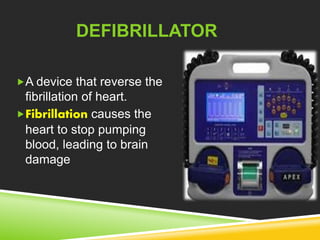
DEFIBRILLATOR 
A device that reverse the 
fibrillation of heart. 
Fibrillation causes the 
heart to stop pumping 
blood, leading to brain 
damage
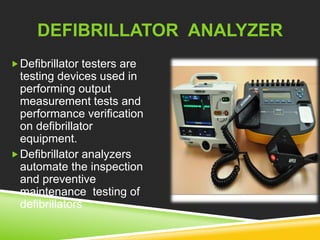
DEFIBRILLATOR ANALYZER 
Defibrillator testers are 
testing devices used in 
performing output 
measurement tests and 
performance verification 
on defibrillator 
equipment. 
Defibrillator analyzers 
automate the inspection 
and preventive 
maintenance testing of 
defibrillators
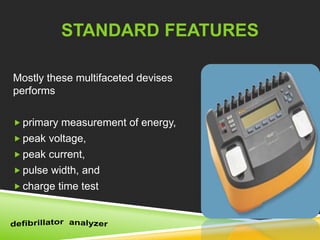
STANDARD FEATURES 
Mostly these multifaceted devises 
performs 
 primary measurement of energy, 
 peak voltage, 
 peak current, 
 pulse width, and 
 charge time test
 Also, the device performs cardio version analysis, 
Output Energy Measurement (in Joules), On-demand 
Pacemaker Testing, and generates simulated 
performance waves used in defibrillator testing as well 
as several additional tests. 
 Lastly, technicians can store, print data, or possibly 
transfer it to an automated computerized maintenance 
management system for archival.
Electrosurgery and ESU
ELECTROSURGERY 
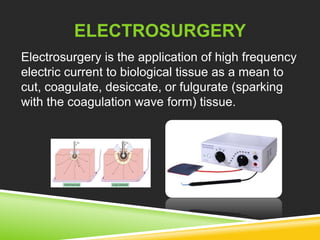
Electrosurgery is the application of high frequency 
electric current to biological tissue as a mean to 
cut, coagulate, desiccate, or fulgurate (sparking 
with the coagulation wave form) tissue.
BENEFITS 
Its benefits include: 
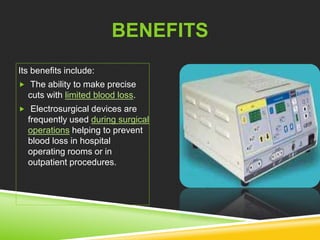
 The ability to make precise 
cuts with limited blood loss. 
 Electrosurgical devices are 
frequently used during surgical 
operations helping to prevent 
blood loss in hospital 
operating rooms or in 
outpatient procedures.
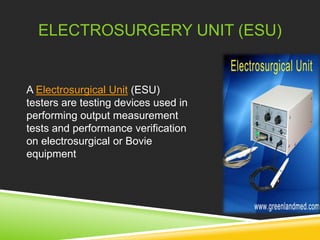
ELECTROSURGERY UNIT (ESU) 
A Electrosurgical Unit (ESU) 
testers are testing devices used in 
performing output measurement 
tests and performance verification 
on electrosurgical or Bovie 
equipment
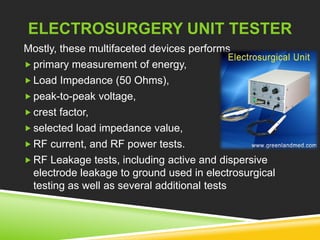
ELECTROSURGERY UNIT TESTER 
Mostly, these multifaceted devices performs 
 primary measurement of energy, 
 Load Impedance (50 Ohms), 
 peak-to-peak voltage, 
 crest factor, 
 selected load impedance value, 
 RF current, and RF power tests. 
 RF Leakage tests, including active and dispersive 
electrode leakage to ground used in electrosurgical 
testing as well as several additional tests
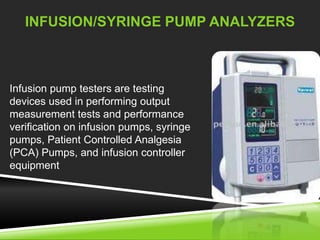
INFUSION/SYRINGE PUMP ANALYZERS 
Infusion pump testers are testing 
devices used in performing output 
measurement tests and performance 
verification on infusion pumps, syringe 
pumps, Patient Controlled Analgesia 
(PCA) Pumps, and infusion controller 
equipment
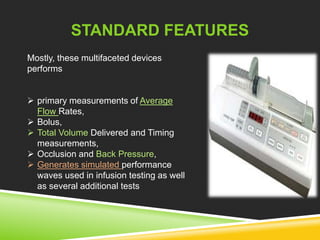
STANDARD FEATURES 
Mostly, these multifaceted devices 
performs 
 primary measurements of Average 
Flow Rates, 
 Bolus, 
 Total Volume Delivered and Timing 
measurements, 
 Occlusion and Back Pressure, 
 Generates simulated performance 
waves used in infusion testing as well 
as several additional tests
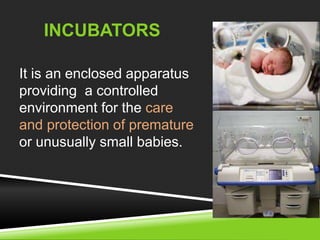
INCUBATORS 
It is an enclosed apparatus 
providing a controlled 
environment for the care 
and protection of premature 
or unusually small babies.
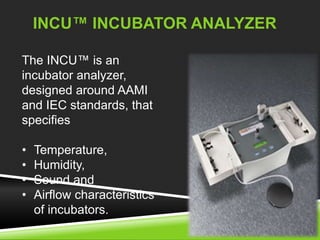
INCU™ INCUBATOR ANALYZER 
The INCU™ is an 
incubator analyzer, 
designed around AAMI 
and IEC standards, that 
specifies 
• Temperature, 
• Humidity, 
• Sound and 
• Airflow characteristics 
of incubators.
PRESSURE METERS 
DPM2Plus Pressure Meter 
DPM4 Parameter Tester 
DPM1B Pneumatic Transducer 
Tester
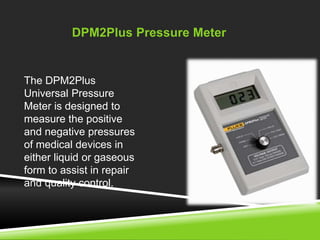
DPM2Plus Pressure Meter 
The DPM2Plus 
Universal Pressure 
Meter is designed to 
measure the positive 
and negative pressures 
of medical devices in 
either liquid or gaseous 
form to assist in repair 
and quality control.
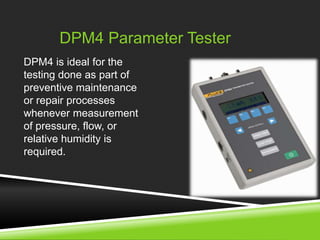
DPM4 Parameter Tester 
DPM4 is ideal for the 
testing done as part of 
preventive maintenance 
or repair processes 
whenever measurement 
of pressure, flow, or 
relative humidity is 
required.
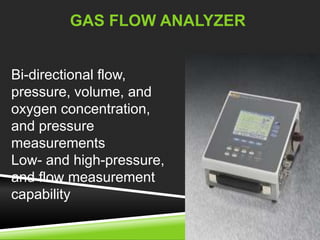
GAS FLOW ANALYZER 
Bi-directional flow, 
pressure, volume, and 
oxygen concentration, 
and pressure 
measurements 
Low- and high-pressure, 
and flow measurement 
capability
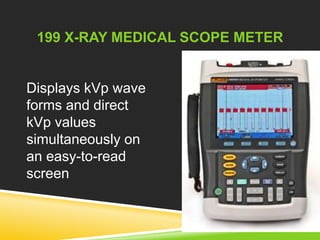
199 X-RAY MEDICAL SCOPE METER 
Displays kVp wave 
forms and direct 
kVp values 
simultaneously on 
an easy-to-read 
screen
3. Simulators & Controllers
SIMULATORS & CONTROLLERS 
Multipara meter Patient Simulators 
Non-Invasive Blood Pressure Simulators 
Sp02 Simulators 
Fetal Simulators 
Controllers
MULTIPARAMETER PATIENT SIMULATORS 
PS410 ECG/Arrythmia Simulator 
 medSim 300B Patient Simulator 
MPS450 Patient Simulator 
Data Sim 6100 Patient Simulator 
ECG Simulator, PS420 Multiparameter Patient ECG 
Simulator
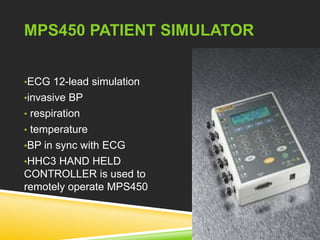
MPS450 PATIENT SIMULATOR 
•ECG 12-lead simulation 
•invasive BP 
• respiration 
• temperature 
•BP in sync with ECG 
•HHC3 HAND HELD 
CONTROLLER is used to 
remotely operate MPS450
NON-INVASIVE BLOOD PRESSURE 
SIMULATORS 
BP Pump 2 Non-Invasive 
Blood Pressure Simulator 
CuffLink Non-Invasive Blood 
Pressure Simulator
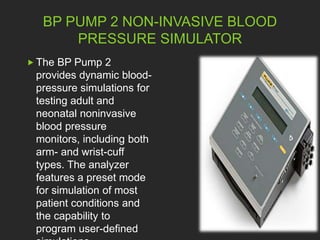
BP PUMP 2 NON-INVASIVE BLOOD 
PRESSURE SIMULATOR 
 The BP Pump 2 
provides dynamic blood-pressure 
simulations for 
testing adult and 
neonatal noninvasive 
blood pressure 
monitors, including both 
arm- and wrist-cuff 
types. The analyzer 
features a preset mode 
for simulation of most 
patient conditions and 
the capability to 
program user-defined 
simulations
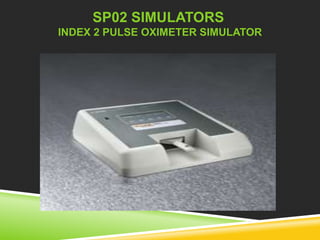
SP02 SIMULATORS 
INDEX 2 PULSE OXIMETER SIMULATOR
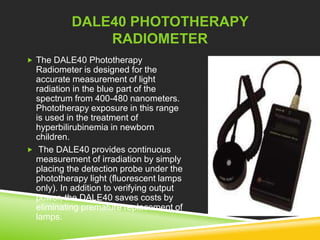
DALE40 PHOTOTHERAPY 
RADIOMETER 
 The DALE40 Phototherapy 
Radiometer is designed for the 
accurate measurement of light 
radiation in the blue part of the 
spectrum from 400-480 nanometers. 
Phototherapy exposure in this range 
is used in the treatment of 
hyperbilirubinemia in newborn 
children. 
 The DALE40 provides continuous 
measurement of irradiation by simply 
placing the detection probe under the 
phototherapy light (fluorescent lamps 
only). In addition to verifying output 
power, the DALE40 saves costs by 
eliminating premature replacement of 
lamps.
OTHER DEVICES
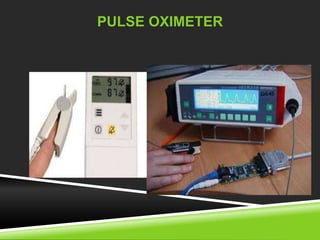
PULSE OXIMETER
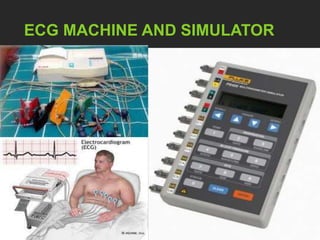
ECG MACHINE AND SIMULATOR
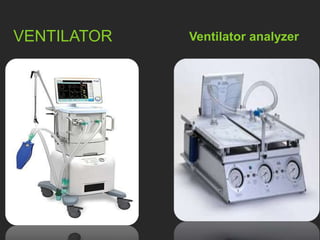
VENTILATOR Ventilator analyzer
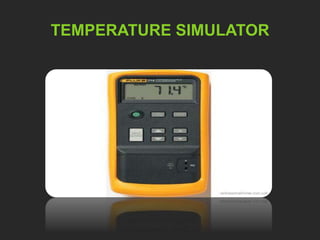
TEMPERATURE SIMULATOR
Who is responsible for that?
ANY QUESTION?

Bio instrumentation

  • 1.
    University of centralPunjab Tel #+923314947934
  • 3.
    OBJECTIVE.. As aresult of completing this module you should be able to understand the: The concept of :  Electrical Safety Analyzers  Performance Analyzers  Simulators & Controllers
  • 4.
  • 5.
    "... hearts &brains too good to die." Peter Safar, MD
  • 6.
    Despite advances inmedical science Sudden Death continues to increase Advances in modern medical science (including Emergency Medical Services) have helped to prolong life and reduce the number of deaths from many “killer” health problems. But the problem of sudden cardiac death has continued to go virtually unchecked.
  • 7.
    BUT THANX TOBIOMEDICAL ENGINEERING AND ADVANCE TECHNOLOGY
  • 8.
    BIOMEDICAL ENGINEERS Whowe are ? What we do?
  • 9.
    WHO WE ARE?  Biomedical engineering is a team of engineering professionals working in a clinical environment to resolve technology issues related to patient care What we do?  Biomedical engineers provide their services by reducing the risks, improve patient outcome and enhance patient care in a cost effective manner
  • 10.
    FOR THE HEALTHINDUSTRY , BE IT HOSPITALS OR MANUFACTURES OF MEDICAL EQUIPMENT-NOTHING COUNTS MORE THAN THE SAFETY OF PATIENT.
  • 11.
    Hence proper Testing, Repairing , and Calibrations of medical Equipment's is necessary
  • 12.
    Why testing andcalibration is necessary?
  • 13.
  • 15.
  • 16.
    WE CAN DIVIDELAB DEVICES IN TO THREE TYPES: 1. Electrical Safety Analyzers 2. Performance Analyzers 3. Simulators & Controllers
  • 17.
    ELECTRICAL SAFETY ANALYZERS  ESA612 Electrical Safety Analyzer »ESA620 Electrical Safety Analyzer »ULT800 Ultrasound Transducer  Leakage Current Tester » medTester 5000C Automated Biomedical Equipment Test  System  180 Electrical Safety Analyzer  175 Electrical Safety Analyzer
  • 18.
    PERFORMANCE ANALYZERS Defibrillator analyzer  Electrosurgery  Infusion Device  Incubator  Pressure Meters  Gas-Flow  Oxygen Analyzers  Medical Scopemeters
  • 19.
    SIMULATORS & CONTROLLERS  Multipara meter Patient Simulators Non-Invasive Blood Pressure Simulators Sp02 Simulators  Fetal Simulators Controllers
  • 20.
    1: ELECTRICAL SAFETY TESTING AND ANALYZERS
  • 21.
    WHY CALIBRATION ANDELECTRICAL SAFETY OF MEDICAL EQUIPMENT Why Test & Calibration What you cannot measure you cannot control
  • 22.
    Electrical safety testing It is essential to ensure safe operating standards for any product that uses electricity. In most markets it is mandatory for a product to conform to safetystandards pro mulgated by safety and standard agencies such as UL, CE, VDE, CSA, BSI, CCC and so on.
  • 23.
    ELECTRICAL SAFETY TESTS To conform to such standards, the product must pass safety tests such as the high voltage test (also called as Dielectric voltage-withstand test or high potential test),  Mains Voltage  Dual Lead Voltage  Dual Lead Leakage  Current Consumption  Insulation Resistance Test,  Ground (Earth) Bond & Ground Continuity Test & Leakage Current Test (also called as Line Leakage Test, Earth Leakage Current Test,  Enclosure Leakage Current Test or Patient Leakage Current Test). These tests are described in IEC 60335, IEC 61010 and many other national and international standards
  • 24.
  • 25.
    ELECTRICAL SAFETY ANALYZERS  ESA612 Electrical Safety  Analyzer »ESA620 Electrical Safety  Analyzer »ULT800 Ultrasound Transducer  Leakage Current Tester » medTester 5000C  Automated Biomedical Equipment Test  180 Electrical Safety Analyzer  175 Electrical Safety Analyzer
  • 27.
    STANDARD FEATURES The most advanced Electrical Safety Analyzer on the market EN60601-1, EN601010-1, and AAMI & ESI test loads (user selectable) into one device The One-Touch-Testing user interface  Allows user to perform rapid tests on various medical devices  Multiple enclosure-leakage points  Multiple patient-applied-part types
  • 28.
    STANDARD FEATURES •Power ON/OFF delay • DC only for patient- and auxiliary-leakage tests • User-programmable test sequences • Offers manual, auto, step, and computer-control mode operations • ASCII data transfer • Memory for up to 1000 device-information records • Conducts electrical safety testing in accordance with IEC 601-1, VDE 751, VDE 701, HEI 95, IEC 1010, AAMI, and AS/NZS 3551 requirements
  • 29.
    STANDARD FEATURES •Flags failures, and simulates performance, ECG, and arrhythmia, waveforms. • Results automatically analyzed and saved in non-volatile memory • Accepts device information that is input using an – External keyboard, – Integrated keypad, – Barcode keyboard wedge Optional Feature • Onboard thermal printing
  • 30.
    SPECIFICATIONS Voltage Range:0 to 300 V True RMS (single and dual lead) Accuracy: DC - 100 Hz ± 1.5 % of reading ± 1 LSD Insulation Resistance Range: 0.5 to 400.0 MΩ Accuracy: ± 5 % of reading ± 2 LSD Current Consumption Range: 0 to 15 A ac True RMS Accuracy: ± 5 % of reading ± 2 LSD Mains on Applied Part Applied Voltage: ≥ 110 % of mains voltage Accuracy: ± 2 % of reading ± 6 μA Protective Earth Resistance Range: 0.000 to 2.999 Ω Accuracy: ± 5 % of reading ± 4 mΩ (1 A, 10 A, and 25 A test currents) (Refer to Operator’s Manual for additional specs qualifying the effects on accuracy of variations in load inductance and phase angle.) Supply Voltage 90 to 265 Vac, auto switching
  • 31.
    IEC601-1 and AAMI Leakage Currents Range: 0 to 8000 μA True RMS Accuracy: (per IEC601-1 or AAMI filter), -DC - 1 kHz ± 1 % of -reading ± 1 μA -1 to 100 kHz ± 2 % of reading ± 1 μA - 100 kHz to 1 MHz ± 5 % of reading ± 1 μA DC-Only Frequency Response: DC - 5 Hz (approx) ECG Simulation and Performance Testing ECG Complex: 30, 60, 120, 180, 240 BPM Performance Pulse: 30, 60 BPM, 63 ms pulse width 600 to 700 μs rise and fall time Sine Waves: 10, 40, 50, 60, 100 Hz Square Wave: 0.125, 2.000 Hz (50 % duty cycle) Triangle Wave: 2 Hz, 2 mV Dimensions 16.62 in L x 11.75 in W x 5.56 in H Weight 17lb / 7.7kg
  • 32.
    Effects of Electric Current on Human Body
  • 33.
    Effects of ElectricCurrent on Human Body •Threshold of perception of electric shock is about 1mA •Tingling sensation is felt when contacted with electrified object through intact of skin •As magnitude of alternating current is increased – Tingling sensation leads to contraction of muscles – Muscular contraction increases – Finally value of current is reached where grip of current cannot be released
  • 34.
     Let -go-current: the max. current at which the subject is still capable of releasing a conductor by using muscles  Here individual can withstand with no serious effects  Average let go current for males- 16mA, females-10.5mA, approx. 9-6 mA for both. Hold-on-type: A current level higher than let go current, the subject looses ability to control his own muscle action and unable to release grip on the conductor  Such currents are very painful and hard to bear  Physical injury is caused b currents in range of 20-100mA A very high currents (6 amperes and above) lead to  Temporary respiratory paralysis  Serious burns
  • 35.
    Recommendations of IEC International Electrotechnical Commission (IEC) said:  Continuous medical equipment current should not exceed 100 uA  Should be with in a frequency range of 0 to 1kHz  In abnormal situations recommended max. current is 500 uA  Should be in a frequency upto 1 kHz  Above 1 kHz max increases is proportionally with frequency
  • 37.
    PERFORMANCE ANALYZERS Defibrillator analyzer  Electrosurgery  Infusion Device  Incubator  Pressure Meters  Gas-Flow  Oxygen Analyzers  Medical Scopemeters
  • 38.
  • 39.
    To understand thecocept of defibrillator analyzer first we must know : What is defibrillation? What is defibrillator?
  • 40.
    DEFIBRILLATION Defibrillation isa proses in which an electronic devise sends an electric shock to the heart to stop an extremely rapid, irregular heartbeat, and restore the normal heart rhythm.
  • 41.
    DEFIBRILLATOR A devicethat reverse the fibrillation of heart. Fibrillation causes the heart to stop pumping blood, leading to brain damage
  • 42.
    DEFIBRILLATOR ANALYZER Defibrillatortesters are testing devices used in performing output measurement tests and performance verification on defibrillator equipment. Defibrillator analyzers automate the inspection and preventive maintenance testing of defibrillators
  • 43.
    STANDARD FEATURES Mostlythese multifaceted devises performs  primary measurement of energy,  peak voltage,  peak current,  pulse width, and  charge time test
  • 44.
     Also, thedevice performs cardio version analysis, Output Energy Measurement (in Joules), On-demand Pacemaker Testing, and generates simulated performance waves used in defibrillator testing as well as several additional tests.  Lastly, technicians can store, print data, or possibly transfer it to an automated computerized maintenance management system for archival.
  • 45.
  • 46.
    ELECTROSURGERY Electrosurgery isthe application of high frequency electric current to biological tissue as a mean to cut, coagulate, desiccate, or fulgurate (sparking with the coagulation wave form) tissue.
  • 47.
    BENEFITS Its benefitsinclude:  The ability to make precise cuts with limited blood loss.  Electrosurgical devices are frequently used during surgical operations helping to prevent blood loss in hospital operating rooms or in outpatient procedures.
  • 48.
    ELECTROSURGERY UNIT (ESU) A Electrosurgical Unit (ESU) testers are testing devices used in performing output measurement tests and performance verification on electrosurgical or Bovie equipment
  • 49.
    ELECTROSURGERY UNIT TESTER Mostly, these multifaceted devices performs  primary measurement of energy,  Load Impedance (50 Ohms),  peak-to-peak voltage,  crest factor,  selected load impedance value,  RF current, and RF power tests.  RF Leakage tests, including active and dispersive electrode leakage to ground used in electrosurgical testing as well as several additional tests
  • 50.
    INFUSION/SYRINGE PUMP ANALYZERS Infusion pump testers are testing devices used in performing output measurement tests and performance verification on infusion pumps, syringe pumps, Patient Controlled Analgesia (PCA) Pumps, and infusion controller equipment
  • 51.
    STANDARD FEATURES Mostly,these multifaceted devices performs  primary measurements of Average Flow Rates,  Bolus,  Total Volume Delivered and Timing measurements,  Occlusion and Back Pressure,  Generates simulated performance waves used in infusion testing as well as several additional tests
  • 52.
    INCUBATORS It isan enclosed apparatus providing a controlled environment for the care and protection of premature or unusually small babies.
  • 53.
    INCU™ INCUBATOR ANALYZER The INCU™ is an incubator analyzer, designed around AAMI and IEC standards, that specifies • Temperature, • Humidity, • Sound and • Airflow characteristics of incubators.
  • 54.
    PRESSURE METERS DPM2PlusPressure Meter DPM4 Parameter Tester DPM1B Pneumatic Transducer Tester
  • 55.
    DPM2Plus Pressure Meter The DPM2Plus Universal Pressure Meter is designed to measure the positive and negative pressures of medical devices in either liquid or gaseous form to assist in repair and quality control.
  • 56.
    DPM4 Parameter Tester DPM4 is ideal for the testing done as part of preventive maintenance or repair processes whenever measurement of pressure, flow, or relative humidity is required.
  • 57.
    GAS FLOW ANALYZER Bi-directional flow, pressure, volume, and oxygen concentration, and pressure measurements Low- and high-pressure, and flow measurement capability
  • 58.
    199 X-RAY MEDICALSCOPE METER Displays kVp wave forms and direct kVp values simultaneously on an easy-to-read screen
  • 59.
    3. Simulators &Controllers
  • 60.
    SIMULATORS & CONTROLLERS Multipara meter Patient Simulators Non-Invasive Blood Pressure Simulators Sp02 Simulators Fetal Simulators Controllers
  • 61.
    MULTIPARAMETER PATIENT SIMULATORS PS410 ECG/Arrythmia Simulator  medSim 300B Patient Simulator MPS450 Patient Simulator Data Sim 6100 Patient Simulator ECG Simulator, PS420 Multiparameter Patient ECG Simulator
  • 62.
    MPS450 PATIENT SIMULATOR •ECG 12-lead simulation •invasive BP • respiration • temperature •BP in sync with ECG •HHC3 HAND HELD CONTROLLER is used to remotely operate MPS450
  • 63.
    NON-INVASIVE BLOOD PRESSURE SIMULATORS BP Pump 2 Non-Invasive Blood Pressure Simulator CuffLink Non-Invasive Blood Pressure Simulator
  • 64.
    BP PUMP 2NON-INVASIVE BLOOD PRESSURE SIMULATOR  The BP Pump 2 provides dynamic blood-pressure simulations for testing adult and neonatal noninvasive blood pressure monitors, including both arm- and wrist-cuff types. The analyzer features a preset mode for simulation of most patient conditions and the capability to program user-defined simulations
  • 65.
    SP02 SIMULATORS INDEX2 PULSE OXIMETER SIMULATOR
  • 66.
    DALE40 PHOTOTHERAPY RADIOMETER  The DALE40 Phototherapy Radiometer is designed for the accurate measurement of light radiation in the blue part of the spectrum from 400-480 nanometers. Phototherapy exposure in this range is used in the treatment of hyperbilirubinemia in newborn children.  The DALE40 provides continuous measurement of irradiation by simply placing the detection probe under the phototherapy light (fluorescent lamps only). In addition to verifying output power, the DALE40 saves costs by eliminating premature replacement of lamps.
  • 67.
  • 68.
  • 69.
    ECG MACHINE ANDSIMULATOR
  • 70.
  • 71.
  • 72.
  • 74.