1
Submitted by:
Name- Mahi Raj
Registration No- 51H/22
Class- 3rd
year Horticulture
Course No- NRM-314
Biofertilizer: Types, production and application
Submitted to:
Dr. Dinesh Kumar
Assistant Professor (Agronomy)
2
Introduction
• Biofertilizers is a substance which contains living microorganisms, which when
applied to seed, plant surface, or soil, colonizes the rhizosphere or interior of the
plant and promotes growth by increasing the supply or availability of primary
nutrients to the host plant.
• Bio-fertilizers add nutrients through the natural processes of nitrogen fixation,
solubilizing phosphorus, and stimulating plant growth through the synthesis of
growth-promoting substances
• They are reasonable and nature friendly fertilizers which contain microbial
inoculants of algae, fungi and bacteria either alone or in combination
3
What is Biofertilizer?
• Biofertilizers are natural fertilizers that are microbial inoculants of bacteria, algae
and fungi (separately or in combination).
• which may help biological nitrogen fixation for the benefit of plants.
• They help build up the soil micro-flora and there by the soil health.
• Biofertilizer also include organic fertilizers(manure, etc.)
• Use of bio-fertilizer is recommended for improving the soil fertility in organic
farming
4
Types of Biofertilizers
On the bases of nature and function
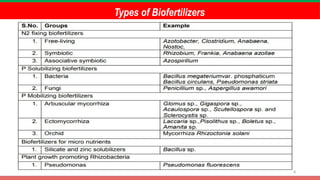
1.Nitrogen fixing: Nitrogen is most abundant and ubiquitous in the air, yet becomes a limiting
nutrient due to difficulty of its fixation and uptake by the plants. However, certain microorganisms,
some of which can form various associations with plants as well, are capable of considerable nitrogen
fixation.These microbes can be:
– Bacteria
a) Free living: Free-living in the soil eg. Azotobacter
b) Associative: Living in symbioses. Eg. Azospirillum
c) Symbiotic: Having symbiotic and other endophytic associations with plants. Eg. Rhizobia,
Frankia
– Blue green algae (Cyanobacteria): BGA can provide natural growth hormones, 172
proteins, vitamins, and minerals to the soil. Eg. Anabaena, Nostoc, Tolypothrix, Cylindrospermum
etc.
5
Types of Biofertilizers
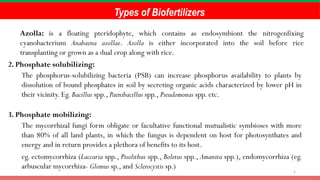
Azolla: is a floating pteridophyte, which contains as endosymbiont the nitrogenfixing
cyanobacterium Anabaena azollae. Azolla is either incorporated into the soil before rice
transplanting or grown as a dual crop along with rice.
2. Phosphate solubilizing:
The phosphorus-solubilizing bacteria (PSB) can increase phosphorus availability to plants by
dissolution of bound phosphates in soil by secreting organic acids characterized by lower pH in
their vicinity. Eg. Bacillus spp., Paenibacillus spp., Pseudomonas spp. etc.
3. Phosphate mobilizing:
The mycorrhizal fungi form obligate or facultative functional mutualistic symbioses with more
than 80% of all land plants, in which the fungus is dependent on host for photosynthates and
energy and in return provides a plethora of benefits to its host.
eg. ectomycorrhiza (Laccaria spp., Pisolithus spp., Boletus spp., Amanita spp.), endomycorrhiza (eg.
arbuscular mycorrhiza- Glomus sp., and Sclerocystis sp.)
6
Types of Biofertilizers
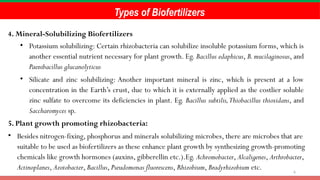
4. Mineral-Solubilizing Biofertilizers
• Potassium solubilizing: Certain rhizobacteria can solubilize insoluble potassium forms, which is
another essential nutrient necessary for plant growth. Eg. Bacillus edaphicus, B.mucilaginosus, and
Paenibacillus glucanolyticus
• Silicate and zinc solubilizing: Another important mineral is zinc, which is present at a low
concentration in the Earth’s crust, due to which it is externally applied as the costlier soluble
zinc sulfate to overcome its deficiencies in plant. Eg. Bacillus subtilis,Thiobacillus thioxidans, and
Saccharomyces sp.
5. Plant growth promoting rhizobacteria:
• Besides nitrogen-fixing, phosphorus and minerals solubilizing microbes, there are microbes that are
suitable to be used as biofertilizers as these enhance plant growth by synthesizing growth-promoting
chemicals like growth hormones (auxins, gibberellin etc.).Eg. Achromobacter, Alcaligenes, Arthrobacter,
Actinoplanes, Azotobacter, Bacillus, Pseudomonas fluorescens, Rhizobium, Bradyrhizobium etc.
7
Types of Biofertilizers
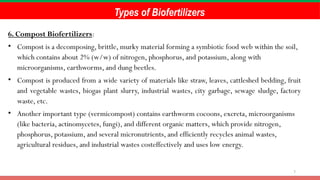
6. Compost Biofertilizers:
• Compost is a decomposing, brittle, murky material forming a symbiotic food web within the soil,
which contains about 2% (w/w) of nitrogen, phosphorus, and potassium, along with
microorganisms, earthworms, and dung beetles.
• Compost is produced from a wide variety of materials like straw, leaves, cattleshed bedding, fruit
and vegetable wastes, biogas plant slurry, industrial wastes, city garbage, sewage sludge, factory
waste, etc.
• Another important type (vermicompost) contains earthworm cocoons, excreta, microorganisms
(like bacteria, actinomycetes, fungi), and different organic matters, which provide nitrogen,
phosphorus, potassium, and several micronutrients, and efficiently recycles animal wastes,
agricultural residues, and industrial wastes costeffectively and uses low energy.
8
Types of Biofertilizers
9
Method of application of Biofertilizers
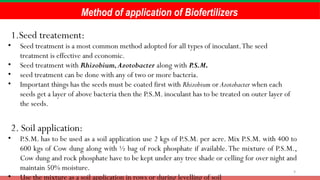
1.Seed treatement:
• Seed treatment is a most common method adopted for all types of inoculant.The seed
treatment is effective and economic.
• Seed treatment with Rhizobium,Azotobacter along with P.S.M.
• seed treatment can be done with any of two or more bacteria.
• Important things has the seeds must be coated first with Rhizobium or Azotobacter when each
seeds get a layer of above bacteria then the P.S.M. inoculant has to be treated on outer layer of
the seeds.
2. Soil application:
• P.S.M. has to be used as a soil application use 2 kgs of P.S.M. per acre. Mix P.S.M. with 400 to
600 kgs of Cow dung along with ½ bag of rock phosphate if available.The mixture of P.S.M.,
Cow dung and rock phosphate have to be kept under any tree shade or celling for over night and
maintain 50% moisture.
• Use the mixture as a soil application in rows or during levelling of soil
10
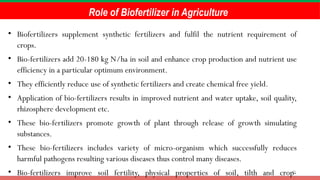
Role of Biofertilizer in Agriculture
• Biofertilizers supplement synthetic fertilizers and fulfil the nutrient requirement of
crops.
• Bio-fertilizers add 20-180 kg N/ha in soil and enhance crop production and nutrient use
efficiency in a particular optimum environment.
• They efficiently reduce use of synthetic fertilizers and create chemical free yield.
• Application of bio-fertilizers results in improved nutrient and water uptake, soil quality,
rhizosphere development etc.
• These bio-fertilizers promote growth of plant through release of growth simulating
substances.
• These bio-fertilizers includes variety of micro-organism which successfully reduces
harmful pathogens resulting various diseases thus control many diseases.
• Bio-fertilizers improve soil fertility, physical properties of soil, tilth and crop-
11
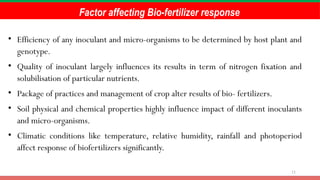
Factor affecting Bio-fertilizer response
• Efficiency of any inoculant and micro-organisms to be determined by host plant and
genotype.
• Quality of inoculant largely influences its results in term of nitrogen fixation and
solubilisation of particular nutrients.
• Package of practices and management of crop alter results of bio- fertilizers.
• Soil physical and chemical properties highly influence impact of different inoculants
and micro-organisms.
• Climatic conditions like temperature, relative humidity, rainfall and photoperiod
affect response of biofertilizers significantly.
12
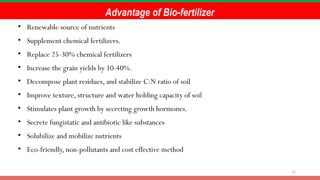
Advantage of Bio-fertilizer
• Renewable source of nutrients
• Supplement chemical fertilizers.
• Replace 25-30% chemical fertilizers
• Increase the grain yields by 10-40%.
• Decompose plant residues, and stabilize C:N ratio of soil
• Improve texture, structure and water holding capacity of soil
• Stimulates plant growth by secreting growth hormones.
• Secrete fungistatic and antibiotic like substances
• Solubilize and mobilize nutrients
• Eco-friendly, non-pollutants and cost effective method
13
Constraints in Bio-fertilizers application
• There is lack of good quality of strain which efficiently provide required nutrients in
soil.
• Non- existence of storage facility makes it difficult to adopt bio-fertilizers.
• Field conditions like extremely high or low pH, temperature, nutrients deficiency
not only influence the response of inoculants but also limits heir benefits.
• Biofertilizers require special care for long-term storage because they are alive.
• must be used before their expiry date.
• If other microorganisms contaminate the carrier medium or if growers use the
wrong strain, they are not as effective.
• Biofertilizers lose their effectiveness if the soil is too hot or dry.
14
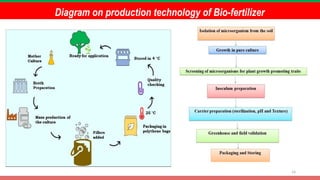
Diagram on production technology of Bio-fertilizer
15
Government scheme and policies
• NPOF (National project on organic farming)
• NMNF (National mission on natural farming)
• PKVY (Paramparagat KrishiVikasYojana)
• NMOOP (National Mission on Oilseeds and Oil Palm)
• MOVCDNER (Mission OrganicValue Chain Development for North East Region)
• NHM (National Horticulture mission)
16
“The use of biofertilizers is a step towards sustainable agriculture, as it
reduces our dependence on chemical fertilizers and promotes eco-friendly
farming practices.” Bharat Ratna Awardee, Late Dr. M.S. Swaminathan
Thank You

MR51.pptx biofertilizer and it's important

  • 1.
    1 Submitted by: Name- MahiRaj Registration No- 51H/22 Class- 3rd year Horticulture Course No- NRM-314 Biofertilizer: Types, production and application Submitted to: Dr. Dinesh Kumar Assistant Professor (Agronomy)
  • 2.
    2 Introduction • Biofertilizers isa substance which contains living microorganisms, which when applied to seed, plant surface, or soil, colonizes the rhizosphere or interior of the plant and promotes growth by increasing the supply or availability of primary nutrients to the host plant. • Bio-fertilizers add nutrients through the natural processes of nitrogen fixation, solubilizing phosphorus, and stimulating plant growth through the synthesis of growth-promoting substances • They are reasonable and nature friendly fertilizers which contain microbial inoculants of algae, fungi and bacteria either alone or in combination
  • 3.
    3 What is Biofertilizer? •Biofertilizers are natural fertilizers that are microbial inoculants of bacteria, algae and fungi (separately or in combination). • which may help biological nitrogen fixation for the benefit of plants. • They help build up the soil micro-flora and there by the soil health. • Biofertilizer also include organic fertilizers(manure, etc.) • Use of bio-fertilizer is recommended for improving the soil fertility in organic farming
  • 4.
    4 Types of Biofertilizers Onthe bases of nature and function 1.Nitrogen fixing: Nitrogen is most abundant and ubiquitous in the air, yet becomes a limiting nutrient due to difficulty of its fixation and uptake by the plants. However, certain microorganisms, some of which can form various associations with plants as well, are capable of considerable nitrogen fixation.These microbes can be: – Bacteria a) Free living: Free-living in the soil eg. Azotobacter b) Associative: Living in symbioses. Eg. Azospirillum c) Symbiotic: Having symbiotic and other endophytic associations with plants. Eg. Rhizobia, Frankia – Blue green algae (Cyanobacteria): BGA can provide natural growth hormones, 172 proteins, vitamins, and minerals to the soil. Eg. Anabaena, Nostoc, Tolypothrix, Cylindrospermum etc.
  • 5.
    5 Types of Biofertilizers Azolla:is a floating pteridophyte, which contains as endosymbiont the nitrogenfixing cyanobacterium Anabaena azollae. Azolla is either incorporated into the soil before rice transplanting or grown as a dual crop along with rice. 2. Phosphate solubilizing: The phosphorus-solubilizing bacteria (PSB) can increase phosphorus availability to plants by dissolution of bound phosphates in soil by secreting organic acids characterized by lower pH in their vicinity. Eg. Bacillus spp., Paenibacillus spp., Pseudomonas spp. etc. 3. Phosphate mobilizing: The mycorrhizal fungi form obligate or facultative functional mutualistic symbioses with more than 80% of all land plants, in which the fungus is dependent on host for photosynthates and energy and in return provides a plethora of benefits to its host. eg. ectomycorrhiza (Laccaria spp., Pisolithus spp., Boletus spp., Amanita spp.), endomycorrhiza (eg. arbuscular mycorrhiza- Glomus sp., and Sclerocystis sp.)
  • 6.
    6 Types of Biofertilizers 4.Mineral-Solubilizing Biofertilizers • Potassium solubilizing: Certain rhizobacteria can solubilize insoluble potassium forms, which is another essential nutrient necessary for plant growth. Eg. Bacillus edaphicus, B.mucilaginosus, and Paenibacillus glucanolyticus • Silicate and zinc solubilizing: Another important mineral is zinc, which is present at a low concentration in the Earth’s crust, due to which it is externally applied as the costlier soluble zinc sulfate to overcome its deficiencies in plant. Eg. Bacillus subtilis,Thiobacillus thioxidans, and Saccharomyces sp. 5. Plant growth promoting rhizobacteria: • Besides nitrogen-fixing, phosphorus and minerals solubilizing microbes, there are microbes that are suitable to be used as biofertilizers as these enhance plant growth by synthesizing growth-promoting chemicals like growth hormones (auxins, gibberellin etc.).Eg. Achromobacter, Alcaligenes, Arthrobacter, Actinoplanes, Azotobacter, Bacillus, Pseudomonas fluorescens, Rhizobium, Bradyrhizobium etc.
  • 7.
    7 Types of Biofertilizers 6.Compost Biofertilizers: • Compost is a decomposing, brittle, murky material forming a symbiotic food web within the soil, which contains about 2% (w/w) of nitrogen, phosphorus, and potassium, along with microorganisms, earthworms, and dung beetles. • Compost is produced from a wide variety of materials like straw, leaves, cattleshed bedding, fruit and vegetable wastes, biogas plant slurry, industrial wastes, city garbage, sewage sludge, factory waste, etc. • Another important type (vermicompost) contains earthworm cocoons, excreta, microorganisms (like bacteria, actinomycetes, fungi), and different organic matters, which provide nitrogen, phosphorus, potassium, and several micronutrients, and efficiently recycles animal wastes, agricultural residues, and industrial wastes costeffectively and uses low energy.
  • 8.
  • 9.
    9 Method of applicationof Biofertilizers 1.Seed treatement: • Seed treatment is a most common method adopted for all types of inoculant.The seed treatment is effective and economic. • Seed treatment with Rhizobium,Azotobacter along with P.S.M. • seed treatment can be done with any of two or more bacteria. • Important things has the seeds must be coated first with Rhizobium or Azotobacter when each seeds get a layer of above bacteria then the P.S.M. inoculant has to be treated on outer layer of the seeds. 2. Soil application: • P.S.M. has to be used as a soil application use 2 kgs of P.S.M. per acre. Mix P.S.M. with 400 to 600 kgs of Cow dung along with ½ bag of rock phosphate if available.The mixture of P.S.M., Cow dung and rock phosphate have to be kept under any tree shade or celling for over night and maintain 50% moisture. • Use the mixture as a soil application in rows or during levelling of soil
  • 10.
    10 Role of Biofertilizerin Agriculture • Biofertilizers supplement synthetic fertilizers and fulfil the nutrient requirement of crops. • Bio-fertilizers add 20-180 kg N/ha in soil and enhance crop production and nutrient use efficiency in a particular optimum environment. • They efficiently reduce use of synthetic fertilizers and create chemical free yield. • Application of bio-fertilizers results in improved nutrient and water uptake, soil quality, rhizosphere development etc. • These bio-fertilizers promote growth of plant through release of growth simulating substances. • These bio-fertilizers includes variety of micro-organism which successfully reduces harmful pathogens resulting various diseases thus control many diseases. • Bio-fertilizers improve soil fertility, physical properties of soil, tilth and crop-
  • 11.
    11 Factor affecting Bio-fertilizerresponse • Efficiency of any inoculant and micro-organisms to be determined by host plant and genotype. • Quality of inoculant largely influences its results in term of nitrogen fixation and solubilisation of particular nutrients. • Package of practices and management of crop alter results of bio- fertilizers. • Soil physical and chemical properties highly influence impact of different inoculants and micro-organisms. • Climatic conditions like temperature, relative humidity, rainfall and photoperiod affect response of biofertilizers significantly.
  • 12.
    12 Advantage of Bio-fertilizer •Renewable source of nutrients • Supplement chemical fertilizers. • Replace 25-30% chemical fertilizers • Increase the grain yields by 10-40%. • Decompose plant residues, and stabilize C:N ratio of soil • Improve texture, structure and water holding capacity of soil • Stimulates plant growth by secreting growth hormones. • Secrete fungistatic and antibiotic like substances • Solubilize and mobilize nutrients • Eco-friendly, non-pollutants and cost effective method
  • 13.
    13 Constraints in Bio-fertilizersapplication • There is lack of good quality of strain which efficiently provide required nutrients in soil. • Non- existence of storage facility makes it difficult to adopt bio-fertilizers. • Field conditions like extremely high or low pH, temperature, nutrients deficiency not only influence the response of inoculants but also limits heir benefits. • Biofertilizers require special care for long-term storage because they are alive. • must be used before their expiry date. • If other microorganisms contaminate the carrier medium or if growers use the wrong strain, they are not as effective. • Biofertilizers lose their effectiveness if the soil is too hot or dry.
  • 14.
    14 Diagram on productiontechnology of Bio-fertilizer
  • 15.
    15 Government scheme andpolicies • NPOF (National project on organic farming) • NMNF (National mission on natural farming) • PKVY (Paramparagat KrishiVikasYojana) • NMOOP (National Mission on Oilseeds and Oil Palm) • MOVCDNER (Mission OrganicValue Chain Development for North East Region) • NHM (National Horticulture mission)
  • 16.
    16 “The use ofbiofertilizers is a step towards sustainable agriculture, as it reduces our dependence on chemical fertilizers and promotes eco-friendly farming practices.” Bharat Ratna Awardee, Late Dr. M.S. Swaminathan Thank You