GROUP - 1
FARAZ KHAN
(UW-12-CE-BS.c-041)
•Bsc Civil Engineering
•farazali0041@gmail.com
•+92-3315258522
3
4
• Hydrologic Cycle
• Major Water Compartments
• Water Use
• Freshwater Shortages
• Dams and Diversions
• Water Management
• If All Else Fails
Outline
5
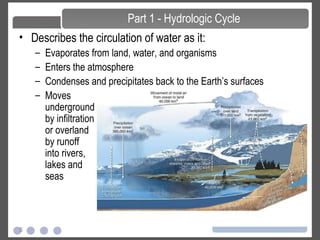
• Describes the circulation of water as it:
– Evaporates from land, water, and organisms
– Enters the atmosphere
– Condenses and precipitates back to the Earth’s surfaces
Part 1 - Hydrologic Cycle
– Moves
underground
by infiltration
or overland
by runoff
into rivers,
lakes and
seas
6
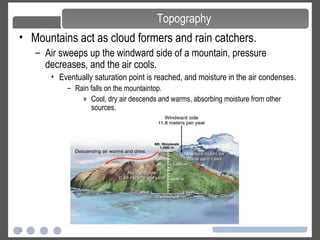
• Mountains act as cloud formers and rain catchers.
– Air sweeps up the windward side of a mountain, pressure
decreases, and the air cools.
• Eventually saturation point is reached, and moisture in the air condenses.
– Rain falls on the mountaintop.
» Cool, dry air descends and warms, absorbing moisture from other
sources.
Topography
7
Part 2 - Major Water Compartments
Source: Facts and Trends, WBCSD
8
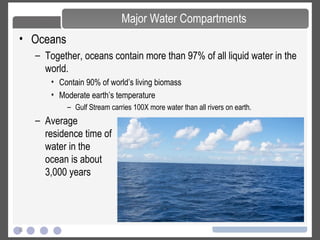
• Oceans
– Together, oceans contain more than 97% of all liquid water in the
world.
• Contain 90% of world’s living biomass
• Moderate earth’s temperature
– Gulf Stream carries 100X more water than all rivers on earth.
Major Water Compartments
– Average
residence time of
water in the
ocean is about
3,000 years
9
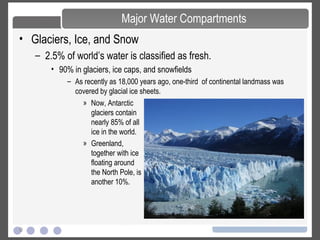
• Glaciers, Ice, and Snow
– 2.5% of world’s water is classified as fresh.
• 90% in glaciers, ice caps, and snowfields
– As recently as 18,000 years ago, one-third of continental landmass was
covered by glacial ice sheets.
Major Water Compartments
» Now, Antarctic
glaciers contain
nearly 85% of all
ice in the world.
» Greenland,
together with ice
floating around
the North Pole, is
another 10%.
10
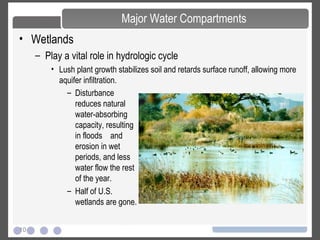
• Wetlands
– Play a vital role in hydrologic cycle
• Lush plant growth stabilizes soil and retards surface runoff, allowing more
aquifer infiltration.
Major Water Compartments
– Disturbance
reduces natural
water-absorbing
capacity, resulting
in floods and
erosion in wet
periods, and less
water flow the rest
of the year.
– Half of U.S.
wetlands are gone.
11
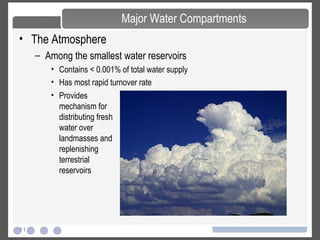
• The Atmosphere
– Among the smallest water reservoirs
• Contains < 0.001% of total water supply
• Has most rapid turnover rate
Major Water Compartments
• Provides
mechanism for
distributing fresh
water over
landmasses and
replenishing
terrestrial
reservoirs
12
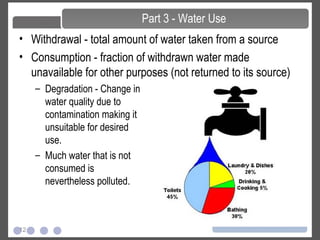
• Withdrawal - total amount of water taken from a source
• Consumption - fraction of withdrawn water made
unavailable for other purposes (not returned to its source)
Part 3 - Water Use
– Degradation - Change in
water quality due to
contamination making it
unsuitable for desired
use.
– Much water that is not
consumed is
nevertheless polluted.
13
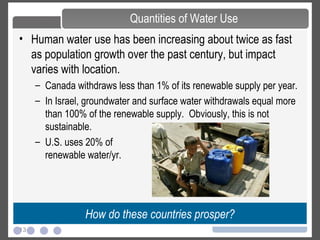
• Human water use has been increasing about twice as fast
as population growth over the past century, but impact
varies with location.
– Canada withdraws less than 1% of its renewable supply per year.
– In Israel, groundwater and surface water withdrawals equal more
than 100% of the renewable supply. Obviously, this is not
sustainable.
Quantities of Water Use
– U.S. uses 20% of
renewable water/yr.
How do these countries prosper?
14
• Water use is divided into agriculture, domestic use and
industrial use.
Agricultural Water Use
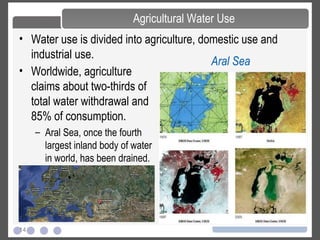
• Worldwide, agriculture
claims about two-thirds of
total water withdrawal and
85% of consumption.
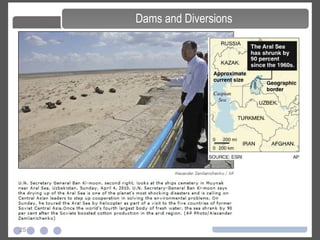
– Aral Sea, once the fourth
largest inland body of water
in world, has been drained.
Aral Sea
15
Water Use in Agriculture
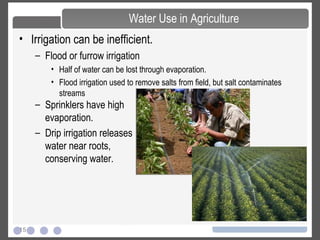
– Sprinklers have high
evaporation.
– Drip irrigation releases
water near roots,
conserving water.
• Irrigation can be inefficient.
– Flood or furrow irrigation
• Half of water can be lost through evaporation.
• Flood irrigation used to remove salts from field, but salt contaminates
streams
16
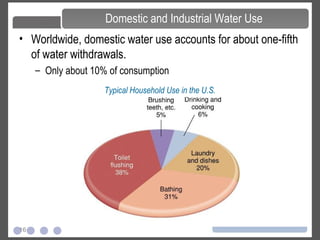
• Worldwide, domestic water use accounts for about one-fifth
of water withdrawals.
– Only about 10% of consumption
Domestic and Industrial Water Use
Typical Household Use in the U.S.
17
Domestic and Industrial Water Use
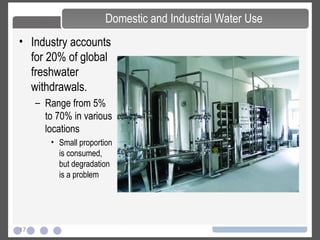
• Industry accounts
for 20% of global
freshwater
withdrawals.
– Range from 5%
to 70% in various
locations
• Small proportion
is consumed,
but degradation
is a problem
18
• U.N. estimates a billion people lack access to safe drinking
water.
– 2.6 billion lack acceptable sanitation.
• At least 45 countries, mostly in Africa and the Middle East,
are considered to have serious water stress.
Part 4 - Freshwater Shortages
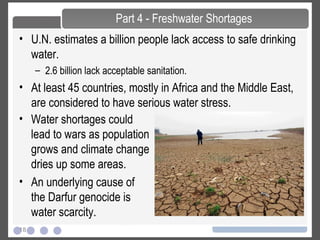
• Water shortages could
lead to wars as population
grows and climate change
dries up some areas.
• An underlying cause of
the Darfur genocide is
water scarcity.
19
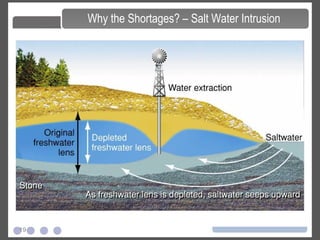
Why the Shortages? – Salt Water Intrusion
20
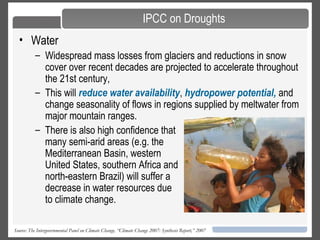
• Water
– Widespread mass losses from glaciers and reductions in snow
cover over recent decades are projected to accelerate throughout
the 21st century,
– This will reduce water availability, hydropower potential, and
change seasonality of flows in regions supplied by meltwater from
major mountain ranges.
Source: The Intergovernmental Panel on Climate Change, “Climate Change 2007: Synthesis Report,” 2007
IPCC on Droughts
– There is also high confidence that
many semi-arid areas (e.g. the
Mediterranean Basin, western
United States, southern Africa and
north-eastern Brazil) will suffer a
decrease in water resources due
to climate change.
21
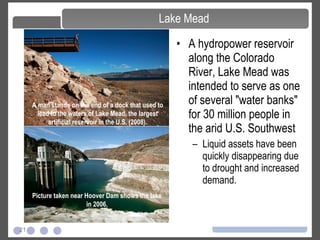
Lake Mead
• A hydropower reservoir
along the Colorado
River, Lake Mead was
intended to serve as one
of several "water banks"
for 30 million people in
the arid U.S. Southwest
– Liquid assets have been
quickly disappearing due
to drought and increased
demand.
A man stands on the end of a dock that used to
lead to the waters of Lake Mead, the largest
artificial reservoir in the U.S. (2008).
Picture taken near Hoover Dam shows the lake
in 2006.
22
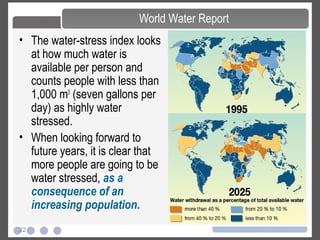
• The water-stress index looks
at how much water is
available per person and
counts people with less than
1,000 m3
(seven gallons per
day) as highly water
stressed.
• When looking forward to
future years, it is clear that
more people are going to be
water stressed, as a
consequence of an
increasing population.
World Water Report
23
• Before 1900 there were 250 high dams in the world; today
there are more than 45,000.
• In the U.S. dams are built by Army Corps of Engineers and
Bureau of Reclamation
Part 5 - Dams and Diversions
– Provide cheap
hydroelectric power
– Jobs
– Reduce flooding
– Allow farming on
lands that would
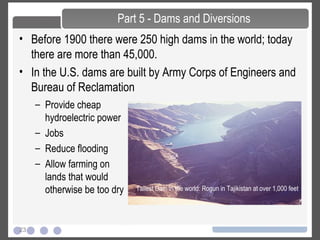
otherwise be too dry Tallest Dam in the world: Rogun in Tajikistan at over 1,000 feet
24
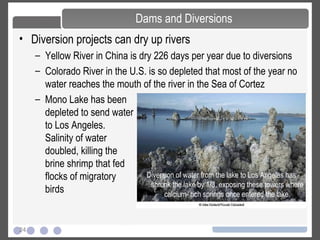
• Diversion projects can dry up rivers
– Yellow River in China is dry 226 days per year due to diversions
– Colorado River in the U.S. is so depleted that most of the year no
water reaches the mouth of the river in the Sea of Cortez
Dams and Diversions
– Mono Lake has been
depleted to send water
to Los Angeles.
Salinity of water
doubled, killing the
brine shrimp that fed
flocks of migratory
birds
Diversion of water from the lake to Los Angeles has
shrunk the lake by 1/3, exposing these towers where
calcium- rich springs once entered the lake.
25
Dams and Diversions
26Source: “Water Scarcity and Climate Change,” Ceres: (2016)
• Physical Risks
– Water scarcity directly impacts business activities, raw material
supply, intermediate supply chain, and product use in a variety of
ways.
– Declines or disruptions in water supply can undermine industrial
and manufacturing operations where water is needed for
production, irrigation, material processing, cooling and/or washing
and cleaning.
Water Related Business Risks
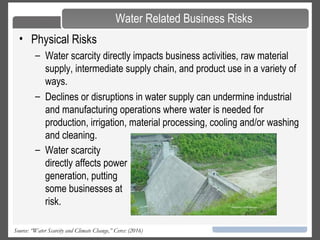
– Water scarcity
directly affects power
generation, putting
some businesses at
risk.
27
• Companies have a clear economic incentive to closely
assess their relationship to their water inputs and outputs
and to proactively address and manage them. To do so,
companies should take the following steps:
1. Measure the company’s water footprint throughout its value
chain.
2. Assess the physical, regulatory and reputational risks associated
with its water footprint
3. Integrate water issues into strategic business planning and
governance.
4. Disclose and communicate water performance and associated
risks.
What Can Companies Do To Manage Risk?
28
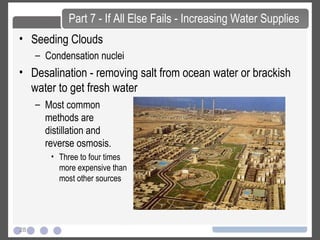
• Seeding Clouds
– Condensation nuclei
• Desalination - removing salt from ocean water or brackish
water to get fresh water
Part 7 - If All Else Fails - Increasing Water Supplies
– Most common
methods are
distillation and
reverse osmosis.
• Three to four times
more expensive than
most other sources
29
• Hydrologic Cycle
– Describes the circulation of water in the Earth
• Major Water Compartments
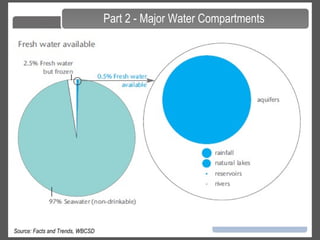
– Only 0.5% of water is available, the majority is in rivers, lakes and groundwater
• Water Use
– Makes conservation necessary
• Freshwater Shortages
– Significant throughout the world, critical in the U.S. Southwest
• Dams and Diversions
– Impact availability of freshwater
• Water Management –
– Critical to ensure business sustainability
• If All Else Fails
– “Radical” measures are available
Summary and Conclusion
Water use and management

Water use and management

  • 2.
    GROUP - 1 FARAZKHAN (UW-12-CE-BS.c-041) •Bsc Civil Engineering •farazali0041@gmail.com •+92-3315258522
  • 3.
  • 4.
    4 • Hydrologic Cycle •Major Water Compartments • Water Use • Freshwater Shortages • Dams and Diversions • Water Management • If All Else Fails Outline
  • 5.
    5 • Describes thecirculation of water as it: – Evaporates from land, water, and organisms – Enters the atmosphere – Condenses and precipitates back to the Earth’s surfaces Part 1 - Hydrologic Cycle – Moves underground by infiltration or overland by runoff into rivers, lakes and seas
  • 6.
    6 • Mountains actas cloud formers and rain catchers. – Air sweeps up the windward side of a mountain, pressure decreases, and the air cools. • Eventually saturation point is reached, and moisture in the air condenses. – Rain falls on the mountaintop. » Cool, dry air descends and warms, absorbing moisture from other sources. Topography
  • 7.
    7 Part 2 -Major Water Compartments Source: Facts and Trends, WBCSD
  • 8.
    8 • Oceans – Together,oceans contain more than 97% of all liquid water in the world. • Contain 90% of world’s living biomass • Moderate earth’s temperature – Gulf Stream carries 100X more water than all rivers on earth. Major Water Compartments – Average residence time of water in the ocean is about 3,000 years
  • 9.
    9 • Glaciers, Ice,and Snow – 2.5% of world’s water is classified as fresh. • 90% in glaciers, ice caps, and snowfields – As recently as 18,000 years ago, one-third of continental landmass was covered by glacial ice sheets. Major Water Compartments » Now, Antarctic glaciers contain nearly 85% of all ice in the world. » Greenland, together with ice floating around the North Pole, is another 10%.
  • 10.
    10 • Wetlands – Playa vital role in hydrologic cycle • Lush plant growth stabilizes soil and retards surface runoff, allowing more aquifer infiltration. Major Water Compartments – Disturbance reduces natural water-absorbing capacity, resulting in floods and erosion in wet periods, and less water flow the rest of the year. – Half of U.S. wetlands are gone.
  • 11.
    11 • The Atmosphere –Among the smallest water reservoirs • Contains < 0.001% of total water supply • Has most rapid turnover rate Major Water Compartments • Provides mechanism for distributing fresh water over landmasses and replenishing terrestrial reservoirs
  • 12.
    12 • Withdrawal -total amount of water taken from a source • Consumption - fraction of withdrawn water made unavailable for other purposes (not returned to its source) Part 3 - Water Use – Degradation - Change in water quality due to contamination making it unsuitable for desired use. – Much water that is not consumed is nevertheless polluted.
  • 13.
    13 • Human wateruse has been increasing about twice as fast as population growth over the past century, but impact varies with location. – Canada withdraws less than 1% of its renewable supply per year. – In Israel, groundwater and surface water withdrawals equal more than 100% of the renewable supply. Obviously, this is not sustainable. Quantities of Water Use – U.S. uses 20% of renewable water/yr. How do these countries prosper?
  • 14.
    14 • Water useis divided into agriculture, domestic use and industrial use. Agricultural Water Use • Worldwide, agriculture claims about two-thirds of total water withdrawal and 85% of consumption. – Aral Sea, once the fourth largest inland body of water in world, has been drained. Aral Sea
  • 15.
    15 Water Use inAgriculture – Sprinklers have high evaporation. – Drip irrigation releases water near roots, conserving water. • Irrigation can be inefficient. – Flood or furrow irrigation • Half of water can be lost through evaporation. • Flood irrigation used to remove salts from field, but salt contaminates streams
  • 16.
    16 • Worldwide, domesticwater use accounts for about one-fifth of water withdrawals. – Only about 10% of consumption Domestic and Industrial Water Use Typical Household Use in the U.S.
  • 17.
    17 Domestic and IndustrialWater Use • Industry accounts for 20% of global freshwater withdrawals. – Range from 5% to 70% in various locations • Small proportion is consumed, but degradation is a problem
  • 18.
    18 • U.N. estimatesa billion people lack access to safe drinking water. – 2.6 billion lack acceptable sanitation. • At least 45 countries, mostly in Africa and the Middle East, are considered to have serious water stress. Part 4 - Freshwater Shortages • Water shortages could lead to wars as population grows and climate change dries up some areas. • An underlying cause of the Darfur genocide is water scarcity.
  • 19.
    19 Why the Shortages?– Salt Water Intrusion
  • 20.
    20 • Water – Widespreadmass losses from glaciers and reductions in snow cover over recent decades are projected to accelerate throughout the 21st century, – This will reduce water availability, hydropower potential, and change seasonality of flows in regions supplied by meltwater from major mountain ranges. Source: The Intergovernmental Panel on Climate Change, “Climate Change 2007: Synthesis Report,” 2007 IPCC on Droughts – There is also high confidence that many semi-arid areas (e.g. the Mediterranean Basin, western United States, southern Africa and north-eastern Brazil) will suffer a decrease in water resources due to climate change.
  • 21.
    21 Lake Mead • Ahydropower reservoir along the Colorado River, Lake Mead was intended to serve as one of several "water banks" for 30 million people in the arid U.S. Southwest – Liquid assets have been quickly disappearing due to drought and increased demand. A man stands on the end of a dock that used to lead to the waters of Lake Mead, the largest artificial reservoir in the U.S. (2008). Picture taken near Hoover Dam shows the lake in 2006.
  • 22.
    22 • The water-stressindex looks at how much water is available per person and counts people with less than 1,000 m3 (seven gallons per day) as highly water stressed. • When looking forward to future years, it is clear that more people are going to be water stressed, as a consequence of an increasing population. World Water Report
  • 23.
    23 • Before 1900there were 250 high dams in the world; today there are more than 45,000. • In the U.S. dams are built by Army Corps of Engineers and Bureau of Reclamation Part 5 - Dams and Diversions – Provide cheap hydroelectric power – Jobs – Reduce flooding – Allow farming on lands that would otherwise be too dry Tallest Dam in the world: Rogun in Tajikistan at over 1,000 feet
  • 24.
    24 • Diversion projectscan dry up rivers – Yellow River in China is dry 226 days per year due to diversions – Colorado River in the U.S. is so depleted that most of the year no water reaches the mouth of the river in the Sea of Cortez Dams and Diversions – Mono Lake has been depleted to send water to Los Angeles. Salinity of water doubled, killing the brine shrimp that fed flocks of migratory birds Diversion of water from the lake to Los Angeles has shrunk the lake by 1/3, exposing these towers where calcium- rich springs once entered the lake.
  • 25.
  • 26.
    26Source: “Water Scarcityand Climate Change,” Ceres: (2016) • Physical Risks – Water scarcity directly impacts business activities, raw material supply, intermediate supply chain, and product use in a variety of ways. – Declines or disruptions in water supply can undermine industrial and manufacturing operations where water is needed for production, irrigation, material processing, cooling and/or washing and cleaning. Water Related Business Risks – Water scarcity directly affects power generation, putting some businesses at risk.
  • 27.
    27 • Companies havea clear economic incentive to closely assess their relationship to their water inputs and outputs and to proactively address and manage them. To do so, companies should take the following steps: 1. Measure the company’s water footprint throughout its value chain. 2. Assess the physical, regulatory and reputational risks associated with its water footprint 3. Integrate water issues into strategic business planning and governance. 4. Disclose and communicate water performance and associated risks. What Can Companies Do To Manage Risk?
  • 28.
    28 • Seeding Clouds –Condensation nuclei • Desalination - removing salt from ocean water or brackish water to get fresh water Part 7 - If All Else Fails - Increasing Water Supplies – Most common methods are distillation and reverse osmosis. • Three to four times more expensive than most other sources
  • 29.
    29 • Hydrologic Cycle –Describes the circulation of water in the Earth • Major Water Compartments – Only 0.5% of water is available, the majority is in rivers, lakes and groundwater • Water Use – Makes conservation necessary • Freshwater Shortages – Significant throughout the world, critical in the U.S. Southwest • Dams and Diversions – Impact availability of freshwater • Water Management – – Critical to ensure business sustainability • If All Else Fails – “Radical” measures are available Summary and Conclusion