Trees and Graphs
Spencer Moran
12/3/13
Properties of a Tree
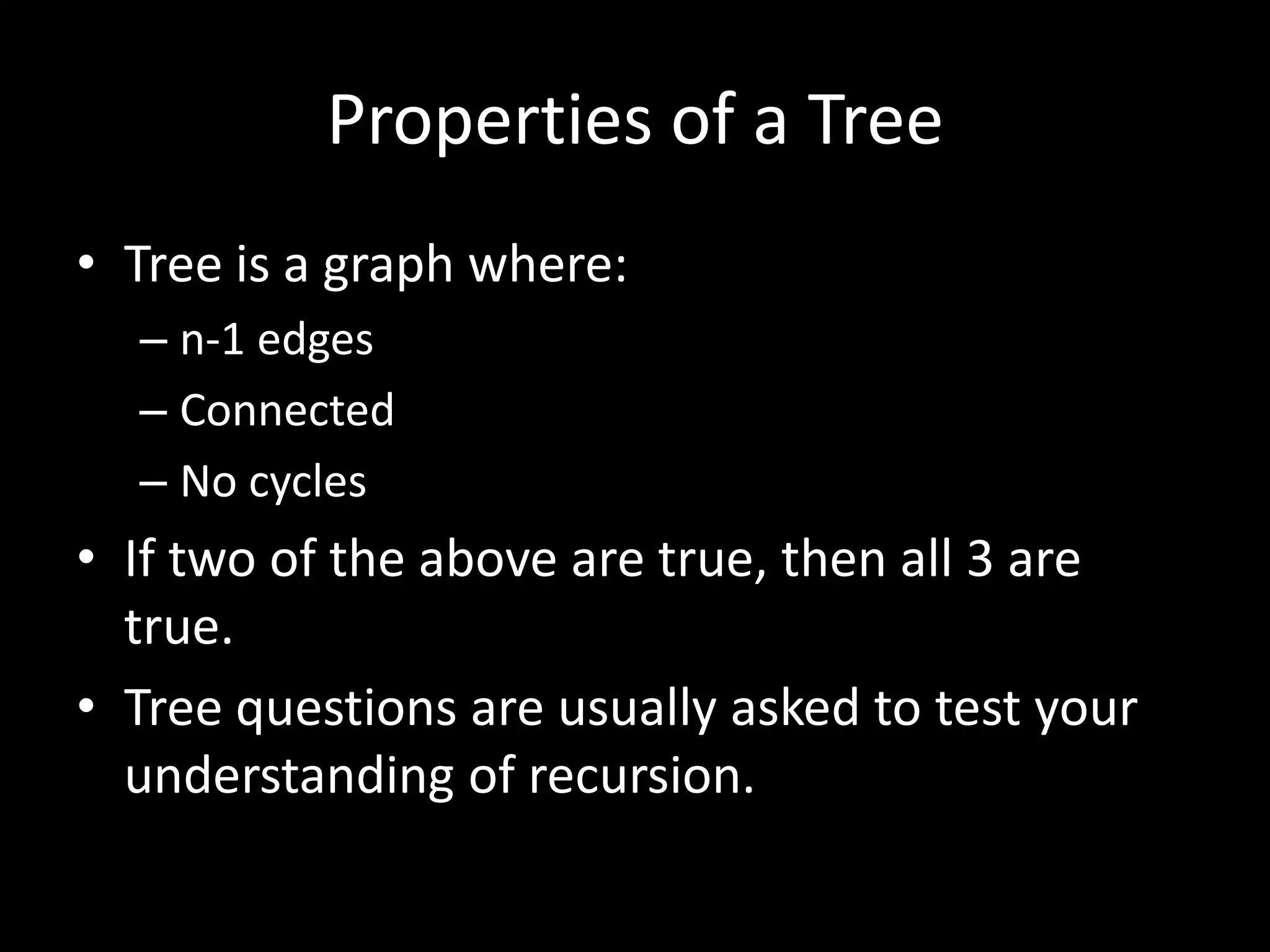
• Tree is a graph where:
– n-1 edges
– Connected
– No cycles

• If two of the above are true, then all 3 are
true.
• Tree questions are usually asked to test your
understanding of recursion.
Binary Search Trees
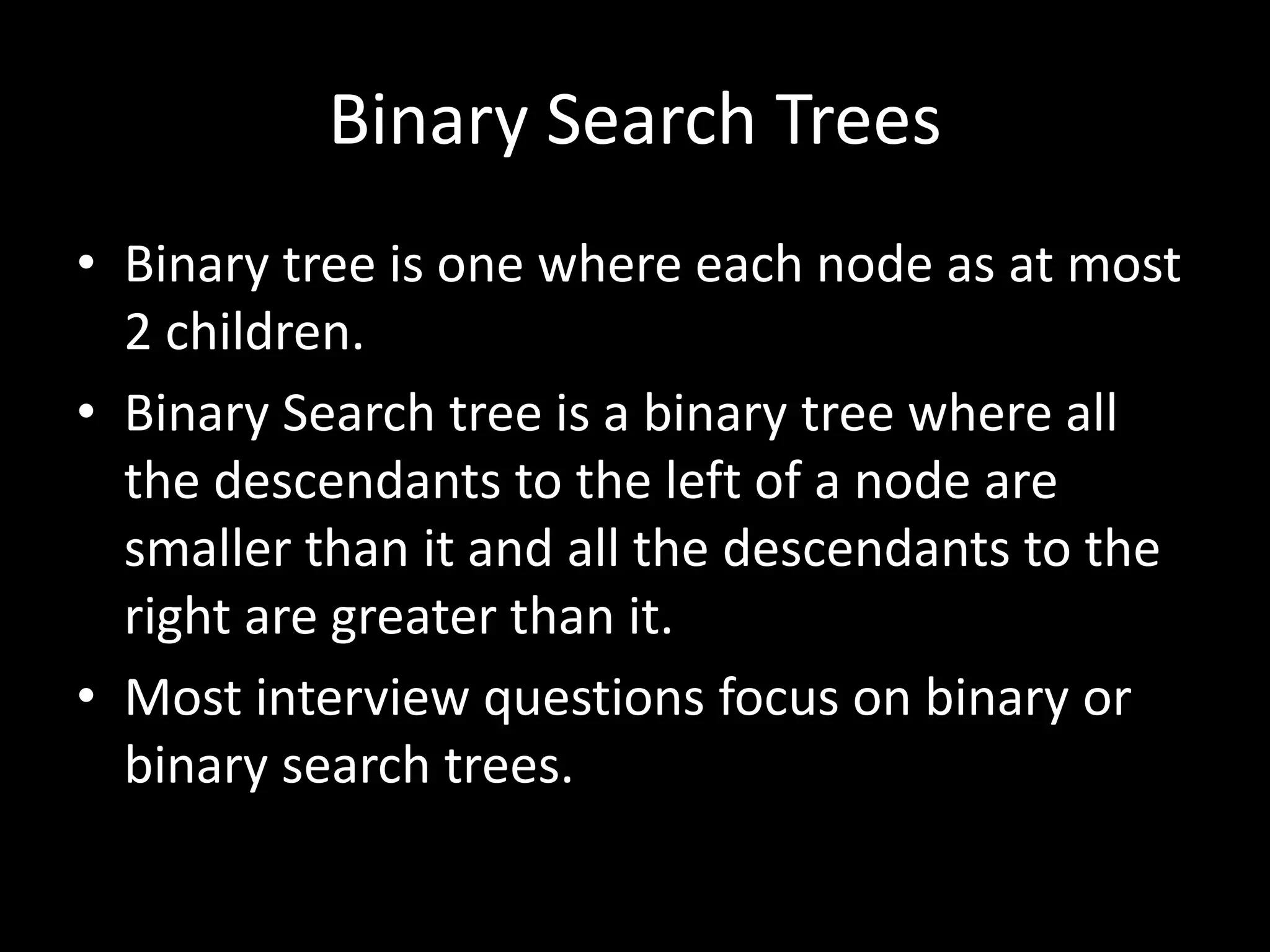
• Binary tree is one where each node as at most
2 children.
• Binary Search tree is a binary tree where all
the descendants to the left of a node are
smaller than it and all the descendants to the
right are greater than it.
• Most interview questions focus on binary or
binary search trees.
Binary Search Tree Complexity
•
•
•
•
•
•

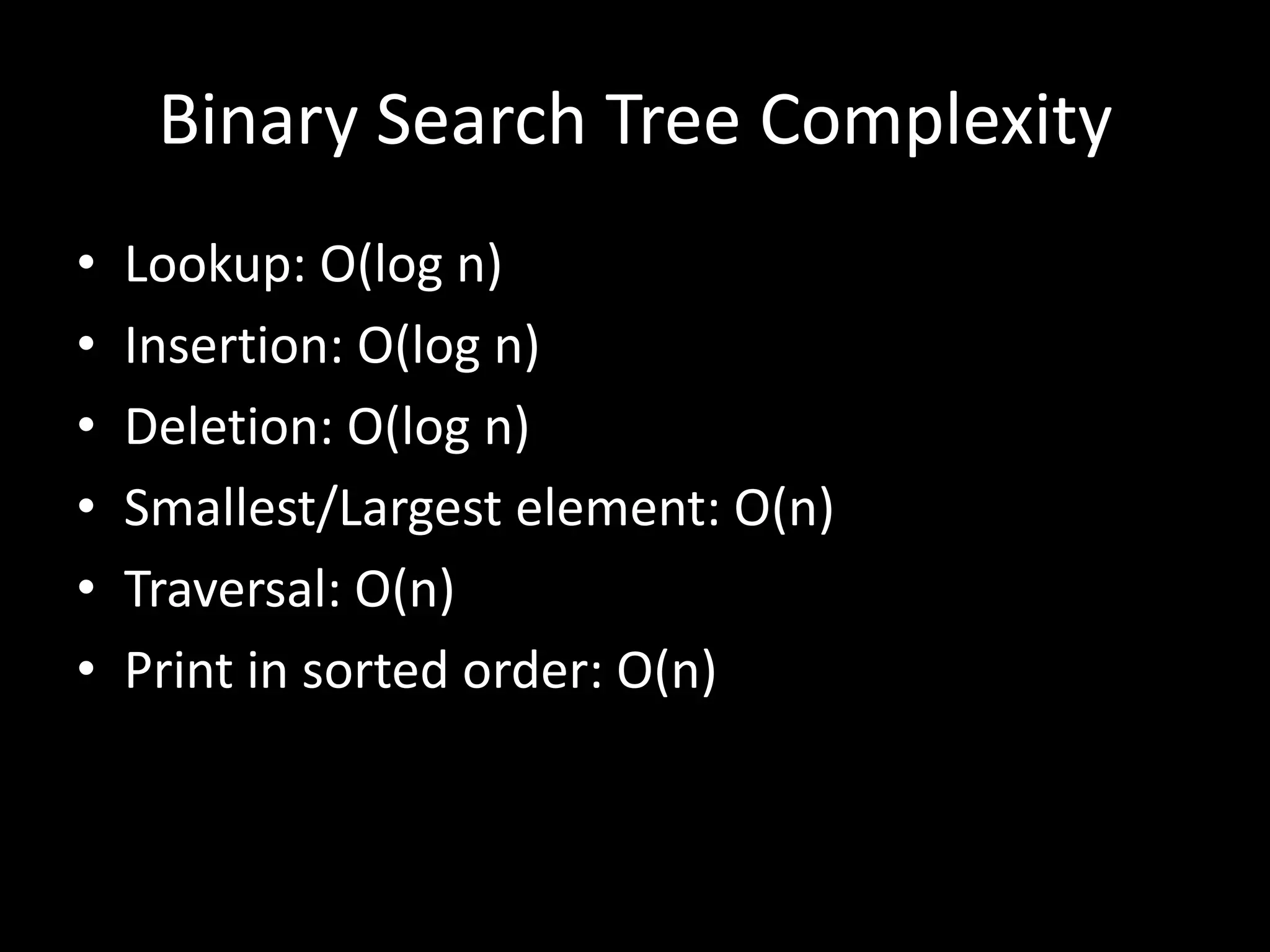
Lookup: O(log n)
Insertion: O(log n)
Deletion: O(log n)
Smallest/Largest element: O(n)
Traversal: O(n)
Print in sorted order: O(n)
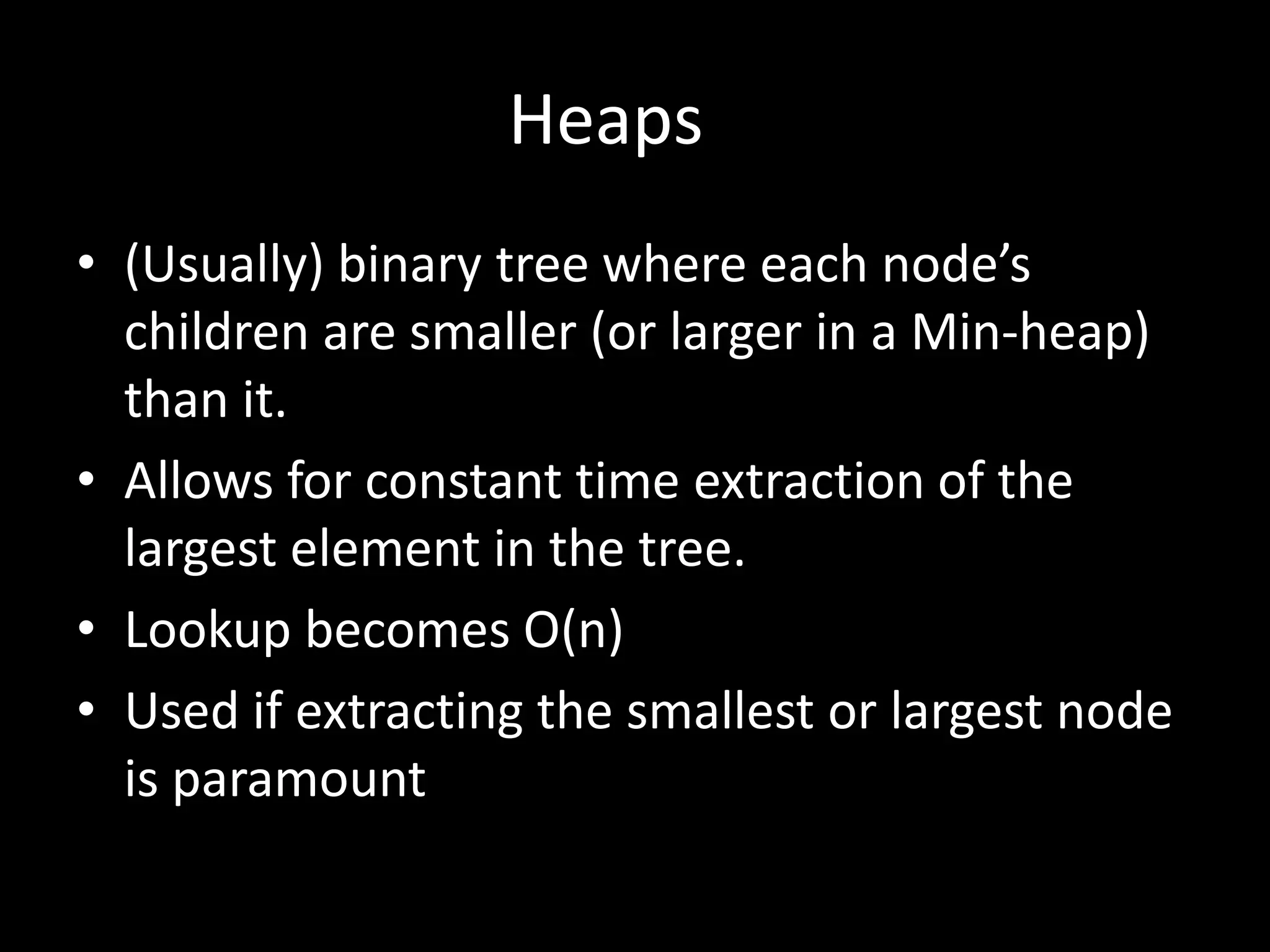
Heaps
• (Usually) binary tree where each node’s
children are smaller (or larger in a Min-heap)
than it.
• Allows for constant time extraction of the
largest element in the tree.
• Lookup becomes O(n)
• Used if extracting the smallest or largest node
is paramount
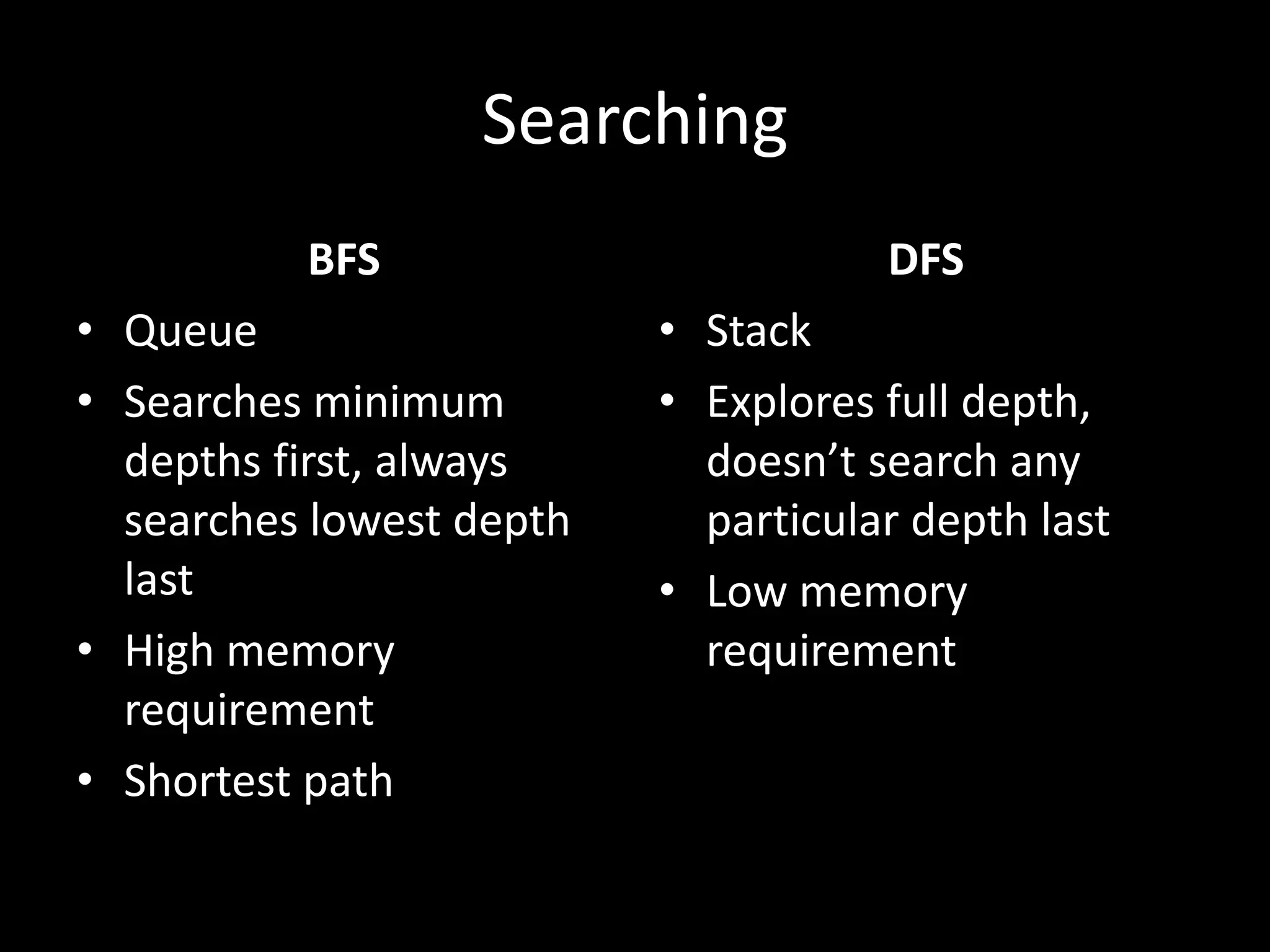
Searching
BFS

• Queue
• Searches minimum
depths first, always
searches lowest depth
last
• High memory
requirement
• Shortest path

DFS

• Stack
• Explores full depth,
doesn’t search any
particular depth last
• Low memory
requirement
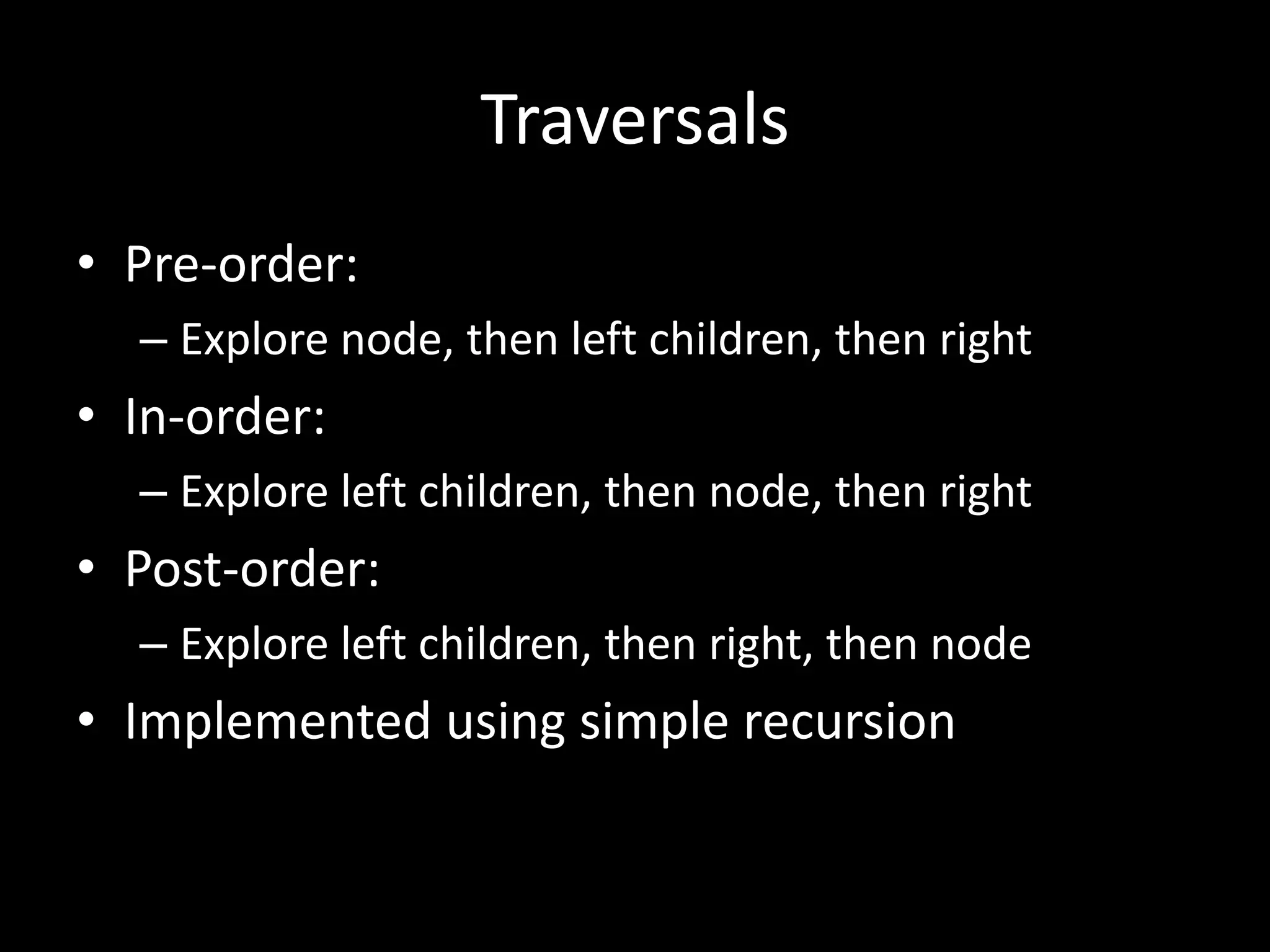
Traversals
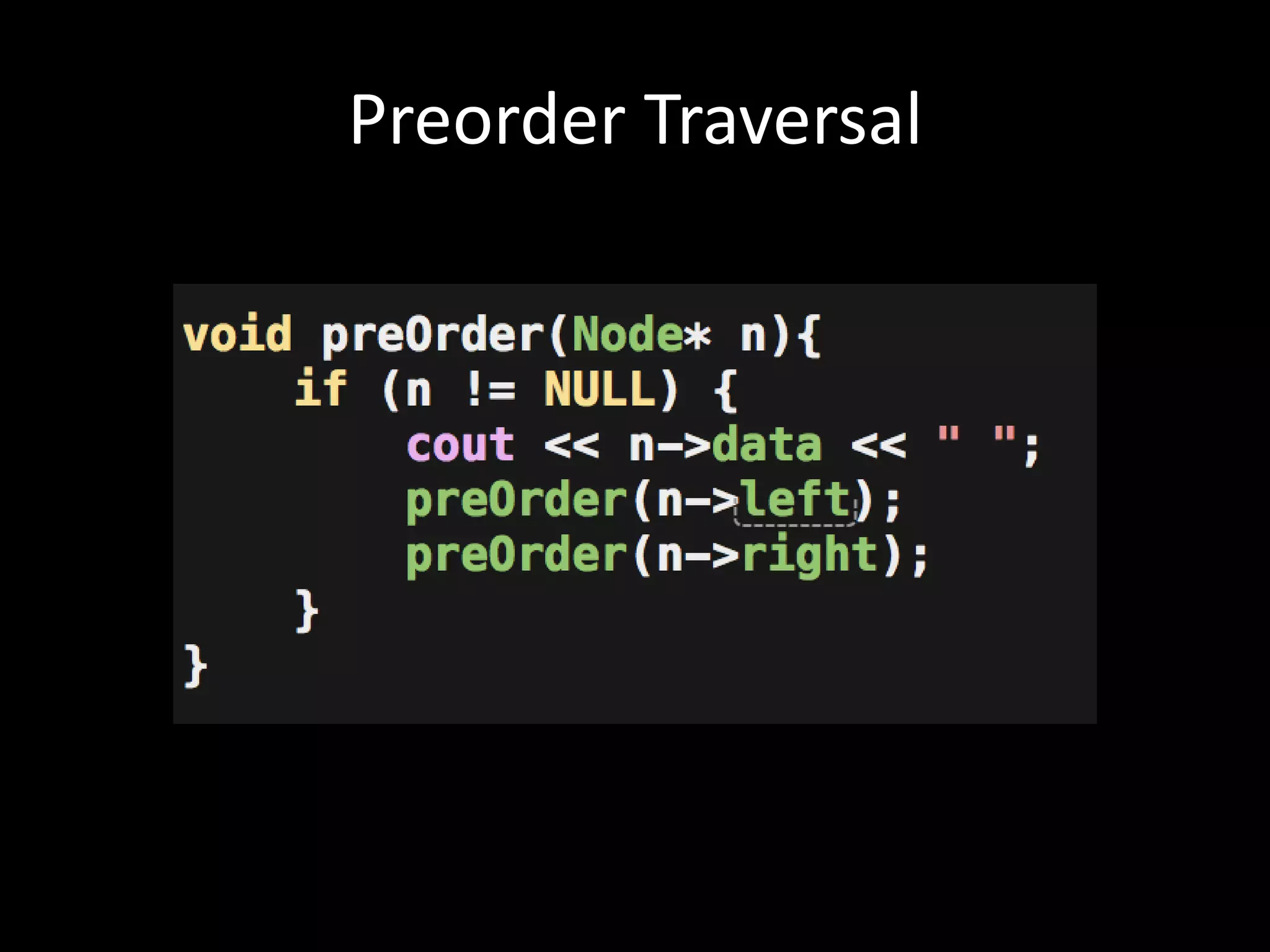
• Pre-order:
– Explore node, then left children, then right

• In-order:
– Explore left children, then node, then right

• Post-order:
– Explore left children, then right, then node

• Implemented using simple recursion
Preorder Traversal
Sample Question

Find the height of a binary tree.
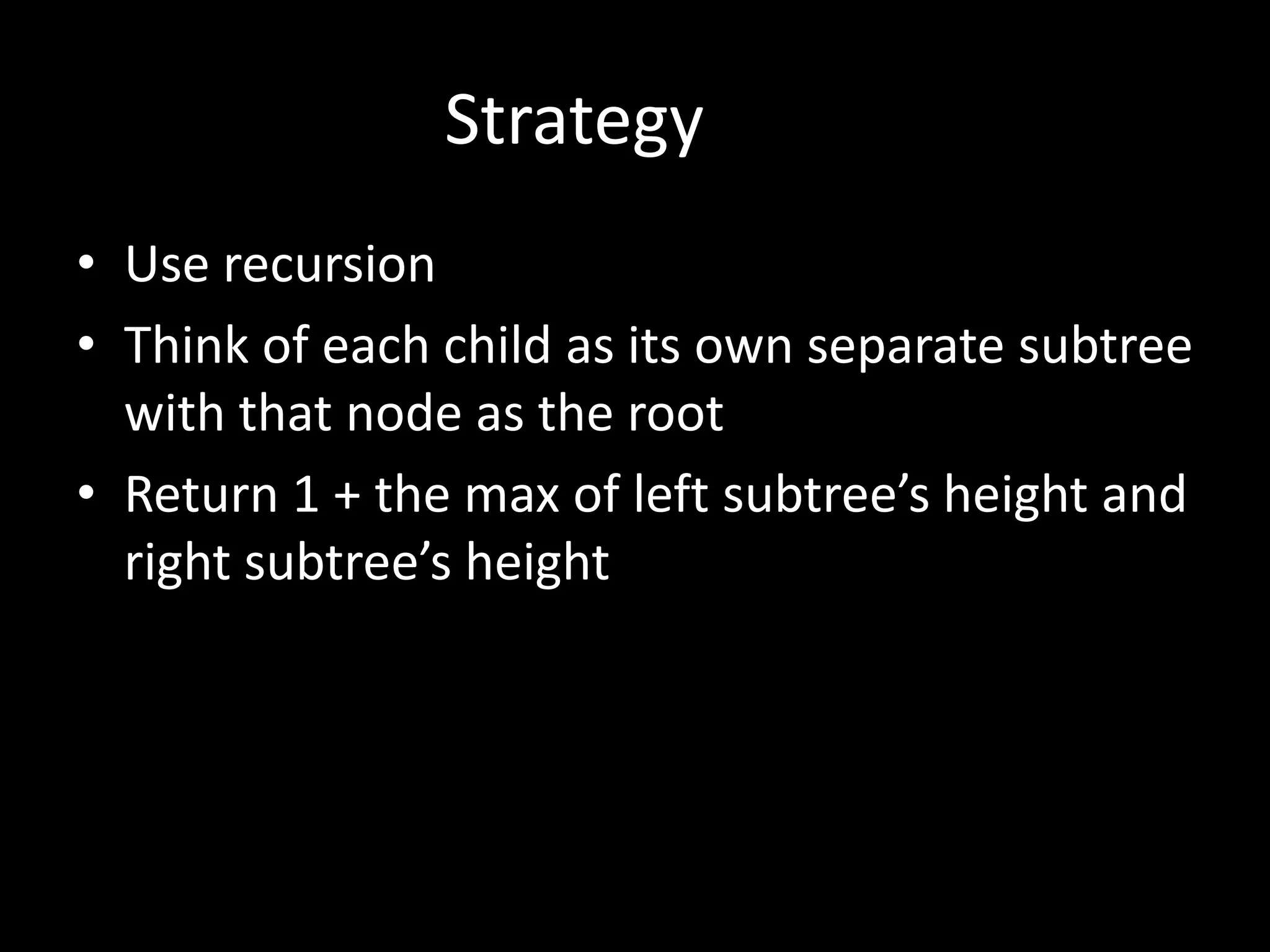
Strategy
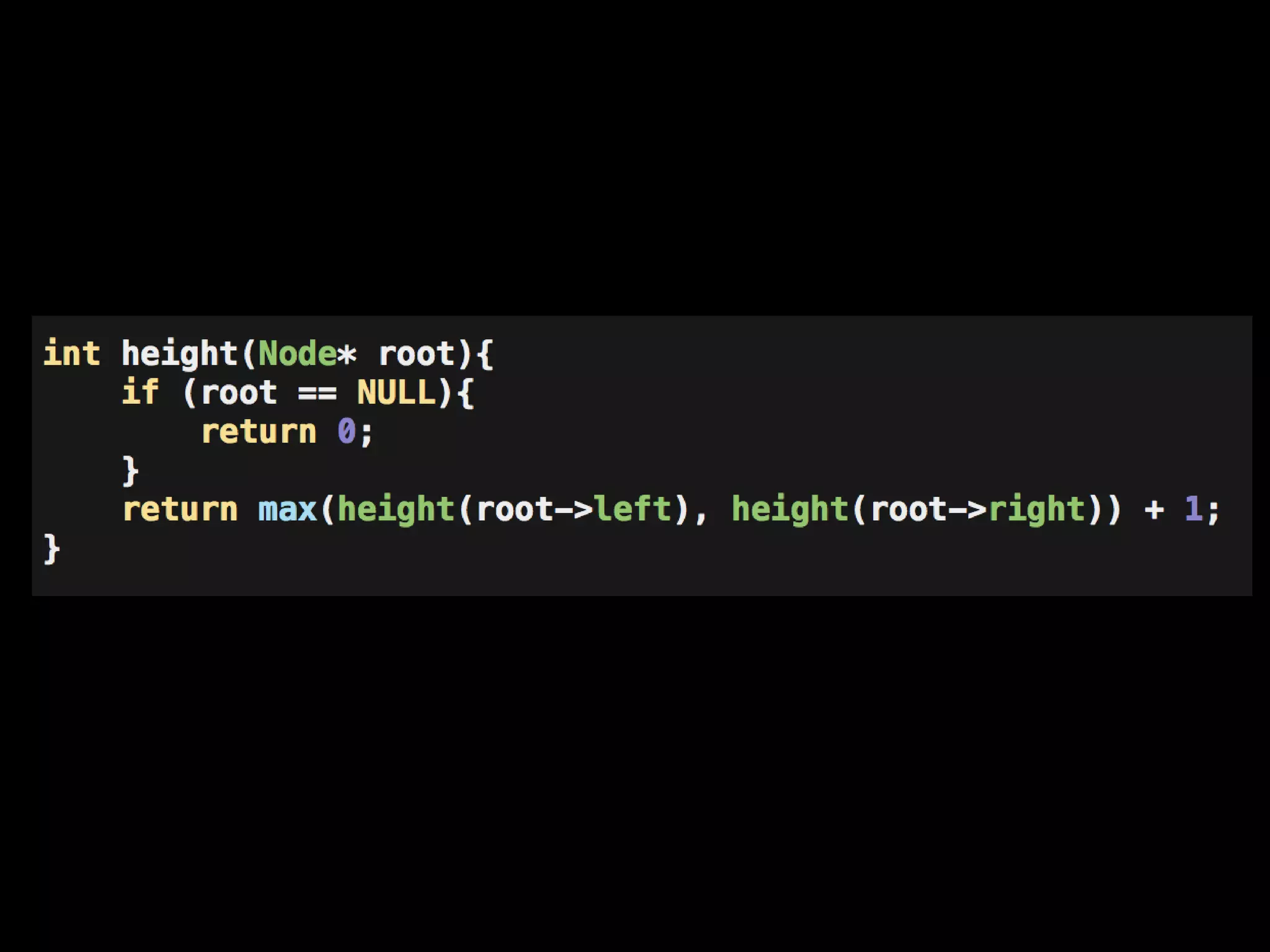
• Use recursion
• Think of each child as its own separate subtree
with that node as the root
• Return 1 + the max of left subtree’s height and
right subtree’s height
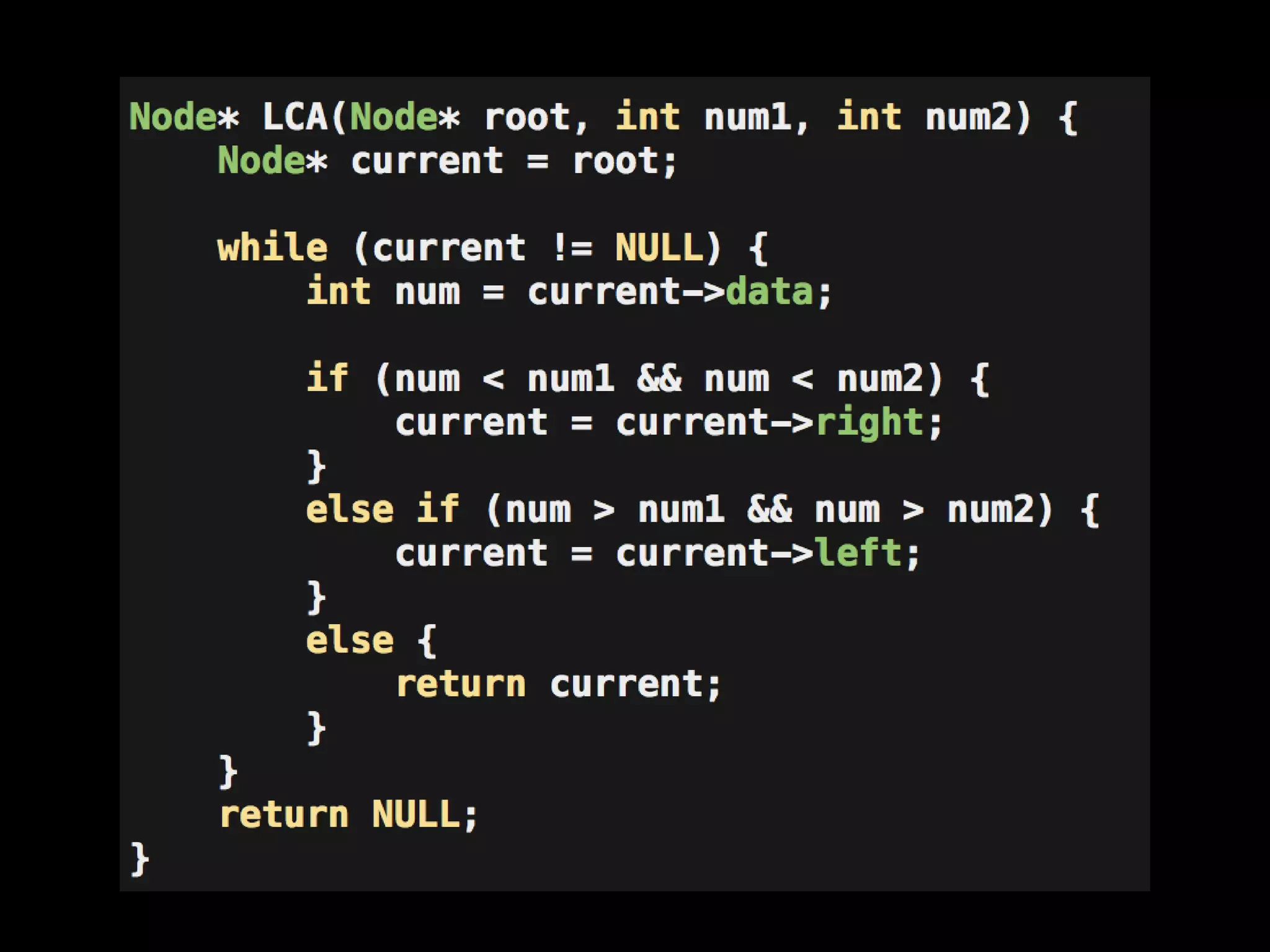
Sample Question

Given the value of two nodes in a BST, find the
lowest common ancestor. You may assume both
values exist in the tree.
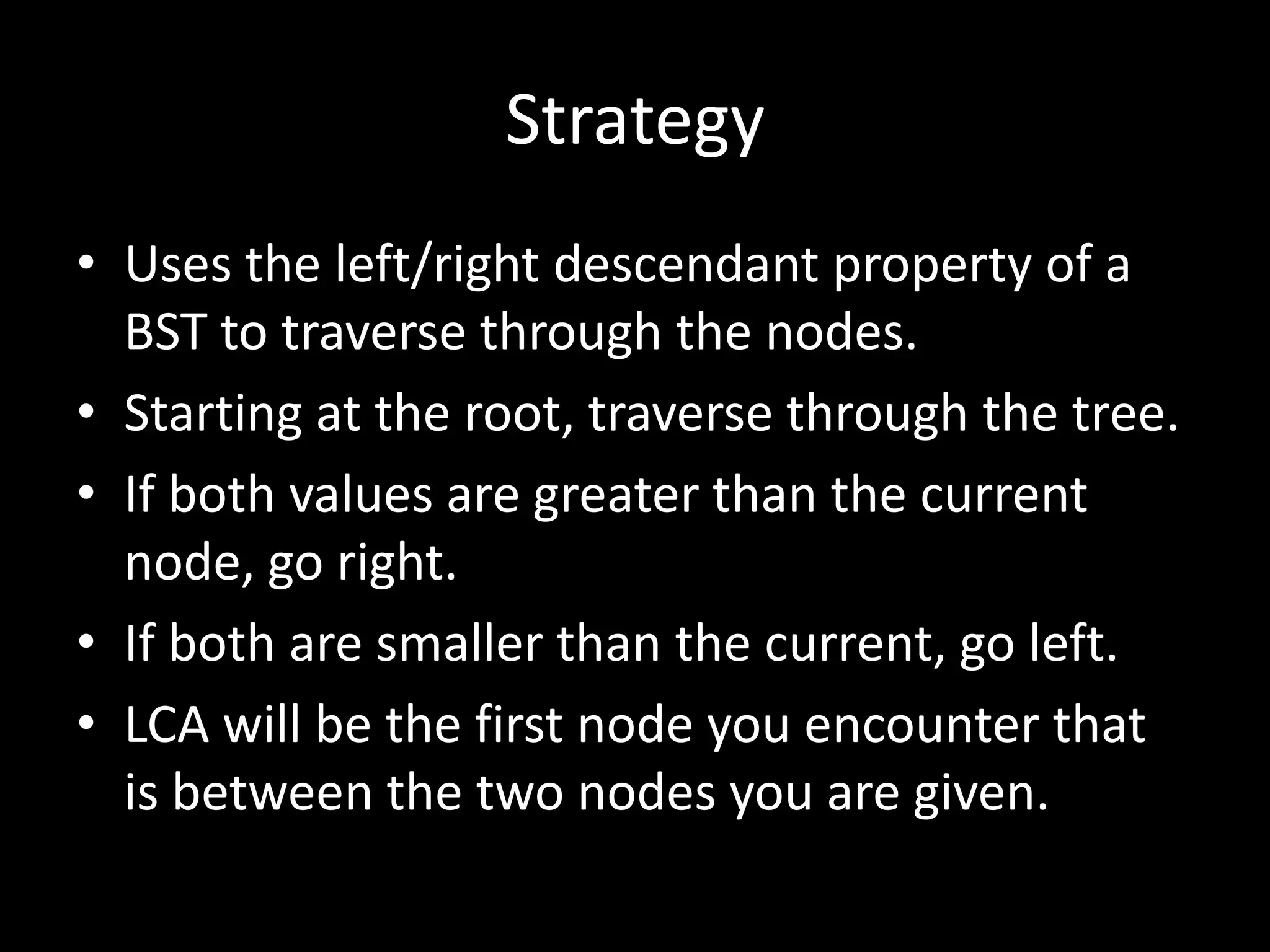
Strategy
• Uses the left/right descendant property of a
BST to traverse through the nodes.
• Starting at the root, traverse through the tree.
• If both values are greater than the current
node, go right.
• If both are smaller than the current, go left.
• LCA will be the first node you encounter that
is between the two nodes you are given.
Other Common Tree Questions
• Binary tree to heap
• Is Binary tree a BST?
• Balance an unbalanced BST (left or right
rotation)
• Count # of leaves
Graphs
• Graph questions are much more complicated
and less common.
• We will cover graphs during the group
meeting.

Treesandgraphs

  • 1.
  • 2.
    Properties of aTree • Tree is a graph where: – n-1 edges – Connected – No cycles • If two of the above are true, then all 3 are true. • Tree questions are usually asked to test your understanding of recursion.
  • 3.
    Binary Search Trees •Binary tree is one where each node as at most 2 children. • Binary Search tree is a binary tree where all the descendants to the left of a node are smaller than it and all the descendants to the right are greater than it. • Most interview questions focus on binary or binary search trees.
  • 4.
    Binary Search TreeComplexity • • • • • • Lookup: O(log n) Insertion: O(log n) Deletion: O(log n) Smallest/Largest element: O(n) Traversal: O(n) Print in sorted order: O(n)
  • 5.
    Heaps • (Usually) binarytree where each node’s children are smaller (or larger in a Min-heap) than it. • Allows for constant time extraction of the largest element in the tree. • Lookup becomes O(n) • Used if extracting the smallest or largest node is paramount
  • 6.
    Searching BFS • Queue • Searchesminimum depths first, always searches lowest depth last • High memory requirement • Shortest path DFS • Stack • Explores full depth, doesn’t search any particular depth last • Low memory requirement
  • 7.
    Traversals • Pre-order: – Explorenode, then left children, then right • In-order: – Explore left children, then node, then right • Post-order: – Explore left children, then right, then node • Implemented using simple recursion
  • 8.
  • 9.
    Sample Question Find theheight of a binary tree.
  • 10.
    Strategy • Use recursion •Think of each child as its own separate subtree with that node as the root • Return 1 + the max of left subtree’s height and right subtree’s height
  • 12.
    Sample Question Given thevalue of two nodes in a BST, find the lowest common ancestor. You may assume both values exist in the tree.
  • 13.
    Strategy • Uses theleft/right descendant property of a BST to traverse through the nodes. • Starting at the root, traverse through the tree. • If both values are greater than the current node, go right. • If both are smaller than the current, go left. • LCA will be the first node you encounter that is between the two nodes you are given.
  • 15.
    Other Common TreeQuestions • Binary tree to heap • Is Binary tree a BST? • Balance an unbalanced BST (left or right rotation) • Count # of leaves
  • 16.
    Graphs • Graph questionsare much more complicated and less common. • We will cover graphs during the group meeting.