What is a Tree
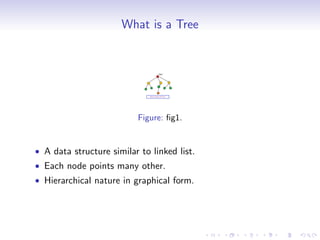
Figure: fig1.
• A data structure similar to linked list.
• Each node points many other.
• Hierarchical nature in graphical form.
Features and types
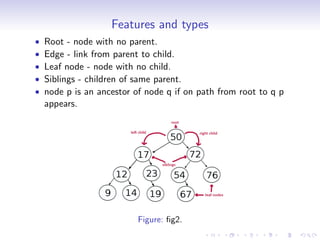
• Root - node with no parent.
• Edge - link from parent to child.
• Leaf node - node with no child.
• Siblings - children of same parent.
• node p is an ancestor of node q if on path from root to q p
appears.
Figure: fig2.
conti.
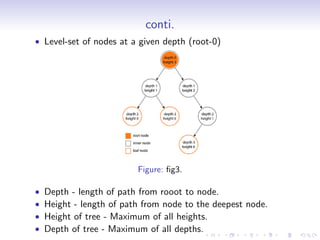
• Level-set of nodes at a given depth (root-0)
Figure: fig3.
• Depth - length of path from rooot to node.
• Height - length of path from node to the deepest node.
• Height of tree - Maximum of all heights.
• Depth of tree - Maximum of all depths.
conti.
Conti.
• Size - Number of descendants including itself.
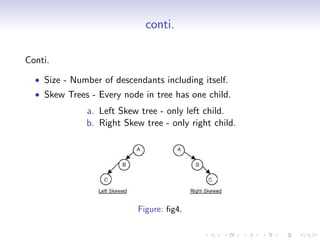
• Skew Trees - Every node in tree has one child.
a. Left Skew tree - only left child.
b. Right Skew tree - only right child.
Figure: fig4.
About Binary Trees
• Binary Tree
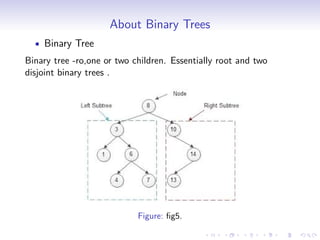
Binary tree -ro,one or two children. Essentially root and two
disjoint binary trees .
Figure: fig5.
Types Of Binary Trees
• Types of Binary Trees
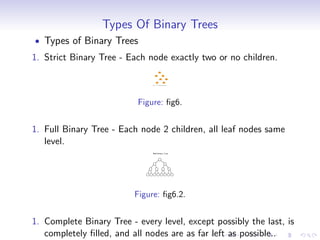
1. Strict Binary Tree - Each node exactly two or no children.
Figure: fig6.
1. Full Binary Tree - Each node 2 children, all leaf nodes same
level.
Figure: fig6.2.
1. Complete Binary Tree - every level, except possibly the last, is
completely filled, and all nodes are as far left as possible..
Properties of Binary Trees
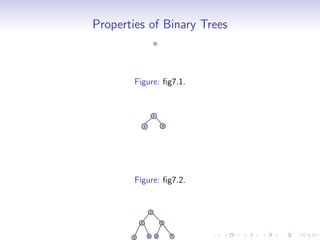
Figure: fig7.1.
Figure: fig7.2.
Infering from table
• Conti
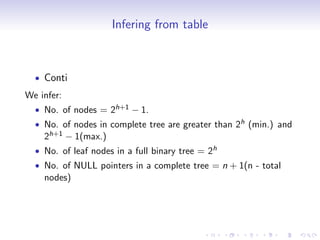
We infer:
• No. of nodes = 2h+1 − 1.
• No. of nodes in complete tree are greater than 2h (min.) and
2h+1 − 1(max.)
• No. of leaf nodes in a full binary tree = 2h
• No. of NULL pointers in a complete tree = n + 1(n - total
nodes)
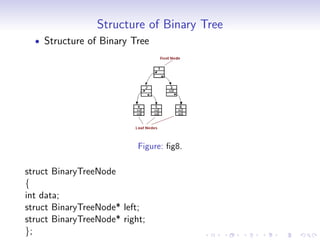
Structure of Binary Tree
• Structure of Binary Tree
Figure: fig8.
struct BinaryTreeNode
{
int data;
struct BinaryTreeNode* left;
struct BinaryTreeNode* right;
};
Operations on Binary Trees
• Operations on Binary Trees
Basic Operations
* Inserting an element into tree.
* Deleting an element from tree.
* Searching for an element.
* traversing the tree.
Auxiliary Operations
* Finding size of the tree.
* Finding height of tree.
* Finding the level which has maximum sum.
* Finding least common ancestor(LCA).
applications
• Applicatons of Binary Tree
• Expression trees - used in compilers.
• Huffman coding trees - used in data compression algorithms.
• Binary Search Trees - support search,insertion and deletion in
O(logn) (average).
• Priority Queues - support search and deletion in logarithmic
time(worst case).
End

Trees

  • 1.
    What is aTree Figure: fig1. • A data structure similar to linked list. • Each node points many other. • Hierarchical nature in graphical form.
  • 2.
    Features and types •Root - node with no parent. • Edge - link from parent to child. • Leaf node - node with no child. • Siblings - children of same parent. • node p is an ancestor of node q if on path from root to q p appears. Figure: fig2.
  • 3.
    conti. • Level-set ofnodes at a given depth (root-0) Figure: fig3. • Depth - length of path from rooot to node. • Height - length of path from node to the deepest node. • Height of tree - Maximum of all heights. • Depth of tree - Maximum of all depths.
  • 4.
    conti. Conti. • Size -Number of descendants including itself. • Skew Trees - Every node in tree has one child. a. Left Skew tree - only left child. b. Right Skew tree - only right child. Figure: fig4.
  • 5.
    About Binary Trees •Binary Tree Binary tree -ro,one or two children. Essentially root and two disjoint binary trees . Figure: fig5.
  • 6.
    Types Of BinaryTrees • Types of Binary Trees 1. Strict Binary Tree - Each node exactly two or no children. Figure: fig6. 1. Full Binary Tree - Each node 2 children, all leaf nodes same level. Figure: fig6.2. 1. Complete Binary Tree - every level, except possibly the last, is completely filled, and all nodes are as far left as possible..
  • 7.
    Properties of BinaryTrees Figure: fig7.1. Figure: fig7.2.
  • 8.
    Infering from table •Conti We infer: • No. of nodes = 2h+1 − 1. • No. of nodes in complete tree are greater than 2h (min.) and 2h+1 − 1(max.) • No. of leaf nodes in a full binary tree = 2h • No. of NULL pointers in a complete tree = n + 1(n - total nodes)
  • 9.
    Structure of BinaryTree • Structure of Binary Tree Figure: fig8. struct BinaryTreeNode { int data; struct BinaryTreeNode* left; struct BinaryTreeNode* right; };
  • 10.
    Operations on BinaryTrees • Operations on Binary Trees Basic Operations * Inserting an element into tree. * Deleting an element from tree. * Searching for an element. * traversing the tree. Auxiliary Operations * Finding size of the tree. * Finding height of tree. * Finding the level which has maximum sum. * Finding least common ancestor(LCA).
  • 11.
    applications • Applicatons ofBinary Tree • Expression trees - used in compilers. • Huffman coding trees - used in data compression algorithms. • Binary Search Trees - support search,insertion and deletion in O(logn) (average). • Priority Queues - support search and deletion in logarithmic time(worst case).
  • 12.