BINARY OPERATION
JOHN CLIFFORD T. MORENO, LPT
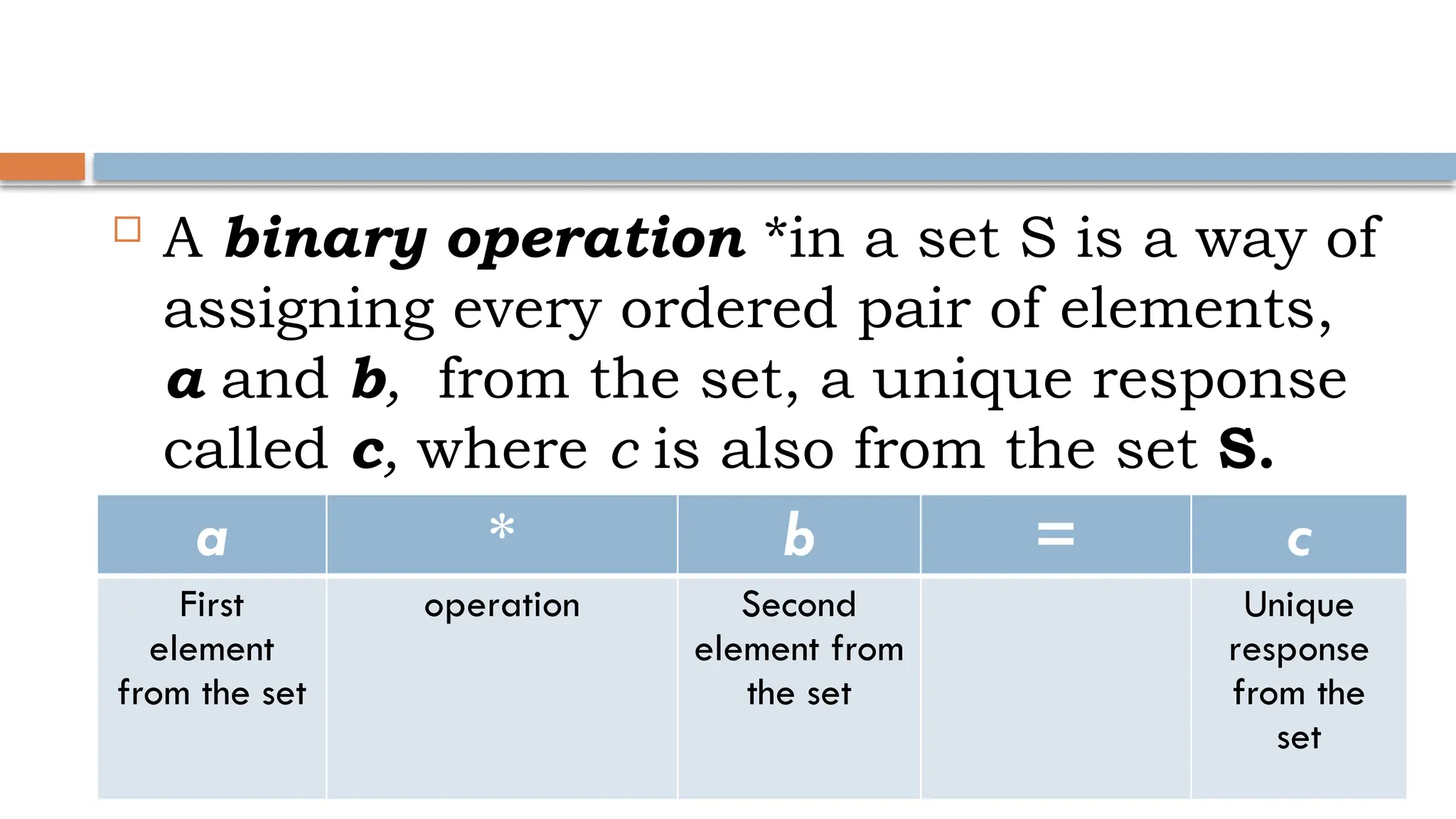
 A binary operation *in a set S is a way of
assigning every ordered pair of elements,
a and b, from the set, a unique response
called c, where c is also from the set S.
a * b = c
First
element
from the set
operation Second
element from
the set
Unique
response
from the
set
 Binary operations include addition,
subtraction, multiplication and division.
 The value of f(x) is obtained upon
assigning a specific value for x. The
variable x represents the independent
variable and y represents the dependent
variable.
 Given y=f(x) and let a be in the domain
of f . Then f(a) represents the second
element in the pair of defining f, or the
value of the function at x = a. The value
of f(a) is obtained by replacing x by a in
f(x).
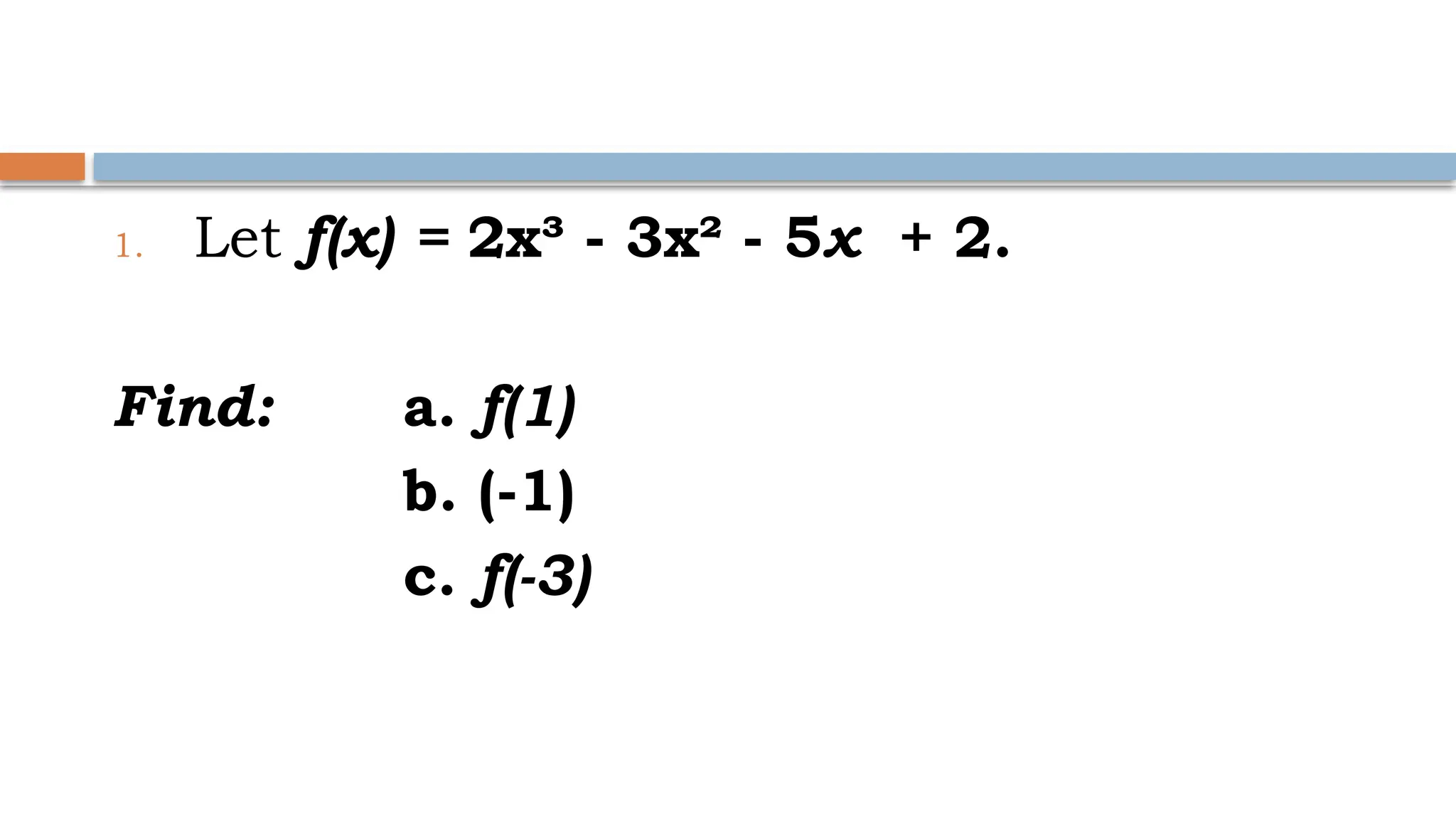
1. Let f(x) = 2x³ - 3x² - 5x + 2.
Find: a. f(1)
b. (-1)
c. f(-3)
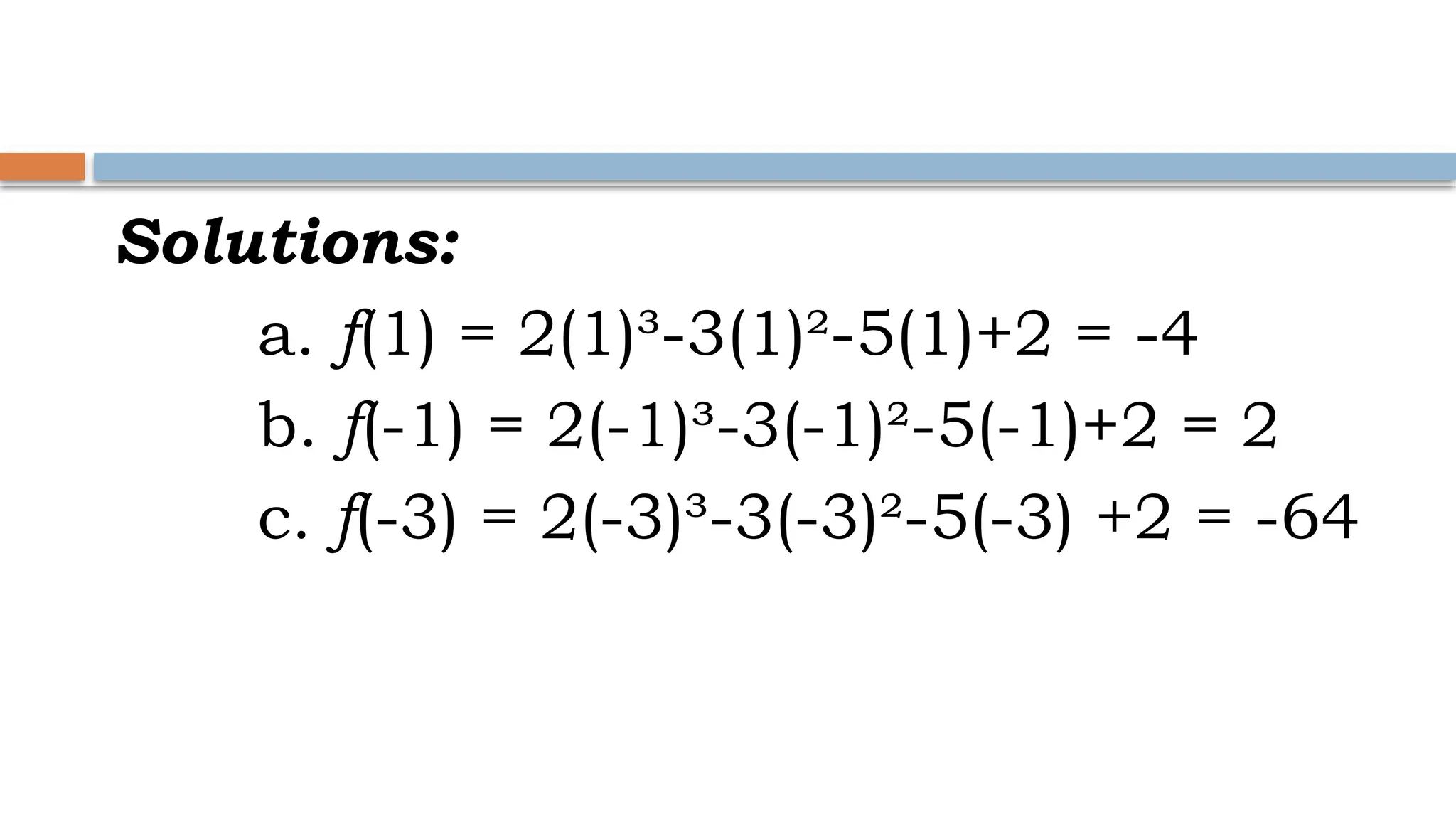
Solutions:
a. f(1) = 2(1)³-3(1)²-5(1)+2 = -4
b. f(-1) = 2(-1)³-3(-1)²-5(-1)+2 = 2
c. f(-3) = 2(-3)³-3(-3)²-5(-3) +2 = -64
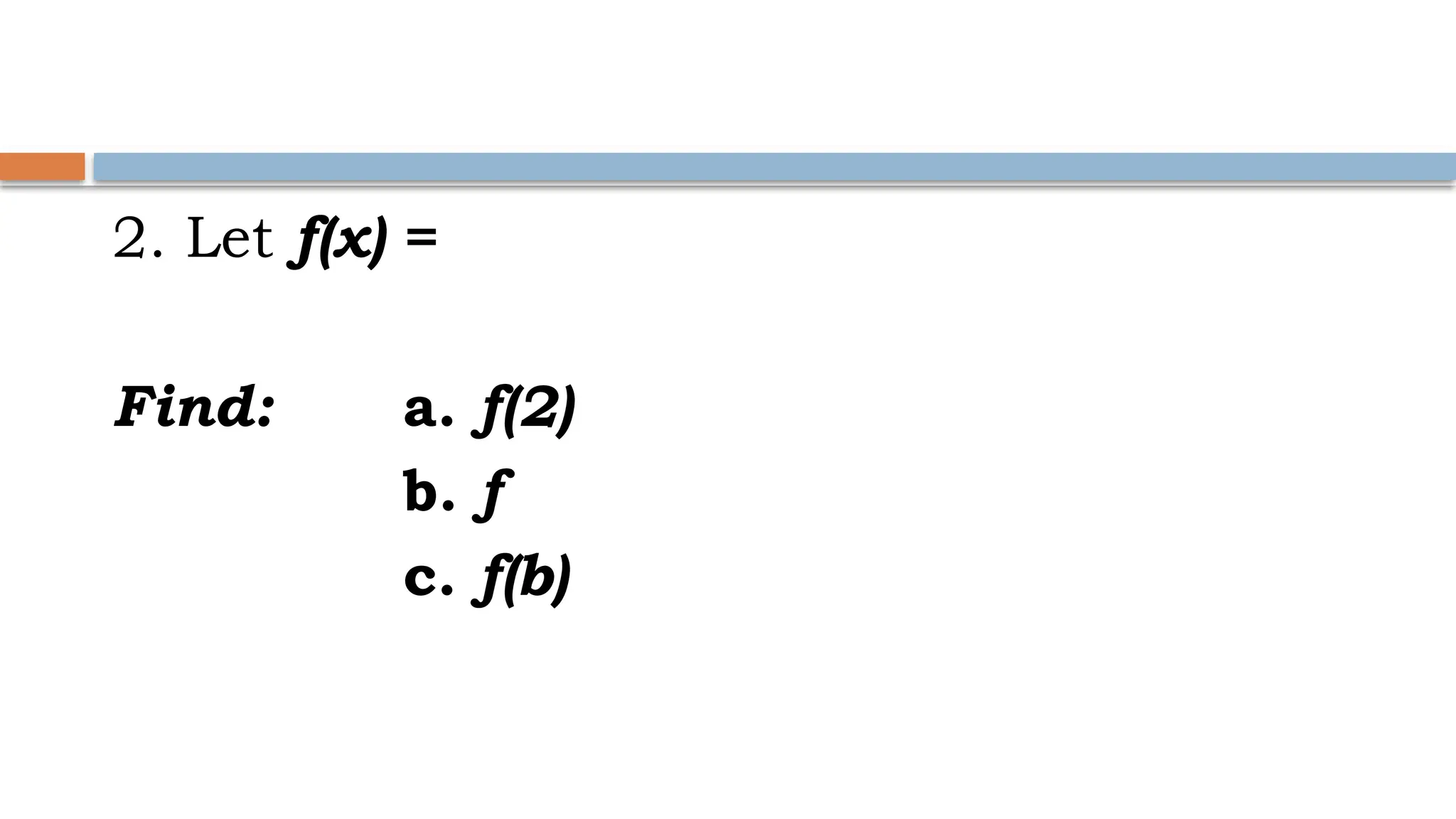
2. Let f(x) =
Find: a. f(2)
b. f
c. f(b)
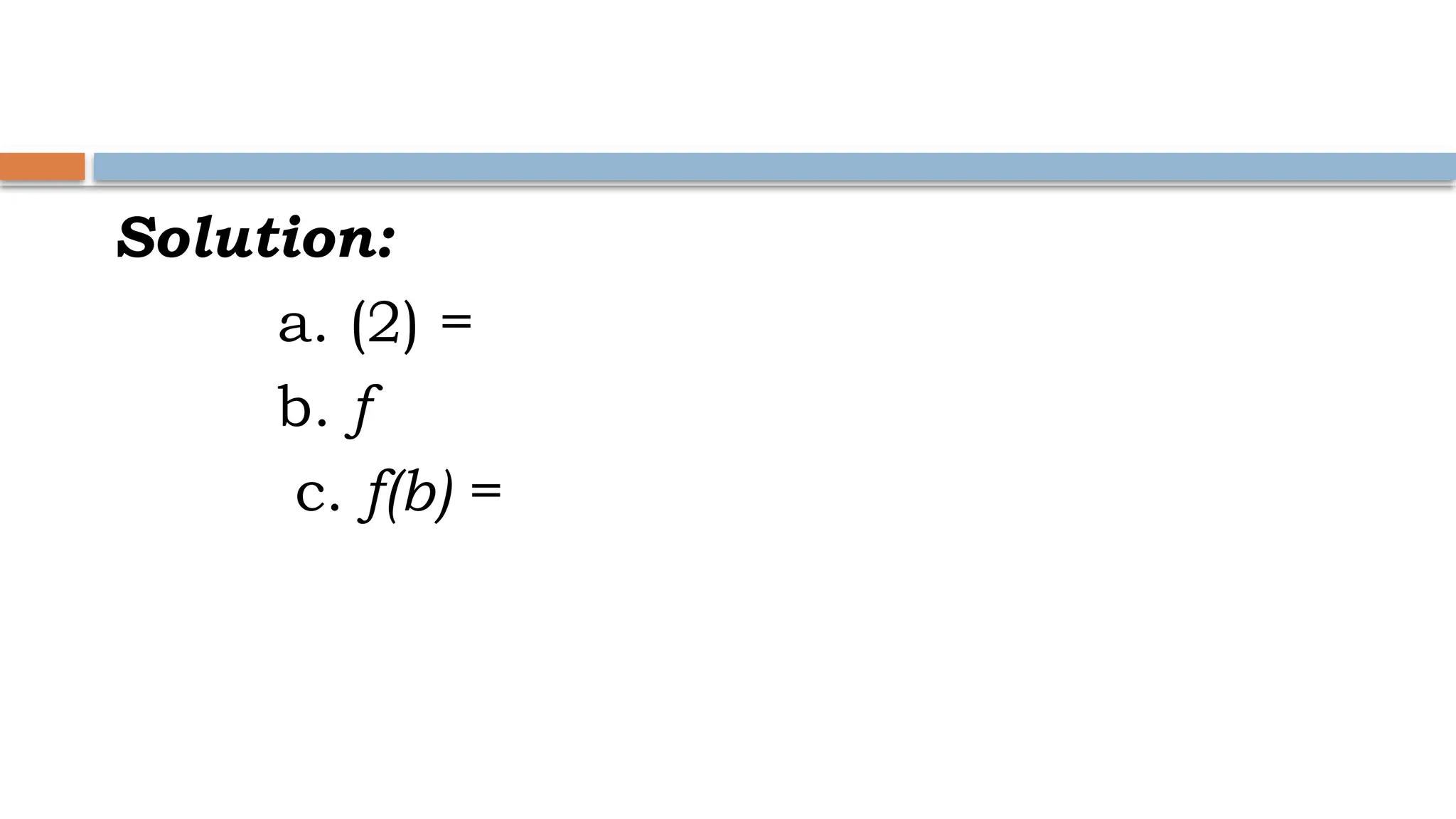
Solution:
a. (2) =
b. f
c. f(b) =
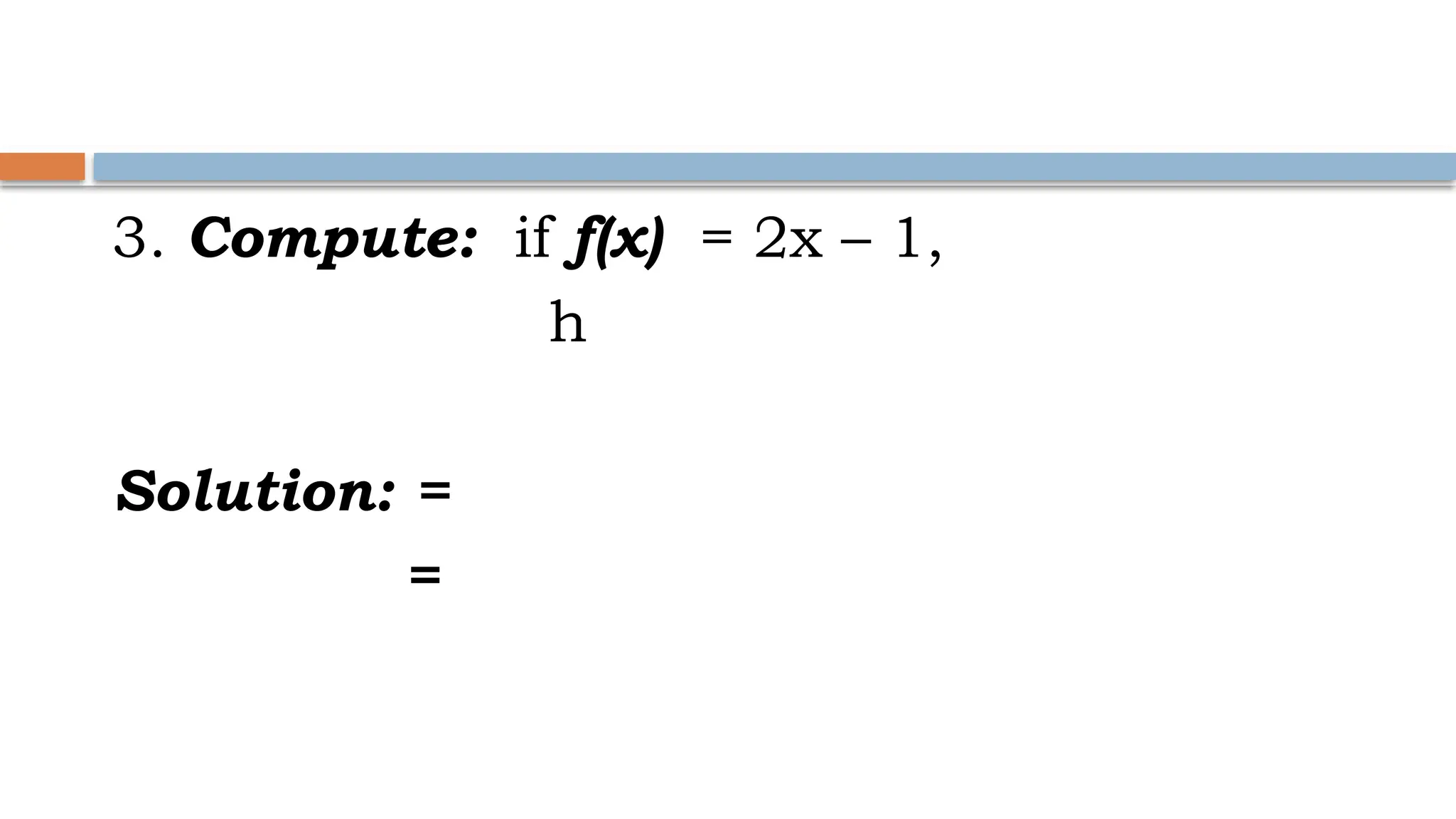
3. Compute: if f(x) = 2x – 1,
h
Solution: =
=
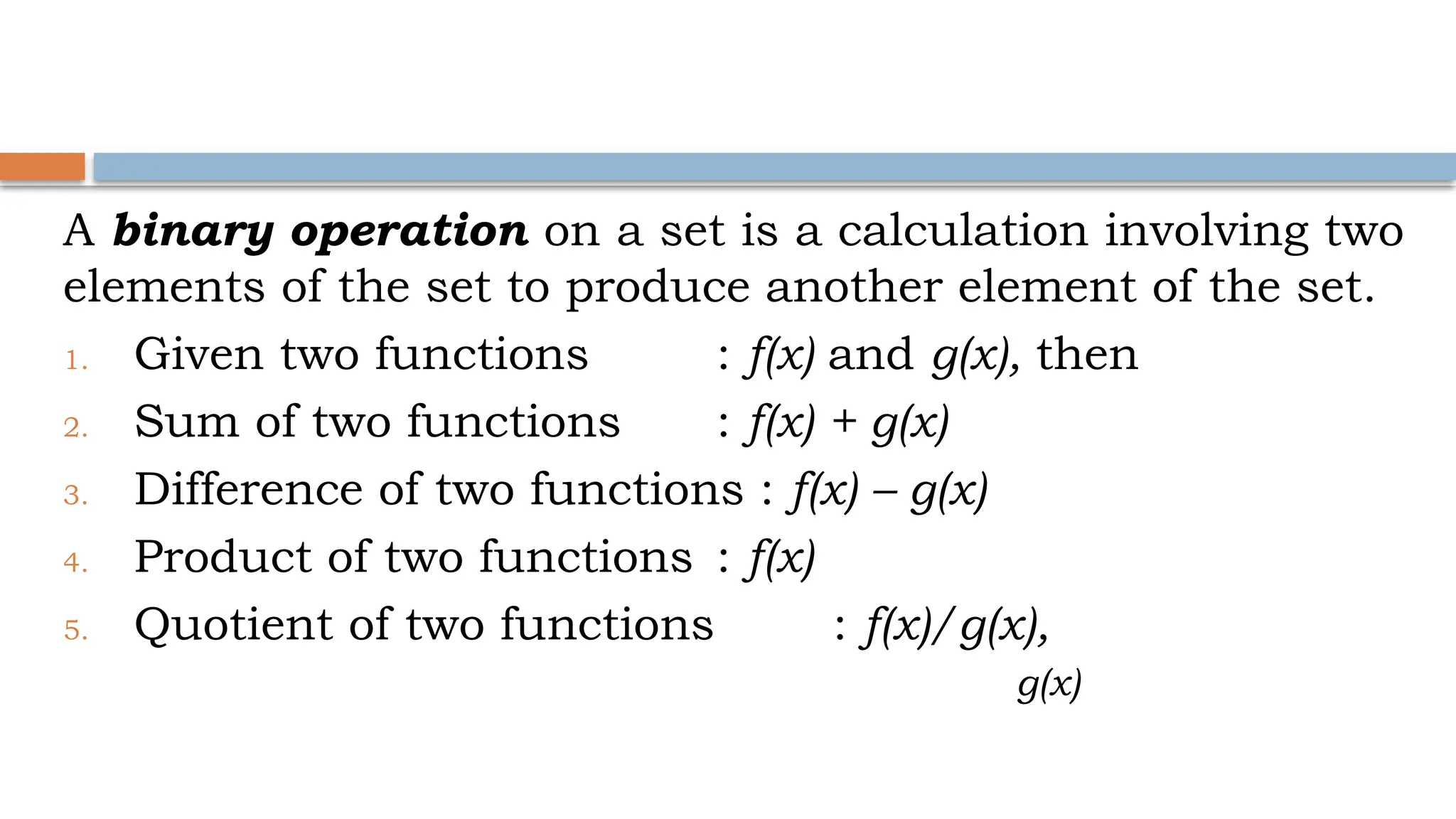
A binary operation on a set is a calculation involving two
elements of the set to produce another element of the set.
1. Given two functions : f(x) and g(x), then
2. Sum of two functions : f(x) + g(x)
3. Difference of two functions : f(x) – g(x)
4. Product of two functions : f(x)
5. Quotient of two functions : f(x)/g(x),
g(x)
Operations with Functions
We can add, subtract,
multiply and divide
functions!
The result is a new
function.
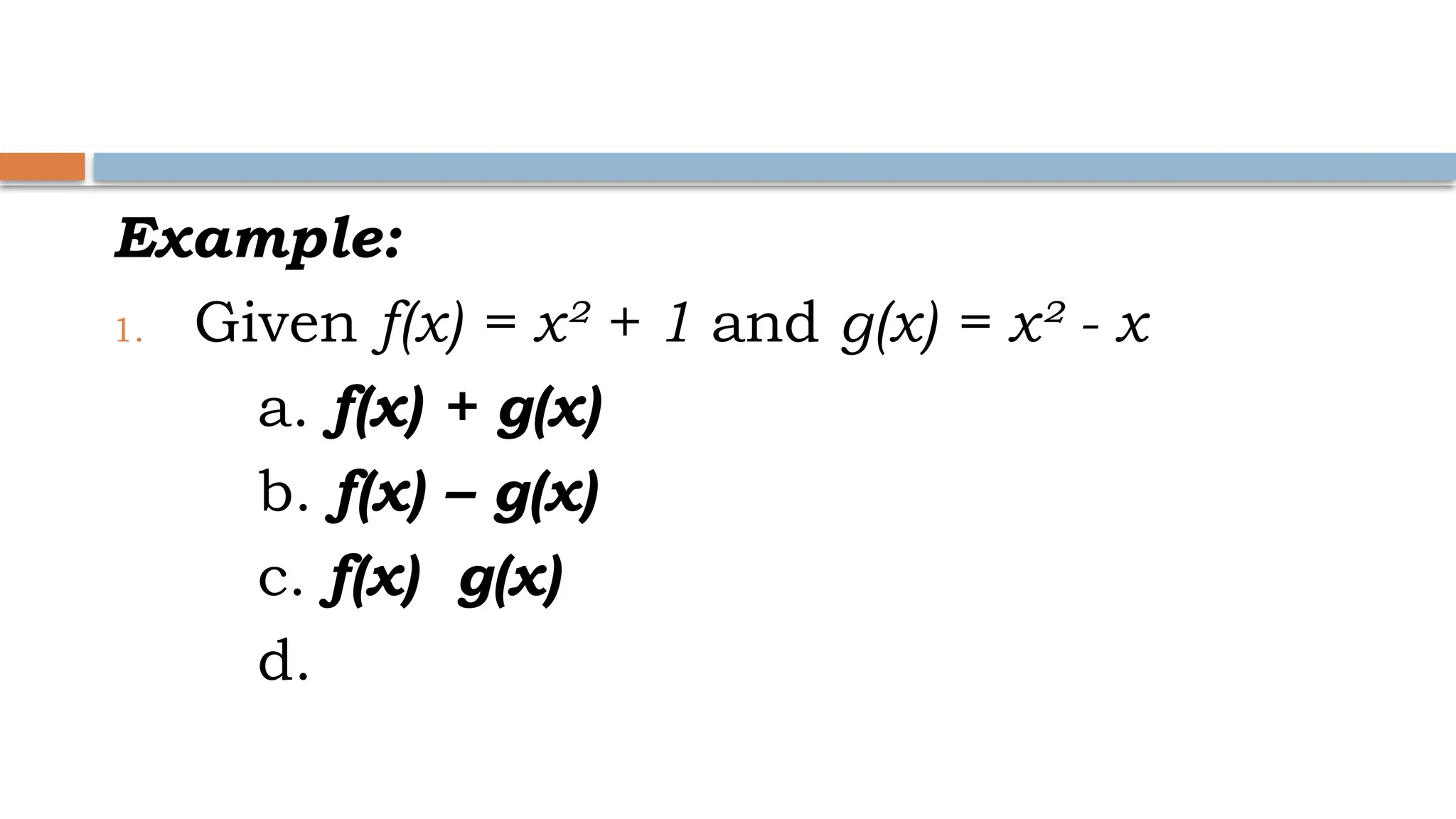
Example:
1. Given f(x) = x² + 1 and g(x) = x² - x
a. f(x) + g(x)
b. f(x) – g(x)
c. f(x) g(x)
d.
Solution:
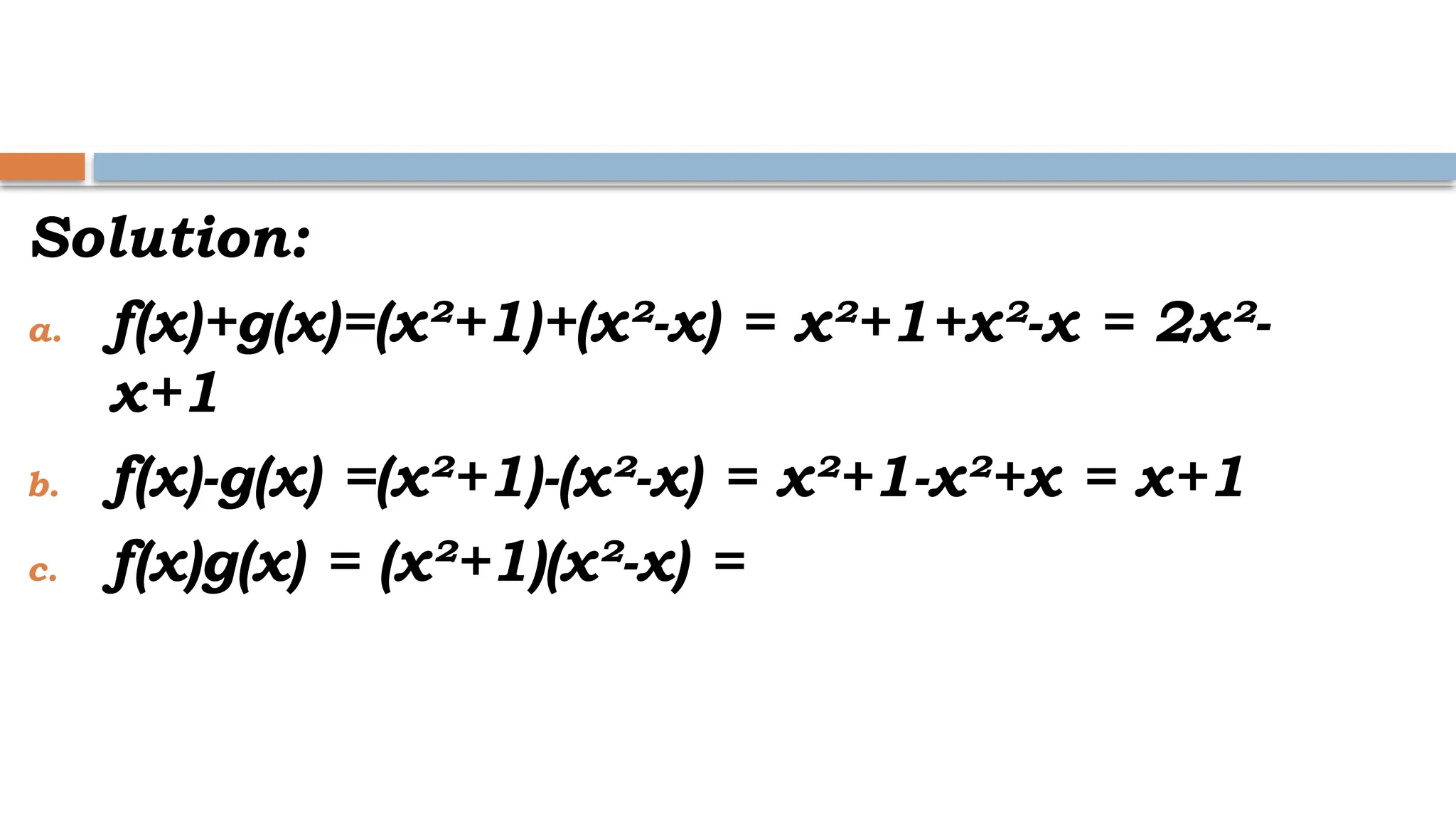
a. f(x)+g(x)=(x²+1)+(x²-x) = x²+1+x²-x = 2x²-
x+1
b. f(x)-g(x) =(x²+1)-(x²-x) = x²+1-x²+x = x+1
c. f(x)g(x) = (x²+1)(x²-x) =
Addition of Function
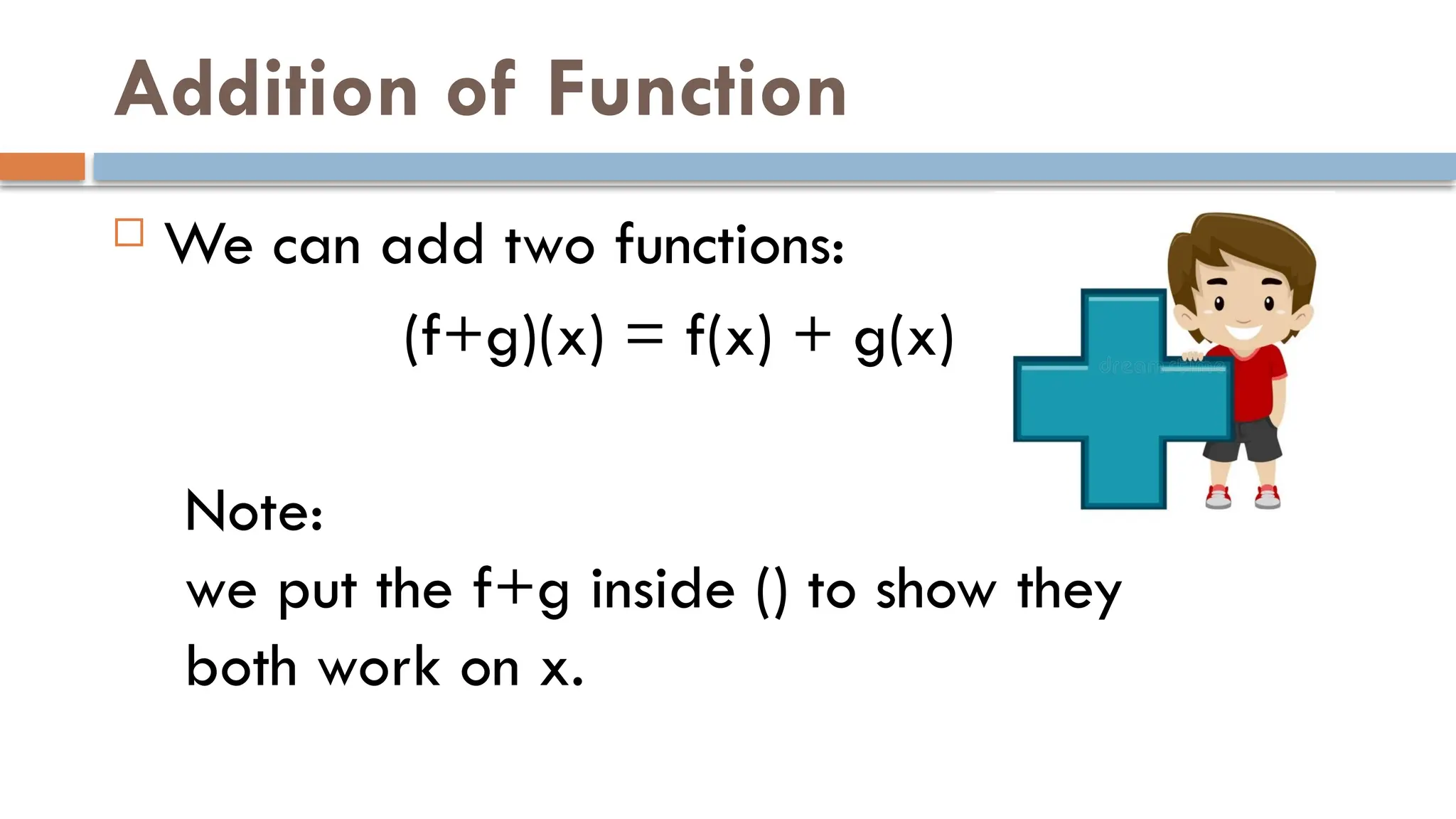
 We can add two functions:
(f+g)(x) = f(x) + g(x)
Note:
we put the f+g inside () to show they
both work on x.
Example 1
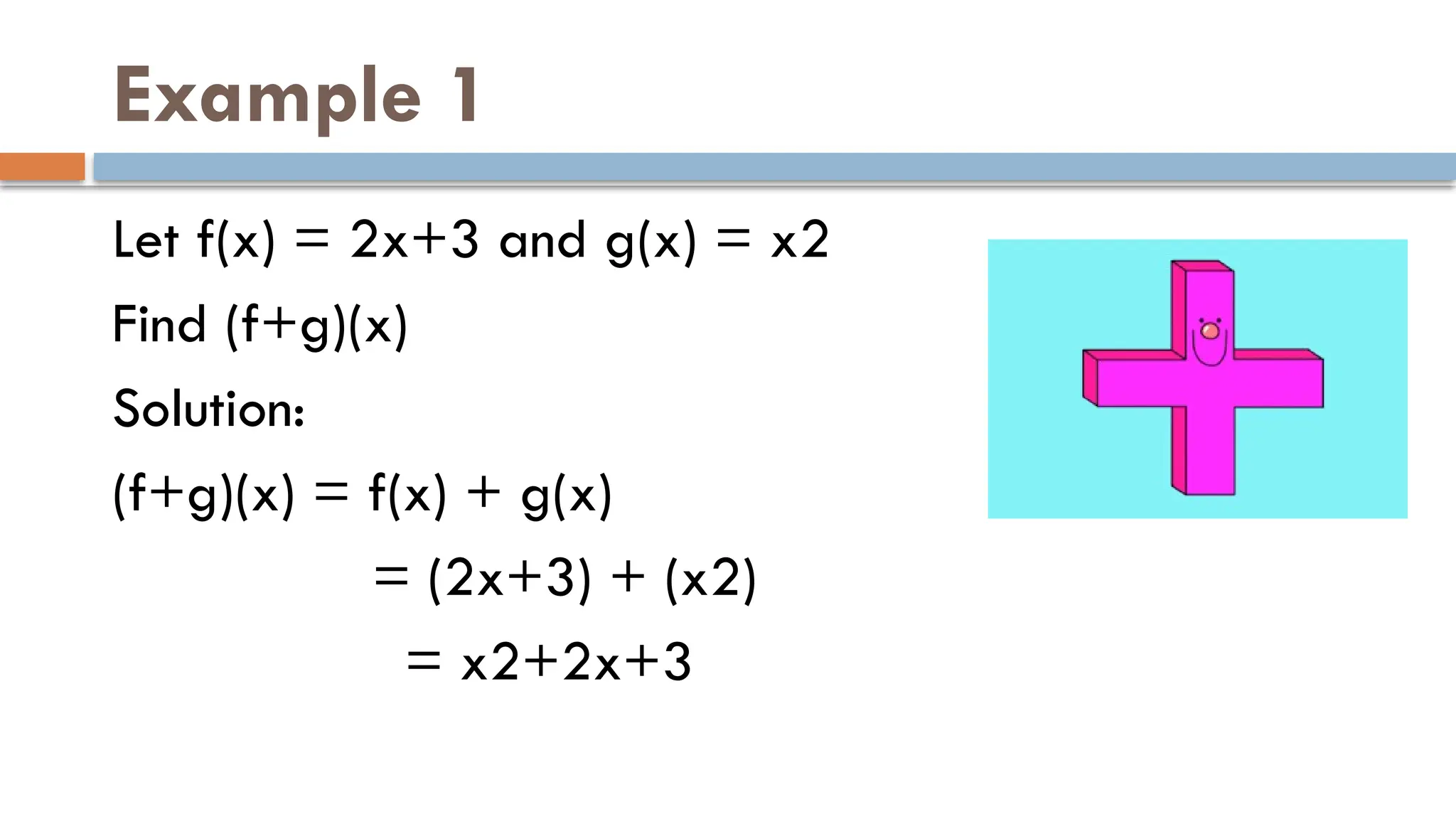
Let f(x) = 2x+3 and g(x) = x2
Find (f+g)(x)
Solution:
(f+g)(x) = f(x) + g(x)
= (2x+3) + (x2)
= x2+2x+3
Example 2
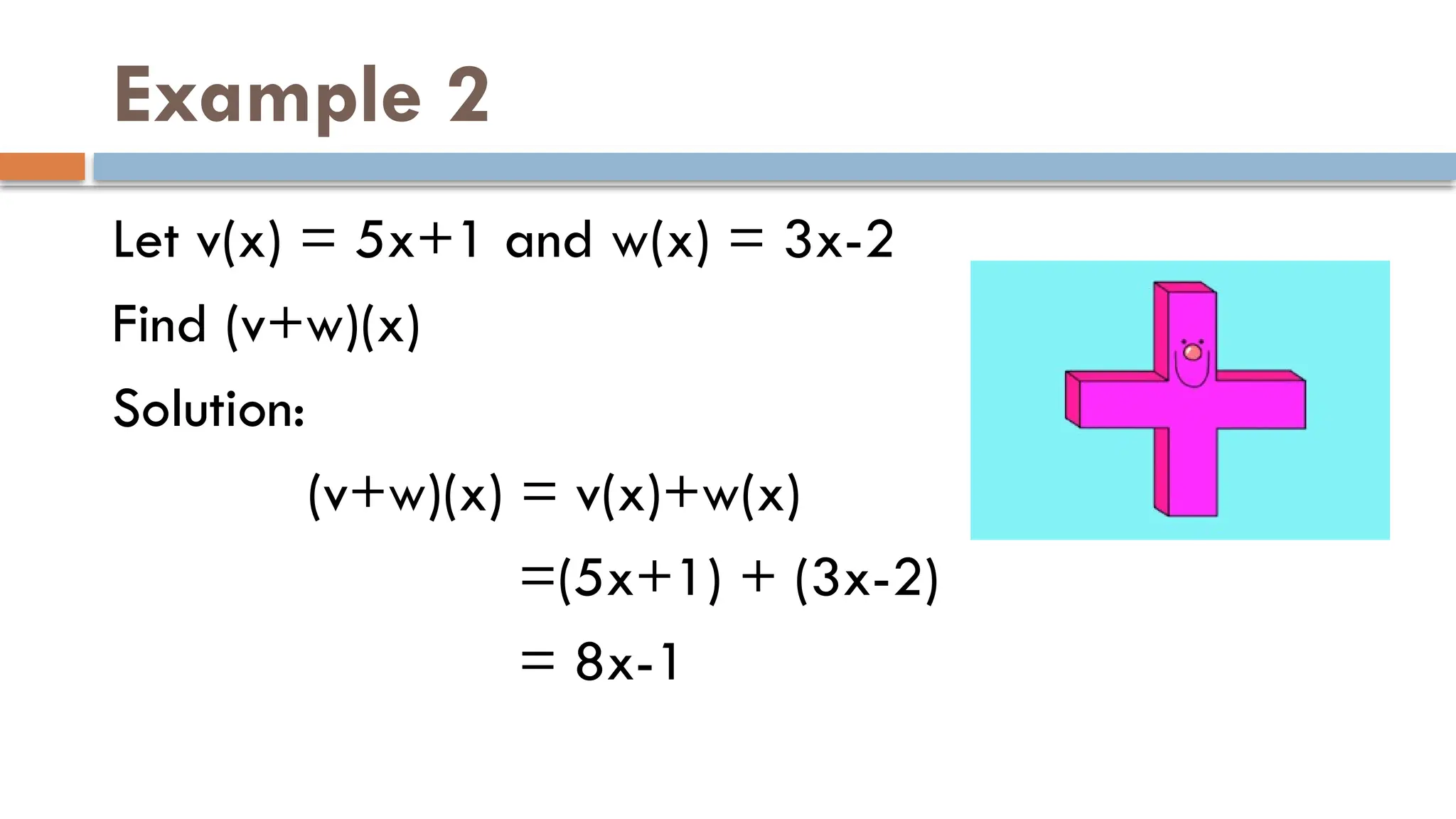
Let v(x) = 5x+1 and w(x) = 3x-2
Find (v+w)(x)
Solution:
(v+w)(x) = v(x)+w(x)
=(5x+1) + (3x-2)
= 8x-1
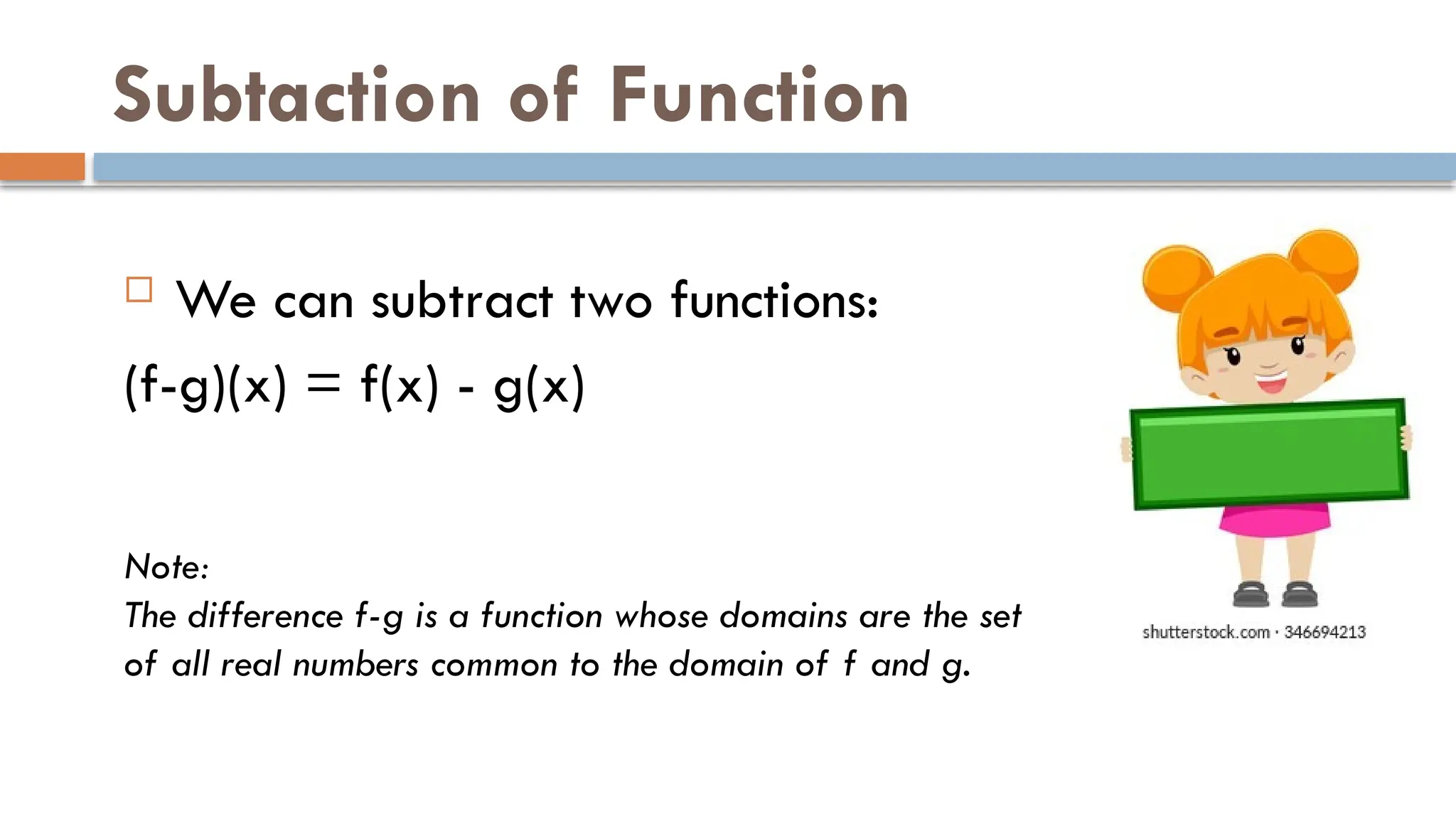
Subtaction of Function
 We can subtract two functions:
(f-g)(x) = f(x) - g(x)
Note:
The difference f-g is a function whose domains are the set
of all real numbers common to the domain of f and g.
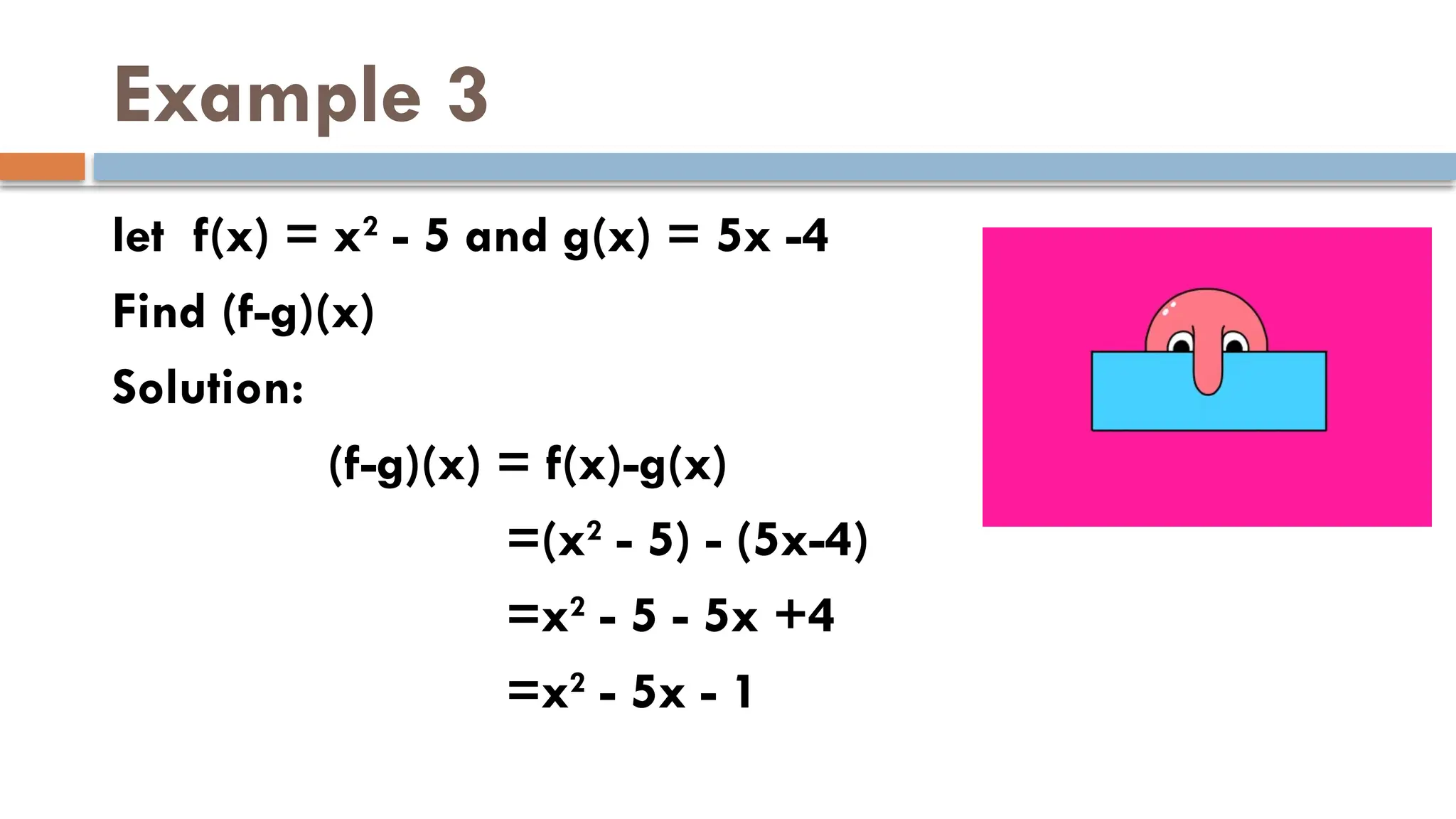
Example 3
let f(x) = x2
- 5 and g(x) = 5x -4
Find (f-g)(x)
Solution:
(f-g)(x) = f(x)-g(x)
=(x2
- 5) - (5x-4)
=x2
- 5 - 5x +4
=x2
- 5x - 1
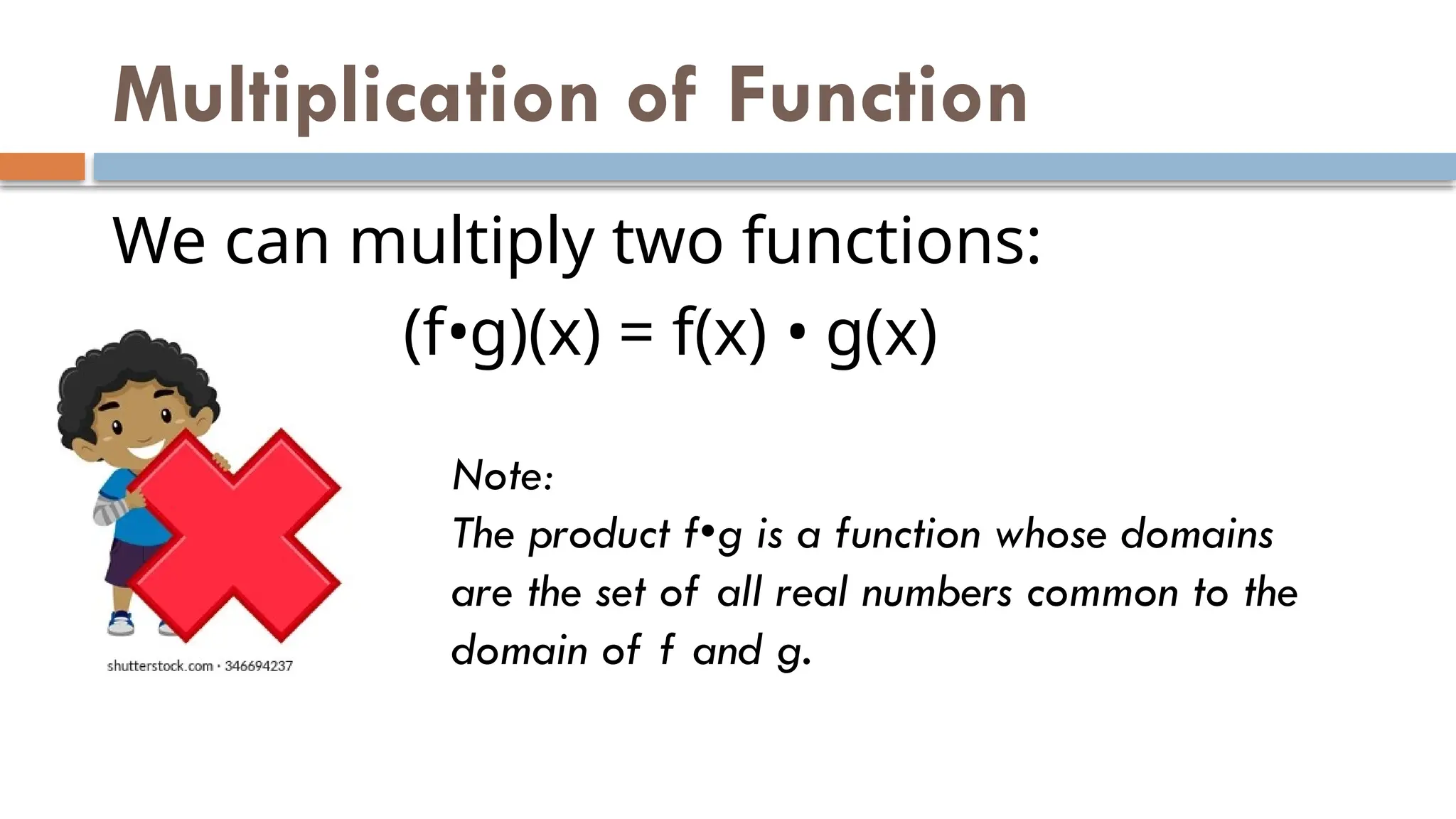
Multiplication of Function
We can multiply two functions:
(f•g)(x) = f(x) • g(x)
Note:
The product f•g is a function whose domains
are the set of all real numbers common to the
domain of f and g.
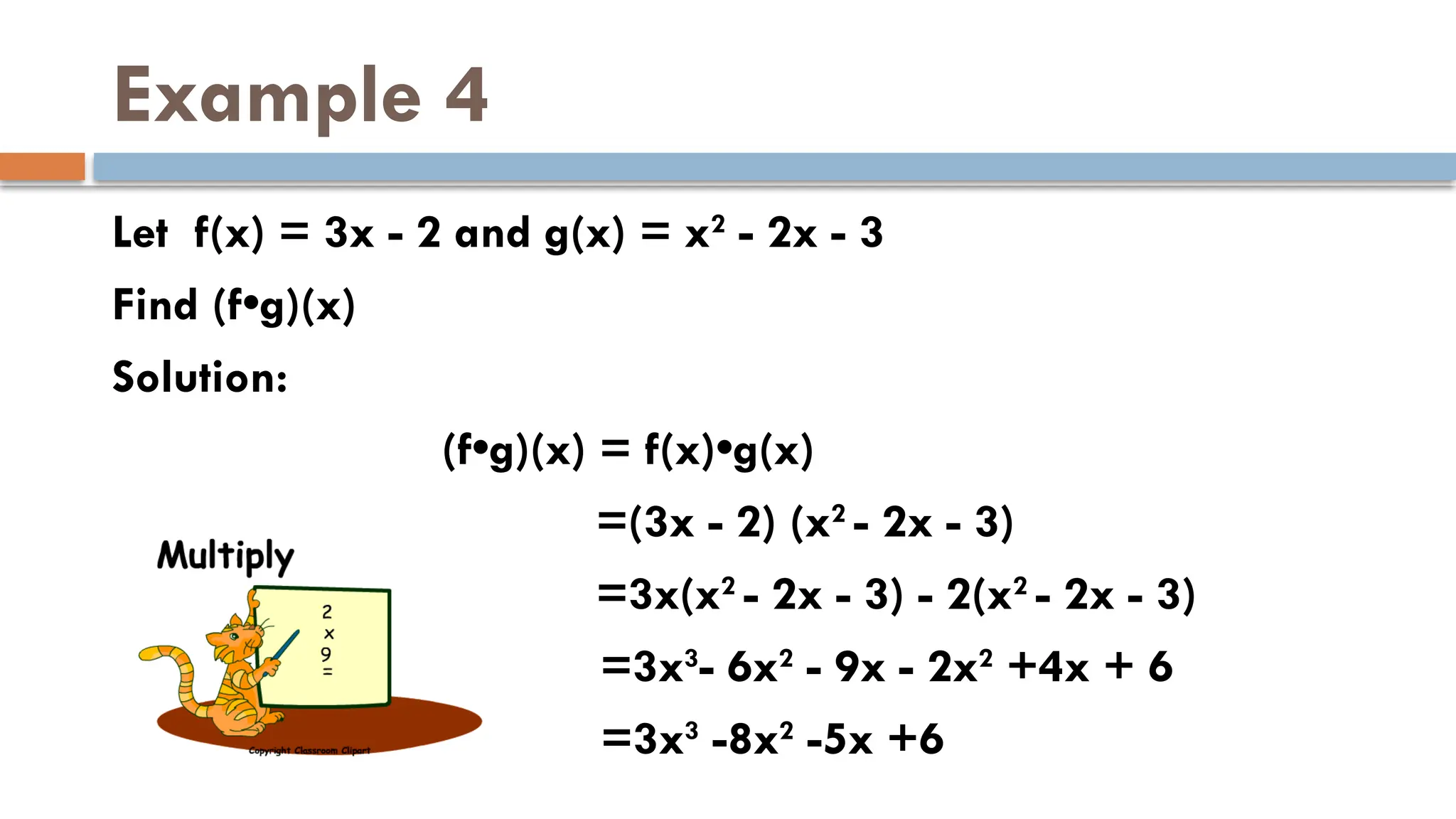
Example 4
Let f(x) = 3x - 2 and g(x) = x2
- 2x - 3
Find (f•g)(x)
Solution:
(f•g)(x) = f(x)•g(x)
=(3x - 2) (x2
- 2x - 3)
=3x(x2
- 2x - 3) - 2(x2
- 2x - 3)
=3x3
- 6x2
- 9x - 2x2
+4x + 6
=3x3
-8x2
-5x +6
Division of Function
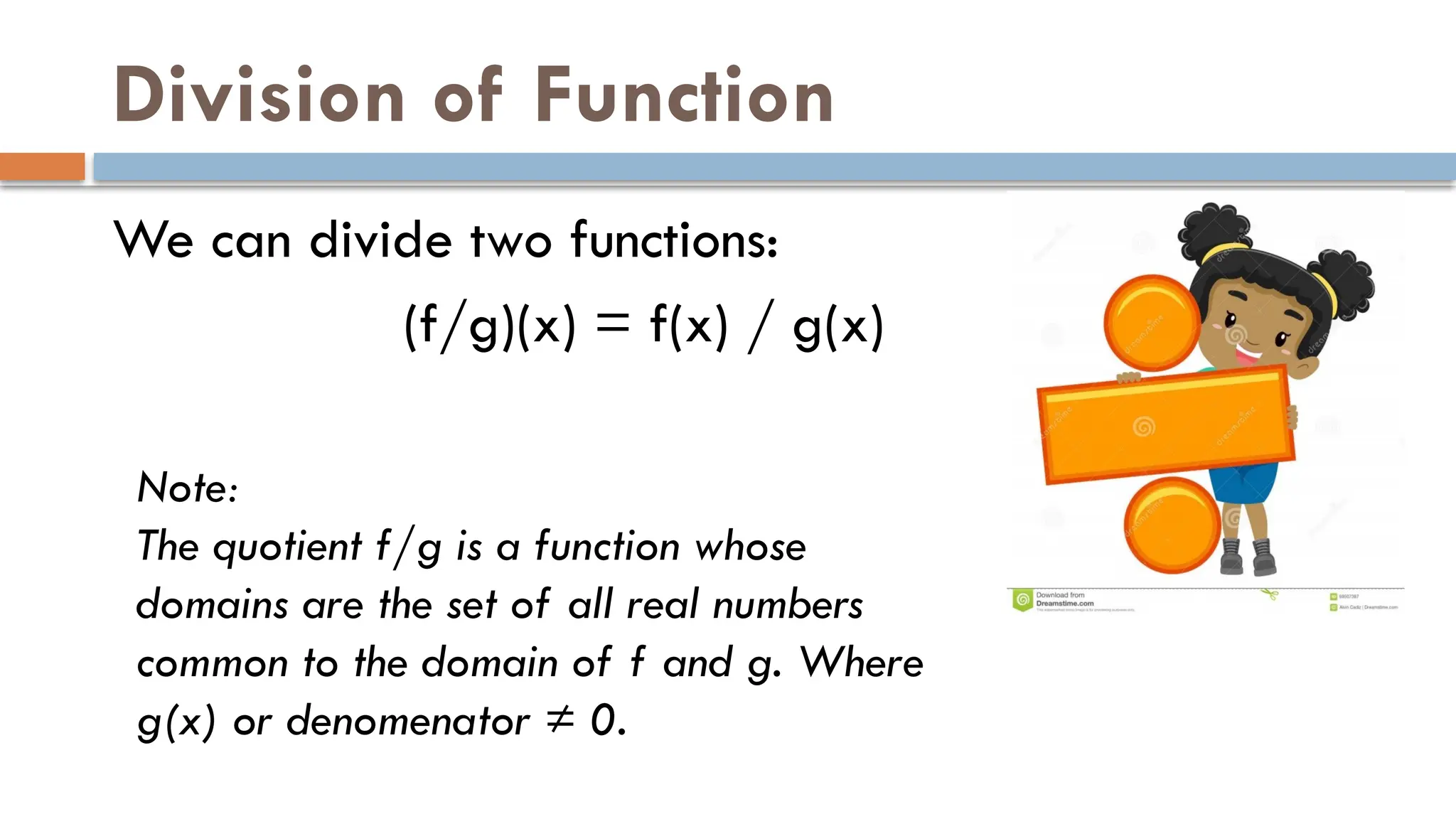
We can divide two functions:
(f/g)(x) = f(x) / g(x)
Note:
The quotient f/g is a function whose
domains are the set of all real numbers
common to the domain of f and g. Where
g(x) or denomenator ≠ 0.
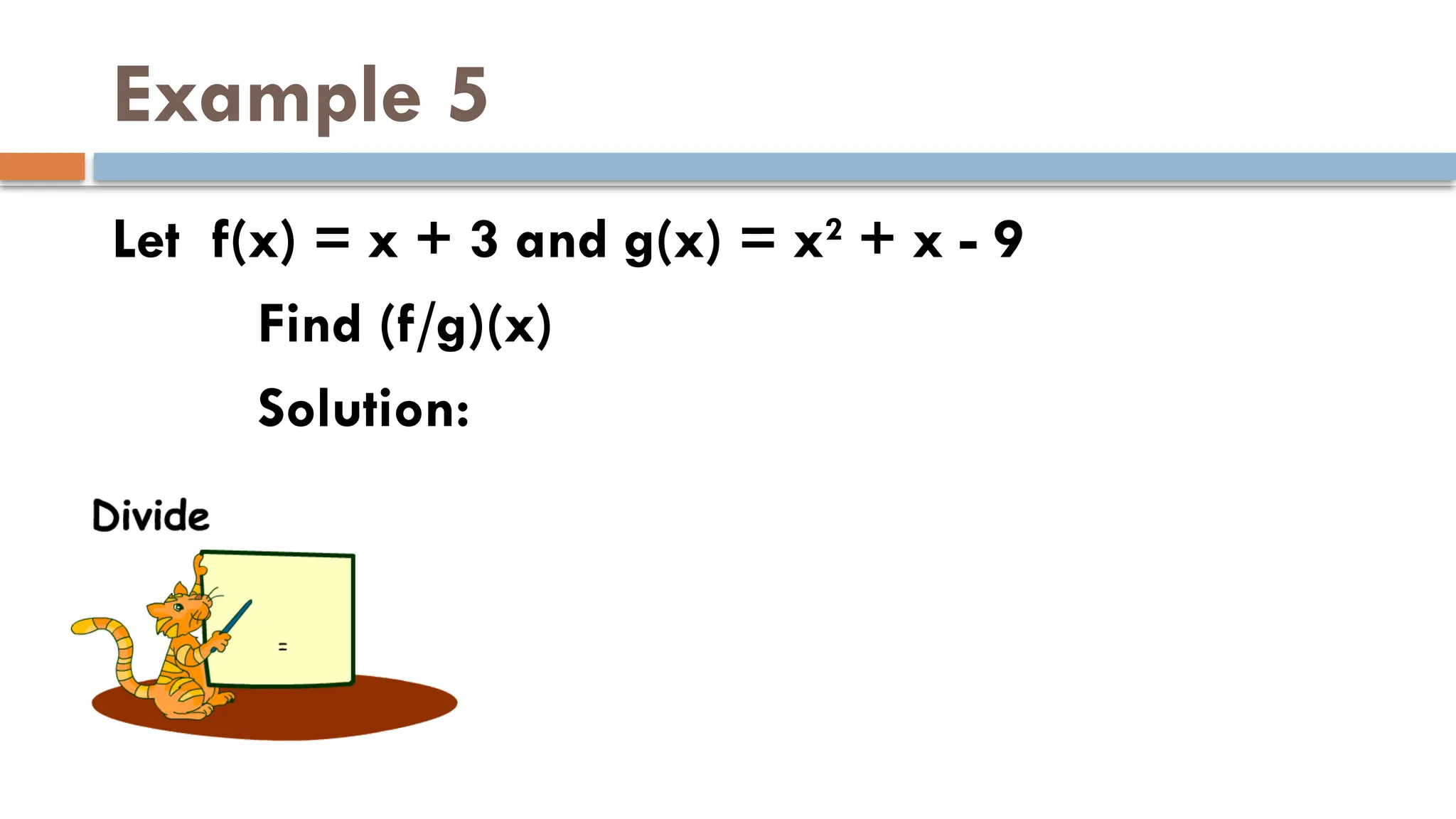
Example 5
Let f(x) = x + 3 and g(x) = x2
+ x - 9
Find (f/g)(x)
Solution:
ACTIVITY 3!
Q: Sir kanus-a ipass?
A: I-pass ni siya dungan sa
midterm napod nga activities
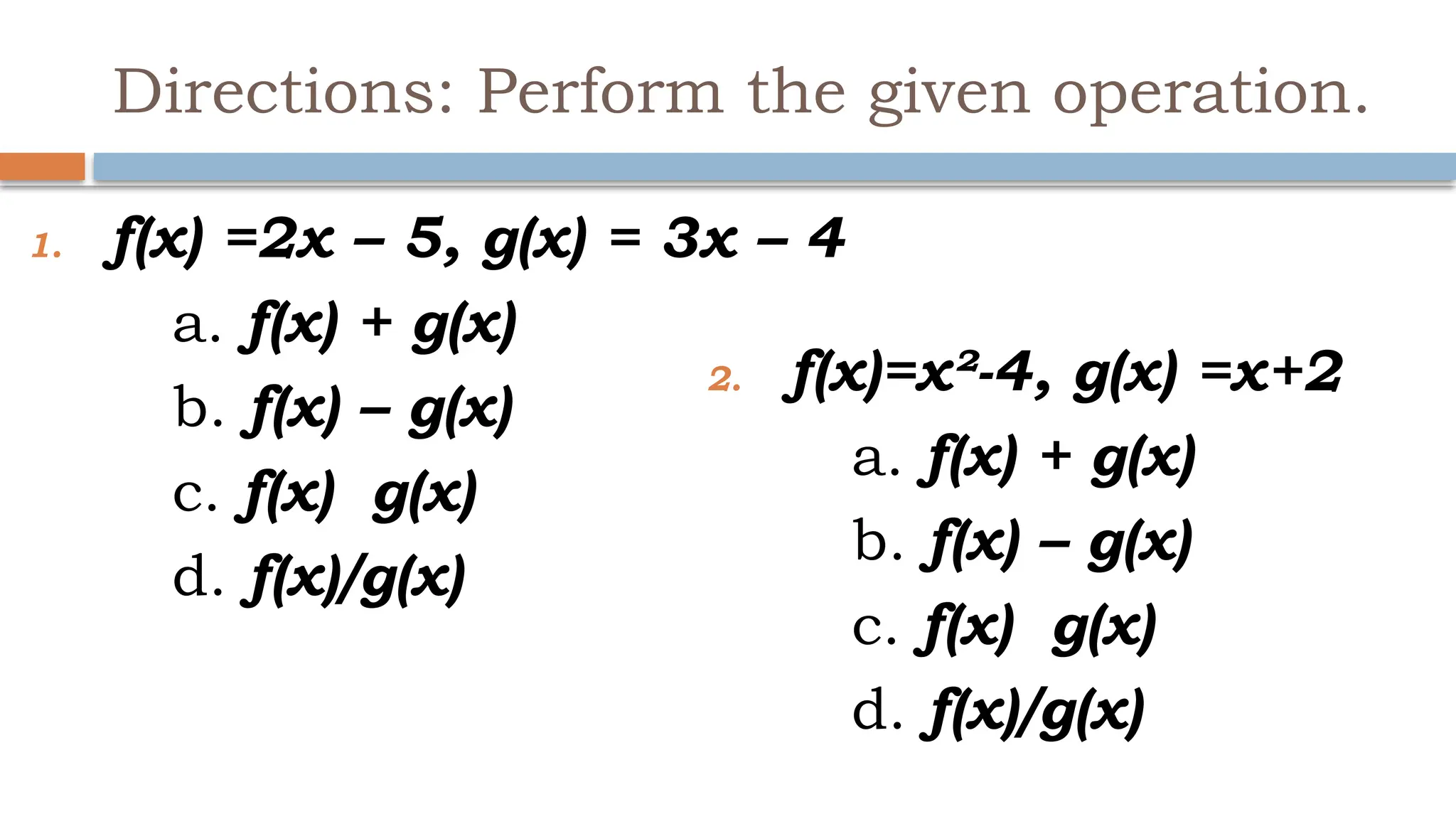
Directions: Perform the given operation.
1. f(x) =2x – 5, g(x) = 3x – 4
a. f(x) + g(x)
b. f(x) – g(x)
c. f(x) g(x)
d. f(x)/g(x)
2. f(x)=x²-4, g(x) =x+2
a. f(x) + g(x)
b. f(x) – g(x)
c. f(x) g(x)
d. f(x)/g(x)
BINARY-OPERATION and OPERATION OF FUNCTION.pptx

BINARY-OPERATION and OPERATION OF FUNCTION.pptx

  • 1.
  • 2.
     A binaryoperation *in a set S is a way of assigning every ordered pair of elements, a and b, from the set, a unique response called c, where c is also from the set S. a * b = c First element from the set operation Second element from the set Unique response from the set
  • 3.
     Binary operationsinclude addition, subtraction, multiplication and division.  The value of f(x) is obtained upon assigning a specific value for x. The variable x represents the independent variable and y represents the dependent variable.
  • 4.
     Given y=f(x)and let a be in the domain of f . Then f(a) represents the second element in the pair of defining f, or the value of the function at x = a. The value of f(a) is obtained by replacing x by a in f(x).
  • 6.
    1. Let f(x)= 2x³ - 3x² - 5x + 2. Find: a. f(1) b. (-1) c. f(-3)
  • 7.
    Solutions: a. f(1) =2(1)³-3(1)²-5(1)+2 = -4 b. f(-1) = 2(-1)³-3(-1)²-5(-1)+2 = 2 c. f(-3) = 2(-3)³-3(-3)²-5(-3) +2 = -64
  • 8.
    2. Let f(x)= Find: a. f(2) b. f c. f(b)
  • 9.
  • 10.
    3. Compute: iff(x) = 2x – 1, h Solution: = =
  • 11.
    A binary operationon a set is a calculation involving two elements of the set to produce another element of the set. 1. Given two functions : f(x) and g(x), then 2. Sum of two functions : f(x) + g(x) 3. Difference of two functions : f(x) – g(x) 4. Product of two functions : f(x) 5. Quotient of two functions : f(x)/g(x), g(x)
  • 12.
    Operations with Functions Wecan add, subtract, multiply and divide functions! The result is a new function.
  • 13.
    Example: 1. Given f(x)= x² + 1 and g(x) = x² - x a. f(x) + g(x) b. f(x) – g(x) c. f(x) g(x) d.
  • 14.
    Solution: a. f(x)+g(x)=(x²+1)+(x²-x) =x²+1+x²-x = 2x²- x+1 b. f(x)-g(x) =(x²+1)-(x²-x) = x²+1-x²+x = x+1 c. f(x)g(x) = (x²+1)(x²-x) =
  • 15.
    Addition of Function We can add two functions: (f+g)(x) = f(x) + g(x) Note: we put the f+g inside () to show they both work on x.
  • 16.
    Example 1 Let f(x)= 2x+3 and g(x) = x2 Find (f+g)(x) Solution: (f+g)(x) = f(x) + g(x) = (2x+3) + (x2) = x2+2x+3
  • 17.
    Example 2 Let v(x)= 5x+1 and w(x) = 3x-2 Find (v+w)(x) Solution: (v+w)(x) = v(x)+w(x) =(5x+1) + (3x-2) = 8x-1
  • 18.
    Subtaction of Function We can subtract two functions: (f-g)(x) = f(x) - g(x) Note: The difference f-g is a function whose domains are the set of all real numbers common to the domain of f and g.
  • 19.
    Example 3 let f(x)= x2 - 5 and g(x) = 5x -4 Find (f-g)(x) Solution: (f-g)(x) = f(x)-g(x) =(x2 - 5) - (5x-4) =x2 - 5 - 5x +4 =x2 - 5x - 1
  • 20.
    Multiplication of Function Wecan multiply two functions: (f•g)(x) = f(x) • g(x) Note: The product f•g is a function whose domains are the set of all real numbers common to the domain of f and g.
  • 21.
    Example 4 Let f(x)= 3x - 2 and g(x) = x2 - 2x - 3 Find (f•g)(x) Solution: (f•g)(x) = f(x)•g(x) =(3x - 2) (x2 - 2x - 3) =3x(x2 - 2x - 3) - 2(x2 - 2x - 3) =3x3 - 6x2 - 9x - 2x2 +4x + 6 =3x3 -8x2 -5x +6
  • 22.
    Division of Function Wecan divide two functions: (f/g)(x) = f(x) / g(x) Note: The quotient f/g is a function whose domains are the set of all real numbers common to the domain of f and g. Where g(x) or denomenator ≠ 0.
  • 23.
    Example 5 Let f(x)= x + 3 and g(x) = x2 + x - 9 Find (f/g)(x) Solution:
  • 24.
    ACTIVITY 3! Q: Sirkanus-a ipass? A: I-pass ni siya dungan sa midterm napod nga activities
  • 25.
    Directions: Perform thegiven operation. 1. f(x) =2x – 5, g(x) = 3x – 4 a. f(x) + g(x) b. f(x) – g(x) c. f(x) g(x) d. f(x)/g(x) 2. f(x)=x²-4, g(x) =x+2 a. f(x) + g(x) b. f(x) – g(x) c. f(x) g(x) d. f(x)/g(x)