B nar y
 i
    In 1854, British mathematician
   George Boole published a paper
 detailing a system of logic that would
 become known as Boolean algebra.

His logical system proved instrumental
   in the development of the binary
        system, particularly in its
implementation in electronic circuitry.
B nar y
 i
A numbering systems that only uses
         two digits. 0 and 1.
Rather than a base ten that we are all
            familiar with.
   Computers use binary to store
   information in a digital format.

 Each digit ( 0 or 1) represents one bit
   Eight bits are equal to one byte.
Bt
 i

 One Binary Digit
 abbreviation is “b”


Can be thought of as one character
     Either a 1 or a 0
B e
 yt

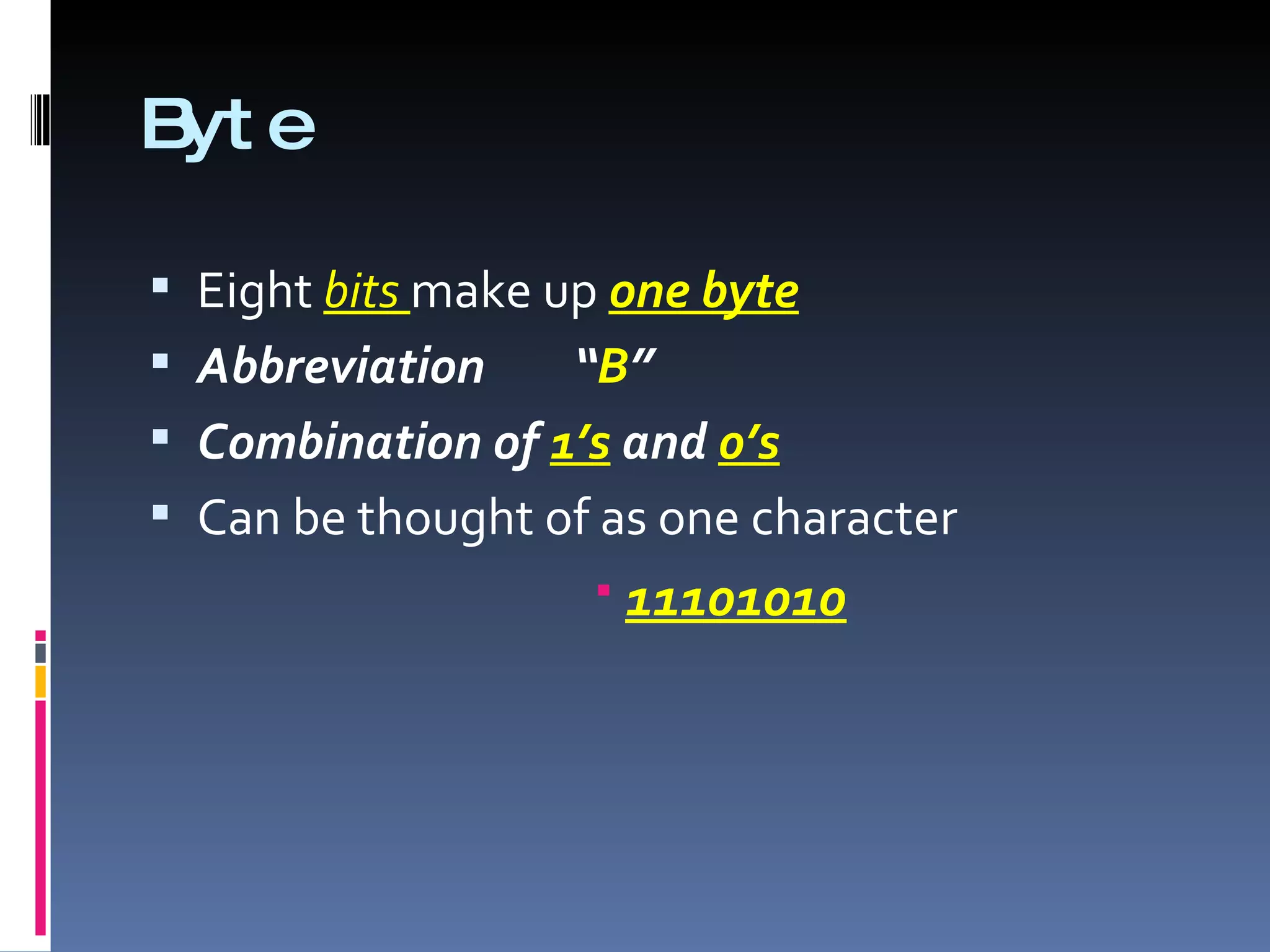
 Eight bits make up one byte
 Abbreviation     “B”
 Combination of 1’s and 0’s
 Can be thought of as one character
                    11101010
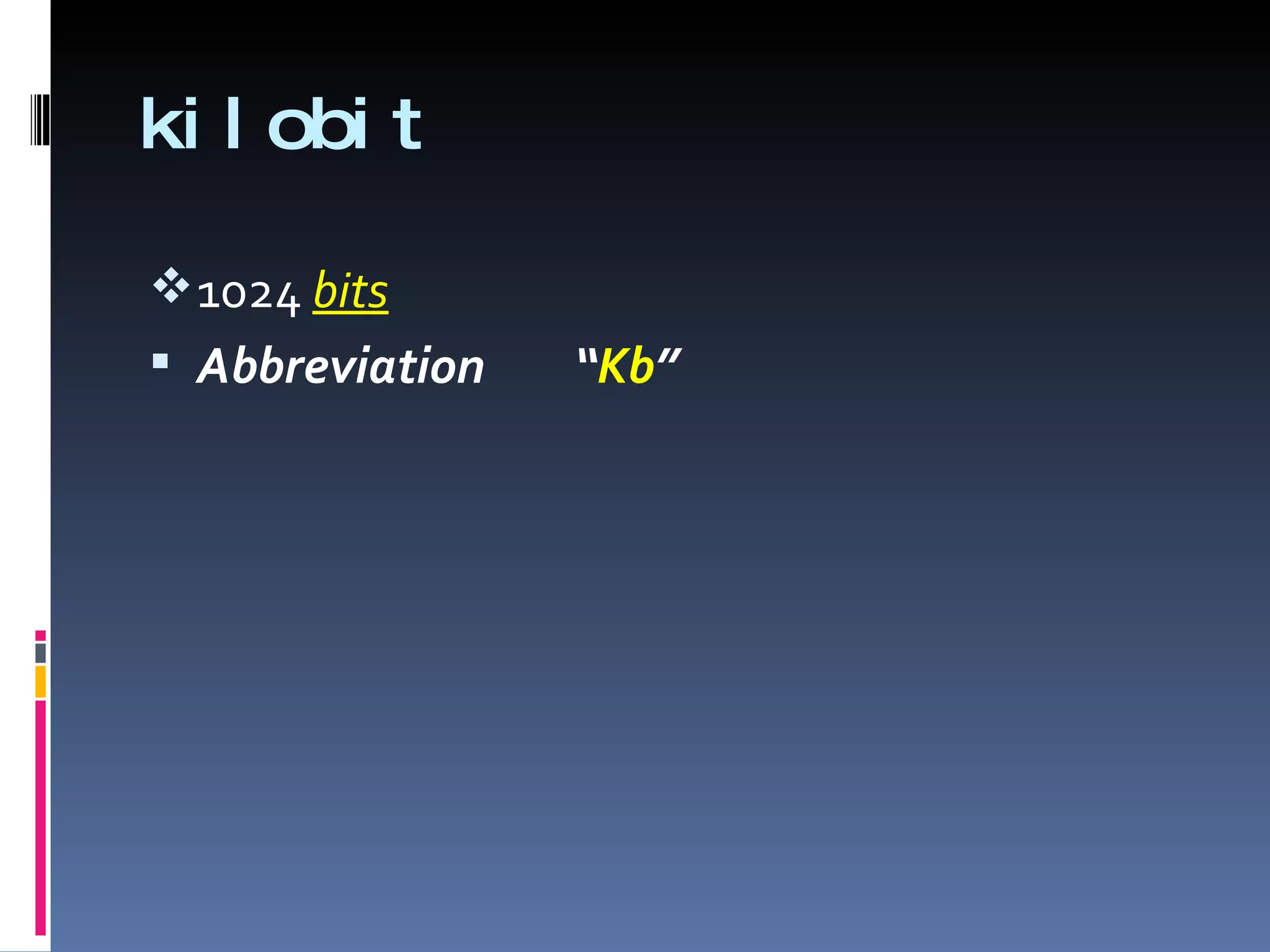
ki l obi t

 1024 bits
 Abbreviation   “Kb”
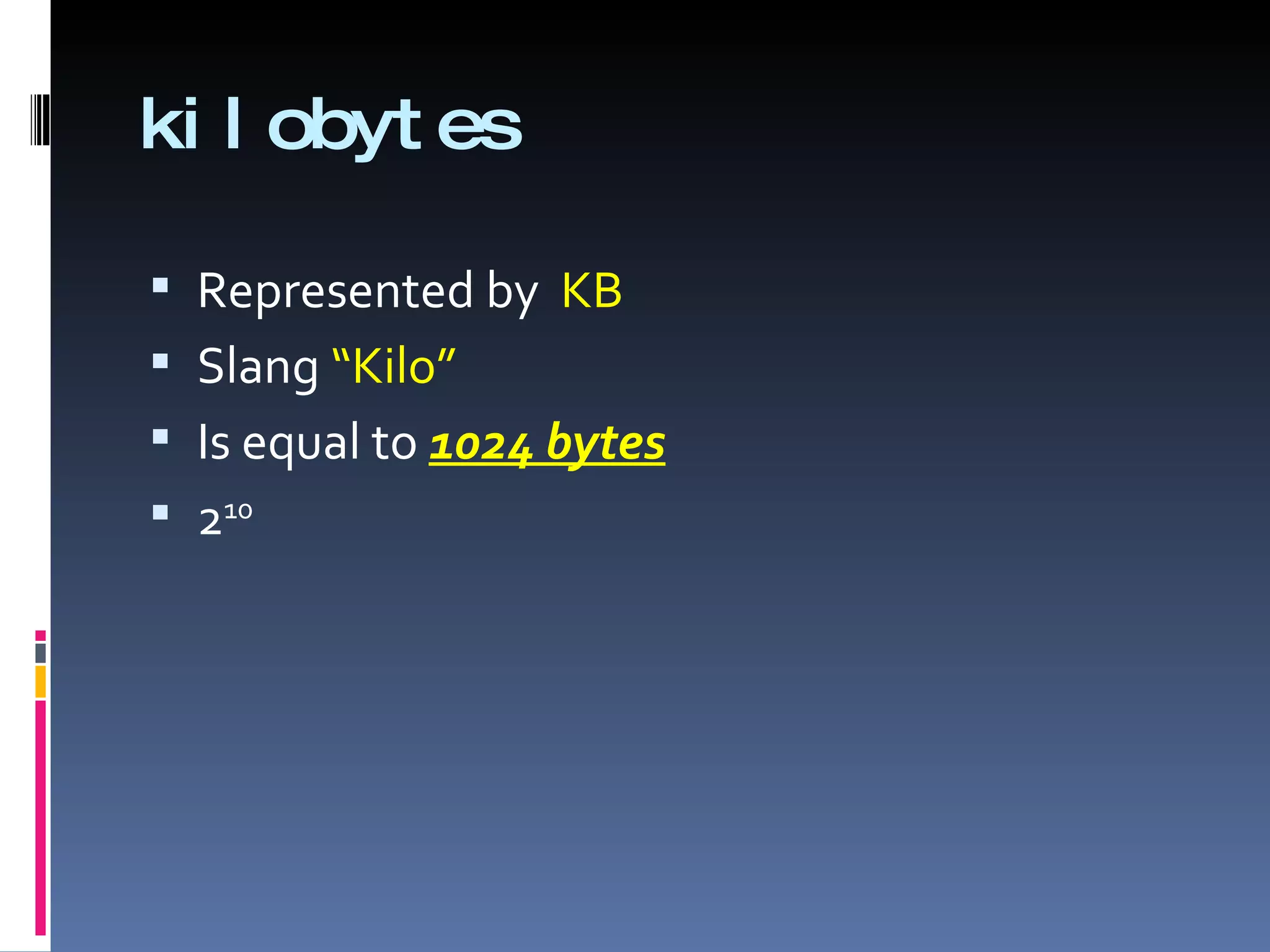
ki l obyt es

 Represented by KB
 Slang “Kilo”
 Is equal to 1024 bytes
 210
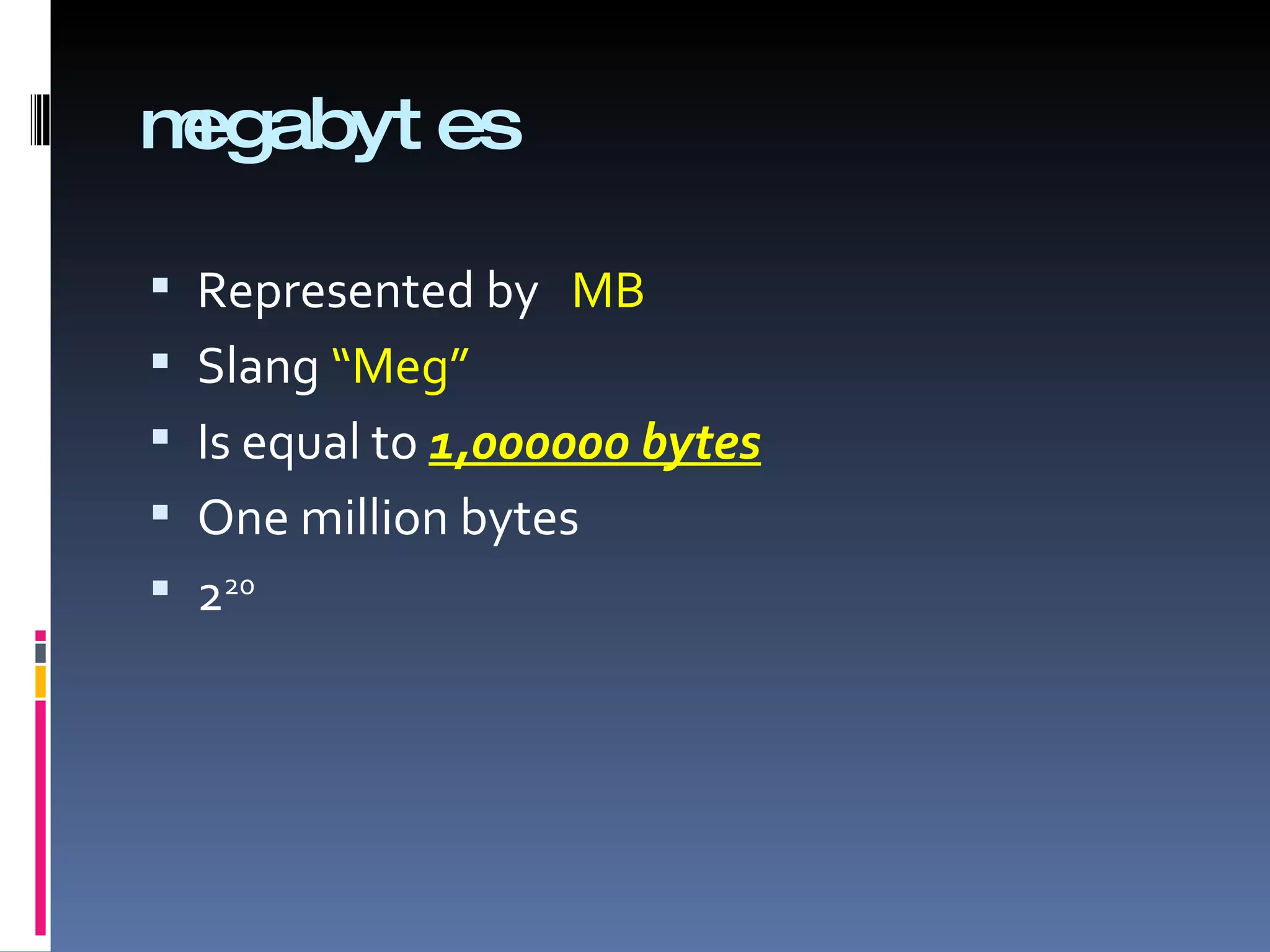
megabyt es

 Represented by MB
 Slang “Meg”
 Is equal to 1,000000 bytes
 One million bytes
 220
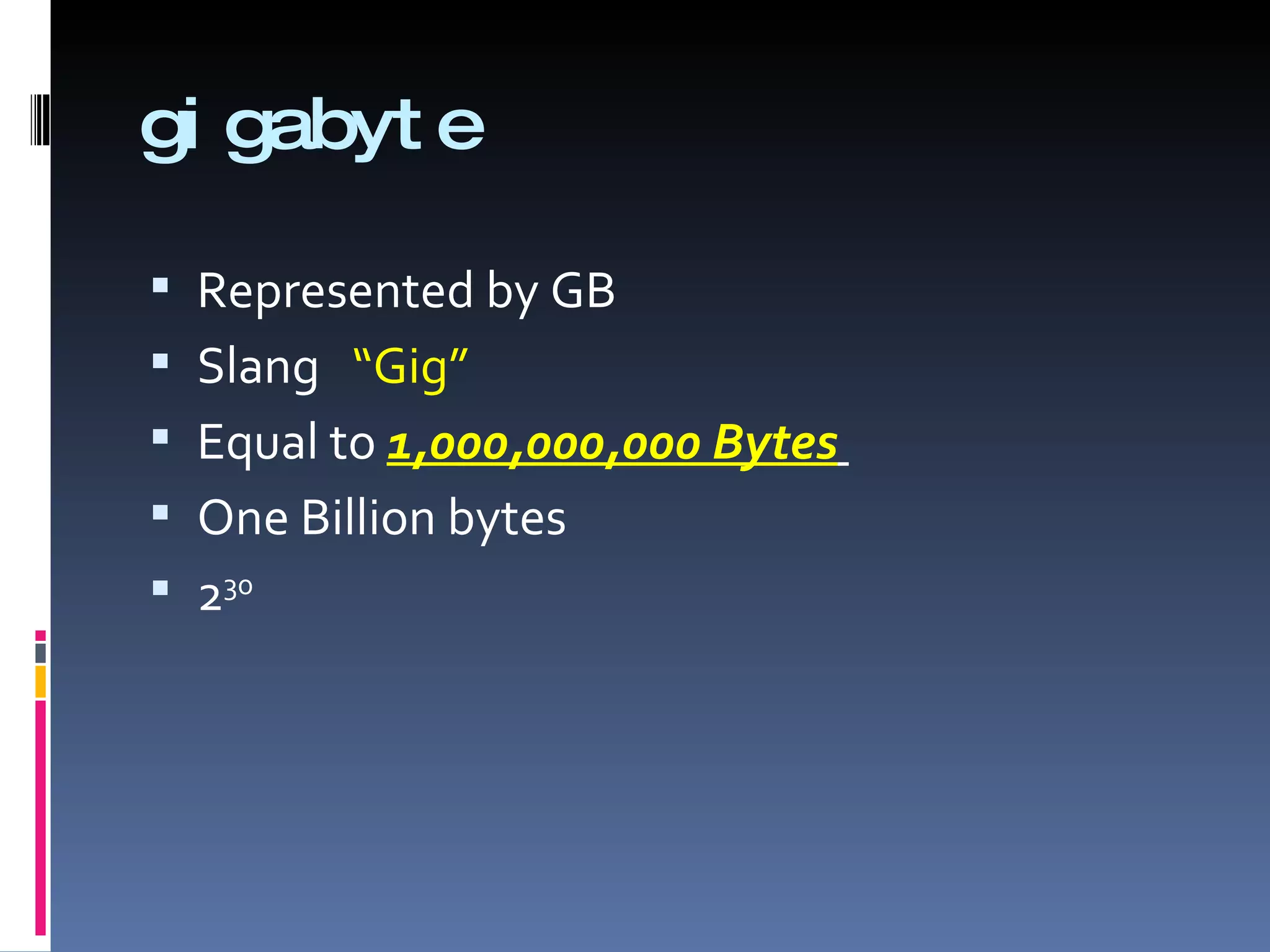
gi gabyt e

 Represented by GB
 Slang “Gig”
 Equal to 1,000,000,000 Bytes
 One Billion bytes
 230
t er abyt e

 Represented by TB
 Slang “tera”
 Equal to 1,000,000,000,000 Bytes
 One Trillion bytes
 240
pet abyt e

 Represented by PB
 Slang “peta”
 Equal to 1,000,000,000,000,000 Bytes
 One Thousand Trillion bytes
 250
exabyt e

   Represented by EB
   Slang “exa”
   Equal to 1,000,000,000,000,000,000 Bytes
   One Million Trillion bytes
   260
   All printed materialin the world
                                       would use about 5   Exabytes
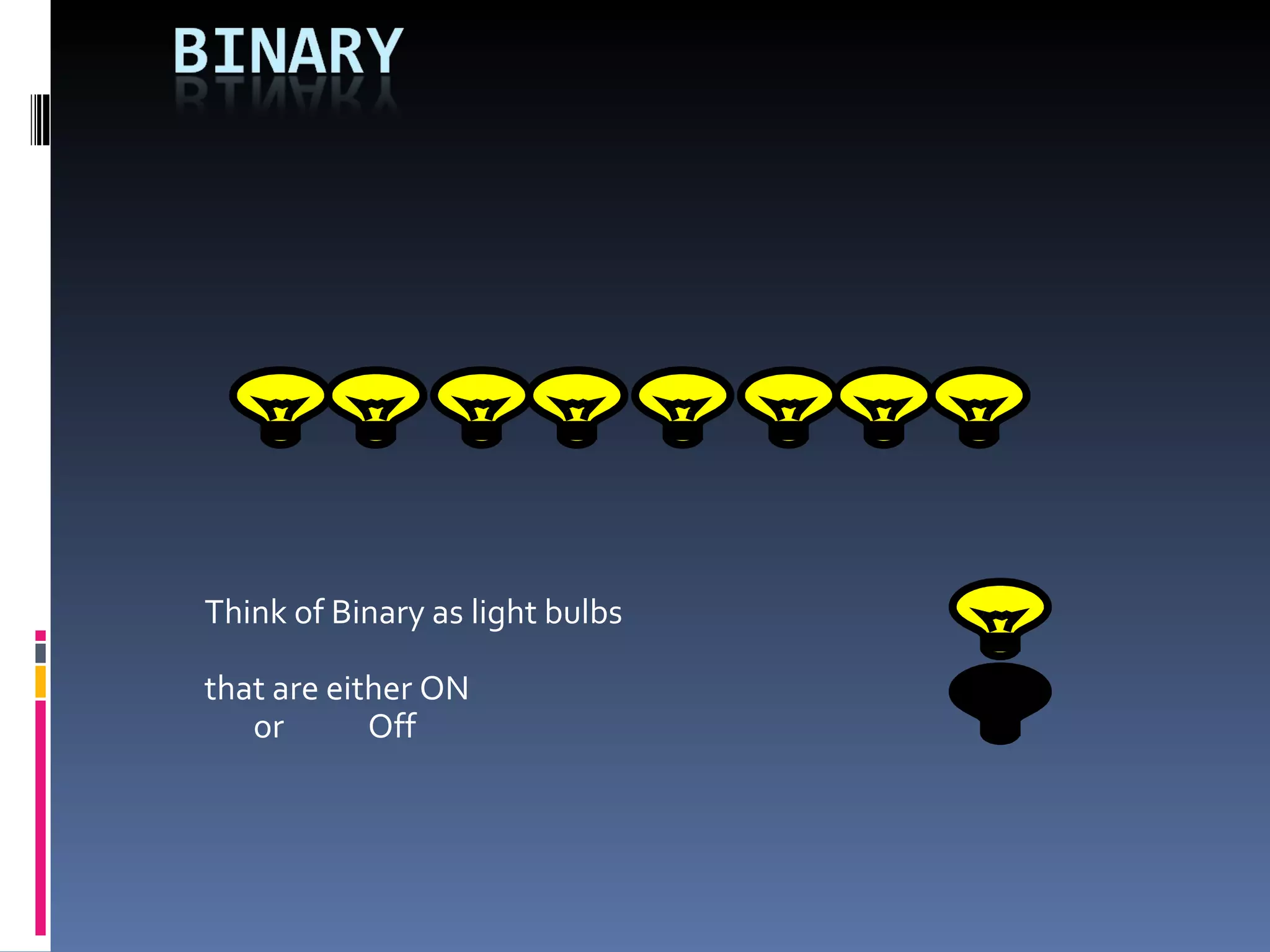
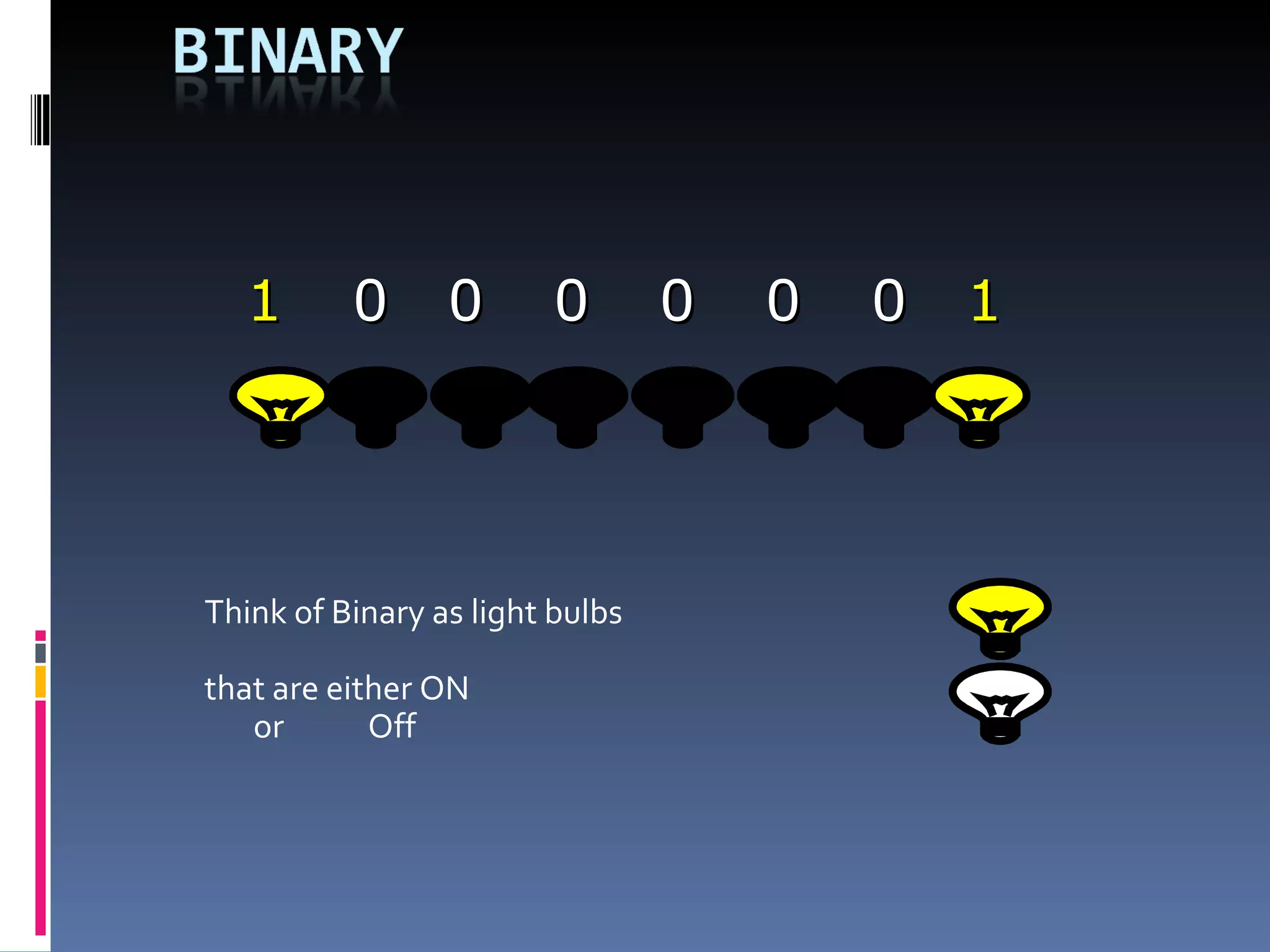
Think of Binary as light bulbs

that are either ON
   or       Off
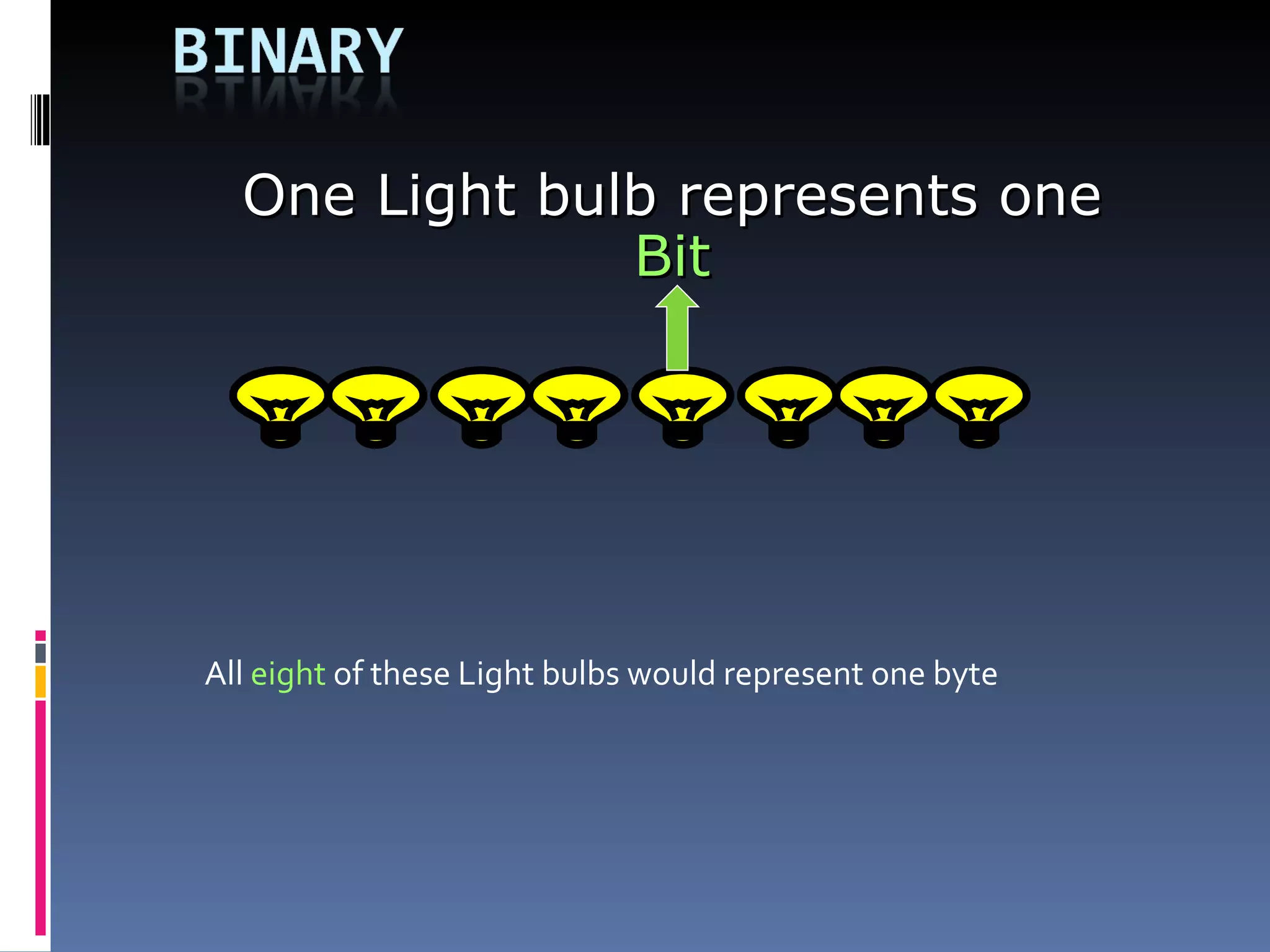
One Light bulb represents one
               Bit


All eight of these Light bulbs would represent one byte
1      0      0       0       0   0   0   1


Think of Binary as light bulbs

that are either ON
   or       Off
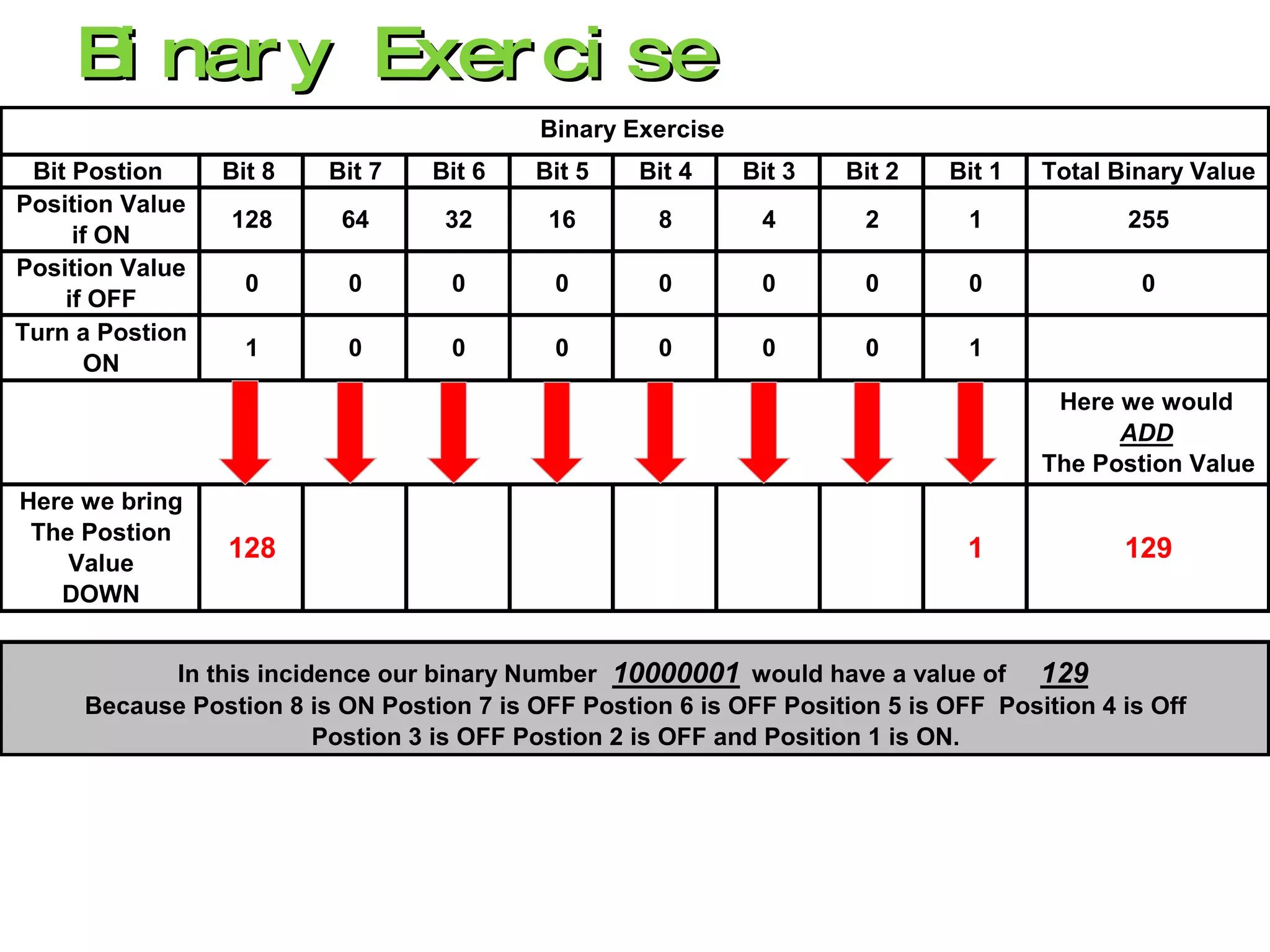
B nar y Exer ci se
     i
                                           Binary Exercise
 Bit Postion     Bit 8   Bit 7    Bit 6    Bit 5   Bit 4     Bit 3   Bit 2   Bit 1   Total Binary Value
Position Value
                 128      64       32       16       8        4       2        1             255
     if ON
Position Value
                   0       0        0       0        0        0       0        0              0
    if OFF
Turn a Postion
                   1       0        0       0        0        0       0        1
      ON
                                                                                      Here we would
                                                                                           ADD
                                                                                     The Postion Value
Here we bring
 The Postion
    Value
                 128                                                           1            129
   DOWN


           In this incidence our binary Number 10000001 would have a value of 129
     Because Postion 8 is ON Postion 7 is OFF Postion 6 is OFF Position 5 is OFF Position 4 is Off
                        Postion 3 is OFF Postion 2 is OFF and Position 1 is ON.
B nar y
     i
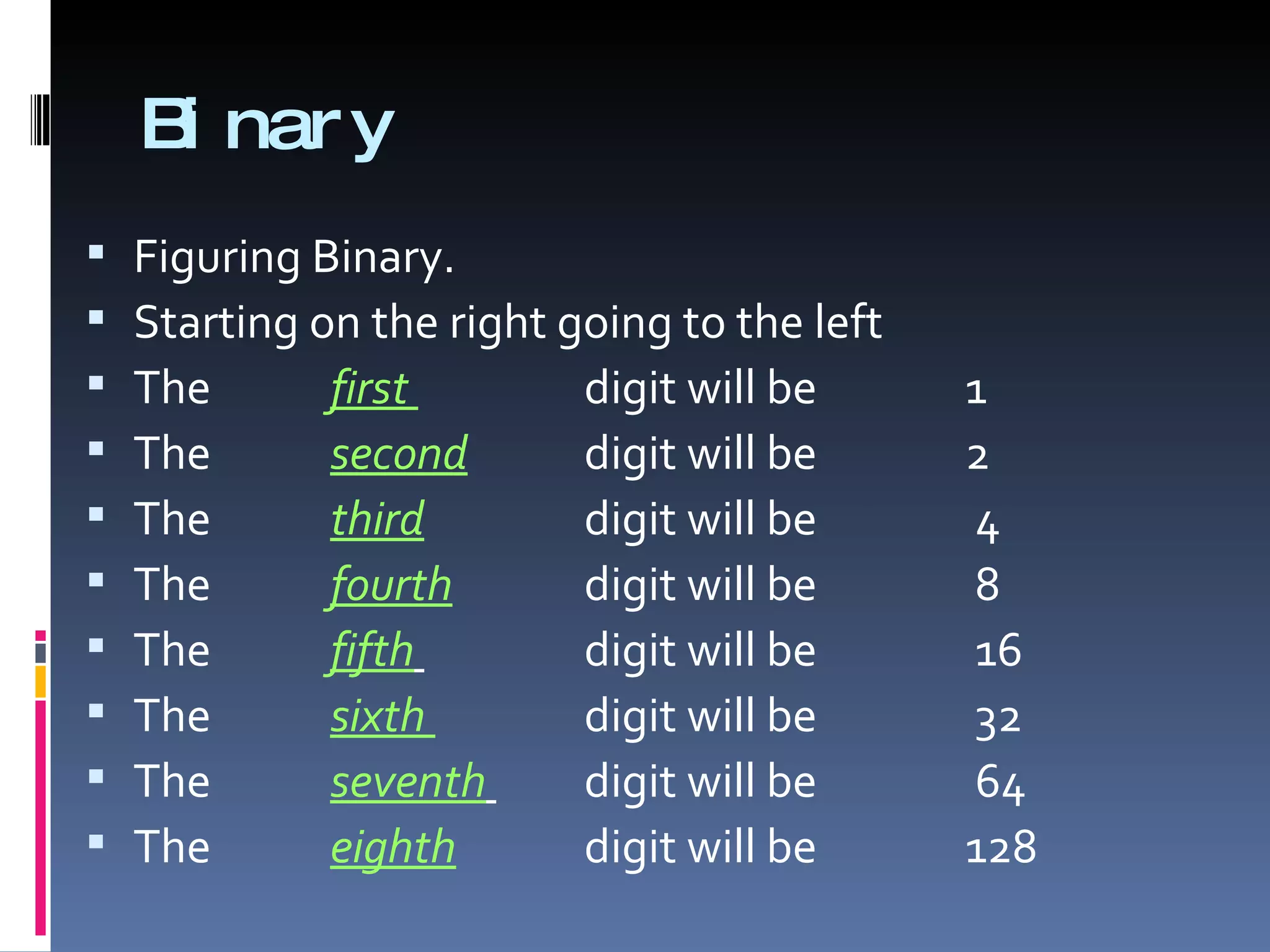
   Figuring Binary.
   Starting on the right going to the left
   The       first        digit will be      1
   The       second       digit will be      2
   The       third        digit will be      4
   The       fourth       digit will be      8
   The       fifth        digit will be      16
   The       sixth        digit will be      32
   The       seventh      digit will be      64
   The       eighth       digit will be      128
B nar y
   i
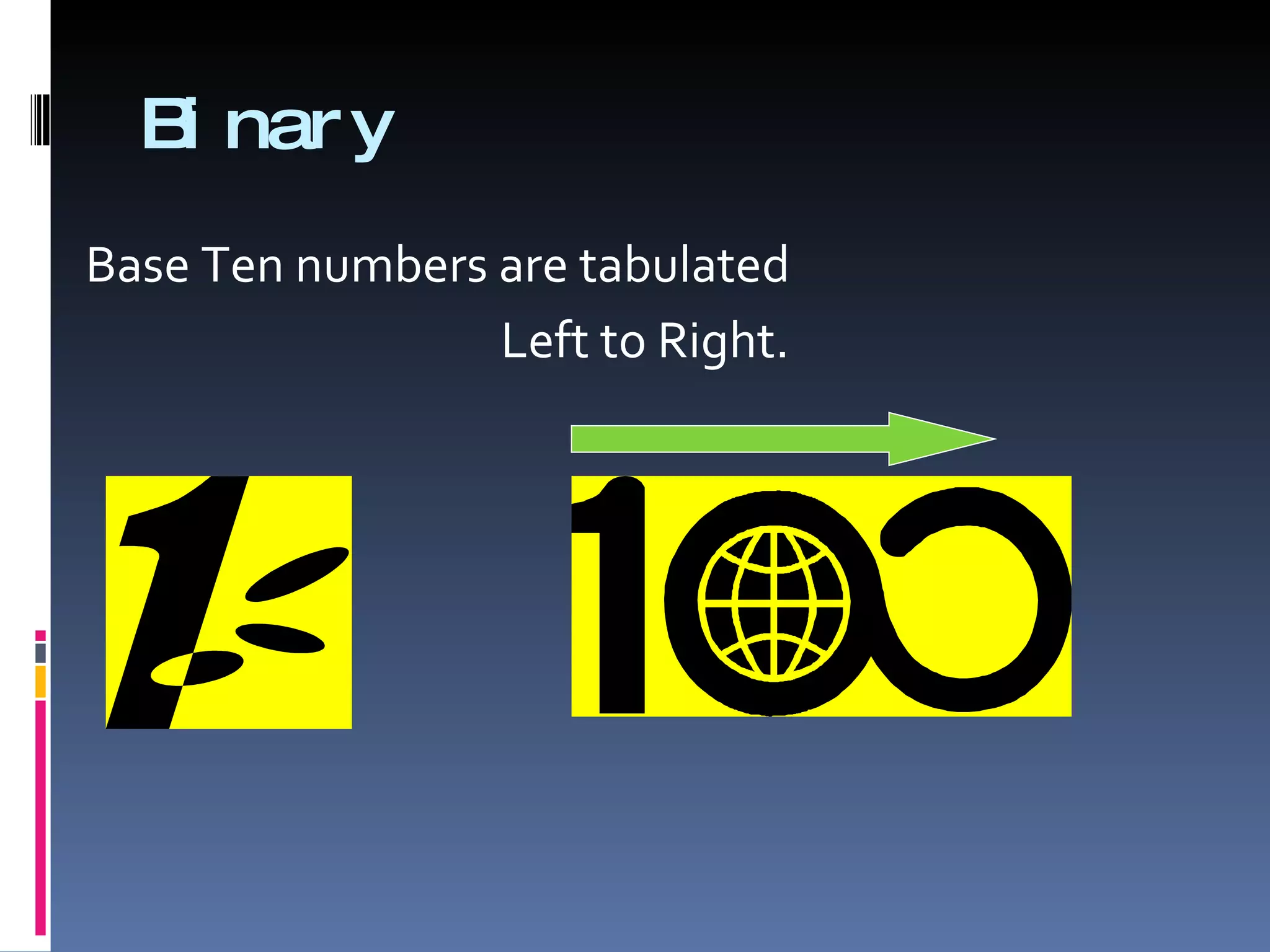
Base Ten numbers are tabulated
                 Left to Right.
B nar y
   i
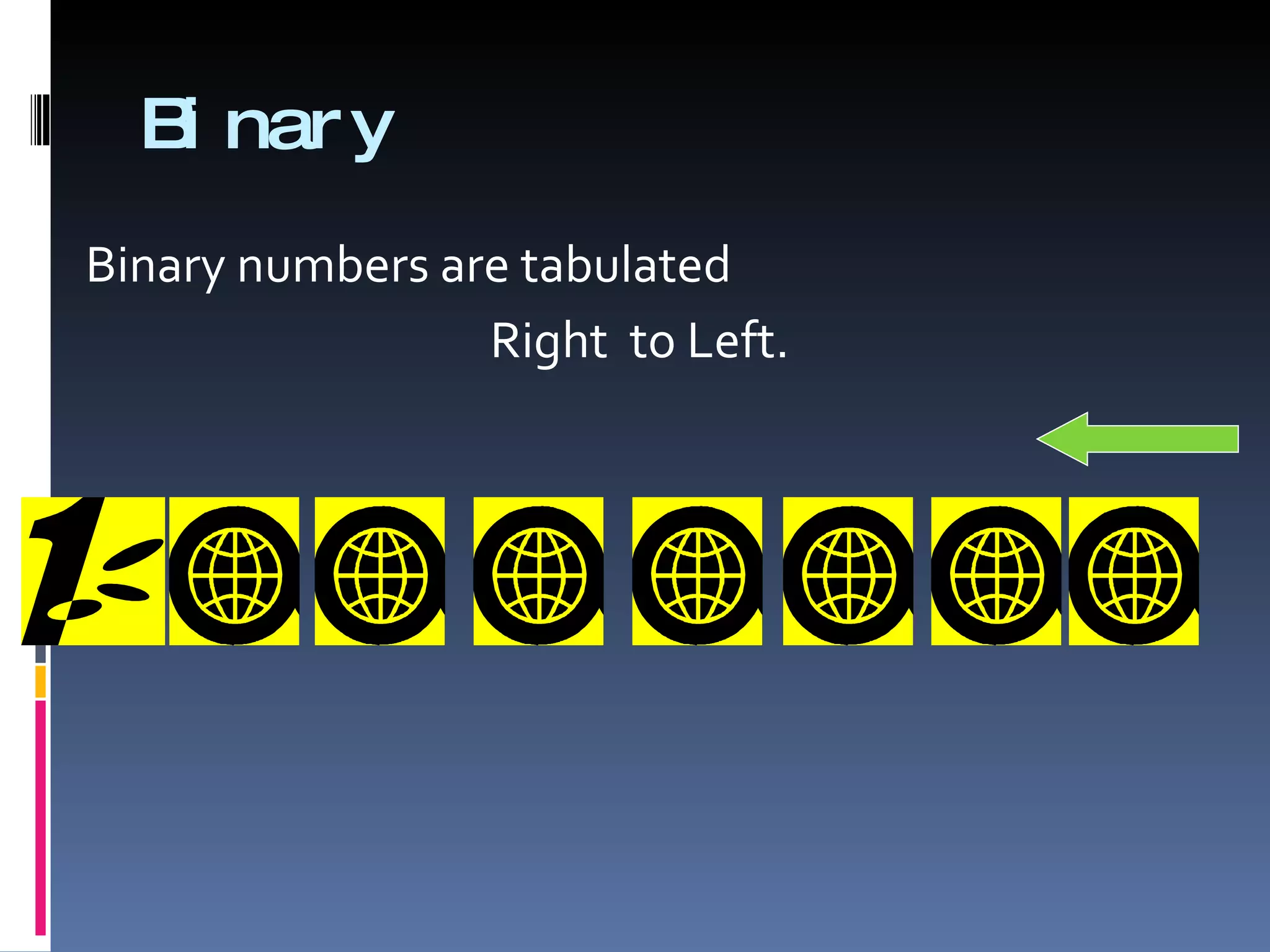
Binary numbers are tabulated
                 Right to Left.
Exam e
    pl
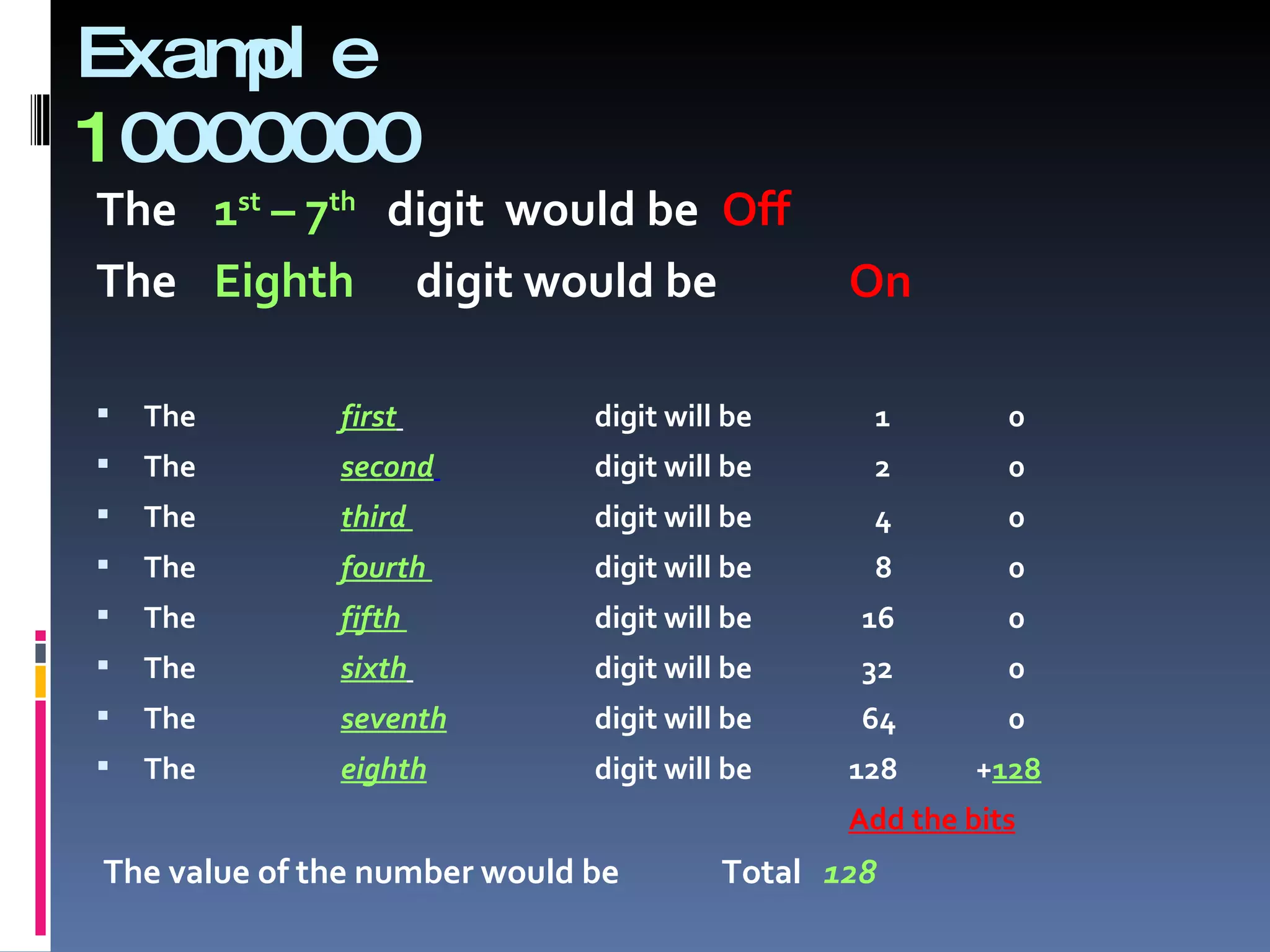
10000000
The 1st – 7th digit would be Off
The Eighth digit would be                      On

   The       first           digit will be     1         0
   The       second          digit will be     2         0
   The       third           digit will be     4         0
   The       fourth          digit will be     8         0
   The       fifth           digit will be     16        0
   The       sixth           digit will be     32        0
   The       seventh         digit will be     64        0
   The       eighth          digit will be    128      +128
                                               Add the bits
The value of the number would be        Total 128
Exam e
    pl
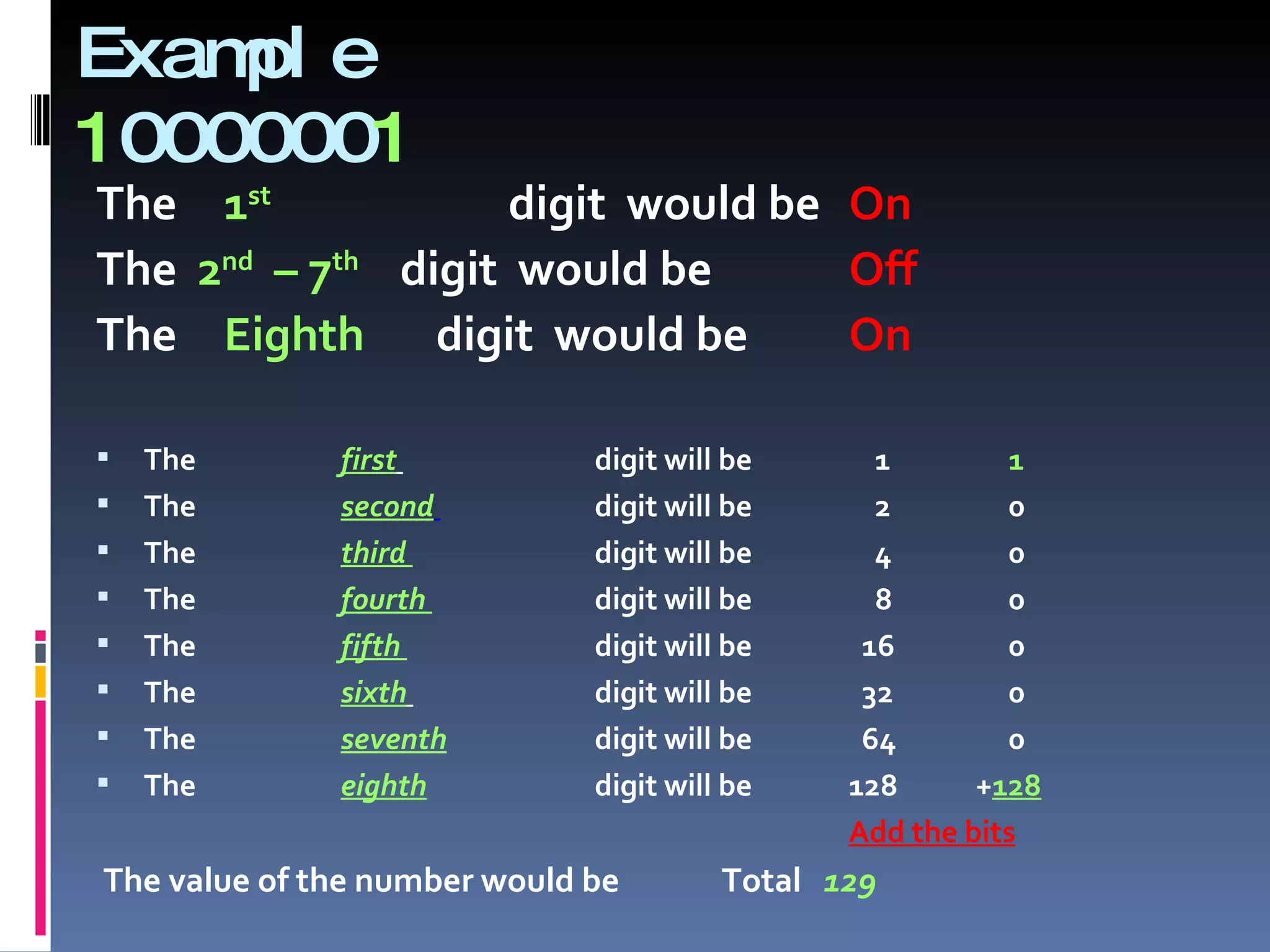
10000001
The 1st             digit would be On
The 2nd – 7th digit would be       Off
The Eighth digit would be          On

   The       first           digit will be      1        1
   The       second          digit will be      2        0
   The       third           digit will be      4        0
   The       fourth          digit will be      8        0
   The       fifth           digit will be     16        0
   The       sixth           digit will be     32        0
   The       seventh         digit will be     64        0
   The       eighth          digit will be    128      +128
                                               Add the bits
The value of the number would be        Total 129
Exam e
    pl
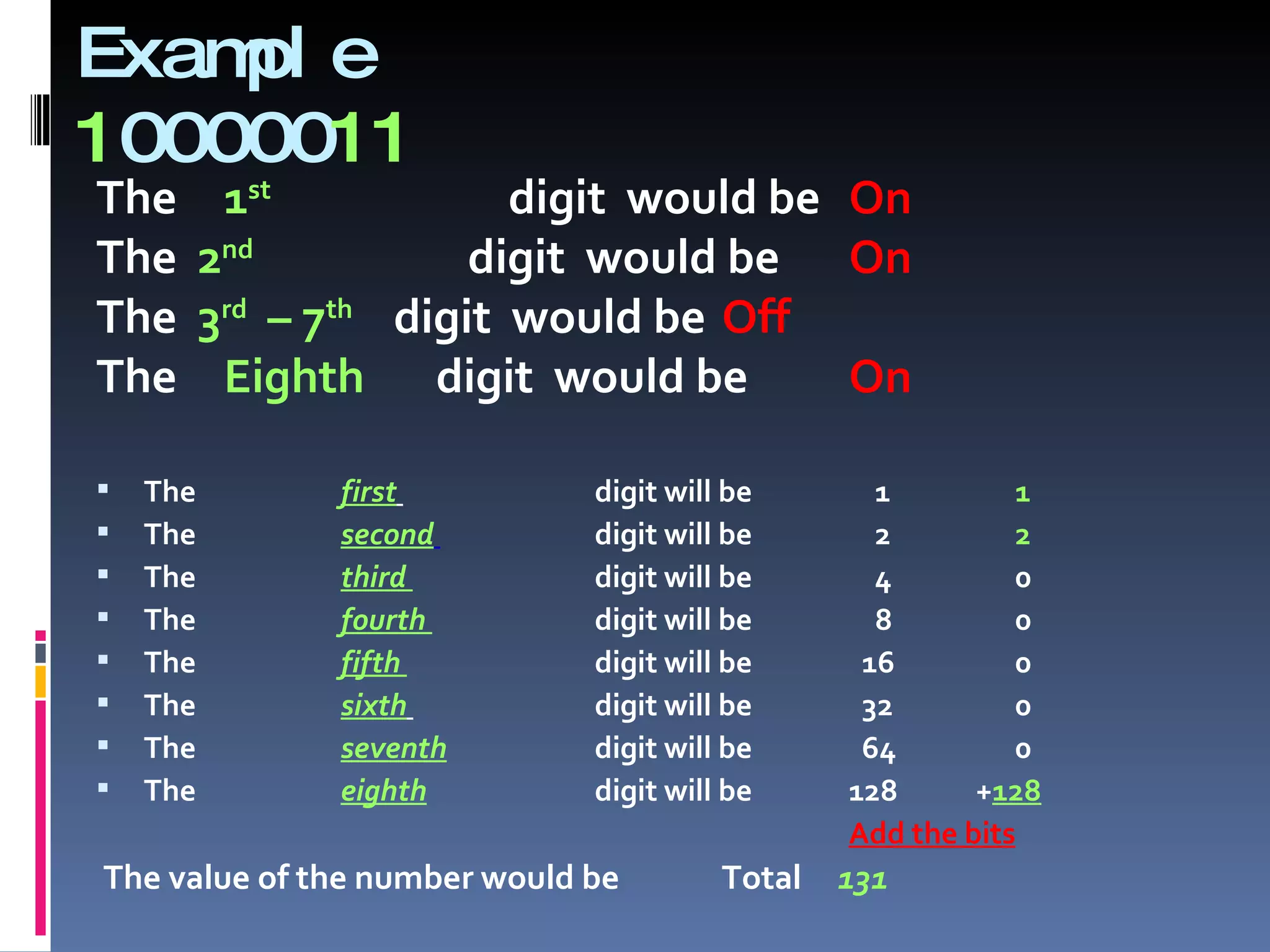
10000011
The        1st            digit would be On
The       2nd           digit would be On
The       3rd – 7th digit would be Off
The        Eighth digit would be         On

   The          first        digit will be       1         1
   The          second       digit will be       2         2
   The          third        digit will be       4         0
   The          fourth       digit will be       8         0
   The          fifth        digit will be      16         0
   The          sixth        digit will be      32         0
   The          seventh      digit will be      64         0
   The          eighth       digit will be     128      +128
                                                Add the bits
The value of the number would be        Total   131
Exam e
    pl
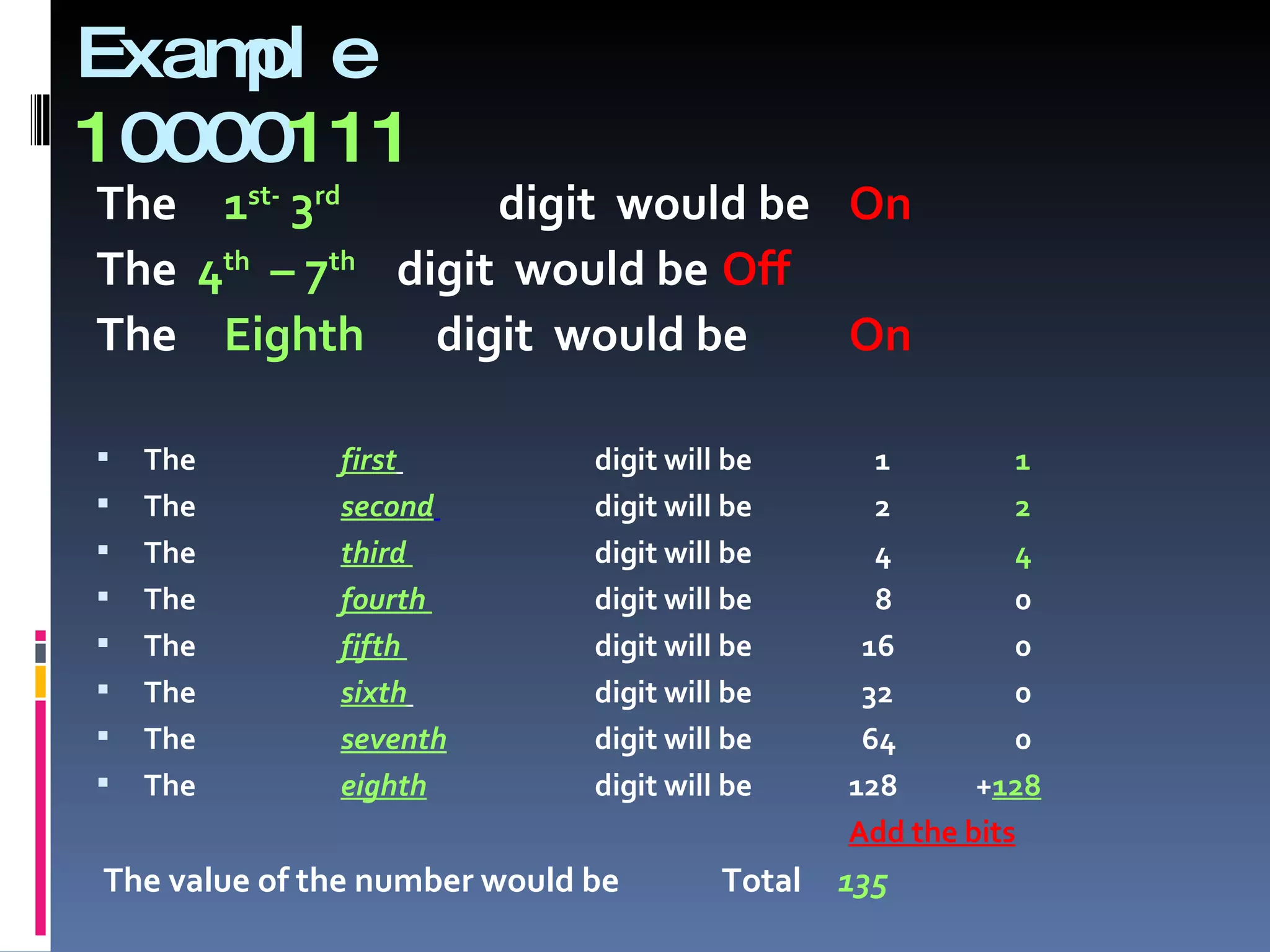
10000111
The 1st- 3rd       digit would be On
The 4th – 7th digit would be Off
The Eighth digit would be         On

   The       first           digit will be       1         1
   The       second          digit will be       2         2
   The       third           digit will be       4         4
   The       fourth          digit will be       8         0
   The       fifth           digit will be      16         0
   The       sixth           digit will be      32         0
   The       seventh         digit will be      64         0
   The       eighth          digit will be     128      +128
                                                Add the bits
The value of the number would be        Total   135
Exam e
    pl
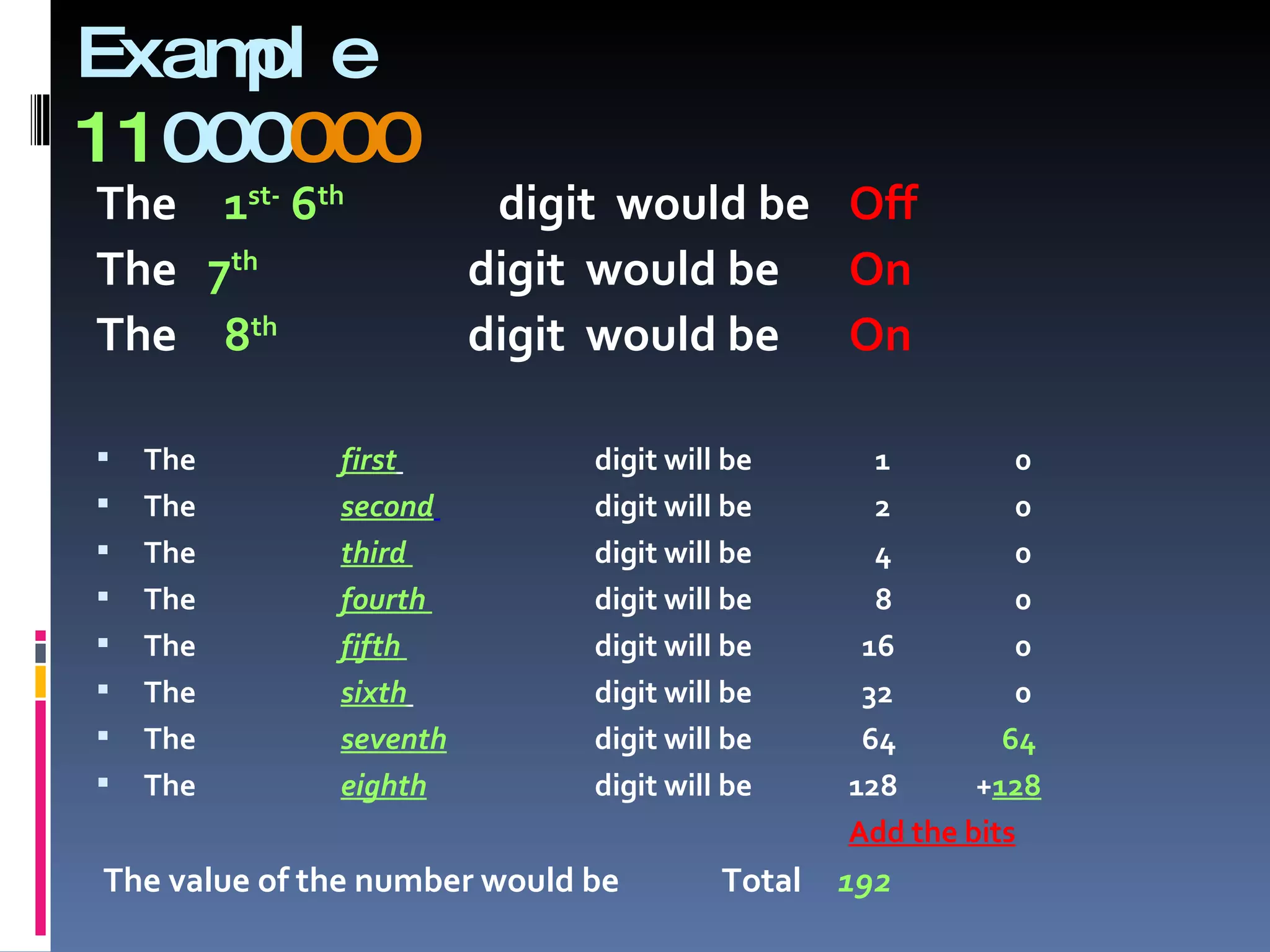
11000000
The 1st- 6th             digit would be Off
The 7th                 digit would be On
The 8th                 digit would be On

   The       first           digit will be       1         0
   The       second          digit will be       2         0
   The       third           digit will be       4         0
   The       fourth          digit will be       8         0
   The       fifth           digit will be      16         0
   The       sixth           digit will be      32         0
   The       seventh         digit will be      64        64
   The       eighth          digit will be     128      +128
                                                Add the bits
The value of the number would be        Total   192
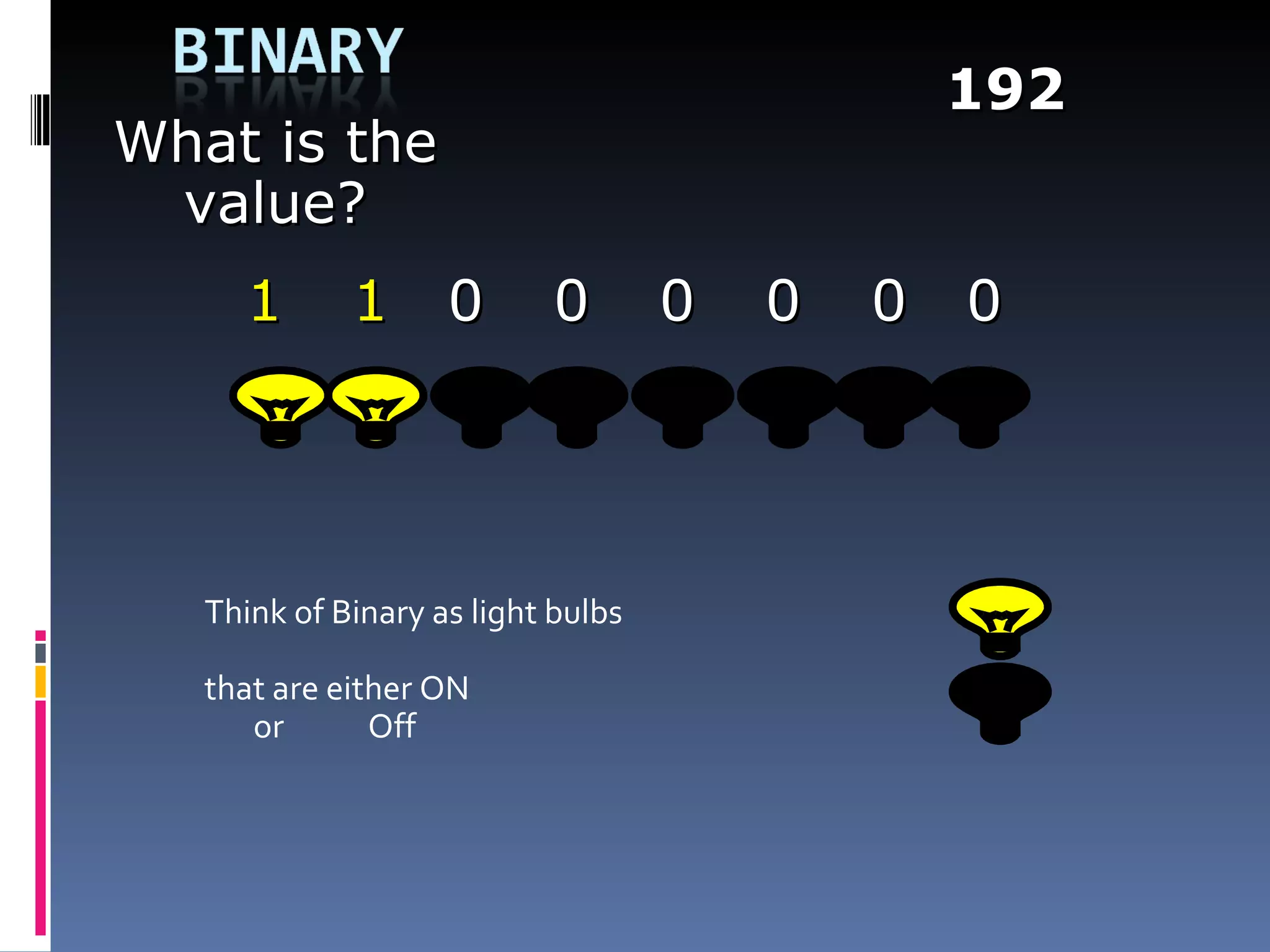
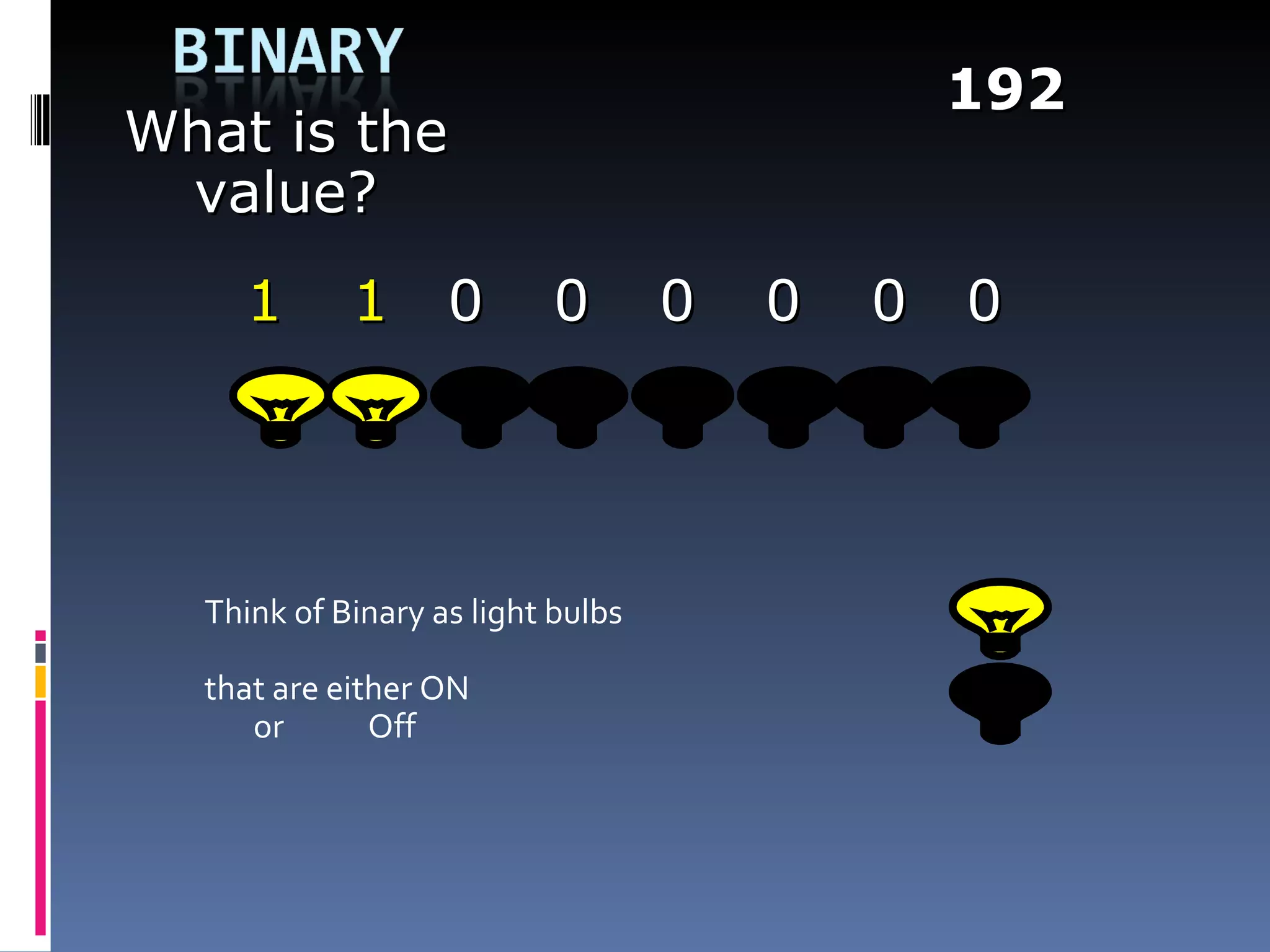
192
What is the
 value?
      1      1      0       0       0   0   0   0


   Think of Binary as light bulbs

   that are either ON
      or       Off
Exam e
    pl
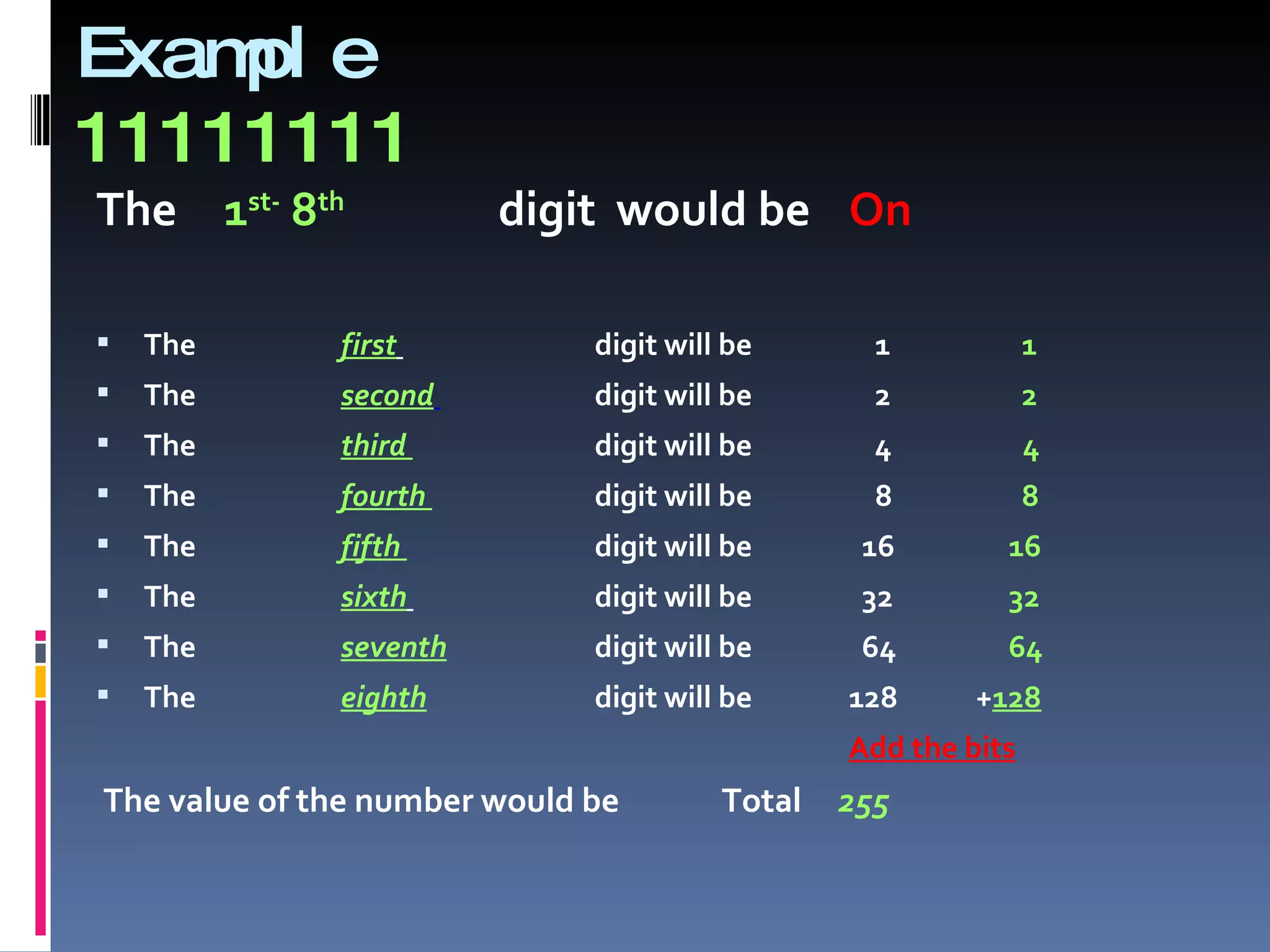
11111111
The 1st- 8th            digit would be On

   The       first           digit will be       1            1
   The       second          digit will be       2            2
   The       third           digit will be       4            4
   The       fourth          digit will be       8            8
   The       fifth           digit will be      16        16
   The       sixth           digit will be      32        32
   The       seventh         digit will be      64        64
   The       eighth          digit will be     128      +128
                                                Add the bits
The value of the number would be        Total   255
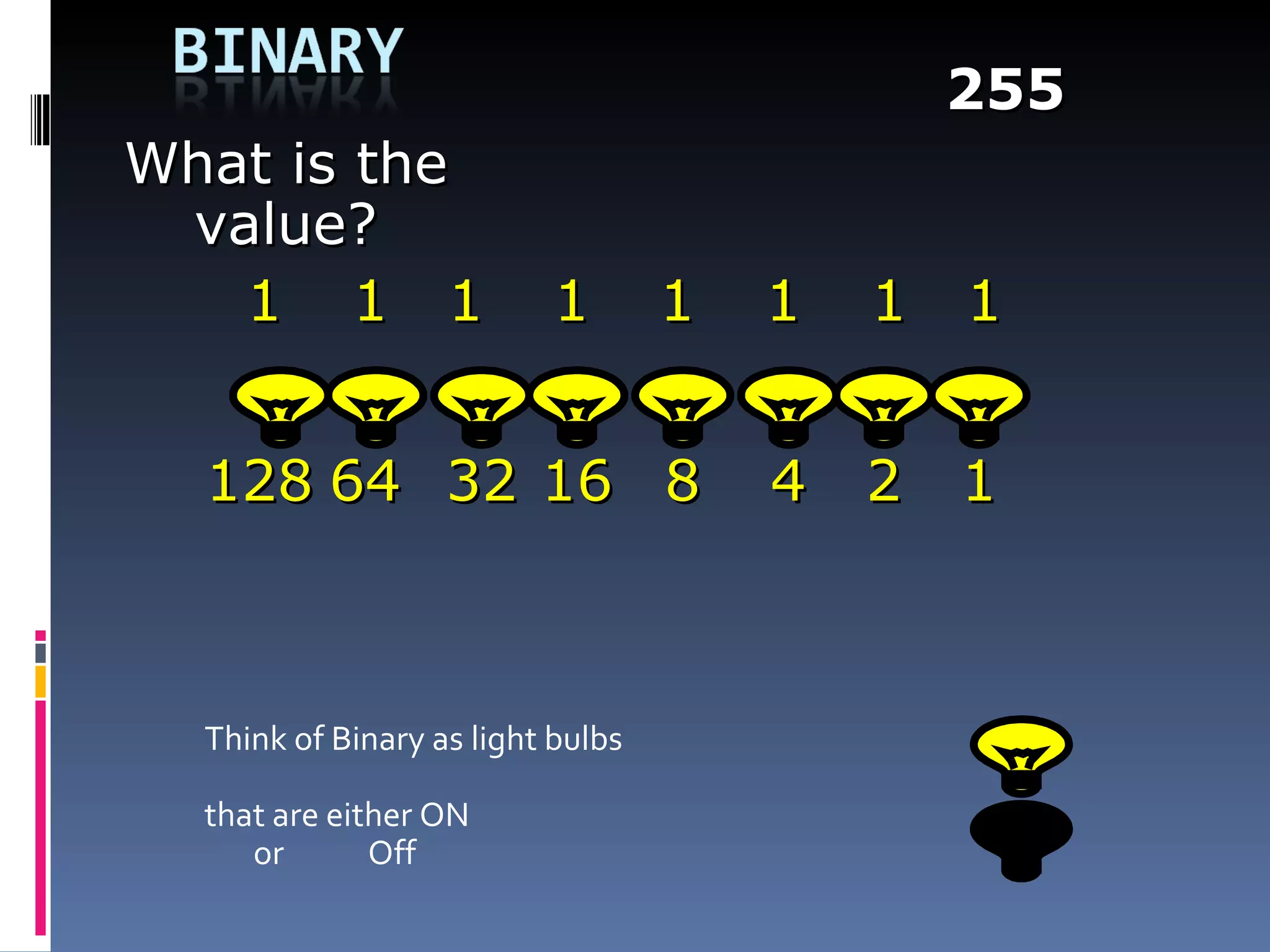
255
What is the
 value?
   1 1 1                   1       1   1   1   1


  128 64 32 16 8                       4   2   1


  Think of Binary as light bulbs

  that are either ON
     or       Off
U ng C cul at or
  si      al
t o f i gur e
B nar y N ber s
  i         um
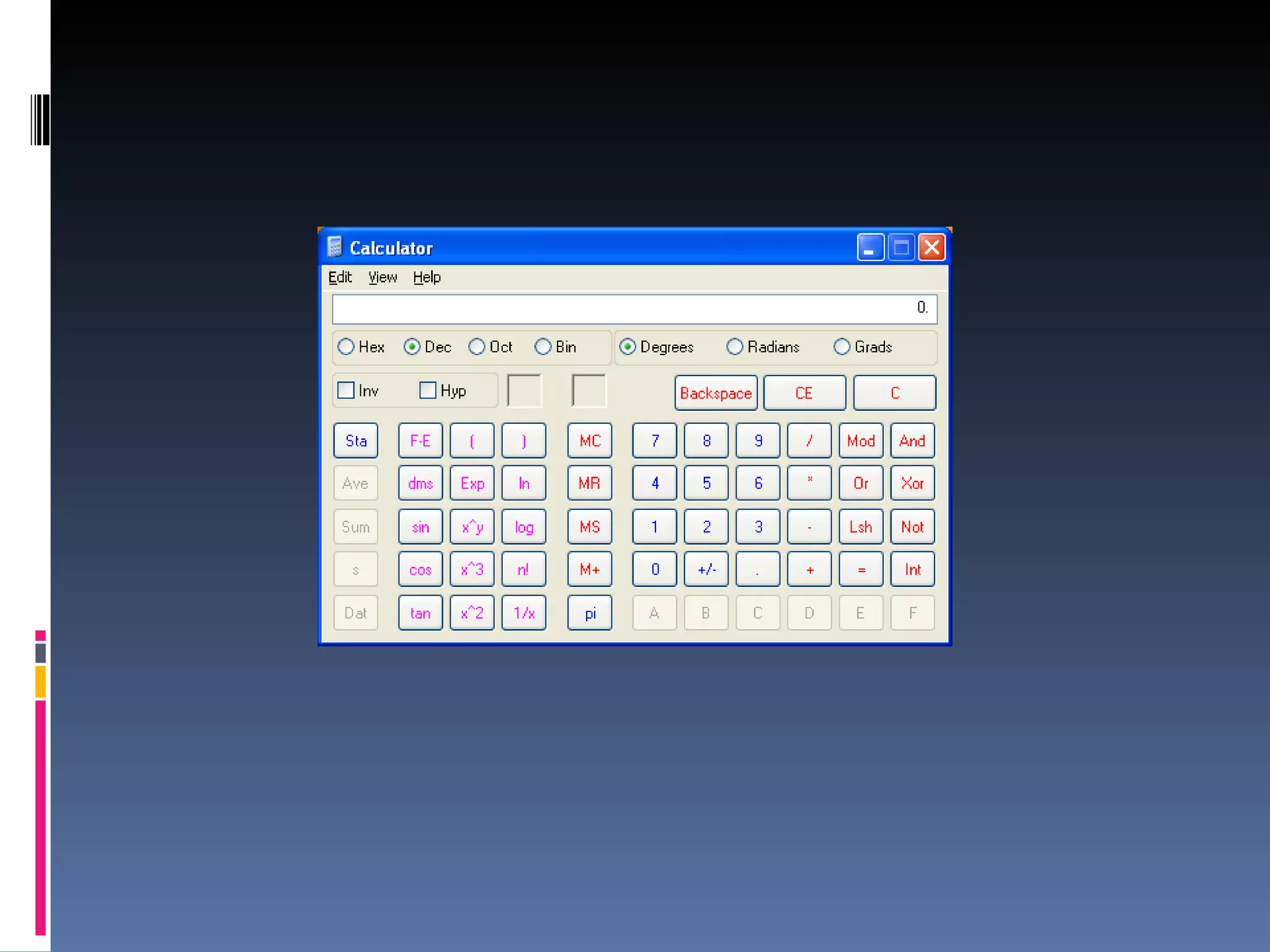
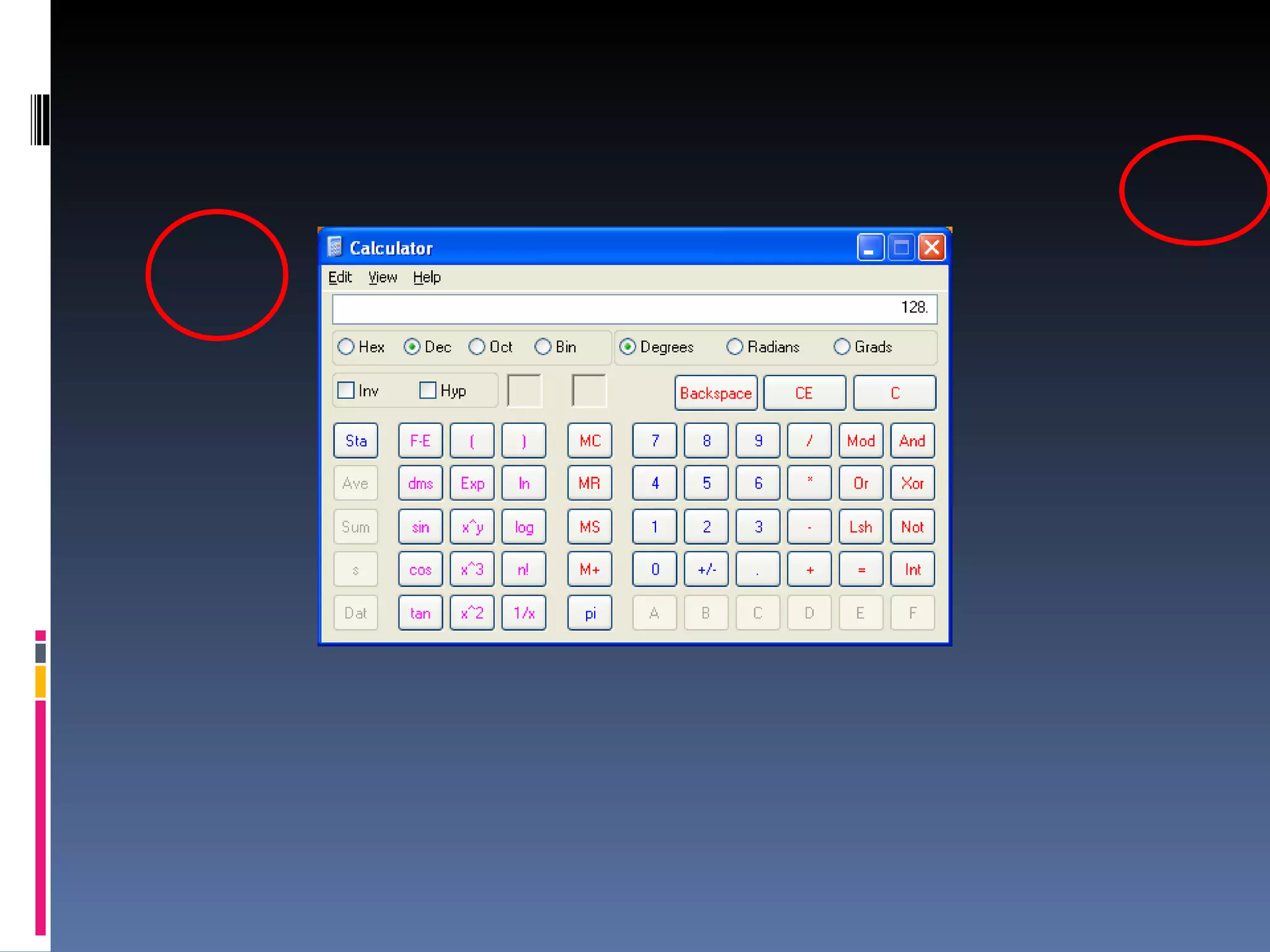
First we would open Calculator
Start/All Programs/Accessories/Calculator
From the Calculator go to View and down
To SCIENTIFIC
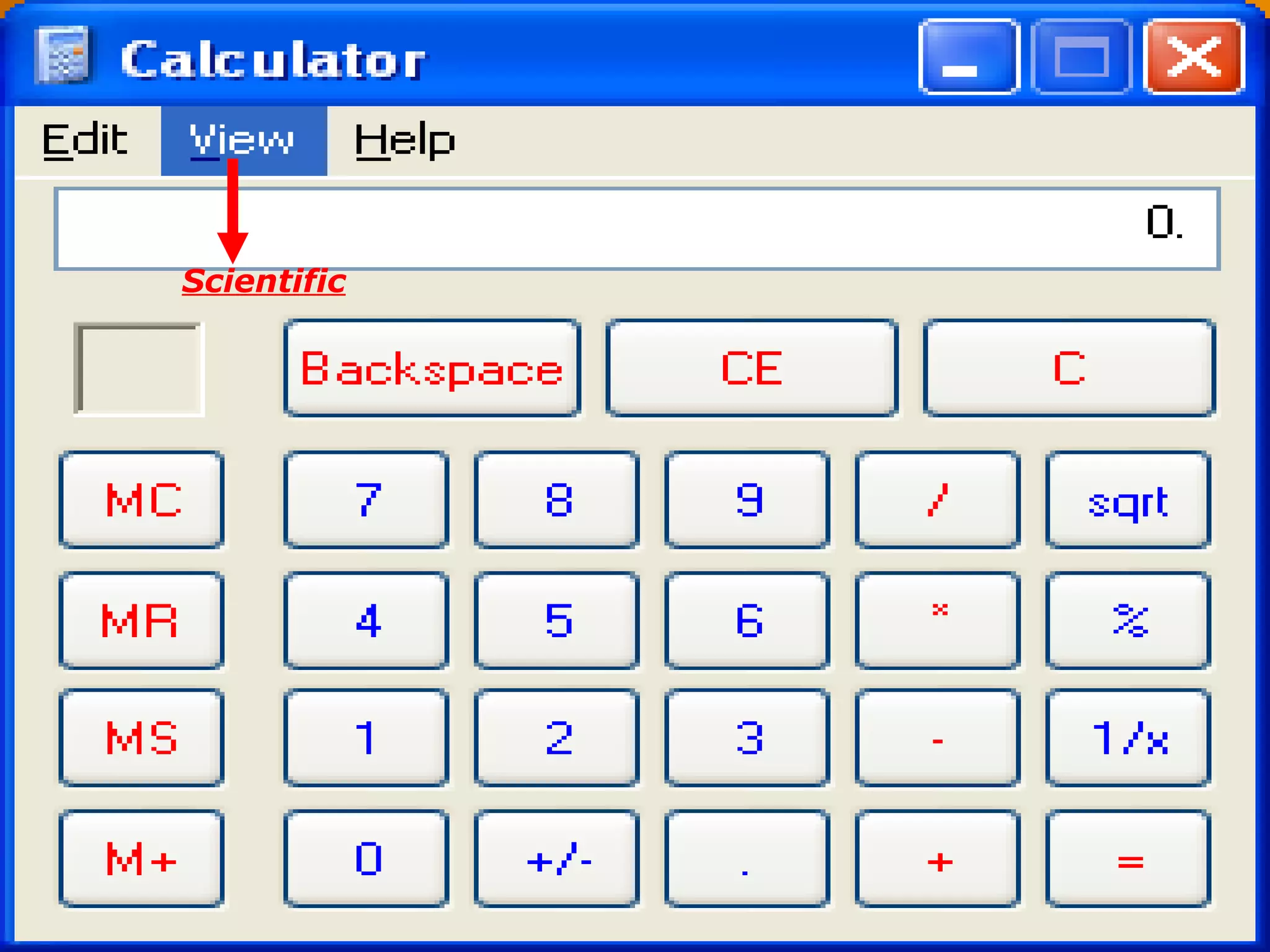
Scientific
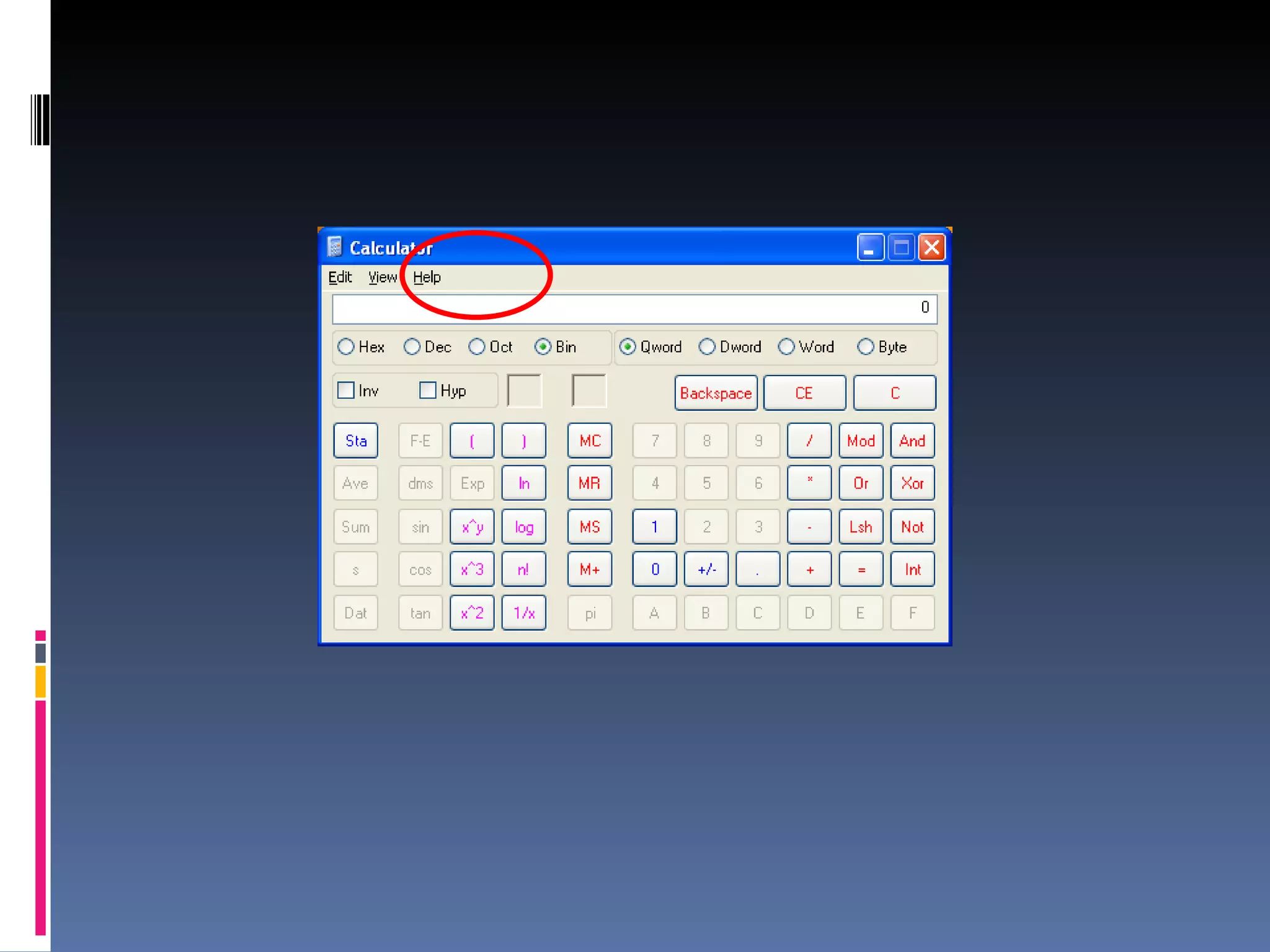
 This is the Scientific Calculator
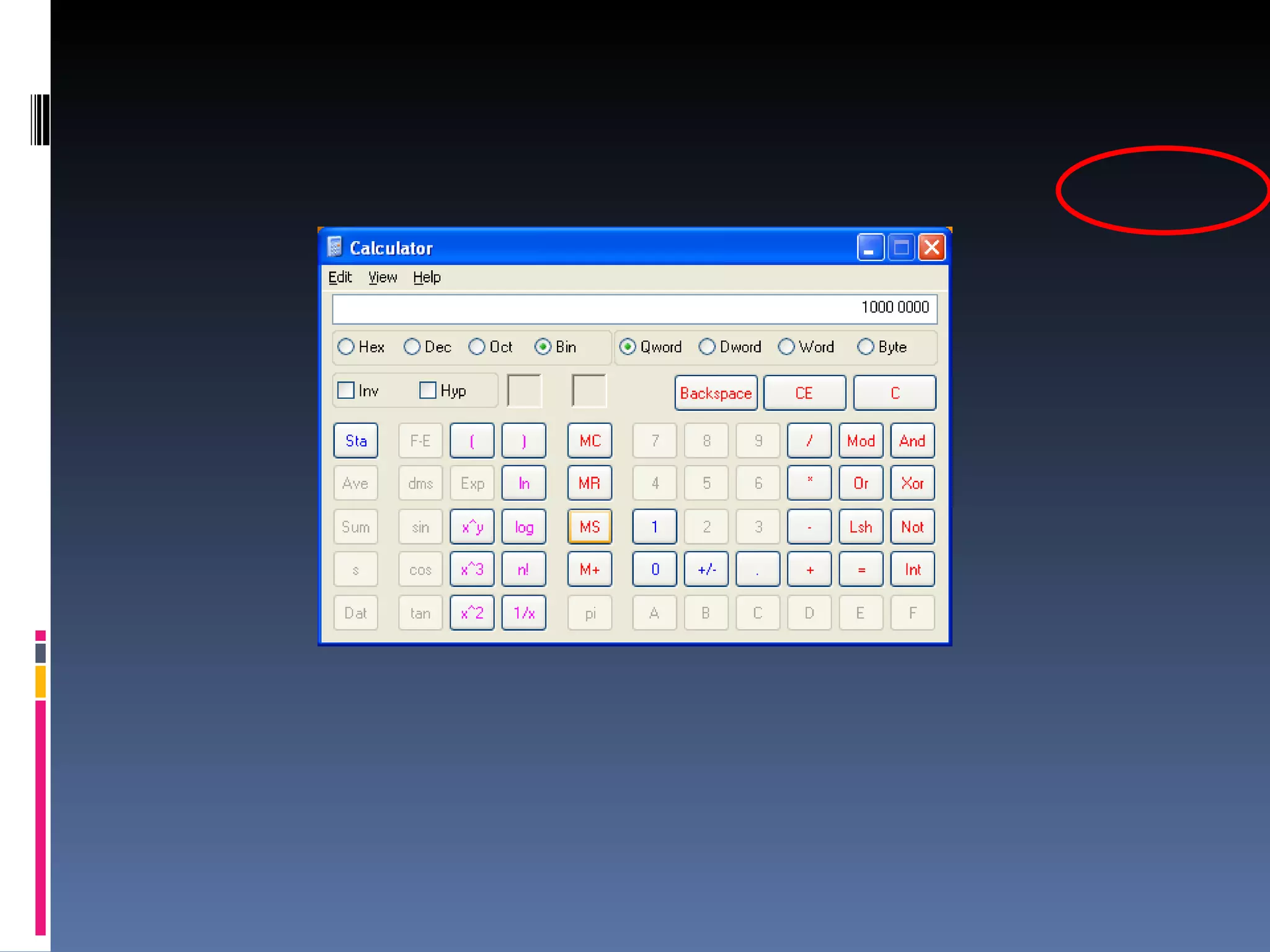
 The next thing we would need to do in select

   BIN for Binary
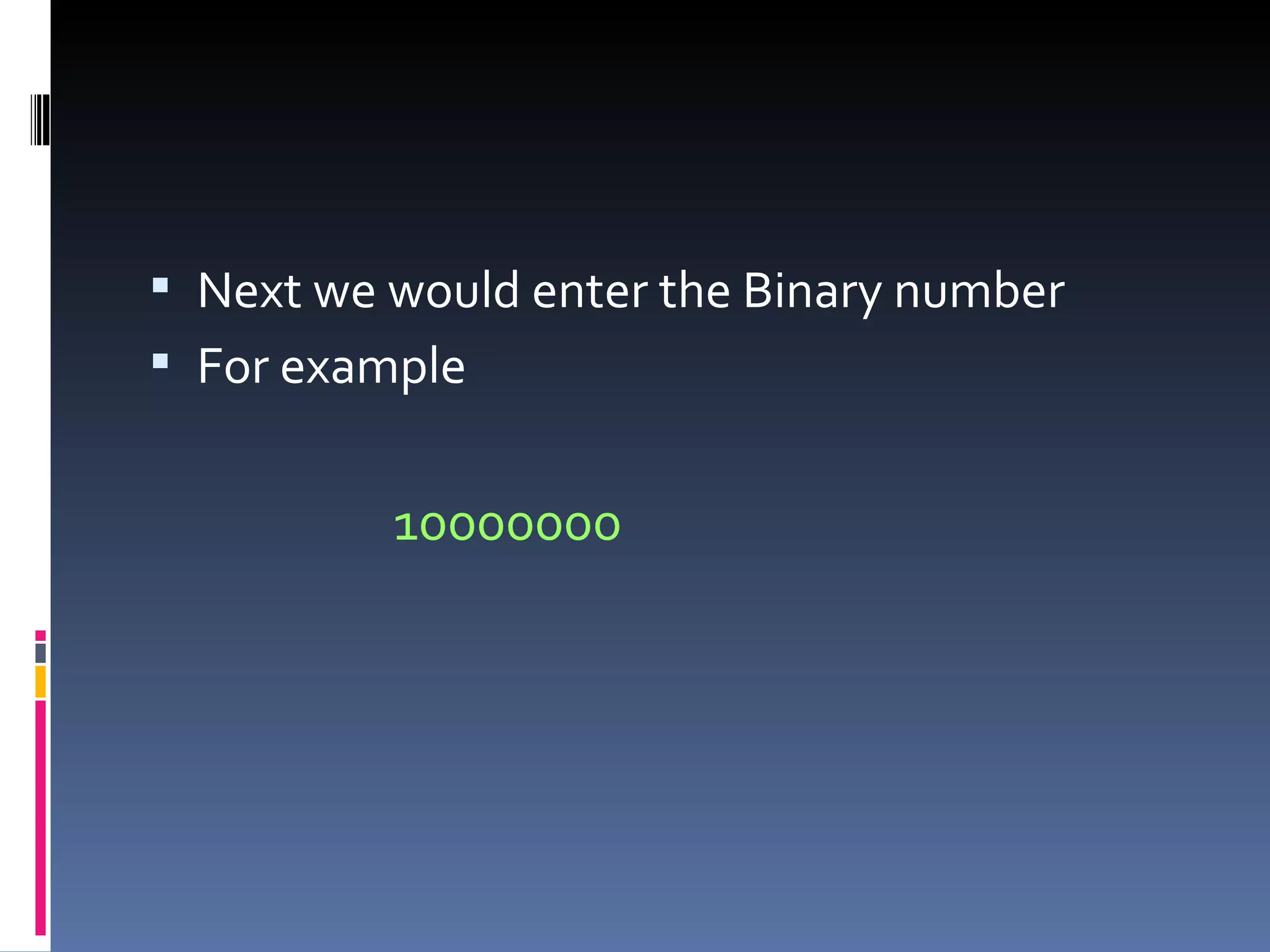
 Next we would enter the Binary number
 For example


          10000000
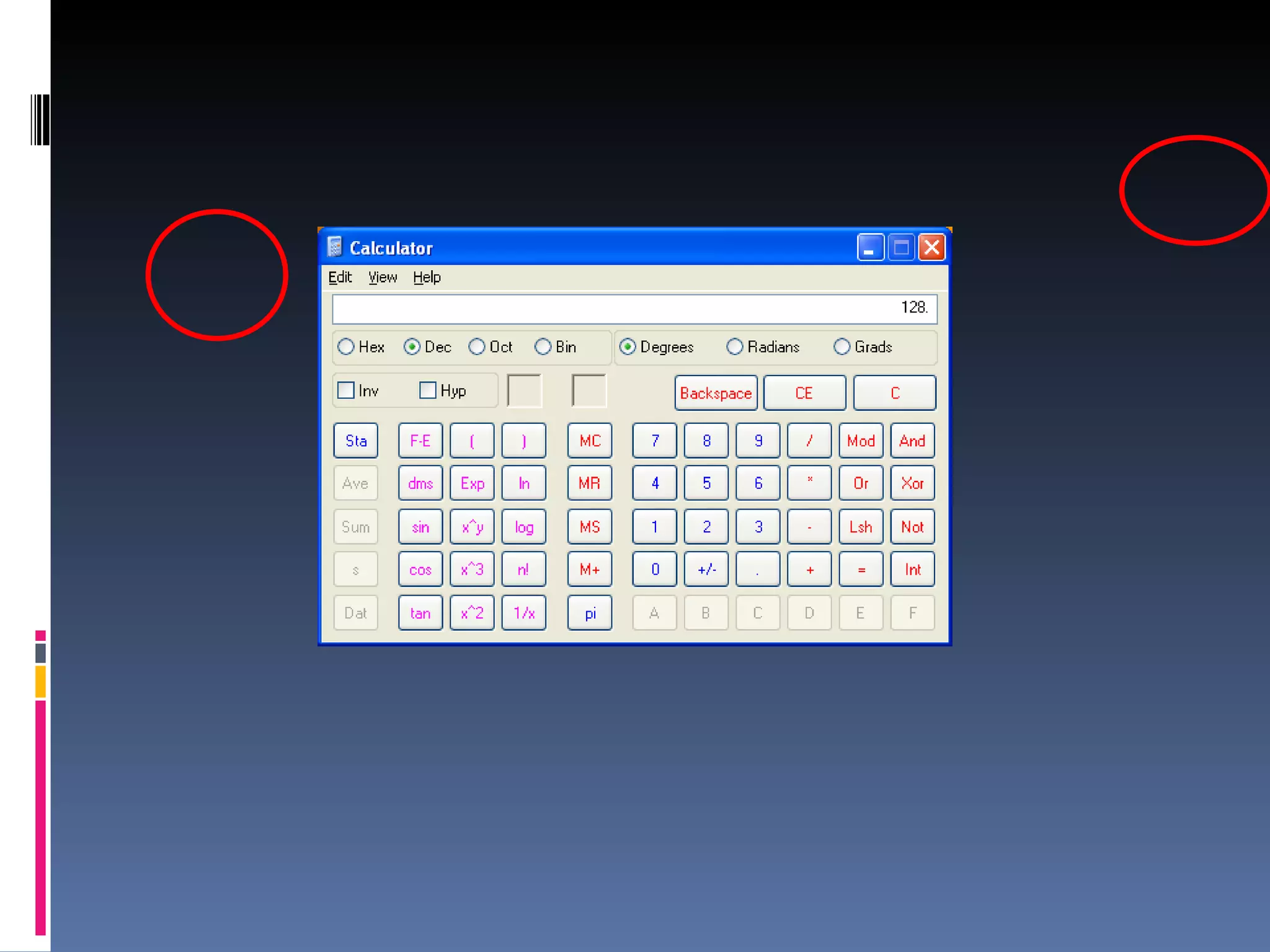
After entering the Binary number we would
  then select the

             Dec   Radio Button
We now see the answer to the problem
Is

                    128
192
What is the
 value?
     1      1      0       0       0   0   0   0


  Think of Binary as light bulbs

  that are either ON
     or       Off
ICT 1
Deci m t o B nar y
      al    i

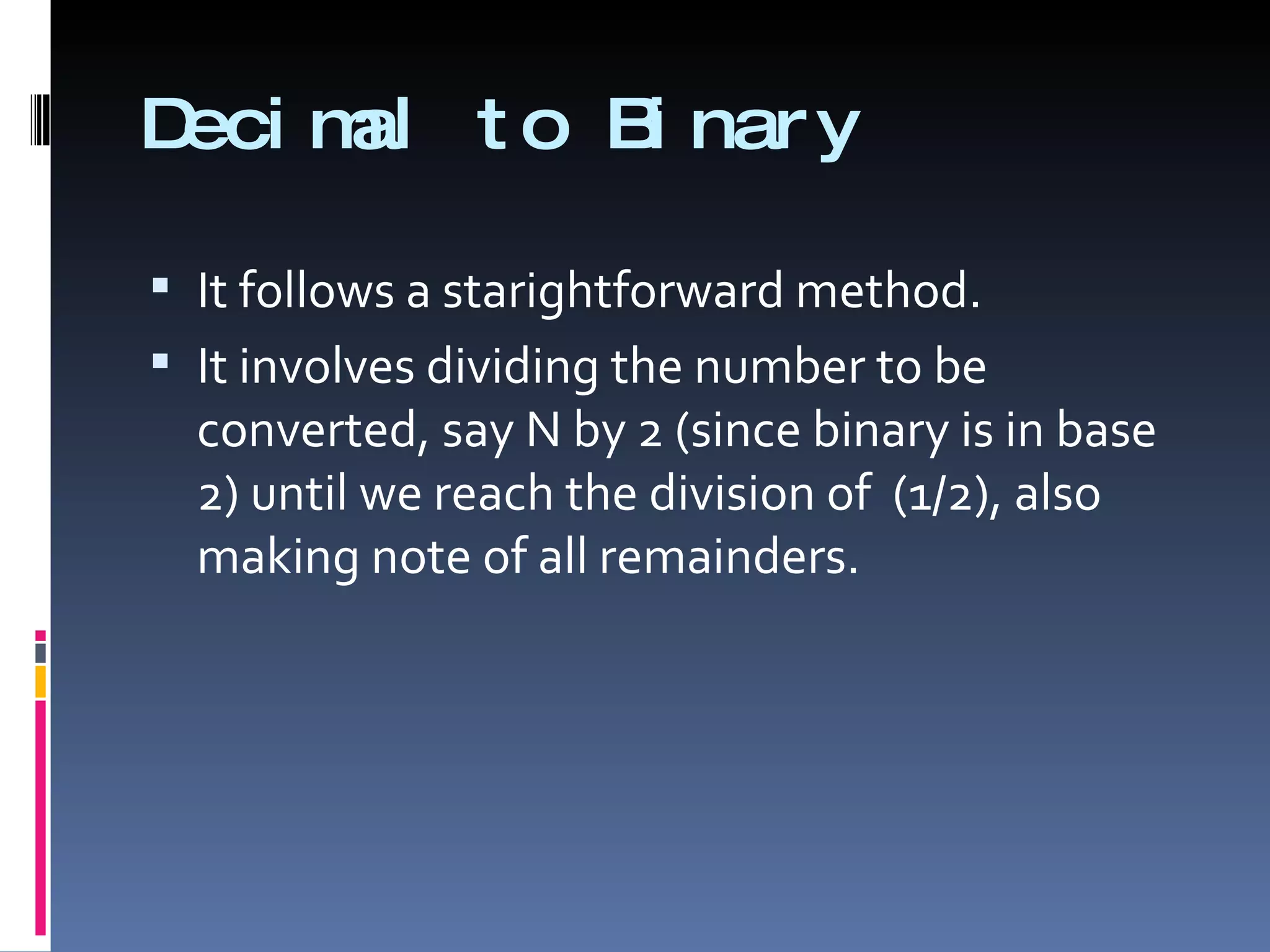
 It follows a starightforward method.
 It involves dividing the number to be
  converted, say N by 2 (since binary is in base
  2) until we reach the division of (1/2), also
  making note of all remainders.
Exam e 1: C
      pl        onver t 98
f r om deci m t o bi nar y
             al
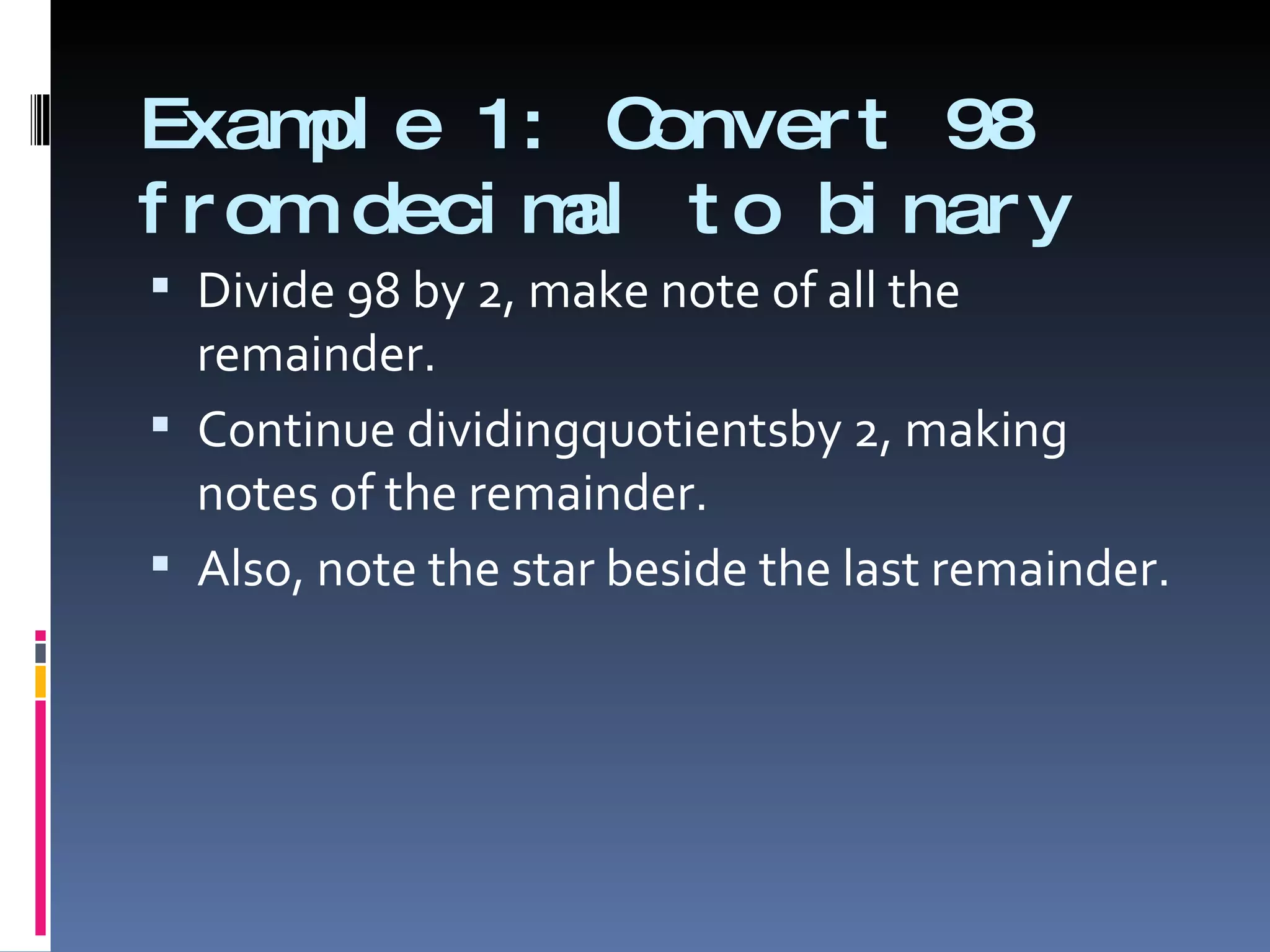
 Divide 98 by 2, make note of all the
  remainder.
 Continue dividingquotientsby 2, making
  notes of the remainder.
 Also, note the star beside the last remainder.
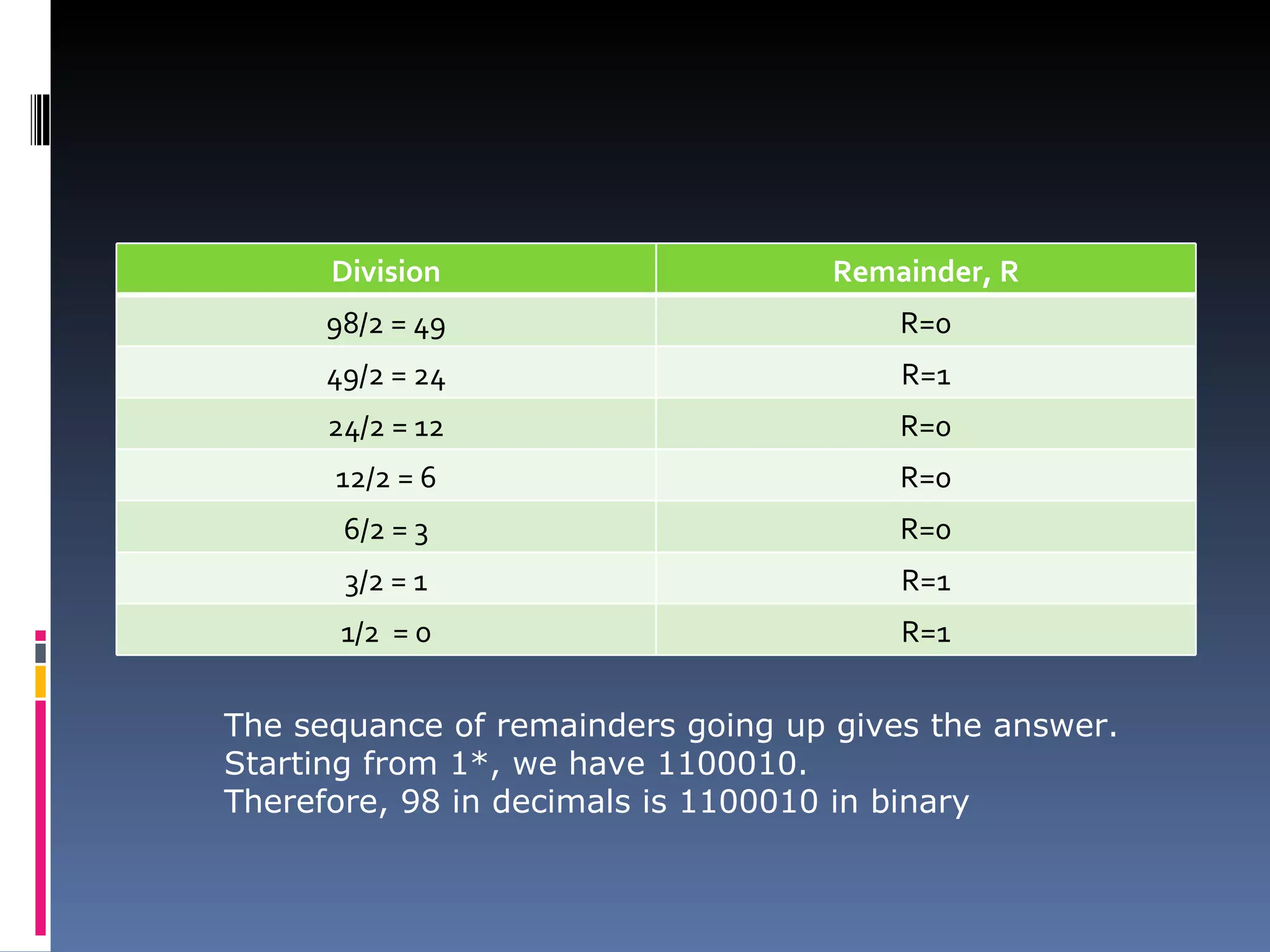
Division                      Remainder, R
      98/2 = 49                         R=0
      49/2 = 24                         R=1
      24/2 = 12                         R=0
      12/2 = 6                          R=0
       6/2 = 3                          R=0
       3/2 = 1                          R=1
       1/2 = 0                          R=1

The sequance of remainders going up gives the answer.
Starting from 1*, we have 1100010.
Therefore, 98 in decimals is 1100010 in binary
Exam e 2: C
       pl        onver t 21
 i nt o bi nar y
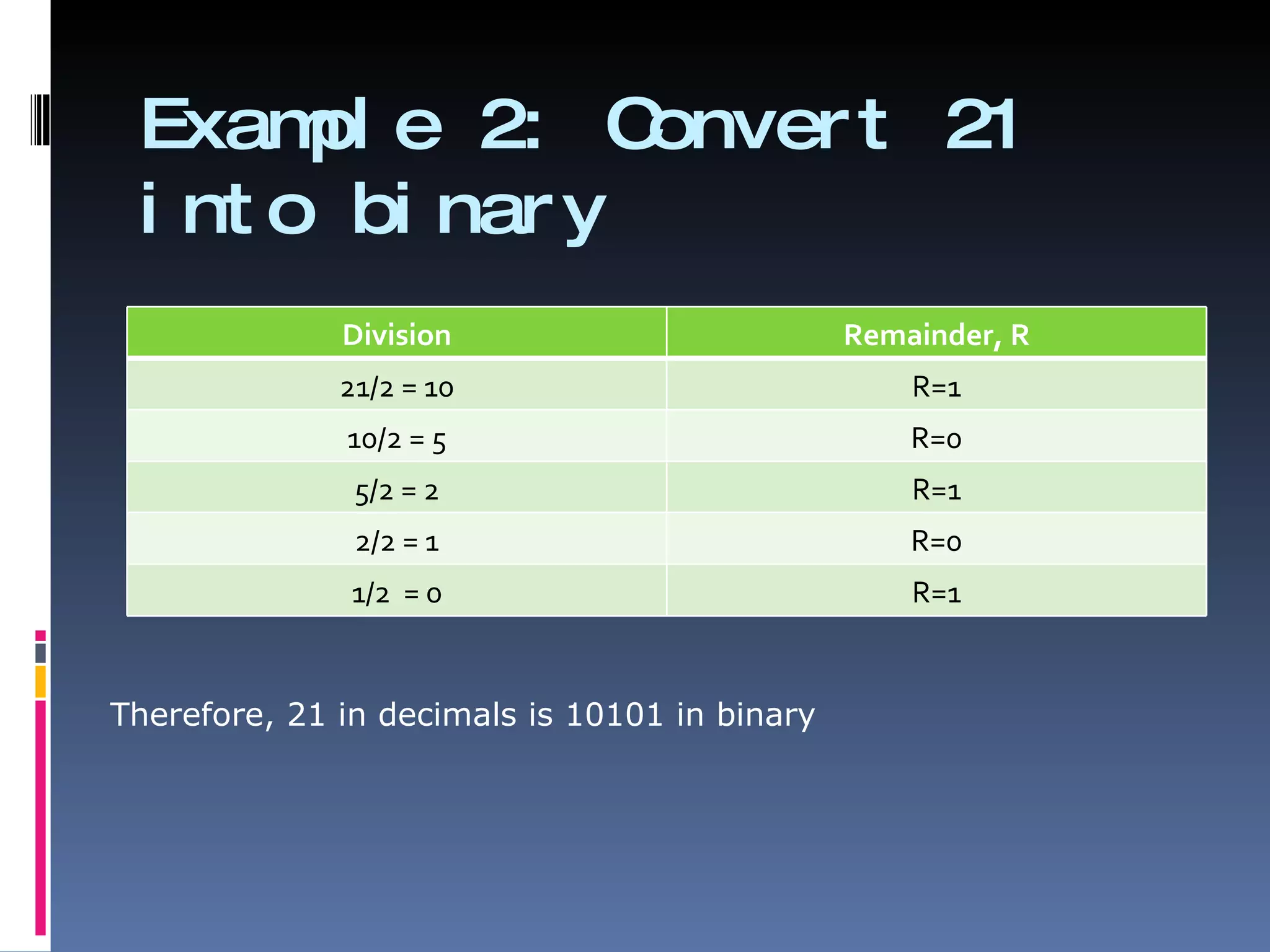
              Division                         Remainder, R
              21/2 = 10                            R=1
              10/2 = 5                             R=0
               5/2 = 2                             R=1
               2/2 = 1                             R=0
               1/2 = 0                             R=1


Therefore, 21 in decimals is 10101 in binary
B nar y t o deci m
 i                al

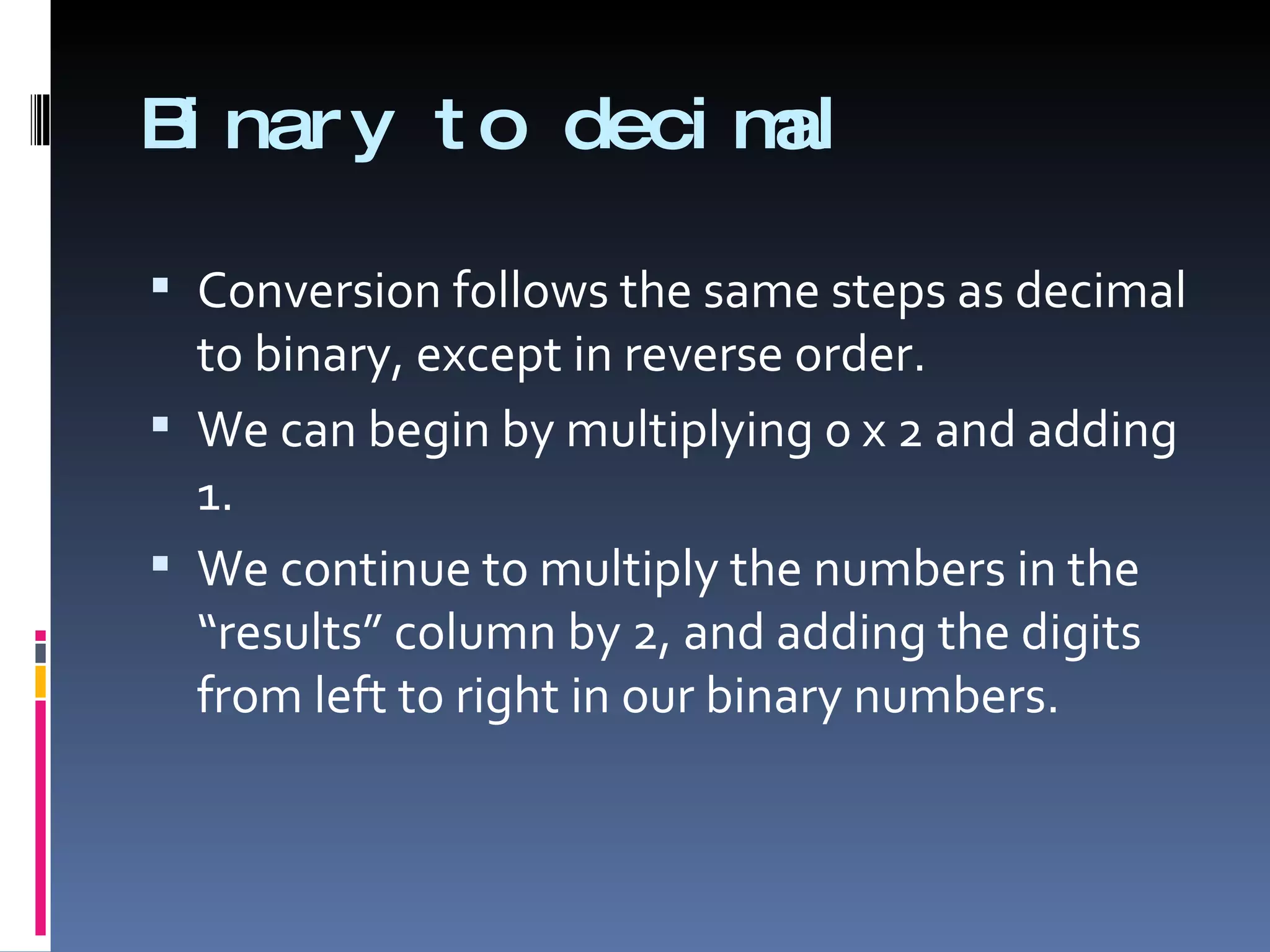
 Conversion follows the same steps as decimal
  to binary, except in reverse order.
 We can begin by multiplying 0 x 2 and adding
  1.
 We continue to multiply the numbers in the
  “results” column by 2, and adding the digits
  from left to right in our binary numbers.
Exam e 1: C
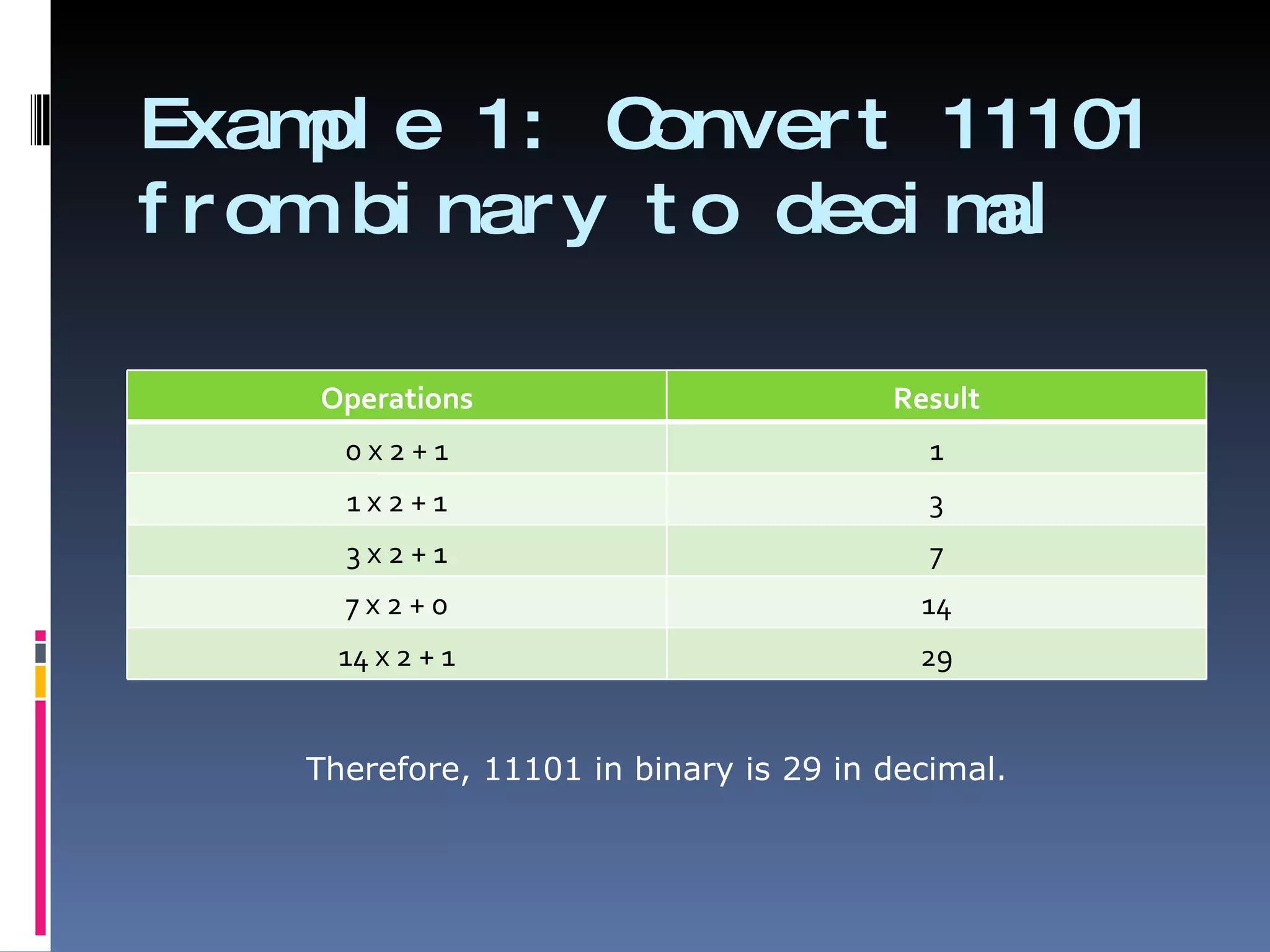
      pl        onver t 11101
f r om bi nar y t o deci mal

     Operations                         Result
      0x2+1                                1
      1x2+1                                3
      3x2+1                                7
      7x2+0                               14
      14 x 2 + 1                          29


    Therefore, 11101 in binary is 29 in decimal.

Binary Conversion

  • 1.
    B nar y i In 1854, British mathematician George Boole published a paper detailing a system of logic that would become known as Boolean algebra. His logical system proved instrumental in the development of the binary system, particularly in its implementation in electronic circuitry.
  • 2.
    B nar y i A numbering systems that only uses two digits. 0 and 1. Rather than a base ten that we are all familiar with. Computers use binary to store information in a digital format. Each digit ( 0 or 1) represents one bit Eight bits are equal to one byte.
  • 3.
    Bt i  OneBinary Digit  abbreviation is “b” Can be thought of as one character  Either a 1 or a 0
  • 4.
    B e yt Eight bits make up one byte  Abbreviation “B”  Combination of 1’s and 0’s  Can be thought of as one character  11101010
  • 5.
    ki l obit  1024 bits  Abbreviation “Kb”
  • 6.
    ki l obytes  Represented by KB  Slang “Kilo”  Is equal to 1024 bytes  210
  • 7.
    megabyt es  Representedby MB  Slang “Meg”  Is equal to 1,000000 bytes  One million bytes  220
  • 8.
    gi gabyt e Represented by GB  Slang “Gig”  Equal to 1,000,000,000 Bytes  One Billion bytes  230
  • 9.
    t er abyte  Represented by TB  Slang “tera”  Equal to 1,000,000,000,000 Bytes  One Trillion bytes  240
  • 10.
    pet abyt e Represented by PB  Slang “peta”  Equal to 1,000,000,000,000,000 Bytes  One Thousand Trillion bytes  250
  • 11.
    exabyt e  Represented by EB  Slang “exa”  Equal to 1,000,000,000,000,000,000 Bytes  One Million Trillion bytes  260  All printed materialin the world would use about 5 Exabytes
  • 12.
    Think of Binaryas light bulbs that are either ON or Off
  • 13.
    One Light bulbrepresents one Bit All eight of these Light bulbs would represent one byte
  • 14.
    1 0 0 0 0 0 0 1 Think of Binary as light bulbs that are either ON or Off
  • 15.
    B nar yExer ci se i Binary Exercise Bit Postion Bit 8 Bit 7 Bit 6 Bit 5 Bit 4 Bit 3 Bit 2 Bit 1 Total Binary Value Position Value 128 64 32 16 8 4 2 1 255 if ON Position Value 0 0 0 0 0 0 0 0 0 if OFF Turn a Postion 1 0 0 0 0 0 0 1 ON Here we would ADD The Postion Value Here we bring The Postion Value 128 1 129 DOWN In this incidence our binary Number 10000001 would have a value of 129 Because Postion 8 is ON Postion 7 is OFF Postion 6 is OFF Position 5 is OFF Position 4 is Off Postion 3 is OFF Postion 2 is OFF and Position 1 is ON.
  • 16.
    B nar y i  Figuring Binary.  Starting on the right going to the left  The first digit will be 1  The second digit will be 2  The third digit will be 4  The fourth digit will be 8  The fifth digit will be 16  The sixth digit will be 32  The seventh digit will be 64  The eighth digit will be 128
  • 17.
    B nar y i Base Ten numbers are tabulated Left to Right.
  • 18.
    B nar y i Binary numbers are tabulated Right to Left.
  • 19.
    Exam e pl 10000000 The 1st – 7th digit would be Off The Eighth digit would be On  The first digit will be 1 0  The second digit will be 2 0  The third digit will be 4 0  The fourth digit will be 8 0  The fifth digit will be 16 0  The sixth digit will be 32 0  The seventh digit will be 64 0  The eighth digit will be 128 +128 Add the bits The value of the number would be Total 128
  • 20.
    Exam e pl 10000001 The 1st digit would be On The 2nd – 7th digit would be Off The Eighth digit would be On  The first digit will be 1 1  The second digit will be 2 0  The third digit will be 4 0  The fourth digit will be 8 0  The fifth digit will be 16 0  The sixth digit will be 32 0  The seventh digit will be 64 0  The eighth digit will be 128 +128 Add the bits The value of the number would be Total 129
  • 21.
    Exam e pl 10000011 The 1st digit would be On The 2nd digit would be On The 3rd – 7th digit would be Off The Eighth digit would be On  The first digit will be 1 1  The second digit will be 2 2  The third digit will be 4 0  The fourth digit will be 8 0  The fifth digit will be 16 0  The sixth digit will be 32 0  The seventh digit will be 64 0  The eighth digit will be 128 +128 Add the bits The value of the number would be Total 131
  • 22.
    Exam e pl 10000111 The 1st- 3rd digit would be On The 4th – 7th digit would be Off The Eighth digit would be On  The first digit will be 1 1  The second digit will be 2 2  The third digit will be 4 4  The fourth digit will be 8 0  The fifth digit will be 16 0  The sixth digit will be 32 0  The seventh digit will be 64 0  The eighth digit will be 128 +128 Add the bits The value of the number would be Total 135
  • 23.
    Exam e pl 11000000 The 1st- 6th digit would be Off The 7th digit would be On The 8th digit would be On  The first digit will be 1 0  The second digit will be 2 0  The third digit will be 4 0  The fourth digit will be 8 0  The fifth digit will be 16 0  The sixth digit will be 32 0  The seventh digit will be 64 64  The eighth digit will be 128 +128 Add the bits The value of the number would be Total 192
  • 24.
    192 What is the value? 1 1 0 0 0 0 0 0 Think of Binary as light bulbs that are either ON or Off
  • 25.
    Exam e pl 11111111 The 1st- 8th digit would be On  The first digit will be 1 1  The second digit will be 2 2  The third digit will be 4 4  The fourth digit will be 8 8  The fifth digit will be 16 16  The sixth digit will be 32 32  The seventh digit will be 64 64  The eighth digit will be 128 +128 Add the bits The value of the number would be Total 255
  • 26.
    255 What is the value? 1 1 1 1 1 1 1 1 128 64 32 16 8 4 2 1 Think of Binary as light bulbs that are either ON or Off
  • 27.
    U ng Ccul at or si al t o f i gur e B nar y N ber s i um First we would open Calculator Start/All Programs/Accessories/Calculator From the Calculator go to View and down To SCIENTIFIC
  • 28.
  • 30.
     This isthe Scientific Calculator  The next thing we would need to do in select  BIN for Binary
  • 32.
     Next wewould enter the Binary number  For example 10000000
  • 34.
    After entering theBinary number we would then select the Dec Radio Button
  • 36.
    We now seethe answer to the problem Is 128
  • 38.
    192 What is the value? 1 1 0 0 0 0 0 0 Think of Binary as light bulbs that are either ON or Off
  • 39.
  • 40.
    Deci m to B nar y al i  It follows a starightforward method.  It involves dividing the number to be converted, say N by 2 (since binary is in base 2) until we reach the division of (1/2), also making note of all remainders.
  • 41.
    Exam e 1:C pl onver t 98 f r om deci m t o bi nar y al  Divide 98 by 2, make note of all the remainder.  Continue dividingquotientsby 2, making notes of the remainder.  Also, note the star beside the last remainder.
  • 42.
    Division Remainder, R 98/2 = 49 R=0 49/2 = 24 R=1 24/2 = 12 R=0 12/2 = 6 R=0 6/2 = 3 R=0 3/2 = 1 R=1 1/2 = 0 R=1 The sequance of remainders going up gives the answer. Starting from 1*, we have 1100010. Therefore, 98 in decimals is 1100010 in binary
  • 43.
    Exam e 2:C pl onver t 21 i nt o bi nar y Division Remainder, R 21/2 = 10 R=1 10/2 = 5 R=0 5/2 = 2 R=1 2/2 = 1 R=0 1/2 = 0 R=1 Therefore, 21 in decimals is 10101 in binary
  • 44.
    B nar yt o deci m i al  Conversion follows the same steps as decimal to binary, except in reverse order.  We can begin by multiplying 0 x 2 and adding 1.  We continue to multiply the numbers in the “results” column by 2, and adding the digits from left to right in our binary numbers.
  • 45.
    Exam e 1:C pl onver t 11101 f r om bi nar y t o deci mal Operations Result 0x2+1 1 1x2+1 3 3x2+1 7 7x2+0 14 14 x 2 + 1 29 Therefore, 11101 in binary is 29 in decimal.