ORIGIN OF BILL OF EXCHANGE
In India instruments of credit have been
in use since time immemorial and are
popularly known as ‘Hundies’
Hundies are written in Indian languages.
BILL OF EXCHANGE
DEFINITION
According to the Negotiable Instruments Act
1881,A bill of exchange is defined as an instrument
in writing containing an unconditional order ,
signed by the maker , directing a certain person to
pay a certain sum of money only to , or to the order
of a certain person or to the bearer of the
instrument.
FEATURES OF A BILL OF
EXCHANGE
A bill of exchange must be in writing.
It is an order to make payment.
The order to make payment is
unconditional.
The maker of the bill of exchange must
sign on it.
The payment to be made must be certain.
FEATURES OF A BILL OF
EXCHANGE
The date on which payment is made
must also be certain person.
The amount is payable either on
demand or on expiry of a fixed
period of time.
It must be stamped as per the
requirement of law.
PARTIES TO A BILL OF EXCHANGE
• DRAWER
• DRAWEE
• PAYEE
1.DRAWER
The maker of the bill of
exchange. A seller of creditor who
is entitled to receive money from
the debtor can draw a bill.
2.DRAWEE
The person upon whom the
payment is to be made. The drawee
is the purchaser or debtor upon
whom the bill of exchange is
drawn.
3.PAYEE
Payee is the person to whom the
payment is to be made. The drawer of the
bill will be the payee if he keeps the bill
with him till the date of its payment.
Payee in case of endorsed bill is the creditor.
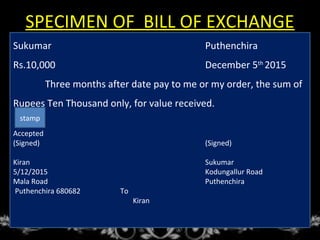
SPECIMEN OF BILL OF EXCHANGE
Sukumar Puthenchira
Rs.10,000 December 5th
2015
Three months after date pay to me or my order, the sum of
Rupees Ten Thousand only, for value received.
Accepted
(Signed) (Signed)
Kiran Sukumar
5/12/2015 Kodungallur Road
Mala Road Puthenchira
Puthenchira 680682 To
Kiran
stamp
PROMISSORY NOTE
According to the Negotiable Instruments Act
1881,Promissory note is defined as an instrument
in writing ( not being a bank note or a currency
note) containing an unconditional undertaking
signed by the maker , to pay a certain sum of
money only to or to the order of a certain person ,
or to the bearer of the instrument.
FEATURE OF A PROMISSORY NOTE
A Promissory note must be in writing.
It must contain an unconditional promise to pay.
The maker of the promissory note must sign on it.
The sum payable must be certain.
It must be payable to a certain person
It should be properly stamped
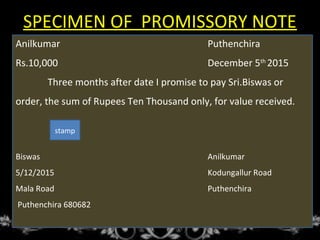
SPECIMEN OF PROMISSORY NOTE
Anilkumar Puthenchira
Rs.10,000 December 5th
2015
Three months after date I promise to pay Sri.Biswas or
order, the sum of Rupees Ten Thousand only, for value received.
Biswas Anilkumar
5/12/2015 Kodungallur Road
Mala Road Puthenchira
Puthenchira 680682
stamp
PARTIES TO A PROMISSORY NOTE
• DRAWER OR MAKER
• DRAWEE OR PAYEE
1.DRAWER OR MAKER
The person who makes or draws
the promissory note to pay a certain
amount as specified in the promissory
note. He is also called the promisor.
3.DRAWEE OR PAYEE
The person in whose favour the
promissory note is drawn . He is also called
the promisee.
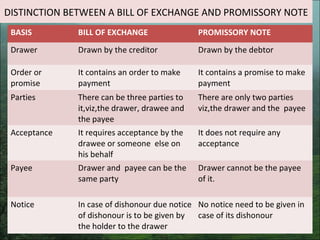
DISTINCTION BETWEEN A BILL OF EXCHANGE AND PROMISSORY NOTE
BASIS BILL OF EXCHANGE PROMISSORY NOTE
Drawer Drawn by the creditor Drawn by the debtor
Order or
promise
It contains an order to make
payment
It contains a promise to make
payment
Parties There can be three parties to
it,viz,the drawer, drawee and
the payee
There are only two parties
viz,the drawer and the payee
Acceptance It requires acceptance by the
drawee or someone else on
his behalf
It does not require any
acceptance
Payee Drawer and payee can be the
same party
Drawer cannot be the payee
of it.
Notice In case of dishonour due notice
of dishonour is to be given by
the holder to the drawer
No notice need to be given in
case of its dishonour
ADVANTAGES OF BILL OF EXCHANGE
• Framework for relationships:-It is a device, which enables
credit transaction between the seller and buyer or debtor and
creditor
• Certainty of terms and conditions:-The creditor knows the time
when he would receive the money . The debtor is also fully
aware of the date by which he has to pay the money.
• Convenient means of credit:-A bill of exchange enables the
buyer to buy the goods on credit and pay after the period of
credit
• Conclusive proof :- It is a legal evidence of a credit transaction.
• Easy transferability:-A debt can be settled by transferring a bill of
exchange through endorsement and delivery
Maturity of a Bill
The term maturity refers to the
date on which a bill of exchange
or promissory note becomes due
for payment. In arriving at the
maturity date three days, known
as days of grace, must be added
to the date on which the period
of credit expires.
Maturity of a Bill
When the date of maturity is a public holiday, the
instrument will become due on the preceding
business day.
But when an emergent holiday is declared under
negotiable instruments Act , then the maturity date
will be the next working day .
Bill of exchange

Bill of exchange

  • 2.
    ORIGIN OF BILLOF EXCHANGE In India instruments of credit have been in use since time immemorial and are popularly known as ‘Hundies’ Hundies are written in Indian languages.
  • 3.
    BILL OF EXCHANGE DEFINITION Accordingto the Negotiable Instruments Act 1881,A bill of exchange is defined as an instrument in writing containing an unconditional order , signed by the maker , directing a certain person to pay a certain sum of money only to , or to the order of a certain person or to the bearer of the instrument.
  • 4.
    FEATURES OF ABILL OF EXCHANGE A bill of exchange must be in writing. It is an order to make payment. The order to make payment is unconditional. The maker of the bill of exchange must sign on it. The payment to be made must be certain.
  • 5.
    FEATURES OF ABILL OF EXCHANGE The date on which payment is made must also be certain person. The amount is payable either on demand or on expiry of a fixed period of time. It must be stamped as per the requirement of law.
  • 6.
    PARTIES TO ABILL OF EXCHANGE • DRAWER • DRAWEE • PAYEE
  • 7.
    1.DRAWER The maker ofthe bill of exchange. A seller of creditor who is entitled to receive money from the debtor can draw a bill.
  • 8.
    2.DRAWEE The person uponwhom the payment is to be made. The drawee is the purchaser or debtor upon whom the bill of exchange is drawn.
  • 9.
    3.PAYEE Payee is theperson to whom the payment is to be made. The drawer of the bill will be the payee if he keeps the bill with him till the date of its payment. Payee in case of endorsed bill is the creditor.
  • 10.
    SPECIMEN OF BILLOF EXCHANGE Sukumar Puthenchira Rs.10,000 December 5th 2015 Three months after date pay to me or my order, the sum of Rupees Ten Thousand only, for value received. Accepted (Signed) (Signed) Kiran Sukumar 5/12/2015 Kodungallur Road Mala Road Puthenchira Puthenchira 680682 To Kiran stamp
  • 11.
    PROMISSORY NOTE According tothe Negotiable Instruments Act 1881,Promissory note is defined as an instrument in writing ( not being a bank note or a currency note) containing an unconditional undertaking signed by the maker , to pay a certain sum of money only to or to the order of a certain person , or to the bearer of the instrument.
  • 12.
    FEATURE OF APROMISSORY NOTE A Promissory note must be in writing. It must contain an unconditional promise to pay. The maker of the promissory note must sign on it. The sum payable must be certain. It must be payable to a certain person It should be properly stamped
  • 13.
    SPECIMEN OF PROMISSORYNOTE Anilkumar Puthenchira Rs.10,000 December 5th 2015 Three months after date I promise to pay Sri.Biswas or order, the sum of Rupees Ten Thousand only, for value received. Biswas Anilkumar 5/12/2015 Kodungallur Road Mala Road Puthenchira Puthenchira 680682 stamp
  • 14.
    PARTIES TO APROMISSORY NOTE • DRAWER OR MAKER • DRAWEE OR PAYEE
  • 15.
    1.DRAWER OR MAKER Theperson who makes or draws the promissory note to pay a certain amount as specified in the promissory note. He is also called the promisor.
  • 16.
    3.DRAWEE OR PAYEE Theperson in whose favour the promissory note is drawn . He is also called the promisee.
  • 17.
    DISTINCTION BETWEEN ABILL OF EXCHANGE AND PROMISSORY NOTE BASIS BILL OF EXCHANGE PROMISSORY NOTE Drawer Drawn by the creditor Drawn by the debtor Order or promise It contains an order to make payment It contains a promise to make payment Parties There can be three parties to it,viz,the drawer, drawee and the payee There are only two parties viz,the drawer and the payee Acceptance It requires acceptance by the drawee or someone else on his behalf It does not require any acceptance Payee Drawer and payee can be the same party Drawer cannot be the payee of it. Notice In case of dishonour due notice of dishonour is to be given by the holder to the drawer No notice need to be given in case of its dishonour
  • 18.
    ADVANTAGES OF BILLOF EXCHANGE • Framework for relationships:-It is a device, which enables credit transaction between the seller and buyer or debtor and creditor • Certainty of terms and conditions:-The creditor knows the time when he would receive the money . The debtor is also fully aware of the date by which he has to pay the money. • Convenient means of credit:-A bill of exchange enables the buyer to buy the goods on credit and pay after the period of credit • Conclusive proof :- It is a legal evidence of a credit transaction. • Easy transferability:-A debt can be settled by transferring a bill of exchange through endorsement and delivery
  • 19.
    Maturity of aBill The term maturity refers to the date on which a bill of exchange or promissory note becomes due for payment. In arriving at the maturity date three days, known as days of grace, must be added to the date on which the period of credit expires.
  • 20.
    Maturity of aBill When the date of maturity is a public holiday, the instrument will become due on the preceding business day. But when an emergent holiday is declared under negotiable instruments Act , then the maturity date will be the next working day .