Bill of exchange define  Bill of exchange  As per the indian negotiable Act. 1881 A bill of exchange is an instrument in writing contaning an unconditional Order, signed by the maker, directing a certain person to pay a certain sum of money only  at a specified time to a certain person or according to is order or to the bearer of the instruments.
CHARACTERISTICS OF BILL OF EXCHANGE 1. A bill must be in writing. So an oral order cannot be called a bill. 2. The bill must be addressed to a specific person. 3. The bill must be contain an order to pay money, not a request. 4. The amount shown in the bill must be definite and clear.  5. The date of writing the bill must be clear in the bill. 6. The duration of the bill must be definite.
PARTIES TO A BILL OF EXCHANGE  Normally there are three parties to a bill of exchange .
1. Drawer of the bill.
2. Acceptor \Drawee \Payer of the bill.
3.  Payee of the bill.
DETAIL OF A BILL OF EXCHANGE 1. AMOUNT 2. DATE  3. PEROID 4. SIGNATURE 5. REVENEU STAMP
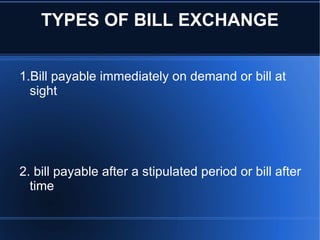
TYPES OF BILL EXCHANGE 1.Bill payable immediately on demand or bill at sight
2. bill payable after a stipulated period or bill after time
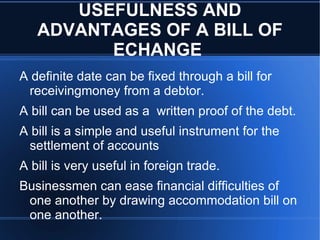
USEFULNESS AND ADVANTAGES OF A BILL OF ECHANGE  A definite date can be fixed through a bill for receivingmoney from a debtor.
A bill can be used as a  written proof of the debt.
A bill is a simple and useful instrument for the settlement of accounts

Faisalproject

  • 1.
    Bill of exchangedefine Bill of exchange As per the indian negotiable Act. 1881 A bill of exchange is an instrument in writing contaning an unconditional Order, signed by the maker, directing a certain person to pay a certain sum of money only at a specified time to a certain person or according to is order or to the bearer of the instruments.
  • 2.
    CHARACTERISTICS OF BILLOF EXCHANGE 1. A bill must be in writing. So an oral order cannot be called a bill. 2. The bill must be addressed to a specific person. 3. The bill must be contain an order to pay money, not a request. 4. The amount shown in the bill must be definite and clear. 5. The date of writing the bill must be clear in the bill. 6. The duration of the bill must be definite.
  • 3.
    PARTIES TO ABILL OF EXCHANGE Normally there are three parties to a bill of exchange .
  • 4.
    1. Drawer ofthe bill.
  • 5.
    2. Acceptor \Drawee\Payer of the bill.
  • 6.
    3. Payeeof the bill.
  • 7.
    DETAIL OF ABILL OF EXCHANGE 1. AMOUNT 2. DATE 3. PEROID 4. SIGNATURE 5. REVENEU STAMP
  • 8.
    TYPES OF BILLEXCHANGE 1.Bill payable immediately on demand or bill at sight
  • 9.
    2. bill payableafter a stipulated period or bill after time
  • 10.
    USEFULNESS AND ADVANTAGESOF A BILL OF ECHANGE A definite date can be fixed through a bill for receivingmoney from a debtor.
  • 11.
    A bill canbe used as a written proof of the debt.
  • 12.
    A bill isa simple and useful instrument for the settlement of accounts