SAJID AHAMAD T DODDAMANI
LLM (INT LAW) I SEM
MANSAGANGOTRI
MYSORE
THE NEGOTIABLE INSTRUMENT ACT
Definition:Sectin 13 of the Negotiable Instrument Act, 1881, defines a negotiable instrument as:
“A negotiable instrument means a promissory note, bill of exchange or cheque payable either to
order or to bearer.”
Meaning :Negotiable means transferable. Instrument means document. Negotiable instrument,
therefore, means a transferable document. The law relating to negotiable instruments is contained
in the Negotiable Instruments Act, 1881
• Explanation:
• The Act narrows down the meaning of instrument. It regulates only three types of instruments,
viz., Promissory Notes, Bills of Exchange and Cheques.
• A negotiable instrument is one which entitles the holder to the receipt of money. It gives him the
right to transfer the same by mere delivery or endorsement thereon. The negotiability of the
instrument continues till its maturity.
WHAT IS BILL OF EXCHANGE ?
• Bill of exchange is a type of negotiable instrument in which a written,
unconditional order made by one party (drawer) is transferred to another (the
drawee) to pay a certain sum of money, either immediately or on a fixed date as
mentioned in the bill, for payment of goods or services received. Drawee by
signing the bill accepts it and this makes the bill a post dated check. Hence a
binding contract is formed.
• In bill of exchange, there are three parties:-
1.Drawer – Drawer is the person who draws or makes the bill of exchange.
2.Drawee– Drawee includes the person upon whom the bill of exchange is
drawn.
3.Payee– Payee is that person to whom payment is to be made.
MEANING AND DEFINITION
• Section 5 of the Act defines,
“A bill of exchange is an instrument inwriting containing an
unconditional order, signed by the maker, directing a certain person to
pay a certain sum of money only to, or to the order of a certain person
or to the bearer of the instrument”.
FORMAT OF BILL OF EXCHANGE
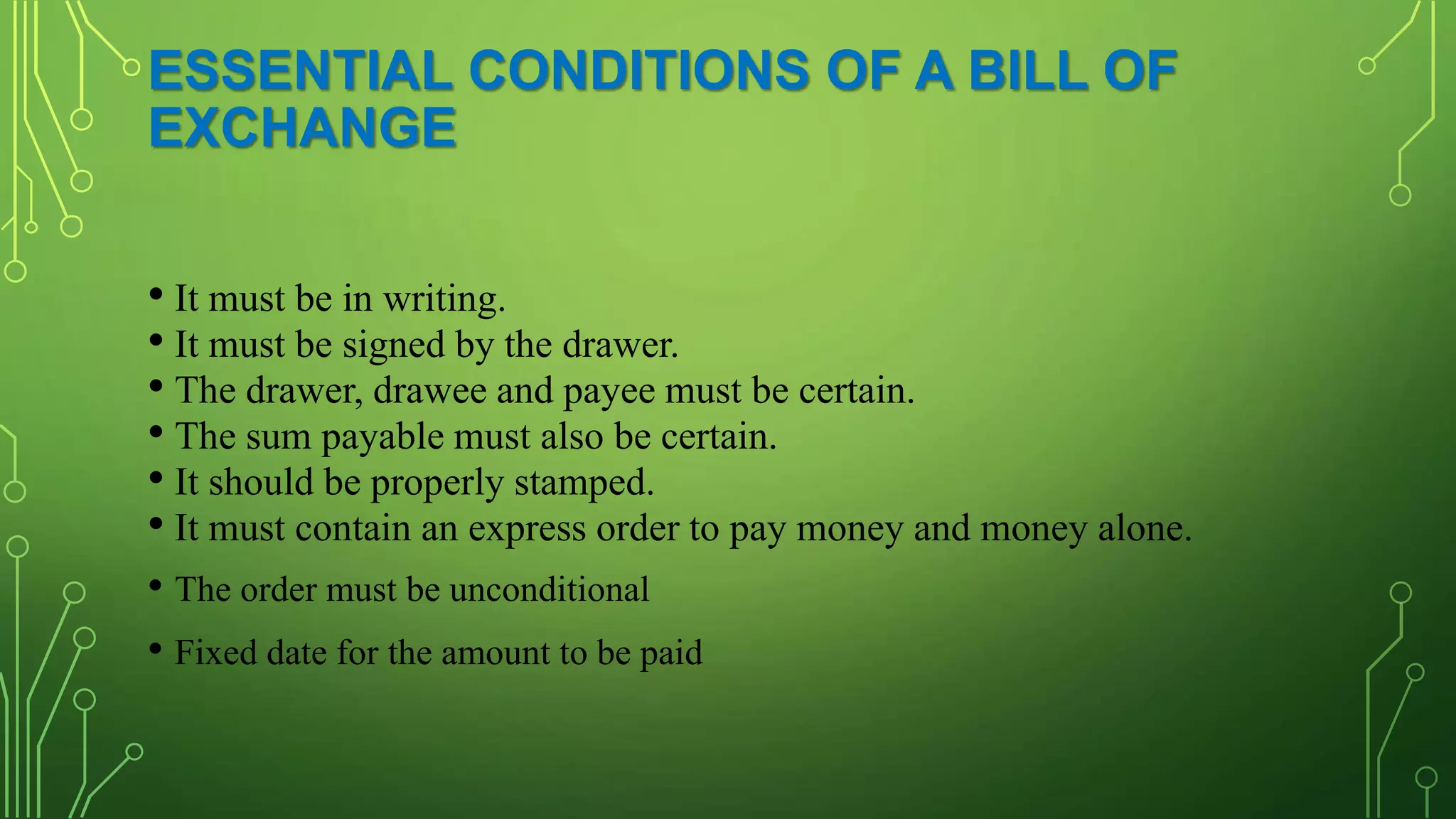
ESSENTIAL CONDITIONS OF A BILL OF
EXCHANGE
• It must be in writing.
• It must be signed by the drawer.
• The drawer, drawee and payee must be certain.
• The sum payable must also be certain.
• It should be properly stamped.
• It must contain an express order to pay money and money alone.
• The order must be unconditional
• Fixed date for the amount to be paid
TYPES
• Documentary Bill
• Demand Bill
• Usance Bill
• Inland Bill
• Clean Bill
• Foreign Bill
• Accommodation Bill
• Trade Bill
• Supply Bill
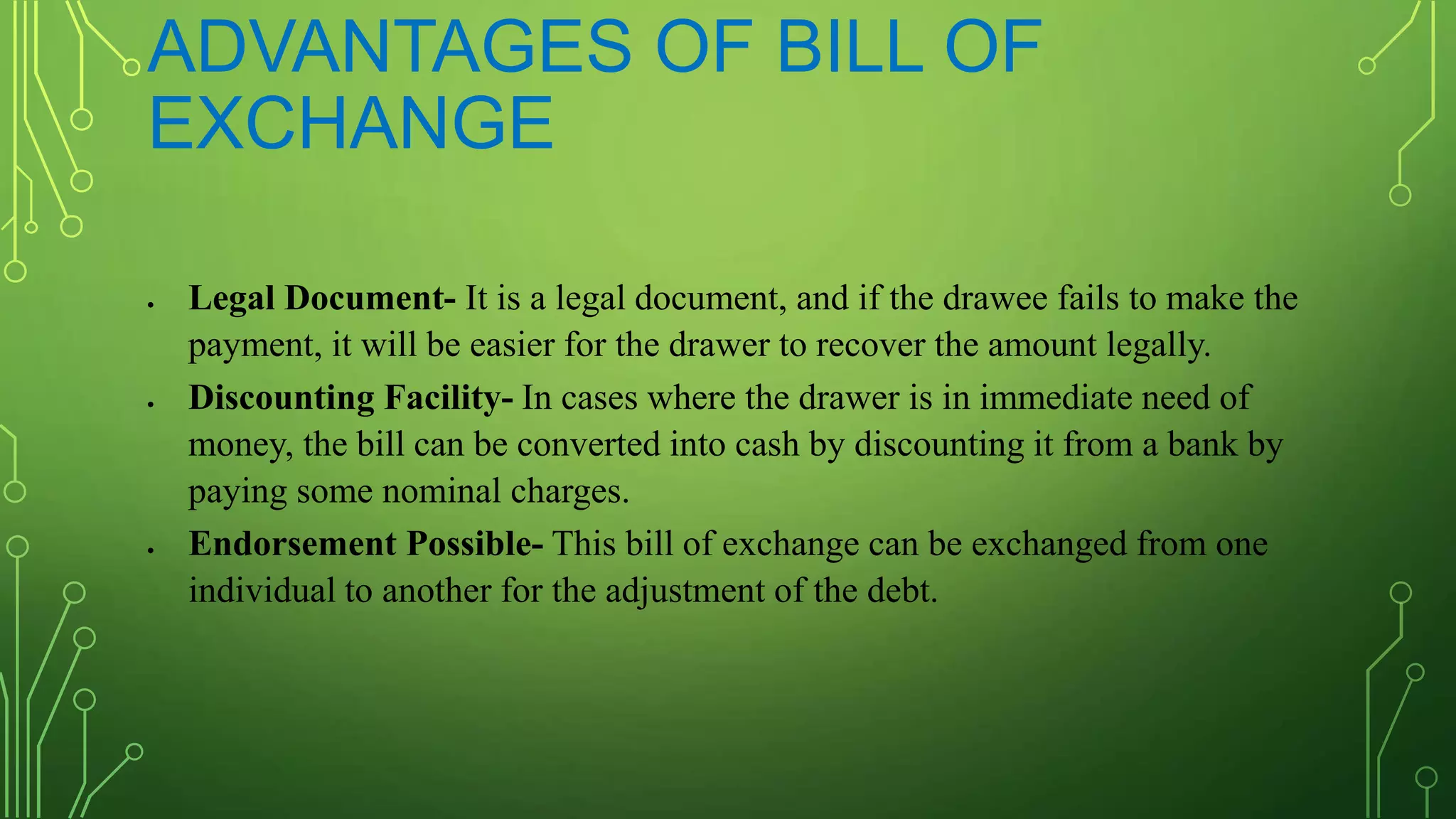
ADVANTAGES OF BILL OF
EXCHANGE
ď‚· Legal Document- It is a legal document, and if the drawee fails to make the
payment, it will be easier for the drawer to recover the amount legally.
ď‚· Discounting Facility- In cases where the drawer is in immediate need of
money, the bill can be converted into cash by discounting it from a bank by
paying some nominal charges.
ď‚· Endorsement Possible- This bill of exchange can be exchanged from one
individual to another for the adjustment of the debt.
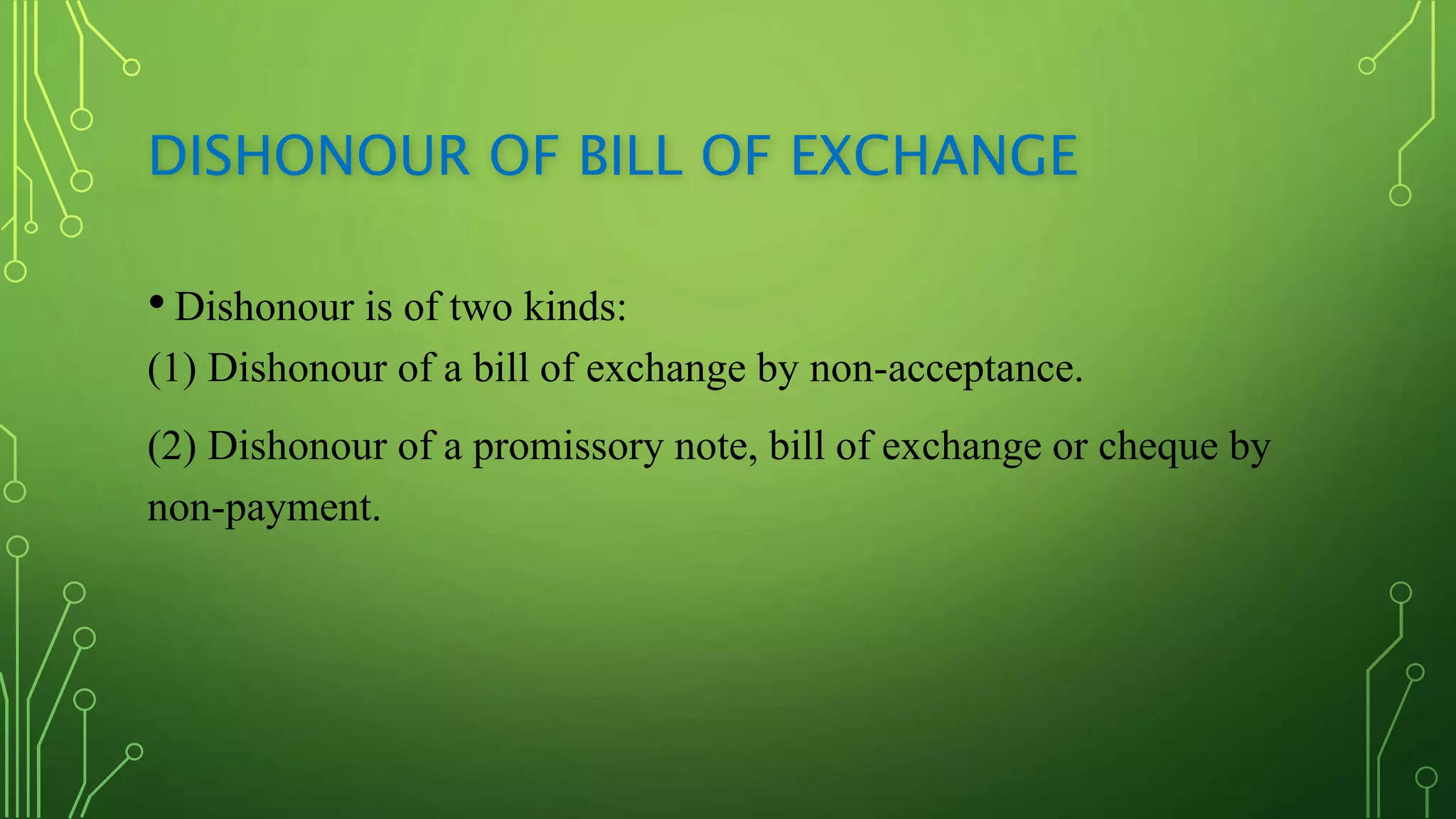
DISHONOUR OF BILL OF EXCHANGE
• Dishonour is of two kinds:
(1) Dishonour of a bill of exchange by non-acceptance.
(2) Dishonour of a promissory note, bill of exchange or cheque by
non-payment.
THE ROLE OF BILL OF EXCHANGE IN
EXPORT BUSINESS
• In an international trade, bill of exchange is a negotiable instrument made by
seller/exporter addressed to the buyer/importer.
• Once after shipping goods, the required documents for import along with bill of
exchange are submitted with exporter’s bank to send to foreign buyer through
buyer’s bank. The said bill of exchange draws in duplicate as per specified
format.
• The bill of exchange is drawn on the letter head of exporter and signs under
and sends to buyer through his bank. Once after reaching documents to
overseas buyer, he accepts bill of exchange by signing on bill of
exchange. On maturity date of bill of exchange, the buyer effects amount of
proceeds to the supplier of goods through his bank.
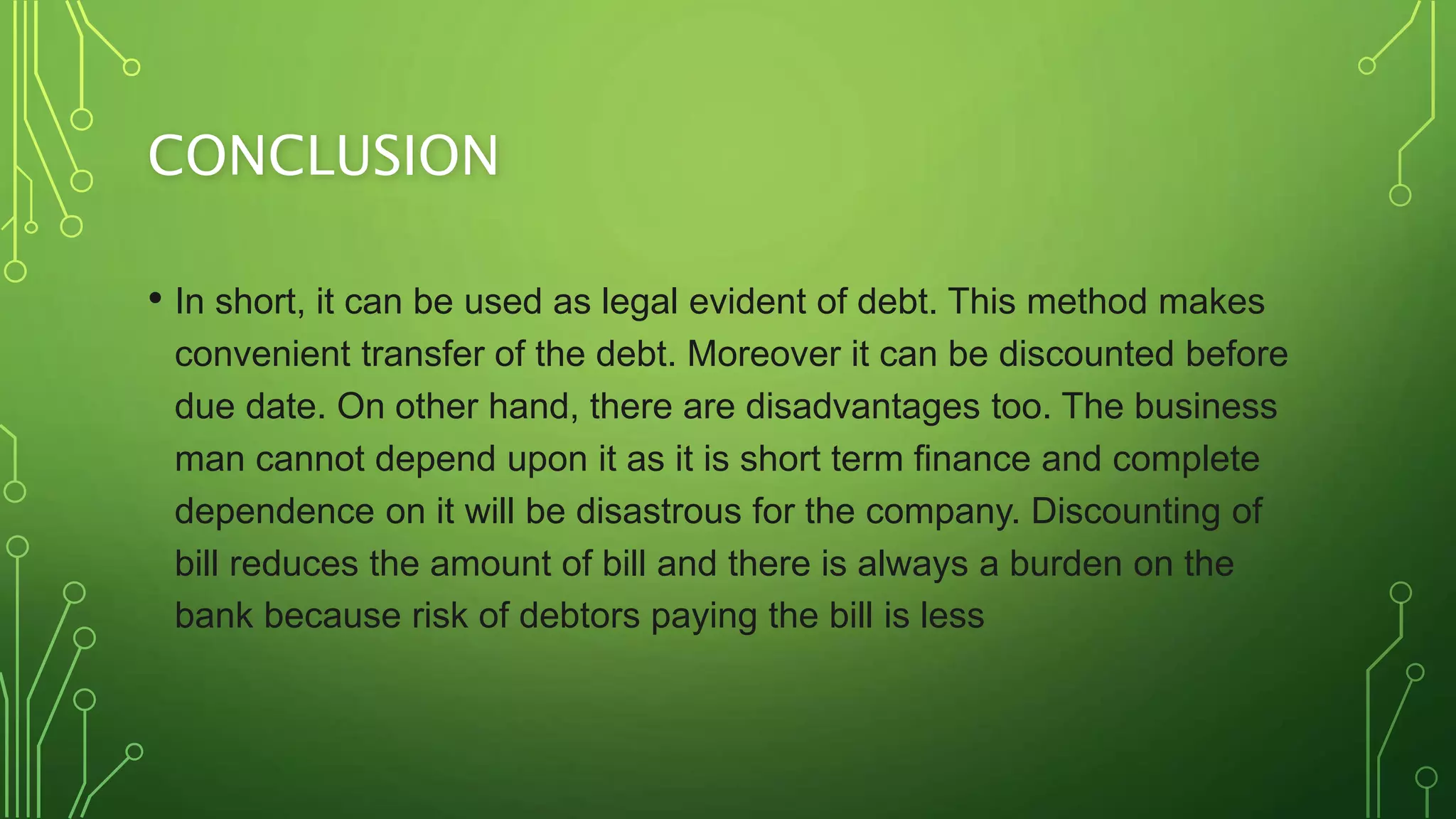
CONCLUSION
• In short, it can be used as legal evident of debt. This method makes
convenient transfer of the debt. Moreover it can be discounted before
due date. On other hand, there are disadvantages too. The business
man cannot depend upon it as it is short term finance and complete
dependence on it will be disastrous for the company. Discounting of
bill reduces the amount of bill and there is always a burden on the
bank because risk of debtors paying the bill is less

Bill of exchange

  • 1.
    SAJID AHAMAD TDODDAMANI LLM (INT LAW) I SEM MANSAGANGOTRI MYSORE
  • 2.
    THE NEGOTIABLE INSTRUMENTACT Definition:Sectin 13 of the Negotiable Instrument Act, 1881, defines a negotiable instrument as: “A negotiable instrument means a promissory note, bill of exchange or cheque payable either to order or to bearer.” Meaning :Negotiable means transferable. Instrument means document. Negotiable instrument, therefore, means a transferable document. The law relating to negotiable instruments is contained in the Negotiable Instruments Act, 1881 • Explanation: • The Act narrows down the meaning of instrument. It regulates only three types of instruments, viz., Promissory Notes, Bills of Exchange and Cheques. • A negotiable instrument is one which entitles the holder to the receipt of money. It gives him the right to transfer the same by mere delivery or endorsement thereon. The negotiability of the instrument continues till its maturity.
  • 3.
    WHAT IS BILLOF EXCHANGE ? • Bill of exchange is a type of negotiable instrument in which a written, unconditional order made by one party (drawer) is transferred to another (the drawee) to pay a certain sum of money, either immediately or on a fixed date as mentioned in the bill, for payment of goods or services received. Drawee by signing the bill accepts it and this makes the bill a post dated check. Hence a binding contract is formed. • In bill of exchange, there are three parties:- 1.Drawer – Drawer is the person who draws or makes the bill of exchange. 2.Drawee– Drawee includes the person upon whom the bill of exchange is drawn. 3.Payee– Payee is that person to whom payment is to be made.
  • 4.
    MEANING AND DEFINITION •Section 5 of the Act defines, “A bill of exchange is an instrument inwriting containing an unconditional order, signed by the maker, directing a certain person to pay a certain sum of money only to, or to the order of a certain person or to the bearer of the instrument”.
  • 5.
    FORMAT OF BILLOF EXCHANGE
  • 6.
    ESSENTIAL CONDITIONS OFA BILL OF EXCHANGE • It must be in writing. • It must be signed by the drawer. • The drawer, drawee and payee must be certain. • The sum payable must also be certain. • It should be properly stamped. • It must contain an express order to pay money and money alone. • The order must be unconditional • Fixed date for the amount to be paid
  • 7.
    TYPES • Documentary Bill •Demand Bill • Usance Bill • Inland Bill • Clean Bill • Foreign Bill • Accommodation Bill • Trade Bill • Supply Bill
  • 8.
    ADVANTAGES OF BILLOF EXCHANGE ď‚· Legal Document- It is a legal document, and if the drawee fails to make the payment, it will be easier for the drawer to recover the amount legally. ď‚· Discounting Facility- In cases where the drawer is in immediate need of money, the bill can be converted into cash by discounting it from a bank by paying some nominal charges. ď‚· Endorsement Possible- This bill of exchange can be exchanged from one individual to another for the adjustment of the debt.
  • 9.
    DISHONOUR OF BILLOF EXCHANGE • Dishonour is of two kinds: (1) Dishonour of a bill of exchange by non-acceptance. (2) Dishonour of a promissory note, bill of exchange or cheque by non-payment.
  • 10.
    THE ROLE OFBILL OF EXCHANGE IN EXPORT BUSINESS • In an international trade, bill of exchange is a negotiable instrument made by seller/exporter addressed to the buyer/importer. • Once after shipping goods, the required documents for import along with bill of exchange are submitted with exporter’s bank to send to foreign buyer through buyer’s bank. The said bill of exchange draws in duplicate as per specified format. • The bill of exchange is drawn on the letter head of exporter and signs under and sends to buyer through his bank. Once after reaching documents to overseas buyer, he accepts bill of exchange by signing on bill of exchange. On maturity date of bill of exchange, the buyer effects amount of proceeds to the supplier of goods through his bank.
  • 11.
    CONCLUSION • In short,it can be used as legal evident of debt. This method makes convenient transfer of the debt. Moreover it can be discounted before due date. On other hand, there are disadvantages too. The business man cannot depend upon it as it is short term finance and complete dependence on it will be disastrous for the company. Discounting of bill reduces the amount of bill and there is always a burden on the bank because risk of debtors paying the bill is less