Requisites of Promissory Note
Presented by Ashif Kanniyath
What is promissory note
• A promissory note is an instrument in writing.
(not being a bank note or a currency note)
• Containing an unconditional undertaking.
• Singed by the maker.
• To pay a certain sum of money.
• Only to or to the order of a certain person, or to the
bearer of the instrument.
Definition
According to Section 4, “A promissory

note is an instrument in writing (not
being a bank-note or a currency-note)
containing
an
unconditional
undertaking, signed by the maker, to
pay a certain sum of money only to, or
to the order of, a certain person, or to
the bearer of the instrument.”
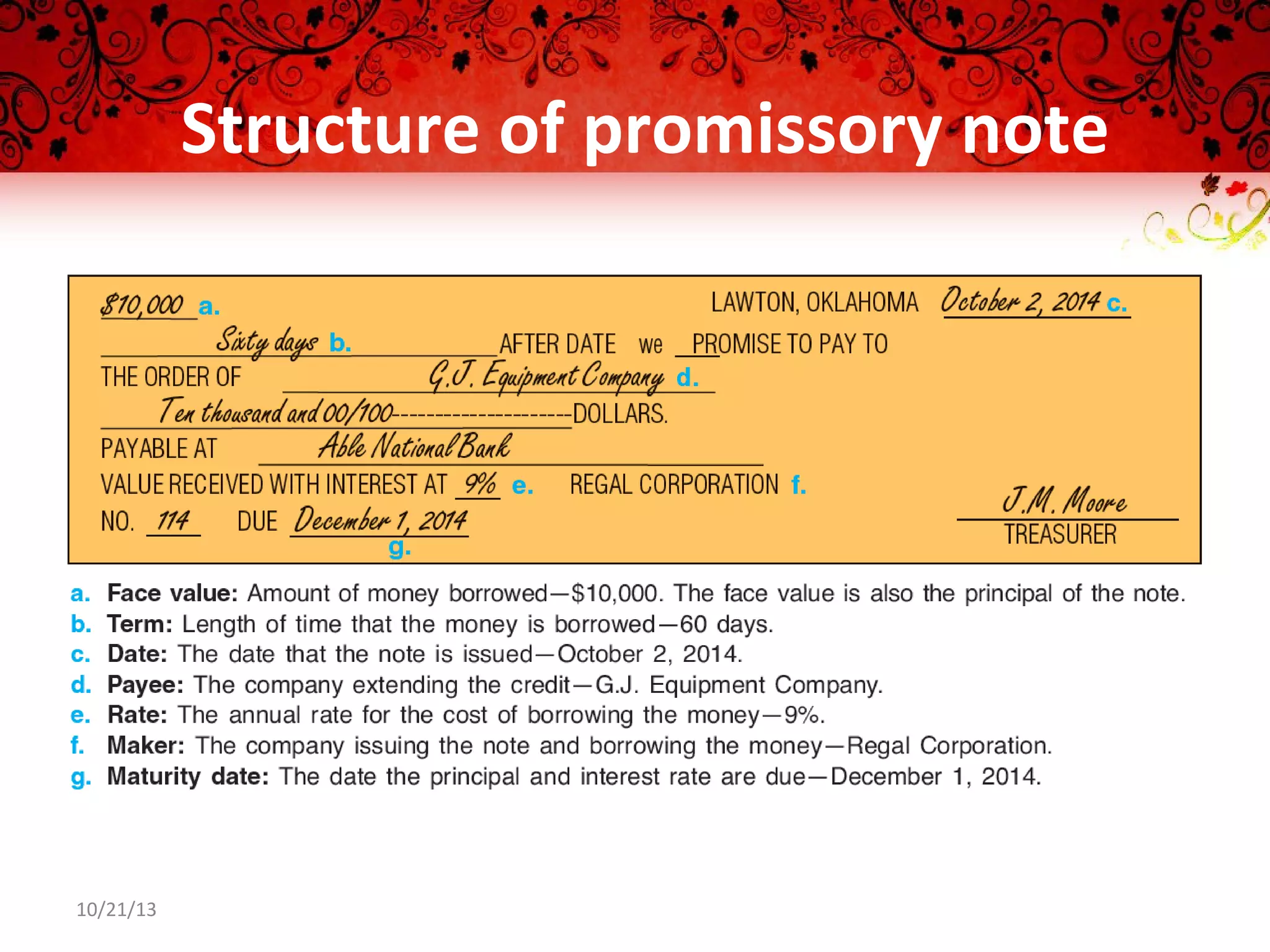
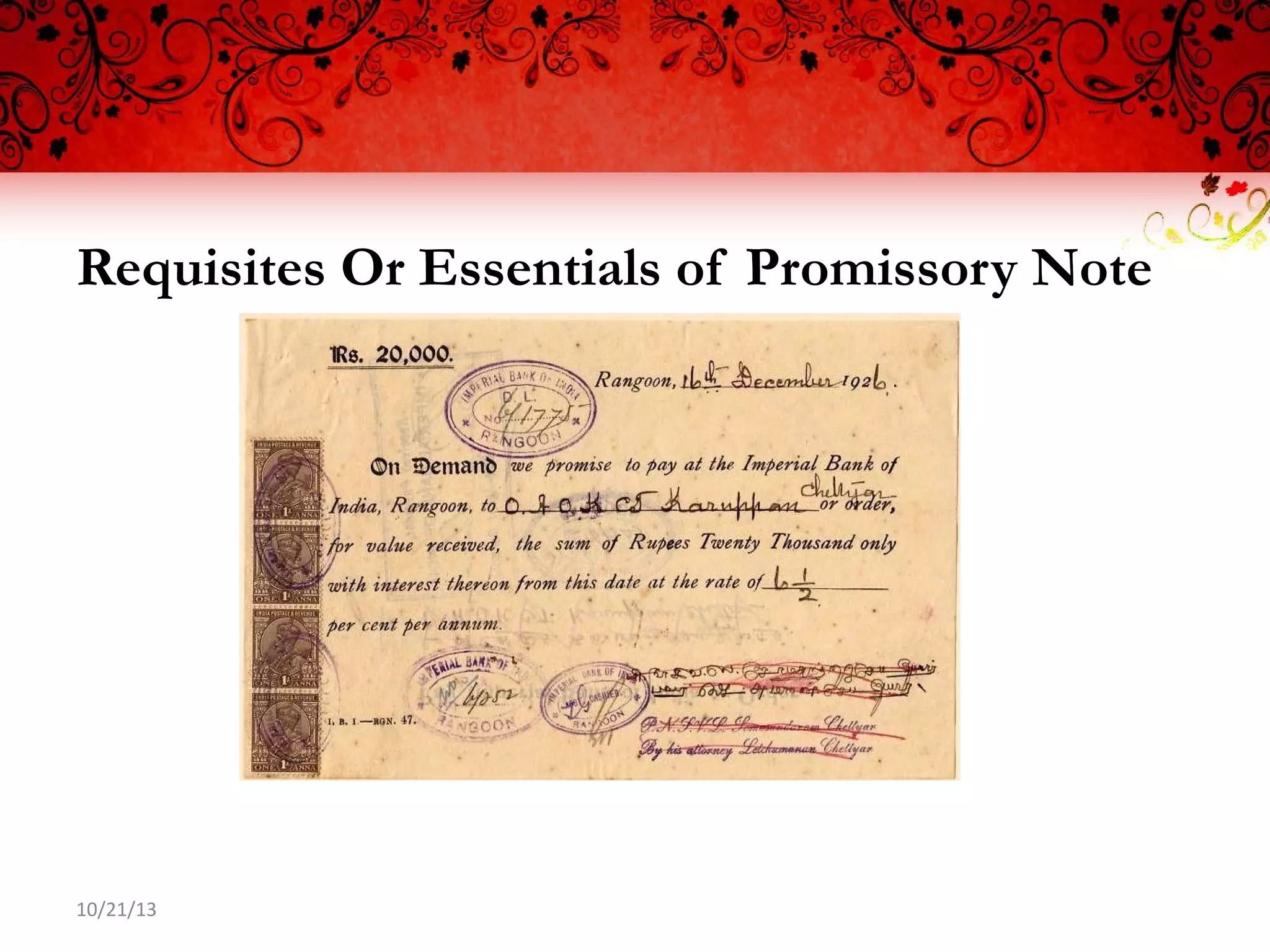
Structure of promissory note

10/21/13
Parties of a Promissory Note
There are primarily two parties involved in a
promissory note. They are:
(i) The Maker or Drawer: The person who
makes the note and promises to pay the amount
stated therein.
(ii) The Payee – The person to whom the
amount is payable.

10/21/13
Cntd:
In course of transfer of a promissory note by
payee and others, the parties involved may be –
(a) The Endorser – the person who endorses the
note in favour of another person.
(b) The Endorsee – the person in whose favour
the note is negotiated by endorsement.

10/21/13
Requisites Or Essentials of Promissory Note

10/21/13
1. It must be in writing
•
•
•
•

A promissory note has to be in writing
An oral promise to pay does not become a
promissory note
The writing may be on any paper or book
Illustrations: A signs the instruments in the
following terms:
•
•

“I promise to pay B or order Rs. 500”
“I acknowledge myself to be indebted to B in Rs. 1, 000
to be paid on demand, for value received”

Both the above instruments are valid
promissory notes.
10/21/13
2. It must contain a promise or
undertaking to pay
• There must be a promise or an undertaking to pay
• The undertaking to pay may be gathered either from express
words or by necessary implication
• A mere acknowledgement of indebtedness is not a
promissory note, although it is valid as an agreement and may
be sued upon as such
• Illustrations: A signs the instruments in the following terms:
•“Mr. B I owe you Rs. 1,000”
•“I am liable to pay to B Rs. 500”

The above instruments are not promissory notes as there is
no undertaking or promise to pay. There is only an
acknowledgement of indebtedness.
• Where A signs the instrument in the following terms:
10/21/13

•“I acknowledge myself to be indebted to B in Rs. 1, 000, to be paid on
demand, for value received,” there is a valid promissory note
3. The promise to pay must be
unconditional
• A promissory note must contain an unconditional promise to
pay
• The promise to pay must not depend upon the happening of
some uncertain event, i.e., a contingency or the fulfillment of a
condition
• Illustrations: A signs the instruments in the following terms:
• “I promise to pay B Rs. 500 seven days after my marriage with
C”
• “I promise to pay B Rs. 500 as soon as I can”
• The above instruments are not valid promissory notes as the
payment is made depending upon the happening of an uncertain
event which may never happen and as a result the sum may never
become payable
10/21/13
4. It must be signed by the maker
• It is imperative that the promissory note should
be duly authenticated by the ‘signature’ of the
maker
• ‘Signature’ means the writing or otherwise
affixing a person’s name or a mark to represent
his name, by himself or by his authority with the
intention of authenticating a document.

10/21/13
5. The maker must be a certain person
• The instrument must itself indicate with
certainty who is the person or are the persons
engaging himself or themselves to pay
• Alternative promisors are not permitted in law
because of the general rule that “where liability
lies no ambiguity must lie”

10/21/13
6. The payee must be certain
• Like the maker the payee of a pronote must also
be certain on the face of the instrument
• A note in favour of fictitious person is illegal
and void
• A pronote mad epayable to the maker himself is
a nullity, the reason being the same person is
both the promisor and the promisee

10/21/13
7. The sum payable must be certain
• For a valid pronote it is also essential that the sum of money
promised to be payable must be certain and definite
• The amount payable must not be capable of contingent
additions or subtractions
• Illustrations: A signs the instruments in the following terms:
• “I promise to pay B Rs. 500 and all other sums which shall be
due to him”
• “I promise to pay B Rs. 500, first deducting thereout any
money which he may owe me”
• The above instruments are invalid as promissory notes because
the exact amount to be paid by A is not certain.
10/21/13
8. The amount payable must be in legal
tender money of India
• A document containing a promise to pay a
certain amount of foreign money or to deliver a
certain quantity of goods is not a pronote.

10/21/13
Thank You

Promissory note ppt, negotiable instrument act.

  • 1.
    Requisites of PromissoryNote Presented by Ashif Kanniyath
  • 2.
    What is promissorynote • A promissory note is an instrument in writing. (not being a bank note or a currency note) • Containing an unconditional undertaking. • Singed by the maker. • To pay a certain sum of money. • Only to or to the order of a certain person, or to the bearer of the instrument.
  • 3.
    Definition According to Section4, “A promissory note is an instrument in writing (not being a bank-note or a currency-note) containing an unconditional undertaking, signed by the maker, to pay a certain sum of money only to, or to the order of, a certain person, or to the bearer of the instrument.”
  • 4.
  • 5.
    Parties of aPromissory Note There are primarily two parties involved in a promissory note. They are: (i) The Maker or Drawer: The person who makes the note and promises to pay the amount stated therein. (ii) The Payee – The person to whom the amount is payable. 10/21/13
  • 6.
    Cntd: In course oftransfer of a promissory note by payee and others, the parties involved may be – (a) The Endorser – the person who endorses the note in favour of another person. (b) The Endorsee – the person in whose favour the note is negotiated by endorsement. 10/21/13
  • 7.
    Requisites Or Essentialsof Promissory Note 10/21/13
  • 8.
    1. It mustbe in writing • • • • A promissory note has to be in writing An oral promise to pay does not become a promissory note The writing may be on any paper or book Illustrations: A signs the instruments in the following terms: • • “I promise to pay B or order Rs. 500” “I acknowledge myself to be indebted to B in Rs. 1, 000 to be paid on demand, for value received” Both the above instruments are valid promissory notes. 10/21/13
  • 9.
    2. It mustcontain a promise or undertaking to pay • There must be a promise or an undertaking to pay • The undertaking to pay may be gathered either from express words or by necessary implication • A mere acknowledgement of indebtedness is not a promissory note, although it is valid as an agreement and may be sued upon as such • Illustrations: A signs the instruments in the following terms: •“Mr. B I owe you Rs. 1,000” •“I am liable to pay to B Rs. 500” The above instruments are not promissory notes as there is no undertaking or promise to pay. There is only an acknowledgement of indebtedness. • Where A signs the instrument in the following terms: 10/21/13 •“I acknowledge myself to be indebted to B in Rs. 1, 000, to be paid on demand, for value received,” there is a valid promissory note
  • 10.
    3. The promiseto pay must be unconditional • A promissory note must contain an unconditional promise to pay • The promise to pay must not depend upon the happening of some uncertain event, i.e., a contingency or the fulfillment of a condition • Illustrations: A signs the instruments in the following terms: • “I promise to pay B Rs. 500 seven days after my marriage with C” • “I promise to pay B Rs. 500 as soon as I can” • The above instruments are not valid promissory notes as the payment is made depending upon the happening of an uncertain event which may never happen and as a result the sum may never become payable 10/21/13
  • 11.
    4. It mustbe signed by the maker • It is imperative that the promissory note should be duly authenticated by the ‘signature’ of the maker • ‘Signature’ means the writing or otherwise affixing a person’s name or a mark to represent his name, by himself or by his authority with the intention of authenticating a document. 10/21/13
  • 12.
    5. The makermust be a certain person • The instrument must itself indicate with certainty who is the person or are the persons engaging himself or themselves to pay • Alternative promisors are not permitted in law because of the general rule that “where liability lies no ambiguity must lie” 10/21/13
  • 13.
    6. The payeemust be certain • Like the maker the payee of a pronote must also be certain on the face of the instrument • A note in favour of fictitious person is illegal and void • A pronote mad epayable to the maker himself is a nullity, the reason being the same person is both the promisor and the promisee 10/21/13
  • 14.
    7. The sumpayable must be certain • For a valid pronote it is also essential that the sum of money promised to be payable must be certain and definite • The amount payable must not be capable of contingent additions or subtractions • Illustrations: A signs the instruments in the following terms: • “I promise to pay B Rs. 500 and all other sums which shall be due to him” • “I promise to pay B Rs. 500, first deducting thereout any money which he may owe me” • The above instruments are invalid as promissory notes because the exact amount to be paid by A is not certain. 10/21/13
  • 15.
    8. The amountpayable must be in legal tender money of India • A document containing a promise to pay a certain amount of foreign money or to deliver a certain quantity of goods is not a pronote. 10/21/13
  • 16.