Traveling Wave
Transient Overvoltages
• Any disturbance on a transmission line or system such
as sudden opening or closing of a line, a short circuit
or a fault results in the development of over voltages
or over currents at that point
• disturbance propagates as a travelling wave to the ends
of the line or to a termination, such as, a sub-station.
• these travelling waves are high frequency disturbances
and travel as waves
• They may be reflected, transmitted, attenuated or
distorted during propagation until the energy is
absorbed.
Traveling Wave
• Disturbance represented by closing
or opening the switch S.
• If Switch S closed, the line suddenly
connected to the source.
• The whole line is not energized
instantaneously.
• Processed :
– When Switch S closed
– The first capacitor becomes
charged immediately
– Because of the first series inductor
(acts as open circuit), the second
capacitor is delayed
• This gradual buildup of voltage over
the line conductor can be regarded
as a voltage wave is traveling from
one end to the other end
2.1 Velocity of Surge Propagation
• In the air  = 300 000 km/s
•  = 1/(LC) m/s
• Inductance single conductor Overhead Line (assuming zero
ground resistivity) :
L=2 x 10⁻⁷ ln (2h/r) H/m
C=1/[18 x 109 ln(2h/r)] F/m
•
• In the cable :  = 1/(LC) = 3 x 10⁸ K m/s
K=dielectric constant (2.5 to 4.0)
 
 
1
2
/
1
9
7
/
2
ln
10
18
/
2
ln
10
2
1






















r
h
r
h
LC
v
Attenuation and Distortion of Travelling
Waves
• The decrease in the magnitude of the wave as it
propagates along the line is called attenuation
• The elongation or change of wave shape that
occurs is called distortion
• Sometimes, the steepness of the wave is reduced
by distortion.
• Attenuation is caused due to the energy loss in
the line and distortion is caused due to the
inductance and capacitance of the line
• The changes in the inductance are due to the skin
effect, the proximity effect and the non-uniform
distribution effect of currents, and the nearness to
steel structures such as transmission towers.
• The variation is capacitance is due to capacitance
change in the insulation nearest to the ground
structures etc
• The other factor that contributes for the attenuation
and distortion is the corona on the lines.
Reflection and Transmission of Waves
at Transition Points
• Whenever there is an abrupt change in the parameters of a
transmission line, such as an open circuit or a termination,
the travelling wave undergoes a transition
• part of the wave is reflected or sent back and only a
portion is transmitted forward.
• At the transition point, the voltage or current wave may
attain a value which can vary from zero to two times its
initial value
• The incoming wave is called the incident wave and
• the other waves are called the reflected and transmitted
waves at the transition point
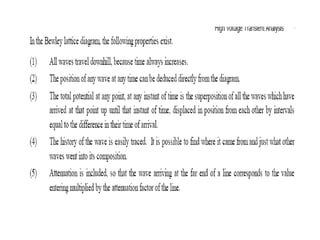
Bewley Lattice Diagram
• This diagram shows at a glance the position and
direction of motion of every incident, reflected, and
transmitted wave on the system at every instant of
time.
• The diagram overcomes the difficulty of otherwise
keeping track of the multiplicity of successive
reflections at the various junctions.
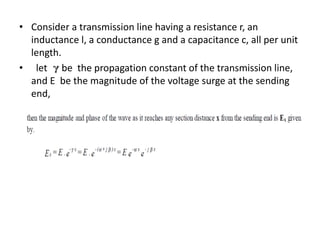
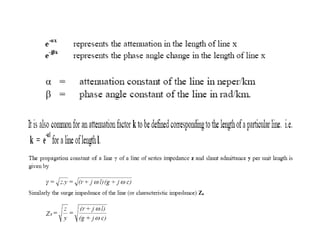
• Consider a transmission line having a resistance r, an
inductance l, a conductance g and a capacitance c, all per unit
length.
• let be the propagation constant of the transmission line,
and E be the magnitude of the voltage surge at the sending
end,
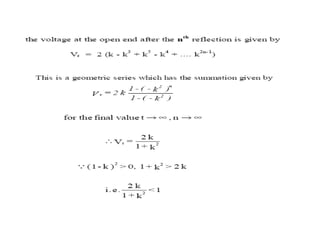
Analysis of an open-circuit line fed
from ideal source
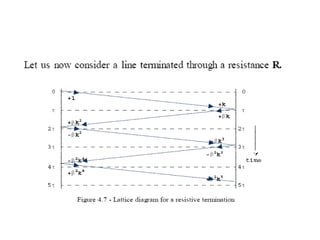
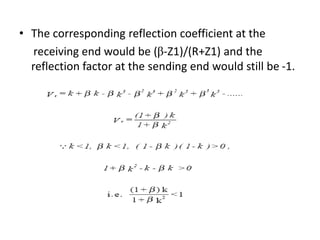
• The corresponding reflection coefficient at the
receiving end would be (β-Z1)/(R+Z1) and the
reflection factor at the sending end would still be -1.
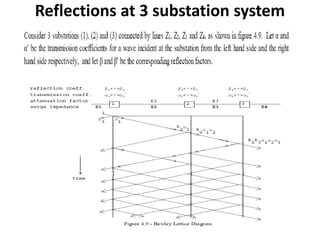
Reflections at 3 substation system

lattice diagram.ppt

  • 1.
  • 2.
    • Any disturbanceon a transmission line or system such as sudden opening or closing of a line, a short circuit or a fault results in the development of over voltages or over currents at that point • disturbance propagates as a travelling wave to the ends of the line or to a termination, such as, a sub-station. • these travelling waves are high frequency disturbances and travel as waves • They may be reflected, transmitted, attenuated or distorted during propagation until the energy is absorbed.
  • 3.
    Traveling Wave • Disturbancerepresented by closing or opening the switch S. • If Switch S closed, the line suddenly connected to the source. • The whole line is not energized instantaneously. • Processed : – When Switch S closed – The first capacitor becomes charged immediately – Because of the first series inductor (acts as open circuit), the second capacitor is delayed • This gradual buildup of voltage over the line conductor can be regarded as a voltage wave is traveling from one end to the other end
  • 4.
    2.1 Velocity ofSurge Propagation • In the air  = 300 000 km/s •  = 1/(LC) m/s • Inductance single conductor Overhead Line (assuming zero ground resistivity) : L=2 x 10⁻⁷ ln (2h/r) H/m C=1/[18 x 109 ln(2h/r)] F/m • • In the cable :  = 1/(LC) = 3 x 10⁸ K m/s K=dielectric constant (2.5 to 4.0)     1 2 / 1 9 7 / 2 ln 10 18 / 2 ln 10 2 1                       r h r h LC v
  • 5.
    Attenuation and Distortionof Travelling Waves • The decrease in the magnitude of the wave as it propagates along the line is called attenuation • The elongation or change of wave shape that occurs is called distortion • Sometimes, the steepness of the wave is reduced by distortion. • Attenuation is caused due to the energy loss in the line and distortion is caused due to the inductance and capacitance of the line
  • 6.
    • The changesin the inductance are due to the skin effect, the proximity effect and the non-uniform distribution effect of currents, and the nearness to steel structures such as transmission towers. • The variation is capacitance is due to capacitance change in the insulation nearest to the ground structures etc • The other factor that contributes for the attenuation and distortion is the corona on the lines.
  • 7.
    Reflection and Transmissionof Waves at Transition Points • Whenever there is an abrupt change in the parameters of a transmission line, such as an open circuit or a termination, the travelling wave undergoes a transition • part of the wave is reflected or sent back and only a portion is transmitted forward. • At the transition point, the voltage or current wave may attain a value which can vary from zero to two times its initial value • The incoming wave is called the incident wave and • the other waves are called the reflected and transmitted waves at the transition point
  • 8.
    Bewley Lattice Diagram •This diagram shows at a glance the position and direction of motion of every incident, reflected, and transmitted wave on the system at every instant of time. • The diagram overcomes the difficulty of otherwise keeping track of the multiplicity of successive reflections at the various junctions.
  • 9.
    • Consider atransmission line having a resistance r, an inductance l, a conductance g and a capacitance c, all per unit length. • let be the propagation constant of the transmission line, and E be the magnitude of the voltage surge at the sending end,
  • 12.
    Analysis of anopen-circuit line fed from ideal source
  • 15.
    • The correspondingreflection coefficient at the receiving end would be (β-Z1)/(R+Z1) and the reflection factor at the sending end would still be -1.
  • 16.
    Reflections at 3substation system