A Behavioral Science Perspective
WHY EXECUTIVES UNDERINVEST
IN CYBERSECURITY
HackerOne + ideas42 Webinar | October 10, 2017
© 2017 ideas42 2
We use insights from the behavioral sciences
to design solutions to some of the world’s most persistent
social problems.
What is ?
© 2017 ideas42 3
WHAT WE’LL
COVER
TODAY • Dive into why executives underinvest in
cybersecurity
• Examine using the lens of behavioral
science
• Point to steps security executives and
professionals can take to motivate decision
makers to invest more in cybersecurity
© 2017 ideas42 4
WE DID OUR RESEARCH!
60+ Expert Interviews
120+ Research Articles
© 2017 ideas42 5
A QUICK PRIMER ON BEHAVIORAL SCIENCE
odd choice.
© 2017 ideas42 6
© 2015 ideas42 6
4 behavioral reasons
why executives underinvest in cybersecurity
and what you can do about it
© 2017 ideas42 7
© 2015 ideas42 7
1. Thinking about risk differently
© 2017 ideas42 8
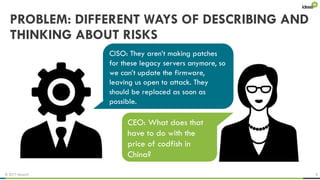
CISO: They aren’t making patches
for these legacy servers anymore, so
we can’t update the firmware,
leaving us open to attack. They
should be replaced as soon as
possible.
PROBLEM: DIFFERENT WAYS OF DESCRIBING AND
THINKING ABOUT RISKS
CEO: What does that
have to do with the
price of codfish in
China?
© 2017 ideas42 9
PROBLEM: DIFFERENT WAYS OF DESCRIBING AND
THINKING ABOUT RISKS
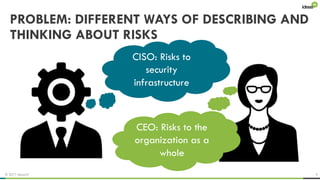
CISO: Risks to
security
infrastructure
CEO: Risks to the
organization as a
whole
© 2017 ideas42 10
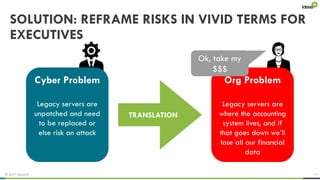
SOLUTION: REFRAME RISKS IN VIVID TERMS FOR
EXECUTIVES
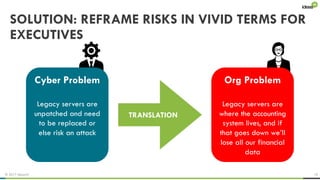
Cyber Problem
Legacy servers are
unpatched and need
to be replaced or
else risk an attack
Org Problem
Legacy servers are
where the accounting
system lives, and if
that goes down we’ll
lose all our financial
data
TRANSLATION
© 2017 ideas42 11
SOLUTION: REFRAME RISKS IN VIVID TERMS FOR
EXECUTIVES
Cyber Problem
Legacy servers are
unpatched and need
to be replaced or
else risk an attack
Org Problem
Legacy servers are
where the accounting
system lives, and if
that goes down we’ll
lose all our financial
data
TRANSLATION
Ok, take my
$$$
© 2017 ideas42 12
© 2015 ideas42 12
2. Opposing mental models
© 2017 ideas42 13
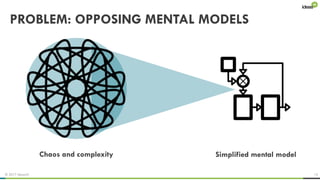
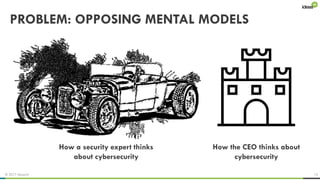
PROBLEM: OPPOSING MENTAL MODELS
Chaos and complexity Simplified mental model
© 2017 ideas42 14
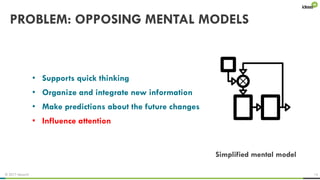
PROBLEM: OPPOSING MENTAL MODELS
Simplified mental model
• Supports quick thinking
• Organize and integrate new information
• Make predictions about the future changes
• Influence attention
© 2017 ideas42 15
PROBLEM: OPPOSING MENTAL MODELS
How a security expert thinks
about cybersecurity
How the CEO thinks about
cybersecurity
© 2017 ideas42 16
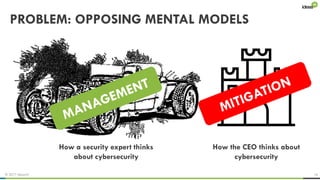
PROBLEM: OPPOSING MENTAL MODELS
How a security expert thinks
about cybersecurity
How the CEO thinks about
cybersecurity
© 2017 ideas42 17
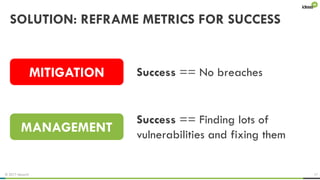
SOLUTION: REFRAME METRICS FOR SUCCESS
MITIGATION
MANAGEMENT
Success == No breaches
Success == Finding lots of
vulnerabilities and fixing them
© 2017 ideas42 18
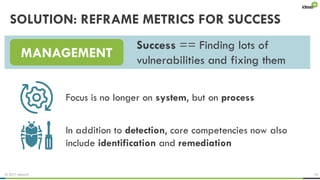
SOLUTION: REFRAME METRICS FOR SUCCESS
MANAGEMENT
Success == Finding lots of
vulnerabilities and fixing them
Focus is no longer on system, but on process
In addition to detection, core competencies now also
include identification and remediation
© 2017 ideas42 19
© 2015 ideas42 19
3. Overconfidence in current investments
© 2017 ideas42 20
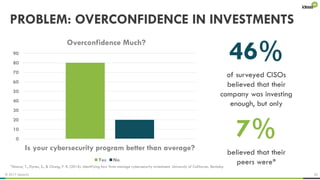
PROBLEM: OVERCONFIDENCE IN INVESTMENTS
0
10
20
30
40
50
60
70
80
90
Is your cybersecurity program better than average?
Overconfidence Much?
Yes No
46%
of surveyed CISOs
believed that their
company was investing
enough, but only
7%
believed that their
peers were**Moore, T., Dynes, S., & Chang, F. R. (2016). Identifying how firms manage cybersecurity investment. University of California, Berkeley.
© 2017 ideas42 21
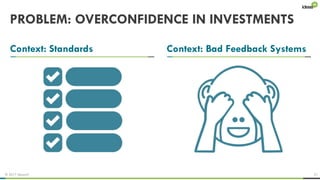
PROBLEM: OVERCONFIDENCE IN INVESTMENTS
Context: Standards Context: Bad Feedback Systems
© 2017 ideas42 22
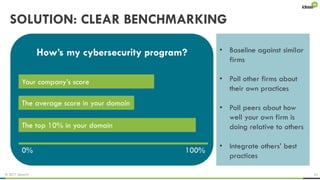
SOLUTION: CLEAR BENCHMARKING
0% 100%
Your company’s score
The average score in your domain
The top 10% in your domain
How’s my cybersecurity program? • Baseline against similar
firms
• Poll other firms about
their own practices
• Poll peers about how
well your own firm is
doing relative to others
• Integrate others’ best
practices
© 2017 ideas42 23
© 2015 ideas42 23
4. Attention is on the wrong things
© 2017 ideas42 24
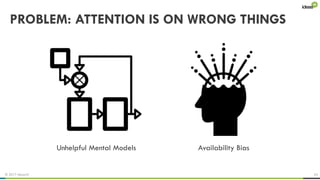
PROBLEM: ATTENTION IS ON WRONG THINGS
Unhelpful Mental Models Availability Bias
© 2017 ideas42 25
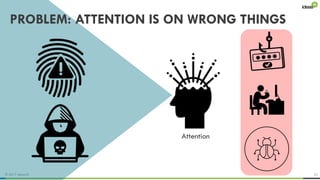
Attention
PROBLEM: ATTENTION IS ON WRONG THINGS
© 2017 ideas42 26
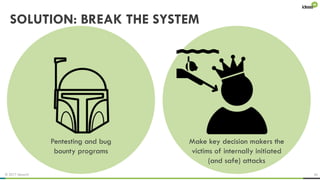
SOLUTION: BREAK THE SYSTEM
Pentesting and bug
bounty programs
Make key decision makers the
victims of internally initiated
(and safe) attacks
© 2017 ideas42 27
© 2015 ideas42 27
To summarize…
© 2017 ideas42 28
FOUR KEY TAKEAWAYS FOR INCREASING
EXECUTIVE INVESTMENT IN CYBER
Vividly connect cyber risks to organizational risks for execs
Use process metrics as opposed to outcome metrics to ”fix”
executives mental models about cyber programs
Survey your peers to help curb overconfidence
Break the system (with help)!
© 2017 ideas42 29
TO LEARN MORE!
Check out: Deep Thought: A Cybersecurity
Story at ideas42.org/cyber
Check out:
The Behavioral
Economics of Why
Executives Underinvest
in Cybersecurity
at HBR.org
© 2017 ideas42 30
THANK YOU!
ablau@ideas42.org
Q&A

Why Executives Underinvest In Cybersecurity

  • 1.
    A Behavioral SciencePerspective WHY EXECUTIVES UNDERINVEST IN CYBERSECURITY HackerOne + ideas42 Webinar | October 10, 2017
  • 2.
    © 2017 ideas422 We use insights from the behavioral sciences to design solutions to some of the world’s most persistent social problems. What is ?
  • 3.
    © 2017 ideas423 WHAT WE’LL COVER TODAY • Dive into why executives underinvest in cybersecurity • Examine using the lens of behavioral science • Point to steps security executives and professionals can take to motivate decision makers to invest more in cybersecurity
  • 4.
    © 2017 ideas424 WE DID OUR RESEARCH! 60+ Expert Interviews 120+ Research Articles
  • 5.
    © 2017 ideas425 A QUICK PRIMER ON BEHAVIORAL SCIENCE odd choice.
  • 6.
    © 2017 ideas426 © 2015 ideas42 6 4 behavioral reasons why executives underinvest in cybersecurity and what you can do about it
  • 7.
    © 2017 ideas427 © 2015 ideas42 7 1. Thinking about risk differently
  • 8.
    © 2017 ideas428 CISO: They aren’t making patches for these legacy servers anymore, so we can’t update the firmware, leaving us open to attack. They should be replaced as soon as possible. PROBLEM: DIFFERENT WAYS OF DESCRIBING AND THINKING ABOUT RISKS CEO: What does that have to do with the price of codfish in China?
  • 9.
    © 2017 ideas429 PROBLEM: DIFFERENT WAYS OF DESCRIBING AND THINKING ABOUT RISKS CISO: Risks to security infrastructure CEO: Risks to the organization as a whole
  • 10.
    © 2017 ideas4210 SOLUTION: REFRAME RISKS IN VIVID TERMS FOR EXECUTIVES Cyber Problem Legacy servers are unpatched and need to be replaced or else risk an attack Org Problem Legacy servers are where the accounting system lives, and if that goes down we’ll lose all our financial data TRANSLATION
  • 11.
    © 2017 ideas4211 SOLUTION: REFRAME RISKS IN VIVID TERMS FOR EXECUTIVES Cyber Problem Legacy servers are unpatched and need to be replaced or else risk an attack Org Problem Legacy servers are where the accounting system lives, and if that goes down we’ll lose all our financial data TRANSLATION Ok, take my $$$
  • 12.
    © 2017 ideas4212 © 2015 ideas42 12 2. Opposing mental models
  • 13.
    © 2017 ideas4213 PROBLEM: OPPOSING MENTAL MODELS Chaos and complexity Simplified mental model
  • 14.
    © 2017 ideas4214 PROBLEM: OPPOSING MENTAL MODELS Simplified mental model • Supports quick thinking • Organize and integrate new information • Make predictions about the future changes • Influence attention
  • 15.
    © 2017 ideas4215 PROBLEM: OPPOSING MENTAL MODELS How a security expert thinks about cybersecurity How the CEO thinks about cybersecurity
  • 16.
    © 2017 ideas4216 PROBLEM: OPPOSING MENTAL MODELS How a security expert thinks about cybersecurity How the CEO thinks about cybersecurity
  • 17.
    © 2017 ideas4217 SOLUTION: REFRAME METRICS FOR SUCCESS MITIGATION MANAGEMENT Success == No breaches Success == Finding lots of vulnerabilities and fixing them
  • 18.
    © 2017 ideas4218 SOLUTION: REFRAME METRICS FOR SUCCESS MANAGEMENT Success == Finding lots of vulnerabilities and fixing them Focus is no longer on system, but on process In addition to detection, core competencies now also include identification and remediation
  • 19.
    © 2017 ideas4219 © 2015 ideas42 19 3. Overconfidence in current investments
  • 20.
    © 2017 ideas4220 PROBLEM: OVERCONFIDENCE IN INVESTMENTS 0 10 20 30 40 50 60 70 80 90 Is your cybersecurity program better than average? Overconfidence Much? Yes No 46% of surveyed CISOs believed that their company was investing enough, but only 7% believed that their peers were**Moore, T., Dynes, S., & Chang, F. R. (2016). Identifying how firms manage cybersecurity investment. University of California, Berkeley.
  • 21.
    © 2017 ideas4221 PROBLEM: OVERCONFIDENCE IN INVESTMENTS Context: Standards Context: Bad Feedback Systems
  • 22.
    © 2017 ideas4222 SOLUTION: CLEAR BENCHMARKING 0% 100% Your company’s score The average score in your domain The top 10% in your domain How’s my cybersecurity program? • Baseline against similar firms • Poll other firms about their own practices • Poll peers about how well your own firm is doing relative to others • Integrate others’ best practices
  • 23.
    © 2017 ideas4223 © 2015 ideas42 23 4. Attention is on the wrong things
  • 24.
    © 2017 ideas4224 PROBLEM: ATTENTION IS ON WRONG THINGS Unhelpful Mental Models Availability Bias
  • 25.
    © 2017 ideas4225 Attention PROBLEM: ATTENTION IS ON WRONG THINGS
  • 26.
    © 2017 ideas4226 SOLUTION: BREAK THE SYSTEM Pentesting and bug bounty programs Make key decision makers the victims of internally initiated (and safe) attacks
  • 27.
    © 2017 ideas4227 © 2015 ideas42 27 To summarize…
  • 28.
    © 2017 ideas4228 FOUR KEY TAKEAWAYS FOR INCREASING EXECUTIVE INVESTMENT IN CYBER Vividly connect cyber risks to organizational risks for execs Use process metrics as opposed to outcome metrics to ”fix” executives mental models about cyber programs Survey your peers to help curb overconfidence Break the system (with help)!
  • 29.
    © 2017 ideas4229 TO LEARN MORE! Check out: Deep Thought: A Cybersecurity Story at ideas42.org/cyber Check out: The Behavioral Economics of Why Executives Underinvest in Cybersecurity at HBR.org
  • 30.
    © 2017 ideas4230 THANK YOU! ablau@ideas42.org
  • 31.