



Big Data in term of
security measure For Hadoop
Environments
Yaakub Bin Idris
Advanced Informatics School
Malaysia University of Technology
Kuala Lumpur, Malaysia
yaakub.idris@gmail.com
INTERNET SECURITY THREAT REPORT
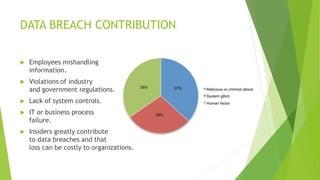
DATA BREACH CONTRIBUTION
 Employees mishandling
information.
 Violations of industry
and government regulations.
 Lack of system controls.
 IT or business process
failure.
 Insiders greatly contribute
to data breaches and that
loss can be costly to organizations.
FACTORS THAT INFLUENCE THE COST OF
DATA BREACH
 The company had an incident management plan.
 The company had a relatively strong security posture at the time of
the incident.
 Chief information security officer (or equivalent) responsible for data
protection.
 Data was lost due to third party error.
 The company notified data breach victims quickly.
 Consultants were engaged to help remediate the data breach.
WHY HADOOP???
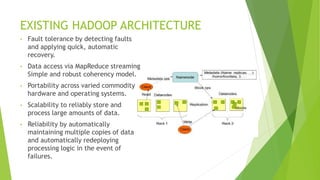
EXISTING HADOOP ARCHITECTURE
• Fault tolerance by detecting faults
and applying quick, automatic
recovery.
• Data access via MapReduce streaming
Simple and robust coherency model.
• Portability across varied commodity
hardware and operating systems.
• Scalability to reliably store and
process large amounts of data.
• Reliability by automatically
maintaining multiple copies of data
and automatically redeploying
processing logic in the event of
failures.
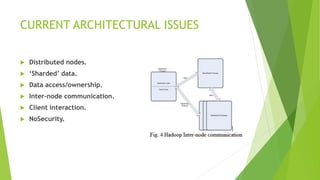
CURRENT ARCHITECTURAL ISSUES
 Distributed nodes.
 ‘Sharded’ data.
 Data access/ownership.
 Inter-node communication.
 Client interaction.
 NoSecurity.
PROPOSED SOLUTIONS
 Use Kerberos.
 Use file/OS layer encryption.
 Use key/certificate management.
 Validate nodes during deployment.
 Log transactions, anomalies, and administrative activity.
 Use SSL or TLS network security.
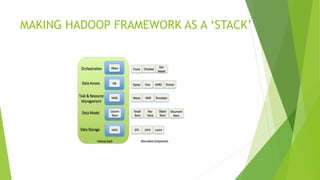
MAKING HADOOP FRAMEWORK AS A ‘STACK’
SOME OF CORPORATE SECURITY SOLUTIONS
IBM Security Intelligence
 Real-time abnormality
detection.
 High-speed querying of security
intelligence data.
 Flexible BDA across all types of
data sources.
 Interactive visualization
dashboards for exploring BDA
outputs.
 Network forensics.
Solera Networks
 Root Cause Analysis.
 Pathway Analysis.
 Application Discovery.
 Data Leakage Discovery.
 Insider Threat Analysis.
**Big Data Analytics (BDA)
CONCLUSIONS
 Traditional security solutions are not capable anymore of
encompassing the real-time big data
 Using security of Big Data techniques to derive actionable intelligence
and insights from streams in real-time is rapidly becoming a need.
 Current adoption of security measure solutions is by no means
revolutionary but the awareness of adoption is increasing rapidly.
 Different types of big data solution, the primary components of a
security model, some examples of security outputs, steps for
implementing a security solution, and finally, the corporates/product
which are offering solutions for cybersecurity along with their
features.

Big data in term of security measure

  • 1.
    Big Data interm of security measure For Hadoop Environments Yaakub Bin Idris Advanced Informatics School Malaysia University of Technology Kuala Lumpur, Malaysia yaakub.idris@gmail.com
  • 2.
  • 3.
    DATA BREACH CONTRIBUTION Employees mishandling information.  Violations of industry and government regulations.  Lack of system controls.  IT or business process failure.  Insiders greatly contribute to data breaches and that loss can be costly to organizations.
  • 4.
    FACTORS THAT INFLUENCETHE COST OF DATA BREACH  The company had an incident management plan.  The company had a relatively strong security posture at the time of the incident.  Chief information security officer (or equivalent) responsible for data protection.  Data was lost due to third party error.  The company notified data breach victims quickly.  Consultants were engaged to help remediate the data breach.
  • 5.
  • 6.
    EXISTING HADOOP ARCHITECTURE •Fault tolerance by detecting faults and applying quick, automatic recovery. • Data access via MapReduce streaming Simple and robust coherency model. • Portability across varied commodity hardware and operating systems. • Scalability to reliably store and process large amounts of data. • Reliability by automatically maintaining multiple copies of data and automatically redeploying processing logic in the event of failures.
  • 7.
    CURRENT ARCHITECTURAL ISSUES Distributed nodes.  ‘Sharded’ data.  Data access/ownership.  Inter-node communication.  Client interaction.  NoSecurity.
  • 8.
    PROPOSED SOLUTIONS  UseKerberos.  Use file/OS layer encryption.  Use key/certificate management.  Validate nodes during deployment.  Log transactions, anomalies, and administrative activity.  Use SSL or TLS network security.
  • 9.
    MAKING HADOOP FRAMEWORKAS A ‘STACK’
  • 10.
    SOME OF CORPORATESECURITY SOLUTIONS IBM Security Intelligence  Real-time abnormality detection.  High-speed querying of security intelligence data.  Flexible BDA across all types of data sources.  Interactive visualization dashboards for exploring BDA outputs.  Network forensics. Solera Networks  Root Cause Analysis.  Pathway Analysis.  Application Discovery.  Data Leakage Discovery.  Insider Threat Analysis. **Big Data Analytics (BDA)
  • 11.
    CONCLUSIONS  Traditional securitysolutions are not capable anymore of encompassing the real-time big data  Using security of Big Data techniques to derive actionable intelligence and insights from streams in real-time is rapidly becoming a need.  Current adoption of security measure solutions is by no means revolutionary but the awareness of adoption is increasing rapidly.  Different types of big data solution, the primary components of a security model, some examples of security outputs, steps for implementing a security solution, and finally, the corporates/product which are offering solutions for cybersecurity along with their features.