

Welcome to Our Presentation
Presentation on
Big Data and Data Mining
Introduction
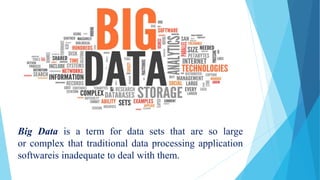
Big Data is a term for data sets that are so large
or complex that traditional data processing application
softwareis inadequate to deal with them.
Data mining is the computing process of
discovering patterns in large data sets involving
methods at the intersection of machine
learning, statistics, and database systems.
Important Info
 Daily 2500 quadrillion of data are produced and more than 90 percentage of data
are produced within past two years.
 A regular person is processing daily more data than a 16th century individual in his
entire life
 The volume of business data worldwide, across all companies, doubles every 1.2
years (was 1.5 years)
 Bad data or poor data quality costs US businesses $600 billion annually
 By 2015, 4.4 million IT jobs globally will be created to support big data (Gartner)
 Facebook processes 10 TB of data every day / Twitter 7 TB
 Google has over 3 million servers processing over 2 trillion searches per year in
2012 (only 22 million in 2000)
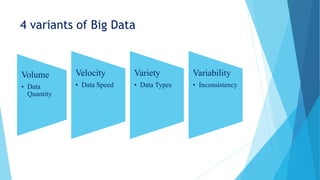
4 variants of Big Data
Volume
• Data
Quantity
Velocity
• Data Speed
Variety
• Data Types
Variability
• Inconsistency
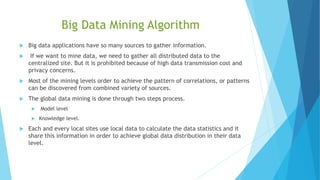
Big Data Mining Algorithm
 Big data applications have so many sources to gather information.
 If we want to mine data, we need to gather all distributed data to the
centralized site. But it is prohibited because of high data transmission cost and
privacy concerns.
 Most of the mining levels order to achieve the pattern of correlations, or patterns
can be discovered from combined variety of sources.
 The global data mining is done through two steps process.
 Model level
 Knowledge level.
 Each and every local sites use local data to calculate the data statistics and it
share this information in order to achieve global data distribution in their data
level.
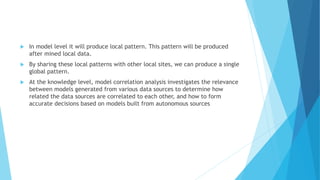
 In model level it will produce local pattern. This pattern will be produced
after mined local data.
 By sharing these local patterns with other local sites, we can produce a single
global pattern.
 At the knowledge level, model correlation analysis investigates the relevance
between models generated from various data sources to determine how
related the data sources are correlated to each other, and how to form
accurate decisions based on models built from autonomous sources
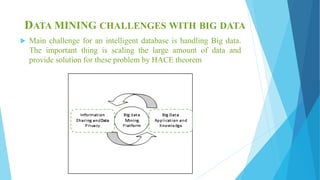
DATA MINING CHALLENGES WITH BIG DATA
 Main challenge for an intelligent database is handling Big data.
The important thing is scaling the large amount of data and
provide solution for these problem by HACE theorem
Challenges
Hardware resources- RAM capacity
Location of Big Data sources- Commonly Big Data are
stored in different locations
Volume of the Big Data- size of the Big Data grows
continuously.
Privacy- Medical reports, bank transactions
Having domain knowledge
Getting meaningful information
Solutions
Parallel computing programming
An efficient platform for computing will
not have centralized data storage instead of
that platform will be distributed in big scale
storage.
Restricting access to the data
BIG Data Mining Tools
 Hadoop
 Apache S4
 Strom
 Apache Mahout
 MOA
Hadoop
 It is developed by Apache Software Foundation project and open source
software platform for scalable, distributed computing.
 Apache Hadoop software library is a framework that allows for the distributed
processing of large data sets across clusters of computers using simple
programming models.
 Hadoop provides fast and reliable analysis of both Structured and un
structured data.
 It is designed to scale up from single servers to thousands of machines, each
offering local computation and storage.
 Hadoop uses MapReduce programming model to mine data.
 This MapReduce program is used to separate datasets which are sent as input
into independent subsets. Those are process parallel map task.
 Map() procedure that performs filtering and sorting
 Reduce() procedure that performs a summary operation
Applications of Big Data
 Healthcare organizations can achieve better insight into disease trends and
patient treatments.
 Public sector agencies can catch fraud and other threats in real-time.
 Applications of Multimedia data
 To find travelling pattern of travelers
 CC TV camera footage
 Photos and Videos from social network
 Recommender system
 Integration and mining of Bio data from various sources in Biological network
by NSF (National Science Foundation).
 Classifying the Big data stream in run time, by Australian Research council.
Advantages
 Fast response
 Extract useful information
 Prediction of required data from large amount of data.
 Savour of better results in the form of visualization.
We Are: The Genius
 Gopesh Singha ………………….1519
 Md. Mizanur Rahman ………..…1524
 Kawsar Ahmed ……………….…1531
 Hasan Pervez…………………….1520

Big Data & Data Mining

  • 1.
    Welcome to OurPresentation Presentation on Big Data and Data Mining
  • 2.
  • 3.
    Big Data isa term for data sets that are so large or complex that traditional data processing application softwareis inadequate to deal with them.
  • 4.
    Data mining isthe computing process of discovering patterns in large data sets involving methods at the intersection of machine learning, statistics, and database systems.
  • 5.
    Important Info  Daily2500 quadrillion of data are produced and more than 90 percentage of data are produced within past two years.  A regular person is processing daily more data than a 16th century individual in his entire life  The volume of business data worldwide, across all companies, doubles every 1.2 years (was 1.5 years)  Bad data or poor data quality costs US businesses $600 billion annually  By 2015, 4.4 million IT jobs globally will be created to support big data (Gartner)  Facebook processes 10 TB of data every day / Twitter 7 TB  Google has over 3 million servers processing over 2 trillion searches per year in 2012 (only 22 million in 2000)
  • 6.
    4 variants ofBig Data Volume • Data Quantity Velocity • Data Speed Variety • Data Types Variability • Inconsistency
  • 7.
    Big Data MiningAlgorithm  Big data applications have so many sources to gather information.  If we want to mine data, we need to gather all distributed data to the centralized site. But it is prohibited because of high data transmission cost and privacy concerns.  Most of the mining levels order to achieve the pattern of correlations, or patterns can be discovered from combined variety of sources.  The global data mining is done through two steps process.  Model level  Knowledge level.  Each and every local sites use local data to calculate the data statistics and it share this information in order to achieve global data distribution in their data level.
  • 8.
     In modellevel it will produce local pattern. This pattern will be produced after mined local data.  By sharing these local patterns with other local sites, we can produce a single global pattern.  At the knowledge level, model correlation analysis investigates the relevance between models generated from various data sources to determine how related the data sources are correlated to each other, and how to form accurate decisions based on models built from autonomous sources
  • 9.
    DATA MINING CHALLENGESWITH BIG DATA  Main challenge for an intelligent database is handling Big data. The important thing is scaling the large amount of data and provide solution for these problem by HACE theorem
  • 10.
    Challenges Hardware resources- RAMcapacity Location of Big Data sources- Commonly Big Data are stored in different locations Volume of the Big Data- size of the Big Data grows continuously. Privacy- Medical reports, bank transactions Having domain knowledge Getting meaningful information
  • 11.
    Solutions Parallel computing programming Anefficient platform for computing will not have centralized data storage instead of that platform will be distributed in big scale storage. Restricting access to the data
  • 12.
    BIG Data MiningTools  Hadoop  Apache S4  Strom  Apache Mahout  MOA
  • 13.
    Hadoop  It isdeveloped by Apache Software Foundation project and open source software platform for scalable, distributed computing.  Apache Hadoop software library is a framework that allows for the distributed processing of large data sets across clusters of computers using simple programming models.  Hadoop provides fast and reliable analysis of both Structured and un structured data.  It is designed to scale up from single servers to thousands of machines, each offering local computation and storage.  Hadoop uses MapReduce programming model to mine data.  This MapReduce program is used to separate datasets which are sent as input into independent subsets. Those are process parallel map task.  Map() procedure that performs filtering and sorting  Reduce() procedure that performs a summary operation
  • 14.
    Applications of BigData  Healthcare organizations can achieve better insight into disease trends and patient treatments.  Public sector agencies can catch fraud and other threats in real-time.  Applications of Multimedia data  To find travelling pattern of travelers  CC TV camera footage  Photos and Videos from social network  Recommender system  Integration and mining of Bio data from various sources in Biological network by NSF (National Science Foundation).  Classifying the Big data stream in run time, by Australian Research council.
  • 15.
    Advantages  Fast response Extract useful information  Prediction of required data from large amount of data.  Savour of better results in the form of visualization.
  • 17.
    We Are: TheGenius  Gopesh Singha ………………….1519  Md. Mizanur Rahman ………..…1524  Kawsar Ahmed ……………….…1531  Hasan Pervez…………………….1520

Editor's Notes

  • #3 In 2012, debate which is held during president election between Obama & Mitt triggered about 10 million tweets within 2 hours. And the well-known web site Flickr which is used to post our images faced a problem. It receives 1.8 million photographs every day which has the size of 2MB. Approximately they need 3.6TB storage capacity per day. These situations shows the reason for rise of Big Data application
  • #6 Sourcessssssssss Social network Satellite data Geographical data Live streaming data