Introduction to Big Data
By
Akshata Humbe
•What is Data:
The data is nothing but collection of information on which
operations are performed by a computer, which may be stored and
transmitted in the form of electrical signals and recorded on
magnetic, optical, or mechanical recording media.
•What is Big Data?
Big Data is also data but with a huge size. Big Data is a term
used to describe a collection of data that is huge in volume and
yet growing exponentially with time. In short such data is so large
and complex that none of the traditional data management tools
are able to store it or process it efficiently.
Examples Of Big Data
Following are some the examples of Big Data-
Social Media
The statistic shows that 500+terabytes of new data get ingested into the
databases of social media site Facebook, every day. This data is mainly
generated in terms of photo and video uploads, message exchanges,
putting comments etc.
A single Jet engine can generate 10+terabytes of data in 30 minutes of
flight time. With many thousand flights per day, generation of data reaches
up to many Petabytes.
Types Of Big Data
BigData' could be found in three forms:
Structured
Unstructured
Semi-structured
Structured:
• Any data that can be stored, accessed and processed in the form of fixed
format is termed as a 'structured' data.
•Over the period of time, talent in computer science has achieved greater
success in developing techniques for working with such kind of data (where
the format is well known in advance) and also deriving value out of it.
•However, nowadays, we are foreseeing issues when a size of such data
grows to a huge extent, typical sizes are being in the rage of multiple
zettabytes.
•Looking at these figures one can easily understand why the name Big Data
is given and imagine the challenges involved in its storage and processing.
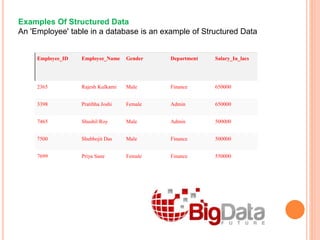
Examples Of Structured Data
An 'Employee' table in a database is an example of Structured Data
Employee_ID Employee_Name Gender Department Salary_In_lacs
2365 Rajesh Kulkarni Male Finance 650000
3398 Pratibha Joshi Female Admin 650000
7465 Shushil Roy Male Admin 500000
7500 Shubhojit Das Male Finance 500000
7699 Priya Sane Female Finance 550000
Unstructured:
•Any data with unknown form or the structure is classified as
unstructured data.
•In addition to the size being huge, un-structured data poses multiple
challenges in terms of its processing for deriving value out of it.
•A typical example of unstructured data is a heterogeneous data
source containing a combination of simple text files, images, videos
etc.
•Now day organizations have wealth of data available with them but
unfortunately, they don't know how to derive value out of it since this
data is in its raw form or unstructured format.
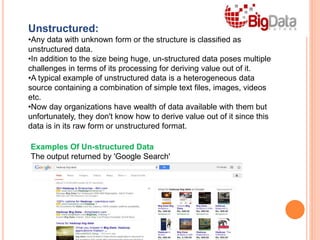
Examples Of Un-structured Data
The output returned by 'Google Search'
Semi-structured
Semi-structured data can contain both the forms of data. We can see semi-
structured data as a structured in form but it is actually not defined with e.g.
a table definition in relational DBMS. Example of semi-structured data is a
data represented in an XML file.
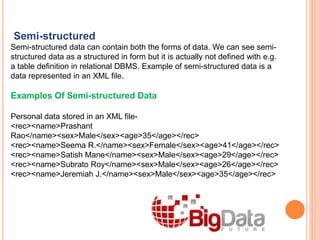
Examples Of Semi-structured Data
Personal data stored in an XML file-
<rec><name>Prashant
Rao</name><sex>Male</sex><age>35</age></rec>
<rec><name>Seema R.</name><sex>Female</sex><age>41</age></rec>
<rec><name>Satish Mane</name><sex>Male</sex><age>29</age></rec>
<rec><name>Subrato Roy</name><sex>Male</sex><age>26</age></rec>
<rec><name>Jeremiah J.</name><sex>Male</sex><age>35</age></rec>
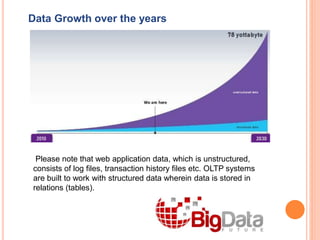
Data Growth over the years
Please note that web application data, which is unstructured,
consists of log files, transaction history files etc. OLTP systems
are built to work with structured data wherein data is stored in
relations (tables).
Characteristics Of Big Data:
(i) Volume –
The name Big Data itself is related to a size which is enormous. Size of
data plays a very crucial role in determining value out of data. Also,
whether a particular data can actually be considered as a Big Data or not,
is dependent upon the volume of data. Hence, 'Volume' is one
characteristic which needs to be considered while dealing with Big Data.
(ii) Variety –
The next aspect of Big Data is its variety. Variety refers to heterogeneous
sources and the nature of data, both structured and unstructured. During
earlier days, spreadsheets and databases were the only sources of data
considered by most of the applications. Nowadays, data in the form of
emails, photos, videos, monitoring devices, PDFs, audio, etc. are also
being considered in the analysis applications. This variety of unstructured
data poses certain issues for storage, mining and analyzing data
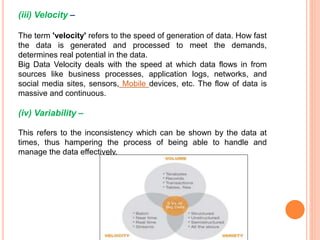
(iii) Velocity –
The term 'velocity' refers to the speed of generation of data. How fast
the data is generated and processed to meet the demands,
determines real potential in the data.
Big Data Velocity deals with the speed at which data flows in from
sources like business processes, application logs, networks, and
social media sites, sensors, Mobile devices, etc. The flow of data is
massive and continuous.
(iv) Variability –
This refers to the inconsistency which can be shown by the data at
times, thus hampering the process of being able to handle and
manage the data effectively.
Big Data Analytics
Big Data analytics is the process of collecting, organizing and
analyzing large sets of data (called Big Data) to discover
patterns and other useful information. Big Data analytics can
help organizations to better understand the information
contained within the data and will also help identify the data that
is most important to the business and future business
decisions. Analysts working with Big Data typically want
the knowledge that comes from analyzing the data.
Applications of Big Data:
1) Healthcare
Big Data has already started to create a huge difference in the healthcare
sector. With the help of predictive analytics, medical professionals and
HCPs are now able to provide personalized healthcare services to
individual patients. Apart from that, fitness wearables, telemedicine, remote
monitoring – all powered by Big Data and AI – are helping change lives for
the better.
2) Academia
Big Data is also helping enhance education today. Education is no more
limited to the physical bounds of the classroom – there are numerous
online educational courses to learn from. Academic institutions are
investing in digital courses powered by Big Data technologies to aid the all-
round development of budding learners.
3) Banking
The banking sector relies on Big Data for fraud detection. Big Data tools
can efficiently detect fraudulent acts in real-time such as misuse of
credit/debit cards, archival of inspection tracks, faulty alteration in customer
stats, etc.
4) Manufacturing
According to TCS Global Trend Study, the most significant benefit of Big
Data in manufacturing is improving the supply strategies and product
quality. In the manufacturing sector, Big data helps create a transparent
infrastructure, thereby, predicting uncertainties and incompetencies that can
affect the business adversely.
5) IT
One of the largest users of Big Data, IT companies around the world are
using Big Data to optimize their functioning, enhance employee productivity,
and minimize risks in business operations. By combining Big Data
technologies with ML and AI, the IT sector is continually powering
innovation to find solutions even for the most complex of problems.
6. Retail
Big Data has changed the way of working in traditional brick and mortar retail
stores. Over the years, retailers have collected vast amounts of data from
local demographic surveys, POS scanners, RFID, customer loyalty cards,
store inventory, and so on. Now, they’ve started to leverage this data to
create personalized customer experiences, boost sales, increase revenue,
and deliver outstanding customer service.
Retailers are even using smart sensors and Wi-Fi to track the movement of
customers, the most frequented aisles, for how long customers linger in the
aisles, among other things. They also gather social media data to understand
what customers are saying about their brand, their services, and tweak their
product design and marketing strategies accordingly.
7. Transportation
Big Data Analytics holds immense value for the transportation industry. In
countries across the world, both private and government-run transportation
companies use Big Data technologies to optimize route planning, control
traffic, manage road congestion, and improve services. Additionally,
transportation services even use Big Data to revenue management, drive
technological innovation, enhance logistics, and of course, to gain the upper
hand in the market
Summary
•Big Data is defined as data that is huge in size. Bigdata is a term
used to describe a collection of data that is huge in size and yet
growing exponentially with time.
•Examples of Big Data generation includes stock exchanges, social
media sites, jet engines, etc.
•Big Data could be 1) Structured, 2) Unstructured, 3) Semi-structured
•Volume, Variety, Velocity, and Variability are few Characteristics of
Bigdata
•Improved customer service, better operational efficiency, Better
Decision Making are few advantages of Bigdata

Introduction to Big Data

  • 1.
    Introduction to BigData By Akshata Humbe
  • 2.
    •What is Data: Thedata is nothing but collection of information on which operations are performed by a computer, which may be stored and transmitted in the form of electrical signals and recorded on magnetic, optical, or mechanical recording media. •What is Big Data? Big Data is also data but with a huge size. Big Data is a term used to describe a collection of data that is huge in volume and yet growing exponentially with time. In short such data is so large and complex that none of the traditional data management tools are able to store it or process it efficiently.
  • 3.
    Examples Of BigData Following are some the examples of Big Data- Social Media The statistic shows that 500+terabytes of new data get ingested into the databases of social media site Facebook, every day. This data is mainly generated in terms of photo and video uploads, message exchanges, putting comments etc. A single Jet engine can generate 10+terabytes of data in 30 minutes of flight time. With many thousand flights per day, generation of data reaches up to many Petabytes. Types Of Big Data BigData' could be found in three forms: Structured Unstructured Semi-structured
  • 4.
    Structured: • Any datathat can be stored, accessed and processed in the form of fixed format is termed as a 'structured' data. •Over the period of time, talent in computer science has achieved greater success in developing techniques for working with such kind of data (where the format is well known in advance) and also deriving value out of it. •However, nowadays, we are foreseeing issues when a size of such data grows to a huge extent, typical sizes are being in the rage of multiple zettabytes. •Looking at these figures one can easily understand why the name Big Data is given and imagine the challenges involved in its storage and processing.
  • 5.
    Examples Of StructuredData An 'Employee' table in a database is an example of Structured Data Employee_ID Employee_Name Gender Department Salary_In_lacs 2365 Rajesh Kulkarni Male Finance 650000 3398 Pratibha Joshi Female Admin 650000 7465 Shushil Roy Male Admin 500000 7500 Shubhojit Das Male Finance 500000 7699 Priya Sane Female Finance 550000
  • 6.
    Unstructured: •Any data withunknown form or the structure is classified as unstructured data. •In addition to the size being huge, un-structured data poses multiple challenges in terms of its processing for deriving value out of it. •A typical example of unstructured data is a heterogeneous data source containing a combination of simple text files, images, videos etc. •Now day organizations have wealth of data available with them but unfortunately, they don't know how to derive value out of it since this data is in its raw form or unstructured format. Examples Of Un-structured Data The output returned by 'Google Search'
  • 7.
    Semi-structured Semi-structured data cancontain both the forms of data. We can see semi- structured data as a structured in form but it is actually not defined with e.g. a table definition in relational DBMS. Example of semi-structured data is a data represented in an XML file. Examples Of Semi-structured Data Personal data stored in an XML file- <rec><name>Prashant Rao</name><sex>Male</sex><age>35</age></rec> <rec><name>Seema R.</name><sex>Female</sex><age>41</age></rec> <rec><name>Satish Mane</name><sex>Male</sex><age>29</age></rec> <rec><name>Subrato Roy</name><sex>Male</sex><age>26</age></rec> <rec><name>Jeremiah J.</name><sex>Male</sex><age>35</age></rec>
  • 8.
    Data Growth overthe years Please note that web application data, which is unstructured, consists of log files, transaction history files etc. OLTP systems are built to work with structured data wherein data is stored in relations (tables).
  • 9.
    Characteristics Of BigData: (i) Volume – The name Big Data itself is related to a size which is enormous. Size of data plays a very crucial role in determining value out of data. Also, whether a particular data can actually be considered as a Big Data or not, is dependent upon the volume of data. Hence, 'Volume' is one characteristic which needs to be considered while dealing with Big Data. (ii) Variety – The next aspect of Big Data is its variety. Variety refers to heterogeneous sources and the nature of data, both structured and unstructured. During earlier days, spreadsheets and databases were the only sources of data considered by most of the applications. Nowadays, data in the form of emails, photos, videos, monitoring devices, PDFs, audio, etc. are also being considered in the analysis applications. This variety of unstructured data poses certain issues for storage, mining and analyzing data
  • 10.
    (iii) Velocity – Theterm 'velocity' refers to the speed of generation of data. How fast the data is generated and processed to meet the demands, determines real potential in the data. Big Data Velocity deals with the speed at which data flows in from sources like business processes, application logs, networks, and social media sites, sensors, Mobile devices, etc. The flow of data is massive and continuous. (iv) Variability – This refers to the inconsistency which can be shown by the data at times, thus hampering the process of being able to handle and manage the data effectively.
  • 11.
    Big Data Analytics BigData analytics is the process of collecting, organizing and analyzing large sets of data (called Big Data) to discover patterns and other useful information. Big Data analytics can help organizations to better understand the information contained within the data and will also help identify the data that is most important to the business and future business decisions. Analysts working with Big Data typically want the knowledge that comes from analyzing the data.
  • 12.
    Applications of BigData: 1) Healthcare Big Data has already started to create a huge difference in the healthcare sector. With the help of predictive analytics, medical professionals and HCPs are now able to provide personalized healthcare services to individual patients. Apart from that, fitness wearables, telemedicine, remote monitoring – all powered by Big Data and AI – are helping change lives for the better. 2) Academia Big Data is also helping enhance education today. Education is no more limited to the physical bounds of the classroom – there are numerous online educational courses to learn from. Academic institutions are investing in digital courses powered by Big Data technologies to aid the all- round development of budding learners. 3) Banking The banking sector relies on Big Data for fraud detection. Big Data tools can efficiently detect fraudulent acts in real-time such as misuse of credit/debit cards, archival of inspection tracks, faulty alteration in customer stats, etc.
  • 13.
    4) Manufacturing According toTCS Global Trend Study, the most significant benefit of Big Data in manufacturing is improving the supply strategies and product quality. In the manufacturing sector, Big data helps create a transparent infrastructure, thereby, predicting uncertainties and incompetencies that can affect the business adversely. 5) IT One of the largest users of Big Data, IT companies around the world are using Big Data to optimize their functioning, enhance employee productivity, and minimize risks in business operations. By combining Big Data technologies with ML and AI, the IT sector is continually powering innovation to find solutions even for the most complex of problems.
  • 14.
    6. Retail Big Datahas changed the way of working in traditional brick and mortar retail stores. Over the years, retailers have collected vast amounts of data from local demographic surveys, POS scanners, RFID, customer loyalty cards, store inventory, and so on. Now, they’ve started to leverage this data to create personalized customer experiences, boost sales, increase revenue, and deliver outstanding customer service. Retailers are even using smart sensors and Wi-Fi to track the movement of customers, the most frequented aisles, for how long customers linger in the aisles, among other things. They also gather social media data to understand what customers are saying about their brand, their services, and tweak their product design and marketing strategies accordingly. 7. Transportation Big Data Analytics holds immense value for the transportation industry. In countries across the world, both private and government-run transportation companies use Big Data technologies to optimize route planning, control traffic, manage road congestion, and improve services. Additionally, transportation services even use Big Data to revenue management, drive technological innovation, enhance logistics, and of course, to gain the upper hand in the market
  • 15.
    Summary •Big Data isdefined as data that is huge in size. Bigdata is a term used to describe a collection of data that is huge in size and yet growing exponentially with time. •Examples of Big Data generation includes stock exchanges, social media sites, jet engines, etc. •Big Data could be 1) Structured, 2) Unstructured, 3) Semi-structured •Volume, Variety, Velocity, and Variability are few Characteristics of Bigdata •Improved customer service, better operational efficiency, Better Decision Making are few advantages of Bigdata