Bienvenidos 
Engaging Latino Audiences 
& 
Building Cross-Cultural 
Engagement
Bienvenidos 
Session Goals & Format 
• Strategies, tools, and contexts 
• Perspectives on diversity and inclusion 
• Models that engage new communities and build new relationships and 
patterns of visitation and support, applicable to targeted constituencies 
• Latino Engagement as template for cross-cultural communication and 
participation 
• How this affects strategic planning, professional development, 
communication tools, and public programs 
• 3 panelists + Q&A/Discussion
Our Panelists 
• Salvador Acevedo, Principal, Contemporánea 
• Gabriela Martinez, Curator of Education 
Museum of Latin American Art, Long Beach 
• Gail Anderson, President 
Gail Anderson & Associates 
• Moderator: Jill Hartz, Executive Director 
Jordan Schnitzer Museum of Art, Univ. of 
Oregon; President, Assoc. of Academic 
Museums & Galleries
Bienvenidos! 
Building Cross Cultural Engagement 
with Latino Audiences 
An Institutional Perspective 
WMA 2014
Audience Building Must Be 
an Institutional Commitment
Thoughts for Today 
Essential elements: 
• Clarity of motivation 
• Broad responsibility 
• Leadership commitment 
• Healthy culture 
• Integrated approach 
• Relationship building
Institutional Motivation, 
Responsibility, & Leadership
Clarify Your Motivation 
To understand: 
• Why you are expanding audiences and who is 
making this a priority 
• The level of commitment needed to broaden 
audience engagement 
• The potential changes that engaging diverse 
audiences may offer the institution 
• How honest institutional-assessments 
increase mindfulness & strengthen success
Institutional Responsibility 
Expanding audiences is: 
•Everyone’s responsibility & should not rest on 
the shoulders of only the education, visitor 
services, or marketing departments 
•Involves the work of the Board, staff, & 
volunteers 
•Integral & central to the museum vitality 
•An extraordinary opportunity to make a 
difference in the community & the museum
Museum Leadership 
Ensures that: 
• Audiences & community are central to museum 
operations 
• Board & staff are committed to engagement 
• Thoughtful preparation, adequate resources, & 
ongoing support are consistent 
• Necessary changes are implemented 
• Institutional identity, mission, vision, & 
inclusive practices are all integrated
Organizational Culture Can 
Predict Success
Organizational Culture 
Reveals: 
• Styles and methods of communication 
• How staff engage with one another 
(deliberately and in unspoken ways) 
• Acceptance of diversity, identity, & different 
cultural backgrounds 
• Levels of respect, trust, & support 
• How problems arise & conflict is resolved 
• Any needed work towards supporting a 
healthy, open, & sensitive internal culture
Integrated & Holistic Commitment 
Take the time to: 
•Strengthen culture intentionally 
•Clarify everyone’s roles & responsibilities 
•Build in time for training & reflection 
•Regularly engage your communities on their turf 
(outside of your museum) 
•Nurture relationships & keep conversations alive 
for the long-term 
•Focus on the joy of community building
Audience Engagement 
Is About Building Relationships
At the End of the Day, 
It’s All About… 
People & Relationships: 
• Listening & learning 
• Connecting with people 
• Building something bigger 
• Participating in meaningful change 
• Creating broader social value
Gracias!
¡Bienvenidos! 
Engaging Latino Audiences and Building Cross-Cultural 
Bridges 
Western Museums Association 
Salvador Acevedo, Principal 
October, 2014
The New “Us” 
18
Percent of total US population by ethnicity, 1960 - 
2060 
3% 6% 
5% 
17% 
12% 
8% 
31% 
13% 
© Contemporanea 2014 19 
100 
80 
60 
40 
20 
0 
1 
4% 
10% 
1960 1970 1980 1990 2000 2010 2020 2030 2040 2050 2060 
All other 
Asian 
Hispanic 
Black 
White 
85% 
63% 
43% 
Source: Pew Research Center, 2014 
2043- Majority-minority
Some Facts… 
• Latinos are now the largest ethnic group in California 
(2014) and Nuevo Mexico (2008) 
• “Minority” groups make the majority of K-12 
enrollment nationwide (2014) 
• Latinos, for the first time in history, make the majority 
of the University of California’s enrollment (2014) 
Client Project Title 20
Latinos and AA are highly connected… 
21 
86% 
49% 
84% 
46% 
90% 
50% 
Own a cell Own smartphone 
Latino 
White (non 
Latino) 
76% 
73% 69% 
68% 
60% 
66% 
Access internet on 
mobile 
Use social media 
Among all internet users Among all adults 
Source: Pew Research Center, 2014 
© Contemporanea 2014
22 
What is Latino? A Few Thoughts on Identity 
• Cultural identity depends on the context. 
• Growth in the Latino population comes from 2nd and 
3rd generations. 
• 2nd and 3rd generation ethnic identity is at a all time 
high (Pew Research Center) 
• 45% of Latinos identify as white (Census) 
• “Latino” has never been a homogenous identity (and 
neither has been any of the other ethnic identities, 
including white). 
© Contemporanea 2014
Engagement with Cultural Institutions 
23
24 
• Cultural participation among Latinos and African Americans 
over-index that of non-Latino whites (GPCA, 2011). 
• Participation occur at non-traditional venues (Irvine, 2011) 
• Non-whites and Latinos saw no declines in their arts 
attendance rates from 2008 to 2012; on the contrary, they 
even saw increases in some categories. NEA/SPPA, 2013. 
• Social dancing is the most popular form of art-making or 
art-sharing. Young adults and Hispanic Americans are 
among the most active in this category. NEA/SPPA, 2013. 
• Latinos bought 25% of movie tickets sold in 2013 (MPAA, 
2013) 
Cultural Participation Trends 
© Contemporanea 2014
25 
Signs of Inclusion 
What Latinos perceive as signs of inclusion (or not): 
• Spanish language communications 
• Latino staff/stakeholders 
• If they perceive value, there are no obstacles for 
participation 
• They perceive a lack of interest from mainstream 
cultural organizations for engaging them 
Contemporanea, 2014 
© Contemporanea 2014
The Question 
26
How do we reach out to Latinos/ Hispanics? 
VS. 
How do we change so we remain relevant when society 
changes? 
27
Thank you!
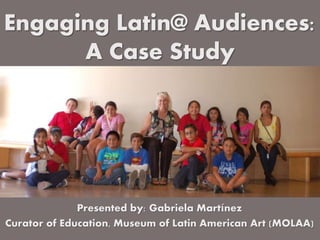
Engaging Latin@ Audiences: 
A Case Study 
Presented by: Gabriela Martínez 
Curator of Education, Museum of Latin American Art (MOLAA)
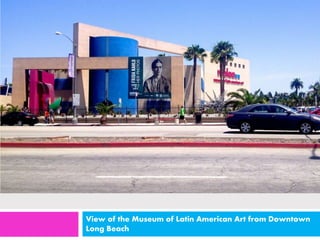
View of the Museum of Latin American Art from Downtown 
Long Beach
Founded in 1996 by 
Dr. Robert Gumbiner 
Located along the 
border of Downtown 
Long Beach in a 
residential area 
Focus on Modern and 
Contemporary Latin 
American Art 
MOLAA Founder Dr. Robert Gumbiner (US, 1923-2009) 
ABOUT MOLAA
MOLAA’s 2007 Mission Statement: 
MOLAA's mission is to education the public about contemporary Latin American 
fine art (by artists who have lived and worked in Latin America since WWII) 
through the presentation of a significant permanent collection, dynamic 
exhibitions and related cultural and educational programs. 
MOLAA Members at the Opening for Sociales: Debora Arango Arrives Today
The Average MOLAA Member… 
…is a 
Caucasian 
female 
…is over the 
age of 60 
…has a post-graduate 
degree 
MOLAA Members Enjoy the opening party for the exhibition Play with Me in 
MOLAA’s Sculpture Garden
Enacting Change 
to Create 
Accessibility: 
Policies, 
Programs, and 
Personal 
Relationships 
MOLAA President and CEO, Stuart Ashman, with Summer Art Camp participants.
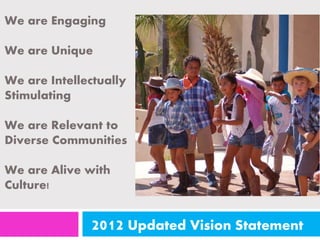
We are Engaging 
We are Unique 
We are Intellectually 
Stimulating 
We are Relevant to 
Diverse Communities 
We are Alive with 
Culture! 
2012 Updated Vision Statement
Target Free Sundays & Family Festivals
Interactive Gallery Experiences 
Left: A mother and daughter play Lotería in the gallery’s Participation Station 
Right: Youth enjoy an “Artventure” tour, guided by Omar Gallegos, a local artist
Curatorial Initiative: Touch the Art. MOLAA’s 2012 
Summer Challenge
Membership Initiative: Thematic, Public, Art 
Opening Parties
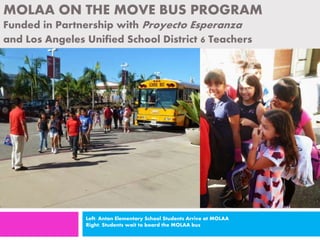
MOLAA ON THE MOVE BUS PROGRAM 
Funded in Partnership with Proyecto Esperanza 
and Los Angeles Unified School District 6 Teachers 
Left: Anton Elementary School Students Arrive at MOLAA 
Right: Students wait to board the MOLAA bus
OFF SITE OUTREACH
Visitors admire the Gypsy Rose at the opening for MEX/LA: Mexican Modernism(s) 
in the United States, 1930-1985
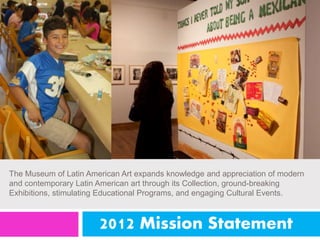
The Museum of Latin American Art expands knowledge and appreciation of modern 
and contemporary Latin American art through its Collection, ground-breaking 
Exhibitions, stimulating Educational Programs, and engaging Cultural Events. 
2012 Mission Statement
2014 Board Initiative: “Latin American” now defines 
Chican@/Latin@ artists who have exclusively lived and 
worked in the U.S. 
“One of the objectives of 
our founder, Dr. Robert 
Gumbiner, was to remain 
relevant to the community 
and the public in our 
exhibitions and programs. 
This resolution allows us to 
maintain our relevance as 
an arts institution in a 
nation with a growing 
Latino demographic. I am 
very pleased to be leading 
the museum in this new era 
of inclusiveness.”—Stuart 
Ashman, MOLAA President 
and CEO 
A change of definition.

Bienven Bienvenidos! Engaging Latino Audiences and Building Cross-Cultural Bridges

  • 1.
    Bienvenidos Engaging LatinoAudiences & Building Cross-Cultural Engagement
  • 2.
    Bienvenidos Session Goals& Format • Strategies, tools, and contexts • Perspectives on diversity and inclusion • Models that engage new communities and build new relationships and patterns of visitation and support, applicable to targeted constituencies • Latino Engagement as template for cross-cultural communication and participation • How this affects strategic planning, professional development, communication tools, and public programs • 3 panelists + Q&A/Discussion
  • 3.
    Our Panelists •Salvador Acevedo, Principal, Contemporánea • Gabriela Martinez, Curator of Education Museum of Latin American Art, Long Beach • Gail Anderson, President Gail Anderson & Associates • Moderator: Jill Hartz, Executive Director Jordan Schnitzer Museum of Art, Univ. of Oregon; President, Assoc. of Academic Museums & Galleries
  • 4.
    Bienvenidos! Building CrossCultural Engagement with Latino Audiences An Institutional Perspective WMA 2014
  • 5.
    Audience Building MustBe an Institutional Commitment
  • 6.
    Thoughts for Today Essential elements: • Clarity of motivation • Broad responsibility • Leadership commitment • Healthy culture • Integrated approach • Relationship building
  • 7.
  • 8.
    Clarify Your Motivation To understand: • Why you are expanding audiences and who is making this a priority • The level of commitment needed to broaden audience engagement • The potential changes that engaging diverse audiences may offer the institution • How honest institutional-assessments increase mindfulness & strengthen success
  • 9.
    Institutional Responsibility Expandingaudiences is: •Everyone’s responsibility & should not rest on the shoulders of only the education, visitor services, or marketing departments •Involves the work of the Board, staff, & volunteers •Integral & central to the museum vitality •An extraordinary opportunity to make a difference in the community & the museum
  • 10.
    Museum Leadership Ensuresthat: • Audiences & community are central to museum operations • Board & staff are committed to engagement • Thoughtful preparation, adequate resources, & ongoing support are consistent • Necessary changes are implemented • Institutional identity, mission, vision, & inclusive practices are all integrated
  • 11.
  • 12.
    Organizational Culture Reveals: • Styles and methods of communication • How staff engage with one another (deliberately and in unspoken ways) • Acceptance of diversity, identity, & different cultural backgrounds • Levels of respect, trust, & support • How problems arise & conflict is resolved • Any needed work towards supporting a healthy, open, & sensitive internal culture
  • 13.
    Integrated & HolisticCommitment Take the time to: •Strengthen culture intentionally •Clarify everyone’s roles & responsibilities •Build in time for training & reflection •Regularly engage your communities on their turf (outside of your museum) •Nurture relationships & keep conversations alive for the long-term •Focus on the joy of community building
  • 14.
    Audience Engagement IsAbout Building Relationships
  • 15.
    At the Endof the Day, It’s All About… People & Relationships: • Listening & learning • Connecting with people • Building something bigger • Participating in meaningful change • Creating broader social value
  • 16.
  • 17.
    ¡Bienvenidos! Engaging LatinoAudiences and Building Cross-Cultural Bridges Western Museums Association Salvador Acevedo, Principal October, 2014
  • 18.
  • 19.
    Percent of totalUS population by ethnicity, 1960 - 2060 3% 6% 5% 17% 12% 8% 31% 13% © Contemporanea 2014 19 100 80 60 40 20 0 1 4% 10% 1960 1970 1980 1990 2000 2010 2020 2030 2040 2050 2060 All other Asian Hispanic Black White 85% 63% 43% Source: Pew Research Center, 2014 2043- Majority-minority
  • 20.
    Some Facts… •Latinos are now the largest ethnic group in California (2014) and Nuevo Mexico (2008) • “Minority” groups make the majority of K-12 enrollment nationwide (2014) • Latinos, for the first time in history, make the majority of the University of California’s enrollment (2014) Client Project Title 20
  • 21.
    Latinos and AAare highly connected… 21 86% 49% 84% 46% 90% 50% Own a cell Own smartphone Latino White (non Latino) 76% 73% 69% 68% 60% 66% Access internet on mobile Use social media Among all internet users Among all adults Source: Pew Research Center, 2014 © Contemporanea 2014
  • 22.
    22 What isLatino? A Few Thoughts on Identity • Cultural identity depends on the context. • Growth in the Latino population comes from 2nd and 3rd generations. • 2nd and 3rd generation ethnic identity is at a all time high (Pew Research Center) • 45% of Latinos identify as white (Census) • “Latino” has never been a homogenous identity (and neither has been any of the other ethnic identities, including white). © Contemporanea 2014
  • 23.
    Engagement with CulturalInstitutions 23
  • 24.
    24 • Culturalparticipation among Latinos and African Americans over-index that of non-Latino whites (GPCA, 2011). • Participation occur at non-traditional venues (Irvine, 2011) • Non-whites and Latinos saw no declines in their arts attendance rates from 2008 to 2012; on the contrary, they even saw increases in some categories. NEA/SPPA, 2013. • Social dancing is the most popular form of art-making or art-sharing. Young adults and Hispanic Americans are among the most active in this category. NEA/SPPA, 2013. • Latinos bought 25% of movie tickets sold in 2013 (MPAA, 2013) Cultural Participation Trends © Contemporanea 2014
  • 25.
    25 Signs ofInclusion What Latinos perceive as signs of inclusion (or not): • Spanish language communications • Latino staff/stakeholders • If they perceive value, there are no obstacles for participation • They perceive a lack of interest from mainstream cultural organizations for engaging them Contemporanea, 2014 © Contemporanea 2014
  • 26.
  • 27.
    How do wereach out to Latinos/ Hispanics? VS. How do we change so we remain relevant when society changes? 27
  • 28.
  • 29.
    Engaging Latin@ Audiences: A Case Study Presented by: Gabriela Martínez Curator of Education, Museum of Latin American Art (MOLAA)
  • 30.
    View of theMuseum of Latin American Art from Downtown Long Beach
  • 31.
    Founded in 1996by Dr. Robert Gumbiner Located along the border of Downtown Long Beach in a residential area Focus on Modern and Contemporary Latin American Art MOLAA Founder Dr. Robert Gumbiner (US, 1923-2009) ABOUT MOLAA
  • 32.
    MOLAA’s 2007 MissionStatement: MOLAA's mission is to education the public about contemporary Latin American fine art (by artists who have lived and worked in Latin America since WWII) through the presentation of a significant permanent collection, dynamic exhibitions and related cultural and educational programs. MOLAA Members at the Opening for Sociales: Debora Arango Arrives Today
  • 33.
    The Average MOLAAMember… …is a Caucasian female …is over the age of 60 …has a post-graduate degree MOLAA Members Enjoy the opening party for the exhibition Play with Me in MOLAA’s Sculpture Garden
  • 34.
    Enacting Change toCreate Accessibility: Policies, Programs, and Personal Relationships MOLAA President and CEO, Stuart Ashman, with Summer Art Camp participants.
  • 35.
    We are Engaging We are Unique We are Intellectually Stimulating We are Relevant to Diverse Communities We are Alive with Culture! 2012 Updated Vision Statement
  • 36.
    Target Free Sundays& Family Festivals
  • 37.
    Interactive Gallery Experiences Left: A mother and daughter play Lotería in the gallery’s Participation Station Right: Youth enjoy an “Artventure” tour, guided by Omar Gallegos, a local artist
  • 38.
    Curatorial Initiative: Touchthe Art. MOLAA’s 2012 Summer Challenge
  • 39.
    Membership Initiative: Thematic,Public, Art Opening Parties
  • 40.
    MOLAA ON THEMOVE BUS PROGRAM Funded in Partnership with Proyecto Esperanza and Los Angeles Unified School District 6 Teachers Left: Anton Elementary School Students Arrive at MOLAA Right: Students wait to board the MOLAA bus
  • 41.
  • 42.
    Visitors admire theGypsy Rose at the opening for MEX/LA: Mexican Modernism(s) in the United States, 1930-1985
  • 43.
    The Museum ofLatin American Art expands knowledge and appreciation of modern and contemporary Latin American art through its Collection, ground-breaking Exhibitions, stimulating Educational Programs, and engaging Cultural Events. 2012 Mission Statement
  • 44.
    2014 Board Initiative:“Latin American” now defines Chican@/Latin@ artists who have exclusively lived and worked in the U.S. “One of the objectives of our founder, Dr. Robert Gumbiner, was to remain relevant to the community and the public in our exhibitions and programs. This resolution allows us to maintain our relevance as an arts institution in a nation with a growing Latino demographic. I am very pleased to be leading the museum in this new era of inclusiveness.”—Stuart Ashman, MOLAA President and CEO A change of definition.

Editor's Notes

  • #31 MOLAA is bordered by the East Village Arts District to the west, Hellman/Crafstman village to the North, and North Alamitos Beach to the South and East. It sits at the intersection of three neighborhoods.
  • #32 Information regarding Dr. Gumbiner including mission of original clinic gallery.
  • #34 Compare to Long Beach demographics, specifically NABA neighborhood. Discuss LB community relationship with MOLAA up until 2007