MULTICULTURAL	
  ENGAGEMENT	
  

                            Presentation by

                            Armando Rayo
                           VP, Engagement

                            Paulina Artieda
                 Associate Creative Director
Agenda
Welcome and Introductions
Multicultural Marketing: Overview
• Case Studies

• Strategies and Tactics
• Q&A
OVERVIEW
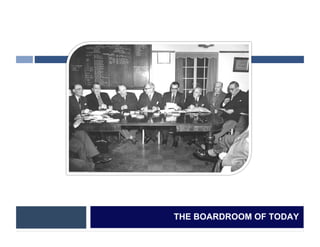
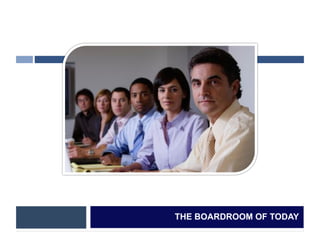
THE BOARDROOM OF TODAY
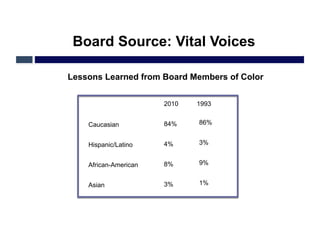
Board Source: Vital Voices

Lessons Learned from Board Members of Color


                       2010   1993


    Caucasian          84%    86%


    Hispanic/Latino    4%     3%


    African-American   8%     9%


    Asian              3%     1%
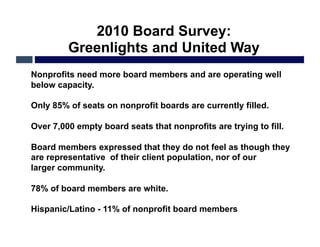
2010 Board Survey:
         Greenlights and United Way
Nonprofits need more board members and are operating well
below capacity.

Only 85% of seats on nonprofit boards are currently filled.

Over 7,000 empty board seats that nonprofits are trying to fill.

Board members expressed that they do not feel as though they
are representative of their client population, nor of our
larger community.

78% of board members are white.

Hispanic/Latino - 11% of nonprofit board members
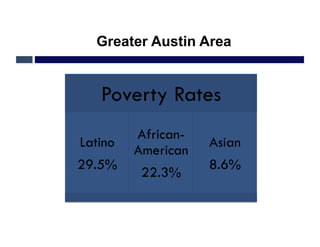
Greater Austin Area


   Poverty Rates
         African-
Latino              Asian
         American
29.5%               8.6%
          22.3%
DEFINITION
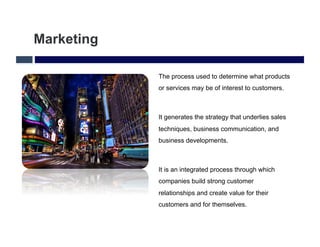
Marketing

            The process used to determine what products
            or services may be of interest to customers.


            It generates the strategy that underlies sales
            techniques, business communication, and
            business developments.


            It is an integrated process through which
            companies build strong customer
            relationships and create value for their
            customers and for themselves.
Marketing Strategies

• Understand your business.
Analyze your goals to build a campaign.

Understand why you are different from other organizations and begin
to build a message to stand out.

• Understand who your target is.
Include all potential members, clients, or customers who can benefit
from your brand.

• Research & listen to the conversations.
Why should they have a relationship with your brand?

Learn as much as you can about the effects of your business on their
lives.
Marketing Strategies

•  Tailor your strategy.
     Tailor your materials so they are interesting and relevant to the
     community you choose to engage.

•  Be transparent.
     To build brand loyalty with your audience let your intentions be
     known initially.
     A push interpreted as deceptive can destroy a connection
     permanently.

•     Quality versus Quantity.
     Instead of measuring your impact by counting your fans, email lists,
     or likes, count the interactions with your audience.
     This goes for online and off - this is more than outreach, it’s
      engagement.
Multicultural Marketing
It’s the promotion of a brand’s product or service to one
or more targeted multicultural group(s), or to an
ethnically diverse consumer base.

It follows the same standards as regular marketing but
uses cultural touch points such as language, traditions,
celebrations, religion and any other concepts that may
relevant to the particular cultural audience.
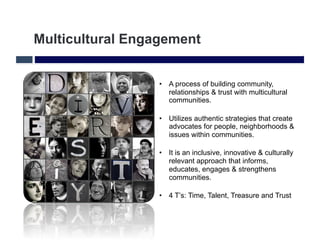
Multicultural Engagement


                  •  A process of building community,
                     relationships & trust with multicultural
                     communities.

                  •  Utilizes authentic strategies that create
                     advocates for people, neighborhoods &
                     issues within communities.

                  •  It is an inclusive, innovative & culturally
                     relevant approach that informs,
                     educates, engages & strengthens
                     communities.

                  •  4 T’s: Time, Talent, Treasure and Trust
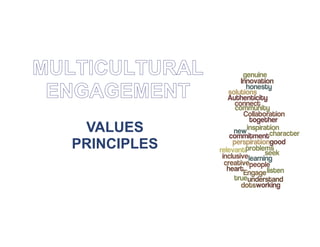
VALUES
PRINCIPLES
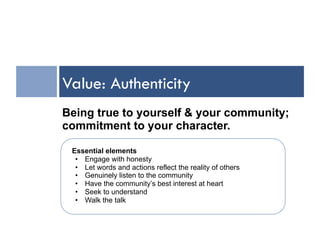
Value: Authenticity
Being true to yourself & your community;
commitment to your character.

 Essential elements
  •  Engage with honesty
  •  Let words and actions reflect the reality of others
  •  Genuinely listen to the community
  •  Have the community’s best interest at heart
  •  Seek to understand
  •  Walk the talk
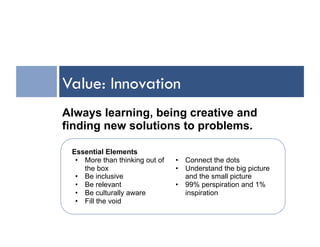
Value: Innovation
Always learning, being creative and
finding new solutions to problems.

 Essential Elements
  •  More than thinking out of   •  Connect the dots
     the box                     •  Understand the big picture
  •  Be inclusive                   and the small picture
  •  Be relevant                 •  99% perspiration and 1%
  •  Be culturally aware            inspiration
  •  Fill the void
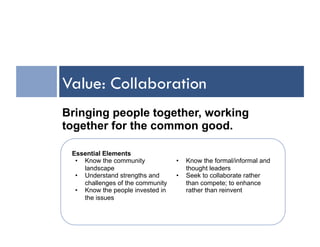
Value: Collaboration
Bringing people together, working
together for the common good.

 Essential Elements
  •  Know the community            •    Know the formal/informal and
     landscape                          thought leaders
  •  Understand strengths and      •    Seek to collaborate rather
     challenges of the community        than compete; to enhance
  •  Know the people invested in        rather than reinvent
     the issues
Principles
 •  Engage - Share your experience. Discuss viewpoints.
    Respect others.
 •  Educate - Learn the issues. Acquire new skills. Know
    your community.
 •  Volunteer - Give an hour. Give a Saturday. Give your
    best.
 •  Advocate - Champion a cause. Stay informed. Raise
    Awareness. Find your voice.
 •  Give - Research. Understand. Invest.
 •  Lead - Influence others. Open doors. Create systemic
    change.
Goals
 •    Increase program visibility
 •    Connect with audience
 •    Broaden community awareness
 •    Network with other community
      organizations
HISTORY
  ISSUES
MOTIVATIONS
African-Americans

•  1787: the Free African Society of Philadelphia was formed to aid free slaves.

•  With the abolition of slavery, black social service organizations emerged in the
   form of sororities and fraternities, and the NAACP

•  Source for support: community-based mutual aid organizations, churches, or
   major political movements

•  1862: Freedman’s aid societies were organized in the northern states to
   provide supplies and send teachers to educate former slaves.


“It was philanthropy for and by African Americans that helped establish
historical black colleges and universities. Black fraternities and sororities are
also a part of this heritage.”
                           - Rodney Jackson, president and CEO of the National Center for Black Philanthropy Inc.
African-Americans

•  Quality education is a primary concern among African-American residents.

•  Although African-Americans are actively engaged in education by serving as
   mentors, tutors, etc., the sentiment is that the need for African-Americans to
   serve in these roles far exceeds the supply.

•  More women than men volunteer, yet comments from the focus groups
   pointed to a serious need for African American male role models and mentors.

•  Opportunities to increase the number of African-American volunteers by
   reaching out to those who currently are not being asked to volunteer, do not
   know how to become involved and are not satisfied with their current level of
   volunteer participation.
Asian-Americans

•  Asian Americans are the most diverse ethnic group in the United States today,
   with the influence of more than fifteen different cultures.

•  The wide range of languages spoken includes Cantonese, Hawaiian, Hindi,
   Japanese, Korean, Mandarin, Tagalog, Urdu and Vietnamese.

•  Asian American profile is considered young (median age: 31.6 yrs), affluent
   and educated. (In 2003, 50% of Asian Americans had a bachelor’s degree)

•  Mutual Aid Associations began as a response to racial discrimination and
   violence during the early immigration days in the late 1800s. Today, these
   associations continue to grow and flourish as new immigrant groups emerge
   and adjust to the new country. (i.e. daycare centers and credit unions)
Asian-Americans

•  Religious institutions provide both spiritual and social activities, also act at
   safe havens for immigrants.
    o  Activities ranging from picnics, baseball leagues, English classes and job
       training seminars are almost always run by volunteers.

•  Language and cultural schools are also organized almost entirely by
   volunteers.
    o  Some of these schools are run under the auspices of a religious
       organization or mutual aid associations.

•  Professional associations such as Chinese engineering societies, South Asian
   networking groups and Filipino medical organizations utilize volunteers to help
   newcomers traverse the many complicated steps toward stability.
    o  Once established, members often conduct civic projects and raise funds
       for worthy causes.
Latinos/Hispanics

•  The Hispanic community has had a long-standing tradition of giving,
    o  Generally done through organizations or causes that are close to the
       hearts of the individuals.

•  Informal giving has been a strong value of the Latin American community for
   more than 500 years.
    o  However, Latinos are less accustomed to organized giving through
       nonprofits and philanthropic organizations (Ramos 2002).

•  Many people in the Hispanic community still have strong ties to the
   communities where they were originally born, and/or where they still have
   family.
    o  Very common to see the money that could potentially go to
       non-profit organizations or foundations sent back home to aid the rest of
       the family.
Latinos/Hispanics

•  In 1998, nearly 7 in 10 Hispanics gave to charities.

•  Now the largest minority in the US, are gaining political, professional and
   economic status.

•  Are discovering how philanthropic efforts and leadership have helped women
   and other groups gain social and political influence.

•  Are increasingly working together to focus their philanthropy on the non-profit
   institutions that will impact/strengthen their community and create new
   opportunities.

•  Chronicle of Philanthropy: Hispanic giving actually equaled or surpassed
   Anglo-American giving.

•  Hispanic volunteerism = 14.7% and growing.
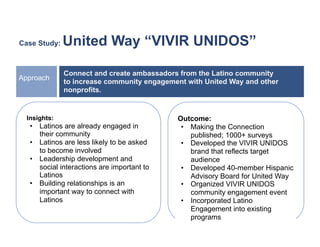
Case Study:   United Way “VIVIR UNIDOS”

              Connect and create ambassadors from the Latino community
Approach
              to increase community engagement with United Way and other
              nonprofits.


  Insights:                                  Outcome:
   •  Latinos are already engaged in          •  Making the Connection
      their community                            published; 1000+ surveys
   •  Latinos are less likely to be asked     •  Developed the VIVIR UNIDOS
      to become involved                         brand that reflects target
   •  Leadership development and                 audience
      social interactions are important to    •  Developed 40-member Hispanic
      Latinos                                    Advisory Board for United Way
   •  Building relationships is an            •  Organized VIVIR UNIDOS
      important way to connect with              community engagement event
      Latinos                                 •  Incorporated Latino
                                                 Engagement into existing
                                                 programs
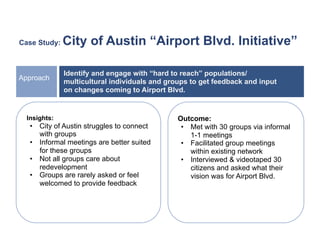
Case Study:   City of Austin “Airport Blvd. Initiative”

              Identify and engage with “hard to reach” populations/
Approach
              multicultural individuals and groups to get feedback and input
              on changes coming to Airport Blvd.


  Insights:                                    Outcome:
   •  City of Austin struggles to connect       •  Met with 30 groups via informal
      with groups                                  1-1 meetings
   •  Informal meetings are better suited       •  Facilitated group meetings
      for these groups                             within existing network
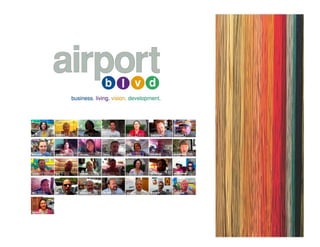
   •  Not all groups care about                 •  Interviewed & videotaped 30
      redevelopment                                citizens and asked what their
   •  Groups are rarely asked or feel              vision was for Airport Blvd.
      welcomed to provide feedback
Case Study:   RISE GLOBAL “Multicultural Series”

              Identify and recruit entrepreneurs of color and entrepreneur
Approach
              circles for the RISE Global Multicultural Series


  Insights:                                    Outcome:
   •  Entrepreneurs of color were not           •  Developed Hispanic Series in
      familiar with RISE Global                    the first year
   •  Entrepreneurs gathered among              •  Developed Multicultural Series
      comfortable circles                          that included 60 speakers form
   •  Most entrepreneurs were                      the Hispanic/Latino, African-
      interested in sharing their journey          American, Asian & Middle
      with other entrepreneurs                     Eastern populations
   •  The RISE Global “unconference”            •  Increased speaker, participant
      format was unfamiliar/confusing to           attendance and relevance for
      these groups                                 RISE Global
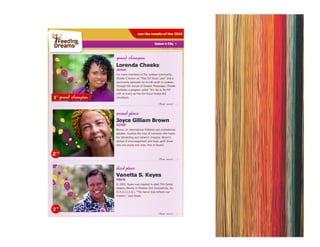
Case Study:   General Mills “Feeding Dreams”

              Emotionally connect with African American women by celebrating
Approach      her efforts to make a better environment for her family and
              community.


 Insights:                                  Outcome:
  •  African American moms are              • Delivered a significant sales and HH
     concerned about the future of their    penetration increases in year 1.
     children and make purchases            • Strong and continuous sales results
     based on brands that show              +3.1% over 7 months.
     community effort.                      • Significant increases in AA HH
  •  African American moms are more         penetration and increased consumer
     likely to be influenced by in-store    commitment.
     marketing.
                                            • Most of the sales lifts happened in
  •  It is important for brands to have
                                            non-promoted sales weeks
     visible presence in the community.
Case Study: Leave      No Child Inside - Latinos & The Outdoors

             Discover barriers preventing Latinos in Waukegan, IL from participating in
Approach     the outdoors and develop a model that inspires behavioral change among
             LNCI’s target audience


 Insights:                                       Outcome:
 •  Social Isolation: Latinos, especially        •  CS developed a Nature Engagement
 new immigrants not integrated into              Model with a Nature Navigator as the
 social fabric                                   key player connecting partner
 •  Language Access: Lack of                     organizations to target audience
 appropriate bilingual information and
 staff                                           •  CS provided tactics guided by
                                                 Connect, Equip, Mobilize process
 •  Personalism: Latinos value personal
                                                 such as neighborhood walks, platicas,
 relationships over institutional
                                                 and coordinating LNCI Day of Action
 relationships
 •  Trust: Families need to develop trust        •  LNCI will be implementing strategies
 with institutions and individuals.              in the year to come
Strategies
    Identify your objectives and the markets you are
     trying to reach.
     - Why do you want to reach this audience?
     - What will be the mutual benefit from this outreach?
     - Identify your market clearly and their characteristics.

•    Identify their unique touch points.
     - Where is their comfort zone? At home? Specific stores?
     - What do they consume? Language Preference?
     - Who are the significant influencers in their community?
     - What traditions are important?
Strategies
    Identify the media that makes sense for your goals.
     - What media do they most commonly consume?
     - How do they engage with media?
     - Are there other unique ways of reaching them, such as
     brand ambassadors?
     - Create a message that is relevant and unique to them.

•    Evaluating your approach and learning from others
     mistakes.
     - Were your efforts effective?
     - Did you begin a conversation with the consumer, a
     relationship?
     - Have you learned from your market what works and
Strategies
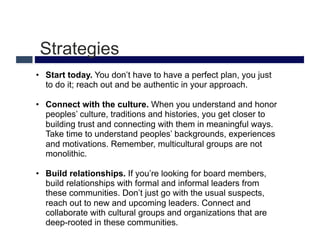
•  Start today. You don’t have to have a perfect plan, you just
   to do it; reach out and be authentic in your approach.

•  Connect with the culture. When you understand and honor
   peoples’ culture, traditions and histories, you get closer to
   building trust and connecting with them in meaningful ways.
   Take time to understand peoples’ backgrounds, experiences
   and motivations. Remember, multicultural groups are not
   monolithic.

•  Build relationships. If you’re looking for board members,
   build relationships with formal and informal leaders from
   these communities. Don’t just go with the usual suspects,
   reach out to new and upcoming leaders. Connect and
   collaborate with cultural groups and organizations that are
   deep-rooted in these communities.
Strategies
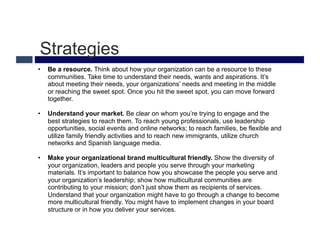
•    Be a resource. Think about how your organization can be a resource to these
     communities. Take time to understand their needs, wants and aspirations. It’s
     about meeting their needs, your organizations’ needs and meeting in the middle
     or reaching the sweet spot. Once you hit the sweet spot, you can move forward
     together.

•    Understand your market. Be clear on whom you’re trying to engage and the
     best strategies to reach them. To reach young professionals, use leadership
     opportunities, social events and online networks; to reach families, be flexible and
     utilize family friendly activities and to reach new immigrants, utilize church
     networks and Spanish language media.

•    Make your organizational brand multicultural friendly. Show the diversity of
     your organization, leaders and people you serve through your marketing
     materials. It’s important to balance how you showcase the people you serve and
     your organization’s leadership; show how multicultural communities are
     contributing to your mission; don’t just show them as recipients of services.
     Understand that your organization might have to go through a change to become
     more multicultural friendly. You might have to implement changes in your board
     structure or in how you deliver your services.
Strategies
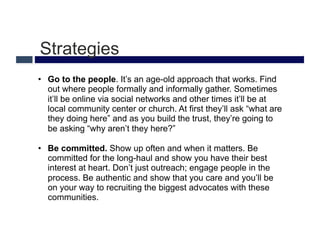
•  Go to the people. It’s an age-old approach that works. Find
   out where people formally and informally gather. Sometimes
   it’ll be online via social networks and other times it’ll be at
   local community center or church. At first they’ll ask “what are
   they doing here” and as you build the trust, they’re going to
   be asking “why aren’t they here?”

•  Be committed. Show up often and when it matters. Be
   committed for the long-haul and show you have their best
   interest at heart. Don’t just outreach; engage people in the
   process. Be authentic and show that you care and you’ll be
   on your way to recruiting the biggest advocates with these
   communities.
THANK	
  YOU.	


              Armando Rayo
             VP, engagement
arayo@cultural-strategies.com
                512-785-0447
   www.culturalstrategies.com

Multicultural Marketing

  • 1.
    MULTICULTURAL  ENGAGEMENT   Presentation by Armando Rayo VP, Engagement Paulina Artieda Associate Creative Director
  • 2.
    Agenda Welcome and Introductions MulticulturalMarketing: Overview • Case Studies • Strategies and Tactics • Q&A
  • 3.
  • 4.
  • 5.
  • 14.
    Board Source: VitalVoices Lessons Learned from Board Members of Color 2010 1993 Caucasian 84% 86% Hispanic/Latino 4% 3% African-American 8% 9% Asian 3% 1%
  • 15.
    2010 Board Survey: Greenlights and United Way Nonprofits need more board members and are operating well below capacity. Only 85% of seats on nonprofit boards are currently filled. Over 7,000 empty board seats that nonprofits are trying to fill. Board members expressed that they do not feel as though they are representative of their client population, nor of our larger community. 78% of board members are white. Hispanic/Latino - 11% of nonprofit board members
  • 17.
    Greater Austin Area Poverty Rates African- Latino Asian American 29.5% 8.6% 22.3%
  • 18.
  • 19.
    Marketing The process used to determine what products or services may be of interest to customers. It generates the strategy that underlies sales techniques, business communication, and business developments. It is an integrated process through which companies build strong customer relationships and create value for their customers and for themselves.
  • 20.
    Marketing Strategies • Understand yourbusiness. Analyze your goals to build a campaign. Understand why you are different from other organizations and begin to build a message to stand out. • Understand who your target is. Include all potential members, clients, or customers who can benefit from your brand. • Research & listen to the conversations. Why should they have a relationship with your brand? Learn as much as you can about the effects of your business on their lives.
  • 21.
    Marketing Strategies •  Tailoryour strategy. Tailor your materials so they are interesting and relevant to the community you choose to engage. •  Be transparent. To build brand loyalty with your audience let your intentions be known initially. A push interpreted as deceptive can destroy a connection permanently. •  Quality versus Quantity. Instead of measuring your impact by counting your fans, email lists, or likes, count the interactions with your audience. This goes for online and off - this is more than outreach, it’s engagement.
  • 22.
    Multicultural Marketing It’s thepromotion of a brand’s product or service to one or more targeted multicultural group(s), or to an ethnically diverse consumer base. It follows the same standards as regular marketing but uses cultural touch points such as language, traditions, celebrations, religion and any other concepts that may relevant to the particular cultural audience.
  • 23.
    Multicultural Engagement •  A process of building community, relationships & trust with multicultural communities. •  Utilizes authentic strategies that create advocates for people, neighborhoods & issues within communities. •  It is an inclusive, innovative & culturally relevant approach that informs, educates, engages & strengthens communities. •  4 T’s: Time, Talent, Treasure and Trust
  • 24.
  • 25.
    Value: Authenticity Being trueto yourself & your community; commitment to your character. Essential elements •  Engage with honesty •  Let words and actions reflect the reality of others •  Genuinely listen to the community •  Have the community’s best interest at heart •  Seek to understand •  Walk the talk
  • 26.
    Value: Innovation Always learning,being creative and finding new solutions to problems. Essential Elements •  More than thinking out of •  Connect the dots the box •  Understand the big picture •  Be inclusive and the small picture •  Be relevant •  99% perspiration and 1% •  Be culturally aware inspiration •  Fill the void
  • 27.
    Value: Collaboration Bringing peopletogether, working together for the common good. Essential Elements •  Know the community •  Know the formal/informal and landscape thought leaders •  Understand strengths and •  Seek to collaborate rather challenges of the community than compete; to enhance •  Know the people invested in rather than reinvent the issues
  • 28.
    Principles •  Engage- Share your experience. Discuss viewpoints. Respect others. •  Educate - Learn the issues. Acquire new skills. Know your community. •  Volunteer - Give an hour. Give a Saturday. Give your best. •  Advocate - Champion a cause. Stay informed. Raise Awareness. Find your voice. •  Give - Research. Understand. Invest. •  Lead - Influence others. Open doors. Create systemic change.
  • 29.
    Goals •  Increase program visibility •  Connect with audience •  Broaden community awareness •  Network with other community organizations
  • 30.
  • 31.
    African-Americans •  1787: theFree African Society of Philadelphia was formed to aid free slaves. •  With the abolition of slavery, black social service organizations emerged in the form of sororities and fraternities, and the NAACP •  Source for support: community-based mutual aid organizations, churches, or major political movements •  1862: Freedman’s aid societies were organized in the northern states to provide supplies and send teachers to educate former slaves. “It was philanthropy for and by African Americans that helped establish historical black colleges and universities. Black fraternities and sororities are also a part of this heritage.”   - Rodney Jackson, president and CEO of the National Center for Black Philanthropy Inc.
  • 32.
    African-Americans •  Quality educationis a primary concern among African-American residents. •  Although African-Americans are actively engaged in education by serving as mentors, tutors, etc., the sentiment is that the need for African-Americans to serve in these roles far exceeds the supply. •  More women than men volunteer, yet comments from the focus groups pointed to a serious need for African American male role models and mentors. •  Opportunities to increase the number of African-American volunteers by reaching out to those who currently are not being asked to volunteer, do not know how to become involved and are not satisfied with their current level of volunteer participation.
  • 33.
    Asian-Americans •  Asian Americansare the most diverse ethnic group in the United States today, with the influence of more than fifteen different cultures. •  The wide range of languages spoken includes Cantonese, Hawaiian, Hindi, Japanese, Korean, Mandarin, Tagalog, Urdu and Vietnamese. •  Asian American profile is considered young (median age: 31.6 yrs), affluent and educated. (In 2003, 50% of Asian Americans had a bachelor’s degree) •  Mutual Aid Associations began as a response to racial discrimination and violence during the early immigration days in the late 1800s. Today, these associations continue to grow and flourish as new immigrant groups emerge and adjust to the new country. (i.e. daycare centers and credit unions)
  • 34.
    Asian-Americans •  Religious institutionsprovide both spiritual and social activities, also act at safe havens for immigrants. o  Activities ranging from picnics, baseball leagues, English classes and job training seminars are almost always run by volunteers. •  Language and cultural schools are also organized almost entirely by volunteers. o  Some of these schools are run under the auspices of a religious organization or mutual aid associations. •  Professional associations such as Chinese engineering societies, South Asian networking groups and Filipino medical organizations utilize volunteers to help newcomers traverse the many complicated steps toward stability. o  Once established, members often conduct civic projects and raise funds for worthy causes.
  • 35.
    Latinos/Hispanics •  The Hispaniccommunity has had a long-standing tradition of giving, o  Generally done through organizations or causes that are close to the hearts of the individuals. •  Informal giving has been a strong value of the Latin American community for more than 500 years. o  However, Latinos are less accustomed to organized giving through nonprofits and philanthropic organizations (Ramos 2002). •  Many people in the Hispanic community still have strong ties to the communities where they were originally born, and/or where they still have family. o  Very common to see the money that could potentially go to non-profit organizations or foundations sent back home to aid the rest of the family.
  • 36.
    Latinos/Hispanics •  In 1998,nearly 7 in 10 Hispanics gave to charities. •  Now the largest minority in the US, are gaining political, professional and economic status. •  Are discovering how philanthropic efforts and leadership have helped women and other groups gain social and political influence. •  Are increasingly working together to focus their philanthropy on the non-profit institutions that will impact/strengthen their community and create new opportunities. •  Chronicle of Philanthropy: Hispanic giving actually equaled or surpassed Anglo-American giving. •  Hispanic volunteerism = 14.7% and growing.
  • 39.
    Case Study: United Way “VIVIR UNIDOS” Connect and create ambassadors from the Latino community Approach to increase community engagement with United Way and other nonprofits. Insights: Outcome: •  Latinos are already engaged in •  Making the Connection their community published; 1000+ surveys •  Latinos are less likely to be asked •  Developed the VIVIR UNIDOS to become involved brand that reflects target •  Leadership development and audience social interactions are important to •  Developed 40-member Hispanic Latinos Advisory Board for United Way •  Building relationships is an •  Organized VIVIR UNIDOS important way to connect with community engagement event Latinos •  Incorporated Latino Engagement into existing programs
  • 41.
    Case Study: City of Austin “Airport Blvd. Initiative” Identify and engage with “hard to reach” populations/ Approach multicultural individuals and groups to get feedback and input on changes coming to Airport Blvd. Insights: Outcome: •  City of Austin struggles to connect •  Met with 30 groups via informal with groups 1-1 meetings •  Informal meetings are better suited •  Facilitated group meetings for these groups within existing network •  Not all groups care about •  Interviewed & videotaped 30 redevelopment citizens and asked what their •  Groups are rarely asked or feel vision was for Airport Blvd. welcomed to provide feedback
  • 43.
    Case Study: RISE GLOBAL “Multicultural Series” Identify and recruit entrepreneurs of color and entrepreneur Approach circles for the RISE Global Multicultural Series Insights: Outcome: •  Entrepreneurs of color were not •  Developed Hispanic Series in familiar with RISE Global the first year •  Entrepreneurs gathered among •  Developed Multicultural Series comfortable circles that included 60 speakers form •  Most entrepreneurs were the Hispanic/Latino, African- interested in sharing their journey American, Asian & Middle with other entrepreneurs Eastern populations •  The RISE Global “unconference” •  Increased speaker, participant format was unfamiliar/confusing to attendance and relevance for these groups RISE Global
  • 45.
    Case Study: General Mills “Feeding Dreams” Emotionally connect with African American women by celebrating Approach her efforts to make a better environment for her family and community. Insights: Outcome: •  African American moms are • Delivered a significant sales and HH concerned about the future of their penetration increases in year 1. children and make purchases • Strong and continuous sales results based on brands that show +3.1% over 7 months. community effort. • Significant increases in AA HH •  African American moms are more penetration and increased consumer likely to be influenced by in-store commitment. marketing. • Most of the sales lifts happened in •  It is important for brands to have non-promoted sales weeks visible presence in the community.
  • 47.
    Case Study: Leave No Child Inside - Latinos & The Outdoors Discover barriers preventing Latinos in Waukegan, IL from participating in Approach the outdoors and develop a model that inspires behavioral change among LNCI’s target audience Insights: Outcome: •  Social Isolation: Latinos, especially •  CS developed a Nature Engagement new immigrants not integrated into Model with a Nature Navigator as the social fabric key player connecting partner •  Language Access: Lack of organizations to target audience appropriate bilingual information and staff •  CS provided tactics guided by Connect, Equip, Mobilize process •  Personalism: Latinos value personal such as neighborhood walks, platicas, relationships over institutional and coordinating LNCI Day of Action relationships •  Trust: Families need to develop trust •  LNCI will be implementing strategies with institutions and individuals. in the year to come
  • 50.
    Strategies   Identify your objectives and the markets you are trying to reach. - Why do you want to reach this audience? - What will be the mutual benefit from this outreach? - Identify your market clearly and their characteristics. •  Identify their unique touch points. - Where is their comfort zone? At home? Specific stores? - What do they consume? Language Preference? - Who are the significant influencers in their community? - What traditions are important?
  • 51.
    Strategies   Identify the media that makes sense for your goals. - What media do they most commonly consume? - How do they engage with media? - Are there other unique ways of reaching them, such as brand ambassadors? - Create a message that is relevant and unique to them. •  Evaluating your approach and learning from others mistakes. - Were your efforts effective? - Did you begin a conversation with the consumer, a relationship? - Have you learned from your market what works and
  • 52.
    Strategies •  Start today.You don’t have to have a perfect plan, you just to do it; reach out and be authentic in your approach. •  Connect with the culture. When you understand and honor peoples’ culture, traditions and histories, you get closer to building trust and connecting with them in meaningful ways. Take time to understand peoples’ backgrounds, experiences and motivations. Remember, multicultural groups are not monolithic. •  Build relationships. If you’re looking for board members, build relationships with formal and informal leaders from these communities. Don’t just go with the usual suspects, reach out to new and upcoming leaders. Connect and collaborate with cultural groups and organizations that are deep-rooted in these communities.
  • 53.
    Strategies •  Be a resource. Think about how your organization can be a resource to these communities. Take time to understand their needs, wants and aspirations. It’s about meeting their needs, your organizations’ needs and meeting in the middle or reaching the sweet spot. Once you hit the sweet spot, you can move forward together. •  Understand your market. Be clear on whom you’re trying to engage and the best strategies to reach them. To reach young professionals, use leadership opportunities, social events and online networks; to reach families, be flexible and utilize family friendly activities and to reach new immigrants, utilize church networks and Spanish language media. •  Make your organizational brand multicultural friendly. Show the diversity of your organization, leaders and people you serve through your marketing materials. It’s important to balance how you showcase the people you serve and your organization’s leadership; show how multicultural communities are contributing to your mission; don’t just show them as recipients of services. Understand that your organization might have to go through a change to become more multicultural friendly. You might have to implement changes in your board structure or in how you deliver your services.
  • 54.
    Strategies •  Go tothe people. It’s an age-old approach that works. Find out where people formally and informally gather. Sometimes it’ll be online via social networks and other times it’ll be at local community center or church. At first they’ll ask “what are they doing here” and as you build the trust, they’re going to be asking “why aren’t they here?” •  Be committed. Show up often and when it matters. Be committed for the long-haul and show you have their best interest at heart. Don’t just outreach; engage people in the process. Be authentic and show that you care and you’ll be on your way to recruiting the biggest advocates with these communities.
  • 55.
    THANK  YOU.     Armando Rayo VP, engagement arayo@cultural-strategies.com 512-785-0447 www.culturalstrategies.com