AUTOMOTIVE DESIGN
PROCESS
The Progression to Quality Design
Steps-Automotive Design
Process
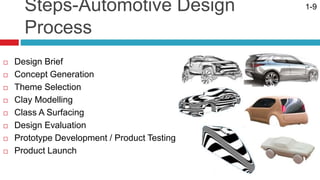
 Design Brief
 Concept Generation
 Theme Selection
 Clay Modelling
 Class A Surfacing
 Design Evaluation
 Prototype Development / Product Testing
 Product Launch
1-9
Design Brief
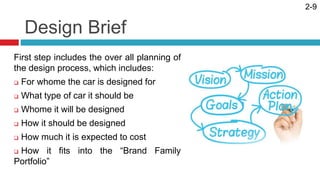
First step includes the over all planning of
the design process, which includes:
 For whome the car is designed for
 What type of car it should be
 Whome it will be designed
 How it should be designed
 How much it is expected to cost
 How it fits into the “Brand Family
Portfolio”
2-9
Concept Generation
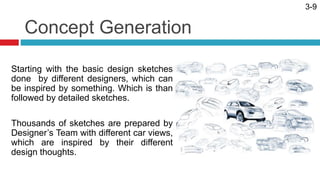
Starting with the basic design sketches
done by different designers, which can
be inspired by something. Which is than
followed by detailed sketches.
Thousands of sketches are prepared by
Designer’s Team with different car views,
which are inspired by their different
design thoughts.
3-9
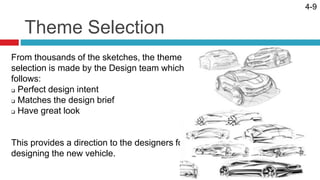
Theme Selection
From thousands of the sketches, the theme
selection is made by the Design team which
follows:
 Perfect design intent
 Matches the design brief
 Have great look
This provides a direction to the designers for
designing the new vehicle.
4-9
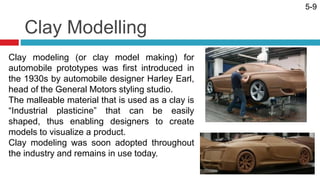
Clay Modelling
Clay modeling (or clay model making) for
automobile prototypes was first introduced in
the 1930s by automobile designer Harley Earl,
head of the General Motors styling studio.
The malleable material that is used as a clay is
“Industrial plasticine” that can be easily
shaped, thus enabling designers to create
models to visualize a product.
Clay modeling was soon adopted throughout
the industry and remains in use today.
5-9
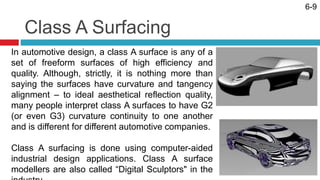
Class A Surfacing
In automotive design, a class A surface is any of a
set of freeform surfaces of high efficiency and
quality. Although, strictly, it is nothing more than
saying the surfaces have curvature and tangency
alignment – to ideal aesthetical reflection quality,
many people interpret class A surfaces to have G2
(or even G3) curvature continuity to one another
and is different for different automotive companies.
Class A surfacing is done using computer-aided
industrial design applications. Class A surface
modellers are also called “Digital Sculptors" in the
6-9
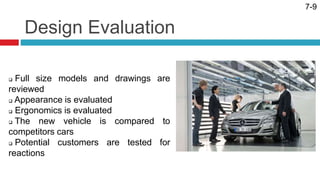
Design Evaluation
 Full size models and drawings are
reviewed
 Appearance is evaluated
 Ergonomics is evaluated
 The new vehicle is compared to
competitors cars
 Potential customers are tested for
reactions
7-9
Prototype development/Testing
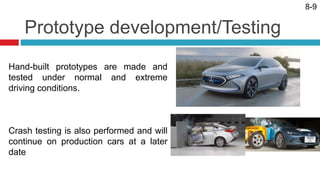
Hand-built prototypes are made and
tested under normal and extreme
driving conditions.
Crash testing is also performed and will
continue on production cars at a later
date
8-9
Product Launch
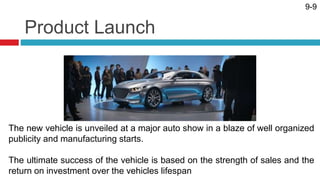
The new vehicle is unveiled at a major auto show in a blaze of well organized
publicity and manufacturing starts.
The ultimate success of the vehicle is based on the strength of sales and the
return on investment over the vehicles lifespan
9-9
Karan Bhola
karanbhola777@gmail.com

Automotive design process

  • 1.
  • 2.
    Steps-Automotive Design Process  DesignBrief  Concept Generation  Theme Selection  Clay Modelling  Class A Surfacing  Design Evaluation  Prototype Development / Product Testing  Product Launch 1-9
  • 3.
    Design Brief First stepincludes the over all planning of the design process, which includes:  For whome the car is designed for  What type of car it should be  Whome it will be designed  How it should be designed  How much it is expected to cost  How it fits into the “Brand Family Portfolio” 2-9
  • 4.
    Concept Generation Starting withthe basic design sketches done by different designers, which can be inspired by something. Which is than followed by detailed sketches. Thousands of sketches are prepared by Designer’s Team with different car views, which are inspired by their different design thoughts. 3-9
  • 5.
    Theme Selection From thousandsof the sketches, the theme selection is made by the Design team which follows:  Perfect design intent  Matches the design brief  Have great look This provides a direction to the designers for designing the new vehicle. 4-9
  • 6.
    Clay Modelling Clay modeling(or clay model making) for automobile prototypes was first introduced in the 1930s by automobile designer Harley Earl, head of the General Motors styling studio. The malleable material that is used as a clay is “Industrial plasticine” that can be easily shaped, thus enabling designers to create models to visualize a product. Clay modeling was soon adopted throughout the industry and remains in use today. 5-9
  • 7.
    Class A Surfacing Inautomotive design, a class A surface is any of a set of freeform surfaces of high efficiency and quality. Although, strictly, it is nothing more than saying the surfaces have curvature and tangency alignment – to ideal aesthetical reflection quality, many people interpret class A surfaces to have G2 (or even G3) curvature continuity to one another and is different for different automotive companies. Class A surfacing is done using computer-aided industrial design applications. Class A surface modellers are also called “Digital Sculptors" in the 6-9
  • 8.
    Design Evaluation  Fullsize models and drawings are reviewed  Appearance is evaluated  Ergonomics is evaluated  The new vehicle is compared to competitors cars  Potential customers are tested for reactions 7-9
  • 9.
    Prototype development/Testing Hand-built prototypesare made and tested under normal and extreme driving conditions. Crash testing is also performed and will continue on production cars at a later date 8-9
  • 10.
    Product Launch The newvehicle is unveiled at a major auto show in a blaze of well organized publicity and manufacturing starts. The ultimate success of the vehicle is based on the strength of sales and the return on investment over the vehicles lifespan 9-9
  • 11.