APNIC eLearning:
BGP Basics
Contact: training@apnic.net
eROU03_v1.0
Overview
• What is BGP?
• BGP Features
• Path Vector Routing Protocol
• Peering and Transit
• BGP General Operation
• BGP Terminology
• BGP Attributes
• Inserting Prefixes into BGP
What is BGP?
• Border Gateway Protocol
• A Routing Protocol used to exchange routing information
between different networks
– Exterior gateway protocol
• Described in RFC4271
– RFC4276 gives an implementation report on BGP
– RFC4277 describes operational experiences using BGP
BGP Features
• Path Vector Protocol
• Incremental Updates
• Many options for policy enforcement
• Classless Inter Domain Routing (CIDR)
• Widely used for Internet backbone
• Autonomous systems
What is Path Vector Routing Protocol
• A path vector routing protocol is used to span different
autonomous systems
• It defines a route as a collection of a number of AS that it
passes through from source AS to destination AS
• This list of ASes are called AS path and used to avoid
routing loop
• AS path is also used to select path to destination
• RFC 1322
– “A path vector protocol defines a route as a pairing between a
destination and the attributes of the path to that destination.”
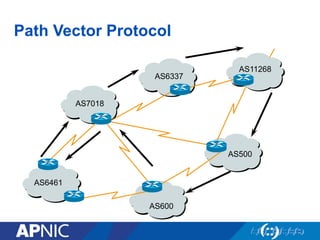
Path Vector Protocol
AS6461
AS7018
AS6337
AS11268
AS500
AS600
Definitions
• Transit – carrying traffic across a network, usually
for a fee
• Peering – exchanging routing information and
traffic
• Default – where to send traffic when there is no
explicit match in the routing table
Default Free Zone
The default free zone is made up
of Internet routers which have
explicit routing information about
the rest of the Internet, and
therefore do not need to use a
default route
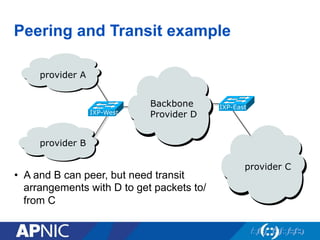
Peering and Transit example
• A and B can peer, but need transit
arrangements with D to get packets to/
from C
provider A
provider C
provider B
Backbone
Provider D
IXP-East
IXP-West
What Is An Autonomous System?
• Group of Internet Protocol-based networks with the same
routing policy
– Usually under single ownership, trust or administrative control
• The AS is used both in the exchange of exterior routing
information (between neighboring ASes) and as an identifier
of the AS itself
• The Autonomous System is the cornerstone of BGP
– It is used to uniquely identify networks with a common routing policy
Autonomous System Number (ASN)
• globally unique identifiers for IP networks
• ASN uniquely identifies each network on the Internet
• allocated to each Autonomous System (AS) for use in BGP
routing
• 2-byte only AS number range : 0 – 65535
• 4-byte only AS number range – represented in two ways
– AS PLAIN: 65,536 - 4,294,967,295
– AS DOT: 1.0 - 65535.65535
BGP General Operation
• Learns multiple paths via internal and external BGP
speakers
• Picks the best path and installs it in the routing table (RIB)
• Best path is sent to external BGP neighbours
• Policies are applied by influencing the best path selection
BGP Basics
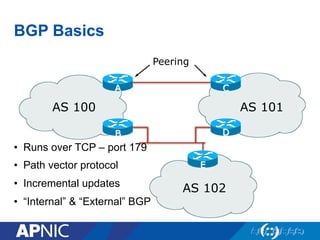
• Runs over TCP – port 179
• Path vector protocol
• Incremental updates
• “Internal” & “External” BGP
AS 100 AS 101
AS 102
E
B D
A C
Peering
BGP Terminology
• Neighbor
– Any two routers that have formed a TCP connection to exchange
BGP routing information are called peers or neighbors
• iBGP
– iBGP refers to the BGP neighbor relationship within the same AS.
– The neighbors do not have to be directly connected.
• eBGP
– When BGP neighbor relationship are formed between two peers
belongs to different AS are called eBGP.
– EBGP neighbors by default need to be directly connected.
BGP Attributes
• Well-known attributes – must be supported by every BGP
implementation
• Mandatory attributes – must be included with every route entry. If one
attribute is missing, it will result in an error message
– Ex: ORIGIN, AS_PATH, NEXT_HOP, LOCAL_PREF
• Discretionary attributes – every BGP router must recognize, but they
don’t have to be present with every route entry
– Ex. ATOMIC_AGGREGATE
• Optional attributes – not necessarily supported by all BGP
implementations. It can be either transitive or non-transitive.
– AGGREGATOR, COMMUNITY, MULTI_EXIT_DISC
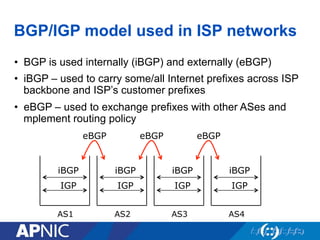
BGP/IGP model used in ISP networks
• BGP is used internally (iBGP) and externally (eBGP)
• iBGP – used to carry some/all Internet prefixes across ISP
backbone and ISP’s customer prefixes
• eBGP – used to exchange prefixes with other ASes and
mplement routing policy
IGP
iBGP
IGP
iBGP
IGP
iBGP
IGP
iBGP
eBGP eBGP eBGP
AS1 AS2 AS3 AS4
Internal BGP (iBGP)
• BGP peer within the same AS
• Not required to be directly connected
– IGP takes care of inter-BGP speaker connectivity
• iBGP speakers must be fully meshed:
– They originate connected networks
– They pass on prefixes learned from outside the ASN
– They do not pass on prefixes learned from other iBGP speakers
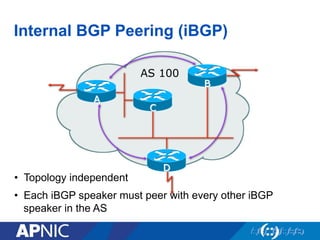
Internal BGP Peering (iBGP)
• Topology independent
• Each iBGP speaker must peer with every other iBGP
speaker in the AS
AS 100
A
D
C
B
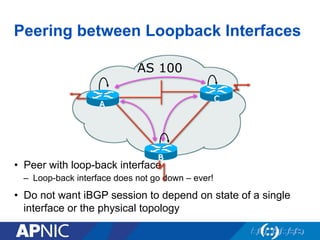
Peering between Loopback Interfaces
• Peer with loop-back interface
– Loop-back interface does not go down – ever!
• Do not want iBGP session to depend on state of a single
interface or the physical topology
AS 100
A
B
C
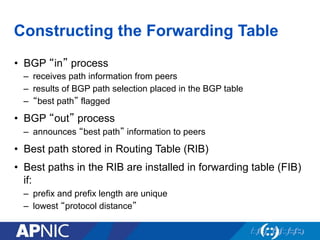
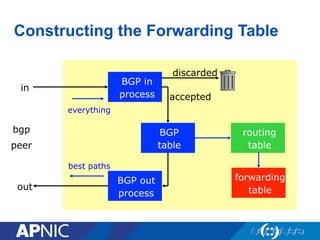
Constructing the Forwarding Table
• BGP “in” process
– receives path information from peers
– results of BGP path selection placed in the BGP table
– “best path” flagged
• BGP “out” process
– announces “best path” information to peers
• Best path stored in Routing Table (RIB)
• Best paths in the RIB are installed in forwarding table (FIB)
if:
– prefix and prefix length are unique
– lowest “protocol distance”
Constructing the Forwarding Table
BGP in
process
BGP
table
BGP out
process
accepted
discarded
bgp
peer
routing
table
in
out
best paths
everything
forwarding
table
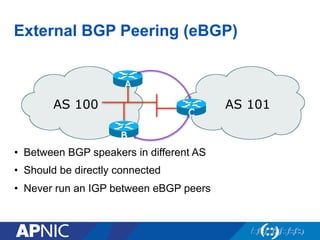
External BGP Peering (eBGP)
• Between BGP speakers in different AS
• Should be directly connected
• Never run an IGP between eBGP peers
AS 100 AS 101
C
A
B
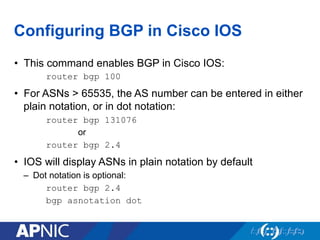
Configuring BGP in Cisco IOS
• This command enables BGP in Cisco IOS:
router bgp 100
• For ASNs > 65535, the AS number can be entered in either
plain notation, or in dot notation:
router bgp 131076
or
router bgp 2.4
• IOS will display ASNs in plain notation by default
– Dot notation is optional:
router bgp 2.4
bgp asnotation dot
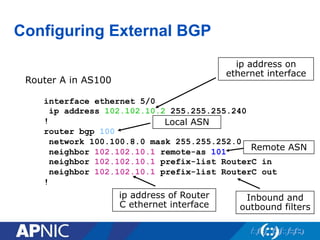
Configuring External BGP
Router A in AS100
interface ethernet 5/0
ip address 102.102.10.2 255.255.255.240
!
router bgp 100
network 100.100.8.0 mask 255.255.252.0
neighbor 102.102.10.1 remote-as 101
neighbor 102.102.10.1 prefix-list RouterC in
neighbor 102.102.10.1 prefix-list RouterC out
!
ip address on
ethernet interface
ip address of Router
C ethernet interface
Local ASN
Remote ASN
Inbound and
outbound filters
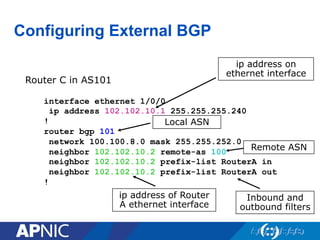
Configuring External BGP
Router C in AS101
interface ethernet 1/0/0
ip address 102.102.10.1 255.255.255.240
!
router bgp 101
network 100.100.8.0 mask 255.255.252.0
neighbor 102.102.10.2 remote-as 100
neighbor 102.102.10.2 prefix-list RouterA in
neighbor 102.102.10.2 prefix-list RouterA out
!
ip address on
ethernet interface
ip address of Router
A ethernet interface
Local ASN
Remote ASN
Inbound and
outbound filters
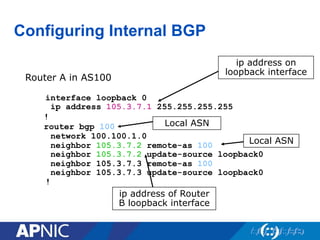
Configuring Internal BGP
Router A in AS100
interface loopback 0
ip address 105.3.7.1 255.255.255.255
!
router bgp 100
network 100.100.1.0
neighbor 105.3.7.2 remote-as 100
neighbor 105.3.7.2 update-source loopback0
neighbor 105.3.7.3 remote-as 100
neighbor 105.3.7.3 update-source loopback0
!
ip address on
loopback interface
ip address of Router
B loopback interface
Local ASN
Local ASN
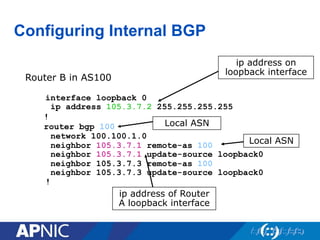
Configuring Internal BGP
Router B in AS100
interface loopback 0
ip address 105.3.7.2 255.255.255.255
!
router bgp 100
network 100.100.1.0
neighbor 105.3.7.1 remote-as 100
neighbor 105.3.7.1 update-source loopback0
neighbor 105.3.7.3 remote-as 100
neighbor 105.3.7.3 update-source loopback0
!
ip address on
loopback interface
ip address of Router
A loopback interface
Local ASN
Local ASN
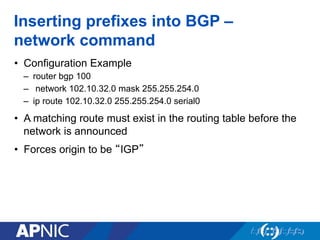
Inserting prefixes into BGP –
network command
• Configuration Example
– router bgp 100
– network 102.10.32.0 mask 255.255.254.0
– ip route 102.10.32.0 255.255.254.0 serial0
• A matching route must exist in the routing table before the
network is announced
• Forces origin to be “IGP”
Configuring Aggregation –
Network Command
• Configuration Example
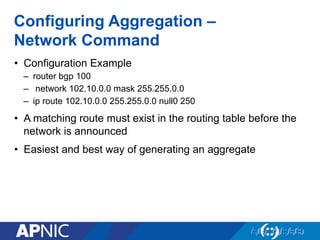
– router bgp 100
– network 102.10.0.0 mask 255.255.0.0
– ip route 102.10.0.0 255.255.0.0 null0 250
• A matching route must exist in the routing table before the
network is announced
• Easiest and best way of generating an aggregate
Summary
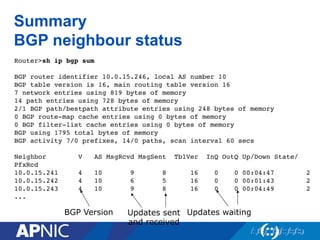
BGP neighbour status
Router>sh ip bgp sum!
!
BGP router identifier 10.0.15.246, local AS number 10!
BGP table version is 16, main routing table version 16!
7 network entries using 819 bytes of memory!
14 path entries using 728 bytes of memory!
2/1 BGP path/bestpath attribute entries using 248 bytes of memory!
0 BGP route-map cache entries using 0 bytes of memory!
0 BGP filter-list cache entries using 0 bytes of memory!
BGP using 1795 total bytes of memory!
BGP activity 7/0 prefixes, 14/0 paths, scan interval 60 secs!
!
Neighbor V AS MsgRcvd MsgSent TblVer InQ OutQ Up/Down State/
PfxRcd!
10.0.15.241 4 10 9 8 16 0 0 00:04:47 2!
10.0.15.242 4 10 6 5 16 0 0 00:01:43 2!
10.0.15.243 4 10 9 8 16 0 0 00:04:49 2!
...!
BGP Version Updates sent
and received
Updates waiting
Summary
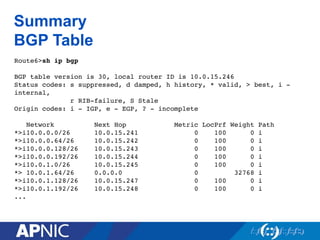
BGP Table
Route6>sh ip bgp!
!
BGP table version is 30, local router ID is 10.0.15.246!
Status codes: s suppressed, d damped, h history, * valid, > best, i -
internal,!
r RIB-failure, S Stale!
Origin codes: i - IGP, e - EGP, ? - incomplete!
!
Network Next Hop Metric LocPrf Weight Path!
*>i10.0.0.0/26 10.0.15.241 0 100 0 i!
*>i10.0.0.64/26 10.0.15.242 0 100 0 i!
*>i10.0.0.128/26 10.0.15.243 0 100 0 i!
*>i10.0.0.192/26 10.0.15.244 0 100 0 i!
*>i10.0.1.0/26 10.0.15.245 0 100 0 i!
*> 10.0.1.64/26 0.0.0.0 0 32768 i!
*>i10.0.1.128/26 10.0.15.247 0 100 0 i!
*>i10.0.1.192/26 10.0.15.248 0 100 0 i!
...!
Questions
• Please remember to fill out the
feedback form
– <survey-link>
• Slide handouts will be available
after completing the survey
APNIC Helpdesk Chat
Thank you!
End of Session

Apnic_bgp_training_cisco_ciscosaicoc.pdf

  • 1.
    APNIC eLearning: BGP Basics Contact:training@apnic.net eROU03_v1.0
  • 2.
    Overview • What isBGP? • BGP Features • Path Vector Routing Protocol • Peering and Transit • BGP General Operation • BGP Terminology • BGP Attributes • Inserting Prefixes into BGP
  • 3.
    What is BGP? •Border Gateway Protocol • A Routing Protocol used to exchange routing information between different networks – Exterior gateway protocol • Described in RFC4271 – RFC4276 gives an implementation report on BGP – RFC4277 describes operational experiences using BGP
  • 4.
    BGP Features • PathVector Protocol • Incremental Updates • Many options for policy enforcement • Classless Inter Domain Routing (CIDR) • Widely used for Internet backbone • Autonomous systems
  • 5.
    What is PathVector Routing Protocol • A path vector routing protocol is used to span different autonomous systems • It defines a route as a collection of a number of AS that it passes through from source AS to destination AS • This list of ASes are called AS path and used to avoid routing loop • AS path is also used to select path to destination • RFC 1322 – “A path vector protocol defines a route as a pairing between a destination and the attributes of the path to that destination.”
  • 6.
  • 7.
    Definitions • Transit –carrying traffic across a network, usually for a fee • Peering – exchanging routing information and traffic • Default – where to send traffic when there is no explicit match in the routing table
  • 8.
    Default Free Zone Thedefault free zone is made up of Internet routers which have explicit routing information about the rest of the Internet, and therefore do not need to use a default route
  • 9.
    Peering and Transitexample • A and B can peer, but need transit arrangements with D to get packets to/ from C provider A provider C provider B Backbone Provider D IXP-East IXP-West
  • 10.
    What Is AnAutonomous System? • Group of Internet Protocol-based networks with the same routing policy – Usually under single ownership, trust or administrative control • The AS is used both in the exchange of exterior routing information (between neighboring ASes) and as an identifier of the AS itself • The Autonomous System is the cornerstone of BGP – It is used to uniquely identify networks with a common routing policy
  • 11.
    Autonomous System Number(ASN) • globally unique identifiers for IP networks • ASN uniquely identifies each network on the Internet • allocated to each Autonomous System (AS) for use in BGP routing • 2-byte only AS number range : 0 – 65535 • 4-byte only AS number range – represented in two ways – AS PLAIN: 65,536 - 4,294,967,295 – AS DOT: 1.0 - 65535.65535
  • 12.
    BGP General Operation •Learns multiple paths via internal and external BGP speakers • Picks the best path and installs it in the routing table (RIB) • Best path is sent to external BGP neighbours • Policies are applied by influencing the best path selection
  • 13.
    BGP Basics • Runsover TCP – port 179 • Path vector protocol • Incremental updates • “Internal” & “External” BGP AS 100 AS 101 AS 102 E B D A C Peering
  • 14.
    BGP Terminology • Neighbor –Any two routers that have formed a TCP connection to exchange BGP routing information are called peers or neighbors • iBGP – iBGP refers to the BGP neighbor relationship within the same AS. – The neighbors do not have to be directly connected. • eBGP – When BGP neighbor relationship are formed between two peers belongs to different AS are called eBGP. – EBGP neighbors by default need to be directly connected.
  • 15.
    BGP Attributes • Well-knownattributes – must be supported by every BGP implementation • Mandatory attributes – must be included with every route entry. If one attribute is missing, it will result in an error message – Ex: ORIGIN, AS_PATH, NEXT_HOP, LOCAL_PREF • Discretionary attributes – every BGP router must recognize, but they don’t have to be present with every route entry – Ex. ATOMIC_AGGREGATE • Optional attributes – not necessarily supported by all BGP implementations. It can be either transitive or non-transitive. – AGGREGATOR, COMMUNITY, MULTI_EXIT_DISC
  • 16.
    BGP/IGP model usedin ISP networks • BGP is used internally (iBGP) and externally (eBGP) • iBGP – used to carry some/all Internet prefixes across ISP backbone and ISP’s customer prefixes • eBGP – used to exchange prefixes with other ASes and mplement routing policy IGP iBGP IGP iBGP IGP iBGP IGP iBGP eBGP eBGP eBGP AS1 AS2 AS3 AS4
  • 17.
    Internal BGP (iBGP) •BGP peer within the same AS • Not required to be directly connected – IGP takes care of inter-BGP speaker connectivity • iBGP speakers must be fully meshed: – They originate connected networks – They pass on prefixes learned from outside the ASN – They do not pass on prefixes learned from other iBGP speakers
  • 18.
    Internal BGP Peering(iBGP) • Topology independent • Each iBGP speaker must peer with every other iBGP speaker in the AS AS 100 A D C B
  • 19.
    Peering between LoopbackInterfaces • Peer with loop-back interface – Loop-back interface does not go down – ever! • Do not want iBGP session to depend on state of a single interface or the physical topology AS 100 A B C
  • 20.
    Constructing the ForwardingTable • BGP “in” process – receives path information from peers – results of BGP path selection placed in the BGP table – “best path” flagged • BGP “out” process – announces “best path” information to peers • Best path stored in Routing Table (RIB) • Best paths in the RIB are installed in forwarding table (FIB) if: – prefix and prefix length are unique – lowest “protocol distance”
  • 21.
    Constructing the ForwardingTable BGP in process BGP table BGP out process accepted discarded bgp peer routing table in out best paths everything forwarding table
  • 22.
    External BGP Peering(eBGP) • Between BGP speakers in different AS • Should be directly connected • Never run an IGP between eBGP peers AS 100 AS 101 C A B
  • 23.
    Configuring BGP inCisco IOS • This command enables BGP in Cisco IOS: router bgp 100 • For ASNs > 65535, the AS number can be entered in either plain notation, or in dot notation: router bgp 131076 or router bgp 2.4 • IOS will display ASNs in plain notation by default – Dot notation is optional: router bgp 2.4 bgp asnotation dot
  • 24.
    Configuring External BGP RouterA in AS100 interface ethernet 5/0 ip address 102.102.10.2 255.255.255.240 ! router bgp 100 network 100.100.8.0 mask 255.255.252.0 neighbor 102.102.10.1 remote-as 101 neighbor 102.102.10.1 prefix-list RouterC in neighbor 102.102.10.1 prefix-list RouterC out ! ip address on ethernet interface ip address of Router C ethernet interface Local ASN Remote ASN Inbound and outbound filters
  • 25.
    Configuring External BGP RouterC in AS101 interface ethernet 1/0/0 ip address 102.102.10.1 255.255.255.240 ! router bgp 101 network 100.100.8.0 mask 255.255.252.0 neighbor 102.102.10.2 remote-as 100 neighbor 102.102.10.2 prefix-list RouterA in neighbor 102.102.10.2 prefix-list RouterA out ! ip address on ethernet interface ip address of Router A ethernet interface Local ASN Remote ASN Inbound and outbound filters
  • 26.
    Configuring Internal BGP RouterA in AS100 interface loopback 0 ip address 105.3.7.1 255.255.255.255 ! router bgp 100 network 100.100.1.0 neighbor 105.3.7.2 remote-as 100 neighbor 105.3.7.2 update-source loopback0 neighbor 105.3.7.3 remote-as 100 neighbor 105.3.7.3 update-source loopback0 ! ip address on loopback interface ip address of Router B loopback interface Local ASN Local ASN
  • 27.
    Configuring Internal BGP RouterB in AS100 interface loopback 0 ip address 105.3.7.2 255.255.255.255 ! router bgp 100 network 100.100.1.0 neighbor 105.3.7.1 remote-as 100 neighbor 105.3.7.1 update-source loopback0 neighbor 105.3.7.3 remote-as 100 neighbor 105.3.7.3 update-source loopback0 ! ip address on loopback interface ip address of Router A loopback interface Local ASN Local ASN
  • 28.
    Inserting prefixes intoBGP – network command • Configuration Example – router bgp 100 – network 102.10.32.0 mask 255.255.254.0 – ip route 102.10.32.0 255.255.254.0 serial0 • A matching route must exist in the routing table before the network is announced • Forces origin to be “IGP”
  • 29.
    Configuring Aggregation – NetworkCommand • Configuration Example – router bgp 100 – network 102.10.0.0 mask 255.255.0.0 – ip route 102.10.0.0 255.255.0.0 null0 250 • A matching route must exist in the routing table before the network is announced • Easiest and best way of generating an aggregate
  • 30.
    Summary BGP neighbour status Router>ship bgp sum! ! BGP router identifier 10.0.15.246, local AS number 10! BGP table version is 16, main routing table version 16! 7 network entries using 819 bytes of memory! 14 path entries using 728 bytes of memory! 2/1 BGP path/bestpath attribute entries using 248 bytes of memory! 0 BGP route-map cache entries using 0 bytes of memory! 0 BGP filter-list cache entries using 0 bytes of memory! BGP using 1795 total bytes of memory! BGP activity 7/0 prefixes, 14/0 paths, scan interval 60 secs! ! Neighbor V AS MsgRcvd MsgSent TblVer InQ OutQ Up/Down State/ PfxRcd! 10.0.15.241 4 10 9 8 16 0 0 00:04:47 2! 10.0.15.242 4 10 6 5 16 0 0 00:01:43 2! 10.0.15.243 4 10 9 8 16 0 0 00:04:49 2! ...! BGP Version Updates sent and received Updates waiting
  • 31.
    Summary BGP Table Route6>sh ipbgp! ! BGP table version is 30, local router ID is 10.0.15.246! Status codes: s suppressed, d damped, h history, * valid, > best, i - internal,! r RIB-failure, S Stale! Origin codes: i - IGP, e - EGP, ? - incomplete! ! Network Next Hop Metric LocPrf Weight Path! *>i10.0.0.0/26 10.0.15.241 0 100 0 i! *>i10.0.0.64/26 10.0.15.242 0 100 0 i! *>i10.0.0.128/26 10.0.15.243 0 100 0 i! *>i10.0.0.192/26 10.0.15.244 0 100 0 i! *>i10.0.1.0/26 10.0.15.245 0 100 0 i! *> 10.0.1.64/26 0.0.0.0 0 32768 i! *>i10.0.1.128/26 10.0.15.247 0 100 0 i! *>i10.0.1.192/26 10.0.15.248 0 100 0 i! ...!
  • 32.
    Questions • Please rememberto fill out the feedback form – <survey-link> • Slide handouts will be available after completing the survey
  • 33.
  • 34.