Developing a T&P Narrative including  Philosophy of Teaching Meghan Burke, Kennesaw State University   (with thanks to Bill Hill) March, 2010 www.kennesaw.edu/cetl
Quotation for the Day   If You Teach, Learn To Do It Well; If You Do It Well, Learn To Do It Better (Ludy Benjamin, Texas A & M University)  www.kennesaw.edu/cetl
Workshop Goals Provide a broad overview of the elements of a narrative and of a philosophy of teaching Provide some practical suggestions and activities that participants can use to develop their own narratives www.kennesaw.edu/cetl
Workshop Assumption Participants Will Vary in Teaching Experience and May or May or May Not Be Familiar With the Teaching Literature www.kennesaw.edu/cetl
What is the Narrative? A narrative is a way of walking the reviewer of your portfolio through your accomplishments. It should include a philosophy of teaching, and describe how you conduct your teaching consistent with this philosophy. It also should guide the reader through your accomplishments, which will be listed in your cv. www.kennesaw.edu/cetl
Things to Consider Your narrative is your primary statement (especially to reviewers outside your discipline) Know the expectations for tenure or promotion to the next rank & write your narrative with an eye towards those expectations Don’t cover everything you’ve done – spotlight your best work Should be well-written & well-organized Find someone to review your narrative (preferably not someone who will be formally reviewing your portfolio) – no changes can be made after you submit it Don’t procrastinate! Don’t procrastinate! www.kennesaw.edu/cetl
Guidelines for the Narrative Maximum 12 pages, double spaced, 12 point font, one-inch margins Describes the quality and significance of the faculty member’s contributions during the period under review in the appropriate performance areas www.kennesaw.edu/cetl
Structure of the Narrative Introduction:  Context: current rank, how long at KSU, which review this is a brief summary of criteria for review, which areas you have emphasized, any special circumstances. Areas (subtitled): Teaching, Supervising, and Mentoring, including philosophy of teaching Research and Creative Activity  Professional Service Administration and Leadership  Conclusion: reiterate criteria & that you meet them www.kennesaw.edu/cetl
Web Resource Details and Sample narratives available at Academic Affairs web site: http://web.kennesaw.edu/academicaffairs www.kennesaw.edu/cetl
Developing your Philosophy of Teaching www.kennesaw.edu/cetl
Small Group Discussion of Effective Teaching  Form dyads/triads and generate a list of the “Top Five” characteristics of effective teaching.  You might approach this through sharing descriptions of the “Best Teacher” you had as a student www.kennesaw.edu/cetl
Large Group Exchange of Ideas on Effective Teaching  www.kennesaw.edu/cetl
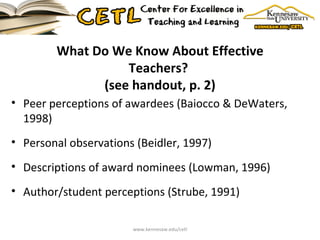
What Do We Know About Effective Teachers?  (see handout, p. 2) Peer perceptions of awardees (Baiocco & DeWaters, 1998) Personal observations (Beidler, 1997) Descriptions of award nominees (Lowman, 1996) Author/student perceptions (Strube, 1991) www.kennesaw.edu/cetl
A Summary of the Qualities of Master Teachers Based on a Brief Literature Review See your handout, p. 3. www.kennesaw.edu/cetl
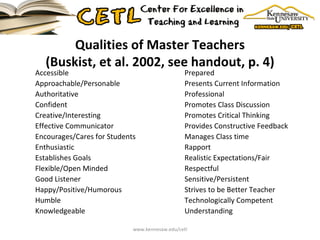
Qualities of Master Teachers (Buskist, et al. 2002, see handout, p. 4) Accessible Approachable/Personable Authoritative Confident Creative/Interesting Effective Communicator Encourages/Cares for Students Enthusiastic Establishes Goals Flexible/Open Minded Good Listener Happy/Positive/Humorous Humble Knowledgeable Prepared Presents Current Information Professional Promotes Class Discussion Promotes Critical Thinking Provides Constructive Feedback Manages Class time Rapport Realistic Expectations/Fair Respectful Sensitive/Persistent Strives to be Better Teacher Technologically Competent Understanding www.kennesaw.edu/cetl
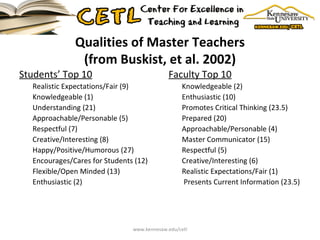
Qualities of Master Teachers (from Buskist, et al. 2002) Students’ Top 10 Realistic Expectations/Fair (9) Knowledgeable (1) Understanding (21) Approachable/Personable (5) Respectful (7) Creative/Interesting (8) Happy/Positive/Humorous (27) Encourages/Cares for Students (12) Flexible/Open Minded (13) Enthusiastic (2) Faculty Top 10 Knowledgeable (2) Enthusiastic (10) Promotes Critical Thinking (23.5) Prepared (20) Approachable/Personable (4) Master Communicator (15) Respectful (5) Creative/Interesting (6) Realistic Expectations/Fair (1) Presents Current Information (23.5) www.kennesaw.edu/cetl
A Philosophy of Teaching….. What Is It?   The main components of philosophy of teaching statements are descriptions of how the teachers think learning occurs, how they think they can intervene in this process, what chief goals they have for students, and what actions they take to implement their intentions.  (Handout, p. 5) “ Developing a Philosophy of Teaching Statement,” Nancy Van Note Chism, The Ohio State University (http://www.cofc.edu/~cetl/Essays/DevelopingaPhilosophyofTeaching.html, Retrieved on October 6, 2004) www.kennesaw.edu/cetl
A Philosophy of Teaching….. What Is It?   A teaching philosophy is an expression of individual values. It is like a personal mission statement. “ Teaching Philosophy,” The Center for Effective Teaching and Learning (http://cetal.utep.edu/resources/portfolios/philos.htm, Retrieved on December 7, 2004)   www.kennesaw.edu/cetl
Purpose of a Teaching Philosophy Statement  Expresses Your Personal Beliefs, Opinions, and Views About What You  Do  As a Teacher Intended to Be Used for Reflection, Guidance, and Personal Development of Yourself as a Teacher Is Most Effective When You Revisit and Revise it Frequently Provides a Developmental History of Your Growth as a Teacher Can be supplemented with “Semesterly Reflections”—Short Essays that Reflect on Your Teaching Experiences Over the Course of Each Semester  www.kennesaw.edu/cetl
Some Questions to Guide Yourself in  Writing a Teaching Philosophy Statement  (Thanks to Steve Davis for this list) General Overview of You as a Teacher Why do you teach? What do you find rewarding about teaching? What are the basic principles that underlie your teaching? What are your standards or criteria for effective teaching? Your Style of Teaching What is unique about your teaching? How do you establish rapport with your students? What are your expectations for your students’ intellectual accomplishments? Teaching Goals What do you wish for your students learn? Within what sort of context do you teach (liberal arts, preprofessional training, or both)? What sorts of skills do you deliberately attempt to teach in your classes and why? How will you evaluate whether you’ve accomplished your teaching goals? www.kennesaw.edu/cetl
See handout, pp. 5-8 for additional guidance on developing a philosophy of teaching statement www.kennesaw.edu/cetl
I believe that a teacher’s role is primarily to provide guidance to students in their study of any subject matter. Teachers are not all-knowing, all-powerful sages who sit on their thrones and dispense knowledge to others. Rather, the learning process is collaborative—student and teacher joining together in working toward a better understanding of the subject matter. I will provide you specific goals for you to accomplish on your way to achieving this understanding. Likewise, you will challenge me to find new and interesting ways to help you learn about psychology in the process. I will urge you to take an active role in what you are learning and how you will learn it. I will answer your questions to the best of my ability and throw a few questions your way every now and then. Finally, I believe that teaching and learning should be fun. I want all of us to enjoy the class, the experience of learning about psychology, and learning about ourselves and our humanity.  I also believe that students should be expected to read the text and understand a sizeable portion of its content. Thus, I do not feel compelled to lecture word-for-word from the text. Instead, I will supplement what the text covers with additional material. I will review those concepts discussed in the book that are particularly difficult to understand, but beyond that, I will be covering fresh ground. I encourage you to ask questions at any time to clarify text material or the content of my presentations. (Bill Buskist)  www.kennesaw.edu/cetl
My philosophy and practice of teaching embodies several basic tenets.  First, I believe that a good teacher must approach the classroom situation as a shared learning experience.  This requires me to make every effort to involve the students in their educational experience.  I try to accomplish this through an enthusiastic attitude toward the material, encouraging students to participate in class through the use of a Socratic method of teaching, helping students make connections between the course material and their everyday experiences, and attempting to establish an atmosphere where students can be free to express their ideas and opinions.  Secondly, I want to challenge the student to use the course material as a foundation for life-long learning.  I attempt to accomplish this goal through the development of creative projects and exercises both within and outside class that are both designed to stimulate their interest in the course content and relate it to their future career goals. Next, I believe that I must be fair and objective in my course planning and follow through.  Finally, I hope that I can be a role model of excellent teaching for my students thus inspiring some of them to pursue a teaching career in higher education. (Bill Hill) www.kennesaw.edu/cetl
Write First Draft of Your “Brief” Statement  Working alone, each of you will draft/revise your Statement www.kennesaw.edu/cetl
Sharing Statement Drafts www.kennesaw.edu/cetl
Some Course Contexts That Can Embody Your Philosophy The first day Course syllabus Performance assessments Everyday classroom activities (e.g., lectures, activities, discussions) Out-of-class interactions www.kennesaw.edu/cetl
Student Performance Assessments Breakout Groups Individually list the main ways that you assess student performance in the primary course you teach. What are the matches and mismatches between the assessments on your list and your philosophy of teaching? www.kennesaw.edu/cetl
Student Performance Assessments Categories of Assessments Purpose: Formative v. Summative  Focus: Knowledge Skills Values www.kennesaw.edu/cetl
Formative Assessments Major Resources: Text ancillaries Angelo and Cross (1993) www.kennesaw.edu/cetl
Other Methods for Engaging and Assessing Students Student Response Systems Case- or Problem-Based Teaching & Learning What else? www.kennesaw.edu/cetl
Out-of-Class Interactions Class does not end when we walk out the door!! Accessibility Approachable Listen Positive/Encouraging Constructive Feedback Rapport Understanding Individual and group interactions Service through student organization advisement and presentations www.kennesaw.edu/cetl
5 Criteria For Appraising Teaching Effectiveness 1.  Pedagogical Skills that exemplify Mastery of Existing Knowledge, Effectiveness of Communication, and Significance of Results 2.  Professionalism that exemplifies Consistently Ethical behavior 3.  Assessment of Student Learning that exemplifies Mastery of Existing Knowledge and Significance of Results www.kennesaw.edu/cetl
5 Criteria For Appraising Teaching Effectiveness 4.  Professional Development that exemplifies Clarity and Relevance of Goals and Mastery of Existing Knowledge 5.  Reflective Practice that exemplifies Clarity and Relevance of Goals and Effective Communication www.kennesaw.edu/cetl
Comments & Questions www.kennesaw.edu/cetl

Developing a T&P Narrative Including Philosophy of Teaching

  • 1.
    Developing a T&PNarrative including Philosophy of Teaching Meghan Burke, Kennesaw State University   (with thanks to Bill Hill) March, 2010 www.kennesaw.edu/cetl
  • 2.
    Quotation for theDay If You Teach, Learn To Do It Well; If You Do It Well, Learn To Do It Better (Ludy Benjamin, Texas A & M University) www.kennesaw.edu/cetl
  • 3.
    Workshop Goals Providea broad overview of the elements of a narrative and of a philosophy of teaching Provide some practical suggestions and activities that participants can use to develop their own narratives www.kennesaw.edu/cetl
  • 4.
    Workshop Assumption ParticipantsWill Vary in Teaching Experience and May or May or May Not Be Familiar With the Teaching Literature www.kennesaw.edu/cetl
  • 5.
    What is theNarrative? A narrative is a way of walking the reviewer of your portfolio through your accomplishments. It should include a philosophy of teaching, and describe how you conduct your teaching consistent with this philosophy. It also should guide the reader through your accomplishments, which will be listed in your cv. www.kennesaw.edu/cetl
  • 6.
    Things to ConsiderYour narrative is your primary statement (especially to reviewers outside your discipline) Know the expectations for tenure or promotion to the next rank & write your narrative with an eye towards those expectations Don’t cover everything you’ve done – spotlight your best work Should be well-written & well-organized Find someone to review your narrative (preferably not someone who will be formally reviewing your portfolio) – no changes can be made after you submit it Don’t procrastinate! Don’t procrastinate! www.kennesaw.edu/cetl
  • 7.
    Guidelines for theNarrative Maximum 12 pages, double spaced, 12 point font, one-inch margins Describes the quality and significance of the faculty member’s contributions during the period under review in the appropriate performance areas www.kennesaw.edu/cetl
  • 8.
    Structure of theNarrative Introduction: Context: current rank, how long at KSU, which review this is a brief summary of criteria for review, which areas you have emphasized, any special circumstances. Areas (subtitled): Teaching, Supervising, and Mentoring, including philosophy of teaching Research and Creative Activity Professional Service Administration and Leadership Conclusion: reiterate criteria & that you meet them www.kennesaw.edu/cetl
  • 9.
    Web Resource Detailsand Sample narratives available at Academic Affairs web site: http://web.kennesaw.edu/academicaffairs www.kennesaw.edu/cetl
  • 10.
    Developing your Philosophyof Teaching www.kennesaw.edu/cetl
  • 11.
    Small Group Discussionof Effective Teaching Form dyads/triads and generate a list of the “Top Five” characteristics of effective teaching. You might approach this through sharing descriptions of the “Best Teacher” you had as a student www.kennesaw.edu/cetl
  • 12.
    Large Group Exchangeof Ideas on Effective Teaching www.kennesaw.edu/cetl
  • 13.
    What Do WeKnow About Effective Teachers? (see handout, p. 2) Peer perceptions of awardees (Baiocco & DeWaters, 1998) Personal observations (Beidler, 1997) Descriptions of award nominees (Lowman, 1996) Author/student perceptions (Strube, 1991) www.kennesaw.edu/cetl
  • 14.
    A Summary ofthe Qualities of Master Teachers Based on a Brief Literature Review See your handout, p. 3. www.kennesaw.edu/cetl
  • 15.
    Qualities of MasterTeachers (Buskist, et al. 2002, see handout, p. 4) Accessible Approachable/Personable Authoritative Confident Creative/Interesting Effective Communicator Encourages/Cares for Students Enthusiastic Establishes Goals Flexible/Open Minded Good Listener Happy/Positive/Humorous Humble Knowledgeable Prepared Presents Current Information Professional Promotes Class Discussion Promotes Critical Thinking Provides Constructive Feedback Manages Class time Rapport Realistic Expectations/Fair Respectful Sensitive/Persistent Strives to be Better Teacher Technologically Competent Understanding www.kennesaw.edu/cetl
  • 16.
    Qualities of MasterTeachers (from Buskist, et al. 2002) Students’ Top 10 Realistic Expectations/Fair (9) Knowledgeable (1) Understanding (21) Approachable/Personable (5) Respectful (7) Creative/Interesting (8) Happy/Positive/Humorous (27) Encourages/Cares for Students (12) Flexible/Open Minded (13) Enthusiastic (2) Faculty Top 10 Knowledgeable (2) Enthusiastic (10) Promotes Critical Thinking (23.5) Prepared (20) Approachable/Personable (4) Master Communicator (15) Respectful (5) Creative/Interesting (6) Realistic Expectations/Fair (1) Presents Current Information (23.5) www.kennesaw.edu/cetl
  • 17.
    A Philosophy ofTeaching….. What Is It? The main components of philosophy of teaching statements are descriptions of how the teachers think learning occurs, how they think they can intervene in this process, what chief goals they have for students, and what actions they take to implement their intentions. (Handout, p. 5) “ Developing a Philosophy of Teaching Statement,” Nancy Van Note Chism, The Ohio State University (http://www.cofc.edu/~cetl/Essays/DevelopingaPhilosophyofTeaching.html, Retrieved on October 6, 2004) www.kennesaw.edu/cetl
  • 18.
    A Philosophy ofTeaching….. What Is It? A teaching philosophy is an expression of individual values. It is like a personal mission statement. “ Teaching Philosophy,” The Center for Effective Teaching and Learning (http://cetal.utep.edu/resources/portfolios/philos.htm, Retrieved on December 7, 2004) www.kennesaw.edu/cetl
  • 19.
    Purpose of aTeaching Philosophy Statement Expresses Your Personal Beliefs, Opinions, and Views About What You Do As a Teacher Intended to Be Used for Reflection, Guidance, and Personal Development of Yourself as a Teacher Is Most Effective When You Revisit and Revise it Frequently Provides a Developmental History of Your Growth as a Teacher Can be supplemented with “Semesterly Reflections”—Short Essays that Reflect on Your Teaching Experiences Over the Course of Each Semester www.kennesaw.edu/cetl
  • 20.
    Some Questions toGuide Yourself in Writing a Teaching Philosophy Statement (Thanks to Steve Davis for this list) General Overview of You as a Teacher Why do you teach? What do you find rewarding about teaching? What are the basic principles that underlie your teaching? What are your standards or criteria for effective teaching? Your Style of Teaching What is unique about your teaching? How do you establish rapport with your students? What are your expectations for your students’ intellectual accomplishments? Teaching Goals What do you wish for your students learn? Within what sort of context do you teach (liberal arts, preprofessional training, or both)? What sorts of skills do you deliberately attempt to teach in your classes and why? How will you evaluate whether you’ve accomplished your teaching goals? www.kennesaw.edu/cetl
  • 21.
    See handout, pp.5-8 for additional guidance on developing a philosophy of teaching statement www.kennesaw.edu/cetl
  • 22.
    I believe thata teacher’s role is primarily to provide guidance to students in their study of any subject matter. Teachers are not all-knowing, all-powerful sages who sit on their thrones and dispense knowledge to others. Rather, the learning process is collaborative—student and teacher joining together in working toward a better understanding of the subject matter. I will provide you specific goals for you to accomplish on your way to achieving this understanding. Likewise, you will challenge me to find new and interesting ways to help you learn about psychology in the process. I will urge you to take an active role in what you are learning and how you will learn it. I will answer your questions to the best of my ability and throw a few questions your way every now and then. Finally, I believe that teaching and learning should be fun. I want all of us to enjoy the class, the experience of learning about psychology, and learning about ourselves and our humanity. I also believe that students should be expected to read the text and understand a sizeable portion of its content. Thus, I do not feel compelled to lecture word-for-word from the text. Instead, I will supplement what the text covers with additional material. I will review those concepts discussed in the book that are particularly difficult to understand, but beyond that, I will be covering fresh ground. I encourage you to ask questions at any time to clarify text material or the content of my presentations. (Bill Buskist) www.kennesaw.edu/cetl
  • 23.
    My philosophy andpractice of teaching embodies several basic tenets. First, I believe that a good teacher must approach the classroom situation as a shared learning experience. This requires me to make every effort to involve the students in their educational experience. I try to accomplish this through an enthusiastic attitude toward the material, encouraging students to participate in class through the use of a Socratic method of teaching, helping students make connections between the course material and their everyday experiences, and attempting to establish an atmosphere where students can be free to express their ideas and opinions. Secondly, I want to challenge the student to use the course material as a foundation for life-long learning. I attempt to accomplish this goal through the development of creative projects and exercises both within and outside class that are both designed to stimulate their interest in the course content and relate it to their future career goals. Next, I believe that I must be fair and objective in my course planning and follow through. Finally, I hope that I can be a role model of excellent teaching for my students thus inspiring some of them to pursue a teaching career in higher education. (Bill Hill) www.kennesaw.edu/cetl
  • 24.
    Write First Draftof Your “Brief” Statement Working alone, each of you will draft/revise your Statement www.kennesaw.edu/cetl
  • 25.
    Sharing Statement Draftswww.kennesaw.edu/cetl
  • 26.
    Some Course ContextsThat Can Embody Your Philosophy The first day Course syllabus Performance assessments Everyday classroom activities (e.g., lectures, activities, discussions) Out-of-class interactions www.kennesaw.edu/cetl
  • 27.
    Student Performance AssessmentsBreakout Groups Individually list the main ways that you assess student performance in the primary course you teach. What are the matches and mismatches between the assessments on your list and your philosophy of teaching? www.kennesaw.edu/cetl
  • 28.
    Student Performance AssessmentsCategories of Assessments Purpose: Formative v. Summative Focus: Knowledge Skills Values www.kennesaw.edu/cetl
  • 29.
    Formative Assessments MajorResources: Text ancillaries Angelo and Cross (1993) www.kennesaw.edu/cetl
  • 30.
    Other Methods forEngaging and Assessing Students Student Response Systems Case- or Problem-Based Teaching & Learning What else? www.kennesaw.edu/cetl
  • 31.
    Out-of-Class Interactions Classdoes not end when we walk out the door!! Accessibility Approachable Listen Positive/Encouraging Constructive Feedback Rapport Understanding Individual and group interactions Service through student organization advisement and presentations www.kennesaw.edu/cetl
  • 32.
    5 Criteria ForAppraising Teaching Effectiveness 1. Pedagogical Skills that exemplify Mastery of Existing Knowledge, Effectiveness of Communication, and Significance of Results 2. Professionalism that exemplifies Consistently Ethical behavior 3. Assessment of Student Learning that exemplifies Mastery of Existing Knowledge and Significance of Results www.kennesaw.edu/cetl
  • 33.
    5 Criteria ForAppraising Teaching Effectiveness 4. Professional Development that exemplifies Clarity and Relevance of Goals and Mastery of Existing Knowledge 5. Reflective Practice that exemplifies Clarity and Relevance of Goals and Effective Communication www.kennesaw.edu/cetl
  • 34.
    Comments & Questionswww.kennesaw.edu/cetl

Editor's Notes

  • #16 Out of the 28 qualities….see handout
  • #17 Out of the 28 qualities….see handout