Better teaching
methods, better
speakers
- a methodological presentation
by Emilia Frînculeasă,
Nehoiu, January 25, 2017
What can you say
about teaching speaking?
Teaching speaking as a productive skill
- is a complex process that requires time,
effort and also the right teaching methods
- involves activating the learner through
motivating practice (interesting topics/
texts, attractive lessons, challenging tasks)
- implies communicative situations and a
communicative purpose which should
engage the students’ personal knowledge
and experience and address their
linguistic proficiency as well as their age
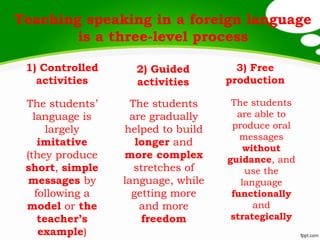
Teaching speaking in a foreign language
is a three-level process
1) Controlled
activities
The students’
language is
largely
imitative
(they produce
short, simple
messages by
following a
model or the
teacher’s
example)
2) Guided
activities
The students
are gradually
helped to build
longer and
more complex
stretches of
language, while
getting more
and more
freedom
The students
are able to
produce oral
messages
without
guidance, and
use the
language
functionally
and
strategically
3) Free
production
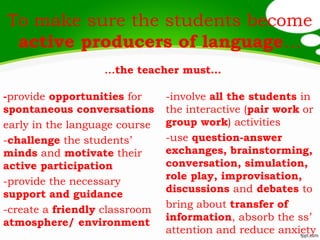
To make sure the students become
active producers of language…
…the teacher must…
-provide opportunities for
spontaneous conversations
early in the language course
-challenge the students’
minds and motivate their
active participation
-provide the necessary
support and guidance
-create a friendly classroom
atmosphere/ environment
-involve all the students in
the interactive (pair work or
group work) activities
-use question-answer
exchanges, brainstorming,
conversation, simulation,
role play, improvisation,
discussions and debates to
bring about transfer of
information, absorb the ss’
attention and reduce anxiety
What do teachers do to improve their
students’ speaking skills?
- provide the most useful models (drills and exercises) for
the students to learn the basic vocabulary and structures
for different types of contextual interactions
-use linguistic and non-linguistic props (key words,
phrases, maps, pictures, charts, cards, video and audio
recordings) to promote the students’ emotional involvement
and facilitate independent language production
- allow the students to become autonomous, less
dependent on help and support in order to be able to use
the language meaningfully, fluently and creatively
What else could be done?
-explain how the task will benefit the students or why they
are asked to do certain things
-give students opportunities to initiate oral
communication (ask questions, suggest topics, control
conversations, change the subject etc.)
-provide appropriate feedback and correction
- use techniques that encourage the use of authentic
language in meaningful contexts
- recommend sources and resources that the students can
use to become better speakers of English
How do we know if a speaking activity
is successful or not?
1. The learners talk a lot, not the teacher, and there are few pauses;
2. Participation is even- the classroom discussion is not dominated
by
a minority: all the participants get the chance to express
themselves and their contributions are fairly evenly distributed;
3. Motivation is high: the learners are eager to speak either because
they are interested in the topic and have something new to say about it
or because they want to contribute to achieving the task objective;
4. The language used during the lesson is of an acceptable level.
The learners express themselves in utterances that are relevant, easily
comprehensible and of an acceptable level of language accuracy;
5. The target language is spoken, not the mother tongue: the
teacher might appoint a monitor in each group to remind
Bibliography:
1. Vizental, A.- Metodica Predării Limbii Engleze, Strategies of
Teaching and Testing English as a Foreign Language
2. Brown, Douglas H. – Teaching By Principles, An Interactive
Approach to Language Pedagogy
3. Ur, P. – A Course in Language Teaching, Practice and Theory
Bibliography:
1. Vizental, A.- Metodica Predării Limbii Engleze, Strategies of
Teaching and Testing English as a Foreign Language
2. Brown, Douglas H. – Teaching By Principles, An Interactive
Approach to Language Pedagogy
3. Ur, P. – A Course in Language Teaching, Practice and Theory

Better teaching methods, better speakers

  • 1.
    Better teaching methods, better speakers -a methodological presentation by Emilia Frînculeasă, Nehoiu, January 25, 2017
  • 2.
    What can yousay about teaching speaking?
  • 3.
    Teaching speaking asa productive skill - is a complex process that requires time, effort and also the right teaching methods - involves activating the learner through motivating practice (interesting topics/ texts, attractive lessons, challenging tasks) - implies communicative situations and a communicative purpose which should engage the students’ personal knowledge and experience and address their linguistic proficiency as well as their age
  • 4.
    Teaching speaking ina foreign language is a three-level process 1) Controlled activities The students’ language is largely imitative (they produce short, simple messages by following a model or the teacher’s example) 2) Guided activities The students are gradually helped to build longer and more complex stretches of language, while getting more and more freedom The students are able to produce oral messages without guidance, and use the language functionally and strategically 3) Free production
  • 5.
    To make surethe students become active producers of language… …the teacher must… -provide opportunities for spontaneous conversations early in the language course -challenge the students’ minds and motivate their active participation -provide the necessary support and guidance -create a friendly classroom atmosphere/ environment -involve all the students in the interactive (pair work or group work) activities -use question-answer exchanges, brainstorming, conversation, simulation, role play, improvisation, discussions and debates to bring about transfer of information, absorb the ss’ attention and reduce anxiety
  • 6.
    What do teachersdo to improve their students’ speaking skills? - provide the most useful models (drills and exercises) for the students to learn the basic vocabulary and structures for different types of contextual interactions -use linguistic and non-linguistic props (key words, phrases, maps, pictures, charts, cards, video and audio recordings) to promote the students’ emotional involvement and facilitate independent language production - allow the students to become autonomous, less dependent on help and support in order to be able to use the language meaningfully, fluently and creatively
  • 7.
    What else couldbe done? -explain how the task will benefit the students or why they are asked to do certain things -give students opportunities to initiate oral communication (ask questions, suggest topics, control conversations, change the subject etc.) -provide appropriate feedback and correction - use techniques that encourage the use of authentic language in meaningful contexts - recommend sources and resources that the students can use to become better speakers of English
  • 8.
    How do weknow if a speaking activity is successful or not? 1. The learners talk a lot, not the teacher, and there are few pauses; 2. Participation is even- the classroom discussion is not dominated by a minority: all the participants get the chance to express themselves and their contributions are fairly evenly distributed; 3. Motivation is high: the learners are eager to speak either because they are interested in the topic and have something new to say about it or because they want to contribute to achieving the task objective; 4. The language used during the lesson is of an acceptable level. The learners express themselves in utterances that are relevant, easily comprehensible and of an acceptable level of language accuracy; 5. The target language is spoken, not the mother tongue: the teacher might appoint a monitor in each group to remind
  • 9.
    Bibliography: 1. Vizental, A.-Metodica Predării Limbii Engleze, Strategies of Teaching and Testing English as a Foreign Language 2. Brown, Douglas H. – Teaching By Principles, An Interactive Approach to Language Pedagogy 3. Ur, P. – A Course in Language Teaching, Practice and Theory
  • 10.
    Bibliography: 1. Vizental, A.-Metodica Predării Limbii Engleze, Strategies of Teaching and Testing English as a Foreign Language 2. Brown, Douglas H. – Teaching By Principles, An Interactive Approach to Language Pedagogy 3. Ur, P. – A Course in Language Teaching, Practice and Theory