MONEY MATTERS
                Class 5


Presented by:
                Susan Huff
Credit Report

A summary of your financial history.
Credit Report
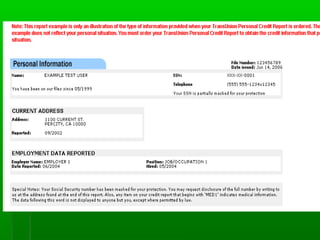
Each credit report list:
 Credit accounts, including credit cards,
  auto loans, student loans, and
  mortgages
     Creditor and account number
     Balance
     Date opened
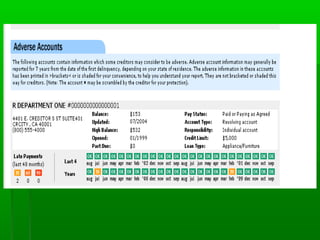
     Payment history
     Current status, such as “OK”, “Closed by
      customer”, “30 days late payment”, etc.
 Inquiries: recent applications for new
  credit

 Collections: when a collection agency is
  seeking you to repay a debt

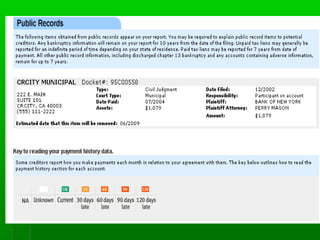
 Public Records: court judgments such as
  a bankruptcy, foreclosure, or tax lien
Credit Report

  Credit Reporting Agencies:
      Experian
      Trans Union
      Equifax

  Credit reporting agencies track how well
   you repay your loans.
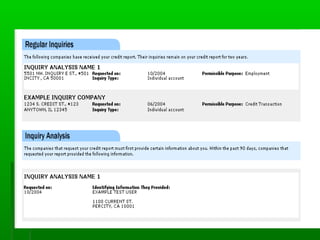
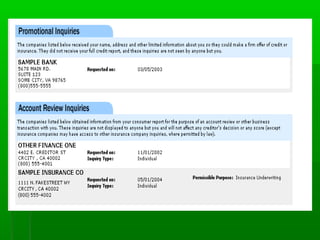
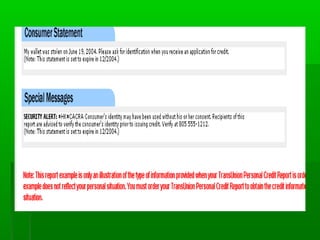
Sample Credit Report
How long does
negative information
remain on credit
reports?
 Creditor inquiries – 1 to 2 years
 Employer inquires – 2 years

   Delinquencies – 7 years
   Collection – 7 years
   Garnishment – 7 years
   Repossessions – 7 years
   Court Orders - 7 Years
   Eviction for non-payment – 7 years
   Missed Child Support – 7 years
   Foreclosures – 7 years
 Chapter 13 Bankruptcy – 7 Years from
  the date filed.

 Chapter 7,11 & 12 Bankruptcy – 10 years
  from the date filed.

 Tax Liens – 7 years from the date paid or
  indefinitely if not paid
How long does positive
information stay on my
credit report?
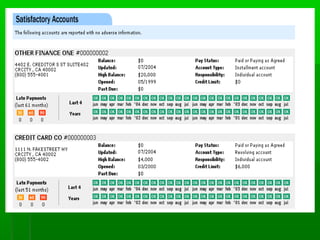
  Active positive information can remain
   indefinitely.

  If an account is closed that has been
   positive, then it will remain on your report
   for 10 years after the date of last activity.
CREDIT SCORE
A number that summarizes your credit risk based
  on your credit report, at a particular point in
  time.

   Determines who qualifies for credit, at what interest
    rate and what credit limits.
   statistical analysis of a person’s credit report
   fast, fair, objective estimate of your credit risk
   very predictive of risk
   increased the availability of credit
   reduced the cost of providing credit
Who can access my
credit score?
 The Fair Credit Reporting Act (FCRA)
  restricts who can access your credit
  report

 Business have a right to check your
  credit report before they agree to do
  business with you.
Traditional uses of
Credit Score
  Lending Institutions
      Banks
      Credit Unions
      Finance Companies
  Credit Card issuers
  Auto Dealers
  Employers
Non-Traditional uses
of Credit Score
    Auto Insurance
    Homeowner’s Insurance
    Utility Companies
    Landlords
    State and local child support
     enforcement agencies
 FICO (Fair Isaac Corporation)
     90% of lenders
     300 – 850, higher is better
     Most credit scores fall between 600 to 750
   NextGen Score
   CE Score
   Vantage Score
     501 – 990
     Assigns letter grade (A to F) to specific
      score ranges.
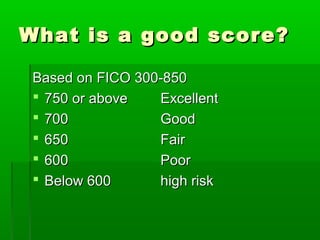
What is a good score?

 Based on FICO 300-850
  750 or above   Excellent
  700            Good
  650            Fair
  600            Poor
  Below 600      high risk
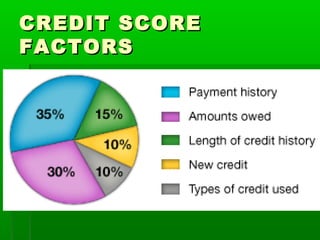
CREDIT SCORE
FACTORS
FICO High Achievers
  93% have missed no payments
  Oldest account was opened 19 years ago
  Average age of accounts is 6-12 years
  Ratio of revolving balances to credit limits 7%
  Carry a balance of $1200 or less on non-
   mortgage accounts
  Virtually no FICO High Achievers have a public
   record or a collection listed on their credit
   report.
Improving Your Credit
Score
  Correct mistakes / dispute errors on your
   report.
  Pay your bills on time.
  Focus on the negative factors provided
   with your FICO score
  Reduce balances on credit cards
  Pay off Debt rather than moving it around
  Don’t close unused credit card accounts
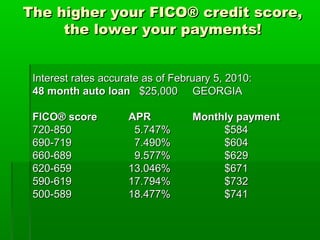
The higher your FICO® credit score,
     the lower your payments!

 Interest rates accurate as of February 5, 2010:
 30 Yr fixed mortgage        $200,000      GEORGIA

 FICO® score        APR          Monthly payment
 760-850            4.646%            $1,031
 700-759            4.868%            $1,058
 680-699            5.045%            $1,079
 660-679            5.259%            $1,106
 640-659            5.689%            $1,159
 620-639            6.236%            $1,230
The higher your FICO® credit score,
     the lower your payments!


 Interest rates accurate as of February 5, 2010:
 48 month auto loan $25,000 GEORGIA

 FICO® score         APR           Monthly payment
 720-850              5.747%            $584
 690-719              7.490%            $604
 660-689              9.577%            $629
 620-659             13.046%            $671
 590-619             17.794%            $732
 500-589             18.477%            $741
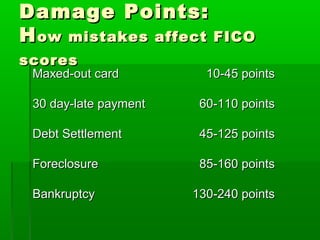
Damage Points:
H ow mistakes affect FICO
scores
 Maxed-out card          10-45 points

 30 day-late payment    60-110 points

 Debt Settlement        45-125 points

 Foreclosure            85-160 points

 Bankruptcy            130-240 points
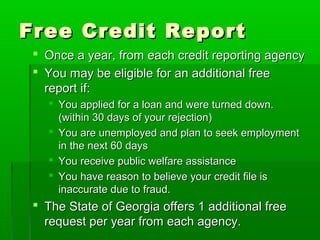
Free Credit Report
  Once a year, from each credit reporting agency
  You may be eligible for an additional free
   report if:
    You applied for a loan and were turned down.
     (within 30 days of your rejection)
    You are unemployed and plan to seek employment
     in the next 60 days
    You receive public welfare assistance
    You have reason to believe your credit file is
     inaccurate due to fraud.
  The State of Georgia offers 1 additional free
   request per year from each agency.
“THE   REAL”
Free   Credit Report
       www.annualcreditreport.com
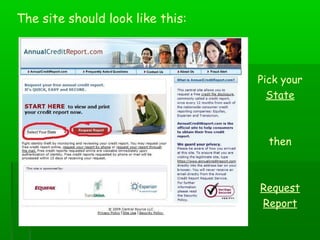
The site should look like this:


                                  Pick your
                                    State


                                    then


                                  Request
                                  Report
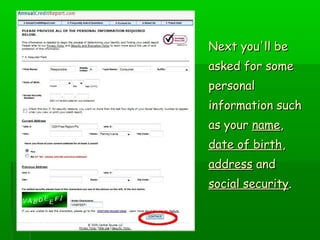
Next you'll be
asked for some
personal
information such
as your name,
date of birth,
address and
social security.
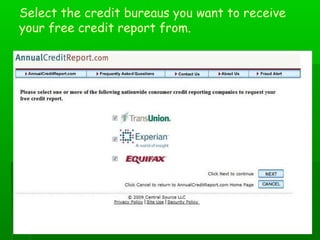
Select the credit bureaus you want to receive
your free credit report from.
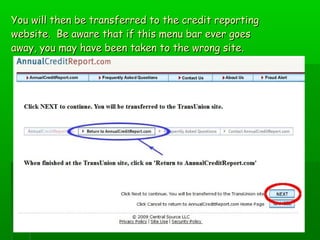
You will then be transferred to the credit reporting
website. Be aware that if this menu bar ever goes
away, you may have been taken to the wrong site.
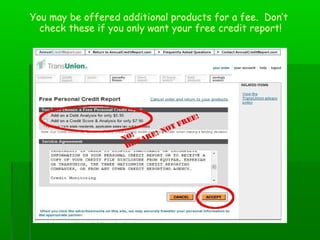
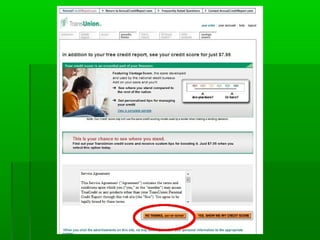
You may be offered additional products for a fee. Don’t
  check these if you only want your free credit report!
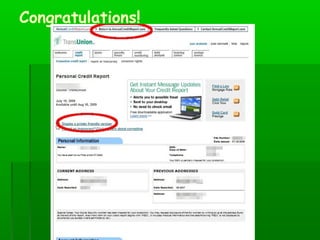
Congratulations!
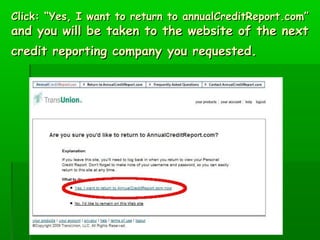
Click: “Yes, I want to return to annualCreditReport.com”
and you will be taken to the website of the next
credit reporting company you requested.
Credit Score

  myfico.com

  Equifax or TransUnion score for $19.95
  Explanation of your credit score and how
   lenders view you
  Positive and Negative factors affecting
   your score.
Free Credit Scores

  creditkarma.com
  quizzle.com
  Credit.com
Consumer Credit Counseling
             Service

Founded in 1964
Non-profit and member of the National
 Foundation for Credit Counseling
 (NFCC)

http://www.credAbility.org/
1.800.251.2227
 Start checking your credit report 6
  months before you plan to obtain new
  credit to ensure that you credit report is
  accurate and you are doing all you can to
  keep your score high.

Money Matters Class 5: Credit Score

  • 1.
    MONEY MATTERS Class 5 Presented by: Susan Huff
  • 2.
    Credit Report A summaryof your financial history.
  • 3.
    Credit Report Each creditreport list:  Credit accounts, including credit cards, auto loans, student loans, and mortgages  Creditor and account number  Balance  Date opened  Payment history  Current status, such as “OK”, “Closed by customer”, “30 days late payment”, etc.
  • 4.
     Inquiries: recentapplications for new credit  Collections: when a collection agency is seeking you to repay a debt  Public Records: court judgments such as a bankruptcy, foreclosure, or tax lien
  • 5.
    Credit Report Credit Reporting Agencies:  Experian  Trans Union  Equifax  Credit reporting agencies track how well you repay your loans.
  • 6.
  • 14.
    How long does negativeinformation remain on credit reports?
  • 15.
     Creditor inquiries– 1 to 2 years  Employer inquires – 2 years  Delinquencies – 7 years  Collection – 7 years  Garnishment – 7 years  Repossessions – 7 years  Court Orders - 7 Years  Eviction for non-payment – 7 years  Missed Child Support – 7 years  Foreclosures – 7 years
  • 16.
     Chapter 13Bankruptcy – 7 Years from the date filed.  Chapter 7,11 & 12 Bankruptcy – 10 years from the date filed.  Tax Liens – 7 years from the date paid or indefinitely if not paid
  • 17.
    How long doespositive information stay on my credit report?  Active positive information can remain indefinitely.  If an account is closed that has been positive, then it will remain on your report for 10 years after the date of last activity.
  • 18.
    CREDIT SCORE A numberthat summarizes your credit risk based on your credit report, at a particular point in time.  Determines who qualifies for credit, at what interest rate and what credit limits.  statistical analysis of a person’s credit report  fast, fair, objective estimate of your credit risk  very predictive of risk  increased the availability of credit  reduced the cost of providing credit
  • 19.
    Who can accessmy credit score?  The Fair Credit Reporting Act (FCRA) restricts who can access your credit report  Business have a right to check your credit report before they agree to do business with you.
  • 20.
    Traditional uses of CreditScore  Lending Institutions  Banks  Credit Unions  Finance Companies  Credit Card issuers  Auto Dealers  Employers
  • 21.
    Non-Traditional uses of CreditScore  Auto Insurance  Homeowner’s Insurance  Utility Companies  Landlords  State and local child support enforcement agencies
  • 22.
     FICO (FairIsaac Corporation)  90% of lenders  300 – 850, higher is better  Most credit scores fall between 600 to 750  NextGen Score  CE Score  Vantage Score  501 – 990  Assigns letter grade (A to F) to specific score ranges.
  • 23.
    What is agood score? Based on FICO 300-850  750 or above Excellent  700 Good  650 Fair  600 Poor  Below 600 high risk
  • 24.
  • 25.
    FICO High Achievers  93% have missed no payments  Oldest account was opened 19 years ago  Average age of accounts is 6-12 years  Ratio of revolving balances to credit limits 7%  Carry a balance of $1200 or less on non- mortgage accounts  Virtually no FICO High Achievers have a public record or a collection listed on their credit report.
  • 26.
    Improving Your Credit Score  Correct mistakes / dispute errors on your report.  Pay your bills on time.  Focus on the negative factors provided with your FICO score  Reduce balances on credit cards  Pay off Debt rather than moving it around  Don’t close unused credit card accounts
  • 27.
    The higher yourFICO® credit score, the lower your payments! Interest rates accurate as of February 5, 2010: 30 Yr fixed mortgage $200,000 GEORGIA FICO® score APR Monthly payment 760-850 4.646% $1,031 700-759 4.868% $1,058 680-699 5.045% $1,079 660-679 5.259% $1,106 640-659 5.689% $1,159 620-639 6.236% $1,230
  • 28.
    The higher yourFICO® credit score, the lower your payments! Interest rates accurate as of February 5, 2010: 48 month auto loan $25,000 GEORGIA FICO® score APR Monthly payment 720-850 5.747% $584 690-719 7.490% $604 660-689 9.577% $629 620-659 13.046% $671 590-619 17.794% $732 500-589 18.477% $741
  • 29.
    Damage Points: H owmistakes affect FICO scores Maxed-out card 10-45 points 30 day-late payment 60-110 points Debt Settlement 45-125 points Foreclosure 85-160 points Bankruptcy 130-240 points
  • 30.
    Free Credit Report  Once a year, from each credit reporting agency  You may be eligible for an additional free report if:  You applied for a loan and were turned down. (within 30 days of your rejection)  You are unemployed and plan to seek employment in the next 60 days  You receive public welfare assistance  You have reason to believe your credit file is inaccurate due to fraud.  The State of Georgia offers 1 additional free request per year from each agency.
  • 31.
    “THE REAL” Free Credit Report www.annualcreditreport.com
  • 32.
    The site shouldlook like this: Pick your State then Request Report
  • 33.
    Next you'll be askedfor some personal information such as your name, date of birth, address and social security.
  • 34.
    Select the creditbureaus you want to receive your free credit report from.
  • 35.
    You will thenbe transferred to the credit reporting website. Be aware that if this menu bar ever goes away, you may have been taken to the wrong site.
  • 36.
    You may beoffered additional products for a fee. Don’t check these if you only want your free credit report!
  • 40.
  • 41.
    Click: “Yes, Iwant to return to annualCreditReport.com” and you will be taken to the website of the next credit reporting company you requested.
  • 42.
    Credit Score myfico.com  Equifax or TransUnion score for $19.95  Explanation of your credit score and how lenders view you  Positive and Negative factors affecting your score.
  • 43.
    Free Credit Scores  creditkarma.com  quizzle.com  Credit.com
  • 44.
    Consumer Credit Counseling Service Founded in 1964 Non-profit and member of the National Foundation for Credit Counseling (NFCC) http://www.credAbility.org/ 1.800.251.2227
  • 45.
     Start checkingyour credit report 6 months before you plan to obtain new credit to ensure that you credit report is accurate and you are doing all you can to keep your score high.

Editor's Notes

  • #3 Because of the delinquencies and charge-offs, the banking industry is in crisis and it is impacting everyone. Banks in an effort to reduce risks are closing a record number of credit card accounts and reducing millions of dollars in credit lines. So how does this affect us as we go about our business.
  • #4 Because of the delinquencies and charge-offs, the banking industry is in crisis and it is impacting everyone. Banks in an effort to reduce risks are closing a record number of credit card accounts and reducing millions of dollars in credit lines. So how does this affect us as we go about our business.
  • #5 Personal Identifying Information, such as current and past addresses are included in the report. Employment history is included in the report
  • #6 Your credit report is complied by three agencies. Your creditors report you handling of credit to the agencies. Each agency report may be slightly different depending if your creditor reports to all the agencies and how often the information is reported.
  • #15 Negative Information has a statute of limitations.
  • #16 Creditor Inquiries: Soft inquiries , or inquiries not initiated by you, usually remain on your credit report for 1 year. Soft inquiries do not effect your credit score Hard inquiries , or inquiries initiated by you, usually remain on your credit report for 2 years. Hard inquiries will negatively impact your credit score. They have most impact in the first 6 months and after 1 year are not counted toward your credit score though they are still visible on your credit report. Hard inquiries are generated from applications for mortgages, credit cards, and other loans. They can also be generated by things like opening a bank account, getting cable/satellite TV, or a new cell phone provider Inquiries have greater impact if you have a few accounts or a short history. A large number of inquiries have a greater impact. However, multiple inquiries (rate shopping) for a single loan such as a mortgage will often be viewed as one. Late payments will show up for 7 years from missed payments. Collection accounts : The negative information will remain for seven years and 180 days from the time you first became delinquent, regardless of when it went into collection or was reported Court Orders : Judgments generally remain on your credit file for seven years from the date filed, whether satisfied (paid) or not.
  • #19 Credit scores use mathematical models developed from the behavior patterns of millions of borrowers to determine the risk of extending credit to an individual . The more traits you share with people who have proven to be good credit risks, the higher your score. Because the score does not consider race, sex or ethnicity, it is generally considered to be the most fair and objective underwriting tool available to lenders. The Federal Reserve Board did a study that noted that scores have increased the availability of credit and reduced the cost of credit.
  • #20 The Fair Credit Reporting Act (FCRA) specifies who can see your credit report. Businesses must have a "permissible purpose," as defined in the FCRA, to obtain your credit report. Otherwise, only you and those you give written permission to can access your credit report. Your neighbors, friends, employers, co-workers or family members cannot access your Equifax credit report unless you authorize it. The permissible purposes include: A court order or Federal grand jury subpoena In accordance with written instructions from a consumer to whom the file relates As part of a credit transaction involving the consumer To review and collect the consumer's account For employment purposes (only with the consumer's written consent) Underwriting of insurance for personal, family or household purposes Government agencies for determination of consumer's eligibility for a license or other governmental benefit In connection with a valuation of, or an assessment of the credit or prepayment risks  associated with, an existing credit obligation In connection with a legitimate business need relating to a business transaction initiated by the consumer To review an account to determine whether the consumer continues to meet the terms of the account Manage risk of current or potential credit In connection with child support determination In connection with credit or insurance transaction not initiated by you
  • #21 Traditional Uses:
  • #22 Traditional Uses: Lending Institutions Credit Card Companies Auto Companies Employers
  • #23 FICO scores are calculated from the information in the consumers credit report. Each individual actually has three credit score at any given time, because the three credit agencies have their own databases, gather reports from different creditors at different times. USA average score is 692. Georgia average score is 661. A score above 700 usually suggests good credit management. NextGen – assesses consumer credit risk, designed by FICO. CE Score published by CE Analytics and available through sites like Quizzle and Community Empower. It is free to consumers. Vantage Score, the three major credit agencies in an attempt to try and win business from FICO introduced their own score with a similar mathematical model to the FICO score. The standard has five tiers: "A" for scores between 900-990 "B" for scores between 800-899 "C" for scores between 700-799 "D" for scores between 600-699 "F" for scores 599 and below. Statistical Models for determining credit scores are subject to federal regulations. If negative action results from a credit score the lender must state to the borrower the specific reason for the denial.
  • #25 35% — Payment History – Paying bills as agreed over time will improve a consumer’s FICO score. 30% — Credit Utilization - The ratio of current revolving debt (such as credit card balances) to the total available revolving credit (credit limits). Consumers can improve their FICO scores by paying off debt and lowering their utilization ratio. The closing of existing revolving accounts will typically adversely affect this ratio and therefore have a negative impact on their FICO score. 20% or below. The average for FICO high achievers is 7%. 15% — Length of Credit History 10% — Types of Credit Used (installment, revolving, consumer finance) – Consumers can benefit by having a history of managing different types of credit. 10% — Recent search for credit and/or amount of credit obtained recently - (no more than one to three in 6 month period Lenders use their own internal scoring models as well - current income and employment history, tenancy status
  • #26 72% didn’t apply for credit in the last year FICO High Achievers – 760 or above $20,000 * 7% = $1400
  • #27 Over 50% of credit bureau reports have errors. Also look for signs of identity theft. (unauthorized activity)
  • #30 As of October 17, 2011 DAMAGE POINTS: HOW MISTAKES AFFECT FICO SCORES Credit mistake If your starting score is 680 If your starting score is 780 Maxed-out card 680 – Down 10 to 30 pts. 780 – Down 25 to 45 pts. 30-day late payment 680 – Down 60 to 80 pts. 780 – Down 90 to 110 pts. Debt settlement 680 – Down 45 to 65 pts. 780 – Down 105 to 125 pts. Foreclosure 680 – Down 85 to 105 pts. 780 – Down 140 to 160 pts. Bankruptcy 680 – Down 130 to 150 pts. 780 – Down 220 to 240 pts.
  • #36 Take note of this next screen. It will tell you that you’re going to a different site. If you want to return, click “Return to AnnualCreditReport.com.” If this menu bar ever goes away, be careful – you may have been taken to another site.
  • #37 This next screen is critical – there are two options “Add on a Debt Analysis for only $5.95” and “Add on a Credit Score & Analysis for only $7.95.” Don’t check these if you don’t want to pay any more than zero dollars . These are not necessary to retrieve your report. Read the service agreement and click “Accept.”
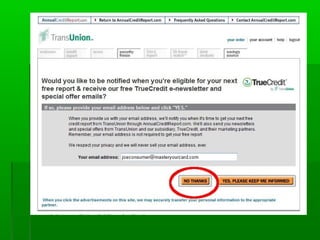
  • #38 Next, TransUnion will ask if you want to receive reminder emails and their newsletter. Feel free to sign up if you’d like – it’s free – but if you don’t want to clutter up your inbox, click “No Thanks.”
  • #39 This next screen also has a sale on it. It’ll ask you if you want to know our credit score. Note that this is different from your credit report and is NOT given to you for free by law . It costs $7.95 and may be interesting, but isn’t essential. Click “No thanks, just my report” to keep things free.
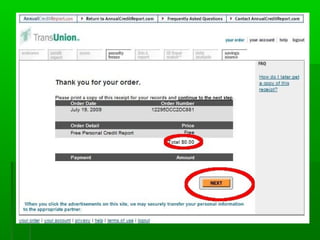
  • #40 You’ll see a receipt for your order. If all went well, the grand total will be $0.00. Click “Next” to continue.
  • #41 You are now viewing your free credit report from TransUnion. Make sure you click “Display a printer friendly version” and print off a hard copy or save a PDF of your report for future reference. You can only pull it for free once a year.
  • #45 Now rebranded as CredAbility