WELCOME!
Anita Nesiba
             Certified Credit Counselor
            Certified Housing Counselor
          Certified Student Loan Counselor
Consumer Credit Counseling Services
     Lutheran Social Services
Inspired by love we care for, support and strengthen
         individuals, families and communities
“As long as we have hope, we have direction,
  the energy to move and the map to move by,
  we have a hundred alternatives, a thousand
  paths and an infinity of dreams.”
                             Author Unknown
QUESTIONAIRE
 Financial Choices
The key to managing your finances is:

a)   Having access to credit
b)   Having a budget
c)   Paying less interest
d)   Making more money
What is the foundation of a budget:
a)   Your income
b)   Your debts
c)   Your goals
d)   Accurate number for your income and
     expenses
If you began with a penny and doubled your
money every day, at the end of thirty days
you would have:
 a)   $8896
 b)   $83,886
 c)   $670,088
 d)   $5,368,709
Which of the following statements are
true:
a) After deductions you can expect to take
   home 70% to 80% of your gross pay
b) After deductions you can expect to take
   home 60% to 70% of your gross pay
c) After deductions you can expect to take
   home 50% to 60% of your gross pay
d) After deductions you will be left with nothing
What are the major types of expenses:
a)   Expected and Unexpected
b)   Fixed, flexible and periodic
c)   Taxes, education and utilities
d)   Food, clothing, shelter and transportation
Your budget is in balance if:
a) Your expenses exceed your income
b) Your expenses are equal to or less than your
   income
c) You get paid weekly
d) You get a raise
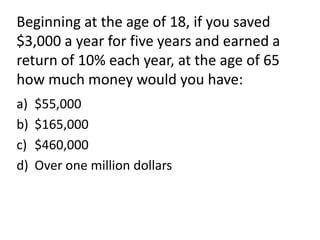
Beginning at the age of 18, if you saved
$3,000 a year for five years and earned a
return of 10% each year, at the age of 65
how much money would you have:
a)   $55,000
b)   $165,000
c)   $460,000
d)   Over one million dollars
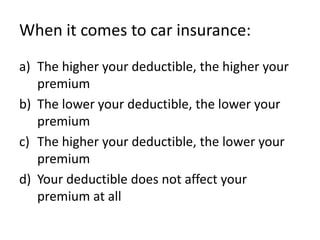
When it comes to car insurance:
a) The higher your deductible, the higher your
   premium
b) The lower your deductible, the lower your
   premium
c) The higher your deductible, the lower your
   premium
d) Your deductible does not affect your
   premium at all
Budgeting
Do you currently keep track of your monthly
  expenses?
Fixed, Flexible and Periodic Expenses
  What are they?
Tracking, tracking, tracking!
Congratulations!
Graduation: What is next?
Goals
• Where do you see yourself in 12 months, 5
  years, possibly 10 years?
Considerations
1. Where do you want to live? Costs of living?
2. What type of employment are you
   considering and what time frame do you
   have for your goals of employment?
3. Graduate school?
Student Loans
* According to Federal Reserve in New
  York the student loan debt is now
  about $870 billion. This tops Credit
  Card debt at $693 billion and Auto
  loan debt at $730 billion.
Loan Repayment
            Federal Student Loans
1.    Standard Repayment Plan
2.    Graduated Repayment Plan
3.    Extended Repayment Plan
4.    Income Based Repayment Plans
     a) Direct Loan Income Contingent Repayment
        Plan
     b) IBR- Income Sensitive Repayment Plan
Loan Forgiveness
• Repayment plans after 25 years if Federal
• Working in a specific job where you could see
  loan forgiveness after 10 years of payments
• If you are a teacher with Perkins Loans or in a
  specific profession
• Employers can offer incentives
Private Student Loans
• Be cautious and always keep informed about
  payment plan options.
• Limited
Postponing Repayment
                 Federal
• Loan Deferment
• Loan Forbearance
• Private Student Loans- limited in options
CONSEQUENCES OF DEFAULT
Tax Refund Offset
• The IRS can intercept any income tax refund
  you may be entitled to receive until your
  student loans are paid in full.
Paycheck Garnishment
• Federal government can take ”garnish” up to
  15% of your disposable income but is not able
  to take more than the equivalent of 30 times
  the current federal minimum wage.
• Best way to avoid garnishment is to contact
  the holder of your loan to negotiate a
  repayment schedule.
Federal Benefits
• The federal government can take benefit
  payments, including Social Security and Social
  Security Disability, but no Supplemental
  Security Income. They have to leave you with
  benefits of $750 a month or $9000 a year.
You Get Sued
• The government and private lenders can sue
  you to collect defaulted student loans. Unlike
  other debts, there is not any time limit on
  collection of the debts.
Resource for Information
• www.studentloanborrowerassistance.org
• www.studentaid.ed.gov/publicservice
• Financial Aid Office

Senior Series Finance Workshop 3.6.13

  • 1.
  • 2.
    Anita Nesiba Certified Credit Counselor Certified Housing Counselor Certified Student Loan Counselor Consumer Credit Counseling Services Lutheran Social Services Inspired by love we care for, support and strengthen individuals, families and communities
  • 3.
    “As long aswe have hope, we have direction, the energy to move and the map to move by, we have a hundred alternatives, a thousand paths and an infinity of dreams.” Author Unknown
  • 4.
  • 5.
    The key tomanaging your finances is: a) Having access to credit b) Having a budget c) Paying less interest d) Making more money
  • 6.
    What is thefoundation of a budget: a) Your income b) Your debts c) Your goals d) Accurate number for your income and expenses
  • 7.
    If you beganwith a penny and doubled your money every day, at the end of thirty days you would have: a) $8896 b) $83,886 c) $670,088 d) $5,368,709
  • 8.
    Which of thefollowing statements are true: a) After deductions you can expect to take home 70% to 80% of your gross pay b) After deductions you can expect to take home 60% to 70% of your gross pay c) After deductions you can expect to take home 50% to 60% of your gross pay d) After deductions you will be left with nothing
  • 9.
    What are themajor types of expenses: a) Expected and Unexpected b) Fixed, flexible and periodic c) Taxes, education and utilities d) Food, clothing, shelter and transportation
  • 10.
    Your budget isin balance if: a) Your expenses exceed your income b) Your expenses are equal to or less than your income c) You get paid weekly d) You get a raise
  • 11.
    Beginning at theage of 18, if you saved $3,000 a year for five years and earned a return of 10% each year, at the age of 65 how much money would you have: a) $55,000 b) $165,000 c) $460,000 d) Over one million dollars
  • 12.
    When it comesto car insurance: a) The higher your deductible, the higher your premium b) The lower your deductible, the lower your premium c) The higher your deductible, the lower your premium d) Your deductible does not affect your premium at all
  • 13.
    Budgeting Do you currentlykeep track of your monthly expenses? Fixed, Flexible and Periodic Expenses What are they? Tracking, tracking, tracking!
  • 14.
  • 15.
    Goals • Where doyou see yourself in 12 months, 5 years, possibly 10 years?
  • 16.
    Considerations 1. Where doyou want to live? Costs of living? 2. What type of employment are you considering and what time frame do you have for your goals of employment? 3. Graduate school?
  • 17.
    Student Loans * Accordingto Federal Reserve in New York the student loan debt is now about $870 billion. This tops Credit Card debt at $693 billion and Auto loan debt at $730 billion.
  • 18.
    Loan Repayment Federal Student Loans 1. Standard Repayment Plan 2. Graduated Repayment Plan 3. Extended Repayment Plan 4. Income Based Repayment Plans a) Direct Loan Income Contingent Repayment Plan b) IBR- Income Sensitive Repayment Plan
  • 19.
    Loan Forgiveness • Repaymentplans after 25 years if Federal • Working in a specific job where you could see loan forgiveness after 10 years of payments • If you are a teacher with Perkins Loans or in a specific profession • Employers can offer incentives
  • 20.
    Private Student Loans •Be cautious and always keep informed about payment plan options. • Limited
  • 21.
    Postponing Repayment Federal • Loan Deferment • Loan Forbearance • Private Student Loans- limited in options
  • 22.
  • 23.
    Tax Refund Offset •The IRS can intercept any income tax refund you may be entitled to receive until your student loans are paid in full.
  • 24.
    Paycheck Garnishment • Federalgovernment can take ”garnish” up to 15% of your disposable income but is not able to take more than the equivalent of 30 times the current federal minimum wage. • Best way to avoid garnishment is to contact the holder of your loan to negotiate a repayment schedule.
  • 25.
    Federal Benefits • Thefederal government can take benefit payments, including Social Security and Social Security Disability, but no Supplemental Security Income. They have to leave you with benefits of $750 a month or $9000 a year.
  • 26.
    You Get Sued •The government and private lenders can sue you to collect defaulted student loans. Unlike other debts, there is not any time limit on collection of the debts.
  • 27.
    Resource for Information •www.studentloanborrowerassistance.org • www.studentaid.ed.gov/publicservice • Financial Aid Office