Page 1
Teaching Pronunciation –Objectives/Instructions
© 2007 Kat Bradley-Bennett – Reprint with permission only
Teaching Pronunciation
An Independent Study Course for
Teachers of
Adult English as a Second Language Learners
Objectives
o Identify elements of good oral production
o Identify and apply techniques in teaching pronunciation
o Compare textbooks and evaluate their approaches to pronunciation
instruction
o Understand how to incorporate pronunciation exercises into lesson plans
o When completed, you will receive 15 professional development (PD) or
Literacy Instruction Authorization (LIA) renewal points
When you have completed this course, you will receive 15 professional
development (PD) or Literacy Instruction Authorization (LIA) renewal points
Kat Bradley-Bennett
Northern Colorado Professional Development Center
619 Bowen Street
Longmont, CO 80501
303-702-7912
ncpdc@stvrain.k12.co.us
Page 2
Teaching Pronunciation –Objectives/Instructions
© 2007 Kat Bradley-Bennett – Reprint with permission only
The Purpose of the Independent Study Course Series
The Independent Study Course is approved and accepted by The Colorado Department of
Education office of Adult Education and Family Literacy for the purpose of professional
development in the field of teaching English as a second language.
It’s estimated that this Study Course will require 11-15 hours to complete, including in-
class time with the Application Activities. When you have completed the course, you will receive
15 PD or LIA renewal points.
The purpose of this study course is to present some basic Theory, a few tried-and-true
techniques, or Best Practices for improving your students’ pronunciation, and Application
Activities to put what you’ve learned into practice. A Glossary at the end defines key terms. Be
sure to visit the Bibliography and Resources page for additional information.
Who Is This Course For?
This Independent Study Course is for adult ESL practitioners, including teachers new to
adult ESL instruction.
How to Use This Study Course
1. Welcome to this downloadable Adobe Reader version of Teaching Pronunciation. If you
don’t have Adobe Reader installed on your computer, click here.
2. Hyperlinks in this document are active and are in blue italics. First, click on
VIEW/TOOLBARS and select WEB. To follow a hyperlink, hold the CTRL button and
left-click your mouse. To return to where you left off, click on the blue BACK ARROW
in the upper left of your toolbars.
3. After reading the Introduction and Theory continue to Best Practices, where you will
find descriptions of strategies and techniques you can use in your own classroom, using
your own core curricula, to improve the oral production of your students.
4. At the end of the course, you’ll find three Application Activities. Do all three application
activities and discuss your experiences with your project director or coordinator.
5. The Bibliography and Resources link provides you with a list of books and other
resources, should you wish to continue to delve further into the topic of pronunciation
instruction.
6. Portions of this course are copyrighted and may be reprinted with permission only. The
Application worksheets and the Evaluation Form may be printed for purposes of this
course.
Project Director’s Evaluation Page
If you are a project director, use the Evaluation Form, based on the objectives of the
course, to verify staff participation in this Independent Study Course. Record the teacher’s
PD points in the Annual Professional Development Activity Record.
Page 3
Teaching Pronunciation –Introduction
© 2007 Kat Bradley-Bennett – Reprint with permission only
Teaching Pronunciation
Introduction
Communication can be a tricky business, especially when the listener and speaker are
from different linguistic backgrounds. There are pitfalls aplenty with poor word choice and
improper inflection, and there are numerous reasons a student has difficulty reproducing the
sounds of English correctly. Perhaps pronunciation had little focus in previous classes, or maybe
the student has never had any formal language instruction. Even students with significant
educational experience can have problems. Perhaps early pronunciation was taught by non-
native speakers who themselves have oral production problems. Maybe the student’s first
language contains different phonemes and the student simply cannot hear the sounds, let alone
accurately replicate them.
Below are several scenarios from my personal experiences, as well as from my
colleagues, as ESL professionals abroad and in the U.S.
I Rove Lak!
A student in Seoul, South Korea was asked to keep a recorded cassette journal because
his teacher was having difficulty understanding his spoken English. The unit topic was
Entertainment and the student was asked to respond to the question, “What kind of music do you
like?” On his cassette journal he proudly professed his love for Lok and Naitch.
Lok was not too difficult to decode, especially given the context. He loves rock-and-roll,
but displayed the typical Asian difficulty pronouncing English l and r. The teacher listened and
listened and could not decode Naitch. She returned to class the next day, played the tape, and
asked the student to write the words on paper. The mystery was solved. He loves New Age
music!.
This might have been a problem arising from untrained or undisciplined listening skills,
or possibly a physical linguistic difference. English requires more open movement of the mouth
and jaw than does Korean Hangul. This could explain the absence of the diphthong necessary to
move from the long u sound in new to the long a sound in age. The mispronunciation of the g
sound to ch was an additional challenge. Whatever the cause, poor oral production interfered
with communication
Put Your Teeth Into It!
Another colleague in Seoul asked his students to prepare one five-minute presentation for
the semester. One student had recently “conquered” the sound of f (f and p are difficult sounds
for some Korean students to distinguish). The student displayed a cross-section of a mouth and
dutifully explained that there are two ways to produce the sound f, one way is to place the top
teeth on the bottom lip and blow air. The teacher nodded in agreement, wondering what on
Page 4
Teaching Pronunciation –Introduction
© 2007 Kat Bradley-Bennett – Reprint with permission only
Earth the second method could be. The student happily demonstrated that f can also be produced
by placing the bottom teeth on the top lip and blowing air. The teacher had to restrain from
laughing, but the student had been taught that this was acceptable technique by a Korean Middle
School English teacher.
Just Write it Down
A Hispanic ESL student in Colorado wants to become a United States citizen. He
diligently attends English class three nights per week and an ESL literacy laboratory one night
per week, moving slowly but steadily up the Student Performance Level (SPL) ladder, based on
CASAS listening tests. He holds a fulltime job and attends his children’s parent-teacher
conferences.
The student once reported that his boss complains about his strong accent. Teachers and
tutors have also reported difficulty understanding this student’s speech. After much repetition
and occasionally asking him to write down what it is he’s trying to say, does it become apparent
that he comprehends what he’s being asked. The student’s poor oral production could have
numerous negative consequences for him in the future, including difficulties getting a better job
and passing the INS interview.
Keep Your Eye on the Prize!
I once read an article in a Korean-English newspaper about a surgery some Korean
parents have had performed on their children, even children as young as six months. The surgery
involves clipping the frenulum, that little strip of skin that attaches your tongue to the floor of
your mouth, believing that the tongue will be more flexible, thereby eliminating problems with
production of English l and r. (Never mind that there are numerous other phonological
differences between Korean Hangul and English!) I was horrified, but many of my students truly
believed that this extreme and very costly procedure was a viable solution to a problem that, in
their minds, would impede their academic success.
Linguists around the world denounced frenotomy as cruel, unnecessary, and ineffective
and I’m inclined to accept those assertions. One has only to listen to South Korea’s opera diva,
Cho Su-mi (known as Sumi Jo in America) in her rendition of I Dreamed I Lived in Marbled
Halls with its heartbreaking refrain, “You loved me still the same,” enunciated as clearly as any
native speaker, to know that it is possible for a native Korean speaker to form perfect l and r
without going under the knife! Listen to Chinese film director Ang Li and you hear the same,
perfect pronunciation of these consonants.
I’m happy to say that none of my students ever had a frenotomy, and as we worked on
pronunciation in class, I hope that they realized that communication could still occur, despite
their accents.
Students may or may not be aware that their oral production is a problem. As teachers,
it’s up to us to identify the problems, weighing their importance against the student’s needs.
Page 5
Teaching Pronunciation –Introduction
© 2007 Kat Bradley-Bennett – Reprint with permission only
Keep your eye on the prize: successful communication, not perfection.
How important is it for ESL instructors to incorporate pronunciation practice into their
lessons? How much time and effort should be devoted to it? What are the keys to good
pronunciation? What are the best classroom strategies and techniques to improve students’ oral
production? In other words, what do other teachers do?
Stephen Krashen says, “Comprehensible input stimulates natural language acquisition.”
(Krashen and Terrell, P.98). Giving students lots of speaking and listening practice in a context
they can understand can help the student untie the pronunciation knots. Access to native speakers
is invaluable, be it teachers, friends, coworkers, television, radio, movies, or grocery store clerks.
Pronunciation problems can be based on a number of auditory, physiological, cultural,
emotional, even psychological factors. Pronunciation practice should be multidimensional, with
emphasis on listening in a contextualized format with ample exposure to the target sounds and
utterances, and lots of contextualized oral practice. Listening “is essential not only as a receptive
skill but also to the development of spoken language proficiency.” (Nunan and Miller, p.v.)
Krashen defines the opposite of comprehensible input as noise. Perhaps it can be said,
then, that the role of an ESL/EFL teacher in the development of pronunciation is to assist in
transforming that noise into discernible and distinguishable sounds with meaning.
Page 6
Teaching Pronunciation – Theory
© 2007 Kat Bradley-Bennett – Reprint with permission only
Teaching Pronunciation
Theory
Learning a new language requires adequate exposure to the language, the ability to
discriminate between phonemic elements, the ability to analyze the grammar and social rules, the
ability to recall learned components of the language (grammar, spelling, vocabulary,
pronunciation, etc.), and to use all of these appropriately. What a task!
Research into the teaching of pronunciation has been less extensive than research into
second language acquisition (SLA) and first language (L1) interference. For this Independent
Study Course a small sampling of theoretical elements is presented to help you understand
challenges facing adult students who are trying to master English pronunciation, and to give you
some basis on which to apply pronunciation tasks and exercises in your classroom.
Teach English, Not About English!
Unless you’re teaching a Masters class in Second Language Acquisition or Applied
Linguistics, chances are you won’t be focusing very much of any lesson on the fine minutiae of
pronunciation, such as suprasmegentals (stress, pitch, rhythm, and intonation). It’s doubtful that
a classroom of ESL students will benefit much from a lesson objective of looking at the stress-
timed nature of English. However, this is not to say that pronunciation shouldn’t be a part of
every lesson. Of course, it should, and within contexts that are comprehensible to your learners.
Consider this practice exchange for Level 2 ESL students and some possible errors you
might encounter:
A: Can I please espeak to dapardmend manaher?
B: I’m esorry, he’s not in. Can I take a massage?
A: Jes, please. My chower is licking.
This dialog provides opportunity for both real-life meaning and substantive oral practice
that can be extended to other real-life situations. Adult ESL students want and need meaning.
Their pronunciation will improve with practice, time, and most importantly, no pressure! As
your students progress, so will their abilities to analyze the language and their own production.
In other words, your focus should be to teach English but not teach about English.
Good oral production requires a combination of the following elements: correct sound
articulation, proper stress and pitch, and appropriate intonation. Your students will make
pronunciation gaffs in any one, or all of these areas. Every lesson should provide them with
exposure to natural language that is simplified appropriately for their level, opportunities for the
students to practice the language in relevant contexts, lots of repetition, and review. It’s
perfectly OK to hone in on a specific phoneme, for example, or a consonant blend, or a cluster of
Page 7
Teaching Pronunciation – Theory
© 2007 Kat Bradley-Bennett – Reprint with permission only
chunked words in a phrase to improve your students’ oral production. But this will be a small
piece of your lesson.
There are many factors affecting a non-native English speaker’s pronunciation; likewise,
there isn’t one cure-all method to improve poor oral production. It can be argued that too much
focus on pronunciation distracts the learner from the meaning of the content (Parrish, P. 107).
Understanding what factor(s) could possibly be interfering with a student’s oral production (there
might be several and it’s difficult to be absolutely certain) can help the teacher integrate effective
pronunciation practice into each lesson.
Static on the Line – L1 Interference
The role of a student’s native language (L1) in second language acquisition is the focus
of numerous theories and hypothesis regarding phonological development of a new language.
Contrastive analysis theory states that the language being learned is filtered through L1. The
student’s L1 assists SLA where the two languages share common structures, and interferes where
those structures are either wildly different or are nonexistent in L1 (Celce-Murcia, Brinton, and
Goodwin, P19).
A student’s L1 can affect pronunciation in three basic ways: 1) If the L1 sound system is
different from English, 2) if the rules for combining sounds into words are different, and 3) if the
patterns of stress and intonation are different (Avery & Ehrlich, P xv).
L1 Interference #1 – Phonemic Pitfalls
Phonemes from the student’s first language (L1) can interfere with auditory recognition
and replication of English phonemes. Students whose L1 is from a different linguistic family
than English, Mandarin or Vietnamese, for example, might have difficulty hearing and
replicating English phonemes.
Teachers of Hispanic students, for example, will hear estudent or eschool because the
English words student and school are being filtered through Spanish, where there are no initial
consonant clusters beginning with s. French students will likely not pronounce an aspirated h at
the beginning of a word because initial h in French is silent. Knowing this, the teacher can be
aware of the contrasts and work to correct the filtration process. The th sounds in English are
particularly difficult for speakers of many languages, ending up more like t or d, s or z.
Some students may even overcompensate for difficult sounds and substitute the wrong
phoneme altogether. In this case, the student exhibits awareness of the problem and is focusing
on the correction (Lightbown & Spada, P. 105). Other students may exhibit neither awareness
nor recognition of the sounds of English. This phonological deafness could have its basis in lack
of exposure to native English, no previous English education, instruction by teachers who
themselves had L1 accents, or physiological problems, such as hearing loss or learning
disabilities.
There can also be physiological barriers. Perhaps the student’s L1 requires an entirely
different muscular formation than does English. Maybe the student has a physical or learning
Page 8
Teaching Pronunciation – Theory
© 2007 Kat Bradley-Bennett – Reprint with permission only
disability that affects hearing and auditory processing. Post-traumatic stress disorder can also be
a factor. “Since language learning demands control, connection, and meaning, adults
experiencing effects of past or current trauma are particularly challenged in learning a new
language.” (Iserlis).
There are several ways to improve a student’s phonemic discrimination. These are
covered in the Best Practices section.
L1 Interference #2 – Coming to School and Breaking the Sound
Combination Rules
All languages have rules for combining sounds into words. As children, we absorb these
sound rules through listening and trial and error. We develop an unconscious knowledge of what
works and what’s inappropriate. We know that we can say blanket and there’s meaning
associated with it, but bnanket has no meaning, nor does an English word ever begin with the
combination bn.
Your students’ native languages also have rules of combination and as English is filtered
through L1, those rules will surface in the form of mispronounced words.
Take, for example, the word call. Low level Hispanic students might say ky because in
Spanish ll is pronounced the same as the initial y in English, as in yellow.
Vowels in other languages are transparent, that is a vowel requires the same sound every
time. Due to the opaque nature of English vowels, which contain numerous oral forms with
several different pronunciations, vowel combinations are likely to be misinterpreted and
mispronounced as well. To add insult to injury, English vowels don’t always follow their own
rules. Is it any wonder that our students scratch their heads when they hear the difference
between woman and women, or the present form of the verb read vs. the past form read?
L1 Interference #3 – Stress and Intonation: Putting the emPHASis on
the right syllAble!
English is a stress-time language. That means that as we speak, the moments of stress
come at regular intervals and the number of stresses in an utterance affect the length of time
needed to say it. For example, “I’m going to the store tomorrow.” This statement takes very
little time to say. Maybe you’ll put a little emphasis on I’m, but only the destination store is
strongly stressed. Even the meaning-laden time-marker, tomorrow, is unstressed.
Other languages are syllable-timed, with equal time distance between syllables.
Therefore, the amount of time it takes to say something depends on the number of syllables in
the utterance. A student from a syllable-timed language will have a tendency to stress all
syllables equally, with a staccato quality that can influence comprehension (Avery & Ehrlich, P.
73).
Page 9
Teaching Pronunciation – Theory
© 2007 Kat Bradley-Bennett – Reprint with permission only
What’s With That Accent?
It isn’t necessary for English language learners to learn how to speak English like a
native. A good approximation of the sounds of English is all that’s necessary for successful
communication. There also are cultural considerations. The student’s accent is part of who he or
she is culturally and ethnically (Diaz-Rico and Weed, P 83). An immigrant who assimilates into
American culture can retain the L1 accent yet function quite effectively in American society.
Remember the prize is effective communication, not the elimination of the student’s
accent. Focus on critical errors, the ones that affect communication where the utterance is
ambiguous, inappropriate, or completely unintelligible. Provide adequate practice within
meaningful contexts to improve communication.
What’s the Student’s History and Current Living Situation?
An important consideration, often absent in “how-to” books, is the effect of the student’s
history on his or her learning capabilities, and pronunciation is no exception. How much
experience does the student have with pronunciation practice? Was there any formal English
instruction? If so, did it involve drilling isolated vocabulary or sounds out of context? Was the
student’s prior instruction taught by instructors whose own pronunciation deviated from the
norm? Does the student live in a culturally cohesive neighborhood where only the student’s
native language is spoken? Even a student’s attitude and self-image can affect phonological
development in a new language. Whatever the reasons, pronunciation problems might be fixed
and systematic (Celce-Murcia, Brinton, and Goodwin, P17). It might take a long time with
substantial intervention and practice to supplant serious production errors.
Now Hear This: The Key to the Realm is Listening!
The design and delivery of ESL instruction in a program is driven by the program’s
philosophy of learning. Ideally, the curriculum selection is based on learner needs, program
objectives, language acquisition theory, and research. The role of pronunciation will vary,
depending on these factors.
The key to improved pronunciation is listening, but listening in a context that is both
comprehensible to the students and relevant to their lives beyond the classroom walls. Students
should be exposed to different voices and through different modes of delivery. Students who
only hear the teacher in class may find it very difficult to discriminate sounds or get meaning
when they listen to language on a cassette tape.
Oral production is linked to the meaning of the discourse (Avery & Ehrlich, P. 163).
Provide practice within a contextualized theme, rather than isolating individual sounds out of the
context of a word or sentence, and repeat, repeat, repeat!
Page 10
Teaching Pronunciation – Theory
© 2007 Kat Bradley-Bennett – Reprint with permission only
A Fossilization Plateau is NOT a Dinosaur Dig!
Second language learners come to the classroom with at least some knowledge about the
second language, competency in their native language, the ability to use language functions, and
their general knowledge of the world. (Diaz-Rico and Weed, P. 66). The classroom provides a
safe learning environment in which they can experiment and take risks, but it’s not enough.
ESL/EFL students need lots of exposure to English outside the classroom where they
have to negotiate meaning in a variety of settings with a variety of native speakers. (Diaz-Rico
and Weed, P. 66) However, hard as some try, there are students who reach a point of
fossilization, a plateau that requires exceptional effort and motivation to move beyond (Celce-
Murcia, Brinton, and Goodwin, P21).
Perhaps this describes one or more of your students, who seemed to move forward quite
nicely through lower levels of English, but seem to stall out at the intermediate or advanced
levels. This is difficult for teachers and stressful for the students. Have patience. Be supportive.
Be consistent. Encourage them to continue to listen to English outside of class as much as
possible and practice speaking as much as possible.
Oh, what to do? What to do? (With no great wringing of hands and
gnashing of teeth!)
There is no magic, but there are good practices in developing pronunciation. Progress
might be slow in some students while others show dramatic improvement in a shorter time, and
you now know that there could be many reasons for these differences.
The key is listening to spoken English. There are many effective listening tasks and
activities that help students discriminate and distinguish the sounds of English. Likewise, there
are speaking tasks to help them practice their oral production.
The Best Practices section of this course presents some tried and true strategies and
techniques for you to use in your own classroom.
Page 11
Teaching Pronunciation – Best Practices
© 2007 Kat Bradley-Bennett – Reprint with permission only
Teaching Pronunciation
Best Practices
Remove the Scaffolding Gradually and Keep It Natural
Oral practice in the ESL/EFL classroom should provide the structure of guided practice
and scaffolding, which is gradually reduced and eventually removed, challenging students to
retrieve what they’ve practiced before and apply it in new situations and real-life conversations.
Classroom practice can be teacher-student(s), student-student or student(s)-teacher.
Incorporating five to ten minutes per lesson on pronunciation can have a big impact.
Learners at all levels benefit from appropriate oral practice. Don’t underestimate the value of
multiple exposures of the target language and repetition, repetition, repetition.
However you teach pronunciation, whatever techniques you use and whatever tasks in
which your students engage themselves, the model language should be as natural as possible.
Separating syllables in a very staccato manner (“I... am... from... A-mer-i-ca.”), stretching
diphthongs (“What... is... your... nay-eeem?”) might be helpful to some students with a severe
sound-to-speech disconnection, but we certainly don’t want our students speaking in this manner
out in the community. Slow down and simplify your teacher language, but keep it natural.
This course presents listening, speaking, and writing activities, as well as task-based
listening activities, where students aren’t required to produce the oral language, but complete a
task that demonstrates their comprehension, instead.
Now, let’s get to the good stuff, classroom activities for teaching pronunciation. There
are three basic types of activities presented in this course: rhythm & intonation
(suprasegmentals), visual/physical patterns, and minimal pair activities. You will encounter a
variety of pronunciation problems among your students. Any of these activities can be custom-fit
to identify those specific problems (see Application Activity #3).
First, Some Tools of the Trade
Have a clear cross-section diagram of the mouth handy and show students where various
sounds are produced in the mouth. For animations of how English sounds are produced in the
mouth refer to TV Tutor video by Kay Koschnick Freeman. Long explanations aren’t necessary,
but physically feeling how and where a sound is produced is an important part of the
pronunciation process.
Another excellent resource is Pronunciation Contrasts in English by Nilsen and Nilsen,
which provides minimal pair sets for 51 different foreign languages, including Native American
languages.
A small supply of hand mirrors is very useful for students to watch their own mouths
form the target sounds. Other useful tools include matches, feathers, large rubber bands, and fly-
swatters (read on!). For students with extremely poor sound production, create a small listening
Page 12
Teaching Pronunciation – Best Practices
© 2007 Kat Bradley-Bennett – Reprint with permission only
“phone” by connecting two 3.5-4” PVC pipe joints, available at most hardware stores. A student
needs only to speak quietly into the phone and hear his or her pronunciation [Figure 1].
Figure 1 – Students with severe pronunciation problems can listen to their
own speech with a simple “phone,” created by fitting two 3.5” - 4" PVC
pipe joints together.
A set of Same/Different/I Don’t Know cards is useful at all levels. Students listen and
respond by holding up the card that reflects their answers. Beginning students can have S on one
color card, D on a different color, and a third color to represent I don’t know. (See the Minimal
Pair activities below.)
Best Technique #1 – Rhythm and Intonation
As students practice speaking, they’re internalizing the sounds and patterns of the
language. Proper stress, intonation and pitch patterns will improve the production of vowels and
consonants, as well as the meaning of what’s being said. These are the suprasegmentals and
they certainly should not be taken for granted.
Some teachers believe that in a multi-cultural classroom, where learners represent a
variety of native languages, teaching the suprasegmentals is more beneficial than teaching the
segmentals, while other teachers feel that phonemic awareness is more important. However you
fall in that debate, you’ll want to incorporate practice in the rhythm and intonation of English.
However, this might be easier said than done. It requires that the student hear the
patterns correctly and reproduce them. You don’t need a lot of fancy technology to teach stress
and intonation, but incorporating different learning styles, or learning modalities, such as
Page 13
Teaching Pronunciation – Best Practices
© 2007 Kat Bradley-Bennett – Reprint with permission only
listening, visual, written, and physical activities, can help students assimilate the rhythm and
stress of English through multiple channels.
There are books and products to help you teach the rhythm and intonation of English.
Carolyn Graham’s series of Jazz Chants, published by Oxford University Press, were developed
to give students repetitive speaking practice in stress and intonation, syntax, and vocabulary.
The chants incorporate natural speaking rhythm in fun little poems. Students practice orally but
adding hand claps or foot stomps on the downbeats adds a level of fun that some adult students
might not expect in the classroom.
Jazz Chants have been incorporated into some ESL textbooks and there are specialized
Jazz Chants books for children and adults. Graham’s Creating Chants and Songs, contains tips
and guidelines for creating your own chants using the target language of your classroom
curriculum.
Another text that incorporates the meter and pacing of English is Clear Speech by Judy
Gilbert.
Rhythm and Intonation Activity 1.1 – I Got Rhythm!
Appropriate For: Beginning to intermediate
Time to Implement: 5-10 minutes
Materials: A list of statements, questions, or a short dialog to which students have already been
exposed
Preparation Time: 5-10 minutes
Procedure: Model the statements or questions, tapping out the beat of normal English
conversation in a steady rhythm on a table or by clapping your hands with a steady and slow
tempo. Repeat and have students imitate your beats. Remember that English is a stress-timed
language. Intervals between your beats will remain fairly constant, even though the number of
words between beats can vary widely.
Do this very slowly, stopping between each line of the dialog to “reset” your rhythm.
Then practice dialog without tapping. Repeat the activity with other familiar dialogs or
statements.
Examples for Beginners:
(Beats are indicated by underlines, this is where you tap. Syllables and words between the beats
are unstressed. Tap out the empty beats at the ends of lines as well.)
A: Nice to meet you (_ _).
B: Nice to meet you, too (_).
A: Hello, Manuel. How are you today?
B: I’m fine, Margaret. And you (_)?
A: I’m fine (_).
B: Where are you going?
A: I’m going to class. What about you?
Page 14
Teaching Pronunciation – Best Practices
© 2007 Kat Bradley-Bennett – Reprint with permission only
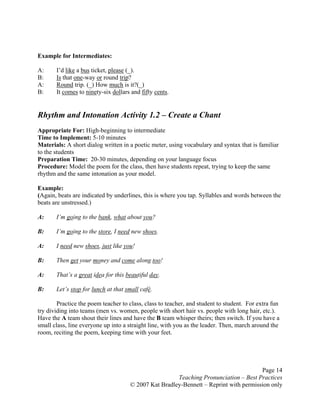
Example for Intermediates:
A: I’d like a bus ticket, please (_).
B: Is that one-way or round trip?
A: Round trip. (_) How much is it?(_)
B: It comes to ninety-six dollars and fifty cents.
Rhythm and Intonation Activity 1.2 – Create a Chant
Appropriate For: High-beginning to intermediate
Time to Implement: 5-10 minutes
Materials: A short dialog written in a poetic meter, using vocabulary and syntax that is familiar
to the students
Preparation Time: 20-30 minutes, depending on your language focus
Procedure: Model the poem for the class, then have students repeat, trying to keep the same
rhythm and the same intonation as your model.
Example:
(Again, beats are indicated by underlines, this is where you tap. Syllables and words between the
beats are unstressed.)
A: I’m going to the bank, what about you?
B: I’m going to the store, I need new shoes.
A: I need new shoes, just like you!
B: Then get your money and come along too!
A: That’s a great idea for this beautiful day.
B: Let’s stop for lunch at that small café.
Practice the poem teacher to class, class to teacher, and student to student. For extra fun
try dividing into teams (men vs. women, people with short hair vs. people with long hair, etc.).
Have the A team shout their lines and have the B team whisper theirs; then switch. If you have a
small class, line everyone up into a straight line, with you as the leader. Then, march around the
room, reciting the poem, keeping time with your feet.
Page 15
Teaching Pronunciation – Best Practices
© 2007 Kat Bradley-Bennett – Reprint with permission only
Best Technique #2: Visualizing Patterns
Students with little experience in English and students with learning disabilities may have
a lot of difficulty hearing the sounds of the language, let alone correctly reproducing them. Add
to this the fact that all students have different learning styles and you can see that using only one
format to teach pronunciation is a recipe for frustration. The teacher can incorporate other
learning modalities to assist in this process, helping students get the information through
different channels.
Visualizing Patterns Activity 2.1 – Where is the stress?
Appropriate for: Beginning to Advanced students
Time to Implement: 5-10 minutes
Materials: A list of 5 or 6 words (for beginners) or full statements and/or questions
(intermediate to advanced) students have previously practiced (don’t use unfamiliar vocabulary!)
Preparation Time: 20-30 minutes to type up the sentences and apply bold type or a black ball to
identify the point of stress on one or two examples. Preparation time could be minimal if you
simply write the sentences on your board or overhead and let students identify the stress.
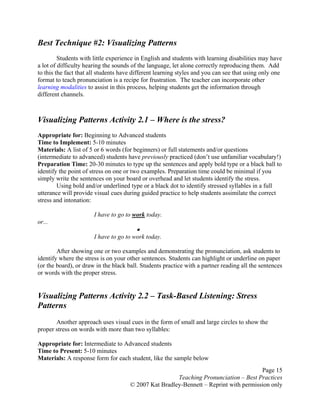
Using bold and/or underlined type or a black dot to identify stressed syllables in a full
utterance will provide visual cues during guided practice to help students assimilate the correct
stress and intonation:
I have to go to work today.
or...
•
I have to go to work today.
After showing one or two examples and demonstrating the pronunciation, ask students to
identify where the stress is on your other sentences. Students can highlight or underline on paper
(or the board), or draw in the black ball. Students practice with a partner reading all the sentences
or words with the proper stress.
Visualizing Patterns Activity 2.2 – Task-Based Listening: Stress
Patterns
Another approach uses visual cues in the form of small and large circles to show the
proper stress on words with more than two syllables:
Appropriate for: Intermediate to Advanced students
Time to Present: 5-10 minutes
Materials: A response form for each student, like the sample below
Page 16
Teaching Pronunciation – Best Practices
© 2007 Kat Bradley-Bennett – Reprint with permission only
Time to Prepare: 20-30 minutes to create your form.
Example: Students whose first language is Spanish often put stress on the final syllable of a
word that ends in –tion, since this is where the stress occurs in the Spanish cognates that end in –
ción; communicación for example, and this terminal (final) syllable is the point of interference.
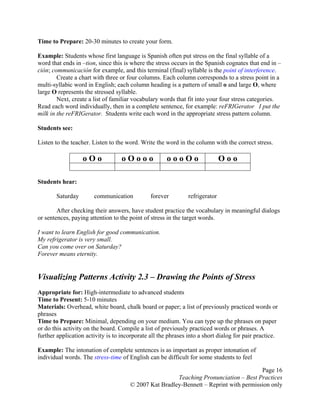
Create a chart with three or four columns. Each column corresponds to a stress point in a
multi-syllabic word in English; each column heading is a pattern of small o and large O, where
large O represents the stressed syllable.
Next, create a list of familiar vocabulary words that fit into your four stress categories.
Read each word individually, then in a complete sentence, for example: reFRIGerator I put the
milk in the reFRIGerator. Students write each word in the appropriate stress pattern column.
Students see:
Listen to the teacher. Listen to the word. Write the word in the column with the correct stress.
o O o o O o o o o o o O o O o o
Students hear:
Saturday communication forever refrigerator
After checking their answers, have student practice the vocabulary in meaningful dialogs
or sentences, paying attention to the point of stress in the target words.
I want to learn English for good communication.
My refrigerator is very small.
Can you come over on Saturday?
Forever means eternity.
Visualizing Patterns Activity 2.3 – Drawing the Points of Stress
Appropriate for: High-intermediate to advanced students
Time to Present: 5-10 minutes
Materials: Overhead, white board, chalk board or paper; a list of previously practiced words or
phrases
Time to Prepare: Minimal, depending on your medium. You can type up the phrases on paper
or do this activity on the board. Compile a list of previously practiced words or phrases. A
further application activity is to incorporate all the phrases into a short dialog for pair practice.
Example: The intonation of complete sentences is as important as proper intonation of
individual words. The stress-time of English can be difficult for some students to feel
Page 17
Teaching Pronunciation – Best Practices
© 2007 Kat Bradley-Bennett – Reprint with permission only
comfortable with. Students whose first language is a syllable-timed language will tend to read
and speak in a manner that puts emphasis on nearly every syllable of every word.
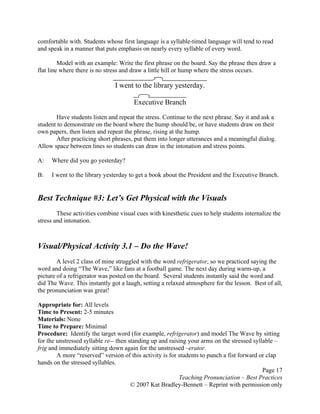
Model with an example: Write the first phrase on the board. Say the phrase then draw a
flat line where there is no stress and draw a little hill or hump where the stress occurs.
I went to the library yesterday.
Executive Branch
Have students listen and repeat the stress. Continue to the next phrase. Say it and ask a
student to demonstrate on the board where the hump should be, or have students draw on their
own papers, then listen and repeat the phrase, rising at the hump.
After practicing short phrases, put them into longer utterances and a meaningful dialog.
Allow space between lines so students can draw in the intonation and stress points.
A: Where did you go yesterday?
B: I went to the library yesterday to get a book about the President and the Executive Branch.
Best Technique #3: Let’s Get Physical with the Visuals
These activities combine visual cues with kinesthetic cues to help students internalize the
stress and intonation.
Visual/Physical Activity 3.1 – Do the Wave!
A level 2 class of mine struggled with the word refrigerator, so we practiced saying the
word and doing “The Wave,” like fans at a football game. The next day during warm-up, a
picture of a refrigerator was posted on the board. Several students instantly said the word and
did The Wave. This instantly got a laugh, setting a relaxed atmosphere for the lesson. Best of all,
the pronunciation was great!
Appropriate for: All levels
Time to Present: 2-5 minutes
Materials: None
Time to Prepare: Minimal
Procedure: Identify the target word (for example, refrigerator) and model The Wave by sitting
for the unstressed syllable re-- then standing up and raising your arms on the stressed syllable –
frig and immediately sitting down again for the unstressed –erator.
A more “reserved” version of this activity is for students to punch a fist forward or clap
hands on the stressed syllables.
Page 18
Teaching Pronunciation – Best Practices
© 2007 Kat Bradley-Bennett – Reprint with permission only
Visual/Physical Activity 3.2 – Rubber Bands
Another visual-physical technique is to use a large rubber band. (Be sure to use new ones
so that students won’t get snapped by old rubber bands that break!)
Appropriate for: All levels
Time to Present: 2-5 minutes
Materials: Large rubber bands (new!)
Time to Prepare: Minimal
Procedure: Hold the rubber band with the four fingers or the two thumbs. This is the “resting”
position. Select your target word or utterance and demonstrate the point of stress by stretching
the rubber band slightly and releasing it back to the resting position. Remember, the point of
stress might be a syllable within one word (reFRIGerator) or one syllable or word within a
complete utterance (I’m going to SCHOOL tomorrow). If you don’t have rubber bands have
students mimic the action by holding their hands together and separating them on the stress.
Visual/Physical Activity 3.3 – Feathers and Matches
Students who struggle with aspirated and explosive vs. implosive consonants might
benefit from another visual-physical technique that uses a small feather (available at craft stores)
or a lit match. If you don’t have a feather, a strip of lightweight tissue paper works well.
Appropriate for: All levels
Time to Present: 2-5 minutes
Materials: Feathers or matches (or lightweight tissue paper)
Time to Prepare: Minimal
Procedure: Select your target sounds, for example, pump vs. bump, or plumber vs. plumper.
Hold the lit match or the feather about three inches in front of the student’s mouth. If the student
properly produces the implosive b the match should stay lit or the feather will move only
slightly. The properly formed explosive p will blow out the match or move the feather
considerably more.
Again, putting the target vocabulary into a meaningful dialog for pair practice gives
students the opportunity to apply this oral practice.
A: My refrigerator isn’t working.
B: Why don’t you call the plumber?
A: I don’t need a plumber. I need a new refrigerator!
Best Techniques #4: Minimal Pairs and Task-Based Listening
Regardless of your instructional content, you’re likely to encounter minimal pairs on a
daily basis. A minimal pair consists of two words that almost sound the same, differing only by
Page 19
Teaching Pronunciation – Best Practices
© 2007 Kat Bradley-Bennett – Reprint with permission only
a single phoneme. These pairs can be confusing for students and frustrating for the teacher. The
phonemic difference might be minimal, but the communicative value is huge! Is he buying a
ship or a sheep? Is the dress thirteen dollars or thirty? Does she have a beautiful face or a
beautiful vase? Not to mention the cultural faux pas to be had with pairs such as beach/bitch and
others I won’t mention here!
Including minimal pair activities adds spice to your lessons and demonstrates to students
the importance of pronunciation in communication, and I have included several tried-and-true
methods of minimal pair practice. The activities listed below can be first used as guided practice
with the teacher as the model/director and used later for communicative practice between pairs of
students.
Several of the minimal pair activities included here are also task-based listening. This is
an excellent platform on which to present minimal pair activities because students are not
required to produce oral or written language, but respond by performing a simple task, such as
circling a word or letter on paper or holding up a different colored card, depending on the
response.
A very useful resource for identifying minimal pairs that target specific L1 problems is
Pronunciation Contrasts in English by Nilsen and Nilsen. The authors contrasted fifty-one
different foreign and Native American languages and compiled a comprehensive list of vowel
sounds, consonant sounds, diphthongs, and blends, along with simple activities pronunciation
practice.
A text and teacher’s guide with activities that focus on minimal pairs is Pronunciation
Pairs by Ann Baker and Sharon Goldstein.
Every foreign student will have difficulty with minimal pairs somewhere along the way.
For this reason, there are more minimal pair activities in this course than any other type. The
activities are presented in order from easiest to more difficult.
Minimal Pairs/Task-based Listening 4.1 – Same/Different/I Don’t
Know Cards
Same/Different/I Don’t Know cards are effective visual assessments of your students’
abilities to discriminate between sounds. Students say nothing, they only respond with the
appropriate color card.
You’ll need three different colored index cards (or construction paper), one for each
response. For beginners, write a large S on the color for SAME, a D on the color for
DIFFERENT, and nothing on the color for I DON’T KNOW.
For Intermediate to Advanced students it isn’t necessary to write anything on the cards.
Regardless of level, demonstrate how the cards are to be used. Remind students that they are to
say nothing, only hold up a card.
Appropriate for: Excellent for beginners, but helpful at all levels.
Time to Present: 5-10 minutes (can be used for review or as an evaluation activity)
Page 20
Teaching Pronunciation – Best Practices
© 2007 Kat Bradley-Bennett – Reprint with permission only
Materials: Same/Different/I Don’t Know Cards; two different sets of minimal pairs per pair of
students. Depending on the level of student, four or five pairs/student is probably adequate.
Students can swap sets to extend practice time.
Preparation Time: Approximately 15-20 minutes to prepare one set of three cards for each
student.
Procedure: Each student gets a set of Same/Different/I Don’t Know. Using one minimal pair,
for example chop and shop, the teacher says one of the words two times or both of the words one
time each. Students listen and hold up S if they think the two words were the same and D if they
think the two words were different. If they’re not sure, they hold up the I Don’t Know card.
This provides students with a safe and non-threatening way to let you know they’re not hearing
the differences.
When students get familiar with this activity let them work in pairs to practice their own
pronunciation either with the same group of words, or different ones.
Sample Pairs:
face – vase sick – sick come – gum I’m – am
house – horse past – pest flash – flush shoe – shoe
pies – buys calm – comb bite – bite peek – pick
four – far free – three ride – write toe – toe
For more challenge, use pairs that can be inserted into similar sentences:
Put the flowers here – Pot the flowers here
I don’t have the rent – I don’t have the wrench
She needs a new pen – She needs a new pan
An alternative for intermediate to advanced students is to use equal and non-equal
symbols = ≠ on an answer sheet. Students circle whether they hear same or different.
Minimal Pairs/Task-Based Listening Activity 4.2 – Check the Sound
You Hear
Appropriate for: Beginning to intermediate students
Time to Present: 5-10 minutes
Materials: A grid similar to the example below
Time to Prepare: 20-30 minutes to create your grid and prepare a list of words
Procedure: Students listen to the teacher and make a check mark on a grid that identifies the
sounds they hear.
Example: Imagine students are practicing the following dialog:
A: Hi, Javier. What are you doing?
B: I’m eating some potato chips
Page 21
Teaching Pronunciation – Best Practices
© 2007 Kat Bradley-Bennett – Reprint with permission only
Imagine that several students have difficulty with the initial –ch sound in chips and it comes out
sounding like ships. The initial consonant cluster is the point of interference. You can customize
a list of minimal pairs that contains those points of interference.
Students see:
Listen to the teacher.
Listen to the word.
What sound did you hear?
Put a check in the correct box.
sh ch
1.
2.
3
4.
Teacher recites:
Chips – I’m eating potato chips.
Sheep – Those are sheep.
She’s – She’s a student.
Child – I have one child.
Minimal Pairs/Task-Based Listening Activity 4.3 – Point to the Word
You Hear
Appropriate for: High-beginning to intermediate students
Time to Present: 5-10 minutes
Materials: One set of 5 or 6 minimal pairs per pair of students
Time to Prepare: 15-20 minutes to type up a list of minimal pairs
Procedure: Students work with identical lists of minimal pairs. Student A says one word and
Student B repeats the word and then points to the word on the paper. If the response is incorrect,
the pair works on the pronunciation together.
Example:
1) ship – sheep
2) favor – flavor
3) burn – born
Page 22
Teaching Pronunciation – Best Practices
© 2007 Kat Bradley-Bennett – Reprint with permission only
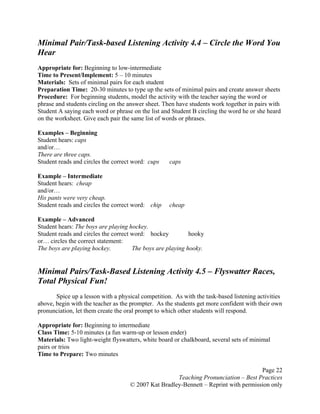
Minimal Pair/Task-based Listening Activity 4.4 – Circle the Word You
Hear
Appropriate for: Beginning to low-intermediate
Time to Present/Implement: 5 – 10 minutes
Materials: Sets of minimal pairs for each student
Preparation Time: 20-30 minutes to type up the sets of minimal pairs and create answer sheets
Procedure: For beginning students, model the activity with the teacher saying the word or
phrase and students circling on the answer sheet. Then have students work together in pairs with
Student A saying each word or phrase on the list and Student B circling the word he or she heard
on the worksheet. Give each pair the same list of words or phrases.
Examples – Beginning
Student hears: caps
and/or…
There are three caps.
Student reads and circles the correct word: cups caps
Example – Intermediate
Student hears: cheap
and/or…
His pants were very cheap.
Student reads and circles the correct word: chip cheap
Example – Advanced
Student hears: The boys are playing hockey.
Student reads and circles the correct word: hockey hooky
or… circles the correct statement:
The boys are playing hockey. The boys are playing hooky.
Minimal Pairs/Task-Based Listening Activity 4.5 – Flyswatter Races,
Total Physical Fun!
Spice up a lesson with a physical competition. As with the task-based listening activities
above, begin with the teacher as the prompter. As the students get more confident with their own
pronunciation, let them create the oral prompt to which other students will respond.
Appropriate for: Beginning to intermediate
Class Time: 5-10 minutes (a fun warm-up or lesson ender)
Materials: Two light-weight flyswatters, white board or chalkboard, several sets of minimal
pairs or trios
Time to Prepare: Two minutes
Page 23
Teaching Pronunciation – Best Practices
© 2007 Kat Bradley-Bennett – Reprint with permission only
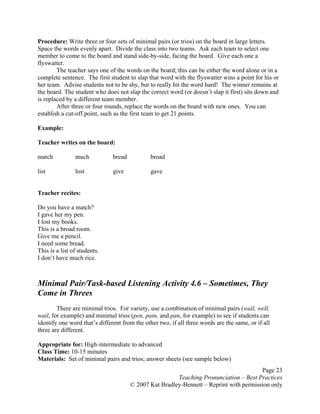
Procedure: Write three or four sets of minimal pairs (or trios) on the board in large letters.
Space the words evenly apart. Divide the class into two teams. Ask each team to select one
member to come to the board and stand side-by-side, facing the board. Give each one a
flyswatter.
The teacher says one of the words on the board; this can be either the word alone or in a
complete sentence. The first student to slap that word with the flyswatter wins a point for his or
her team. Advise students not to be shy, but to really hit the word hard! The winner remains at
the board. The student who does not slap the correct word (or doesn’t slap it first) sits down and
is replaced by a different team member.
After three or four rounds, replace the words on the board with new ones. You can
establish a cut-off point, such as the first team to get 21 points.
Example:
Teacher writes on the board:
match much bread broad
list lost give gave
Teacher recites:
Do you have a match?
I gave her my pen.
I lost my books.
This is a broad room.
Give me a pencil.
I need some bread.
This is a list of students.
I don’t have much rice.
Minimal Pair/Task-based Listening Activity 4.6 – Sometimes, They
Come in Threes
There are minimal trios. For variety, use a combination of minimal pairs (wail, well,
wail, for example) and minimal trios (pen, pain, and pan, for example) to see if students can
identify one word that’s different from the other two, if all three words are the same, or if all
three are different.
Appropriate for: High-intermediate to advanced
Class Time: 10-15 minutes
Materials: Set of minimal pairs and trios; answer sheets (see sample below)
Page 24
Teaching Pronunciation – Best Practices
© 2007 Kat Bradley-Bennett – Reprint with permission only
Preparation Time: 30 minutes to create answer sheets and lists of pairs/trios.
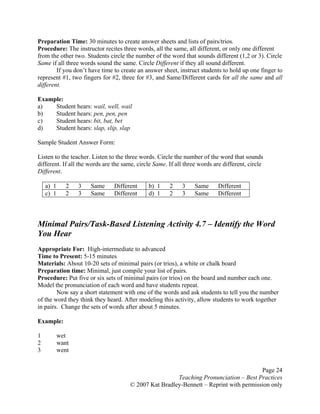
Procedure: The instructor recites three words, all the same, all different, or only one different
from the other two. Students circle the number of the word that sounds different (1,2 or 3). Circle
Same if all three words sound the same. Circle Different if they all sound different.
If you don’t have time to create an answer sheet, instruct students to hold up one finger to
represent #1, two fingers for #2, three for #3, and Same/Different cards for all the same and all
different.
Example:
a) Student hears: wail, well, wail
b) Student hears: pen, pen, pen
c) Student hears: bit, bat, bet
d) Student hears: slap, slip, slap
Sample Student Answer Form:
Listen to the teacher. Listen to the three words. Circle the number of the word that sounds
different. If all the words are the same, circle Same. If all three words are different, circle
Different.
a) 1 2 3 Same Different b) 1 2 3 Same Different
c) 1 2 3 Same Different d) 1 2 3 Same Different
Minimal Pairs/Task-Based Listening Activity 4.7 – Identify the Word
You Hear
Appropriate For: High-intermediate to advanced
Time to Present: 5-15 minutes
Materials: About 10-20 sets of minimal pairs (or trios), a white or chalk board
Preparation time: Minimal, just compile your list of pairs.
Procedure: Put five or six sets of minimal pairs (or trios) on the board and number each one.
Model the pronunciation of each word and have students repeat.
Now say a short statement with one of the words and ask students to tell you the number
of the word they think they heard. After modeling this activity, allow students to work together
in pairs. Change the sets of words after about 5 minutes.
Example:
1 wet
2 want
3 went
Page 25
Teaching Pronunciation – Best Practices
© 2007 Kat Bradley-Bennett – Reprint with permission only
4 kiss
5 kits
6 sheep
7 ship
8 chip
9 weather
10 whether
11 wither
Instructor recites:
Do you know where she went?
She gave him the kits.
That’s a really big ship.
I don’t know whether he’s a teacher or a student.
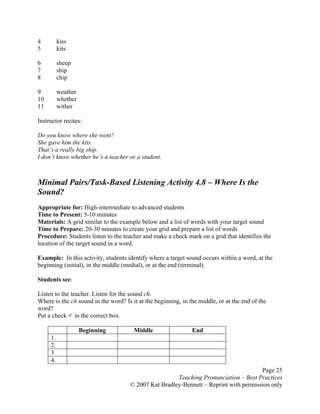
Minimal Pairs/Task-Based Listening Activity 4.8 – Where Is the
Sound?
Appropriate for: High-intermediate to advanced students
Time to Present: 5-10 minutes
Materials: A grid similar to the example below and a list of words with your target sound
Time to Prepare: 20-30 minutes to create your grid and prepare a list of words
Procedure: Students listen to the teacher and make a check mark on a grid that identifies the
location of the target sound in a word.
Example: In this activity, students identify where a target sound occurs within a word, at the
beginning (initial), in the middle (medial), or at the end (terminal).
Students see:
Listen to the teacher. Listen for the sound ch.
Where is the ch sound in the word? Is it at the beginning, in the middle, or at the end of the
word?
Put a check in the correct box.
Beginning Middle End
1.
2.
3
4.
Page 26
Teaching Pronunciation – Best Practices
© 2007 Kat Bradley-Bennett – Reprint with permission only
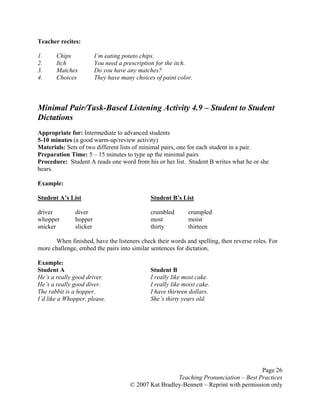
Teacher recites:
1. Chips I’m eating potato chips.
2. Itch You need a prescription for the itch.
3. Matches Do you have any matches?
4. Choices They have many choices of paint color.
Minimal Pair/Task-Based Listening Activity 4.9 – Student to Student
Dictations
Appropriate for: Intermediate to advanced students
5-10 minutes (a good warm-up/review activity)
Materials: Sets of two different lists of minimal pairs, one for each student in a pair.
Preparation Time: 5 – 15 minutes to type up the minimal pairs
Procedure: Student A reads one word from his or her list. Student B writes what he or she
hears.
Example:
Student A’s List Student B’s List
driver diver crumbled crumpled
whopper hopper most moist
snicker slicker thirty thirteen
When finished, have the listeners check their words and spelling, then reverse roles. For
more challenge, embed the pairs into similar sentences for dictation.
Example:
Student A Student B
He’s a really good driver. I really like most cake.
He’s a really good diver. I really like moist cake.
The rabbit is a hopper. I have thirteen dollars.
I’d like a Whopper, please. She’s thirty years old.
Page 27
Teaching Pronunciation – Application Activities
© 2007 Kat Bradley-Bennett – Permission to copy granted for classroom purposes
Teaching Pronunciation
Application Activities
Now that you have a bit of pronunciation theory under your belt and you’ve had a look at
some best practices, how can you apply this knowledge?
To complete this course and to earn the full 15 Pd points or 15 LIA renewal points, do all
three application activities.
The Application Activity 1 allows you to select and use some of the best practices in your
own classroom. Application Activity 2 involves taking a look at existing ESL text and evaluating
each book’s approach to pronunciation. In Application Activity 3 you will identify some of the
significant pronunciation problems within your own group or groups of learners, and make a
plan to focus pronunciation practice towards those specific problems.
Once you have completed the Application Activities, meet with your director or
supervisor with the Evaluation Form for the final phase of this independent study course.
Page 28
Teaching Pronunciation – Application Activities
© 2007 Kat Bradley-Bennett – Permission to copy granted for classroom purposes
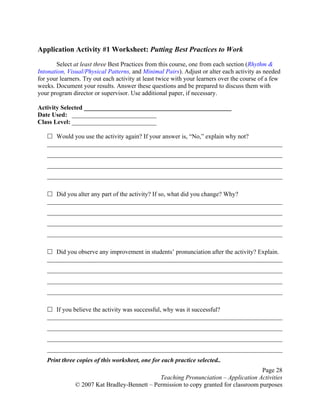
Application Activity #1 Worksheet: Putting Best Practices to Work
Select at least three Best Practices from this course, one from each section (Rhythm &
Intonation, Visual/Physical Patterns, and Minimal Pairs). Adjust or alter each activity as needed
for your learners. Try out each activity at least twice with your learners over the course of a few
weeks. Document your results. Answer these questions and be prepared to discuss them with
your program director or supervisor. Use additional paper, if necessary.
Activity Selected _______________________________________________
Date Used: ___________________________
Class Level: ___________________________
Would you use the activity again? If your answer is, “No,” explain why not?
___________________________________________________________________________
___________________________________________________________________________
___________________________________________________________________________
___________________________________________________________________________
Did you alter any part of the activity? If so, what did you change? Why?
___________________________________________________________________________
___________________________________________________________________________
___________________________________________________________________________
___________________________________________________________________________
Did you observe any improvement in students’ pronunciation after the activity? Explain.
___________________________________________________________________________
___________________________________________________________________________
___________________________________________________________________________
___________________________________________________________________________
If you believe the activity was successful, why was it successful?
___________________________________________________________________________
___________________________________________________________________________
___________________________________________________________________________
___________________________________________________________________________
Print three copies of this worksheet, one for each practice selected..
Page 29
Teaching Pronunciation – Application Activities
© 2007 Kat Bradley-Bennett – Permission to copy granted for classroom purposes
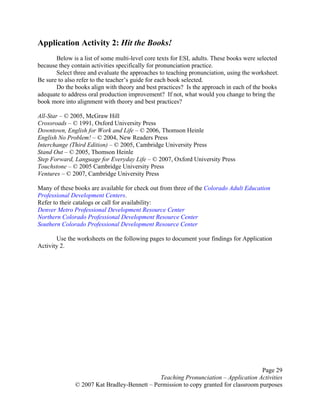
Application Activity 2: Hit the Books!
Below is a list of some multi-level core texts for ESL adults. These books were selected
because they contain activities specifically for pronunciation practice.
Select three and evaluate the approaches to teaching pronunciation, using the worksheet.
Be sure to also refer to the teacher’s guide for each book selected.
Do the books align with theory and best practices? Is the approach in each of the books
adequate to address oral production improvement? If not, what would you change to bring the
book more into alignment with theory and best practices?
All-Star – © 2005, McGraw Hill
Crossroads – © 1991, Oxford University Press
Downtown, English for Work and Life – © 2006, Thomson Heinle
English No Problem! – © 2004, New Readers Press
Interchange (Third Edition) – © 2005, Cambridge University Press
Stand Out – © 2005, Thomson Heinle
Step Forward, Language for Everyday Life – © 2007, Oxford University Press
Touchstone – © 2005 Cambridge University Press
Ventures – © 2007, Cambridge University Press
Many of these books are available for check out from three of the Colorado Adult Education
Professional Development Centers.
Refer to their catalogs or call for availability:
Denver Metro Professional Development Resource Center
Northern Colorado Professional Development Resource Center
Southern Colorado Professional Development Resource Center
Use the worksheets on the following pages to document your findings for Application
Activity 2.
Page 30
Teaching Pronunciation – Application Activities
© 2007 Kat Bradley-Bennett – Permission to copy granted for classroom purposes
Teaching Pronunciation Application #2 Worksheet 2.1: Hit the Books!
Select one adult ESL core text from the list provided and answer the following questions about
each one.
Book 1 Title: _______________________________________________________
1. Describe the pronunciation activities in this book:
______________________________________________________________________________
______________________________________________________________________________
______________________________________________________________________________
______________________________________________________________________________
2. Does this book’s approach to pronunciation align with what you know about theory
and best practices?
Yes? Briefly describe how this puts pronunciation theory into practice.
______________________________________________________________________________
______________________________________________________________________________
______________________________________________________________________________
_____________________________________________________________________________
No? If not, what theory is the book not putting into practice?
______________________________________________________________________________
______________________________________________________________________________
______________________________________________________________________________
_____________________________________________________________________________
3. What would you do to improve this book’s approach to pronunciation theory?
What would you change? How would you provide practice?
______________________________________________________________________________
______________________________________________________________________________
______________________________________________________________________________
_____________________________________________________________________________
Print one copy of this worksheet
Page 31
Teaching Pronunciation – Application Activities
© 2007 Kat Bradley-Bennett – Permission to copy granted for classroom purposes
Teaching Pronunciation Application #2 Worksheet 2.2: Hit the Books!
Select one adult ESL core text from the list provided and answer the following questions about
each one.
Book 1 Title: _______________________________________________________
1. Describe the pronunciation activities in this book:
______________________________________________________________________________
______________________________________________________________________________
______________________________________________________________________________
______________________________________________________________________________
2. Does this book’s approach to pronunciation align with what you know about theory
and best practices?
Yes? Briefly describe how this puts pronunciation theory into practice.
______________________________________________________________________________
______________________________________________________________________________
______________________________________________________________________________
_____________________________________________________________________________
No? If not, what theory is the book not putting into practice?
______________________________________________________________________________
______________________________________________________________________________
______________________________________________________________________________
_____________________________________________________________________________
3. What would you do to improve this book’s approach to pronunciation theory?
What would you change? How would you provide practice?
______________________________________________________________________________
______________________________________________________________________________
______________________________________________________________________________
_____________________________________________________________________________
Print one copy of this worksheet
Page 32
Teaching Pronunciation – Application Activities
© 2007 Kat Bradley-Bennett – Permission to copy granted for classroom purposes
Teaching Pronunciation Application #2 Worksheet 2.3: Hit the Books!
Select one adult ESL core text from the list provided and answer the following questions about
each one.
Book 1 Title: _______________________________________________________
1. Describe the pronunciation activities in this book:
______________________________________________________________________________
______________________________________________________________________________
______________________________________________________________________________
______________________________________________________________________________
2. Does this book’s approach to pronunciation align with what you know about theory
and best practices?
Yes? Briefly describe how this puts pronunciation theory into practice.
______________________________________________________________________________
______________________________________________________________________________
______________________________________________________________________________
_____________________________________________________________________________
No? If not, what theory is the book not putting into practice?
______________________________________________________________________________
______________________________________________________________________________
______________________________________________________________________________
_____________________________________________________________________________
3. What would you do to improve this book’s approach to pronunciation theory?
What would you change? How would you provide practice?
______________________________________________________________________________
______________________________________________________________________________
______________________________________________________________________________
_____________________________________________________________________________
Print one copy of this worksheet
Page 33
Teaching Pronunciation – Application Activities
© 2007 Kat Bradley-Bennett – Permission to copy granted for classroom purposes
Application Activity 3: Focus on Your Learners
To really serve the needs of your learners, it helps to know what particular pronunciation
problems they encounter. Teachers can usually pinpoint the points of interference with a
particular student simply by listening to the student in class and in normal everyday English
conversation. A class with mixed nationalities will present a variety of pronunciation problems
for which you can customize pronunciation practice in your lessons, using any of the Best
Practices provided in this course.
Pronunciation Contrasts in English by Nilsen and Nilsen, provides minimal pair sets for
51 different foreign languages, including Native American languages. In many cases different
languages share the same or similar problems with the same minimal pairs.
Identify a maximum of five points of interference, or specific sounds or sound
combinations that your students struggle with in your class, and design pronunciation activities
around the problems. Document your activities on the worksheet and be prepared to talk about
them with your director or supervisor.
Whenever possible, use material directly from the text(s) you’re using in that class. This
is especially important for beginning and low-intermediate students. Use vocabulary and dialogs
that students have practiced and are familiar with.
Also, remember that your goal is effective communication, not the eradication of student
accents.
Page 34
Teaching Pronunciation – Application Activities
© 2007 Kat Bradley-Bennett – Permission to copy granted for classroom purposes
Teaching Pronunciation Application #3 Worksheet 3
Customized Pronunciation Practice
Sound Focus – Which vowel, consonant or letter blend is the focus of the practice?
_________________________________________________________________________
Activity – What activity did you select for this focus (E.g.: Rhythm & Intonation, Visual or
Physical Patterns, or Minimal Pairs/Trios)?
_________________________________________________________________________
Implementation – How did you conduct the activity?
_________________________________________________________________________
_________________________________________________________________________
_________________________________________________________________________
_________________________________________________________________________
_________________________________________________________________________
Evaluation – What is your overall impression of the effectiveness of the activity?
_________________________________________________________________________
_________________________________________________________________________
_________________________________________________________________________
_________________________________________________________________________
_________________________________________________________________________
_________________________________________________________________________
Print one worksheet for each activity selected
Page 35
Teaching Pronunciation – Evaluation
© 2007 Kat Bradley-Bennett – Permission to copy granted for classroom purposes
Evaluation Form
Continued…
Instructions for project directors and coordinators:
Print the evaluation form on the next page
Discuss with your teacher the outcomes of this
independent study course
Make notations on the evaluation form
Record the teacher’s PD points in the Annual
Professional Development Activity Record
Page 36
Teaching Pronunciation – Evaluation
© 2007 Kat Bradley-Bennett – Permission to copy granted for classroom purposes
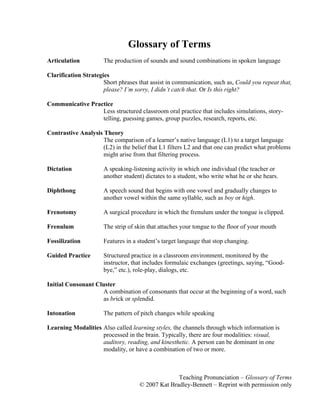
TeacherDemonstrates
LittleorNoKnowledge
ofthisTopic
TeacherNeedsto
ExpandKnowledgein
thisTopic
Teacher
Demonstrates
Knowledgeofthis
Topic
TeachingPronunciation–EvaluationFormforProjectDirectorsandCoordinators
Objective
Identifythebasicprinciplesof
teachingpronunciation.
Identify,implement,and
evaluatetheeffectivenessof
somebestpracticesinteaching
pronunciation.Documenton
theworksheetsprovided.
ComparethreeadultESLcore
textbooksandevaluatetheir
approachestopronunciation
instruction.Documentonthe
worksheetsprovided.
Identifyamaximumoffive
pointsofinterferencethatyour
currentstudentsstrugglewith
inclass.Designactivities
aroundtheproblems.
Documentontheworksheet
provided.
Print this form for your files
Teaching Pronunciation – Glossary of Terms
© 2007 Kat Bradley-Bennett – Reprint with permission only
Glossary of Terms
Articulation The production of sounds and sound combinations in spoken language
Clarification Strategies
Short phrases that assist in communication, such as, Could you repeat that,
please? I’m sorry, I didn’t catch that. Or Is this right?
Communicative Practice
Less structured classroom oral practice that includes simulations, story-
telling, guessing games, group puzzles, research, reports, etc.
Contrastive Analysis Theory
The comparison of a learner’s native language (L1) to a target language
(L2) in the belief that L1 filters L2 and that one can predict what problems
might arise from that filtering process.
Dictation A speaking-listening activity in which one individual (the teacher or
another student) dictates to a student, who write what he or she hears.
Diphthong A speech sound that begins with one vowel and gradually changes to
another vowel within the same syllable, such as boy or high.
Frenotomy A surgical procedure in which the frenulum under the tongue is clipped.
Frenulum The strip of skin that attaches your tongue to the floor of your mouth
Fossilization Features in a student’s target language that stop changing.
Guided Practice Structured practice in a classroom environment, monitored by the
instructor, that includes formulaic exchanges (greetings, saying, “Good-
bye,” etc.), role-play, dialogs, etc.
Initial Consonant Cluster
A combination of consonants that occur at the beginning of a word, such
as brick or splendid.
Intonation The pattern of pitch changes while speaking
Learning Modalities Also called learning styles, the channels through which information is
processed in the brain. Typically, there are four modalities: visual,
auditory, reading, and kinesthetic. A person can be dominant in one
modality, or have a combination of two or more.
Teaching Pronunciation – Glossary of Terms
© 2007 Kat Bradley-Bennett – Reprint with permission only
Minimal Pair A pair of words that differ in sound by only one phonemic element, such
as chair and share, or nice and niece.
Opaque Vowels Vowels that contain numerous oral forms. English vowels are opaque,
with several different pronunciations.
Phonemes The individual sounds of language that can contain meaning. . Change the
phoneme of a word and you change its meaning, back to bake, for
example.
Pitch The tonal rising or falling of one’s voice when speaking
Point of Interference
The identified location of mispronunciation in a word or sentence.
Rhythm The combination of syllable and word stress in speech
Scaffolding Contextualized framework and support provided by the teacher to help
students develop their skills and gain confidence.
Segmentals The individual sounds of language
Stress The accent or emphasis placed on a syllable within a word, or a word
within a phrase
Stress-timed Language
In English, only certain words or certain syllables are stressed. The words
and syllables between stresses are compressed into unstressed segments.
More syllables do not necessarily require more time to say.
Suprasegmentals The melody and rhythm of spoken language
Syllable-timed Language
A language in which every syllable receives the same amount of timing. A
sentence with more syllables will require more time to say.
Task-Based Listening
An activity in which students are not required to produce oral language,
but complete a task that demonstrates they comprehend what they hear.
Total Physical Response
A listening-based activity in which students respond to an auditory prompt
with some physical activity, rather than spoken language.
Transparent Vowels Vowels in a language that have only one oral sound.
Teaching Pronunciation – Bibliography and Resources
© 2007 Kat Bradley-Bennett – Reprint with permission only
Bibliography and Resources*
Avery, Peter and Ehrlich, Suzan, Teaching American English Pronunciation, New York, Oxford
University Press, 1992
Baker, Ann and Goldstein, Sharon, Pronunciation Pairs, An Introductory Course for Students of
English, USA: Cambridge University Press, 2003 (15th
printing)
Celce-Murcia, Brinton, and Goodwin, Teaching Pronunciation: A Reference for Teachers of
English to Speakers of Other Languages. USA: Cambridge University Press, 1996.
Diaz-Rico, Lynne T. and Weed, Kathryn Z, The Crosscultural Language and Academic
Development Handbook, USA: Pearson Education, Inc. (Allyn & Bacon imprint), Third Edition
2006
Gilbert, Judy, Clear Speech From the Start, Basic Pronunciation and Listening Comprehension
in North American English: New York: Cambridge University Press, 2000
Gilbert, Judy, Clear Speech, Pronunciation and Listening Comprehension in North American
English (Third Edition): New York: Cambridge University Press, 2005
Graham, Carolyn, Creating Chants and Songs, New York: Oxford University Press, 2006
Graham, Carolyn, Jazz Chants, New York: Oxford University Press, 1978
Grant, Linda, Well Said; Heinle & Heinle, 2001
Iserlis, Janet, Trauma and the English Language Learner; retrieved from ERIC Digest,
http://eric.ed.gov, ED444397, 2000
Koschnick Freeman, Kay, TV Tutor: Consonant Sounds Training Video; New Reader’s Press,
1990.
Koschnick Freeman, Kay, TV Tutor: Consonant Sounds Instructor’s Handbook; New Reader’s
Press, 1990.
Krashen, Stephen D. and Terrell, Tracy D., The Natural Approach, Language Acquisition in the
Classroom; Prentice Hall, 1995
Lightbown, Patsy M. and Spada, Nina; How Languages Are Learned (Third Edition); Oxford
University Press, 2006
Lindsay, Paul, Teaching English Worldwide, A New Practical Guide to Teaching English; Alta
Book Center, 2000
Teaching Pronunciation – Bibliography and Resources
© 2007 Kat Bradley-Bennett – Reprint with permission only
Nilsen, Don L.F. & Nilsen, Alleen Pace; Pronunciation Contrasts in English, USA: Pearson
Education 1973 (2002 Waveland Press reissue)
Nunan, David and Miller, Lindsay, Editors; New Ways in Teaching Listening; New Ways in
TESOL Series, 1995
Parrish, Betsy, Teaching Adult ESL, A Practical Introduction, New York: McGraw Hill, 2004
Schwarz, Dr. Robin, Using Phonemic Awareness with ESL Students, retrieved from the National
Center for Adult Learning and Literacy, 1998
Rivers, Wilga M. and Temperley, Mary S., A Practical Guide to the Teaching of English as a
Second or Foreign Language, USA: Oxford University Press, 1978
*Many of these books are available for check out from the Colorado Adult Education
Professional Development Centers. Refer to their catalogs for availability:
Denver Metro Professional Development Resource Center
Four Corners Virtual Resource Center
Northern Colorado Professional Development Resource Center
Southern Colorado Professional Development Resource Center
Web Resources:
Dave’s ESL Café
http://www.eslcafe.com/teachers/
eslflow.com
http://www.homestead.com/prosites-eslflow/pronunciationlessonplans.html
North Carolina State University Index of Learning Styles
http://www.engr.ncsu.edu/learningstyles/ilsweb.html
Pizzaz! Tongue Twisters
http://darkwing.uoregon.edu/~leslieob/twisters.html
Sounds of English
http://www.soundsofenglish.org/
University of Iowa Phonetics Flash Animation Project
http://www.uiowa.edu/~acadtech/phonetics/
VARK Guide to Learning Styles
http://www.vark-learn.com/english/index.asp

Teaching pronunciationadults

  • 1.
    Page 1 Teaching Pronunciation–Objectives/Instructions © 2007 Kat Bradley-Bennett – Reprint with permission only Teaching Pronunciation An Independent Study Course for Teachers of Adult English as a Second Language Learners Objectives o Identify elements of good oral production o Identify and apply techniques in teaching pronunciation o Compare textbooks and evaluate their approaches to pronunciation instruction o Understand how to incorporate pronunciation exercises into lesson plans o When completed, you will receive 15 professional development (PD) or Literacy Instruction Authorization (LIA) renewal points When you have completed this course, you will receive 15 professional development (PD) or Literacy Instruction Authorization (LIA) renewal points Kat Bradley-Bennett Northern Colorado Professional Development Center 619 Bowen Street Longmont, CO 80501 303-702-7912 ncpdc@stvrain.k12.co.us
  • 2.
    Page 2 Teaching Pronunciation–Objectives/Instructions © 2007 Kat Bradley-Bennett – Reprint with permission only The Purpose of the Independent Study Course Series The Independent Study Course is approved and accepted by The Colorado Department of Education office of Adult Education and Family Literacy for the purpose of professional development in the field of teaching English as a second language. It’s estimated that this Study Course will require 11-15 hours to complete, including in- class time with the Application Activities. When you have completed the course, you will receive 15 PD or LIA renewal points. The purpose of this study course is to present some basic Theory, a few tried-and-true techniques, or Best Practices for improving your students’ pronunciation, and Application Activities to put what you’ve learned into practice. A Glossary at the end defines key terms. Be sure to visit the Bibliography and Resources page for additional information. Who Is This Course For? This Independent Study Course is for adult ESL practitioners, including teachers new to adult ESL instruction. How to Use This Study Course 1. Welcome to this downloadable Adobe Reader version of Teaching Pronunciation. If you don’t have Adobe Reader installed on your computer, click here. 2. Hyperlinks in this document are active and are in blue italics. First, click on VIEW/TOOLBARS and select WEB. To follow a hyperlink, hold the CTRL button and left-click your mouse. To return to where you left off, click on the blue BACK ARROW in the upper left of your toolbars. 3. After reading the Introduction and Theory continue to Best Practices, where you will find descriptions of strategies and techniques you can use in your own classroom, using your own core curricula, to improve the oral production of your students. 4. At the end of the course, you’ll find three Application Activities. Do all three application activities and discuss your experiences with your project director or coordinator. 5. The Bibliography and Resources link provides you with a list of books and other resources, should you wish to continue to delve further into the topic of pronunciation instruction. 6. Portions of this course are copyrighted and may be reprinted with permission only. The Application worksheets and the Evaluation Form may be printed for purposes of this course. Project Director’s Evaluation Page If you are a project director, use the Evaluation Form, based on the objectives of the course, to verify staff participation in this Independent Study Course. Record the teacher’s PD points in the Annual Professional Development Activity Record.
  • 3.
    Page 3 Teaching Pronunciation–Introduction © 2007 Kat Bradley-Bennett – Reprint with permission only Teaching Pronunciation Introduction Communication can be a tricky business, especially when the listener and speaker are from different linguistic backgrounds. There are pitfalls aplenty with poor word choice and improper inflection, and there are numerous reasons a student has difficulty reproducing the sounds of English correctly. Perhaps pronunciation had little focus in previous classes, or maybe the student has never had any formal language instruction. Even students with significant educational experience can have problems. Perhaps early pronunciation was taught by non- native speakers who themselves have oral production problems. Maybe the student’s first language contains different phonemes and the student simply cannot hear the sounds, let alone accurately replicate them. Below are several scenarios from my personal experiences, as well as from my colleagues, as ESL professionals abroad and in the U.S. I Rove Lak! A student in Seoul, South Korea was asked to keep a recorded cassette journal because his teacher was having difficulty understanding his spoken English. The unit topic was Entertainment and the student was asked to respond to the question, “What kind of music do you like?” On his cassette journal he proudly professed his love for Lok and Naitch. Lok was not too difficult to decode, especially given the context. He loves rock-and-roll, but displayed the typical Asian difficulty pronouncing English l and r. The teacher listened and listened and could not decode Naitch. She returned to class the next day, played the tape, and asked the student to write the words on paper. The mystery was solved. He loves New Age music!. This might have been a problem arising from untrained or undisciplined listening skills, or possibly a physical linguistic difference. English requires more open movement of the mouth and jaw than does Korean Hangul. This could explain the absence of the diphthong necessary to move from the long u sound in new to the long a sound in age. The mispronunciation of the g sound to ch was an additional challenge. Whatever the cause, poor oral production interfered with communication Put Your Teeth Into It! Another colleague in Seoul asked his students to prepare one five-minute presentation for the semester. One student had recently “conquered” the sound of f (f and p are difficult sounds for some Korean students to distinguish). The student displayed a cross-section of a mouth and dutifully explained that there are two ways to produce the sound f, one way is to place the top teeth on the bottom lip and blow air. The teacher nodded in agreement, wondering what on
  • 4.
    Page 4 Teaching Pronunciation–Introduction © 2007 Kat Bradley-Bennett – Reprint with permission only Earth the second method could be. The student happily demonstrated that f can also be produced by placing the bottom teeth on the top lip and blowing air. The teacher had to restrain from laughing, but the student had been taught that this was acceptable technique by a Korean Middle School English teacher. Just Write it Down A Hispanic ESL student in Colorado wants to become a United States citizen. He diligently attends English class three nights per week and an ESL literacy laboratory one night per week, moving slowly but steadily up the Student Performance Level (SPL) ladder, based on CASAS listening tests. He holds a fulltime job and attends his children’s parent-teacher conferences. The student once reported that his boss complains about his strong accent. Teachers and tutors have also reported difficulty understanding this student’s speech. After much repetition and occasionally asking him to write down what it is he’s trying to say, does it become apparent that he comprehends what he’s being asked. The student’s poor oral production could have numerous negative consequences for him in the future, including difficulties getting a better job and passing the INS interview. Keep Your Eye on the Prize! I once read an article in a Korean-English newspaper about a surgery some Korean parents have had performed on their children, even children as young as six months. The surgery involves clipping the frenulum, that little strip of skin that attaches your tongue to the floor of your mouth, believing that the tongue will be more flexible, thereby eliminating problems with production of English l and r. (Never mind that there are numerous other phonological differences between Korean Hangul and English!) I was horrified, but many of my students truly believed that this extreme and very costly procedure was a viable solution to a problem that, in their minds, would impede their academic success. Linguists around the world denounced frenotomy as cruel, unnecessary, and ineffective and I’m inclined to accept those assertions. One has only to listen to South Korea’s opera diva, Cho Su-mi (known as Sumi Jo in America) in her rendition of I Dreamed I Lived in Marbled Halls with its heartbreaking refrain, “You loved me still the same,” enunciated as clearly as any native speaker, to know that it is possible for a native Korean speaker to form perfect l and r without going under the knife! Listen to Chinese film director Ang Li and you hear the same, perfect pronunciation of these consonants. I’m happy to say that none of my students ever had a frenotomy, and as we worked on pronunciation in class, I hope that they realized that communication could still occur, despite their accents. Students may or may not be aware that their oral production is a problem. As teachers, it’s up to us to identify the problems, weighing their importance against the student’s needs.
  • 5.
    Page 5 Teaching Pronunciation–Introduction © 2007 Kat Bradley-Bennett – Reprint with permission only Keep your eye on the prize: successful communication, not perfection. How important is it for ESL instructors to incorporate pronunciation practice into their lessons? How much time and effort should be devoted to it? What are the keys to good pronunciation? What are the best classroom strategies and techniques to improve students’ oral production? In other words, what do other teachers do? Stephen Krashen says, “Comprehensible input stimulates natural language acquisition.” (Krashen and Terrell, P.98). Giving students lots of speaking and listening practice in a context they can understand can help the student untie the pronunciation knots. Access to native speakers is invaluable, be it teachers, friends, coworkers, television, radio, movies, or grocery store clerks. Pronunciation problems can be based on a number of auditory, physiological, cultural, emotional, even psychological factors. Pronunciation practice should be multidimensional, with emphasis on listening in a contextualized format with ample exposure to the target sounds and utterances, and lots of contextualized oral practice. Listening “is essential not only as a receptive skill but also to the development of spoken language proficiency.” (Nunan and Miller, p.v.) Krashen defines the opposite of comprehensible input as noise. Perhaps it can be said, then, that the role of an ESL/EFL teacher in the development of pronunciation is to assist in transforming that noise into discernible and distinguishable sounds with meaning.
  • 6.
    Page 6 Teaching Pronunciation– Theory © 2007 Kat Bradley-Bennett – Reprint with permission only Teaching Pronunciation Theory Learning a new language requires adequate exposure to the language, the ability to discriminate between phonemic elements, the ability to analyze the grammar and social rules, the ability to recall learned components of the language (grammar, spelling, vocabulary, pronunciation, etc.), and to use all of these appropriately. What a task! Research into the teaching of pronunciation has been less extensive than research into second language acquisition (SLA) and first language (L1) interference. For this Independent Study Course a small sampling of theoretical elements is presented to help you understand challenges facing adult students who are trying to master English pronunciation, and to give you some basis on which to apply pronunciation tasks and exercises in your classroom. Teach English, Not About English! Unless you’re teaching a Masters class in Second Language Acquisition or Applied Linguistics, chances are you won’t be focusing very much of any lesson on the fine minutiae of pronunciation, such as suprasmegentals (stress, pitch, rhythm, and intonation). It’s doubtful that a classroom of ESL students will benefit much from a lesson objective of looking at the stress- timed nature of English. However, this is not to say that pronunciation shouldn’t be a part of every lesson. Of course, it should, and within contexts that are comprehensible to your learners. Consider this practice exchange for Level 2 ESL students and some possible errors you might encounter: A: Can I please espeak to dapardmend manaher? B: I’m esorry, he’s not in. Can I take a massage? A: Jes, please. My chower is licking. This dialog provides opportunity for both real-life meaning and substantive oral practice that can be extended to other real-life situations. Adult ESL students want and need meaning. Their pronunciation will improve with practice, time, and most importantly, no pressure! As your students progress, so will their abilities to analyze the language and their own production. In other words, your focus should be to teach English but not teach about English. Good oral production requires a combination of the following elements: correct sound articulation, proper stress and pitch, and appropriate intonation. Your students will make pronunciation gaffs in any one, or all of these areas. Every lesson should provide them with exposure to natural language that is simplified appropriately for their level, opportunities for the students to practice the language in relevant contexts, lots of repetition, and review. It’s perfectly OK to hone in on a specific phoneme, for example, or a consonant blend, or a cluster of
  • 7.
    Page 7 Teaching Pronunciation– Theory © 2007 Kat Bradley-Bennett – Reprint with permission only chunked words in a phrase to improve your students’ oral production. But this will be a small piece of your lesson. There are many factors affecting a non-native English speaker’s pronunciation; likewise, there isn’t one cure-all method to improve poor oral production. It can be argued that too much focus on pronunciation distracts the learner from the meaning of the content (Parrish, P. 107). Understanding what factor(s) could possibly be interfering with a student’s oral production (there might be several and it’s difficult to be absolutely certain) can help the teacher integrate effective pronunciation practice into each lesson. Static on the Line – L1 Interference The role of a student’s native language (L1) in second language acquisition is the focus of numerous theories and hypothesis regarding phonological development of a new language. Contrastive analysis theory states that the language being learned is filtered through L1. The student’s L1 assists SLA where the two languages share common structures, and interferes where those structures are either wildly different or are nonexistent in L1 (Celce-Murcia, Brinton, and Goodwin, P19). A student’s L1 can affect pronunciation in three basic ways: 1) If the L1 sound system is different from English, 2) if the rules for combining sounds into words are different, and 3) if the patterns of stress and intonation are different (Avery & Ehrlich, P xv). L1 Interference #1 – Phonemic Pitfalls Phonemes from the student’s first language (L1) can interfere with auditory recognition and replication of English phonemes. Students whose L1 is from a different linguistic family than English, Mandarin or Vietnamese, for example, might have difficulty hearing and replicating English phonemes. Teachers of Hispanic students, for example, will hear estudent or eschool because the English words student and school are being filtered through Spanish, where there are no initial consonant clusters beginning with s. French students will likely not pronounce an aspirated h at the beginning of a word because initial h in French is silent. Knowing this, the teacher can be aware of the contrasts and work to correct the filtration process. The th sounds in English are particularly difficult for speakers of many languages, ending up more like t or d, s or z. Some students may even overcompensate for difficult sounds and substitute the wrong phoneme altogether. In this case, the student exhibits awareness of the problem and is focusing on the correction (Lightbown & Spada, P. 105). Other students may exhibit neither awareness nor recognition of the sounds of English. This phonological deafness could have its basis in lack of exposure to native English, no previous English education, instruction by teachers who themselves had L1 accents, or physiological problems, such as hearing loss or learning disabilities. There can also be physiological barriers. Perhaps the student’s L1 requires an entirely different muscular formation than does English. Maybe the student has a physical or learning
  • 8.
    Page 8 Teaching Pronunciation– Theory © 2007 Kat Bradley-Bennett – Reprint with permission only disability that affects hearing and auditory processing. Post-traumatic stress disorder can also be a factor. “Since language learning demands control, connection, and meaning, adults experiencing effects of past or current trauma are particularly challenged in learning a new language.” (Iserlis). There are several ways to improve a student’s phonemic discrimination. These are covered in the Best Practices section. L1 Interference #2 – Coming to School and Breaking the Sound Combination Rules All languages have rules for combining sounds into words. As children, we absorb these sound rules through listening and trial and error. We develop an unconscious knowledge of what works and what’s inappropriate. We know that we can say blanket and there’s meaning associated with it, but bnanket has no meaning, nor does an English word ever begin with the combination bn. Your students’ native languages also have rules of combination and as English is filtered through L1, those rules will surface in the form of mispronounced words. Take, for example, the word call. Low level Hispanic students might say ky because in Spanish ll is pronounced the same as the initial y in English, as in yellow. Vowels in other languages are transparent, that is a vowel requires the same sound every time. Due to the opaque nature of English vowels, which contain numerous oral forms with several different pronunciations, vowel combinations are likely to be misinterpreted and mispronounced as well. To add insult to injury, English vowels don’t always follow their own rules. Is it any wonder that our students scratch their heads when they hear the difference between woman and women, or the present form of the verb read vs. the past form read? L1 Interference #3 – Stress and Intonation: Putting the emPHASis on the right syllAble! English is a stress-time language. That means that as we speak, the moments of stress come at regular intervals and the number of stresses in an utterance affect the length of time needed to say it. For example, “I’m going to the store tomorrow.” This statement takes very little time to say. Maybe you’ll put a little emphasis on I’m, but only the destination store is strongly stressed. Even the meaning-laden time-marker, tomorrow, is unstressed. Other languages are syllable-timed, with equal time distance between syllables. Therefore, the amount of time it takes to say something depends on the number of syllables in the utterance. A student from a syllable-timed language will have a tendency to stress all syllables equally, with a staccato quality that can influence comprehension (Avery & Ehrlich, P. 73).
  • 9.
    Page 9 Teaching Pronunciation– Theory © 2007 Kat Bradley-Bennett – Reprint with permission only What’s With That Accent? It isn’t necessary for English language learners to learn how to speak English like a native. A good approximation of the sounds of English is all that’s necessary for successful communication. There also are cultural considerations. The student’s accent is part of who he or she is culturally and ethnically (Diaz-Rico and Weed, P 83). An immigrant who assimilates into American culture can retain the L1 accent yet function quite effectively in American society. Remember the prize is effective communication, not the elimination of the student’s accent. Focus on critical errors, the ones that affect communication where the utterance is ambiguous, inappropriate, or completely unintelligible. Provide adequate practice within meaningful contexts to improve communication. What’s the Student’s History and Current Living Situation? An important consideration, often absent in “how-to” books, is the effect of the student’s history on his or her learning capabilities, and pronunciation is no exception. How much experience does the student have with pronunciation practice? Was there any formal English instruction? If so, did it involve drilling isolated vocabulary or sounds out of context? Was the student’s prior instruction taught by instructors whose own pronunciation deviated from the norm? Does the student live in a culturally cohesive neighborhood where only the student’s native language is spoken? Even a student’s attitude and self-image can affect phonological development in a new language. Whatever the reasons, pronunciation problems might be fixed and systematic (Celce-Murcia, Brinton, and Goodwin, P17). It might take a long time with substantial intervention and practice to supplant serious production errors. Now Hear This: The Key to the Realm is Listening! The design and delivery of ESL instruction in a program is driven by the program’s philosophy of learning. Ideally, the curriculum selection is based on learner needs, program objectives, language acquisition theory, and research. The role of pronunciation will vary, depending on these factors. The key to improved pronunciation is listening, but listening in a context that is both comprehensible to the students and relevant to their lives beyond the classroom walls. Students should be exposed to different voices and through different modes of delivery. Students who only hear the teacher in class may find it very difficult to discriminate sounds or get meaning when they listen to language on a cassette tape. Oral production is linked to the meaning of the discourse (Avery & Ehrlich, P. 163). Provide practice within a contextualized theme, rather than isolating individual sounds out of the context of a word or sentence, and repeat, repeat, repeat!
  • 10.
    Page 10 Teaching Pronunciation– Theory © 2007 Kat Bradley-Bennett – Reprint with permission only A Fossilization Plateau is NOT a Dinosaur Dig! Second language learners come to the classroom with at least some knowledge about the second language, competency in their native language, the ability to use language functions, and their general knowledge of the world. (Diaz-Rico and Weed, P. 66). The classroom provides a safe learning environment in which they can experiment and take risks, but it’s not enough. ESL/EFL students need lots of exposure to English outside the classroom where they have to negotiate meaning in a variety of settings with a variety of native speakers. (Diaz-Rico and Weed, P. 66) However, hard as some try, there are students who reach a point of fossilization, a plateau that requires exceptional effort and motivation to move beyond (Celce- Murcia, Brinton, and Goodwin, P21). Perhaps this describes one or more of your students, who seemed to move forward quite nicely through lower levels of English, but seem to stall out at the intermediate or advanced levels. This is difficult for teachers and stressful for the students. Have patience. Be supportive. Be consistent. Encourage them to continue to listen to English outside of class as much as possible and practice speaking as much as possible. Oh, what to do? What to do? (With no great wringing of hands and gnashing of teeth!) There is no magic, but there are good practices in developing pronunciation. Progress might be slow in some students while others show dramatic improvement in a shorter time, and you now know that there could be many reasons for these differences. The key is listening to spoken English. There are many effective listening tasks and activities that help students discriminate and distinguish the sounds of English. Likewise, there are speaking tasks to help them practice their oral production. The Best Practices section of this course presents some tried and true strategies and techniques for you to use in your own classroom.
  • 11.
    Page 11 Teaching Pronunciation– Best Practices © 2007 Kat Bradley-Bennett – Reprint with permission only Teaching Pronunciation Best Practices Remove the Scaffolding Gradually and Keep It Natural Oral practice in the ESL/EFL classroom should provide the structure of guided practice and scaffolding, which is gradually reduced and eventually removed, challenging students to retrieve what they’ve practiced before and apply it in new situations and real-life conversations. Classroom practice can be teacher-student(s), student-student or student(s)-teacher. Incorporating five to ten minutes per lesson on pronunciation can have a big impact. Learners at all levels benefit from appropriate oral practice. Don’t underestimate the value of multiple exposures of the target language and repetition, repetition, repetition. However you teach pronunciation, whatever techniques you use and whatever tasks in which your students engage themselves, the model language should be as natural as possible. Separating syllables in a very staccato manner (“I... am... from... A-mer-i-ca.”), stretching diphthongs (“What... is... your... nay-eeem?”) might be helpful to some students with a severe sound-to-speech disconnection, but we certainly don’t want our students speaking in this manner out in the community. Slow down and simplify your teacher language, but keep it natural. This course presents listening, speaking, and writing activities, as well as task-based listening activities, where students aren’t required to produce the oral language, but complete a task that demonstrates their comprehension, instead. Now, let’s get to the good stuff, classroom activities for teaching pronunciation. There are three basic types of activities presented in this course: rhythm & intonation (suprasegmentals), visual/physical patterns, and minimal pair activities. You will encounter a variety of pronunciation problems among your students. Any of these activities can be custom-fit to identify those specific problems (see Application Activity #3). First, Some Tools of the Trade Have a clear cross-section diagram of the mouth handy and show students where various sounds are produced in the mouth. For animations of how English sounds are produced in the mouth refer to TV Tutor video by Kay Koschnick Freeman. Long explanations aren’t necessary, but physically feeling how and where a sound is produced is an important part of the pronunciation process. Another excellent resource is Pronunciation Contrasts in English by Nilsen and Nilsen, which provides minimal pair sets for 51 different foreign languages, including Native American languages. A small supply of hand mirrors is very useful for students to watch their own mouths form the target sounds. Other useful tools include matches, feathers, large rubber bands, and fly- swatters (read on!). For students with extremely poor sound production, create a small listening
  • 12.
    Page 12 Teaching Pronunciation– Best Practices © 2007 Kat Bradley-Bennett – Reprint with permission only “phone” by connecting two 3.5-4” PVC pipe joints, available at most hardware stores. A student needs only to speak quietly into the phone and hear his or her pronunciation [Figure 1]. Figure 1 – Students with severe pronunciation problems can listen to their own speech with a simple “phone,” created by fitting two 3.5” - 4" PVC pipe joints together. A set of Same/Different/I Don’t Know cards is useful at all levels. Students listen and respond by holding up the card that reflects their answers. Beginning students can have S on one color card, D on a different color, and a third color to represent I don’t know. (See the Minimal Pair activities below.) Best Technique #1 – Rhythm and Intonation As students practice speaking, they’re internalizing the sounds and patterns of the language. Proper stress, intonation and pitch patterns will improve the production of vowels and consonants, as well as the meaning of what’s being said. These are the suprasegmentals and they certainly should not be taken for granted. Some teachers believe that in a multi-cultural classroom, where learners represent a variety of native languages, teaching the suprasegmentals is more beneficial than teaching the segmentals, while other teachers feel that phonemic awareness is more important. However you fall in that debate, you’ll want to incorporate practice in the rhythm and intonation of English. However, this might be easier said than done. It requires that the student hear the patterns correctly and reproduce them. You don’t need a lot of fancy technology to teach stress and intonation, but incorporating different learning styles, or learning modalities, such as
  • 13.
    Page 13 Teaching Pronunciation– Best Practices © 2007 Kat Bradley-Bennett – Reprint with permission only listening, visual, written, and physical activities, can help students assimilate the rhythm and stress of English through multiple channels. There are books and products to help you teach the rhythm and intonation of English. Carolyn Graham’s series of Jazz Chants, published by Oxford University Press, were developed to give students repetitive speaking practice in stress and intonation, syntax, and vocabulary. The chants incorporate natural speaking rhythm in fun little poems. Students practice orally but adding hand claps or foot stomps on the downbeats adds a level of fun that some adult students might not expect in the classroom. Jazz Chants have been incorporated into some ESL textbooks and there are specialized Jazz Chants books for children and adults. Graham’s Creating Chants and Songs, contains tips and guidelines for creating your own chants using the target language of your classroom curriculum. Another text that incorporates the meter and pacing of English is Clear Speech by Judy Gilbert. Rhythm and Intonation Activity 1.1 – I Got Rhythm! Appropriate For: Beginning to intermediate Time to Implement: 5-10 minutes Materials: A list of statements, questions, or a short dialog to which students have already been exposed Preparation Time: 5-10 minutes Procedure: Model the statements or questions, tapping out the beat of normal English conversation in a steady rhythm on a table or by clapping your hands with a steady and slow tempo. Repeat and have students imitate your beats. Remember that English is a stress-timed language. Intervals between your beats will remain fairly constant, even though the number of words between beats can vary widely. Do this very slowly, stopping between each line of the dialog to “reset” your rhythm. Then practice dialog without tapping. Repeat the activity with other familiar dialogs or statements. Examples for Beginners: (Beats are indicated by underlines, this is where you tap. Syllables and words between the beats are unstressed. Tap out the empty beats at the ends of lines as well.) A: Nice to meet you (_ _). B: Nice to meet you, too (_). A: Hello, Manuel. How are you today? B: I’m fine, Margaret. And you (_)? A: I’m fine (_). B: Where are you going? A: I’m going to class. What about you?
  • 14.
    Page 14 Teaching Pronunciation– Best Practices © 2007 Kat Bradley-Bennett – Reprint with permission only Example for Intermediates: A: I’d like a bus ticket, please (_). B: Is that one-way or round trip? A: Round trip. (_) How much is it?(_) B: It comes to ninety-six dollars and fifty cents. Rhythm and Intonation Activity 1.2 – Create a Chant Appropriate For: High-beginning to intermediate Time to Implement: 5-10 minutes Materials: A short dialog written in a poetic meter, using vocabulary and syntax that is familiar to the students Preparation Time: 20-30 minutes, depending on your language focus Procedure: Model the poem for the class, then have students repeat, trying to keep the same rhythm and the same intonation as your model. Example: (Again, beats are indicated by underlines, this is where you tap. Syllables and words between the beats are unstressed.) A: I’m going to the bank, what about you? B: I’m going to the store, I need new shoes. A: I need new shoes, just like you! B: Then get your money and come along too! A: That’s a great idea for this beautiful day. B: Let’s stop for lunch at that small café. Practice the poem teacher to class, class to teacher, and student to student. For extra fun try dividing into teams (men vs. women, people with short hair vs. people with long hair, etc.). Have the A team shout their lines and have the B team whisper theirs; then switch. If you have a small class, line everyone up into a straight line, with you as the leader. Then, march around the room, reciting the poem, keeping time with your feet.
  • 15.
    Page 15 Teaching Pronunciation– Best Practices © 2007 Kat Bradley-Bennett – Reprint with permission only Best Technique #2: Visualizing Patterns Students with little experience in English and students with learning disabilities may have a lot of difficulty hearing the sounds of the language, let alone correctly reproducing them. Add to this the fact that all students have different learning styles and you can see that using only one format to teach pronunciation is a recipe for frustration. The teacher can incorporate other learning modalities to assist in this process, helping students get the information through different channels. Visualizing Patterns Activity 2.1 – Where is the stress? Appropriate for: Beginning to Advanced students Time to Implement: 5-10 minutes Materials: A list of 5 or 6 words (for beginners) or full statements and/or questions (intermediate to advanced) students have previously practiced (don’t use unfamiliar vocabulary!) Preparation Time: 20-30 minutes to type up the sentences and apply bold type or a black ball to identify the point of stress on one or two examples. Preparation time could be minimal if you simply write the sentences on your board or overhead and let students identify the stress. Using bold and/or underlined type or a black dot to identify stressed syllables in a full utterance will provide visual cues during guided practice to help students assimilate the correct stress and intonation: I have to go to work today. or... • I have to go to work today. After showing one or two examples and demonstrating the pronunciation, ask students to identify where the stress is on your other sentences. Students can highlight or underline on paper (or the board), or draw in the black ball. Students practice with a partner reading all the sentences or words with the proper stress. Visualizing Patterns Activity 2.2 – Task-Based Listening: Stress Patterns Another approach uses visual cues in the form of small and large circles to show the proper stress on words with more than two syllables: Appropriate for: Intermediate to Advanced students Time to Present: 5-10 minutes Materials: A response form for each student, like the sample below
  • 16.
    Page 16 Teaching Pronunciation– Best Practices © 2007 Kat Bradley-Bennett – Reprint with permission only Time to Prepare: 20-30 minutes to create your form. Example: Students whose first language is Spanish often put stress on the final syllable of a word that ends in –tion, since this is where the stress occurs in the Spanish cognates that end in – ción; communicación for example, and this terminal (final) syllable is the point of interference. Create a chart with three or four columns. Each column corresponds to a stress point in a multi-syllabic word in English; each column heading is a pattern of small o and large O, where large O represents the stressed syllable. Next, create a list of familiar vocabulary words that fit into your four stress categories. Read each word individually, then in a complete sentence, for example: reFRIGerator I put the milk in the reFRIGerator. Students write each word in the appropriate stress pattern column. Students see: Listen to the teacher. Listen to the word. Write the word in the column with the correct stress. o O o o O o o o o o o O o O o o Students hear: Saturday communication forever refrigerator After checking their answers, have student practice the vocabulary in meaningful dialogs or sentences, paying attention to the point of stress in the target words. I want to learn English for good communication. My refrigerator is very small. Can you come over on Saturday? Forever means eternity. Visualizing Patterns Activity 2.3 – Drawing the Points of Stress Appropriate for: High-intermediate to advanced students Time to Present: 5-10 minutes Materials: Overhead, white board, chalk board or paper; a list of previously practiced words or phrases Time to Prepare: Minimal, depending on your medium. You can type up the phrases on paper or do this activity on the board. Compile a list of previously practiced words or phrases. A further application activity is to incorporate all the phrases into a short dialog for pair practice. Example: The intonation of complete sentences is as important as proper intonation of individual words. The stress-time of English can be difficult for some students to feel
  • 17.
    Page 17 Teaching Pronunciation– Best Practices © 2007 Kat Bradley-Bennett – Reprint with permission only comfortable with. Students whose first language is a syllable-timed language will tend to read and speak in a manner that puts emphasis on nearly every syllable of every word. Model with an example: Write the first phrase on the board. Say the phrase then draw a flat line where there is no stress and draw a little hill or hump where the stress occurs. I went to the library yesterday. Executive Branch Have students listen and repeat the stress. Continue to the next phrase. Say it and ask a student to demonstrate on the board where the hump should be, or have students draw on their own papers, then listen and repeat the phrase, rising at the hump. After practicing short phrases, put them into longer utterances and a meaningful dialog. Allow space between lines so students can draw in the intonation and stress points. A: Where did you go yesterday? B: I went to the library yesterday to get a book about the President and the Executive Branch. Best Technique #3: Let’s Get Physical with the Visuals These activities combine visual cues with kinesthetic cues to help students internalize the stress and intonation. Visual/Physical Activity 3.1 – Do the Wave! A level 2 class of mine struggled with the word refrigerator, so we practiced saying the word and doing “The Wave,” like fans at a football game. The next day during warm-up, a picture of a refrigerator was posted on the board. Several students instantly said the word and did The Wave. This instantly got a laugh, setting a relaxed atmosphere for the lesson. Best of all, the pronunciation was great! Appropriate for: All levels Time to Present: 2-5 minutes Materials: None Time to Prepare: Minimal Procedure: Identify the target word (for example, refrigerator) and model The Wave by sitting for the unstressed syllable re-- then standing up and raising your arms on the stressed syllable – frig and immediately sitting down again for the unstressed –erator. A more “reserved” version of this activity is for students to punch a fist forward or clap hands on the stressed syllables.
  • 18.
    Page 18 Teaching Pronunciation– Best Practices © 2007 Kat Bradley-Bennett – Reprint with permission only Visual/Physical Activity 3.2 – Rubber Bands Another visual-physical technique is to use a large rubber band. (Be sure to use new ones so that students won’t get snapped by old rubber bands that break!) Appropriate for: All levels Time to Present: 2-5 minutes Materials: Large rubber bands (new!) Time to Prepare: Minimal Procedure: Hold the rubber band with the four fingers or the two thumbs. This is the “resting” position. Select your target word or utterance and demonstrate the point of stress by stretching the rubber band slightly and releasing it back to the resting position. Remember, the point of stress might be a syllable within one word (reFRIGerator) or one syllable or word within a complete utterance (I’m going to SCHOOL tomorrow). If you don’t have rubber bands have students mimic the action by holding their hands together and separating them on the stress. Visual/Physical Activity 3.3 – Feathers and Matches Students who struggle with aspirated and explosive vs. implosive consonants might benefit from another visual-physical technique that uses a small feather (available at craft stores) or a lit match. If you don’t have a feather, a strip of lightweight tissue paper works well. Appropriate for: All levels Time to Present: 2-5 minutes Materials: Feathers or matches (or lightweight tissue paper) Time to Prepare: Minimal Procedure: Select your target sounds, for example, pump vs. bump, or plumber vs. plumper. Hold the lit match or the feather about three inches in front of the student’s mouth. If the student properly produces the implosive b the match should stay lit or the feather will move only slightly. The properly formed explosive p will blow out the match or move the feather considerably more. Again, putting the target vocabulary into a meaningful dialog for pair practice gives students the opportunity to apply this oral practice. A: My refrigerator isn’t working. B: Why don’t you call the plumber? A: I don’t need a plumber. I need a new refrigerator! Best Techniques #4: Minimal Pairs and Task-Based Listening Regardless of your instructional content, you’re likely to encounter minimal pairs on a daily basis. A minimal pair consists of two words that almost sound the same, differing only by
  • 19.
    Page 19 Teaching Pronunciation– Best Practices © 2007 Kat Bradley-Bennett – Reprint with permission only a single phoneme. These pairs can be confusing for students and frustrating for the teacher. The phonemic difference might be minimal, but the communicative value is huge! Is he buying a ship or a sheep? Is the dress thirteen dollars or thirty? Does she have a beautiful face or a beautiful vase? Not to mention the cultural faux pas to be had with pairs such as beach/bitch and others I won’t mention here! Including minimal pair activities adds spice to your lessons and demonstrates to students the importance of pronunciation in communication, and I have included several tried-and-true methods of minimal pair practice. The activities listed below can be first used as guided practice with the teacher as the model/director and used later for communicative practice between pairs of students. Several of the minimal pair activities included here are also task-based listening. This is an excellent platform on which to present minimal pair activities because students are not required to produce oral or written language, but respond by performing a simple task, such as circling a word or letter on paper or holding up a different colored card, depending on the response. A very useful resource for identifying minimal pairs that target specific L1 problems is Pronunciation Contrasts in English by Nilsen and Nilsen. The authors contrasted fifty-one different foreign and Native American languages and compiled a comprehensive list of vowel sounds, consonant sounds, diphthongs, and blends, along with simple activities pronunciation practice. A text and teacher’s guide with activities that focus on minimal pairs is Pronunciation Pairs by Ann Baker and Sharon Goldstein. Every foreign student will have difficulty with minimal pairs somewhere along the way. For this reason, there are more minimal pair activities in this course than any other type. The activities are presented in order from easiest to more difficult. Minimal Pairs/Task-based Listening 4.1 – Same/Different/I Don’t Know Cards Same/Different/I Don’t Know cards are effective visual assessments of your students’ abilities to discriminate between sounds. Students say nothing, they only respond with the appropriate color card. You’ll need three different colored index cards (or construction paper), one for each response. For beginners, write a large S on the color for SAME, a D on the color for DIFFERENT, and nothing on the color for I DON’T KNOW. For Intermediate to Advanced students it isn’t necessary to write anything on the cards. Regardless of level, demonstrate how the cards are to be used. Remind students that they are to say nothing, only hold up a card. Appropriate for: Excellent for beginners, but helpful at all levels. Time to Present: 5-10 minutes (can be used for review or as an evaluation activity)
  • 20.
    Page 20 Teaching Pronunciation– Best Practices © 2007 Kat Bradley-Bennett – Reprint with permission only Materials: Same/Different/I Don’t Know Cards; two different sets of minimal pairs per pair of students. Depending on the level of student, four or five pairs/student is probably adequate. Students can swap sets to extend practice time. Preparation Time: Approximately 15-20 minutes to prepare one set of three cards for each student. Procedure: Each student gets a set of Same/Different/I Don’t Know. Using one minimal pair, for example chop and shop, the teacher says one of the words two times or both of the words one time each. Students listen and hold up S if they think the two words were the same and D if they think the two words were different. If they’re not sure, they hold up the I Don’t Know card. This provides students with a safe and non-threatening way to let you know they’re not hearing the differences. When students get familiar with this activity let them work in pairs to practice their own pronunciation either with the same group of words, or different ones. Sample Pairs: face – vase sick – sick come – gum I’m – am house – horse past – pest flash – flush shoe – shoe pies – buys calm – comb bite – bite peek – pick four – far free – three ride – write toe – toe For more challenge, use pairs that can be inserted into similar sentences: Put the flowers here – Pot the flowers here I don’t have the rent – I don’t have the wrench She needs a new pen – She needs a new pan An alternative for intermediate to advanced students is to use equal and non-equal symbols = ≠ on an answer sheet. Students circle whether they hear same or different. Minimal Pairs/Task-Based Listening Activity 4.2 – Check the Sound You Hear Appropriate for: Beginning to intermediate students Time to Present: 5-10 minutes Materials: A grid similar to the example below Time to Prepare: 20-30 minutes to create your grid and prepare a list of words Procedure: Students listen to the teacher and make a check mark on a grid that identifies the sounds they hear. Example: Imagine students are practicing the following dialog: A: Hi, Javier. What are you doing? B: I’m eating some potato chips
  • 21.
    Page 21 Teaching Pronunciation– Best Practices © 2007 Kat Bradley-Bennett – Reprint with permission only Imagine that several students have difficulty with the initial –ch sound in chips and it comes out sounding like ships. The initial consonant cluster is the point of interference. You can customize a list of minimal pairs that contains those points of interference. Students see: Listen to the teacher. Listen to the word. What sound did you hear? Put a check in the correct box. sh ch 1. 2. 3 4. Teacher recites: Chips – I’m eating potato chips. Sheep – Those are sheep. She’s – She’s a student. Child – I have one child. Minimal Pairs/Task-Based Listening Activity 4.3 – Point to the Word You Hear Appropriate for: High-beginning to intermediate students Time to Present: 5-10 minutes Materials: One set of 5 or 6 minimal pairs per pair of students Time to Prepare: 15-20 minutes to type up a list of minimal pairs Procedure: Students work with identical lists of minimal pairs. Student A says one word and Student B repeats the word and then points to the word on the paper. If the response is incorrect, the pair works on the pronunciation together. Example: 1) ship – sheep 2) favor – flavor 3) burn – born
  • 22.
    Page 22 Teaching Pronunciation– Best Practices © 2007 Kat Bradley-Bennett – Reprint with permission only Minimal Pair/Task-based Listening Activity 4.4 – Circle the Word You Hear Appropriate for: Beginning to low-intermediate Time to Present/Implement: 5 – 10 minutes Materials: Sets of minimal pairs for each student Preparation Time: 20-30 minutes to type up the sets of minimal pairs and create answer sheets Procedure: For beginning students, model the activity with the teacher saying the word or phrase and students circling on the answer sheet. Then have students work together in pairs with Student A saying each word or phrase on the list and Student B circling the word he or she heard on the worksheet. Give each pair the same list of words or phrases. Examples – Beginning Student hears: caps and/or… There are three caps. Student reads and circles the correct word: cups caps Example – Intermediate Student hears: cheap and/or… His pants were very cheap. Student reads and circles the correct word: chip cheap Example – Advanced Student hears: The boys are playing hockey. Student reads and circles the correct word: hockey hooky or… circles the correct statement: The boys are playing hockey. The boys are playing hooky. Minimal Pairs/Task-Based Listening Activity 4.5 – Flyswatter Races, Total Physical Fun! Spice up a lesson with a physical competition. As with the task-based listening activities above, begin with the teacher as the prompter. As the students get more confident with their own pronunciation, let them create the oral prompt to which other students will respond. Appropriate for: Beginning to intermediate Class Time: 5-10 minutes (a fun warm-up or lesson ender) Materials: Two light-weight flyswatters, white board or chalkboard, several sets of minimal pairs or trios Time to Prepare: Two minutes
  • 23.
    Page 23 Teaching Pronunciation– Best Practices © 2007 Kat Bradley-Bennett – Reprint with permission only Procedure: Write three or four sets of minimal pairs (or trios) on the board in large letters. Space the words evenly apart. Divide the class into two teams. Ask each team to select one member to come to the board and stand side-by-side, facing the board. Give each one a flyswatter. The teacher says one of the words on the board; this can be either the word alone or in a complete sentence. The first student to slap that word with the flyswatter wins a point for his or her team. Advise students not to be shy, but to really hit the word hard! The winner remains at the board. The student who does not slap the correct word (or doesn’t slap it first) sits down and is replaced by a different team member. After three or four rounds, replace the words on the board with new ones. You can establish a cut-off point, such as the first team to get 21 points. Example: Teacher writes on the board: match much bread broad list lost give gave Teacher recites: Do you have a match? I gave her my pen. I lost my books. This is a broad room. Give me a pencil. I need some bread. This is a list of students. I don’t have much rice. Minimal Pair/Task-based Listening Activity 4.6 – Sometimes, They Come in Threes There are minimal trios. For variety, use a combination of minimal pairs (wail, well, wail, for example) and minimal trios (pen, pain, and pan, for example) to see if students can identify one word that’s different from the other two, if all three words are the same, or if all three are different. Appropriate for: High-intermediate to advanced Class Time: 10-15 minutes Materials: Set of minimal pairs and trios; answer sheets (see sample below)
  • 24.
    Page 24 Teaching Pronunciation– Best Practices © 2007 Kat Bradley-Bennett – Reprint with permission only Preparation Time: 30 minutes to create answer sheets and lists of pairs/trios. Procedure: The instructor recites three words, all the same, all different, or only one different from the other two. Students circle the number of the word that sounds different (1,2 or 3). Circle Same if all three words sound the same. Circle Different if they all sound different. If you don’t have time to create an answer sheet, instruct students to hold up one finger to represent #1, two fingers for #2, three for #3, and Same/Different cards for all the same and all different. Example: a) Student hears: wail, well, wail b) Student hears: pen, pen, pen c) Student hears: bit, bat, bet d) Student hears: slap, slip, slap Sample Student Answer Form: Listen to the teacher. Listen to the three words. Circle the number of the word that sounds different. If all the words are the same, circle Same. If all three words are different, circle Different. a) 1 2 3 Same Different b) 1 2 3 Same Different c) 1 2 3 Same Different d) 1 2 3 Same Different Minimal Pairs/Task-Based Listening Activity 4.7 – Identify the Word You Hear Appropriate For: High-intermediate to advanced Time to Present: 5-15 minutes Materials: About 10-20 sets of minimal pairs (or trios), a white or chalk board Preparation time: Minimal, just compile your list of pairs. Procedure: Put five or six sets of minimal pairs (or trios) on the board and number each one. Model the pronunciation of each word and have students repeat. Now say a short statement with one of the words and ask students to tell you the number of the word they think they heard. After modeling this activity, allow students to work together in pairs. Change the sets of words after about 5 minutes. Example: 1 wet 2 want 3 went
  • 25.
    Page 25 Teaching Pronunciation– Best Practices © 2007 Kat Bradley-Bennett – Reprint with permission only 4 kiss 5 kits 6 sheep 7 ship 8 chip 9 weather 10 whether 11 wither Instructor recites: Do you know where she went? She gave him the kits. That’s a really big ship. I don’t know whether he’s a teacher or a student. Minimal Pairs/Task-Based Listening Activity 4.8 – Where Is the Sound? Appropriate for: High-intermediate to advanced students Time to Present: 5-10 minutes Materials: A grid similar to the example below and a list of words with your target sound Time to Prepare: 20-30 minutes to create your grid and prepare a list of words Procedure: Students listen to the teacher and make a check mark on a grid that identifies the location of the target sound in a word. Example: In this activity, students identify where a target sound occurs within a word, at the beginning (initial), in the middle (medial), or at the end (terminal). Students see: Listen to the teacher. Listen for the sound ch. Where is the ch sound in the word? Is it at the beginning, in the middle, or at the end of the word? Put a check in the correct box. Beginning Middle End 1. 2. 3 4.
  • 26.
    Page 26 Teaching Pronunciation– Best Practices © 2007 Kat Bradley-Bennett – Reprint with permission only Teacher recites: 1. Chips I’m eating potato chips. 2. Itch You need a prescription for the itch. 3. Matches Do you have any matches? 4. Choices They have many choices of paint color. Minimal Pair/Task-Based Listening Activity 4.9 – Student to Student Dictations Appropriate for: Intermediate to advanced students 5-10 minutes (a good warm-up/review activity) Materials: Sets of two different lists of minimal pairs, one for each student in a pair. Preparation Time: 5 – 15 minutes to type up the minimal pairs Procedure: Student A reads one word from his or her list. Student B writes what he or she hears. Example: Student A’s List Student B’s List driver diver crumbled crumpled whopper hopper most moist snicker slicker thirty thirteen When finished, have the listeners check their words and spelling, then reverse roles. For more challenge, embed the pairs into similar sentences for dictation. Example: Student A Student B He’s a really good driver. I really like most cake. He’s a really good diver. I really like moist cake. The rabbit is a hopper. I have thirteen dollars. I’d like a Whopper, please. She’s thirty years old.
  • 27.
    Page 27 Teaching Pronunciation– Application Activities © 2007 Kat Bradley-Bennett – Permission to copy granted for classroom purposes Teaching Pronunciation Application Activities Now that you have a bit of pronunciation theory under your belt and you’ve had a look at some best practices, how can you apply this knowledge? To complete this course and to earn the full 15 Pd points or 15 LIA renewal points, do all three application activities. The Application Activity 1 allows you to select and use some of the best practices in your own classroom. Application Activity 2 involves taking a look at existing ESL text and evaluating each book’s approach to pronunciation. In Application Activity 3 you will identify some of the significant pronunciation problems within your own group or groups of learners, and make a plan to focus pronunciation practice towards those specific problems. Once you have completed the Application Activities, meet with your director or supervisor with the Evaluation Form for the final phase of this independent study course.
  • 28.
    Page 28 Teaching Pronunciation– Application Activities © 2007 Kat Bradley-Bennett – Permission to copy granted for classroom purposes Application Activity #1 Worksheet: Putting Best Practices to Work Select at least three Best Practices from this course, one from each section (Rhythm & Intonation, Visual/Physical Patterns, and Minimal Pairs). Adjust or alter each activity as needed for your learners. Try out each activity at least twice with your learners over the course of a few weeks. Document your results. Answer these questions and be prepared to discuss them with your program director or supervisor. Use additional paper, if necessary. Activity Selected _______________________________________________ Date Used: ___________________________ Class Level: ___________________________ Would you use the activity again? If your answer is, “No,” explain why not? ___________________________________________________________________________ ___________________________________________________________________________ ___________________________________________________________________________ ___________________________________________________________________________ Did you alter any part of the activity? If so, what did you change? Why? ___________________________________________________________________________ ___________________________________________________________________________ ___________________________________________________________________________ ___________________________________________________________________________ Did you observe any improvement in students’ pronunciation after the activity? Explain. ___________________________________________________________________________ ___________________________________________________________________________ ___________________________________________________________________________ ___________________________________________________________________________ If you believe the activity was successful, why was it successful? ___________________________________________________________________________ ___________________________________________________________________________ ___________________________________________________________________________ ___________________________________________________________________________ Print three copies of this worksheet, one for each practice selected..
  • 29.
    Page 29 Teaching Pronunciation– Application Activities © 2007 Kat Bradley-Bennett – Permission to copy granted for classroom purposes Application Activity 2: Hit the Books! Below is a list of some multi-level core texts for ESL adults. These books were selected because they contain activities specifically for pronunciation practice. Select three and evaluate the approaches to teaching pronunciation, using the worksheet. Be sure to also refer to the teacher’s guide for each book selected. Do the books align with theory and best practices? Is the approach in each of the books adequate to address oral production improvement? If not, what would you change to bring the book more into alignment with theory and best practices? All-Star – © 2005, McGraw Hill Crossroads – © 1991, Oxford University Press Downtown, English for Work and Life – © 2006, Thomson Heinle English No Problem! – © 2004, New Readers Press Interchange (Third Edition) – © 2005, Cambridge University Press Stand Out – © 2005, Thomson Heinle Step Forward, Language for Everyday Life – © 2007, Oxford University Press Touchstone – © 2005 Cambridge University Press Ventures – © 2007, Cambridge University Press Many of these books are available for check out from three of the Colorado Adult Education Professional Development Centers. Refer to their catalogs or call for availability: Denver Metro Professional Development Resource Center Northern Colorado Professional Development Resource Center Southern Colorado Professional Development Resource Center Use the worksheets on the following pages to document your findings for Application Activity 2.
  • 30.
    Page 30 Teaching Pronunciation– Application Activities © 2007 Kat Bradley-Bennett – Permission to copy granted for classroom purposes Teaching Pronunciation Application #2 Worksheet 2.1: Hit the Books! Select one adult ESL core text from the list provided and answer the following questions about each one. Book 1 Title: _______________________________________________________ 1. Describe the pronunciation activities in this book: ______________________________________________________________________________ ______________________________________________________________________________ ______________________________________________________________________________ ______________________________________________________________________________ 2. Does this book’s approach to pronunciation align with what you know about theory and best practices? Yes? Briefly describe how this puts pronunciation theory into practice. ______________________________________________________________________________ ______________________________________________________________________________ ______________________________________________________________________________ _____________________________________________________________________________ No? If not, what theory is the book not putting into practice? ______________________________________________________________________________ ______________________________________________________________________________ ______________________________________________________________________________ _____________________________________________________________________________ 3. What would you do to improve this book’s approach to pronunciation theory? What would you change? How would you provide practice? ______________________________________________________________________________ ______________________________________________________________________________ ______________________________________________________________________________ _____________________________________________________________________________ Print one copy of this worksheet
  • 31.
    Page 31 Teaching Pronunciation– Application Activities © 2007 Kat Bradley-Bennett – Permission to copy granted for classroom purposes Teaching Pronunciation Application #2 Worksheet 2.2: Hit the Books! Select one adult ESL core text from the list provided and answer the following questions about each one. Book 1 Title: _______________________________________________________ 1. Describe the pronunciation activities in this book: ______________________________________________________________________________ ______________________________________________________________________________ ______________________________________________________________________________ ______________________________________________________________________________ 2. Does this book’s approach to pronunciation align with what you know about theory and best practices? Yes? Briefly describe how this puts pronunciation theory into practice. ______________________________________________________________________________ ______________________________________________________________________________ ______________________________________________________________________________ _____________________________________________________________________________ No? If not, what theory is the book not putting into practice? ______________________________________________________________________________ ______________________________________________________________________________ ______________________________________________________________________________ _____________________________________________________________________________ 3. What would you do to improve this book’s approach to pronunciation theory? What would you change? How would you provide practice? ______________________________________________________________________________ ______________________________________________________________________________ ______________________________________________________________________________ _____________________________________________________________________________ Print one copy of this worksheet
  • 32.
    Page 32 Teaching Pronunciation– Application Activities © 2007 Kat Bradley-Bennett – Permission to copy granted for classroom purposes Teaching Pronunciation Application #2 Worksheet 2.3: Hit the Books! Select one adult ESL core text from the list provided and answer the following questions about each one. Book 1 Title: _______________________________________________________ 1. Describe the pronunciation activities in this book: ______________________________________________________________________________ ______________________________________________________________________________ ______________________________________________________________________________ ______________________________________________________________________________ 2. Does this book’s approach to pronunciation align with what you know about theory and best practices? Yes? Briefly describe how this puts pronunciation theory into practice. ______________________________________________________________________________ ______________________________________________________________________________ ______________________________________________________________________________ _____________________________________________________________________________ No? If not, what theory is the book not putting into practice? ______________________________________________________________________________ ______________________________________________________________________________ ______________________________________________________________________________ _____________________________________________________________________________ 3. What would you do to improve this book’s approach to pronunciation theory? What would you change? How would you provide practice? ______________________________________________________________________________ ______________________________________________________________________________ ______________________________________________________________________________ _____________________________________________________________________________ Print one copy of this worksheet
  • 33.
    Page 33 Teaching Pronunciation– Application Activities © 2007 Kat Bradley-Bennett – Permission to copy granted for classroom purposes Application Activity 3: Focus on Your Learners To really serve the needs of your learners, it helps to know what particular pronunciation problems they encounter. Teachers can usually pinpoint the points of interference with a particular student simply by listening to the student in class and in normal everyday English conversation. A class with mixed nationalities will present a variety of pronunciation problems for which you can customize pronunciation practice in your lessons, using any of the Best Practices provided in this course. Pronunciation Contrasts in English by Nilsen and Nilsen, provides minimal pair sets for 51 different foreign languages, including Native American languages. In many cases different languages share the same or similar problems with the same minimal pairs. Identify a maximum of five points of interference, or specific sounds or sound combinations that your students struggle with in your class, and design pronunciation activities around the problems. Document your activities on the worksheet and be prepared to talk about them with your director or supervisor. Whenever possible, use material directly from the text(s) you’re using in that class. This is especially important for beginning and low-intermediate students. Use vocabulary and dialogs that students have practiced and are familiar with. Also, remember that your goal is effective communication, not the eradication of student accents.
  • 34.
    Page 34 Teaching Pronunciation– Application Activities © 2007 Kat Bradley-Bennett – Permission to copy granted for classroom purposes Teaching Pronunciation Application #3 Worksheet 3 Customized Pronunciation Practice Sound Focus – Which vowel, consonant or letter blend is the focus of the practice? _________________________________________________________________________ Activity – What activity did you select for this focus (E.g.: Rhythm & Intonation, Visual or Physical Patterns, or Minimal Pairs/Trios)? _________________________________________________________________________ Implementation – How did you conduct the activity? _________________________________________________________________________ _________________________________________________________________________ _________________________________________________________________________ _________________________________________________________________________ _________________________________________________________________________ Evaluation – What is your overall impression of the effectiveness of the activity? _________________________________________________________________________ _________________________________________________________________________ _________________________________________________________________________ _________________________________________________________________________ _________________________________________________________________________ _________________________________________________________________________ Print one worksheet for each activity selected
  • 35.
    Page 35 Teaching Pronunciation– Evaluation © 2007 Kat Bradley-Bennett – Permission to copy granted for classroom purposes Evaluation Form Continued… Instructions for project directors and coordinators: Print the evaluation form on the next page Discuss with your teacher the outcomes of this independent study course Make notations on the evaluation form Record the teacher’s PD points in the Annual Professional Development Activity Record
  • 36.
    Page 36 Teaching Pronunciation– Evaluation © 2007 Kat Bradley-Bennett – Permission to copy granted for classroom purposes TeacherDemonstrates LittleorNoKnowledge ofthisTopic TeacherNeedsto ExpandKnowledgein thisTopic Teacher Demonstrates Knowledgeofthis Topic TeachingPronunciation–EvaluationFormforProjectDirectorsandCoordinators Objective Identifythebasicprinciplesof teachingpronunciation. Identify,implement,and evaluatetheeffectivenessof somebestpracticesinteaching pronunciation.Documenton theworksheetsprovided. ComparethreeadultESLcore textbooksandevaluatetheir approachestopronunciation instruction.Documentonthe worksheetsprovided. Identifyamaximumoffive pointsofinterferencethatyour currentstudentsstrugglewith inclass.Designactivities aroundtheproblems. Documentontheworksheet provided. Print this form for your files
  • 37.
    Teaching Pronunciation –Glossary of Terms © 2007 Kat Bradley-Bennett – Reprint with permission only Glossary of Terms Articulation The production of sounds and sound combinations in spoken language Clarification Strategies Short phrases that assist in communication, such as, Could you repeat that, please? I’m sorry, I didn’t catch that. Or Is this right? Communicative Practice Less structured classroom oral practice that includes simulations, story- telling, guessing games, group puzzles, research, reports, etc. Contrastive Analysis Theory The comparison of a learner’s native language (L1) to a target language (L2) in the belief that L1 filters L2 and that one can predict what problems might arise from that filtering process. Dictation A speaking-listening activity in which one individual (the teacher or another student) dictates to a student, who write what he or she hears. Diphthong A speech sound that begins with one vowel and gradually changes to another vowel within the same syllable, such as boy or high. Frenotomy A surgical procedure in which the frenulum under the tongue is clipped. Frenulum The strip of skin that attaches your tongue to the floor of your mouth Fossilization Features in a student’s target language that stop changing. Guided Practice Structured practice in a classroom environment, monitored by the instructor, that includes formulaic exchanges (greetings, saying, “Good- bye,” etc.), role-play, dialogs, etc. Initial Consonant Cluster A combination of consonants that occur at the beginning of a word, such as brick or splendid. Intonation The pattern of pitch changes while speaking Learning Modalities Also called learning styles, the channels through which information is processed in the brain. Typically, there are four modalities: visual, auditory, reading, and kinesthetic. A person can be dominant in one modality, or have a combination of two or more.
  • 38.
    Teaching Pronunciation –Glossary of Terms © 2007 Kat Bradley-Bennett – Reprint with permission only Minimal Pair A pair of words that differ in sound by only one phonemic element, such as chair and share, or nice and niece. Opaque Vowels Vowels that contain numerous oral forms. English vowels are opaque, with several different pronunciations. Phonemes The individual sounds of language that can contain meaning. . Change the phoneme of a word and you change its meaning, back to bake, for example. Pitch The tonal rising or falling of one’s voice when speaking Point of Interference The identified location of mispronunciation in a word or sentence. Rhythm The combination of syllable and word stress in speech Scaffolding Contextualized framework and support provided by the teacher to help students develop their skills and gain confidence. Segmentals The individual sounds of language Stress The accent or emphasis placed on a syllable within a word, or a word within a phrase Stress-timed Language In English, only certain words or certain syllables are stressed. The words and syllables between stresses are compressed into unstressed segments. More syllables do not necessarily require more time to say. Suprasegmentals The melody and rhythm of spoken language Syllable-timed Language A language in which every syllable receives the same amount of timing. A sentence with more syllables will require more time to say. Task-Based Listening An activity in which students are not required to produce oral language, but complete a task that demonstrates they comprehend what they hear. Total Physical Response A listening-based activity in which students respond to an auditory prompt with some physical activity, rather than spoken language. Transparent Vowels Vowels in a language that have only one oral sound.
  • 39.
    Teaching Pronunciation –Bibliography and Resources © 2007 Kat Bradley-Bennett – Reprint with permission only Bibliography and Resources* Avery, Peter and Ehrlich, Suzan, Teaching American English Pronunciation, New York, Oxford University Press, 1992 Baker, Ann and Goldstein, Sharon, Pronunciation Pairs, An Introductory Course for Students of English, USA: Cambridge University Press, 2003 (15th printing) Celce-Murcia, Brinton, and Goodwin, Teaching Pronunciation: A Reference for Teachers of English to Speakers of Other Languages. USA: Cambridge University Press, 1996. Diaz-Rico, Lynne T. and Weed, Kathryn Z, The Crosscultural Language and Academic Development Handbook, USA: Pearson Education, Inc. (Allyn & Bacon imprint), Third Edition 2006 Gilbert, Judy, Clear Speech From the Start, Basic Pronunciation and Listening Comprehension in North American English: New York: Cambridge University Press, 2000 Gilbert, Judy, Clear Speech, Pronunciation and Listening Comprehension in North American English (Third Edition): New York: Cambridge University Press, 2005 Graham, Carolyn, Creating Chants and Songs, New York: Oxford University Press, 2006 Graham, Carolyn, Jazz Chants, New York: Oxford University Press, 1978 Grant, Linda, Well Said; Heinle & Heinle, 2001 Iserlis, Janet, Trauma and the English Language Learner; retrieved from ERIC Digest, http://eric.ed.gov, ED444397, 2000 Koschnick Freeman, Kay, TV Tutor: Consonant Sounds Training Video; New Reader’s Press, 1990. Koschnick Freeman, Kay, TV Tutor: Consonant Sounds Instructor’s Handbook; New Reader’s Press, 1990. Krashen, Stephen D. and Terrell, Tracy D., The Natural Approach, Language Acquisition in the Classroom; Prentice Hall, 1995 Lightbown, Patsy M. and Spada, Nina; How Languages Are Learned (Third Edition); Oxford University Press, 2006 Lindsay, Paul, Teaching English Worldwide, A New Practical Guide to Teaching English; Alta Book Center, 2000
  • 40.
    Teaching Pronunciation –Bibliography and Resources © 2007 Kat Bradley-Bennett – Reprint with permission only Nilsen, Don L.F. & Nilsen, Alleen Pace; Pronunciation Contrasts in English, USA: Pearson Education 1973 (2002 Waveland Press reissue) Nunan, David and Miller, Lindsay, Editors; New Ways in Teaching Listening; New Ways in TESOL Series, 1995 Parrish, Betsy, Teaching Adult ESL, A Practical Introduction, New York: McGraw Hill, 2004 Schwarz, Dr. Robin, Using Phonemic Awareness with ESL Students, retrieved from the National Center for Adult Learning and Literacy, 1998 Rivers, Wilga M. and Temperley, Mary S., A Practical Guide to the Teaching of English as a Second or Foreign Language, USA: Oxford University Press, 1978 *Many of these books are available for check out from the Colorado Adult Education Professional Development Centers. Refer to their catalogs for availability: Denver Metro Professional Development Resource Center Four Corners Virtual Resource Center Northern Colorado Professional Development Resource Center Southern Colorado Professional Development Resource Center Web Resources: Dave’s ESL Café http://www.eslcafe.com/teachers/ eslflow.com http://www.homestead.com/prosites-eslflow/pronunciationlessonplans.html North Carolina State University Index of Learning Styles http://www.engr.ncsu.edu/learningstyles/ilsweb.html Pizzaz! Tongue Twisters http://darkwing.uoregon.edu/~leslieob/twisters.html Sounds of English http://www.soundsofenglish.org/ University of Iowa Phonetics Flash Animation Project http://www.uiowa.edu/~acadtech/phonetics/ VARK Guide to Learning Styles http://www.vark-learn.com/english/index.asp