Best Practices for Multilingual
     Linked Open Data


      Jose Emilio Labra Gayo
     University of Oviedo, Spain
         http://www.di.uniovi.es/~labra
About me
          WESO Research Group (Web Semantics Oviedo, since 2004)

          Several projects involving Multilingual LOD
                    Example: EU Public procurement notices (MOLDEAS)
                                        Catalog of product schema clasifications (1842053 triples)
                                           http://thedatahub.org/dataset/pscs-catalogue
                                        Common Procurement vocabulary (803311 triples)
                                           http://thedatahub.org/dataset/cpv-2008
                              23 EU languages


Jose Emilio Labra Gayo, http://www.di.uniovi.es/~labra
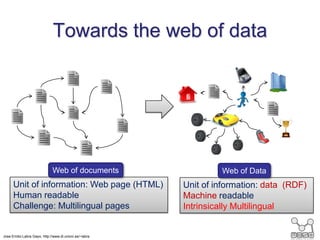
Towards the web of data


                              Web of documents                    Web of Data
      Unit of information: Web page (HTML)               Unit of information: data (RDF)
      Human readable                                     Machine readable
      Challenge: Multilingual pages                      Intrinsically Multilingual


Jose Emilio Labra Gayo, http://www.di.uniovi.es/~labra
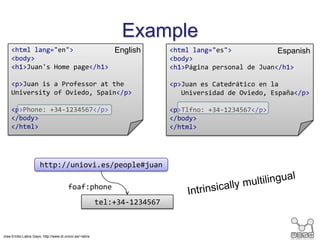
Example
     <html lang="en">          English                                     <html lang="es">            Espanish
     <body>                                                                <body>
     <h1>Juan's Home page</h1>                                             <h1>Página personal de Juan</h1>

     <p>Juan is a Professor at the                                         <p>Juan es Catedrático en la
     University of Oviedo, Spain</p>                                          Universidad de Oviedo, España</p>

     <p>Phone: +34-1234567</p>                                             <p>Tlfno: +34-1234567</p>
     </body>                                                               </body>
     </html>                                                               </html>


                      http://uniovi.es/people#juan

                                        foaf:phone
                                                         tel:+34-1234567


Jose Emilio Labra Gayo, http://www.di.uniovi.es/~labra
Multilingual data
          Data that appears in a multilingual context
                    It contains labels/comments
                    Human-readable information
                    Using different languages/conventions


Jose Emilio Labra Gayo, http://www.di.uniovi.es/~labra
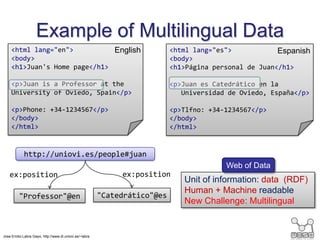
Example of Multilingual Data
     <html lang="en">          English                                      <html lang="es">            Espanish
     <body>                                                                 <body>
     <h1>Juan's Home page</h1>                                              <h1>Página personal de Juan</h1>

     <p>Juan is a Professor at the                                          <p>Juan es Catedrático en la
     University of Oviedo, Spain</p>                                           Universidad de Oviedo, España</p>

     <p>Phone: +34-1234567</p>                                              <p>Tlfno: +34-1234567</p>
     </body>                                                                </body>
     </html>                                                                </html>


            http://uniovi.es/people#juan
                                                                                          Web of Data
    ex:position                                               ex:position
                                                                               Unit of information: data (RDF)
                                                                               Human + Machine readable
         "Professor"@en                                  "Catedrático"@es
                                                                               New Challenge: Multilingual


Jose Emilio Labra Gayo, http://www.di.uniovi.es/~labra
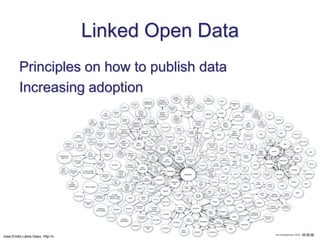
Linked Open Data
          Principles on how to publish data
          Increasing adoption


Jose Emilio Labra Gayo, http://www.di.uniovi.es/~labra
Best practices for LOD
          Several proposals:
                    Linked data book [Heath, Bizer, 2011]
                    Linked data patterns [Dodds, Davis, 2012]
                    Best Practices for Publishing Linked Data [Hyland et al]
                    SemWeb Rules of thumb [R. Cyganiak]
                    etc. . .
          In this talk
                    Best practices affected by multilinguality


Jose Emilio Labra Gayo, http://www.di.uniovi.es/~labra
Multilingual LOD practices
          1.         Design a good URI scheme
          2.         Model resources, not labels
          3.         Use human-readable info
          4.         Labels for all
          5.         Use Multilingual literals
          6.         Content negotiation
          7.         Literals without language
          8.         Multilingual vocabularies
Jose Emilio Labra Gayo, http://www.di.uniovi.es/~labra
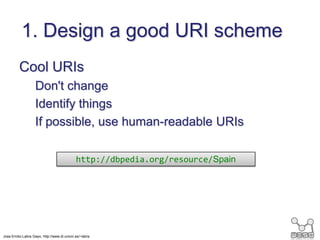
1. Design a good URI scheme
          Cool URIs
                    Don't change
                    Identify things
                    If possible, use human-readable URIs

                                             http://dbpedia.org/resource/Spain


Jose Emilio Labra Gayo, http://www.di.uniovi.es/~labra
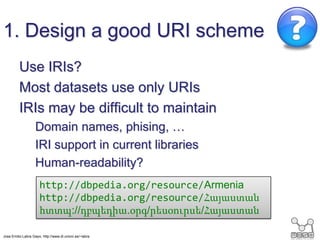
1. Design a good URI scheme
          Use IRIs?
          Most datasets use only URIs
          IRIs may be difficult to maintain
                    Domain names, phising, …
                    IRI support in current libraries
                    Human-readability?
                      http://dbpedia.org/resource/Armenia
                      http://dbpedia.org/resource/Հայաստան
                      հտտպ://դբպեդիա.օրգ/րեսօուրսե/Հայաստան

Jose Emilio Labra Gayo, http://www.di.uniovi.es/~labra
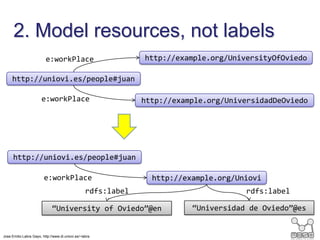
2. Model resources, not labels
          Define URIs only for resources
                  Resources do not depend on a given language
                  Assign labels to those resources
          Do not mint separate URIs for labels


Jose Emilio Labra Gayo, http://www.di.uniovi.es/~labra
2. Model resources, not labels
                          e:workPlace                           http://example.org/UniversityOfOviedo

     http://uniovi.es/people#juan

                       e:workPlace                              http://example.org/UniversidadDeOviedo


      http://uniovi.es/people#juan

                         e:workPlace                              http://example.org/Uniovi
                                                   rdfs:label                          rdfs:label

                              “University of Oviedo”@en                    “Universidad de Oviedo”@es


Jose Emilio Labra Gayo, http://www.di.uniovi.es/~labra
2. Model resources, not labels
          Some domains may require to model labels
                    Thesaurus
                    Assertions and relations between labels
                    Example: SKOS-XL labels
                              Resources of type sxosxl:Label
                              Labels are URI-identifiable


Jose Emilio Labra Gayo, http://www.di.uniovi.es/~labra
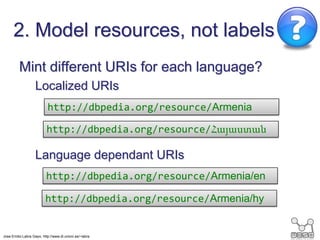
2. Model resources, not labels
          Mint different URIs for each language?
                    Localized URIs
                           http://dbpedia.org/resource/Armenia

                           http://dbpedia.org/resource/Հայաստան

                    Language dependant URIs
                          http://dbpedia.org/resource/Armenia/en

                          http://dbpedia.org/resource/Armenia/hy


Jose Emilio Labra Gayo, http://www.di.uniovi.es/~labra
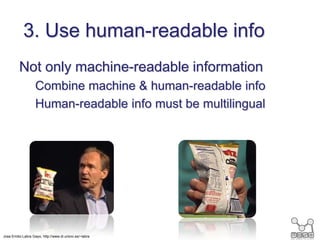
3. Use human-readable info
          Not only machine-readable information
                    Combine machine & human-readable info
                    Human-readable info must be multilingual


Jose Emilio Labra Gayo, http://www.di.uniovi.es/~labra
3. Use human-readable info
          Facilitates search over the web of data
          Linked data browsing
                    Applications can display labels instead of URIs
          Some common properties:
                    rdfs:label
                    skos:prefLabel
                    dcterms:title
                    dcterms:description
                    rdfs:comment
                    etc.


Jose Emilio Labra Gayo, http://www.di.uniovi.es/~labra
3. Use Human-readable info
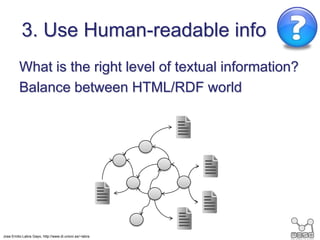
          What is the right level of textual information?
          Balance between HTML/RDF world


Jose Emilio Labra Gayo, http://www.di.uniovi.es/~labra
4. Labels for all
          Provide labels for all URIs
                    Individuals / Concepts / Properties
                    Not just the main entities
          Displaying labels becomes easier and faster
          Reduce number of requests


Jose Emilio Labra Gayo, http://www.di.uniovi.es/~labra
4. Labels for all
          It may be difficult to select the right label
                    Don't provide more than one preferred label
                    Not feasible for some datasets
                              Only 38% non-information resources have labels
                                                                                [B. Ell et al, 2011]

          Avoid camel case or similar notations

                 http://www.example.org#uniovi


                                                         rdfs:label   "UniversityOfOviedo"

Jose Emilio Labra Gayo, http://www.di.uniovi.es/~labra
5. Use Multilingual literals
          Use language tags
                    Select the right IETF language tag (RFC 5646)
          Example:
                 "University of Oviedo"@en
                 "Universidad de Oviedo"@es
                 "Universidá d'Uvieu"@ast
                 "Օվիեդոյի համալսարանում"@hy


Jose Emilio Labra Gayo, http://www.di.uniovi.es/~labra
5. Use Multilingual literals
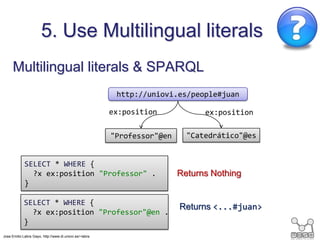
     Multilingual literals & SPARQL
                                                          http://uniovi.es/people#juan

                                                         ex:position            ex:position

                                                         "Professor"@en     "Catedrático"@es


             SELECT * WHERE {
               ?x ex:position "Professor" .                               Returns Nothing
             }

             SELECT * WHERE {
                                                                          Returns <...#juan>
               ?x ex:position "Professor"@en .
             }
Jose Emilio Labra Gayo, http://www.di.uniovi.es/~labra
5. Use Multilingual literals
     Underused feature
               4.78% non info-resources have one language tag
               Only 0.7% datasets contain several language tags

               Most commonly language used:
                          44.72% (en), 5.22% (de), 5.11% (fr), 3.96% (it),...
                                                                 [B.Ell et al, 2011]


Jose Emilio Labra Gayo, http://www.di.uniovi.es/~labra
5. Use Multilingual literals
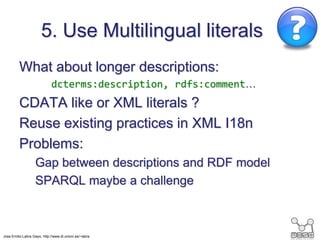
          What about longer descriptions:
                              dcterms:description, rdfs:comment…
          CDATA like or XML literals ?
          Reuse existing practices in XML I18n
          Problems:
                    Gap between descriptions and RDF model
                    SPARQL maybe a challenge


Jose Emilio Labra Gayo, http://www.di.uniovi.es/~labra
6. Content negotiation
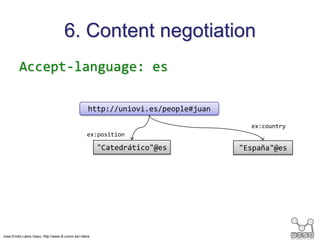
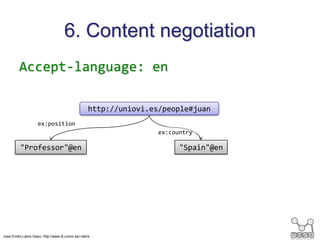
          Use HTTP Accept-Language
          Return different sets of labels
          Reduce load in client applications


Jose Emilio Labra Gayo, http://www.di.uniovi.es/~labra
6. Content negotiation
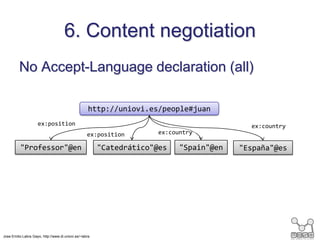
          No Accept-Language declaration (all)

                                                     http://uniovi.es/people#juan
                     ex:position                                                            ex:country
                                                    ex:position        ex:country

          "Professor"@en                                 "Catedrático"@es    "Spain"@en   "España"@es


Jose Emilio Labra Gayo, http://www.di.uniovi.es/~labra
6. Content negotiation
          Accept-language: es

                                                     http://uniovi.es/people#juan

                                                                                      ex:country
                                                    ex:position

                                                         "Catedrático"@es           "España"@es


Jose Emilio Labra Gayo, http://www.di.uniovi.es/~labra
6. Content negotiation
          Accept-language: en

                                                     http://uniovi.es/people#juan
                     ex:position
                                                                     ex:country

          "Professor"@en                                                   "Spain"@en


Jose Emilio Labra Gayo, http://www.di.uniovi.es/~labra
6. Content negotiation
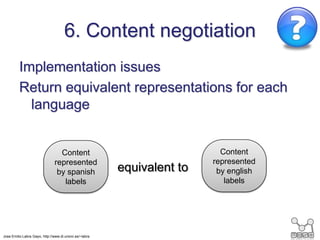
          Implementation issues
          Return equivalent representations for each
            language


                                  Content                                  Content
                                represented                              represented
                                 by spanish              equivalent to    by english
                                   labels                                   labels


Jose Emilio Labra Gayo, http://www.di.uniovi.es/~labra
7. Literals without language tag
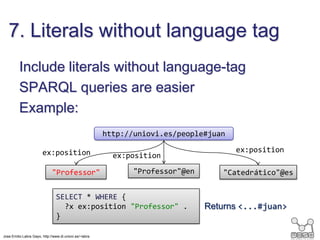
          Include literals without language-tag
          SPARQL queries are easier
          Example:
                                                         http://uniovi.es/people#juan

                        ex:position                                                     ex:position
                                                           ex:position

                              "Professor"                       "Professor"@en       "Catedrático"@es


                                 SELECT * WHERE {
                                   ?x ex:position "Professor" .                  Returns <...#juan>
                                 }

Jose Emilio Labra Gayo, http://www.di.uniovi.es/~labra
7. Literals without language tag
          Selecting a default language maybe
           controversial
          How to declare the primary language of a
           dataset?


Jose Emilio Labra Gayo, http://www.di.uniovi.es/~labra
8. Multilingual vocabularies
          Link to existing vocabularies
          Quality selection criteria for vocabularies
                    Vocabularies should contain descriptions in
                     more than one language
                                                         [Hyland et al, 2012]


Jose Emilio Labra Gayo, http://www.di.uniovi.es/~labra
8. Multilingual vocabularies
          What to do if they are not localized?
                  Enrich vocabularies with translated extensions?
                  Example:
                            dc:contributor rdfs:label "Colaborador"@es .


Jose Emilio Labra Gayo, http://www.di.uniovi.es/~labra
8. Multilingual vocabularies
          Beware of cross-lingual mappings
                  Example:

                                         Concept of                                           Concept of
                                         professor in                         ≠              professor in
                                        english culture                                     spanish culture


                             "Professor"@en                                                         "Profesor"@es


                     Possible solutions:
                               Ontology-lexicon, Lemon Model
                                                         [Gracia et al, 2011, Buitelaar et al, 2011, McCrae et al 2011]


Jose Emilio Labra Gayo, http://www.di.uniovi.es/~labra
Other issues not covered
          Unicode support in N-Triples
          Language declarations in Microdata
          Internationalization topics:
                    Text direction
                    Ruby annotations
                    Notes for localizers
                    Translation rules


Jose Emilio Labra Gayo, http://www.di.uniovi.es/~labra
Conclusions
          LOD adoption offers new challenges
          Web of data is not just for machines
          At the end, human users will employ LOD
            applications.
                    Human users speak different languages
          Challenge:
                    Best? practices for multilingual LOD


Jose Emilio Labra Gayo, http://www.di.uniovi.es/~labra
Acknowledgements
          Aidan Hogan
          Richard Cyganiak
          Basil Ell
          Jose María Álvarez Rodríguez
          Elena Montiel
          Jeni Tennison


Jose Emilio Labra Gayo, http://www.di.uniovi.es/~labra
References
          [Buitelaar et al, 2011] Ontology Lexicalisation: The lemon Perspective, 9th International
              Conference on Terminology and Artificial Intelligence, 2011
          [Cyganiak] SemWeb Rules of thumb
                    http://www.w3.org/wiki/User:Rcygania2/RulesOfThumb
          [Dodds, Davis, 2012] Linked data patterns
                    http://patterns.dataincubator.org/book/
          [Ell et al, 2011] Labels in the Web of Data, ISWC 2011
          [Gracia et al, 2011] Challenges for the Multilingual Web of Data, International Jounal on
               Semantic Web and Information Systems, 2011
          [Hogan et al, 2012] An empirical study of Linked Data Conformance, Journal of Web
               Semantics, to appear.
          [Heath, Bizer, 2011] Linked data: Evolving the Web into a Global Data Space
                    http://linkeddatabook.com/editions/1.0/
          [Hyland et al] Best Practices for Publishing Linked Data
                    https://dvcs.w3.org/hg/gld/raw-file/default/bp/index.html#internationalized-resource-identifiers
          [Hyland et al] Linked data cookbook. Open Government Linked Data
                    http://www.w3.org/2011/gld/wiki/Linked_Data_Cookbook
          [McCrae et al, 2011] Linking Lexical Resources and Ontologies on the
          Semantic Web with lemon, ESWC, 2011
Jose Emilio Labra Gayo, http://www.di.uniovi.es/~labra
End of presentation


                  http://purl.org/weso

Best Practices for Multilingual Linked Open Data

  • 1.
    Best Practices forMultilingual Linked Open Data Jose Emilio Labra Gayo University of Oviedo, Spain http://www.di.uniovi.es/~labra
  • 2.
    About me WESO Research Group (Web Semantics Oviedo, since 2004) Several projects involving Multilingual LOD Example: EU Public procurement notices (MOLDEAS) Catalog of product schema clasifications (1842053 triples) http://thedatahub.org/dataset/pscs-catalogue Common Procurement vocabulary (803311 triples) http://thedatahub.org/dataset/cpv-2008 23 EU languages Jose Emilio Labra Gayo, http://www.di.uniovi.es/~labra
  • 3.
    Towards the webof data Web of documents Web of Data Unit of information: Web page (HTML) Unit of information: data (RDF) Human readable Machine readable Challenge: Multilingual pages Intrinsically Multilingual Jose Emilio Labra Gayo, http://www.di.uniovi.es/~labra
  • 4.
    Example <html lang="en"> English <html lang="es"> Espanish <body> <body> <h1>Juan's Home page</h1> <h1>Página personal de Juan</h1> <p>Juan is a Professor at the <p>Juan es Catedrático en la University of Oviedo, Spain</p> Universidad de Oviedo, España</p> <p>Phone: +34-1234567</p> <p>Tlfno: +34-1234567</p> </body> </body> </html> </html> http://uniovi.es/people#juan foaf:phone tel:+34-1234567 Jose Emilio Labra Gayo, http://www.di.uniovi.es/~labra
  • 5.
    Multilingual data Data that appears in a multilingual context It contains labels/comments Human-readable information Using different languages/conventions Jose Emilio Labra Gayo, http://www.di.uniovi.es/~labra
  • 6.
    Example of MultilingualData <html lang="en"> English <html lang="es"> Espanish <body> <body> <h1>Juan's Home page</h1> <h1>Página personal de Juan</h1> <p>Juan is a Professor at the <p>Juan es Catedrático en la University of Oviedo, Spain</p> Universidad de Oviedo, España</p> <p>Phone: +34-1234567</p> <p>Tlfno: +34-1234567</p> </body> </body> </html> </html> http://uniovi.es/people#juan Web of Data ex:position ex:position Unit of information: data (RDF) Human + Machine readable "Professor"@en "Catedrático"@es New Challenge: Multilingual Jose Emilio Labra Gayo, http://www.di.uniovi.es/~labra
  • 7.
    Linked Open Data Principles on how to publish data Increasing adoption Jose Emilio Labra Gayo, http://www.di.uniovi.es/~labra
  • 8.
    Best practices forLOD Several proposals: Linked data book [Heath, Bizer, 2011] Linked data patterns [Dodds, Davis, 2012] Best Practices for Publishing Linked Data [Hyland et al] SemWeb Rules of thumb [R. Cyganiak] etc. . . In this talk Best practices affected by multilinguality Jose Emilio Labra Gayo, http://www.di.uniovi.es/~labra
  • 9.
    Multilingual LOD practices 1. Design a good URI scheme 2. Model resources, not labels 3. Use human-readable info 4. Labels for all 5. Use Multilingual literals 6. Content negotiation 7. Literals without language 8. Multilingual vocabularies Jose Emilio Labra Gayo, http://www.di.uniovi.es/~labra
  • 10.
    1. Design agood URI scheme Cool URIs Don't change Identify things If possible, use human-readable URIs http://dbpedia.org/resource/Spain Jose Emilio Labra Gayo, http://www.di.uniovi.es/~labra
  • 11.
    1. Design agood URI scheme Use IRIs? Most datasets use only URIs IRIs may be difficult to maintain Domain names, phising, … IRI support in current libraries Human-readability? http://dbpedia.org/resource/Armenia http://dbpedia.org/resource/Հայաստան հտտպ://դբպեդիա.օրգ/րեսօուրսե/Հայաստան Jose Emilio Labra Gayo, http://www.di.uniovi.es/~labra
  • 12.
    2. Model resources,not labels Define URIs only for resources Resources do not depend on a given language Assign labels to those resources Do not mint separate URIs for labels Jose Emilio Labra Gayo, http://www.di.uniovi.es/~labra
  • 13.
    2. Model resources,not labels e:workPlace http://example.org/UniversityOfOviedo http://uniovi.es/people#juan e:workPlace http://example.org/UniversidadDeOviedo http://uniovi.es/people#juan e:workPlace http://example.org/Uniovi rdfs:label rdfs:label “University of Oviedo”@en “Universidad de Oviedo”@es Jose Emilio Labra Gayo, http://www.di.uniovi.es/~labra
  • 14.
    2. Model resources,not labels Some domains may require to model labels Thesaurus Assertions and relations between labels Example: SKOS-XL labels Resources of type sxosxl:Label Labels are URI-identifiable Jose Emilio Labra Gayo, http://www.di.uniovi.es/~labra
  • 15.
    2. Model resources,not labels Mint different URIs for each language? Localized URIs http://dbpedia.org/resource/Armenia http://dbpedia.org/resource/Հայաստան Language dependant URIs http://dbpedia.org/resource/Armenia/en http://dbpedia.org/resource/Armenia/hy Jose Emilio Labra Gayo, http://www.di.uniovi.es/~labra
  • 16.
    3. Use human-readableinfo Not only machine-readable information Combine machine & human-readable info Human-readable info must be multilingual Jose Emilio Labra Gayo, http://www.di.uniovi.es/~labra
  • 17.
    3. Use human-readableinfo Facilitates search over the web of data Linked data browsing Applications can display labels instead of URIs Some common properties: rdfs:label skos:prefLabel dcterms:title dcterms:description rdfs:comment etc. Jose Emilio Labra Gayo, http://www.di.uniovi.es/~labra
  • 18.
    3. Use Human-readableinfo What is the right level of textual information? Balance between HTML/RDF world Jose Emilio Labra Gayo, http://www.di.uniovi.es/~labra
  • 19.
    4. Labels forall Provide labels for all URIs Individuals / Concepts / Properties Not just the main entities Displaying labels becomes easier and faster Reduce number of requests Jose Emilio Labra Gayo, http://www.di.uniovi.es/~labra
  • 20.
    4. Labels forall It may be difficult to select the right label Don't provide more than one preferred label Not feasible for some datasets Only 38% non-information resources have labels [B. Ell et al, 2011] Avoid camel case or similar notations http://www.example.org#uniovi rdfs:label "UniversityOfOviedo" Jose Emilio Labra Gayo, http://www.di.uniovi.es/~labra
  • 21.
    5. Use Multilingualliterals Use language tags Select the right IETF language tag (RFC 5646) Example: "University of Oviedo"@en "Universidad de Oviedo"@es "Universidá d'Uvieu"@ast "Օվիեդոյի համալսարանում"@hy Jose Emilio Labra Gayo, http://www.di.uniovi.es/~labra
  • 22.
    5. Use Multilingualliterals Multilingual literals & SPARQL http://uniovi.es/people#juan ex:position ex:position "Professor"@en "Catedrático"@es SELECT * WHERE { ?x ex:position "Professor" . Returns Nothing } SELECT * WHERE { Returns <...#juan> ?x ex:position "Professor"@en . } Jose Emilio Labra Gayo, http://www.di.uniovi.es/~labra
  • 23.
    5. Use Multilingualliterals Underused feature 4.78% non info-resources have one language tag Only 0.7% datasets contain several language tags Most commonly language used: 44.72% (en), 5.22% (de), 5.11% (fr), 3.96% (it),... [B.Ell et al, 2011] Jose Emilio Labra Gayo, http://www.di.uniovi.es/~labra
  • 24.
    5. Use Multilingualliterals What about longer descriptions: dcterms:description, rdfs:comment… CDATA like or XML literals ? Reuse existing practices in XML I18n Problems: Gap between descriptions and RDF model SPARQL maybe a challenge Jose Emilio Labra Gayo, http://www.di.uniovi.es/~labra
  • 25.
    6. Content negotiation Use HTTP Accept-Language Return different sets of labels Reduce load in client applications Jose Emilio Labra Gayo, http://www.di.uniovi.es/~labra
  • 26.
    6. Content negotiation No Accept-Language declaration (all) http://uniovi.es/people#juan ex:position ex:country ex:position ex:country "Professor"@en "Catedrático"@es "Spain"@en "España"@es Jose Emilio Labra Gayo, http://www.di.uniovi.es/~labra
  • 27.
    6. Content negotiation Accept-language: es http://uniovi.es/people#juan ex:country ex:position "Catedrático"@es "España"@es Jose Emilio Labra Gayo, http://www.di.uniovi.es/~labra
  • 28.
    6. Content negotiation Accept-language: en http://uniovi.es/people#juan ex:position ex:country "Professor"@en "Spain"@en Jose Emilio Labra Gayo, http://www.di.uniovi.es/~labra
  • 29.
    6. Content negotiation Implementation issues Return equivalent representations for each language Content Content represented represented by spanish equivalent to by english labels labels Jose Emilio Labra Gayo, http://www.di.uniovi.es/~labra
  • 30.
    7. Literals withoutlanguage tag Include literals without language-tag SPARQL queries are easier Example: http://uniovi.es/people#juan ex:position ex:position ex:position "Professor" "Professor"@en "Catedrático"@es SELECT * WHERE { ?x ex:position "Professor" . Returns <...#juan> } Jose Emilio Labra Gayo, http://www.di.uniovi.es/~labra
  • 31.
    7. Literals withoutlanguage tag Selecting a default language maybe controversial How to declare the primary language of a dataset? Jose Emilio Labra Gayo, http://www.di.uniovi.es/~labra
  • 32.
    8. Multilingual vocabularies Link to existing vocabularies Quality selection criteria for vocabularies Vocabularies should contain descriptions in more than one language [Hyland et al, 2012] Jose Emilio Labra Gayo, http://www.di.uniovi.es/~labra
  • 33.
    8. Multilingual vocabularies What to do if they are not localized? Enrich vocabularies with translated extensions? Example: dc:contributor rdfs:label "Colaborador"@es . Jose Emilio Labra Gayo, http://www.di.uniovi.es/~labra
  • 34.
    8. Multilingual vocabularies Beware of cross-lingual mappings Example: Concept of Concept of professor in ≠ professor in english culture spanish culture "Professor"@en "Profesor"@es Possible solutions: Ontology-lexicon, Lemon Model [Gracia et al, 2011, Buitelaar et al, 2011, McCrae et al 2011] Jose Emilio Labra Gayo, http://www.di.uniovi.es/~labra
  • 35.
    Other issues notcovered Unicode support in N-Triples Language declarations in Microdata Internationalization topics: Text direction Ruby annotations Notes for localizers Translation rules Jose Emilio Labra Gayo, http://www.di.uniovi.es/~labra
  • 36.
    Conclusions LOD adoption offers new challenges Web of data is not just for machines At the end, human users will employ LOD applications. Human users speak different languages Challenge: Best? practices for multilingual LOD Jose Emilio Labra Gayo, http://www.di.uniovi.es/~labra
  • 37.
    Acknowledgements Aidan Hogan Richard Cyganiak Basil Ell Jose María Álvarez Rodríguez Elena Montiel Jeni Tennison Jose Emilio Labra Gayo, http://www.di.uniovi.es/~labra
  • 38.
    References [Buitelaar et al, 2011] Ontology Lexicalisation: The lemon Perspective, 9th International Conference on Terminology and Artificial Intelligence, 2011 [Cyganiak] SemWeb Rules of thumb http://www.w3.org/wiki/User:Rcygania2/RulesOfThumb [Dodds, Davis, 2012] Linked data patterns http://patterns.dataincubator.org/book/ [Ell et al, 2011] Labels in the Web of Data, ISWC 2011 [Gracia et al, 2011] Challenges for the Multilingual Web of Data, International Jounal on Semantic Web and Information Systems, 2011 [Hogan et al, 2012] An empirical study of Linked Data Conformance, Journal of Web Semantics, to appear. [Heath, Bizer, 2011] Linked data: Evolving the Web into a Global Data Space http://linkeddatabook.com/editions/1.0/ [Hyland et al] Best Practices for Publishing Linked Data https://dvcs.w3.org/hg/gld/raw-file/default/bp/index.html#internationalized-resource-identifiers [Hyland et al] Linked data cookbook. Open Government Linked Data http://www.w3.org/2011/gld/wiki/Linked_Data_Cookbook [McCrae et al, 2011] Linking Lexical Resources and Ontologies on the Semantic Web with lemon, ESWC, 2011 Jose Emilio Labra Gayo, http://www.di.uniovi.es/~labra
  • 39.
    End of presentation http://purl.org/weso