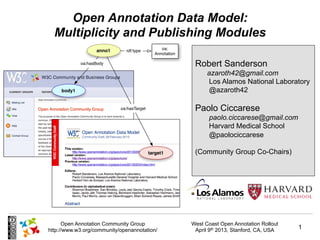
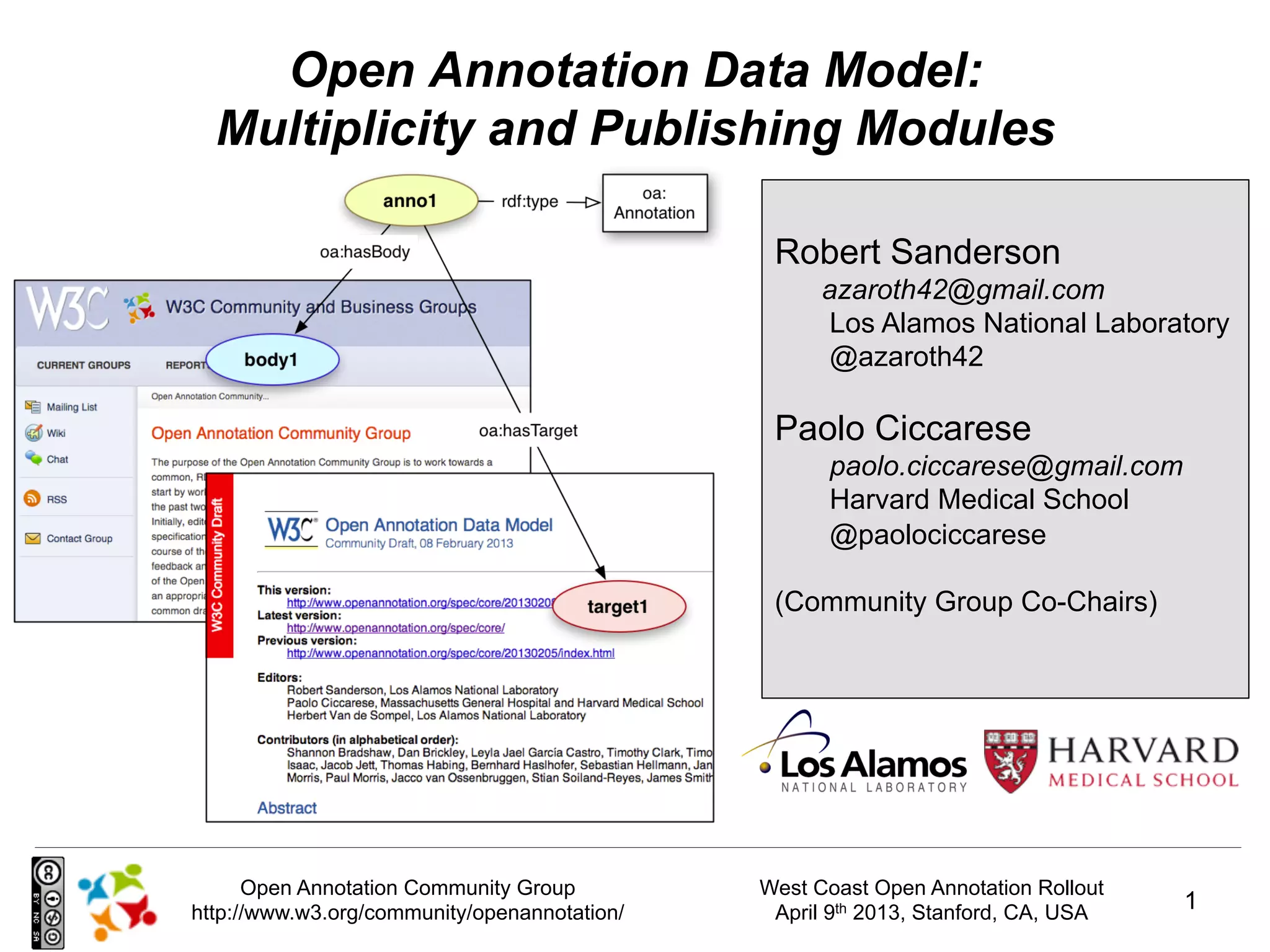
Open Annotation Data Model:
  Multiplicity and Publishing Modules

                                               Robert Sanderson
                                                    azaroth42@gmail.com
                                                    Los Alamos National Laboratory
                                                    @azaroth42

                                               Paolo Ciccarese
                                                    paolo.ciccarese@gmail.com
                                                    Harvard Medical School
                                                    @paolociccarese

                                               (Community Group Co-Chairs)


      Open Annotation Community Group         West Coast Open Annotation Rollout
http://www.w3.org/community/openannotation/    April 9th 2013, Stanford, CA, USA   1
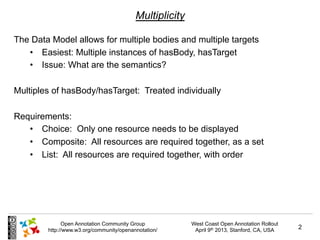
Multiplicity

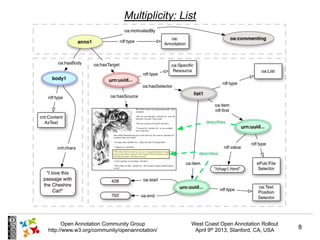
The Data Model allows for multiple bodies and multiple targets
   •  Easiest: Multiple instances of hasBody, hasTarget
   •  Issue: What are the semantics?

Multiples of hasBody/hasTarget: Treated individually

Requirements:
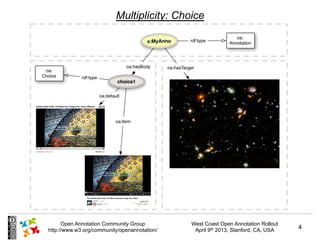
   •  Choice: Only one resource needs to be displayed
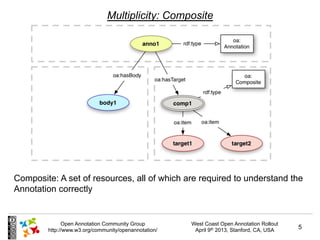
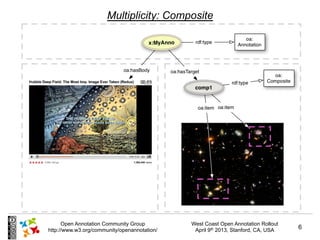
   •  Composite: All resources are required together, as a set
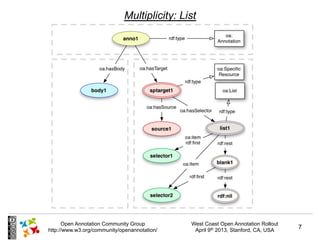
   •  List: All resources are required together, with order


              Open Annotation Community Group            West Coast Open Annotation Rollout
        http://www.w3.org/community/openannotation/       April 9th 2013, Stanford, CA, USA   2
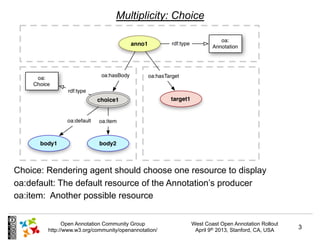
Multiplicity: Choice


Choice: Rendering agent should choose one resource to display
oa:default: The default resource of the Annotation’s producer
oa:item: Another possible resource


              Open Annotation Community Group         West Coast Open Annotation Rollout
        http://www.w3.org/community/openannotation/    April 9th 2013, Stanford, CA, USA   3
Multiplicity: Choice


      Open Annotation Community Group         West Coast Open Annotation Rollout
http://www.w3.org/community/openannotation/    April 9th 2013, Stanford, CA, USA   4
Multiplicity: Composite


Composite: A set of resources, all of which are required to understand the
Annotation correctly


              Open Annotation Community Group         West Coast Open Annotation Rollout
        http://www.w3.org/community/openannotation/    April 9th 2013, Stanford, CA, USA   5
Multiplicity: Composite


      Open Annotation Community Group         West Coast Open Annotation Rollout
http://www.w3.org/community/openannotation/    April 9th 2013, Stanford, CA, USA   6
Multiplicity: List


      Open Annotation Community Group         West Coast Open Annotation Rollout
http://www.w3.org/community/openannotation/    April 9th 2013, Stanford, CA, USA   7
Multiplicity: List


      Open Annotation Community Group         West Coast Open Annotation Rollout
http://www.w3.org/community/openannotation/    April 9th 2013, Stanford, CA, USA   8
Publishing Annotations

The Data Model is only a model, not a protocol:
   •  Does not specify interactions between client/server
   •  Does not limit additional descriptive features
   •  Does not specify annotation search, retrieval or management


Some aspects related to publishing are important:
   •  Serialization of the model
   •  Embedding resources
       •  Including other graphs
   •  Equivalence of resources


              Open Annotation Community Group         West Coast Open Annotation Rollout
        http://www.w3.org/community/openannotation/    April 9th 2013, Stanford, CA, USA   9
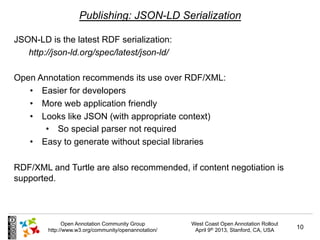
Publishing: JSON-LD Serialization

JSON-LD is the latest RDF serialization:
   http://json-ld.org/spec/latest/json-ld/

Open Annotation recommends its use over RDF/XML:
   •  Easier for developers
   •  More web application friendly
   •  Looks like JSON (with appropriate context)
       •  So special parser not required
   •  Easy to generate without special libraries

RDF/XML and Turtle are also recommended, if content negotiation is
supported.


               Open Annotation Community Group         West Coast Open Annotation Rollout
         http://www.w3.org/community/openannotation/    April 9th 2013, Stanford, CA, USA   10
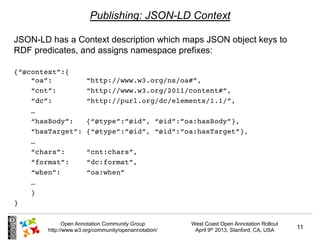
Publishing: JSON-LD Context

JSON-LD has a Context description which maps JSON object keys to
RDF predicates, and assigns namespace prefixes:

{“@context”:{
    “oa”:              “http://www.w3.org/ns/oa#”,
    “cnt”:             “http://www.w3.org/2011/content#”,
    “dc”:              “http://purl.org/dc/elements/1.1/”,
    …
    “hasBody”:         {“@type”:”@id”, “@id”:”oa:hasBody”},
    “hasTarget”:       {“@type”:”@id”, “@id”:”oa:hasTarget”},
    …
    “chars”:           “cnt:chars”,
    “format”:          “dc:format”,
    “when”:            “oa:when”
    …
    }
}

              Open Annotation Community Group         West Coast Open Annotation Rollout
        http://www.w3.org/community/openannotation/    April 9th 2013, Stanford, CA, USA   11
Publishing: JSON-LD Example

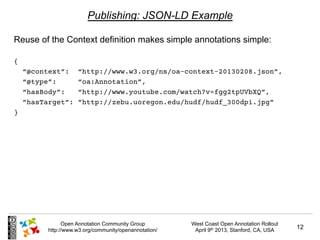
Reuse of the Context definition makes simple annotations simple:

{
  “@context”:      “http://www.w3.org/ns/oa-context-20130208.json”,
  “@type”:         “oa:Annotation”,
  “hasBody”:       “http://www.youtube.com/watch?v=fgg2tpUVbXQ”,
  ”hasTarget”:     ”http://zebu.uoregon.edu/hudf/hudf_300dpi.jpg”
}


              Open Annotation Community Group         West Coast Open Annotation Rollout
        http://www.w3.org/community/openannotation/    April 9th 2013, Stanford, CA, USA   12
Publishing: JSON-LD Example

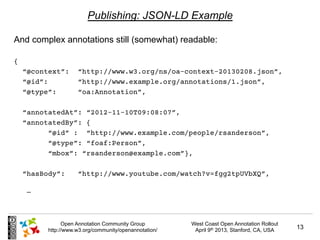
And complex annotations still (somewhat) readable:

{
  “@context”: “http://www.w3.org/ns/oa-context-20130208.json”,
  “@id”:       “http://www.example.org/annotations/1.json”,
  “@type”:     “oa:Annotation”,

  “annotatedAt”: “2012-11-10T09:08:07”,
  “annotatedBy”: {
        “@id” : “http://www.example.com/people/rsanderson”,
        “@type”: “foaf:Person”,
        “mbox”: “rsanderson@example.com”},

  “hasBody”:   “http://www.youtube.com/watch?v=fgg2tpUVbXQ”,

   …


              Open Annotation Community Group         West Coast Open Annotation Rollout
        http://www.w3.org/community/openannotation/    April 9th 2013, Stanford, CA, USA   13
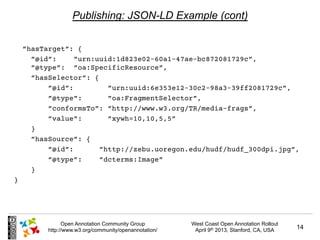
Publishing: JSON-LD Example (cont)


  ”hasTarget”: {
    ”@id”:    ”urn:uuid:1d823e02-60a1-47ae-bc872081729c”,
    ”@type”: ”oa:SpecificResource”,    
    ”hasSelector”: {
        ”@id”:        ”urn:uuid:6e353e12-30c2-98a3-39ff2081729c”,
        ”@type”:      ”oa:FragmentSelector”,
        ”conformsTo”: ”http://www.w3.org/TR/media-frags”,
        ”value”:      ”xywh=10,10,5,5”
    }    
    ”hasSource”: {
        ”@id”:      ”http://zebu.uoregon.edu/hudf/hudf_300dpi.jpg”,
        ”@type”:    ”dcterms:Image”
    }
}


              Open Annotation Community Group         West Coast Open Annotation Rollout
        http://www.w3.org/community/openannotation/    April 9th 2013, Stanford, CA, USA   14
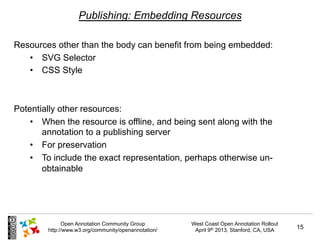
Publishing: Embedding Resources

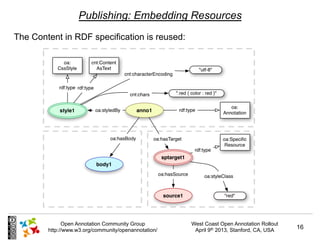
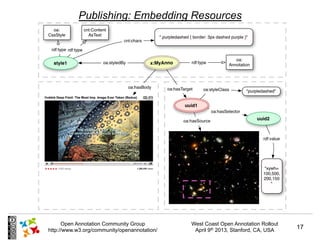
Resources other than the body can benefit from being embedded:
   •  SVG Selector
   •  CSS Style


Potentially other resources:
    •  When the resource is offline, and being sent along with the
       annotation to a publishing server
    •  For preservation
    •  To include the exact representation, perhaps otherwise un-
       obtainable


              Open Annotation Community Group         West Coast Open Annotation Rollout
        http://www.w3.org/community/openannotation/    April 9th 2013, Stanford, CA, USA   15
Publishing: Embedding Resources
The Content in RDF specification is reused:


              Open Annotation Community Group         West Coast Open Annotation Rollout
        http://www.w3.org/community/openannotation/    April 9th 2013, Stanford, CA, USA   16
Publishing: Embedding Resources


      Open Annotation Community Group         West Coast Open Annotation Rollout
http://www.w3.org/community/openannotation/    April 9th 2013, Stanford, CA, USA   17
Publishing: Embedding RDF Graphs
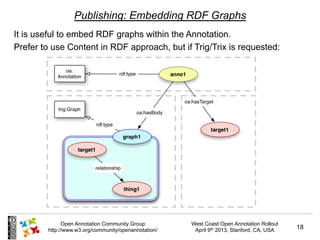
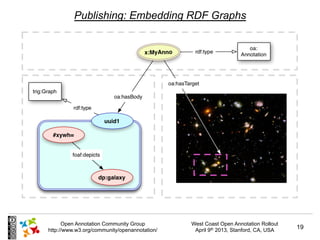
It is useful to embed RDF graphs within the Annotation.
Prefer to use Content in RDF approach, but if Trig/Trix is requested:


              Open Annotation Community Group         West Coast Open Annotation Rollout
        http://www.w3.org/community/openannotation/    April 9th 2013, Stanford, CA, USA   18
Publishing: Embedding RDF Graphs


      Open Annotation Community Group         West Coast Open Annotation Rollout
http://www.w3.org/community/openannotation/    April 9th 2013, Stanford, CA, USA   19
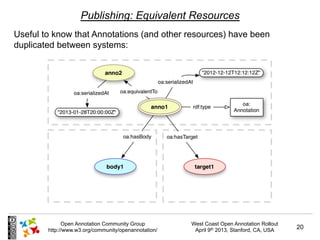
Publishing: Equivalent Resources
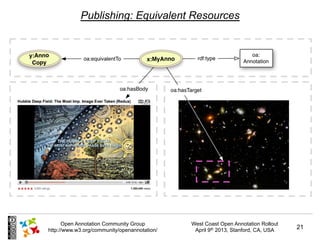
Useful to know that Annotations (and other resources) have been
duplicated between systems:


              Open Annotation Community Group         West Coast Open Annotation Rollout
        http://www.w3.org/community/openannotation/    April 9th 2013, Stanford, CA, USA   20
Publishing: Equivalent Resources


      Open Annotation Community Group         West Coast Open Annotation Rollout
http://www.w3.org/community/openannotation/    April 9th 2013, Stanford, CA, USA   21
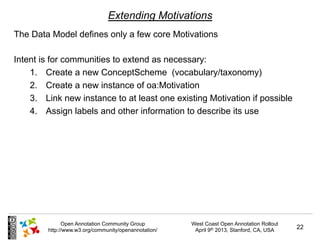
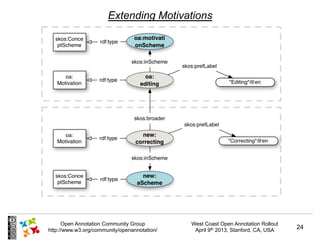
Extending Motivations
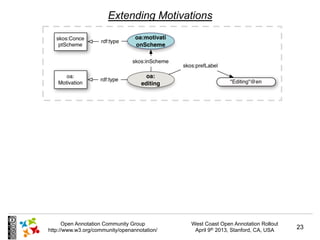
The Data Model defines only a few core Motivations

Intent is for communities to extend as necessary:
    1.  Create a new ConceptScheme (vocabulary/taxonomy)
    2.  Create a new instance of oa:Motivation
    3.  Link new instance to at least one existing Motivation if possible
    4.  Assign labels and other information to describe its use


              Open Annotation Community Group         West Coast Open Annotation Rollout
        http://www.w3.org/community/openannotation/    April 9th 2013, Stanford, CA, USA   22
Extending Motivations


      Open Annotation Community Group         West Coast Open Annotation Rollout
http://www.w3.org/community/openannotation/    April 9th 2013, Stanford, CA, USA   23
Extending Motivations


      Open Annotation Community Group         West Coast Open Annotation Rollout
http://www.w3.org/community/openannotation/    April 9th 2013, Stanford, CA, USA   24
Thank You


                                                      Robert Sanderson
                                                           azaroth42@gmail.com
                                                           Los Alamos National Laboratory
                                                           @azaroth42

                                                      Paolo Ciccarese
                                                           paolo.ciccarese@gmail.com
                                                           Harvard Medical School
                                                           @paolociccarese

                                                      (Community Group Co-Chairs)

http://www.flickr.com/photos/hinkeb/5232293964/


               http://www.w3.org/community/openannotation/
                       http://www.openannotation.org/

            Open Annotation Community Group           West Coast Open Annotation Rollout
      http://www.w3.org/community/openannotation/      April 9th 2013, Stanford, CA, USA   25

Multiplicity and Publishing in Open Annotation (tutorial)

  • 1.
    Open Annotation DataModel: Multiplicity and Publishing Modules Robert Sanderson azaroth42@gmail.com Los Alamos National Laboratory @azaroth42 Paolo Ciccarese paolo.ciccarese@gmail.com Harvard Medical School @paolociccarese (Community Group Co-Chairs) Open Annotation Community Group West Coast Open Annotation Rollout http://www.w3.org/community/openannotation/ April 9th 2013, Stanford, CA, USA 1
  • 2.
    Multiplicity The Data Modelallows for multiple bodies and multiple targets •  Easiest: Multiple instances of hasBody, hasTarget •  Issue: What are the semantics? Multiples of hasBody/hasTarget: Treated individually Requirements: •  Choice: Only one resource needs to be displayed •  Composite: All resources are required together, as a set •  List: All resources are required together, with order Open Annotation Community Group West Coast Open Annotation Rollout http://www.w3.org/community/openannotation/ April 9th 2013, Stanford, CA, USA 2
  • 3.
    Multiplicity: Choice Choice: Renderingagent should choose one resource to display oa:default: The default resource of the Annotation’s producer oa:item: Another possible resource Open Annotation Community Group West Coast Open Annotation Rollout http://www.w3.org/community/openannotation/ April 9th 2013, Stanford, CA, USA 3
  • 4.
    Multiplicity: Choice Open Annotation Community Group West Coast Open Annotation Rollout http://www.w3.org/community/openannotation/ April 9th 2013, Stanford, CA, USA 4
  • 5.
    Multiplicity: Composite Composite: Aset of resources, all of which are required to understand the Annotation correctly Open Annotation Community Group West Coast Open Annotation Rollout http://www.w3.org/community/openannotation/ April 9th 2013, Stanford, CA, USA 5
  • 6.
    Multiplicity: Composite Open Annotation Community Group West Coast Open Annotation Rollout http://www.w3.org/community/openannotation/ April 9th 2013, Stanford, CA, USA 6
  • 7.
    Multiplicity: List Open Annotation Community Group West Coast Open Annotation Rollout http://www.w3.org/community/openannotation/ April 9th 2013, Stanford, CA, USA 7
  • 8.
    Multiplicity: List Open Annotation Community Group West Coast Open Annotation Rollout http://www.w3.org/community/openannotation/ April 9th 2013, Stanford, CA, USA 8
  • 9.
    Publishing Annotations The DataModel is only a model, not a protocol: •  Does not specify interactions between client/server •  Does not limit additional descriptive features •  Does not specify annotation search, retrieval or management Some aspects related to publishing are important: •  Serialization of the model •  Embedding resources •  Including other graphs •  Equivalence of resources Open Annotation Community Group West Coast Open Annotation Rollout http://www.w3.org/community/openannotation/ April 9th 2013, Stanford, CA, USA 9
  • 10.
    Publishing: JSON-LD Serialization JSON-LDis the latest RDF serialization: http://json-ld.org/spec/latest/json-ld/ Open Annotation recommends its use over RDF/XML: •  Easier for developers •  More web application friendly •  Looks like JSON (with appropriate context) •  So special parser not required •  Easy to generate without special libraries RDF/XML and Turtle are also recommended, if content negotiation is supported. Open Annotation Community Group West Coast Open Annotation Rollout http://www.w3.org/community/openannotation/ April 9th 2013, Stanford, CA, USA 10
  • 11.
    Publishing: JSON-LD Context JSON-LDhas a Context description which maps JSON object keys to RDF predicates, and assigns namespace prefixes: {“@context”:{ “oa”: “http://www.w3.org/ns/oa#”, “cnt”: “http://www.w3.org/2011/content#”, “dc”: “http://purl.org/dc/elements/1.1/”, … “hasBody”: {“@type”:”@id”, “@id”:”oa:hasBody”}, “hasTarget”: {“@type”:”@id”, “@id”:”oa:hasTarget”}, … “chars”: “cnt:chars”, “format”: “dc:format”, “when”: “oa:when” … } } Open Annotation Community Group West Coast Open Annotation Rollout http://www.w3.org/community/openannotation/ April 9th 2013, Stanford, CA, USA 11
  • 12.
    Publishing: JSON-LD Example Reuseof the Context definition makes simple annotations simple: { “@context”: “http://www.w3.org/ns/oa-context-20130208.json”, “@type”: “oa:Annotation”, “hasBody”: “http://www.youtube.com/watch?v=fgg2tpUVbXQ”, ”hasTarget”: ”http://zebu.uoregon.edu/hudf/hudf_300dpi.jpg” } Open Annotation Community Group West Coast Open Annotation Rollout http://www.w3.org/community/openannotation/ April 9th 2013, Stanford, CA, USA 12
  • 13.
    Publishing: JSON-LD Example Andcomplex annotations still (somewhat) readable: { “@context”: “http://www.w3.org/ns/oa-context-20130208.json”, “@id”: “http://www.example.org/annotations/1.json”, “@type”: “oa:Annotation”, “annotatedAt”: “2012-11-10T09:08:07”, “annotatedBy”: { “@id” : “http://www.example.com/people/rsanderson”, “@type”: “foaf:Person”, “mbox”: “rsanderson@example.com”}, “hasBody”: “http://www.youtube.com/watch?v=fgg2tpUVbXQ”, … Open Annotation Community Group West Coast Open Annotation Rollout http://www.w3.org/community/openannotation/ April 9th 2013, Stanford, CA, USA 13
  • 14.
    Publishing: JSON-LD Example(cont) ”hasTarget”: { ”@id”: ”urn:uuid:1d823e02-60a1-47ae-bc872081729c”, ”@type”: ”oa:SpecificResource”, ”hasSelector”: { ”@id”: ”urn:uuid:6e353e12-30c2-98a3-39ff2081729c”, ”@type”: ”oa:FragmentSelector”, ”conformsTo”: ”http://www.w3.org/TR/media-frags”, ”value”: ”xywh=10,10,5,5” } ”hasSource”: { ”@id”: ”http://zebu.uoregon.edu/hudf/hudf_300dpi.jpg”, ”@type”: ”dcterms:Image” } } Open Annotation Community Group West Coast Open Annotation Rollout http://www.w3.org/community/openannotation/ April 9th 2013, Stanford, CA, USA 14
  • 15.
    Publishing: Embedding Resources Resourcesother than the body can benefit from being embedded: •  SVG Selector •  CSS Style Potentially other resources: •  When the resource is offline, and being sent along with the annotation to a publishing server •  For preservation •  To include the exact representation, perhaps otherwise un- obtainable Open Annotation Community Group West Coast Open Annotation Rollout http://www.w3.org/community/openannotation/ April 9th 2013, Stanford, CA, USA 15
  • 16.
    Publishing: Embedding Resources TheContent in RDF specification is reused: Open Annotation Community Group West Coast Open Annotation Rollout http://www.w3.org/community/openannotation/ April 9th 2013, Stanford, CA, USA 16
  • 17.
    Publishing: Embedding Resources Open Annotation Community Group West Coast Open Annotation Rollout http://www.w3.org/community/openannotation/ April 9th 2013, Stanford, CA, USA 17
  • 18.
    Publishing: Embedding RDFGraphs It is useful to embed RDF graphs within the Annotation. Prefer to use Content in RDF approach, but if Trig/Trix is requested: Open Annotation Community Group West Coast Open Annotation Rollout http://www.w3.org/community/openannotation/ April 9th 2013, Stanford, CA, USA 18
  • 19.
    Publishing: Embedding RDFGraphs Open Annotation Community Group West Coast Open Annotation Rollout http://www.w3.org/community/openannotation/ April 9th 2013, Stanford, CA, USA 19
  • 20.
    Publishing: Equivalent Resources Usefulto know that Annotations (and other resources) have been duplicated between systems: Open Annotation Community Group West Coast Open Annotation Rollout http://www.w3.org/community/openannotation/ April 9th 2013, Stanford, CA, USA 20
  • 21.
    Publishing: Equivalent Resources Open Annotation Community Group West Coast Open Annotation Rollout http://www.w3.org/community/openannotation/ April 9th 2013, Stanford, CA, USA 21
  • 22.
    Extending Motivations The DataModel defines only a few core Motivations Intent is for communities to extend as necessary: 1.  Create a new ConceptScheme (vocabulary/taxonomy) 2.  Create a new instance of oa:Motivation 3.  Link new instance to at least one existing Motivation if possible 4.  Assign labels and other information to describe its use Open Annotation Community Group West Coast Open Annotation Rollout http://www.w3.org/community/openannotation/ April 9th 2013, Stanford, CA, USA 22
  • 23.
    Extending Motivations Open Annotation Community Group West Coast Open Annotation Rollout http://www.w3.org/community/openannotation/ April 9th 2013, Stanford, CA, USA 23
  • 24.
    Extending Motivations Open Annotation Community Group West Coast Open Annotation Rollout http://www.w3.org/community/openannotation/ April 9th 2013, Stanford, CA, USA 24
  • 25.
    Thank You Robert Sanderson azaroth42@gmail.com Los Alamos National Laboratory @azaroth42 Paolo Ciccarese paolo.ciccarese@gmail.com Harvard Medical School @paolociccarese (Community Group Co-Chairs) http://www.flickr.com/photos/hinkeb/5232293964/ http://www.w3.org/community/openannotation/ http://www.openannotation.org/ Open Annotation Community Group West Coast Open Annotation Rollout http://www.w3.org/community/openannotation/ April 9th 2013, Stanford, CA, USA 25