Interoperability issues between learning 
            object repositories and metadata 
                        harvesters

    Ricard de la Vega1, Jordi Conesa2, Julià Minguillón2

    Centre de Supercomputació de Catalunya (CESCA)
    1


             2
              Universitat Oberta de Catalunya (UOC)

        Open Repositories, July 6th­9th 2010, Madrid, Spain


Table of contents
    Introduction
    UOC & OER (LO repository)
    CESCA & MDX (LO harvester)
    Interoperability issues
    Use of semantics for describing LOs
    Road map & future work
    Conclusions
    Some references 
                               

                                  Open Repositories 2010, 6­9 July, Madrid, Spain
Learning objects (LO)
    LOs are small pieces of content that are supposed to 
     help learners to acquire a specific learning goal

    LO (digital) = content + metadata

    Reuse, Redistribute, Revise, Remix

    Important issues: Granularity / size, Open format, 
      License


    LORs: Repositories are a way to organize LOs 
                               

                                 Open Repositories 2010, 6­9 July, Madrid, Spain
Table of contents
    Introduction
    UOC & OER (LO repository)
    CESCA & MDX (LO harvester)
    Interoperability issues
    Use of semantics for describing LOs
    Road map & future work
    Conclusions
    Some references 
                               

                                  Open Repositories 2010, 6­9 July, Madrid, Spain
UOC & OER
    UOC is an on­line distance university with more 
     than 40,000 students and 2,500 staff

    OER (http://oer.uoc.edu) is part of a large project 
     with the aim of promoting the development and 
     acquisition of competences though the use of 
     LORs

    OER is always beta, to test on research and  
     innovation (currently now, about Statistics)
                              

                                 Open Repositories 2010, 6­9 July, Madrid, Spain
LOR goals
    Repositories main goals:
    Ensure preservation
    Promote reutilization

    Dissemination / positioning

    And a LOR should become an...
    Active element of the learning process, so students using 
     LORs should achieve a set of competences


                                      Open Repositories 2010, 6­9 July, Madrid, Spain
OER content

Exercises                     PDF, QTI, …
Examples                      PDF, PPT, ODP, …
Graphics                      JPEG, PNG, ...
Simulations                   Applets, Flash
Data                          XLS, SPSS, …
Equations                     LaTeX, MathML, …
Tables                        PDF, XLS, …

  Searching and browsing actions are designed 
 
  from a teaching perspective (not librarian)
                           

                         Open Repositories 2010, 6­9 July, Madrid, Spain
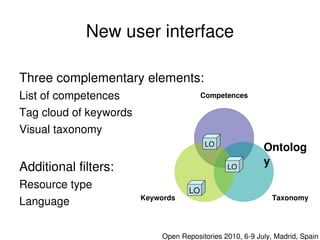
New user interface

Three complementary elements:
List of competences                      Competences

Tag cloud of keywords
Visual taxonomy
                                          LO
                                                          Ontolog
                                                          y
Additional filters:                            LO

Resource type                       LO
                        Keywords                             Taxonomy
Language

                            Open Repositories 2010, 6­9 July, Madrid, Spain
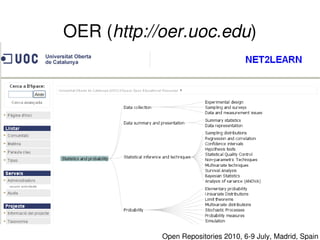
OER (http://oer.uoc.edu)


                   Open Repositories 2010, 6­9 July, Madrid, Spain
Table of contents
    Introduction
    UOC & OER (LO repository)
    CESCA & MDX (LO harvester)
    Interoperability issues
    Use of semantics for describing LOs
    Road map & future work
    Conclusions
    Some references 
                               

                                  Open Repositories 2010, 6­9 July, Madrid, Spain
CESCA
    CESCA is a public consortium which is integrated by the 
     Generalitat de Catalunya, Talència, nine Catalan 
     universities, and CSIC
    The objective is to manage e­infrastructures, in order to 
      provide support to universities and research, based on 
      five activity areas: communications networks; portals 
      and repositories for university information; HPC 
      and data­storage systems, promotion of the use and 
      benefits of these technologies, and operation and 
      maintenance of the entire Centre infrastructure


                                    Open Repositories 2010, 6­9 July, Madrid, Spain
CESCA & MDX
    Dissertations (2000, migrating to DSpace)
    Research documents (2005, DSpace)
    Scientific, cultural and academic journals 
     (2006, OJS) 
    Catalan digital heritage (2006, Heritrix...)
    Spanish scientific and technological journals 
     (2008, OJS)
    LOs (2009, DSpace)
    Documents of cultural interest (2010, DSpace)
    ...with/for CBUC, BC, FECYT, Catalonia Government
                         

                       Open Repositories 2010, 6­9 July, Madrid, Spain
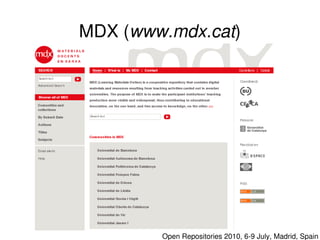
MDX (www.mdx.cat)


                Open Repositories 2010, 6­9 July, Madrid, Spain
MDX’s participant institutions
    2 ways: deposit or harvest LOs

    Now, 10 CBUC universities (about 1.400 LOs)
     UB, UAB, UPC, UPF, UdG, UdL, URV, UOC, Uvic, UJI

    UOC open repositories:
    O2: institutional (included)
    OCW: institutional (included)
    OER: thematic (not included, yet)
                                    

                                       Open Repositories 2010, 6­9 July, Madrid, Spain
Table of contents
    Introduction
    UOC & OER (LO repository)
    CESCA & MDX (LO harvester)
    Interoperability issues
    Use of semantics for describing LOs
    Road map & future work
    Conclusions
    Some references 
                               

                                  Open Repositories 2010, 6­9 July, Madrid, Spain
Visibility & OAI­PMH harvesters
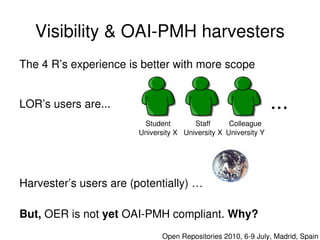
    The 4 R’s experience is better with more scope


    LOR’s users are...                                                ...
                             Student        Staff      Colleague
                            University X University X University Y


    Harvester’s users are (potentially) …

    But, OER is not yet OAI­PMH compliant. Why? 
                                   

                                      Open Repositories 2010, 6­9 July, Madrid, Spain
Traditional & OERs perspective
Traditional perspective is library centered:
  Books, journals, works, … (mostly textual)
  Everything has a unique title, one or more authors
  Everything has a creation date, a source
   Almost everything is a PDF file   u


Main goal: easily finding a resource by using a minimum 
set of common descriptors

LO... What’s the title or the author of an exercise?
Options: hidden metadata, semantics, ...
                              Open Repositories 2010, 6­9 July, Madrid, Spain
Semantic description of LOs
    Incomplete metadata records (only keywords and 
      taxonomies)
    Ontologies provide additional metadata (computed, 
     inherited, ...)


    i.e. For exams, the ontology says that “title” is not 
       mandatory and “date” means the date when the 
       exam was done (not the document creation)

    title = “Exam” + Degree + Subject + Semester
                                   

                                      Open Repositories 2010, 6­9 July, Madrid, Spain
Semantic description of LOs
    Ontology + rules provide:


    An OAI­DC compliant metadata for any record by 
     refactoring process


    An extended schema with all the metadata 
     available through the ListMetadataFormats of 
     an OAI service
                             

                                Open Repositories 2010, 6­9 July, Madrid, Spain
Pros & Cons
    But... for providing an OAI­DCnq, is it necessary 
     to fully implement the ontology?  Performance 
     issues! Maybe a crosswalk is enough...


    But, but there are more opportunities to exploit  
     the ontology:
    Ex. Useful information for filling the submit forms
    Items related or “similar” for a given LO
    Rules that say that, i.e., a text item has no “duration”
                                       

                                          Open Repositories 2010, 6­9 July, Madrid, Spain
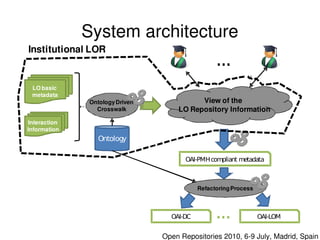
System architecture
    Institutional LOR
                                                           ...
     LO basic 
     metadata
                   Ontology Driven                  View of the 
                     Crosswalk                LO Repository Information
    Interaction 
    Information
                      Ontology

                                                 OAI-PMH compliant metadata


                                                     Refactoring Process


                                            OAI-DC         ...             OAI-LOM


                                          Open Repositories 2010, 6­9 July, Madrid, Spain
Table of contents
    Introduction
    UOC & OER (LO repository )
    CESCA & MDX (LO harvester)
    Interoperability issues
    Use of semantics for describing LOs
    Road map & future work
    Conclusions
    Some references 
                               

                                  Open Repositories 2010, 6­9 July, Madrid, Spain
Road map & future work
    Now, we are implementing a pilot project with:
    LO’s ontology with rules:
      To generate DCnq metadata for OAI­PMH servers
      To help with related information in the submit forms

    Add­on to use with with DSpace based on the 
     Koutsomitropoulos semantic search code

    More possible applications through the use of upper 
     ontologies
                                 

                                    Open Repositories 2010, 6­9 July, Madrid, Spain
Conclusions
    LOR's to preserve, reuse, disseminate... and learn

    Reuse, Redistribute, Revise, Remix but first... find it

    OAI­PMH harvesters increase LOR visibility

    Semantics is a way to generate DCnq from a LOR and... 
     much more

    We are at the beginning, there are a lot of potential 
     outputs to explore 
                                  

                                     Open Repositories 2010, 6­9 July, Madrid, Spain
References and bibliography
    Antoniou, G., Harmelen, F. V. (2004) "A Semantic Web Primer". Massachussets Institute of Technology Press.

    Córcoles, C., Minguillón, J. and Lamb, B. (2009) “Building an open social learning community around a Dspace repository on 
        Statistics”, In: Proceedings of the 4th International Conference on Open Repositories (posters), Online Version, 
        http://hdl.handle.net/1853/28480

    Currier, S. (2008), “Metadata for learning resources: an update on standards activity for 2008”, ARIADNE, Vol. 55. Online Version, 
         http://www.ariadne.ac.uk/issue55/currier

    Ferran, N., Guerrero­Roldán, A., Mor, E., and Minguillón, J. (2009) “User Centered Design of a Learning Object Repository”, In: 
         Proceedings of the 1st international Conference on Human Centered Design: Held As Part of HCI international 2009 (San 
         Diego, CA, July 19 ­ 24, 2009). M. Kurosu, Ed. Lecture Notes in Computer Science, vol. 5619, pp. 679­688.

    Huguet, M., Anglada­i­de­Ferrer, Lluís M. and de­la­Vega, R. (2007) "Catalan Policies and Experiences on Cooperative 
        Repositories", In: 1st Iberian Grid Infrastructure Conference Proceedings (IBERGRID). Santiago de Compostela, Spain. May 
        14­16, 2007. p. 63­75. Online Version, http://hdl.handle.net/2072/4083.

    Kim, H.­L., Decker, S. and Breslin J. G. (2010) “Representing and sharing folksonomies with semantics”, Journal of Information 
        Science, 36 (1), pp. 57–72.

    Koutsomitropoulos, D., Solomou, G., Papatheodorou, T. (2009) "Metadata and Semantics in Digital Object Collections: A Case­
        Study on CIDOC­CRM and Dublin Core and a Prototype Implementation", Journal of Digital Information, North America, 10, 
        dec. 2009. Online version, http://journals.tdl.org/jodi/article/view/693.

    Sicilia, M.A. and García­Barriocanal, E. (2005) “On the Convergence of Formal Ontologies and standardized e­Learning”, Journal of 
          Distance Education Technologies, 3(2), pp. 12­28.

    Wiley, David A. (2000), "Connecting Learning Objects to Instructional Design Theory: A Definition, A Metaphor, and A Taxonomy", in 
        Wiley, David A. (DOC), The Instructional Use of Learning Objects. Online Version, http://reusability.org/read/chapters/wiley.doc
                                                                      

                                                                         Open Repositories 2010, 6­9 July, Madrid, Spain
Thanks for your attention! 
Contact information:


        Ricard de la Vega  rdelavega@cesca.cat

          Jordi Conesa                jconesac@uoc.edu

           Julià Minguillón jminguillona@uoc.edu


                                           CC-BY-NC-SA
                          

                             Open Repositories 2010, 6­9 July, Madrid, Spain

Interoperability issues between learning object repositories and metadata harvesters

  • 1.
    Interoperability issues between learning  object repositories and metadata  harvesters Ricard de la Vega1, Jordi Conesa2, Julià Minguillón2 Centre de Supercomputació de Catalunya (CESCA) 1 2 Universitat Oberta de Catalunya (UOC) Open Repositories, July 6th­9th 2010, Madrid, Spain    
  • 2.
    Table of contents Introduction UOC & OER (LO repository) CESCA & MDX (LO harvester) Interoperability issues Use of semantics for describing LOs Road map & future work Conclusions Some references      Open Repositories 2010, 6­9 July, Madrid, Spain
  • 3.
    Learning objects (LO) LOs are small pieces of content that are supposed to  help learners to acquire a specific learning goal LO (digital) = content + metadata Reuse, Redistribute, Revise, Remix Important issues: Granularity / size, Open format,  License   LORs: Repositories are a way to organize LOs    Open Repositories 2010, 6­9 July, Madrid, Spain
  • 4.
    Table of contents Introduction UOC & OER (LO repository) CESCA & MDX (LO harvester) Interoperability issues Use of semantics for describing LOs Road map & future work Conclusions Some references      Open Repositories 2010, 6­9 July, Madrid, Spain
  • 5.
    UOC & OER UOC is an on­line distance university with more  than 40,000 students and 2,500 staff OER (http://oer.uoc.edu) is part of a large project  with the aim of promoting the development and  acquisition of competences though the use of  LORs OER is always beta, to test on research and   innovation (currently now, about Statistics)     Open Repositories 2010, 6­9 July, Madrid, Spain
  • 6.
    LOR goals Repositories main goals: Ensure preservation Promote reutilization Dissemination / positioning And a LOR should become an... Active element of the learning process, so students using  LORs should achieve a set of competences     Open Repositories 2010, 6­9 July, Madrid, Spain
  • 7.
    OER content Exercises PDF, QTI, … Examples PDF, PPT, ODP, … Graphics JPEG, PNG, ... Simulations Applets, Flash Data XLS, SPSS, … Equations LaTeX, MathML, … Tables PDF, XLS, … Searching and browsing actions are designed    from a teaching perspective (not librarian)   Open Repositories 2010, 6­9 July, Madrid, Spain
  • 8.
    New user interface Three complementary elements: List of competences Competences Tag cloud of keywords Visual taxonomy LO Ontolog y Additional filters: LO Resource type LO Keywords Taxonomy Language Open Repositories 2010, 6­9 July, Madrid, Spain
  • 9.
    OER (http://oer.uoc.edu)     Open Repositories 2010, 6­9 July, Madrid, Spain
  • 10.
    Table of contents Introduction UOC & OER (LO repository) CESCA & MDX (LO harvester) Interoperability issues Use of semantics for describing LOs Road map & future work Conclusions Some references      Open Repositories 2010, 6­9 July, Madrid, Spain
  • 11.
    CESCA CESCA is a public consortium which is integrated by the  Generalitat de Catalunya, Talència, nine Catalan  universities, and CSIC The objective is to manage e­infrastructures, in order to  provide support to universities and research, based on  five activity areas: communications networks; portals  and repositories for university information; HPC  and data­storage systems, promotion of the use and  benefits of these technologies, and operation and  maintenance of the entire Centre infrastructure     Open Repositories 2010, 6­9 July, Madrid, Spain
  • 12.
    CESCA & MDX Dissertations (2000, migrating to DSpace) Research documents (2005, DSpace) Scientific, cultural and academic journals  (2006, OJS)  Catalan digital heritage (2006, Heritrix...) Spanish scientific and technological journals  (2008, OJS) LOs (2009, DSpace) Documents of cultural interest (2010, DSpace)   ...with/for CBUC, BC, FECYT, Catalonia Government   Open Repositories 2010, 6­9 July, Madrid, Spain
  • 13.
    MDX (www.mdx.cat)     Open Repositories 2010, 6­9 July, Madrid, Spain
  • 14.
    MDX’s participant institutions 2 ways: deposit or harvest LOs Now, 10 CBUC universities (about 1.400 LOs) UB, UAB, UPC, UPF, UdG, UdL, URV, UOC, Uvic, UJI UOC open repositories: O2: institutional (included) OCW: institutional (included) OER: thematic (not included, yet)     Open Repositories 2010, 6­9 July, Madrid, Spain
  • 15.
    Table of contents Introduction UOC & OER (LO repository) CESCA & MDX (LO harvester) Interoperability issues Use of semantics for describing LOs Road map & future work Conclusions Some references      Open Repositories 2010, 6­9 July, Madrid, Spain
  • 16.
    Visibility & OAI­PMH harvesters The 4 R’s experience is better with more scope LOR’s users are... ... Student Staff Colleague University X University X University Y Harvester’s users are (potentially) … But, OER is not yet OAI­PMH compliant. Why?      Open Repositories 2010, 6­9 July, Madrid, Spain
  • 17.
    Traditional & OERs perspective Traditional perspective is library centered:   Books, journals, works, … (mostly textual)   Everything has a unique title, one or more authors   Everything has a creation date, a source   Almost everything is a PDF file u Main goal: easily finding a resource by using a minimum  set of common descriptors LO... What’s the title or the author of an exercise? Options: hidden metadata, semantics, ... Open Repositories 2010, 6­9 July, Madrid, Spain
  • 18.
    Semantic description of LOs Incomplete metadata records (only keywords and  taxonomies) Ontologies provide additional metadata (computed,  inherited, ...) i.e. For exams, the ontology says that “title” is not  mandatory and “date” means the date when the  exam was done (not the document creation) title = “Exam” + Degree + Subject + Semester     Open Repositories 2010, 6­9 July, Madrid, Spain
  • 19.
    Semantic description of LOs Ontology + rules provide: An OAI­DC compliant metadata for any record by  refactoring process An extended schema with all the metadata  available through the ListMetadataFormats of  an OAI service     Open Repositories 2010, 6­9 July, Madrid, Spain
  • 20.
    Pros & Cons But... for providing an OAI­DCnq, is it necessary  to fully implement the ontology?  Performance  issues! Maybe a crosswalk is enough... But, but there are more opportunities to exploit   the ontology: Ex. Useful information for filling the submit forms Items related or “similar” for a given LO Rules that say that, i.e., a text item has no “duration”     Open Repositories 2010, 6­9 July, Madrid, Spain
  • 21.
    System architecture Institutional LOR ... LO basic  metadata Ontology Driven  View of the  Crosswalk LO Repository Information Interaction  Information Ontology OAI-PMH compliant metadata Refactoring Process     OAI-DC ... OAI-LOM Open Repositories 2010, 6­9 July, Madrid, Spain
  • 22.
    Table of contents Introduction UOC & OER (LO repository ) CESCA & MDX (LO harvester) Interoperability issues Use of semantics for describing LOs Road map & future work Conclusions Some references      Open Repositories 2010, 6­9 July, Madrid, Spain
  • 23.
    Road map & future work Now, we are implementing a pilot project with: LO’s ontology with rules: To generate DCnq metadata for OAI­PMH servers To help with related information in the submit forms Add­on to use with with DSpace based on the  Koutsomitropoulos semantic search code More possible applications through the use of upper  ontologies     Open Repositories 2010, 6­9 July, Madrid, Spain
  • 24.
    Conclusions LOR's to preserve, reuse, disseminate... and learn Reuse, Redistribute, Revise, Remix but first... find it OAI­PMH harvesters increase LOR visibility Semantics is a way to generate DCnq from a LOR and...  much more We are at the beginning, there are a lot of potential  outputs to explore      Open Repositories 2010, 6­9 July, Madrid, Spain
  • 25.
    References and bibliography Antoniou, G., Harmelen, F. V. (2004) "A Semantic Web Primer". Massachussets Institute of Technology Press. Córcoles, C., Minguillón, J. and Lamb, B. (2009) “Building an open social learning community around a Dspace repository on  Statistics”, In: Proceedings of the 4th International Conference on Open Repositories (posters), Online Version,  http://hdl.handle.net/1853/28480 Currier, S. (2008), “Metadata for learning resources: an update on standards activity for 2008”, ARIADNE, Vol. 55. Online Version,  http://www.ariadne.ac.uk/issue55/currier Ferran, N., Guerrero­Roldán, A., Mor, E., and Minguillón, J. (2009) “User Centered Design of a Learning Object Repository”, In:  Proceedings of the 1st international Conference on Human Centered Design: Held As Part of HCI international 2009 (San  Diego, CA, July 19 ­ 24, 2009). M. Kurosu, Ed. Lecture Notes in Computer Science, vol. 5619, pp. 679­688. Huguet, M., Anglada­i­de­Ferrer, Lluís M. and de­la­Vega, R. (2007) "Catalan Policies and Experiences on Cooperative  Repositories", In: 1st Iberian Grid Infrastructure Conference Proceedings (IBERGRID). Santiago de Compostela, Spain. May  14­16, 2007. p. 63­75. Online Version, http://hdl.handle.net/2072/4083. Kim, H.­L., Decker, S. and Breslin J. G. (2010) “Representing and sharing folksonomies with semantics”, Journal of Information  Science, 36 (1), pp. 57–72. Koutsomitropoulos, D., Solomou, G., Papatheodorou, T. (2009) "Metadata and Semantics in Digital Object Collections: A Case­ Study on CIDOC­CRM and Dublin Core and a Prototype Implementation", Journal of Digital Information, North America, 10,  dec. 2009. Online version, http://journals.tdl.org/jodi/article/view/693. Sicilia, M.A. and García­Barriocanal, E. (2005) “On the Convergence of Formal Ontologies and standardized e­Learning”, Journal of  Distance Education Technologies, 3(2), pp. 12­28. Wiley, David A. (2000), "Connecting Learning Objects to Instructional Design Theory: A Definition, A Metaphor, and A Taxonomy", in  Wiley, David A. (DOC), The Instructional Use of Learning Objects. Online Version, http://reusability.org/read/chapters/wiley.doc     Open Repositories 2010, 6­9 July, Madrid, Spain
  • 26.
    Thanks for your attention!  Contact information: Ricard de la Vega  rdelavega@cesca.cat Jordi Conesa  jconesac@uoc.edu Julià Minguillón jminguillona@uoc.edu CC-BY-NC-SA     Open Repositories 2010, 6­9 July, Madrid, Spain