

Source Selection 101Susan Smith21CONSCol Tom Walker AFSPC/CX
PurposeInsight in how and why the RFP is developedInsight on how the Gov’t evaluates proposals“Demystify” the source selection process:Encourage more participation, especially small businessesImprove offeror’s potential for awardsObjective is for the Gov’t to get better proposals
TopicsRFP Development ProcessEvaluation Factors/SubfactorsOverall AssessmentSummary
RFP DevelopmentProcess
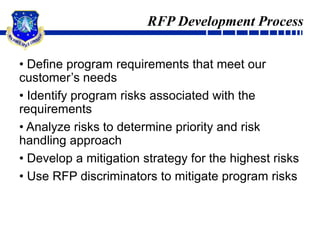
RFP Development ProcessDefine program requirements that meet our customer’s needs
 Identify program risks associated with the requirements
 Analyze risks to determine priority and risk handling approach
 Develop a mitigation strategy for the highest risks
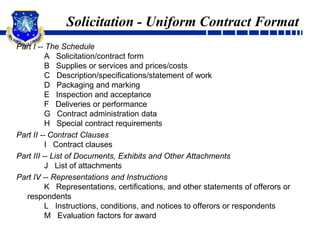
 Use RFP discriminators to mitigate program risksSolicitation - Uniform Contract FormatPart I -- The Schedule	A   Solicitation/contract form	B   Supplies or services and prices/costs	C   Description/specifications/statement of work	D   Packaging and marking	E   Inspection and acceptance	F   Deliveries or performance	G   Contract administration data	H   Special contract requirementsPart II -- Contract Clauses	I   Contract clausesPart III -- List of Documents, Exhibits and Other Attachments	J   List of attachmentsPart IV -- Representations and Instructions	K   Representations, certifications, and other statements of offerors or respondents	L   Instructions, conditions, and notices to offerors or respondents	M   Evaluation factors for award
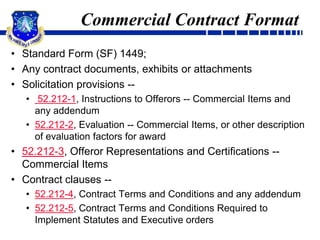
Commercial Contract FormatStandard Form (SF) 1449;Any contract documents, exhibits or attachmentsSolicitation provisions -- 52.212-1, Instructions to Offerors -- Commercial Items and any addendum 52.212-2, Evaluation -- Commercial Items, or other description of evaluation factors for award52.212-3, Offeror Representations and Certifications -- Commercial ItemsContract clauses --52.212-4, Contract Terms and Conditions and any addendum52.212-5, Contract Terms and Conditions Required to Implement Statutes and Executive orders
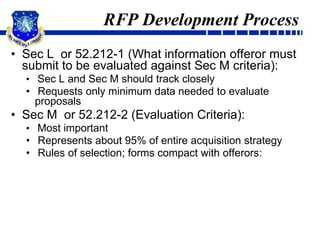
RFP Development ProcessSec L  or 52.212-1 (What information offeror must submit to be evaluated against Sec M criteria):Sec L and Sec M should track closely Requests only minimum data needed to evaluate proposalsSec M  or 52.212-2 (Evaluation Criteria):Most important Represents about 95% of entire acquisition strategy Rules of selection; forms compact with offerors:
Evaluation Factors &Subfactors
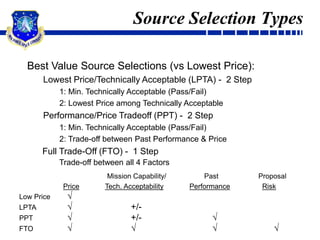
Source Selection TypesBest Value Source Selections (vs Lowest Price):
Lowest Price/Technically Acceptable (LPTA) -  2 Step
 1: Min. Technically Acceptable (Pass/Fail)
 2: Lowest Price among Technically Acceptable
Performance/Price Tradeoff (PPT) -  2 Step
 1: Min. Technically Acceptable (Pass/Fail)
 2: Trade-off between Past Performance & Price   Full Trade-Off (FTO) -  1 Step Trade-off between all 4 Factors      	    Mission Capability/                   Past                    ProposalPriceTech. AcceptabilityPerformanceRiskLow Price	LPTA		             +/-PPT			             +/- 		       	FTO            		             	      	             
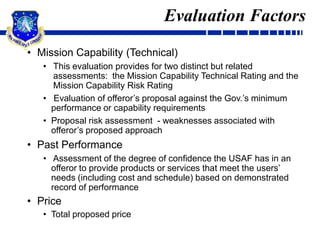
Evaluation FactorsMission Capability (Technical)
This evaluation provides for two distinct but related assessments:  the Mission Capability Technical Rating and the Mission Capability Risk Rating
 Evaluation of offeror’s proposal against the Gov.’s minimum performance or capability requirements
Proposal risk assessment  - weaknesses associated with offeror’s proposed approach
Past Performance
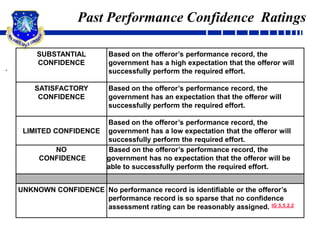
 Assessment of the degree of confidence the USAF has in an offeror to provide products or services that meet the users’ needs (including cost and schedule) based on demonstrated record of performance
Price

5. source selection_101

  • 1.
    Source Selection 101SusanSmith21CONSCol Tom Walker AFSPC/CX
  • 2.
    PurposeInsight in howand why the RFP is developedInsight on how the Gov’t evaluates proposals“Demystify” the source selection process:Encourage more participation, especially small businessesImprove offeror’s potential for awardsObjective is for the Gov’t to get better proposals
  • 3.
    TopicsRFP Development ProcessEvaluationFactors/SubfactorsOverall AssessmentSummary
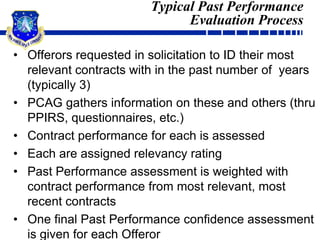
  • 4.
  • 5.
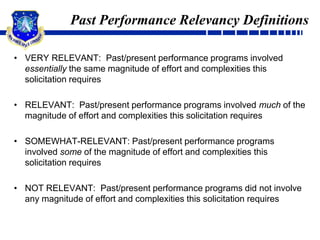
    RFP Development ProcessDefineprogram requirements that meet our customer’s needs
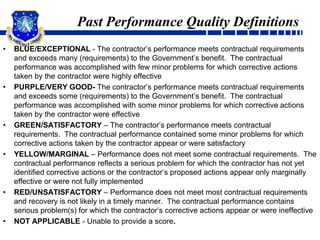
  • 6.
    Identify programrisks associated with the requirements
  • 7.
    Analyze risksto determine priority and risk handling approach
  • 8.
    Develop amitigation strategy for the highest risks
  • 9.
    Use RFPdiscriminators to mitigate program risksSolicitation - Uniform Contract FormatPart I -- The Schedule A Solicitation/contract form B Supplies or services and prices/costs C Description/specifications/statement of work D Packaging and marking E Inspection and acceptance F Deliveries or performance G Contract administration data H Special contract requirementsPart II -- Contract Clauses I Contract clausesPart III -- List of Documents, Exhibits and Other Attachments J List of attachmentsPart IV -- Representations and Instructions K Representations, certifications, and other statements of offerors or respondents L Instructions, conditions, and notices to offerors or respondents M Evaluation factors for award
  • 10.
    Commercial Contract FormatStandardForm (SF) 1449;Any contract documents, exhibits or attachmentsSolicitation provisions -- 52.212-1, Instructions to Offerors -- Commercial Items and any addendum 52.212-2, Evaluation -- Commercial Items, or other description of evaluation factors for award52.212-3, Offeror Representations and Certifications -- Commercial ItemsContract clauses --52.212-4, Contract Terms and Conditions and any addendum52.212-5, Contract Terms and Conditions Required to Implement Statutes and Executive orders
  • 11.
    RFP Development ProcessSecL or 52.212-1 (What information offeror must submit to be evaluated against Sec M criteria):Sec L and Sec M should track closely Requests only minimum data needed to evaluate proposalsSec M or 52.212-2 (Evaluation Criteria):Most important Represents about 95% of entire acquisition strategy Rules of selection; forms compact with offerors:
  • 12.
  • 13.
    Source Selection TypesBestValue Source Selections (vs Lowest Price):
  • 14.
  • 15.
    1: Min.Technically Acceptable (Pass/Fail)
  • 16.
    2: LowestPrice among Technically Acceptable
  • 17.
  • 18.
    1: Min.Technically Acceptable (Pass/Fail)
  • 19.
    2: Trade-offbetween Past Performance & Price Full Trade-Off (FTO) - 1 Step Trade-off between all 4 Factors Mission Capability/ Past ProposalPriceTech. AcceptabilityPerformanceRiskLow Price LPTA  +/-PPT  +/-  FTO    
  • 20.
  • 21.
    This evaluation providesfor two distinct but related assessments: the Mission Capability Technical Rating and the Mission Capability Risk Rating
  • 22.
    Evaluation ofofferor’s proposal against the Gov.’s minimum performance or capability requirements
  • 23.
    Proposal risk assessment - weaknesses associated with offeror’s proposed approach
  • 24.
  • 25.
    Assessment ofthe degree of confidence the USAF has in an offeror to provide products or services that meet the users’ needs (including cost and schedule) based on demonstrated record of performance
  • 26.
  • 27.
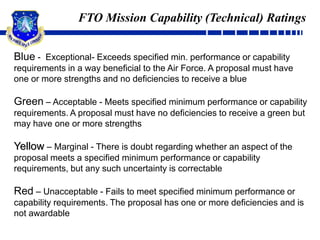
    Total proposed priceFTOMission Capability (Technical) RatingsBlue - Exceptional- Exceeds specified min. performance or capability requirements in a way beneficial to the Air Force. A proposal must have one or more strengths and no deficiencies to receive a blueGreen – Acceptable - Meets specified minimum performance or capability requirements. A proposal must have no deficiencies to receive a green but may have one or more strengthsYellow – Marginal - There is doubt regarding whether an aspect of the proposal meets a specified minimum performance or capability requirements, but any such uncertainty is correctableRed – Unacceptable - Fails to meet specified minimum performance or capability requirements. The proposal has one or more deficiencies and is not awardable
  • 28.
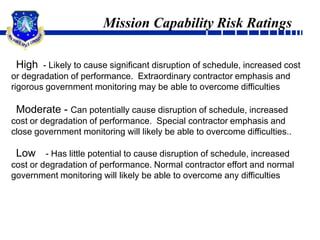
    Mission Capability RiskRatingsHigh - Likely to cause significant disruption of schedule, increased cost or degradation of performance. Extraordinary contractor emphasis and rigorous government monitoring may be able to overcome difficulties.Moderate - Can potentially cause disruption of schedule, increased cost or degradation of performance. Special contractor emphasis and close government monitoring will likely be able to overcome difficulties..Low - Has little potential to cause disruption of schedule, increased cost or degradation of performance. Normal contractor effort and normal government monitoring will likely be able to overcome any difficulties
  • 29.
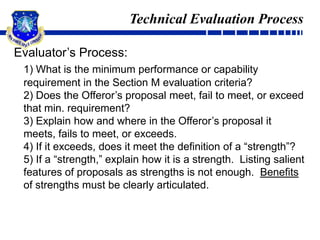
    Technical Evaluation ProcessEvaluator’sProcess:1) What is the minimum performance or capability requirement in the Section M evaluation criteria? 2) Does the Offeror’s proposal meet, fail to meet, or exceed that min. requirement? 3) Explain how and where in the Offeror’s proposal it meets, fails to meet, or exceeds. 4) If it exceeds, does it meet the definition of a “strength”? 5) If a “strength,” explain how it is a strength. Listing salient features of proposals as strengths is not enough. Benefits of strengths must be clearly articulated.
  • 30.
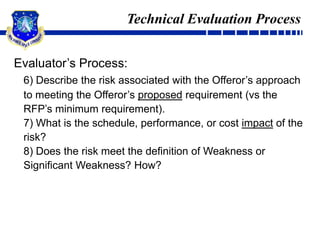
    Technical Evaluation ProcessEvaluator’sProcess:6) Describe the risk associated with the Offeror’s approach to meeting the Offeror’s proposed requirement (vs the RFP’s minimum requirement). 7) What is the schedule, performance, or cost impact of the risk? 8) Does the risk meet the definition of Weakness or Significant Weakness? How?
  • 31.
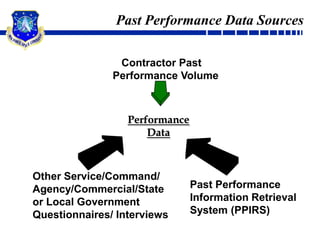
    Past Performance DataSources Contractor Past Performance VolumePerformanceDataOther Service/Command/Agency/Commercial/Stateor Local Government Questionnaires/ InterviewsPast PerformanceInformation Retrieval System (PPIRS)
  • 32.
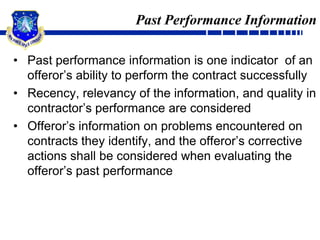
    Past Performance InformationPastperformance information is one indicator of an offeror’s ability to perform the contract successfullyRecency, relevancy of the information, and quality in contractor’s performance are consideredOfferor’s information on problems encountered on contracts they identify, and the offeror’s corrective actions shall be considered when evaluating the offeror’s past performance
  • 33.
    Typical Past PerformanceEvaluationProcessOfferors requested in solicitation to ID their most relevant contracts with in the past number of years (typically 3)PCAG gathers information on these and others (thru PPIRS, questionnaires, etc.)Contract performance for each is assessed Each are assigned relevancy ratingPast Performance assessment is weighted with contract performance from most relevant, most recent contracts One final Past Performance confidence assessment is given for each Offeror
  • 34.
  • 35.
    Past Performance RelevancyDefinitionsVERY RELEVANT: Past/present performance programs involved essentially the same magnitude of effort and complexities this solicitation requiresRELEVANT: Past/present performance programs involved much of the magnitude of effort and complexities this solicitation requiresSOMEWHAT-RELEVANT: Past/present performance programs involved some of the magnitude of effort and complexities this solicitation requiresNOT RELEVANT: Past/present performance programs did not involve any magnitude of effort and complexities this solicitation requires
  • 36.
    Past Performance QualityDefinitionsBLUE/EXCEPTIONAL - The contractor’s performance meets contractual requirements and exceeds many (requirements) to the Government’s benefit. The contractual performance was accomplished with few minor problems for which corrective actions taken by the contractor were highly effectivePURPLE/VERY GOOD- The contractor’s performance meets contractual requirements and exceeds some (requirements) to the Government’s benefit. The contractual performance was accomplished with some minor problems for which corrective actions taken by the contractor were effectiveGREEN/SATISFACTORY – The contractor’s performance meets contractual requirements. The contractual performance contained some minor problems for which corrective actions taken by the contractor appear or were satisfactoryYELLOW/MARGINAL – Performance does not meet some contractual requirements. The contractual performance reflects a serious problem for which the contractor has not yet identified corrective actions or the contractor’s proposed actions appear only marginally effective or were not fully implementedRED/UNSATISFACTORY – Performance does not meet most contractual requirements and recovery is not likely in a timely manner. The contractual performance contains serious problem(s) for which the contractor’s corrective actions appear or were ineffectiveNOT APPLICABLE - Unable to provide a score.
  • 37.
  • 38.
    Factor/Subfactor Order ofImportanceRFP Section M, Evaluation Factors for Award, SHALL specify order of importance, including subfactors and elements, if usedAll evaluation factors (other than cost or price), when combined, are: Significantly more important than cost or price;Approximately equal to cost or price; orSignificantly less important than cost or priceOrder of importance is needed when trade-offs are to be used
  • 39.
    Evaluation Principles Sourceselection is a process of discrimination: - All offerors come into the process with a clean slate - If source selection is properly structured and conducted: - - Offerors who are too expensive, too risky, don’t understand the requirements, will drop to the bottom - - Offerors who have superior ideas, excellent past performance, low costs will rise to the top - - Offerors who are OK or mediocre, will be in the middle
  • 40.
  • 41.
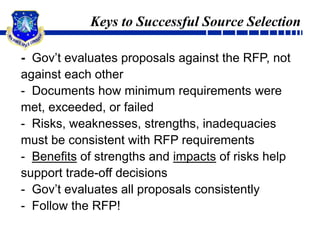
    Keys to SuccessfulSource Selection- Gov’t evaluates proposals against the RFP, not against each other - Documents how minimum requirements were met, exceeded, or failed - Risks, weaknesses, strengths, inadequacies must be consistent with RFP requirements - Benefits of strengths and impacts of risks help support trade-off decisions - Gov’t evaluates all proposals consistently - Follow the RFP!