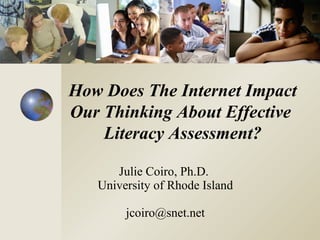

How Does The Internet Impact
Our Thinking About Effective
    Literacy Assessment?

      Julie Coiro, Ph.D.
   University of Rhode Island

        jcoiro@snet.net
Goals for today’s conversation
Understand the issues that cause us to think
differently about literacy assessment
View examples of assessments developed to
measure the new literacies of online reading
comprehension
Explore some of the concerns and challenges
related to measuring online literacy and learning
Dialogue & reflect on connections to issues in your
own teaching / learning context
The New Literacies
  Research Team                                                          QuickTimeª and a
                                                                 TIFF (Uncompressed) decompressor
                                                                   are needed to see this picture.


                Supported by:
                           • Ray and Carole Neag
                           • The Carnegie Corporation of New York
                           • U.S. Department of Education
                           • The National Science Foundation
                           • North Central Educational Research Lab
                           • PBS
                           • The Annenberg Foundation
       QuickTimeª and a    • William and Flora Hewlett Foundation
TIFF (Uncompressed) decompressor
  are needed to see this picture.
                           • Bill and Melinda Gates Foundation
                           • Australian Council of Educational
                                  Research
A New Literacies Perspective
considers the Internet as this
generation’s defining technology
for information, communication,
and especially for learning.

As a result, several important
differences require our attention:
New skills and strategies are required
to comprehend and learn from
information on the Internet
You begin by identifying an important question
New ways of locating information
New reasons for critically evaluating the
information
New contexts for synthesizing information to
answer your questions
 New ways of communicating the answers to others
       Leu, Kinzer, Coiro, and Cammack (2004)
New dispositions (attitudes, beliefs,
   mindsets) are also required
Initiative, confidence, self-direction, critical
stance, adaptability, emotional resilience,
persistence, flexibility, divergent and
convergent thinking, personal productivity,
leadership, social responsibility, teamwork,
curiosity, motivation, openness, …
(e.g., American Library Association; Partnership for 21st
Century; New Literacies Research Team;
Johnston, 2005; Tsai & Tsai, 2003;
Whipp & Chiarelli, 2004)
Processes may be even more
   important than the products
   (especially for informing instruction)
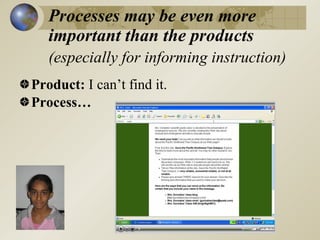
Product: I can’t find it.
Process…
Developmental differences appear
           across each phase of the online
           inquiry process (and are particular to tasks)
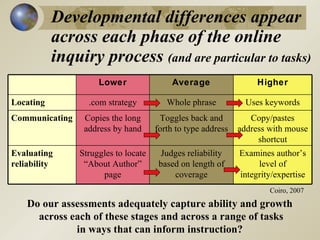
                     Lower                Average                  Higher

Locating          .com strategy          Whole phrase           Uses keywords
Communicating    Copies the long       Toggles back and          Copy/pastes
                 address by hand      forth to type address   address with mouse
                                                                   shortcut
Evaluating      Struggles to locate     Judges reliability    Examines author’s
reliability      “About Author”        based on length of          level of
                      page                 coverage           integrity/expertise
                                                                      Coiro, 2007

    Do our assessments adequately capture ability and growth
      across each of these stages and across a range of tasks
              in ways that can inform instruction?
Other issues to consider when
  assessing online literacies
Students often work collaboratively in
groups or seek help from others online, yet
we continue to measure reading performance
individually and without online assistance
  New assessments are needed to evaluate group
  collaboration and productivity as well as how
  readers seek assistance from a globally networked
  community
Other issues to consider when
   assessing online literacies
Today’s authentic problems often require
interdisciplinary connections, yet we most often
measure reading performance outside of these
authentic problem-solving contexts
  Valid new assessments of online reading comprehension
  should situate reading tasks within a range of relevant
  content area/interdisciplinary information challenges
  Valid new assessments should also integrate the
  information and communication tools used in the
  workforce and in students’ daily lives (“real”
  blogs, wikis, instant message, Flickr sites,
  etc.)
                                                            QuickTimeª and a
                                                   TIFF (Uncompressed) decompressor
                                                      are needed to see this picture.
The ultimate challenge to consider
   when assessing online literacies…
Online texts, tools, and learning environments will
continue to rapidly change…
We need to be prepared to continually reconsider,
change, and expand what it means to be a skilled
online reader.
Thus… our measures need to continually change and
expand…
Which makes it difficult to replicate the use of the
same measure over time (establishing reliability) or
the same tool/environment over time (ecological
validity)
To summarize, at least eight issues
  impact our thinking about literacy
  assessment in a digital age
New literacy skills and strategies
New dispositions
New processes to add to products
New developmental differences to capture
New group measures to add to individual measures
New authentic problems to solve across disciplines
New tools and technologies for school, work, and
daily life
Rapid and continual change
Your Turn..
     Connecting with you

  Are you noticing challenges to
assessment with and of technology
      use in your discipline?

If so, can you share some examples?
          Possible solutions?
So, what have we learned in the
past three years about designing
 assessments to measure online
   reading comprehension?
Assessments of Online
        Reading Comprehension
ORCA-Instant Message
ORCA-Blog
ORCA Scenarios I and II
ORCA Iditarod
ORCA Iditarod-Revised
Survey of Internet Use and Online Reading
ORCA Growth-Curve Measures
Formative Assessments of Online Strategy Use
ISSUES: Environments; Items; Scoring Systems; Group or Individual;
Protocols for Administering & Conducting; “Plan B or C”; Managing
Student Data; Analysis; Making Teacher Friendly
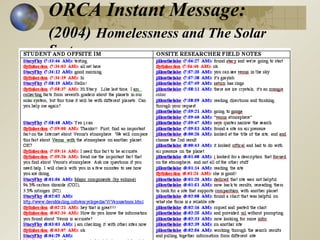
ORCA Instant Message:
(2004) Homelessness and The Solar
System
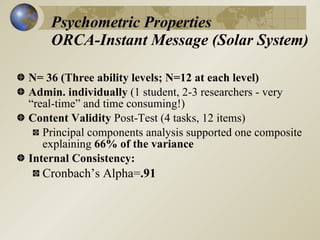
Psychometric Properties
    ORCA-Instant Message (Solar System)

N= 36 (Three ability levels; N=12 at each level)
Admin. individually (1 student, 2-3 researchers - very
“real-time” and time consuming!)
Content Validity Post-Test (4 tasks, 12 items)
   Principal components analysis supported one composite
   explaining 66% of the variance
Internal Consistency:
  Cronbach’s Alpha=.91
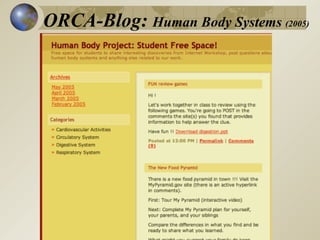
ORCA-Blog: Human Body Systems (2005)
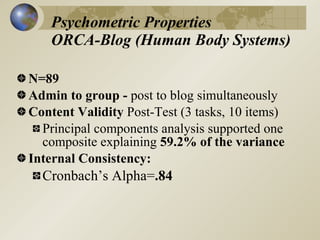
Psychometric Properties
    ORCA-Blog (Human Body Systems)

N=89
Admin to group - post to blog simultaneously
Content Validity Post-Test (3 tasks, 10 items)
  Principal components analysis supported one
  composite explaining 59.2% of the variance
Internal Consistency:
  Cronbach’s Alpha=.84
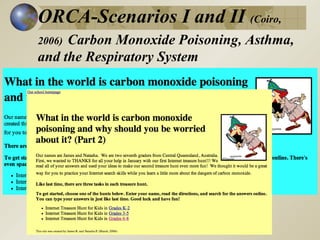
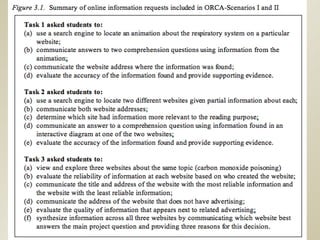
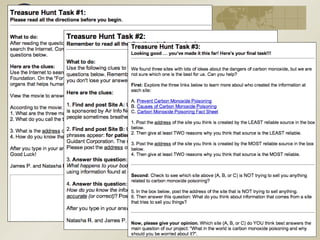
ORCA-Scenarios I and II (Coiro,
2006)Carbon Monoxide Poisoning, Asthma,
and the Respiratory System
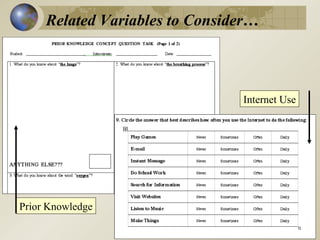
Related Variables to Consider…


                                Internet Use


Prior Knowledge
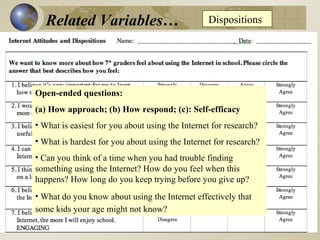
Related Variables…                            Dispositions


Open-ended questions:
(a) How approach; (b) How respond; (c): Self-efficacy
• What is easiest for you about using the Internet for research?
• What is hardest for you about using the Internet for research?
• Can you think of a time when you had trouble finding
something using the Internet? How do you feel when this
happens? How long do you keep trying before you give up?
• What do you know about using the Internet effectively that
some kids your age might not know?
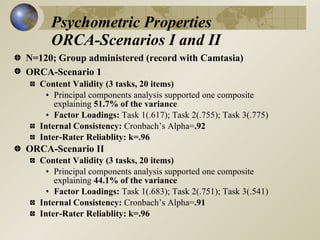
Psychometric Properties
      ORCA-Scenarios I and II
N=120; Group administered (record with Camtasia)
ORCA-Scenario 1
   Content Validity (3 tasks, 20 items)
     • Principal components analysis supported one composite
       explaining 51.7% of the variance
     • Factor Loadings: Task 1(.617); Task 2(.755); Task 3(.775)
   Internal Consistency: Cronbach’s Alpha=.92
   Inter-Rater Reliablity: k=.96
ORCA-Scenario II
   Content Validity (3 tasks, 20 items)
     • Principal components analysis supported one composite
       explaining 44.1% of the variance
     • Factor Loadings: Task 1(.683); Task 2(.751); Task 3(.541)
   Internal Consistency: Cronbach’s Alpha=.91
   Inter-Rater Reliablity: k=.96
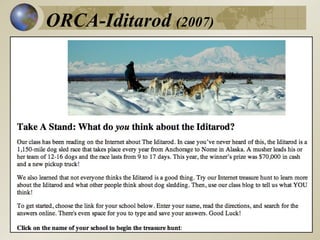
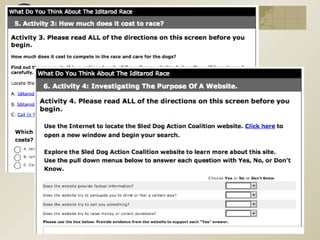
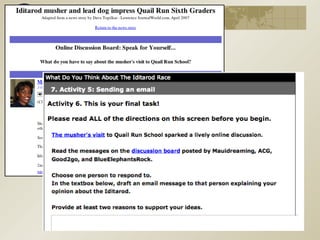
ORCA-Iditarod (2007)
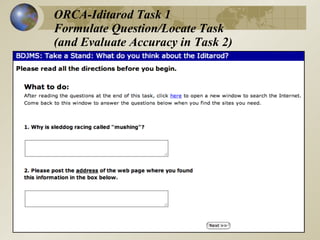
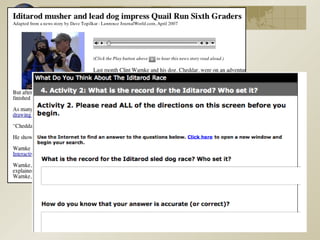
ORCA-Iditarod Task 1
Formulate Question/Locate Task
(and Evaluate Accuracy in Task 2)
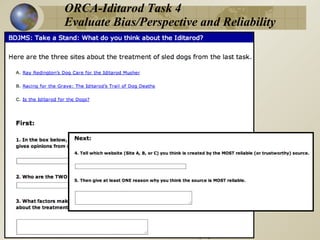
ORCA-Iditarod Task 4
     Evaluate Bias/Perspective and Reliability


Big idea
  Smaller idea


            www.newliteracies.uconn.edu/iesproject
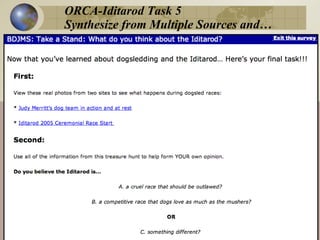
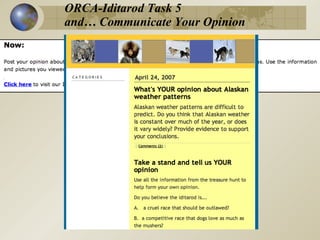
ORCA-Iditarod Task 5
Synthesize from Multiple Sources and…


      www.newliteracies.uconn.edu/iesproject
ORCA-Iditarod Task 5
and… Communicate Your Opinion
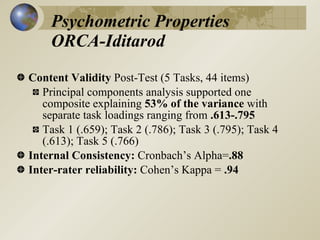
Psychometric Properties
    ORCA-Iditarod
Content Validity Post-Test (5 Tasks, 44 items)
   Principal components analysis supported one
   composite explaining 53% of the variance with
   separate task loadings ranging from .613-.795
   Task 1 (.659); Task 2 (.786); Task 3 (.795); Task 4
   (.613); Task 5 (.766)
Internal Consistency: Cronbach’s Alpha=.88
Inter-rater reliability: Cohen’s Kappa = .94
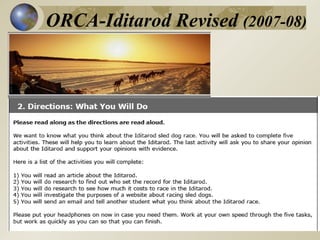
ORCA-Iditarod Revised (2007-08)
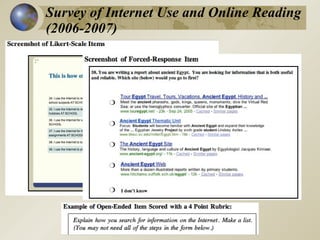
Survey of Internet Use and Online Reading
(2006-2007)
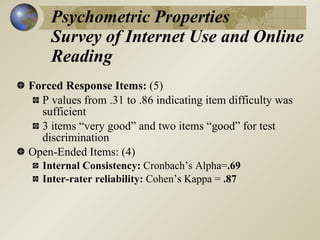
Psychometric Properties
    Survey of Internet Use and Online
    Reading
Forced Response Items: (5)
  P values from .31 to .86 indicating item difficulty was
  sufficient
  3 items “very good” and two items “good” for test
  discrimination
Open-Ended Items: (4)
   Internal Consistency: Cronbach’s Alpha=.69
   Inter-rater reliability: Cohen’s Kappa = .87
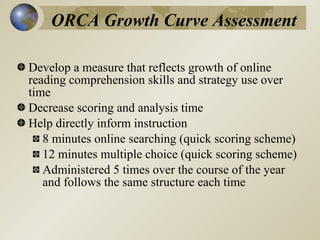
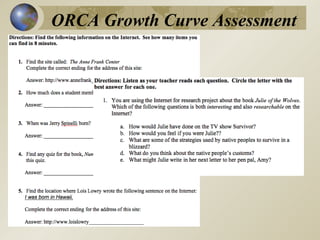
ORCA Growth Curve Assessment

Develop a measure that reflects growth of online
reading comprehension skills and strategy use over
time
Decrease scoring and analysis time
Help directly inform instruction
   8 minutes online searching (quick scoring scheme)
   12 minutes multiple choice (quick scoring scheme)
   Administered 5 times over the course of the year
   and follows the same structure each time
ORCA Growth Curve Assessment
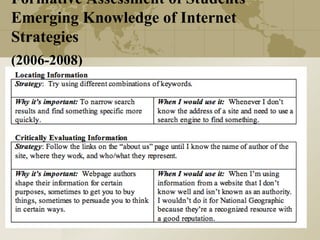
Formative Assessment of Students’
Emerging Knowledge of Internet
Strategies
(2006-2008)
 •   Create many opportunities for students to practice all
     three dimensions of strategic knowledge.
 •   Be sure to measure all three dimensions when
     determining how well your students read and learn on
     the Internet.
Summary of Assessments of
   Online Reading Comprehension

ORCA-Instant Message
ORCA-Blog
ORCA Scenarios I and II
ORCA Iditarod
ORCA Iditarod-Revised
Survey of Internet Use and Online Reading
ORCA Growth-Curve Measures
Formative Assessments of Online Strategy Use
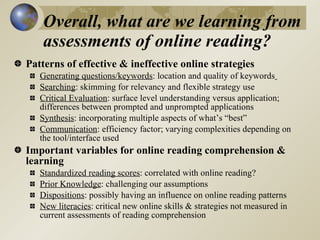
Overall, what are we learning from
    assessments of online reading?
Patterns of effective & ineffective online strategies
   Generating questions/keywords: location and quality of keywords
   Searching: skimming for relevancy and flexible strategy use
   Critical Evaluation: surface level understanding versus application;
   differences between prompted and unprompted applications
   Synthesis: incorporating multiple aspects of what’s “best”
   Communication: efficiency factor; varying complexities depending on
   the tool/interface used
Important variables for online reading comprehension &
learning
   Standardized reading scores: correlated with online reading?
   Prior Knowledge: challenging our assumptions
   Dispositions: possibly having an influence on online reading patterns
   New literacies: critical new online skills & strategies not measured in
   current assessments of reading comprehension
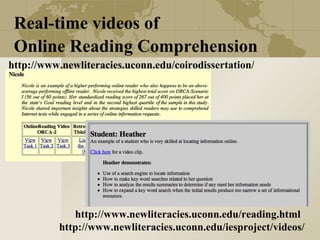
Real-time videos of
 Online Reading Comprehension
http://www.newliteracies.uconn.edu/coirodissertation/


             http://www.newliteracies.uconn.edu/reading.html
          http://www.newliteracies.uconn.edu/iesproject/videos/
Some challenges with online
  assessments…
Developing tasks when websites come and go
Multiple paths to the correct (or incorrect) answer
  Implications of “electronic scaffolds”
  Differences in search engines and results
Issues of capturing and watching process data
  Using real-time video for each student
  Time-consuming scoring
The nature of online reading scenarios prompts new
ways of thinking about missing data
Your Turn..
    Connecting with you

  What successes have you had
  with learning how to capture,
   measure, analyze, and apply
information about your students’
  proficiency with learning with
           technology?

 Other questions…comments?
Thank you for the conversation!

For more information:

               Julie Coiro
         University of Rhode Island
             Jcoiro@snet.net
    http://www.uri.edu/hss/education/faculty/coiro.html

         New Literacies Research Team
      http://www.newliteracies.uconn.edu

Uconn Coiro Assessment 2008

  • 1.
    How Does TheInternet Impact Our Thinking About Effective Literacy Assessment? Julie Coiro, Ph.D. University of Rhode Island jcoiro@snet.net
  • 2.
    Goals for today’sconversation Understand the issues that cause us to think differently about literacy assessment View examples of assessments developed to measure the new literacies of online reading comprehension Explore some of the concerns and challenges related to measuring online literacy and learning Dialogue & reflect on connections to issues in your own teaching / learning context
  • 3.
    The New Literacies Research Team QuickTimeª and a TIFF (Uncompressed) decompressor are needed to see this picture. Supported by: • Ray and Carole Neag • The Carnegie Corporation of New York • U.S. Department of Education • The National Science Foundation • North Central Educational Research Lab • PBS • The Annenberg Foundation QuickTimeª and a • William and Flora Hewlett Foundation TIFF (Uncompressed) decompressor are needed to see this picture. • Bill and Melinda Gates Foundation • Australian Council of Educational Research
  • 4.
    A New LiteraciesPerspective considers the Internet as this generation’s defining technology for information, communication, and especially for learning. As a result, several important differences require our attention:
  • 5.
    New skills andstrategies are required to comprehend and learn from information on the Internet You begin by identifying an important question New ways of locating information New reasons for critically evaluating the information New contexts for synthesizing information to answer your questions New ways of communicating the answers to others Leu, Kinzer, Coiro, and Cammack (2004)
  • 6.
    New dispositions (attitudes,beliefs, mindsets) are also required Initiative, confidence, self-direction, critical stance, adaptability, emotional resilience, persistence, flexibility, divergent and convergent thinking, personal productivity, leadership, social responsibility, teamwork, curiosity, motivation, openness, … (e.g., American Library Association; Partnership for 21st Century; New Literacies Research Team; Johnston, 2005; Tsai & Tsai, 2003; Whipp & Chiarelli, 2004)
  • 7.
    Processes may beeven more important than the products (especially for informing instruction) Product: I can’t find it. Process…
  • 8.
    Developmental differences appear across each phase of the online inquiry process (and are particular to tasks) Lower Average Higher Locating .com strategy Whole phrase Uses keywords Communicating Copies the long Toggles back and Copy/pastes address by hand forth to type address address with mouse shortcut Evaluating Struggles to locate Judges reliability Examines author’s reliability “About Author” based on length of level of page coverage integrity/expertise Coiro, 2007 Do our assessments adequately capture ability and growth across each of these stages and across a range of tasks in ways that can inform instruction?
  • 9.
    Other issues toconsider when assessing online literacies Students often work collaboratively in groups or seek help from others online, yet we continue to measure reading performance individually and without online assistance New assessments are needed to evaluate group collaboration and productivity as well as how readers seek assistance from a globally networked community
  • 10.
    Other issues toconsider when assessing online literacies Today’s authentic problems often require interdisciplinary connections, yet we most often measure reading performance outside of these authentic problem-solving contexts Valid new assessments of online reading comprehension should situate reading tasks within a range of relevant content area/interdisciplinary information challenges Valid new assessments should also integrate the information and communication tools used in the workforce and in students’ daily lives (“real” blogs, wikis, instant message, Flickr sites, etc.) QuickTimeª and a TIFF (Uncompressed) decompressor are needed to see this picture.
  • 11.
    The ultimate challengeto consider when assessing online literacies… Online texts, tools, and learning environments will continue to rapidly change… We need to be prepared to continually reconsider, change, and expand what it means to be a skilled online reader. Thus… our measures need to continually change and expand… Which makes it difficult to replicate the use of the same measure over time (establishing reliability) or the same tool/environment over time (ecological validity)
  • 12.
    To summarize, atleast eight issues impact our thinking about literacy assessment in a digital age New literacy skills and strategies New dispositions New processes to add to products New developmental differences to capture New group measures to add to individual measures New authentic problems to solve across disciplines New tools and technologies for school, work, and daily life Rapid and continual change
  • 13.
    Your Turn.. Connecting with you Are you noticing challenges to assessment with and of technology use in your discipline? If so, can you share some examples? Possible solutions?
  • 14.
    So, what havewe learned in the past three years about designing assessments to measure online reading comprehension?
  • 15.
    Assessments of Online Reading Comprehension ORCA-Instant Message ORCA-Blog ORCA Scenarios I and II ORCA Iditarod ORCA Iditarod-Revised Survey of Internet Use and Online Reading ORCA Growth-Curve Measures Formative Assessments of Online Strategy Use ISSUES: Environments; Items; Scoring Systems; Group or Individual; Protocols for Administering & Conducting; “Plan B or C”; Managing Student Data; Analysis; Making Teacher Friendly
  • 16.
    ORCA Instant Message: (2004)Homelessness and The Solar System
  • 17.
    Psychometric Properties ORCA-Instant Message (Solar System) N= 36 (Three ability levels; N=12 at each level) Admin. individually (1 student, 2-3 researchers - very “real-time” and time consuming!) Content Validity Post-Test (4 tasks, 12 items) Principal components analysis supported one composite explaining 66% of the variance Internal Consistency: Cronbach’s Alpha=.91
  • 18.
    ORCA-Blog: Human BodySystems (2005)
  • 19.
    Psychometric Properties ORCA-Blog (Human Body Systems) N=89 Admin to group - post to blog simultaneously Content Validity Post-Test (3 tasks, 10 items) Principal components analysis supported one composite explaining 59.2% of the variance Internal Consistency: Cronbach’s Alpha=.84
  • 20.
    ORCA-Scenarios I andII (Coiro, 2006)Carbon Monoxide Poisoning, Asthma, and the Respiratory System
  • 22.
    Related Variables toConsider… Internet Use Prior Knowledge
  • 23.
    Related Variables… Dispositions Open-ended questions: (a) How approach; (b) How respond; (c): Self-efficacy • What is easiest for you about using the Internet for research? • What is hardest for you about using the Internet for research? • Can you think of a time when you had trouble finding something using the Internet? How do you feel when this happens? How long do you keep trying before you give up? • What do you know about using the Internet effectively that some kids your age might not know?
  • 25.
    Psychometric Properties ORCA-Scenarios I and II N=120; Group administered (record with Camtasia) ORCA-Scenario 1 Content Validity (3 tasks, 20 items) • Principal components analysis supported one composite explaining 51.7% of the variance • Factor Loadings: Task 1(.617); Task 2(.755); Task 3(.775) Internal Consistency: Cronbach’s Alpha=.92 Inter-Rater Reliablity: k=.96 ORCA-Scenario II Content Validity (3 tasks, 20 items) • Principal components analysis supported one composite explaining 44.1% of the variance • Factor Loadings: Task 1(.683); Task 2(.751); Task 3(.541) Internal Consistency: Cronbach’s Alpha=.91 Inter-Rater Reliablity: k=.96
  • 26.
  • 27.
    ORCA-Iditarod Task 1 FormulateQuestion/Locate Task (and Evaluate Accuracy in Task 2)
  • 28.
    ORCA-Iditarod Task 4 Evaluate Bias/Perspective and Reliability Big idea Smaller idea www.newliteracies.uconn.edu/iesproject
  • 29.
    ORCA-Iditarod Task 5 Synthesizefrom Multiple Sources and… www.newliteracies.uconn.edu/iesproject
  • 30.
    ORCA-Iditarod Task 5 and…Communicate Your Opinion
  • 31.
    Psychometric Properties ORCA-Iditarod Content Validity Post-Test (5 Tasks, 44 items) Principal components analysis supported one composite explaining 53% of the variance with separate task loadings ranging from .613-.795 Task 1 (.659); Task 2 (.786); Task 3 (.795); Task 4 (.613); Task 5 (.766) Internal Consistency: Cronbach’s Alpha=.88 Inter-rater reliability: Cohen’s Kappa = .94
  • 32.
  • 36.
    Survey of InternetUse and Online Reading (2006-2007)
  • 37.
    Psychometric Properties Survey of Internet Use and Online Reading Forced Response Items: (5) P values from .31 to .86 indicating item difficulty was sufficient 3 items “very good” and two items “good” for test discrimination Open-Ended Items: (4) Internal Consistency: Cronbach’s Alpha=.69 Inter-rater reliability: Cohen’s Kappa = .87
  • 38.
    ORCA Growth CurveAssessment Develop a measure that reflects growth of online reading comprehension skills and strategy use over time Decrease scoring and analysis time Help directly inform instruction 8 minutes online searching (quick scoring scheme) 12 minutes multiple choice (quick scoring scheme) Administered 5 times over the course of the year and follows the same structure each time
  • 39.
  • 40.
    Formative Assessment ofStudents’ Emerging Knowledge of Internet Strategies (2006-2008) • Create many opportunities for students to practice all three dimensions of strategic knowledge. • Be sure to measure all three dimensions when determining how well your students read and learn on the Internet.
  • 41.
    Summary of Assessmentsof Online Reading Comprehension ORCA-Instant Message ORCA-Blog ORCA Scenarios I and II ORCA Iditarod ORCA Iditarod-Revised Survey of Internet Use and Online Reading ORCA Growth-Curve Measures Formative Assessments of Online Strategy Use
  • 42.
    Overall, what arewe learning from assessments of online reading? Patterns of effective & ineffective online strategies Generating questions/keywords: location and quality of keywords Searching: skimming for relevancy and flexible strategy use Critical Evaluation: surface level understanding versus application; differences between prompted and unprompted applications Synthesis: incorporating multiple aspects of what’s “best” Communication: efficiency factor; varying complexities depending on the tool/interface used Important variables for online reading comprehension & learning Standardized reading scores: correlated with online reading? Prior Knowledge: challenging our assumptions Dispositions: possibly having an influence on online reading patterns New literacies: critical new online skills & strategies not measured in current assessments of reading comprehension
  • 43.
    Real-time videos of Online Reading Comprehension http://www.newliteracies.uconn.edu/coirodissertation/ http://www.newliteracies.uconn.edu/reading.html http://www.newliteracies.uconn.edu/iesproject/videos/
  • 44.
    Some challenges withonline assessments… Developing tasks when websites come and go Multiple paths to the correct (or incorrect) answer Implications of “electronic scaffolds” Differences in search engines and results Issues of capturing and watching process data Using real-time video for each student Time-consuming scoring The nature of online reading scenarios prompts new ways of thinking about missing data
  • 45.
    Your Turn.. Connecting with you What successes have you had with learning how to capture, measure, analyze, and apply information about your students’ proficiency with learning with technology? Other questions…comments?
  • 46.
    Thank you forthe conversation! For more information: Julie Coiro University of Rhode Island Jcoiro@snet.net http://www.uri.edu/hss/education/faculty/coiro.html New Literacies Research Team http://www.newliteracies.uconn.edu