Local adaptation in Populus trichocarpa:
Role of introgression from P. balsamifera
Adriana Suarez-Gonzalez, Camille Christi, Armando
Gerald's, Charles Heifer, Christian Lexar, Quentin Crank
and Carl Douglas
Adaptations
Genetic variation is the ingredient for Natural Selection
– Introgression can provide allelic variation
Rohde and Bhalerao 2007
Poplars: a system to study introgression
and molecular basis of adaptation
• Widespread distributions across environmental gradients
• Hybrids and contact zones
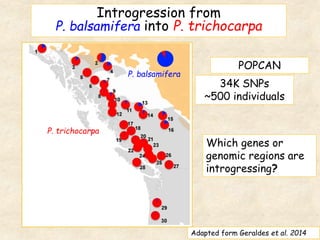
Introgression from
P. balsamifera into P. trichocarpa
Adapted form Geraldes et al. 2014
P. trichocarpa
P. balsamifera
34K SNPs
~500 individuals
POPCAN
Which genes or
genomic regions are
introgressing?
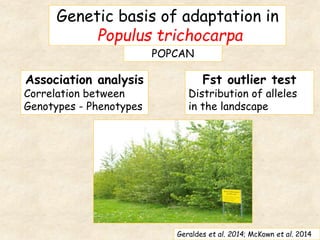
Genetic basis of adaptation in
Populus trichocarpa
Geraldes et al. 2014; McKown et al. 2014
POPCAN
Fst outlier test
Distribution of alleles
in the landscape
Association analysis
Correlation between
Genotypes - Phenotypes
Chr 15
FAR1
FHY3
Chr 06
Genetic basis of adaptation in
Populus trichocarpa
COMT1
PRR5
Genes in chromosome 6 and 15 were:
• Associated with adaptive traits (eg. chlorophyll, leaf drop)
• Fst outliers
27Mb
15Mb
Signals of introgression in genes on
chromosome 15: PRR5
P. balsamifera
R
W
Candidate genes in P. trichocarpa
introgressed from P. balsamifera
What is the size of this introgressed region?
Is this adaptive introgression?
Are there other introgressed region?
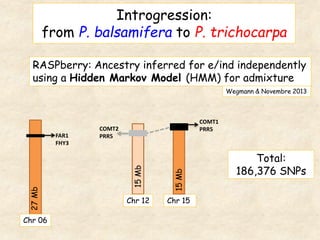
RASPberry: Ancestry inferred for e/ind independently
using a Hidden Markov Model (HMM) for admixture
Introgression:
from P. balsamifera to P. trichocarpa
Wegmann & Novembre 2013
Total:
186,376 SNPs
Chr 12 Chr 15
Chr 06
COMT1
PRR5COMT2
PRR5FAR1
FHY3
27Mb
15Mb
15Mb
- 50 pure P. balsamifera - P. trichocarpa
- 38 admixed P. trichocarpa individuals
- Proportion of alleles with
P. balsamifera ancestry at each SNP
- Sliding window: Size 100 kb, step 20kb
Introgression:
from P. balsamifera to P. trichocarpa
Signals of introgression in genes on
chromosome 15: PRR5
P. balsamifera
R
W
Balsamiferaancestry
Million base pairs
Introgression:
P. balsamifera into
P. trichocarpa
Chr12
COMT2
PRR5
Introgression:
P. balsamifera into
P. trichocarpa
Chr15
880 Kb 580 Kb
COMT1
PRR5
Chr06
580 Kb
FAR1
Introgression from P. balsamifera
into P. trichocarpa
We found three introgressed regions
Geraldes et al. 2014
Are these introgressed regions
adaptive in P. trichocarpa ?
Chr 12 Chr 15
Chr 06
COMT1
PRR5COMT2
PRR5
FAR1
FHY3
Are introgressed regions
adaptive in P. trichocarpa ?
1. Functional Category Enrichment Analyses
2. Nucleotide Diversity in pure species
*Test for Balancing Selection
3. Phenotypic (Association) analyses
Chr 15
Chr 06
1. Functional Category Enrichment in
Candidate Region on Chromosome 15
GO:0032502: developmental process
GO:0032501: multicellular organismal process
GO:0007275: multicellular organismal development
Chr 15
PRR5
TTG1
ANAC62
Chr 15
95%
5%
P. balsamifera P. trichocarpa
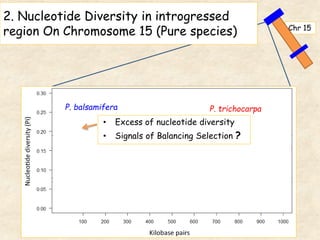
• Excess of nucleotide diversity
• Signals of Balancing Selection ?
2. Nucleotide Diversity in introgressed
region On Chromosome 15 (Pure species)
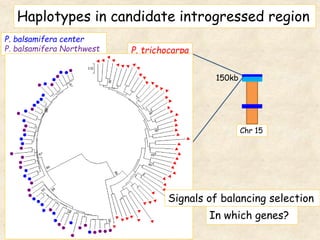
P. trichocarpa
P. balsamifera center
P. balsamifera Northwest
In which genes?
Chr 15
Signals of balancing selection
Haplotypes in candidate introgressed region
150kb
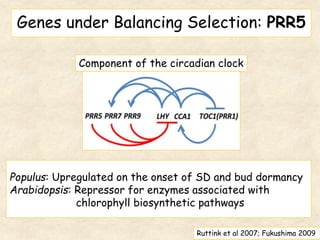
Genes under Balancing Selection: PRR5
Populus: Upregulated on the onset of SD and bud dormancy
Arabidopsis: Repressor for enzymes associated with
chlorophyll biosynthetic pathways
Component of the circadian clock
Ruttink et al 2007; Fukushima 2009
R
W
Nakamichi et al. 2010
Genes under Balancing Selection: PRR5
R/W
3. Introgressed P. balsamifera alleles change
P. trichocarpa phenotype
• Admixed P. trichocarpa showed higher chlorophyll content
• Higher chlorophyll is associated with higher photosynthetic rate,
and could be correlated with faster growth.
Soolanayakanahally et al 2009
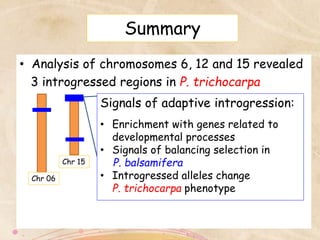
Summary
• Analysis of chromosomes 6, 12 and 15 revealed
3 introgressed regions in P. trichocarpa
Chr 15
Chr 06
Signals of adaptive introgression:
• Enrichment with genes related to
developmental processes
• Signals of balancing selection in
P. balsamifera
• Introgressed alleles change
P. trichocarpa phenotype
Future work
Genome-wide analysis
Phenotypic analysis
19 chromosomes
Thanks to
BRITE

Adaptive_introgression_Adriana_June

  • 1.
    Local adaptation inPopulus trichocarpa: Role of introgression from P. balsamifera Adriana Suarez-Gonzalez, Camille Christi, Armando Gerald's, Charles Heifer, Christian Lexar, Quentin Crank and Carl Douglas
  • 2.
    Adaptations Genetic variation isthe ingredient for Natural Selection – Introgression can provide allelic variation Rohde and Bhalerao 2007
  • 3.
    Poplars: a systemto study introgression and molecular basis of adaptation • Widespread distributions across environmental gradients • Hybrids and contact zones
  • 4.
    Introgression from P. balsamiferainto P. trichocarpa Adapted form Geraldes et al. 2014 P. trichocarpa P. balsamifera 34K SNPs ~500 individuals POPCAN Which genes or genomic regions are introgressing?
  • 5.
    Genetic basis ofadaptation in Populus trichocarpa Geraldes et al. 2014; McKown et al. 2014 POPCAN Fst outlier test Distribution of alleles in the landscape Association analysis Correlation between Genotypes - Phenotypes
  • 6.
    Chr 15 FAR1 FHY3 Chr 06 Geneticbasis of adaptation in Populus trichocarpa COMT1 PRR5 Genes in chromosome 6 and 15 were: • Associated with adaptive traits (eg. chlorophyll, leaf drop) • Fst outliers 27Mb 15Mb
  • 7.
    Signals of introgressionin genes on chromosome 15: PRR5 P. balsamifera R W
  • 8.
    Candidate genes inP. trichocarpa introgressed from P. balsamifera What is the size of this introgressed region? Is this adaptive introgression? Are there other introgressed region?
  • 9.
    RASPberry: Ancestry inferredfor e/ind independently using a Hidden Markov Model (HMM) for admixture Introgression: from P. balsamifera to P. trichocarpa Wegmann & Novembre 2013 Total: 186,376 SNPs Chr 12 Chr 15 Chr 06 COMT1 PRR5COMT2 PRR5FAR1 FHY3 27Mb 15Mb 15Mb
  • 10.
    - 50 pureP. balsamifera - P. trichocarpa - 38 admixed P. trichocarpa individuals - Proportion of alleles with P. balsamifera ancestry at each SNP - Sliding window: Size 100 kb, step 20kb Introgression: from P. balsamifera to P. trichocarpa
  • 11.
    Signals of introgressionin genes on chromosome 15: PRR5 P. balsamifera R W
  • 12.
    Balsamiferaancestry Million base pairs Introgression: P.balsamifera into P. trichocarpa Chr12 COMT2 PRR5
  • 13.
    Introgression: P. balsamifera into P.trichocarpa Chr15 880 Kb 580 Kb COMT1 PRR5 Chr06 580 Kb FAR1
  • 14.
    Introgression from P.balsamifera into P. trichocarpa We found three introgressed regions Geraldes et al. 2014 Are these introgressed regions adaptive in P. trichocarpa ? Chr 12 Chr 15 Chr 06 COMT1 PRR5COMT2 PRR5 FAR1 FHY3
  • 15.
    Are introgressed regions adaptivein P. trichocarpa ? 1. Functional Category Enrichment Analyses 2. Nucleotide Diversity in pure species *Test for Balancing Selection 3. Phenotypic (Association) analyses Chr 15 Chr 06
  • 16.
    1. Functional CategoryEnrichment in Candidate Region on Chromosome 15 GO:0032502: developmental process GO:0032501: multicellular organismal process GO:0007275: multicellular organismal development Chr 15 PRR5 TTG1 ANAC62
  • 17.
    Chr 15 95% 5% P. balsamiferaP. trichocarpa • Excess of nucleotide diversity • Signals of Balancing Selection ? 2. Nucleotide Diversity in introgressed region On Chromosome 15 (Pure species)
  • 18.
    P. trichocarpa P. balsamiferacenter P. balsamifera Northwest In which genes? Chr 15 Signals of balancing selection Haplotypes in candidate introgressed region 150kb
  • 19.
    Genes under BalancingSelection: PRR5 Populus: Upregulated on the onset of SD and bud dormancy Arabidopsis: Repressor for enzymes associated with chlorophyll biosynthetic pathways Component of the circadian clock Ruttink et al 2007; Fukushima 2009
  • 20.
    R W Nakamichi et al.2010 Genes under Balancing Selection: PRR5 R/W
  • 21.
    3. Introgressed P.balsamifera alleles change P. trichocarpa phenotype • Admixed P. trichocarpa showed higher chlorophyll content • Higher chlorophyll is associated with higher photosynthetic rate, and could be correlated with faster growth. Soolanayakanahally et al 2009
  • 22.
    Summary • Analysis ofchromosomes 6, 12 and 15 revealed 3 introgressed regions in P. trichocarpa Chr 15 Chr 06 Signals of adaptive introgression: • Enrichment with genes related to developmental processes • Signals of balancing selection in P. balsamifera • Introgressed alleles change P. trichocarpa phenotype
  • 23.
  • 24.

Editor's Notes

  • #2 I will be taking about my project, where I am trying to determine if
  • #3 Adaptations contribute to the fitness and survival of individuals, For example is decidjios trees temporal modifications in growth together with cyclical changes in climate are essential for survival in variable environments Gv is an important ingredient for these processes of NS And an important source that can provide this type of allelic variation is introgression …and underley adaptive procesese That is why I am interested on understanding the genetic variation of local adaptation
  • #4 P trichocarpa ref genome, silicide genome duplication, whole genome And then introduce distribution and introgression
  • #5 introgression from sister species balsamifera appeared as important processes shaping the distribution of genetic diversity across P. trichocarpa range pie chart depicts the averageQbalsam (black) vs all other six Q (in green) among all accessions from that drainage (or species) (balsamifera's pie chart which was placed randomly).
  • #6 Fst outlier test where we focus on genotypes, specifically allele freq. Fst is an index used to estimate levels of pop differentiion and if a SNP or genes is an Fst outlier it could mean that certain alleles are restricted to some parts of the range. If this is the case we could hypothesised that these alleles are involved in adaptive process in these specific environments.
  • #9 Adaptations contribute to the fitness and survival of individuals, For example is decidjios trees temporal modifications in growth together with cyclical changes in climate are essential for survival in variable environments Gv is an important ingredient for these processes of NS And an important source that can provide this type of allelic variation is introgression …and underley adaptive procesese That is why I am interested on understanding the genetic variation of local adaptation
  • #10 HMM-based inference depends on: a ref panel of phased haplotypes from e/of the ancestral pops
  • #11 I used this approach because there was variation in SNP density among windows. So I weighting these estimations based on the # of SNPs per window. The weighted mean data points with more SNPs contribute more than others (instead of e/of the data points contributing equally to the final average)
  • #17 Bonferroni Benjamini (no FDR), ch15_2: PTHR18958~ANKYRIN REPEAT-CONTAINING GO:0032502 biological p =progression of anatomical structure (subcellular, cell, tissue, organ), or organism over time from initial to later condition GO:0032501 biological p= in multicellular organism, pertinent to its function GO:0007275 biological p = progression of multicellular organism over time from initial condition (zygote, young adult) to a later condition (multicellular animal, aged adult). ~Cellular component: parts of a cell or extracellular env ~Molecular function: activities of gene product at molecular level (binding or catalysis) ~Biological process: molecular events functioning of cells, tissues, organs, organisms
  • #18 After looking at this data These results led me to test for signals of bs. Used tajima =
  • #21 pseudoreceiver domain and the CONSTANS, CONSTANS-LIKE, and TOC1 (CCT) motif