Linkage Disequilibrium and 
Recombination in the Domestic Cat: 
Applications to Genome-wide 
Association and Linkage Studies 
Hasan Alhaddad 
Advisor: Dr. Leslie Lyons
Presentation Overview 
• Introduction 
• Linkage disequilibrium in cats 
• Population recombination rate and 
recombination hotspots 
• Genome-wide analyses of progressive retinal 
atrophy in Persian cats 
• Conclusion 
• Acknowledgments
Introduction Linkage Disequilibrium Recombination hotspots Persian PRA Conclusion 
A bit of history Cat domestication Cat breeds Phenotype genetics Disease genetics Genetic resources 
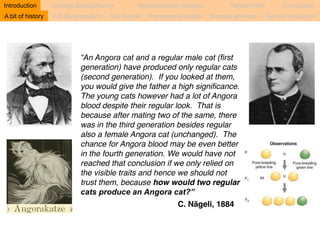
“An Angora cat and a regular male cat (first 
generation) have produced only regular cats 
(second generation). If you looked at them, 
you would give the father a high significance. 
The young cats however had a lot of Angora 
blood despite their regular look. That is 
because after mating two of the same, there 
was in the third generation besides regular 
also a female Angora cat (unchanged). The 
chance for Angora blood may be even better 
in the fourth generation. We would have not 
reached that conclusion if we only relied on 
the visible traits and hence we should not 
trust them, because how would two regular 
cats produce an Angora cat?” 
C. Nägeli, 1884
Introduction Linkage Disequilibrium Recombination hotspots Persian PRA Conclusion 
A bit of history Cat domestication Cat breeds Phenotype genetics Disease genetics Genetic resources 
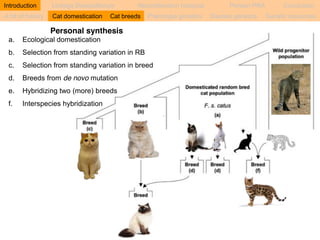
Personal synthesis 
a. Ecological domestication 
b. Selection from standing variation in RB 
c. Selection from standing variation in breed 
d. Breeds from de novo mutation 
e. Hybridizing two (more) breeds 
f. Interspecies hybridization
Introduction Linkage Disequilibrium Recombination hotspots Persian PRA Conclusion 
A bit of history Cat domestication Cat breeds Phenotype genetics Disease genetics Genetic resources 
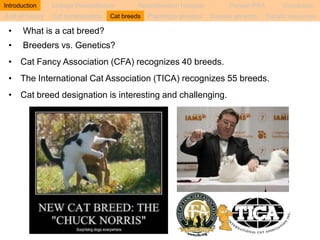
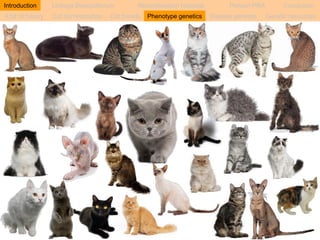
• What is a cat breed? 
• Breeders vs. Genetics? 
• Cat Fancy Association (CFA) recognizes 40 breeds. 
• The International Cat Association (TICA) recognizes 55 breeds. 
• Cat breed designation is interesting and challenging.
Introduction Linkage Disequilibrium Recombination hotspots Persian PRA Conclusion 
A bit of history Cat domestication Cat breeds Phenotype genetics Disease genetics Genetic resources 
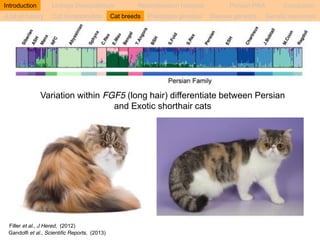
Variation within FGF5 (long hair) differentiate between Persian 
Filler et al., J Hered, (2012) 
Gandolfi et al., Scientific Reports, (2013) 
and Exotic shorthair cats
Introduction Linkage Disequilibrium Recombination hotspots Persian PRA Conclusion 
A bit of history Cat domestication Cat breeds Phenotype genetics Disease genetics Genetic resources 
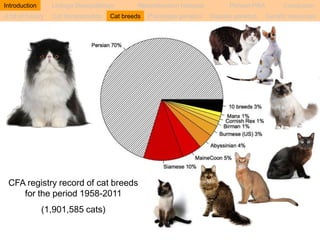
CFA registry record of cat breeds 
for the period 1958-2011 
(1,901,585 cats)
Introduction Linkage Disequilibrium Recombination hotspots Persian PRA Conclusion 
A bit of history Cat domestication Cat breeds Phenotype genetics Disease genetics Genetic resources
Introduction Linkage Disequilibrium Recombination hotspots Persian PRA Conclusion 
A bit of history Cat domestication Cat breeds Phenotype genetics Disease genetics Genetic resources 
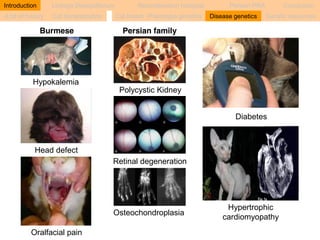
Burmese 
Hypokalemia 
Head defect 
Oralfacial pain 
Persian family 
Polycystic Kidney 
Retinal degeneration 
Osteochondroplasia 
Diabetes 
Hypertrophic 
cardiomyopathy
Introduction Linkage Disequilibrium Recombination hotspots Persian PRA Conclusion 
A bit of history Cat domestication Cat breeds Phenotype genetics Disease genetics Genetic resources 
• Somatic cell hybrid panels 
O’Brien and Nash, Science 1982 
• Intra-inter species linkage map 
Menotti-Raymond et al., Genomics 1999 
Menotti-Raymond et al., Journal of Heredity 2003 
Menotti-Raymond et al., Genomics 2009 
• RH panel 
Murphy et al., Genome Research 2000 
Bach et al., Cytogenet Genome Res 2012 
• Genome sequencing 
Pontius et al., Genome Research 2007 – 2X ~ 60% genome 
Mullikin et al., BMC Genomics 2010 – 3X ~ 80% genome and 1,000,000 
SNPs 
• 63K Illumina Array chip
Introduction Linkage Disequilibrium Recombination hotspots Persian PRA Conclusion
Introduction Linkage Disequilibrium Recombination hotspots Persian PRA Conclusion 
Objectives Hypotheses 
O1: Estimate the extent of LD in cats. 
O2: Provide insights for design of GWA studies. 
H1: Linkage disequilibrium varies across populations and 
genomic regions. 
H2: Variation in linkage disequilibrium among populations 
reflects population histories.
Introduction Linkage Disequilibrium Recombination hotspots Persian PRA Conclusion 
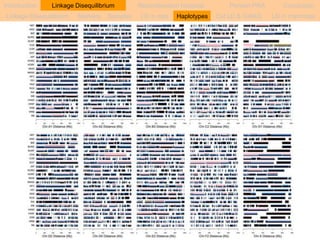
Linkage Disequilibrium Markers Samples LD in cats Haplotypes Cat LD & GWAS LD in mammals 
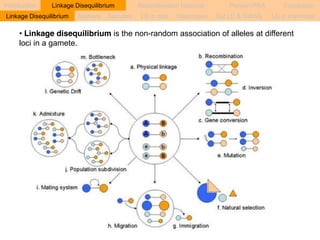
• Linkage disequilibrium is the non-random association of alleles at different 
loci in a gamete.
Introduction Linkage Disequilibrium Recombination hotspots Persian PRA Conclusion 
Markers Samples LD in cats Haplotypes Cat LD & GWAS LD in mammals 
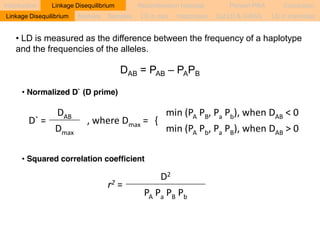
• LD is measured as the difference between the frequency of a haplotype 
and the frequencies of the alleles. 
D` = 
DAB , where Dmax = { 
min (PA PB, Pa Pb), when DAB < 0 
Dmax min (PA Pb, Pa PB), when DAB > 0 
• Squared correlation coefficient 
r2 = 
D2 
PA Pa PB Pb 
• Normalized D` (D prime) 
DAB = PAB – PAPB 
Linkage Disequilibrium
Introduction Linkage Disequilibrium Recombination hotspots Persian PRA Conclusion 
Markers Samples LD in cats Haplotypes Cat LD & GWAS LD in mammals 
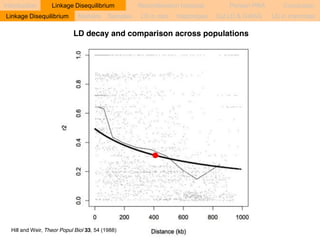
LD decay and comparison across populations 
Linkage Disequilibrium 
Hill and Weir, Theor Popul Biol 33, 54 (1988)
Introduction Linkage Disequilibrium Recombination hotspots Persian PRA Conclusion 
Markers Samples LD in cats Haplotypes Cat LD & GWAS LD in mammals 
Linkage Disequilibrium 
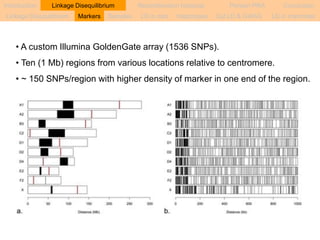
• A custom Illumina GoldenGate array (1536 SNPs). 
• Ten (1 Mb) regions from various locations relative to centromere. 
• ~ 150 SNPs/region with higher density of marker in one end of the region.
Introduction Linkage Disequilibrium Recombination hotspots Persian PRA Conclusion 
Markers Samples LD in cats Haplotypes Cat LD & GWAS LD in mammals 
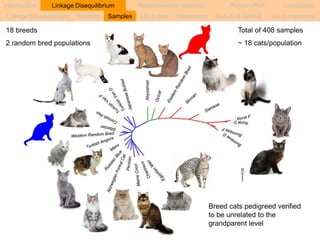
18 breeds 
2 random bred populations 
Total of 408 samples 
~ 18 cats/population 
Breed cats pedigreed verified 
to be unrelated to the 
grandparent level 
Linkage Disequilibrium
Introduction Linkage Disequilibrium Recombination hotspots Persian PRA Conclusion 
Markers Samples LD in cats Haplotypes Cat LD & GWAS LD in mammals 
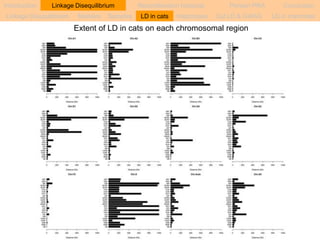
Extent of LD in cats on each chromosomal region 
Linkage Disequilibrium
Introduction Linkage Disequilibrium Recombination hotspots Persian PRA Conclusion 
Markers Samples LD in cats Haplotypes Cat LD & GWAS LD in mammals 
Linkage Disequilibrium 
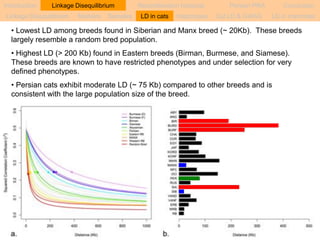
• Lowest LD among breeds found in Siberian and Manx breed (~ 20Kb). These breeds 
largely resemble a random bred population. 
• Highest LD (> 200 Kb) found in Eastern breeds (Birman, Burmese, and Siamese). 
These breeds are known to have restricted phenotypes and under selection for very 
defined phenotypes. 
• Persian cats exhibit moderate LD (~ 75 Kb) compared to other breeds and is 
consistent with the large population size of the breed.
Introduction Linkage Disequilibrium Recombination hotspots Persian PRA Conclusion 
Linkage Disequilibrium Markers Samples LD in cats Haplotypes Cat LD & GWAS LD in mammals
Introduction Linkage Disequilibrium Recombination hotspots Persian PRA Conclusion 
Markers Samples LD in cats Haplotypes Cat LD & GWAS LD in mammals 
Linkage Disequilibrium 
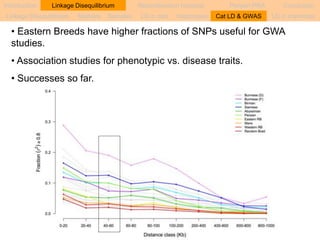
• Eastern Breeds have higher fractions of SNPs useful for GWA 
studies. 
• Association studies for phenotypic vs. disease traits. 
• Successes so far.
Introduction Linkage Disequilibrium Recombination hotspots Persian PRA Conclusion 
Linkage Disequilibrium Markers Samples LD in cats Haplotypes Cat LD & GWAS LD in mammals 
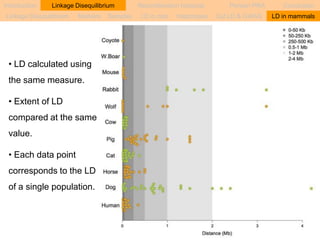
• LD calculated using 
the same measure. 
• Extent of LD 
compared at the same 
value. 
• Each data point 
corresponds to the LD 
of a single population.
Introduction Linkage Disequilibrium Recombination hotspots Persian PRA Conclusion 
LD Markers Samples LD in cats Haplotypes Cat LD & GWAS LD in mammals 
Conclusion 
• Extent of LD varies across chromosomal localities and among 
breeds. 
• LD of cat breeds reflects the demographic and breeding histories. 
• Eastern breeds exhibit larger extent of LD. Association studies in 
involving such breeds are likely to be successful. 
• Breeds such as Manx and Siberian (may be Persian) require a 
higher density SNP array or alternative approaches. 
Any questions?
Introduction Linkage Disequilibrium Recombination hotspots Persian PRA Conclusion 
A glance at recombination hotspots in the 
domestic cat 
Alhaddad, H., Zhang C., Rannala B., and Lyons L.A.
Introduction Linkage Disequilibrium Recombination hotspots Persian PRA Conclusion 
Objectives Hypotheses 
O: Use coalescent based methods to infer population 
parameters. 
O: Understand recombination hotspots in cats. 
H1: Population recombination rates vary at different genomic 
localities. 
H2: Variation in population recombination rate at different 
regions is due to the presence of specific genomic features 
(i.e. recombination hotspots)
Introduction Linkage Disequilibrium Recombination hotspots Persian PRA Conclusion 
Recombination Coalescent Markers samples program Estimates&interpretation Hot&warm-spots G. features 
Parent 
Recombination 
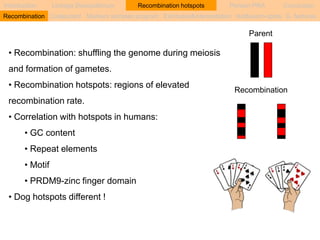
• Recombination: shuffling the genome during meiosis 
and formation of gametes. 
• Recombination hotspots: regions of elevated 
recombination rate. 
• Correlation with hotspots in humans: 
• GC content 
• Repeat elements 
• Motif 
• PRDM9-zinc finger domain 
• Dog hotspots different !
Introduction Linkage Disequilibrium Recombination hotspots Persian PRA Conclusion 
Recombination Coalescent Markers samples program Estimates&interpretation Hot&warm-spots G. features 
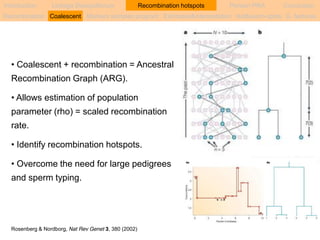
• Coalescent + recombination = Ancestral 
Recombination Graph (ARG). 
• Allows estimation of population 
parameter (rho) = scaled recombination 
rate. 
• Identify recombination hotspots. 
• Overcome the need for large pedigrees 
and sperm typing. 
Rosenberg & Nordborg, Nat Rev Genet 3, 380 (2002)
Introduction Linkage Disequilibrium Recombination hotspots Persian PRA Conclusion 
Recombination Coalescent Markers samples program Estimates&interpretation Hot&warm-spots G. features 
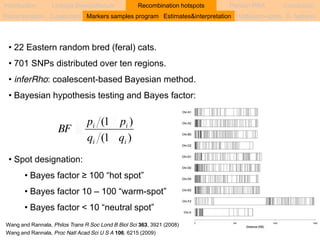
• 22 Eastern random bred (feral) cats. 
• 701 SNPs distributed over ten regions. 
• inferRho: coalescent-based Bayesian method. 
• Bayesian hypothesis testing and Bayes factor: 
BF 
• Spot designation: 
(1 ) 
p p 
i i 
q q 
(1 ) 
i i 
• Bayes factor ≥ 100 “hot spot” 
• Bayes factor 10 – 100 “warm-spot” 
• Bayes factor < 10 “neutral spot” 
Wang and Rannala, Philos Trans R Soc Lond B Biol Sci 363, 3921 (2008) 
Wang and Rannala, Proc Natl Acad Sci U S A 106, 6215 (2009)
Introduction Linkage Disequilibrium Recombination hotspots Persian PRA Conclusion 
Recombination Coalescent Markers samples program Estimates&interpretation Hot&warm-spots G. features 
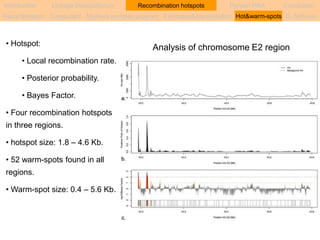
• Hotspot: Analysis of chromosome E2 region 
• Local recombination rate. 
• Posterior probability. 
• Bayes Factor. 
• Four recombination hotspots 
in three regions. 
• hotspot size: 1.8 – 4.6 Kb. 
• 52 warm-spots found in all 
regions. 
• Warm-spot size: 0.4 – 5.6 Kb.
Introduction Linkage Disequilibrium Recombination hotspots Persian PRA Conclusion 
Recombination Coalescent Markers samples program Estimates&interpretation Hot&warm-spots G. features 
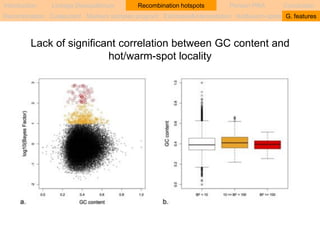
Lack of significant correlation between GC content and 
hot/warm-spot locality
Introduction Linkage Disequilibrium Recombination hotspots Persian PRA Conclusion 
Recombination Coalescent Markers samples program Estimates&interpretation Hot&warm-spots G. features 
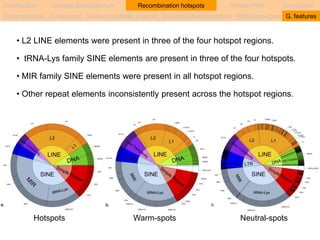
• L2 LINE elements were present in three of the four hotspot regions. 
• tRNA-Lys family SINE elements are present in three of the four hotspots. 
• MIR family SINE elements were present in all hotspot regions. 
• Other repeat elements inconsistently present across the hotspot regions. 
Hotspots Warm-spots Neutral-spots
Introduction Linkage Disequilibrium Recombination hotspots Persian PRA Conclusion 
Conclusion 
• Population recombination rate varies across regions examined. 
• Regions with higher recombination rates contain hotspots. 
• Four recombination hotspots were identified. 
• No correlation between GC content and hotspot locality (need 
more data). 
• L2, MIR, tRNA-Lys likely to be a signature of hotspots in cats 
(need more data). 
Any questions?
Introduction Linkage Disequilibrium Recombination hotspots Persian PRA Conclusion 
Localization of progressive retinal atrophy 
of Persian cats using genome-wide 
analyses 
Alhaddad, H., Gandolfi B., Grahn R.A., Rah H., Peterson C.B., Maggs 
D.J., Pedersen N.C., and Lyons L.A.
Introduction Linkage Disequilibrium Recombination hotspots Persian PRA Conclusion 
Objectives Hypotheses 
O: Evaluate genome-wide methods for cat pedigree data. 
O: Identify the causative mutation of PRA in Persian cats. 
H: Progressive Retinal Atrophy (PRA) of Persian cats can 
be localized using a dense genotype data of a family. 
H: The causative mutation can be identified using 
candidate gene approach.
Introduction Linkage Disequilibrium Recombination hotspots Persian PRA Conclusion 
PRA Samples Linkage TDT sib-TDT Case-Control Haplotype Candidate genes 
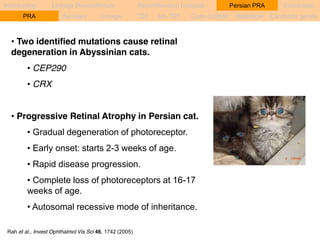
• Two identified mutations cause retinal 
degeneration in Abyssinian cats. 
• CEP290 
• CRX 
• Progressive Retinal Atrophy in Persian cat. 
• Gradual degeneration of photoreceptor. 
• Early onset: starts 2-3 weeks of age. 
• Rapid disease progression. 
• Complete loss of photoreceptors at 16-17 
weeks of age. 
• Autosomal recessive mode of inheritance. 
Rah et al., Invest Ophthalmol Vis Sci 46, 1742 (2005)
Introduction Linkage Disequilibrium Recombination hotspots Persian PRA Conclusion 
PRA Samples Linkage TDT sib-TDT Case-Control Haplotype Candidate genes 
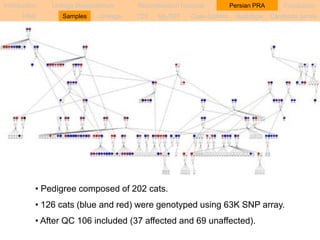
• Pedigree composed of 202 cats. 
• 126 cats (blue and red) were genotyped using 63K SNP array. 
• After QC 106 included (37 affected and 69 unaffected).
Introduction Linkage Disequilibrium Recombination hotspots Persian PRA Conclusion 
PRA Samples Linkage TDT sib-TDT Case-Control Haplotype Candidate genes 
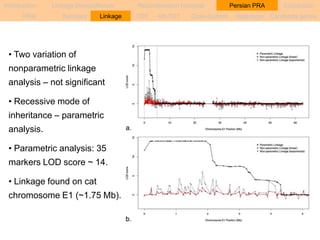
• Two variation of 
nonparametric linkage 
analysis – not significant 
• Recessive mode of 
inheritance – parametric 
analysis. 
• Parametric analysis: 35 
markers LOD score ~ 14. 
• Linkage found on cat 
chromosome E1 (~1.75 Mb).
Introduction Linkage Disequilibrium Recombination hotspots Persian PRA Conclusion 
PRA Samples Linkage TDT sib-TDT Case-Control Haplotype Candidate genes 
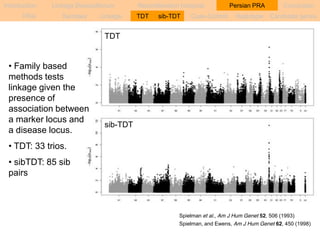
TDT 
sib-TDT 
Spielman et al., Am J Hum Genet 52, 506 (1993) 
Spielman, and Ewens, Am J Hum Genet 62, 450 (1998) 
• Family based 
methods tests 
linkage given the 
presence of 
association between 
a marker locus and 
a disease locus. 
• TDT: 33 trios. 
• sibTDT: 85 sib 
pairs
Introduction Linkage Disequilibrium Recombination hotspots Persian PRA Conclusion 
PRA Samples Linkage TDT sib-TDT Case-Control Haplotype Candidate genes 
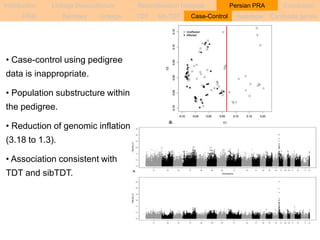
• Case-control using pedigree 
data is inappropriate. 
• Population substructure within 
the pedigree. 
• Reduction of genomic inflation 
(3.18 to 1.3). 
• Association consistent with 
TDT and sibTDT.
Introduction Linkage Disequilibrium Recombination hotspots Persian PRA Conclusion 
PRA Samples Linkage TDT sib-TDT Case-Control Haplotype Candidate genes 
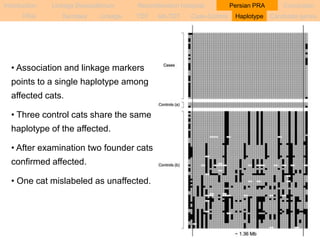
• Association and linkage markers 
points to a single haplotype among 
affected cats. 
• Three control cats share the same 
haplotype of the affected. 
• After examination two founder cats 
confirmed affected. 
• One cat mislabeled as unaffected.
Introduction Linkage Disequilibrium Recombination hotspots Persian PRA Conclusion 
PRA Samples Linkage TDT sib-TDT Case-Control Haplotype Candidate genes 
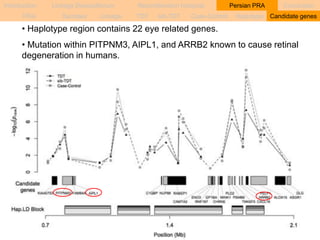
• Haplotype region contains 22 eye related genes. 
• Mutation within PITPNM3, AIPL1, and ARRB2 known to cause retinal 
degeneration in humans.
Introduction Linkage Disequilibrium Recombination hotspots Persian PRA Conclusion 
PRA Samples Linkage TDT sib-TDT Case-Control Haplotype Candidate genes 
Conclusion 
• Parametric linkage and various association analyses consistently 
points to the same region. 
• Progressive Retinal Atrophy of Persian cats was localized to ~ 
1.36Mb region on cat chromosome E1. 
• Three genes are likely candidates. 
Any questions?
Introduction Linkage Disequilibrium Recombination hotspots Persian PRA Conclusion 
Future Direction 
• Genome-wide estimation of LD in cats using 63K array. 
• Investigating recombination across the genome and 
studying genomic signatures of recombination hotspots. 
• Comparing recombination hotspots across different cat 
populations. 
• Investigating PRDM9 in cats and analyzing the motif 
recognition portion. 
• Studying PRA localized region via candidate gene 
sequencing, targeted sequencing, or whole genome 
sequencing. 
• Continue on the development of cat genetic resources.
Acknowledgments 
Dissertation Committee 
• Dr. Leslie A. Lyons (Chair) 
• Dr. Bruce Rannala 
• Dr. Jeffrey Ross-Ibarra 
Lyons Laboratory 
• Dr. Barbara Gandolfi 
• Dr Robert A. Grahn 
• Razib Khan 
• Many grad students 
• Many Many cool undergrads 
CCAH 
• Dr. Niels Pederson and lab 
• Dr. Ben Sacks and lab 
• Dr. Holly Ernest and lab 
Collaborator 
• Dr. Chi Zhang 
GGG 
• Carolyn Yrigollen 
• Gavin Rice 
•Lattha Souvannaseng 
• Rebecca Nitcher 
• My cohort (Fall 2009) 
• All GGG students 
• Demian Sainz 
• Ellen Picht 
Vet genetics lab 
• All are cool

Alhaddad Exit Seminar

  • 1.
    Linkage Disequilibrium and Recombination in the Domestic Cat: Applications to Genome-wide Association and Linkage Studies Hasan Alhaddad Advisor: Dr. Leslie Lyons
  • 2.
    Presentation Overview •Introduction • Linkage disequilibrium in cats • Population recombination rate and recombination hotspots • Genome-wide analyses of progressive retinal atrophy in Persian cats • Conclusion • Acknowledgments
  • 3.
    Introduction Linkage DisequilibriumRecombination hotspots Persian PRA Conclusion A bit of history Cat domestication Cat breeds Phenotype genetics Disease genetics Genetic resources “An Angora cat and a regular male cat (first generation) have produced only regular cats (second generation). If you looked at them, you would give the father a high significance. The young cats however had a lot of Angora blood despite their regular look. That is because after mating two of the same, there was in the third generation besides regular also a female Angora cat (unchanged). The chance for Angora blood may be even better in the fourth generation. We would have not reached that conclusion if we only relied on the visible traits and hence we should not trust them, because how would two regular cats produce an Angora cat?” C. Nägeli, 1884
  • 4.
    Introduction Linkage DisequilibriumRecombination hotspots Persian PRA Conclusion A bit of history Cat domestication Cat breeds Phenotype genetics Disease genetics Genetic resources Personal synthesis a. Ecological domestication b. Selection from standing variation in RB c. Selection from standing variation in breed d. Breeds from de novo mutation e. Hybridizing two (more) breeds f. Interspecies hybridization
  • 5.
    Introduction Linkage DisequilibriumRecombination hotspots Persian PRA Conclusion A bit of history Cat domestication Cat breeds Phenotype genetics Disease genetics Genetic resources • What is a cat breed? • Breeders vs. Genetics? • Cat Fancy Association (CFA) recognizes 40 breeds. • The International Cat Association (TICA) recognizes 55 breeds. • Cat breed designation is interesting and challenging.
  • 6.
    Introduction Linkage DisequilibriumRecombination hotspots Persian PRA Conclusion A bit of history Cat domestication Cat breeds Phenotype genetics Disease genetics Genetic resources Variation within FGF5 (long hair) differentiate between Persian Filler et al., J Hered, (2012) Gandolfi et al., Scientific Reports, (2013) and Exotic shorthair cats
  • 7.
    Introduction Linkage DisequilibriumRecombination hotspots Persian PRA Conclusion A bit of history Cat domestication Cat breeds Phenotype genetics Disease genetics Genetic resources CFA registry record of cat breeds for the period 1958-2011 (1,901,585 cats)
  • 8.
    Introduction Linkage DisequilibriumRecombination hotspots Persian PRA Conclusion A bit of history Cat domestication Cat breeds Phenotype genetics Disease genetics Genetic resources
  • 9.
    Introduction Linkage DisequilibriumRecombination hotspots Persian PRA Conclusion A bit of history Cat domestication Cat breeds Phenotype genetics Disease genetics Genetic resources Burmese Hypokalemia Head defect Oralfacial pain Persian family Polycystic Kidney Retinal degeneration Osteochondroplasia Diabetes Hypertrophic cardiomyopathy
  • 10.
    Introduction Linkage DisequilibriumRecombination hotspots Persian PRA Conclusion A bit of history Cat domestication Cat breeds Phenotype genetics Disease genetics Genetic resources • Somatic cell hybrid panels O’Brien and Nash, Science 1982 • Intra-inter species linkage map Menotti-Raymond et al., Genomics 1999 Menotti-Raymond et al., Journal of Heredity 2003 Menotti-Raymond et al., Genomics 2009 • RH panel Murphy et al., Genome Research 2000 Bach et al., Cytogenet Genome Res 2012 • Genome sequencing Pontius et al., Genome Research 2007 – 2X ~ 60% genome Mullikin et al., BMC Genomics 2010 – 3X ~ 80% genome and 1,000,000 SNPs • 63K Illumina Array chip
  • 11.
    Introduction Linkage DisequilibriumRecombination hotspots Persian PRA Conclusion
  • 12.
    Introduction Linkage DisequilibriumRecombination hotspots Persian PRA Conclusion Objectives Hypotheses O1: Estimate the extent of LD in cats. O2: Provide insights for design of GWA studies. H1: Linkage disequilibrium varies across populations and genomic regions. H2: Variation in linkage disequilibrium among populations reflects population histories.
  • 13.
    Introduction Linkage DisequilibriumRecombination hotspots Persian PRA Conclusion Linkage Disequilibrium Markers Samples LD in cats Haplotypes Cat LD & GWAS LD in mammals • Linkage disequilibrium is the non-random association of alleles at different loci in a gamete.
  • 14.
    Introduction Linkage DisequilibriumRecombination hotspots Persian PRA Conclusion Markers Samples LD in cats Haplotypes Cat LD & GWAS LD in mammals • LD is measured as the difference between the frequency of a haplotype and the frequencies of the alleles. D` = DAB , where Dmax = { min (PA PB, Pa Pb), when DAB < 0 Dmax min (PA Pb, Pa PB), when DAB > 0 • Squared correlation coefficient r2 = D2 PA Pa PB Pb • Normalized D` (D prime) DAB = PAB – PAPB Linkage Disequilibrium
  • 15.
    Introduction Linkage DisequilibriumRecombination hotspots Persian PRA Conclusion Markers Samples LD in cats Haplotypes Cat LD & GWAS LD in mammals LD decay and comparison across populations Linkage Disequilibrium Hill and Weir, Theor Popul Biol 33, 54 (1988)
  • 16.
    Introduction Linkage DisequilibriumRecombination hotspots Persian PRA Conclusion Markers Samples LD in cats Haplotypes Cat LD & GWAS LD in mammals Linkage Disequilibrium • A custom Illumina GoldenGate array (1536 SNPs). • Ten (1 Mb) regions from various locations relative to centromere. • ~ 150 SNPs/region with higher density of marker in one end of the region.
  • 17.
    Introduction Linkage DisequilibriumRecombination hotspots Persian PRA Conclusion Markers Samples LD in cats Haplotypes Cat LD & GWAS LD in mammals 18 breeds 2 random bred populations Total of 408 samples ~ 18 cats/population Breed cats pedigreed verified to be unrelated to the grandparent level Linkage Disequilibrium
  • 18.
    Introduction Linkage DisequilibriumRecombination hotspots Persian PRA Conclusion Markers Samples LD in cats Haplotypes Cat LD & GWAS LD in mammals Extent of LD in cats on each chromosomal region Linkage Disequilibrium
  • 19.
    Introduction Linkage DisequilibriumRecombination hotspots Persian PRA Conclusion Markers Samples LD in cats Haplotypes Cat LD & GWAS LD in mammals Linkage Disequilibrium • Lowest LD among breeds found in Siberian and Manx breed (~ 20Kb). These breeds largely resemble a random bred population. • Highest LD (> 200 Kb) found in Eastern breeds (Birman, Burmese, and Siamese). These breeds are known to have restricted phenotypes and under selection for very defined phenotypes. • Persian cats exhibit moderate LD (~ 75 Kb) compared to other breeds and is consistent with the large population size of the breed.
  • 20.
    Introduction Linkage DisequilibriumRecombination hotspots Persian PRA Conclusion Linkage Disequilibrium Markers Samples LD in cats Haplotypes Cat LD & GWAS LD in mammals
  • 21.
    Introduction Linkage DisequilibriumRecombination hotspots Persian PRA Conclusion Markers Samples LD in cats Haplotypes Cat LD & GWAS LD in mammals Linkage Disequilibrium • Eastern Breeds have higher fractions of SNPs useful for GWA studies. • Association studies for phenotypic vs. disease traits. • Successes so far.
  • 22.
    Introduction Linkage DisequilibriumRecombination hotspots Persian PRA Conclusion Linkage Disequilibrium Markers Samples LD in cats Haplotypes Cat LD & GWAS LD in mammals • LD calculated using the same measure. • Extent of LD compared at the same value. • Each data point corresponds to the LD of a single population.
  • 23.
    Introduction Linkage DisequilibriumRecombination hotspots Persian PRA Conclusion LD Markers Samples LD in cats Haplotypes Cat LD & GWAS LD in mammals Conclusion • Extent of LD varies across chromosomal localities and among breeds. • LD of cat breeds reflects the demographic and breeding histories. • Eastern breeds exhibit larger extent of LD. Association studies in involving such breeds are likely to be successful. • Breeds such as Manx and Siberian (may be Persian) require a higher density SNP array or alternative approaches. Any questions?
  • 24.
    Introduction Linkage DisequilibriumRecombination hotspots Persian PRA Conclusion A glance at recombination hotspots in the domestic cat Alhaddad, H., Zhang C., Rannala B., and Lyons L.A.
  • 25.
    Introduction Linkage DisequilibriumRecombination hotspots Persian PRA Conclusion Objectives Hypotheses O: Use coalescent based methods to infer population parameters. O: Understand recombination hotspots in cats. H1: Population recombination rates vary at different genomic localities. H2: Variation in population recombination rate at different regions is due to the presence of specific genomic features (i.e. recombination hotspots)
  • 26.
    Introduction Linkage DisequilibriumRecombination hotspots Persian PRA Conclusion Recombination Coalescent Markers samples program Estimates&interpretation Hot&warm-spots G. features Parent Recombination • Recombination: shuffling the genome during meiosis and formation of gametes. • Recombination hotspots: regions of elevated recombination rate. • Correlation with hotspots in humans: • GC content • Repeat elements • Motif • PRDM9-zinc finger domain • Dog hotspots different !
  • 27.
    Introduction Linkage DisequilibriumRecombination hotspots Persian PRA Conclusion Recombination Coalescent Markers samples program Estimates&interpretation Hot&warm-spots G. features • Coalescent + recombination = Ancestral Recombination Graph (ARG). • Allows estimation of population parameter (rho) = scaled recombination rate. • Identify recombination hotspots. • Overcome the need for large pedigrees and sperm typing. Rosenberg & Nordborg, Nat Rev Genet 3, 380 (2002)
  • 28.
    Introduction Linkage DisequilibriumRecombination hotspots Persian PRA Conclusion Recombination Coalescent Markers samples program Estimates&interpretation Hot&warm-spots G. features • 22 Eastern random bred (feral) cats. • 701 SNPs distributed over ten regions. • inferRho: coalescent-based Bayesian method. • Bayesian hypothesis testing and Bayes factor: BF • Spot designation: (1 ) p p i i q q (1 ) i i • Bayes factor ≥ 100 “hot spot” • Bayes factor 10 – 100 “warm-spot” • Bayes factor < 10 “neutral spot” Wang and Rannala, Philos Trans R Soc Lond B Biol Sci 363, 3921 (2008) Wang and Rannala, Proc Natl Acad Sci U S A 106, 6215 (2009)
  • 29.
    Introduction Linkage DisequilibriumRecombination hotspots Persian PRA Conclusion Recombination Coalescent Markers samples program Estimates&interpretation Hot&warm-spots G. features • Hotspot: Analysis of chromosome E2 region • Local recombination rate. • Posterior probability. • Bayes Factor. • Four recombination hotspots in three regions. • hotspot size: 1.8 – 4.6 Kb. • 52 warm-spots found in all regions. • Warm-spot size: 0.4 – 5.6 Kb.
  • 30.
    Introduction Linkage DisequilibriumRecombination hotspots Persian PRA Conclusion Recombination Coalescent Markers samples program Estimates&interpretation Hot&warm-spots G. features Lack of significant correlation between GC content and hot/warm-spot locality
  • 31.
    Introduction Linkage DisequilibriumRecombination hotspots Persian PRA Conclusion Recombination Coalescent Markers samples program Estimates&interpretation Hot&warm-spots G. features • L2 LINE elements were present in three of the four hotspot regions. • tRNA-Lys family SINE elements are present in three of the four hotspots. • MIR family SINE elements were present in all hotspot regions. • Other repeat elements inconsistently present across the hotspot regions. Hotspots Warm-spots Neutral-spots
  • 32.
    Introduction Linkage DisequilibriumRecombination hotspots Persian PRA Conclusion Conclusion • Population recombination rate varies across regions examined. • Regions with higher recombination rates contain hotspots. • Four recombination hotspots were identified. • No correlation between GC content and hotspot locality (need more data). • L2, MIR, tRNA-Lys likely to be a signature of hotspots in cats (need more data). Any questions?
  • 33.
    Introduction Linkage DisequilibriumRecombination hotspots Persian PRA Conclusion Localization of progressive retinal atrophy of Persian cats using genome-wide analyses Alhaddad, H., Gandolfi B., Grahn R.A., Rah H., Peterson C.B., Maggs D.J., Pedersen N.C., and Lyons L.A.
  • 34.
    Introduction Linkage DisequilibriumRecombination hotspots Persian PRA Conclusion Objectives Hypotheses O: Evaluate genome-wide methods for cat pedigree data. O: Identify the causative mutation of PRA in Persian cats. H: Progressive Retinal Atrophy (PRA) of Persian cats can be localized using a dense genotype data of a family. H: The causative mutation can be identified using candidate gene approach.
  • 35.
    Introduction Linkage DisequilibriumRecombination hotspots Persian PRA Conclusion PRA Samples Linkage TDT sib-TDT Case-Control Haplotype Candidate genes • Two identified mutations cause retinal degeneration in Abyssinian cats. • CEP290 • CRX • Progressive Retinal Atrophy in Persian cat. • Gradual degeneration of photoreceptor. • Early onset: starts 2-3 weeks of age. • Rapid disease progression. • Complete loss of photoreceptors at 16-17 weeks of age. • Autosomal recessive mode of inheritance. Rah et al., Invest Ophthalmol Vis Sci 46, 1742 (2005)
  • 36.
    Introduction Linkage DisequilibriumRecombination hotspots Persian PRA Conclusion PRA Samples Linkage TDT sib-TDT Case-Control Haplotype Candidate genes • Pedigree composed of 202 cats. • 126 cats (blue and red) were genotyped using 63K SNP array. • After QC 106 included (37 affected and 69 unaffected).
  • 37.
    Introduction Linkage DisequilibriumRecombination hotspots Persian PRA Conclusion PRA Samples Linkage TDT sib-TDT Case-Control Haplotype Candidate genes • Two variation of nonparametric linkage analysis – not significant • Recessive mode of inheritance – parametric analysis. • Parametric analysis: 35 markers LOD score ~ 14. • Linkage found on cat chromosome E1 (~1.75 Mb).
  • 38.
    Introduction Linkage DisequilibriumRecombination hotspots Persian PRA Conclusion PRA Samples Linkage TDT sib-TDT Case-Control Haplotype Candidate genes TDT sib-TDT Spielman et al., Am J Hum Genet 52, 506 (1993) Spielman, and Ewens, Am J Hum Genet 62, 450 (1998) • Family based methods tests linkage given the presence of association between a marker locus and a disease locus. • TDT: 33 trios. • sibTDT: 85 sib pairs
  • 39.
    Introduction Linkage DisequilibriumRecombination hotspots Persian PRA Conclusion PRA Samples Linkage TDT sib-TDT Case-Control Haplotype Candidate genes • Case-control using pedigree data is inappropriate. • Population substructure within the pedigree. • Reduction of genomic inflation (3.18 to 1.3). • Association consistent with TDT and sibTDT.
  • 40.
    Introduction Linkage DisequilibriumRecombination hotspots Persian PRA Conclusion PRA Samples Linkage TDT sib-TDT Case-Control Haplotype Candidate genes • Association and linkage markers points to a single haplotype among affected cats. • Three control cats share the same haplotype of the affected. • After examination two founder cats confirmed affected. • One cat mislabeled as unaffected.
  • 41.
    Introduction Linkage DisequilibriumRecombination hotspots Persian PRA Conclusion PRA Samples Linkage TDT sib-TDT Case-Control Haplotype Candidate genes • Haplotype region contains 22 eye related genes. • Mutation within PITPNM3, AIPL1, and ARRB2 known to cause retinal degeneration in humans.
  • 42.
    Introduction Linkage DisequilibriumRecombination hotspots Persian PRA Conclusion PRA Samples Linkage TDT sib-TDT Case-Control Haplotype Candidate genes Conclusion • Parametric linkage and various association analyses consistently points to the same region. • Progressive Retinal Atrophy of Persian cats was localized to ~ 1.36Mb region on cat chromosome E1. • Three genes are likely candidates. Any questions?
  • 43.
    Introduction Linkage DisequilibriumRecombination hotspots Persian PRA Conclusion Future Direction • Genome-wide estimation of LD in cats using 63K array. • Investigating recombination across the genome and studying genomic signatures of recombination hotspots. • Comparing recombination hotspots across different cat populations. • Investigating PRDM9 in cats and analyzing the motif recognition portion. • Studying PRA localized region via candidate gene sequencing, targeted sequencing, or whole genome sequencing. • Continue on the development of cat genetic resources.
  • 44.
    Acknowledgments Dissertation Committee • Dr. Leslie A. Lyons (Chair) • Dr. Bruce Rannala • Dr. Jeffrey Ross-Ibarra Lyons Laboratory • Dr. Barbara Gandolfi • Dr Robert A. Grahn • Razib Khan • Many grad students • Many Many cool undergrads CCAH • Dr. Niels Pederson and lab • Dr. Ben Sacks and lab • Dr. Holly Ernest and lab Collaborator • Dr. Chi Zhang GGG • Carolyn Yrigollen • Gavin Rice •Lattha Souvannaseng • Rebecca Nitcher • My cohort (Fall 2009) • All GGG students • Demian Sainz • Ellen Picht Vet genetics lab • All are cool