“Benefiting from
a Quality Problem
   Management
    Program”

Eliminating recurring problems from         Peter McGarahan
     impacting the organization,           President / Founder
      employee productivity and
                                         McGarahan & Associates
 increasing the total cost of support.
About The Speaker


•   12 years with PepsiCo/Taco Bell IT and Business
    Planning
•   Managed the Service Desk and all of the IT
    Infrastructure for 4500 restaurants, 8 zone offices,
    field managers and Corporate office
•   2 years as a Product Manager for Vantive
•   Executive Director for HDI
•   6 years with STI Knowledge/Help Desk 2000
•   Founder, McGarahan & Associates (7 years)
•   McGarahan & Associates delivers service and support
    best practice consulting delivered through
    assessment / findings / recommendations /
    continuous improvement roadmap.
•   Retired Chairman, IT Infrastructure Management


                                                                          2
3
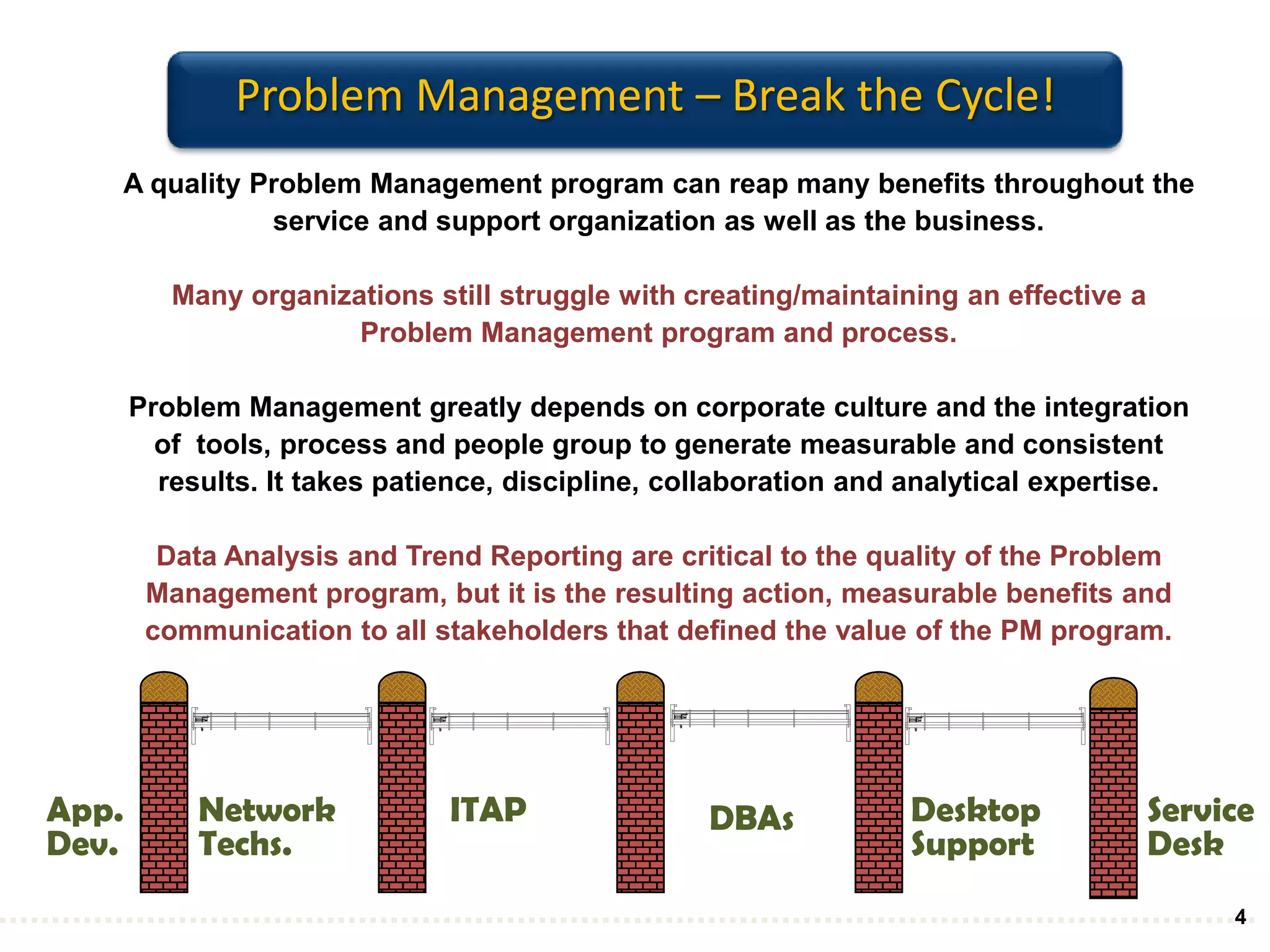
Problem Management – Break the Cycle!
   A quality Problem Management program can reap many benefits throughout the
              service and support organization as well as the business.

          Many organizations still struggle with creating/maintaining an effective a
                       Problem Management program and process.

       Problem Management greatly depends on corporate culture and the integration
         of tools, process and people group to generate measurable and consistent
         results. It takes patience, discipline, collaboration and analytical expertise.

         Data Analysis and Trend Reporting are critical to the quality of the Problem
        Management program, but it is the resulting action, measurable benefits and
        communication to all stakeholders that defined the value of the PM program.


App.        Network            ITAP                DBAs           Desktop              Service
Dev.        Techs.                                                Support              Desk
                                                                                            4
Right Work, Right People & Right Reasons.

Know Call Types.

Speed to Resolution.

Reduce Customer Contacts.

Make Knowledge Work.

Provide Resolutions Close to Customer.

                                            5
Service Strategy & Design - A Fresh Start

                         Design customer-centric services
                            that improve service delivery
                            (service level management),
                        enhancing the customer experience
                        through organizational flexibility, tool
                          integration, process efficiency &
                                people effectiveness.


       Create a service strategy

  Develop business aligned goals & objectives
       Deliver service excellence
                                                                   6
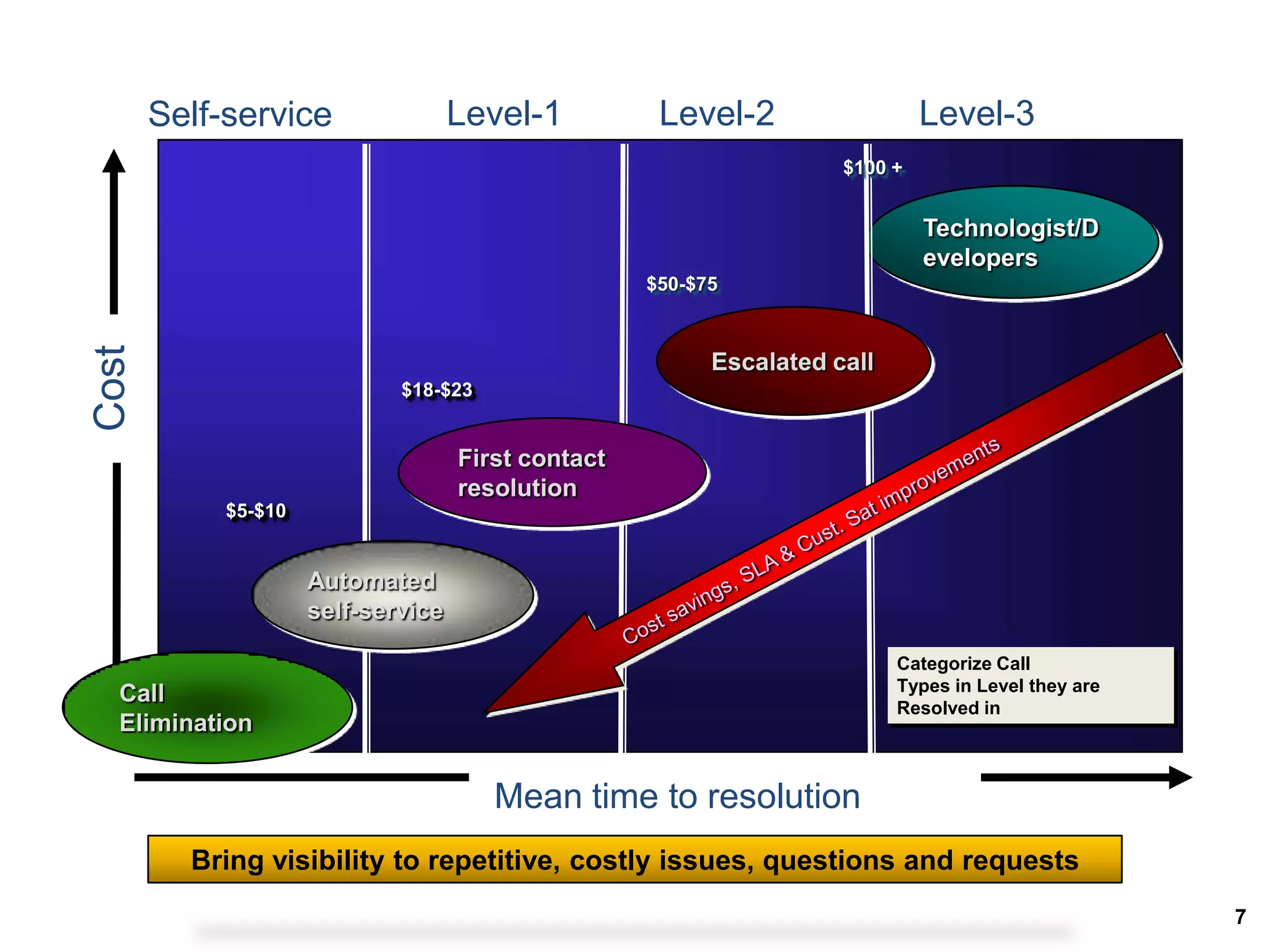
Self-service                 Level-1          Level-2                  Level-3
                                                                     $100 +


                                                                              Technologist/D
                                                                              evelopers
                                                    $50-$75
Cost


                                                          Escalated call
                             $18-$23


                                    First contact
                                    resolution
            $5-$10


                     Automated
                     self-service

                                                                           Categorize Call
                                                                           Types in Level they are
  Call
                                                                           Resolved in
  Elimination


                                       Mean time to resolution
         Bring visibility to repetitive, costly issues, questions and requests
                                                                                                     7
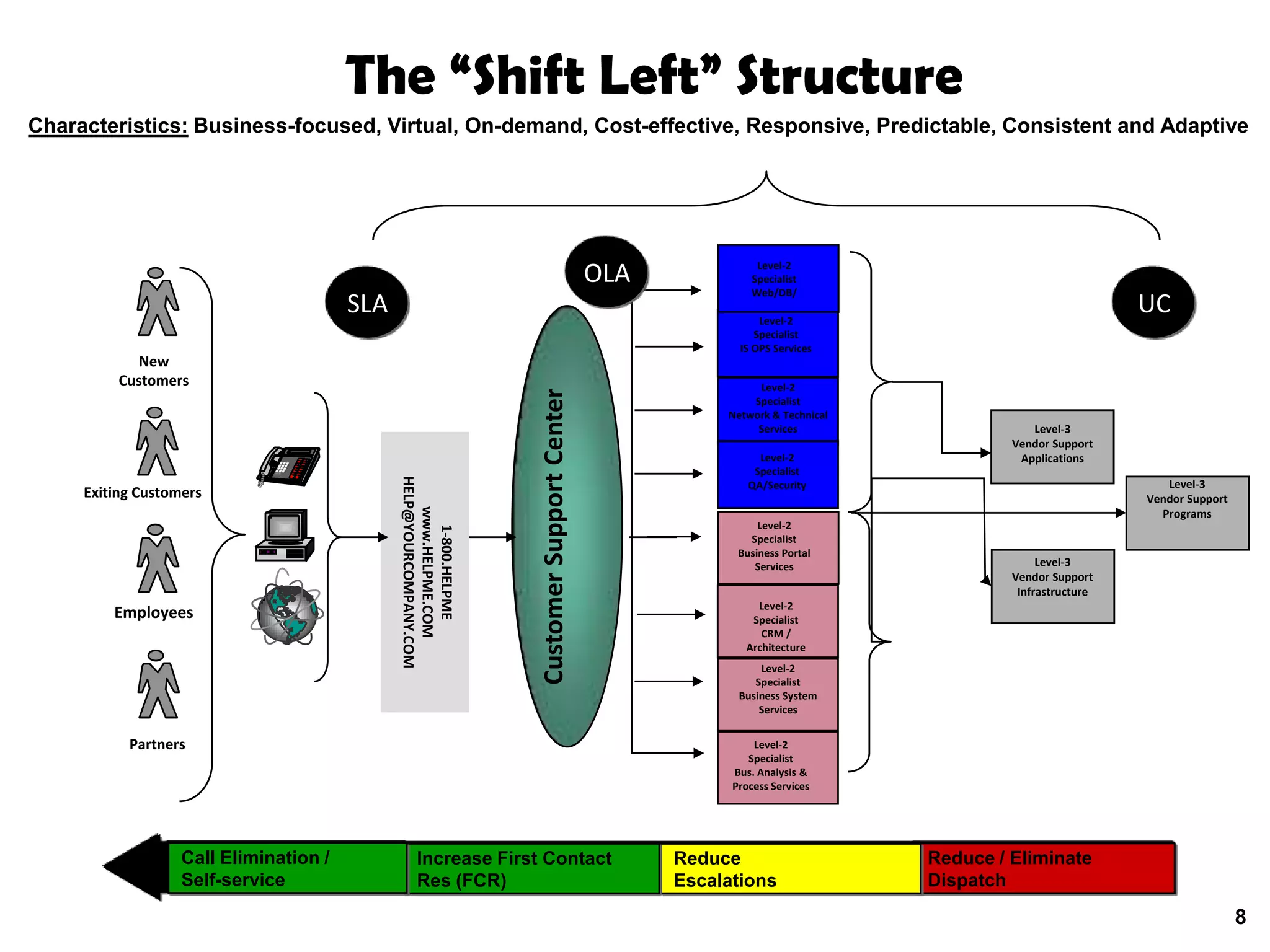
The “Shift Left” Structure
Characteristics: Business-focused, Virtual, On-demand, Cost-effective, Responsive, Predictable, Consistent and Adaptive


                                                                                                               Level-2
                                                                                               OLA            Specialist
                                                                                                              Web/DB/
                                        SLA                                                                     Level-2
                                                                                                                                                           UC
                                                                                                               Specialist
                                                                                                            IS OPS Services
             New
          Customers                                                                                            Level-2


                                                                     Customer Support Center
                                                                                                              Specialist
                                                                                                          Network & Technical
                                                                                                               Services                     Level-3
                                                                                                                                         Vendor Support
                                                                                                                Level-2                   Applications
                                                                                                               Specialist
                                              HELP@YOURCOMPANY.COM


                                                                                                              QA/Security                                     Level-3
     Exiting Customers                                                                                                                                     Vendor Support
                                                  www.HELPME.COM


                                                                                                                                                             Programs
                                                                                                                Level-2
                                                    1-800.HELPME


                                                                                                              Specialist
                                                                                                            Business Portal
                                                                                                               Services                       Level-3
                                                                                                                                         Vendor Support
                                                                                                                                          Infrastructure
                                                                                                               Level-2
         Employees                                                                                            Specialist
                                                                                                                CRM /
                                                                                                             Architecture
                                                                                                                Level-2
                                                                                                               Specialist
                                                                                                            Business System
                                                                                                                Services


           Partners                                                                                            Level-2
                                                                                                              Specialist
                                                                                                           Bus. Analysis &
                                                                                                           Process Services


                   Call Elimination /               Increase First Contact                           Reduce                     Reduce / Eliminate
                   Self-service                     Res (FCR)                                        Escalations                Dispatch

                                                                                                                                                                            8
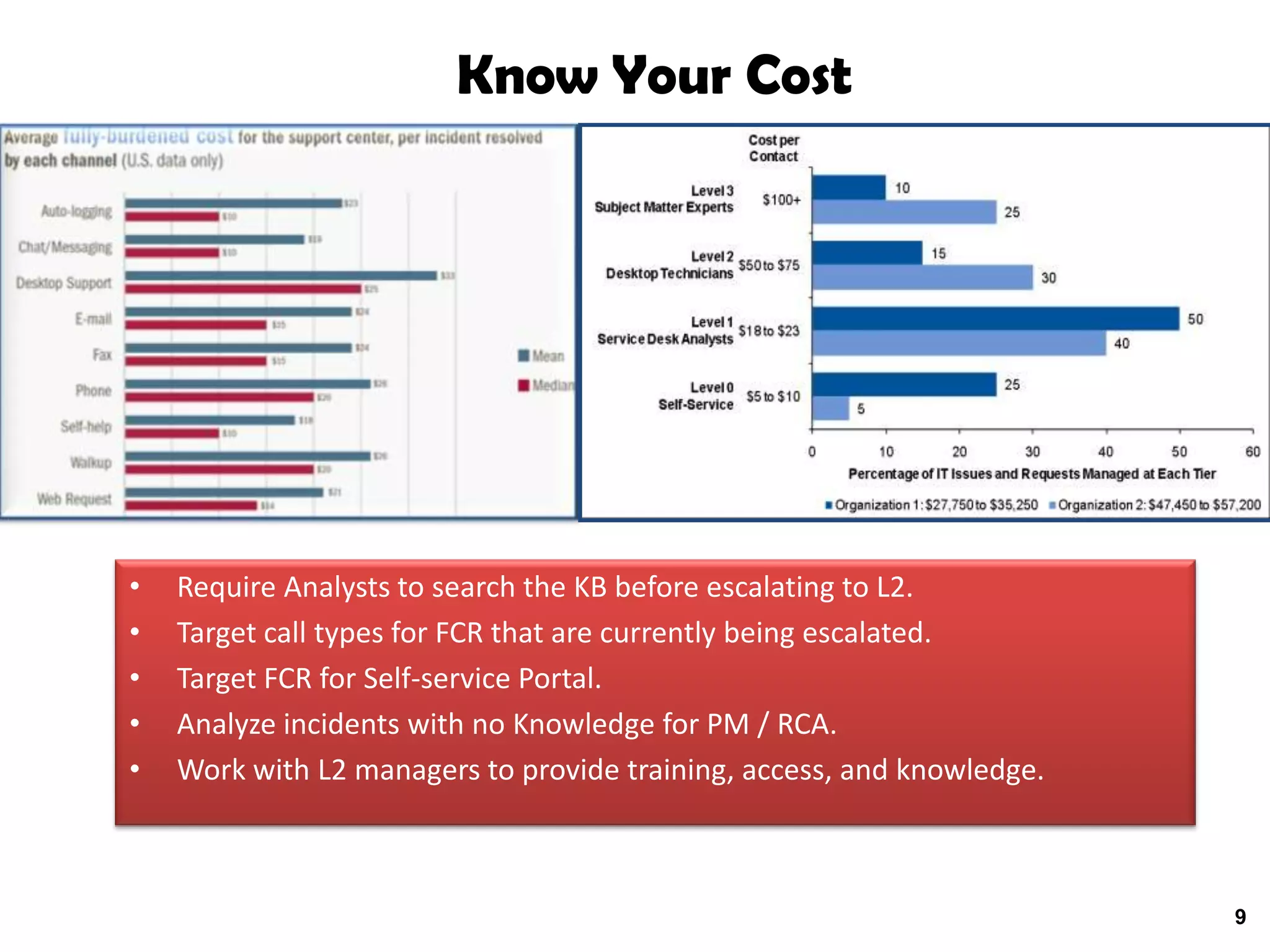
Know Your Cost


•   Require Analysts to search the KB before escalating to L2.
•   Target call types for FCR that are currently being escalated.
•   Target FCR for Self-service Portal.
•   Analyze incidents with no Knowledge for PM / RCA.
•   Work with L2 managers to provide training, access, and knowledge.


                                    Source: HDI Practice & Salary Guide / Gartner Research   9
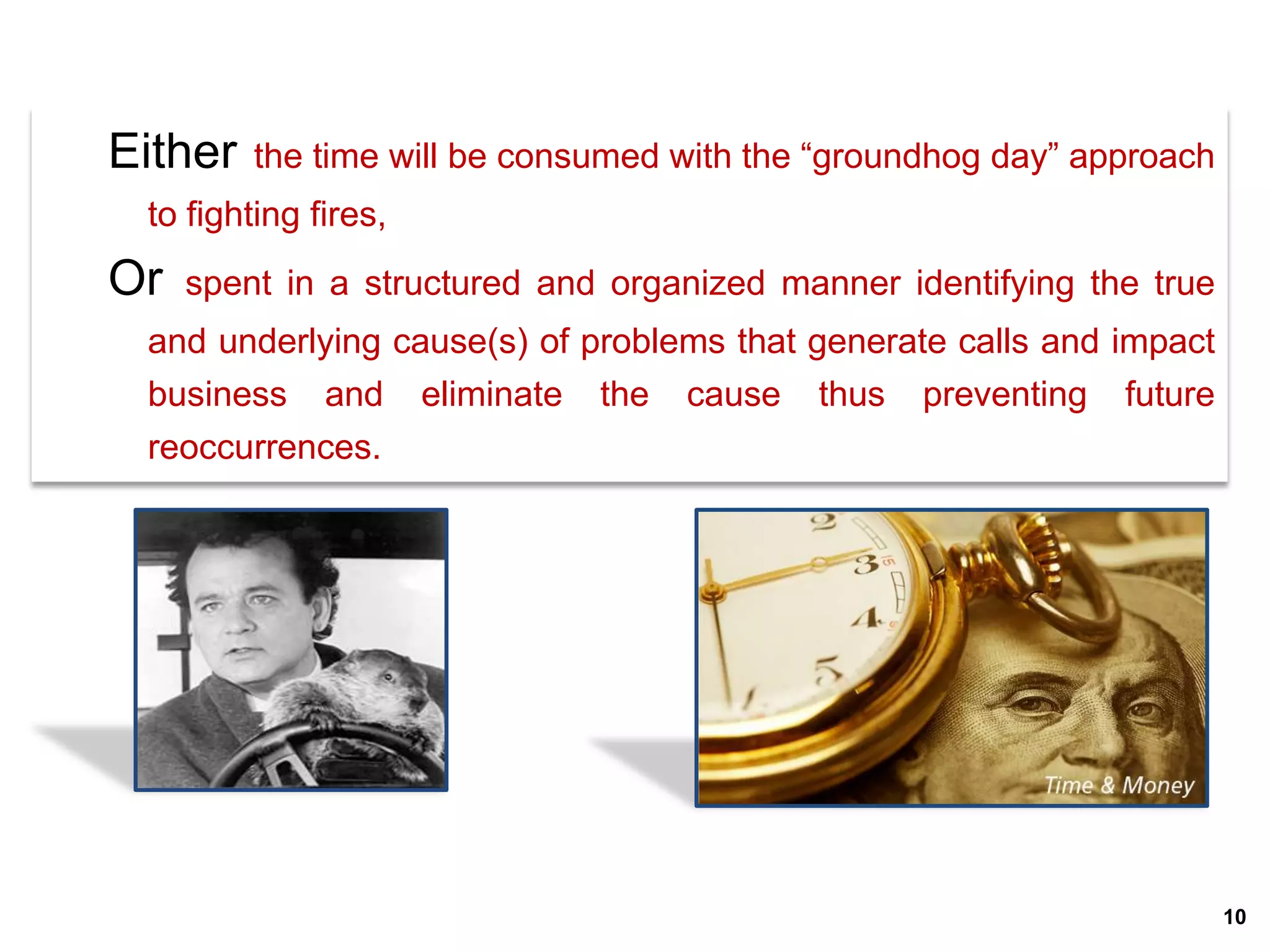
Either   the time will be consumed with the “groundhog day” approach
 to fighting fires,
Or   spent in a structured and organized manner identifying the true
 and underlying cause(s) of problems that generate calls and impact
 business and eliminate the cause thus preventing future
 reoccurrences.


                                                                       10
What To Do, Simply!
      Step1: Finding the root cause of issues, documenting and
       communicating the “work-arounds” to Level-1 & Level-2.

Step 2: Indentifying / Justifying a permanent solution or “fix” targeted at
the problem’s root cause, approved by Change and Released into the
production environment eliminating the incidents / calls caused by the
                                  problem.

How the Service Desk Adds Value:
    – Focus on accurate and complete incident record logging.
    – Categorize / Prioritize accurately for easy reporting.
    – Flag the escalated incidents with no workaround / knowledge.
    – Analyze the high priority (business impact) incidents, the most
      frequently escalated and the longest Mean Time to Resolve (MTTR) as
      PM targets.


                                                                              11
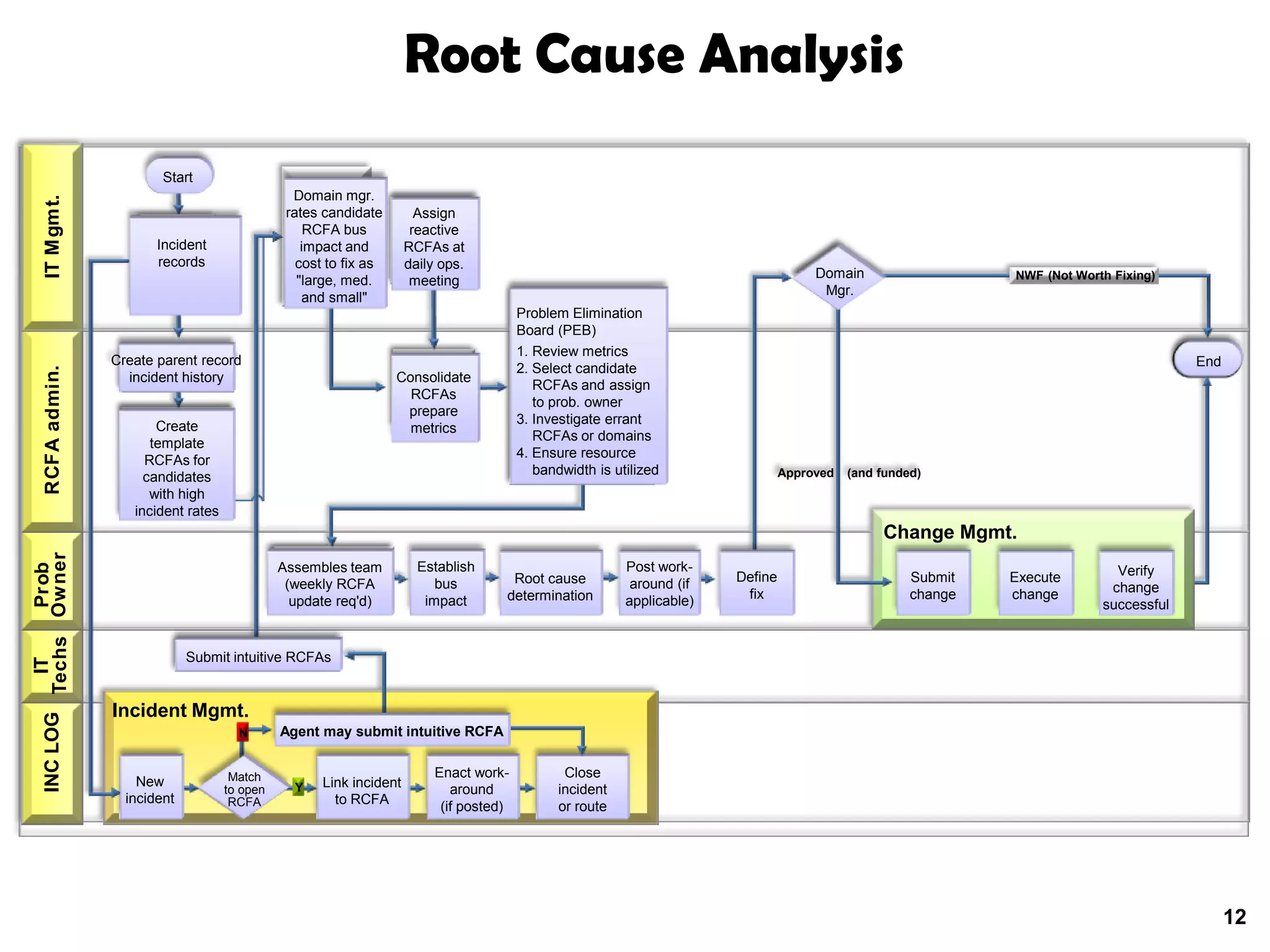
Root Cause Analysis
                              Start
                                                      Domain mgr.
     IT M gmt.


                                                     rates candidate         Assign
                                                         RCFA bus           reactive
                             Incident                   impact and         RCFAs at
                             records                   cost to fix as      daily ops.
                                                       "large, med.                                                                          Domain                   NWF (Not Worth Fixing)
                                                                            meeting
                                                        and small"                                                                            Mgr.
                                                                                               Problem Elimination
                                                                                               Board (PEB)
                                                                                               1. Review metrics
                      Create parent record                                                                                                                                                      End
                                                                                               2. Select candidate
     RCFA admin.


                        incident history                                Consolidate
                                                                                                  RCFAs and assign
                                                                          RCFAs
                                                                                                  to prob. owner
                                                                         prepare
                                                                                               3. Investigate errant
                             Create                                       metrics
                                                                                                  RCFAs or domains
                            template
                                                                                               4. Ensure resource
                           RCFAs for
                                                                                                  bandwidth is utilized                 Approved   (and funded)
                           candidates
                            with high
                         incident rates
                                                                                                                                                        Change Mgmt.
INC LOG Techs Owner


                                                    Assembles team           Establish                           Post work-
               Prob


                                                                                                                               Define                        Submit   Execute        Verify
                                                     (weekly RCFA               bus         Root cause            around (if
                                                                                                                                fix                          change   change        change
                                                      update req'd)           impact       determination         applicable)                                                       successful


                                   Submit intuitive RCFAs
          IT


                      Incident Mgmt.
                                            N       Agent may submit intuitive RCFA


                                           Match                                Enact work-            Close
                          New                         Y    Link incident
                                          to open                                  around             incident
                        incident           RCFA              to RCFA             (if posted)          or route


                                                                                                                                                                                                      12
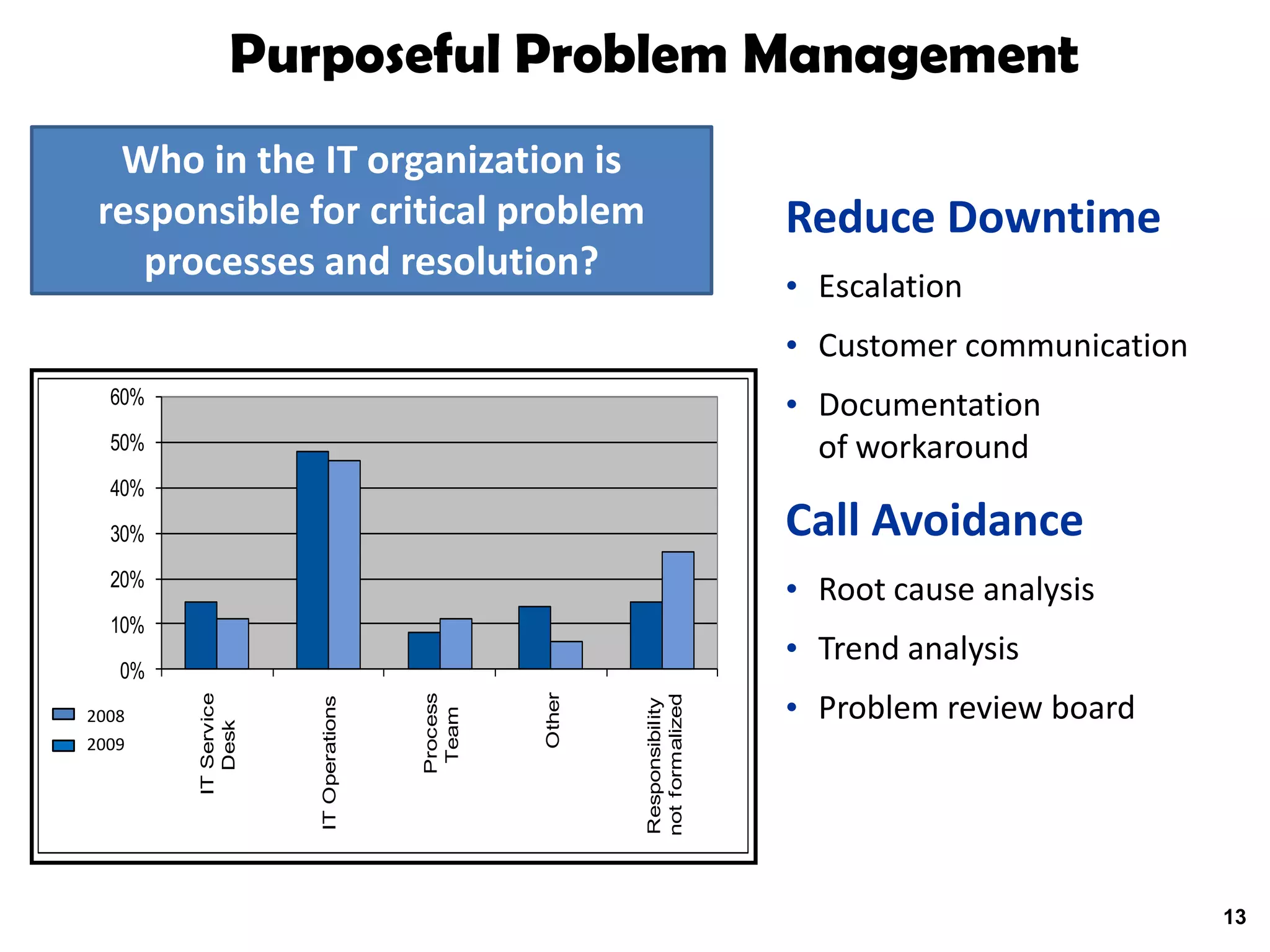
Purposeful Problem Management
  Who in the IT organization is
 responsible for critical problem                                       Reduce Downtime
    processes and resolution?
                                                                        • Escalation
                                                                        • Customer communication
  60%                                                                   • Documentation
  50%                                                                     of workaround
  40%
  30%                                                                   Call Avoidance
  20%
                                                                        • Root cause analysis
  10%
                                                                        • Trend analysis
   0%
                                                                        • Problem review board
                                               Other
        IT Service


                                     Process


                                                       not formalized
                     IT Operations


                                                       Responsibility
                                      Team


2008
           Desk


2009


                                                                                                   13
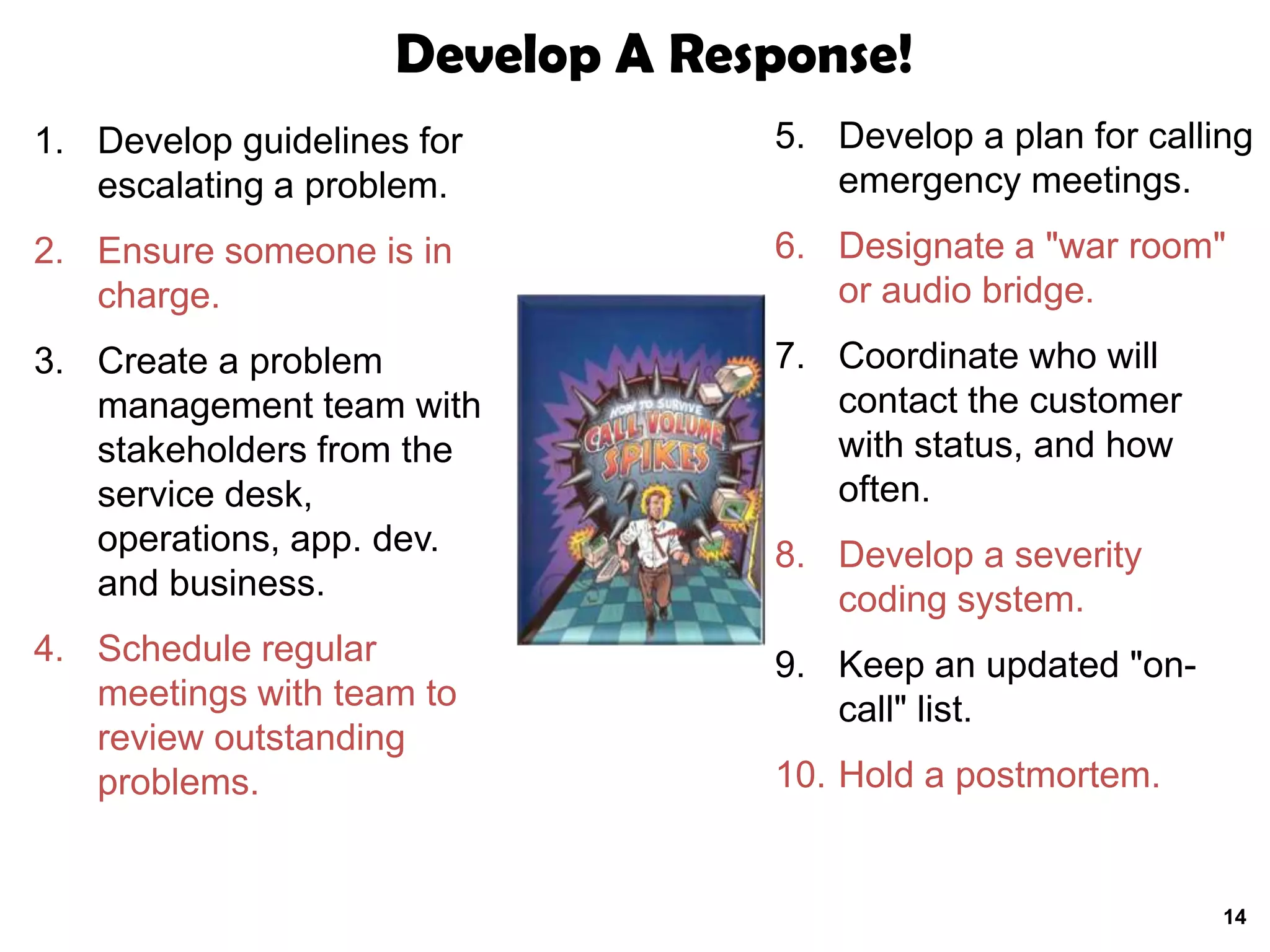
Develop A Response!
1. Develop guidelines for         5. Develop a plan for calling
   escalating a problem.             emergency meetings.
2. Ensure someone is in           6. Designate a "war room"
   charge.                           or audio bridge.
3. Create a problem               7. Coordinate who will
   management team with              contact the customer
   stakeholders from the             with status, and how
   service desk,                     often.
   operations, app. dev.          8. Develop a severity
   and business.                     coding system.
4. Schedule regular               9. Keep an updated "on-
   meetings with team to             call" list.
   review outstanding
   problems.                      10. Hold a postmortem.


                                                             14
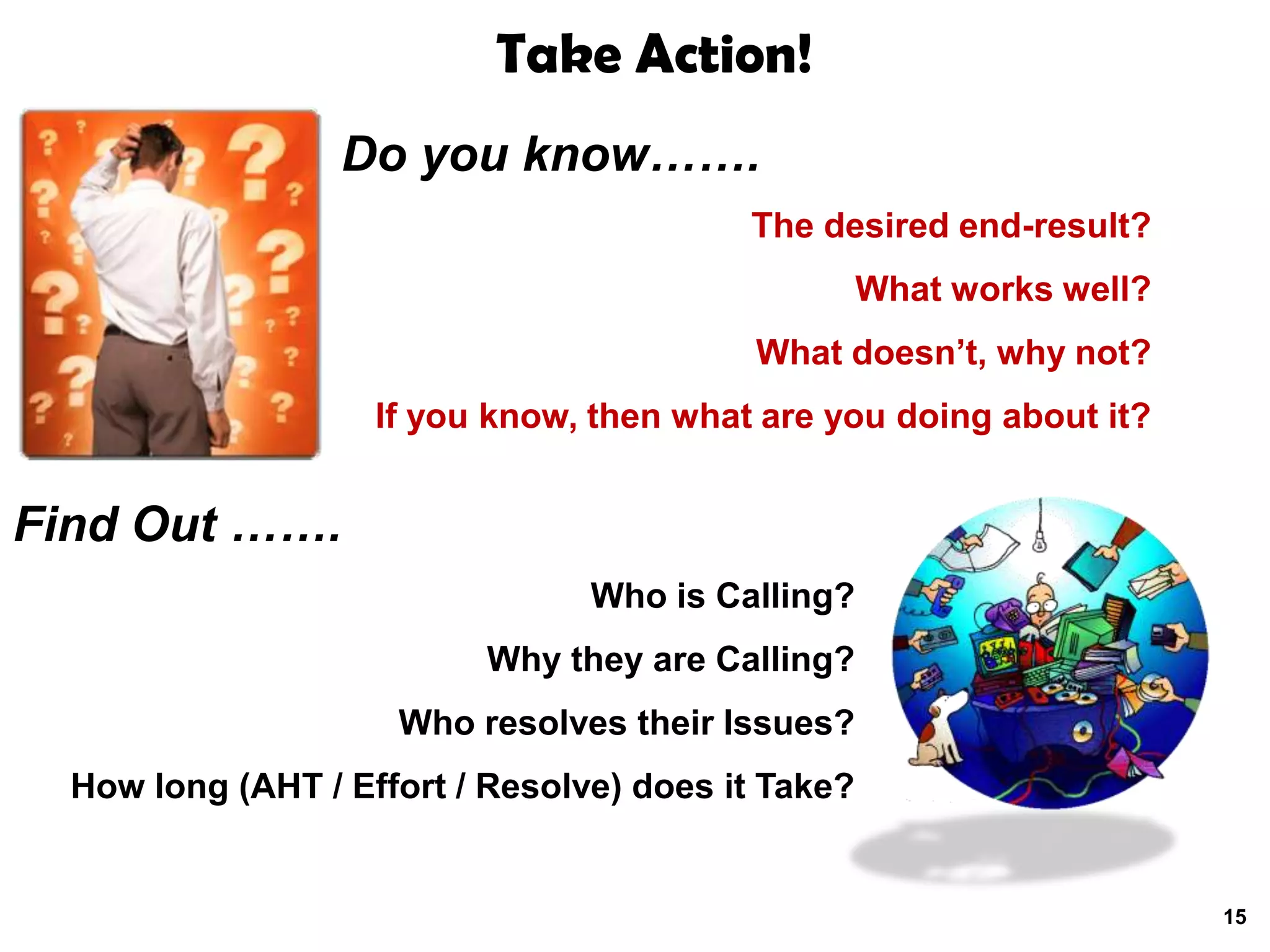
Take Action!
                  Do you know…….
                                          The desired end-result?
                                                    What works well?
                                           What doesn’t, why not?
                    If you know, then what are you doing about it?


Find Out …….
                                 Who is Calling?
                          Why they are Calling?
                     Who resolves their Issues?
  How long (AHT / Effort / Resolve) does it Take?


                                                                       15
Categorization / Taxonomy
 • Categories grow organically

      – It’s easy to add a new one - even with change management.

      – Categories are not organized and consistent.

      – Don’t remove old or irrelevant categories.

      – What ends-up in a categorization schema “decision-tree” may not reflect the true nature
        of the incident / problem.

 • Categories should drive reporting

      – It is challenging to query and design reports for root cause analysis when you are sure of
        what to ask but not confident in what you get back.

 • Categories try to be everything at once / end-up being nothing at all

      – Intentions are good, but relevance / simplicity to the support professionals who are
        tagging the incident is absent.

 • Categories levels when linked should tell the story

      – Not knowing root cause, how resolved and what the symptoms are as expressed by the
        customer leaves the problem manager literally blind when querying data for analysis /
        action.

16                                                                                                   16
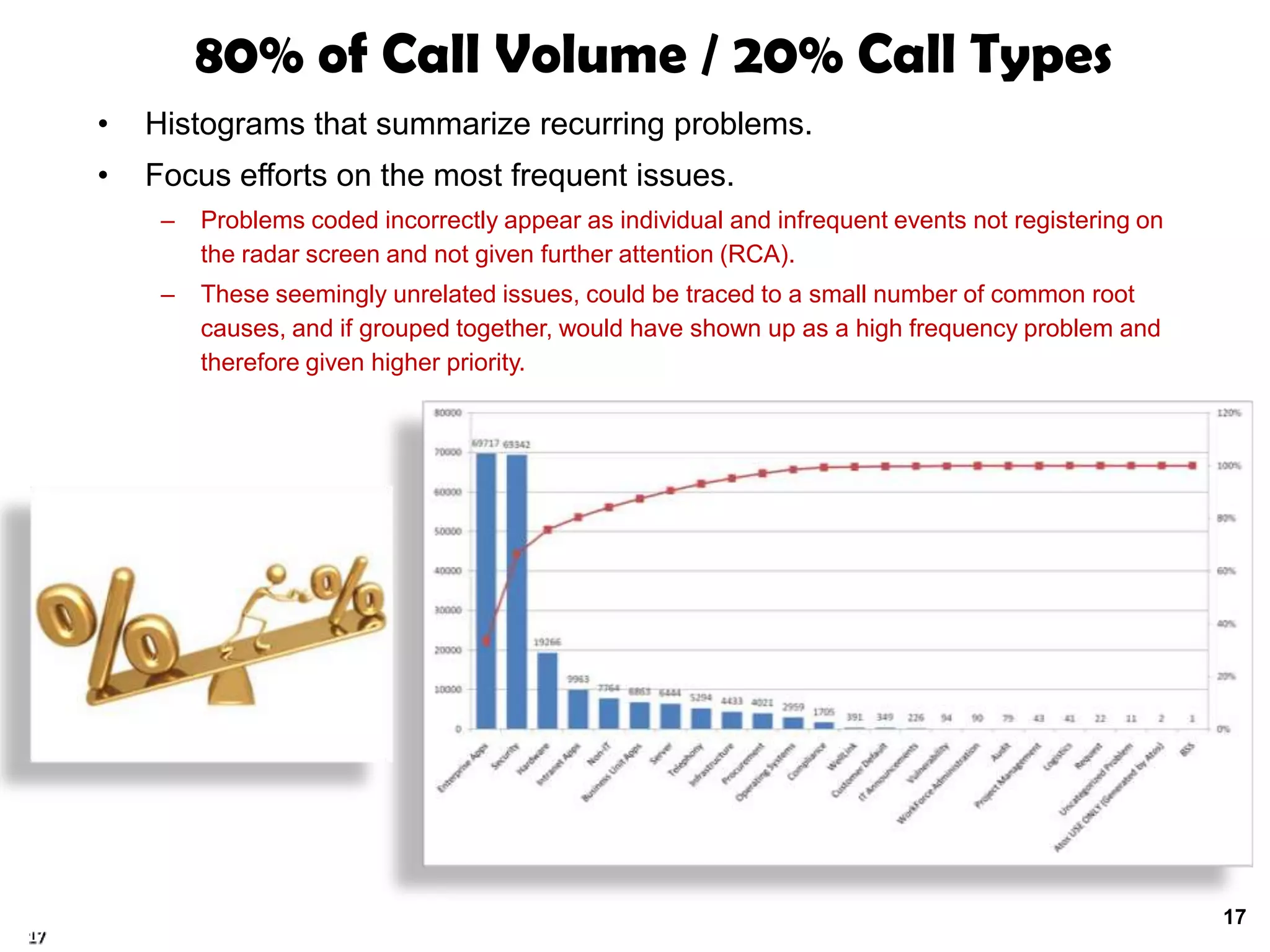
80% of Call Volume / 20% Call Types
     •   Histograms that summarize recurring problems.
     •   Focus efforts on the most frequent issues.
          –   Problems coded incorrectly appear as individual and infrequent events not registering on
              the radar screen and not given further attention (RCA).
          –   These seemingly unrelated issues, could be traced to a small number of common root
              causes, and if grouped together, would have shown up as a high frequency problem and
              therefore given higher priority.


                                                                                                         17
17
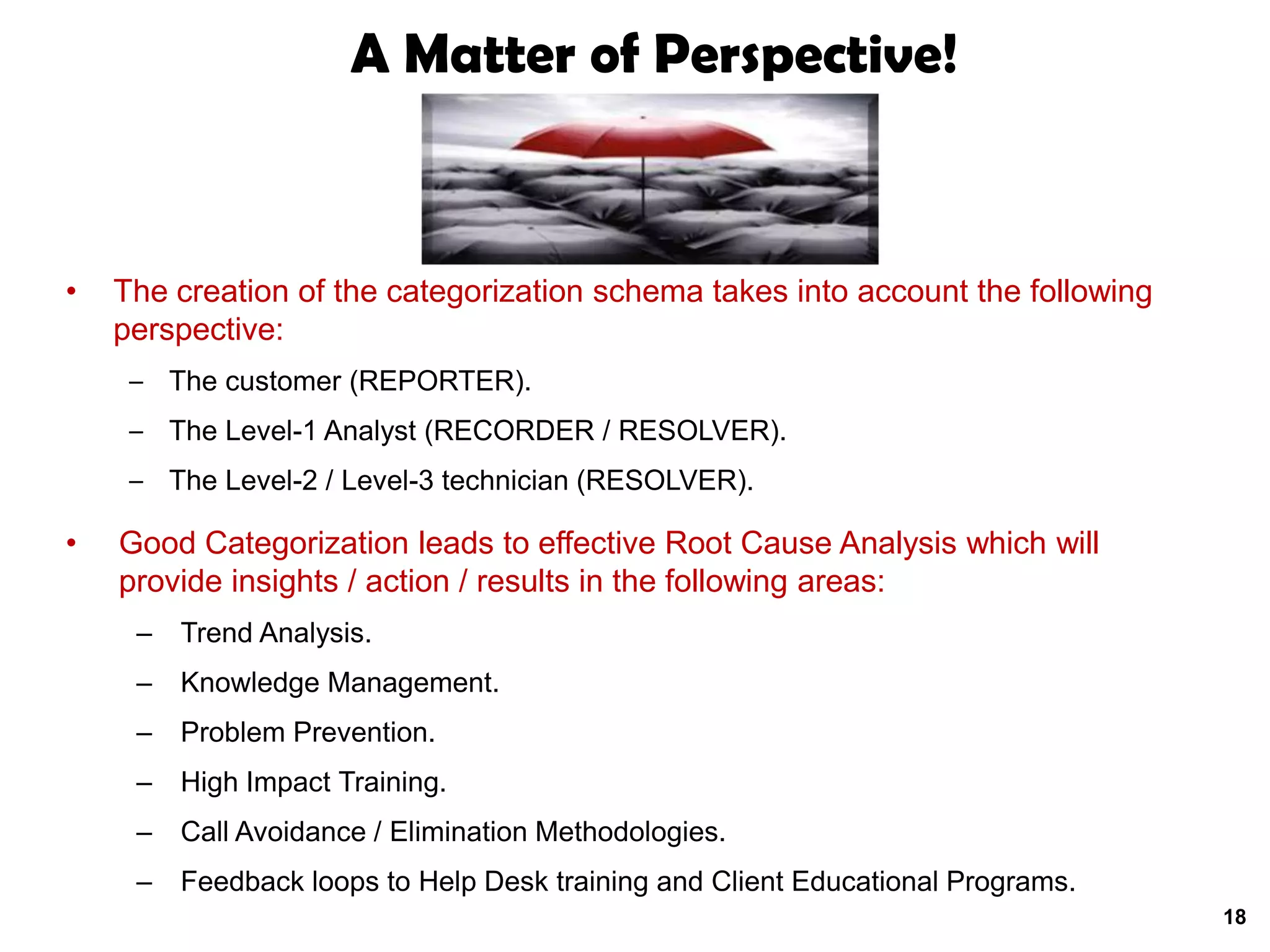
A Matter of Perspective!


•   The creation of the categorization schema takes into account the following
    perspective:
     – The customer (REPORTER).
     – The Level-1 Analyst (RECORDER / RESOLVER).
     – The Level-2 / Level-3 technician (RESOLVER).

•   Good Categorization leads to effective Root Cause Analysis which will
    provide insights / action / results in the following areas:
     –   Trend Analysis.
     –   Knowledge Management.
     –   Problem Prevention.
     –   High Impact Training.
     –   Call Avoidance / Elimination Methodologies.
     –   Feedback loops to Help Desk training and Client Educational Programs.
                                                                                 18
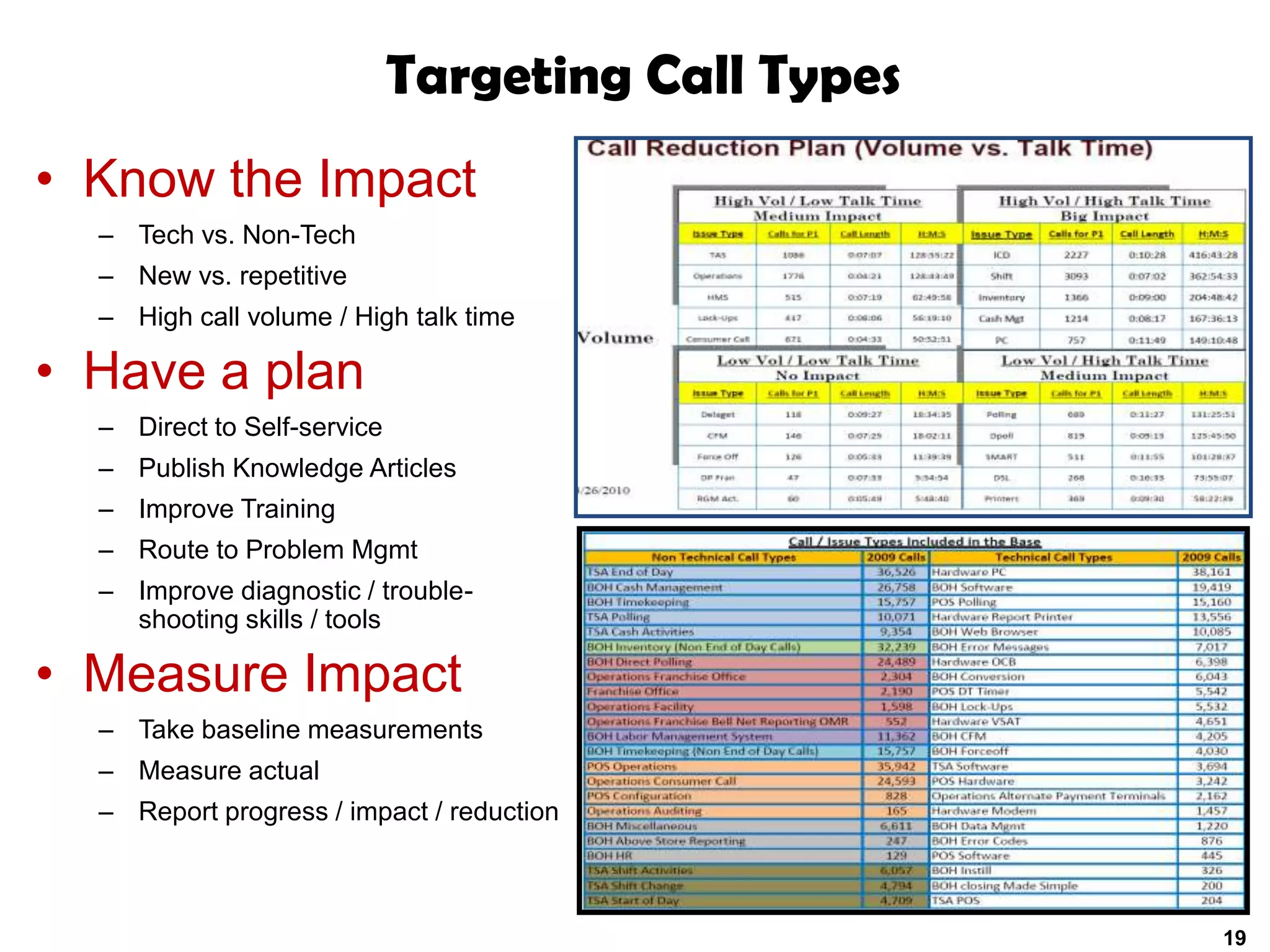
Targeting Call Types
• Know the Impact
  – Tech vs. Non-Tech
  – New vs. repetitive
  – High call volume / High talk time

• Have a plan
  – Direct to Self-service
  – Publish Knowledge Articles
  – Improve Training
  – Route to Problem Mgmt
  – Improve diagnostic / trouble-
    shooting skills / tools

• Measure Impact
  – Take baseline measurements
  – Measure actual
  – Report progress / impact / reduction


                                                    19
Call Avoidance (Deflection / Elimination)

• Review historical data for persistent and
  common problems (categorization /
  RCA).
• Observe patterns of temperamental
  infrastructure equipment (Configuration).
• Ask 1st, 2nd, 3rd level analysts and
  business where they
  see patterns (focus / debriefs).
• Communicate to employees well-known
  issues and fixes (self-service).
• Develop strong processes (change and
  release management).


                                                   20
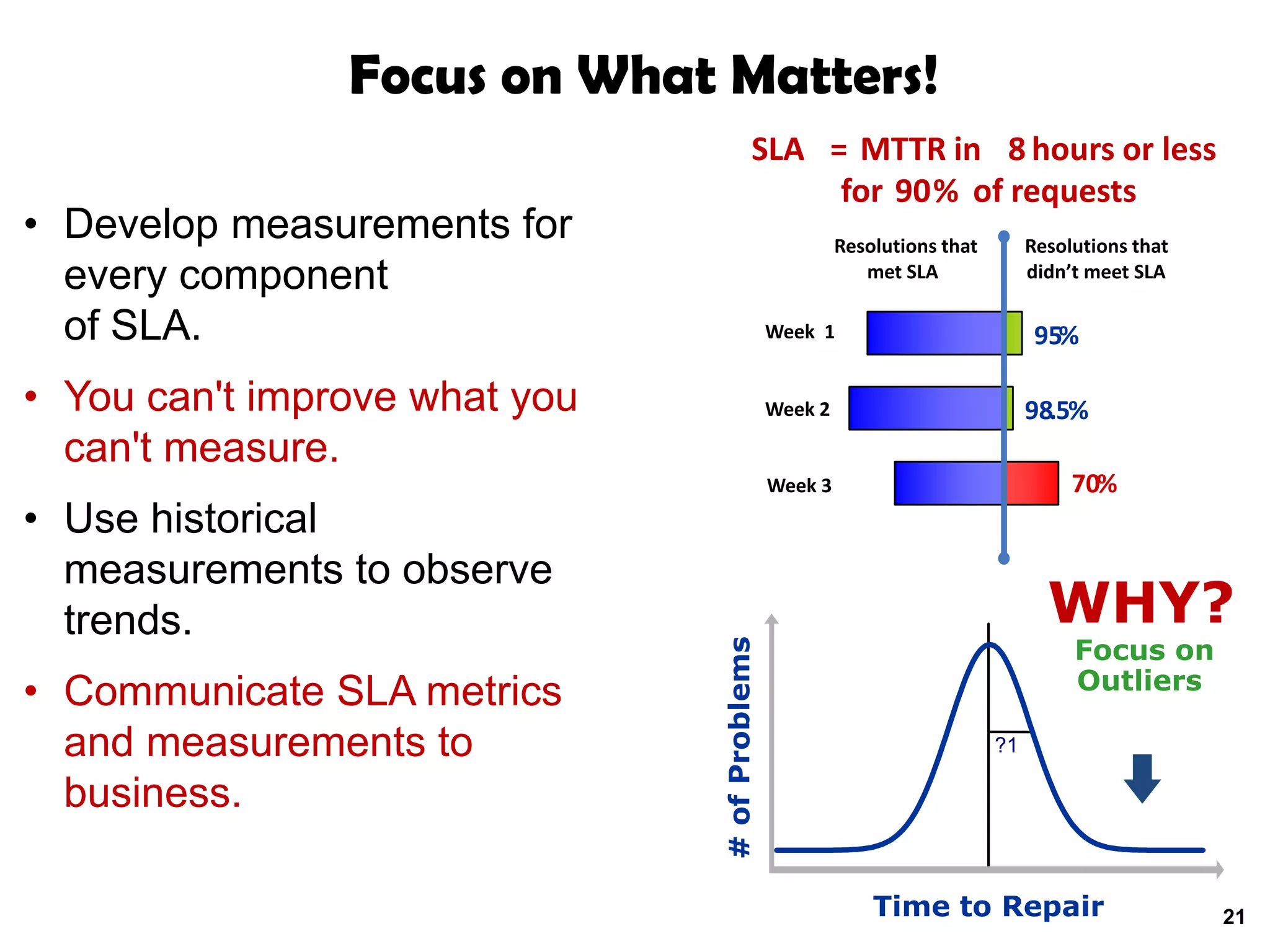
Focus on What Matters!
                                          SLA = MTTR in 8 hours or less
                                               for 90% of requests
• Develop measurements for                              Resolutions that        Resolutions that
  every component                                          met SLA              didn’t meet SLA

  of SLA.                                      Week 1                            95%

• You can't improve what you                   Week 2                           98.5%
  can't measure.
                                               Week 3                                70%
• Use historical
  measurements to observe
  trends.                                                                         WHY?
                                                                                     Focus on


                               # of Problems
                                                                                     Outliers
• Communicate SLA metrics
  and measurements to                                                      ?1

  business.

                                                            Time to Repair                         21
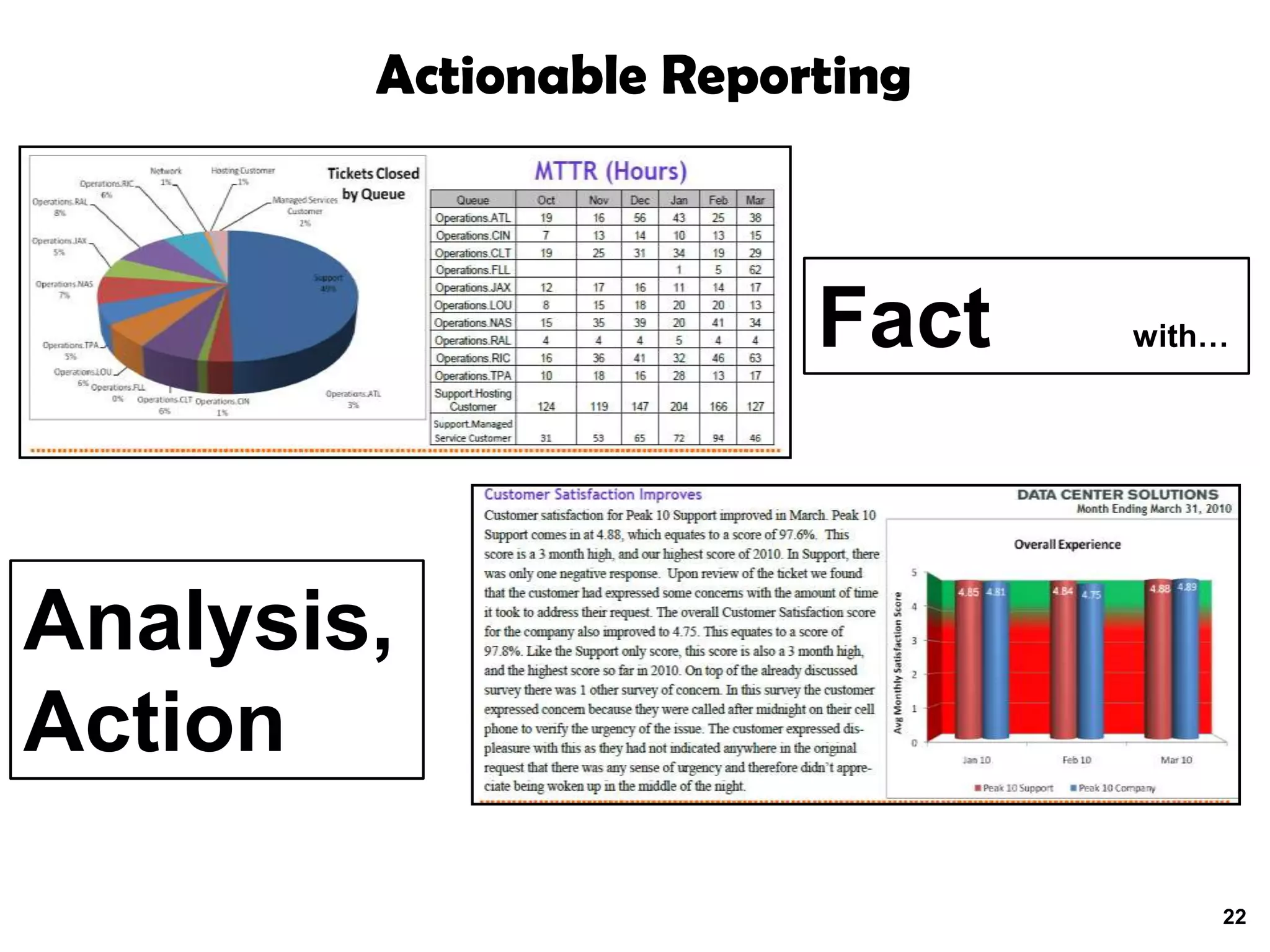
Actionable Reporting


                        Fact   with…


Analysis,
Action

                                   22
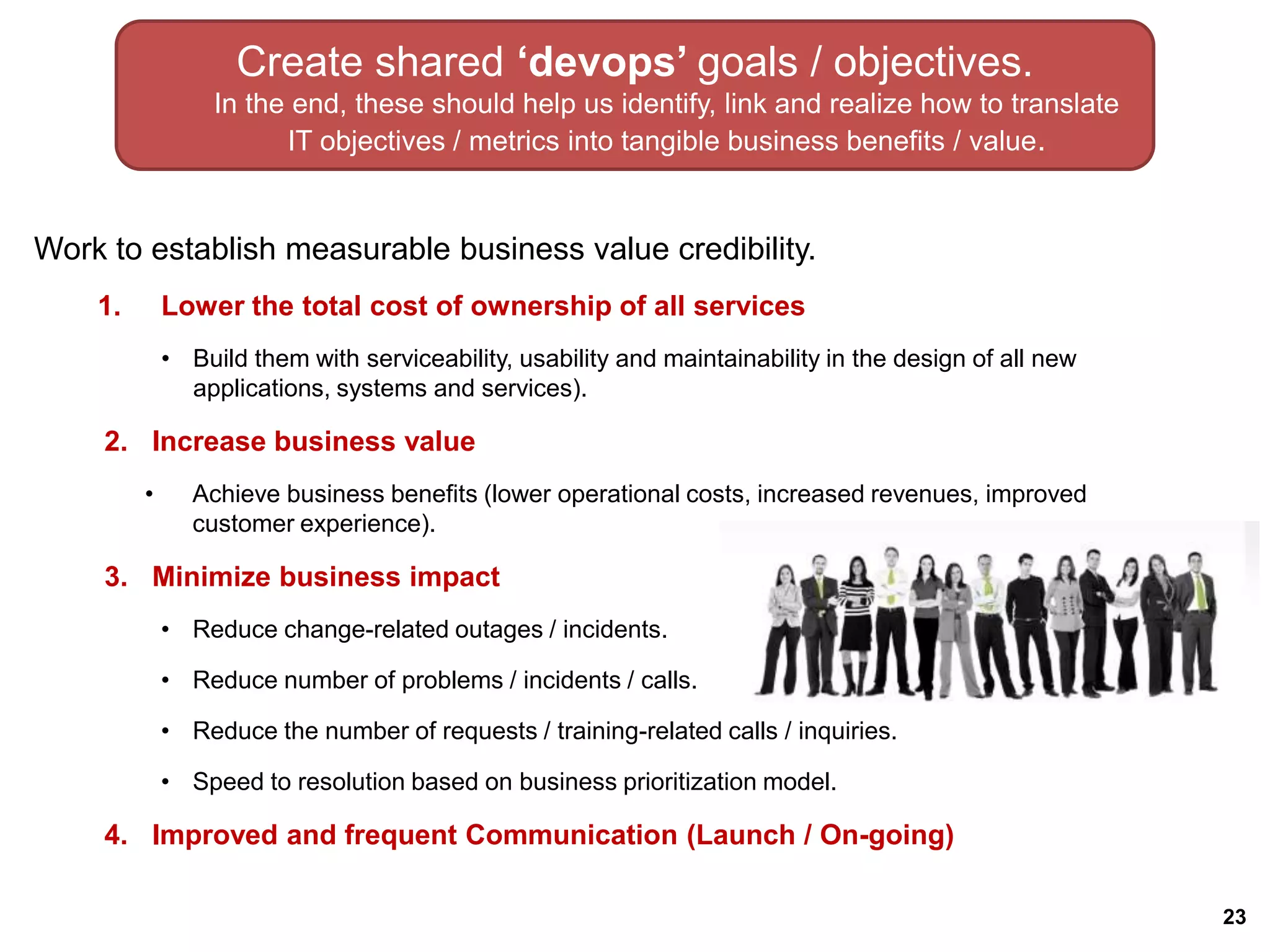
Create shared ‘devops’ goals / objectives.
                  In the end, these should help us identify, link and realize how to translate
                        IT objectives / metrics into tangible business benefits / value.


Work to establish measurable business value credibility.
    1.       Lower the total cost of ownership of all services
             • Build them with serviceability, usability and maintainability in the design of all new
               applications, systems and services).

     2. Increase business value
         •      Achieve business benefits (lower operational costs, increased revenues, improved
                customer experience).

     3. Minimize business impact
             • Reduce change-related outages / incidents.

             • Reduce number of problems / incidents / calls.

             • Reduce the number of requests / training-related calls / inquiries.

             • Speed to resolution based on business prioritization model.

     4. Improved and frequent Communication (Launch / On-going)

                                                                                                        23
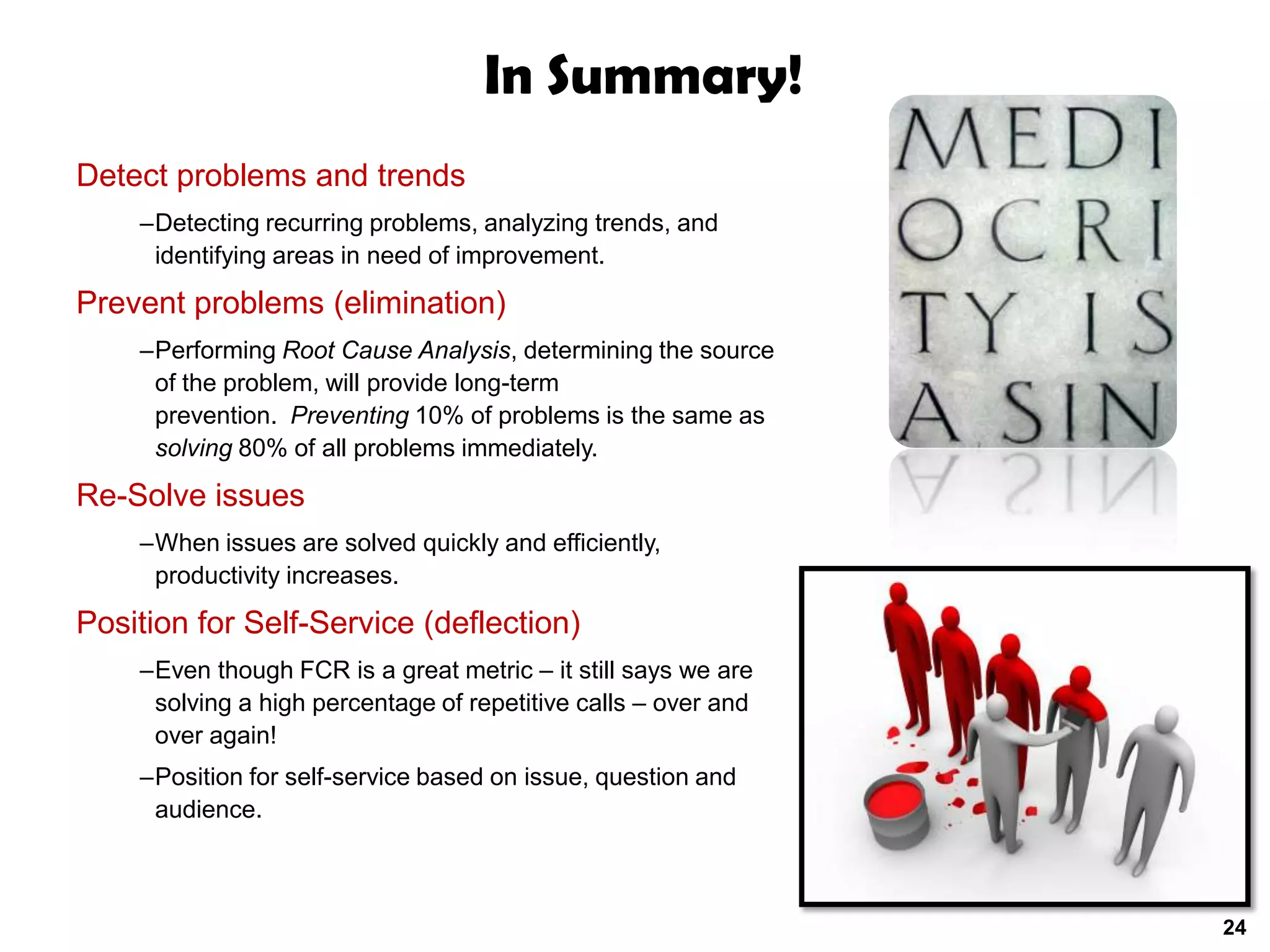
In Summary!
Detect problems and trends
    –Detecting recurring problems, analyzing trends, and
     identifying areas in need of improvement.

Prevent problems (elimination)
    –Performing Root Cause Analysis, determining the source
     of the problem, will provide long-term
     prevention. Preventing 10% of problems is the same as
     solving 80% of all problems immediately.

Re-Solve issues
    –When issues are solved quickly and efficiently,
     productivity increases.

Position for Self-Service (deflection)
    –Even though FCR is a great metric – it still says we are
     solving a high percentage of repetitive calls – over and
     over again!
    –Position for self-service based on issue, question and
     audience.


                                                                24
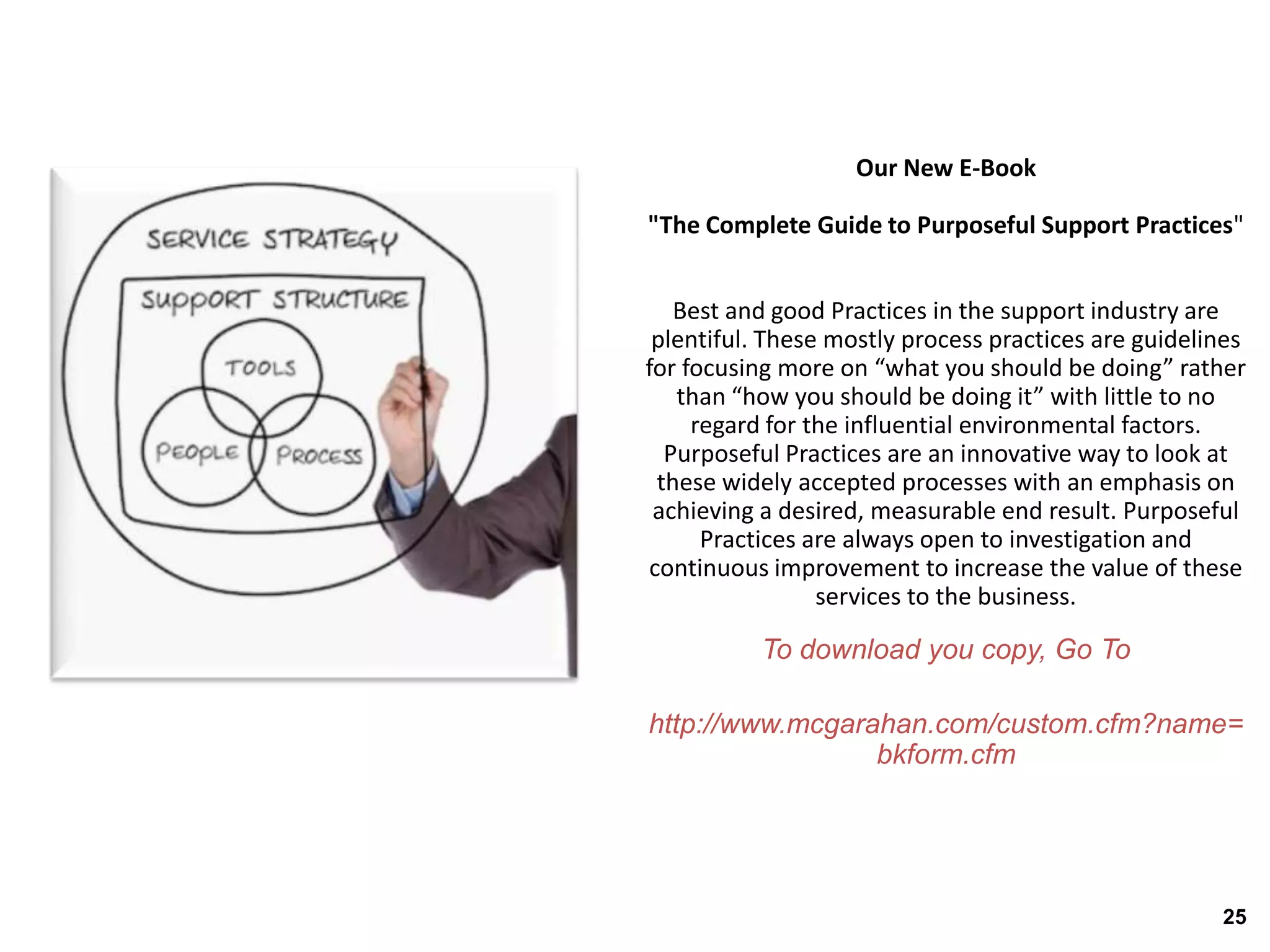
Our New E-Book

"The Complete Guide to Purposeful Support Practices"


   Best and good Practices in the support industry are
 plentiful. These mostly process practices are guidelines
for focusing more on “what you should be doing” rather
   than “how you should be doing it” with little to no
     regard for the influential environmental factors.
  Purposeful Practices are an innovative way to look at
 these widely accepted processes with an emphasis on
 achieving a desired, measurable end result. Purposeful
      Practices are always open to investigation and
continuous improvement to increase the value of these
                 services to the business.

           To download you copy, Go To

http://www.mcgarahan.com/custom.cfm?name=
                 bkform.cfm


                                                      25

Benefiting from a Quality Problem Management Program v2

  • 1.
    “Benefiting from a QualityProblem Management Program” Eliminating recurring problems from Peter McGarahan impacting the organization, President / Founder employee productivity and McGarahan & Associates increasing the total cost of support.
  • 2.
    About The Speaker • 12 years with PepsiCo/Taco Bell IT and Business Planning • Managed the Service Desk and all of the IT Infrastructure for 4500 restaurants, 8 zone offices, field managers and Corporate office • 2 years as a Product Manager for Vantive • Executive Director for HDI • 6 years with STI Knowledge/Help Desk 2000 • Founder, McGarahan & Associates (7 years) • McGarahan & Associates delivers service and support best practice consulting delivered through assessment / findings / recommendations / continuous improvement roadmap. • Retired Chairman, IT Infrastructure Management 2
  • 3.
  • 4.
    Problem Management –Break the Cycle! A quality Problem Management program can reap many benefits throughout the service and support organization as well as the business. Many organizations still struggle with creating/maintaining an effective a Problem Management program and process. Problem Management greatly depends on corporate culture and the integration of tools, process and people group to generate measurable and consistent results. It takes patience, discipline, collaboration and analytical expertise. Data Analysis and Trend Reporting are critical to the quality of the Problem Management program, but it is the resulting action, measurable benefits and communication to all stakeholders that defined the value of the PM program. App. Network ITAP DBAs Desktop Service Dev. Techs. Support Desk 4
  • 5.
    Right Work, RightPeople & Right Reasons. Know Call Types. Speed to Resolution. Reduce Customer Contacts. Make Knowledge Work. Provide Resolutions Close to Customer. 5
  • 6.
    Service Strategy &Design - A Fresh Start Design customer-centric services that improve service delivery (service level management), enhancing the customer experience through organizational flexibility, tool integration, process efficiency & people effectiveness. Create a service strategy Develop business aligned goals & objectives Deliver service excellence 6
  • 7.
    Self-service Level-1 Level-2 Level-3 $100 + Technologist/D evelopers $50-$75 Cost Escalated call $18-$23 First contact resolution $5-$10 Automated self-service Categorize Call Types in Level they are Call Resolved in Elimination Mean time to resolution Bring visibility to repetitive, costly issues, questions and requests 7
  • 8.
    The “Shift Left”Structure Characteristics: Business-focused, Virtual, On-demand, Cost-effective, Responsive, Predictable, Consistent and Adaptive Level-2 OLA Specialist Web/DB/ SLA Level-2 UC Specialist IS OPS Services New Customers Level-2 Customer Support Center Specialist Network & Technical Services Level-3 Vendor Support Level-2 Applications Specialist HELP@YOURCOMPANY.COM QA/Security Level-3 Exiting Customers Vendor Support www.HELPME.COM Programs Level-2 1-800.HELPME Specialist Business Portal Services Level-3 Vendor Support Infrastructure Level-2 Employees Specialist CRM / Architecture Level-2 Specialist Business System Services Partners Level-2 Specialist Bus. Analysis & Process Services Call Elimination / Increase First Contact Reduce Reduce / Eliminate Self-service Res (FCR) Escalations Dispatch 8
  • 9.
    Know Your Cost • Require Analysts to search the KB before escalating to L2. • Target call types for FCR that are currently being escalated. • Target FCR for Self-service Portal. • Analyze incidents with no Knowledge for PM / RCA. • Work with L2 managers to provide training, access, and knowledge. Source: HDI Practice & Salary Guide / Gartner Research 9
  • 10.
    Either the time will be consumed with the “groundhog day” approach to fighting fires, Or spent in a structured and organized manner identifying the true and underlying cause(s) of problems that generate calls and impact business and eliminate the cause thus preventing future reoccurrences. 10
  • 11.
    What To Do,Simply! Step1: Finding the root cause of issues, documenting and communicating the “work-arounds” to Level-1 & Level-2. Step 2: Indentifying / Justifying a permanent solution or “fix” targeted at the problem’s root cause, approved by Change and Released into the production environment eliminating the incidents / calls caused by the problem. How the Service Desk Adds Value: – Focus on accurate and complete incident record logging. – Categorize / Prioritize accurately for easy reporting. – Flag the escalated incidents with no workaround / knowledge. – Analyze the high priority (business impact) incidents, the most frequently escalated and the longest Mean Time to Resolve (MTTR) as PM targets. 11
  • 12.
    Root Cause Analysis Start Domain mgr. IT M gmt. rates candidate Assign RCFA bus reactive Incident impact and RCFAs at records cost to fix as daily ops. "large, med. Domain NWF (Not Worth Fixing) meeting and small" Mgr. Problem Elimination Board (PEB) 1. Review metrics Create parent record End 2. Select candidate RCFA admin. incident history Consolidate RCFAs and assign RCFAs to prob. owner prepare 3. Investigate errant Create metrics RCFAs or domains template 4. Ensure resource RCFAs for bandwidth is utilized Approved (and funded) candidates with high incident rates Change Mgmt. INC LOG Techs Owner Assembles team Establish Post work- Prob Define Submit Execute Verify (weekly RCFA bus Root cause around (if fix change change change update req'd) impact determination applicable) successful Submit intuitive RCFAs IT Incident Mgmt. N Agent may submit intuitive RCFA Match Enact work- Close New Y Link incident to open around incident incident RCFA to RCFA (if posted) or route 12
  • 13.
    Purposeful Problem Management Who in the IT organization is responsible for critical problem Reduce Downtime processes and resolution? • Escalation • Customer communication 60% • Documentation 50% of workaround 40% 30% Call Avoidance 20% • Root cause analysis 10% • Trend analysis 0% • Problem review board Other IT Service Process not formalized IT Operations Responsibility Team 2008 Desk 2009 13
  • 14.
    Develop A Response! 1.Develop guidelines for 5. Develop a plan for calling escalating a problem. emergency meetings. 2. Ensure someone is in 6. Designate a "war room" charge. or audio bridge. 3. Create a problem 7. Coordinate who will management team with contact the customer stakeholders from the with status, and how service desk, often. operations, app. dev. 8. Develop a severity and business. coding system. 4. Schedule regular 9. Keep an updated "on- meetings with team to call" list. review outstanding problems. 10. Hold a postmortem. 14
  • 15.
    Take Action! Do you know……. The desired end-result? What works well? What doesn’t, why not? If you know, then what are you doing about it? Find Out ……. Who is Calling? Why they are Calling? Who resolves their Issues? How long (AHT / Effort / Resolve) does it Take? 15
  • 16.
    Categorization / Taxonomy • Categories grow organically – It’s easy to add a new one - even with change management. – Categories are not organized and consistent. – Don’t remove old or irrelevant categories. – What ends-up in a categorization schema “decision-tree” may not reflect the true nature of the incident / problem. • Categories should drive reporting – It is challenging to query and design reports for root cause analysis when you are sure of what to ask but not confident in what you get back. • Categories try to be everything at once / end-up being nothing at all – Intentions are good, but relevance / simplicity to the support professionals who are tagging the incident is absent. • Categories levels when linked should tell the story – Not knowing root cause, how resolved and what the symptoms are as expressed by the customer leaves the problem manager literally blind when querying data for analysis / action. 16 16
  • 17.
    80% of CallVolume / 20% Call Types • Histograms that summarize recurring problems. • Focus efforts on the most frequent issues. – Problems coded incorrectly appear as individual and infrequent events not registering on the radar screen and not given further attention (RCA). – These seemingly unrelated issues, could be traced to a small number of common root causes, and if grouped together, would have shown up as a high frequency problem and therefore given higher priority. 17 17
  • 18.
    A Matter ofPerspective! • The creation of the categorization schema takes into account the following perspective: – The customer (REPORTER). – The Level-1 Analyst (RECORDER / RESOLVER). – The Level-2 / Level-3 technician (RESOLVER). • Good Categorization leads to effective Root Cause Analysis which will provide insights / action / results in the following areas: – Trend Analysis. – Knowledge Management. – Problem Prevention. – High Impact Training. – Call Avoidance / Elimination Methodologies. – Feedback loops to Help Desk training and Client Educational Programs. 18
  • 19.
    Targeting Call Types •Know the Impact – Tech vs. Non-Tech – New vs. repetitive – High call volume / High talk time • Have a plan – Direct to Self-service – Publish Knowledge Articles – Improve Training – Route to Problem Mgmt – Improve diagnostic / trouble- shooting skills / tools • Measure Impact – Take baseline measurements – Measure actual – Report progress / impact / reduction 19
  • 20.
    Call Avoidance (Deflection/ Elimination) • Review historical data for persistent and common problems (categorization / RCA). • Observe patterns of temperamental infrastructure equipment (Configuration). • Ask 1st, 2nd, 3rd level analysts and business where they see patterns (focus / debriefs). • Communicate to employees well-known issues and fixes (self-service). • Develop strong processes (change and release management). 20
  • 21.
    Focus on WhatMatters! SLA = MTTR in 8 hours or less for 90% of requests • Develop measurements for Resolutions that Resolutions that every component met SLA didn’t meet SLA of SLA. Week 1 95% • You can't improve what you Week 2 98.5% can't measure. Week 3 70% • Use historical measurements to observe trends. WHY? Focus on # of Problems Outliers • Communicate SLA metrics and measurements to ?1 business. Time to Repair 21
  • 22.
    Actionable Reporting Fact with… Analysis, Action 22
  • 23.
    Create shared ‘devops’goals / objectives. In the end, these should help us identify, link and realize how to translate IT objectives / metrics into tangible business benefits / value. Work to establish measurable business value credibility. 1. Lower the total cost of ownership of all services • Build them with serviceability, usability and maintainability in the design of all new applications, systems and services). 2. Increase business value • Achieve business benefits (lower operational costs, increased revenues, improved customer experience). 3. Minimize business impact • Reduce change-related outages / incidents. • Reduce number of problems / incidents / calls. • Reduce the number of requests / training-related calls / inquiries. • Speed to resolution based on business prioritization model. 4. Improved and frequent Communication (Launch / On-going) 23
  • 24.
    In Summary! Detect problemsand trends –Detecting recurring problems, analyzing trends, and identifying areas in need of improvement. Prevent problems (elimination) –Performing Root Cause Analysis, determining the source of the problem, will provide long-term prevention. Preventing 10% of problems is the same as solving 80% of all problems immediately. Re-Solve issues –When issues are solved quickly and efficiently, productivity increases. Position for Self-Service (deflection) –Even though FCR is a great metric – it still says we are solving a high percentage of repetitive calls – over and over again! –Position for self-service based on issue, question and audience. 24
  • 25.
    Our New E-Book "TheComplete Guide to Purposeful Support Practices" Best and good Practices in the support industry are plentiful. These mostly process practices are guidelines for focusing more on “what you should be doing” rather than “how you should be doing it” with little to no regard for the influential environmental factors. Purposeful Practices are an innovative way to look at these widely accepted processes with an emphasis on achieving a desired, measurable end result. Purposeful Practices are always open to investigation and continuous improvement to increase the value of these services to the business. To download you copy, Go To http://www.mcgarahan.com/custom.cfm?name= bkform.cfm 25