Native EnglishNatural Grammar
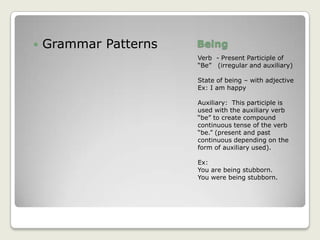
BeingVerb  - Present Participle of  “Be”   (irregular and auxiliary)State of being – with adjectiveEx: I am happyAuxiliary:  This participle is used with the auxiliary verb “be” to create compound continuous tense of the verb “be.” (present and past continuous depending on the form of auxiliary used).Ex:You are being stubborn.You were being stubborn.Grammar Patterns
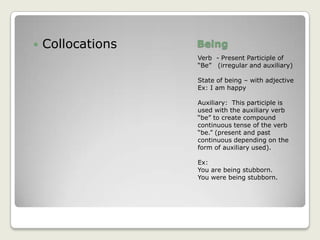
BeingVerb  - Present Participle of  “Be”   (irregular and auxiliary)State of being – with adjectiveEx: I am happyAuxiliary:  This participle is used with the auxiliary verb “be” to create compound continuous tense of the verb “be.” (present and past continuous depending on the form of auxiliary used).Ex:You are being stubborn.You were being stubborn.Collocations
BeingVerb  - Present Participle of  “Be”   (irregular and auxiliary)State of being – with adjectiveEx: I am happyAuxiliary:  This participle is used with the auxiliary verb “be” to create compound continuous tense of the verb “be.” (present and past continuous depending on the form of auxiliary used).Ex:You are being stubborn.You were being stubborn.Set Phrases
BeingVerb  - Present Participle of  “Be”   (irregular and auxiliary)State of being – with adjectiveEx: I am happyAuxiliary:  This participle is used with the auxiliary verb “be” to create compound continuous tense of the verb “be.” (present and past continuous depending on the form of auxiliary used).Ex:You are being stubborn.You were being stubborn.Examples
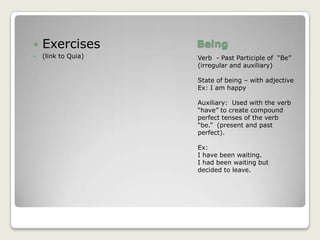
BeingVerb  - Past Participle of  “Be”   (irregular and auxiliary)State of being – with adjectiveEx: I am happyAuxiliary:  Used with the verb “have” to create compound perfect tenses of the verb “be.”  (present and past perfect).Ex:I have been waiting.I had been waiting but decided to leave.Exercises(link to Quia)

Being

  • 1.
  • 2.
    BeingVerb -Present Participle of “Be” (irregular and auxiliary)State of being – with adjectiveEx: I am happyAuxiliary: This participle is used with the auxiliary verb “be” to create compound continuous tense of the verb “be.” (present and past continuous depending on the form of auxiliary used).Ex:You are being stubborn.You were being stubborn.Grammar Patterns
  • 3.
    BeingVerb -Present Participle of “Be” (irregular and auxiliary)State of being – with adjectiveEx: I am happyAuxiliary: This participle is used with the auxiliary verb “be” to create compound continuous tense of the verb “be.” (present and past continuous depending on the form of auxiliary used).Ex:You are being stubborn.You were being stubborn.Collocations
  • 4.
    BeingVerb -Present Participle of “Be” (irregular and auxiliary)State of being – with adjectiveEx: I am happyAuxiliary: This participle is used with the auxiliary verb “be” to create compound continuous tense of the verb “be.” (present and past continuous depending on the form of auxiliary used).Ex:You are being stubborn.You were being stubborn.Set Phrases
  • 5.
    BeingVerb -Present Participle of “Be” (irregular and auxiliary)State of being – with adjectiveEx: I am happyAuxiliary: This participle is used with the auxiliary verb “be” to create compound continuous tense of the verb “be.” (present and past continuous depending on the form of auxiliary used).Ex:You are being stubborn.You were being stubborn.Examples
  • 6.
    BeingVerb -Past Participle of “Be” (irregular and auxiliary)State of being – with adjectiveEx: I am happyAuxiliary: Used with the verb “have” to create compound perfect tenses of the verb “be.” (present and past perfect).Ex:I have been waiting.I had been waiting but decided to leave.Exercises(link to Quia)